

IEC 61340-5-1:2016
(Main)Electrostatics - Part 5-1: Protection of electronic devices from electrostatic phenomena - General requirements
General Information
- Abstract
IEC 61340-5-1:2016 applies to activities that: manufacture, process, assemble, install, package, label, service, test, inspect, transport or otherwise handle electrical or electronic parts, assemblies and equipment with withstand voltages greater than or equal to 100 V HBM, 200 V CDM and 35 V for isolated conductors. ESDS with lower withstand voltages may require additional control elements or adjusted limits. Processes designed to handle items that have lower ESD withstand voltage(s) can still claim compliance to this standard. This standard provides the requirements for an ESD control program. IEC TR 61340-5-2 [9] provides guidance on the implementation of this standard. This standard does not apply to electrically initiated explosive devices, flammable liquids, gases and powders. The purpose of this standard is to provide the administrative and technical requirements for establishing, implementing and maintaining an ESD control program (hereinafter referred to as the "program"). This edition includes the following significant technical changes with respect to the previous edition:
a) Technical requirements were changed to align IEC 61340-5-1 with other industry ESD standards;
b) Reference documents were updated to reflect newly released IEC standards;
c) A section on product qualification was added;
d) Table 4 was deleted and detailed packaging requirements were deferred to IEC 61340-5-3;
e) Clause A.1 was removed and is now included in IEC 61340-4-6.
The contents of the corrigendum of May 2017 have been included in this copy.
- Status
- Published
- Publication Date
- 26-May-2016
- Technical Committee
- TC 101 - Electrostatics
- Drafting Committee
- WG 5 - TC 101/WG 5
- Current Stage
- DELPUB - Deleted Publication
- Start Date
- 21-May-2024
- Completion Date
- 31-Mar-2022
Buy Documents
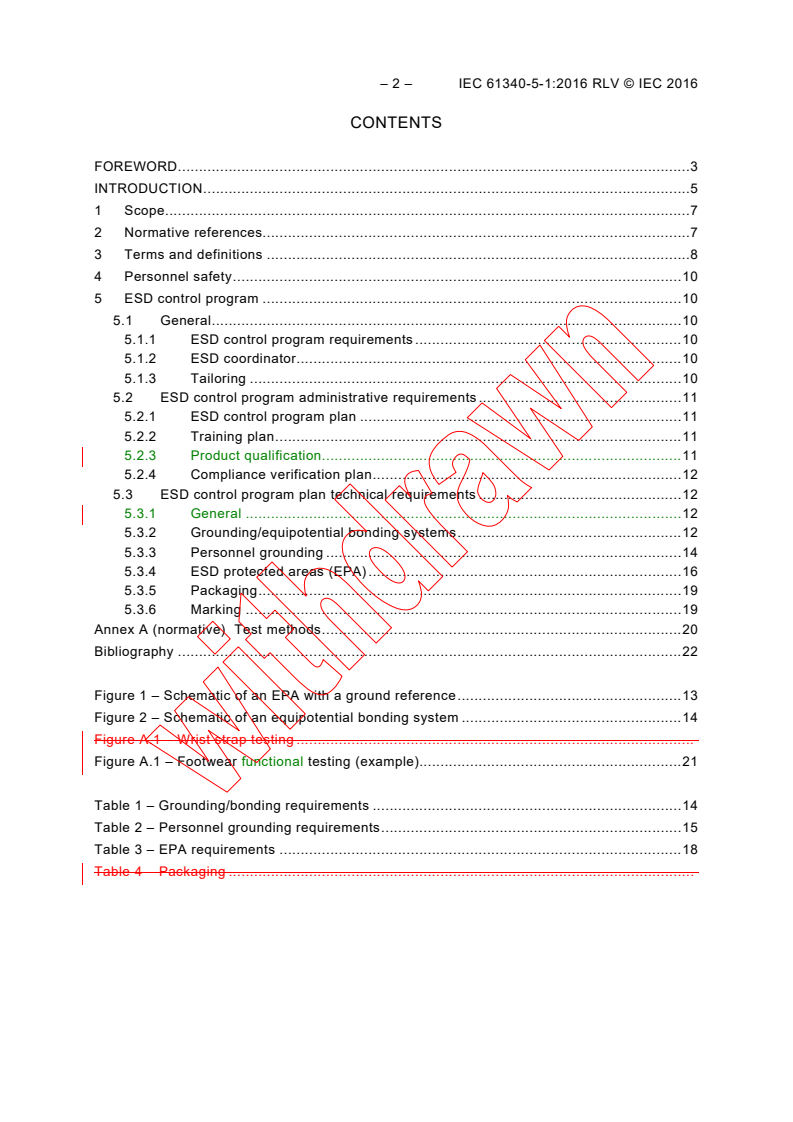
IEC 61340-5-1:2016 RLV - Electrostatics - Part 5-1: Protection of electronic devices from electrostatic phenomena - General requirements Released:5/27/2016
IEC 61340-5-1:2016 - Electrostatics - Part 5-1: Protection of electronic devices from electrostatic phenomena - General requirements Released:5/27/2016
Overview
IEC 61340-5-1:2016 - “Electrostatics - Part 5-1: Protection of electronic devices from electrostatic phenomena - General requirements” defines the administrative and technical requirements for establishing, implementing and maintaining an ESD control program. The standard applies to activities that manufacture, process, assemble, install, package, label, service, test, inspect, transport or otherwise handle electrical/electronic parts, assemblies and equipment with typical withstand thresholds of ≥ 100 V (HBM), ≥ 200 V (CDM) and ≥ 35 V for isolated conductors. It excludes electrically-initiated explosives and flammable liquids/gases/powders. IEC TR 61340-5-2 gives implementation guidance; Annex A contains normative test methods. This edition incorporates technical alignment with other industry ESD standards, adds product qualification, and defers detailed packaging requirements to IEC 61340-5-3.
Key topics and technical requirements
- ESD control program: required plan documenting scope, responsibilities, tailoring and technical controls. An ESD coordinator role is recommended.
- Administrative elements: ESD control program plan, ongoing training plan, product qualification requirements, and a compliance verification plan (audits and testing).
- Grounding and equipotential bonding: requirements for grounding systems to prevent potential differences between personnel, equipment and conductors.
- Personnel grounding: wrist straps, footwear and other measures to control charge on personnel inside ESD Protected Areas (EPAs).
- ESD Protected Areas (EPA): zoning, material selection and controls to maintain equipotential balance inside work areas.
- Packaging and marking: general packaging/marking requirements are covered; detailed packaging specifications are in IEC 61340-5-3.
- Test methods: Annex A lists test procedures for verifying grounding, wrist straps, footwear and other controls.
- Tailoring and risk: devices with lower ESD withstand voltages may need additional controls or adjusted limits; processes handling such devices can still comply if controls are documented.
Practical applications - who uses it and why
- Target users: electronics manufacturers, PCB assemblers, test labs, packaging/transport teams, service and repair centers, design and quality engineers, and supply chain managers.
- Use cases:
- Establishing company-wide ESD control programs and training curricula.
- Designing EPAs, grounding/equipotential systems and personnel grounding methods.
- Defining product qualification and compliance-verification procedures for HBM/CDM sensitivity.
- Specifying packaging and handling requirements for shipment outside EPAs.
- Integrating ESD controls into quality management and supplier requirements.
Related standards and guidance
- IEC TR 61340-5-2 (implementation guidance)
- IEC 61340-5-3 (detailed packaging requirements)
- Referenced IEC standards and corrigenda (this edition includes the May 2017 corrigendum)
Keywords: IEC 61340-5-1, ESD control, electrostatic discharge, EPA, HBM, CDM, product qualification, grounding, equipotential bonding, personnel grounding, compliance verification.
Relations
- Effective Date
- 05-Sep-2023
- Effective Date
- 05-Sep-2023
- Effective Date
- 05-Sep-2023
Buy Documents
IEC 61340-5-1:2016 RLV - Electrostatics - Part 5-1: Protection of electronic devices from electrostatic phenomena - General requirements Released:5/27/2016
IEC 61340-5-1:2016 - Electrostatics - Part 5-1: Protection of electronic devices from electrostatic phenomena - General requirements Released:5/27/2016
Get Certified
Connect with accredited certification bodies for this standard

IMQ S.p.A. (Certification)
Italian electrical product certification.

SLG Prüf- und Zertifizierungs GmbH
German testing and certification body.

UL Solutions
Global safety science company with testing, inspection and certification.
Sponsored listings
Frequently Asked Questions
IEC 61340-5-1:2016 is a standard published by the International Electrotechnical Commission (IEC). Its full title is "Electrostatics - Part 5-1: Protection of electronic devices from electrostatic phenomena - General requirements". This standard covers: IEC 61340-5-1:2016 applies to activities that: manufacture, process, assemble, install, package, label, service, test, inspect, transport or otherwise handle electrical or electronic parts, assemblies and equipment with withstand voltages greater than or equal to 100 V HBM, 200 V CDM and 35 V for isolated conductors. ESDS with lower withstand voltages may require additional control elements or adjusted limits. Processes designed to handle items that have lower ESD withstand voltage(s) can still claim compliance to this standard. This standard provides the requirements for an ESD control program. IEC TR 61340-5-2 [9] provides guidance on the implementation of this standard. This standard does not apply to electrically initiated explosive devices, flammable liquids, gases and powders. The purpose of this standard is to provide the administrative and technical requirements for establishing, implementing and maintaining an ESD control program (hereinafter referred to as the "program"). This edition includes the following significant technical changes with respect to the previous edition: a) Technical requirements were changed to align IEC 61340-5-1 with other industry ESD standards; b) Reference documents were updated to reflect newly released IEC standards; c) A section on product qualification was added; d) Table 4 was deleted and detailed packaging requirements were deferred to IEC 61340-5-3; e) Clause A.1 was removed and is now included in IEC 61340-4-6. The contents of the corrigendum of May 2017 have been included in this copy.
IEC 61340-5-1:2016 applies to activities that: manufacture, process, assemble, install, package, label, service, test, inspect, transport or otherwise handle electrical or electronic parts, assemblies and equipment with withstand voltages greater than or equal to 100 V HBM, 200 V CDM and 35 V for isolated conductors. ESDS with lower withstand voltages may require additional control elements or adjusted limits. Processes designed to handle items that have lower ESD withstand voltage(s) can still claim compliance to this standard. This standard provides the requirements for an ESD control program. IEC TR 61340-5-2 [9] provides guidance on the implementation of this standard. This standard does not apply to electrically initiated explosive devices, flammable liquids, gases and powders. The purpose of this standard is to provide the administrative and technical requirements for establishing, implementing and maintaining an ESD control program (hereinafter referred to as the "program"). This edition includes the following significant technical changes with respect to the previous edition: a) Technical requirements were changed to align IEC 61340-5-1 with other industry ESD standards; b) Reference documents were updated to reflect newly released IEC standards; c) A section on product qualification was added; d) Table 4 was deleted and detailed packaging requirements were deferred to IEC 61340-5-3; e) Clause A.1 was removed and is now included in IEC 61340-4-6. The contents of the corrigendum of May 2017 have been included in this copy.
IEC 61340-5-1:2016 is classified under the following ICS (International Classification for Standards) categories: 17.220.99 - Other standards related to electricity and magnetism; 19.040 - Environmental testing; 29.020 - Electrical engineering in general. The ICS classification helps identify the subject area and facilitates finding related standards.
IEC 61340-5-1:2016 has the following relationships with other standards: It is inter standard links to IEC 61340-5-1:2016/COR1:2017, IEC 61340-5-1:2007, IEC 61340-5-1:2024. Understanding these relationships helps ensure you are using the most current and applicable version of the standard.
IEC 61340-5-1:2016 is available in PDF format for immediate download after purchase. The document can be added to your cart and obtained through the secure checkout process. Digital delivery ensures instant access to the complete standard document.
Standards Content (Sample)
IEC 61340-5-1 ®
Edition 2.0 2016-05
REDLINE VERSION
INTERNATIONAL
STANDARD
colour
inside
Electrostatics –
Part 5-1: Protection of electronic devices from electrostatic phenomena –
General requirements
All rights reserved. Unless otherwise specified, no part of this publication may be reproduced or utilized in any form
or by any means, electronic or mechanical, including photocopying and microfilm, without permission in writing from
either IEC or IEC's member National Committee in the country of the requester. If you have any questions about IEC
copyright or have an enquiry about obtaining additional rights to this publication, please contact the address below or
your local IEC member National Committee for further information.
IEC Central Office Tel.: +41 22 919 02 11
3, rue de Varembé Fax: +41 22 919 03 00
CH-1211 Geneva 20 info@iec.ch
Switzerland www.iec.ch
About the IEC
The International Electrotechnical Commission (IEC) is the leading global organization that prepares and publishes
International Standards for all electrical, electronic and related technologies.
About IEC publications
The technical content of IEC publications is kept under constant review by the IEC. Please make sure that you have the
latest edition, a corrigenda or an amendment might have been published.
IEC Catalogue - webstore.iec.ch/catalogue Electropedia - www.electropedia.org
The stand-alone application for consulting the entire The world's leading online dictionary of electronic and
bibliographical information on IEC International Standards, electrical terms containing 20 000 terms and definitions in
Technical Specifications, Technical Reports and other English and French, with equivalent terms in 15 additional
documents. Available for PC, Mac OS, Android Tablets and languages. Also known as the International Electrotechnical
iPad. Vocabulary (IEV) online.
IEC publications search - www.iec.ch/searchpub IEC Glossary - std.iec.ch/glossary
The advanced search enables to find IEC publications by a 65 000 electrotechnical terminology entries in English and
variety of criteria (reference number, text, technical French extracted from the Terms and Definitions clause of
committee,…). It also gives information on projects, replaced IEC publications issued since 2002. Some entries have been
and withdrawn publications. collected from earlier publications of IEC TC 37, 77, 86 and
CISPR.
IEC Just Published - webstore.iec.ch/justpublished
Stay up to date on all new IEC publications. Just Published IEC Customer Service Centre - webstore.iec.ch/csc
details all new publications released. Available online and If you wish to give us your feedback on this publication or
also once a month by email. need further assistance, please contact the Customer Service
Centre: csc@iec.ch.
IEC 61340-5-1 ®
Edition 2.0 2016-05
REDLINE VERSION
INTERNATIONAL
STANDARD
colour
inside
Electrostatics –
Part 5-1: Protection of electronic devices from electrostatic phenomena –
General requirements
INTERNATIONAL
ELECTROTECHNICAL
COMMISSION
ICS 17.220.99; 29.020 ISBN 978-2-8322-3443-3
– 2 – IEC 61340-5-1:2016 RLV © IEC 2016
CONTENTS
FOREWORD . 3
INTRODUCTION . 5
1 Scope . 7
2 Normative references. 7
3 Terms and definitions . 8
4 Personnel safety . 10
5 ESD control program . 10
5.1 General . 10
5.1.1 ESD control program requirements . 10
5.1.2 ESD coordinator . 10
5.1.3 Tailoring . 10
5.2 ESD control program administrative requirements . 11
5.2.1 ESD control program plan . 11
5.2.2 Training plan . 11
5.2.3 Product qualification . 11
5.2.4 Compliance verification plan . 12
5.3 ESD control program plan technical requirements . 12
5.3.1 General . 12
5.3.2 Grounding/equipotential bonding systems . 12
5.3.3 Personnel grounding . 14
5.3.4 ESD protected areas (EPA) . 16
5.3.5 Packaging . 19
5.3.6 Marking . 19
Annex A (normative) Test methods . 20
Bibliography . 22
Figure 1 – Schematic of an EPA with a ground reference . 13
Figure 2 – Schematic of an equipotential bonding system . 14
Figure A.1 – Wrist strap testing .
Figure A.1 – Footwear functional testing (example). 21
Table 1 – Grounding/bonding requirements . 14
Table 2 – Personnel grounding requirements . 15
Table 3 – EPA requirements . 18
Table 4 – Packaging .
INTERNATIONAL ELECTROTECHNICAL COMMISSION
____________
ELECTROSTATICS –
Part 5-1: Protection of electronic devices from
electrostatic phenomena – General requirements
FOREWORD
1) The International Electrotechnical Commission (IEC) is a worldwide organization for standardization comprising
all national electrotechnical committees (IEC National Committees). The object of IEC is to promote
international co-operation on all questions concerning standardization in the electrical and electronic fields. To
this end and in addition to other activities, IEC publishes International Standards, Technical Specifications,
Technical Reports, Publicly Available Specifications (PAS) and Guides (hereafter referred to as “IEC
Publication(s)”). Their preparation is entrusted to technical committees; any IEC National Committee interested
in the subject dealt with may participate in this preparatory work. International, governmental and non-
governmental organizations liaising with the IEC also participate in this preparation. IEC collaborates closely
with the International Organization for Standardization (ISO) in accordance with conditions determined by
agreement between the two organizations.
2) The formal decisions or agreements of IEC on technical matters express, as nearly as possible, an international
consensus of opinion on the relevant subjects since each technical committee has representation from all
interested IEC National Committees.
3) IEC Publications have the form of recommendations for international use and are accepted by IEC National
Committees in that sense. While all reasonable efforts are made to ensure that the technical content of IEC
Publications is accurate, IEC cannot be held responsible for the way in which they are used or for any
misinterpretation by any end user.
4) In order to promote international uniformity, IEC National Committees undertake to apply IEC Publications
transparently to the maximum extent possible in their national and regional publications. Any divergence
between any IEC Publication and the corresponding national or regional publication shall be clearly indicated in
the latter.
5) IEC itself does not provide any attestation of conformity. Independent certification bodies provide conformity
assessment services and, in some areas, access to IEC marks of conformity. IEC is not responsible for any
services carried out by independent certification bodies.
6) All users should ensure that they have the latest edition of this publication.
7) No liability shall attach to IEC or its directors, employees, servants or agents including individual experts and
members of its technical committees and IEC National Committees for any personal injury, property damage or
other damage of any nature whatsoever, whether direct or indirect, or for costs (including legal fees) and
expenses arising out of the publication, use of, or reliance upon, this IEC Publication or any other IEC
Publications.
8) Attention is drawn to the Normative references cited in this publication. Use of the referenced publications is
indispensable for the correct application of this publication.
9) Attention is drawn to the possibility that some of the elements of this IEC Publication may be the subject of
patent rights. IEC shall not be held responsible for identifying any or all such patent rights.
This redline version of the official IEC Standard allows the user to identify the changes
made to the previous edition. A vertical bar appears in the margin wherever a change
has been made. Additions are in green text, deletions are in strikethrough red text.
– 4 – IEC 61340-5-1:2016 RLV © IEC 2016
International Standard IEC 61340-5-1 has been prepared by IEC technical committee 101:
Electrostatics.
This second edition cancels and replaces the first edition published in 2007. This edition
constitutes a technical revision.
This edition includes the following significant technical changes with respect to the previous
edition:
a) Technical requirements were changed to align IEC 61340-5-1 with other industry ESD
standards;
b) Reference documents were updated to reflect newly released IEC standards;
c) A section on product qualification was added;
d) Table 4 was deleted and detailed packaging requirements were deferred to IEC 6134053;
e) Clause A.1 was removed and is now included in IEC 61340-4-6.
The text of this standard is based on the following documents:
FDIS Report on voting
101/505/FDIS 101/508/RVD
Full information on the voting for the approval of this standard can be found in the report on
voting indicated in the above table.
This publication has been drafted in accordance with the ISO/IEC Directives, Part 2.
A list of all parts in the IEC 61340 series, published under the general title Electrostatics, can
be found on the IEC website.
The committee has decided that the contents of this publication will remain unchanged until
the stability date indicated on the IEC website under "http://webstore.iec.ch" in the data
related to the specific publication. At this date, the publication will be
• reconfirmed,
• withdrawn,
• replaced by a revised edition, or
• amended.
The contents of the corrigendum of May 2017 have been included in this copy.
IMPORTANT – The “colour inside” logo on the cover page of this publication indicates
that it contains colours which are considered to be useful for the correct understanding
of its contents. Users should therefore print this publication using a colour printer.
INTRODUCTION
This part of IEC 61340 covers the requirements necessary to design, establish, implement
and maintain an electrostatic discharge (ESD) control program for activities that: manufacture,
process, assemble, install, package, label, service, test, inspect, transport or otherwise
handle electrical or electronic parts, assemblies and equipment susceptible to damage by
electrostatic discharges greater than or equal to 100 V human body model (HBM), 200 V
charged device model (CDM) and 35 V on isolated conductors. Isolated conductors were
historically represented by machine model (MM). The 35 V limit is related to the level
achievable using ionizers specified in this standard. The MM test is no longer required for
qualification of devices, only the HBM and CDM tests are. The MM test is retained in this
standard for process control of isolated conductors only.
Any contact and physical separation of materials or flow of solids, liquids, or particle-laden
gases can generate electrostatic charges. Common sources of ESD include charged:
personnel, conductors, common polymeric materials, and processing equipment. ESD
damage can occur when:
• a charged person or object comes into contact with an ESD sensitive device (ESDS);
• an ESDS comes into direct contact with a highly conductive surface while exposed to an
electrostatic field;
• a charged ESDS comes into contact with another conductive surface which is at a different
electrical potential. This surface may or may not be grounded.
Examples of ESDS are microcircuits, discrete semiconductors, thick and thin film resistors,
hybrid devices, printed circuit boards and piezoelectric crystals. It is possible to determine
device and item susceptibility by exposing the device to simulated ESD events. The ESD
withstand voltage determined by sensitivity tests using simulated ESD events does not
necessarily represent the ability of the device to withstand ESD from real sources at that
voltage level. However, the levels of sensitivity are used to establish a baseline of
susceptibility data for comparison of devices with equivalent part numbers from different
manufacturers. Three different models have been used for qualification of electronic
components – human body model (HBM), machine model (MM), and charged device model
(CDM). In current practice devices are qualified only using HBM and CDM susceptibility tests.
This standard covers the ESD control program requirements necessary for setting up a
program to handle ESDS, based on the historical experience of both military and commercial
organizations. The fundamental ESD control principles that form the basis of this standard are
as follows.
• Avoid a discharge from any charged, conductive object (personnel and especially
automated handling equipment) into the ESDS. This can be accomplished by bonding or
electrically connecting all conductors in the environment, including personnel, to a known
ground or contrived ground (as on board ship or on aircraft). This attachment creates an
equipotential balance between all conducting objects and personnel. Electrostatic
protection can be maintained at a potential different from a “zero” voltage ground potential
as long as all conductive objects in the system are at the same potential.
• Avoid a discharge from any charged ESD sensitive device. Charging can result from direct
contact and separation or it can be induced by an electric field. Necessary insulators in
the environment cannot lose their electrostatic charge by attachment to ground. Ionization
systems provide neutralization of charges on these necessary insulators (circuit board
materials and some device packages are examples of necessary insulators). Assessment
of The ESD hazard created by electrostatic charges on the necessary insulators in the
work place is required assessed to ensure that appropriate actions are implemented,
according to the risk.
• Once outside of an electrostatic discharge protected area (hereinafter referred to as an
EPA) it is often generally not possible to control the above items, therefore, ESD
protective packaging may be required. ESD protection can be achieved by enclosing ESD
sensitive products in static protective materials, although the type of material depends on
– 6 – IEC 61340-5-1:2016 RLV © IEC 2016
the situation and destination. Inside an EPA, static dissipative materials may provide
adequate protection. Outside an EPA, static discharge shielding materials are
recommended. Whilst all of these materials are not discussed in this standard, it is
important to recognize the differences in their application. For more information see
IEC 61340-5-3.
Each company has different processes, and so will require a different blend of ESD
prevention measures for an optimum ESD control program. It is vital that these Measures are
should be selected, based on technical necessity and carefully documented in an ESD control
program plan, so that all concerned can be sure of the program requirements.
Training is an essential part of an ESD control program in order to ensure that the personnel
involved understand the equipment and procedures they are to use in order to be in
compliance with the ESD control program plan. Training is also essential in raising awareness
and understanding of ESD issues. Without training, personnel are often a major source of
ESD risk. With training, they become an effective first line of defence against ESD damage.
Regular compliance verification checks and tests are essential to ensure that equipment
remains effective and that the ESD control program is correctly implemented in compliance
with the ESD control program plan.
Any contact and physical separation of materials or flow of solids, liquids, or particle-laden
gases can generate electrostatic charges. Common sources of ESD include charged:
personnel, conductors, common polymeric materials, and processing equipment. ESD
damage can occur when:
– a charged person or object comes into contact with an ESDS;
– an ESDS comes into direct contact with a highly conductive surface while exposed to an
electrostatic field;
– a charged ESDS comes into contact with another conductive surface which is at a different
electrical potential. This surface may or may not be grounded.
Examples of ESDS are microcircuits, discrete semiconductors, thick and thin film resistors,
hybrid devices, printed circuit boards and piezoelectric crystals. It is possible to determine
device and item susceptibility by exposing the device to simulated ESD events. The level of
sensitivity, determined by test using simulated ESD events, may not necessarily relate to the
level of sensitivity in a real life situation. However, they are used to establish a baseline of
susceptibility data for comparison of devices with equivalent part numbers from different
manufacturers. Three different models are used for characterization of electronic components
- human body model (HBM), machine model (MM), and charged device model (CDM).
ELECTROSTATICS –
Part 5-1: Protection of electronic devices from
electrostatic phenomena – General requirements
1 Scope
This part of IEC 61340 applies to activities that: manufacture, process, assemble, install,
package, label, service, test, inspect, transport or otherwise handle electrical or electronic
parts, assemblies and equipment susceptible to damage by electrostatic discharges greater
than or equal to 100 V human body model (HBM) with withstand voltages greater than or
equal to 100 V HBM, 200 V CDM and 35 V for isolated conductors. ESDS with lower withstand
voltages may require additional control elements or adjusted limits. Processes designed to
handle items that have lower ESD withstand voltage(s) can still claim compliance to this
standard.
This standard provides the requirements for an ESD control program. The user should refer to
IEC TR 61340-5-2 [9] for provides guidance on the implementation of this standard.
This standard does not apply to electrically initiated explosive devices, flammable liquids,
gases and powders.
The purpose of this standard is to provide the administrative and technical requirements for
establishing, implementing and maintaining an ESD control program (hereinafter referred to
as the “program”).
NOTE Isolated conductors were historically represented by MM.
2 Normative references
The following documents, in whole or in part, are normatively referenced in this document and
are indispensable for its application. For dated references, only the edition cited applies. For
undated references, the latest edition of the referenced document (including any
amendments) applies.
IEC 60364 (all parts), Low-voltage electrical installations
IEC/TS 60479-1, Effects of current on human beings and livestock – Part 1: General aspects
IEC/TS 60479-2, Effects of current on human beings and livestock – Part 2: Special aspects
IEC 60749-26, Semiconductor devices – Mechanical and climatic test methods – Part 26:
Electrostatic discharge (ESD) sensitivity testing – Human body model (HBM)
IEC 61010-1, Safety requirements for electrical equipment for measurement, control and
laboratory use – Part 1: General requirements
IEC 61140, Protection against electric shock – Common aspects for installation and
equipment
_____________
Numbers in square brackets refer to the bibliography.
– 8 – IEC 61340-5-1:2016 RLV © IEC 2016
IEC 61340-2-3, Electrostatics – Part 2-3: Methods of test for determining the resistance and
resistivity of solid planar materials used to avoid electrostatic charge accumulation
IEC 61340-4-1, Electrostatics – Part 4-1: Standard test methods for specific applications –
Electrical resistance of floor coverings and installed floors
IEC 61340-4-3, Electrostatics – Part 4-3: Standard test methods for specific applications –
Footwear
IEC 61340-4-5, Electrostatics – Part 4-5: Standard test methods for specific applications –
Methods for characterizing the electrostatic protection of footwear and flooring in combination
with a person
IEC 61340-4-6, Electrostatics – Part 4-6: Standard test methods for specific applications –
Wrist straps
IEC 61340-4-7, Electrostatics – Part 4-7: Standard test methods for specific applications –
Ionization
IEC 61340-4-9, Electrostatics – Part 4-9: Standard test methods for specific applications –
Garments
IEC/TR 61340-5-2, Electrostatics – Part 5-2: Protection of electronic devices from
electrostatic phenomena – User guide
IEC 61340-5-3, Electrostatics – Part 5-3: Protection of electronic devices from electrostatic
phenomena – Properties and requirements classification for packaging intended for
electrostatic discharge sensitive devices
ANSI/ESD S1.1, Standard Test Method for the protection of electrostatic charge susceptible
items – Wrist Straps
ANSI/ESD STM2.1, Standard Test Method for the protection of electrostatic discharge
susceptible items – Garments
ANSI/ESD STM3.1, Standard Test Method for the electrostatic discharge susceptible items –
Ionization
ANSI/ESD STM11.31, Standard Test Method for evaluating the performance of electrostatic
discharge shielding materials – Bags
3 Terms and definitions
For the purposes of this document, the following terms and definitions in the future IEC
61340-1-2 as well as the following, apply.
NOTE For the purposes of this document “earth” and “ground” have the same meaning.
3.1
charged device model
CDM
ESD stress model that approximates the discharge event that occurs when a charged
component is quickly discharged to another object at a different electrostatic potential
Note 1 to entry: Charged device model is described in ANSI/ESDA/JEDEC JS-002-2014 [1].
Note 2 to entry: This note only applies to the French language.
3.2
common ground point
grounded device or location where the conductors of two or more ESD control items are
bonded
3.3
common connection point
device or location where the conductors of two or more ESD control items are connected in
order to bring the ESD protective items to the same electrical potential through equipotential
bonding
3.4
equipotential bond
electrical connection of exposed conductive parts (or items used to control ESD) so that they
are at substantially the same voltage under normal and fault conditions
3.5
electrostatic discharge
ESD
rapid transfer of charge between bodies that are at different electrostatic potentials
Note 1 to entry: This note only applies to the French language.
3.6
ESD control items
materials or products designed to prevent the generation of static charge and/or dissipate
static charges that have been generated so as to prevent damage to ESD sensitive devices
3.7
ESD protected area
EPA
area in which an ESDS can be handled with accepted risk of damage as a result of
electrostatic discharge or fields
Note 1 to entry: This note only applies to the French language.
3.8
ESD sensitive device
ESDS
sensitive device, integrated circuit or assembly that may be damaged by electrostatic fields or
electrostatic discharge
3.9
ESD withstand voltage
highest voltage level that does not cause device failure
Note 1 to entry: The device passes all tested lower voltages.
3.10
functional ground
terminal used to connect parts to earth ground for reasons other than safety
3.11
human body model
HBM
ESD stress model that approximates the discharge from the fingertip of a typical human being
onto a pin of a device with another pin grounded
Note 1 to entry: Human body model is described in IEC 60749-26 [2].
– 10 – IEC 61340-5-1:2016 RLV © IEC 2016
Note 2 to entry: This note only applies to the French language.
3.12
machine model
MM
ESD stress model that approximates the discharge to a device pin due to contact of
equipment or tools such as those found in the manufacturing line
Note 1 to entry: Machine model is described in IEC 60749-27 [3].
Note 2 to entry: This note only applies to the French language.
3.13
organization
company, group or body that handles ESDS
3.14
protective earth
terminal used to connect parts to earth for safety reasons
4 Personnel safety
The procedures and equipment described in this standard may expose personnel to
hazardous electrical conditions. Users of this standard are responsible for selecting
equipment that complies with applicable laws, regulatory codes and both external and internal
policy. Users are cautioned that this standard cannot replace or supersede any requirements
for personnel safety.
Electrical hazard reduction practices should shall be exercised and proper grounding
instructions for equipment must shall be followed.
5 ESD control program
5.1 General
5.1.1 ESD control program requirements
An ESD control program, that has been established using the technical limits required by this
standard, will minimize ESD related damage to devices that have an ESD sensitivity greater
than or equal to 100 V HBM as determined through testing using IEC 60749-26. The ESD
control program shall include all the administrative and technical requirements of this
standard. The ESD control program shall document the lowest ESD withstand voltage(s) that
can be handled. The organization shall establish, document, implement, maintain and verify
the compliance of the program in accordance with the requirements of this standard.
5.1.2 ESD coordinator
A person shall be assigned by the organization with the responsibility for implementing the
requirements of this standard including establishing, documenting, maintaining and verifying
the compliance of the program.
5.1.3 Tailoring
This standard, or portions of it, may not apply to all applications. Tailoring is accomplished by
evaluating the applicability of each requirement for the specific application. Upon completion
of the evaluation, requirements may be added, modified or deleted. Tailoring decisions,
including rationale and technical justification, shall be documented.
5.2 ESD control program administrative requirements
5.2.1 ESD control program plan
The organization shall prepare an ESD control program plan that addresses each of the
requirements of the program. Those requirements concern are:
• training,
• product qualification,
• compliance verification,
• grounding/bonding systems,
• personnel grounding,
• EPA requirements,
• packaging systems,
• marking.
The plan is the principal document for implementing and verifying the program. The goal is a
fully implemented and integrated program that conforms to internal quality system
requirements. The plan shall apply to all applicable facets of the organization’s work.
5.2.2 Training plan
The training plan shall define all personnel that are required to have ESD awareness and
prevention training. At a minimum, initial and recurrent ESD awareness and prevention
training shall be provided to all personnel who handle or otherwise come into contact with any
ESDS items. Initial training shall be provided before personnel handle ESD sensitive devices.
The type and frequency of ESD training for personnel shall be defined in the training plan.
The training plan shall include a requirement for maintaining employee training records and
shall document where the records are stored. Training methods and the use of specific
techniques are at the organization’s discretion. The training plan shall include methods used
by the organization to ensure trainee comprehension and training adequacy.
5.2.3 Product qualification
The organization shall qualify all ESD control items that are selected for use as part of the
ESD control program. Tables 2 and 3 list the required product qualification test methods,
associated limits for each ESD control item and other requirements as stated in this standard.
Acceptable evidence of product qualification includes:
a) Product data sheets published by the manufacturer of the ESD control item:
1) The data sheet shall reference the required IEC test method for that item.
2) The data sheet limits shall, at a minimum, comply with the limits for that ESD control
item
b) Test reports from an independent laboratory: the test report shall reference the applicable
IEC test method and the limits shall comply with the limits for that item as specified in this
standard.
c) Test reports generated internally by the organization for its own use: the test report shall
reference the applicable IEC test method and the limits shall comply with the limits for that
item.
d) For ESD control items that were installed by the organization before the adoption of this
standard, on-going compliance verification records can be used as evidence of product
qualification.
For ESD control items that are not listed in Tables 2 and 3, but are considered to be a part of
the ESD control program, the organization using such items shall qualify these products prior
– 12 – IEC 61340-5-1:2016 RLV © IEC 2016
to use. The test method used for product qualification and the user defined acceptance limits
for each item shall be documented in the ESD control program plan.
NOTE IEC TR 61340-5-2 contains guidance for items not listed in Tables 2 and 3 of this document.
5.2.4 Compliance verification plan
A compliance verification plan shall be established to ensure the organization’s fulfilment of
the requirements of the plan. Process monitoring (measurements) shall be conducted in
accordance with a compliance verification plan that identifies the technical requirements to be
verified, the measurement limits and the frequency at which those verifications must shall
occur. The compliance verification plan must shall document the test methods used for
process monitoring and measurements. If the organization uses different test methods that
differ from the standards referenced in to replace those of this standard, the organization
must shall be able to show that the results achieved correlate with the referenced standards.
Where test methods are devised for testing items not covered in this standard, these shall be
adequately documented including corresponding test limits. Compliance verification records
shall be established and maintained to provide evidence of conformity to the technical
requirements.
The test equipment selected shall be capable of making the measurements defined in the
compliance verification plan.
Consideration should be taken regarding the lowest relative humidity levels experienced by
the organization; some of the measurements should be made under these conditions.
5.3 ESD control program plan technical requirements
5.3.1 General
The following subclauses describe the essential technical requirements used in the
development of an ESD control program.
The required limits are based on the test methods or standards listed in Table 1, Table 2 and
Table 3. The compliance verification plan must shall document the methods used to verify the
limits. These procedures may or may not be based on the test methods in each table. Test
methods and corresponding limits used by the organization that differ from the test methods
or references in Tables 1 to 3 shall be documented with a technical justification that supports
their use.
Some of the technical elements listed in Tables 1 to 3 do not have a defined lower resistance
limit. However, a minimum resistance value may be required for safety reasons.
See relevant national requirements and/or IEC 60364[4] series, IEC TS 60479-1[5],
IEC TS 60479-2[6], IEC 61010-1[7] and IEC 61140[8].
5.3.2 Grounding/equipotential bonding systems
In order to eliminate ESD damage, it is necessary to eliminate differences in potential
between ESDS items and other conductors that ESDS might come into contact with such as
personnel, automated handling equipment, fixtures and mobile equipment. All conductive and
dissipative items shall be connected to ground or to each other (equipotential bonding) in
order to eliminate differences in potential. All items that come into contact with ESDS and are
capable of conducting electricity shall be connected to ground or electrically bonded in order
to eliminate differences in potential. This can be achieved in three different ways:
• Grounding using protective earth
The first and preferred ESD ground is protective earth if available. In this case, the ESD
control elements and grounded personnel are connected to protective earth (see
Figure 1).
• Grounding using functional ground
The second acceptable ESD ground is achieved through the use of a functional ground.
This conductor can be a ground rod, stake that is used for grounding the ESD control
items in use at a facility or a separate wiring system that is bonded to the AC ground at
the main service panel (see Figure 1); in order to eliminate differences in potential
between protective earth and the functional ground system, it is highly recommended that
the two systems be electrically bonded together (see Figure 1) the two systems shall be
electrically bonded together where possible.
• Equipotential bonding
In the event that a ground facility is not available, ESD protection can be achieved by
connecting all of the ESD control items together at a common connection point (see
Figure 2). The maximum resistance between any protective item and the common
connection point must shall comply with the limits established for the protective items as
per Tables 2 and 3.
Whichever grounding/bonding system is selected, it shall be referred to as “ground” in the
remainder of this standard.
IEC
Key
1 Wrist strap (band and ground cord)
2 Work surface
3 example of Common ground point
4 ESD Floor mat
5 ESD Floor
6 Protective earth or functional ground (functional ground, if used, should shall be bonded to protective earth)
Figure 1 – Schematic of an EPA with a ground reference
CAUTION: Users are advised to consult local and national electrical codes and regulations
before making any connections to facility electrical wiring systems.
– 14 – IEC 61340-5-1:2016 RLV © IEC 2016
IEC
Key
1 Wrist strap and cord
2 Work surface
3 Common connection point
4 ESD Floor mat
5 ESD Floor
Figure 2 – Schematic of an equipotential bonding system
Table 1 – Grounding/bonding requirements
Technical requirement Grounding method Test method/standard Required limit(s)
Grounding/bonding system Protective earth National electrical system National electrical code
standard limits
Functional ground National electrical system National electrical code
standard limits
If the national electrical
code does not specify a
requirement, then the
resistance between
functional ground and
protective earth shall not
exceed 25 Ω
Equipotential bonding See applicable See limits for each ESD
implementing process from control item from Tables 2
Tables 2 and 3 and 3
5.3.3 Personnel grounding
All personnel shall be grounded or equipotentially bonded according to the requirements
below when handling ESDS. When personnel are seated at ESD protective workstations, they
shall be connected to ground via a wrist strap system.
For standing operations, personnel can be grounded via a wrist strap system or by a
footwear-flooring system. When a footwear-flooring system is used, either of personnel shall
wear ESD footwear on both feet and the two following conditions shall be met:
• the total resistance of the system (from the person, through the footwear and flooring to
equipment ground) shall be less than 3,5 × 10 1,0 × 10 Ω;
• the maximum body voltage generation shall be less than 100 V and the total resistance of
the system shall be less than 1 x10 Ω.
Table 2 – Personnel grounding requirements
Product qualification Compliance verification
Technical ESD control
requirement item b b
Test method Limits Test method Limits
Personnel Wrist straps ANSI/ESD S1.1 See wrist strap system
R < 5 × 10 Ω or
grounding (bands and (5.1) user defined value
ground cords) IEC 61340-4-6
Wrist band ANSI/ESD S1.1
resistance (5.2)
IEC 61340-4-6
– interior Not applicable
≤ 1 × 10 Ω
– exterior > 1 × 10 Ω Not applicable
Wrist strap Not applicable IEC 61340-5-1
R < 3,5 × 10 Ω
a
system Clause A.1
IEC 61340-4-6
Wrist strap
continuity test
c
Footwear IEC 61340-4-3 Conductive: See person/footwear system
<1x10 Ω
Dissipative:
5 8
1x10 ≤R≤1x10 Ω
R ≤ 1 × 10 Ω
See person/footwear system
7 9 d,f
Person/footwe IEC 61340-4-5 IEC 61340-4-5 R < 1,0 × 10 Ω
R <3,5x10 Ω
g
g
ar/flooring
OR
system
R <1,0x10 Ω and
g
body voltage <100
V (average of 5
highest peaks)
R < 1,0 × 10 Ω
g
and absolute value
of body voltage
< 100 V
(average of 5
highest peaks)
Person/footwe Not applicable IEC 61340-5-1 R<3,5x10 Ω
ar system Clause A.2
R < 1,0 × 10 Ω
gp
e
See Annex A
a
For situations where an ESD garment is used as part of the wrist strap grounding path, the total system
resistance including the person, garment and grounding cord should be less than 3,5 × 10 Ω.
b
Symbols used in this table: R refers to resistance to ground, R refers to resistance to groundable point
g gp
c
For the product qualification of footwear, the environmental conditions for testing, using IEC 61340-4-3 should
be (12 ± 3) % RH and 23 °C ± 2 °C.
d
A periodic body voltage generation test should be done to verify the voltage is less than 100 V
e
The resistance limit applies to measuring each foot one by one, not two in parallel.
f 9
The required limit of < 1,0 × 10 Ω is the maximum allowed value. The user should establish an upper limit from
the resistance values that were measured for product qualification for the footwear and the floor to comply with
the < 100 V body voltage generation and use these resistances for compliance verification.
– 16 – IEC 61340-5-1:2016 RLV © IEC 2016
5.3.4 ESD protected areas (EPA)
5.3.4.1 Handling ESDS and access to EPA
Handling of ESDS without ESD protective covering or packaging shall be performed in an
EPA. The boundaries of the EPA shall be clearly identified as EPA boundaries (e.g, caution
signs indicating the existence of the EPA shall can be posted and clearly visible conspicuous
to personnel prior to entry to the EPA.)
NOTE 1 An EPA can, for example, consist of a building, an entire room or a single workstation.
Access to the EPA shall be limited to personnel who have completed appropriate ESD
training. Untrained individuals shall be escorted by trained personnel while in an EPA.
5.3.4.2 Insulators
All non-essential insulators and items (plastics and paper), such as coffee cups, food
wrappers and personal items shall be removed from the workstation or any operation where
unprotected ESDS are handled.
The ESD threat associated with process essential insulators or electrostatic field sources
shall be evaluated to ensure that:
• the electrostatic field at the position where the ESDS are handled shall not exceed
10 000 5 000 V/m;
or
• if the electrostatic potential measured at the surface of the process required insulator
exceeds 2 000 V, the item shall be kept a minimum of 30 cm from the ESDS; and
• if the electrostatic potential measured at the surface of the process required insulator
exceeds 125 V, the item shall be kept a minimum of 2,5 cm from the ESDS.
If the measured electrostatic field or surface potential exceeds the stated limits, ionization or
other charge mitigating techniques shall be used.
Some of the measurements should be taken at the lowest expected relative humidity
experienced by the facility.
NOTE 1 These measurements are made based on the frequency defined in the compliance verification plan.
NOTE 2 An ESD threat is considered a metal to metal contact while the ESDS is in the presence of the field
NOTE 3 The accurate measurement of electrostatic fields requires that the person makin
...
IEC 61340-5-1 ®
Edition 2.0 2016-05
INTERNATIONAL
STANDARD
NORME
INTERNATIONALE
Electrostatics –
Part 5-1: Protection of electronic devices from electrostatic phenomena –
General requirements
Électrostatique –
Partie 5-1: Protection des dispositifs électroniques contre les phénomènes
électrostatiques – Exigences générales
All rights reserved. Unless otherwise specified, no part of this publication may be reproduced or utilized in any form
or by any means, electronic or mechanical, including photocopying and microfilm, without permission in writing from
either IEC or IEC's member National Committee in the country of the requester. If you have any questions about IEC
copyright or have an enquiry about obtaining additional rights to this publication, please contact the address below or
your local IEC member National Committee for further information.
Droits de reproduction réservés. Sauf indication contraire, aucune partie de cette publication ne peut être reproduite
ni utilisée sous quelque forme que ce soit et par aucun procédé, électronique ou mécanique, y compris la photocopie
et les microfilms, sans l'accord écrit de l'IEC ou du Comité national de l'IEC du pays du demandeur. Si vous avez des
questions sur le copyright de l'IEC ou si vous désirez obtenir des droits supplémentaires sur cette publication, utilisez
les coordonnées ci-après ou contactez le Comité national de l'IEC de votre pays de résidence.
IEC Central Office Tel.: +41 22 919 02 11
3, rue de Varembé Fax: +41 22 919 03 00
CH-1211 Geneva 20 info@iec.ch
Switzerland www.iec.ch
About the IEC
The International Electrotechnical Commission (IEC) is the leading global organization that prepares and publishes
International Standards for all electrical, electronic and related technologies.
About IEC publications
The technical content of IEC publications is kept under constant review by the IEC. Please make sure that you have the
latest edition, a corrigenda or an amendment might have been published.
IEC Catalogue - webstore.iec.ch/catalogue Electropedia - www.electropedia.org
The stand-alone application for consulting the entire The world's leading online dictionary of electronic and
bibliographical information on IEC International Standards, electrical terms containing 20 000 terms and definitions in
Technical Specifications, Technical Reports and other English and French, with equivalent terms in 15 additional
documents. Available for PC, Mac OS, Android Tablets and languages. Also known as the International Electrotechnical
iPad. Vocabulary (IEV) online.
IEC publications search - www.iec.ch/searchpub IEC Glossary - std.iec.ch/glossary
The advanced search enables to find IEC publications by a 65 000 electrotechnical terminology entries in English and
variety of criteria (reference number, text, technical French extracted from the Terms and Definitions clause of
committee,…). It also gives information on projects, replaced IEC publications issued since 2002. Some entries have been
and withdrawn publications. collected from earlier publications of IEC TC 37, 77, 86 and
CISPR.
IEC Just Published - webstore.iec.ch/justpublished
Stay up to date on all new IEC publications. Just Published IEC Customer Service Centre - webstore.iec.ch/csc
details all new publications released. Available online and If you wish to give us your feedback on this publication or
also once a month by email. need further assistance, please contact the Customer Service
Centre: csc@iec.ch.
A propos de l'IEC
La Commission Electrotechnique Internationale (IEC) est la première organisation mondiale qui élabore et publie des
Normes internationales pour tout ce qui a trait à l'électricité, à l'électronique et aux technologies apparentées.
A propos des publications IEC
Le contenu technique des publications IEC est constamment revu. Veuillez vous assurer que vous possédez l’édition la
plus récente, un corrigendum ou amendement peut avoir été publié.
Catalogue IEC - webstore.iec.ch/catalogue Electropedia - www.electropedia.org
Application autonome pour consulter tous les renseignements
Le premier dictionnaire en ligne de termes électroniques et
bibliographiques sur les Normes internationales,
électriques. Il contient 20 000 termes et définitions en anglais
Spécifications techniques, Rapports techniques et autres
et en français, ainsi que les termes équivalents dans 15
documents de l'IEC. Disponible pour PC, Mac OS, tablettes
langues additionnelles. Egalement appelé Vocabulaire
Android et iPad.
Electrotechnique International (IEV) en ligne.
Recherche de publications IEC - www.iec.ch/searchpub
Glossaire IEC - std.iec.ch/glossary
La recherche avancée permet de trouver des publications IEC 65 000 entrées terminologiques électrotechniques, en anglais
en utilisant différents critères (numéro de référence, texte, et en français, extraites des articles Termes et Définitions des
comité d’études,…). Elle donne aussi des informations sur les publications IEC parues depuis 2002. Plus certaines entrées
projets et les publications remplacées ou retirées. antérieures extraites des publications des CE 37, 77, 86 et
CISPR de l'IEC.
IEC Just Published - webstore.iec.ch/justpublished
Service Clients - webstore.iec.ch/csc
Restez informé sur les nouvelles publications IEC. Just
Published détaille les nouvelles publications parues. Si vous désirez nous donner des commentaires sur cette
Disponible en ligne et aussi une fois par mois par email. publication ou si vous avez des questions contactez-nous:
csc@iec.ch.
IEC 61340-5-1 ®
Edition 2.0 2016-05
INTERNATIONAL
STANDARD
NORME
INTERNATIONALE
Electrostatics –
Part 5-1: Protection of electronic devices from electrostatic phenomena –
General requirements
Électrostatique –
Partie 5-1: Protection des dispositifs électroniques contre les phénomènes
électrostatiques – Exigences générales
INTERNATIONAL
ELECTROTECHNICAL
COMMISSION
COMMISSION
ELECTROTECHNIQUE
INTERNATIONALE
ICS 17.220.99; 29.020 ISBN 978-2-8322-3422-8
– 2 – IEC 61340-5-1:2016 © IEC 2016
CONTENTS
FOREWORD . 3
INTRODUCTION . 5
1 Scope . 7
2 Normative references. 7
3 Terms and definitions . 8
4 Personnel safety . 9
5 ESD control program . 10
5.1 General . 10
5.1.1 ESD control program requirements . 10
5.1.2 ESD coordinator . 10
5.1.3 Tailoring . 10
5.2 ESD control program administrative requirements . 10
5.2.1 ESD control program plan . 10
5.2.2 Training plan . 10
5.2.3 Product qualification . 11
5.2.4 Compliance verification plan . 11
5.3 ESD control program plan technical requirements . 11
5.3.1 General . 11
5.3.2 Grounding/equipotential bonding systems . 12
5.3.3 Personnel grounding . 14
5.3.4 ESD protected areas (EPA) . 15
5.3.5 Packaging . 17
5.3.6 Marking . 17
Annex A (normative) Test methods . 19
Bibliography . 20
Figure 1 – Schematic of an EPA with a ground reference . 13
Figure 2 – Schematic of an equipotential bonding system . 14
Figure A.1 – Footwear functional testing (example). 19
Table 1 – Grounding/bonding requirements . 14
Table 2 – Personnel grounding requirements . 15
Table 3 – EPA requirements . 17
INTERNATIONAL ELECTROTECHNICAL COMMISSION
____________
ELECTROSTATICS –
Part 5-1: Protection of electronic devices from
electrostatic phenomena – General requirements
FOREWORD
1) The International Electrotechnical Commission (IEC) is a worldwide organization for standardization comprising
all national electrotechnical committees (IEC National Committees). The object of IEC is to promote
international co-operation on all questions concerning standardization in the electrical and electronic fields. To
this end and in addition to other activities, IEC publishes International Standards, Technical Specifications,
Technical Reports, Publicly Available Specifications (PAS) and Guides (hereafter referred to as “IEC
Publication(s)”). Their preparation is entrusted to technical committees; any IEC National Committee interested
in the subject dealt with may participate in this preparatory work. International, governmental and non-
governmental organizations liaising with the IEC also participate in this preparation. IEC collaborates closely
with the International Organization for Standardization (ISO) in accordance with conditions determined by
agreement between the two organizations.
2) The formal decisions or agreements of IEC on technical matters express, as nearly as possible, an international
consensus of opinion on the relevant subjects since each technical committee has representation from all
interested IEC National Committees.
3) IEC Publications have the form of recommendations for international use and are accepted by IEC National
Committees in that sense. While all reasonable efforts are made to ensure that the technical content of IEC
Publications is accurate, IEC cannot be held responsible for the way in which they are used or for any
misinterpretation by any end user.
4) In order to promote international uniformity, IEC National Committees undertake to apply IEC Publications
transparently to the maximum extent possible in their national and regional publications. Any divergence
between any IEC Publication and the corresponding national or regional publication shall be clearly indicated in
the latter.
5) IEC itself does not provide any attestation of conformity. Independent certification bodies provide conformity
assessment services and, in some areas, access to IEC marks of conformity. IEC is not responsible for any
services carried out by independent certification bodies.
6) All users should ensure that they have the latest edition of this publication.
7) No liability shall attach to IEC or its directors, employees, servants or agents including individual experts and
members of its technical committees and IEC National Committees for any personal injury, property damage or
other damage of any nature whatsoever, whether direct or indirect, or for costs (including legal fees) and
expenses arising out of the publication, use of, or reliance upon, this IEC Publication or any other IEC
Publications.
8) Attention is drawn to the Normative references cited in this publication. Use of the referenced publications is
indispensable for the correct application of this publication.
9) Attention is drawn to the possibility that some of the elements of this IEC Publication may be the subject of
patent rights. IEC shall not be held responsible for identifying any or all such patent rights.
International Standard IEC 61340-5-1 has been prepared by IEC technical committee 101:
Electrostatics.
This second edition cancels and replaces the first edition published in 2007. This edition
constitutes a technical revision.
This edition includes the following significant technical changes with respect to the previous
edition:
a) Technical requirements were changed to align IEC 61340-5-1 with other industry ESD
standards;
b) Reference documents were updated to reflect newly released IEC standards;
c) A section on product qualification was added;
d) Table 4 was deleted and detailed packaging requirements were deferred to
IEC 61340-5-3;
– 4 – IEC 61340-5-1:2016 © IEC 2016
e) Clause A.1 was removed and is now included in IEC 61340-4-6.
The text of this standard is based on the following documents:
FDIS Report on voting
101/505/FDIS 101/508/RVD
Full information on the voting for the approval of this standard can be found in the report on
voting indicated in the above table.
This publication has been drafted in accordance with the ISO/IEC Directives, Part 2.
A list of all parts in the IEC 61340 series, published under the general title Electrostatics, can
be found on the IEC website.
The committee has decided that the contents of this publication will remain unchanged until
the stability date indicated on the IEC website under "http://webstore.iec.ch" in the data
related to the specific publication. At this date, the publication will be
• reconfirmed,
• withdrawn,
• replaced by a revised edition, or
• amended.
The contents of the corrigendum of May 2017 have been included in this copy.
INTRODUCTION
This part of IEC 61340 covers the requirements necessary to design, establish, implement
and maintain an electrostatic discharge (ESD) control program for activities that: manufacture,
process, assemble, install, package, label, service, test, inspect, transport or otherwise
handle electrical or electronic parts, assemblies and equipment susceptible to damage by
electrostatic discharges greater than or equal to 100 V human body model (HBM), 200 V
charged device model (CDM) and 35 V on isolated conductors. Isolated conductors were
historically represented by machine model (MM). The 35 V limit is related to the level
achievable using ionizers specified in this standard. The MM test is no longer required for
qualification of devices, only the HBM and CDM tests are. The MM test is retained in this
standard for process control of isolated conductors only.
Any contact and physical separation of materials or flow of solids, liquids, or particle-laden
gases can generate electrostatic charges. Common sources of ESD include charged:
personnel, conductors, common polymeric materials, and processing equipment. ESD
damage can occur when:
• a charged person or object comes into contact with an ESD sensitive device (ESDS);
• an ESDS comes into direct contact with a highly conductive surface while exposed to an
electrostatic field;
• a charged ESDS comes into contact with another conductive surface which is at a different
electrical potential. This surface may or may not be grounded.
Examples of ESDS are microcircuits, discrete semiconductors, thick and thin film resistors,
hybrid devices, printed circuit boards and piezoelectric crystals. It is possible to determine
device and item susceptibility by exposing the device to simulated ESD events. The ESD
withstand voltage determined by sensitivity tests using simulated ESD events does not
necessarily represent the ability of the device to withstand ESD from real sources at that
voltage level. However, the levels of sensitivity are used to establish a baseline of
susceptibility data for comparison of devices with equivalent part numbers from different
manufacturers. Three different models have been used for qualification of electronic
components – human body model (HBM), machine model (MM), and charged device model
(CDM). In current practice devices are qualified only using HBM and CDM susceptibility tests.
This standard covers the ESD control program requirements necessary for setting up a
program to handle ESDS, based on the historical experience of both military and commercial
organizations. The fundamental ESD control principles that form the basis of this standard are
as follows.
• Avoid a discharge from any charged, conductive object (personnel and especially
automated handling equipment) into the ESDS. This can be accomplished by bonding or
electrically connecting all conductors in the environment, including personnel, to a known
ground or contrived ground (as on board ship or on aircraft). This attachment creates an
equipotential balance between all conducting objects and personnel. Electrostatic
protection can be maintained at a potential different from a “zero” voltage ground potential
as long as all conductive objects in the system are at the same potential.
• Avoid a discharge from any charged ESD sensitive device. Charging can result from direct
contact and separation or it can be induced by an electric field. Necessary insulators in
the environment cannot lose their electrostatic charge by attachment to ground. Ionization
systems provide neutralization of charges on these necessary insulators (circuit board
materials and some device packages are examples of necessary insulators). The ESD
hazard created by electrostatic charges on the necessary insulators in the work place is
assessed to ensure that appropriate actions are implemented, according to the risk.
• Once outside of an electrostatic discharge protected area (hereinafter referred to as an
EPA) it is generally not possible to control the above items, therefore, ESD protective
packaging may be required. ESD protection can be achieved by enclosing ESD sensitive
products in static protective materials, although the type of material depends on the
situation and destination. Inside an EPA, static dissipative materials may provide
– 6 – IEC 61340-5-1:2016 © IEC 2016
adequate protection. Outside an EPA, static discharge shielding materials are
recommended. Whilst all of these materials are not discussed in this standard, it is
important to recognize the differences in their application. For more information see
IEC 61340-5-3.
Each company has different processes, and so will require a different blend of ESD
prevention measures for an optimum ESD control program. Measures should be selected,
based on technical necessity and carefully documented in an ESD control program plan, so
that all concerned can be sure of the program requirements.
Training is an essential part of an ESD control program in order to ensure that the personnel
involved understand the equipment and procedures they are to use in order to be in
compliance with the ESD control program plan. Training is also essential in raising awareness
and understanding of ESD issues. Without training, personnel are often a major source of
ESD risk. With training, they become an effective first line of defence against ESD damage.
Regular compliance verification checks and tests are essential to ensure that equipment
remains effective and that the ESD control program is correctly implemented in compliance
with the ESD control program plan.
ELECTROSTATICS –
Part 5-1: Protection of electronic devices from
electrostatic phenomena – General requirements
1 Scope
This part of IEC 61340 applies to activities that: manufacture, process, assemble, install,
package, label, service, test, inspect, transport or otherwise handle electrical or electronic
parts, assemblies and equipment with withstand voltages greater than or equal to 100 V HBM,
200 V CDM and 35 V for isolated conductors. ESDS with lower withstand voltages may
require additional control elements or adjusted limits. Processes designed to handle items
that have lower ESD withstand voltage(s) can still claim compliance to this standard.
This standard provides the requirements for an ESD control program. IEC TR 61340-5-2 [9]
provides guidance on the implementation of this standard.
This standard does not apply to electrically initiated explosive devices, flammable liquids,
gases and powders.
The purpose of this standard is to provide the administrative and technical requirements for
establishing, implementing and maintaining an ESD control program (hereinafter referred to
as the “program”).
NOTE Isolated conductors were historically represented by MM.
2 Normative references
The following documents, in whole or in part, are normatively referenced in this document and
are indispensable for its application. For dated references, only the edition cited applies. For
undated references, the latest edition of the referenced document (including any
amendments) applies.
IEC 61340-2-3, Electrostatics – Part 2-3: Methods of test for determining the resistance and
resistivity of solid planar materials used to avoid electrostatic charge accumulation
IEC 61340-4-1, Electrostatics – Part 4-1: Standard test methods for specific applications –
Electrical resistance of floor coverings and installed floors
IEC 61340-4-3, Electrostatics – Part 4-3: Standard test methods for specific applications –
Footwear
IEC 61340-4-5, Electrostatics – Part 4-5: Standard test methods for specific applications –
Methods for characterizing the electrostatic protection of footwear and flooring in combination
with a person
IEC 61340-4-6, Electrostatics – Part 4-6: Standard test methods for specific applications –
Wrist straps
_____________
Numbers in square brackets refer to the bibliography.
– 8 – IEC 61340-5-1:2016 © IEC 2016
IEC 61340-4-7, Electrostatics – Part 4-7: Standard test methods for specific applications –
Ionization
IEC 61340-4-9, Electrostatics – Part 4-9: Standard test methods for specific applications –
Garments
IEC 61340-5-3, Electrostatics – Part 5-3: Protection of electronic devices from electrostatic
phenomena – Properties and requirements classification for packaging intended for
electrostatic discharge sensitive devices
3 Terms and definitions
For the purposes of this document, the following terms and definitions apply.
NOTE For the purposes of this document “earth” and “ground” have the same meaning.
3.1
charged device model
CDM
ESD stress model that approximates the discharge event that occurs when a charged
component is quickly discharged to another object at a different electrostatic potential
Note 1 to entry: Charged device model is described in ANSI/ESDA/JEDEC JS-002-2014 [1].
Note 2 to entry: This note only applies to the French language.
3.2
common ground point
grounded device or location where the conductors of two or more ESD control items are
bonded
3.3
common connection point
device or location where the conductors of two or more ESD control items are connected in
order to bring the ESD protective items to the same electrical potential through equipotential
bonding
3.4
equipotential bond
electrical connection of conductive parts (or items used to control ESD) so that they are at
substantially the same voltage under normal and fault conditions
3.5
electrostatic discharge
ESD
rapid transfer of charge between bodies that are at different electrostatic potentials
Note 1 to entry: This note only applies to the French language.
3.6
ESD control items
materials or products designed to prevent the generation of static charge and/or dissipate
static charges that have been generated so as to prevent damage to ESD sensitive devices
3.7
ESD protected area
EPA
area in which an ESDS can be handled with accepted risk of damage as a result of
electrostatic discharge or fields
Note 1 to entry: This note only applies to the French language.
3.8
ESD sensitive device
ESDS
sensitive device, integrated circuit or assembly that may be damaged by electrostatic fields or
electrostatic discharge
3.9
ESD withstand voltage
highest voltage level that does not cause device failure
Note 1 to entry: The device passes all tested lower voltages.
3.10
functional ground
terminal used to connect parts to ground for reasons other than safety
3.11
human body model
HBM
ESD stress model that approximates the discharge from the fingertip of a typical human being
onto a pin of a device with another pin grounded
Note 1 to entry: Human body model is described in IEC 60749-26 [2].
Note 2 to entry: This note only applies to the French language.
3.12
machine model
MM
ESD stress model that approximates the discharge to a device pin due to contact of
equipment or tools such as those found in the manufacturing line
Note 1 to entry: Machine model is described in IEC 60749-27 [3].
Note 2 to entry: This note only applies to the French language.
3.13
organization
company, group or body that handles ESDS
3.14
protective earth
terminal used to connect parts to earth for safety reasons
4 Personnel safety
The procedures and equipment described in this standard may expose personnel to
hazardous electrical conditions. Users of this standard are responsible for selecting
equipment that complies with applicable laws, regulatory codes and both external and internal
policy. Users are cautioned that this standard cannot replace or supersede any requirements
for personnel safety.
Electrical hazard reduction practices shall be exercised and proper grounding instructions for
equipment shall be followed.
– 10 – IEC 61340-5-1:2016 © IEC 2016
5 ESD control program
5.1 General
5.1.1 ESD control program requirements
The ESD control program shall include all the administrative and technical requirements of
this standard. The ESD control program shall document the lowest ESD withstand voltage(s)
that can be handled. The organization shall establish, document, implement, maintain and
verify the compliance of the program in accordance with the requirements of this standard.
5.1.2 ESD coordinator
A person shall be assigned by the organization with the responsibility for implementing the
requirements of this standard including establishing, documenting, maintaining and verifying
the compliance of the program.
5.1.3 Tailoring
This standard, or portions of it, may not apply to all applications. Tailoring is accomplished by
evaluating the applicability of each requirement for the specific application. Upon completion
of the evaluation, requirements may be added, modified or deleted. Tailoring decisions,
including rationale and technical justification, shall be documented.
5.2 ESD control program administrative requirements
5.2.1 ESD control program plan
The organization shall prepare an ESD control program plan that addresses each of the
requirements of the program. Those requirements are:
• training,
• product qualification,
• compliance verification,
• grounding/bonding systems,
• personnel grounding,
• EPA requirements,
• packaging systems,
• marking.
The plan is the principal document for implementing and verifying the program. The goal is a
fully implemented and integrated program that conforms to internal quality system
requirements. The plan shall apply to all applicable facets of the organization’s work.
5.2.2 Training plan
The training plan shall define all personnel that are required to have ESD awareness and
prevention training. At a minimum, initial and recurrent ESD awareness and prevention
training shall be provided to all personnel who handle or otherwise come into contact with any
ESDS. Initial training shall be provided before personnel handle ESD sensitive devices. The
type and frequency of ESD training for personnel shall be defined in the training plan. The
training plan shall include a requirement for maintaining employee training records and shall
document where the records are stored. Training methods and the use of specific techniques
are at the organization’s discretion. The training plan shall include methods used by the
organization to ensure trainee comprehension and training adequacy.
5.2.3 Product qualification
The organization shall qualify all ESD control items that are selected for use as part of the
ESD control program. Tables 2 and 3 list the required product qualification test methods,
associated limits for each ESD control item and other requirements as stated in this standard.
Acceptable evidence of product qualification includes:
a) Product data sheets published by the manufacturer of the ESD control item:
1) The data sheet shall reference the required IEC test method for that item.
2) The data sheet limits shall, at a minimum, comply with the limits for that ESD control
item
b) Test reports from an independent laboratory: the test report shall reference the applicable
IEC test method and the limits shall comply with the limits for that item as specified in this
standard.
c) Test reports generated internally by the organization for its own use: the test report shall
reference the applicable IEC test method and the limits shall comply with the limits for that
item.
d) For ESD control items that were installed by the organization before the adoption of this
standard, on-going compliance verification records can be used as evidence of product
qualification.
For ESD control items that are not listed in Tables 2 and 3, but are considered to be a part of
the ESD control program, the organization using such items shall qualify these products prior
to use. The test method used for product qualification and the user defined acceptance limits
for each item shall be documented in the ESD control program plan.
NOTE IEC TR 61340-5-2 contains guidance for items not listed in Tables 2 and 3 of this document.
5.2.4 Compliance verification plan
A compliance verification plan shall be established to ensure the organization’s fulfilment of
the requirements of the plan. Process monitoring (measurements) shall be conducted in
accordance with a compliance verification plan that identifies the technical requirements to be
verified, the measurement limits and the frequency at which those verifications shall occur.
The compliance verification plan shall document the test methods used for process monitoring
and measurements. If the organization uses different test methods to replace those of this
standard, the organization shall be able to show that the results achieved correlate with the
referenced standards. Where test methods are devised for testing items not covered in this
standard, these shall be adequately documented including corresponding test limits.
Compliance verification records shall be established and maintained to provide evidence of
conformity to the technical requirements.
The test equipment selected shall be capable of making the measurements defined in the
compliance verification plan.
Consideration should be taken regarding the lowest relative humidity levels experienced by
the organization; some of the measurements should be made under these conditions.
5.3 ESD control program plan technical requirements
5.3.1 General
The following subclauses describe the essential technical requirements used in the
development of an ESD control program.
The required limits are based on the test methods or standards listed in Table 1, Table 2 and
Table 3. The compliance verification plan shall document the methods used to verify the
limits. These procedures may or may not be based on the test methods in each table. Test
– 12 – IEC 61340-5-1:2016 © IEC 2016
methods and corresponding limits used by the organization that differ from the test methods
or references in Tables 1 to 3 shall be documented with a technical justification that supports
their use.
Some of the technical elements listed in Tables 1 to 3 do not have a defined lower resistance
limit. However, a minimum resistance value may be required for safety reasons.
See relevant national requirements and/or IEC 60364[4] series, IEC TS 60479-1[5],
IEC TS 60479-2[6], IEC 61010-1[7], and IEC 61140[8].
5.3.2 Grounding/equipotential bonding systems
In order to eliminate ESD damage, it is necessary to eliminate differences in potential
between ESDS and other conductors that ESDS might come into contact with such as
personnel, automated handling equipment, fixtures and mobile equipment. All items that come
into contact with ESDS and are capable of conducting electricity shall be connected to ground
or electrically bonded in order to eliminate differences in potential. This can be achieved in
three different ways:
• Grounding using protective earth
The first and preferred ESD ground is protective earth if available. In this case, the ESD
control elements and grounded personnel are connected to protective earth (see
Figure 1).
• Grounding using functional ground
The second acceptable ESD ground is achieved through the use of a functional ground.
This conductor can be a ground rod, stake or a separate wiring system that is bonded to
the AC ground at the main service panel (see Figure 1); in order to eliminate differences in
potential between protective earth and the functional ground system, the two systems
shall be electrically bonded together where possible.
• Equipotential bonding
In the event that a ground facility is not available, ESD protection can be achieved by
connecting all of the ESD control items together at a common connection point (see
Figure 2). The maximum resistance between any protective item and the common
connection point shall comply with the limits established for the protective items as per
Tables 2 and 3.
Whichever grounding/bonding system is selected, it shall be referred to as “ground” in the
remainder of this standard.
IEC
Key
1 Wrist strap (band and ground cord)
2 Work surface
3 Common ground point
4 Floor mat
5 Floor
6 Protective earth or functional ground (functional ground, if used, shall be bonded to protective earth)
Figure 1 – Schematic of an EPA with a ground reference
CAUTION: Users are advised to consult local and national electrical codes and regulations
before making any connections to facility electrical wiring systems.
– 14 – IEC 61340-5-1:2016 © IEC 2016
IEC
Key
1 Wrist strap and cord
2 Work surface
3 Common connection point
4 Floor mat
5 Floor
Figure 2 – Schematic of an equipotential bonding system
Table 1 – Grounding/bonding requirements
Technical requirement Grounding method Test method/standard Required limit(s)
Grounding/bonding system Protective earth National electrical system National electrical code
standard limits
Functional ground National electrical system National electrical code
standard limits
If the national electrical
code does not specify a
requirement, then the
resistance between
functional ground and
protective earth shall not
exceed 25 Ω
Equipotential bonding See applicable See limits for each ESD
implementing process from control item from Tables 2
Tables 2 and 3 and 3
5.3.3 Personnel grounding
All personnel shall be grounded or equipotentially bonded according to the requirements
below when handling ESDS. When personnel are seated at ESD protective workstations, they
shall be connected to ground via a wrist strap system.
For standing operations, personnel can be grounded via a wrist strap system or by a
footwear-flooring system. When a footwear-flooring system is used, personnel shall wear ESD
footwear on both feet and the two following conditions shall be met:
• the total resistance of the system (from the person, through the footwear and flooring to
ground) shall be less than 1,0 × 10 Ω;
• the maximum body voltage generation shall be less than 100 V.
Table 2 – Personnel grounding requirements
Product qualification Compliance verification
Technical ESD control
requirement item
b b
Test method Limits Test method Limits
Personnel Wrist straps IEC 61340-4-6 R < 5 × 10 Ω or See wrist strap system
grounding (bands and user defined value
ground cords)
Wrist band IEC 61340-4-6
resistance
– interior ≤ 1 × 10 Ω Not applicable
– exterior Not applicable
> 1 × 10 Ω
Wrist strap Not applicable IEC 61340-4-6 R < 3,5 × 10 Ω
a
system Wrist strap
continuity test
c
Footwear IEC 61340-4-3 See person/footwear system
R ≤ 1 × 10 Ω
9 9 d,f
Person/footwear IEC 61340-4-5 R < 1,0 × 10 Ω IEC 61340-4-5 R < 1,0 × 10 Ω
g g
/flooring system
and absolute
value of body
voltage < 100 V
(average of 5
highest peaks)
e 8
Person/footwear Not applicable See Annex A R < 1,0 × 10 Ω
gp
system
a
For situations where an ESD garment is used as part of the wrist strap grounding path, the total system
resistance including the person, garment and grounding cord should be less than 3,5 × 10 Ω.
b
Symbols used in this table: R refers to resistance to ground, R refers to resistance to groundable point
g gp
c
For the product qualification of footwear, the environmental conditions for testing, using IEC 61340-4-3
should be (12 ± 3) % RH and 23 °C ± 2 °C.
d
A periodic body voltage generation test should be done to verify the voltage is less than 100 V
e
The resistance limit applies to measuring each foot one by one, not two in parallel.
f 9
The required limit of < 1,0 × 10 Ω is the maximum allowed value. The user should establish an upper limit
from the resistance values that were measured for product qualification for the footwear and the floor to
comply with the < 100 V body voltage generation and use these resistances for compliance verification.
5.3.4 ESD protected areas (EPA)
5.3.4.1 Handling ESDS and access to EPA
Handling of ESDS without ESD protective covering or packaging shall be performed in an
EPA. The boundaries of the EPA shall be clearly identified as EPA boundaries (e.g, Caution
signs indicating the existence of the EPA can be posted and conspicuous to personnel prior to
entry to the EPA.)
NOTE An EPA can, for example, consist of a building, an entire room or a single workstation.
Access to the EPA shall be limited to personnel who have completed appropriate ESD
training. Untrained individuals shall be escorted by trained personnel while in an EPA.
5.3.4.2 Insulators
All non-essential insulators and items (plastics and paper), such as coffee cups, food
wrappers and personal items shall be removed from the workstation or any operation where
unprotected ESDS are handled.
– 16 – IEC 61340-5-1:2016 © IEC 2016
The ESD threat associated with process essential insulators or electrostatic field sources
shall be evaluated to ensure that:
• the electrostatic field at the position where the ESDS are handled shall not exceed
5 000 V/m;
or
• if the electrostatic potential measured at the surface of the process required insulator
exceeds 2 000 V, the item shall be kept a minimum of 30 cm from the ESDS; and
• if the electrostatic potential measured at the surface of the process required insulator
exceeds 125 V, the item shall be kept a minimum of 2,5 cm from the ESDS.
If the measured electrostatic field or surface potential exceeds the stated limits, ionization or
other charge mitigating techniques shall be used.
Some of the measurements should be taken at the lowest expected relative humidity
experienced by the facility.
NOTE 1 These measurements are made based on the frequency defined in the compliance verification plan.
NOTE 2 An ESD threat is considered a metal to metal contact while the ESDS is in the presence of the field
NOTE 3 The accurate measurement of electrostatic fields requires that the person making the measurement is
familiar with the operation of the measuring equipment. Most hand held meters require that the reading be taken at
a fixed distance from the object. They also normally specify that the object has a minimum dimension of fixed size
in order to obtain an accurate reading.
5.3.4.3 Isolated conductors
When establishing an ESD control plan, if a conductor that comes into contact with an ESDS
item cannot be grounded or equipotentially bonded together, then the process shall ensure
that the difference in potential between the conductor and the contact of the ESDS item is
less than 35 V.
This can be accomplished by measuring the ESDS item and the conductor by using: a non-
contact electrostatic voltmeter or a high impedance contact electrostatic voltmeter.
NOTE The 35 V limit is related to the level achievable using ionizers specified in this standard.
5.3.4.4 ESD control items
An EPA shall be established wherever ESD sensitive products are handled without ESD
protective covering or packaging. However, there are many different ways to establish an
ESD control program. Table 3 lists some optional ESD control items which can be used to
control static electricity. For those ESD control items that are selected for use in the ESD
control program, the required range for that item becomes mandatory.
If the limits in Table 3 are exceeded, the ESD control program shall include a tailoring
statement as required by 5.1.3.
Table 3 – EPA requirements
a b
Product qualification Compliance verification
EPA ESD control
Based on test
requirements item
c c
Test method Limits Limits
method
9 9
Working IEC 61340-2-3 IEC 61340-2-3
R < 1 × 10 Ω R < 1 × 10 Ω
gp g
surfaces,
9 f
R < 1 × 10 Ω
storage racks p-p
g
and trolley
Wrist strap R < 5 x 10 Ω
g
bonding point
d,e 9 9
Flooring IEC 61340-4-1 R < 1 × 10 Ω IEC 61340-4-1 R < 1 × 10 Ω
gp g
Ionization Decay (1 000 V to Decay (1 000 V to
100 V and 100 V and
–1 000 V to –1 000 V to
–100 V) < 20 s –100 V) < 20 s or
IEC 61340-4-7 IEC 61340-4-7
user defined
Offset voltage
Offset voltage
< ±
...