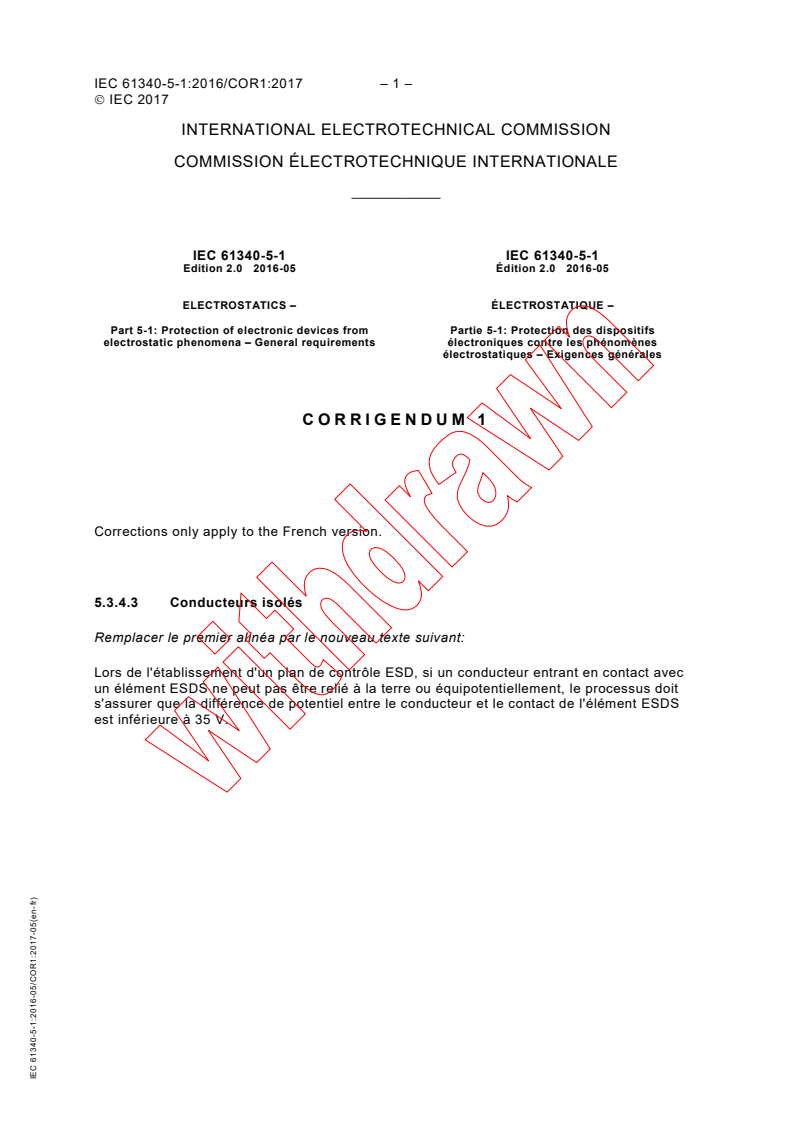
IEC 61340-5-1:2016/COR1:2017
(Corrigendum)Corrigendum 1 - Electrostatics - Part 5-1: Protection of electronic devices from electrostatic phenomena - General requirements
Corrigendum 1 - Electrostatics - Part 5-1: Protection of electronic devices from electrostatic phenomena - General requirements
Corrigendum 1 - Électrostatique - Partie 5-1: Protection des dispositifs électroniques contre les phénomènes électrostatiques - Exigences générales
General Information
Relations
Standards Content (Sample)
IEC 2017
INTERNATIONAL ELECTROTECHNICAL COMMISSION
COMMISSION ÉLECTROTECHNIQUE INTERNATIONALE
____________
IEC 61340-5-1 IEC 61340-5-1
Edition 2.0 2016-05 Édition 2.0 2016-05
ELECTROSTATICS – ÉLECTROSTATIQUE –
Part 5-1: Protection of electronic devices from Partie 5-1: Protection des dispositifs
electrostatic phenomena – General requirements électroniques contre les phénomènes
électrostatiques – Exigences générales
CO RRI G E NDUM 1
...
This May Also Interest You
IEC TS 61340-5-6:2025 establishes a set of methodologies, techniques, and instruments to characterize a process where electrostatic discharge (ESD) sensitive items (ESDS) are handled. ESD risk assessment covers risks by charged personnel, ungrounded conductors, charged ESDS, charged insulators, and ESDS in an electrostatic field. This document applies to activities that manufacture, process, assemble, install, package, label, service, test, inspect, transport, or otherwise handle electrical or electronic parts, assemblies, and equipment susceptible to damage by electrostatic discharges. This document does not apply to electrically initiated explosive items, flammable gases and liquids or powders. The document does not address program management, compliance verification or program manager/coordinator certification. Risks due to electromagnetic sources that produce AC fields are not considered. This document cancels and replaces IEC PAS 61340-5-6 published in 2022. This first edition constitutes a technical revision.
- Technical specification67 pagesEnglish languagesale 15% off
IEC TR 61340-1-1:2025 gives guidance on error consideration and uncertainty estimation in electrostatics and ESD control measurements. It provides guidance on minimizing measurement errors and estimating measurement uncertainties using practical methods. The document also outlines how measurement results can be expressed in a test report. It is important to note that this document serves as an informative guideline intended for individuals who already have a solid understanding of the basics of electrostatics theory and measurement techniques.
- Technical report27 pagesEnglish languagesale 15% off
IEC 61340-4-11:2025 specifies the electrostatic testing, design and safe use requirements for composite intermediate bulk containers (IBC) intended for use in hazardous areas.
Composite IBC are often filled with flammable liquids which can create an explosive atmosphere in the inner receptacle. The design requirements for composite IBC intended for such use are defined in 7.3.4.5 of IEC TS 60079-32-1:2013.
The test procedures described in this document can be used by manufacturers, suppliers and product users for product qualification and compliance verification of new and reconditioned composite IBC. Additionally, the requirements of this document can be used for testing the electrostatic properties of composite IBC, independent of any inspection periods.
Precautions regarding the use of composite IBC (e.g., stirring, cleaning etc.) are defined in 7.3.4.5 of IEC TS 60079-32-1:2013.
Compliance with the requirements of this document does not mitigate the need for full risk assessment.
- Standard50 pagesEnglish and French languagesale 15% off
IEC 61340-6-1:2018 applies to facilities that provide healthcare including hospitals, care centres and clinics. This document provides technical requirements and recommendations for controlling electrostatic phenomena in healthcare facilities, which includes requirements for equipment, materials, and products used to control static electricity. The requirements of this document do not apply to medical electrical equipment specified in IEC 60601-1 and in vitro diagnostic (IVD) medical equipment specified in IEC 61010‑2‑101.
- Standard46 pagesEnglish languagesale 15% off
- Standard45 pagesEnglish and French languagesale 15% off
- Standard12 pagesEnglish and French languagesale 15% off
IEC 61340-5-1:2024 applies to organizations that: manufacture, process, assemble, install, package, label, service, test, inspect, transport, or otherwise handle electrical or electronic parts, assemblies and equipment with withstand voltages greater than or equal to 100 V human body model (HBM) and 200 V charge device model (CDM). Also, protection from isolated conductors is addressed by limiting the voltage on isolated conductors to less than 35 V. ESDS with lower withstand voltages can require additional control elements or adjusted limits. Processes designed to handle items that have lower ESD withstand voltage(s) can still claim compliance to this document. This document provides the requirements for an ESD control program. IEC TR 61340-5-2 provides guidance on the implementation of this document. This document does not apply to electrically initiated explosive devices, flammable liquids, gases, and powders. The purpose of this document is to provide the administrative and technical requirements for establishing, implementing, and maintaining an ESD control program (hereinafter referred to as the “program”). This edition includes the following significant technical changes with respect to the previous edition:
a) definitions have been added to the document;
b) updates to product qualification requirements;
c) subclause 5.3.3 now includes a reference to groundable static control garment systems;
d) Table 2 was replaced;
e) subclause 5.3.4.2 was updated to define what an insulator is;
f) subclause 5.3.4.3 was updated to include a definition for isolated conductor;
g) Table 3 was updated, technical items added, including a reference to IEC 61340-5-4 for compliance verification testing;
h) Table 4 was added as a summary of the requirements in IEC 61340-5-3 and to include requirements for compliance verification of packaging;
i) Annex A was replaced: the former Annex is no longer required. Annex A are examples of tailoring.
- Standard69 pagesEnglish languagesale 15% off
- Standard43 pagesEnglish and French languagesale 15% off
IEC TS 61340-6-2:2023 applies to the interior design of public places, retail and office areas such as, but not limited to staircases, offices, meeting rooms, auditoriums, airports, train stations, shopping centres, restaurants and theatres. This document includes guidelines for architects, interior designers and facility managers.
Hazards, nuisances and other problems associated with electrostatic phenomena and the principles of their control are outlined. This document includes requirements and recommendations for materials, and products used to control static electricity.
The handling of electrostatic sensitive components is described in IEC 61340-5-1 and the avoidance of hazards due to static electricity in explosive atmospheres is presented in IEC TS 60079-32-1. The requirements for electrostatic control in healthcare facilities are specified in IEC 61340-6-1. The guidance in this document is not intended to replace or supersede the requirements of the aforementioned standards and technical specification, but can be used in association with them to establish appropriate electrostatic control measures.
These guidelines do not replace or supersede any requirements for personnel safety specified in other standards or codes of practice.
- Technical specification18 pagesEnglish languagesale 15% off
- Standard3 pagesEnglish and French languagesale 15% off
IEC PAS 61340-5-6:2022 describe a set of methodologies, techniques, and tools that can be used to characterize a process where ESD sensitive (ESDS) items are handled. The process assessment covers risks by charged personnel, ungrounded conductors, charged ESDS items, and ESDS items in an electrostatic field. This document applies to activities that manufacture, process, assemble, install, package, label, service, test, inspect, transport, or otherwise handle electrical or electronic parts, assemblies, and equipment susceptible to damage by electrostatic discharges. This document does not apply to electrically initiated explosive items, flammable liquids, or powders. The document does not address program management, compliance verification, troubleshooting, or program manager/coordinator certification. In this version of the document, risks due to electromagnetic sources that produce AC fields are not considered.
- Technical specification54 pagesEnglish languagesale 15% off
IEC 61340-2-1:2015 describes test methods for measuring the rate of dissipation of static charge of insulating and static dissipative materials and products. It includes a generic description of test methods and detailed test procedures for specific applications. The two test methods for measuring charge decay time, one using corona charging and one using a charged metal plate are different and may not give equivalent results. Nevertheless, each method has a range of applications for which it is best suited. The corona charging method is suitable for evaluating the ability of materials, e.g. textiles, packaging, etc., to dissipate charge from their own surfaces. The charged metal plate method is suitable for evaluating the ability of materials and objects such as gloves, finger cots, hand tools, etc. to dissipate charge from conductive objects placed on or in contact with them. The charged plate method may not be suitable for evaluating the ability of materials to dissipate charge from their own surfaces. In addition to its general application, this horizontal standard is also intended for use by technical committees in the preparation of standards in accordance with the principles laid down in IEC Guide 108. This edition includes the following significant technical changes with respect to the previous edition:
a) the first edition supported requirements in IEC TR 61340-5-1, but with the revision of IEC TR 61340-5-1 into an International Standard, this support is no longer required; references to IEC 61340-5-1 have been removed;
b) the introduction gives additional information on when charge decay time measurements are appropriate, and the applications for which each of the two test methods are best suited;
c) procedures for performance verification of measuring instruments for the corona charging method have been added. It has the status of a horizontal standard in accordance with IEC Guide 108.
- Standard48 pagesEnglish languagesale 15% off
- Standard46 pagesEnglish and French languagesale 15% off
- Standard100 pagesEnglish and French languagesale 15% off


Questions, Comments and Discussion
Ask us and Technical Secretary will try to provide an answer. You can facilitate discussion about the standard in here.
Loading comments...