

IEC 61340-6-1:2018
(Main)Electrostatics - Part 6-1: Electrostatic control for healthcare - General requirements for facilities
General Information
- Abstract
IEC 61340-6-1:2018 applies to facilities that provide healthcare including hospitals, care centres and clinics. This document provides technical requirements and recommendations for controlling electrostatic phenomena in healthcare facilities, which includes requirements for equipment, materials, and products used to control static electricity. The requirements of this document do not apply to medical electrical equipment specified in IEC 60601-1 and in vitro diagnostic (IVD) medical equipment specified in IEC 61010‑2‑101.
- Status
- Published
- Publication Date
- 17-Oct-2024
- Technical Committee
- TC 101 - Electrostatics
- Drafting Committee
- WG 16 - TC 101/WG 16
- Current Stage
- PPUB - Publication issued
- Start Date
- 24-Sep-2018
- Completion Date
- 07-Sep-2018
Buy Documents
IEC 61340-6-1:2018+AMD1:2024 CSV - Electrostatics - Part 6-1: Electrostatic control in healthcare, commercial and public facilities - Healthcare Released:10/18/2024
IEC 61340-6-1:2018 - Electrostatics - Part 6-1: Electrostatic control for healthcare - General requirements for facilities Released:9/24/2018
Overview
IEC 61340-6-1:2018 - "Electrostatics - Part 6-1: Electrostatic control for healthcare - General requirements for facilities" specifies technical requirements and recommendations for controlling electrostatic phenomena in healthcare facilities (hospitals, care centres, clinics). The standard addresses hazards from electrostatic discharge (ESD), electrostatic attraction (ESA), ignition of flammable substances and electrostatic shocks, and sets out requirements for equipment, materials and operational controls used to manage static electricity. It specifically excludes medical electrical equipment covered by IEC 60601-1 and IVD equipment covered by IEC 61010‑2‑101.
Key topics and technical requirements
- Scope and terminology: Definitions for ESD, ESA, ESDS (electrostatic discharge sensitive devices), EPA (ESD protected area) and related terms.
- Electrostatic hazards: Identification of risks to patients, staff and equipment (instrumentation upset, contamination, ignition, shocks).
- Classification of medical locations: Rooms and procedures are classified (e.g., Group 0, Group 1, Group 2) where electrostatic control ranges from recommended to required depending on risk and activity.
- Electrostatic control requirements:
- Administrative controls: design, operational responsibility, qualification, verification and acceptance testing.
- Technical controls: electrical safety, material classification, selection of low-charging textiles, footwear and floor coverings, packaging and containers for electrostatic control.
- Service and maintenance: ongoing checks and procedures to sustain control measures.
- Test methods and verification: Annex A provides test methods for low-charging textiles (clothing, bedding, surgical drapes); Annex B covers ionization and other considerations.
- Standards referenced: IEC 61340 series (measurement & test methods), IEC TR 61340-1, IEC 60364-7-710 (medical location electrical installations), ISO textile test methods and others.
Practical applications
- Design and retrofit of operating theatres, imaging suites and other critical medical areas where ESD can affect equipment or contamination-sensitive procedures.
- Specification and selection of flooring, garments, bedding, surgical drapes, footwear and ESD packaging used in healthcare facilities.
- Development of facility-level ESD control policies, acceptance tests, qualification and maintenance schedules.
- Risk mitigation where flammable substances or sensitive electronic assemblies are present.
Who should use this standard
- Hospital facility managers and architects
- Biomedical and clinical engineers
- EHS (Environment, Health & Safety) and infection control teams
- Procurement/specification writers for medical textiles, flooring and ESD products
- Manufacturers of ESD control materials and PPE supplying healthcare
Related standards (selection)
- IEC 61340-2-1, -2-3, -4-1, -4-3, -4-5 (electrostatics measurement & test methods)
- IEC TR 61340-1 (principles and measurements)
- IEC 60364-7-710 (electrical installations for medical locations)
- IEC 60601-1 and IEC 61010‑2‑101 (not covered - medical electrical/IVD equipment)
Keywords: IEC 61340-6-1, electrostatic control, healthcare facilities, ESD, electrostatic discharge, electrostatic attraction, ESDS, EPA, medical locations, low-charging textiles.
Relations
- Effective Date
- 05-Sep-2023
Buy Documents
IEC 61340-6-1:2018+AMD1:2024 CSV - Electrostatics - Part 6-1: Electrostatic control in healthcare, commercial and public facilities - Healthcare Released:10/18/2024
IEC 61340-6-1:2018 - Electrostatics - Part 6-1: Electrostatic control for healthcare - General requirements for facilities Released:9/24/2018
Get Certified
Connect with accredited certification bodies for this standard

BSI Group
BSI (British Standards Institution) is the business standards company that helps organizations make excellence a habit.

TÜV Rheinland
TÜV Rheinland is a leading international provider of technical services.

TÜV SÜD
TÜV SÜD is a trusted partner of choice for safety, security and sustainability solutions.
Sponsored listings
Frequently Asked Questions
IEC 61340-6-1:2018 is a standard published by the International Electrotechnical Commission (IEC). Its full title is "Electrostatics - Part 6-1: Electrostatic control for healthcare - General requirements for facilities". This standard covers: IEC 61340-6-1:2018 applies to facilities that provide healthcare including hospitals, care centres and clinics. This document provides technical requirements and recommendations for controlling electrostatic phenomena in healthcare facilities, which includes requirements for equipment, materials, and products used to control static electricity. The requirements of this document do not apply to medical electrical equipment specified in IEC 60601-1 and in vitro diagnostic (IVD) medical equipment specified in IEC 61010‑2‑101.
IEC 61340-6-1:2018 applies to facilities that provide healthcare including hospitals, care centres and clinics. This document provides technical requirements and recommendations for controlling electrostatic phenomena in healthcare facilities, which includes requirements for equipment, materials, and products used to control static electricity. The requirements of this document do not apply to medical electrical equipment specified in IEC 60601-1 and in vitro diagnostic (IVD) medical equipment specified in IEC 61010‑2‑101.
IEC 61340-6-1:2018 is classified under the following ICS (International Classification for Standards) categories: 11.020.99 - Other standards related to health care in general; 17.220.99 - Other standards related to electricity and magnetism; 29.020 - Electrical engineering in general; 29.060.10 - Wires. The ICS classification helps identify the subject area and facilitates finding related standards.
IEC 61340-6-1:2018 has the following relationships with other standards: It is inter standard links to IEC 61340-6-1:2018/AMD1:2024. Understanding these relationships helps ensure you are using the most current and applicable version of the standard.
IEC 61340-6-1:2018 is available in PDF format for immediate download after purchase. The document can be added to your cart and obtained through the secure checkout process. Digital delivery ensures instant access to the complete standard document.
Standards Content (Sample)
IEC 61340-6-1 ®
Edition 1.1 2024-10
CONSOLIDATED VERSION
INTERNATIONAL
STANDARD
colour
inside
Electrostatics –
Part 6-1: Electrostatic control for healthcare – General requirements for
facilities Electrostatic control in healthcare, commercial and public facilities –
Healthcare
All rights reserved. Unless otherwise specified, no part of this publication may be reproduced or utilized in any form
or by any means, electronic or mechanical, including photocopying and microfilm, without permission in writing from
either IEC or IEC's member National Committee in the country of the requester. If you have any questions about IEC
copyright or have an enquiry about obtaining additional rights to this publication, please contact the address below or
your local IEC member National Committee for further information.
IEC Secretariat Tel.: +41 22 919 02 11
3, rue de Varembé info@iec.ch
CH-1211 Geneva 20 www.iec.ch
Switzerland
About the IEC
The International Electrotechnical Commission (IEC) is the leading global organization that prepares and publishes
International Standards for all electrical, electronic and related technologies.
About IEC publications
The technical content of IEC publications is kept under constant review by the IEC. Please make sure that you have the
latest edition, a corrigendum or an amendment might have been published.
IEC publications search - webstore.iec.ch/advsearchform IEC Products & Services Portal - products.iec.ch
The advanced search enables to find IEC publications by a Discover our powerful search engine and read freely all the
variety of criteria (reference number, text, technical publications previews, graphical symbols and the glossary.
committee, …). It also gives information on projects, replaced With a subscription you will always have access to up to date
and withdrawn publications. content tailored to your needs.
IEC Just Published - webstore.iec.ch/justpublished
Electropedia - www.electropedia.org
Stay up to date on all new IEC publications. Just Published
The world's leading online dictionary on electrotechnology,
details all new publications released. Available online and once
containing more than 22 500 terminological entries in English
a month by email.
and French, with equivalent terms in 25 additional languages.
Also known as the International Electrotechnical Vocabulary
IEC Customer Service Centre - webstore.iec.ch/csc
(IEV) online.
If you wish to give us your feedback on this publication or need
further assistance, please contact the Customer Service
Centre: sales@iec.ch.
IEC 61340-6-1 ®
Edition 1.1 2024-10
CONSOLIDATED VERSION
INTERNATIONAL
STANDARD
colour
inside
Electrostatics –
Part 6-1: Electrostatic control for healthcare – General requirements for
facilities Electrostatic control in healthcare, commercial and public facilities –
Healthcare
INTERNATIONAL
ELECTROTECHNICAL
COMMISSION
ICS 17.220.99, 29.020, 11.020.99 ISBN 978-2-8322-9913-5
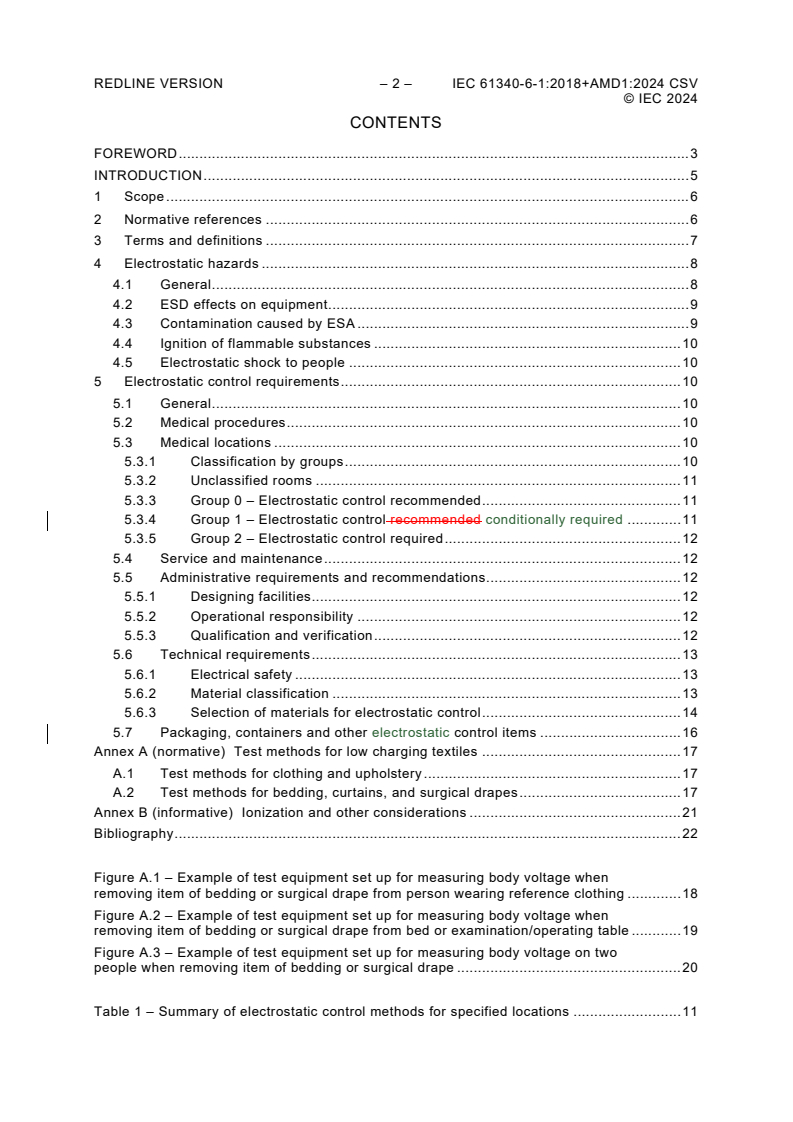
REDLINE VERSION – 2 – IEC 61340-6-1:2018+AMD1:2024 CSV
© IEC 2024
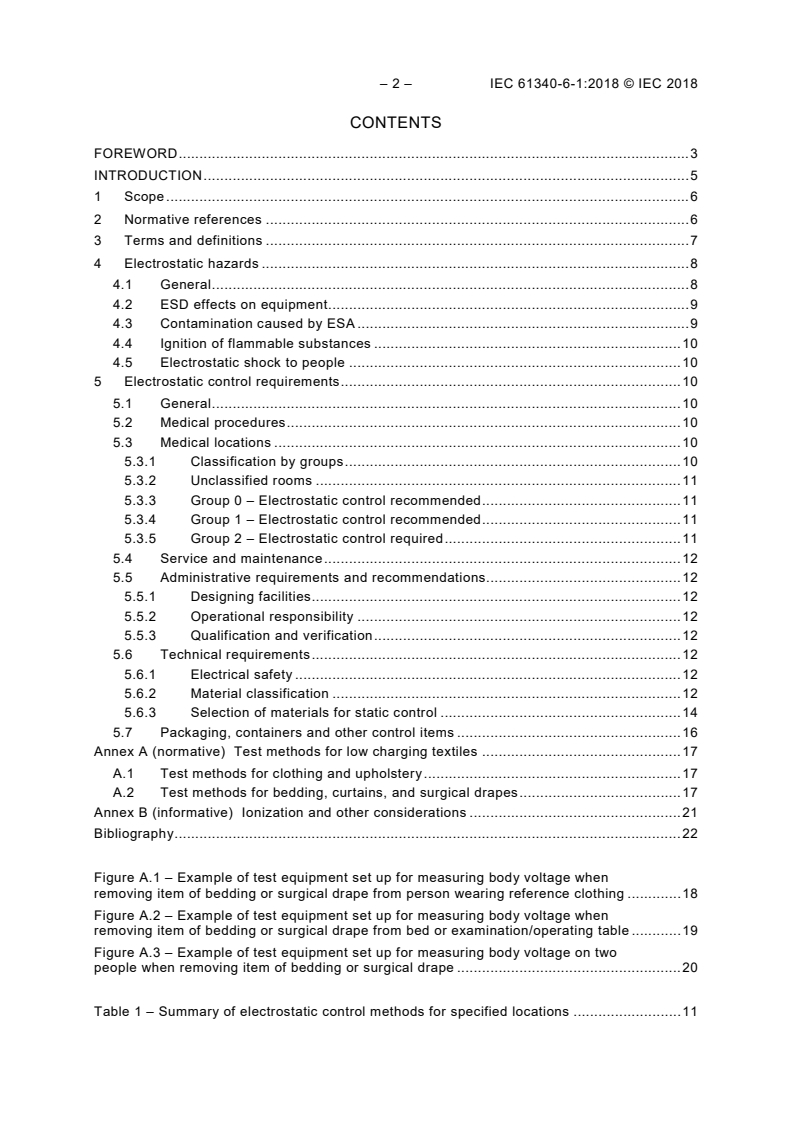
CONTENTS
FOREWORD . 3
INTRODUCTION . 5
1 Scope . 6
2 Normative references . 6
3 Terms and definitions . 7
4 Electrostatic hazards . 8
4.1 General . 8
4.2 ESD effects on equipment . 9
4.3 Contamination caused by ESA . 9
4.4 Ignition of flammable substances . 10
4.5 Electrostatic shock to people . 10
5 Electrostatic control requirements . 10
5.1 General . 10
5.2 Medical procedures . 10
5.3 Medical locations . 10
5.3.1 Classification by groups . 10
5.3.2 Unclassified rooms . 11
5.3.3 Group 0 – Electrostatic control recommended . 11
5.3.4 Group 1 – Electrostatic control recommended conditionally required . 11
5.3.5 Group 2 – Electrostatic control required . 12
5.4 Service and maintenance . 12
5.5 Administrative requirements and recommendations. 12
5.5.1 Designing facilities. 12
5.5.2 Operational responsibility . 12
5.5.3 Qualification and verification . 12
5.6 Technical requirements . 13
5.6.1 Electrical safety . 13
5.6.2 Material classification . 13
5.6.3 Selection of materials for electrostatic control . 14
5.7 Packaging, containers and other electrostatic control items . 16
Annex A (normative) Test methods for low charging textiles . 17
A.1 Test methods for clothing and upholstery . 17
A.2 Test methods for bedding, curtains, and surgical drapes . 17
Annex B (informative) Ionization and other considerations . 21
Bibliography . 22
Figure A.1 – Example of test equipment set up for measuring body voltage when
removing item of bedding or surgical drape from person wearing reference clothing . 18
Figure A.2 – Example of test equipment set up for measuring body voltage when
removing item of bedding or surgical drape from bed or examination/operating table . 19
Figure A.3 – Example of test equipment set up for measuring body voltage on two
people when removing item of bedding or surgical drape . 20
Table 1 – Summary of electrostatic control methods for specified locations . 11
© IEC 2024
INTERNATIONAL ELECTROTECHNICAL COMMISSION
____________
ELECTROSTATICS –
Part 6-1: Electrostatic control for healthcare –
General requirements for facilities
Electrostatic control in healthcare,
commercial and public facilities – Healthcare
FOREWORD
1) The International Electrotechnical Commission (IEC) is a worldwide organization for standardization comprising
all national electrotechnical committees (IEC National Committees). The object of IEC is to promote
international co-operation on all questions concerning standardization in the electrical and electronic fields. To
this end and in addition to other activities, IEC publishes International Standards, Technical Specifications,
Technical Reports, Publicly Available Specifications (PAS) and Guides (hereafter referred to as “IEC
Publication(s)”). Their preparation is entrusted to technical committees; any IEC National Committee interested
in the subject dealt with may participate in this preparatory work. International, governmental and non-
governmental organizations liaising with the IEC also participate in this preparation. IEC collaborates closely
with the International Organization for Standardization (ISO) in accordance with conditions determined by
agreement between the two organizations.
2) The formal decisions or agreements of IEC on technical matters express, as nearly as possible, an international
consensus of opinion on the relevant subjects since each technical committee has representation from all
interested IEC National Committees.
3) IEC Publications have the form of recommendations for international use and are accepted by IEC National
Committees in that sense. While all reasonable efforts are made to ensure that the technical content of IEC
Publications is accurate, IEC cannot be held responsible for the way in which they are used or for any
misinterpretation by any end user.
4) In order to promote international uniformity, IEC National Committees undertake to apply IEC Publications
transparently to the maximum extent possible in their national and regional publications. Any divergence
between any IEC Publication and the corresponding national or regional publication shall be clearly indicated in
the latter.
5) IEC itself does not provide any attestation of conformity. Independent certification bodies provide conformity
assessment services and, in some areas, access to IEC marks of conformity. IEC is not responsible for any
services carried out by independent certification bodies.
6) All users should ensure that they have the latest edition of this publication.
7) No liability shall attach to IEC or its directors, employees, servants or agents including individual experts and
members of its technical committees and IEC National Committees for any personal injury, property damage or
other damage of any nature whatsoever, whether direct or indirect, or for costs (including legal fees) and
expenses arising out of the publication, use of, or reliance upon, this IEC Publication or any other IEC
Publications.
8) Attention is drawn to the Normative references cited in this publication. Use of the referenced publications is
indispensable for the correct application of this publication.
9) IEC draws attention to the possibility that the implementation of this document may involve the use of (a)
patent(s). IEC takes no position concerning the evidence, validity or applicability of any claimed patent rights in
respect thereof. As of the date of publication of this document, IEC had not received notice of (a) patent(s),
which may be required to implement this document. However, implementers are cautioned that this may not
represent the latest information, which may be obtained from the patent database available at
https://patents.iec.ch. IEC shall not be held responsible for identifying any or all such patent rights.
This consolidated version of the official IEC Standard and its amendment has been
prepared for user convenience.
IEC 61340-6-1 edition 1.1 contains the first edition (2018-09) [documents 101/566/FDIS
and 101/570/RVD] and its amendment 1 (2024-10) [documents 101/713/FDIS and
101/720/RVD].
In this Redline version, a vertical line in the margin shows where the technical content
is modified by amendment 1. Additions are in green text, deletions are in strikethrough
REDLINE VERSION – 4 – IEC 61340-6-1:2018+AMD1:2024 CSV
© IEC 2024
red text. A separate Final version with all changes accepted is available in this
publication.
International Standard IEC 61340-6-1 has been prepared by IEC technical committee 101:
Electrostatics.
This document has been drafted in accordance with the ISO/IEC Directives, Part 2.
A list of all parts in the IEC 61340 series, published under the general title Electrostatics, can
be found on the IEC website.
The committee has decided that the contents of this document and its amendment will remain
unchanged until the stability date indicated on the IEC website under webstore.iec.ch in the
data related to the specific document. At this date, the document will be
• reconfirmed,
• withdrawn, or
• revised.
IMPORTANT – The 'colour inside' logo on the cover page of this publication indicates
that it contains colours which are considered to be useful for the correct
understanding of its contents. Users should therefore print this document using a
colour printer.
© IEC 2024
INTRODUCTION
Static electricity can be the source of several hazards to patients, staff and equipment in
healthcare facilities. Such hazards include:
• electromagnetic disturbance or electrostatic discharge (ESD) disruption or damage to
medical instrumentation and data processing equipment;
• damage to ESD susceptible electronic components and assemblies during service and
maintenance;
• electrostatic attraction (ESA) and contamination;
• ignition of flammable gases, liquids and other materials, and
• electrostatic shocks to people.
Adequate electrostatic control can eliminate these hazards, or at least reduce residual risk to
tolerable levels.
REDLINE VERSION – 6 – IEC 61340-6-1:2018+AMD1:2024 CSV
© IEC 2024
ELECTROSTATICS –
Part 6-1: Electrostatic control for healthcare –
General requirements for facilities
Electrostatic control in healthcare,
commercial and public facilities – Healthcare
1 Scope
This part of IEC 61340 applies to facilities that provide healthcare including hospitals, care
centres and clinics.
This document provides technical requirements and recommendations for controlling
electrostatic phenomena in healthcare facilities, which includes requirements for equipment,
materials, and products used to control static electricity.
The requirements of this document do not apply to medical electrical equipment specified in
IEC 60601-1 [1] and in vitro diagnostic (IVD) medical equipment specified in
IEC 61010-2-101 [2].
2 Normative references
The following documents are referred to in the text in such a way that some or all of their
content constitutes requirements of this document. For dated references, only the edition
cited applies. For undated references, the latest edition of the referenced document (including
any amendments) applies.
IEC 60364-7-710, Electrical installations of buildings Low-voltage electrical installations – Part
7-710: Requirements for special installations or locations – Medical locations
IEC TR 61340-1, Electrostatics – Part 1: Electrostatic phenomena – Principles and
measurements
IEC 61340-2-1, Electrostatics – Part 2-1: Measurement methods – Ability of materials and
products to dissipate static electric charge
IEC 61340-2-3, Electrostatics – Part 2-3: Methods of test for determining the resistance and
resistivity of solid materials used to avoid electrostatic charge accumulation
IEC 61340-4-1, Electrostatics – Part 4-1: Standard test methods for specific applications –
Electrical resistance of floor coverings and installed floors
IEC TS 61340-4-2:2013, Electrostatics – Part 4-2: Standard test methods for specific
applications – Electrostatic properties of garments
IEC 61340-4-3, Electrostatics – Part 4-3: Standard test methods for specific applications –
Footwear
___________
Numbers in square brackets refer to the bibliography.
© IEC 2024
IEC 61340-4-5, Electrostatics – Part 4-5: Standard test methods for specific applications –
Methods for characterizing the electrostatic protection of footwear and flooring in combination
with a person
IEC 61340-5-1, Electrostatics – Part 5-1: Protection of electronic devices from electrostatic
phenomena – General requirements
ISO 18080-2, Textiles – Test methods for evaluating the electrostatic propensity of fabrics –
Part 2: Test method using rotary mechanical friction
ISO 18080-3, Textiles – Test methods for evaluating the electrostatic propensity of fabrics –
Part 3: Test method using manual friction
ISO 18080-4, Textiles – Test methods for evaluating the electrostatic propensity of fabrics –
Part 4: Test method using horizontal mechanical friction
ISO 20344, Personal protective equipment – Test methods for footwear
3 Terms and definitions
For the purposes of this document, the terms and definitions given in IEC TR 61340-1 and the
following apply.
ISO and IEC maintain terminological databases for use in standardization at the following
addresses:
• IEC Electropedia: available at http://www.electropedia.org/
• ISO Online browsing platform: available at http://www.iso.org/obp
3.1
acceptance test
test used to determine if systems or products meet specified requirements prior to installation
or first use
Note 1 to entry: Acceptance tests may be the same as those used for qualification, or can be simpler tests more
appropriate for use in a facility rather than a controlled test laboratory.
3.2
electrostatic attraction
ESA
force between two or more oppositely charged objects resulting in an increased deposition
rate of particles onto charged surfaces or movement of charged particles
Note 1 to entry: This note applies to the French language only.
3.3
electrostatic discharge
ESD
transfer of electric charge between bodies of different electric potential in proximity or through
direct contact
3.4
electrostatic discharge sensitive device
ESDS
sensitive devices, integrated circuit or assembly that can be damaged by electrostatic fields or
electrostatic discharge
Note 1 to entry: This note applies to the French language only.
REDLINE VERSION – 8 – IEC 61340-6-1:2018+AMD1:2024 CSV
© IEC 2024
3.5
ESD protected area
EPA
area in which an ESDS can be handled with acceptable risk of damage as a result of
electrostatic discharge or fields
Note 1 to entry: This note applies to the French language only.
3.6
electromagnetic compatibility
EMC
ability of an equipment or system to function satisfactorily in its electromagnetic environment
without introducing intolerable electromagnetic disturbances to anything in that environment
3.7
functional ground
terminal used to connect parts to ground for reasons other than safety
Note 1 to entry: A functional ground can be a ground rod, stake or a separate wiring system that is bonded to the
AC ground at the main service panel.
Note 2 to entry: In the absence of a dedicated functional ground, a protective earth can be used as a functional
ground.
3.8
isolated conductors
non-grounded conductors
3.9
low charging material
materials with a tendency to minimize charge generation when contacting and rubbing against
other materials
Note 1 to entry: As contact electrification and triboelectric charging are dependent on the nature of both
contacting surfaces and the local environment, materials qualified as low charging under specific test conditions
are not necessarily low charging under all possible conditions.
3.10
protective earth
terminal used to connect parts to earth for safety reasons
Note 1 to entry: Protective earth is also known as equipment grounding conductor.
3.11
qualification
process of evaluating test data or system/product data sheets to ensure that systems,
materials or finished products meet specified requirements
4 Electrostatic hazards
4.1 General
Four different hazards of static electricity are generally recognized: ESD damaging or
disrupting electrical equipment, contamination caused by ESA, ignition of flammable
substances and electrostatic shock to people.
© IEC 2024
4.2 ESD effects on equipment
Electrostatic discharges can cause losses of the functions of instrumentation during patient
care increasing the risks to human safety. Insufficient electrostatic control may also cause
unnecessary repair costs of medical equipment, as well as corruption of data affecting the
quality and reliability of medical operation.
Electrical installation requirements for medical equipment and locations are provided in the
electrical safety rules specified in IEC 60364 (all parts) [3]. It is essential to recognize that
electrical safety does not necessarily provide precautions for prevention of the risks of static
electricity and electrostatic discharge (ESD). Local safety regulations shall be taken into
account.
ESD immunity testing does not cover all the real discharge scenarios, such as those where
metal parts having different electric potentials are touched together. A current limiting resistor
used in the ESD testing specified in IEC 61000-4-2 [4] does not necessarily exist in such
situations, resulting in higher discharge power in equipment under real stress. Charge
accumulation in a mobile metal object can also result in high energies in uncontrolled
environments. Especially in low humidity, discharge energies can exceed the stress levels
used in IEC 61000-4-2 [4].
A completely integrated system in medical care is not necessarily tested against transients
caused by ESD, although individual parts of the system have passed EMC qualification.
Therefore, it does not always take into account all the realistic coupling and failure scenarios
of the whole system.
Discharges from isolated conductors or from a human body can be prevented with grounding.
Conductive parts of patient beds, intravenous stands, trolleys, delivery carts, over-bed tables,
chairs, and other mobile metal objects are not normally connected to the protective earth.
Therefore, grounding all conductive parts of every item through the flooring or with direct
electrical connection to a functional ground becomes essential for static electrostatic control.
The probability of ESD can efficiently be reduced by optimization of humidity levels, bipolar
ionization, adequate material selection, personnel grounding, and grounding of mobile metal
objects. In general, the prevention of static charge generation and ESD is preferable
compared to enhancing medical equipment EMC immunity.
If a functional ground is used for electrostatic control purposes, it should be electrically
bonded to protective earth where possible so as to avoid potential differences between the
two systems.
4.3 Contamination caused by ESA
Electrostatically charged surfaces attract airborne particles. Increased deposition of
microorganisms onto charged surfaces, including the airways, human skin, and open wounds,
can contribute to the incidence of hospital infections. Electrostatic sources of contamination
and nosocomial infection can be healthcare personnel, patients, or the environment. All
objects that come into contact with patients can be considered as potentially contaminated.
Cleaning, disinfection and sterilizing can prevent transmission of infective agents. However,
because of the human factor, complete certainty in cleanliness cannot be achieved without
adequate control of the environment. Avoidance of electrostatic attraction (ESA) decreases
airborne microbe contamination and improves overall cleanliness in healthcare. The reduction
in charge carried by airborne submicron contaminants will additionally reduce the deposition
of such contaminants in the airways, thereby reducing the load placed on the body’s immune
system. Charge accumulation and high surface charge densities can be reduced to tolerable
levels by grounding of personnel and other conductors, and by correct selection of materials.
REDLINE VERSION – 10 – IEC 61340-6-1:2018+AMD1:2024 CSV
© IEC 2024
4.4 Ignition of flammable substances
The use of flammable substances in healthcare facilities has decreased, but the risk of fires
and explosions can still occur especially in laboratories, intensive care units and operating
rooms. For example, using alcohol based sterilizing substances has caused fires due to
electrostatic discharge. ESD can be an ignition source in hyperbaric oxygen facilities and
other locations where the oxygen concentration exceeds 23,5 % by volume.
The risk of incendiary ESD can be reduced to tolerable levels by grounding of personnel and
other conductors, and by correct selection of materials.
4.5 Electrostatic shock to people
The incidence of unpleasant electrostatic shocks to people has increased due to the
increased use of highly insulating materials such as plastics. An electrostatic discharge
occurs when a human body approaches close enough to an object with different electric
potential to exceed the electric breakdown field strength. ESD energy can be high enough to
cause painful sensations to patients and healthcare personnel, resulting in involuntary
movements, which can lead to accidents.
The risk of electrostatic shock can be reduced to tolerable levels by grounding of personnel
and other conductors, and by correct selection of materials.
5 Electrostatic control requirements
5.1 General
Electrostatic control requirements in healthcare depend on the medical procedures, locations
and activities such as service and maintenance of medical equipment.
5.2 Medical procedures
To ensure safety of patients from electrostatic hazards, protective measures shall be applied
during medical examination and treatment.
Medical procedures can require specific electrostatic control actions that are dependent on
the particular requirements of instrumentation, electric equipment or cleanliness. When
protective measures have not otherwise been specified, the requirements in 5.3 to 5.7 shall
be applied. Consideration shall also be given to applying the recommendations in 5.3 to 5.7
and Annex B.
5.3 Medical locations
5.3.1 Classification by groups
Locations that are intended for purposes of diagnosis, treatment, monitoring and care of
patients shall be classified in the following groups, as defined in IEC 60364-7-710:
unclassified, G0, G1 and G2.
Selection of materials to reduce residual charge levels is recommended in all locations.
Grounding of personnel and other conductors is recommended in G0 and locations, is
conditionally required in G1 locations, (see 5.3.4) and is required in G2 locations.
Electrostatic control methods for each location are summarised in Table 1.
© IEC 2024
Table 1 – Summary of electrostatic control methods for specified locations
Electrostatic control method
Ground personnel Ground other Use of conductive or Use of low
Location
via footwear and conductors via flooring dissipative materials charging
flooring or direct connection materials
Not mandatory
Unclassified Not mandatory Not mandatory Recommended
a
Recommended
a
G0 Recommended Recommended Recommended Recommended
Recommended
Recommended
a
G1 Conditionally Recommended Recommended
b
Conditionally required
b
required
a
G2 Required Required Recommended Recommended
a
Conductive and dissipative materials should only be used if grounding is provided.
b
Electrostatic control methods are required in G1 locations if the humidity was less than 30 % RH (see 5.3.4).
5.3.2 Unclassified rooms
Waiting rooms, office areas, and corridors are not necessarily classified medical locations. It
is recommended to use flooring and upholstery materials that limit human body voltage to
below 2 000 V, thereby limiting occurrence of unpleasant electrostatic shocks, contaminant
deposition, and errors in data processing. Temporary use of medical equipment shall be taken
into account.
NOTE As an example, EN 1307 [5] specifies textile floor coverings with antistatic behaviour as being those giving
rise to a body voltage of less than 2 000 V measured according to ISO 6356 [6] at 25 % RH.
5.3.3 Group 0 – Electrostatic control recommended
Typical locations are consulting rooms and inpatient wards massage therapy rooms.
Electrostatic control methods are recommended in G0 locations to reduce the risk of ESA
based contamination, ignition accidents, unpleasant electrostatic shocks and ESD induced
errors in data processing to tolerable levels.
5.3.4 Group 1 – Electrostatic control recommended conditionally required
Typical locations are endoscopic examination rooms, electrocardiogram (ECG),
electroencephalogram (EEG) and electrohysterogram (EHG) rooms, computed tomography
rooms, special care baby units, urology units and nuclear medicine rooms.
Typical locations are bedrooms, delivery rooms, electrocardiogram (ECG),
electroencephalogram (EEG), electrohysterogram (EHG) rooms, endoscopic rooms,
examination or treatment rooms, urology rooms, radiological diagnostic and therapy rooms,
hydrotherapy rooms, physiotherapy rooms, haemodialysis rooms, MRI rooms and nuclear
medicine rooms.
Electrostatic control methods are recommended in G1 locations to reduce the risk of ESA
based contamination, ignition accidents, unpleasant electrostatic shocks and ESD induced
errors in data processing to tolerable levels.
Electrostatic control methods are required in G1 locations if the humidity falls below 30 % RH,
or below the humidity specified by equipment manufacturers, for a significant period of time
(typically a continuous period of more than an hour), or if there is evidence of unacceptably
high electrostatic charging. Evidence of unacceptably high charging can be the occurrence of
any of the electrostatic hazards described in Clause 4, and can be confirmed by testing, see
5.6.2.3.3, 5.6.3.4 and 5.7 c) and d).
REDLINE VERSION – 12 – IEC 61340-6-1:2018+AMD1:2024 CSV
© IEC 2024
5.3.5 Group 2 – Electrostatic control required
Typical locations are operating theatre suites, operating preparation rooms, operating plaster
rooms, operating recovery rooms, cardiac catheterization rooms, coronary care units and
intensive care units.
Typical locations are anaesthetic areas, operating theatres, operating preparation rooms,
operating plaster rooms, operating recovery rooms, heart catheterization rooms, intensive
care rooms, angiographic examination rooms, premature baby rooms and intermediate care
units.
Electrostatic control methods are required in G2 locations, where temporary losses of
functions of medical equipment pose a significant risk to the life of patients and cannot,
therefore, be tolerated. Electrostatic control methods can also be required in other medical
locations depending on medical treatment or on manufacturer’s specifications of medical
equipment.
5.4 Service and maintenance
Unprotected ESD sensitive devices (ESDS) shall not be handled without an adequate ESD
control programme. When unprotected ESDS are handled, the requirements of IEC 61340-5-1
shall be applied.
5.5 Administrative requirements and recommendations
5.5.1 Designing facilities
Precautions against electrostatic hazards in healthcare facilities are mainly based on passive
control methods such as material selections and ground connections. Therefore, it is essential
to take recommendations and requirements of this document into account in designing new
facilities or refurbishing existing facilities. Active control measures such as optimizing dew
point temperature, introducing bipolar ionization and optimizing room layouts and equipment
locations as means to reduce individuals’ exposures to excess charge and charged
contaminants within the micro-environments they typically occupy should also be considered.
5.5.2 Operational responsibility
Organizations operating healthcare facilities are responsible for maintaining documentation
and verification of the precautions against electrostatic hazards as well as considering any
related training needs.
5.5.3 Qualification and verification
All new installations and materials used for electrostatic control shall be qualified before
procurement. In addition, sample based acceptance testing at minimum is required for
floorings and other installations. Periodic verifications or random checks of electrostatic
control items are recommended.
Unless otherwise agreed, the atmosphere for conditioning and testing for qualification
purposes shall be (23 ± 2) °C and (12 ± 3) % relative humidity, and the conditioning time prior
to testing shall be at least 48 h. Verification testing shall be done under the range of ambient
temperature and humidity conditions within the facility. For assessing the worst-case
conditions humidity and temperature shall be measured at different times of the year when
different humidity conditions can be experienced.
© IEC 2024
5.6 Technical requirements
5.6.1 Electrical safety
This document includes technical requirements for electrostatic control. These requirements
shall not replace or supersede any requirements for personnel safety.
5.6.2 Material classification
5.6.2.1 General requirements for material classification
Materials for electrostatic control shall: limit the generation of electrostatic charge; quickly
dissipate electrostatic charge; suppress or attenuate electrostatic field or electrostatic
potential associated with residual electrostatic charge. To a certain extent, these functions are
related. For example, a material that is able to dissipate charge faster than it is generated will
appear to be one that limits the generation of charge. However, in some cases, the functions
can be independent. Some materials that do not dissipate charge quickly, can show limited
accumulation of charge or low measured surface potential.
Surface and volume resistance measurements (see 5.6.2.2) are one way to classify a
material’s ability to dissipate electrostatic charge and, in many cases, to limit electrostatic
charge generation. If materials are to be used in the ground path for grounding personnel and
other conductors, resistance measurements are essential. Nevertheless, there are materials
that can be used for electrostatic control for which resistance measurements are not
appropriate. Alternative test methods (see 5.6.2.3) shall be used for such materials.
Another option is for healthcare facilities to specify their own test methods and classification
requirements, either based on other standards, or defined within their own facility
specifications. Guidance on electrostatic test methods can be found in IEC TR 61340-1,
IEC TR 61340-2-2 [7] and IEC 60079-32-2 [8].
Clothing worn by personnel that is intended to protect the wearer from hazards such as
chemicals, heat or cold, impact, ignition of flammable atmospheres, etc. is classified as
personal protective equipment (PPE) and is commonly subject to specific regulations. For
example, in Europe, PPE must comply with the PPE Directive (PPE Regulation from 2018),
and clothing materials for use in flammable atmospheres are normally tested and evaluated
using the EN 1149 series of standards [9].
NOTE Guidance on the selection, use, care and maintenance of PPE for preventing electrostatic risks in
hazardous areas is given in CEN TR 16832 [10].
5.6.2.2 Material classification based on resistive properties
5.6.2.2.1 Resistance measurements
Surface and volume resistance measurements shall be made according to IEC 61340-2-3.
5.6.2.2.2 Electrostatic conductive materials
Conductive materials may be surface conductive, volume conductive or both. A surface
conductive material shall have a surface resistance < 1 × 10 Ω. Volume conductive materials
shall have a volume resistance < 1 × 10 Ω. ESD-control Electrostatic control items can have
different limits depending on the standard.
5.6.2.2.3 Electrostatic dissipative materials
Dissipative materials may be surface dissipative, volume dissipative or both. Surface
4 11
dissipative materials shall have a surface resistance ≥ 1 × 10 Ω and < 1 × 10 Ω. Volume
4 11
dissipative materials shall have a volume resistance ≥ 1 × 10 Ω and < 1 × 10 Ω.
ESD-control Electrostatic control items can have different limits depending on the standard.
REDLINE VERSION – 14 – IEC 61340-6-1:2018+AMD1:2024 CSV
© IEC 2024
5.6.2.2.4 Electrostatic insulating materials
Electrostatic insulating materials may be surface insulating, volume insulating or both.
Surface insulating materials have a surface resistance ≥ 1 × 10 Ω. Volume insulating
materials have a volume resistance ≥ 1 × 10 Ω. ESD-control Electrostatic control items can
have different limits depending on the standard.
5.6.2.3 Material classification based on charge decay time and triboelectric charging
5.6.2.3.1 Charge decay time measurements
Charge decay time measurements shall be made according to IEC 61340-2-1.
5.6.2.3.2 Electrostatic dissipative materials
Electrostatic dissipative materials shall have a charge decay time of ≤ 2 s from an initial value
between (200 ± 10) V and (1 000 ± 50) V to (100 ± 5) V. A material is also classified as
electrostatic dissipative if on application of a corona voltage of at least 7 kV the maximum
surface voltage is less than 190 V.
5.6.2.3.3 Low charging materials
Low charging materials shall meet one or more of the following requirements:
a) friction-charged electrostatic potential ≤ 1 000 V (ISO 18080-2 or ISO 18080-4)
b) friction charge density ≤ 2 μC/m (ISO 18080-3)
NOTE The ISO 18080 series of test methods are primarily intended for textile materials. All the test methods
described in the ISO 18080 series can be used to evaluate similar thin, flexible materials. ISO 18080-3 can also be
used with minimum modification to evaluate many different types of material.
5.6.3 Selection of materials for static electrostatic control
5.6.3.1 Preferred materials
Electrostatic conductive or electrostatic dissipative materials are preferred for electrostatic
control purposes.
In the specifications for their products, manufacturers can sometimes include reference to
different standards that specify requirements for electrostatic performance of products for
general applications or for use other than in healthcare facilities. Some of these other
standards can be consistent with the requirements of this document, but others are not
because of different test methods, test conditions or performance requirements. In cases of
conflict or doubt when considering materials for electrostatic control for healthcare facilities,
materials complying with the testing and performance requirements of this document shall be
used.
5.6.3.2 Flooring used to ground personnel and equipment
When flooring is required to ground personnel and equipment for electrostatic control
purposes, resistance to ground shall be ≤ 1 × 10 Ω measured in accordance with
IEC 61340-4-1.
Resistance to ground ≤ 1 × 10 Ω is required for flooring in locations where flammable
anaesthetics and hyperbaric oxygen systems are used and where high electrostatic charging
mechanisms are expected, for example rapid removal of sheets from beds or drapes from
operating tables. If resistance to ground ≤ 1 × 10 Ω is not achievable, precautions shall be
taken to eliminate high charging mechanisms. For example, bedding or drapes shall be
removed slowly.
© IEC 2024
5.6.3.3 Footwear used to ground personnel
When footwear is required to ground personnel and handheld equipment for electrostatic
control purposes, resistance shall be ≤ 1 × 10 Ω measured in accordance with ISO 20344 or
IEC 61340-4-3. In compliance verification resistance to ground shall be ≤ 1 × 10 Ω measured
in accordance with IEC 61340-5-1.
Resistance to ground ≤ 1 × 10 Ω is required for footwear worn flooring in locations where
flammable anaesthetics and hyperbaric oxygen systems are used and where high electrostatic
charging mechanisms are expected, for example rapid removal of sheets from beds or drapes
from operating tables. If resistance to ground ≤ 1 × 10 Ω is not achievable, precautions shall
be taken to eliminate high charging mechanisms. For example, bedding or drapes shall be
removed slowly.
5.6.3.4 Person – footwear – flooring system
When electrostatic control is required, but it is not possible or necessary to ground patients or
healthcare personnel via footwear and flooring, for example in unclassified rooms (see 5.3.2),
flooring shall be used that generates a body voltage ≤ 2 000 V measured according to
IEC 61340-4-5.
The footwear used for testing shall be representative of footwear typically worn in the facility,
or which is considered to represent worst case charging conditions.
5.6.3.5 Mobile metal objects, electrical equipment and furniture
When electrostatic control is required, all the mobile metal objects such as patient beds,
stretchers, intravenous stands, trolleys, delivery carts, over bed tables, and chairs shall be
connected to ground. Resistance to ground shall be ≤ 1 × 10 Ω. Measurement is made
according to IEC 61340-2-3 between the local functional ground and an electrode assembly
placed, where possible, on a metal surface of the item. If it is not possible to use the
electrode assembly specified in IEC 61340-2-3, a metal probe shall be used to contact the
metal frame of the item.
When wheels are used for grounding in combination with flooring, at least two electrostatic
conductive or dissipative wheels are recommended.
When electrostatic control is required, mobile battery operated electrical equipment shall be
connected to a functional ground if the equipment has a built-in ground connection available.
NOTE Modification of medical devices/equipment can be subject to medical device regulations.
5.6.3.6 Textiles
When electrostatic control is required, textiles shall be made of electrostatic conductive,
electrostatic dissipative or low charging materials, complying with at least one of the following
requirements:
a) surface resistance < 1 × 10 Ω, measured in accordance with IEC 61340-2-3;
b) charge decay time from initial value between (200 ± 10) V and (1 000 ± 50) V to
(100 ± 5) V of less than or equal to 2 s measured in accordance with IEC 61340-2-1 (a
material is also classified as electrostatic dissipative if on application of a corona voltage
of at least 7 kV the maximum surface voltage is less than 190 V);
c) friction-charged electrostatic potential ≤ 1 000 V, measured in accordance with
ISO 18080-2 or ISO 18080-4;
d) friction charge density ≤ 2 μC/m , measured in accordance with ISO 18080-3.
It is rare for textiles to be entirely conductive; it is more common for so called conductive
textiles to be made from insulating materials that incorporate conductive fibres either as an
REDLINE VERSION – 16 – IEC 61340-6-1:2018+AMD1:20
...
IEC 61340-6-1 ®
Edition 1.0 2018-09
INTERNATIONAL
STANDARD
NORME
INTERNATIONALE
Electrostatics –
Part 6-1: Electrostatic control for healthcare – General requirements for facilities
Électrostatique –
Partie 6-1: Contrôle électrostatique dans le domaine de la santé – Exigences
générales relatives aux établissements
All rights reserved. Unless otherwise specified, no part of this publication may be reproduced or utilized in any form
or by any means, electronic or mechanical, including photocopying and microfilm, without permission in writing from
either IEC or IEC's member National Committee in the country of the requester. If you have any questions about IEC
copyright or have an enquiry about obtaining additional rights to this publication, please contact the address below or
your local IEC member National Committee for further information.
Droits de reproduction réservés. Sauf indication contraire, aucune partie de cette publication ne peut être reproduite
ni utilisée sous quelque forme que ce soit et par aucun procédé, électronique ou mécanique, y compris la photocopie
et les microfilms, sans l'accord écrit de l'IEC ou du Comité national de l'IEC du pays du demandeur. Si vous avez des
questions sur le copyright de l'IEC ou si vous désirez obtenir des droits supplémentaires sur cette publication, utilisez
les coordonnées ci-après ou contactez le Comité national de l'IEC de votre pays de résidence.
IEC Central Office Tel.: +41 22 919 02 11
3, rue de Varembé info@iec.ch
CH-1211 Geneva 20 www.iec.ch
Switzerland
About the IEC
The International Electrotechnical Commission (IEC) is the leading global organization that prepares and publishes
International Standards for all electrical, electronic and related technologies.
About IEC publications
The technical content of IEC publications is kept under constant review by the IEC. Please make sure that you have the
latest edition, a corrigenda or an amendment might have been published.
IEC Catalogue - webstore.iec.ch/catalogue Electropedia - www.electropedia.org
The stand-alone application for consulting the entire The world's leading online dictionary of electronic and
bibliographical information on IEC International Standards, electrical terms containing 21 000 terms and definitions in
Technical Specifications, Technical Reports and other English and French, with equivalent terms in 16 additional
documents. Available for PC, Mac OS, Android Tablets and languages. Also known as the International Electrotechnical
iPad. Vocabulary (IEV) online.
IEC publications search - webstore.iec.ch/advsearchform IEC Glossary - std.iec.ch/glossary
The advanced search enables to find IEC publications by a 67 000 electrotechnical terminology entries in English and
variety of criteria (reference number, text, technical French extracted from the Terms and Definitions clause of
committee,…). It also gives information on projects, replaced IEC publications issued since 2002. Some entries have been
and withdrawn publications. collected from earlier publications of IEC TC 37, 77, 86 and
CISPR.
IEC Just Published - webstore.iec.ch/justpublished
Stay up to date on all new IEC publications. Just Published IEC Customer Service Centre - webstore.iec.ch/csc
details all new publications released. Available online and If you wish to give us your feedback on this publication or
also once a month by email. need further assistance, please contact the Customer Service
Centre: sales@iec.ch.
A propos de l'IEC
La Commission Electrotechnique Internationale (IEC) est la première organisation mondiale qui élabore et publie des
Normes internationales pour tout ce qui a trait à l'électricité, à l'électronique et aux technologies apparentées.
A propos des publications IEC
Le contenu technique des publications IEC est constamment revu. Veuillez vous assurer que vous possédez l’édition la
plus récente, un corrigendum ou amendement peut avoir été publié.
Catalogue IEC - webstore.iec.ch/catalogue Electropedia - www.electropedia.org
Application autonome pour consulter tous les renseignements
Le premier dictionnaire en ligne de termes électroniques et
bibliographiques sur les Normes internationales,
électriques. Il contient 21 000 termes et définitions en anglais
Spécifications techniques, Rapports techniques et autres
et en français, ainsi que les termes équivalents dans 16
documents de l'IEC. Disponible pour PC, Mac OS, tablettes
langues additionnelles. Egalement appelé Vocabulaire
Android et iPad.
Electrotechnique International (IEV) en ligne.
Recherche de publications IEC -
Glossaire IEC - std.iec.ch/glossary
webstore.iec.ch/advsearchform
67 000 entrées terminologiques électrotechniques, en anglais
La recherche avancée permet de trouver des publications IEC et en français, extraites des articles Termes et Définitions des
en utilisant différents critères (numéro de référence, texte, publications IEC parues depuis 2002. Plus certaines entrées
comité d’études,…). Elle donne aussi des informations sur les antérieures extraites des publications des CE 37, 77, 86 et
projets et les publications remplacées ou retirées. CISPR de l'IEC.
IEC Just Published - webstore.iec.ch/justpublished Service Clients - webstore.iec.ch/csc
Restez informé sur les nouvelles publications IEC. Just Si vous désirez nous donner des commentaires sur cette
Published détaille les nouvelles publications parues. publication ou si vous avez des questions contactez-nous:
Disponible en ligne et aussi une fois par mois par email. sales@iec.ch.
IEC 61340-6-1 ®
Edition 1.0 2018-09
INTERNATIONAL
STANDARD
NORME
INTERNATIONALE
Electrostatics –
Part 6-1: Electrostatic control for healthcare – General requirements for facilities
Électrostatique –
Partie 6-1: Contrôle électrostatique dans le domaine de la santé – Exigences
générales relatives aux établissements
INTERNATIONAL
ELECTROTECHNICAL
COMMISSION
COMMISSION
ELECTROTECHNIQUE
INTERNATIONALE
ICS 11.020.99; 17.220.99; 29.020 ISBN 978-2-8322-6036-4
– 2 – IEC 61340-6-1:2018 © IEC 2018
CONTENTS
FOREWORD . 3
INTRODUCTION . 5
1 Scope . 6
2 Normative references . 6
3 Terms and definitions . 7
4 Electrostatic hazards . 8
4.1 General . 8
4.2 ESD effects on equipment . 9
4.3 Contamination caused by ESA . 9
4.4 Ignition of flammable substances . 10
4.5 Electrostatic shock to people . 10
5 Electrostatic control requirements . 10
5.1 General . 10
5.2 Medical procedures . 10
5.3 Medical locations . 10
5.3.1 Classification by groups . 10
5.3.2 Unclassified rooms . 11
5.3.3 Group 0 – Electrostatic control recommended . 11
5.3.4 Group 1 – Electrostatic control recommended . 11
5.3.5 Group 2 – Electrostatic control required . 11
5.4 Service and maintenance . 12
5.5 Administrative requirements and recommendations. 12
5.5.1 Designing facilities. 12
5.5.2 Operational responsibility . 12
5.5.3 Qualification and verification . 12
5.6 Technical requirements . 12
5.6.1 Electrical safety . 12
5.6.2 Material classification . 12
5.6.3 Selection of materials for static control . 14
5.7 Packaging, containers and other control items . 16
Annex A (normative) Test methods for low charging textiles . 17
A.1 Test methods for clothing and upholstery . 17
A.2 Test methods for bedding, curtains, and surgical drapes . 17
Annex B (informative) Ionization and other considerations . 21
Bibliography . 22
Figure A.1 – Example of test equipment set up for measuring body voltage when
removing item of bedding or surgical drape from person wearing reference clothing . 18
Figure A.2 – Example of test equipment set up for measuring body voltage when
removing item of bedding or surgical drape from bed or examination/operating table . 19
Figure A.3 – Example of test equipment set up for measuring body voltage on two
people when removing item of bedding or surgical drape . 20
Table 1 – Summary of electrostatic control methods for specified locations . 11
INTERNATIONAL ELECTROTECHNICAL COMMISSION
____________
ELECTROSTATICS –
Part 6-1: Electrostatic control for healthcare –
General requirements for facilities
FOREWORD
1) The International Electrotechnical Commission (IEC) is a worldwide organization for standardization comprising
all national electrotechnical committees (IEC National Committees). The object of IEC is to promote
international co-operation on all questions concerning standardization in the electrical and electronic fields. To
this end and in addition to other activities, IEC publishes International Standards, Technical Specifications,
Technical Reports, Publicly Available Specifications (PAS) and Guides (hereafter referred to as “IEC
Publication(s)”). Their preparation is entrusted to technical committees; any IEC National Committee interested
in the subject dealt with may participate in this preparatory work. International, governmental and non-
governmental organizations liaising with the IEC also participate in this preparation. IEC collaborates closely
with the International Organization for Standardization (ISO) in accordance with conditions determined by
agreement between the two organizations.
2) The formal decisions or agreements of IEC on technical matters express, as nearly as possible, an international
consensus of opinion on the relevant subjects since each technical committee has representation from all
interested IEC National Committees.
3) IEC Publications have the form of recommendations for international use and are accepted by IEC National
Committees in that sense. While all reasonable efforts are made to ensure that the technical content of IEC
Publications is accurate, IEC cannot be held responsible for the way in which they are used or for any
misinterpretation by any end user.
4) In order to promote international uniformity, IEC National Committees undertake to apply IEC Publications
transparently to the maximum extent possible in their national and regional publications. Any divergence
between any IEC Publication and the corresponding national or regional publication shall be clearly indicated in
the latter.
5) IEC itself does not provide any attestation of conformity. Independent certification bodies provide conformity
assessment services and, in some areas, access to IEC marks of conformity. IEC is not responsible for any
services carried out by independent certification bodies.
6) All users should ensure that they have the latest edition of this publication.
7) No liability shall attach to IEC or its directors, employees, servants or agents including individual experts and
members of its technical committees and IEC National Committees for any personal injury, property damage or
other damage of any nature whatsoever, whether direct or indirect, or for costs (including legal fees) and
expenses arising out of the publication, use of, or reliance upon, this IEC Publication or any other IEC
Publications.
8) Attention is drawn to the Normative references cited in this publication. Use of the referenced publications is
indispensable for the correct application of this publication.
9) Attention is drawn to the possibility that some of the elements of this IEC Publication may be the subject of
patent rights. IEC shall not be held responsible for identifying any or all such patent rights.
International Standard IEC 61340-6-1 has been prepared by IEC technical committee 101:
Electrostatics.
The text of this International Standard is based on the following documents:
FDIS Report on voting
101/566/FDIS 101/570/RVD
Full information on the voting for the approval of this International Standard can be found in
the report on voting indicated in the above table.
This document has been drafted in accordance with the ISO/IEC Directives, Part 2.
A list of all parts in the IEC 61340 series, published under the general title Electrostatics, can
be found on the IEC website.
– 4 – IEC 61340-6-1:2018 © IEC 2018
The committee has decided that the contents of this document will remain unchanged until the
stability date indicated on the IEC website under "http://webstore.iec.ch" in the data related to
the specific document. At this date, the document will be
• reconfirmed,
• withdrawn,
• replaced by a revised edition, or
• amended.
INTRODUCTION
Static electricity can be the source of several hazards to patients, staff and equipment in
healthcare facilities. Such hazards include:
• electromagnetic disturbance or electrostatic discharge (ESD) disruption or damage to
medical instrumentation and data processing equipment;
• damage to ESD susceptible electronic components and assemblies during service and
maintenance;
• electrostatic attraction (ESA) and contamination;
• ignition of flammable gases, liquids and other materials, and
• electrostatic shocks to people.
Adequate electrostatic control can eliminate these hazards, or at least reduce residual risk to
tolerable levels.
– 6 – IEC 61340-6-1:2018 © IEC 2018
ELECTROSTATICS –
Part 6-1: Electrostatic control for healthcare –
General requirements for facilities
1 Scope
This part of IEC 61340 applies to facilities that provide healthcare including hospitals, care
centres and clinics.
This document provides technical requirements and recommendations for controlling
electrostatic phenomena in healthcare facilities, which includes requirements for equipment,
materials, and products used to control static electricity.
The requirements of this document do not apply to medical electrical equipment specified in
IEC 60601-1 [1] and in vitro diagnostic (IVD) medical equipment specified in
IEC 61010-2-101 [2].
2 Normative references
The following documents are referred to in the text in such a way that some or all of their
content constitutes requirements of this document. For dated references, only the edition
cited applies. For undated references, the latest edition of the referenced document (including
any amendments) applies.
IEC 60364-7-710, Electrical installations of buildings – Part 7-710: Requirements for special
installations or locations – Medical locations
IEC TR 61340-1, Electrostatics – Part 1: Electrostatic phenomena – Principles and
measurements
IEC 61340-2-1, Electrostatics – Part 2-1: Measurement methods – Ability of materials and
products to dissipate static electric charge
IEC 61340-2-3, Electrostatics – Part 2-3: Methods of test for determining the resistance and
resistivity of solid materials used to avoid electrostatic charge accumulation
IEC 61340-4-1, Electrostatics – Part 4-1: Standard test methods for specific applications –
Electrical resistance of floor coverings and installed floors
IEC TS 61340-4-2:2013, Electrostatics – Part 4-2: Standard test methods for specific
applications – Electrostatic properties of garments
IEC 61340-4-3, Electrostatics – Part 4-3: Standard test methods for specific applications –
Footwear
IEC 61340-4-5, Electrostatics – Part 4-5: Standard test methods for specific applications –
Methods for characterizing the electrostatic protection of footwear and flooring in combination
with a person
___________
Numbers in square brackets refer to the bibliography.
IEC 61340-5-1, Electrostatics – Part 5-1: Protection of electronic devices from electrostatic
phenomena – General requirements
ISO 18080-2, Textiles – Test methods for evaluating the electrostatic propensity of fabrics –
Part 2: Test method using rotary mechanical friction
ISO 18080-3, Textiles – Test methods for evaluating the electrostatic propensity of fabrics –
Part 3: Test method using manual friction
ISO 18080-4, Textiles – Test methods for evaluating the electrostatic propensity of fabrics –
Part 4: Test method using horizontal mechanical friction
ISO 20344, Personal protective equipment – Test methods for footwear
3 Terms and definitions
For the purposes of this document, the terms and definitions given in IEC TR 61340-1 and the
following apply.
ISO and IEC maintain terminological databases for use in standardization at the following
addresses:
• IEC Electropedia: available at http://www.electropedia.org/
• ISO Online browsing platform: available at http://www.iso.org/obp
3.1
acceptance test
test used to determine if systems or products meet specified requirements prior to installation
or first use
Note 1 to entry: Acceptance tests may be the same as those used for qualification, or can be simpler tests more
appropriate for use in a facility rather than a controlled test laboratory.
3.2
electrostatic attraction
ESA
force between two or more oppositely charged objects resulting in an increased deposition
rate of particles onto charged surfaces or movement of charged particles
Note 1 to entry: This note applies to the French language only.
3.3
electrostatic discharge
ESD
transfer of electric charge between bodies of different electric potential in proximity or through
direct contact
3.4
electrostatic discharge sensitive device
ESDS
sensitive devices, integrated circuit or assembly that can be damaged by electrostatic fields or
electrostatic discharge
Note 1 to entry: This note applies to the French language only.
– 8 – IEC 61340-6-1:2018 © IEC 2018
3.5
ESD protected area
EPA
area in which an ESDS can be handled with acceptable risk of damage as a result of
electrostatic discharge or fields
Note 1 to entry: This note applies to the French language only.
3.6
electromagnetic compatibility
EMC
ability of an equipment or system to function satisfactorily in its electromagnetic environment
without introducing intolerable electromagnetic disturbances to anything in that environment
3.7
functional ground
terminal used to connect parts to ground for reasons other than safety
Note 1 to entry: A functional ground can be a ground rod, stake or a separate wiring system that is bonded to the
AC ground at the main service panel.
Note 2 to entry: In the absence of a dedicated functional ground, a protective earth can be used as a functional
ground.
3.8
isolated conductors
non-grounded conductors
3.9
low charging material
materials with a tendency to minimize charge generation when contacting and rubbing against
other materials
Note 1 to entry: As contact electrification and triboelectric charging are dependent on the nature of both
contacting surfaces and the local environment, materials qualified as low charging under specific test conditions
are not necessarily low charging under all possible conditions.
3.10
protective earth
terminal used to connect parts to earth for safety reasons
Note 1 to entry: Protective earth is also known as equipment grounding conductor.
3.11
qualification
process of evaluating test data or system/product data sheets to ensure that systems,
materials or finished products meet specified requirements
4 Electrostatic hazards
4.1 General
Four different hazards of static electricity are generally recognized: ESD damaging or
disrupting electrical equipment, contamination caused by ESA, ignition of flammable
substances and electrostatic shock to people.
4.2 ESD effects on equipment
Electrostatic discharges can cause losses of the functions of instrumentation during patient
care increasing the risks to human safety. Insufficient electrostatic control may also cause
unnecessary repair costs of medical equipment, as well as corruption of data affecting the
quality and reliability of medical operation.
Electrical installation requirements for medical equipment and locations are provided in the
electrical safety rules specified in IEC 60364 (all parts) [3]. It is essential to recognize that
electrical safety does not necessarily provide precautions for prevention of the risks of static
electricity and electrostatic discharge (ESD). Local safety regulations shall be taken into
account.
ESD immunity testing does not cover all the real discharge scenarios, such as those where
metal parts having different electric potentials are touched together. A current limiting resistor
used in the ESD testing specified in IEC 61000-4-2 [4] does not necessarily exist in such
situations, resulting in higher discharge power in equipment under real stress. Charge
accumulation in a mobile metal object can also result in high energies in uncontrolled
environments. Especially in low humidity, discharge energies can exceed the stress levels
used in IEC 61000-4-2 [4].
A completely integrated system in medical care is not necessarily tested against transients
caused by ESD, although individual parts of the system have passed EMC qualification.
Therefore, it does not always take into account all the realistic coupling and failure scenarios
of the whole system.
Discharges from isolated conductors or from a human body can be prevented with grounding.
Conductive parts of patient beds, intravenous stands, trolleys, delivery carts, over-bed tables,
chairs, and other mobile metal objects are not normally connected to the protective earth.
Therefore, grounding all conductive parts of every item through the flooring or with direct
electrical connection to a functional ground becomes essential for static control.
The probability of ESD can efficiently be reduced by optimization of humidity levels, bipolar
ionization, adequate material selection, personnel grounding, and grounding of mobile metal
objects. In general, the prevention of static charge generation and ESD is preferable
compared to enhancing medical equipment EMC immunity.
If a functional ground is used for electrostatic control purposes, it should be electrically
bonded to protective earth where possible so as to avoid potential differences between the
two systems.
4.3 Contamination caused by ESA
Electrostatically charged surfaces attract airborne particles. Increased deposition of
microorganisms onto charged surfaces, including the airways, human skin, and open wounds,
can contribute to the incidence of hospital infections. Electrostatic sources of contamination
and nosocomial infection can be healthcare personnel, patients, or the environment. All
objects that come into contact with patients can be considered as potentially contaminated.
Cleaning, disinfection and sterilizing can prevent transmission of infective agents. However,
because of the human factor, complete certainty in cleanliness cannot be achieved without
adequate control of the environment. Avoidance of electrostatic attraction (ESA) decreases
airborne microbe contamination and improves overall cleanliness in healthcare. The reduction
in charge carried by airborne submicron contaminants will additionally reduce the deposition
of such contaminants in the airways, thereby reducing the load placed on the body’s immune
system. Charge accumulation and high surface charge densities can be reduced to tolerable
levels by grounding of personnel and other conductors, and by correct selection of materials.
– 10 – IEC 61340-6-1:2018 © IEC 2018
4.4 Ignition of flammable substances
The use of flammable substances in healthcare facilities has decreased, but the risk of fires
and explosions can still occur especially in laboratories, intensive care units and operating
rooms. For example, using alcohol based sterilizing substances has caused fires due to
electrostatic discharge. ESD can be an ignition source in hyperbaric oxygen facilities and
other locations where the oxygen concentration exceeds 23,5 % by volume.
The risk of incendiary ESD can be reduced to tolerable levels by grounding of personnel and
other conductors, and by correct selection of materials.
4.5 Electrostatic shock to people
The incidence of unpleasant electrostatic shocks to people has increased due to the
increased use of highly insulating materials such as plastics. An electrostatic discharge
occurs when a human body approaches close enough to an object with different electric
potential to exceed the electric breakdown field strength. ESD energy can be high enough to
cause painful sensations to patients and healthcare personnel, resulting in involuntary
movements, which can lead to accidents.
The risk of electrostatic shock can be reduced to tolerable levels by grounding of personnel
and other conductors, and by correct selection of materials.
5 Electrostatic control requirements
5.1 General
Electrostatic control requirements in healthcare depend on the medical procedures, locations
and activities such as service and maintenance of medical equipment.
5.2 Medical procedures
To ensure safety of patients from electrostatic hazards, protective measures shall be applied
during medical examination and treatment.
Medical procedures can require specific electrostatic control actions that are dependent on
the particular requirements of instrumentation, electric equipment or cleanliness. When
protective measures have not otherwise been specified, the requirements in 5.3 to 5.7 shall
be applied. Consideration shall also be given to applying the recommendations in 5.3 to 5.7
and Annex B.
5.3 Medical locations
5.3.1 Classification by groups
Locations that are intended for purposes of diagnosis, treatment, monitoring and care of
patients shall be classified in the following groups, as defined in IEC 60364-7-710:
unclassified, G0, G1 and G2.
Selection of materials to reduce residual charge levels is recommended in all locations.
Grounding of personnel and other conductors is recommended in G0 and G1 locations, and is
required in G2 locations. Electrostatic control methods for each location are summarised in
Table 1.
Table 1 – Summary of electrostatic control methods for specified locations
Control method
Ground personnel Ground other Use of conductive Use of low
Location
via footwear and conductors via or dissipative
charging materials
flooring flooring or direct materials
connection
Unclassified Not mandatory Not mandatory Not mandatory Recommended
a
G0 Recommended Recommended Recommended Recommended
a
G1 Recommended Recommended Recommended Recommended
a
G2 Required Required Recommended Recommended
a
Conductive and dissipative materials should only be used if grounding is provided.
5.3.2 Unclassified rooms
Waiting rooms, office areas, and corridors are not necessarily classified medical locations. It
is recommended to use flooring and upholstery materials that limit human body voltage to
below 2 000 V, thereby limiting occurrence of unpleasant electrostatic shocks, contaminant
deposition, and errors in data processing. Temporary use of medical equipment shall be taken
into account.
NOTE As an example, EN 1307 [5] specifies textile floor coverings with antistatic behaviour as being those giving
rise to a body voltage of less than 2 000 V measured according to ISO 6356 [6] at 25 % RH.
5.3.3 Group 0 – Electrostatic control recommended
Typical locations are consulting rooms and inpatient wards.
Electrostatic control methods are recommended in G0 locations to reduce the risk of ESA
based contamination, ignition accidents, unpleasant electrostatic shocks and ESD induced
errors in data processing to tolerable levels.
5.3.4 Group 1 – Electrostatic control recommended
Typical locations are endoscopic examination rooms, electrocardiogram (ECG),
electroencephalogram (EEG) and electrohysterogram (EHG) rooms, computed tomography
rooms, special care baby units, urology units and nuclear medicine rooms.
Electrostatic control methods are recommended in G1 locations to reduce the risk of ESA
based contamination, ignition accidents, unpleasant electrostatic shocks and ESD induced
errors in data processing to tolerable levels.
5.3.5 Group 2 – Electrostatic control required
Typical locations are operating theatre suites, operating preparation rooms, operating plaster
rooms, operating recovery rooms, cardiac catheterization rooms, coronary care units and
intensive care units.
Electrostatic control methods are required in G2 locations, where temporary losses of
functions of medical equipment pose a significant risk to the life of patients and cannot,
therefore, be tolerated. Control methods can also be required in other medical locations
depending on medical treatment or on manufacturer’s specifications of medical equipment.
– 12 – IEC 61340-6-1:2018 © IEC 2018
5.4 Service and maintenance
Unprotected ESD sensitive devices (ESDS) shall not be handled without an adequate ESD
control programme. When unprotected ESDS are handled, the requirements of IEC 61340-5-1
shall be applied.
5.5 Administrative requirements and recommendations
5.5.1 Designing facilities
Precautions against electrostatic hazards in healthcare facilities are mainly based on passive
control methods such as material selections and ground connections. Therefore, it is essential
to take recommendations and requirements of this document into account in designing new
facilities or refurbishing existing facilities. Active control measures such as optimizing dew
point temperature, introducing bipolar ionization and optimizing room layouts and equipment
locations as means to reduce individuals’ exposures to excess charge and charged
contaminants within the micro-environments they typically occupy should also be considered.
5.5.2 Operational responsibility
Organizations operating healthcare facilities are responsible for maintaining documentation
and verification of the precautions against electrostatic hazards as well as considering any
related training needs.
5.5.3 Qualification and verification
All new installations and materials used for electrostatic control shall be qualified before
procurement. In addition, sample based acceptance testing at minimum is required for
floorings and other installations. Periodic verifications or random checks of control items are
recommended.
Unless otherwise agreed, the atmosphere for conditioning and testing for qualification
purposes shall be (23 ± 2) °C and (12 ± 3) % relative humidity, and the conditioning time prior
to testing shall be at least 48 h. Verification testing shall be done under the range of ambient
temperature and humidity conditions within the facility. For assessing the worst-case
conditions humidity and temperature shall be measured at different times of the year when
different humidity conditions can be experienced.
5.6 Technical requirements
5.6.1 Electrical safety
This document includes technical requirements for electrostatic control. These requirements
shall not replace or supersede any requirements for personnel safety.
5.6.2 Material classification
5.6.2.1 General requirements for material classification
Materials for electrostatic control shall: limit the generation of electrostatic charge; quickly
dissipate electrostatic charge; suppress or attenuate electrostatic field or electrostatic
potential associated with residual electrostatic charge. To a certain extent, these functions are
related. For example, a material that is able to dissipate charge faster than it is generated will
appear to be one that limits the generation of charge. However, in some cases, the functions
can be independent. Some materials that do not dissipate charge quickly, can show limited
accumulation of charge or low measured surface potential.
Surface and volume resistance measurements (see 5.6.2.2) are one way to classify a
material’s ability to dissipate electrostatic charge and, in many cases, to limit electrostatic
charge generation. If materials are to be used in the ground path for grounding personnel and
other conductors, resistance measurements are essential. Nevertheless, there are materials
that can be used for electrostatic control for which resistance measurements are not
appropriate. Alternative test methods (see 5.6.2.3) shall be used for such materials.
Another option is for healthcare facilities to specify their own test methods and classification
requirements, either based on other standards, or defined within their own facility
specifications. Guidance on electrostatic test methods can be found in IEC TR 61340-1,
IEC TR 61340-2-2 [7] and IEC 60079-32-2 [8].
Clothing worn by personnel that is intended to protect the wearer from hazards such as
chemicals, heat or cold, impact, ignition of flammable atmospheres, etc. is classified as
personal protective equipment (PPE) and is commonly subject to specific regulations. For
example, in Europe, PPE must comply with the PPE Directive (PPE Regulation from 2018),
and clothing materials for use in flammable atmospheres are normally tested and evaluated
using the EN 1149 series of standards [9].
NOTE Guidance on the selection, use, care and maintenance of PPE for preventing electrostatic risks in
hazardous areas is given in CEN TR 16832 [10].
5.6.2.2 Material classification based on resistive properties
5.6.2.2.1 Resistance measurements
Surface and volume resistance measurements shall be made according to IEC 61340-2-3.
5.6.2.2.2 Electrostatic conductive materials
Conductive materials may be surface conductive, volume conductive or both. A surface
conductive material shall have a surface resistance < 1 × 10 Ω. Volume conductive materials
shall have a volume resistance < 1 × 10 Ω. ESD-control items can have different limits
depending on the standard.
5.6.2.2.3 Electrostatic dissipative materials
Dissipative materials may be surface dissipative, volume dissipative or both. Surface
4 11
dissipative materials shall have a surface resistance ≥ 1 × 10 Ω and < 1 × 10 Ω. Volume
4 11
dissipative materials shall have a volume resistance ≥ 1 × 10 Ω and < 1 × 10 Ω.
ESD-control items can have different limits depending on the standard.
5.6.2.2.4 Electrostatic insulating materials
Electrostatic insulating materials may be surface insulating, volume insulating or both.
Surface insulating materials have a surface resistance ≥ 1 × 10 Ω. Volume insulating
materials have a volume resistance ≥ 1 × 10 Ω. ESD-control items can have different limits
depending on the standard.
5.6.2.3 Material classification based on charge decay time and triboelectric charging
5.6.2.3.1 Charge decay time measurements
Charge decay time measurements shall be made according to IEC 61340-2-1.
5.6.2.3.2 Electrostatic dissipative materials
Electrostatic dissipative materials shall have a charge decay time of ≤ 2 s from an initial value
between (200 ± 10) V and (1 000 ± 50) V to (100 ± 5) V. A material is also classified as
electrostatic dissipative if on application of a corona voltage of at least 7 kV the maximum
surface voltage is less than 190 V.
– 14 – IEC 61340-6-1:2018 © IEC 2018
5.6.2.3.3 Low charging materials
Low charging materials shall meet one or more of the following requirements:
a) friction-charged electrostatic potential ≤ 1 000 V (ISO 18080-2 or ISO 18080-4)
b) friction charge density ≤ 2 μC/m (ISO 18080-3)
NOTE The ISO 18080 series of test methods are primarily intended for textile materials. All the test methods
described in the ISO 18080 series can be used to evaluate similar thin, flexible materials. ISO 18080-3 can also be
used with minimum modification to evaluate many different types of material.
5.6.3 Selection of materials for static control
5.6.3.1 Preferred materials
Electrostatic conductive or electrostatic dissipative materials are preferred for electrostatic
control purposes.
5.6.3.2 Flooring used to ground personnel and equipment
When flooring is required to ground personnel and equipment for electrostatic control
purposes, resistance to ground shall be ≤ 1 × 10 Ω measured in accordance with
IEC 61340-4-1.
Ω is required for flooring in locations where flammable
Resistance to ground ≤ 1 × 10
anaesthetics and hyperbaric oxygen systems are used and where high electrostatic charging
mechanisms are expected, for example rapid removal of sheets from beds or drapes from
operating tables.
5.6.3.3 Footwear used to ground personnel
When footwear is required to ground personnel and handheld equipment for electrostatic
control purposes, resistance shall be ≤ 1 × 10 Ω measured in accordance with ISO 20344 or
IEC 61340-4-3. In compliance verification resistance to ground shall be ≤ 1 × 10 Ω measured
in accordance with IEC 61340-5-1.
Resistance ≤ 1 × 10 Ω is required for footwear worn in locations where flammable
anaesthetics and hyperbaric oxygen systems are used and where high electrostatic charging
mechanisms are expected, for example rapid removal of sheets from beds or drapes from
operating tables.
5.6.3.4 Person – footwear – flooring system
When electrostatic control is required, but it is not possible or necessary to ground patients or
healthcare personnel via footwear and flooring, for example in unclassified rooms (see 5.3.2),
flooring shall be used that generates a body voltage ≤ 2 000 V measured according to
IEC 61340-4-5.
The footwear used for testing shall be representative of footwear typically worn in the facility,
or which is considered to represent worst case charging conditions.
5.6.3.5 Mobile metal objects, electrical equipment and furniture
When electrostatic control is required, all the mobile metal objects such as patient beds,
stretchers, intravenous stands, trolleys, delivery carts, over bed tables, and chairs shall be
connected to ground. Resistance to ground shall be ≤ 1 × 10 Ω. Measurement is made
according to IEC 61340-2-3 between the local functional ground and an electrode assembly
placed, where possible, on a metal surface of the item. If it is not possible to use the
electrode assembly specified in IEC 61340-2-3, a metal probe shall be used to contact the
metal frame of the item.
When wheels are used for grounding in combination with flooring, at least two electrostatic
conductive or dissipative wheels are recommended.
When electrostatic control is required, mobile battery operated electrical equipment shall be
connected to a functional ground if the equipment has a built-in ground connection available.
NOTE Modification of medical devices/equipment can be subject to medical device regulations.
5.6.3.6 Textiles
When electrostatic control is required, textiles shall be made of electrostatic conductive,
electrostatic dissipative or low charging materials, complying with at least one of the following
requirements:
a) surface resistance < 1 × 10 Ω, measured in accordance with IEC 61340-2-3;
b) charge decay time from initial value between (200 ± 10) V and (1 000 ± 50) V to
(100 ± 5) V of less than or equal to 2 s measured in accordance with IEC 61340-2-1 (a
material is also classified as electrostatic dissipative if on application of a corona voltage
of at least 7 kV the maximum surface voltage is less than 190 V);
c) friction-charged electrostatic potential ≤ 1 000 V, measured in accordance with
ISO 18080-2 or ISO 18080-4;
d) friction charge density ≤ 2 μC/m , measured in accordance with ISO 18080-3.
It is rare for textiles to be entirely conductive; it is more common for so called conductive
textiles to be made from insulating materials that incorporate conductive fibres either as an
intimate blend or in a stripe or grid pattern. Irrespective of the method of construction,
electrostatic conductive textiles shall be connected to ground during use in areas where static
control is required.
Electrostatic dissipative and low charging textile materials can be made from materials that
are chemically treated or coated in such a way that the entire surface is electrostatic
dissipative or low charging. It is also common for electrostatic dissipative and low charging
textiles to be made from insulating materials that incorporate dissipative or core-conductive
fibres. Grounding of electrostatic dissipative or low charging textiles is not always necessary,
unless the surface resistance is less than 10 Ω.
In unclassified and G0 rooms, where patients are often ungrounded, and in other locations
where grounding of personnel is not possible or practical, the occurrence of electrostatic
hazar
...