


IEC PAS 62264-6:2016
(Main)Enterprise-control system integration - Part 6: Messaging Service Model
General Information
- Abstract
IEC PAS 62264-6:2016(E) defines a model of a set of messaging services for information exchanges across Levels 3 and 4, and within Level 3, between applications performing business and manufacturing activities. It defines a standard interface for information exchange between systems.
- Status
- Replaced
- Publication Date
- 04-Jul-2016
- Technical Committee
- SC 65E - Devices and integration in enterprise systems
- Current Stage
- DELPUB - Deleted Publication
- Start Date
- 26-Jun-2020
- Completion Date
- 28-Aug-2026
Relations
- Replaced By
IEC 62264-6:2020 - Enterprise-control system integration - Part 6: Messaging service model - Effective Date
- 05-Sep-2023
Get Certified
Connect with accredited certification bodies for this standard

BSI Group
BSI (British Standards Institution) is the business standards company that helps organizations make excellence a habit.

DVS-ZERT GmbH
German welding certification society.
CARES (UK Certification Authority for Reinforcing Steels)
UK certification for reinforcing steels and construction.
Sponsored listings
Frequently Asked Questions
IEC PAS 62264-6:2016 is a technical specification published by the International Electrotechnical Commission (IEC). Its full title is "Enterprise-control system integration - Part 6: Messaging Service Model". This standard covers: IEC PAS 62264-6:2016(E) defines a model of a set of messaging services for information exchanges across Levels 3 and 4, and within Level 3, between applications performing business and manufacturing activities. It defines a standard interface for information exchange between systems.
IEC PAS 62264-6:2016(E) defines a model of a set of messaging services for information exchanges across Levels 3 and 4, and within Level 3, between applications performing business and manufacturing activities. It defines a standard interface for information exchange between systems.
IEC PAS 62264-6:2016 is classified under the following ICS (International Classification for Standards) categories: 25.040.99 - Other industrial automation systems; 35.100 - Open systems interconnection (OSI); 35.100.50 - Session layer. The ICS classification helps identify the subject area and facilitates finding related standards.
IEC PAS 62264-6:2016 has the following relationships with other standards: It is inter standard links to IEC 62264-6:2020. Understanding these relationships helps ensure you are using the most current and applicable version of the standard.
IEC PAS 62264-6:2016 is available in PDF format for immediate download after purchase. The document can be added to your cart and obtained through the secure checkout process. Digital delivery ensures instant access to the complete standard document.
Standards Content (Sample)
IEC PAS 62264-6 ®
Edition 1.0 2016-07
PUBLICLY AVAILABLE
SPECIFICATION
PRE-STANDARD
colour
inside
Enterprise-control system integration –
Part 6: Messaging Service Model
All rights reserved. Unless otherwise specified, no part of this publication may be reproduced or utilized in any form
or by any means, electronic or mechanical, including photocopying and microfilm, without permission in writing from
either IEC or IEC's member National Committee in the country of the requester. If you have any questions about IEC
copyright or have an enquiry about obtaining additional rights to this publication, please contact the address below or
your local IEC member National Committee for further information.
IEC Central Office Tel.: +41 22 919 02 11
3, rue de Varembé Fax: +41 22 919 03 00
CH-1211 Geneva 20 info@iec.ch
Switzerland www.iec.ch
About the IEC
The International Electrotechnical Commission (IEC) is the leading global organization that prepares and publishes
International Standards for all electrical, electronic and related technologies.
About IEC publications
The technical content of IEC publications is kept under constant review by the IEC. Please make sure that you have the
latest edition, a corrigenda or an amendment might have been published.
IEC Catalogue - webstore.iec.ch/catalogue Electropedia - www.electropedia.org
The stand-alone application for consulting the entire The world's leading online dictionary of electronic and
bibliographical information on IEC International Standards, electrical terms containing 20 000 terms and definitions in
Technical Specifications, Technical Reports and other English and French, with equivalent terms in 15 additional
documents. Available for PC, Mac OS, Android Tablets and languages. Also known as the International Electrotechnical
iPad. Vocabulary (IEV) online.
IEC publications search - www.iec.ch/searchpub IEC Glossary - std.iec.ch/glossary
The advanced search enables to find IEC publications by a 65 000 electrotechnical terminology entries in English and
variety of criteria (reference number, text, technical French extracted from the Terms and Definitions clause of
committee,…). It also gives information on projects, replaced IEC publications issued since 2002. Some entries have been
and withdrawn publications. collected from earlier publications of IEC TC 37, 77, 86 and
CISPR.
IEC Just Published - webstore.iec.ch/justpublished
Stay up to date on all new IEC publications. Just Published IEC Customer Service Centre - webstore.iec.ch/csc
details all new publications released. Available online and If you wish to give us your feedback on this publication or
also once a month by email. need further assistance, please contact the Customer Service
Centre: csc@iec.ch.
IEC PAS 62264-6 ®
Edition 1.0 2016-07
PUBLICLY AVAILABLE
SPECIFICATION
PRE-STANDARD
colour
inside
Enterprise-control system integration –
Part 6: Messaging Service Model
INTERNATIONAL
ELECTROTECHNICAL
COMMISSION
ICS 25.040.99; 35.100; 35.100.50 ISBN 978-2-8322-3487-7
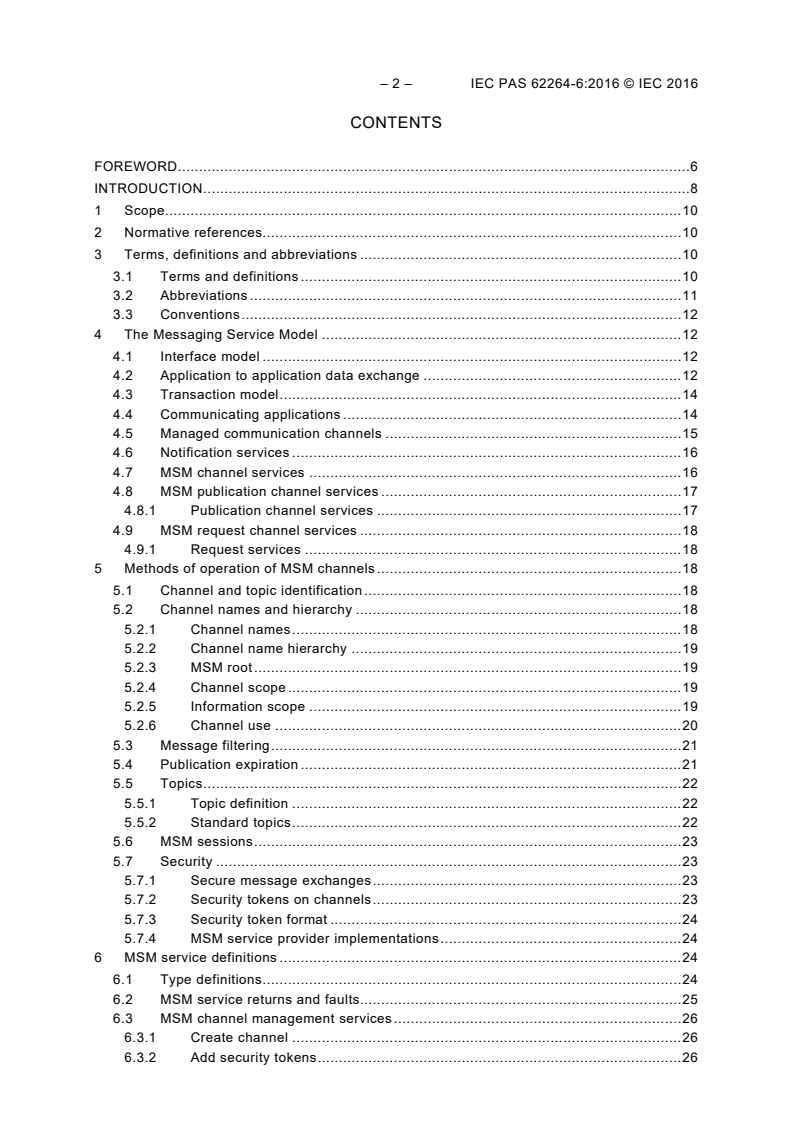
– 2 – IEC PAS 62264-6:2016 © IEC 2016
CONTENTS
FOREWORD . 6
INTRODUCTION . 8
1 Scope . 10
2 Normative references. 10
3 Terms, definitions and abbreviations . 10
3.1 Terms and definitions . 10
3.2 Abbreviations . 11
3.3 Conventions . 12
4 The Messaging Service Model . 12
4.1 Interface model . 12
4.2 Application to application data exchange . 12
4.3 Transaction model . 14
4.4 Communicating applications . 14
4.5 Managed communication channels . 15
4.6 Notification services . 16
4.7 MSM channel services . 16
4.8 MSM publication channel services . 17
4.8.1 Publication channel services . 17
4.9 MSM request channel services . 18
4.9.1 Request services . 18
5 Methods of operation of MSM channels . 18
5.1 Channel and topic identification . 18
5.2 Channel names and hierarchy . 18
5.2.1 Channel names . 18
5.2.2 Channel name hierarchy . 19
5.2.3 MSM root . 19
5.2.4 Channel scope . 19
5.2.5 Information scope . 19
5.2.6 Channel use . 20
5.3 Message filtering . 21
5.4 Publication expiration . 21
5.5 Topics . 22
5.5.1 Topic definition . 22
5.5.2 Standard topics . 22
5.6 MSM sessions . 23
5.7 Security . 23
5.7.1 Secure message exchanges . 23
5.7.2 Security tokens on channels . 23
5.7.3 Security token format . 24
5.7.4 MSM service provider implementations . 24
6 MSM service definitions . 24
6.1 Type definitions . 24
6.2 MSM service returns and faults. 25
6.3 MSM channel management services . 26
6.3.1 Create channel . 26
6.3.2 Add security tokens . 26
6.3.3 Remove security tokens . 26
6.3.4 Delete channel . 27
6.3.5 Get channel . 27
6.3.6 Get channels . 28
6.4 Notify listener service . 28
6.4.1 Notify listener . 28
6.5 MSM provider publication services . 28
6.5.1 Open publication session . 28
6.5.2 Post publication . 29
6.5.3 Expire publication . 29
6.5.4 Close publication session . 30
6.6 MSM consumer publication services . 30
6.6.1 Open subscription session . 30
6.6.2 Read publication . 30
6.6.3 Remove publication . 31
6.6.4 Close subscription session . 31
6.7 MSM provider request services . 32
6.7.1 Open provider request session . 32
6.7.2 Read request . 32
6.7.3 Remove request . 32
6.7.4 Post response . 33
6.7.5 Close provider request session . 33
6.8 MSM consumer request services . 34
6.8.1 Open consumer request session . 34
6.8.2 Post request . 34
6.8.3 Read response . 34
6.8.4 Remove response . 35
6.8.5 Close consumer request session . 35
7 Scenarios . 36
7.1 Publish-subscribe scenarios . 36
7.1.1 Simple publish-subscribe scenario . 36
7.1.2 Publish-subscribe scenario with multiple messages . 36
7.1.3 Publish-subscribe scenario without notification . 37
7.1.4 Multiple publishers scenario . 38
7.1.5 Publish-subscribe scenario with publication expiration . 39
7.2 Request channel scenarios . 40
7.2.1 Request-response scenario with notification . 40
7.2.2 Request-response scenario without notification . 41
7.2.3 Multiple providers . 42
8 Compliance . 43
Annex A (informative) MSM service provider considerations . 44
A.1 Service provider considerations . 44
A.2 Notification . 44
A.3 Security considerations . 44
A.4 MSM application implementation considerations . 44
A.5 MSM channel security considerations . 44
A.6 MSM session ID considerations . 45
A.7 Data format validation . 45
A.8 Allowed application checking . 45
– 4 – IEC PAS 62264-6:2016 © IEC 2016
A.9 Data exchange logging . 45
A.10 Common error handling . 45
A.11 Data transformation services . 45
A.12 Cross company bridges . 46
A.13 Message maintenance . 47
Annex B (informative) Enterprise Service Buses . 48
Bibliography . 50
Figure 1 – Steps in application-to-application communication . 9
Figure 2 – Application communication stack . 13
Figure 3 – Defined standards at each level . 14
Figure 4 – Messaging service model names . 15
Figure 5 – MSM channel management services . 17
Figure 6 – MSM publication channel services . 17
Figure 7 – Services for request/response . 18
Figure 8 – Changes and checkpoint channel example . 21
Figure 9 – Security of channels . 24
Figure 10 – Publication scenario with notification . 36
Figure 11 – Publication scenario with multiple messages . 37
Figure 12 – Publication scenario without notification . 38
Figure 13 – Publication scenario with multiple provider applications . 39
Figure 14 – Publication scenario with expired publications . 40
Figure 15 – GET/SHOW request service scenario . 41
Figure 16 – CHANGE / RESPONSE request service scenario . 42
Figure 17 – Multiple providers CHANGE/RESPONSE scenario . 43
Figure A.1 – Transformation services with the MSM service provider . 46
Figure A.2 – Cross company bridge between multiple MSMs . 47
Figure B.1 – Standard interface to ESBs and other message exchange systems . 49
Table 1 – MSM type definitions . 25
Table 2 – MSM service returns and fault definitions . 25
Table 3 – Create channel . 26
Table 4 – Add security token . 26
Table 5 – Remove security token . 27
Table 6 – Delete channel . 27
Table 7 – Get channel . 27
Table 8 – Get channels . 28
Table 9 – Notify listener . 28
Table 10 – Open publication session . 29
Table 11 – Post publication . 29
Table 12 – Expire publication . 29
Table 13 – Close publication session . 30
Table 14 – Open subscription session . 30
Table 15 – Read publication . 31
Table 16 – Remove publication . 31
Table 17 – Close subscription session . 31
Table 18 – Open provider request session . 32
Table 19 – Read request . 32
Table 20 – Remove request . 33
Table 21 – Post response . 33
Table 22 – Close provider request session . 33
Table 23 – Open consumer request session . 34
Table 24 – Post request . 34
Table 25 – Read response . 35
Table 26 – Remove response . 35
Table 27 – Close consumer request session . 35
– 6 – IEC PAS 62264-6:2016 © IEC 2016
INTERNATIONAL ELECTROTECHNICAL COMMISSION
____________
ENTERPRISE-CONTROL SYSTEM INTEGRATION –
Part 6: Messaging Service Model
FOREWORD
1) The International Electrotechnical Commission (IEC) is a worldwide organization for standardization comprising
all national electrotechnical committees (IEC National Committees). The object of IEC is to promote
international co-operation on all questions concerning standardization in the electrical and electronic fields. To
this end and in addition to other activities, IEC publishes International Standards, Technical Specifications,
Technical Reports, Publicly Available Specifications (PAS) and Guides (hereafter referred to as “IEC
Publication(s)”). Their preparation is entrusted to technical committees; any IEC National Committee interested
in the subject dealt with may participate in this preparatory work. International, governmental and non-
governmental organizations liaising with the IEC also participate in this preparation. IEC collaborates closely
with the International Organization for Standardization (ISO) in accordance with conditions determined by
agreement between the two organizations.
2) The formal decisions or agreements of IEC on technical matters express, as nearly as possible, an international
consensus of opinion on the relevant subjects since each technical committee has representation from all
interested IEC National Committees.
3) IEC Publications have the form of recommendations for international use and are accepted by IEC National
Committees in that sense. While all reasonable efforts are made to ensure that the technical content of IEC
Publications is accurate, IEC cannot be held responsible for the way in which they are used or for any
misinterpretation by any end user.
4) In order to promote international uniformity, IEC National Committees undertake to apply IEC Publications
transparently to the maximum extent possible in their national and regional publications. Any divergence
between any IEC Publication and the corresponding national or regional publication shall be clearly indicated in
the latter.
5) IEC itself does not provide any attestation of conformity. Independent certification bodies provide conformity
assessment services and, in some areas, access to IEC marks of conformity. IEC is not responsible for any
services carried out by independent certification bodies.
6) All users should ensure that they have the latest edition of this publication.
7) No liability shall attach to IEC or its directors, employees, servants or agents including individual experts and
members of its technical committees and IEC National Committees for any personal injury, property damage or
other damage of any nature whatsoever, whether direct or indirect, or for costs (including legal fees) and
expenses arising out of the publication, use of, or reliance upon, this IEC Publication or any other IEC
Publications.
8) Attention is drawn to the Normative references cited in this publication. Use of the referenced publications is
indispensable for the correct application of this publication.
9) Attention is drawn to the possibility that some of the elements of this IEC Publication may be the subject of
patent rights. IEC shall not be held responsible for identifying any or all such patent rights.
A PAS is a technical specification not fulfilling the requirements for a standard, but made
available to the public.
IEC PAS 62264-6 has been processed by subcommittee 65E: Devices and integration in
enterprise systems, of IEC technical committee 65: Industrial-process measurement, control
and automation.
The text of this PAS is based on the This PAS was approved for publication
following document: by the P-members of the committee
concerned as indicated in the following
document
Draft PAS Report on voting
65E/476/PAS 65E/502/RVD
Following publication of this PAS, which is a pre-standard publication, the technical committee
or subcommittee concerned may transform it into an International Standard.
This PAS shall remain valid for an initial maximum period of 3 years starting from the
publication date. The validity may be extended for a single period up to a maximum of 3 years,
at the end of which it shall be published as another type of normative document, or shall be
withdrawn.
IMPORTANT – The 'colour inside' logo on the cover page of this publication indicates
that it contains colours which are considered to be useful for the correct
understanding of its contents. Users should therefore print this document using a
colour printer.
– 8 – IEC PAS 62264-6:2016 © IEC 2016
INTRODUCTION
This PAS is based on the use of ISA-95 object models defined in
ISA-95 Parts 2, 4 and 5 (Parts 1 and 3 do not contain object models) to define a set of
services that may be used to exchange information messages. It is recognized that other,
non-Part 6 sets of services are possible and are not deemed invalid as a result of this PAS.
This PAS defines a Messaging Service Model (MSM) for exchanging data exchange
messages in a publish/subscribe mode and a request/response mode. It defines a minimal
interface subset to message exchange systems.
The Messaging Service Model provides a method for applications to send and receive
messages from MSM service providers without regard to the underlying communication
mechanism, as part of a complete application-to-application communication protocol.
This PAS defines a set of services definitions that are designed to provide the functionality
needed for a vendor-independent method for sending and receiving data exchange messages
on a message exchange system, such as an Enterprise Service Bus (ESB).
The knowledge requirements to interface to just one message exchange system can be
immense, and are usually not transferable to a different system. MSM defines a single
interface, independent of the underlying services, for Level 3-3 and Level 4-3 communications.
This removes the need for vendors to build custom interface after custom interface, and for
end users to get locked into a single vendor because their investment prevents them from
reusing any of the integration efforts.
Enterprise-control system integration involves multiple different steps to exchange data
between different computer system applications, as shown in Figure 1.
a) The applications usually have different internal representations of exchanged objects in
their own local data stores. This representation is usually converted from the local format
to a commonly accepted global format. The ISA-95 Part 2 standard defines
representations of a global format for Level 4-3 data exchanges. The Part 4 standard
defines representations of a global format for Level 3-3 data exchanges. This conversion,
from local to global and global to local, is usually performed twice for any two-way
communications.
EXAMPLE 1 Assume two applications, ALPHA and BETA: the ALPHA application initiates a data exchange
with the BETA application, and BETA responds back to ALPHA. The format conversions are: ALPHA’s local
format to global format for the request data, global format to BETA’s local format for the request data, BETA’s
local format to global format for the response data, and global format to ALPHA’s format for the response data.
b) Conversion is performed to align the namespaces among the exchanging applications, and
is usually performed four times for any two-way communications.
EXAMPLE 2 Names for elements of data may be codes, tag names, or equipment identifiers.
EXAMPLE 3 Data which are represented in one element namespace, such as codes 1,2,3,4, may have a
different namespace in another application, such as codes Ok, Done, Error, Delay.
c) Once information is in the global format with appropriate global names, the exchanged
information is sent from one application to another application.
d) Messages are transported from one application to another, either within the same
computer environment or across computers. Transport mechanisms are defined in other
standards, such as TCP/IP and Ethernet standards.
e) When data exchange information is received, there are specific rules that define what
resultant data are to be returned. The transaction rules are defined in the ISA-95 Part 5
standard.
Figure 1 – Steps in application-to-application communication
– 10 – IEC PAS 62264-6:2016 © IEC 2016
ENTERPRISE-CONTROL SYSTEM INTEGRATION –
Part 6: Messaging Service Model
1 Scope
This part of IEC 62264, which is a PAS, defines a model of a set of messaging services for
information exchanges across Levels 3 and 4, and within Level 3, between applications
performing business and manufacturing activities. It defines a standard interface for
information exchange between systems.
2 Normative references
The following documents are referred to in the text in such a way that some or all of their
content constitutes requirements of this document. For dated references, only the edition
cited applies. For undated references, the latest edition of the referenced document (including
any amendments) applies.
ANSI/ISA-95.00.01-2010 (IEC 62264-1 Mod), Enterprise-Control System Integration – Part 1:
Models and Terminology
ANSI/ISA-95.00.02-2010 (IEC 62264-2 Mod), Enterprise-Control System Integration – Part 2:
Object Model Attributes
ANSI/ISA-95.00.04-2012, Enterprise-Control System Integration – Part 4: Objects and
Attributes for Manufacturing Operations Management Integration
ANSI/ISA-95.00.05-2013, Enterprise-Control System Integration – Part 5: Business-to-
Manufacturing Transactions
3 Terms, definitions and abbreviations
3.1 Terms and definitions
For the purposes of this document, the following terms and definitions apply.
ISO and IEC maintain terminological databases for use in standardization at the following
addresses:
• IEC Electropedia: available at http://www.electropedia.org/
• ISO Online browsing platform: available at http://www.iso.org/obp
3.1.1
channel description
text that describes a channel
3.1.2
channel type
primary use of a channel for publications or requests
3.1.3
channel URI
primary identifier for a channel
3.1.4
filter expression
filtering element that may be applied to messages on a channel
3.1.5
listener identification
implementation defined element that is used to indicate to an application when a new
message has arrived
3.1.6
message content
body of the message
3.1.7
message expiry
duration until the expiration of a publication message on a publication channel
3.1.8
message ID
identifier generated upon posting of a message to a channel in a session
3.1.9
namespace
collection of names or words that define a formal and distinct set
3.1.10
security token
physical device or software code used to gain access to a channel
3.1.11
session ID
identifier generated upon an application creating a session on a channel and provided to the
application for use in the MSM services
3.1.12
topic
identification of the information content in a message
3.2 Abbreviations
B2MML Business to Manufacturing Markup Language
CB (radio) Citizens’ Band radio
CCOM-ML Common Conceptual Object Model – Markup Language
ERP Enterprise Resource Planning
ESB Enterprise Service Bus
FTP File Transfer Protocol
HTTP Hypertext Transmission Protocol
JMS Java Message Service
MSM Messaging Service Model
MIMOSA An Operations and Maintenance Information Open System Alliance
OAG Open Applications Group
OAGIS Open Applications Group Integration Specification
OMAC The Organization for Machine Automation and Control
OpenO&M Open Operations and Maintenance Group
– 12 – IEC PAS 62264-6:2016 © IEC 2016
OPC-UA OPC-Unified Architecture
REST Representational State Transfer
RSS Really Simple Syndication
SOAP Simple Object Access Protocol
TCP/IP Transmission Control Protocol / Internet Protocol
UDDI Universal Description, Discovery and Integration
URI Universal Resource Identifier
WS_* World Wide Web Service standards
XML Extensible Markup Language
XSLT Extensible Stylesheet Language Transformations
3.3 Conventions
Input and returned parameters defined in Clause 6 are required unless they are explicitly
defined as optional.
4 The Messaging Service Model
4.1 Interface model
The MSM defines a standard set of services that shall be provided by an application or
network service. The services provide a method for multiple applications to communicate
using the transaction models defined in the ISA-95.00.05 and IEC 62264-5 standards. The
MSM:
– does not define how the services are implemented,
– does not define the architecture of the supporting application or network service,
– does not define any specific underlying communication method.
The MSM provides a standard interface to an Enterprise Service Bus (ESB) system or to any
other message or file exchange system that offers guaranteed message delivery, message
sequencing, and storage or caching of exchanged messages.
NOTE 1 Multiple different implementations are envisioned, such as a service using OPC UA, a service using FTP,
or a service using an ESB.
NOTE 2 The MSM service will have to include some method for storage or caching of exchanged information, and
some method of guaranteed message delivery.
The level of services not defined in this PAS, for example the type of security, reliability,
guaranteed delivery, quality of service, transformation capability, and other features would be
provided by the MSM Service Provider and provide differentiation between suppliers and
solutions.
4.2 Application to application data exchange
Application to application data exchange is represented in communication models as a single
“Application” layer. However, with the development of data object standards (such as ISA-95
models), data representation messages (such as B2MML, MIMOSA CCOM-ML and OAGIS
Nouns), and transaction messages (such as IEC 62264-5 and OAGIS 9.0 Verbs), means that
a simple single layer is insufficient to describe the complexity of object based application-to-
application transactional communication.
________________
See Annex B for a brief discussion on Enterprise Service Buses.
Two additional elements can be defined for application-to-application communication: a data
object definition and transaction message definition which communicate to the application
layer and the underlying exchange services, as shown in Figure 2.
MSM is a minimal interface subset that can reside on most exchange services and is based
on well-defined and structured data objects and transaction messages.
Application “A” Application “B”
Data Object Data Object
Transaction Transaction
MSM Interface MSM Interface
Application Application
Presentation Presentation
Session Session
Transport Transport
Network Network
Data Link Data Link
Physical Physical
Figure 2 – Application communication stack
Each of these layers addresses a specific element of application data exchange, as shown in
Figure 3:
a) A Data Object layer defines the meaning, format, and structure of the basic elements of
exchanged information.
NOTE 1 This layer uses application space specific definitions, such as the ISA-95.02 object definitions,
MESA B2MML, MIMOSA CCOM-ML objects, and “Nouns” defined in OAGIS.
b) A Transaction layer defines the meaning, format, and structure of actions to be taken on
the data objects.
NOTE 2 This layer can use IEC 62264-5 transaction style specific definitions. Another transaction layer
definition could be the OAGIS “Verb” definitions.
c) The MSM Service Interface defines a minimal interface to the Application layer’s
Exchange Services.
d) The application, presentation, session and lower level layers define the meaning, format,
and structure for coordination, buffering, and exchange of messages or files. These layers
contain transfer or exchange style specific definitions, such as Enterprise Service Buses,
Enterprise Message Delivery Systems, the OPC-UA specification
(IEC 62541 (all parts)), RSS, FTP, Named Pipes, Ethernet, TCP/IP, HTTP, and others.
Security
Security
– 14 – IEC PAS 62264-6:2016 © IEC 2016
Data Object
ISA-95.02, B2MML, MIMOSA, OAGIS, OMAC…
Transaction ISA-95.05 (IEC 62264-5), OAGIS
MSM Interface
Application
ESB, OPC UA, RSS, FTP,
Named Pipes,
Presentation
Message Queue System, …
SOAP, WS_*…
Session
OSI Stack
Transport
Network
Ethernet, TCP/IP, HTTP, …
IEEE 802.xx, …
Data Link
Physical
Figure 3 – Defined standards at each level
The ISA-95.05 and IEC 62264-5 standards define transactions on the information. The
Messaging Service Model (MSM) defines an interface to methods for exchange. In a sense,
MSM defines the standard “on-ramp” and "off-ramp" to a set of communication services. It
defines how data is placed into exchange methods and how it is retrieved from the exchange
methods.
NOTE 1 Message synchronization at the MSM interface is distinct from the message synchronization provided by
ISA-95.05 transaction models as well as distinct from the synchronization mechanisms provided at lower levels of
the communications stack.
NOTE 2 In this PAS, asynchronous message exchanges between consumers and producers can be considered to
be pairs of distinct, unidirectional messages.
4.3 Transaction model
The ISA-95.05 and IEC 62264-5 standards define three models for business transactions: a
publish model, a push model, and a pull model .
The MSM defines a standard interface for applications to exchange data following any of the
ISA-95.05 transaction models using XML schemas to represent data.
The transactions supported by the MSM support:
a) A publish-subscribe model with multiple subscribers and multiple publishers, where the
publishers and subscribers have no direct knowledge of other applications.
b) A push and pull model, also called a request-response model, where an application sends
unsolicited requests for a service and has no direct knowledge of the receiving application
that will process the request.
4.4 Communicating applications
ISA-95 and IEC 62264 define four roles:
1) Information Provider (to receive GET messages and send SYNC messages),
2) Information Receiver (to receive PROCESS, CHANGE, and CANCEL messages),
________________
See the ISA-95 standards for a complete description of the types and format for transactions.
Security
3) Information Users (to send GET messages and receive SYNC messages),
4) Information Sender (to send PROCESS, CHANGE, and CANCEL messages).
In the MSM model, these are simplified to Provider Application (Information Provider and
Information Receiver) and Consumer Application (Information User and Information Sender),
as shown in Figure 4.
The Provider Application is the owner of data. The Provider Application can publish changes
to the data, can receive requests to change the data, and respond to queries for the data.
NOTE The phrase “owner of data” is used to identify the application that has responsibility for enforcing the
consistency of data.
An application can be a provider application, consumer application or both. If an application is
both, then it should be a consumer of different data than it provides.
Information Provider Information User
ISA 95 Names
Information Receiver Information Sender
Consumer
Application
Provider
Application
Consumer
MSM
MSM Names
Application
Services
Provider
Application
Consumer
Application
Figure 4 – Messaging service model names
4.5 Managed communication channels
The MSM is based on the concept of managed communication channels. A channel is a
software object that represents a specific many-to-many communication conduit between
applications. Some channels are for requests and responses, some channels are for general
information distribution. Channels have topics.
NOTE 1 An analogy for an MSM channel is a channel on a CB radio.
NOTE 2 An analogy for a topic is a conversation topic on a CB channel. Users can choose to listen to some topics
on the channel but ignore others.
NOTE 3 The assumption of this PAS is that the MSM services are provided by a communication application,
middleware, or an ESB provider. The implementation method for the MSM services is not defined in this PAS and
multiple architectures are possible, such as an OPC-UA implementation, an FTP based system, shared directories,
a message queuing system implementation, or an RSS implementation.
The MSM provides a definition of the standard interfaces to the services (not how they are
implemented).
A managed communication channel is called an MSM Channel.
The services provided for each MSM Channel are the MSM Channel Services.
An MSM Channel is identified using a URI or equivalent identifier. A URI is recommended to
allow a hierarchy of channel definitions that match a company’s physical or application
structures, such as channels identified by plant site or major application suite name.
– 16 – IEC PAS 62264-6:2016 © IEC 2016
An MSM Service Provider is the application or network service that exposes and implements
the MSM Channel Services.
A recommended structure for the MSM Channel hierarchy is defined in this PAS.
Each MSM Channel supports three general types of information exchange:
A – Publications – Information that may be sent to multiple consumer applications.
B – Requests – Information that may be sent to one or more provider applications.
C – Responses – Information returned from a request to a consumer application.
Each MSM Channel supports two way communications between provider applications and
consumer applications.
a) An MSM Channel may be created to support either publication services or request
services.
b) A Provider Application may post publications to an MSM Publication Channel.
c) Consumer Applications may subscribe to publication notifications (if supported by the
specific MSM Publication Channel Service) and may read publications. If notifications are
not supported, then the Consumer Application may poll the MSM Publication Channel
using the read publication service.
d) A Consumer Application may post requests to an MSM Request Channel.
e) A Provider Application may subscribe to request notifications (if supported by
...