


IEC 62129-3:2019
(Main)Calibration of wavelength/optical frequency measurement instruments - Part 3:Optical frequency meters internally referenced to a frequency comb
General Information
- Abstract
IEC 62129-3:2019 describes the calibration of optical frequency meters using an optical frequency comb as an internal reference. It is applicable to instruments measuring the optical frequency emitted from sources that are typical for the fibre-optic communications industry. It is assumed that the optical radiation will be coupled to the optical frequency meter by a single-mode optical fibre. This document is part of the IEC 62129 series on the calibration of wavelength/optical frequency measurement instruments. Refer to IEC 621291 [3] for the calibration of optical spectrum analyzers, and refer to IEC 62129-2 [4] for calibration of Michelson interferometer single wavelength meters. This first edition cancels and replaces IEC TS 62129-3, published in 2014. This edition includes the following significant technical changes with respect to the previous edition:
a) text has been added to 5.2.3 about calibration at a second optical frequency;
b) Annex D is now normative;
c) Subclause 4.2 has been improved;
d) measurement method of frequency has been moved to Annex B;
e) example of optical frequency comb has been moved to Annex C;
f) frequency-dependence uncertainty has been moved to Annex D.
Keywords: calibration of optical frequency meters
- Status
- Withdrawn
- Publication Date
- 19-May-2019
- Withdrawal Date
- 03-Dec-2023
- Technical Committee
- TC 86 - Fibre optics
- Drafting Committee
- WG 4 - TC 86/WG 4
Buy Documents
IEC 62129-3:2019 - Calibration of wavelength/optical frequency measurement instruments - Part 3:Optical frequency meters internally referenced to a frequency comb Released:5/20/2019
Relations
- Effective Date
- 05-Sep-2023
Buy Documents
IEC 62129-3:2019 - Calibration of wavelength/optical frequency measurement instruments - Part 3:Optical frequency meters internally referenced to a frequency comb Released:5/20/2019
Get Certified
Connect with accredited certification bodies for this standard

IMQ S.p.A. (Certification)
Italian electrical product certification.

SLG Prüf- und Zertifizierungs GmbH
German testing and certification body.

UL Solutions
Global safety science company with testing, inspection and certification.
Sponsored listings
Frequently Asked Questions
IEC 62129-3:2019 is a standard published by the International Electrotechnical Commission (IEC). Its full title is "Calibration of wavelength/optical frequency measurement instruments - Part 3:Optical frequency meters internally referenced to a frequency comb". This standard covers: IEC 62129-3:2019 describes the calibration of optical frequency meters using an optical frequency comb as an internal reference. It is applicable to instruments measuring the optical frequency emitted from sources that are typical for the fibre-optic communications industry. It is assumed that the optical radiation will be coupled to the optical frequency meter by a single-mode optical fibre. This document is part of the IEC 62129 series on the calibration of wavelength/optical frequency measurement instruments. Refer to IEC 621291 [3] for the calibration of optical spectrum analyzers, and refer to IEC 62129-2 [4] for calibration of Michelson interferometer single wavelength meters. This first edition cancels and replaces IEC TS 62129-3, published in 2014. This edition includes the following significant technical changes with respect to the previous edition: a) text has been added to 5.2.3 about calibration at a second optical frequency; b) Annex D is now normative; c) Subclause 4.2 has been improved; d) measurement method of frequency has been moved to Annex B; e) example of optical frequency comb has been moved to Annex C; f) frequency-dependence uncertainty has been moved to Annex D. Keywords: calibration of optical frequency meters
IEC 62129-3:2019 describes the calibration of optical frequency meters using an optical frequency comb as an internal reference. It is applicable to instruments measuring the optical frequency emitted from sources that are typical for the fibre-optic communications industry. It is assumed that the optical radiation will be coupled to the optical frequency meter by a single-mode optical fibre. This document is part of the IEC 62129 series on the calibration of wavelength/optical frequency measurement instruments. Refer to IEC 621291 [3] for the calibration of optical spectrum analyzers, and refer to IEC 62129-2 [4] for calibration of Michelson interferometer single wavelength meters. This first edition cancels and replaces IEC TS 62129-3, published in 2014. This edition includes the following significant technical changes with respect to the previous edition: a) text has been added to 5.2.3 about calibration at a second optical frequency; b) Annex D is now normative; c) Subclause 4.2 has been improved; d) measurement method of frequency has been moved to Annex B; e) example of optical frequency comb has been moved to Annex C; f) frequency-dependence uncertainty has been moved to Annex D. Keywords: calibration of optical frequency meters
IEC 62129-3:2019 is classified under the following ICS (International Classification for Standards) categories: 01.040.29 - Electrical engineering (Vocabularies); 29.020 - Electrical engineering in general; 33.180.01 - Fibre optic systems in general. The ICS classification helps identify the subject area and facilitates finding related standards.
IEC 62129-3:2019 has the following relationships with other standards: It is inter standard links to IEC TS 62129-3:2014. Understanding these relationships helps ensure you are using the most current and applicable version of the standard.
IEC 62129-3:2019 is available in PDF format for immediate download after purchase. The document can be added to your cart and obtained through the secure checkout process. Digital delivery ensures instant access to the complete standard document.
Standards Content (Sample)
IEC 62129-3 ®
Edition 1.0 2019-05
INTERNATIONAL
STANDARD
NORME
INTERNATIONALE
colour
inside
Calibration of wavelength / optical frequency measurement instruments –
Part 3: Optical frequency meters internally referenced to a frequency comb
Étalonnage des appareils de mesure de longueur d'onde / appareil de mesure de
la fréquence optique –
Partie 3: Fréquencemètres optiques faisant référence en interne à un peigne de
fréquence
All rights reserved. Unless otherwise specified, no part of this publication may be reproduced or utilized in any form
or by any means, electronic or mechanical, including photocopying and microfilm, without permission in writing from
either IEC or IEC's member National Committee in the country of the requester. If you have any questions about IEC
copyright or have an enquiry about obtaining additional rights to this publication, please contact the address below or
your local IEC member National Committee for further information.
Droits de reproduction réservés. Sauf indication contraire, aucune partie de cette publication ne peut être reproduite ni
utilisée sous quelque forme que ce soit et par aucun procédé, électronique ou mécanique, y compris la photocopie et
les microfilms, sans l'accord écrit de l'IEC ou du Comité national de l'IEC du pays du demandeur. Si vous avez des
questions sur le copyright de l'IEC ou si vous désirez obtenir des droits supplémentaires sur cette publication, utilisez
les coordonnées ci-après ou contactez le Comité national de l'IEC de votre pays de résidence.
IEC Central Office Tel.: +41 22 919 02 11
3, rue de Varembé info@iec.ch
CH-1211 Geneva 20 www.iec.ch
Switzerland
About the IEC
The International Electrotechnical Commission (IEC) is the leading global organization that prepares and publishes
International Standards for all electrical, electronic and related technologies.
About IEC publications
The technical content of IEC publications is kept under constant review by the IEC. Please make sure that you have the
latest edition, a corrigendum or an amendment might have been published.
IEC publications search - webstore.iec.ch/advsearchform Electropedia - www.electropedia.org
The advanced search enables to find IEC publications by a The world's leading online dictionary on electrotechnology,
variety of criteria (reference number, text, technical containing more than 22 000 terminological entries in English
committee,…). It also gives information on projects, replaced and French, with equivalent terms in 16 additional languages.
and withdrawn publications. Also known as the International Electrotechnical Vocabulary
(IEV) online.
IEC Just Published - webstore.iec.ch/justpublished
Stay up to date on all new IEC publications. Just Published IEC Glossary - std.iec.ch/glossary
details all new publications released. Available online and once 67 000 electrotechnical terminology entries in English and
a month by email. French extracted from the Terms and Definitions clause of IEC
publications issued since 2002. Some entries have been
IEC Customer Service Centre - webstore.iec.ch/csc collected from earlier publications of IEC TC 37, 77, 86 and
If you wish to give us your feedback on this publication or need CISPR.
further assistance, please contact the Customer Service
Centre: sales@iec.ch.
A propos de l'IEC
La Commission Electrotechnique Internationale (IEC) est la première organisation mondiale qui élabore et publie des
Normes internationales pour tout ce qui a trait à l'électricité, à l'électronique et aux technologies apparentées.
A propos des publications IEC
Le contenu technique des publications IEC est constamment revu. Veuillez vous assurer que vous possédez l’édition la
plus récente, un corrigendum ou amendement peut avoir été publié.
Recherche de publications IEC - Le premier dictionnaire d'électrotechnologie en ligne au monde,
webstore.iec.ch/advsearchform avec plus de 22 000 articles terminologiques en anglais et en
La recherche avancée permet de trouver des publications IEC français, ainsi que les termes équivalents dans 16 langues
en utilisant différents critères (numéro de référence, texte, additionnelles. Egalement appelé Vocabulaire
comité d’études,…). Elle donne aussi des informations sur les Electrotechnique International (IEV) en ligne.
projets et les publications remplacées ou retirées.
Glossaire IEC - std.iec.ch/glossary
IEC Just Published - webstore.iec.ch/justpublished 67 000 entrées terminologiques électrotechniques, en anglais
Restez informé sur les nouvelles publications IEC. Just et en français, extraites des articles Termes et Définitions des
Published détaille les nouvelles publications parues. publications IEC parues depuis 2002. Plus certaines entrées
Disponible en ligne et une fois par mois par email. antérieures extraites des publications des CE 37, 77, 86 et
CISPR de l'IEC.
Service Clients - webstore.iec.ch/csc
Si vous désirez nous donner des commentaires sur cette
publication ou si vous avez des questions contactez-nous:
sales@iec.ch.
Electropedia - www.electropedia.org
IEC 62129-3 ®
Edition 1.0 2019-05
INTERNATIONAL
STANDARD
NORME
INTERNATIONALE
colour
inside
Calibration of wavelength / optical frequency measurement instruments –
Part 3: Optical frequency meters internally referenced to a frequency comb
Étalonnage des appareils de mesure de longueur d'onde / appareil de mesure de
la fréquence optique –
Partie 3: Fréquencemètres optiques faisant référence en interne à un peigne de
fréquence
INTERNATIONAL
ELECTROTECHNICAL
COMMISSION
COMMISSION
ELECTROTECHNIQUE
INTERNATIONALE
ICS 33.180.01 ISBN 978-2-8322-6922-0
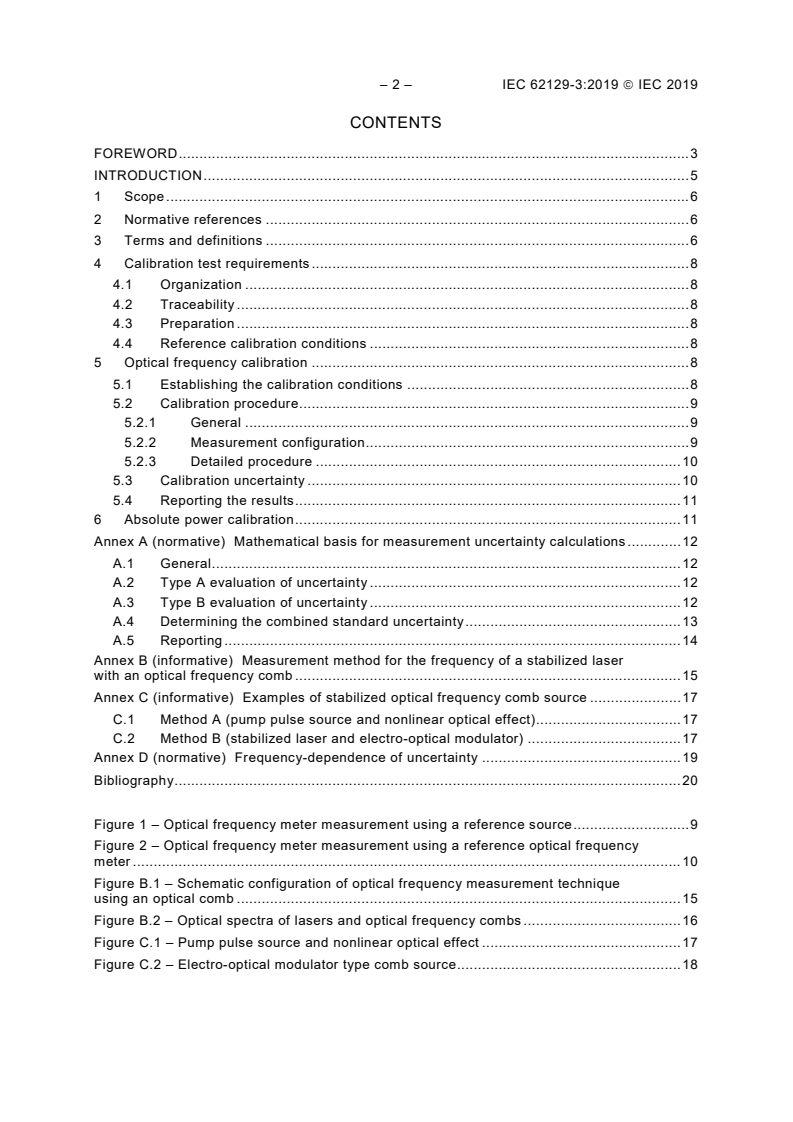
– 2 – IEC 62129-3:2019 IEC 2019
CONTENTS
FOREWORD . 3
INTRODUCTION . 5
1 Scope . 6
2 Normative references . 6
3 Terms and definitions . 6
4 Calibration test requirements . 8
4.1 Organization . 8
4.2 Traceability . 8
4.3 Preparation . 8
4.4 Reference calibration conditions . 8
5 Optical frequency calibration . 8
5.1 Establishing the calibration conditions . 8
5.2 Calibration procedure . 9
5.2.1 General . 9
5.2.2 Measurement configuration . 9
5.2.3 Detailed procedure . 10
5.3 Calibration uncertainty . 10
5.4 Reporting the results . 11
6 Absolute power calibration . 11
Annex A (normative) Mathematical basis for measurement uncertainty calculations . 12
A.1 General . 12
A.2 Type A evaluation of uncertainty . 12
A.3 Type B evaluation of uncertainty . 12
A.4 Determining the combined standard uncertainty . 13
A.5 Reporting . 14
Annex B (informative) Measurement method for the frequency of a stabilized laser
with an optical frequency comb . 15
Annex C (informative) Examples of stabilized optical frequency comb source . 17
C.1 Method A (pump pulse source and nonlinear optical effect) . 17
C.2 Method B (stabilized laser and electro-optical modulator) . 17
Annex D (normative) Frequency-dependence of uncertainty . 19
Bibliography . 20
Figure 1 – Optical frequency meter measurement using a reference source . 9
Figure 2 – Optical frequency meter measurement using a reference optical frequency
meter . 10
Figure B.1 – Schematic configuration of optical frequency measurement technique
using an optical comb . 15
Figure B.2 – Optical spectra of lasers and optical frequency combs . 16
Figure C.1 – Pump pulse source and nonlinear optical effect . 17
Figure C.2 – Electro-optical modulator type comb source . 18
INTERNATIONAL ELECTROTECHNICAL COMMISSION
____________
CALIBRATION OF WAVELENGTH /
OPTICAL FREQUENCY MEASUREMENT INSTRUMENTS –
Part 3: Optical frequency meters internally
referenced to a frequency comb
FOREWORD
1) The International Electrotechnical Commission (IEC) is a worldwide organization for standardization comprising
all national electrotechnical committees (IEC National Committees). The object of IEC is to promote international
co-operation on all questions concerning standardization in the electrical and electronic fields. To this end and
in addition to other activities, IEC publishes International Standards, Technical Specifications, Technical Reports,
Publicly Available Specifications (PAS) and Guides (hereafter referred to as "IEC Publication(s)"). Their
preparation is entrusted to technical committees; any IEC National Committee interested in the subject dealt with
may participate in this preparatory work. International, governmental and non-governmental organizations liaising
with the IEC also participate in this preparation. IEC collaborates closely with the International Organization for
Standardization (ISO) in accordance with conditions determined by agreement between the two organizations.
2) The formal decisions or agreements of IEC on technical matters express, as nearly as possible, an international
consensus of opinion on the relevant subjects since each technical committee has representation from all
interested IEC National Committees.
3) IEC Publications have the form of recommendations for international use and are accepted by IEC National
Committees in that sense. While all reasonable efforts are made to ensure that the technical content of IEC
Publications is accurate, IEC cannot be held responsible for the way in which they are used or for any
misinterpretation by any end user.
4) In order to promote international uniformity, IEC National Committees undertake to apply IEC Publications
transparently to the maximum extent possible in their national and regional publications. Any divergence between
any IEC Publication and the corresponding national or regional publication shall be clearly indicated in the latter.
5) IEC itself does not provide any attestation of conformity. Independent certification bodies provide conformity
assessment services and, in some areas, access to IEC marks of conformity. IEC is not responsible for any
services carried out by independent certification bodies.
6) All users should ensure that they have the latest edition of this publication.
7) No liability shall attach to IEC or its directors, employees, servants or agents including individual experts and
members of its technical committees and IEC National Committees for any personal injury, property damage or
other damage of any nature whatsoever, whether direct or indirect, or for costs (including legal fees) and
expenses arising out of the publication, use of, or reliance upon, this IEC Publication or any other IEC Publications.
8) Attention is drawn to the Normative references cited in this publication. Use of the referenced publications is
indispensable for the correct application of this publication.
9) Attention is drawn to the possibility that some of the elements of this IEC Publication may be the subject of patent
rights. IEC shall not be held responsible for identifying any or all such patent rights.
International Standard IEC 62129-3 has been prepared by IEC technical committee 86: Fibre
optics.
This first edition cancels and replaces IEC TS 62129-3, published in 2014.
This edition includes the following significant technical changes with respect to the previous
edition:
a) text has been added to 5.2.3 about calibration at a second optical frequency;
b) Annex D is now normative;
c) Subclause 4.2 has been improved;
d) measurement method of frequency has been moved to Annex B;
e) example of optical frequency comb has been moved to Annex C;
f) frequency-dependence uncertainty has been moved to Annex D.
– 4 – IEC 62129-3:2019 IEC 2019
The text of this International Standard is based on the following documents:
FDIS Report on voting
86/551/FDIS 86/554/RVD
Full information on the voting for the approval of this International Standard can be found in the
report on voting indicated in the above table.
This document has been drafted in accordance with the ISO/IEC Directives, Part 2.
A list of all parts in the IEC 62129 series, published under the general title Calibration of
wavelength/optical frequency measurement instruments, can be found on the IEC website.
The committee has decided that the contents of this document will remain unchanged until the
stability date indicated on the IEC website under "http://webstore.iec.ch" in the data related to
the specific document. At this date, the document will be
• reconfirmed,
• withdrawn,
• replaced by a revised edition, or
• amended.
IMPORTANT – The 'colour inside' logo on the cover page of this publication indicates
that it contains colours which are considered to be useful for the correct understanding
of its contents. Users should therefore print this document using a colour printer.
INTRODUCTION
It is essential for realizing fibre optic systems that optical channels are defined in the optical
frequency domain, not the wavelength domain. One example: the anchor frequency of the ITU-
T grid is 193,1 THz, and the channel spacings of the ITU-T grid are 12,5 GHz, 25 GHz, 50 GHz,
and 100 GHz [1] .
ITU-T has also discussed λ-interface systems such as "black link" [2]. "Black link" includes
WDM MUX/DEMUX and a transmission fibre, and provides λ-interfaces. Especially in DWDM
systems (channel spacing < 100 GHz), the uncertainty in specifying optical frequency needs to
be minimized.
To implement future telecom systems, it is expected that optical frequency measurements will
need to be extremely precise. For example, to achieve the channel spacing of 25 GHz, signal
optical frequency uncertainty (Uf ) and required measurement uncertainty (Uf ) need to be
sig meas
-5 -6 -6 -8
2 GHz to 200 MHz (Uf / f = 10 to 10 ) and 200 MHz to 2 MHz (Uf / f = 10 to 10 ),
sig meas
respectively. Unfortunately, conventional wavelength meters have measurement uncertainties
-6 -7
of 10 to 10 . The solution is to use optical frequency measurements since measurement
-9
uncertainties can be as small as 10 , which satisfies the above telecom requirement
-6 -8
(Uf / f = 10 to 10 ). Therefore, an optical frequency measurement scheme is necessary
meas
for the calibration of future telecom systems.
The frequency meter to calibrate with the procedure described in this document is the
measurement equipment internally utilizing the optical frequency comb. In Annex A, the
mathematical basis for the uncertainty of measurement is described. The measurement
procedure of the frequency with the frequency meter utilizing the optical frequency comb is
shown in Annex B and the example of the optical frequency comb sources are shown in Annex C.
Additionally, the uncertainty depending on the frequency is shown in Annex D.
This document defines all the steps involved in the calibration process of the frequency
measuring with the optical frequency meter internally utilizing an optical frequency comb:
establishing the calibration conditions, carrying out the calibration, calculating the uncertainty,
and reporting the uncertainty, the calibration conditions and the traceability.
____________
Numbers in square brackets refer to the Bibliography.
– 6 – IEC 62129-3:2019 IEC 2019
CALIBRATION OF WAVELENGTH /
OPTICAL FREQUENCY MEASUREMENT INSTRUMENTS –
Part 3: Optical frequency meters internally
referenced to a frequency comb
1 Scope
This part of IEC 62129 describes the calibration of optical frequency meters using an optical
frequency comb as an internal reference. It is applicable to instruments measuring the optical
frequency emitted from sources that are typical for the fibre-optic communications industry. It
is assumed that the optical radiation will be coupled to the optical frequency meter by a single-
mode optical fibre. This document is part of the IEC 62129 series on the calibration of
wavelength/optical frequency measurement instruments. Refer to IEC 62129-1 [3] for the
calibration of optical spectrum analyzers, and refer to IEC 62129-2 [4] for calibration of
Michelson interferometer single wavelength meters.
2 Normative references
The following documents are referred to in the text in such a way that some or all of their content
constitutes requirements of this document. For dated references, only the edition cited applies.
For undated references, the latest edition of the referenced document (including any
amendments) applies.
IEC 60793-2-50, Optical fibres – Part 2-50: Product specifications – Sectional specification for
class B single-mode fibres
IEC 60825-1, Safety of laser products – Part 1: Equipment classification and requirements
IEC 60825-2, Safety of laser products – Part 2: Safety of optical fibre communication systems
(OFCS)
IEC TR 61931, Fibre optic – Terminology
ISO/IEC Guide 98-3:2008, Uncertainty of measurement – Part 3: Guide to the expression of
uncertainty in measurement (GUM:1995)
3 Terms and definitions
For the purposes of this document, the terms and definitions given in IEC TR 61931, and the
following apply.
ISO and IEC maintain terminological databases for use in standardization at the following
addresses:
• IEC Electropedia: available at http://www.electropedia.org/
• ISO Online browsing platform: available at http://www.iso.org/obp
3.1
accredited calibration laboratory
calibration laboratory authorized by the appropriate national organization to issue calibration
certificates with a minimum specified uncertainty, which demonstrate traceability to national
measurement standards (3.3)
3.2
calibration
set of operations that establish, under specified conditions, the relationship between the values
of quantities indicated by a measuring instrument and the corresponding values realized by
measurement standards
Note 1 to entry: The result of a calibration permits either the assignment of values of measurands to the indications
or the determination of corrections with respect to indications.
Note 2 to entry: A calibration may also determine other metrological properties such as the effect of influence
quantities.
Note 3 to entry: The result of a calibration may be recorded in a document, sometimes called a calibration certificate
or a calibration report.
[SOURCE: ISO/IEC Guide 99:2007 [5], 2.39, modified – Only the first part of the definition has
been used and the notes to entry have been modified.]
3.3
national measurement standard
standard recognized by a national decision to serve, in a country, as the basis for assigning
values to other standards for the quantity concerned
[ISO/IEC Guide 99:2007, 5.3, modified – Some terms have been replaced with similar meaning.]
3.4
reference standard
standard, generally having the highest metrological quality available at a given location or in a
given organization, from which measurements made therein are derived
Note 1 to entry: The general definition of this term is described in ISO/IEC Guide 99:2007, 5.6.
3.5
traceability
property of the result of a measurement or the value of a measurement standard whereby it can
be related to stated references, usually national or international measurement standards,
through an unbroken chain of comparisons all having stated uncertainties
Note 1 to entry: The general definition of this term is described in ISO/IEC Guide 99:2007, 2.41.
3.6
traceability chain
unbroken chain of comparison
Note 1 to entry: The general definition of this term is described in ISO/IEC Guide 99:2007, 2.42.
3.7
working standard
measurement standard that is used routinely to calibrate or check measuring instruments
Note 1 to entry: A working standard is usually calibrated against a reference standard.
Note 2 to entry: The general definition of this term is described in ISO/IEC Guide 99:2007, 5.7.
– 8 – IEC 62129-3:2019 IEC 2019
4 Calibration test requirements
4.1 Organization
The calibration laboratory should ensure that suitable requirements for calibration are followed.
NOTE Guidance about good practices for calibration can be found in ISO/IEC 17025 [6].
There shall be a documented measurement procedure for each type of calibration performed,
giving step-by-step operating instructions and equipment to be used.
4.2 Traceability
The calibration laboratory should ensure that suitable requirements for traceability are followed.
NOTE Guidance about good practices for traceability can be found in ISO/IEC 17025.
Make sure that any test equipment which has a significant influence on the calibration results
is calibrated. Upon request, specify this test equipment and its calibration chain(s). The
recalibration period(s) shall be defined and documented.
4.3 Preparation
The environmental conditions shall be commensurate with the degree of uncertainty that is
required for calibration:
a) the environment shall be clean;
b) temperature monitoring and control is required;
c) all laser sources shall be safely operated (refer to IEC 60825-1 and to IEC 60825-2).
4.4 Reference calibration conditions
The reference calibration conditions usually include the following parameters and, if necessary,
their tolerance bands: date, temperature, relative humidity, displayed power level, displayed
optical frequency, fibre, (spectral) bandwidth and resolution bandwidth (spectral resolution) set.
Unless otherwise specified, use a single-mode optical fibre input pigtail as specified in
IEC 60793-2-50, having a length of at least 2 m.
The calibration should be made in a temperature-controlled environment. The recommended
temperature is 23 °C. Depending on the desired uncertainty, the temperature, atmospheric
pressure and humidity may need to be monitored during the measurement.
Operate the optical frequency meter in accordance with the manufacturer's specifications and
operating procedures. Where practical, select a range of test conditions and parameters which
emulate the actual field operating conditions of the optical frequency meter under test. Choose
these parameters so as to optimize the optical frequency meter's uncertainties, as specified by
the manufacturer's operating procedures.
NOTE The calibration results only apply to the set of test conditions used in the calibration process.
5 Optical frequency calibration
5.1 Establishing the calibration conditions
Establishing and maintaining the calibration conditions is an important part of the calibration,
because any change of these conditions is capable of producing erroneous measurement
results. The calibration conditions should be a close approximation to the intended operating
conditions. This ensures that the (additional) uncertainty in the operating environment is as
small as possible. The calibration conditions should be specified in the form of nominal values
with uncertainties when applicable. In order to meet the requirements of this document, the
calibration conditions shall at least consist of:
a) date of calibration;
b) ambient temperature, for example 23 °C. The temperature may need to be monitored
continuously to ensure that it remains within the requisite limits;
c) ambient relative humidity, for example 30 % to 70 %. The ambient relative humidity may
need to be monitored continuously to ensure that it remains within the requisite limits. A
relative humidity below the condensation point is assumed by default;
d) input optical power (that has to fall within the allowable specification for the optical
frequency meters);
e) if a transition locked source is used, then the quality of the lock shall be continuously
monitored during the measurements; a lock indicator can be sufficient.
The above conditions may not be exhaustive. There might be other parameters that have a
significant influence on the calibration uncertainty.
5.2 Calibration procedure
5.2.1 General
The main steps of the calibration procedure are as follows:
a) establish and record the appropriate calibration conditions (see 5.1). Switch on all
instrumentation and wait until it stabilizes;
b) set up the reference source in accordance with condition 5.1 d);
c) set up the instrument state of the test optical frequency meter according to the instruction
manual. Select appropriate units;
d) record the instrument states of the optical frequency meter.
5.2.2 Measurement configuration
Two possible configurations can be used for calibration. One uses a stabilized laser as shown
in Figure 1, and the other uses a reference frequency meter as shown in Figure 2.
Figure 1 shows the configuration using the reference source.
Figure 1 – Optical frequency meter measurement using a reference source
Figure 2 shows the configuration using a reference optical frequency meter.
It is necessary that the measurements be performed simultaneously on both the reference and
the test optical frequency meters.
– 10 – IEC 62129-3:2019 IEC 2019
Figure 2 – Optical frequency meter measurement
using a reference optical frequency meter
5.2.3 Detailed procedure
The measurement process is as follows:
a) allow the equipment to reach equilibrium;
b) configure the data acquisition software;
c) ensure that the optical source is operating correctly;
d) run the data acquisition software.
The correction factor (CF) is determined from the difference between the reference optical
frequency and the mean values from each measurement:
n
CF f − f
(1)
ref ∑ test
i
n
i=1
where
f is the reference optical frequency, which is the frequency of the reference stabilized laser
ref
in calibration of Figure 1 and the frequency of the reference frequency meter in calibration
of Figure 2, and
f is the optical frequency measured by the test optical frequency meter.
test
In order to obtain the statistical stability of the measurement, it is desirable to take 50 samples
(n), for example, per measurement.
It is recommended to repeat the measurement at a second reference optical frequency in case
there is an error in the comb spacing frequency. This is described in Annex D.
NOTE The number of measurements averaged per reading affects the size of the results file, the rejection of data
by the measurement routine, and the frequency stability of the reference source. A large number of samples per
measurement will increase the size of the data set used to check that the extreme data points are valid, and
uncertainty of the reference source frequency and the n can be determined with the method of statistical rejection of
outlying points described in Annex B of IEC 62129-2:2011.
5.3 Calibration uncertainty
The mathematical basis, Annex A, should be used to calculate and state the uncertainty. Note
that the following list may not be complete; additional contributions may have to be taken into
account, depending on the measurement setup and procedure:
=
a) stability measurement (drift of equipment during measurements taken over a long period of
time);
b) "on/off repeatability" measurement (uncertainty of measured value in repeat of on and off of
electric power supply);
c) frequency dependence measurement (difference in uncertainty due to measured frequency);
d) uncertainty of the reference frequency meter;
e) reference source uncertainty (how well the source is stabilized to the natural standard, for
example to a molecular absorption line);
f) display resolution of the test frequency meter (difference between the measured value and
displayed value that might be degraded due to resolution);
g) temperature and relative humidity (uncertainty of performance of components embedded in
the equipment due to environmental conditions).
5.4 Reporting the results
Suitable requirements for reporting the results of each calibration should be followed.
NOTE Guidance about good practices for reporting the results of calibration can be found in ISO/IEC 17025.
Calibration certificates referring to this document shall, at a minimum, include the following
information:
a) all calibration conditions of the calibration process as described in 5.1;
b) the test meter's correction factor(s) or deviation(s), if the test meter was not adjusted;
c) on receipt, correction factors or deviations and, after adjustment, correction factors or
deviations in the case that an adjustment was carried out;
d) the calibration uncertainty in the form of an expanded uncertainty as described in 5.3 and
Annex A;
e) the configuration of the test meter during the calibration;
f) evidence that the measurements are traceable (see ISO/IEC 17025).
6 Absolute power calibration
Currently, the frequency meter does not have the function to measure the optical power at a
specific optical frequency due to its measurement principle. If the frequency meter has a power
measurement capability in the future, then it shall be calibrated using the power meter
calibration procedure (IEC 61315 [7]).
– 12 – IEC 62129-3:2019 IEC 2019
Annex A
(normative)
Mathematical basis for measurement uncertainty calculations
A.1 General
This annex summarizes the form of evaluating, combining and reporting the uncertainty of
measurement. It is based on ISO/IEC Guide 98-3. Annex A shall be read in conjunction with
ISO/IEC Guide 98-3 for additional information.
This annex distinguishes two types of evaluation of uncertainty of measurement. Type A is the
method of evaluation of uncertainty by the statistical analysis of a series of measurements on
the same measurand. Type B is the method of evaluation of uncertainty based on other
knowledge.
A.2 Type A evaluation of uncertainty
Type A evaluation of standard uncertainty can be applied when several independent
observations have been made for a quantity under the same conditions of measurement.
For a quantity X estimated from n independent repeated observations X , the arithmetic mean is:
i
n
XX=
( ) (A.1)
∑ i
n
i=1
This mean is used as the estimate of the quantity, that is . The experimental standard
x = X
deviation of the observations is given by:
1/2
n
sX X− X
( ) (A.2)
( )
∑ i
n −1
i=1
where
X is the arithmetic mean of the observed values;
X are the measurement samples of a series of measurements;
i
n is the number of measurements; it is assumed to be large, for example, n ≥ 10.
The type A standard uncertainty u (x) associated with the estimate x is the experimental
typeA
standard deviation of the mean.
sX
( )
u x sX
( ) ( )
typeA
n
(A.3)
A.3 Type B evaluation of uncertainty
Type B evaluation of standard uncertainty is the method of evaluating the uncertainty by means
other than the statistical analysis of a series of observations. It is evaluated by scientific
judgement based on all available information on the variability of the quantity.
==
=
If the estimate x of a quantity X is taken from a manufacturer's specification, calibration
certificate, handbook, or other source and its quoted uncertainty U(x) is stated to be a multiple
k of a standard deviation, the standard uncertainty u(x) is simply the quoted value divided by
the multiplier:
Ux
( )
ux = (A.4)
( )
k
If only upper and lower limit X and X can be estimated for the value of the quantity X, a
max min
rectangular probability distribution is assumed.
The standard uncertainty is:
X −−x ,X x
( )
max min
MAX
ux = (A.5)
( )
The contribution to the standard uncertainty associated with the output estimate y resulting from
the standard uncertainty associated with the input estimate x is:
u y c×ux (A.6)
( ) ( )
where c is the sensitivity coefficient associated with the input estimate x, that is the partial
derivative of the model function y(x), evaluated at the input estimate x.
The sensitivity coefficient c describes the extent to which the output estimate y is influenced by
variations of the input estimate x. It can be evaluated by Equation (A.7) or by using numerical
methods, i.e. by calculating the change in the output estimate y due to a change in the input
estimate x from a model function. Sometimes it may be more appropriate to find the change in
the output estimate y due to the change of x from an experiment.
∂y
c =
∂x
(A.7)
A.4 Determining the combined standard uncertainty
Combined standard uncertainty is used to collect a number of individual uncertainties into a
single number. The combined standard uncertainty is based on statistical independence of the
individual uncertainties. It is calculated by root-sum-squaring all standard uncertainties
obtained from type A and type B evaluations.
n
uy = u y (A.8)
( ) ( )
ci∑
i=1
where
i is the current number of individual contributions;
u (y) are the standard uncertainty contributions;
i
n is the number of uncertainties.
NOTE Uncertainty contributions in Equation (A.8) that are smaller than 1/10 of the largest contribution are negligible,
because squaring them will reduce their significance to 1/100 of the largest contribution.
=
– 14 – IEC 62129-3:2019 IEC 2019
When the quantities above are to be used as the basis for further uncertainty computations, the
combined standard uncertainty, u , can be re-inserted into Equation (A.8). Despite its partial
c
type A origin, u should be considered as describing an uncertainty of type B.
c
A.5 Reporting
In calibration reports and technical data sheets, combined standard uncertainties shall be
reported in the form of expanded uncertainties together with the applicable level of confidence.
Correction factors or deviations shall be reported. The expanded uncertainty U is obtained by
multiplying the standard uncertainty u (y) by a coverage factor k:
c
U ku⋅ y (A.9)
( )
c
For a level of confidence of approximately 95 %, the default level, then k = 2. If a level of
confidence of approximately 99 % is chosen, then k = 3. The above values for k are valid under
some conditions (see GUM); if these conditions are not met, other coverage factors are to be
used to reach these levels of confidence.
=
Annex B
(informative)
Measurement method for the frequency of a stabilized laser
with an optical frequency comb
For optical frequency measurement, equally-spaced frequency comb lines (spacing of up to
50 GHz) from an optical frequency comb are utilized as a ruler for optical frequency
measurement [8 to 19]. Optical frequency measurements provide more accurate calibration than
interferometric wavelength measurements in air by eliminating the effects of refractive indices.
Some examples of practical optical frequency comb are shown in Annex C.
Figure B.1 is the schematic configuration of an optical frequency measurement technique that
uses optical frequency combs.
Figure B.1 – Schematic configuration of optical frequency
measurement technique using an optical comb
Figure B.2 shows the optical spectrum of the laser and the optical frequency comb. The optical
frequency comb generates an optical frequency comb with uniform spacing (f(comb spacing)
which is equal to the frequency of the electrical frequency standard driving the optical frequency
comb. f(comb spacing) is also equal to the pulse repetition rate. Thus, the uncertainty of comb
spacing is proportional to the uncertainty of the frequency of the electrical frequency standard.
The comb spacing generally lies between 100 MHz and 25 GHz. In this case, the stabilized
laser (f ) output is combined with the optical frequency comb, and then these two
stabilized laser
lights are input to an optical-electrical (O/E) converter. The beat frequency (f ) between the
beat
two lights is taken as the output of the O/E converter. The optical frequency (f ) of
stabilized laser
the stabilized laser can be calculated by Equation (B.1).
f fN± f (B.1)
( )
stabilized laser beat
Here, f(N) is the optical frequency of the N-th mode of optical frequency comb, and is the
summation of f and the carrier envelope offset frequency f , as shown in
comb spacing CEO
Equation (B.2).
(B.2)
fN =N× f + f
( )
comb spacing CEO
Here, N is the large integer, and can be determined with a wavelength meter. The sign of the
beat frequency (+ or −) can be deduced by changing f , f or f slightly.
stabilized laser comb spacing CEO
=
– 16 – IEC 62129-3:2019 IEC 2019
f is related to the pulse-to-pulse phase shift, ∆φ, between the peak of the electrical field
CEO
and the peak of the envelope [9], as shown in Equation (B.3).
f = Δ2φ/ π f
( ) (B.3)
CEO comb spacing
Key
f optical frequency
f stabilized laser frequency
stabilized laser
f comb spacing
comb spacing
f beat frequency
beat
f (N) optical frequency of the N-th comb mode
f carrier envelope offset frequency
CEO
Figure B.2 – Optical spectra of lasers and optical frequency combs
Annex C
(informative)
Examples of stabilized optical frequency comb source
C.1 Method A (pump pulse source and nonlinear optical effect)
Figure C.1 shows an optical comb system combining a pump pulse source and nonlinear optical
effects [8 to 17, 19]. The pump pulse source generates an optical pulse train with a repetition
rate of f . The pump pulse train is amplified when the pulse power is small. The
frequency standard
optical pulse train is input to a nonlinear material (fibre, etc.) and the resulting spectral
broadening can exceed an octave. By comparing the optical frequencies of the octave-
broadened comb with those of the second harmonic, one can stabilize and measure the
frequency offset (f ). The frequencies f and f are locked to the electrical
CEO CEO comb spacing
frequency standard, thus yielding a very stable optical comb without the use of an external
stabilized laser. The uncertainty of the optical comb is determined by that of the electrical
frequency standard, so very small values can be expected.
The pump pulse source can be realized with several sources. For example, a mode-locked laser
can be utilized. A titanium-doped sapphire (Ti:S) laser or a fibre laser can be used as the mode-
locked laser. These optical frequency comb systems can be extended to any IR wavelength
region (1 µm to 2 µm). As a second example, the supercontinuum (SC) comb source can be
utilized. SC is a spectral broadening phenomenon and is realized when nonlinear materials are
pumped by short optical pulses. It occurs due to the combined effects of self-phase modulation;
cross-phase modulation; parametric, four-wave mixing; and Raman scattering. A
superbroadened bandwidth of more than 200 nm (25 THz) with the spacing range from several
GHz to several 10 GHz at 1,5 µm and the uncertainty of 1 MHz for 25 GHz spacing in the
telecom bands has been reported [19].
Figure C.1 – Pump pulse source and nonlinear optical effect
C.2 Method B (stabilized laser and electro-optical modulator)
Figure C.2 shows an electro-optical modulator type comb source with a stabilized laser. The
stabilized laser output is amplified and then input into the electro-optical modulator which is
driven by an electrical frequency standard. This method has been reported to offer 5 THz
bandwidth optical comb generation with 6,25 GHz spacing [18].
– 18 – IEC 62129-3:2019 IEC 2019
Figure C.2 – Electro-optical modulator type comb source
Annex D
(normative)
Frequency-dependence of uncertainty
This annex describes how the frequency measurement uncertainty with frequency combs is
affected by the uncertainty of the frequency of the electrical frequency standard.
The uncertainty arising from the electrical frequency standards in Clauses C.1 and C.2 will
affect the mode spacing in a way that varies with comb mode number.
From Equation (B.1)
f = f+×N f ± f
(D.1)
meas 0 comb spacing beat
where f is the measured frequency value and f = f in Clause C.1 and f in
meas 0 CEO stabilized laser
Clause C.2. Therefore, the uncertainty in the comb spacing is multiplied by N, which varies
depending on the frequency of the tunable laser under test.
For example, when the uncertainty arising from the electric
...