


IEC PAS 63083:2017
(Main)Specific absorption rate (SAR) measurement procedure for long term evolution (LTE) devices
General Information
- Abstract
IEC PAS 63083:2017(E) applies to measurement procedures of Specific Absorption Rate (SAR) generated by devices with LTE (Long Term Evolution) technology specified by 3rd Generation Partnership Project (3GPP), Rel. 8 and 9 [1] where the devices are intended to be used with the radiating part in close proximity to the human head and body. This document supports both FDD and TDD modes. The objective of this document is to define the number of test conditions with respect to basic radio frequency aspects, i.e. channel bandwidths, number and offset of allocated resource blocks (RB), modulation, and maximum power reduction (MPR) for IEC 62209-1 and IEC 62209-2. This PAS is a technical specification not fulfilling the requirements for a standard, but made available to the public.
- Status
- Withdrawn
- Publication Date
- 29-Jan-2017
- Withdrawal Date
- 14-Sep-2022
- Technical Committee
- TC 106 - Methods for the assessment of electric, magnetic and electromagnetic fields associated with human exposure
- Drafting Committee
- MT 1 - TC 106/MT 1
- Current Stage
- WPUB - Publication withdrawn
- Start Date
- 19-Sep-2022
- Completion Date
- 15-Sep-2022
Get Certified
Connect with accredited certification bodies for this standard

BSI Group
BSI (British Standards Institution) is the business standards company that helps organizations make excellence a habit.

Bureau Veritas
Bureau Veritas is a world leader in laboratory testing, inspection and certification services.

DNV
DNV is an independent assurance and risk management provider.
Sponsored listings
Frequently Asked Questions
IEC PAS 63083:2017 is a technical specification published by the International Electrotechnical Commission (IEC). Its full title is "Specific absorption rate (SAR) measurement procedure for long term evolution (LTE) devices". This standard covers: IEC PAS 63083:2017(E) applies to measurement procedures of Specific Absorption Rate (SAR) generated by devices with LTE (Long Term Evolution) technology specified by 3rd Generation Partnership Project (3GPP), Rel. 8 and 9 [1] where the devices are intended to be used with the radiating part in close proximity to the human head and body. This document supports both FDD and TDD modes. The objective of this document is to define the number of test conditions with respect to basic radio frequency aspects, i.e. channel bandwidths, number and offset of allocated resource blocks (RB), modulation, and maximum power reduction (MPR) for IEC 62209-1 and IEC 62209-2. This PAS is a technical specification not fulfilling the requirements for a standard, but made available to the public.
IEC PAS 63083:2017(E) applies to measurement procedures of Specific Absorption Rate (SAR) generated by devices with LTE (Long Term Evolution) technology specified by 3rd Generation Partnership Project (3GPP), Rel. 8 and 9 [1] where the devices are intended to be used with the radiating part in close proximity to the human head and body. This document supports both FDD and TDD modes. The objective of this document is to define the number of test conditions with respect to basic radio frequency aspects, i.e. channel bandwidths, number and offset of allocated resource blocks (RB), modulation, and maximum power reduction (MPR) for IEC 62209-1 and IEC 62209-2. This PAS is a technical specification not fulfilling the requirements for a standard, but made available to the public.
IEC PAS 63083:2017 is classified under the following ICS (International Classification for Standards) categories: 03.100.40 - Research and development; 03.120.01 - Quality in general; 17.220.20 - Measurement of electrical and magnetic quantities; 17.240 - Radiation measurements. The ICS classification helps identify the subject area and facilitates finding related standards.
IEC PAS 63083:2017 is available in PDF format for immediate download after purchase. The document can be added to your cart and obtained through the secure checkout process. Digital delivery ensures instant access to the complete standard document.
Standards Content (Sample)
IEC PAS 63083 ®
Edition 1.0 2017-01
PUBLICLY AVAILABLE
SPECIFICATION
colour
inside
Specific absorption rate (SAR) measurement procedure for long term evolution
(LTE) devices
All rights reserved. Unless otherwise specified, no part of this publication may be reproduced or utilized in any form
or by any means, electronic or mechanical, including photocopying and microfilm, without permission in writing from
either IEC or IEC's member National Committee in the country of the requester. If you have any questions about IEC
copyright or have an enquiry about obtaining additional rights to this publication, please contact the address below or
your local IEC member National Committee for further information.
IEC Central Office Tel.: +41 22 919 02 11
3, rue de Varembé Fax: +41 22 919 03 00
CH-1211 Geneva 20 info@iec.ch
Switzerland www.iec.ch
About the IEC
The International Electrotechnical Commission (IEC) is the leading global organization that prepares and publishes
International Standards for all electrical, electronic and related technologies.
About IEC publications
The technical content of IEC publications is kept under constant review by the IEC. Please make sure that you have the
latest edition, a corrigenda or an amendment might have been published.
IEC Catalogue - webstore.iec.ch/catalogue Electropedia - www.electropedia.org
The stand-alone application for consulting the entire The world's leading online dictionary of electronic and
bibliographical information on IEC International Standards, electrical terms containing 20 000 terms and definitions in
Technical Specifications, Technical Reports and other English and French, with equivalent terms in 16 additional
documents. Available for PC, Mac OS, Android Tablets and languages. Also known as the International Electrotechnical
iPad. Vocabulary (IEV) online.
IEC publications search - www.iec.ch/searchpub IEC Glossary - std.iec.ch/glossary
The advanced search enables to find IEC publications by a 65 000 electrotechnical terminology entries in English and
variety of criteria (reference number, text, technical French extracted from the Terms and Definitions clause of
committee,…). It also gives information on projects, replaced IEC publications issued since 2002. Some entries have been
and withdrawn publications. collected from earlier publications of IEC TC 37, 77, 86 and
CISPR.
IEC Just Published - webstore.iec.ch/justpublished
Stay up to date on all new IEC publications. Just Published IEC Customer Service Centre - webstore.iec.ch/csc
details all new publications released. Available online and If you wish to give us your feedback on this publication or
also once a month by email. need further assistance, please contact the Customer Service
Centre: csc@iec.ch.
IEC PAS 63083 ®
Edition 1.0 2017-01
PUBLICLY AVAILABLE
SPECIFICATION
colour
inside
Specific absorption rate (SAR) measurement procedure for long term evolution
(LTE) devices
INTERNATIONAL
ELECTROTECHNICAL
COMMISSION
ICS 17.220.20; 17.240 ISBN 978-2-8322-3764-9
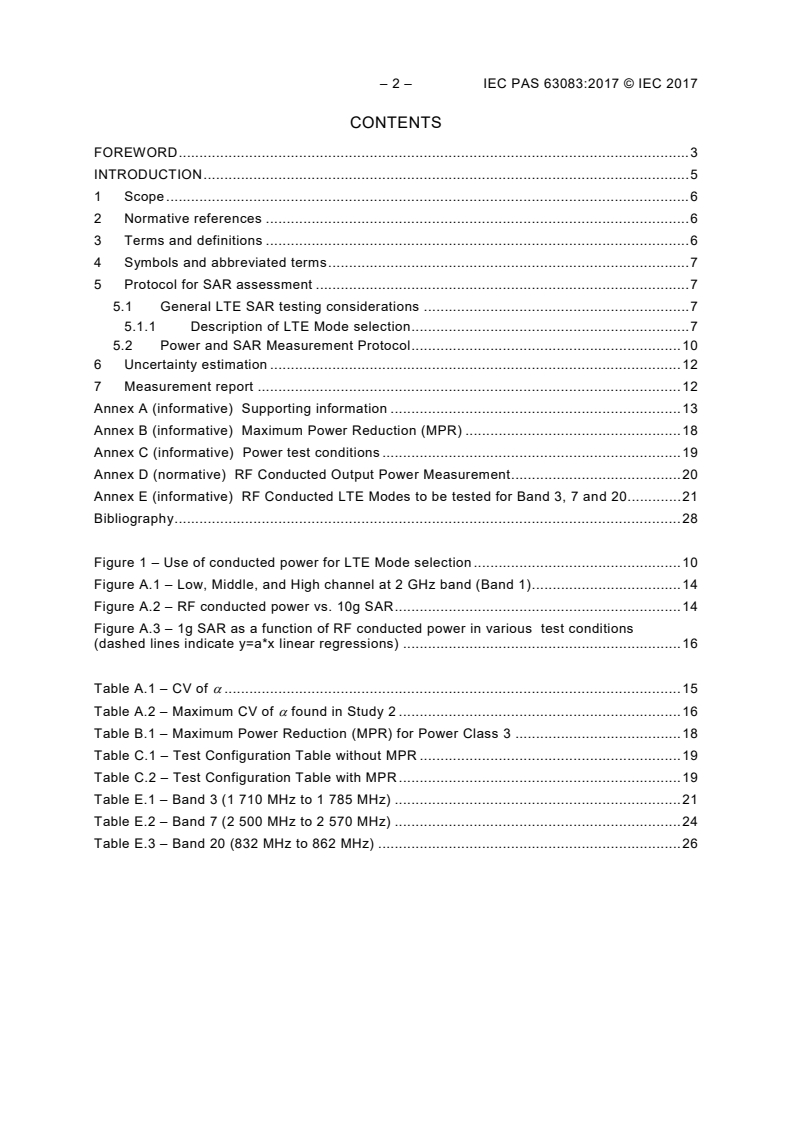
– 2 – IEC PAS 63083:2017 © IEC 2017
CONTENTS
FOREWORD . 3
INTRODUCTION . 5
1 Scope . 6
2 Normative references . 6
3 Terms and definitions . 6
4 Symbols and abbreviated terms . 7
5 Protocol for SAR assessment . 7
5.1 General LTE SAR testing considerations . 7
5.1.1 Description of LTE Mode selection . 7
5.2 Power and SAR Measurement Protocol . 10
6 Uncertainty estimation . 12
7 Measurement report . 12
Annex A (informative) Supporting information . 13
Annex B (informative) Maximum Power Reduction (MPR) . 18
Annex C (informative) Power test conditions . 19
Annex D (normative) RF Conducted Output Power Measurement . 20
Annex E (informative) RF Conducted LTE Modes to be tested for Band 3, 7 and 20 . 21
Bibliography . 28
Figure 1 – Use of conducted power for LTE Mode selection . 10
Figure A.1 – Low, Middle, and High channel at 2 GHz band (Band 1) . 14
Figure A.2 – RF conducted power vs. 10g SAR . 14
Figure A.3 – 1g SAR as a function of RF conducted power in various test conditions
(dashed lines indicate y=a*x linear regressions) . 16
Table A.1 – CV of α . 15
Table A.2 – Maximum CV of α found in Study 2 . 16
Table B.1 – Maximum Power Reduction (MPR) for Power Class 3 . 18
Table C.1 – Test Configuration Table without MPR . 19
Table C.2 – Test Configuration Table with MPR . 19
Table E.1 – Band 3 (1 710 MHz to 1 785 MHz) . 21
Table E.2 – Band 7 (2 500 MHz to 2 570 MHz) . 24
Table E.3 – Band 20 (832 MHz to 862 MHz) . 26
INTERNATIONAL ELECTROTECHNICAL COMMISSION
____________
SPECIFIC ABSORPTION RATE (SAR) MEASUREMENT
PROCEDURE FOR LONG TERM EVOLUTION (LTE) DEVICES
FOREWORD
1) The International Electrotechnical Commission (IEC) is a worldwide organization for standardization comprising
all national electrotechnical committees (IEC National Committees). The object of IEC is to promote
international co-operation on all questions concerning standardization in the electrical and electronic fields. To
this end and in addition to other activities, IEC publishes International Standards, Technical Specifications,
Technical Reports, Publicly Available Specifications (PAS) and Guides (hereafter referred to as “IEC
Publication(s)”). Their preparation is entrusted to technical committees; any IEC National Committee interested
in the subject dealt with may participate in this preparatory work. International, governmental and non-
governmental organizations liaising with the IEC also participate in this preparation. IEC collaborates closely
with the International Organization for Standardization (ISO) in accordance with conditions determined by
agreement between the two organizations.
2) The formal decisions or agreements of IEC on technical matters express, as nearly as possible, an international
consensus of opinion on the relevant subjects since each technical committee has representation from all
interested IEC National Committees.
3) IEC Publications have the form of recommendations for international use and are accepted by IEC National
Committees in that sense. While all reasonable efforts are made to ensure that the technical content of IEC
Publications is accurate, IEC cannot be held responsible for the way in which they are used or for any
misinterpretation by any end user.
4) In order to promote international uniformity, IEC National Committees undertake to apply IEC Publications
transparently to the maximum extent possible in their national and regional publications. Any divergence
between any IEC Publication and the corresponding national or regional publication shall be clearly indicated in
the latter.
5) IEC itself does not provide any attestation of conformity. Independent certification bodies provide conformity
assessment services and, in some areas, access to IEC marks of conformity. IEC is not responsible for any
services carried out by independent certification bodies.
6) All users should ensure that they have the latest edition of this publication.
7) No liability shall attach to IEC or its directors, employees, servants or agents including individual experts and
members of its technical committees and IEC National Committees for any personal injury, property damage or
other damage of any nature whatsoever, whether direct or indirect, or for costs (including legal fees) and
expenses arising out of the publication, use of, or reliance upon, this IEC Publication or any other IEC
Publications.
8) Attention is drawn to the Normative references cited in this publication. Use of the referenced publications is
indispensable for the correct application of this publication.
9) Attention is drawn to the possibility that some of the elements of this IEC Publication may be the subject of
patent rights. IEC shall not be held responsible for identifying any or all such patent rights.
A PAS is a technical specification not fulfilling the requirements for a standard, but made
available to the public.
IEC PAS 63083 has been processed by IEC technical committee 106: Methods for the
assessment of electric, magnetic and electromagnetic fields associated with human exposure.
The text of this PAS is based on the This PAS was approved for
following document: publication by the P-members of the
committee concerned as indicated in
the following document
Draft PAS Report on voting
106/377/PAS 106/385/RVD
This PAS shall remain valid for an initial maximum period of 3 years starting from the
publication date. The validity may be extended for a single period up to a maximum of
3 years, at the end of which it shall be published as another type of normative document, or
shall be withdrawn.
– 4 – IEC PAS 63083:2017 © IEC 2017
A bilingual version of this publication may be issued at a later date.
IMPORTANT – The 'colour inside' logo on the cover page of this publication indicates that it
contains colours which are considered to be useful for the correct understanding of its
contents. Users should therefore print this document using a colour printer.
INTRODUCTION
LTE technology shows an added complexity over previously available radio schemes and in
order to configure and test LTE devices, many signal parameters have to be taken into
account. The combinations of parameters in a given frequency band can result in hundreds of
LTE Modes and SAR test configurations. The main purpose of this protocol is to support the
demonstration of DUT compliance with applicable exposure limits based on a reasonable
number of SAR evaluations.
– 6 – IEC PAS 63083:2017 © IEC 2017
SPECIFIC ABSORPTION RATE (SAR) MEASUREMENT
PROCEDURE FOR LONG TERM EVOLUTION (LTE) DEVICES
1 Scope
This Publicly Available Specification (PAS) applies to measurement procedures of Specific
Absorption Rate (SAR) generated by devices with LTE (Long Term Evolution) technology
specified by 3rd Generation Partnership Project (3GPP), Rel. 8 and 9 [1] where the devices
are intended to be used with the radiating part in close proximity to the human head and body.
This document supports both FDD and TDD modes. The objective of this document is to
define the number of test conditions with respect to basic radio frequency aspects, i.e.
channel bandwidths, number and offset of allocated resource blocks (RB), modulation, and
maximum power reduction (MPR) for IEC 62209-1 and IEC 62209-2.
2 Normative references
The following documents are referred to in the text in such a way that some or all of their
content constitutes requirements of this document. For dated references, only the edition
cited applies. For undated references, the latest edition of the referenced document (including
any amendments) applies.
IEC 62209-1:2016, Measurement procedure for the assessment of specific absorption rate of
human exposure to radio frequency fields from hand-held and body-mounted wireless
communication devices – Part 1: Devices used next to the ear (Frequency range of 300 MHz
to 6 GHz)
IEC 62209-2, Human exposure to radio frequency fields from hand-held and body-mounted
wireless communication devices – Human models, instrumentation, and procedures – Part 2:
Procedure to determine the specific absorption rate (SAR) for wireless communication
devices used in close proximity to the human body (frequency range of 30 MHz to 6 GHz)
ETSI TR 121 905, Digital cellular telecommunications system (Phase 2+) (GSM); Universal
Mobile Telecommunications System (UMTS); LTE; Vocabulary for 3GPP Specifications
3 Terms and definitions
For the purposes of this document, the terms and definitions given in ETSI TR 121 905 and
the following apply.
3.1
LTE Mode
specific operational characteristics of the DUT
Note 1 to entry: LTE Mode is the combination of channel frequency, channel bandwidth, modulation, number of
resource blocks, the offset of the resource blocks within the bandwidth, and the MPR.
3.2
Device Position
orientation and position of the DUT with respect to the phantom
3.3
Test Condition
Test Condition refers to the combination of both the LTE Mode and Device Position
4 Symbols and abbreviated terms
For the measurement procedures specified in this document, the symbols and abbreviated
terms of IEC 62209-1 and IEC 62209-2 shall apply.
5 Protocol for SAR assessment
5.1 General LTE SAR testing considerations
LTE technology shows an added complexity over previously available radio schemes. In order
to configure and test LTE devices, many signal parameters have to be taken into account:
frequency band, channel bandwidth (from 1.4 MHz to 20 MHz), modulation (QPSK and 16-
QAM), number of resource blocks allocated, offset of the resource blocks within the channel
bandwidth as well as MPR. The combinations of parameters in a given frequency band can
result in hundreds of LTE Modes and SAR test configurations. In order to address this a
specific protocol is necessary for SAR assessment of LTE devices. The main purpose of this
protocol is to support demonstration of DUT compliance with applicable limits based on a
reasonable number of SAR evaluations.
For a given LTE Mode and Device Position (Test Condition), the peak spatial-average SAR is
related to the maximum RF output power. As a consequence, RF conducted power
measurements can be used to quickly identify high SAR LTE Mode. SAR and RF conducted
power are however not directly proportional because:
i) RF conducted power is measured with a 50 Ohms load impedance;
ii) the antenna impedance of a DUT is generally not 50 Ohms and varies over frequency;
iii) the antenna impedance can be affected by Device Position and phantom coupling
conditions.
Because of this, a single SAR measurement using the LTE Mode with the highest measured
maximum conducted output power in a frequency band may not be sufficient to demonstrate
compliance unless the SAR value is significantly lower than the applicable compliance limit. In
the following, the required Test Conditions are established by applying the protocol in 5.2.
The LTE Test Conditions are measured according to the SAR measurement protocols in
IEC 62209-1 for devices used next to the ear and in IEC 62209-2 for hand-held and body-
mounted devices. This document only specifies the procedures to identify the LTE Test
Conditions that will most likely result in SAR levels closest to the highest and conservative
SAR result obtained from an up-scaling procedure.
For the above reasons, studies on the relationship between RF conducted power and SAR
were conducted by MT1 using handsets operating in Band 1, 4 and 17. The results in Annex A
show that:
• QPSK modulation with 1 RB allocation generally produces the highest peak spatial-
average SAR – MPR does not apply in this case.
• Peak spatial-average SAR has good correlation with the measured RF conducted output
power. The relationship deviates from proportionality by less than 25 % (k = 2).
• For LTE Modes with maximum conducted power lower than 85 % of P , where P is
max max
the highest measured maximum RF conducted output power across all LTE Modes in the
frequency band, it is highly unlikely that highest SAR results would be expected.
5.1.1 Description of LTE Mode selection
Conducted power shall be measured for the largest channel bandwidth supported by the LTE
Modes in each frequency band, using QPSK modulation with 1 RB allocation. The required
test channels shall be determined by 6.2.5 of IEC 62209-1:2016. If the number of required
channels is 1, the 1 RB shall be allocated at offset = centre; if the number of required
– 8 – IEC PAS 63083:2017 © IEC 2017
channels is 3, the 1 RB shall be allocated at offset = 0, centre, and max within the channel
bandwidth. If the number of required channels is 5, the 1 RB shall be allocated at offset = 0,
centre, centre, centre and max within the channel bandwidth, respectively, for channels from
lowest to highest.
Other LTE Modes besides “QPSK modulation with 1 RB allocation” shall also be measured for
the different channel bandwidth configurations using the modulations and RB allocations
described in Table C.1 (without MPR) and C.2 (with MPR), which are specified by 3GPP for
conformance testing. Conducted maximum output power shall be measured using the
following test channel and RB offset configurations.
• When MPR does not apply, the configurations in Table C.1 are measured for the low and
middle channels with RB offset = 0 and RB offset = max for the high channel.
• When MPR applies, the configurations in Table C.2 are measured
– for the low channel with RB offset = max,
– for middle channel with RB offset = 0 and max,
– for high channel with RB offset = 0.
For “QPSK modulation with 1 RB allocation” in smaller channel bandwidth configurations,
when the same RB offset has already been measured in the highest channel bandwidth, such
RB offset configurations may be omitted. These correspond to RBs allocated next to the
channel edges; for example, offset = 0 for the low channel and max for the high channel for
5 MHz, 10 MHz, 15 MHz channel bandwidths in Band 1 may be omitted.
The conducted maximum output power measurements are illustrated in Figure 1 for 5 MHz,
10 MHz, 15 MHz, and 20 MHz channel bandwidths in Band 1 (1 920 MHz to 1 980 MHz) and
5 MHz and 10 MHz channel bandwidths in Band 17 (704 MHz to 716 MHz). The orange and
blue colour RBs correspond to test configurations that are specified by 3GPP for conformance
testing. The red colour RBs are the additional configurations required for QPSK and 1 RB
allocation in the largest channel bandwidth configuration, not specified for 3GPP conformance
testing. The low, middle and high channels are determined according to the IEC 62209-1
requirements. Annex E lists the LTE Modes to be tested in Band 3, 7 and 20.
NOTE Conducted power testing for additional LTE Modes is allowed, when the results form a superset of above
requirements (e.g. conducted power testing according to FCC requirements). When such a conducted power
superset is reported, all results shall be taken into account in following SAR test procedures.
15 MHZ
20 MHz
5 MHZ 10 MHZ
Middle
Low
High
5 MHz
Can be
1922.5 MHz
1950.0 MHz 1977.5 MHz
omitted
Low Middle
High
5 MHz
MPR = 0
QPSK
MPR ≤ 1 16QAM
QPSK
25 MPR ≤1,2
16QAM
1922.5 MHz 1950.0 MHz 1977.5 MHz
10 MHz
12 12 12
Orange and
blue colors
show
MPR ≤ 1
parameters
determined
MPR≤ 1,2
by 3GPP
1925.0 MHz 1950.0 MHz 1975.0 MHz
15 MHz
16 16
Red color
16 16 shows
16 16
additional
parameters
75 75
determined
1927.5 MHz 1950.0 MHz 1972.5 MHz
by this draft.
20 MHz
MPR = 0
MPR ≤ 1 18
MPR ≤ 1,2
1950.0 MHz 1970.0 MHz
1930.0 MHz
Figure 1a – Band 1 (1 920 MHz to 1 980 MHz)
5 MHz 10 MHz
– 10 – IEC PAS 63083:2017 © IEC 2017
Middle
Low High
5 MHz
Can be
706.5 MHz
710 MHz 713.5MHz
omitted
Low Middle
High
5 MHz
MPR = 0
QPSK
MPR ≤ 1 16QAM
QPSK
25 MPR ≤ 1,2
16QAM
706.5 MHz 710 MHz 713.5MHz
10 MHz
12 12
12 MPR ≤1
MPR≤1,2
709 MHz 710 MHz 711MHz
Red color
Orange and
shows
blue colors
additional
show
parameters
parameters
determined
determined
by this draft.
by 3GPP
Figure 1b – Band 17 (700 MHz)
Figure 1 – Use of conducted power for LTE Mode selection
5.2 Power and SAR Measurement Protocol
The method described in IEC 62209-1 and IEC 62209-2 for the SAR measurement protocol
requires tests to be performed first at the channel that is closest to the center of the transmit
frequency band for each transmit antenna for all device test positions, all use configurations
and all operating modes. Secondly for the condition p
...