

IEC 62995:2018
(Main)Railway applications - Rolling stock - Rules for installation of cabling
General Information
- Abstract
IEC 62995:2018 specifies requirements for the installation of cabling on railway vehicles and within electrical enclosures on railway vehicles, including magnetic levitation trains and trolley buses. This document covers cabling for making electrical connections between items of electrical equipment, including cables, busbars, terminals and plug/socket devices. The material selection criteria given herein are applicable to cables with copper conductors.
- Status
- Published
- Publication Date
- 13-May-2018
- Technical Committee
- TC 9 - Electrical equipment and systems for railways
- Drafting Committee
- PT 62995 - TC 9/PT 62995
- Current Stage
- PPUB - Publication issued
- Start Date
- 14-May-2018
- Completion Date
- 11-May-2018
Overview
IEC 62995:2018 is an essential international standard issued by the International Electrotechnical Commission (IEC) that outlines the rules for the installation of cabling on railway rolling stock. This standard covers electrical cabling requirements for railway vehicles, including magnetic levitation trains and trolley buses. It applies to the installation of cables, busbars, terminals, and plug/socket devices used for electrical connections between electrical equipment on rolling stock. The standard focuses primarily on cables with copper conductors, ensuring safety, reliability, and performance in railway applications.
By providing comprehensive guidelines on cable selection, installation, marking, and testing, IEC 62995:2018 enhances the safety, maintainability, and electromagnetic compatibility (EMC) of railway cabling systems.
Key Topics
Technical Requirements for Cabling
- Selection of cable types and sizes based on current ratings, protection devices, and load conditions
- Specifications for bundling, bending radii, and mechanical protection of cables
- Guidelines on the use of green and yellow colors for protective bonding conductors
- Separation standards for cables with different voltage levels and safety considerations
- Provisions to facilitate refurbishment, inspection, and repair operations on railway vehicles
- Fire prevention measures and cable behavior under fire conditions
Electrical Connections and Terminations
- Requirements for secure busbar connections and electrical terminations at cable ends and device terminals
- Recommended practices for re-termination to maintain cable reliability
- Use of heat-shrinkable sleeves for insulation and marking identification
Electromagnetic Compatibility (EMC)
- Classification of cable categories to control EMC interference within rolling stock environments
- Requirements for cable shielding, earthing, and the use of conductive structures to mitigate electromagnetic disturbances
Marking and Identification
- Guidelines for clear and durable marking of cables, busbars, terminals, plugs, and sockets
- Identification methods to ensure safe and efficient maintenance and troubleshooting
Testing Procedures
- Electrical insulation tests including voltage withstand and insulation impedance tests
- Mechanical and environmental testing of cable terminations and heat-shrinkable sleeve markings
Applications
IEC 62995:2018 is applicable to a broad range of railway vehicles, including:
- Locomotives and passenger trains
- Freight rolling stock
- Magnetic levitation (maglev) trains
- Trolley buses and trams
This standard is critical for manufacturers, installation engineers, maintenance teams, and safety inspectors involved in designing and maintaining the electrical cabling infrastructure of railway vehicles. Adherence to IEC 62995 ensures:
- Compliance with international safety and quality requirements
- Improved reliability and longevity of cabling systems under mechanical and thermal stresses
- Enhanced resistance to electromagnetic interference for consistent electrical performance
- Simplified maintenance through standardized identification and connection methods
Related Standards
For comprehensive railway electrical system integration, IEC 62995:2018 should be used alongside related IEC and international standards such as:
- IEC 60571 – Electronic equipment used on rolling stock – Electronic equipment
- IEC 61373 – Railway applications – Rolling stock equipment – Shock and vibration tests
- IEC 60077 – Electrical equipment for rolling stock
- EN 45545 – Railway applications – Fire protection on railway vehicles
- ISO/IEC/IEEE 42010 – Systems and software engineering - Architecture description
Together, these standards cover the wider spectrum of electrical, mechanical, and safety requirements essential for modern railway rolling stock design and operation.
By following IEC 62995:2018, railway operators and manufacturers can achieve high standards of safety, performance, and interoperability in the installation and maintenance of electrical cabling systems across various types of rolling stock, ultimately contributing to safer and more efficient railway transportation systems worldwide.
Get Certified
Connect with accredited certification bodies for this standard

IRIS Certification (UNIFE)
International Railway Industry Standard certification.

TÜV SÜD Rail GmbH
TÜV SÜD railway certification services.

ANCE
Mexican certification and testing association.
Sponsored listings
Frequently Asked Questions
IEC 62995:2018 is a standard published by the International Electrotechnical Commission (IEC). Its full title is "Railway applications - Rolling stock - Rules for installation of cabling". This standard covers: IEC 62995:2018 specifies requirements for the installation of cabling on railway vehicles and within electrical enclosures on railway vehicles, including magnetic levitation trains and trolley buses. This document covers cabling for making electrical connections between items of electrical equipment, including cables, busbars, terminals and plug/socket devices. The material selection criteria given herein are applicable to cables with copper conductors.
IEC 62995:2018 specifies requirements for the installation of cabling on railway vehicles and within electrical enclosures on railway vehicles, including magnetic levitation trains and trolley buses. This document covers cabling for making electrical connections between items of electrical equipment, including cables, busbars, terminals and plug/socket devices. The material selection criteria given herein are applicable to cables with copper conductors.
IEC 62995:2018 is classified under the following ICS (International Classification for Standards) categories: 33.120.30 - RF connectors; 45.060.01 - Railway rolling stock in general. The ICS classification helps identify the subject area and facilitates finding related standards.
IEC 62995:2018 is available in PDF format for immediate download after purchase. The document can be added to your cart and obtained through the secure checkout process. Digital delivery ensures instant access to the complete standard document.
Standards Content (Sample)
IEC 62995 ®
Edition 1.0 2018-05
INTERNATIONAL
STANDARD
NORME
INTERNATIONALE
colour
inside
Railway applications – Rolling stock – Rules for installation of cabling
Applications ferroviaires – Matériel roulant – Règles d'installation du câblage
All rights reserved. Unless otherwise specified, no part of this publication may be reproduced or utilized in any form
or by any means, electronic or mechanical, including photocopying and microfilm, without permission in writing from
either IEC or IEC's member National Committee in the country of the requester. If you have any questions about IEC
copyright or have an enquiry about obtaining additional rights to this publication, please contact the address below or
your local IEC member National Committee for further information.
Droits de reproduction réservés. Sauf indication contraire, aucune partie de cette publication ne peut être reproduite
ni utilisée sous quelque forme que ce soit et par aucun procédé, électronique ou mécanique, y compris la photocopie
et les microfilms, sans l'accord écrit de l'IEC ou du Comité national de l'IEC du pays du demandeur. Si vous avez des
questions sur le copyright de l'IEC ou si vous désirez obtenir des droits supplémentaires sur cette publication, utilisez
les coordonnées ci-après ou contactez le Comité national de l'IEC de votre pays de résidence.
IEC Central Office Tel.: +41 22 919 02 11
3, rue de Varembé info@iec.ch
CH-1211 Geneva 20 www.iec.ch
Switzerland
About the IEC
The International Electrotechnical Commission (IEC) is the leading global organization that prepares and publishes
International Standards for all electrical, electronic and related technologies.
About IEC publications
The technical content of IEC publications is kept under constant review by the IEC. Please make sure that you have the
latest edition, a corrigenda or an amendment might have been published.
IEC Catalogue - webstore.iec.ch/catalogue Electropedia - www.electropedia.org
The stand-alone application for consulting the entire The world's leading online dictionary of electronic and
bibliographical information on IEC International Standards, electrical terms containing 21 000 terms and definitions in
Technical Specifications, Technical Reports and other English and French, with equivalent terms in 16 additional
documents. Available for PC, Mac OS, Android Tablets and languages. Also known as the International Electrotechnical
iPad. Vocabulary (IEV) online.
IEC publications search - webstore.iec.ch/advsearchform IEC Glossary - std.iec.ch/glossary
The advanced search enables to find IEC publications by a 67 000 electrotechnical terminology entries in English and
variety of criteria (reference number, text, technical French extracted from the Terms and Definitions clause of
committee,…). It also gives information on projects, replaced IEC publications issued since 2002. Some entries have been
and withdrawn publications. collected from earlier publications of IEC TC 37, 77, 86 and
CISPR.
IEC Just Published - webstore.iec.ch/justpublished
Stay up to date on all new IEC publications. Just Published IEC Customer Service Centre - webstore.iec.ch/csc
details all new publications released. Available online and If you wish to give us your feedback on this publication or
also once a month by email. need further assistance, please contact the Customer Service
Centre: sales@iec.ch.
A propos de l'IEC
La Commission Electrotechnique Internationale (IEC) est la première organisation mondiale qui élabore et publie des
Normes internationales pour tout ce qui a trait à l'électricité, à l'électronique et aux technologies apparentées.
A propos des publications IEC
Le contenu technique des publications IEC est constamment revu. Veuillez vous assurer que vous possédez l’édition la
plus récente, un corrigendum ou amendement peut avoir été publié.
Catalogue IEC - webstore.iec.ch/catalogue Electropedia - www.electropedia.org
Application autonome pour consulter tous les renseignements
Le premier dictionnaire en ligne de termes électroniques et
bibliographiques sur les Normes internationales,
électriques. Il contient 21 000 termes et définitions en anglais
Spécifications techniques, Rapports techniques et autres
et en français, ainsi que les termes équivalents dans 16
documents de l'IEC. Disponible pour PC, Mac OS, tablettes
langues additionnelles. Egalement appelé Vocabulaire
Android et iPad.
Electrotechnique International (IEV) en ligne.
Recherche de publications IEC -
Glossaire IEC - std.iec.ch/glossary
webstore.iec.ch/advsearchform
67 000 entrées terminologiques électrotechniques, en anglais
La recherche avancée permet de trouver des publications IEC et en français, extraites des articles Termes et Définitions des
en utilisant différents critères (numéro de référence, texte, publications IEC parues depuis 2002. Plus certaines entrées
comité d’études,…). Elle donne aussi des informations sur les antérieures extraites des publications des CE 37, 77, 86 et
projets et les publications remplacées ou retirées. CISPR de l'IEC.
IEC Just Published - webstore.iec.ch/justpublished Service Clients - webstore.iec.ch/csc
Restez informé sur les nouvelles publications IEC. Just Si vous désirez nous donner des commentaires sur cette
Published détaille les nouvelles publications parues. publication ou si vous avez des questions contactez-nous:
Disponible en ligne et aussi une fois par mois par email. sales@iec.ch.
IEC 62995 ®
Edition 1.0 2018-05
INTERNATIONAL
STANDARD
NORME
INTERNATIONALE
colour
inside
Railway applications – Rolling stock – Rules for installation of cabling
Applications ferroviaires – Matériel roulant – Règles d'installation du câblage
INTERNATIONAL
ELECTROTECHNICAL
COMMISSION
COMMISSION
ELECTROTECHNIQUE
INTERNATIONALE
ICS 45.060.01 ISBN 978-2-8322-5640-4
– 2 – IEC 62995:2018 IEC 2018
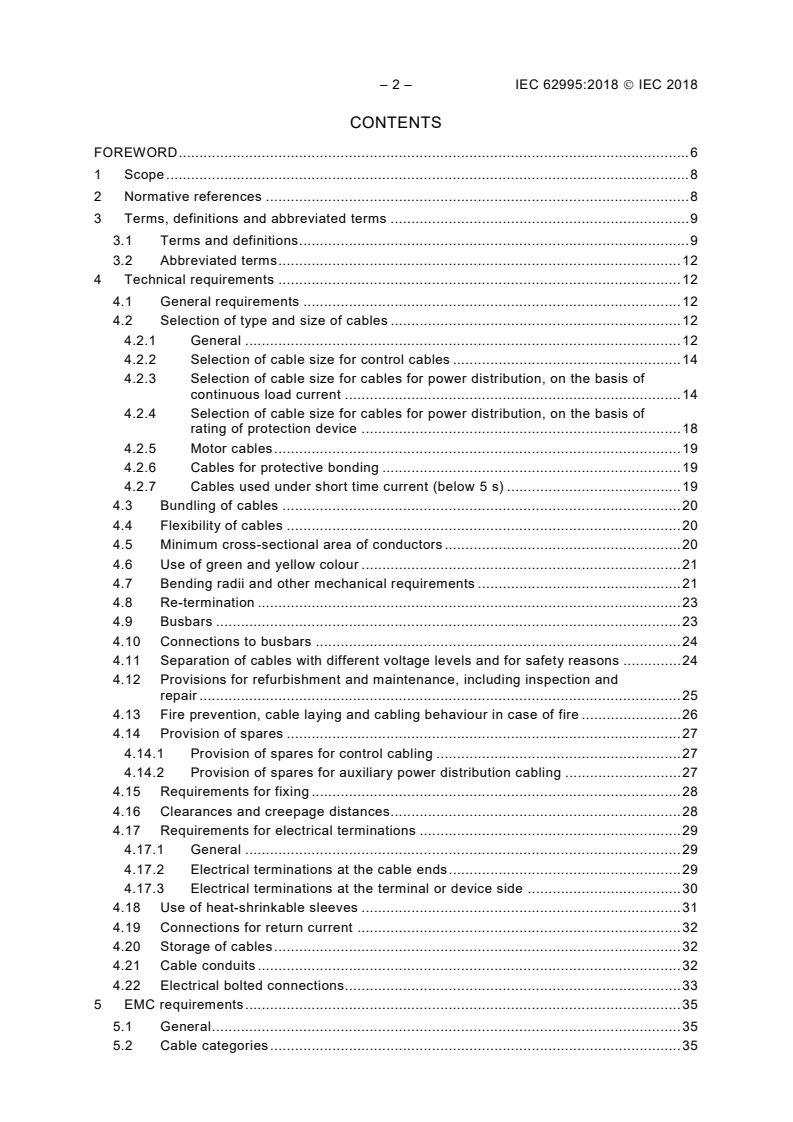
CONTENTS
FOREWORD . 6
1 Scope . 8
2 Normative references . 8
3 Terms, definitions and abbreviated terms . 9
3.1 Terms and definitions . 9
3.2 Abbreviated terms . 12
4 Technical requirements . 12
4.1 General requirements . 12
4.2 Selection of type and size of cables . 12
4.2.1 General . 12
4.2.2 Selection of cable size for control cables . 14
4.2.3 Selection of cable size for cables for power distribution, on the basis of
continuous load current . 14
4.2.4 Selection of cable size for cables for power distribution, on the basis of
rating of protection device . 18
4.2.5 Motor cables . 19
4.2.6 Cables for protective bonding . 19
4.2.7 Cables used under short time current (below 5 s) . 19
4.3 Bundling of cables . 20
4.4 Flexibility of cables . 20
4.5 Minimum cross-sectional area of conductors . 20
4.6 Use of green and yellow colour . 21
4.7 Bending radii and other mechanical requirements . 21
4.8 Re-termination . 23
4.9 Busbars . 23
4.10 Connections to busbars . 24
4.11 Separation of cables with different voltage levels and for safety reasons . 24
4.12 Provisions for refurbishment and maintenance, including inspection and
repair . 25
4.13 Fire prevention, cable laying and cabling behaviour in case of fire . 26
4.14 Provision of spares . 27
4.14.1 Provision of spares for control cabling . 27
4.14.2 Provision of spares for auxiliary power distribution cabling . 27
4.15 Requirements for fixing . 28
4.16 Clearances and creepage distances . 28
4.17 Requirements for electrical terminations . 29
4.17.1 General . 29
4.17.2 Electrical terminations at the cable ends . 29
4.17.3 Electrical terminations at the terminal or device side . 30
4.18 Use of heat-shrinkable sleeves . 31
4.19 Connections for return current . 32
4.20 Storage of cables . 32
4.21 Cable conduits . 32
4.22 Electrical bolted connections . 33
5 EMC requirements . 35
5.1 General . 35
5.2 Cable categories . 35
5.3 Separation of cables . 36
5.4 Return conductor . 36
5.5 Use of conductive structure . 37
5.6 Shielding and earthing . 37
5.7 Supply connection from battery . 37
5.8 Databus lines . 37
6 Marking for identification . 38
6.1 General . 38
6.2 Marking for identification of cables and busbars . 38
6.3 Marking for identification of terminal blocks, individual terminals, plugs and
sockets . 39
6.4 Marking of insulators . 39
6.5 Marking for warning against electrical shock . 39
6.6 Marking using heat-shrinkable sleeves . 39
7 Testing . 39
7.1 General concerning testing . 39
7.2 Electrical insulation tests . 40
7.2.1 General . 40
7.2.2 Voltage withstand test . 40
7.2.3 Insulation impedance test . 42
Annex A (normative) Cable sizing – Calculation under short time current conditions . 43
Annex B (informative) Cable sizing – Examples of current ratings . 44
Annex C (normative) Cable sizing – Calculating current ratings for temperature
classes other than 90 °C . 46
Annex D (normative) Cable sizing – Correction factor k for expected ambient
temperature . 47
Annex E (informative) Cable sizing – Cable thermal lifetime expectation . 48
E.1 General cable lifetime considerations . 48
E.2 Reducing cable lifetime . 49
E.3 Increasing cable lifetime . 50
Annex F (informative) Cable sizing – Calculation examples . 51
F.1 Cables sizing calculation examples . 51
F.1.1 General . 51
F.1.2 Example 1 . 51
F.1.3 Example 2 . 52
F.1.4 Example 3 . 52
F.2 Cables sizing calculation recommendation . 53
Annex G (informative) Terminations . 55
G.1 Methods of terminating cables . 55
G.2 Tensile strength test values . 60
Annex H (normative) Tests on marking when using heat-shrinkable sleeves . 62
H.1 General . 62
H.2 Preparation of specimens . 62
H.3 Testing of specimens . 62
H.4 Result of test . 62
Annex I (informative) Effects of the number of earth connections to a cable screen . 63
Annex J (informative) Differences of electrochemical potentials between some
conductive materials . 64
– 4 – IEC 62995:2018 IEC 2018
Annex K (informative) Locations on board rolling stock to be distinguished . 65
Bibliography . 67
Figure 1 – Example of short-circuit condition where cable size has influence on
protection device behavior . 14
Figure 2 – Cable grouping and installation conditions . 18
Figure 3 – Locations in rolling stock, concerning use of minimum cross-sectional areas
for conductors . 21
Figure 4 – Definition of internal bending radius . 22
Figure 5 – Examples of mechanical protection of cabling . 23
Figure 6 – Separation of cables by required distance: D > 2d and D > 0,1 m . 25
Figure 7 – Examples of separation of cables by barriers or by insulation . 25
Figure 8 – Dimensions for calculating the effective area of a contact (example for a
cable lug) . 31
Figure 9 – Example of sequence order of elements belonging to a bolted connection (nut) . 34
Figure 10 – Example of sequence order of elements belonging to a bolted connection
(bolt) . 34
Figure 11 – Example of sequence order of elements belonging to a bolted connection
(bolt + nut) . 35
Figure 12 – Examples of cable or plug constructions where identification is done by
configuration . 38
Figure K.1 – Distinguishing locations on board rolling stock . 65
Table 1 – Modification factor k for individual cores within a multi-core cable . 16
Table 2 – Modification factor k for installation type (grouping and installation
conditions) . 17
Table 3 – Selection of cable conductor size on the basis of rating of protection device . 19
Table 4 – Minimum internal bending radii R for static applications . 22
Table 5 – Cable categories with respect to EMC . 36
Table 6 – Minimum distances between cables of different EMC categories . 36
Table 7 – Test voltages according to on-board voltages . 41
Table 8 – Test voltages according to supply line voltages . 42
Table A.1 – Modification factor k . 43
Table B.1 – Examples of current ratings for standard wall cables, with 90 °C maximum
conductor operating temperature . 44
Table C.1 – Factor k*, used when comparing current ratings for 90 °C maximum
conductor operating temperature with other temperature classes . 46
Table D.1 – Modification factor k . 47
Table E.1 – Temperature for expected lifetime . 49
Table E.2 – Examples of values of correction factor k to allow for decrease in
predicted cable lifetime for a 90 °C cable . 49
Table F.1 – Recommended short-circuit current ratings for rolling stock cables of
90 °C maximum conductor temperature . 53
Table F.2 – Value of K . 54
Table G.1 – Methods of terminating cables – Conductor side . 55
Table G.2 – Methods of terminating cables – Terminal side – Crimp connections . 56
Table G.3 – Methods of terminating cables – Terminal side – Screwed and bolted
connection . 57
Table G.4 – Methods of terminating cables – Terminal side – Connection by clamping . 58
Table G.5 – Methods of terminating cables – Terminal side – Connection by insulation
displacement or penetration . 59
Table G.6 – National standards for termination methods . 60
Table G.7 – Pull out force for crimp connections . 61
Table H.1 – Preparation of heat-shrinkable sleeve for test of marking quality . 62
Table I.1 – Effects of shielding . 63
Table J.1 – Differences of electrochemical potentials between some conductive
materials (in mV) . 64
Table K.1 – Distinguishing locations on board rolling stock . 66
– 6 – IEC 62995:2018 IEC 2018
INTERNATIONAL ELECTROTECHNICAL COMMISSION
____________
RAILWAY APPLICATIONS – ROLLING STOCK –
RULES FOR INSTALLATION OF CABLING
FOREWORD
1) The International Electrotechnical Commission (IEC) is a worldwide organization for standardization comprising
all national electrotechnical committees (IEC National Committees). The object of IEC is to promote
international co-operation on all questions concerning standardization in the electrical and electronic fields. To
this end and in addition to other activities, IEC publishes International Standards, Technical Specifications,
Technical Reports, Publicly Available Specifications (PAS) and Guides (hereafter referred to as “IEC
Publication(s)”). Their preparation is entrusted to technical committees; any IEC National Committee interested
in the subject dealt with may participate in this preparatory work. International, governmental and non-
governmental organizations liaising with the IEC also participate in this preparation. IEC collaborates closely
with the International Organization for Standardization (ISO) in accordance with conditions determined by
agreement between the two organizations.
2) The formal decisions or agreements of IEC on technical matters express, as nearly as possible, an international
consensus of opinion on the relevant subjects since each technical committee has representation from all
interested IEC National Committees.
3) IEC Publications have the form of recommendations for international use and are accepted by IEC National
Committees in that sense. While all reasonable efforts are made to ensure that the technical content of IEC
Publications is accurate, IEC cannot be held responsible for the way in which they are used or for any
misinterpretation by any end user.
4) In order to promote international uniformity, IEC National Committees undertake to apply IEC Publications
transparently to the maximum extent possible in their national and regional publications. Any divergence
between any IEC Publication and the corresponding national or regional publication shall be clearly indicated in
the latter.
5) IEC itself does not provide any attestation of conformity. Independent certification bodies provide conformity
assessment services and, in some areas, access to IEC marks of conformity. IEC is not responsible for any
services carried out by independent certification bodies.
6) All users should ensure that they have the latest edition of this publication.
7) No liability shall attach to IEC or its directors, employees, servants or agents including individual experts and
members of its technical committees and IEC National Committees for any personal injury, property damage or
other damage of any nature whatsoever, whether direct or indirect, or for costs (including legal fees) and
expenses arising out of the publication, use of, or reliance upon, this IEC Publication or any other IEC
Publications.
8) Attention is drawn to the Normative references cited in this publication. Use of the referenced publications is
indispensable for the correct application of this publication.
9) Attention is drawn to the possibility that some of the elements of this IEC Publication may be the subject of
patent rights. IEC shall not be held responsible for identifying any or all such patent rights.
International Standard IEC 62995 has been prepared by IEC technical committee 9: Electrical
equipment and systems for railways.
This standard is based on EN 50343:2014 and EN 50343 A1:2017.
The text of this International Standard is based on the following documents:
FDIS Report on voting
9/2378/FDIS 9/2406/RVD
Full information on the voting for the approval of this International Standard can be found in
the report on voting indicated in the above table.
This document has been drafted in accordance with the ISO/IEC Directives, Part 2.
The committee has decided that the contents of this document will remain unchanged until the
stability dateindicated on the IEC website under "http://webstore.iec.ch" in the data related to
the specific document. At this date, the document will be
• reconfirmed,
• withdrawn,
• replaced by a revised edition, or
• amended.
IMPORTANT – The 'colour inside' logo on the cover page of this publication indicates
that it contains colours which are considered to be useful for the correct
understanding of its contents. Users should therefore print this document using a
colour printer.
– 8 – IEC 62995:2018 IEC 2018
RAILWAY APPLICATIONS – ROLLING STOCK –
RULES FOR INSTALLATION OF CABLING
1 Scope
This document specifies requirements for the installation of cabling on railway vehicles and
within electrical enclosures on railway vehicles, including magnetic levitation trains and trolley
buses.
NOTE With respect to trolley buses, this document applies to the whole electric traction system, including current
collecting circuits, power converters and the respective control circuits. The installation of other circuits is covered
by street vehicle standards for example those for combustion driven buses.
This document covers cabling for making electrical connections between items of electrical
equipment, including cables, busbars, terminals and plug/socket devices. It does not cover
special effect conductors, such as fibre optic cables or hollow conductors (waveguides).
The material selection criteria given herein are applicable to cables with copper conductors.
This document is not applicable to the following:
– special purpose vehicles, such as track-laying machines, ballast cleaners and personnel
carriers;
– vehicles used for entertainment on fairgrounds;
– vehicles used in mining;
– electric cars;
– funicular railways.
2 Normative references
The following documents are referred to in the text in such a way that some or all of their
content constitutes requirements of this document. For dated references, only the edition
cited applies. For undated references, the latest edition of the referenced document (including
any amendments) applies.
IEC 60228, Conductors of insulated cables
IEC 60332-1-2, Tests on electric and optical fibre cables under fire conditions – Part 1-2: Test
for vertical flame propagation for a single insulated wire or cable – Procedure for 1 kW pre-
mixed flame
IEC 60332-3-24, Tests on electric and optical fibre cables under fire conditions – Part 3-24:
Test for vertical flame spread of vertically-mounted bunched wires or cables – Category C
IEC 60332-3-25, Tests on electric and optical fibre cables under fire conditions – Part 3-25:
Test for vertical flame spread of vertically-mounted bunched wires or cables – Category D
IEC 60352 (all parts), Solderless connections
IEC 60364-5-54:2011, Low-voltage electrical installations – Part 5-54: Selection and erection
of electrical equipment – Earthing arrangements and protective conductors
IEC 60684-3-212, Flexible insulating sleeving – Part 3: Specifications for individual types of
sleeving – Sheet 212: Heat-shrinkable polyolefin sleevings
IEC 60684-3-216, Flexible insulating sleeving – Part 3: Specifications for individual types of
sleeving – Sheet 216: Heat-shrinkable, flame-retarded, limited-fire hazard sleeving
IEC 60684-3-271, Flexible insulating sleeving – Part 3: Specifications for individual types of
sleeving – Sheet 271: Heat-shrinkable elastomer sleevings, flame retarded, fluid resistant,
shrink ratio 2:1
IEC 60695-7-2:2011, Fire hazard testing – Part 7-2: Toxicity of fire effluent – Summary and
relevance of test methods
IEC 60757, Code for designation of colours
IEC 61034-2, Measurement of smoke density of cables burning under defined conditions –
Part 2: Test procedure and requirements
IEC 61133:2016, Railway applications – Rolling stock – Testing of rolling stock on completion
of construction and before entry into service
IEC 61180, High-voltage test techniques for low-voltage equipment – Definitions, test and
procedure requirements, test equipment
IEC 61991, Railway applications – Rolling stock – Protective provisions against electrical
hazards
IEC 62236-3-1, Railway applications – Electromagnetic compatibility – Part 3-1: Rolling stock
– Train and complete vehicle
IEC 62236-3-2, Railway applications – Electromagnetic compatibility – Part 3-2: Rolling stock
– Apparatus
IEC 62497-1, Railway applications – Insulation coordination – Part 1: Basic requirements –
Clearances and creepage distances for all electrical and electronic equipment
IEC 62498-1, Railway applications – Environmental conditions for equipment – Part 1:
Equipment on board rolling stock
IEC 62847, Railway applications – Rolling stock – Electrical connectors – Requirements and
test methods
3 Terms, definitions and abbreviated terms
3.1 Terms and definitions
For the purposes of this document, the following terms and definitions apply.
ISO and IEC maintain terminological databases for use in standardization at the following
addresses:
• IEC Electropedia: available at http://www.electropedia.org/
• ISO Online browsing platform: available at http://www.iso.org/obp
– 10 – IEC 62995:2018 IEC 2018
3.1.1
insulated cable
assembly consisting of
– one or more cores (screened or unscreened),
– their individual covering(s) (if any),
– assembly protection (if any),
– screen(s) (if any),
– sheath (if any)
3.1.2
conductor
part of a cable which has the specific function of carrying current
[SOURCE: IEC 60050-461:2008, 461-01-01]
3.1.3
core
assembly comprising a conductor with its own insulation (and screens if any)
[SOURCE: IEC 60050-461:2008, 461-04-04, modified – The note has been deleted.]
3.1.4
solid conductor
conductor consisting of a single wire
[SOURCE: IEC 60050-461:2008, 461-01-06, modified – The note has been deleted.]
3.1.5
stranded conductor
conductor consisting of a number of individual wires or strands all or some of which generally
have a helical form
[SOURCE: IEC 60050-461:2008, 461-01-07, modified – The notes have been deleted.]
3.1.6
busbar
conductor consisting of a rigid metal profile
3.1.7
screen
conducting layer(s) having the function of control of the electromagnetic field within the cable
and/or to protect the cable from external electromagnetic influences
3.1.8
bundle
group of cables tied together
3.1.9
bolted connection
connection in which the pressure to the conductor is applied by bolting
[SOURCE: IEC 60050-461:2008, 461-19-05]
3.1.10
crimp
cable termination in which a permanent connection is made by applying pressure, inducing
the deformation or reshaping of a barrel part of the termination around the conductor
3.1.11
spring-clamp connection
terminal connection in which the pressure between the conductor and terminal is applied by a
spring
3.1.12
penetration
terminal connection in which the contact with the conductor is achieved by jaws which
penetrate the insulation
3.1.13
plug
connector intended to be coupled at the free end of an insulated conductor or cable, to be
inserted into a matching socket, or readily removed when required
3.1.14
socket
connector intended to be mounted on a rigid surface and to hold a matching plug, such that
the conductors contained within the socket make electrical contact individually with those in
the plug
3.1.15
heat-shrinkable sleeve
tube that on exposure to heat during installation, will at a critical temperature, permanently
reduce in diameter, while increasing in wall thickness
3.1.16
manufacturer
organisation that has the responsibility for the supply of vehicle(s), equipment or groups of
equipment to the purchaser
3.1.17
purchaser
organisation that orders the vehicle or equipment or groups of equipment and has the
responsibility for direct negotiations with the manufacturer
3.1.18
cable tie
mechanical construction needed for either keeping cables or assemblies of cables together, or
for attaching them in a defined place
3.1.19
short time current
certain operation case where an electrical circuit carries a current that will introduce an
amount of heat into the electrical circuit, which in general will increase its temperature
Note 1 to entry: "Short time" means that the heat exchange against the surrounding material is not significant.
– 12 – IEC 62995:2018 IEC 2018
3.2 Abbreviated terms
AC alternating current
CSA cross-sectional area
DC direct current
EMC electromagnetic compatibility
IP international protection (ingress protection)
RMS root mean square
UV ultraviolet
4 Technical requirements
4.1 General requirements
Cables and installation materials shall be type tested, selected for size and installed so as to
be suitable for their function under their operating conditions. Size and installation of cables
(including busbars and bare conductors) shall take into account the particular stresses to be
expected in rolling stock. The materials used and methods of cabling shall be such as to
prevent strain or chafing, and excessive lengths of unsupported cable shall be avoided.
Cables on rolling stock shall not be used for any purpose other than for transmission,
distribution and collection of electrical energy, electrical controls or monitoring systems. All
components of cabling shall be selected, installed, protected, used and maintained so as to
prevent danger (e.g. electrical or fire hazard, EMC problems).
The electrical connections shall be made in such a way that they cannot be unintentionally
disconnected or interrupted during service.
Effects that have impact on electrical connections and should be considered are at least:
– the thermal effects,
– the dynamic loads, as shock, vibration, car-body motions, and
– the material creepage.
For consideration of environmental conditions, IEC 62498-1 shall apply.
When considering operating conditions and environmental conditions, the locations as
presented in Annex K should be taken into account.
For correct use of connectors, IEC 62847 shall apply.
For protection against electrical hazard, the cabling installed shall be in accordance with
IEC 61991.
4.2 Selection of type and size of cables
4.2.1 General
When selecting cables or busbars, the expected operating conditions should be taken into
account. These should include, but are not limited to, the following parameters:
– voltage;
– current;
– higher harmonics by electronical converters (skin-effect);
– overload current;
– short time current;
– voltage drop;
– short-circuit current;
– shape and frequency of current;
– fusing characteristic of the protection device;
– grouping of cables;
– ambient temperature and temperature due to load current;
– methods of installation;
– predicted cable lifetime;
– presence of rain or steam or snow, or accumulation of condensing water;
– presence of corrosive, polluting or damaging substances;
– mechanical stresses;
– radiation such as sunlight.
Consideration should be given to the expected lifetime of the cabling compared with the
expected lifetime of the vehicle.
The cable type (i.e. cable family) shall be selected according to relevant standards as
applicable.
NOTE 1 For example EN 50264 (all parts), EN 50382 (all parts), EN 50306 (all parts) and EN 45545 (all parts).
Consideration should be given to the fire safety requirements of cables and cabling.
Cables for power, control and associated circuits, in the event of fire, shall limit the risk to
people and improve the safety on railways in general. It covers sheathed and unsheathed
cables with insulation and sheath based on halogen free crosslinked materials, for use in
railway rolling stock. In the event of a fire affecting cables, they have a limited flame spread
and limited emission of toxic gases. In addition, these cables, when burnt, produce limited
amounts of smoke, which minimises loss of visibility in the event of a fire and aids reduced
evacuation times. Using crosslinked halogen free materials in accordance with IEC 63010-
2:2017, 5.3, is recommended.
Cables and cabling shall conform to the fire safety requirements specified in relevant
standards.
NOTE 2 For example EN 45545-2, EN 45545-3 and EN 45545-5.
Once the cable type has been selected, the selection of conductor size (if the cable is
intended for power distribution) shall be based on either load current and current carrying
capacity calculated in accordance with 4.2.3, or based on protection device size in
accordance with 4.2.4.
Short-circuit conditions and overload conditions should be checked with respect to the fusing
characteristic of the protection device and the resistance of the chosen cable. See example in
Figure 1.
Short-circuit conditions should be checked according to 4.2.7.
This short-circuit or overload case should be checked according to the following requirement.
Normal load is less than nominal current rating of protection device, while nominal current
rating of protection device is less than or equal to current carrying capacity of the cable (I ,
corr
see definition in 4.2.3 b)).
– 14 – IEC 62995:2018 IEC 2018
Power supply
Protection device
Short-circuit Impedance of complete current path
Load
0 V
IEC
Figure 1 – Example of short-circuit condition where cable
size has influence on protection device behavior
The cross-sectional area of any conductor shall be not less than the value specified in 4.5.
The number of different types of cables installed on any type of vehicle should be minimized
for practical reasons.
4.2.2 Selection of cable size for control cables
Control cables, which are intended to carry control and data signals only, shall have a
minimum conductor cross-sectional area as specified in 4.5. This is also valid if the load
current would make a smaller cross-sectional area possible.
The cable sizes are selected on the general basis of a nominal current rating of 5 A/mm of
conductor; therefore it is not necessary for the conductor size of these cables to be selected
according to 4.2.3. However, as these cables are thermally capable of operating with a
conductor temperature of 105 °C, advantage of this can be taken for certain applications. In
these cases, the advice of the cable manufacturer should be asked for.
4.2.3 Selection of cable size for cables for power distribution, on the basis of
continuous load current
4.2.3 specifies a method for calculation of continuous maximum load current, of time duration
longer than 5 s, of different cable sizes dependent on their method of installation and ambient
temperature, to enable cables to be selected so as to ensure that the predicted lifetime is
achieved.
For short time current, up to 5 s, see 4.2.7.
Correction factors from cable manufacturers should not be combined with correction factors
given in this document, in order to avoid miscalculation or oversizing.
The continuous maximum conductor temperature for the cable types is given, for example,
90 °C, 105 °C, 120 °C, 150 °C. This is based either on proven experience and reliability over
many years or, in the case of newer, less well defined insulations, upon an acceptance test,
using long-term thermal endurance ageing to demonstrate a lifetime of at least 20 000 h at, for
example, 110 °C, 125 °C, 140 °C, 170 °C respectively (i.e. 20 °C above the continuous rating).
Data from this thermal testing can, with care, be extrapolated to the conductor temperature to
provide a predicted lifetime of the cable when continuously loaded. This predicted lifetime
may be used in conjunction with the known duty cycle of the vehicle, and its predicted time
out of service, to estimate the ability of the cable to function reliably for the predicted lifetime
of the whole vehicle.
NOTE 1 Because the cable standards allow a variety of solutions for insulation type, it i
...