

IEC 62576:2018
(Main)Electric double-layer capacitors for use in hybrid electric vehicles - Test methods for electrical characteristics
General Information
- Abstract
IEC 62576:2018 describes the methods for testing electrical characteristics of electric double-layer capacitor cells (hereinafter referred to as capacitor) to be used for peak power assistance in hybrid electric vehicles. This second edition cancels and replaces the first edition published in 2009. This edition constitutes a technical revision. This edition includes the following significant technical changes with respect to the previous edition:
a) information on applicability of this document has been added in Clause 1;
b) the definitions of some terms in Clause 3 have been improved;
c) the description of test procedures in Clause 4 has been clarified;
d) information on endurance cycling test has been added (Annex E).
- Status
- Published
- Publication Date
- 19-Feb-2018
- Current Stage
- PPUB - Publication issued
- Start Date
- 20-Feb-2018
- Completion Date
- 02-Mar-2018
Buy Documents
IEC 62576:2018 RLV - Electric double-layer capacitors for use in hybrid electric vehicles - Test methods for electrical characteristics Released:2/20/2018
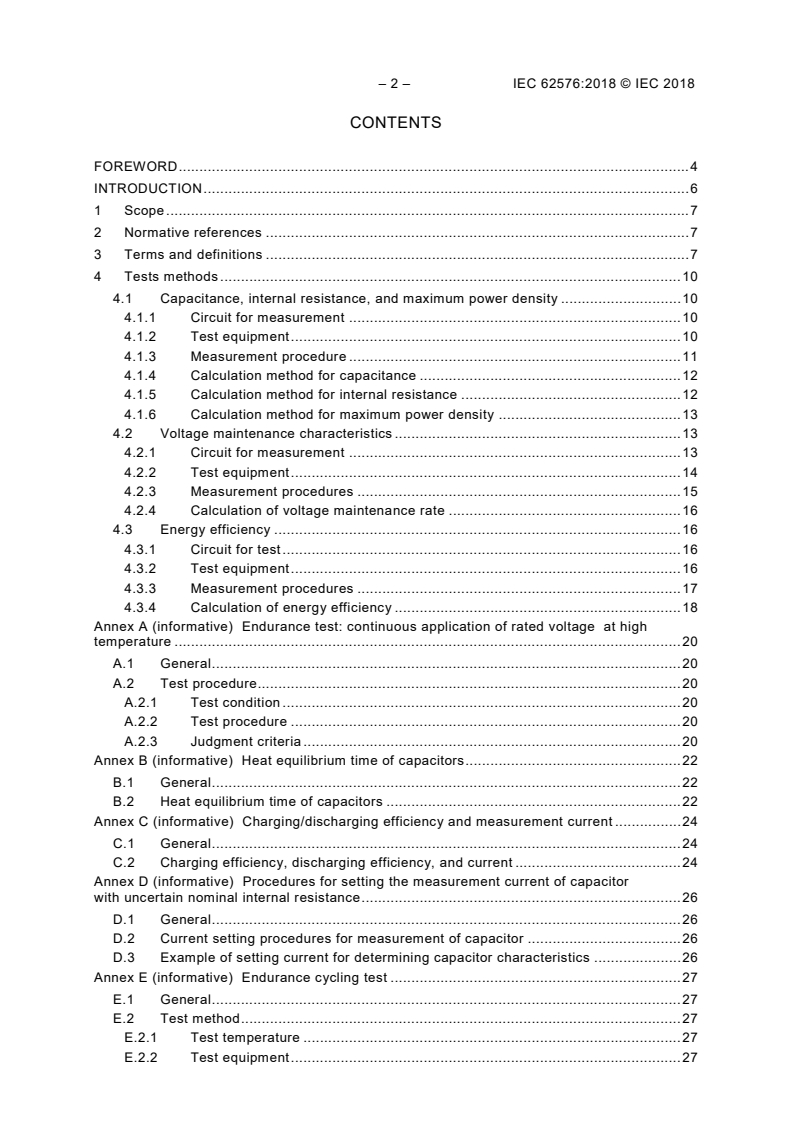
IEC 62576:2018 - Electric double-layer capacitors for use in hybrid electric vehicles - Test methods for electrical characteristics Released:2/20/2018
Overview - IEC 62576:2018 (Electric double‑layer capacitors for HEVs)
IEC 62576:2018 specifies standardized test methods for electrical characteristics of electric double‑layer capacitor (EDLC) cells intended for peak power assistance in hybrid electric vehicles (HEVs). This is Edition 2.0 (2018), a technical revision of the 2009 edition that clarifies applicability, refines definitions, improves test procedure descriptions, and adds endurance cycling test guidance (Annex E). All tests in the document are defined as type tests for capacitor cells.
Key technical topics and requirements
The standard provides measurement circuits, test procedures and calculation methods for key electrical parameters used in HEV applications:
- Capacitance, internal resistance (ESR) and maximum power density - test circuits, measurement steps and calculation methods.
- Voltage maintenance characteristics - procedures to measure voltage retention under defined load/conditions.
- Energy efficiency (charging/discharging efficiency) - measurement circuits, procedures and calculation of energy efficiency.
- Endurance tests and thermal considerations - informative annexes covering continuous high‑temperature voltage endurance (Annex A), heat equilibrium timing (Annex B), charging/discharging measurement guidance (Annex C), current‑setting procedures (Annex D) and endurance cycling test (Annex E).
- Test equipment and preconditioning - requirements and guidance for reproducible measurements.
- Calculation formulas and criteria for reporting results (e.g., voltage‑time curves, power density calculations) are provided to ensure consistent comparability.
Practical applications
IEC 62576:2018 is designed to support reliable evaluation and specification of EDLC cells used where high‑power bursts and rapid energy recovery are required:
- Validation of EDLC cell performance for peak power assistance during acceleration and regenerative braking in HEVs.
- Type testing by component manufacturers to verify product data (capacitance, ESR, power density, efficiency).
- Supplier‑OEM contractual testing protocols to ensure component suitability for vehicle systems.
- Test laboratories implementing standardized procedures for repeatable, comparable results across products and vendors.
Who should use this standard
- Automotive OEMs and powertrain engineers specifying energy storage components.
- EDLC (supercapacitor) manufacturers and suppliers.
- Independent test and certification laboratories.
- System integrators and researchers developing HEV energy recovery and hybridization strategies.
Related standards
- IEC 62391 series (general EDLC standards) - IEC 62576 complements existing capacitor standards by focusing on HEV‑specific usage patterns and test methods.
Using IEC 62576:2018 helps harmonize EDLC electrical testing for automotive applications, improving comparability, supply‑chain clarity and reliability of high‑power energy storage components in hybrid vehicles.
Relations
- Effective Date
- 05-Sep-2023
Buy Documents
IEC 62576:2018 RLV - Electric double-layer capacitors for use in hybrid electric vehicles - Test methods for electrical characteristics Released:2/20/2018
IEC 62576:2018 - Electric double-layer capacitors for use in hybrid electric vehicles - Test methods for electrical characteristics Released:2/20/2018
Get Certified
Connect with accredited certification bodies for this standard

TÜV Rheinland
TÜV Rheinland is a leading international provider of technical services.

TÜV SÜD
TÜV SÜD is a trusted partner of choice for safety, security and sustainability solutions.

DEKRA Certification Inc.
DEKRA US certification services.
Sponsored listings
Frequently Asked Questions
IEC 62576:2018 is a standard published by the International Electrotechnical Commission (IEC). Its full title is "Electric double-layer capacitors for use in hybrid electric vehicles - Test methods for electrical characteristics". This standard covers: IEC 62576:2018 describes the methods for testing electrical characteristics of electric double-layer capacitor cells (hereinafter referred to as capacitor) to be used for peak power assistance in hybrid electric vehicles. This second edition cancels and replaces the first edition published in 2009. This edition constitutes a technical revision. This edition includes the following significant technical changes with respect to the previous edition: a) information on applicability of this document has been added in Clause 1; b) the definitions of some terms in Clause 3 have been improved; c) the description of test procedures in Clause 4 has been clarified; d) information on endurance cycling test has been added (Annex E).
IEC 62576:2018 describes the methods for testing electrical characteristics of electric double-layer capacitor cells (hereinafter referred to as capacitor) to be used for peak power assistance in hybrid electric vehicles. This second edition cancels and replaces the first edition published in 2009. This edition constitutes a technical revision. This edition includes the following significant technical changes with respect to the previous edition: a) information on applicability of this document has been added in Clause 1; b) the definitions of some terms in Clause 3 have been improved; c) the description of test procedures in Clause 4 has been clarified; d) information on endurance cycling test has been added (Annex E).
IEC 62576:2018 is classified under the following ICS (International Classification for Standards) categories: 01 - GENERALITIES. TERMINOLOGY. STANDARDIZATION. DOCUMENTATION; 31.060.99 - Other capacitors; 33.160.30 - Audio systems; 43.120 - Electric road vehicles. The ICS classification helps identify the subject area and facilitates finding related standards.
IEC 62576:2018 has the following relationships with other standards: It is inter standard links to IEC 62576:2009. Understanding these relationships helps ensure you are using the most current and applicable version of the standard.
IEC 62576:2018 is available in PDF format for immediate download after purchase. The document can be added to your cart and obtained through the secure checkout process. Digital delivery ensures instant access to the complete standard document.
Standards Content (Sample)
IEC 62576 ®
Edition 2.0 2018-02
REDLINE VERSION
INTERNATIONAL
STANDARD
colour
inside
Electric double-layer capacitors for use in hybrid electric vehicles –
Test methods for electrical characteristics
All rights reserved. Unless otherwise specified, no part of this publication may be reproduced or utilized in any form
or by any means, electronic or mechanical, including photocopying and microfilm, without permission in writing from
either IEC or IEC's member National Committee in the country of the requester. If you have any questions about IEC
copyright or have an enquiry about obtaining additional rights to this publication, please contact the address below or
your local IEC member National Committee for further information.
IEC Central Office Tel.: +41 22 919 02 11
3, rue de Varembé info@iec.ch
CH-1211 Geneva 20 www.iec.ch
Switzerland
About the IEC
The International Electrotechnical Commission (IEC) is the leading global organization that prepares and publishes
International Standards for all electrical, electronic and related technologies.
About IEC publications
The technical content of IEC publications is kept under constant review by the IEC. Please make sure that you have the
latest edition, a corrigenda or an amendment might have been published.
IEC Catalogue - webstore.iec.ch/catalogue Electropedia - www.electropedia.org
The stand-alone application for consulting the entire The world's leading online dictionary of electronic and
bibliographical information on IEC International Standards, electrical terms containing 21 000 terms and definitions in
Technical Specifications, Technical Reports and other English and French, with equivalent terms in 16 additional
documents. Available for PC, Mac OS, Android Tablets and languages. Also known as the International Electrotechnical
iPad. Vocabulary (IEV) online.
IEC publications search - webstore.iec.ch/advsearchform IEC Glossary - std.iec.ch/glossary
The advanced search enables to find IEC publications by a 67 000 electrotechnical terminology entries in English and
variety of criteria (reference number, text, technical French extracted from the Terms and Definitions clause of
committee,…). It also gives information on projects, replaced IEC publications issued since 2002. Some entries have been
and withdrawn publications. collected from earlier publications of IEC TC 37, 77, 86 and
CISPR.
IEC Just Published - webstore.iec.ch/justpublished
Stay up to date on all new IEC publications. Just Published IEC Customer Service Centre - webstore.iec.ch/csc
details all new publications released. Available online and If you wish to give us your feedback on this publication or
also once a month by email. need further assistance, please contact the Customer Service
Centre: sales@iec.ch.
IEC 62576 ®
Edition 2.0 2018-02
REDLINE VERSION
INTERNATIONAL
STANDARD
colour
inside
Electric double-layer capacitors for use in hybrid electric vehicles –
Test methods for electrical characteristics
INTERNATIONAL
ELECTROTECHNICAL
COMMISSION
ICS 31.060.99; 43.120 ISBN 978-2-8322-5436-3
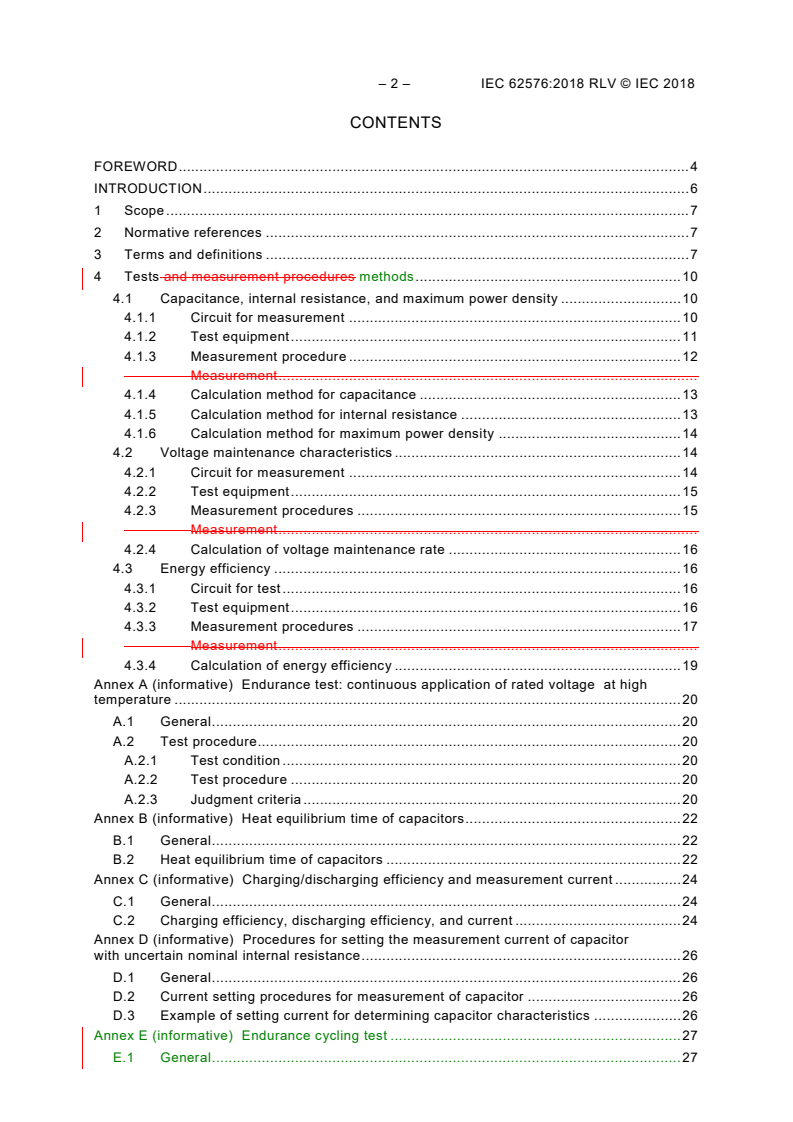
– 2 – IEC 62576:2018 RLV © IEC 2018
CONTENTS
FOREWORD . 4
INTRODUCTION . 6
1 Scope . 7
2 Normative references . 7
3 Terms and definitions . 7
4 Tests and measurement procedures methods . 10
4.1 Capacitance, internal resistance, and maximum power density . 10
4.1.1 Circuit for measurement . 10
4.1.2 Test equipment . 11
4.1.3 Measurement procedure . 12
Measurement .
4.1.4 Calculation method for capacitance . 13
4.1.5 Calculation method for internal resistance . 13
4.1.6 Calculation method for maximum power density . 14
4.2 Voltage maintenance characteristics . 14
4.2.1 Circuit for measurement . 14
4.2.2 Test equipment . 15
4.2.3 Measurement procedures . 15
Measurement .
4.2.4 Calculation of voltage maintenance rate . 16
4.3 Energy efficiency . 16
4.3.1 Circuit for test . 16
4.3.2 Test equipment . 16
4.3.3 Measurement procedures . 17
Measurement .
4.3.4 Calculation of energy efficiency . 19
Annex A (informative) Endurance test: continuous application of rated voltage at high
temperature . 20
A.1 General . 20
A.2 Test procedure . 20
A.2.1 Test condition . 20
A.2.2 Test procedure . 20
A.2.3 Judgment criteria . 20
Annex B (informative) Heat equilibrium time of capacitors . 22
B.1 General . 22
B.2 Heat equilibrium time of capacitors . 22
Annex C (informative) Charging/discharging efficiency and measurement current . 24
C.1 General . 24
C.2 Charging efficiency, discharging efficiency, and current . 24
Annex D (informative) Procedures for setting the measurement current of capacitor
with uncertain nominal internal resistance . 26
D.1 General . 26
D.2 Current setting procedures for measurement of capacitor . 26
D.3 Example of setting current for determining capacitor characteristics . 26
Annex E (informative) Endurance cycling test . 27
E.1 General . 27
E.2 Test method . 27
E.2.1 Test temperature . 27
E.2.2 Test equipment . 27
E.2.3 Preconditioning . 27
E.2.4 Initial measurements . 27
E.2.5 Test steps . 27
E.2.6 Test . 28
E.2.7 End of test criteria . 28
E.2.8 Post-treatment . 29
E.2.9 Final measurement . 29
E.2.10 Acceptance criteria . 29
Bibliography . 30
Figure 1 – Basic circuit for measuring capacitance, internal resistance and maximum
power density . 11
Figure 2 – Voltage–time characteristics between capacitor terminals in capacitance
and internal resistance measurement . 12
Figure 3 – Basic circuit for measuring the voltage maintenance characteristics . 14
Figure 4 – Time characteristics of voltage between capacitor terminals in voltage
maintenance test . 15
Figure 5 – Voltage-time characteristics between capacitor terminals in
charging/discharging efficiency test . 17
Figure B.1 – Heat equilibrium times of capacitors (from 85 °C to 25 °C) . 22
Figure B.2 – Heat equilibrium times of capacitors (from –40 °C to 25 °C) . 23
Figure – Temperature changes of capacitors' central portions (85 °C→25 °C) .
Figure – Temperature changes of capacitors' central portions (–40 °C→25 °C) .
Figure B.3 – Temperature changes of capacitors' central portions . 23
Figure E.1 – Endurance cycling test steps . 28
Table D.1 – Example of setting current for measurement of capacitor . 26
– 4 – IEC 62576:2018 RLV © IEC 2018
INTERNATIONAL ELECTROTECHNICAL COMMISSION
____________
ELECTRIC DOUBLE-LAYER CAPACITORS FOR USE IN
HYBRID ELECTRIC VEHICLES – TEST METHODS
FOR ELECTRICAL CHARACTERISTICS
FOREWORD
1) The International Electrotechnical Commission (IEC) is a worldwide organization for standardization comprising
all national electrotechnical committees (IEC National Committees). The object of IEC is to promote
international co-operation on all questions concerning standardization in the electrical and electronic fields. To
this end and in addition to other activities, IEC publishes International Standards, Technical Specifications,
Technical Reports, Publicly Available Specifications (PAS) and Guides (hereafter referred to as "IEC
Publication(s)"). Their preparation is entrusted to technical committees; any IEC National Committee interested
in the subject dealt with may participate in this preparatory work. International, governmental and
non-governmental organizations liaising with the IEC also participate in this preparation. IEC collaborates
closely with the International Organization for Standardization (ISO) in accordance with conditions determined
by agreement between the two organizations.
2) The formal decisions or agreements of IEC on technical matters express, as nearly as possible, an international
consensus of opinion on the relevant subjects since each technical committee has representation from all
interested IEC National Committees.
3) IEC Publications have the form of recommendations for international use and are accepted by IEC National
Committees in that sense. While all reasonable efforts are made to ensure that the technical content of IEC
Publications is accurate, IEC cannot be held responsible for the way in which they are used or for any
misinterpretation by any end user.
4) In order to promote international uniformity, IEC National Committees undertake to apply IEC Publications
transparently to the maximum extent possible in their national and regional publications. Any divergence
between any IEC Publication and the corresponding national or regional publication shall be clearly indicated in
the latter.
5) IEC itself does not provide any attestation of conformity. Independent certification bodies provide conformity
assessment services and, in some areas, access to IEC marks of conformity. IEC is not responsible for any
services carried out by independent certification bodies.
6) All users should ensure that they have the latest edition of this publication.
7) No liability shall attach to IEC or its directors, employees, servants or agents including individual experts and
members of its technical committees and IEC National Committees for any personal injury, property damage or
other damage of any nature whatsoever, whether direct or indirect, or for costs (including legal fees) and
expenses arising out of the publication, use of, or reliance upon, this IEC Publication or any other IEC
Publications.
8) Attention is drawn to the Normative references cited in this publication. Use of the referenced publications is
indispensable for the correct application of this publication.
9) Attention is drawn to the possibility that some of the elements of this IEC Publication may be the subject of
patent rights. IEC shall not be held responsible for identifying any or all such patent rights.
This redline version of the official IEC Standard allows the user to identify the changes
made to the previous edition. A vertical bar appears in the margin wherever a change
has been made. Additions are in green text, deletions are in strikethrough red text.
International Standard IEC 62576 has been prepared by IEC technical committee 69: Electric
road vehicles and electric industrial trucks.
This second edition cancels and replaces the first edition published in 2009. This edition
constitutes a technical revision.
This edition includes the following significant technical changes with respect to the previous
edition:
a) information on applicability of this document has been added in Clause 1;
b) the definitions of some terms in Clause 3 have been improved;
c) the description of test procedures in Clause 4 has been clarified;
d) information on endurance cycling test has been added (Annex E).
The text of this International Standard is based on the following documents:
CDV Report on voting
69/486/CDV 69/539/RVC
Full information on the voting for the approval of this International Standard can be found in
the report on voting indicated in the above table.
This publication has been drafted in accordance with the ISO/IEC Directives, Part 2.
The committee has decided that the contents of this publication will remain unchanged until
the stability date indicated on the IEC website under "http://webstore.iec.ch" in the data
related to the specific publication. At this date, the publication will be
• reconfirmed,
• withdrawn,
• replaced by a revised edition, or
• amended.
IMPORTANT – The 'colour inside' logo on the cover page of this publication indicates
that it contains colours which are considered to be useful for the correct
understanding of its contents. Users should therefore print this document using a
colour printer.
– 6 – IEC 62576:2018 RLV © IEC 2018
INTRODUCTION
The electric double-layer capacitor (EDLC capacitor) is used as an promising energy storage
system for hybrid electric vehicles (HEVs). EDLC Capacitor-installed HEVs electric vehicles
have begun to be are commercialized with an eye to improving fuel economy by recovering
regenerative energy, and by peak power assistance during acceleration, etc. Although
standards for EDLC capacitors already exists (IEC 62391 series), those for HEVs electric
vehicles involve patterns of use, usage environment, and values of current that are quite
different from those assumed in the existing standards. Standard evaluation and test methods
will be useful for both auto manufacturers and capacitor suppliers to speed up the
development and lower the costs of such EDLCs capacitors. With these points in mind, this
document aims to provide basic and minimum specifications in terms of the methods for
testing electrical characteristics, and to create an environment that supports the expanding
market of HEVs electric vehicles and large capacity EDLCs capacitors. Additional practical
test items to be standardized should be reconsidered after technology and market
stabilization of EDLCs capacitors for HEVs electric vehicles. In terms of Regarding endurance,
which is important in practical use, just a basic concept is set forth in the informative annexes.
ELECTRIC DOUBLE-LAYER CAPACITORS FOR USE IN
HYBRID ELECTRIC VEHICLES – TEST METHODS
FOR ELECTRICAL CHARACTERISTICS
1 Scope
This document describes the methods for testing electrical characteristics of electric
double-layer capacitor cells (hereinafter referred to as "capacitor") used for peak power
assistance in hybrid electric vehicles.
All the tests in this document are type tests.
This document can also be applicable to the capacitor used in idling reduction systems (start
and-stop systems) for the vehicles.
This document can also be applicable to the capacitor modules consisting of more than one
cell.
NOTE Annex E provides information on endurance cycling test.
2 Normative references
The following referenced documents are indispensable for the application of this document.
For dated references, only the edition cited applies. For undated references, the latest edition
of the referenced document (including any amendments) applies.
IEC 60068-1:1988, Environmental testing – Part 1: General and guidance
Amendment 1(1992)
There are no normative references in this document.
3 Terms and definitions
For the purposes of this document, the following terms and definitions apply.
ISO and IEC maintain terminological databases for use in standardization at the following
addresses:
• IEC Electropedia: available at http://www.electropedia.org/
• ISO Online browsing platform: available at http://www.iso.org/obp
3.1
reference temperature
reference temperature (°C) to be used in the test
3.1
ambient temperature
ambient temperature of the air surrounding space in which a the immediate vicinity of a
capacitor is placed
3.2
applied voltage
voltage (V) applied between the terminals of a capacitor
– 8 – IEC 62576:2018 RLV © IEC 2018
3.3
calculation end voltage
voltage (V) at a selected end point for calculating the characteristics including capacitance
under a state of voltage decrease during discharge
3.4
lower category temperature
lowest ambient temperature that a capacitor is designed to operate continuously
3.4
calculation start voltage
voltage (V) at a selected start point for calculating the characteristics including capacitance
under a state of voltage decrease during discharge
3.5
capacitance
ability of a capacitor to store electrical charge (F)
3.6
charge accumulated electrical energy
amount of charged energy (J) accumulated from the beginning to the end of charging
3.7
charge current
I
c
current (A) required to charge a capacitor
3.8
charging efficiency
efficiency under specified charging conditions, and ratio (%) of stored energy to charge
accumulated electrical energy
Note 1 to entry: This value is calculated from the internal resistance of a capacitor.
Note 2 to entry: Refer to Formula C.8.
3.9
constant voltage charging
method of charging a capacitor at specified voltage continuously charging during which the
voltage is maintained at a constant value regardless of charge current or temperature
3.10
discharge accumulated electrical energy
amount of discharged energy (J) accumulated from the beginning to the end of discharging
3.11
discharge current
I
d
current (A) required to discharge a capacitor
3.12
discharging efficiency
efficiency under specified discharging conditions, and ratio (%) of discharge accumulated
electrical energy to stored energy
Note 1 to entry: This value is calculated from the internal resistance of a capacitor.
Note 2 to entry: Refer to Formula C.10.
3.13
electric double-layer capacitor
capacitor
device that stores electrical energy using a double layer in an electrochemical cell, and whose
positive and negative electrodes are of the same material
Note 1 to entry: The electrolytic capacitor is not included in capacitor of this document.
3.14
energy efficiency
E
f
ratio (%) of discharge accumulated electrical energy to charge accumulated electrical energy
under specified charging and discharging conditions
3.15
nominal capacitance
C
N
nominal capacitance value (C ) to be used in design and measurement condition setting (F),
N
generally, at the reference temperature
3.15
internal resistance
combined resistance (Ω) of constituent material specific resistance and inside connection
resistance of a capacitor
3.16
maximum power density
P
dm
maximum power density (W/kg or W/l) that can be recovered from a charged capacitor.
Generally, it is calculated by using the internal resistance and the rated voltage
greatest electrical power output of a capacitor per mass (W/kg) or volume (W/l)
3.17
nominal internal resistance
R
N
nominal value of the internal resistance (R ) to be used in design and measurement condition
N
setting (Ω), generally at the ambient temperature
3.18
post-treatment (recovery)
discharging and storage of a capacitor under specified ambient conditions (temperature,
humidity, and pressure) after tests
Note 1 to entry: Generally, post-treatment implies that a capacitor is discharged and stored until its inner
temperature attains thermal equilibrium with the surrounding temperature before its electrical characteristics are
measured.
3.19
pre-conditioning
charging and discharging and storage of a capacitor under specified ambient conditions
(temperature, humidity, and pressure) before testing.
Note 1 to entry: Generally, pre-conditioning implies that a capacitor is discharged and stored until its inner
temperature attains thermal equilibrium with the surrounding temperature, before its electrical characteristics are
measured.
3.20
voltage treatment
voltage application before measurement of a capacitor’s electrical characteristics
– 10 – IEC 62576:2018 RLV © IEC 2018
NOTE Generally, this treatment is applied to a capacitor that has been stored for a long time or to a capacitor
whose history is not clear.
3.20
rated voltage
U
R
maximum DC voltage (V) that may be applied continuously for a certain time under the upper
category temperature to a capacitor so that a capacitor can exhibit specified demand
characteristics
Note 1 to entry: This voltage is the setting voltage in capacitor design.
Note 2 to entry: The endurance test using the rated voltage is described in Annex A.
3.21
ambient temperature
temperature of air in the vicinity of the device under test, in this document (25 ± 2) °C
3.22
stored energy
energy (J) stored in a capacitor
3.23
upper category temperature
highest ambient temperature that at which a capacitor is designed to operate continuously
3.24
voltage maintenance characteristics
voltage maintenance characteristics of a capacitor when its terminals are open after charging
ability of a capacitor to maintain the voltage, with its terminals open, after a specified time
period subsequent to the charging
3.25
voltage maintenance rate
ratio of voltage maintenance
ratio of the voltage at the open-ended terminals to the charge voltage after a specified time
period subsequent to the charging of a capacitor
3.27
power density
electrical power per unit mass (W/kg) or per unit volume (W/l) that can be recovered from a
charged capacitor
3.28
rated power density
specified maximum power density (W/kg or W/l). Generally, it is calculated by using the
nominal internal resistance and the rated voltage
4 Tests and measurement procedures methods
4.1 Capacitance, internal resistance, and maximum power density
4.1.1 Circuit for measurement
The capacitance and the internal resistance shall be measured by using the constant current
and constant voltage charging and the constant current discharging methods. Figure 1 shows
the basic circuit to be used for the measurement.
Power supply
a)
S
I
CC
Cx
b)
U
CV
IEC
Key
I constant-current
CC
U constant-voltage
CV
A DC ammeter
V DC voltage recorder
S changeover switch
Cx capacitor under test
constant current discharger
a) constant current charging
b) constant voltage charging
Figure 1 – Basic circuit for measuring capacitance, internal resistance
and maximum power density
4.1.2 Test equipment
The test equipment shall be capable of constant current charging, constant voltage charging,
constant current discharging, and continuous measurement of the current and the voltage
between the capacitor terminals in time-series as shown in Figure 2. The test equipment shall
be able to set and measure the current and the voltage with the accuracy equal to ±1 % or less, and
to measure the current and voltage with accuracy equal to ±0,1 %.
The power supply shall provide the constant charge current for the capacitor charge with 95 %
efficiency, set the duration of constant voltage charge, and provide a discharge current
corresponding to the specified discharge efficiency. The DC voltage recorder shall be capable
of conducting measurements and recording with a 5 mV resolution and sampling interval of
100 10 ms or less.
– 12 – IEC 62576:2018 RLV © IEC 2018
Magnified figure
U
R
U
U
Time (s)
T
CV
IEC
Key
U rated voltage (V)
R
U calculation start voltage (V)
U calculation end voltage (V)
∆U voltage drop (V)
T constant voltage charging duration (s)
CV
Figure 2 – Voltage–time characteristics between capacitor terminals
in capacitance and internal resistance measurement
4.1.3 Measurement procedure
Measurements shall be carried out in accordance with the following procedures using the test
equipment specified in 4.1.2.
a) Pre-conditioning
Before measurement, the capacitors shall be fully charged and fully discharged, and then
incubated for 2 h to 6 h under the reference ambient temperature, set at 25 °C ± 2 °C, as
specified in 5.2 in IEC 60068-1, or that specified by the related standards.
NOTE 1 The heat equilibrium time, which provides a reference for the soaking time, is described in Annex B.
NOTE 2 Charging and discharging can be repeated if necessary until the capacity and internal resistance are
stabilized.
EXAMPLE
Charge and discharge the sample using the current specified by the manufacturer in the following order:
1) fully discharge;
2) charge up to U ;
R
3) discharge down to 0,5 U ;
R
4) repeat 2) and 3) ten times.
b) Sample setting
Fit the sample capacitors with the test equipment.
c) Test equipment setup
Unless otherwise specified by related standards, the test equipment shall be set up in the
following manner.
1) Set the constant current I for charging. At this current, the capacitors shall be able to
c
charge with 95 % charging efficiency based on their nominal internal resistance R .
N
The current value is calculated by I = U /38R . The constant current value or the
c R N
charging efficiency may be changed according to the agreement between the customer
and the supplier.
Voltage (V)
∆U
∆U
NOTE The general concept for 95 % charging or discharging efficiency is described in Annex C. When the
rated value of internal resistance of a capacitor is uncertain, the current for the measurement can be set
according to the advisable procedures described in Annex D.
2) Set the maximum voltage for constant current charging as the rated voltage U .
R
3) Set the duration of constant voltage charging T to 300 s.
cv
4) Set the constant current discharge value. This value shall allow for a 95 % discharging
efficiency based on the capacitor’s nominal internal resistance R , and is calculated by
N
I = U /40R .
d R N
The constant current value or the discharging efficiency may be changed according to
the agreement between the customer and the supplier.
5) Set the sampling interval to 100 10 ms or less, and set the test-equipment so as to
measure the voltage drop characteristics up to 0,5 U .
R
d) Test
According to the set-up in 4.1.3 c), charge and discharge the sample in the following order,
and measure the voltage between the capacitor terminals as shown in Figure 2:
– constant current charging up to U ;
R
– constant voltage charging at U for 300 s;
R
– constant current discharging down to 0,4 U .
R
4.1.4 Measurement
After the setting as specified above, the voltage-time characteristics between capacitor
terminals as shown in Figure 2 shall be measured.
4.1.4 Calculation method for capacitance
The capacitance C shall be calculated using Formula (1) based on the voltage-time
characteristics between capacitor terminals obtained in 4.1.4.
NOTE This calculation method is called "energy conversion capacitance method".
2W
C = (1)
2 2
(0,9U ) − (0,7U )
R R
where
C is the capacitance (F) of capacitor;
W is the measured discharged energy (J) from calculation start voltage (0,9 U ) to
R
calculation end voltage (0,7 U );
R
U is the rated voltage (V).
R
4.1.5 Calculation method for internal resistance
The internal resistance R shall be calculated using Formula (2) based on the voltage-time
characteristics between capacitor terminals obtained in 4.1.4.
∆U
(2)
R =
I
d
where
R is the internal resistance (Ω) of capacitor;
I is the discharge current (A);
d
ΔU is the voltage drop (V).
– 14 – IEC 62576:2018 RLV © IEC 2018
To obtain ΔU , apply the straight-line approximation to the voltage drop characteristics from
the calculation start voltage (0,9 U ) to the calculation end voltage (0,7 U ) by using the least
R R
squares method. Obtain the intercept (voltage value) of the straight line at the discharge start
time. ΔU is the difference of voltages (V) between the intercept voltage value and the set
value of constant voltage charging.
NOTE This calculation method is called "least squares internal resistance method".
4.1.6 Calculation method for maximum power density
The maximum power density P is calculated by using the internal resistance value
dm
calculated in 4.1.5 and Formula (3).
NOTE This calculation method is called "matched impedance power density method".
0,25U
R
P =
(3)
dm
RM
where
P is the maximum power density of capacitor (W/kg or W/l);
dm
U is the rated voltage (V);
R
R is the calculated internal resistance (Ω);
M is the mass or volume of capacitor (kg or l).
4.2 Voltage maintenance characteristics
4.2.1 Circuit for measurement
Figure 3 shows the basic circuit for measuring the voltage maintenance characteristics.
Power supply
a)
I
CC
S
Cx
b)
U
CV
IEC
Key
I constant-current
CC
U constant-voltage
CV
V V DC voltmeter
1 2
S changeover switch
Cx capacitor under test
a) constant current charging
b) constant voltage charging
Figure 3 – Basic circuit for measuring the voltage maintenance characteristics
4.2.2 Test equipment
The test equipment shall be capable of constant current charging, constant voltage charging,
and continuous measurement of the voltage between the capacitor terminals in time-series as
shown in Figure 4. The power supply shall provide the constant charge current for the
capacitor charge with 95 % efficiency and set the duration of constant voltage charging. The
test equipment shall be able to set and measure the current and the voltage by the accuracy
equal to ±1 % or less.
The DC voltage recorders V1 and V2 shall have a resolution of 5 mV or less for voltage
measurement. The input impedance of the recorder shall be sufficiently high so that
measurement errors are negligible.
U
R
U
end
Time
T T T
cc1 cv1 oc1
IEC
Key
U rated voltage (V)
R
T charging duration with 95 % efficiency (s)
cc1
T duration of constant voltage charging (s)
cv1
T duration of measurement soaking time (h)
oc1
U voltage when T is 72 h (V)
end OC1
Figure 4 – Time characteristics of voltage between capacitor terminals
in voltage maintenance test
4.2.3 Measurement procedures
The measurements shall be carried out in accordance with the following procedures using the
test equipment specified in 4.2.2.
a) Pre-conditioning
Before measurement, the capacitors shall be fully charged and fully discharged, and then
incubated for 2 h to 6 h under the reference ambient temperature, set at 25 °C ± 2 °C, as
specified in 5.2 in IEC 60068-1, or that specified by the related standards.
NOTE 1 The heat equilibrium time, which provides a reference for the soaking time, is described in Annex B.
NOTE 2 Charging and discharging can be repeated if necessary until the capacity and internal resistance are
stabilized.
EXAMPLE
Charge and discharge the sample using the current specified by the manufacturer in the following order:
1) fully discharge;
2) charge up to U ;
R
3) discharge down to 0,5 U ;
R
4) repeat 2) and 3) ten times.
Voltage (V)
– 16 – IEC 62576:2018 RLV © IEC 2018
b) Sample setting
Fit the sample capacitors with the test equipment.
c) Test equipment setup
Unless otherwise specified by related standards, the test equipment shall be set up in the
following manner.
1) Set the constant current value for charging. At this current, the capacitors shall be able
to charge with 95 % charging efficiency based on their nominal internal resistance. The
current value is calculated by I = U /38R .
c R N
The constant current value or the charging efficiency may be changed according to the
agreement between the customer and the supplier.
NOTE The general concept for 95 % charging or discharging efficiency is described in Annex C. When
the rated value of internal resistance of a capacitor is uncertain, the current for the measurement can be
set according to the advisable procedures described in Annex D.
2) Set the maximum voltage for constant current charging to the rated voltage U .
R
3) Set the duration of constant voltage charging T to 300 s.
cv1
4) After specified charging duration, set the capacitor terminals open.
c) Test
1) According to the setup in 4.2.3 c), charge the sample in the following order:
– constant current charging up to U ;
R
– constant voltage charging at U for 300 s.
R
2) Open the capacitor terminals, and after 72 h, measure the voltage between the
capacitor terminals.
4.2.4 Measurement
After the setting as specified above, measure the voltage between capacitor terminals when
T in Figure 4 is 72 h.
OC1
4.2.4 Calculation of voltage maintenance rate
The voltage maintenance rate A is calculated by Formula (4).
U
end
(4)
Α = ×100
U
R
where
A is the voltage maintenance rate (%);
U is the voltage between open capacitor terminals after 72 h (T ) has elapsed;
end OC1
U is the rated voltage (V).
R
4.3 Energy efficiency
4.3.1 Circuit for test
The energy efficiency test shall be conducted by the constant current charging and
discharging. Figure 1 shows the basic circuit required for this test.
4.3.2 Test equipment
The test equipment shall be as specified in 4.1.2.
The test equipment shall be capable of constant current charging, constant voltage charging,
constant current discharging, and continuous measurement of the current and the voltage
between the capacitor terminals in time-series as shown in Figure 5. The test equipment shall
be able to set and measure the current and the voltage by the with an accuracy equal to ±1 %
or less.
The power supply shall provide the constant charge current for the capacitor charge with 95 %
efficiency, set the duration of constant voltage charge, and provide a discharge current
corresponding to the specified discharge efficiency. The DC voltage recorder shall be capable
of conducting measurements and recording with a 5 mV resolution and sampling interval of
100 ms or less.
U
R
Constant current
discharge
0,5U
R
t t t
0 UR 0,5UR
T T T T T
cc11 cv11 cc12 cv12 cc13
Time (s)
IEC
Key
U rated voltage (V)
R
T constant current charging duration (s) up to 0,5U
CC11 R
T constant voltage charging duration (s) up to at 0,5U
CV11 R
T constant current charging duration (s) up to U
CC12 R
T constant voltage charging duration (s) at U
CV12 R
T constant current discharging duration (s) from U to 0,5 U
CC13 R R
Figure 5 – Voltage-time characteristics between capacitor terminals
in charging/discharging efficiency test
4.3.3 Measurement procedures
The measurements shall be carried out in accordance with the following procedures by using
the test equipment specified in 4.3.2.
a) Pre-conditioning
Before measurement, the capacitor shall be fully charged and fully discharged, and then
incubated for 2 h to 6 h under the reference ambient temperature, set at 25 °C ± 2 °C, as
specified in 5.2 in IEC 60068-1, or that specified by the related standards.
NOTE 1 The heat equilibrium time which provides a reference for the soaking time is in Annex B.
NOTE 2 Charging and discharging can be repeated if necessary until the capacity and internal resistance are
stabilized.
Voltage (V)
Current (A)
– 18 – IEC 62576:2018 RLV © IEC 2018
EXAMPLE
Charge and discharge the sample using the current specified by the manufacturer in the following order:
1) fully discharge;
2) charge up to U ;
R
3) discharge down to 0,5 U ;
R
4) repeat 2) and 3) ten times.
b) Sample setting
Fit the sample capacitors with the test equipment.
c) Test equipment setup
Unless otherwise specified by related standards, the test equipment shall be set up as
follows.
and from 0,5 U to U . At this
1) Set the constant current for charging from 0 V to 0,5 U
R R R
current, the capacitors shall be able to charge with 95 % charging efficiency based on
their nominal internal resistance R . The current value is calculated by I =U /38R .
N c R N
The constant current value or the charging efficiency may be changed according to the
agreement between the customer and the supplier.
NOTE The general concept for 95 % charging or discharging efficiency is described in Annex C. When
the rated value of internal resistance of a capacitor is uncertain, the current for the measurement can be
set according to the advisable procedures described in Annex D.
2) Set the duration of constant voltage charging T at 0,5 U to 300 s, and T at U
CV11 R cv12 R
to 10 s.
3) Set the constant current discharge value. This value shall allow for a 95 % discharging
efficiency based on the capacitor’s nominal internal resistance R and is calculated by
N
I = U /40R .
d R N
The constant current value or the discharging efficiency may be changed according to
the agreement between the customer and the supplier.
NOTE The general concept for 95 % charging or discharging efficiency is described in Annex C. When
the rated value of internal resistance of a capacitor is uncertain, the current for the measurement can be
set according to the advisable procedures described in Annex D.
4) Discharging can be deemed complete when the voltage between the capacitor
terminals reaches 0,5 U .
R
d) Test
1) According to the set-up in 4.3.3 c), charge and discharge the sample in the following
order:
– constant current charging up to 0,5 U ;
R
– constant voltage charging at 0,5 U for 300 s;
R
– constant current charging from 0,5 U up to U ;
R R
– constant voltage charging at U for 10 s;
R
– constant current discharging down to 0,4 U .
R
2) Obtain the charge accumulated electrical energy during T and T and the
CC12 CV12
discharge accumulated electrical energy during T .
CC13
4.3.4 Measurement
After setting up the test equipment as mentioned above, test the following: constant current
charging up to 0,5 U , constant voltage charging at 0,5 U , constant current charging up to
R R
U , constant voltage charging at U , and constant current discharging down to 0,5 U in that
R R R
order. Obtain the charge accumulated electrical energy from 0,5 U (during T and T )
R CC12 CV12
and the discharge accumulated electrical energy during discharging T .
CC13
4.3.4 Calculation of energy efficiency
The energy efficiency E can be obtained by Formula (5) based on the voltage-time and
f
current-time characteristics between 0,5 U to U .
R R
W
d
E = ×100 (5)
f
W
c
where
E is the energy efficiency (%);
f
W is the discharged electrical energy (J) during T period;
d CC13
W is the charged electrical energy (J) during T plus T period.
c cc12 cv12
W can be obtained by Formula (6).
d
t
0,5
U
R
W = I U(t)dt (6)
d d
∫
t
W can be obtained by Formula (7).
c
t
U
R
W = I U(t)dt (7)
c c
∫
t
– 20 – IEC 62576:2018 RLV © IEC 2018
Annex A
(informative)
Endurance test: continuous application of rated voltage
at high temperature
A.1 General
Annex A describes the endurance test for continuous application of rated voltage at high
temperature that is a factor to define
...
IEC 62576 ®
Edition 2.0 2018-02
INTERNATIONAL
STANDARD
NORME
INTERNATIONALE
colour
inside
Electric double-layer capacitors for use in hybrid electric vehicles –
Test methods for electrical characteristics
Condensateurs électriques à double couche pour véhicules électriques hybrides –
Méthodes d'essai des caractéristiques électriques
All rights reserved. Unless otherwise specified, no part of this publication may be reproduced or utilized in any form
or by any means, electronic or mechanical, including photocopying and microfilm, without permission in writing from
either IEC or IEC's member National Committee in the country of the requester. If you have any questions about IEC
copyright or have an enquiry about obtaining additional rights to this publication, please contact the address below or
your local IEC member National Committee for further information.
Droits de reproduction réservés. Sauf indication contraire, aucune partie de cette publication ne peut être reproduite
ni utilisée sous quelque forme que ce soit et par aucun procédé, électronique ou mécanique, y compris la photocopie
et les microfilms, sans l'accord écrit de l'IEC ou du Comité national de l'IEC du pays du demandeur. Si vous avez des
questions sur le copyright de l'IEC ou si vous désirez obtenir des droits supplémentaires sur cette publication, utilisez
les coordonnées ci-après ou contactez le Comité national de l'IEC de votre pays de résidence.
IEC Central Office Tel.: +41 22 919 02 11
3, rue de Varembé info@iec.ch
CH-1211 Geneva 20 www.iec.ch
Switzerland
About the IEC
The International Electrotechnical Commission (IEC) is the leading global organization that prepares and publishes
International Standards for all electrical, electronic and related technologies.
About IEC publications
The technical content of IEC publications is kept under constant review by the IEC. Please make sure that you have the
latest edition, a corrigenda or an amendment might have been published.
IEC Catalogue - webstore.iec.ch/catalogue Electropedia - www.electropedia.org
The stand-alone application for consulting the entire The world's leading online dictionary of electronic and
bibliographical information on IEC International Standards, electrical terms containing 21 000 terms and definitions in
Technical Specifications, Technical Reports and other English and French, with equivalent terms in 16 additional
documents. Available for PC, Mac OS, Android Tablets and languages. Also known as the International Electrotechnical
iPad. Vocabulary (IEV) online.
IEC publications search - webstore.iec.ch/advsearchform IEC Glossary - std.iec.ch/glossary
The advanced search enables to find IEC publications by a 67 000 electrotechnical terminology entries in English and
variety of criteria (reference number, text, technical French extracted from the Terms and Definitions clause of
committee,…). It also gives information on projects, replaced IEC publications issued since 2002. Some entries have been
and withdrawn publications. collected from earlier publications of IEC TC 37, 77, 86 and
CISPR.
IEC Just Published - webstore.iec.ch/justpublished
Stay up to date on all new IEC publications. Just Published IEC Customer Service Centre - webstore.iec.ch/csc
details all new publications released. Available online and If you wish to give us your feedback on this publication or
also once a month by email. need further assistance, please contact the Customer Service
Centre: sales@iec.ch.
A propos de l'IEC
La Commission Electrotechnique Internationale (IEC) est la première organisation mondiale qui élabore et publie des
Normes internationales pour tout ce qui a trait à l'électricité, à l'électronique et aux technologies apparentées.
A propos des publications IEC
Le contenu technique des publications IEC est constamment revu. Veuillez vous assurer que vous possédez l’édition la
plus récente, un corrigendum ou amendement peut avoir été publié.
Catalogue IEC - webstore.iec.ch/catalogue Electropedia - www.electropedia.org
Application autonome pour consulter tous les renseignements
Le premier dictionnaire en ligne de termes électroniques et
bibliographiques sur les Normes internationales,
électriques. Il contient 21 000 termes et définitions en anglais
Spécifications techniques, Rapports techniques et autres
et en français, ainsi que les termes équivalents dans 16
documents de l'IEC. Disponible pour PC, Mac OS, tablettes
langues additionnelles. Egalement appelé Vocabulaire
Android et iPad.
Electrotechnique International (IEV) en ligne.
Recherche de publications IEC -
Glossaire IEC - std.iec.ch/glossary
webstore.iec.ch/advsearchform
67 000 entrées terminologiques électrotechniques, en anglais
La recherche avancée permet de trouver des publications IEC et en français, extraites des articles Termes et Définitions des
en utilisant différents critères (numéro de référence, texte, publications IEC parues depuis 2002. Plus certaines entrées
comité d’études,…). Elle donne aussi des informations sur les antérieures extraites des publications des CE 37, 77, 86 et
projets et les publications remplacées ou retirées. CISPR de l'IEC.
IEC Just Published - webstore.iec.ch/justpublished Service Clients - webstore.iec.ch/csc
Restez informé sur les nouvelles publications IEC. Just Si vous désirez nous donner des commentaires sur cette
Published détaille les nouvelles publications parues. publication ou si vous avez des questions contactez-nous:
Disponible en ligne et aussi une fois par mois par email. sales@iec.ch.
IEC 62576 ®
Edition 2.0 2018-02
INTERNATIONAL
STANDARD
NORME
INTERNATIONALE
colour
inside
Electric double-layer capacitors for use in hybrid electric vehicles –
Test methods for electrical characteristics
Condensateurs électriques à double couche pour véhicules électriques hybrides –
Méthodes d'essai des caractéristiques électriques
INTERNATIONAL
ELECTROTECHNICAL
COMMISSION
COMMISSION
ELECTROTECHNIQUE
INTERNATIONALE
ICS 31.060.99; 43.120 ISBN 978-2-8322-5341-0
– 2 – IEC 62576:2018 © IEC 2018
CONTENTS
FOREWORD . 4
INTRODUCTION . 6
1 Scope . 7
2 Normative references . 7
3 Terms and definitions . 7
4 Tests methods . 10
4.1 Capacitance, internal resistance, and maximum power density . 10
4.1.1 Circuit for measurement . 10
4.1.2 Test equipment . 10
4.1.3 Measurement procedure . 11
4.1.4 Calculation method for capacitance . 12
4.1.5 Calculation method for internal resistance . 12
4.1.6 Calculation method for maximum power density . 13
4.2 Voltage maintenance characteristics . 13
4.2.1 Circuit for measurement . 13
4.2.2 Test equipment . 14
4.2.3 Measurement procedures . 15
4.2.4 Calculation of voltage maintenance rate . 16
4.3 Energy efficiency . 16
4.3.1 Circuit for test . 16
4.3.2 Test equipment . 16
4.3.3 Measurement procedures . 17
4.3.4 Calculation of energy efficiency . 18
Annex A (informative) Endurance test: continuous application of rated voltage at high
temperature . 20
A.1 General . 20
A.2 Test procedure . 20
A.2.1 Test condition . 20
A.2.2 Test procedure . 20
A.2.3 Judgment criteria . 20
Annex B (informative) Heat equilibrium time of capacitors . 22
B.1 General . 22
B.2 Heat equilibrium time of capacitors . 22
Annex C (informative) Charging/discharging efficiency and measurement current . 24
C.1 General . 24
C.2 Charging efficiency, discharging efficiency, and current . 24
Annex D (informative) Procedures for setting the measurement current of capacitor
with uncertain nominal internal resistance . 26
D.1 General . 26
D.2 Current setting procedures for measurement of capacitor . 26
D.3 Example of setting current for determining capacitor characteristics . 26
Annex E (informative) Endurance cycling test . 27
E.1 General . 27
E.2 Test method . 27
E.2.1 Test temperature . 27
E.2.2 Test equipment . 27
E.2.3 Preconditioning . 27
E.2.4 Initial measurements . 27
E.2.5 Test steps . 27
E.2.6 Test . 28
E.2.7 End of test criteria . 28
E.2.8 Post treatment . 29
E.2.9 Final measurement . 29
E.2.10 Acceptance criteria . 29
Bibliography . 30
Figure 1 – Basic circuit for measuring capacitance, internal resistance and maximum
power density . 10
Figure 2 – Voltage–time characteristics between capacitor terminals in capacitance
and internal resistance measurement . 11
Figure 3 – Basic circuit for measuring the voltage maintenance characteristics . 14
Figure 4 – Time characteristics of voltage between capacitor terminals in voltage
maintenance test . 15
Figure 5 – Voltage-time characteristics between capacitor terminals in
charging/discharging efficiency test . 17
Figure B.1 – Heat equilibrium times of capacitors (from 85 °C to 25 °C) . 22
Figure B.2 – Heat equilibrium times of capacitors (from –40 °C to 25 °C) . 23
Figure B.3 – Temperature changes of capacitors' central portions . 23
Figure E.1 – Endurance cycling test steps . 28
Table D.1 – Example of setting current for measurement of capacitor . 26
– 4 – IEC 62576:2018 © IEC 2018
INTERNATIONAL ELECTROTECHNICAL COMMISSION
____________
ELECTRIC DOUBLE-LAYER CAPACITORS FOR USE IN
HYBRID ELECTRIC VEHICLES – TEST METHODS
FOR ELECTRICAL CHARACTERISTICS
FOREWORD
1) The International Electrotechnical Commission (IEC) is a worldwide organization for standardization comprising
all national electrotechnical committees (IEC National Committees). The object of IEC is to promote
international co-operation on all questions concerning standardization in the electrical and electronic fields. To
this end and in addition to other activities, IEC publishes International Standards, Technical Specifications,
Technical Reports, Publicly Available Specifications (PAS) and Guides (hereafter referred to as "IEC
Publication(s)"). Their preparation is entrusted to technical committees; any IEC National Committee interested
in the subject dealt with may participate in this preparatory work. International, governmental and
non-governmental organizations liaising with the IEC also participate in this preparation. IEC collaborates
closely with the International Organization for Standardization (ISO) in accordance with conditions determined
by agreement between the two organizations.
2) The formal decisions or agreements of IEC on technical matters express, as nearly as possible, an international
consensus of opinion on the relevant subjects since each technical committee has representation from all
interested IEC National Committees.
3) IEC Publications have the form of recommendations for international use and are accepted by IEC National
Committees in that sense. While all reasonable efforts are made to ensure that the technical content of IEC
Publications is accurate, IEC cannot be held responsible for the way in which they are used or for any
misinterpretation by any end user.
4) In order to promote international uniformity, IEC National Committees undertake to apply IEC Publications
transparently to the maximum extent possible in their national and regional publications. Any divergence
between any IEC Publication and the corresponding national or regional publication shall be clearly indicated in
the latter.
5) IEC itself does not provide any attestation of conformity. Independent certification bodies provide conformity
assessment services and, in some areas, access to IEC marks of conformity. IEC is not responsible for any
services carried out by independent certification bodies.
6) All users should ensure that they have the latest edition of this publication.
7) No liability shall attach to IEC or its directors, employees, servants or agents including individual experts and
members of its technical committees and IEC National Committees for any personal injury, property damage or
other damage of any nature whatsoever, whether direct or indirect, or for costs (including legal fees) and
expenses arising out of the publication, use of, or reliance upon, this IEC Publication or any other IEC
Publications.
8) Attention is drawn to the Normative references cited in this publication. Use of the referenced publications is
indispensable for the correct application of this publication.
9) Attention is drawn to the possibility that some of the elements of this IEC Publication may be the subject of
patent rights. IEC shall not be held responsible for identifying any or all such patent rights.
International Standard IEC 62576 has been prepared by IEC technical committee 69: Electric
road vehicles and electric industrial trucks.
This second edition cancels and replaces the first edition published in 2009. This edition
constitutes a technical revision.
This edition includes the following significant technical changes with respect to the previous
edition:
a) information on applicability of this document has been added in Clause 1;
b) the definitions of some terms in Clause 3 have been improved;
c) the description of test procedures in Clause 4 has been clarified;
d) information on endurance cycling test has been added (Annex E).
The text of this International Standard is based on the following documents:
CDV Report on voting
69/486/CDV 69/539/RVC
Full information on the voting for the approval of this International Standard can be found in
the report on voting indicated in the above table.
This publication has been drafted in accordance with the ISO/IEC Directives, Part 2.
The committee has decided that the contents of this publication will remain unchanged until
the stability date indicated on the IEC website under "http://webstore.iec.ch" in the data
related to the specific publication. At this date, the publication will be
• reconfirmed,
• withdrawn,
• replaced by a revised edition, or
• amended.
IMPORTANT – The 'colour inside' logo on the cover page of this publication indicates
that it contains colours which are considered to be useful for the correct
understanding of its contents. Users should therefore print this document using a
colour printer.
– 6 – IEC 62576:2018 © IEC 2018
INTRODUCTION
The electric double-layer capacitor (capacitor) is used as an energy storage system for
vehicles. Capacitor-installed electric vehicles are commercialized with an eye to improving
fuel economy by recovering regenerative energy, and by peak power assistance during
acceleration, etc. Although standards for capacitors already exists (IEC 62391 series), those
for electric vehicles involve patterns of use, usage environment, and values of current that are
quite different from those assumed in the existing standards. Standard evaluation and test
methods will be useful for both auto manufacturers and capacitor suppliers to speed up the
development and lower the costs of such capacitors. With these points in mind, this document
aims to provide basic and minimum specifications in terms of the methods for testing
electrical characteristics, and to create an environment that supports the expanding market of
electric vehicles and large capacity capacitors. Additional practical test items to be
standardized should be reconsidered after technology and market stabilization of capacitors
for electric vehicles. Regarding endurance, which is important in practical use, just a basic
concept is set forth in the informative annexes.
ELECTRIC DOUBLE-LAYER CAPACITORS FOR USE IN
HYBRID ELECTRIC VEHICLES – TEST METHODS
FOR ELECTRICAL CHARACTERISTICS
1 Scope
This document describes the methods for testing electrical characteristics of electric
double-layer capacitor cells (hereinafter referred to as "capacitor") used for peak power
assistance in hybrid electric vehicles.
All the tests in this document are type tests.
This document can also be applicable to the capacitor used in idling reduction systems (start
and-stop systems) for the vehicles.
This document can also be applicable to the capacitor modules consisting of more than one
cell.
NOTE Annex E provides information on endurance cycling test.
2 Normative references
There are no normative references in this document.
3 Terms and definitions
For the purposes of this document, the following terms and definitions apply.
ISO and IEC maintain terminological databases for use in standardization at the following
addresses:
• IEC Electropedia: available at http://www.electropedia.org/
• ISO Online browsing platform: available at http://www.iso.org/obp
3.1
ambient temperature
temperature of the air, in the immediate vicinity of a capacitor
3.2
applied voltage
voltage (V) applied between the terminals of a capacitor
3.3
calculation end voltage
voltage (V) at a selected end point for calculating the characteristics including capacitance
under a state of voltage decrease during discharge
3.4
calculation start voltage
voltage (V) at a selected start point for calculating the characteristics including capacitance
under a state of voltage decrease during discharge
– 8 – IEC 62576:2018 © IEC 2018
3.5
capacitance
ability of a capacitor to store electrical charge (F)
3.6
charge accumulated electrical energy
amount of charged energy (J) accumulated from the beginning to the end of charging
3.7
charge current
I
c
current (A) required to charge a capacitor
3.8
charging efficiency
efficiency under specified charging conditions, and ratio (%) of stored energy to charge
accumulated electrical energy
Note 1 to entry: This value is calculated from the internal resistance of a capacitor.
Note 2 to entry: Refer to Formula C.8.
3.9
constant voltage charging
charging during which the voltage is maintained at a constant value regardless of charge
current or temperature
3.10
discharge accumulated electrical energy
amount of discharged energy (J) accumulated from the beginning to the end of discharging
3.11
discharge current
I
d
current (A) required to discharge a capacitor
3.12
discharging efficiency
efficiency under specified discharging conditions, and ratio (%) of discharge accumulated
electrical energy to stored energy
Note 1 to entry: This value is calculated from the internal resistance of a capacitor.
Note 2 to entry: Refer to Formula C.10.
3.13
electric double-layer capacitor
capacitor
device that stores electrical energy using a double layer in an electrochemical cell, and whose
positive and negative electrodes are of the same material
Note 1 to entry: The electrolytic capacitor is not included in capacitor of this document.
3.14
energy efficiency
E
f
ratio (%) of discharge accumulated electrical energy to charge accumulated electrical energy
under specified charging and discharging conditions
3.15
internal resistance
combined resistance (Ω) of constituent material specific resistance and inside connection
resistance of a capacitor
3.16
maximum power density
P
dm
greatest electrical power output of a capacitor per mass (W/kg) or volume (W/l)
3.17
nominal internal resistance
R
N
nominal value of the internal resistance (R ) to be used in design and measurement condition
N
setting (Ω), generally at the ambient temperature
3.18
post-treatment
discharging and storage of a capacitor under specified ambient conditions (temperature,
humidity, and pressure) after tests
Note 1 to entry: Generally, post-treatment implies that a capacitor is discharged and stored until its inner
temperature attains thermal equilibrium with the surrounding temperature before its electrical characteristics are
measured.
3.19
pre-conditioning
charging and discharging and storage of a capacitor under specified ambient conditions
(temperature, humidity, and pressure) before testing.
Note 1 to entry: Generally, pre-conditioning implies that a capacitor is discharged and stored until its inner
temperature attains thermal equilibrium with the surrounding temperature, before its electrical characteristics are
measured.
3.20
rated voltage
U
R
maximum DC voltage (V) that may be applied continuously for a certain time under the upper
category temperature to a capacitor so that a capacitor can exhibit specified demand
characteristics
Note 1 to entry: This voltage is the setting voltage in capacitor design.
Note 2 to entry: The endurance test using the rated voltage is described in Annex A.
3.21
ambient temperature
temperature of air in the vicinity of the device under test, in this document (25 ± 2) °C
3.22
stored energy
energy (J) stored in a capacitor
3.23
upper category temperature
highest ambient temperature at which a capacitor is designed to operate continuously
3.24
voltage maintenance characteristics
ability of a capacitor to maintain the voltage, with its terminals open, after a specified time
period subsequent to the charging
– 10 – IEC 62576:2018 © IEC 2018
3.25
voltage maintenance rate
ratio of voltage maintenance
ratio of the voltage at the open-ended terminals to the charge voltage after a specified time
period subsequent to the charging of a capacitor
4 Tests methods
4.1 Capacitance, internal resistance, and maximum power density
4.1.1 Circuit for measurement
The capacitance and the internal resistance shall be measured by using the constant current
and constant voltage charging and the constant current discharging. Figure 1 shows the basic
circuit to be used for the measurement.
Power supply
a)
S
I
CC
Cx
b)
U
CV
IEC
Key
I constant-current
CC
U constant-voltage
CV
A DC ammeter
V DC voltage recorder
S changeover switch
Cx capacitor under test
constant current discharger
a) constant current charging
b) constant voltage charging
Figure 1 – Basic circuit for measuring capacitance, internal resistance
and maximum power density
4.1.2 Test equipment
The test equipment shall be capable of constant current charging, constant voltage charging,
constant current discharging, and continuous measurement of the current and the voltage
between the capacitor terminals in time-series as shown in Figure 2. The test equipment shall
be able to set the current and the voltage with the accuracy equal to ±1 % or less, and to measure
the current and voltage with accuracy equal to ±0,1 %.
The power supply shall provide the constant charge current for the capacitor charge with 95 %
efficiency, set the duration of constant voltage charge, and provide a discharge current
corresponding to the specified discharge efficiency. The DC voltage recorder shall be capable
of conducting measurements and recording with a sampling interval of 10 ms or less.
Magnified figure
U
R
U
U
Time (s)
T
CV
IEC
Key
U rated voltage (V)
R
U calculation start voltage (V)
U calculation end voltage (V)
∆U voltage drop (V)
T constant voltage charging duration (s)
CV
Figure 2 – Voltage–time characteristics between capacitor terminals
in capacitance and internal resistance measurement
4.1.3 Measurement procedure
Measurements shall be carried out in accordance with the following procedures using the test
equipment specified in 4.1.2.
a) Pre-conditioning
Before measurement, the capacitors shall be fully charged and fully discharged, and then
incubated for 2 h to 6 h under the ambient temperature or that specified by the related
standards.
NOTE 1 The heat equilibrium time, which provides a reference for the soaking time, is described in Annex B.
NOTE 2 Charging and discharging can be repeated if necessary until the capacity and internal resistance are
stabilized.
EXAMPLE
Charge and discharge the sample using the current specified by the manufacturer in the following order:
1) fully discharge;
2) charge up to U ;
R
3) discharge down to 0,5 U ;
R
4) repeat 2) and 3) ten times.
b) Sample setting
Fit the sample capacitors with the test equipment.
c) Test equipment setup
Unless otherwise specified by related standards, the test equipment shall be set up in the
following manner.
1) Set the constant current I for charging. At this current, the capacitors shall be able to
c
charge with 95 % charging efficiency based on their nominal internal resistance R .
N
The current value is calculated by I = U /38R . The constant current value or the
c R N
Voltage (V)
∆U
∆U
– 12 – IEC 62576:2018 © IEC 2018
charging efficiency may be changed according to the agreement between the customer
and the supplier.
NOTE The general concept for 95 % charging or discharging efficiency is described in Annex C. When the
rated value of internal resistance of a capacitor is uncertain, the current for the measurement can be set
according to the advisable procedures described in Annex D.
2) Set the maximum voltage for constant current charging as the rated voltage U .
R
3) Set the duration of constant voltage charging T to 300 s.
cv
4) Set the constant current discharge value. This value shall allow for a 95 % discharging
efficiency based on the capacitor’s nominal internal resistance R , and is calculated by
N
I = U /40R .
d R N
The constant current value or the discharging efficiency may be changed according to
the agreement between the customer and the supplier.
5) Set the sampling interval to 10 ms or less, and set the test-equipment so as to
measure the voltage drop characteristics up to 0,5 U .
R
d) Test
According to the set-up in 4.1.3 c), charge and discharge the sample in the following order,
and measure the voltage between the capacitor terminals as shown in Figure 2:
– constant current charging up to U ;
R
– constant voltage charging at U for 300 s;
R
– constant current discharging down to 0,4 U .
R
4.1.4 Calculation method for capacitance
The capacitance C shall be calculated using Formula (1) based on the voltage-time
characteristics between capacitor terminals obtained in 4.1.4.
NOTE This calculation method is called "energy conversion capacitance method".
2W
(1)
C=
2 2
(0,9U ) − (0,7U )
R R
where
C is the capacitance (F) of capacitor;
W is the measured discharged energy (J) from calculation start voltage (0,9 U ) to
R
calculation end voltage (0,7 U );
R
U is the rated voltage (V).
R
4.1.5 Calculation method for internal resistance
The internal resistance R shall be calculated using Formula (2) based on the voltage-time
characteristics between capacitor terminals obtained in 4.1.4.
∆U
(2)
R=
I
d
where
R is the internal resistance (Ω) of capacitor;
I is the discharge current (A);
d
ΔU is the voltage drop (V).
To obtain , apply the straight-line approximation to the voltage drop characteristics from
ΔU
the calculation start voltage (0,9 U ) to the calculation end voltage (0,7 U ) by using the least
R R
squares method. Obtain the intercept (voltage value) of the straight line at the discharge start
is the difference of voltages (V) between the intercept voltage value and the set
time. ΔU
value of constant voltage charging.
NOTE This calculation method is called "least squares internal resistance method".
4.1.6 Calculation method for maximum power density
The maximum power density P is calculated by using the internal resistance value
dm
calculated in 4.1.5 and Formula (3).
NOTE This calculation method is called "matched impedance power density method".
0,25U
R
P =
(3)
dm
RM
where
P is the maximum power density of capacitor (W/kg or W/l);
dm
U is the rated voltage (V);
R
R is the calculated internal resistance (Ω);
M is the mass or volume of capacitor (kg or l).
4.2 Voltage maintenance characteristics
4.2.1 Circuit for measurement
Figure 3 shows the basic circuit for measuring the voltage maintenance characteristics.
– 14 – IEC 62576:2018 © IEC 2018
Power supply
a)
I
CC
S
Cx
b)
U
CV
IEC
Key
I constant-current
CC
U constant-voltage
CV
V V DC voltmeter
1 2
S changeover switch
Cx capacitor under test
a) constant current charging
b) constant voltage charging
Figure 3 – Basic circuit for measuring the voltage maintenance characteristics
4.2.2 Test equipment
The test equipment shall be capable of constant current charging, constant voltage charging,
and continuous measurement of the voltage between the capacitor terminals in time-series as
shown in Figure 4. The power supply shall provide the constant charge current for the
capacitor charge with 95 % efficiency and set the duration of constant voltage charging. The
test equipment shall be able to set and measure the current and the voltage by the accuracy
equal to ±1 % or less.
The DC voltage recorders V1 and V2 shall have a resolution of 5 mV or less for voltage
measurement. The input impedance of the recorder shall be sufficiently high so that
measurement errors are negligible.
U
R
U
end
Time
T T T
cc1 cv1 oc1
IEC
Key
U rated voltage (V)
R
T charging duration with 95 % efficiency (s)
cc1
T duration of constant voltage charging (s)
cv1
T soaking time (h)
oc1
U voltage when T is 72 h (V)
end OC1
Figure 4 – Time characteristics of voltage between capacitor terminals
in voltage maintenance test
4.2.3 Measurement procedures
The measurements shall be carried out in accordance with the following procedures using the
test equipment specified in 4.2.2.
a) Pre-conditioning
Before measurement, the capacitors shall be fully charged and fully discharged, and then
incubated for 2 h to 6 h under the ambient temperature or that specified by the related
standards.
NOTE 1 The heat equilibrium time, which provides a reference for the soaking time, is described in Annex B.
NOTE 2 Charging and discharging can be repeated if necessary until the capacity and internal resistance are
stabilized.
EXAMPLE
Charge and discharge the sample using the current specified by the manufacturer in the following order:
1) fully discharge;
2) charge up to U ;
R
3) discharge down to 0,5 U ;
R
4) repeat 2) and 3) ten times.
b) Sample setting
Fit the sample capacitors with the test equipment.
Voltage (V)
– 16 – IEC 62576:2018 © IEC 2018
c) Test equipment setup
Unless otherwise specified by related standards, the test equipment shall be set up in the
following manner.
1) Set the constant current value for charging. At this current, the capacitors shall be able
to charge with 95 % charging efficiency based on their nominal internal resistance. The
current value is calculated by I = U /38R .
c R N
The constant current value or the charging efficiency may be changed according to the
agreement between the customer and the supplier.
NOTE The general concept for 95 % charging or discharging efficiency is described in Annex C. When
the rated value of internal resistance of a capacitor is uncertain, the current for the measurement can be
set according to the advisable procedures described in Annex D.
2) Set the maximum voltage for constant current charging to the rated voltage U .
R
3) Set the duration of constant voltage charging T to 300 s.
cv1
d) Test
1) According to the setup in 4.2.3 c), charge the sample in the following order:
– constant current charging up to U ;
R
– constant voltage charging at U for 300 s.
R
2) Open the capacitor terminals, and after 72 h, measure the voltage between the
capacitor terminals.
4.2.4 Calculation of voltage maintenance rate
The voltage maintenance rate A is calculated by Formula (4).
U
end
(4)
Α= ×100
U
R
where
A is the voltage maintenance rate (%);
U is the voltage between open capacitor terminals after 72 h (T ) has elapsed;
end OC1
U is the rated voltage (V).
R
4.3 Energy efficiency
4.3.1 Circuit for test
The energy efficiency test shall be conducted by the constant current charging and
discharging. Figure 1 shows the basic circuit required for this test.
4.3.2 Test equipment
The test equipment shall be capable of constant current charging, constant voltage charging,
constant current discharging, and continuous measurement of the current and the voltage
between the capacitor terminals in time-series as shown in Figure 5. The test equipment shall
be able to set and measure the current and the voltage with an accuracy equal to ±1 % or
less.
The power supply shall provide the constant charge current for the capacitor charge with 95 %
efficiency, set the duration of constant voltage charge, and provide a discharge current
corresponding to the specified discharge efficiency. The DC voltage recorder shall be capable
of conducting measurements and recording with a 5 mV resolution and sampling interval of
100 ms or less.
U
R
Constant current
discharge
0,5U
R
t t t
0 UR 0,5UR
T T T T T
cc11 cv11 cc12 cv12 cc13
Time (s)
IEC
Key
U rated voltage (V)
R
T constant current charging duration (s) up to 0,5U
CC11 R
T constant voltage charging duration (s) at 0,5U
CV11 R
T constant current charging duration (s) up to U
CC12 R
T constant voltage charging duration (s) at U
CV12 R
T constant current discharging duration (s) from U to 0,5 U
CC13 R R
Figure 5 – Voltage-time characteristics between capacitor terminals
in charging/discharging efficiency test
4.3.3 Measurement procedures
The measurements shall be carried out in accordance with the following procedures by using
the test equipment specified in 4.3.2.
a) Pre-conditioning
Before measurement, the capacitor shall be fully charged and fully discharged, and then
incubated for 2 h to 6 h under the ambient temperature or that specified by the related
standards.
NOTE 1 The heat equilibrium time which provides a reference for the soaking time is in Annex B.
NOTE 2 Charging and discharging can be repeated if necessary until the capacity and internal resistance are
stabilized.
EXAMPLE
Charge and discharge the sample using the current specified by the manufacturer in the following order:
1) fully discharge;
2) charge up to U ;
R
3) discharge down to 0,5 U ;
R
4) repeat 2) and 3) ten times.
b) Sample setting
Fit the sample capacitors with the test equipment.
Voltage (V)
Current (A)
– 18 – IEC 62576:2018 © IEC 2018
c) Test equipment setup
Unless otherwise specified by related standards, the test equipment shall be set up as
follows.
1) Set the constant current for charging from 0 V to 0,5 U and from 0,5 U to U . At this
R R R
current, the capacitors shall be able to charge with 95 % charging efficiency based on
their nominal internal resistance R . The current value is calculated by I =U /38R .
N c R N
The constant current value or the charging efficiency may be changed according to the
agreement between the customer and the supplier.
NOTE The general concept for 95 % charging or discharging efficiency is described in Annex C. When
the rated value of internal resistance of a capacitor is uncertain, the current for the measurement can be
set according to the advisable procedures described in Annex D.
2) Set the duration of constant voltage charging T at 0,5 U to 300 s, and T at U
CV11 R cv12 R
to 10 s.
3) Set the constant current discharge value. This value shall allow for a 95 % discharging
efficiency based on the capacitor’s nominal internal resistance R and is calculated by
N
I = U /40R .
d R N
The constant current value or the discharging efficiency may be changed according to
the agreement between the customer and the supplier.
NOTE The general concept for 95 % charging or discharging efficiency is described in Annex C. When
the rated value of internal resistance of a capacitor is uncertain, the current for the measurement can be
set according to the advisable procedures described in Annex D.
d) Test
1) According to the set-up in 4.3.3 c), charge and discharge the sample in the following
order:
– constant current charging up to 0,5 U ;
R
– constant voltage charging at 0,5 U for 300 s;
R
– constant current charging from 0,5 U up to U ;
R R
– constant voltage charging at U for 10 s;
R
– constant current discharging down to 0,4 U .
R
2) Obtain the charge accumulated electrical energy during T and T and the
CC12 CV12
discharge accumulated electrical energy during T .
CC13
4.3.4 Calculation of energy efficiency
The energy efficiency E can be obtained by Formula (5) based on the voltage-time and
f
current-time characteristics between 0,5 U to U .
R R
W
d
(5)
E = ×100
f
W
c
where
E is the energy efficiency (%);
f
W is the discharged electrical energy (J) during T period;
d CC13
W is the charged electrical energy (J) during T plus T period.
c cc12 cv12
W can be obtained by Formula (6).
d
t
0,5
U
R
W = I U(t)dt (6)
d d
∫
t
W can be obtained by Formula (7).
c
t
U
R
(7)
W = I U(t)dt
c c
∫
t
– 20 – IEC 62576:2018 © IEC 2018
Annex A
(informative)
Endurance test: continuous application of rated voltage
at high temperature
A.1 General
Annex A describes the endurance test for continuous application of rated voltage at high
temperature that is a factor to define the rated voltage in 3.20.
A.2 Test procedure
A.2.1 Test condition
Unless otherwise specified by related standards, the test conditions shall be as follows.
– Test temperature: upper category temperature.
– Applied voltage: rated voltage.
– Test duration: 1 000 h.
A.2.2 Test procedure
a) Pre-conditioning
Before measurement, the capacitors shall be fully discharged and then incubated for 2 h
to 6 h under the ambient temperature.
b) Initial measurements
The capacitance and the internal resistance shall be measured according to the procedure
specified in 4.1.
c) Testing
Place the capacitors in a chamber at the upper category temperature and apply the rated
voltage for the specified duration. Charging up to the specified rated voltage shall be
carried out by applying a current that provides 95 % charging efficiency based on the
no
...