

IEC 61726:1999
(Main)Cable assemblies, cables, connectors and passive microwave components - Screening attenuation measurement by the reverberation chamber method
General Information
- Abstract
Describes the measurement of screening attenuation by the reverberation, or stirred, chamber, suitable for virtually any type of microwave component and having no theoretical upper frequency limit. It is only limited toward low frequencies due to the size of the test equipment, which is frequency dependent and is only one of several methods of measuring sreening attenuation. For the purpose of this standard, examples of microwave components are waveguides, phase shifters, diplexers/multiplexers, power dividers/combiners, etc.
- Status
- Published
- Publication Date
- 29-Nov-1999
- Technical Committee
- SC 46A - Coaxial cables
- Current Stage
- DELPUB - Deleted Publication
- Start Date
- 08-Sep-2015
- Completion Date
- 28-Aug-2026
Buy Documents
IEC 61726:1999 - Cable assemblies, cables, connectors and passive microwave components - Screening attenuation measurement by the reverberation chamber method Released:11/30/1999
IEC 61726:1999 - Cable assemblies, cables, connectors and passive microwave components - Screening attenuation measurement by the reverberation chamber method Released:11/30/1999
Overview
IEC 61726:1999 - "Cable assemblies, cables, connectors and passive microwave components - Screening attenuation measurement by the reverberation chamber method" describes a standardized method to measure screening attenuation (screening effectiveness) of microwave components using a reverberation (mode‑stirred) chamber. Published by IEC (second edition, 1999), this method is suitable for virtually any type of passive microwave component (waveguides, phase shifters, diplexers/multiplexers, power dividers/combiners, cables and connectors) and has no theoretical upper frequency limit (practical low‑frequency limits are set by chamber size).
Key topics and technical requirements
- Measurement principle: Compare power coupled into the Device Under Test (DUT) with power at a reference antenna in an almost isotropic and homogeneous field produced inside a stirred cavity. Screening attenuation a_s = −10 log(P_DUT / P_REF) (alternative form uses injected power and cavity insertion loss).
- Reverberation chamber: Shielded enclosure whose smallest dimension > 3 wavelengths at the lowest test frequency; made of conductive materials; avoid lossy contents and regular cubic shapes for low‑frequency performance.
- Mode stirrer: Rotating reflective surface large relative to wavelength; stirrer length ≥ 2 wavelengths (tip to tip) at the lowest frequency; ensures field statistics (isotropic/homogeneous) over a revolution.
- Antennas and coupling: Input and reference antennas with limited resonances and return loss better than 6 dB; avoid direct path coupling (different panels, levels, orientations). Wire antennas (10–20 GHz) should exceed 5 wavelengths in length.
- Chamber performance checks: Cavity insertion loss and quality factor must be verified - during one stirrer revolution, ratio of max to min power at the reference antenna should exceed 20 dB. Combined screening of chamber and instrumentation should exceed DUT requirement by ≥ 10 dB.
- DUT handling: DUT loops > 4 wavelengths to avoid resonances; terminations should be matched; for waveguides use appropriate transitions with return loss better than 15 dB; linking cables typically 50 Ω with screening ≥ 10 dB better than DUT.
- Data evaluation: Includes insertion loss measurement, transfer‑impedance relationships and field environment considerations.
Applications
- Verification of shielding performance for microwave components across wide frequency ranges.
- EMC and RF qualification of cables, connectors, waveguide components and assemblies.
- Product development, production test, and compliance assessment where conventional anechoic or near‑field methods are impractical (irregular shapes or high frequencies).
Who should use IEC 61726
- RF/EMC test engineers and laboratories performing shielding and screening attenuation tests.
- Designers of microwave components (waveguides, filters, dividers, cable assemblies).
- Compliance officers assessing electromagnetic compatibility and product shielding.
Related standards
- IEC 60050 (IEV terminology), IEC 60027, IEC 60417, IEC 60617 (symbol/terminology references cited in the standard).
- Use in conjunction with product‑specific EMC and connector standards as appropriate.
Keywords: IEC 61726, reverberation chamber, mode‑stirred chamber, screening attenuation, screening effectiveness, microwave components, waveguide testing, insertion loss, transfer impedance.
Relations
- Effective Date
- 05-Sep-2023
Buy Documents
IEC 61726:1999 - Cable assemblies, cables, connectors and passive microwave components - Screening attenuation measurement by the reverberation chamber method Released:11/30/1999
IEC 61726:1999 - Cable assemblies, cables, connectors and passive microwave components - Screening attenuation measurement by the reverberation chamber method Released:11/30/1999
Get Certified
Connect with accredited certification bodies for this standard

ANCE
Mexican certification and testing association.

Intertek Slovenia
Intertek testing, inspection, and certification services in Slovenia.

LNE (Laboratoire National de Métrologie et d'Essais)
French national laboratory for metrology and testing.
Sponsored listings
Frequently Asked Questions
IEC 61726:1999 is a standard published by the International Electrotechnical Commission (IEC). Its full title is "Cable assemblies, cables, connectors and passive microwave components - Screening attenuation measurement by the reverberation chamber method". This standard covers: Describes the measurement of screening attenuation by the reverberation, or stirred, chamber, suitable for virtually any type of microwave component and having no theoretical upper frequency limit. It is only limited toward low frequencies due to the size of the test equipment, which is frequency dependent and is only one of several methods of measuring sreening attenuation. For the purpose of this standard, examples of microwave components are waveguides, phase shifters, diplexers/multiplexers, power dividers/combiners, etc.
Describes the measurement of screening attenuation by the reverberation, or stirred, chamber, suitable for virtually any type of microwave component and having no theoretical upper frequency limit. It is only limited toward low frequencies due to the size of the test equipment, which is frequency dependent and is only one of several methods of measuring sreening attenuation. For the purpose of this standard, examples of microwave components are waveguides, phase shifters, diplexers/multiplexers, power dividers/combiners, etc.
IEC 61726:1999 is classified under the following ICS (International Classification for Standards) categories: 33.120.10 - Coaxial cables. Waveguides; 33.120.30 - RF connectors. The ICS classification helps identify the subject area and facilitates finding related standards.
IEC 61726:1999 has the following relationships with other standards: It is inter standard links to IEC 61726:2015. Understanding these relationships helps ensure you are using the most current and applicable version of the standard.
IEC 61726:1999 is available in PDF format for immediate download after purchase. The document can be added to your cart and obtained through the secure checkout process. Digital delivery ensures instant access to the complete standard document.
Standards Content (Sample)
INTERNATIONAL IEC
STANDARD
Second edition
1999-11
Cable assemblies, cables, connectors
and passive microwave components –
Screening attenuation measurement
by the reverberation chamber method
Câbles, cordons, connecteurs et composants
hyperfréquence passifs –
Mesure de l'atténuation d'écran par la méthode
de la chambre réverbérante
Reference number
Numbering
As from 1 January 1997 all IEC publications are issued with a designation in the
60000 series.
Consolidated publications
Consolidated versions of some IEC publications including amendments are
available. For example, edition numbers 1.0, 1.1 and 1.2 refer, respectively, to the
base publication, the base publication incorporating amendment 1 and the base
publication incorporating amendments 1 and 2.
Validity of this publication
The technical content of IEC publications is kept under constant review by the IEC,
thus ensuring that the content reflects current technology.
Information relating to the date of the reconfirmation of the publication is available
in the IEC catalogue.
Information on the subjects under consideration and work in progress undertaken
by the technical committee which has prepared this publication, as well as the list
of publications issued, is to be found at the following IEC sources:
• IEC web site*
•
Catalogue of IEC publications
Published yearly with regular updates
(On-line catalogue)*
• IEC Bulletin
Available both at the IEC web site* and as a printed periodical
Terminology, graphical and letter symbols
For general terminology, readers are referred to IEC 60050: International
Electrotechnical Vocabulary (IEV).
For graphical symbols, and letter symbols and signs approved by the IEC for
general use, readers are referred to publications IEC 60027: Letter symbols to be
used in electrical technology, IEC 60417: Graphical symbols for use on equipment.
Index, survey and compilation of the single sheets and IEC 60617: Graphical symbols
for diagrams.
* See web site address on title page.
INTERNATIONAL IEC
STANDARD
Second edition
1999-11
Cable assemblies, cables, connectors
and passive microwave components –
Screening attenuation measurement
by the reverberation chamber method
Câbles, cordons, connecteurs et composants
hyperfréquence passifs –
Mesure de l'atténuation d'écran par la méthode
de la chambre réverbérante
IEC 1999 Copyright - all rights reserved
No part of this publication may be reproduced or utilized in any form or by any means, electronic or
mechanical, including photocopying and microfilm, without permission in writing from the publisher.
International Electrotechnical Commission 3, rue de Varembé Geneva, Switzerland
Telefax: +41 22 919 0300 e-mail: inmail@iec.ch IEC web site http://www.iec.ch
Commission Electrotechnique Internationale
PRICE CODE
S
International Electrotechnical Commission
For price, see current catalogue
– 2 – 61726 © IEC:1999(E)
CONTENTS
Page
FOREWORD . 3
INTRODUCTION .5
Clause
1 Scope . 6
2 Basic description of the reverberation chamber method . 6
3 Measurement of the screening attenuation of the device under test (DUT) . 7
4 Description of the test set-up. 7
4.1 Reverberation chamber . 7
4.2 Mode stirrer . 7
4.3 Antennas . 7
4.4 Test equipment . 8
4.5 Device under test (DUT). 9
4.6 Linking devices . 9
5 Measurement procedure. 10
5.1 General. 10
5.2 Measurement of the DUT . 10
5.3 Measurement of the insertion loss of the cavity. 10
5.4 Control of the test set-up. 11
5.5 Revolution speed of the mode stirrer . 12
5.6 Test frequencies . 12
5.7 Voltage standing wave ratio (VSWR) . 12
6 Evaluation of the test results . 12
6.1 Screening attenuation . 12
6.2 Relationship between transfer impedance parameters and screening attenuation. 13
6.3 Electromagnetic field surrounding the DUT . 14
Annex A (informative) Design of the reverberation chamber . 15
Annex B (informative) Design of the mode stirrer . 16
Annex C (informative) Example of a calibrator. 18
Annex D (informative) Relationship between transfer impedance and
screening attenuation .20
Bibliography . 22
61726 © IEC:1999(E) – 3 –
INTERNATIONAL ELECTROTECHNICAL COMMISSION
___________
CABLE ASSEMBLIES, CABLES, CONNECTORS
AND PASSIVE MICROWAVE COMPONENTS –
SCREENING ATTENUATION MEASUREMENT
BY THE REVERBERATION CHAMBER METHOD
FOREWORD
1) The IEC (International Electrotechnical Commission) is a worldwide organization for standardization comprising
all national electrotechnical committees (IEC National Committees). The object of the IEC is to promote
international co-operation on all questions concerning standardization in the electrical and electronic fields. To
this end and in addition to other activities, the IEC publishes International Standards. Their preparation is
entrusted to technical committees; any IEC National Committee interested in the subject dealt with may
participate in this preparatory work. International, governmental and non-governmental organizations liaising
with the IEC also participate in this preparation. The IEC collaborates closely with the International Organization
for Standardization (ISO) in accordance with conditions determined by agreement between the two
organizations.
2) The formal decisions or agreements of the IEC on technical matters express, as nearly as possible, an
international consensus of opinion on the relevant subjects since each technical committee has representation
from all interested National Committees.
3) The documents produced have the form of recommendations for international use and are published in the form
of standards, technical specifications, technical reports or guides and they are accepted by the National
Committees in that sense.
4) In order to promote international unification, IEC National Committees undertake to apply IEC International
Standards transparently to the maximum extent possible in their national and regional standards. Any
divergence between the IEC Standard and the corresponding national or regional standard shall be clearly
indicated in the latter.
5) The IEC provides no marking procedure to indicate its approval and cannot be rendered responsible for any
equipment declared to be in conformity with one of its standards.
6) Attention is drawn to the possibility that some of the elements of this International Standard may be the subject
of patent rights. The IEC shall not be held responsible for identifying any or all such patent rights.
International Standard IEC 61726 has been prepared by subcommittee 46A: Coaxial cables, of
IEC technical committee 46: Cables, wires, waveguides, r.f. connectors and accessories for
communication and signalling.
This second edition cancels and replaces the first edition, which was issued as a type 3
technical report in 1995. It constitutes a technical revision and now has the status of an
International Standard.
The text of this standard is based on the following documents:
FDIS Report on voting
46A/356/FDIS 46A/359/RVD
Full information on the voting for the approval of this standard can be found in the report on
voting indicated in the above table.
This publication has been drafted in accordance with the ISO/IEC Directives, Part 3.
Annexes A, B, C and D are for information only.
– 4 – 61726 © IEC:1999(E)
The committee has decided that this publication remains valid until 2005. At this date, in
accordance with the committee's decision, the publication will be
• reconfirmed;
• withdrawn;
• replaced by a revised edition, or
• amended.
61726 © IEC:1999(E) – 5 –
INTRODUCTION
The requirements of modern electronic equipment have indicated a demand for a method of
testing screening attenuation of microwave components over their whole frequency range.
Convenient test methods exist for low frequencies and components of regular shape and these
test methods are described in the relevant product specifications.
For higher frequencies and for components of irregular shape a new test method has become
necessary and such a test method is described in this International Standard.
– 6 – 61726 © IEC:1999(E)
CABLE ASSEMBLIES, CABLES, CONNECTORS
AND PASSIVE MICROWAVE COMPONENTS –
SCREENING ATTENUATION MEASUREMENT
BY THE REVERBERATION CHAMBER METHOD
1 Scope
This International Standard describes the measurement of screening attenuation by the
reverberation chamber test method, sometimes named mode stirred chamber, suitable for
virtually any type of microwave component and having no theoretical upper frequency limit. It is
only limited toward low frequencies due to the size of the test equipment, which is frequency
dependent and is only one of several methods of measuring screening attenuation.
For the purpose of this standard, examples of microwave components are waveguides, phase
shifters, diplexers/multiplexers, power dividers/combiners etc.
2 Basic description of the reverberation chamber method
The reverberation chamber method for measurement of the screening attenuation of
microwave components consists of exposing the device under test (DUT) to an almost
homogeneous and isotropic electromagnetic field and then measuring the signal level induced
into the device.
These conditions are achieved by the use of a shielded enclosure, which acts as an oversized
cavity (in terms of wavelength), with a high quality factor. Its boundary conditions are
continuously agitated by a rotating reflective surface (mode stirrer), mounted within the
chamber, which enables the field to approach homogeneous and isotropic conditions during
one revolution.
Electromagnetic power is fed to the chamber by means of an input or transmitting antenna.
The strength of the field inside the chamber is measured through a reference antenna. The
ratio of the injected power (input antenna) to the received power (reference antenna) is the
insertion loss of the cavity. The insertion loss is strongly frequency dependent and is also
dependent on the quality factor of the cavity.
It has been shown that, due to the isotropic field, any antenna placed inside the cavity behaves
1)
as if its gain was unity [1] , therefore no directional effect is to be expected. If the device
under test is electrically short, its screening attenuation will be directly related to usual transfer
parameters (Z and Z). If the device under test is not electrically short the screening
t f
attenuation may still be related to Z and Z in some simple cases (evenly distributed leakage,
t f
periodically distributed leakage) using summing functions derived from antenna network theory.
___________
1)
Figures in square brackets refer to the Bibliography.
61726 © IEC:1999(E) – 7 –
3 Measurement of the screening attenuation of the device under test (DUT)
The measurement of screening attenuation is based on the comparison of the electromagnetic
field power outside the DUT to the electromagnetic field power induced into the DUT. The
screening attenuation is then defined as:
P
DUT
a = −10 log (1)
s 10
P
REF
or:
P
DUT
a = −10 log (2)
− Δ
s 10 ins
P
INJ
where
P is the power coupled to the device under test (W);
DUT
P is the power coupled to the reference antenna (W);
REF
P is the power injected into the chamber (W);
INJ
Δ is the insertion loss of the chamber in decibels (dB).
ins
4 Description of the test set-up
4.1 Reverberation chamber
The reverberation chamber is a shielded enclosure having any shape, provided that its smallest
dimension exceeds three wavelengths at the lowest test frequency. A perfect cubic shape
should be avoided for optimum performance at lower frequencies. It shall be made of
conductive materials (copper, aluminium or steel) and shall not contain lossy materials.
The upper frequency limit depends only on the screening attenuation, which shall exceed 60 dB
for the whole frequency range. However, this value is not critical if the spectrum analyzer and
the connecting devices of the test set-up are sufficiently screened and if the quality factor of
the cavity remains sufficiently high. The quality factor shall be checked to verify that during one
revolution of the mode stirrer the ratio between the maximum and the minimum power at the
output of the reference antenna exceeds 20 dB. As a minimum, the test chamber and the test
instrumentation shall have a combined screening attenuation at each test frequency that is
10 dB greater than the screening requirement of the DUT.
The shielded enclosure is drilled with four coaxial feed-throughs: two for the output of the
antennas and two for the output of the measuring loop. For further details see annex A.
4.2 Mode stirrer
The mode stirrer shall be large with respect to wavelength and be bent at angles to the walls of
the chamber. The mode stirrer shall be at least two wavelengths from tip to tip at the lowest
test frequency. An example of a mode stirrer is described in annex B.
4.3 Antennas
The reverberation chamber is equipped with input and reference antennas. Both antennas shall
present limited resonances in the frequency range and shall not introduce losses; their return
loss shall be better than 6 dB.
– 8 – 61726 © IEC:1999(E)
For convenience, the same antenna should be kept for the whole frequency range. However,
strongly polarized and directional antennas may disturb measurements due to lack of isotropic
field state. This may be checked by modifying the location and orientation of the antennas. It
should have no noticeable effect on the insertion loss of the cavity.
A wire antenna can be used between 10 GHz and 20 GHz. Its length shall be greater than five
wavelengths at the lowest test frequency. It shall be matched at both ends in order to avoid
resonances. It shall travel along two sides of the chamber, at such a distance that its input
impedance remains superior to 300 Ω. To avoid direct coupling between antennas, they shall
neither be installed on the same panels nor be at the same level and orientation.
Horn antennas may also be used, especially for higher frequencies, provided that direct path
coupling between antennas is avoided. If horns are used, they should be placed in different
corners of the chamber and located so that they face into the corner.
4.4 Test equipment
The essential test equipment and components required for an automated screening attenuation
measurement are shown in figure 1. Preamplifiers, amplifiers and other control equipment may
also be included in order to improve performance.
The generator and the spectrum analyzer shall have a common, highly stable frequency
reference.
P
INJ
P
DUT
P
REF
IEC 1730/99
Figure 1 – Example of a test set-up
61726 © IEC:1999(E) – 9 –
4.5 Device under test (DUT)
To avoid resonances, the DUT is inserted into a loop (made of semi-rigid coaxial cable) having
a length of more than four wavelengths at minimum frequency. The other ports of the DUT
should be terminated with matched loads having a screening attenuation at least 10 dB better
than the DUT. The assembly is then placed inside the chamber in any orientation and location,
the coupling zone being at a minimum distance from the chamber panels of one wavelength at
lower frequency. If the DUT is a cable, it shall be ensured that the connectors used are those
recommended for the particular type of cable, in order to minimize interface losses. If the cable
is to be used in a bent form, than it shall be tested as such within the limitations imposed by a
relevant standard or the manufacturer.
Both ends of the loop are connected to the outputs from the chamber. One end is terminated
with a matched load and the other end is connected to the spectrum analyzer. It is also
acceptable to terminate the DUT inside the chamber, in which case, the second leg of the loop
shall be replaced by a single wire, one end being electrically linked to the DUT, the other end to
a panel of the chamber.
For the purpose of this method of measurement, waveguides and waveguide accessories
(WUT) are not coaxial devices. Therefore, they require to be connected to the appropriate
waveguide to coaxial transition(s) in order to be tested in the reverberation chamber.
The measurement of the dynamic range, insertion loss and coaxial calibrator shall be carried
out with the waveguide to coaxial transition assembled in the test circuit in the same manner as
for the testing of the WUT.
The design of the waveguide to coaxial transitions shall be such that their input and output
return loss shall be better than 15 dB. Their design shall ensure that when they are assembled
into the test circuit, with a highly screened waveguide in place of the WUT, the total screening
effectiveness (dynamic range) shall be at least 10 dB better than the specification for the WUT.
4.6 Linking devices
Linking devices are normally 50 Ω coaxial lines having a screening attenuation at least 10 dB
better than the DUT. Depending on practical considerations, semi-rigid or semi-flexible cables
may be used.
All linking lines shall be characterized for attenuation at all test frequencies prior to starting the
test (attenuators, cable assemblies, etc.).
Equation (2) shall be corrected, taking into account the insertion losses of linking devices:
P
DUT
a = −10 log − Δ − X (3)
s 10 ins L
P
INJ
where X is the insertion loss of all linking devices inside or outside the chamber and is
L
expressed in decibels (dB).
These corrections may be included as part of the test programme for an automated test
system. They shall be checked periodically and, at least, during calibration of the test system.
– 10 – 61726 © IEC:1999(E)
5 Measurement procedure
5.1 General
Different approaches are acceptable depending on the performance of the equipment:
– discrete tuning (step positioning of the mode stirrer);
– continuous tuning (constant rotation of the stirrer);
– peak power acquisition on one revolution of the mode stirrer;
– averaged power calculation on one rotation of the mode stirrer.
When deciding on a measurement procedure it shall be recognized that:
– discrete tuning is slow and requires a large number of sample measurements to be taken
per revolution of the mode stirrer (200 is a usual value up to 20 GHz). This does, however,
result in the acquisition of more accurate measurements.
– averaged power calculation during one revolution of the mode stirrer dramatically
decreases the dynamic range of the method. In this case, acquisitions shall be recorded in
watts (W) and not in dBm.
The measurement procedure described here is very economical in time, but requires a modern
and stable spectrum analyzer.
5.2 Measurement of the DUT
The synthesized generator is connected to the input antenna and set to deliver a constant
power at a fixed frequency. The mode stirrer is set to rotate at a constant speed (for example,
1 revolution every 5 s).
The spectrum analyzer is connected to the output of the device under test. Its resolution filter is
centered on the emitting frequency of the synthesizer and is fixed (SPAN 0: demodulator
mode).
The spot scans the screen during a period which is equal to the time of one revolution of the
mode stirrer.
The resulting trace which appears on the screen shows the evolution of the power as a function
of the angular position of the mode stirrer.
After one complete revolution of the mode stirrer, the maximum value of the power is recorded.
Screening attenuation is then calculated, taking into account the attenuation of links and
insertion loss of the cavity (equation (3)).
The same procedure is repeated for all the required test frequencies.
5.3 Measurement of the insertion loss of the cavity
The synthesized generator is connected to the input antenna and set to deliver a c
...
IEC 61726
Edition 2.0 1999-11
INTERNATIONAL
STANDARD
NORME
INTERNATIONALE
Cable assemblies, cables, connectors and passive microwave components –
Screening attenuation measurement by the reverberation chamber method
Câbles, cordons, connecteurs et composants hyperfréquence passifs – Mesure
de l’atténuation d’écran par la méthode de la chambre réverbérante
Copyright © 1999 IEC, Geneva, Switzerland
All rights reserved. Unless otherwise specified, no part of this publication may be reproduced or utilized in any form or by
any means, electronic or mechanical, including photocopying and microfilm, without permission in writing from either IEC or
IEC's member National Committee in the country of the requester.
If you have any questions about IEC copyright or have an enquiry about obtaining additional rights to this publication,
please contact the address below or your local IEC member National Committee for further information.
Droits de reproduction réservés. Sauf indication contraire, aucune partie de cette publication ne peut être reproduite
ni utilisée sous quelque forme que ce soit et par aucun procédé, électronique ou mécanique, y compris la photocopie
et les microfilms, sans l'accord écrit de la CEI ou du Comité national de la CEI du pays du demandeur.
Si vous avez des questions sur le copyright de la CEI ou si vous désirez obtenir des droits supplémentaires sur cette
publication, utilisez les coordonnées ci-après ou contactez le Comité national de la CEI de votre pays de résidence.
IEC Central Office
3, rue de Varembé
CH-1211 Geneva 20
Switzerland
Email: inmail@iec.ch
Web: www.iec.ch
About the IEC
The International Electrotechnical Commission (IEC) is the leading global organization that prepares and publishes
International Standards for all electrical, electronic and related technologies.
About IEC publications
The technical content of IEC publications is kept under constant review by the IEC. Please make sure that you have the
latest edition, a corrigenda or an amendment might have been published.
ƒ Catalogue of IEC publications: www.iec.ch/searchpub
The IEC on-line Catalogue enables you to search by a variety of criteria (reference number, text, technical committee,…).
It also gives information on projects, withdrawn and replaced publications.
ƒ IEC Just Published: www.iec.ch/online_news/justpub
Stay up to date on all new IEC publications. Just Published details twice a month all new publications released. Available
on-line and also by email.
ƒ Electropedia: www.electropedia.org
The world's leading online dictionary of electronic and electrical terms containing more than 20 000 terms and definitions
in English and French, with equivalent terms in additional languages. Also known as the International Electrotechnical
Vocabulary online.
ƒ Customer Service Centre: www.iec.ch/webstore/custserv
If you wish to give us your feedback on this publication or need further assistance, please visit the Customer Service
Centre FAQ or contact us:
Email: csc@iec.ch
Tel.: +41 22 919 02 11
Fax: +41 22 919 03 00
A propos de la CEI
La Commission Electrotechnique Internationale (CEI) est la première organisation mondiale qui élabore et publie des
normes internationales pour tout ce qui a trait à l'électricité, à l'électronique et aux technologies apparentées.
A propos des publications CEI
Le contenu technique des publications de la CEI est constamment revu. Veuillez vous assurer que vous possédez
l’édition la plus récente, un corrigendum ou amendement peut avoir été publié.
ƒ Catalogue des publications de la CEI: www.iec.ch/searchpub/cur_fut-f.htm
Le Catalogue en-ligne de la CEI vous permet d’effectuer des recherches en utilisant différents critères (numéro de référence,
texte, comité d’études,…). Il donne aussi des informations sur les projets et les publications retirées ou remplacées.
ƒ Just Published CEI: www.iec.ch/online_news/justpub
Restez informé sur les nouvelles publications de la CEI. Just Published détaille deux fois par mois les nouvelles
publications parues. Disponible en-ligne et aussi par email.
ƒ Electropedia: www.electropedia.org
Le premier dictionnaire en ligne au monde de termes électroniques et électriques. Il contient plus de 20 000 termes et
définitions en anglais et en français, ainsi que les termes équivalents dans les langues additionnelles. Egalement appelé
Vocabulaire Electrotechnique International en ligne.
ƒ Service Clients: www.iec.ch/webstore/custserv/custserv_entry-f.htm
Si vous désirez nous donner des commentaires sur cette publication ou si vous avez des questions, visitez le FAQ du
Service clients ou contactez-nous:
Email: csc@iec.ch
Tél.: +41 22 919 02 11
Fax: +41 22 919 03 00
IEC 61726
Edition 2.0 1999-11
INTERNATIONAL
STANDARD
NORME
INTERNATIONALE
Cable assemblies, cables, connectors and passive microwave components –
Screening attenuation measurement by the reverberation chamber method
Câbles, cordons, connecteurs et composants hyperfréquence passifs – Mesure
de l’atténuation d’écran par la méthode de la chambre réverbérante
INTERNATIONAL
ELECTROTECHNICAL
COMMISSION
COMMISSION
ELECTROTECHNIQUE
PRICE CODE
INTERNATIONALE
S
CODE PRIX
ICS 33.120.10; 33.120.30 ISBN 2-8318-5737-6
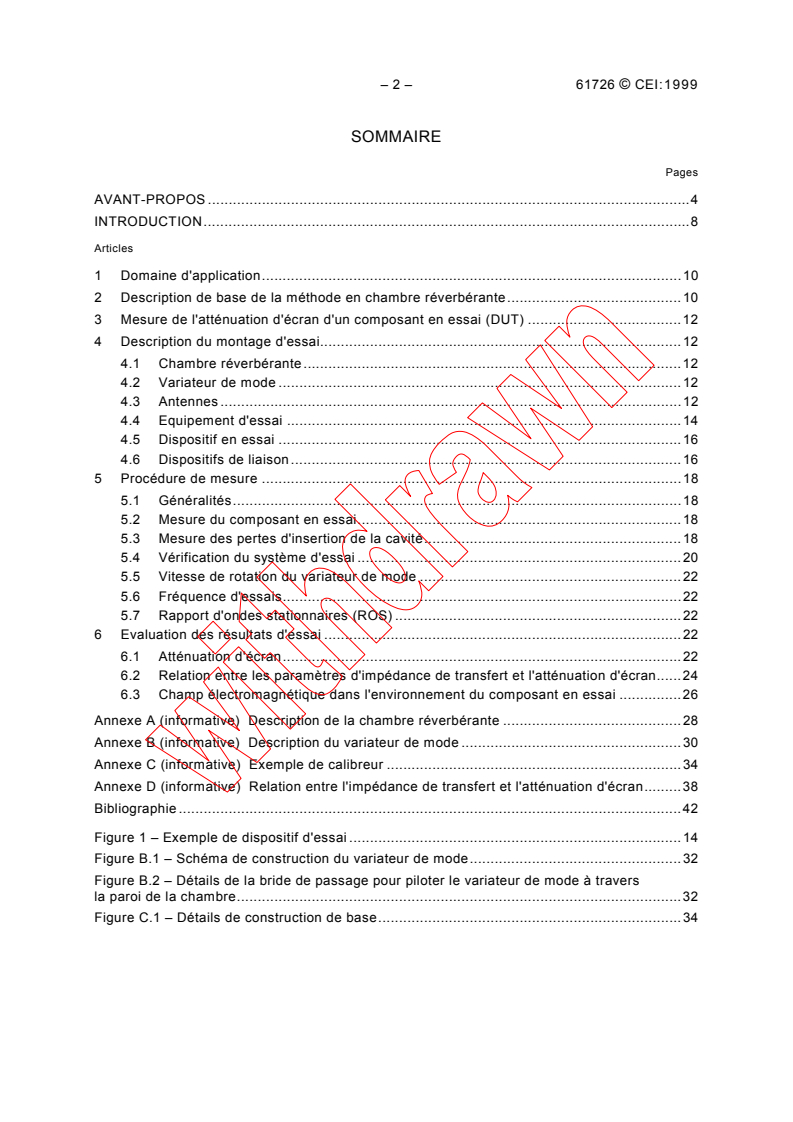
– 2 – 61726 © CEI:1999
SOMMAIRE
Pages
AVANT-PROPOS .4
INTRODUCTION.8
Articles
1 Domaine d'application.10
2 Description de base de la méthode en chambre réverbérante.10
3 Mesure de l'atténuation d'écran d'un composant en essai (DUT) .12
4 Description du montage d'essai.12
4.1 Chambre réverbérante.12
4.2 Variateur de mode .12
4.3 Antennes.12
4.4 Equipement d'essai.14
4.5 Dispositif en essai .16
4.6 Dispositifs de liaison.16
5 Procédure de mesure .18
5.1 Généralités.18
5.2 Mesure du composant en essai.18
5.3 Mesure des pertes d'insertion de la cavité.18
5.4 Vérification du système d'essai .20
5.5 Vitesse de rotation du variateur de mode .22
5.6 Fréquence d'essais.22
5.7 Rapport d'ondes stationnaires (ROS) .22
6 Evaluation des résultats d'essai .22
6.1 Atténuation d'écran.22
6.2 Relation entre les paramètres d'impédance de transfert et l'atténuation d'écran.24
6.3 Champ électromagnétique dans l'environnement du composant en essai .26
Annexe A (informative) Description de la chambre réverbérante .28
Annexe B (informative) Description du variateur de mode .30
Annexe C (informative) Exemple de calibreur .34
Annexe D (informative) Relation entre l'impédance de transfert et l'atténuation d'écran.38
Bibliographie .42
Figure 1 – Exemple de dispositif d'essai .14
Figure B.1 – Schéma de construction du variateur de mode.32
Figure B.2 – Détails de la bride de passage pour piloter le variateur de mode à travers
la paroi de la chambre.32
Figure C.1 – Détails de construction de base.34
61726 © IEC:1999 – 3 –
CONTENTS
Page
FOREWORD.5
INTRODUCTION.9
Clause
1 Scope.11
2 Basic description of the reverberation chamber method.11
3 Measurement of the screening attenuation of the device under test (DUT).13
4 Description of the test set-up .13
4.1 Reverberation chamber.13
4.2 Mode stirrer.13
4.3 Antennas.13
4.4 Test equipment.15
4.5 Device under test (DUT) .17
4.6 Linking devices.17
5 Measurement procedure.19
5.1 General.19
5.2 Measurement of the DUT.19
5.3 Measurement of the insertion loss of the cavity .19
5.4 Control of the test set-up .21
5.5 Revolution speed of the mode stirrer.23
5.6 Test frequencies.23
5.7 Voltage standing wave ratio (VSWR).23
6 Evaluation of the test results .23
6.1 Screening attenuation .23
6.2 Relationship between transfer impedance parameters and screening attenuation .25
6.3 Electromagnetic field surrounding the DUT .27
Annex A (informative) Design of the reverberation chamber.29
Annex B (informative) Design of the mode stirrer.31
Annex C (informative) Example of a calibrator .35
Annex D (informative) Relationship between transfer impedance and screening attenuation .39
Bibliography .43
Figure 1 – Example of a test set-up .15
Figure B.1 – Construction diagram for mode-stirrer.33
Figure B.2 – Details of collet for mounting tuner shaft to drive motor through the
wall of the test chamber .33
Figure C.1 – Basic construction details.35
– 4 – 61726 © CEI:1999
COMMISSION ÉLECTROTECHNIQUE INTERNATIONALE
____________
CÂBLES, CORDONS, CONNECTEURS
ET COMPOSANTS HYPERFRÉQUENCE PASSIFS –
MESURE DE L'ATTÉNUATION D'ÉCRAN
PAR LA MÉTHODE DE LA CHAMBRE RÉVERBÉRANTE
AVANT-PROPOS
1) La CEI (Commission Électrotechnique Internationale) est une organisation mondiale de normalisation composée
de l'ensemble des comités électrotechniques nationaux (Comités nationaux de la CEI). La CEI a pour objet de
favoriser la coopération internationale pour toutes les questions de normalisation dans les domaines de
l'électricité et de l'électronique. A cet effet, la CEI, entre autres activités, publie des Normes internationales.
Leur élaboration est confiée à des comités d'études, aux travaux desquels tout Comité national intéressé par le
sujet traité peut participer. Les organisations internationales, gouvernementales et non gouvernementales, en
liaison avec la CEI, participent également aux travaux. La CEI collabore étroitement avec l'Organisation
Internationale de Normalisation (ISO), selon des conditions fixées par accord entre les deux organisations.
2) Les décisions ou accords officiels de la CEI concernant les questions techniques représentent, dans la mesure
du possible, un accord international sur les sujets étudiés, étant donné que les Comités nationaux intéressés
sont représentés dans chaque comité d’études.
3) Les documents produits se présentent sous la forme de recommandations internationales. Ils sont publiés
comme normes, spécifications techniques, rapports techniques ou guides et agréés comme tels par les Comités
nationaux.
4) Dans le but d'encourager l'unification internationale, les Comités nationaux de la CEI s'engagent à appliquer de
façon transparente, dans toute la mesure possible, les Normes internationales de la CEI dans leurs normes
nationales et régionales. Toute divergence entre la norme de la CEI et la norme nationale ou régionale
correspondante doit être indiquée en termes clairs dans cette dernière.
5) La CEI n’a fixé aucune procédure concernant le marquage comme indication d’approbation et sa responsabilité
n’est pas engagée quand un matériel est déclaré conforme à l’une de ses normes.
6) L’attention est attirée sur le fait que certains des éléments de la présente Norme internationale peuvent faire
l’objet de droits de propriété intellectuelle ou de droits analogues. La CEI ne saurait être tenue pour
responsable de ne pas avoir identifié de tels droits de propriété et de ne pas avoir signalé leur existence.
La Norme internationale CEI 61726 a été établie par le sous-comité 46A de la CEI: Câbles
coaxiaux, du comité d’études 46 de la CEI: Câbles, fils, guides d’ondes, connecteurs, et
accessoires pour communications et signalisation.
Cette seconde édition annule et remplace la première édition, qui a été publiée en tant que
rapport technique de type 3 en 1995. Elle constitue une révision technique et possède
maintenant le statut de norme internationale.
Cette version bilingue, publiée en 2001-04, correspond à la version anglaise.
Le texte anglais de cette norme est basé sur les documents 46A/356/FDIS et 46A/359/RVD. Le
rapport de vote 46A/359/RVD donne toute information sur le vote ayant abouti à l'approbation
de cette norme.
La version française de cette norme n'a pas été soumise au vote.
Cette publication a été rédigée conformément aux Directives ISO/CEI, Partie 3.
61726 © IEC:1999 – 5 –
INTERNATIONAL ELECTROTECHNICAL COMMISSION
____________
CABLE ASSEMBLIES, CABLES, CONNECTORS AND
PASSIVE MICROWAVE COMPONENTS –
SCREENING ATTENUATION MEASUREMENT BY THE
REVERBERATION CHAMBER METHOD
FOREWORD
1) The IEC (International Electrotechnical Commission) is a worldwide organization for standardization comprising
all national electrotechnical committees (IEC National Committees). The object of the IEC is to promote
international co-operation on all questions concerning standardization in the electrical and electronic fields. To
this end and in addition to other activities, the IEC publishes International Standards. Their preparation is
entrusted to technical committees; any IEC National Committee interested in the subject dealt with may
participate in this preparatory work. International, governmental and non-governmental organizations liaising
with the IEC also participate in this preparation. The IEC collaborates closely with the International Organization
for Standardization (ISO) in accordance with conditions determined by agreement between the two
organizations.
2) The formal decisions or agreements of the IEC on technical matters express, as nearly as possible, an
international consensus of opinion on the relevant subjects since each technical committee has representation
from all interested National Committees.
3) The documents produced have the form of recommendations for international use and are published in the form
of standards, technical specifications, technical reports or guides and they are accepted by the National
Committees in that sense.
4) In order to promote international unification, IEC National Committees undertake to apply IEC International
Standards transparently to the maximum extent possible in their national and regional standards. Any
divergence between the IEC Standard and the corresponding national or regional standard shall be clearly
indicated in the latter.
5) The IEC provides no marking procedure to indicate its approval and cannot be rendered responsible for any
equipment declared to be in conformity with one of its standards.
6) Attention is drawn to the possibility that some of the elements of this International Standard may be the subject
of patent rights. The IEC shall not be held responsible for identifying any or all such patent rights.
International Standard IEC 61726 has been prepared by subcommittee 46A: Coaxial cables, of
IEC technical committee 46: Cables, wires, waveguides, r.f. connectors, and accessories for
communication and signalling.
This second edition cancels and replaces the first edition, which was issued as a type 3
technical report in 1995. It constitutes a technical revision and now has the status of an
International Standard.
This bilingual version, published in 2001-04, corresponds to the English version.
The text of this standard is based on the following documents:
FDIS Report on voting
46A/356/FDIS 46A/359/RVD
Full information on the voting for the approval of this standard can be found in the report on
voting indicated in the above table.
This publication has been drafted in accordance with the ISO/IEC Directives, Part 3.
– 6 – 61726 © CEI:1999
Les annexes A, B, C et D ne sont données qu'à titre d'information.
Le comité a décidé que le contenu de cette publication ne sera pas modifié avant 2005.
A cette date, la publication sera
• reconduite;
• supprimée;
• remplacée par une édition révisée, ou
• amendée.
61726 © IEC:1999 – 7 –
Annexes A, B, C and D are for information only.
The committee has decided that the contents of this publication will remain unchanged
until 2005. At this date, the publication will be
• reconfirmed;
• withdrawn;
• replaced by a revised edition, or
• amended.
– 8 – 61726 © CEI:1999
INTRODUCTION
Les exigences des composants électroniques modernes ont révélé le besoin d'établir une
méthode d'essai de l'atténuation d'écran des composants hyperfréquence sur toute leur bande
de fréquences d'utilisation. Des méthodes d'essais adaptées existent pour les basses
fréquences et pour les composants de forme régulière. Ces méthodes d'essai sont décrites
dans les spécifications de produits correspondantes de la CEI.
Une nouvelle méthode d'essai est devenue nécessaire pour les fréquences supérieures et pour
les composants de forme irrégulière. Une telle méthode d'essai est décrite dans la présente
norme.
61726 © IEC:1999 – 9 –
INTRODUCTION
The requirements of modern electronic equipment have indicated a demand for a method of
testing screening attenuation of microwave components over their whole frequency range.
Convenient test methods exist for low frequencies and components of regular shape and these
test methods are described in the relevant IEC product specifications.
For higher frequencies and for components of irregular shape a new test method has become
necessary and such a test method is described in this International Standard.
– 10 – 61726 © CEI:1999
CÂBLES, CORDONS, CONNECTEURS
ET COMPOSANTS HYPERFRÉQUENCE PASSIFS –
MESURE DE L'ATTÉNUATION D'ÉCRAN
PAR LA MÉTHODE DE LA CHAMBRE RÉVERBÉRANTE
1 Domaine d'application
La présente Norme internationale décrit la mesure de l'atténuation d'écran par la méthode
d'essai en chambre réverbérante appelée également quelquefois «méthode à variateur de
mode». Elle convient pour pratiquement n'importe quel type de composants hyperfréquence et
n'a, en théorie, pas de limitation supérieure de fréquence. Elle est simplement limitée vers les
fréquences basses du fait de la taille de l'équipement d'essai qui est dépendant de la
fréquence. Elle ne constitue qu'une des méthodes de mesure de l'atténuation d'écran.
Pour les besoins de la présente norme, des exemples de composants hyperfréquence sont les
guides d'ondes, les déphaseurs, les diplexeurs/multiplexeurs, les répartiteurs/combineurs de
puissance, etc.
2 Description de base de la méthode en chambre réverbérante
La méthode en chambre réverbérante est utilisée pour la mesure de l'atténuation d'écran des
composants hyperfréquences. Elle consiste à exposer le composant en essai (DUT) à un
champ électromagnétique quasi homogène et isotrope et ensuite à mesurer le signal résiduel
dans le dispositif.
Pour cela, on utilise une cage de Faraday qui fonctionne comme une cavité surdimensionnée
en termes de longueur d'ondes et qui présente un facteur de qualité élevé. Ses conditions aux
limites sont agitées de façon continue par une surface réflective en rotation appelée «variateur
de mode», montée à l'intérieur de la chambre, et qui permet au champ d'approcher les
conditions d'homogénéité et d'isotropie durant chacune de ses révolutions.
Le signal électromagnétique est injecté à l'intérieur de la chambre au moyen d'une antenne
d'injection.
Une antenne de référence permet de mesurer l'intensité du champ électromagnétique à
l'intérieur de la chambre. La perte d'insertion de la cavité est le rapport entre la puissance
injectée (antenne d'injection) et la puissance reçue (antenne de référence). La perte d'insertion
dépend fortement de la fréquence. Elle dépend également du facteur de qualité de la cavité.
Il a été montré qu'à cause de l'isotropie du champ toute antenne placée à l'intérieur de la
1)
. Par conséquent, on n'observe
cavité se comporte comme si son gain était égal à l'unité [1]
aucun effet directionnel. L'atténuation d'écran des composants électriquement courts est reliée
et Z). Lorsque le
directement aux paramètres habituels de l'impédance de transfert (Z
t f
et
composant n'est plus électriquement court, l'atténuation d'écran peut encore être reliée à Z
t
dans quelques cas simples (fuite uniformément répartie ou fuite distribuée de manière
Z
f
périodique). Dans ce cas, il est nécessaire d'utiliser des fonctions de sommation dérivées de la
théorie des réseaux d'antennes.
________
1)
Les chiffres entre crochets renvoient à la bibliographie.
61726 © IEC:1999 – 11 –
CABLE ASSEMBLIES, CABLES, CONNECTORS AND
PASSIVE MICROWAVE COMPONENTS –
SCREENING ATTENUATION MEASUREMENT BY THE
REVERBERATION CHAMBER METHOD
1 Scope
This International Standard describes the measurement of screening attenuation by the
reverberation chamber test method, sometimes named mode stirred chamber, suitable for
virtually any type of microwave component and having no theoretical upper frequency limit. It is
only limited toward low frequencies due to the size of the test equipment, which is frequency
dependent and is only one of several methods of measuring screening attenuation.
For the purpose of this standard, examples of microwave components are waveguides, phase
shifters, diplexers/multiplexers, power dividers/combiners etc.
2 Basic description of the reverberation chamber method
The reverberation chamber method for measurement of the screening attenuation of
microwave components consists of exposing the device under test (DUT) to an almost
homogeneous and isotropic electromagnetic field and then measuring the signal level induced
into the device.
These conditions are achieved by the use of a shielded enclosure, which acts as an oversized
cavity (in terms of wavelength), with a high quality factor. Its boundary conditions are
continuously agitated by a rotating reflective surface (mode stirrer), mounted within the
chamber, which enables the field to approach homogeneous and isotropic conditions during
one revolution.
Electromagnetic power is fed to the chamber by means of an input or transmitting antenna.
The strength of the field inside the chamber is measured through a reference antenna. The
ratio of the injected power (input antenna) to the received power (reference antenna) is the
insertion loss of the cavity. The insertion loss is strongly frequency dependent and is also
dependent on the quality factor of the cavity.
It has been shown that, due to the isotropic field, any antenna placed inside the cavity behaves
1)
as if its gain was unity [1] , therefore no directional effect is to be expected. If the device
under test is electrically short, its screening attenuation will be directly related to usual transfer
parameters (Z and Z). If the device under test is not electrically short the screening
t f
attenuation may still be related to Z and Z in some simple cases (evenly distributed leakage,
t f
periodically distributed leakage) using summing functions derived from antenna network theory.
___________
1)
Figures in square brackets refer to the Bibliography.
– 12 – 61726 © CEI:1999
3 Mesure de l'atténuation d'écran d'un composant en essai (DUT)
Pour mesurer l'atténuation d'écran d'un composant, on compare la puissance du champ
électromagnétique dans l'environnement du composant à celle induite à l'intérieur du
composant. L'efficacité d'écran est alors définie comme:
⎛ P ⎞
DUT
⎜ ⎟
a = −10 log (1)
s 10
⎜ ⎟
P
⎝ REF⎠
ou
⎛ ⎞
P
DUT
a = −10 log ⎜ ⎟ − Δ (2)
s 10 ins
⎜ ⎟
P
⎝ INJ ⎠
où
P est la puissance couplée au composant en essai (W);
DUT
P est la puissance couplée à l'antenne de référence (W);
REF
P est la puissance injectée à l'intérieur de la chambre (W);
INJ
Δ sont les pertes d'insertion de la chambre en décibels (dB).
ins
4 Description du montage d'essai
4.1 Chambre réverbérante
La chambre réverbérante est une cage de Faraday qui a n'importe quelle forme, à condition
que sa plus petite dimension soit supérieure à trois longueurs d'onde à la fréquence minimum
d'essai. Pour optimiser les performances aux fréquences les plus basses, il est conseillé
d'éviter une forme parfaitement cubique. Les parois doivent être constituées d'un matériau
conducteur (cuivre, aluminium ou acier). La cage ne doit pas contenir de matériaux dissipatifs.
La fréquence maximale d'utilisation de la cage dépend uniquement de l'atténuation d'écran à la
fréquence la plus élevée, qui doit toujours excéder 60 dB. Cependant, cette valeur n'est pas
critique si l'analyseur de spectre et les dispositifs de connexion de l'équipement de mesure
sont suffisamment blindés et si le facteur de qualité de la cavité reste suffisamment élevé.
Pour contrôler le facteur de qualité, on doit vérifier que, durant une révolution du variateur
de mode, le rapport entre les puissances maximale et minimale obtenues sur l'antenne de
référence reste supérieur à 20 dB. Au minimum, la chambre d'essai et l'instrumentation d'essai
doivent avoir, à chaque fréquence, une efficacité d'écran combinée supérieure d'au moins
10 dB à celle exigée pour le composant en essai.
Quatre passages coaxiaux sont percés dans la cage de Faraday: deux pour les sorties des
antennes et deux pour les sorties de la boucle de mesure. Pour plus de détails, voir annexe A.
4.2 Variateur de mode
Le variateur de mode doit être grand par rapport à la longueur d'onde et doit former un angle
par rapport aux murs de la cage de Faraday. Le variateur de mode doit mesurer au moins deux
longueurs d'onde de pointe à pointe à la fréquence d'essai la plus basse. L'annexe B décrit un
exemple possible du variateur de mode.
4.3 Antennes
La chambre réverbérante comporte une antenne d'injection et une antenne de référence. Ces
deux antennes doivent présenter peu de résonance dans la bande de fréquences et ne doivent
pas faire intervenir de pertes. Leur coefficient de réflexion doit être meilleur que 6 dB.
61726 © IEC:1999 – 13 –
3 Measurement of the screening attenuation of the device under test (DUT)
The measurement of screening attenuation is based on the comparison of the electromagnetic
field power outside the DUT to the electromagnetic field power induced into the DUT. The
screening attenuation is then defined as:
⎛ P ⎞
DUT
⎜ ⎟
a = −10 log (1)
s 10
⎜ ⎟
P
⎝ REF⎠
or
⎛ ⎞
P
DUT
a = −10 log ⎜ ⎟ − Δ (2)
s 10 ins
⎜ ⎟
P
⎝ INJ ⎠
where
P is the power coupled to the device under test (W);
DUT
P is the power coupled to the reference antenna (W);
REF
P is the power injected into the chamber (W);
INJ
Δ is the insertion loss of the chamber in decibels (dB).
ins
4 Description of the test set-up
4.1 Reverberation chamber
The reverberation chamber is a shielded enclosure having any shape, provided that its smallest
dimension exceeds three wavelengths at the lowest test frequency. A perfect cubic shape
should be avoided for optimum performance at lower frequencies. It shall be made of
conductive materials (copper, aluminium or steel) and shall not contain lossy materials.
The upper frequency limit depends only on the screening attenuation, which shall exceed 60 dB
for the whole frequency range. However, this value is not critical if the spectrum analyzer and
the connecting devices of the test set-up are sufficiently screened and if the quality factor of
the cavity remains sufficiently high. The quality factor shall be checked to verify that during one
revolution of the mode stirrer the ratio between the maximum and the minimum power at the
output of the reference antenna exceeds 20 dB. As a minimum, the test chamber and the test
instrumentation shall have a combined screening attenuation at each test frequency that is
10 dB greater than the screening requirement of the DUT.
The shielded enclosure is drilled with four coaxial feed-throughs: two for the output of the
antennas and two for the output of the measuring loop. For further details see annex A.
4.2 Mode stirrer
The mode stirrer shall be large with respect to wavelength and be bent at angles to the walls of
the chamber. The mode stirrer shall be at least two wavelengths from tip to tip at the lowest
test frequency. An example of a mode stirrer is described in annex B.
4.3 Antennas
The reverberation chamber is equipped with input and reference antennas. Both antennas shall
present limited resonances in the frequency range and shall not introduce losses; their return
loss shall be better than 6 dB.
– 14 – 61726 © CEI:1999
Par commodité, il convient de garder la même antenne pour toute la bande de fréquences.
Cependant, les antennes présentant une forte polarisation et directivité peuvent gêner la
mesure du fait d'un manque de l'état isotrope du champ. Il est possible de le vérifier en
modifiant la position et l'orientation des antennes. Il est recommandé que cela ne modifie pas
significativement les pertes d'insertion de la cavité.
On peut utiliser une antenne filaire entre 10 GHz et 20 GHz. Sa longueur doit être supérieure à
cinq longueurs d'onde à la fréquence d'essais minimale. Elle doit être adaptée aux deux
extrémités afin d'éviter toute résonance. Elle doit passer le long de deux côtés de la cage à
une distance telle que son impédance d'entrée reste supérieure à 300 Ω. Pour éviter le
couplage direct entre les deux antennes, celles-ci ne doivent pas être installées sur le même
panneau et ne doivent avoir ni le même niveau ni la même orientation.
On peut également utiliser les antennes cornets, en particulier pour les fréquences les plus
élevées, à condition d'éviter tout couplage direct entre les antennes. Si des cornets sont
utilisés, il convient de les placer dans deux coins différents de la chambre et de les orienter de
telle sorte qu'elles soient dirigées vers le coin.
4.4 Equipement d'essai
La figure 1 montre les principaux équipements d'essais et composants exigés pour une mesure
automatique d'atténuation d'écran. Il est également possible d'utiliser des préamplificateurs,
des amplificateurs ou d'autres équipements de contrôle pour améliorer les performances.
Le générateur et l'analyseur de spectre doivent avoir une fréquence de référence commune
particulièrement stable.
Chambre réverbérante
P
INJ
Antenne
d’entrée
Variateur
Moteur
de mode
pas à pas
P
DU
Synthétiseur Analyseur
de fréquences de spectre
Antenne
de référence
P
REF
Mesure de perte d’insertion (d’étalonnage
autrement charge de 50 Ω)
Pilote
Calculateur
moteur
IEC 108/01
Figure 1 – Exemple de dispositif d'essai
61726 © IEC:1999 – 15 –
For convenience, the same antenna should be kept for the whole frequency range. However,
strongly polarized and directional antennas may disturb measurements due to lack of isotropic
field state. This may be checked by modifying the location and orientation of the antennas. It
should have no noticeable effect on the insertion loss of the cavity.
A wire antenna can be used between 10 GHz and 20 GHz. Its length shall be greater than five
wavelengths at the lowest test frequency. It shall be matched at both ends in order to avoid
resonances. It shall travel along two sides of the chamber, at such a distance that its input
impedance remains superior to 300 Ω. To avoid direct coupling between antennas, they shall
neither be installed on the same panels nor be at the same level and orientation.
Horn antennas may also be used, especially for higher frequencies, provided that direct path
coupling between antennas is avoided. If horns are used, they should be placed in different
corners of the chamber and located so that they face into the corner.
4.4 Test equipment
The essential test equipment and components required for an automated screening attenuation
measurement are shown in figure 1. Preamplifiers, amplifiers and other control equipment may
also be included in order to improve performance.
The generator and the spectrum analyzer shall have a common, highly stable frequency
reference.
Reverberation chambre
P
INJ
Input
antenna
Mode-
Stepper
stirrer
motor
P
DU
Frequency
Spectrum
synthesizer
analyzer
Reference
antenna
P
REF
Insertion loss measurement
(calibration) otherwise 50 Ω load
Motor
Computer
control
IEC 108/01
Figure 1 – Example of a test set-up
– 16 – 61726 © CEI:1999
4.5 Dispositif en essai
Pour éviter les résonances, le dispositif en essai est inséré à l'intérieur d'une boucle (faite de
câble semi-rigide) dont la longueur doit être supérieure à quatre longueurs d'onde à la
fréquence minimale. Il convient que les autres portes du composant en essai soient connec-
tées sur des charges adaptées présentant une atténuation d'écran meilleure d'au moins 10 dB
que celle du composant en essai. L'assemblage est alors placé à l'intérieur de la chambre avec
n'importe quelle orientation et position. La zone de couplage se situe à une distance minimale
des panneaux de la chambre d'au moins une longueur d'onde à la fréquence la plus basse. Si
le dispositif en essai est un câble, on doit s'assurer que les connecteurs utilisés sont ceux qui
sont recommandés pour le type particulier de câble, afin de minimiser les pertes d'interface. Si
le câble doit être utilisé sous une forme courbée, il doit alors être soumis à l'essai en tant que
tel dans le cadre des limites imposées par une norme pertinente ou par le fabricant.
Les deux extrémités de la boucle sont connectées aux sorties de la chambre. Une extrémité
est chargée sur son impédance caractéristique et l'autre extrémité connectée à l'analyseur de
spectre. Il est également acceptable de charger le composant en essai à l'intérieur de la
chambre. Dans ce cas, la seconde branche de la boucle doit être remplacée par un simple fil
conducteur dont une extrémité doit être reliée électriquement au composant en essai, et l'autre
à la paroi.
Pour les besoins de cette méthode de mesure, les guides d'ondes et accessoires de guides
d'ondes (WUT) ne sont pas des dispositifs coaxiaux. De ce fait, ils nécessitent d'être
connectés au guide d'ondes approprié à la ou aux transitions coaxiales afin d'être soumis aux
essais dans la chambre réverbérante.
La mesure de la dynamique, de la perte d'insertion et de l'appareil d'étalonnage coaxial doit
être effectuée en assemblant le guide d'onde pour la transition coaxiale dans le circuit d'essai
de la même manière que pour les essais de WUT.
La conception du guide d'ondes à transitions coaxiales doit être telle que leur facteur
d'adaptation d'entrée et de sortie soit supérieur à 15 dB. Lorsqu'ils sont assemblés dans le
circuit d'essai, avec un guide d'onde à haute efficacité à la place du WUT, leur conception doit
assurer que l'efficacité totale d'écran (dynamique) doit être d'au moins 10 dB supérieure à la
spécification pour les WUT.
4.6 Dispositifs de liaison
Les dispositifs de liaison sont normalement des lignes coaxiales à 50 Ω, présentant une
atténuation d'écran meilleure de 10 dB que celle du composant en essai. En fonction des
considérations pratiques, on peut utiliser des câbles semi-rigides ou semi-flexibles.
Avant de commencer les mesures, les dispositifs de liaison (atténuateurs, cordons etc.)
doivent être caractérisés en atténuation à toutes les fréquences d'essai.
La formule (2) doit être corrigée pour tenir compte des pertes d'insertion des dispositifs de la
liaison:
⎛ P ⎞
DUT
⎜ ⎟
a = −10log −Δ − X (3)
s 10 ins L
⎜ ⎟
P
⎝ INJ ⎠
où X est la perte d'insertion de tous les composants de liaison à l'intérieur de la chambre ou à
L
l'extérieur de la chambre, et est exprimée en décibels (dB).
Ces corrections peuvent être intégrées au logiciel d'essai dans un système automatique. Elles
doivent être vérifiées périodiquement et au minimum lors de chaque calibrage du système
d'essai.
61726 © IEC:1999 – 17 –
4.5 Device under test (DUT)
To avoid resonances, the DUT is inserted into a loop (made of semi-rigid coaxial cable) having
a length of more than four wavelengths at minimum frequency. The other ports of the DUT
should be terminated with matched loads having a screening attenuation at least 10 dB better
than the DUT. The assembly is then placed inside the chamber in any orientation and location,
the coupling zone being at a minimum distance from the chamber panels of one wavelength at
lower frequency. If the DUT is a cable, it shall be ensured that the connectors used are those
recommended for the particular type of cable, in order to minimize interface losses. If the cable
is to be used in a bent form, than it shall be tested as such within the limitations imposed by a
relevant standard or the manufacturer.
Both ends of the loop are connected to the outputs from the chamber. One end is terminated
with a matched load and the other end is connected to the spectrum analyzer. It is also
acceptable to terminate the DUT inside the chamber, in which case, the second leg of the loop
shall be replaced by a single wire, one end being electrically linked to the DUT, the other end to
a panel of the chamber.
For the purpose of this method of measurement, waveguides and waveguide accessories
(WUT) are not coaxial devices. Therefore, they require to be connected to the appropriate
waveguide to coaxial transition(s) in order to be tested in the reverberation chamber.
The measurement of the dynamic range, insertion loss and coaxial calibrator shall be carried
out with the waveguide to coaxial transition assembled in the test circuit in the same manner as
for the testing of the WUT.
The design of the waveguide to coaxial transitions shall be such that their input and output
return loss shall be better than 15 dB. Their design shall ensure that when they are assembled
into the test circuit, with a highly screened waveguide in place of the WUT, the total screening
effectiveness (dynamic range) shall be at least 10 dB better than the specification for the WUT.
4.6 Linking devices
Linking devices are normally 50 Ω coaxial lines having a screening attenuation at least 10 dB
better than the DUT. Depending on practical considerations, semi-rigid or semi-flexible cables
may be used.
All linking lines shall be characterized for attenuation at all test frequencies prior to starting the
test (attenuators, cable assemblies, etc.).
Equation (2) shall be corrected, taking into account the insertion losses of linking devices:
⎛ P ⎞
DUT
⎜ ⎟
a = −10log −Δ − X (3)
s 10 ins L
⎜ ⎟
P
⎝ INJ ⎠
where X is the insertion loss of all linking devices inside or outside the chamber and is
L
expressed in decibels (dB).
These corrections may be included as part of the test programme for an automated test
system. They shall be checked periodically and, at least, during calibration of the test system.
– 18 – 61726 © CEI:1999
5 Procédure de mesure
5.1 Généralités
Différentes méthodes sont acceptables suivant les performances de l'équipement:
– échantillonnage par pas (positionnement pas à pas du variateur de mode);
– acquisition en continu (rotation à une vitesse constante du variateur de mode);
– recherche de la puissance crête sur une rotation du variateur de mode;
– calcul de la puissance moyenne sur une rotation du variateur de mode.
Lorsque l'on décide d'une procédure de mesure, on doit remarquer qu
...