

IEC 62885-4:2020
(Main)Surface cleaning appliances - Part 4: Cordless dry vacuum cleaners for household or similar use - Methods for measuring the performance
General Information
- Abstract
IEC 62885-4:2020 is applicable to measurements of the performance of cordless dry vacuum cleaners for household use or under conditions similar to those in households. The results obtained under this document are intended to be comparable to the results obtained under IEC 62885-2 for mains-connected vacuums.
The purpose of this document is to specify essential performance characteristics of cordless dry vacuum cleaners which are of interest to users and to describe methods for measuring these characteristics.
This standard is to be read in conjunction with IEC 62885-2:2016, to which it refers, and which is applicable unless otherwise specified in this standard.
- Status
- Published
- Publication Date
- 19-Jul-2023
- Technical Committee
- SC 59F - Surface cleaning appliances
- Drafting Committee
- JWG 7 - TC 59/SC 59F/JWG 7
- Current Stage
- PPUB - Publication issued
- Start Date
- 13-Jul-2020
- Completion Date
- 31-Jul-2020
Buy Documents
IEC 62885-4:2020 - Surface cleaning appliances - Part 4: Cordless dry vacuum cleaners for household or similar use - Methods for measuring the performance Released:7/13/2020

IEC 62885-4:2020+AMD1:2023 CSV - Surface cleaning appliances - Part 4: Cordless dry vacuum cleaners for household or similar use - Methods for measuring the performance Released:7/20/2023
Overview
IEC 62885-4:2020, published by the International Electrotechnical Commission (IEC), defines standardized methods for measuring the performance of cordless dry vacuum cleaners for household use or similar environments. This international standard ensures that the performance data of battery-operated vacuum cleaners are consistent, reliable, and comparable with those of mains-powered vacuum cleaners tested under IEC 62885-2. By specifying essential performance characteristics and robust testing methodologies, IEC 62885-4 helps manufacturers, laboratories, and end-users assess product efficacy under clear, repeatable conditions.
Key Topics
- Scope and Applicability: IEC 62885-4 applies to cordless dry vacuum cleaners used in households or similar environments, excluding mains-connected models and cleaning robots. It covers devices powered exclusively by batteries and designed for dry cleaning operations.
- Performance Characteristics: The standard emphasizes performance criteria of importance to users, such as runtime, suction power, dust removal efficiency, filtration effectiveness, and operational noise.
- Test Methods and Procedures: IEC 62885-4 outlines precise methods for preparing, charging, and discharging vacuums, as well as for conducting comparative performance assessments. Test procedures align closely with IEC 62885-2 where feasible, ensuring comparability across product categories.
- Battery Protocols: Special attention is given to battery conditioning, charging intervals, and runtime measurements. The document provides clear guidance for handling different battery chemistries and outlines steps for pre-conditioning and testing battery status.
- Reporting and Documentation: The standard stresses the importance of thorough documentation, including product age, battery condition, and test environment, to ensure reproducibility and transparency in reported results.
Applications
IEC 62885-4:2020 is instrumental in several areas throughout the vacuum cleaner industry and beyond:
- Manufacturers: Vacuum cleaner manufacturers utilize this standard to benchmark product performance, support marketing claims, and facilitate product development. Testing products according to IEC 62885-4 assures customers and retailers of standardized, verifiable performance metrics.
- Laboratories and Testing Facilities: Independent and in-house labs reference IEC 62885-4 to perform product evaluation and certification. Standardized methodology ensures accurate, repeatable results across different test sites and operators.
- Retailers and Consumers: Buyers and retailers benefit from comparable test data, enabling informed choices based on factual performance rather than subjective marketing.
- Regulatory Compliance: Adhering to IEC standards can assist in meeting regional and international regulatory or certification requirements for electrical appliances.
Related Standards
- IEC 62885-2: Dry vacuum cleaners for household or similar use - Methods for measuring the performance. This standard covers mains-powered vacuum cleaners and serves as a foundational reference for IEC 62885-4.
- IEC 60335-1: Household and similar electrical appliances - Safety - General requirements. Provides essential safety guidelines referenced within IEC 62885-4.
- IEC 60335-2-2: Safety for vacuum cleaners and water-suction cleaning appliances for household and similar use.
- IEC 62301: Measurement of standby power, which may be relevant for assessing charging systems and energy consumption.
Conclusion
IEC 62885-4:2020 offers a globally harmonized framework for assessing the key performance characteristics of cordless dry vacuum cleaners. By employing the standardized test methods outlined in this document, stakeholders throughout the supply chain can ensure consistent quality, encourage innovation, and foster transparency in the rapidly growing market for cordless cleaning solutions. Selecting or certifying products tested under this standard helps guarantee both effectiveness and accuracy, building trust with end users and partners alike.
Keywords: IEC 62885-4, cordless vacuum cleaner, vacuum cleaner performance standard, battery-operated vacuum cleaner, household cleaning appliance, vacuum cleaner test methods, IEC standards, product benchmarking.
Relations
- Effective Date
- 05-Sep-2023
Buy Documents
IEC 62885-4:2020 - Surface cleaning appliances - Part 4: Cordless dry vacuum cleaners for household or similar use - Methods for measuring the performance Released:7/13/2020
IEC 62885-4:2020+AMD1:2023 CSV - Surface cleaning appliances - Part 4: Cordless dry vacuum cleaners for household or similar use - Methods for measuring the performance Released:7/20/2023
Get Certified
Connect with accredited certification bodies for this standard

DVS-ZERT GmbH
German welding certification society.
CARES (UK Certification Authority for Reinforcing Steels)
UK certification for reinforcing steels and construction.
EWF/IIW (European/International Welding Federation)
International welding personnel certification.
Sponsored listings
Frequently Asked Questions
IEC 62885-4:2020 is a standard published by the International Electrotechnical Commission (IEC). Its full title is "Surface cleaning appliances - Part 4: Cordless dry vacuum cleaners for household or similar use - Methods for measuring the performance". This standard covers: IEC 62885-4:2020 is applicable to measurements of the performance of cordless dry vacuum cleaners for household use or under conditions similar to those in households. The results obtained under this document are intended to be comparable to the results obtained under IEC 62885-2 for mains-connected vacuums. The purpose of this document is to specify essential performance characteristics of cordless dry vacuum cleaners which are of interest to users and to describe methods for measuring these characteristics. This standard is to be read in conjunction with IEC 62885-2:2016, to which it refers, and which is applicable unless otherwise specified in this standard.
IEC 62885-4:2020 is applicable to measurements of the performance of cordless dry vacuum cleaners for household use or under conditions similar to those in households. The results obtained under this document are intended to be comparable to the results obtained under IEC 62885-2 for mains-connected vacuums. The purpose of this document is to specify essential performance characteristics of cordless dry vacuum cleaners which are of interest to users and to describe methods for measuring these characteristics. This standard is to be read in conjunction with IEC 62885-2:2016, to which it refers, and which is applicable unless otherwise specified in this standard.
IEC 62885-4:2020 is classified under the following ICS (International Classification for Standards) categories: 25.040.40 - Industrial process measurement and control; 97.080 - Cleaning appliances. The ICS classification helps identify the subject area and facilitates finding related standards.
IEC 62885-4:2020 has the following relationships with other standards: It is inter standard links to IEC 62885-4:2020/AMD1:2023. Understanding these relationships helps ensure you are using the most current and applicable version of the standard.
IEC 62885-4:2020 is available in PDF format for immediate download after purchase. The document can be added to your cart and obtained through the secure checkout process. Digital delivery ensures instant access to the complete standard document.
Standards Content (Sample)
IEC 62885-4 ®
Edition 1.0 2020-07
INTERNATIONAL
STANDARD
NORME
INTERNATIONALE
colour
inside
Surface cleaning appliances –
Part 4: Cordless dry vacuum cleaners for household or similar use –
Methods for measuring the performance
Appareils de nettoyage des sols –
Partie 4: Aspirateurs à sec sans fil à usage domestique ou analogue –
Méthodes de mesure de l'aptitude à la fonction
All rights reserved. Unless otherwise specified, no part of this publication may be reproduced or utilized in any form
or by any means, electronic or mechanical, including photocopying and microfilm, without permission in writing from
either IEC or IEC's member National Committee in the country of the requester. If you have any questions about IEC
copyright or have an enquiry about obtaining additional rights to this publication, please contact the address below or
your local IEC member National Committee for further information.
Droits de reproduction réservés. Sauf indication contraire, aucune partie de cette publication ne peut être reproduite
ni utilisée sous quelque forme que ce soit et par aucun procédé, électronique ou mécanique, y compris la photocopie
et les microfilms, sans l'accord écrit de l'IEC ou du Comité national de l'IEC du pays du demandeur. Si vous avez des
questions sur le copyright de l'IEC ou si vous désirez obtenir des droits supplémentaires sur cette publication, utilisez
les coordonnées ci-après ou contactez le Comité national de l'IEC de votre pays de résidence.
IEC Central Office Tel.: +41 22 919 02 11
3, rue de Varembé info@iec.ch
CH-1211 Geneva 20 www.iec.ch
Switzerland
About the IEC
The International Electrotechnical Commission (IEC) is the leading global organization that prepares and publishes
International Standards for all electrical, electronic and related technologies.
About IEC publications
The technical content of IEC publications is kept under constant review by the IEC. Please make sure that you have the
latest edition, a corrigendum or an amendment might have been published.
IEC publications search - webstore.iec.ch/advsearchform Electropedia - www.electropedia.org
The advanced search enables to find IEC publications by a The world's leading online dictionary on electrotechnology,
variety of criteria (reference number, text, technical containing more than 22 000 terminological entries in English
committee,…). It also gives information on projects, replaced and French, with equivalent terms in 16 additional languages.
and withdrawn publications. Also known as the International Electrotechnical Vocabulary
(IEV) online.
IEC Just Published - webstore.iec.ch/justpublished
Stay up to date on all new IEC publications. Just Published IEC Glossary - std.iec.ch/glossary
details all new publications released. Available online and 67 000 electrotechnical terminology entries in English and
once a month by email. French extracted from the Terms and Definitions clause of
IEC publications issued since 2002. Some entries have been
IEC Customer Service Centre - webstore.iec.ch/csc collected from earlier publications of IEC TC 37, 77, 86 and
If you wish to give us your feedback on this publication or CISPR.
need further assistance, please contact the Customer Service
Centre: sales@iec.ch.
A propos de l'IEC
La Commission Electrotechnique Internationale (IEC) est la première organisation mondiale qui élabore et publie des
Normes internationales pour tout ce qui a trait à l'électricité, à l'électronique et aux technologies apparentées.
A propos des publications IEC
Le contenu technique des publications IEC est constamment revu. Veuillez vous assurer que vous possédez l’édition la
plus récente, un corrigendum ou amendement peut avoir été publié.
Recherche de publications IEC - Electropedia - www.electropedia.org
webstore.iec.ch/advsearchform Le premier dictionnaire d'électrotechnologie en ligne au
La recherche avancée permet de trouver des publications IEC monde, avec plus de 22 000 articles terminologiques en
en utilisant différents critères (numéro de référence, texte, anglais et en français, ainsi que les termes équivalents dans
comité d’études,…). Elle donne aussi des informations sur les 16 langues additionnelles. Egalement appelé Vocabulaire
projets et les publications remplacées ou retirées. Electrotechnique International (IEV) en ligne.
IEC Just Published - webstore.iec.ch/justpublished Glossaire IEC - std.iec.ch/glossary
Restez informé sur les nouvelles publications IEC. Just 67 000 entrées terminologiques électrotechniques, en anglais
Published détaille les nouvelles publications parues. et en français, extraites des articles Termes et Définitions des
Disponible en ligne et une fois par mois par email. publications IEC parues depuis 2002. Plus certaines entrées
antérieures extraites des publications des CE 37, 77, 86 et
Service Clients - webstore.iec.ch/csc CISPR de l'IEC.
Si vous désirez nous donner des commentaires sur cette
publication ou si vous avez des questions contactez-nous:
sales@iec.ch.
IEC 62885-4 ®
Edition 1.0 2020-07
INTERNATIONAL
STANDARD
NORME
INTERNATIONALE
colour
inside
Surface cleaning appliances –
Part 4: Cordless dry vacuum cleaners for household or similar use –
Methods for measuring the performance
Appareils de nettoyage des sols –
Partie 4: Aspirateurs à sec sans fil à usage domestique ou analogue –
Méthodes de mesure de l'aptitude à la fonction
INTERNATIONAL
ELECTROTECHNICAL
COMMISSION
COMMISSION
ELECTROTECHNIQUE
INTERNATIONALE
ICS 97.080 ISBN 978-2-8322-8597-8
– 2 – IEC 62885-4:2020 © IEC 2020
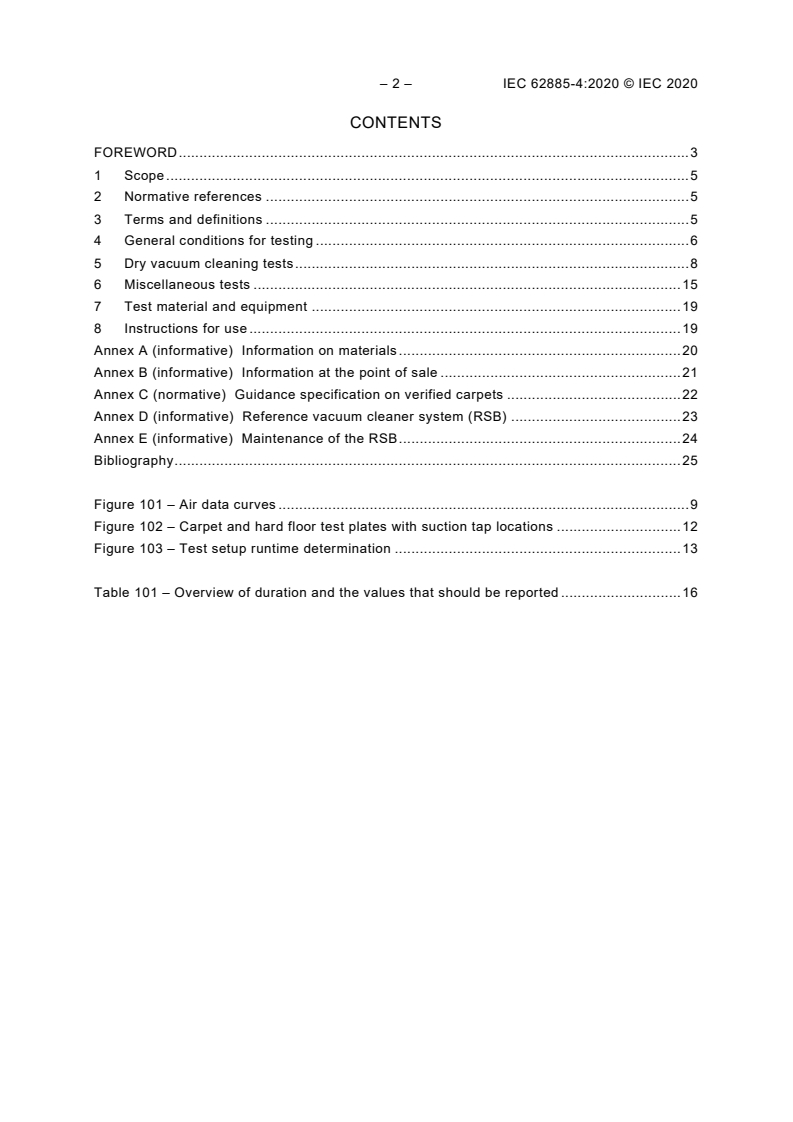
CONTENTS
FOREWORD . 3
1 Scope . 5
2 Normative references . 5
3 Terms and definitions . 5
4 General conditions for testing . 6
5 Dry vacuum cleaning tests . 8
6 Miscellaneous tests . 15
7 Test material and equipment . 19
8 Instructions for use . 19
Annex A (informative) Information on materials . 20
Annex B (informative) Information at the point of sale . 21
Annex C (normative) Guidance specification on verified carpets . 22
Annex D (informative) Reference vacuum cleaner system (RSB) . 23
Annex E (informative) Maintenance of the RSB . 24
Bibliography . 25
Figure 101 – Air data curves . 9
Figure 102 – Carpet and hard floor test plates with suction tap locations . 12
Figure 103 – Test setup runtime determination . 13
Table 101 – Overview of duration and the values that should be reported . 16
INTERNATIONAL ELECTROTECHNICAL COMMISSION
____________
SURFACE CLEANING APPLIANCES –
Part 4: Cordless dry vacuum cleaners for household or similar use –
Methods for measuring the performance
FOREWORD
1) The International Electrotechnical Commission (IEC) is a worldwide organization for standardization comprising
all national electrotechnical committees (IEC National Committees). The object of IEC is to promote
international co-operation on all questions concerning standardization in the electrical and electronic fields. To
this end and in addition to other activities, IEC publishes International Standards, Technical Specifications,
Technical Reports, Publicly Available Specifications (PAS) and Guides (hereafter referred to as "IEC
Publication(s)"). Their preparation is entrusted to technical committees; any IEC National Committee interested
in the subject dealt with may participate in this preparatory work. International, governmental and non-
governmental organizations liaising with the IEC also participate in this preparation. IEC collaborates closely
with the International Organization for Standardization (ISO) in accordance with conditions determined by
agreement between the two organizations.
2) The formal decisions or agreements of IEC on technical matters express, as nearly as possible, an international
consensus of opinion on the relevant subjects since each technical committee has representation from all
interested IEC National Committees.
3) IEC Publications have the form of recommendations for international use and are accepted by IEC National
Committees in that sense. While all reasonable efforts are made to ensure that the technical content of IEC
Publications is accurate, IEC cannot be held responsible for the way in which they are used or for any
misinterpretation by any end user.
4) In order to promote international uniformity, IEC National Committees undertake to apply IEC Publications
transparently to the maximum extent possible in their national and regional publications. Any divergence
between any IEC Publication and the corresponding national or regional publication shall be clearly indicated in
the latter.
5) IEC itself does not provide any attestation of conformity. Independent certification bodies provide conformity
assessment services and, in some areas, access to IEC marks of conformity. IEC is not responsible for any
services carried out by independent certification bodies.
6) All users should ensure that they have the latest edition of this publication.
7) No liability shall attach to IEC or its directors, employees, servants or agents including individual experts and
members of its technical committees and IEC National Committees for any personal injury, property damage or
other damage of any nature whatsoever, whether direct or indirect, or for costs (including legal fees) and
expenses arising out of the publication, use of, or reliance upon, this IEC Publication or any other IEC
Publications.
8) Attention is drawn to the Normative references cited in this publication. Use of the referenced publications is
indispensable for the correct application of this publication.
9) Attention is drawn to the possibility that some of the elements of this IEC Publication may be the subject of
patent rights. IEC shall not be held responsible for identifying any or all such patent rights.
International Standard IEC 62885-4 has been prepared by subcommittee 59F: Surface
cleaning appliances, of IEC technical committee 59: Performance of household and similar
electrical appliances.
The text of this International Standard is based on the following documents:
FDIS Report on voting
59F/397/FDIS 59F/404/RVD
Full information on the voting for the approval of this International Standard can be found in
the report on voting indicated in the above table.
This document has been drafted in accordance with the ISO/IEC Directives, Part 2.
– 4 – IEC 62885-4:2020 © IEC 2020
This standard is to be read in conjunction with IEC 62885-2:2016, to which it refers, and
which is applicable unless otherwise specified in this standard. In order to simplify the
indication of corresponding requirements, the same numbering of clauses and subclauses is
used as in IEC 62885-2:2016. Amendments to these clauses and subclauses are given under
the same references whilst additional subclauses, tables, figures and notes are numbered
from 101. Additional annexes are lettered AA, BB, etc.
A list of all the parts in the IEC 62885 series, under the general title Surface cleaning
appliances, can be found on the IEC website.
In this standard, the following print types are used:
– terms defined in Clause 3: bold type
Where the term dry vacuum cleaner is used, it shall be read cordless dry vacuum cleaner.
The committee has decided that the contents of this document will remain unchanged until the
stability date indicated on the IEC website under "http://webstore.iec.ch" in the data related to
the specific document. At this date, the document will be
• reconfirmed,
• withdrawn,
• replaced by a revised edition, or
• amended.
IMPORTANT – The 'colour inside' logo on the cover page of this publication indicates
that it contains colours which are considered to be useful for the correct
understanding of its contents. Users should therefore print this document using a
colour printer.
SURFACE CLEANING APPLIANCES –
Part 4: Cordless dry vacuum cleaners for household or similar use –
Methods for measuring the performance
1 Scope
This part of IEC 62885 is applicable to measurements of the performance of cordless dry
vacuum cleaners for household use or under conditions similar to those in households. The
results obtained under this document are intended to be comparable to the results obtained
under IEC 62885-2 for mains-connected vacuums.
The purpose of this document is to specify essential performance characteristics of cordless
dry vacuum cleaners which are of interest to users and to describe methods for measuring
these characteristics.
NOTE 1 Owing to the influence of environmental conditions, variations in time, origin of test materials and
proficiency of the operator, most of the described test methods give more reliable results when applied to
comparative testing of a number of appliances at the same time, in the same laboratory and by the same operator.
NOTE 2 This document is not intended for mains-operated vacuum cleaners or cleaning robots.
NOTE 3 Cordless handheld vacuums are excluded, except for 5.7.2 and 5.8.
For safety requirements, reference is made to IEC 60335-1 and IEC 60335-2-2.
A recommendation on information for the consumer at the point of sale is given in Annex B of
IEC 62885-2.
2 Normative references
Clause 2 of IEC 62885-2:2016 applies with the following addition:
IEC 62885-2:2016, Surface cleaning appliances – Part 2: Dry vacuum cleaners for household
or similar use – Methods for measuring the performance
IEC 62301:2011, Household electrical appliances – Measurement of standby power
3 Terms and definitions
Clause 3 of IEC 62885-2:2016 applies with following additions.
3.101
cordless dry vacuum cleaner
dry vacuum cleaner that is not mains-operated
Note 1 to entry: The term "cordless" is equivalent to "battery-operated" throughout the document.
3.102
fully charged
point during charging when, according to the manufacturer's instructions, by indicator or time
period, the product does not need to be charged anymore (see 4.6.101 for specific charging
instructions)
– 6 – IEC 62885-4:2020 © IEC 2020
3.103
fully discharged
point in use when the manufacturer's instructions state the product is fully discharged or the
vacuum motor stops spinning, whichever comes first
3.104
charging time
time required to fully charge a cordless dry vacuum cleaner from a fully discharged
condition
3.105
replacement battery
battery that is identical in type, fit and performance to the battery supplied with the cordless
product, and is changeable without tools
3.106
runtime
effective cleaning time provided by a cordless dry vacuum cleaner from a fully charged
condition as per 3.102 until the vacuum has dropped to less than 40 % of initial suction
performance or when the vacuum is fully discharged as per 3.103, whichever comes first
4 General conditions for testing
Clause 4 of IEC 62885-2:2016 applies with the following modifications.
4.3 Voltage and frequency
Replace the content of 4.3 of IEC 62885-2:2016 with the following:
Unless otherwise stated, charging for measurements shall be carried out at rated voltage with
a tolerance of ±1 % and, if applicable, at rated frequency.
Cordless dry vacuum cleaner chargers not marked with rated frequency shall be powered at
either (50 ± 1) Hz or (60 ± 1) Hz with a total harmonic distortion < 3 %, as is common in the
country of use. All charging should occur at the nominal system voltage of the country
concerned.
4.4 Running-in of dry vacuum cleaner
Replace the heading and content of 4.4 of IEC 62885-2:2016 with the following:
4.4 Running-in of cordless dry vacuum cleaner
Prior to the first test (and following preparations in line with the manufacturer's instructions)
on a new cordless dry vacuum cleaner, it shall be fully charged in accordance with the
manufacturer's instructions and then discharged by running with unrestricted air flow. The
sequence shall be repeated one more time with an interval of at least 30 min after each
discharge. No operation shall be carried out during this waiting time. For active nozzles
during discharge, the agitation device shall be running but not in contact with the floor.
Prior to conducting any series of tests, the age, condition, and history of the product shall be
recorded.
4.4.101 Preparation of battery
Any unused Li-ion battery shall be fully charged and fully discharged once prior to
conducting the first test on a cordless dry vacuum cleaner. All other battery
chemistry/technology types shall be fully charged and fully discharged three times prior to
conducting the first test on a cordless dry vacuum cleaner. Fully charged and fully
discharged conditions are defined in 3.102 and 3.103, respectively.
NOTE It is understood that some cordless vacuums do not allow discharge below a certain energy level for
battery protection.
4.6 Operation of the dry vacuum cleaner
Subclause 4.6 of IEC 62885-2:2016 applies with the following addition to the end of the
subclause:
For declaration and compliance purposes, related tests for a given cleaning task shall be
conducted with the same cordless dry vacuum cleaner setting, cleaning head and cleaning
head setting. These settings shall be reported. Related tests are:
– tests measuring the dust removal from carpet, the energy consumption for cleaning a
carpet, runtime on carpet, and the noise level on carpet;
– tests measuring the dust removal from hard floor with crevices and the energy
consumption for cleaning a hard floor with crevices, runtime on hard floor, and the noise
level on hard floor.
4.6.101 Charging of the cordless dry vacuum cleaner
All testing performed on cordless dry vacuum cleaners is to be non-invasive. Only the
battery(-ies) provided with the product, and replacement battery(-ies) as per 3.105, shall be
used to power the vacuum. Each test is started with a fully charged sample, as per 3.102.
The manufacturer's charging unit, module, or docking system that is provided with the specific
cordless dry vacuum cleaner under test, shall be used for recharging the battery to a fully
charged state. The charging time could be 24 h in length or longer, as determined by the
items below. Proceed in the following order until a charging duration is determined.
a) If the battery charger, appliance (the charged device), the battery itself, or any kind of user
interface (e.g. app) has an indicator to show that the battery is fully charged, that
indicator shall be used as follows:
• If the indicator shows that the battery is fully charged within 19 h, the charging shall
be continued for at least 5 h beyond the full indication. The charging shall be
terminated at not more than 24 h.
• Conversely, if the full-charge indication has not appeared within 19 h of charging, the
charging shall continue until 5 h after the indication is present.
b) If there is no indicator, but the manufacturer's instructions indicate that charging this
battery or this capacity of battery should be complete within 19 h, the charging shall be for
24 h. If the instructions indicate that charging may take longer than 19 h, the charging
shall be run for the longest estimated charge time plus 5 h.
c) If there is no indicator and no time estimate in the manufacturer's instructions, but the
charging current is stated on the charger or in the instructions, calculate the charging
duration D in h as the longer of 24 h or:
C
C
D=1,4×+ 5 h
I
C
where
D is the duration in h;
C is the rated charge capacity in Ah;
C
I is the charge current in A.
C
– 8 – IEC 62885-4:2020 © IEC 2020
d) If none of the above applies, the duration of the charging shall be 24 h.
4.6.1.102 Battery conditions for testing
After a full charge, the cordless dry vacuum cleaner should be tested no earlier than 30 min
and no later than 12 h. The cleaner shall be disconnected from the charger during this period.
Make a note in the report if it is not possible to test owing to a short runtime.
This document does not currently address changing performance throughout the whole
runtime of some appliances. Results at different states of battery charge can vary. The
subclauses potentially affected are 5.1 to 5.6, 5.8 to 5.11 and 6.16. It is recommended to
perform test 5.101 first to understand the potential effect of discharge.
For tests where more than one repeat is needed, testing should be carried out within the
"90 % performance runtime" (t ) as determined in 5.101. However, if during the repeat,
90%rt
the "90 % performance runtime" of the cordless dry vacuum cleaner is exceeded, that
repeat shall be annulled, and the product is to be fully charged or a replacement battery be
employed to repeat the test.
4.7 Conditioning prior to each test
Subclause 4.7 of IEC 62885-2:2016 is not applicable.
5 Dry vacuum cleaning tests
Clause 5 of IEC 62885-2:2016 applies with the following modifications.
5.1.5 Preconditioning of dust receptacle
Subclause 5.1.5 of IEC 62885-2:2016 is applicable with the following modification in
paragraphs 2 and 4:
The cordless dry vacuum cleaner under test is equipped with a clean dust receptacle and
allowed to run with an unimpeded air flow with the nozzle clear of the surface for 30 s.
Since the cordless dry vacuum cleaner air flow can have an effect on the weight mass of
the dust receptacle during the 30 s of preconditioning, caution should be taken so that the
weight mass of the dust receptacle has stabilized before weighing.
5.8.1 Purpose
Subclause 5.8.1 of IEC 62885-2:2016 applies with the following addition:
P , the input power and η, the efficiency, are not relevant for cordless dry vacuum cleaners.
5.8.5 Determination of air data
Subclause 5.8.5 of IEC 62885-2:2016 applies with the second paragraph and Figure 9
removed; the third paragraph is replaced by the following paragraph, and Figure 101 is added:
For each measuring point, the air flow and vacuum are recorded 15 s after the throttling. The
cleaner is then again operated unthrottled for 15 s. This procedure is continued until all the
entire curves have been plotted, the measuring point for maximum vacuum being the last one.
Key
h vacuum in the measuring box, in kilopascals (kPa)
q air flow, in litres per second (l/s)
P suction power, in watts (W)
Figure 101 – Air data curves
5.9.2.1 Test conditions
Subclause 5.9.2.1 of IEC 62885-2:2016 applies with the second bullet point replaced with the
following:
• The plenum chamber shall be fitted with a 19 mm orifice plate.
5.9.2.3 Procedure
Subclause 5.9.2.3 of IEC 62885-2:2016 applies with the second paragraph replaced with the
following:
With the feed tube closed, the cordless dry vacuum cleaner is run for at least 15 s.
Subsequently, the initial vacuum, h , shall be determined.
5.10 Total emissions while vacuum cleaning
Subclause 5.10 of IEC 62885-2:2016 does not apply, but is under consideration.
5.11.5 Verification of particle transport
Subclause 5.11.5 of IEC 62885-2:2016 is replaced by:
NOTE 101 There are known issues with the particle transport within this test. Measures are under development to
ensure and verify a proper particle transport. Changes may be necessary to the measuring equipment or to the way
the test is performed.
– 10 – IEC 62885-4:2020 © IEC 2020
5.11.6 Test procedure
Subclause 5.11.6 of IEC 62885-2:2016 is replaced by:
The test can be conducted either by using a single particle counter that is switched between
the intake and exhaust channels while counting, or by using two particle counters that count
intake and exhaust samples simultaneously.
Particle registration is carried out by a particle analysing system (see 7.3.8.5) that can be
operated with a suitable aerosol dilution system to adapt the count rate capacity and the
particle concentration of the aerosol intake and the exhaust channel, respectively. The results
of any single trial shall be recorded as follows:
• counter events/class; i.e. the number of events recorded by the particle counter, separately
for each range of particle size as well as for aerosol intake channel and exhaust channel;
• sample air volumes, VA (exhaust) and VA (intake); i.e. the volumes of the aerosol
ex in
samples analysed by the particle counter combined in the course of the trial;
• applicable dilution factors k (intake or exhaust) of the particle analysis system; i.e. the
VA
ratio between the volume of the air sample extracted from the channel and the sample air
volume analysed by the particle counter;
• time t for the latest clean air stability check, sampling time t , number of test periods
clean dust
n.
The following test procedure for a single trial may be repeated with several cordless dry
vacuum cleaners of identical type. Then, the final result of the trial shall be averaged
arithmetically.
Proper dilution ratio needs to be verified. Prove that the air is not over-concentrated by serial
dilution, and prove that it is not over-diluted on the exhaust by lessening the dilution serially;
see 7.3.8.5.
5.11.6.101 Single particle counter procedure
A single trial proceeds as follows:
• Conditioning: dust is fed for 5 min while the particle concentration in the intake channel is
monitored (quantity of test dust in accordance with 5.11.3). Afterwards, the cordless dry
vacuum cleaner has to be fully re-charged or a replacement battery employed. For dry
as per 5.101.4)
cordless vacuum cleaners having a "90 % performance runtime" (t
90%rt
of less than 5 min, this procedure has to be repeated until an accumulated conditioning
+1
running time of 5 min has been reached.
−0
• Clean air stability check: the cordless dry vacuum cleaner is operated for a time t
clean
(minimum 2 min but no more than 10 min) without dust being fed until acceptable and
stable conditions are achieved. Stability is defined as follows:
– no more than ±10 % variation in particle counts observed over 100 counts during 30 s
measurement periods when evaluated for a minimum of 2 min; or
– fewer than 100 particle counts observed during 30 s measurement periods, when
evaluated for a minimum of 2 min.
The particle analysing system shall be allowed to flush for up to 15 s between the 30 s
measurement periods. If stability is not met within the minimum 2 min evaluation period,
and the "90 % performance runtime" (t as per 5.101.4) has been reached, the device
90%rt
shall be fully recharged, or a replacement battery employed to repeat the clean air
stability check.
• Sampling: feed the quantity of dust m (as per 5.11.3) for a time t of 5 min, during which
dust
the maximum number n of test periods can be completed within the "90 % performance
runtime" (t as per 5.101.4) of the cordless dry vacuum cleaner less the time t
90%rt clean
for the latest clean air stability check. No more than n = 5 test periods are carried out in
the following order:
– Particle counting from intake channel for 30 s (intake measurement). Repeat this
intake measurement n − 1 times. Allow the particle analysing system to flush for up to
15 s in between.
– Flushing of particle analysing system with the applicable sample stream for at least
10 s, but not longer than 30 s.
– Particle counting from exhaust channel for 30 s (exhaust measurement). Repeat this
exhaust measurement n − 1 times. Allow the particle analysing system to flush for up
to 15 s in between.
This procedure shall be repeated (and the previous results not taken into account) if the time
t for the latest clean air stability check is greater than 2 min, and t + t is greater
clean clean dust
than the "90 % performance runtime" (t as per 5.101.4) of the cordless dry vacuum
90%rt
cleaner.
5.11.6.102 Dual particle counter procedure
If two particle counters are used, their calibration and count rates shall be verified. The
particle counts between counters shall not differ by more than 10 % for each particle size
range when counts are over 100 for 30 s.
A single trial proceeds as follows:
• Conditioning: dust is fed for 5 min while the particle concentration in the intake channel is
monitored (quantity of test dust in accordance with 5.11.3). Afterwards, the device has to
be fully recharged or a replacement battery employed. For cordless dry vacuum
cleaners having a "90 % performance runtime" (t as per 5.101.4) of less than 5 min,
90%rt
this procedure has to be repeated until an accumulated conditioning running time of
+1
5 min has been reached.
−0
• Clean air stability check: the cordless dry vacuum cleaner is operated for a time t
clean
(minimum 2 min but no more than 10 min) without dust being fed until acceptable and
stable conditions are achieved. Stability is defined as follows:
– no more than ± 10 % variation in particle counts observed over 100 counts during 30 s
measurement periods when evaluated for a minimum of 2 min; or
– fewer than 100 particle counts observed during 30 s measurement periods, when
evaluated for a minimum of 2 min.
The particle analysing system shall be allowed to flush for up to 15 s between the 30 s
measurement periods. If stability is not met within the minimum 2 min evaluation period,
and the "90 % performance runtime" (t as per 5.101.4) has been reached, the device
90%rt
shall be fully recharged, or a replacement battery employed to repeat the clean air
stability check.
• Sampling: feed the quantity of dust m (as per 5.11.3) for a time t during which a
dust
maximum of n = 5 test periods are carried out. Each test period consists of simultaneous
particle counting from both intake and exhaust channels for 30 s. Allow the particle
analysing system to flush for up to 15 s between each test period. The number of n = 5
test periods can be reduced if t + t exceeds the "90 % performance runtime"
clean dust
(t as per 5.101.4) of the cordless dry vacuum cleaner.
90%rt
– 12 – IEC 62885-4:2020 © IEC 2020
This procedure shall be repeated (and the previous results not taken into account) if the time
t for the latest clean air stability check is greater than 2 min, and t + t is greater
clean clean dust
as per 5.101.4) of the cordless dry vacuum
than the "90 % performance runtime" (t
90%rt
cleaner.
5.101 Runtime determination for cordless dry vacuum cleaners
5.101.1 Test equipment
For cordless dry vacuum cleaners having passive or active floor cleaning nozzles, a hard,
flat floor in accordance with 7.3.1 (floor test plate) shall be used for determination of runtime
on hard flooring. Carpet in accordance with 7.2.1.3.2 (Wilton carpet) shall be used for
determination of runtime on carpet. The carpet shall be glued flat to a separate wooden test
plate in accordance with 7.3.1, as shown in Figure 102. The whole underside of the carpet
panel shall be glued securely to prevent a cordless dry vacuum cleaner from lifting the
carpet away from the wooden test plate during testing. In the middle of each floor surface, an
opening of 6 mm in diameter shall be placed with a connection to a vacuum measurement
hose (Figure 102), which is connected to an appropriate vacuum measuring instrument.
For cordless dry handheld vacuums and cordless dry vacuum cleaners designed for "above
floor cleaning", the alternative B air data chamber in accordance with 5.8 and a 19 mm fixed
orifice shall be used for the determination of runtime.
Figure 102 – Carpet and hard floor test plates with suction tap locations
5.101.2 Test setup
The main air inlet of the cleaning nozzle (both passive and active floor cleaning nozzles) shall
be placed directly over the 6 mm opening as shown in Figure 103. The handle height above
the floor surface shall be set as described in 4.8. Any possible movement or external impact
of the nozzle shall be avoided during each test trial. The operation of the cordless dry
vacuum cleaner for this test is described in 4.6.1, but with the active floor cleaning nozzle in
contact with the floor.
For cordless dry handheld vacuum cleaners and those designed for "above-floor cleaning",
the cleaning nozzle or tube shall be adapted to the measuring chamber to provide an airtight
seal, as per 5.8.4.2.
Figure 103 – Test setup runtime determination
5.101.3 Test procedure
Prior to the test, the appliance shall be fully charged as per 3.102. Turn on the appliance and
record the vacuum pressure value every second until the appliance is fully discharged in
accordance with 3.103. For cordless dry vacuum cleaners with active floor cleaning
nozzles, the agitator brush shall be rotating during runtime determinations. For general
purpose, cordless dry vacuum cleaners, designed to clean both carpet and hard flooring,
the runtime determinations will be performed on both carpet and hard floor surfaces.
At least three separate trials shall be conducted on carpet for carpet-only cordless dry
vacuum cleaners, and three separate trials on a hard floor for hard-floor-only cordless dry
vacuum cleaners. For general purpose vacuums, three separate trials on each floor surface
shall be conducted.
For cordless handheld and "above the floor" vacuum cleaners, three separate trials in the
alternative B chamber with a 19 mm orifice plate shall be performed.
5.101.4 Determination of the runtime
The moving average of the vacuum at a certain point in time is calculated as the mean value
of the currently measured vacuum averaged over the last 10 measured values:
ht + ht –12+ ht – ++ ht – 9
( ) ( ) ( ) ( )
mm mm mm mm
ht( )=
floor m
where
t is the point in time of the measurement, in s;
m
h (t ) is the measured vacuum at a time t , in kPa;
m m m
h (t ) is the moving average of the vacuum at a time t , in kPa.
floor m m
To determine the initial vacuum h , energize the vacuum for 10 s to ensure stable
floor,0
measurement conditions, and then evaluate the first 10 measured vacuum values:
h = h (t = 19)
floor,0 floor m
Subsequently, continue recording time and vacuum when h has dropped to 90 % and 40 %
floor
of h or until the vacuum is fully discharged, as per 3.103.
floor,0
– 14 – IEC 62885-4:2020 © IEC 2020
The 90 % performance runtime and 40 % performance runtime of the tested cordless dry
vacuum cleaner for a single trial is then defined as:
t = Min [t (h ≤ 90 % × h )] − 10
90%rt m floor floor,0
t = Min [t (h ≤ 40 % × h )] − 10
40%rt m floor floor,0
Where
is the runtime when the vacuum has dropped ≤ 90 % of h , in s.
t
90%rt floor,0
This runtime is to be used for determining when the cordless dry vacuum cleaner will
require recharging during the execution of repeat tests of this document. As an alternative to
recharging, a replacement battery, as per 3.106, may be used for repeat tests.
t is the reported runtime when the vacuum has dropped ≤ 40 % of h or
40%rt floor,0
when the vacuum is fully discharged, as per 3.103.
In consequence,
h (t + 10) ≤ (90 % × h )
floor 90%rt floor,0
and
h (t + 9) > (90 % × h )
floor 90%rt floor,0
shall always be satisfied. Additionally,
h (t + 10) ≤ (40 % × h )
floor 40%rt floor,0
and
h (t + 9) > (40 % × h )
floor 40%rt floor,0
shall always be satisfied.
The final runtime result is the arithmetic average of the individual runtime (t ) results of
40%rt
all trials. The runtime results on carpet and hard floor are to be reported separately.
Care should be taken that wear and ageing of the carpet does not influence the runtime
results.
The test carpet is subject to aging and wear for evaluating runtime of cordless dry vacuum
cleaners having active floor cleaning nozzles. The preferred method to control the test carpet
and to discover potential wear is to compare runtime and suction data of a cordless reference
vacuum cleaner over time.
It is recommended to replace the carpet if the runtime and/or suction data varies by more
than 10 % of the initial measurements with the reference cleaner. Changes in the
performance of a cordless reference vacuum cleaner owing to battery aging should be
monitored. Alternatively, a corded reference vacuum cleaner may be used to evaluate suction
(h) data.
6 Miscellaneous tests
Clause 6 of IEC 62885-2:2016 applies with following modifications.
6.4 Radius of operation
This subclause does not apply.
6.7.4 Test procedure
Subclause 6.7.4 of IEC 62885-2:2016 is applicable with the fifth paragraph replaced by the
following:
During the test, the cordless dry vacuum cleaner shall be switched off and therefore not
running.
6.10 Ability to maintain air flow performance
Subclause 6.10 of IEC 62885-2:2016 does not apply, but is under consideration.
6.11 Mass
Replace the content of 6.11 of IEC 62885-2:2016 with the following:
The mass of the cordless dry vacuum cleaner, and any attachments and accessories, shall
be determined and reported. The mass of the vacuum cleaner includes the contribution of the
most massive accessories placed inside the accessory compartment or mounted to the
vacuum, if provided, and shall be reported in g. The mass excludes extra batteries and
additional equipment needed only for charging and docking/separate stands.
Standard atmospheric conditions in accordance with 4.1 are not required.
6.16 Energy consumption
6.16.1 General
Replace the content of 6.16.1 of IEC 62885-2:2016 with the following:
All power measurements shall be carried out in accordance with IEC 62301:2011.
The general states for measuring the energy consumption of cordless dry vacuum cleaners
are defined as:
1) State 1 – Measuring the power consumption of the charging unit without the cordless dry
vacuum cleaner.
In this state, the cordless dry vacuum cleaner is not connected to the charging unit while
the charging unit is connected to mains.
The power consumption of the charging unit shall be measured for a minimum of 1 h. After
a warm-up period of 30 min, the average of the remaining 30 min shall be reported for the
power consumption. If, during the last 30 min, a spike or change in the power consumption
is observed, the measurement period shall be increased until the power consumption is
stable for 30 min. The average power consumption during the 30 min period shall be
calculated as follows.
n
P = P i
()
C1 ∑ C1
n
i=1
– 16 – IEC 62885-4:2020 © IEC 2020
where
P is the average power intake to the charging unit, in W, for the last 30 min;
C1
P (i) is the power intake, in W, per measurement taken during the last 30 min;
C1
n is the number of power measurements taken during the last 30 min.
Definition of a spike: change of power with respect to average power consumption of
> 20 % for longer than 1 min.
Definition of stabilized: no spike within 30 min.
NOTE 1 This state is equivalent to the stand-by mode of the charging unit without a cordless dry vacuum
cleaner.
2) State 2 – Measuring the energy consumption during charging after cleaning a carpeted or
hard floor surface with a diagonal crevice for 5 min.
In this state, the average energy consumption shall be calculated from the tests for carpet
and hard floor and recorded separately for each surface. The measurement of energy
consumption in accordance with 6.16.2 and 6.16.3 shall be conducted on a soiled floor
surface (carpet and/or hard floor with crevice), unless it is proven that results for the
cordless dry vacuum cleaner under test do not differ by more than 3 % on a non-soiled
floor. When using an active nozzle, the energy consumption figures are in each case the
sum of the values for the cordless dry vacuum cleaner and the active nozzle.
3) State 3 – Measuring the power consumption of the charging unit with a fully charged
cordless dry vacuum cleaner.
In this state, the average power consumption of the charging unit during a 4 h period with
a fully charged cordless dry vacuum cleaner shall be measured and recorded. The
cordless dry vacuum cleaner shall have a minimum charge duration as defined in
4.6.101 prior to starting this test. The average power consumption during the 4 h period
shall be calculated as follows:
n
P = Pi()
C3 ∑ C3
n
i=1
where
P is the average power intake to the charging unit, in W, for the 4 h period;
C3
P (i) is the power intake, in W, per measurement taken during the 4 h period;
C3
n is the number of power measurements taken during the 4 h period.
The description of each state, the time duration of measurements and the reported values for
above are defined in Table 101 below.
Table 101 – Overview of duration and the values that should be reported
State Description Duration of measurement Reported values
Charging unit without cordless
P
1 30 min
C1
dry vacuum cleaner
Energy consumption during Depending on charging time
P
C2
charging after cleaning a after operating the cordless dry
carpeted or hard floor surface for vacuum cleaner over the test
E
5min
5 min surface for 5 min
Charging unit with fully charged
P
3 4 h
C3
cordless vacuum
NOTE 2 State 3 is an important part of cordless vacuum use, but details about this state are not yet agreed.
Methods for measuring state 3 are not yet included in the document because the associated technologies and
complexities of charging systems make establishing an unbiased and consistent method difficult. The method is
under consideration for a future revision.
6.16.2 Energy consumption when vacuuming carpets
6.16.2.2 Test procedure
Replace the content of 6.16.2.2 of IEC 62885-2:2016 with the fo
...
IEC 62885-4 ®
Edition 1.1 2023-07
CONSOLIDATED VERSION
INTERNATIONAL
STANDARD
NORME
INTERNATIONALE
colour
inside
Surface cleaning appliances –
Part 4: Cordless dry vacuum cleaners for household or similar use – Methods for
measuring the performance
Appareils de nettoyage des sols –
Partie 4: Aspirateurs à sec sans fil à usage domestique ou analogue – Méthodes
de mesure de l'aptitude à la fonction
All rights reserved. Unless otherwise specified, no part of this publication may be reproduced or utilized in any form
or by any means, electronic or mechanical, including photocopying and microfilm, without permission in writing from
either IEC or IEC's member National Committee in the country of the requester. If you have any questions about IEC
copyright or have an enquiry about obtaining additional rights to this publication, please contact the address below or
your local IEC member National Committee for further information.
Droits de reproduction réservés. Sauf indication contraire, aucune partie de cette publication ne peut être reproduite ni
utilisée sous quelque forme que ce soit et par aucun procédé, électronique ou mécanique, y compris la photocopie et
les microfilms, sans l'accord écrit de l'IEC ou du Comité national de l'IEC du pays du demandeur. Si vous avez des
questions sur le copyright de l'IEC ou si vous désirez obtenir des droits supplémentaires sur cette publication, utilisez
les coordonnées ci-après ou contactez le Comité national de l'IEC de votre pays de résidence.
IEC Secretariat Tel.: +41 22 919 02 11
3, rue de Varembé info@iec.ch
CH-1211 Geneva 20 www.iec.ch
Switzerland
About the IEC
The International Electrotechnical Commission (IEC) is the leading global organization that prepares and publishes
International Standards for all electrical, electronic and related technologies.
About IEC publications
The technical content of IEC publications is kept under constant review by the IEC. Please make sure that you have the
latest edition, a corrigendum or an amendment might have been published.
IEC publications search - webstore.iec.ch/advsearchform IEC Products & Services Portal - products.iec.ch
The advanced search enables to find IEC publications by a Discover our powerful search engine and read freely all the
variety of criteria (reference number, text, technical publications previews. With a subscription you will always have
committee, …). It also gives information on projects, replaced access to up to date content tailored to your needs.
and withdrawn publications.
Electropedia - www.electropedia.org
IEC Just Published - webstore.iec.ch/justpublished
The world's leading online dictionary on electrotechnology,
Stay up to date on all new IEC publications. Just Published
containing more than 22 300 terminological entries in English
details all new publications released. Available online and once
and French, with equivalent terms in 19 additional languages.
a month by email.
Also known as the International Electrotechnical Vocabulary
(IEV) online.
IEC Customer Service Centre - webstore.iec.ch/csc
If you wish to give us your feedback on this publication or need
further assistance, please contact the Customer Service
Centre: sales@iec.ch.
A propos de l'IEC
La Commission Electrotechnique Internationale (IEC) est la première organisation mondiale qui élabore et publie des
Normes internationales pour tout ce qui a trait à l'électricité, à l'électronique et aux technologies apparentées.
A propos des publications IEC
Le contenu technique des publications IEC est constamment revu. Veuillez vous assurer que vous possédez l’édition la
plus récente, un corrigendum ou amendement peut avoir été publié.
Recherche de publications IEC - Découvrez notre puissant moteur de recherche et consultez
webstore.iec.ch/advsearchform gratuitement tous les aperçus des publications. Avec un
La recherche avancée permet de trouver des publications IEC abonnement, vous aurez toujours accès à un contenu à jour
en utilisant différents critères (numéro de référence, texte, adapté à vos besoins.
comité d’études, …). Elle donne aussi des informations sur les
projets et les publications remplacées ou retirées. Electropedia - www.electropedia.org
Le premier dictionnaire d'électrotechnologie en ligne au monde,
IEC Just Published - webstore.iec.ch/justpublished
avec plus de 22 300 articles terminologiques en anglais et en
Restez informé sur les nouvelles publications IEC. Just
français, ainsi que les termes équivalents dans 19 langues
Published détaille les nouvelles publications parues.
additionnelles. Egalement appelé Vocabulaire
Disponible en ligne et une fois par mois par email.
Electrotechnique International (IEV) en ligne.
Service Clients - webstore.iec.ch/csc
Si vous désirez nous donner des commentaires sur cette
publication ou si vous avez des questions contactez-nous:
sales@iec.ch.
IEC Products & Services Portal - products.iec.ch
IEC 62885-4 ®
Edition 1.1 2023-07
CONSOLIDATED VERSION
INTERNATIONAL
STANDARD
NORME
INTERNATIONALE
colour
inside
Surface cleaning appliances –
Part 4: Cordless dry vacuum cleaners for household or similar use – Methods
for measuring the performance
Appareils de nettoyage des sols –
Partie 4: Aspirateurs à sec sans fil à usage domestique ou analogue – Méthodes
de mesure de l'aptitude à la fonction
INTERNATIONAL
ELECTROTECHNICAL
COMMISSION
COMMISSION
ELECTROTECHNIQUE
INTERNATIONALE
ICS 97.080 ISBN 978-2-8322-7307-4
IEC 62885-4 ®
Edition 1.1 2023-07
CONSOLIDATED VERSION
REDLINE VERSION
VERSION REDLINE
colour
inside
Surface cleaning appliances –
Part 4: Cordless dry vacuum cleaners for household or similar use – Methods for
measuring the performance
Appareils de nettoyage des sols –
Partie 4: Aspirateurs à sec sans fil à usage domestique ou analogue – Méthodes
de mesure de l'aptitude à la fonction
– 2 – IEC 62885-4:2020+AMD1:2023 CSV
© IEC 2023
CONTENTS
FOREWORD . 3
1 Scope . 5
2 Normative references . 5
3 Terms and definitions . 5
4 General conditions for testing . 6
5 Dry vacuum cleaning tests . 8
6 Miscellaneous tests . 15
7 Test material and equipment . 20
8 Instructions for use . 20
Annex A (informative) Information on materials . 21
Annex B (informative) Information at the point of sale . 22
Annex C (normativeinformative) Guidance specification on verified carpets Reference
vacuum cleaner system RSB . 23
Annex D (informative) Reference vacuum cleaner system (RSB) Maintenance of the
RSB . 24
Annex E (informativenormative) Maintenance of the RSB Hard floorboard realization,
floor support and floor pattern . 25
Annex F (informative) Maximum operational power . 26
Bibliography . 27
Figure 101 – Air data curves . 9
Figure 102 – Carpet and hard floor test plates with suction tap locations . 13
Figure 103 – Test setup runtime determination . 13
Table 101 – Overview of duration and the values that should be reported . 17
© IEC 2023
INTERNATIONAL ELECTROTECHNICAL COMMISSION
____________
SURFACE CLEANING APPLIANCES –
Part 4: Cordless dry vacuum cleaners for household or similar use –
Methods for measuring the performance
FOREWORD
1) The International Electrotechnical Commission (IEC) is a worldwide organization for standardization comprising
all national electrotechnical committees (IEC National Committees). The object of IEC is to promote
international co-operation on all questions concerning standardization in the electrical and electronic fields. To
this end and in addition to other activities, IEC publishes International Standards, Technical Specifications,
Technical Reports, Publicly Available Specifications (PAS) and Guides (hereafter referred to as "IEC
Publication(s)"). Their preparation is entrusted to technical committees; any IEC National Committee interested
in the subject dealt with may participate in this preparatory work. International, governmental and non-
governmental organizations liaising with the IEC also participate in this preparation. IEC collaborates closely
with the International Organization for Standardization (ISO) in accordance with conditions determined by
agreement between the two organizations.
2) The formal decisions or agreements of IEC on technical matters express, as nearly as possible, an international
consensus of opinion on the relevant subjects since each technical committee has representation from all
interested IEC National Committees.
3) IEC Publications have the form of recommendations for international use and are accepted by IEC National
Committees in that sense. While all reasonable efforts are made to ensure that the technical content of IEC
Publications is accurate, IEC cannot be held responsible for the way in which they are used or for any
misinterpretation by any end user.
4) In order to promote international uniformity, IEC National Committees undertake to apply IEC Publications
transparently to the maximum extent possible in their national and regional publications. Any divergence
between any IEC Publication and the corresponding national or regional publication shall be clearly indicated in
the latter.
5) IEC itself does not provide any attestation of conformity. Independent certification bodies provide conformity
assessment services and, in some areas, access to IEC marks of conformity. IEC is not responsible for any
services carried out by independent certification bodies.
6) All users should ensure that they have the latest edition of this publication.
7) No liability shall attach to IEC or its directors, employees, servants or agents including individual experts and
members of its technical committees and IEC National Committees for any personal injury, property damage or
other damage of any nature whatsoever, whether direct or indirect, or for costs (including legal fees) and
expenses arising out of the publication, use of, or reliance upon, this IEC Publication or any other IEC
Publications.
8) Attention is drawn to the Normative references cited in this publication. Use of the referenced publications is
indispensable for the correct application of this publication.
9) Attention is drawn to the possibility that some of the elements of this IEC Publication may be the subject of
patent rights. IEC shall not be held responsible for identifying any or all such patent rights.
This consolidated version of the official IEC Standard and its amendment has been
prepared for user convenience.
IEC 62885-4 edition 1.1 contains the first edition (2020-07) [documents 59F/397/FDIS and
59F/404/RVD] and its amendment 1 (2023-07) [documents 59F/472/FDIS and
59F/477/RVD].
In this Redline version, a vertical line in the margin shows where the technical content
is modified by amendment 1. Additions are in green text, deletions are in strikethrough
red text. A separate Final version with all changes accepted is available in this
publication.
– 4 – IEC 62885-4:2020+AMD1:2023 CSV
© IEC 2023
International Standard IEC 62885-4 has been prepared by subcommittee 59F: Surface
cleaning appliances, of IEC technical committee 59: Performance of household and similar
electrical appliances.
This document has been drafted in accordance with the ISO/IEC Directives, Part 2.
This standard is to be read in conjunction with IEC 62885-2:20162021, to which it refers, and
which is applicable unless otherwise specified in this standard. In order to simplify the
indication of corresponding requirements, the same numbering of clauses and subclauses is
used as in IEC 62885-2:20162021. Amendments to these clauses and subclauses are given
under the same references whilst additional subclauses, tables, figures and notes are
numbered from 101. Additional annexes are lettered AA, BB, etc.
A list of all the parts in the IEC 62885 series, under the general title Surface cleaning
appliances, can be found on the IEC website.
In this standard, the following print types are used:
– terms defined in Clause 3: bold type
Where the term dry vacuum cleaner is used, it shall be read cordless dry vacuum cleaner.
The committee has decided that the contents of this document and its amendment will remain
unchanged until the stability date indicated on the IEC website under webstore.iec.ch in the
data related to the specific document. At this date, the document will be
• reconfirmed,
• withdrawn,
• replaced by a revised edition, or
• amended.
IMPORTANT – The 'colour inside' logo on the cover page of this publication indicates
that it contains colours which are considered to be useful for the correct
understanding of its contents. Users should therefore print this document using a
colour printer.
© IEC 2023
SURFACE CLEANING APPLIANCES –
Part 4: Cordless dry vacuum cleaners for household or similar use –
Methods for measuring the performance
1 Scope
This part of IEC 62885 is applicable to measurements of the performance of cordless dry
vacuum cleaners for household use or under conditions similar to those in households. The
results obtained under this document are intended to be comparable to the results obtained
under IEC 62885-2 for mains-connected vacuums.
The purpose of this document is to specify essential performance characteristics of cordless
dry vacuum cleaners which are of interest to users and to describe methods for measuring
these characteristics.
NOTE 1 Owing to the influence of environmental conditions, variations in time, origin of test materials and
proficiency of the operator, most of the described test methods give more reliable results when applied to
comparative testing of a number of appliances at the same time, in the same laboratory and by the same operator.
NOTE 2 This document is not intended for mains-operated vacuum cleaners or cleaning robots.
NOTE 3 Cordless handheld vacuums are excluded, except for 5.7.2 and 5.8.
For safety requirements, reference is made to IEC 60335-1 and IEC 60335-2-2.
A recommendation on information for the consumer at the point of sale is given in Annex B of
IEC 62885-2.
2 Normative references
Clause 2 of IEC 62885-2:20162021 applies with the following addition:
IEC 62885-2:20162021, Surface cleaning appliances – Part 2: Dry vacuum cleaners for
household or similar use – Methods for measuring the performance
IEC 62301:2011, Household electrical appliances – Measurement of standby power
3 Terms and definitions
Clause 3 of IEC 62885-2:20162021 applies with following additions.
3.101
cordless dry vacuum cleaner
dry vacuum cleaner that is not mains-operated
Note 1 to entry: The term "cordless" is equivalent to "battery-operated" throughout the document.
3.102
fully charged
point during charging when, according to the manufacturer's instructions, by indicator or time
period, the product does not need to be charged anymore (see 4.6.101 for specific charging
instructions)
– 6 – IEC 62885-4:2020+AMD1:2023 CSV
© IEC 2023
3.103
fully discharged
point in use when the manufacturer's instructions state the product is fully discharged or the
vacuum motor stops spinning, whichever comes first
3.104
charging time
time required to fully charge a cordless dry vacuum cleaner from a fully discharged
condition
3.105
replacement battery
battery that is identical in type, fit and performance to the battery supplied with the cordless
product, and is changeable without tools
3.106
runtime
effective cleaning time provided by a cordless dry vacuum cleaner from a fully charged
condition as per 3.102 until the vacuum has dropped to less than 40 % of initial suction
performance or when the vacuum is fully discharged as per 3.103, whichever comes first
4 General conditions for testing
Clause 4 of IEC 62885-2:20162021 applies with the following modifications.
4.3 Voltage and frequency
Replace the content of 4.3 of IEC 62885-2:20162021 with the following:
Unless otherwise stated, charging for measurements shall be carried out at rated voltage with
a tolerance of ±1 % and, if applicable, at rated frequency.
Cordless dry vacuum cleaner chargers not marked with rated frequency shall be powered at
either (50 ± 1) Hz or (60 ± 1) Hz with a total harmonic distortion < 3 %, as is common in the
country of use. All charging should occur at the nominal system voltage of the country
concerned.
4.4 Running-in of dry vacuum cleaner
Replace the heading and content of 4.4 of IEC 62885-2:20162021 with the following:
4.4 Running-in of cordless dry vacuum cleaner
Prior to the first test (and following preparations in line with the manufacturer's instructions)
on a new cordless dry vacuum cleaner, it shall be fully charged in accordance with the
manufacturer's instructions and then discharged by running with unrestricted air flow. The
sequence shall be repeated one more time with an interval of at least 30 min after each
discharge. No operation shall be carried out during this waiting time. For active nozzles
during discharge, the agitation device shall be running but not in contact with the floor.
Prior to conducting any series of tests, the age, condition, and history of the product shall be
recorded.
© IEC 2023
4.4.101 Preparation of battery
Any unused Li-ion battery shall be fully charged and fully discharged once prior to
conducting the first test on a cordless dry vacuum cleaner. All other battery
chemistry/technology types shall be fully charged and fully discharged three times prior to
conducting the first test on a cordless dry vacuum cleaner. Fully charged and fully
discharged conditions are defined in 3.102 and 3.103, respectively.
NOTE It is understood that some cordless vacuums do not allow discharge below a certain energy level for
battery protection.
4.6 Operation of the dry vacuum cleaner
Subclause 4.6 of IEC 62885-2:20162021 applies with the following addition to the end of the
subclause:
For declaration and compliance purposes, related tests for a given cleaning task shall be
conducted with the same cordless dry vacuum cleaner setting, cleaning head and cleaning
head setting. These settings shall be reported. Related tests are:
– tests measuring the dust removal from carpet, the energy consumption for cleaning a
carpet, runtime on carpet, and the noise level on carpet;
– tests measuring the dust removal from hard floor with crevices and the energy
consumption for cleaning a hard floor with crevices, runtime on hard floor, and the noise
level on hard floor.
4.6.101 Charging of the cordless dry vacuum cleaner
All testing performed on cordless dry vacuum cleaners is to be non-invasive. Only the
battery(-ies) provided with the product, and replacement battery(-ies) as per 3.105, shall be
used to power the vacuum. Each test is started with a fully charged sample, as per 3.102.
The manufacturer's charging unit, module, or docking system that is provided with the specific
cordless dry vacuum cleaner under test, shall be used for recharging the battery to a fully
charged state. The charging time could be 24 h in length or longer, as determined by the
items below. Proceed in the following order until a charging duration is determined.
a) If the battery charger, appliance (the charged device), the battery itself, or any kind of user
interface (e.g. app) has an indicator to show that the battery is fully charged, that
indicator shall be used as follows:
• If the indicator shows that the battery is fully charged within 19 h, the charging shall
be continued for at least 5 h beyond the full indication. The charging shall be
terminated at not more than 24 h.
• Conversely, if the full-charge indication has not appeared within 19 h of charging, the
charging shall continue until 5 h after the indication is present.
b) If there is no indicator, but the manufacturer's instructions indicate that charging this
battery or this capacity of battery should be complete within 19 h, the charging shall be for
24 h. If the instructions indicate that charging may take longer than 19 h, the charging
shall be run for the longest estimated charge time plus 5 h.
c) If there is no indicator and no time estimate in the manufacturer's instructions, but the
charging current is stated on the charger or in the instructions, calculate the charging
duration D in h as the longer of 24 h or:
C
C
D=1,4×+ 5 h
I
C
where
D is the duration in h;
C is the rated charge capacity in Ah;
C
I is the charge current in A.
C
– 8 – IEC 62885-4:2020+AMD1:2023 CSV
© IEC 2023
d) If none of the above applies, the duration of the charging shall be 24 h.
4.6.1.1024.6.102 Battery conditions for testing
After a full charge, the cordless dry vacuum cleaner should be tested no earlier than 30 min
and no later than 12 h. The cleaner shall be disconnected from the charger during this period.
Make a note in the report if it is not possible to test owing to a short runtime.
This document does not currently address changing performance throughout the whole
runtime of some appliances. Results at different states of battery charge can vary. The
subclauses potentially affected are 5.1 to 5.65.9, 5.85.11 to 5.115.14 and 6.16. It is
recommended to perform test 5.101 first to understand the potential effect of discharge.
For tests where more than one repeat is needed, testing should be carried out within the
"90 % performance runtime" (t ) as determined in 5.101. However, if during the repeat,
90%rt
the "90 % performance runtime" of the cordless dry vacuum cleaner is exceeded, that
repeat shall be annulled, and the product is to be fully charged or a replacement battery be
employed to repeat the test.
4.7 Conditioning prior to each test
Subclause 4.7 of IEC 62885-2:20162021 is not applicable.
5 Dry vacuum cleaning tests
Clause 5 of IEC 62885-2:20162021 applies with the following modifications.
5.1.5 Preconditioning of dust receptacle
Subclause 5.1.5 of IEC 62885-2:20162021 is applicable with the following modification in
paragraphs 2 and 4:
The cordless dry vacuum cleaner under test is equipped with a clean dust receptacle and
allowed to run with an unimpeded air flow with the nozzle clear of the surface for 30 s.
Since the cordless dry vacuum cleaner air flow can have an effect on the weight mass of
the dust receptacle during the 30 s of preconditioning, caution should be taken so that the
weight mass of the dust receptacle has stabilized before weighing.
5.8.15.11.1 Purpose Procedure
Subclause 5.8.15.11.1 of IEC 62885-2:20162021 applies with the following addition:
P , the input power and η, the efficiency, are not relevant for cordless dry vacuum cleaners.
5.8.55.11.5 Determination of air data
Subclause 5.8.55.11.5 of IEC 62885-2:20162021 applies with the second paragraph and
Figure 9 removed; the third paragraph is replaced by the following paragraph, and Figure 101
is added:
For each measuring point, the air flow and vacuum are recorded 15 s after the throttling. The
cleaner is then again operated unthrottled for 15 s. This procedure is continued until all the
entire curves have been plotted, the measuring point for maximum vacuum being the last one.
© IEC 2023
Key
h vacuum in the measuring box, in kilopascals (kPa)
q air flow, in litres per second (l/s)
P suction power, in watts (W)
Figure 101 – Air data curves
5.9.2.1 Test conditions
Subclause 5.9.2.1 of IEC 62885-2:2016 applies with the second bullet point replaced with the
following:
• The plenum chamber shall be fitted with a 19 mm orifice plate.
5.9.2.35.12.2.3 Procedure
Subclause 5.9.2.35.12.2.3 of IEC 62885-2:20162021applies with the second paragraph
replaced with the following:
With the feed tube closed, the cordless dry vacuum cleaner is run for at least 15 s.
Subsequently, the initial vacuum, h , shall be determined.
5.105.13 Total emissions while vacuum cleaning
Subclause 5.105.13 of IEC 62885-2:20162021 does not apply, but is under consideration.
5.11.55.14.5.2 Verification of particle transport
Subclause 5.11.55.14.5.2 of IEC 62885-2:20162021 is replaced by:
NOTE 101 There are known issues with the particle transport within this test. Measures are under development to
ensure and verify a proper particle transport. Changes may be necessary to the measuring equipment or to the way
the test is performed.
– 10 – IEC 62885-4:2020+AMD1:2023 CSV
© IEC 2023
5.11.65.14.4.3 Test procedure
Subclause 5.11.65.14.4.3 of IEC 62885-2:20162021 is replaced by:
The test can be conducted either by using a single particle counter that is switched between
the intake and exhaust channels while counting, or by using two particle counters that count
intake and exhaust samples simultaneously.
Particle registration is carried out by a particle analysing system (see 7.3.8.57.3.8.4) that can
be operated with a suitable aerosol dilution system to adapt the count rate capacity and the
particle concentration of the aerosol intake and the exhaust channel, respectively. The results
of any single trial shall be recorded as follows:
• counter events/class; i.e. the number of events recorded by the particle counter, separately
for each range of particle size as well as for aerosol intake channel and exhaust channel;
• sample air volumes, VA (exhaust) and VA (intake); i.e. the volumes of the aerosol
ex in
samples analysed by the particle counter combined in the course of the trial;
• applicable dilution factors k (intake or exhaust) of the particle analysis system; i.e. the
VA
ratio between the volume of the air sample extracted from the channel and the sample air
volume analysed by the particle counter;
• time t for the latest clean air stability check, sampling time t , number of test periods
clean dust
n.
The following test procedure for a single trial may be repeated with several cordless dry
vacuum cleaners of identical type. Then, the final result of the trial shall be averaged
arithmetically.
Proper dilution ratio needs to be verified. Prove that the air is not over-concentrated by serial
dilution, and prove that it is not over-diluted on the exhaust by lessening the dilution serially;
see 7.3.8.57.3.8.4.
5.11.6.1015.14.4.3.2 Single particle counter procedure
Subclause 5.14.4.3.2 of IEC 62885-2:2021 is replaced by:
A single trial proceeds as follows:
• Conditioning: dust is fed for 5 min while the particle concentration in the intake channel is
monitored (quantity of test dust in accordance with 5.11.35.14.3). Afterwards, the
cordless dry vacuum cleaner has to be fully re-charged or a replacement battery
employed. For dry cordless vacuum cleaners having a "90 % performance runtime"
(t as per 5.101.4) of less than 5 min, this procedure has to be repeated until an
90%rt
+1
accumulated conditioning running time of 5 min has been reached.
−0
• Clean air stability check: the cordless dry vacuum cleaner is operated for a time t
clean
(minimum 2 min but no more than 10 min) without dust being fed until acceptable and
stable conditions are achieved. Stability is defined as follows:
– no more than ±10 % variation in particle counts observed over 100 counts during 30 s
measurement periods when evaluated for a minimum of 2 min; or
– fewer than 100 particle counts observed during 30 s measurement periods, when
evaluated for a minimum of 2 min.
The particle analysing system shall be allowed to flush for up to 15 s between the 30 s
measurement periods. If stability is not met within the minimum 2 min evaluation period,
and the "90 % performance runtime" (t as per 5.101.4) has been reached, the device
90%rt
shall be fully recharged, or a replacement battery employed to repeat the clean air
stability check.
© IEC 2023
• Sampling: feed the quantity of dust m (as per 5.11.35.14.3) for a time t of 5 min, during
dust
which the maximum number n of test periods can be completed within the "90 %
performance runtime" (t as per 5.101.4) of the cordless dry vacuum cleaner less
90%rt
the time t for the latest clean air stability check. No more than n = 5 test periods are
clean
carried out in the following order:
– Particle counting from intake channel for 30 s (intake measurement). Repeat this
intake measurement n − 1 times. Allow the particle analysing system to flush for up to
15 s in between.
– Flushing of particle analysing system with the applicable sample stream for at least
10 s, but not longer than 30 s.
– Particle counting from exhaust channel for 30 s (exhaust measurement). Repeat this
exhaust measurement n − 1 times. Allow the particle analysing system to flush for up
to 15 s in between.
This procedure shall be repeated (and the previous results not taken into account) if the time
t for the latest clean air stability check is greater than 2 min, and t + t is greater
clean clean dust
than the "90 % performance runtime" (t as per 5.101.4) of the cordless dry vacuum
90%rt
cleaner.
5.11.6.1025.14.4.3.3 Dual particle counter procedure
Subclause 5.14.4.3.3 of IEC 62885-2:2021 is replaced by:
If two particle counters are used, their calibration and count rates shall be verified. The
particle counts between counters shall not differ by more than 10 % for each particle size
range when counts are over 100 for 30 s.
A single trial proceeds as follows:
• Conditioning: dust is fed for 5 min while the particle concentration in the intake channel is
monitored (quantity of test dust in accordance with 5.11.35.14.3). Afterwards, the device
has to be fully recharged or a replacement battery employed. For cordless dry vacuum
cleaners having a "90 % performance runtime" (t as per 5.101.4) of less than 5 min,
90%rt
this procedure has to be repeated until an accumulated conditioning running time of
+1
5 min has been reached.
−0
• Clean air stability check: the cordless dry vacuum cleaner is operated for a time t
clean
(minimum 2 min but no more than 10 min) without dust being fed until acceptable and
stable conditions are achieved. Stability is defined as follows:
– no more than ± 10 % variation in particle counts observed over 100 counts during 30 s
measurement periods when evaluated for a minimum of 2 min; or
– fewer than 100 particle counts observed during 30 s measurement periods, when
evaluated for a minimum of 2 min.
The particle analysing system shall be allowed to flush for up to 15 s between the 30 s
measurement periods. If stability is not met within the minimum 2 min evaluation period,
and the "90 % performance runtime" (t as per 5.101.4) has been reached, the device
90%rt
shall be fully recharged, or a replacement battery employed to repeat the clean air
stability check.
• Sampling: feed the quantity of dust m (as per 5.11.35.14.3) for a time t during which a
dust
maximum of n = 5 test periods are carried out. Each test period consists of simultaneous
particle counting from both intake and exhaust channels for 30 s. Allow the particle
analysing system to flush for up to 15 s between each test period. The number of n = 5
test periods can be reduced if t + t exceeds the "90 % performance runtime"
clean dust
(t as per 5.101.4) of the cordless dry vacuum cleaner.
90%rt
– 12 – IEC 62885-4:2020+AMD1:2023 CSV
© IEC 2023
This procedure shall be repeated (and the previous results not taken into account) if the time
t for the latest clean air stability check is greater than 2 min, and t + t is greater
clean clean dust
as per 5.101.4) of the cordless dry vacuum
than the "90 % performance runtime" (t
90%rt
cleaner.
5.14.4.4.2 Evaluation of dust re-emission, logarithmic dust penetration and overall
filtration efficiency
Subclause 5.14.4.4.2 of IEC 62885-2:2021 applies with the 6th formula replaced with the
following:
R E
( ) ( )
UL = 1 − LL
0,3-10 0,95 0,3-10 0,95
5.14.4.5 Particle concentration and dilution
Subclause 5.14.4.5 of IEC 62885-2:2021 applies with the 1st formula replaced with the
following:
Z < 0,2 × Z
SAMPLE COUNTER_MAX
5.14.5.4.2 Evaluation of fractional filtration efficiency
Subclause 5.14.5.4.2 of IEC 62885-2:2021 applies with the determination of the 95% lower
confidence limits replaced with the following formula:
If: Zk >50: Z k Zk −1 ,96 × Zk
( ) ( )( ) ( ) ( )
( )
LL
in in 0,95 in in
If: from Table 1.
Zk( ) ≤ 50 : (Z )(k)
LL
in in 0,95
The determination of corresponding upper limits of the 95 % confidence range is replaced with
the following formula:
If: Zk >50: (Z k Zk −×1 ,96 Zk
( ) ( ) ( ) ( )
( )
UL
ex ex 0,95 ex ex
If: Zk ≤ 50 : Z k from Table 1.
( ) ( )
UL
ex ex 0,95
The symbols of the upper limit of confidence for partial sum class k from exhaust
measurements is replaced with the following:
Z
( )
UL (k)
ex 0,95
5.101 Runtime determination for cordless dry vacuum cleaners
5.101.1 Test equipment
For cordless dry vacuum cleaners having passive or active floor cleaning nozzles, a hard,
flat floor in accordance with 7.3.1 (floor test plate) shall be used for determination of runtime
on hard flooring. Carpet in accordance with 7.2.1.3.27.2.1.1 (Wilton carpet) shall be used for
determination of runtime on carpet. The carpet shall be glued flat to a separate wooden test
plate in accordance with 7.3.1, as shown in Figure 102. The whole underside of the carpet
panel shall be glued securely to prevent a cordless dry vacuum cleaner from lifting the
carpet away from the wooden test plate during testing. In the middle of each floor surface, an
opening of 6 mm in diameter shall be placed with a connection to a vacuum measurement
hose (Figure 102), which is connected to an appropriate vacuum measuring instrument.
=
=
© IEC 2023
For cordless dry handheld vacuums and cordless dry vacuum cleaners designed for "above
floor cleaning", the alternative B air data chamber in accordance with 5.85.11 and a 19 mm
fixed orifice shall be used for the determination of runtime.
Figure 102 – Carpet and hard floor test plates with suction tap locations
5.101.2 Test setup
The main air inlet of the cleaning nozzle (both passive and active floor cleaning nozzles) shall
be placed directly over the 6 mm opening as shown in Figure 103. The handle height above
the floor surface shall be set as described in 4.8. Any possible movement or external impact
of the nozzle shall be avoided during each test trial. The operation of the cordless dry
vacuum cleaner for this test is described in 4.6.1, but with the active floor cleaning nozzle in
contact with the floor.
For cordless dry handheld vacuum cleaners and those designed for "above-floor cleaning",
the cleaning nozzle or tube shall be adapted to the measuring chamber to provide an airtight
seal, as per 5.8.4.25.11.4.
Figure 103 – Test setup runtime determination
5.101.3 Test procedure
Prior to the test, the appliance shall be fully charged as per 3.102. Turn on the appliance and
record the vacuum pressure value every second until the appliance is fully discharged in
– 14 – IEC 62885-4:2020+AMD1:2023 CSV
© IEC 2023
accordance with 3.103. For cordless dry vacuum cleaners with active floor cleaning
nozzles, the agitator brush shall be rotating during runtime determinations. For general
purpose, cordless dry vacuum cleaners, designed to clean both carpet and hard flooring,
the runtime determinations will be performed on both carpet and hard floor surfaces.
At least three separate trials shall be conducted on carpet for carpet-only cordless dry
vacuum cleaners, and three separate trials on a hard floor for hard-floor-only cordless dry
vacuum cleaners. For general purpose vacuums, three separate trials on each floor surface
shall be conducted.
For cordless handheld and "above the floor" vacuum cleaners, three separate trials in the
alternative B chamber with a 19 mm orifice plate shall be performed.
5.101.4 Determination of the runtime
The moving average of the vacuum at a certain point in time is calculated as the mean value
of the currently measured vacuum averaged over the last 10 measured values:
ht( )+ ht( –12)+ ht( – )++ ht( – 9)
mm mm mm mm
ht =
( )
floor m
where
t is the point in time of the measurement, in s;
m
h (t ) is the measured vacuum at a time t , in kPa;
m m m
h (t ) is the moving average of the vacuum at a time t , in kPa.
floor m m
To determine the initial vacuum h , energize the vacuum for 10 s to ensure stable
floor,0
measurement conditions, and then evaluate the first 10 measured vacuum values:
h = h (t = 19)
floor,0 floor m
Subsequently, continue recording time and vacuum when h has dropped to 90 % and 40 %
floor
of h or until the vacuum is fully discharged, as per 3.103.
floor,0
The 90 % performance runtime and 40 % performance runtime of the tested cordless dry
vacuum cleaner for a single trial is then defined as:
t = Min [t (h ≤ 90 % × h )] − 10
90%rt m floor floor,0
t = Min [t (h ≤ 40 % × h )] − 10
40%rt m floor floor,0
Where
t is the runtime when the vacuum has dropped ≤ 90 % of h , in s.
90%rt floor,0
This runtime is to be used for determining when the cordless dry vacuum cleaner will
require recharging during the execution of repeat tests of this document. As an alternative to
recharging, a replacement battery, as per 3.106, may be used for repeat tests.
t is the reported runtime when the vacuum has dropped ≤ 40 % of h or
40%rt floor,0
when the vacuum is fully discharged, as per 3.103.
© IEC 2023
In consequence,
h (t + 10) ≤ (90 % × h )
floor 90%rt floor,0
and
h (t + 9) > (90 % × h )
floor 90%rt floor,0
shall always be satisfied. Additionally,
h (t + 10) ≤ (40 % × h )
floor 40%rt floor,0
and
h (t + 9) > (40 % × h )
floor 40%rt floor,0
shall always be satisfied.
The final runtime result is the arithmetic average of the individual runtime (t ) results of
40%rt
all trials. The runtime results on carpet and hard floor are to be reported separately.
Care should be taken that wear and ageing of the carpet does not influence the runtime
results.
The test carpet is subject to aging and wear for evaluating runtime of cordless dry vacuum
cleaners having active floor cleaning nozzles. The preferred method to control the test carpet
and to discover potential wear is to compare runtime and suction data of a cordless reference
vacuum cleaner over time.
It is recommended to replace the carpet if the runtime and/or suction data varies by more
than 10 % of the initial measurements with the reference cleaner. Changes in the
performance of a cordless reference vacuum cleaner owing to battery aging should be
monitored. Alternatively, a corded reference vacuum cleaner may be used to evaluate suction
(h) data.
6 Miscellaneous tests
Clause 6 of IEC 62885-2:20162021 applies with following modifications.
6.4 Radius of operation
This subclause does not apply.
6.7.4 Test procedure
Subclause 6.7.4 of IEC 62885-2:20162021 is applicable with the fifth paragraph replaced by
the following:
During the test, the cordless dry vacuum cleaner shall be switched off and therefore not
running.
6.10 Ability to maintain air flow performance
Subclause 6.10 of IEC 62885-2:20162021 does not apply, but is under consideration.
– 16 – IEC 62885-4:2020+AMD1:2023 CSV
© IEC 2023
6.11 Mass
Replace the content of 6.11 of IEC 62885-2:20162021 with the following:
The mass of the cordless dry vacuum cleaner, and any attachments and accessories, shall
be determined and reported. The mass of the vacuum cleaner includes the contribution of the
most massive accessories placed inside the accessory compartment or mounted to the
vacuum, if provided, and shall be reported in g. The mass excludes extra batteries and
additional equipment needed only for charging and docking/separate stands.
Standard atmospheric conditions in accordance with 4.1 are not required.
6.16 Energy consumption
6.16.1 General
Replace the content of 6.16.1 of IEC 62885-2:20162021 with the following:
All power measurements shall be carried out in accordance with IEC 62301:2011.
The general states for measuring the energy consumption of cordless dry vacuum cleaners
are defined as:
1) State 1 – Measuring the power consumption of the charging unit without the cordless dry
vacuum cleaner.
In this state, the cordless dry vacuum cleaner is not connected to the charging unit while
the charging unit is connected to mains.
The power consumption of the charging unit shall be measured for a minimum of 1 h. After
a warm-up period of 30 min, the average of the remaining 30 min shall be reported for the
power consumption. If, during the last 30 min, a spike or change in the power consumption
is observed, the measurement period shall be increased until the power consumption is
stable for 30 min. The average power consumption during the 30 min period shall be
calculated as follows.
n
P = P (i)
C1 ∑ C1
n
i=1
where
P is the average power intake to the charging unit, in W, for the last 30 min;
C1
P (i) is the power intake, in W, per measurement taken during the last 30 min;
C1
n is the number of power measurements taken during the last 30 min.
Definition of a spike: change of power with respect to average power consumption of
> 20 % for longer than 1 min.
Definition of stabilized: no spike within
...