


IEC 62761:2014
(Main)Guidelines for the measurement method of nonlinearity for surface acoustic wave (SAW) and bulk acoustic wave (BAW) devices in radio frequency (RF)
Guidelines for the measurement method of nonlinearity for surface acoustic wave (SAW) and bulk acoustic wave (BAW) devices in radio frequency (RF)
IEC 62761:2014-02(en-fr) gives the measurement method for nonlinear signals generated in the radio frequency (RF) surface acoustic wave (SAW) and bulk acoustic wave (BAW) devices such as filters and duplexers, which are used in telecommunications, measuring equipment, radar systems and consumer products. It includes basic properties of non-linearity, and guidelines to setup the measurement system and to establish the measurement procedure of nonlinear signals generated in SAW/BAW devices.
Lignes directrices pour la méthode de mesure des non-linéarités pour les dispositifs à ondes acoustiques de surface (OAS) et à ondes acoustiques de volume (OAV) pour fréquences radioélectriques (RF)
IEC 62761:2014-02(en-fr) présente la méthode de mesure pour des signaux non-linéaires générés dans les dispositifs à ondes acoustiques de surface (OAS) et à ondes acoustiques de volume (OAV) pour les fréquences radioélectriques (RF), tels que les filtres et les duplexeurs utilisés dans les télécommunications, les équipements de mesure, les systèmes radar et les produits de grande consommation. Il inclut des propriétés de base de la non-linéarité, et des lignes directrices pour installer le système de mesure et pour établir la procédure de mesure des signaux non-linéaires générés dans des dispositifs à OAS/OAV.
General Information
- Status
- Published
- Publication Date
- 18-Feb-2014
- Current Stage
- PPUB - Publication issued
- Start Date
- 19-Feb-2014
- Completion Date
- 15-Mar-2014
Overview
IEC 62761:2014 establishes comprehensive guidelines for measuring nonlinearity in surface acoustic wave (SAW) and bulk acoustic wave (BAW) devices operating in the radio frequency (RF) domain. These devices-such as filters and duplexers-are critical components widely used in telecommunications, radar systems, measuring instruments, and various consumer electronics. Given their compact size, SAW/BAW devices inherently exhibit nonlinear behavior under electrical excitation, which can generate unwanted signals that interfere with system performance.
This International Electrotechnical Commission (IEC) standard outlines practical measurement methods to characterize these nonlinearities effectively. It covers fundamental nonlinearity properties, detailed measurement setups, procedures for signal acquisition, and reporting recommendations. By following IEC 62761, manufacturers and users can ensure consistent, reproducible evaluation of RF SAW/BAW device nonlinearities, thereby optimizing device performance and system reliability.
Key Topics
Nonlinearity in SAW/BAW Devices:
RF SAW and BAW devices show nonlinear signal generation even at low power levels because of piezoelectric effects and crystallographic asymmetry. The standard addresses both odd- and even-order nonlinearities, which can produce harmonics and intermodulation distortion (IMD) signals.Measurement Setup Guidelines:
IEC 62761 specifies the ideal configurations for harmonics and intermodulation distortion testing, detailing necessary equipment such as signal generators, power amplifiers, spectrum analyzers, and optional network analyzers. It also emphasizes the importance of peripheral circuit impedance matching for accurate and reproducible characterization.Measurement Procedure:
The standard provides step-by-step instructions covering device under test (DUT) checks, setup validation, data acquisition, and final DUT verification. This procedural uniformity ensures reliable assessment of nonlinear responses.Influence Factors:
The guideline discusses how external factors including circuit impedance and nonlinearity of test setups may affect measurement accuracy, offering mitigation strategies to ensure valid results.Types of Measurements:
- Harmonics measurement to identify nonlinear frequency components.
- Two-tone and three-tone intermodulation distortion measurements to evaluate mixing products arising within SAW/BAW devices, which are critical for RF communication system integrity.
Applications
IEC 62761’s measurement methods are crucial in industries relying on RF acoustic wave technology, including:
Telecommunications:
Ensuring the quality and reliability of filters and duplexers in mobile phones, base stations, and wireless communication devices by minimizing nonlinear distortion.Radar Systems:
Enhancing detection accuracy by controlling unwanted nonlinear signals in RF front-end components.Consumer Electronics:
Improving performance and reducing interference in consumer wireless devices like Wi-Fi routers and smart home gadgets.Test and Measurement Equipment:
Facilitating precise acoustic wave device characterization to support product development and quality assurance activities.
By applying this standard, engineers can effectively suppress signal distortion, increase device robustness, and maintain system fidelity in complex RF environments.
Related Standards
For comprehensive understanding and complementary practices related to RF acoustic wave device evaluation, consider the following standards and resources:
IEC Technical Committee 49 Publications: Focus on piezoelectric and dielectric frequency control devices for further guidelines on device performance testing.
IEC Electropedia: An extensive glossary of electrotechnical terms including those related to nonlinearity and RF devices.
ISO/IEC Directives, Part 2: Guidelines on how international standards like IEC 62761 are structured and developed, ensuring consistency across related documents.
Implementing IEC 62761 harmonizes nonlinear measurement practices globally and supports consistent quality across RF SAW/BAW device manufacturing and application sectors.


Get Certified
Connect with accredited certification bodies for this standard

TL 9000 QuEST Forum
Telecommunications quality management system.

ANCE
Mexican certification and testing association.

Intertek Slovenia
Intertek testing, inspection, and certification services in Slovenia.
Sponsored listings
Frequently Asked Questions
IEC 62761:2014 is a standard published by the International Electrotechnical Commission (IEC). Its full title is "Guidelines for the measurement method of nonlinearity for surface acoustic wave (SAW) and bulk acoustic wave (BAW) devices in radio frequency (RF)". This standard covers: IEC 62761:2014-02(en-fr) gives the measurement method for nonlinear signals generated in the radio frequency (RF) surface acoustic wave (SAW) and bulk acoustic wave (BAW) devices such as filters and duplexers, which are used in telecommunications, measuring equipment, radar systems and consumer products. It includes basic properties of non-linearity, and guidelines to setup the measurement system and to establish the measurement procedure of nonlinear signals generated in SAW/BAW devices.
IEC 62761:2014-02(en-fr) gives the measurement method for nonlinear signals generated in the radio frequency (RF) surface acoustic wave (SAW) and bulk acoustic wave (BAW) devices such as filters and duplexers, which are used in telecommunications, measuring equipment, radar systems and consumer products. It includes basic properties of non-linearity, and guidelines to setup the measurement system and to establish the measurement procedure of nonlinear signals generated in SAW/BAW devices.
IEC 62761:2014 is classified under the following ICS (International Classification for Standards) categories: 31.140 - Piezoelectric devices; 33.180.20 - Fibre optic interconnecting devices. The ICS classification helps identify the subject area and facilitates finding related standards.
IEC 62761:2014 is available in PDF format for immediate download after purchase. The document can be added to your cart and obtained through the secure checkout process. Digital delivery ensures instant access to the complete standard document.
Standards Content (Sample)
IEC 62761 ®
Edition 1.0 2014-02
INTERNATIONAL
STANDARD
NORME
INTERNATIONALE
colour
inside
Guidelines for the measurement method of nonlinearity for surface acoustic
wave (SAW) and bulk acoustic wave (BAW) devices in radio frequency (RF)
Lignes directrices pour la méthode de mesure des non-linéarités pour les
dispositifs à ondes acoustiques de surface (OAS) et à ondes acoustiques de
volume (OAV) pour fréquences radioélectriques (RF)
All rights reserved. Unless otherwise specified, no part of this publication may be reproduced or utilized in any form
or by any means, electronic or mechanical, including photocopying and microfilm, without permission in writing from
either IEC or IEC's member National Committee in the country of the requester. If you have any questions about IEC
copyright or have an enquiry about obtaining additional rights to this publication, please contact the address below or
your local IEC member National Committee for further information.
Droits de reproduction réservés. Sauf indication contraire, aucune partie de cette publication ne peut être reproduite
ni utilisée sous quelque forme que ce soit et par aucun procédé, électronique ou mécanique, y compris la photocopie
et les microfilms, sans l'accord écrit de l'IEC ou du Comité national de l'IEC du pays du demandeur. Si vous avez des
questions sur le copyright de l'IEC ou si vous désirez obtenir des droits supplémentaires sur cette publication, utilisez
les coordonnées ci-après ou contactez le Comité national de l'IEC de votre pays de résidence.
IEC Central Office Tel.: +41 22 919 02 11
3, rue de Varembé Fax: +41 22 919 03 00
CH-1211 Geneva 20 info@iec.ch
Switzerland www.iec.ch
About the IEC
The International Electrotechnical Commission (IEC) is the leading global organization that prepares and publishes
International Standards for all electrical, electronic and related technologies.
About IEC publications
The technical content of IEC publications is kept under constant review by the IEC. Please make sure that you have the
latest edition, a corrigenda or an amendment might have been published.
IEC Catalogue - webstore.iec.ch/catalogue Electropedia - www.electropedia.org
The stand-alone application for consulting the entire The world's leading online dictionary of electronic and
bibliographical information on IEC International Standards, electrical terms containing more than 30 000 terms and
Technical Specifications, Technical Reports and other definitions in English and French, with equivalent terms in 14
documents. Available for PC, Mac OS, Android Tablets and additional languages. Also known as the International
iPad. Electrotechnical Vocabulary (IEV) online.
IEC publications search - www.iec.ch/searchpub IEC Glossary - std.iec.ch/glossary
The advanced search enables to find IEC publications by a More than 55 000 electrotechnical terminology entries in
variety of criteria (reference number, text, technical English and French extracted from the Terms and Definitions
committee,…). It also gives information on projects, replaced clause of IEC publications issued since 2002. Some entries
and withdrawn publications. have been collected from earlier publications of IEC TC 37,
77, 86 and CISPR.
IEC Just Published - webstore.iec.ch/justpublished
Stay up to date on all new IEC publications. Just Published IEC Customer Service Centre - webstore.iec.ch/csc
details all new publications released. Available online and If you wish to give us your feedback on this publication or
also once a month by email. need further assistance, please contact the Customer Service
Centre: csc@iec.ch.
A propos de l'IEC
La Commission Electrotechnique Internationale (IEC) est la première organisation mondiale qui élabore et publie des
Normes internationales pour tout ce qui a trait à l'électricité, à l'électronique et aux technologies apparentées.
A propos des publications IEC
Le contenu technique des publications IEC est constamment revu. Veuillez vous assurer que vous possédez l’édition la
plus récente, un corrigendum ou amendement peut avoir été publié.
Catalogue IEC - webstore.iec.ch/catalogue Electropedia - www.electropedia.org
Application autonome pour consulter tous les renseignements
Le premier dictionnaire en ligne de termes électroniques et
bibliographiques sur les Normes internationales,
électriques. Il contient plus de 30 000 termes et définitions en
Spécifications techniques, Rapports techniques et autres
anglais et en français, ainsi que les termes équivalents dans
documents de l'IEC. Disponible pour PC, Mac OS, tablettes
14 langues additionnelles. Egalement appelé Vocabulaire
Android et iPad.
Electrotechnique International (IEV) en ligne.
Recherche de publications IEC - www.iec.ch/searchpub
Glossaire IEC - std.iec.ch/glossary
Plus de 55 000 entrées terminologiques électrotechniques, en
La recherche avancée permet de trouver des publications IEC
en utilisant différents critères (numéro de référence, texte, anglais et en français, extraites des articles Termes et
comité d’études,…). Elle donne aussi des informations sur les Définitions des publications IEC parues depuis 2002. Plus
projets et les publications remplacées ou retirées. certaines entrées antérieures extraites des publications des
CE 37, 77, 86 et CISPR de l'IEC.
IEC Just Published - webstore.iec.ch/justpublished
Service Clients - webstore.iec.ch/csc
Restez informé sur les nouvelles publications IEC. Just
Published détaille les nouvelles publications parues. Si vous désirez nous donner des commentaires sur cette
Disponible en ligne et aussi une fois par mois par email. publication ou si vous avez des questions contactez-nous:
csc@iec.ch.
IEC 62761 ®
Edition 1.0 2014-02
INTERNATIONAL
STANDARD
NORME
INTERNATIONALE
colour
inside
Guidelines for the measurement method of nonlinearity for surface acoustic
wave (SAW) and bulk acoustic wave (BAW) devices in radio frequency (RF)
Lignes directrices pour la méthode de mesure des non-linéarités pour les
dispositifs à ondes acoustiques de surface (OAS) et à ondes acoustiques de
volume (OAV) pour fréquences radioélectriques (RF)
INTERNATIONAL
ELECTROTECHNICAL
COMMISSION
COMMISSION
ELECTROTECHNIQUE
PRICE CODE
INTERNATIONALE
CODE PRIX T
ICS 31.140 ISBN 978-2-8322-1425-1
– 2 – 62761 © IEC:2014
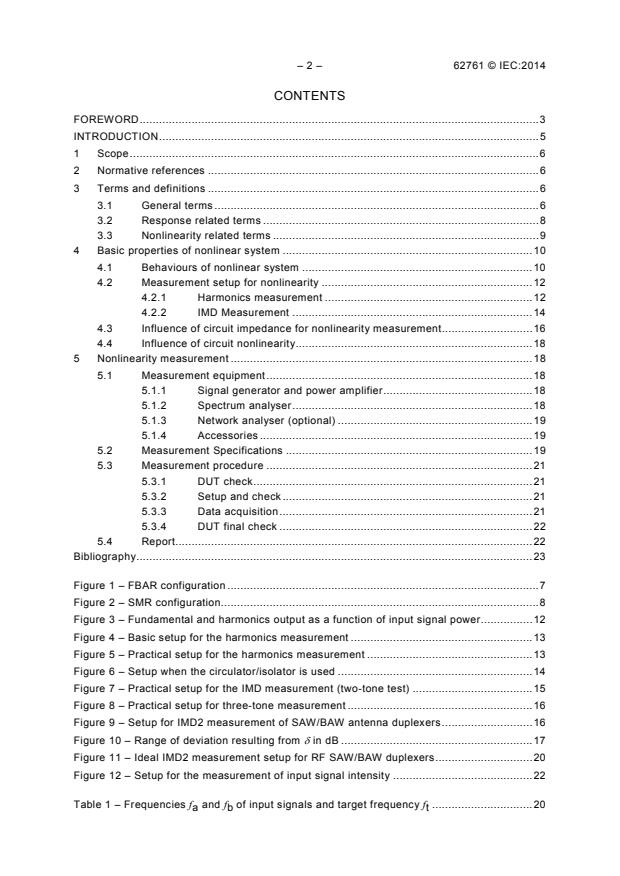
CONTENTS
FOREWORD . 3
INTRODUCTION . 5
1 Scope . 6
2 Normative references . 6
3 Terms and definitions . 6
3.1 General terms . 6
3.2 Response related terms . 8
3.3 Nonlinearity related terms . 9
4 Basic properties of nonlinear system . 10
4.1 Behaviours of nonlinear system . 10
4.2 Measurement setup for nonlinearity . 12
4.2.1 Harmonics measurement . 12
4.2.2 IMD Measurement . 14
4.3 Influence of circuit impedance for nonlinearity measurement . 16
4.4 Influence of circuit nonlinearity . 18
5 Nonlinearity measurement . 18
5.1 Measurement equipment . 18
5.1.1 Signal generator and power amplifier . 18
5.1.2 Spectrum analyser . 18
5.1.3 Network analyser (optional) . 19
5.1.4 Accessories . 19
5.2 Measurement Specifications . 19
5.3 Measurement procedure . 21
5.3.1 DUT check . 21
5.3.2 Setup and check . 21
5.3.3 Data acquisition . 21
5.3.4 DUT final check . 22
5.4 Report. 22
Bibliography . 23
Figure 1 – FBAR configuration . 7
Figure 2 – SMR configuration. 8
Figure 3 – Fundamental and harmonics output as a function of input signal power. 12
Figure 4 – Basic setup for the harmonics measurement . 13
Figure 5 – Practical setup for the harmonics measurement . 13
Figure 6 – Setup when the circulator/isolator is used . 14
Figure 7 – Practical setup for the IMD measurement (two-tone test) . 15
Figure 8 – Practical setup for three-tone measurement . 16
Figure 9 – Setup for IMD2 measurement of SAW/BAW antenna duplexers . 16
Figure 10 – Range of deviation resulting from δ in dB . 17
Figure 11 – Ideal IMD2 measurement setup for RF SAW/BAW duplexers . 20
Figure 12 – Setup for the measurement of input signal intensity . 22
Table 1 – Frequencies f and f of input signals and target frequency f . 20
a b t
62761 © IEC:2014 – 3 –
INTERNATIONAL ELECTROTECHNICAL COMMISSION
____________
GUIDELINES FOR THE MEASUREMENT METHOD OF NONLINEARITY FOR
SURFACE ACOUSTIC WAVE (SAW) AND BULK ACOUSTIC WAVE (BAW)
DEVICES IN RADIO FREQUENCY (RF)
FOREWORD
1) The International Electrotechnical Commission (IEC) is a worldwide organization for standardization comprising
all national electrotechnical committees (IEC National Committees). The object of IEC is to promote
international co-operation on all questions concerning standardization in the electrical and electronic fields. To
this end and in addition to other activities, IEC publishes International Standards, Technical Specifications,
Technical Reports, Publicly Available Specifications (PAS) and Guides (hereafter referred to as “IEC
Publication(s)”). Their preparation is entrusted to technical committees; any IEC National Committee interested
in the subject dealt with may participate in this preparatory work. International, governmental and non-
governmental organizations liaising with the IEC also participate in this preparation. IEC collaborates closely
with the International Organization for Standardization (ISO) in accordance with conditions determined by
agreement between the two organizations.
2) The formal decisions or agreements of IEC on technical matters express, as nearly as possible, an international
consensus of opinion on the relevant subjects since each technical committee has representation from all
interested IEC National Committees.
3) IEC Publications have the form of recommendations for international use and are accepted by IEC National
Committees in that sense. While all reasonable efforts are made to ensure that the technical content of IEC
Publications is accurate, IEC cannot be held responsible for the way in which they are used or for any
misinterpretation by any end user.
4) In order to promote international uniformity, IEC National Committees undertake to apply IEC Publications
transparently to the maximum extent possible in their national and regional publications. Any divergence
between any IEC Publication and the corresponding national or regional publication shall be clearly indicated in
the latter.
5) IEC itself does not provide any attestation of conformity. Independent certification bodies provide conformity
assessment services and, in some areas, access to IEC marks of conformity. IEC is not responsible for any
services carried out by independent certification bodies.
6) All users should ensure that they have the latest edition of this publication.
7) No liability shall attach to IEC or its directors, employees, servants or agents including individual experts and
members of its technical committees and IEC National Committees for any personal injury, property damage or
other damage of any nature whatsoever, whether direct or indirect, or for costs (including legal fees) and
expenses arising out of the publication, use of, or reliance upon, this IEC Publication or any other IEC
Publications.
8) Attention is drawn to the Normative references cited in this publication. Use of the referenced publications is
indispensable for the correct application of this publication.
9) Attention is drawn to the possibility that some of the elements of this IEC Publication may be the subject of
patent rights. IEC shall not be held responsible for identifying any or all such patent rights.
International Standard IEC 62761 has been prepared by IEC technical committee 49:
Piezoelectric, dielectric and electrostatic devices and associated materials for frequency
control, selection and detection.
The text of this standard is based on the following documents:
FDIS Report on voting
49/1091/FDIS 49/1098/RVD
Full information on the voting for the approval of this standard can be found in the report on
voting indicated in the above table.
This publication has been drafted in accordance with the ISO/IEC Directives, Part 2.
– 4 – 62761 © IEC:2014
The committee has decided that the contents of this publication will remain unchanged until
the stability date indicated on the IEC web site under "http://webstore.iec.ch" in the data
related to the specific publication. At this date, the publication will be
• reconfirmed,
• withdrawn,
• replaced by a revised edition, or
• amended.
IMPORTANT – The 'colour inside' logo on the cover page of this publication indicates
that it contains colours which are considered to be useful for the correct
understanding of its contents. Users should therefore print this document using a
colour printer.
62761 © IEC:2014 – 5 –
INTRODUCTION
Radio frequency (RF) surface acoustic wave (SAW) and bulk acoustic wave (BAW) devices
such as filters and duplexers are now widely used in various communication systems. Due to
their small physical size, energy concentration causes generation of nonlinear signals even
when relatively small electric power is applied, and they may interfere with the
communications.
The features of these RF SAW/BAW devices are their small size, light weight, omission of
impedance and/or frequency tuning, high stability and high reliability. Nowadays, RF
SAW/BAW devices with low insertion attenuation are widely used in various applications in
the RF range.
In such applications, suppression of transmission and generation of unnecessary signals is
highly demanded. Since nonlinearity in the RF SAW/BAW devices will generate such signals,
its ultimate suppression is always crucial. In the same time, measurement method of
nonlinear signals should be well established from industrial points of view.
In passive filters like RF SAW/BAW ones, frequency selectivity is realized by impedance
matching/mismatching with peripheral circuitry. Thus impedance of peripheral circuitry shall
be set as specified for reliable and reproducible filter characterization. This is also true for
non-linear characteristics. It should be noted that even-order non-linearity, which is not
common in general passive electronic components, may occur in RF SAW/BAW devices
employing piezoelectric materials for electrical excitation and detection of SAWs/BAWs. This
is because crystallographic asymmetry is necessary for existence of piezoelectricity.
Therefore, measurement methods should be specifically established for non-linear behavior of
RF SAW/BAW devices.
This standard has been compiled in response to a generally expressed desire on the part of
both users and manufacturers for general Information on test condition guidance of RF
SAW/BAW filters, so that the filters may be used to their best advantage. To this end, general
and fundamental characteristics have been explained in this standard.
– 6 – 62761 © IEC:2014
GUIDELINES FOR THE MEASUREMENT METHOD OF NONLINEARITY FOR
SURFACE ACOUSTIC WAVE (SAW) AND BULK ACOUSTIC WAVE (BAW)
DEVICES IN RADIO FREQUENCY (RF)
1 Scope
This International Standard gives the measurement method for nonlinear signals generated in
the radio frequency (RF) surface acoustic wave (SAW) and bulk acoustic wave (BAW) devices
such as filters and duplexers, which are used in telecommunications, measuring equipment,
radar systems and consumer products.
The IEC 62761 includes basic properties of non-linearity, and guidelines to setup the
measurement system and to establish the measurement procedure of nonlinear signals
generated in SAW/BAW devices.
It is not the aim of this standard to explain theory, nor to attempt to cover all the eventualities
which may arise in practical circumstances. This standard draws attention to some of the
more fundamental questions, which the user has to consider before he/she places an order
for an RF SAW/BAW device for a new application. Such a procedure will be the user's
insurance against unsatisfactory performance.
2 Normative references
None
3 Terms and definitions
For the purposes of this document, the following terms and definitions apply.
3.1 General terms
3.1.1
BAW duplexer
antenna duplexer composed of RF BAW resonators
3.1.2
BAW filter
filter characterised by a bulk acoustic wave which is usually generated by a pair of electrodes
and propagates along a thin film thickness direction
3.1.3
bulk acoustic wave
BAW
acoustic wave, propagating between the top and bottom surface of a piezoelectric structure
and traversing the entire thickness of the piezoelectric bulk
Note 1 to entry: The wave is excited by metal electrodes attached to both sides of the piezoelectric layer.
3.1.4
cut-off frequency
frequency of the pass-band at which the relative attenuation reaches a specified value
62761 © IEC:2014 – 7 –
3.1.5
duplexer
device used in the frequency division duplex system, which enables the system to receive and
transmit signal through a common antenna simultaneously
3.1.6
film bulk acoustic resonator
FBAR
thin film BAW resonator consisting of a piezoelectric layer sandwiched between two electrode
layers with stress free top and bottom surface supported mechanically at the edge on a
substrate with cavity structure as shown in Figure 1 or membrane structure as an example
Note 1 to entry: This note applies to the French language only.
Upper electrode
Piezoelectric material
Supporting
h
layer
Lower electrode
Supporting
substrate
IEC 0652/14
Figure 1 – FBAR configuration
3.1.7
Receiver (Rx) band
frequency band used in a receiver part to detect signals from an antenna
3.1.8
Rx filter
filter used in a receiver part to eliminate unnecessary signals
Note 1 to entry: The Rx filter is a basic part of a duplexer.
3.1.9
SAW filter
filter characterised by one or more surface acoustic wave transmission line or resonant
elements, where the surface acoustic wave is usually generated by an interdigital transducer
and propagates along a substrate
3.1.10
solidly mounted resonator
SMR
BAW resonator, supporting the electrode/piezoelectric layer/electrode structure by a
sequence of additional thin films of alternately low and high acoustic impedance Z with
a
quarter wavelength layer, and these layers act as acoustic reflectors and decouple the
resonator acoustically from the substrate as shown in Figure 2 for example
Note 1 to entry: This note applies to the French language only.
– 8 – 62761 © IEC:2014
Upper electrode
Piezoelectric material h
Lower electrode
Lower Z layer
a
Higher Z layer
a
Supporting
substrate
IEC 0653/14
Figure 2 – SMR configuration
3.1.11
surface acoustic wave
SAW
acoustic wave, propagating along a surface of an elastic substrate, whose amplitude decays
exponentially with substrate depth
[SOURCE: IEC 60862-1:2003, 2.2.1.1]
3.1.12
transmitter (Tx) band
frequency band used in a transmitter part to emit signals from an antenna
3.1.13
Tx filter
filter used in a transmitter part to eliminate unnecessary signals. It is a basic part of a
duplexer
3.2 Response related terms
3.2.1
insertion attenuation
logarithmic ratio of the power delivered directly to the load impedance before insertion of the
duplexer to the power delivered to the load impedance after insertion of the duplexer
3.2.2
pass band
band of frequencies in which the relative attenuation is equal to or less than a specified value
3.2.3
reflectivity
dimensionless measure of the degree of mismatch between two impedances Z and Z , i.e.,
1 2
Z − Z
1 2
, where Z and Z represent respectively the input and source impedance or the
1 2
Z + Z
1 2
output and load impedance
Note 1 to entry: The absolute value of reflectivity is called the reflection coefficient.
62761 © IEC:2014 – 9 –
3.2.4
relative attenuation
difference between the attenuation at a given frequency and the attenuation at the reference
frequency
3.2.5
stop band
band of frequencies in which the relative attenuation is equal to or greater than a specified
value
3.2.6
transition band
band of frequencies between the cut-off frequency and the nearest point of the adjacent stop
band
3.3 Nonlinearity related terms
3.3.1
harmonics
non-linear distortion of a device response characterized by the appearance of frequencies at
the output equal to integral multiples of the original signal frequency
3.3.2
hysteresis
memory effect
phenomenon where the output is not determined only from the input and depends also on the
internal state, in other words, the history of the input
3.3.3
intercept point
IP
power level where intensity of the non-linear signal generated by the intermodulation distortion (IMD) is equal to
that of two input signals at the output
Note 1 to entry: This note applies to the French language only.
3.3.4
intermodulation distortion
IMD
non-linear distortion of a device response characterized by the appearance of frequencies at the output equal to
the differences (or sums) of integral multiples of the two or more component frequencies present at the input
Note 1 to entry: This note applies to the French language only.
3.3.5
jammer signal
incoming unnecessary signal
3.3.6
nonlinear distortion
distortion of the signal waveform caused by nonlinearity of the system where the signal
transmits
Note 1 to entry: When the distortion is originated to the frequency dependence of the system signal transfer
function, it is called the linear distortion.
3.3.7
one decibel compression point
input power where gain, the ratio of the output to the input, decreases by 1 dB from the value
when the input is very weak
– 10 – 62761 © IEC:2014
3.3.8
saturation
phenomenon where gain, the ratio of the output to the input, decreases and approaches to
zero when the input is large
3.3.9
three tone test
non-linearity measurement applying three sinusoidal signals with different frequencies
simultaneously
3.3.10
triple beat test
same as the three tone test
3.3.11
two tone test
non-linearity measurement applying two sinusoidal signals with different frequencies
simultaneously
4 Basic properties of nonlinear system
4.1 Behaviours of nonlinear system
Let us consider a response y(x) of a circuit or a device when a signal x is applied. When the
hysteresis (memory effect) is negligible or ignored, the Maclaurin expansion of y with respect
to x gives
1 1
2 3
(1)
y(x) = c x + c x + c x +
1 2 3
2 3
where c is the expansion coefficient. It should be noted that c = 0 for even m, when the
m m
circuit/device satisfies y(− x) = − y(x).
Here we consider a case when two sinusoidal signals with frequencies f and f and
a b
amplitudes a and a are simultaneously applied, namely, x = a cos(2πf t) + a cos(2πf t), and
a b a a b b
a is much greater than a . Then y is approximately given by
a b
2 2
c a c a
3 a 3 a
y ≈ c a 1+ cos(2πf t) + c a 1+ cos(2πf t)
1 a a 1 b b
4c 2c
1 1
2 2 3
c a c a c a
2 a 2 a 3 a
+ + cos(4πf t) + cos(6πf t)
a a
4 4 4
c a a c a a
2 a b 2 a b
(2)
+ cos{2π ( f + f )t}+ cos{2π ( f − f )t}
a b a b
2 2
2 2
c a a c a a
3 a b 3 a b
+ cos{2π (2 f + f )t}+ cos{2π (2 f − f )t}
a b a b
4 4
+
Equation (2) indicates how nonlinearity influences to the circuit/device output. Namely, the
first two terms indicate change in the transmission coefficients for a and a , and express
a b
saturation due to large signal input (usually c /c is negative). The three terms in the second
3 1
line express generation of harmonics with f = mf (m: integer). The two terms in the third line
a
express generation of new signals with f = f ± f called the second-order intermodulation
a b
62761 © IEC:2014 – 11 –
distortion (IMD2). The remaining two terms in the fourth line express those with f = |2f ± f | or
a b
f = |2f ± f | called the third-order intermodulation distortion (IMD3).
b a
Here we consider a wireless receiver tuned for a signal with f = f . Incident signals with f = f /2
t t
and f = f /3 may be detected by the receiver after the harmonics generation, and may interfere
t
the main signal detection. Similarly, when two signals with f and f satisfying either
a b
f = |f ± f |, |2f ± f | or |f ± 2f | are incident to the receiver simultaneously, signals with f = f
t a b a b a b t
generated by IMD2 or IMD3 may also interfere the main signal detection. For transceivers
operating in the frequency division duplex (FDD) mode, transmitting signals with f=f may
a
cause IMD2 and/or IMD3 with an incident signal with f = f , and generated signals with f = f
b t
may also interfere the main signal detection. For transmitters, nonlinearity causes emission of
spurious signals, which may interfere with other wireless communications. These examples
clearly reveal importance to characterise nonlinear behaviour of RF systems and components
as well as the suppression.
For the characterisation of the transmission compression (saturation), we often use the input
signal level where the transmission coefficient decreases by 1 dB, which is called the 1dB
compression point (P ). On the other hand, so called the intercept point is used for the IMD
1dB
characterisation. That is, power P of the IMD2 signal with f = |f ± f | is expressed as
a±b a b
P = P P /OIP2 when signal levels are much lower than the saturation levels. In the
a±b oa ob
expression, P and P are the output power with f and f and OIP2 is called the output
oa ob a b
second-order intercept point. In decibels, the relation is rewritten as
OIP2 = P + P – P (3)
oa ob a±b
In Equation (3), all variables are expressed in dBm.
Similarly, power P of the IMD3 signal with f = |2f ± f | is expressed as
2a ± b a b
2 2
=P P /OIP3 when signal levels are much lower than the saturation levels. In the
P
2a±b oa ob
equation, OIP3 is called the output third-order intercept point. In decibels, the relation is
rewritten as
OIP3 = P + 1/2 × P – 1/2 × P (4)
oa ob 2a ± b
In Equation (4), all variables are expressed in dBm.
It should be noted that the intercept point is also defined by the input signal level P (= P )
ia ib
giving P = OIP2 and P = OIP3. The input second- and third-order intercept points IIP2
a ± b 2a ± b
and IIP3 are related to OIP2 and OIP3 as
IIP2 = OIP2 + IA (5)
and
IIP3 = OIP3 + IA (6)
where IA is the insertion attenuation in dB of the device measured with very weak input signal
level.
Figure 3 shows typical variation of P (n = 1), P (n = 2) and P (n = 3) with P (= P ).
oa a±b 2a±b ia ib
OIPn and IIPn can be estimated graphically from the intersection points between extrapolated
two linear lines. In this case, IIP2 and IIP3 are about 25 dBm and 33 dBm while OIP2 and
OIP3 are about 20 dBm and 28 dBm, respectively.
– 12 – 62761 © IEC:2014
IIP2 IIP3
+30
OIP3
+25
OIP
+20
+15
+10
P (n=1)
oa
+5
–5
P (n=2)
a±b
P (n=3)
2a±b
–10
–5 0 +5 +10 +15 +20 +25 +30 +35
Input signal power, P (=P ) (dBm)
ia ib
IEC 0654/14
Figure 3 – Fundamental and harmonics output as a function of input signal power
By the way, Equation (2) indicates that P and IIP3 are given by
10 log[4(1− 0,89)c / c R ]
1dB
1 3 0
and , respectively, where R is the circuit impedance. From these expressions,
10log[4c / c R ]
1 3 0
we obtain the following relation in decibels:
IIP3 = 9,6 + P (7)
1dB
However, this relation does not hold in general, especially in RF filters. This is because all
parameters appearing in Equation (2), namely c , c , and c are frequency dependent. In
1 2 3
addition, nonlinear parameters appeared in 4.1 such as IIPn and OIPn, are dependent on f , f
a b
and f . Thus they shall be specified at the measurement of nonlinear signals generated in RF
t
SAW/BAW devices .
4.2 Measurement setup for nonlinearity
4.2.1 Harmonics measurement
Figure 4 shows a basic setup for the N-th harmonics measurement of RF components or
systems. A sinusoidal signal with frequencies f and power P is supplied to a device under
a ia
test (DUT) by a signal generator (SG), and a target spectrum component P with frequency f
t t
(= Nf ) is selectively detected by a spectrum analyser (SA). At the measurement, we shall
a
examine following two issues: (a) nonlinearity of SG and SA is negligible, and (b) circuit
impedance looking from the DUT ports shall be defined well not only for the fundamental
frequency (f ) but also for harmonics with f=nf (n ≤ N). The latter is extremely important for
a a
passive RF filters. This is because their frequency selectivity is owed to impedance
mismatching with peripheral circuits, and the device characteristic is sensitive to the circuit
impedance. Usually the circuit impedance is chosen to be equal to specific impedance R of
the measurement system.
___________
1 RF BAW devices are often called the film bulk acoustic resonators (FBARs) or solidly mounted resonators
(SMRs) depending their device configuration.
Output signal power (dBm)
62761 © IEC:2014 – 13 –
DUT (2-port)
Port 1 Port 2
e
s
SG SA
R
R
IEC 0655/14
Figure 4 – Basic setup for the harmonics measurement
Use of an adequate filter is effective to reject nonlinear signals generated in the peripheral
circuit as shown in Figure 5. However since inserted passive filters exhibit the circuit
impedance of R only in the filter pass band, we need to insert an attenuator (ATT) between
the filter and DUT. When the nominal attenuation of the ATT is A dB, insertion of the ATT
improves the return attenuation of the peripheral circuit looking from the port 1 by 2A dB.
Insertion of the ATT also results in reduction of the input signal intensity by A dB, which
causes reduction of the n-th harmonics intensity by nA dB. Reduction of the signal level may
cause fluctuation (inaccuracy) in the SA read due to the thermal noise. Increasing the SG
output seems to be a solution of this difficulty. However, we shall check (a) whether the
harmonics generation in the SG is negligible for the measurement, and (b) whether heat up of
the ATT does not cause variation of the attenuation level with time.
The ATT inserted between the DUT and SA is aimed at suppressing harmonics generation at
SA and variation of the input admittance of SA. Of course this ATT is not necessary when
these effects are negligible.
LPF/BPF ATT DUT (2-port) ATT
Port 1 Port 2
e
s
SG SA
R
R
IEC 0656/14
Figure 5 – Practical setup for the harmonics measurement
When SG output power is not sufficient, we need to add a power amplifier (PA). In that case,
insertion of the filter may not be practical. This is because larger output power is necessary to
compensate the attenuation of the inserted ATT, and may make nonlinearity of the PA more
obvious. In that case, an isolator (or circulator) is often inserted instead of the filter to
suppress influence of the input impedance of the DUT port 1 to the PA (see Figure 6). It shall
be noted that since the circulator/isolator transmits spurious signals in some extent, their
generation in the PA shall be suppressed sufficiently. In addition, since isolators/circulators
usually exhibit their functionality in a narrow frequency range, insertion of an ATT might be
necessary to improve the return attenuation looking from the DUT port.
– 14 – 62761 © IEC:2014
PA Circulator ATT DUT (2-port) ATT
Port 1 Port 2
e
s
SG SA
R
R
R
IEC 0657/14
Figure 6 – Setup when the circulator/isolator is used
4.2.2 IMD Measurement
Figure 7 shows two configurations for the IMD measurement of RF components or systems.
This set up is often called the two-tone test. Two sinusoidal signals with frequencies f and f
a b
are applied to the DUT by two SGs, and a target spectrum component P with frequency f is
t t
selectively measured by the SA. For two-port DUTs, a power combiner is necessary to apply
two signals to the DUT simultaneously as shown in Figure 7(a). In both cases, an appropriate
filter is given to each SG to reject generated nonlinear signals and avoid IMD generation in
SGn. Since characteristics of the power combiner are usually frequency dependent, we may
need to add ATT between the power combiner and the DUT port 1 so as to improve the return
attenuation looking from the DUT port 1. For the three-port configuration shown in Figure 7(b),
ATTs are inserted between the filter and DUT since passive filters exhibit the circuit
impedance of R only in the filter pass band (not for frequencies of IMD signals generated in
the DUT).
62761 © IEC:2014 – 15 –
LPF/BPF
e
a
ATT DUT (2-port) ATT
SGa
Power
Port 1 Port 2
R
combiner
SA
LPF/BPF
R
e
b
SGb
R
IEC 0658/14
Figure 7 a) – Two-port DUT
LPF/BPF ATT DUT (3-port) ATT
Port 1 Port 3
e
a
SA
SGa R
R
LPF/BPF ATT
Port 2
e
b
SGb
R
IEC 0659/14
Figure 7 b) – Three-port DUT
Figure 7 – Practical setup for the IMD measurement (two-tone test)
Figure 8 shows another configuration for the IMD3 measurement using three SGs. This set up
is often called the three-tone (triple-beat) test. Three sinusoidal signals with frequencies f , f
a b
and f are applied simultaneously to the DUT, and a target spectrum component P with
c t
frequency f (= f ± (f − f )) is selectively measured by the SA. Filters and ATT are arranged
t c a b
with the power combiner to reject generated nonlinear signals and avoid IMD generation in
SGa and SGb and to improve the return attenuation looking from the DUT port also for
frequencies of IMD signals generated in the DUT.
– 16 – 62761 © IEC:2014
LPF/BPF
e
a
ATT DUT (3-port) ATT
SGa
Power
Port 1 Port 3
R
combiner
SA
LPF/BPF
R
e
b
LPF/BPF ATT
SGb
Port 2
R
e
c
SGc
R
IEC 0660/14
Figure 8 – Practical setup for three-tone measurement
4.3 Influence of circuit impedance for nonlinearity measurement
Here we discuss influence of the circuit impedance quantitatively. As an example, let us
consider the IMD2 measurement for a SAW/BAW antenna duplexer shown in Figure 9. The
antenna duplexer is composed of two filters:
a) a transmit (Tx) filter connected between ports 1 and 2 that transmits signals in the Tx band,
and
b) a receive (Rx) filter connected between ports 2 and 3 that transmits signals in the Rx band.
Ports 1, 2 and 3 are often called the Tx, antenna (ANT) and Rx ports, respectively.
ATT
LPF/BPF ATT
Port 1 Port 3
(Tx) (Rx)
e
a
SA
SGa
R
SAW/BAW
R
Duplexer
LPF/BPF ATT
Port 2
(ANT)
e
b
SGb
R
IEC 0661/14
Figure 9 – Setup for IMD2 measurement of SAW/BAW antenna duplexers
and “SGb” with f are
For the IMD2 measurement, two RF signal generators “SGa” with f
a b
connected to the ports 1 and 2, respectively, and they simulate the Tx and jammer signals,
respectively. Thus f and f are specified so that:
a b
• f is in the Tx band, and
a
• f + f or f − f is in the Rx band. This means that
a b a b
• f is far from the Tx and Rx bands.
b
Thus the signal “a” incident from the port 1 will transmit to the port 2 through the Tx filter
while the signal “b” incident from the port 2 will be attenuated significantly at the transmission
62761 © IEC:2014 – 17 –
in the Tx and Rx filters. This implies that the IMD2 signal is mainly generated by SAW/BAW
resonators close to the port 2, and appears to the port 3 after the transmission through the Rx
filter.
Variation of IMD2 output is caused mainly by the following five mechanisms:
• variation of the Tx signal intensity due to impedance mismatching at the Tx port for f = f ,
a
• re-entry of the Tx signal to the ANT port due to impedance mismatching at the ANT port
for f = f ,
a
• variation of the jammer signal intensity due to impedance mismatching at the ANT port for
f = f ,
b
• re-entry of the nonlinear signal to the ANT port due to impedance mismatching at the ANT
port for f = f +f or f = f -f , and
a b a b
• variation of detector read due to impedance mismatching at the Rx port for f = f + f or
a b
f = f − f .
a b
When the IMD2 signal is assumed to be generated very close to the DUT port 2, fractional
error δ of the SA read b due to these effects may be approximately given by
δb
a±b a a a a a b b a±b a±b a±b a±b
δ = ≈ S (S S Γ + S Γ + S Γ + S Γ ) + S Γ (8)
32 21 11 1 22 2 22 2 22 2 33 3
b
where S is the reflectivity for the DUT port-n, and Γ is that of the peripheral circuit looking
nn n
from the DUT port-n. In Equation (8), the superscript is added to indicate its frequency
because S and Γ are frequency dependent.
nn n
Figure 10 shows range of deviation of the SA read resulting from δ in dB, namely the range
a±b a
from 20 log(1-|δ|) to 20 log(1+|δ|). Since | S |≈ 1 and | S |≈ 1, this result indicates that
32 21
a a a a b b a±b a±b a±b a±b
S Γ , S Γ , S Γ , S Γ , and S Γ shall be suppressed better than − 25 dB
11 1 22 2 22 2 22 2 33 3
and − 31 dB to obtain measurement accuracy better than ± 0,5 dB and ± 0,25 dB, respectively.
a a a±b a±b b
In commercial duplexers, S ≈ 0 , S ≈ 0 , S ≈ 0, and S ≈ 0 but | S |≈ 1. Thus we
11 22 22 33 22
b
shall pay much attention to the suppression of ; it shall be better than -25 dB (or − 31 dB)
Γ
to obtain measurement accuracy better than ± 0,5 dB (or ± 0,25 dB).
20log (1+|δ |)
20log (1-|δ |)
–1
–2
–3
–4
–40 –35 –30 –25 –20 –15 –10
Error factor, |δ | (dB)
IEC 0662/14
Figure 10 – Range of deviation resulting from δ in dB
Maximum deviation (dB)
– 18 – 62761 © IEC:2014
4.4 Influence of circuit nonlinearity
Here we discuss influence of nonlinear signals generated by the peripheral circuits
quantitatively. As an example, let us consider the IMD2 measurement for an RF SAW/BAW
duplexer shown in Figure 9. In the case, fractional error δ of the SA read b due to the circuit
nonlinearity may be given by
δb
a±b b iφ a±b a iφ a b iφ
1 2 3
(9)
δ = ≈ IP2 (S S e / IP2 + S S e / IP2 + S S e / IP2 )
DUT 31 12 1 32 21 2 31 32 3
b
where IP2 is the IP2 of the DUT, IP2 is the IP2 of the peripheral circuit connected to the
DUT n
DUT port n, and φ is relative phase of the IMD2 signal generated at the peripheral circuit
n
a±b b a±b a
a b
connected to the DUT port n. Since | S S |<< 1, | S S |<< 1 but | S S |≈ 1 , we shall
31 12 31 32 32 21
pay much attention for the suppression of IP2 ; Figure 10 indicates that IP2 /IP2 shall be
2 2 DUT
better than − 25 dB (or − 31 dB) to obtain measurement accuracy better than ± 0,5 dB (or
±0,25 dB).
5 Nonlinearity measurement
5.1 Measurement equipment
5.1.1 Signal generator and power amplifier
In the setups shown in Figures 4-9, SGs shall possess the following properties:
a) small nonlinearity,
b) good short term stability (small frequency fluctuation),
c) capability to synchronise with an external standard oscillation signal (usually 10 MHz).
Requirements b) and c) are imposed to reduce the thermal noise level in the SA read as will
be discussed later.
When the use of Pas is needed, their choice is crucial. Namely, the output stage of the PA
shall operate in the class A mode, and the nominal maximum output of PA shall be sufficiently
larger than the value required for the measurement. For example, use of PAs with maximum
output of 5 W seems appropriate for 500 mW output. Since thermal noise is also emitted from
PAs, the use of PAs with too large maximum output power may result in an increase in the
noise level in the SA read.
5.1.2 Spectrum analyser
In the nonlinearity measurement, various spectrum components are simultaneously incident to
the SA, and some of them may be much stronger than the target frequency component. Thus
the SA shall possess good linearity and wide dynamic range. Since minimum detection level
is determined by the noise level, SAs with low noise level is preferable. One may think that
the vector network analysers (VNAs) can be used for this purpose. Since VNAs possess
smaller linearity and dynamic range than SAs in general, applicability of VNAs might be
limited.
It sh
...
Questions, Comments and Discussion
Ask us and Technical Secretary will try to provide an answer. You can facilitate discussion about the standard in here.
Loading comments...