


IEC TR 61491:2010
(Main)Electrical equipment of industrial machines - Serial data link for real-time communication between controls and drives
General Information
- Abstract
IEC/TR 61491:2010 presents an overview and guidance for IEC 61158, IEC 61784-1, IEC 61784-2 and IEC 61800-7 with respect to a real-time serial interface between the control unit and its associated devices, which is utilized to transmit periodic and non periodic data. This interface is intended to apply to industrial machines, such as machine tools, with multiple devices connected via this interface. This interface supports different operation modes. This first edition of the technical report cancels and replaces the second edition of IEC 61491, published in 2002. The changes are primarily to make reference to material that was moved to IEC 61158, IEC 61784 and IEC 61800-7 series of standards.
- Status
- Withdrawn
- Publication Date
- 20-Jan-2010
- Withdrawal Date
- 30-Dec-2014
- Technical Committee
- SC 22G - Adjustable speed electric power drive systems (PDS)
- Drafting Committee
- WG 10 - TC 22/SC 22G/WG 10
- Current Stage
- WPUB - Publication withdrawn
- Start Date
- 31-Dec-2014
- Completion Date
- 28-Aug-2026
Buy Documents
IEC TR 61491:2010 - Electrical equipment of industrial machines - Serial data link for real-time communication between controls and drives Released:1/21/2010

IEC TR 61491:2010 - Electrical equipment of industrial machines - Serial data link for real-time communication between controls and drives Released:21. 01. 2010
Relations
- Effective Date
- 05-Sep-2023
Buy Documents
IEC TR 61491:2010 - Electrical equipment of industrial machines - Serial data link for real-time communication between controls and drives Released:1/21/2010
IEC TR 61491:2010 - Electrical equipment of industrial machines - Serial data link for real-time communication between controls and drives Released:21. 01. 2010
Get Certified
Connect with accredited certification bodies for this standard

BSI Group
BSI (British Standards Institution) is the business standards company that helps organizations make excellence a habit.

NYCE
Mexican standards and certification body.

ANCE
Mexican certification and testing association.
Sponsored listings
Frequently Asked Questions
IEC TR 61491:2010 is a technical report published by the International Electrotechnical Commission (IEC). Its full title is "Electrical equipment of industrial machines - Serial data link for real-time communication between controls and drives". This standard covers: IEC/TR 61491:2010 presents an overview and guidance for IEC 61158, IEC 61784-1, IEC 61784-2 and IEC 61800-7 with respect to a real-time serial interface between the control unit and its associated devices, which is utilized to transmit periodic and non periodic data. This interface is intended to apply to industrial machines, such as machine tools, with multiple devices connected via this interface. This interface supports different operation modes. This first edition of the technical report cancels and replaces the second edition of IEC 61491, published in 2002. The changes are primarily to make reference to material that was moved to IEC 61158, IEC 61784 and IEC 61800-7 series of standards.
IEC/TR 61491:2010 presents an overview and guidance for IEC 61158, IEC 61784-1, IEC 61784-2 and IEC 61800-7 with respect to a real-time serial interface between the control unit and its associated devices, which is utilized to transmit periodic and non periodic data. This interface is intended to apply to industrial machines, such as machine tools, with multiple devices connected via this interface. This interface supports different operation modes. This first edition of the technical report cancels and replaces the second edition of IEC 61491, published in 2002. The changes are primarily to make reference to material that was moved to IEC 61158, IEC 61784 and IEC 61800-7 series of standards.
IEC TR 61491:2010 is classified under the following ICS (International Classification for Standards) categories: 33.160.40 - Video systems; 33.200 - Telecontrol. Telemetering; 35.240.50 - IT applications in industry. The ICS classification helps identify the subject area and facilitates finding related standards.
IEC TR 61491:2010 has the following relationships with other standards: It is inter standard links to IEC 61491:2002. Understanding these relationships helps ensure you are using the most current and applicable version of the standard.
IEC TR 61491:2010 is available in PDF format for immediate download after purchase. The document can be added to your cart and obtained through the secure checkout process. Digital delivery ensures instant access to the complete standard document.
Standards Content (Sample)
− 2 − 1491 CEI:1995
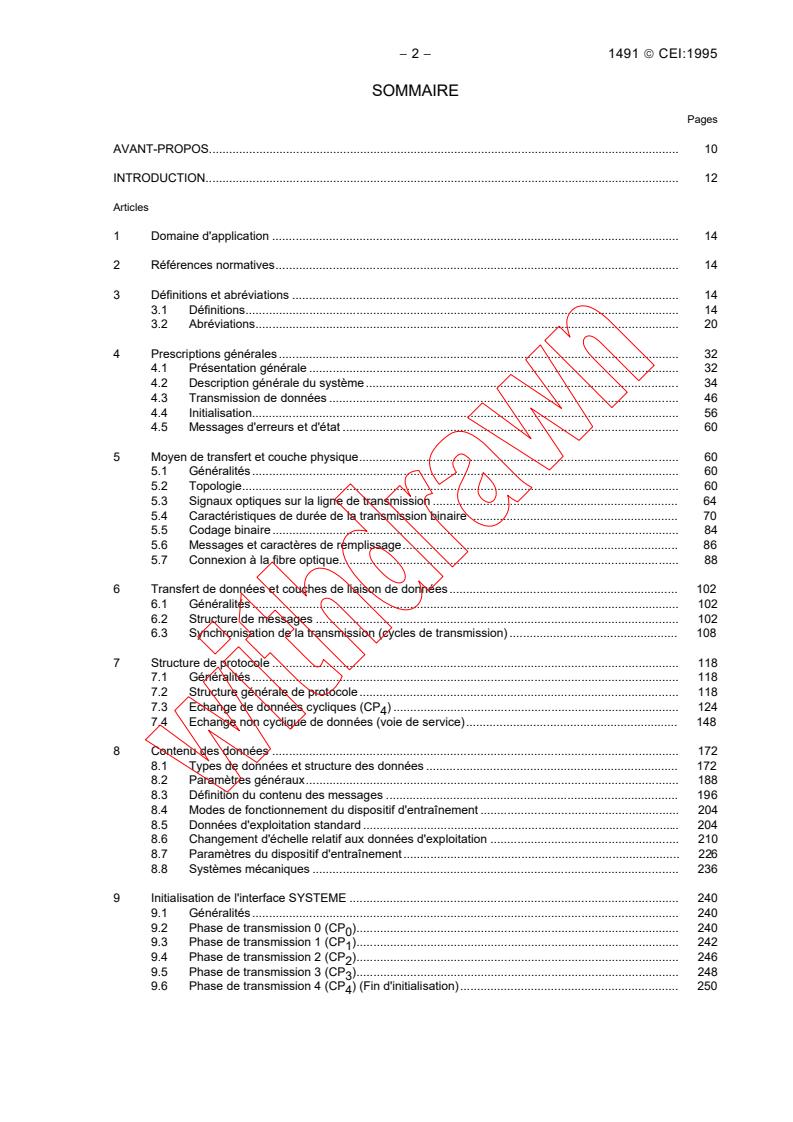
SOMMAIRE
Pages
AVANT-PROPOS. 10
INTRODUCTION. 12
Articles
1 Domaine d'application . 14
2 Références normatives. 14
3 Définitions et abréviations . 14
3.1 Définitions. 14
3.2 Abréviations. 20
4 Prescriptions générales . 32
4.1 Présentation générale. 32
4.2 Description générale du système.34
4.3 Transmission de données . 46
4.4 Initialisation. 56
4.5 Messages d'erreurs et d'état . 60
5 Moyen de transfert et couche physique. 60
5.1 Généralités. 60
5.2 Topologie. 60
5.3 Signaux optiques sur la ligne de transmission . 64
5.4 Caractéristiques de durée de la transmission binaire . 70
5.5 Codage binaire. 84
5.6 Messages et caractères de remplissage. 86
5.7 Connexion à la fibre optique. 88
6 Transfert de données et couches de liaison de données. 102
6.1 Généralités. 102
6.2 Structure de messages . 102
6.3 Synchronisation de la transmission (cycles de transmission) . 108
7 Structure de protocole . 118
7.1 Généralités. 118
7.2 Structure générale de protocole. 118
7.3 Echange de données cycliques (CP ) . 124
7.4 Echange non cyclique de données (voie de service). 148
8 Contenu des données . 172
8.1 Types de données et structure des données . 172
8.2 Paramètres généraux. 188
8.3 Définition du contenu des messages . 196
8.4 Modes de fonctionnement du dispositif d'entraînement . 204
8.5 Données d'exploitation standard . 204
8.6 Changement d'échelle relatif aux données d'exploitation . 210
8.7 Paramètres du dispositif d'entraînement. 226
8.8 Systèmes mécaniques. 236
9 Initialisation de l'interface SYSTEME . 240
9.1 Généralités. 240
9.2 Phase de transmission 0 (CP ). 240
9.3 Phase de transmission 1 (CP ). 242
9.4 Phase de transmission 2 (CP ). 246
9.5 Phase de transmission 3 (CP ). 248
9.6 Phase de transmission 4 (CP ) (Fin d'initialisation). 250
1491 IEC:1995 – 3 –
CONTENTS
Page
FOREWORD. 11
INTRODUCTION. 13
Clause
1 Scope . 15
2 Normative references . 15
3 Definitions and abbreviations. 15
3.1 Definitions . 15
3.2 Abbreviations. 21
4 General requirements . 33
4.1 Overview .33
4.2 System overview. 35
4.3 Data transmission . 47
4.4 Initialization . 57
4.5 Error and status messages. 61
5 Transfer medium and physical layer. 61
5.1 General . 61
5.2 Topology. 61
5.3 Optical signals on the transmission line . 65
5.4 Time performance of bit transmission . 71
5.5 Bit coding . 85
5.6 Telegrams and fill characters . 87
5.7 Connection to the optical fiber . 89
6 Data transfer and data link layer . 103
6.1 General . 103
6.2 Telegram structure . 103
6.3 Timing of the transmission (communication cycles) . 109
7 Protocol structure . 119
7.1 General . 119
7.2 General protocol structure . 119
7.3 Cyclic data exchange (CP ) . 125
7.4 Non-cyclic data exchange (service channel) . 149
8 Data contents. 173
8.1 Data types and data structure. 173
8.2 General parameters . 189
8.3 Definition of telegram contents . 197
8.4 Drive operation modes . 205
8.5 Standard operation data . 205
8.6 Scaling of operation data. 211
8.7 Drive parameters . 227
8.8 Mechanics . 239
9 Initialization of the SYSTEM interface . 241
9.1 General . 241
9.2 Communication phase 0 (CP ) . 241
9.3 Communication phase 1 (CP ) . 243
9.4 Communication phase 2 (CP ) . 247
9.5 Communication phase 3 (CP ) . 249
9.6 Communication phase 4 (CP ) – end of initialization . 251
− 4 − 1491 CEI:1995
Articles Pages
10 Traitement des erreurs . 252
10.1 Fonctions de sécurité des dispositifs d'entraînement. 252
10.2 Défaillance des messages . 254
10.3 Changement de phases de transmission . 256
10.4 Surveillance (présentation générale). 258
10.5 Réaction au délai d'attente de protocole de transport. 260
10.6 Réaction aux messages d'erreur dans la voie de service . 260
10.7 Compteurs d'erreurs dans les liaisons principale et secondaire . 262
11 Séquences fonctionnelles. 266
11.1 Généralités. 266
11.2 Affectation des bits en temps réel . 266
11.3 Retour à la position de référence . 270
11.4 Mesures. 284
11.5 Commande de procédure «positionnement de broche» . 284
11.6 Sélection d'ensembles de paramètres et du rapport d'engrenages . 290
11.7 Fonctions de démarrage/arrêt . 292
11.8 Commande de procédure d’axe de parc . 296
11.9 Commande de procédure d’arrêt complet du dispositif d’entraînement. 298
11.10 Commande de procédure de fonctionnement synchrone commandé par le
dispositif d’entraînement . 298
11.11 Commande de procédure d’engagement d’engrenages commandé par le
dispositif d’entraînement . 304
ANNEXES
A Numéros d’identification (IDN) classés par ordre numérique . 306
B Numéros d’identification (IDN) classés par ordre alphabétique. 320
C Description des IDN. 334
D Interface SYSTEME – Classes de conformité . 466
E Codage des caractères . 496
F Principes fonctionnels du circuit répéteur. 496
G Affaiblissement de la ligne de transmission. 502
H Détermination des tranches de temps de transmission. 506
I Traitement des données d’exploitation. 512
J Exécution des commandes de procédure . 524
TABLEAUX
1 Données de fonctionnement type relatives à une transmission cyclique . 40
2 Caractéristiques des données pour la transmission «non cyclique». 42
3 Spécifications relatives à l’émetteur (données pour λ ). 66
p
4 Spécifications relatives au récepteur (toutes les données pour λ ). 68
p
5 Spécifications techniques relatives aux câbles plastiques . 68
6 Données système relatives à la ligne de transmission optique . 70
7 Paramètres des données de transmission . 76
8 Signaux d'entrée possibles de la liaison secondaire . 82
9 Signaux de sortie possibles de la liaison secondaire . 82
10 Signaux corrects de sortie de la liaison secondaire . 84
11 Spécifications relatives au temps de réglage de l’horloge. 84
12 Fonctions fondamentales de la connexion . 88
13 Valeurs de la zone d'adresse pendant la transmission . 104
14 Valeurs de la zone d'adresse pendant la réception. 106
15 Messages d'erreurs . 160
16 Procédure de contrôle commande. 164
17 Acquitement de la commande de procédure (état des données). 164
18 Perte ou défaillance du message de synchronisation de la liaison principale (MST). 254
19 Défaillance du message de données relatives à la liaison principale (MDT) . 256
20 Défaillance des messages du dispositif d’entraînement (AT). 256
21 Etat des compteurs d'erreurs 1 dans la liaison principale . 262
22 Etat des compteurs d'erreurs 1 dans les dispositifs d’entraînement pour les défaillances
du MST dans CP et CP . 262
3 4
1491 IEC:1995 – 5 –
Clause Page
10 Error handling . 253
10.1 Drive safety functions. 253
10.2 Failure of telegrams . 255
10.3 Changing the communication phases. 257
10.4 Monitoring (overview) . 259
10.5 Reaction to handshake timeout. 261
10.6 Reaction to error messages in the service channel . 261
10.7 Error counters in the master and the slave. 263
11 Functional sequences . 267
11.1 General. 267
11.2 Assignment of real-time bits . 267
11.3 Homing . 271
11.4 Measurements . 283
11.5 Position spindle procedure command. 285
11.6 Switching of parameter sets and the gear ratio. 291
11.7 Starting/stopping functions . 293
11.8 Park axis procedure command. 297
11.9 Positive stop drive procedure command. 299
11.10 Drive controlled synchronous operation procedure command . 299
11.11 Drive controlled gear engaging procedure command. 305
Annexes
A Identification numbers in numerical order . 307
B Identification numbers in alphabetical order . 321
C Description of IDNs . 333
D SYSTEM interface – Compliance classes . 467
E Coded character set . 495
F Functional principles of the repeater circuit . 497
G Attenuation on the transmission line. 503
H Determination of the transmission time-slots . 507
I Processing operation data . 513
J Command execution . 525
Tables
1 Typical operation data for cyclic transmission . 41
2 Typical data for 'non-cyclic' transmission . 43
3 Transmitter specifications (data for λ ). 67
p
4 Receiver specifications (all data for λ ) . 69
p
5 Cable specifications for plastic . 69
6 System data of the optical transmission line . 71
7 Transmission data parameters. 77
8 Possible slave input signals . 83
9 Possible slave output signals . 83
10 Valid slave output signals. 85
11 Specifications of the clock adjustment times . 85
12 Basic functions of the connection . 89
13 Address field values during transmitting. 105
14 Address field values during reception . 107
15 Error messages. 161
16 Procedure command control . 165
17 Procedure command acknowledgment (data status). 165
18 Loss or failure of master synchronization telegram (MST) . 255
19 Failure of master data telegrams (MDT). 257
20 Failure of drive telegrams (AT) . 257
21 States of error counters 1 in the master for MST and AT failures . 263
22 States of error counters 1 in the drives for MST-failures in CP and CP . 263
3 4
− 6 − 1491 CEI:1995
Tableaux Pages
23 Etat des compteurs d'erreurs 1 dans les dispositifs d’entraînement pour les défaillances
du MDT en CP . 262
24 Etats des compteurs d’erreurs 2 dans la liaison principale pour les défaillances de l’AT . 264
25 Etats des compteurs d’erreurs 2 dans les dispositifs d’entraînement pour les défaillances MST . 264
26 Etats des compteurs d'erreurs 2 dans les dispositifs d’entraînement pour les défaillances MDT. 264
FIGURES
1 Topologie. 34
2 Modes de fonctionnement . 38
3 Aperçu général de la structure des zones de données (CP et CP ). 46
3 4
4 Couches de transfert . 48
5 Méthodes d'accès synchronisé. 48
6 Cycle de transmission . 50
7 Topologie. 62
8 Ligne de transmission optique. 64
9 Structure d'un câble unipolaire . 68
10 Enveloppe des signaux optiques. 74
11 Affichage de l’instabilité (J ). 76
bruit
12 Caractéristiques d'entrée et de sortie d'une liaison secondaire . 80
13 Exemple d'un signal codé en NRZI . 86
14 Structure générale d'un message. 86
15 Signal de remplissage . 88
16 Fonctions de connexion d’une liaison principale . 90
17 Signaux de transmission corrects pendant les transitions de signal de remplissage
en délimiteurs de messages. 94
18 Signaux de transmission corrects pendant les transitions de délimiteurs de messages
au signal de remplissage. 96
19 Fonctions de connexion d’une liaison secondaire.96
20 Boucle munie de deux liaisons secondaires. 100
21 Accès au support de transfert. 110
22 Intervalles de temps requis entre messages . 116
23 Validité des valeurs de commande et des temps d’acquisition de retour dans les dispositifs
d'entraînement. 116
24 Structure de bloc de données. 118
25 Zone de données du message de données relatives à la liaison principale . 120
26 Zone de données du message du dispositif d’entraînement . 122
27 Structure du message de synchronisation de la liaison principale . 124
28 Zone BOF . 124
29 Zone ADR. 124
30 Zone info. 126
31 Zone FCS . 126
32 Zone EOF . 126
33 Structure du message de données relatives à la liaison principale (MDT). 130
34 Zone info service de la liaison principale k. 134
35 Données d’exploitation . 134
36 Exemple de MDT (avec des enregistrements de données du message préconfiguré 2
relatifs au mode de fonctionnement en commande de vitesse) . 136
37 Structure de message du dispositif d’entraînement. 138
38 Zone info service du dispositif d’entraînement m . 142
39 Données d'exploitation . 142
40 Exemple de message du dispositif d'entraînement (message préconfiguré 2 relatif
au mode de fonctionnement en commande de vitesse). 144
41 Diagramme de synchronisation relatif au fonctionnement cyclique . 144
42 Fonction des éléments binaires en temps réel . 146
43 Configuration de transmission des données par la voie de service . 150
44 Schéma de traitement de la voie de service. 152
45 Schéma de traitement par étapes. 154
46 Etat de la machine pour l’exécution de la commande de procédure. 168
47 Exécution d’une commande de procédure sans interruption. 170
48 Exécution d’une commande de procédure avec interruption. 170
49 Exécution d’une commande de procédure avec message d’erreur. 172
1491 IEC:1995 – 7 –
Tables Pages
23 States of error counters 1 in the drives for MDT-failures in CP . 263
24 States of error counters in the master for AT-failures . 265
25 States of error counters 2 in the drives for MST-failures. 265
26 States of error counters 2 in the drives for MDT-failures. 265
Figures
1 Topology. 35
2 Operation modes. 39
3 Overview of data field structure (CP and CP ) . 47
3 4
4 Transfer layers. 49
5 Timed access methods. 49
6 Communication cycle . 51
7 Topology. 63
8 Optical transmission line . 65
9 Structure of a single-core cable . 69
10 Optical signal envelope . 75
11 Display of jitter (J ). 77
noise
12 Input-output performance of a slave. 81
13 Example of an NRZI-coded signal. 87
14 General telegram structure . 87
15 Fill signal . 89
16 Functions of a master connection . 91
17 Valid transmitting signals during transitions from fill signal to telegram delimiters . 95
18 Valid transmitting signals during transitions from telegram delimiters to fill signal . 97
19 Functions of a slave connection. 97
20 Ring with two slaves. 101
21 Access to the transfer medium . 111
22 Required time intervals between telegrams. 117
23 Validity of command values and feedback acqusition times in the drives . 117
24 Data block structure . 119
25 Data fields of the master data telegram. 121
26 Data field of the drive telegram. 123
27 Structure of the master synchronization telegram. 125
28 BOF field . 125
29 ADR field . 125
30 Info field . 127
31 FCS field. 127
32 EOF field . 127
33 Structure of the master Data Telegram . 131
34 Master service info field k. 135
35 Operation data . 135
36 Example of MDT (with data records of standard telegram 2 for velocity
control operation mode) . 137
37 Structure of the drive telegram . 139
38 Drive-service info field m. 143
39 Operation data . 143
40 Example of a drive telegram (standard telegram 2 for velocity control operation mode) . 145
41 Timing diagram for cyclic operation . 145
42 Function of the real-time bits . 147
43 Service channel data transmission scheme. 151
44 Service channel handling diagram . 153
45 Step proceeding diagram. 155
46 State machine for procedure command execution . 169
47 Procedure command execution without interrupt . 171
48 Procedure command execution with interrupt . 171
49 Procedure command execution with error message. 173
− 8 − 1491 CEI:1995
Figures Pages
50 Diagramme de synchronisation pour CP /CP . 190
3 4
51 Diagramme du type de changement d’échelle des données de position . 214
52 Diagramme du type de changement d’échelle pour les données de vitesse . 218
53 Diagramme du type de changement d’échelle pour les données de couple/force. 222
54 Diagramme du type de changement d’échelle pour les données d'accélération . 224
55 Exemple de l’ajustement du gain proportionnel pour la boucle de vitesse. 226
56 Exemple de l’ajustement du temps d’action intégral pour la boucle de vitesse . 228
57 Schéma de fonctionnement de la broche synchrone . 232
58 Schéma d’engrenages électroniques . 236
59 Diagramme temporel pour CP . 242
60 Structure du message de demande d’identification . 244
61 Structure du message d’acquittement d’identification . 244
62 Temps de départ de transmission des messages de CP . 246
63 Affectation d’un IDN ≠ 0 aux bits en temps réel (sans autre affectation active avant) . 268
64 Affectation d’un IDN = 0 aux bits en temps réel (avec autre affectation active avant) . 268
65 Affectation d’un IDN ≠ 0 aux bits en temps réel (autre affectation active avant). 270
66 Séquence des bits pour le retour à la position de référence commandé par le dispositif d’entraînement 272
67 Schéma de retour à la position de référence commandé par le dispositif d’entraînement. 272
68 Séquence de bits pour le retour à la position de référence sous le contrôle
de la commande numérique (cas 1). 276
69 Séquence de bits pour le retour à la position de référence sous le contrôle
de la commande numérique (cas 2.1). 278
70 Séquence de bits pour le retour à la position de référence sous le contrôle
de la commande numérique (cas 2.2). 278
71 Système de retour incrémenté . 280
72 Système de retour à codage de distance. 282
73 Séquence de bits pour activer le déplacement du système référencé. 282
74 Séquence de bits pour la mesure. 284
75 Diagramme de vitesse pour le positionnement de la broche (retour de vitesse > vitesse de
positionnement de la bro
...
IEC/TR 61491 ®
Edition 1.0 2010-01
TECHNICAL
REPORT
RAPPORT
TECHNIQUE
Electrical equipment of industrial machines – Serial data link for real-time
communication between controls and drives
Équipement électrique des machines industrielles – Liaison des données
sérielles pour communications en temps réel entre unités de commande et
dispositifs d’entraînement
IEC/TR 61491:2010
All rights reserved. Unless otherwise specified, no part of this publication may be reproduced or utilized in any form or by
any means, electronic or mechanical, including photocopying and microfilm, without permission in writing from either IEC or
IEC's member National Committee in the country of the requester.
If you have any questions about IEC copyright or have an enquiry about obtaining additional rights to this publication,
please contact the address below or your local IEC member National Committee for further information.
Droits de reproduction réservés. Sauf indication contraire, aucune partie de cette publication ne peut être reproduite
ni utilisée sous quelque forme que ce soit et par aucun procédé, électronique ou mécanique, y compris la photocopie
et les microfilms, sans l'accord écrit de la CEI ou du Comité national de la CEI du pays du demandeur.
Si vous avez des questions sur le copyright de la CEI ou si vous désirez obtenir des droits supplémentaires sur cette
publication, utilisez les coordonnées ci-après ou contactez le Comité national de la CEI de votre pays de résidence.
IEC Central Office
3, rue de Varembé
CH-1211 Geneva 20
Switzerland
Email: inmail@iec.ch
Web: www.iec.ch
About the IEC
The International Electrotechnical Commission (IEC) is the leading global organization that prepares and publishes
International Standards for all electrical, electronic and related technologies.
About IEC publications
The technical content of IEC publications is kept under constant review by the IEC. Please make sure that you have the
latest edition, a corrigenda or an amendment might have been published.
Catalogue of IEC publications: www.iec.ch/searchpub
The IEC on-line Catalogue enables you to search by a variety of criteria (reference number, text, technical committee,…).
It also gives information on projects, withdrawn and replaced publications.
IEC Just Published: www.iec.ch/online_news/justpub
Stay up to date on all new IEC publications. Just Published details twice a month all new publications released. Available
on-line and also by email.
Electropedia: www.electropedia.org
The world's leading online dictionary of electronic and electrical terms containing more than 20 000 terms and definitions
in English and French, with equivalent terms in additional languages. Also known as the International Electrotechnical
Vocabulary online.
Customer Service Centre: www.iec.ch/webstore/custserv
If you wish to give us your feedback on this publication or need further assistance, please visit the Customer Service
Centre FAQ or contact us:
Email: csc@iec.ch
Tel.: +41 22 919 02 11
Fax: +41 22 919 03 00
A propos de la CEI
La Commission Electrotechnique Internationale (CEI) est la première organisation mondiale qui élabore et publie des
normes internationales pour tout ce qui a trait à l'électricité, à l'électronique et aux technologies apparentées.
A propos des publications CEI
Le contenu technique des publications de la CEI est constamment revu. Veuillez vous assurer que vous possédez
l’édition la plus récente, un corrigendum ou amendement peut avoir été publié.
Catalogue des publications de la CEI: www.iec.ch/searchpub/cur_fut-f.htm
Le Catalogue en-ligne de la CEI vous permet d’effectuer des recherches en utilisant différents critères (numéro de référence,
texte, comité d’études,…). Il donne aussi des informations sur les projets et les publications retirées ou remplacées.
Just Published CEI: www.iec.ch/online_news/justpub
Restez informé sur les nouvelles publications de la CEI. Just Published détaille deux fois par mois les nouvelles
publications parues. Disponible en-ligne et aussi par email.
Electropedia: www.electropedia.org
Le premier dictionnaire en ligne au monde de termes électroniques et électriques. Il contient plus de 20 000 termes et
définitions en anglais et en français, ainsi que les termes équivalents dans les langues additionnelles. Egalement appelé
Vocabulaire Electrotechnique International en ligne.
Service Clients: www.iec.ch/webstore/custserv/custserv_entry-f.htm
Si vous désirez nous donner des commentaires sur cette publication ou si vous avez des questions, visitez le FAQ du
Service clients ou contactez-nous:
Email: csc@iec.ch
Tél.: +41 22 919 02 11
Fax: +41 22 919 03 00
IEC/TR 61491 ®
Edition 1.0 2010-01
TECHNICAL
REPORT
RAPPORT
TECHNIQUE
Electrical equipment of industrial machines – Serial data link for real-time
communication between controls and drives
Équipement électrique des machines industrielles – Liaison des données
sérielles pour communications en temps réel entre unités de commande et
dispositifs d’entraînement
INTERNATIONAL
ELECTROTECHNICAL
COMMISSION
COMMISSION
ELECTROTECHNIQUE
INTERNATIONALE
ICS 33.200; 35.240.50 ISBN 2-8318-1075-6
– 2 – TR 61491 IEC:2010
CONTENTS
FOREWORD .3
INTRODUCTION .5
1 Scope .6
2 Normative references .6
3 Terms, definitions, symbols and abbreviated terms .7
3.1 Terms and definitions .7
3.2 Symbols and abbreviated terms .7
4 Structure of the communication specification .7
5 Structure of the application specification .8
Bibliography .9
Table 1 – Overview on communication profiles of CPF 16 .8
TR 61491 IEC:2010 – 3 –
INTERNATIONAL ELECTROTECHNICAL COMMISSION
____________
ELECTRICAL EQUIPMENT OF INDUSTRIAL MACHINES –
SERIAL DATA LINK FOR REAL-TIME COMMUNICATION
BETWEEN CONTROLS AND DRIVES
FOREWORD
1) The International Electrotechnical Commission (IEC) is a worldwide organization for standardization comprising
all national electrotechnical committees (IEC National Committees). The object of IEC is to promote
international co-operation on all questions concerning standardization in the electrical and electronic fields. To
this end and in addition to other activities, IEC publishes International Standards, Technical Specifications,
Technical Reports, Publicly Available Specifications (PAS) and Guides (hereafter referred to as “IEC
Publication(s)”). Their preparation is entrusted to technical committees; any IEC National Committee interested
in the subject dealt with may participate in this preparatory work. International, governmental and non-
governmental organizations liaising with the IEC also participate in this preparation. IEC collaborates closely
with the International Organization for Standardization (ISO) in accordance with conditions determined by
agreement between the two organizations.
2) The formal decisions or agreements of IEC on technical matters express, as nearly as possible, an international
consensus of opinion on the relevant subjects since each technical committee has representation from all
interested IEC National Committees.
3) IEC Publications have the form of recommendations for international use and are accepted by IEC National
Committees in that sense. While all reasonable efforts are made to ensure that the technical content of IEC
Publications is accurate, IEC cannot be held responsible for the way in which they are used or for any
misinterpretation by any end user.
4) In order to promote international uniformity, IEC National Committees undertake to apply IEC Publications
transparently to the maximum extent possible in their national and regional publications. Any divergence
between any IEC Publication and the corresponding national or regional publication shall be clearly indicated in
the latter.
5) IEC itself does not provide any attestation of conformity. Independent certification bodies provide conformity
assessment services and, in some areas, access to IEC marks of conformity. IEC is not responsible for any
services carried out by independent certification bodies.
6) All users should ensure that they have the latest edition of this publication.
7) No liability shall attach to IEC or its directors, employees, servants or agents including individual experts and
members of its technical committees and IEC National Committees for any personal injury, property damage or
other damage of any nature whatsoever, whether direct or indirect, or for costs (including legal fees) and
expenses arising out of the publication, use of, or reliance upon, this IEC Publication or any other IEC
Publications.
8) Attention is drawn to the Normative references cited in this publication. Use of the referenced publications is
indispensable for the correct application of this publication.
9) Attention is drawn to the possibility that some of the elements of this IEC Publication may be the subject of
patent rights. IEC shall not be held responsible for identifying any or all such patent rights.
The main task of IEC technical committees is to prepare International Standards. However, a
technical committee may propose the publication of a technical report when it has collected
data of a different kind from that which is normally published as an International Standard, for
example "state of the art".
IEC 61491, which is a technical report, has been prepared by subcommittee 22G: Adjustable
speed electric drive systems incorporating semiconductor power converters, of IEC technical
committee 22: Power electronic systems and equipment.
This first edition of the technical report cancels and replaces the second edition of IEC 61491,
published in 2002. The changes are primarily to make reference to material that was moved to
IEC 61158, IEC 61784 and IEC 61800-7 series of standards.
– 4 – TR 61491 IEC:2010
The text of this technical report is based on the following documents:
Enquiry draft Report on voting
22G/199/DTR 22G/209/RVC
Full information on the voting for the approval of this technical report can be found in the
report on voting indicated in the above table.
This publication has been drafted in accordance with the ISO/IEC Directives, Part 2.
The committee has decided that the contents of this publication will remain unchanged until
the maintenance result date indicated on the IEC web site under "http://webstore.iec.ch" in
the data related to the specific publication. At this date, the publication will be
• reconfirmed,
• withdrawn,
• replaced by a revised edition, or
• amended.
TR 61491 IEC:2010 – 5 –
INTRODUCTION
This technical report replaces the second edition of IEC 61491:2002 which has been
separated into:
a) communication parts, included in the IEC 61158 and IEC 61784 series (prepared by
subcommittee 65C: Industrial networks, of IEC technical committee 65: Industrial process
measurement, control and automation);
b) the application part, included in the IEC 61800-7 series (prepared by subcommittee 22G:
Adjustable speed electric drive systems incorporating semiconductor power converters, of
IEC technical committee 22: Power electronic systems and equipment.)
The communication related content of the second edition of IEC 61491:2002 and technical
updates are specified by communication profile family 16 (CPF 16) in IEC 61784-1 and
IEC 61784-2. The application related content of the second edition of IEC 61491:2002 (drive
profile) and technical updates are specified in IEC 61800-7.
– 6 – TR 61491 IEC:2010
ELECTRICAL EQUIPMENT OF INDUSTRIAL MACHINES –
SERIAL DATA LINK FOR REAL-TIME COMMUNICATION
BETWEEN CONTROLS AND DRIVES
1 Scope
This technical report presents an overview and guidance for IEC 61158, IEC 61784-1,
IEC 61784-2 and IEC 61800-7 with respect to a real-time serial interface between the control
unit and its associated devices, which is utilized to transmit periodic and non periodic data.
This interface is intended to apply to industrial machines, such as machine tools, with multiple
devices connected via this interface. This interface supports different operation modes.
2 Normative references
The following referenced documents are indispensable for the application of this document.
For dated references, only the edition cited applies. For undated references, the latest edition
of the referenced document (including any amendments) applies.
IEC 61158 (all parts), Industrial communication networks – Fieldbus specifications
IEC 61158-1, Industrial communication networks – Fieldbus specifications – Part 1: Overview
and guidance for the IEC 61158 and IEC 61784 series
IEC 61158-2, Industrial communication networks – Fieldbus specifications – Part 2: Physical
layer specification and service definition
IEC 61158-3-16, Industrial communication networks – Fieldbus specifications – Part 3-16:
Data-link layer service definition – Type 16 elements
IEC 61158-3-19, Industrial communication networks – Fieldbus specifications – Part 3-19:
Data-link layer service definition – Type 19 elements
IEC 61158-4-16, Industrial communication networks – Fieldbus specifications – Part 4-16:
Data-link layer protocol specification – Type 16 elements
IEC 61158-4-19, Industrial communication networks – Fieldbus specifications – Part 4-19:
Data-link layer protocol specification – Type 19 elements
IEC 61158-5-16, Industrial communication networks – Fieldbus specifications – Part 5-16:
Application layer service definition – Type 16 elements
IEC 61158-5-19, Industrial communication networks – Fieldbus specifications – Part 5-19:
Application layer service definition – Type 19 elements
IEC 61158-6-16, Industrial communication networks – Fieldbus specifications – Part 6-16:
Application layer protocol specification – Type 16 elements
IEC 61158-6-19, Industrial communication networks – Fieldbus specifications – Part 6-19:
Application layer protocol specification – Type 19 elements
IEC 61784-1, Industrial communication networks – Profiles – Part 1: Fieldbus profiles
TR 61491 IEC:2010 – 7 –
IEC 61784-2, Industrial communication networks – Profiles – Part 2: Additional fieldbus
profiles for real-time networks based on ISO/IEC 8802-3
IEC 61800-7 (all subparts) Adjustable speed electrical power drive systems – Part 7-xxx:
Generic interface and use of profiles for power drive systems
IEC 61800-7-1, Adjustable speed electrical power drive systems – Part 7-1: Generic interface
and use of profiles for power drive systems – Interface definition
IEC 61800-7-204, Adjustable speed electrical power drive systems – Part 7-204: Generic
interface and use of profiles for power drive systems – Profile type 4 specification
IEC 61800-7-304, Adjustable speed electrical power drives systems – Part 7-304: Generic
interface and use of profiles for power drive systems – Mapping of profile type 4 to network
technologies
ISO/IEC 8802-3, Information technology – Telecommunications and information exchange
between systems – Local and metropolitan area networks – Specific requirements – Part 3:
Carrier sense multiple access with collision detection (CSMA/CD) access method and
physical layer specifications
3 Terms, definitions, symbols and abbreviated terms
3.1 Terms and definitions
For the purposes of this document, the terms and definitions given in the referenced
specifications apply.
3.2 Symbols and abbreviated terms
The following abbreviations apply for this document.
CP Communication profile
CPF Communication profile family
PDS Power drive system
4 Structure of the communication specification
The communication related specification is divided into three communication profiles:
• communication profile 16/1 (CP 16/1) in IEC 61784-1 covers the communication related
content of the second edition of IEC 61491:2002;
• communication profile 16/2 (CP 16/2) in IEC 61784-1 covers CP 16/1 and the increased
bit rates (8 Mbit/s and 16 Mbit/s);
• communication profile 16/3 (CP 16/3) in IEC 61784-2 covers an extended functionality of
CP 16/2 based on ISO/IEC 8802-3.
CP 16/1 and CP 16/2 correspond to Type 16 of the IEC 61158 series. CP 16/3 corresponds to
Type 19 of the IEC 61158 series. The relations are shown in Table 1.
The general structure of the IEC 61158 series is explained in IEC 61158-1.
– 8 – TR 61491 IEC:2010
Table 1 – Overview on communication profiles of CPF 16
CP CPF Type Physical layer Data link layer Application layer
16/1 16 16 IEC 61158-2 IEC 61158-3-16 IEC 61158-5-16
IEC 61158-4-16 IEC 611
...