

IEC TR 61930:1998
(Main)Fibre optic graphical symbology
General Information
- Abstract
Applies to graphical symbols used in IEC publications dealing with fibre optics. Provides uniform graphical symbols for the various fibre optic elements and devices.
- Status
- Published
- Publication Date
- 24-Aug-1998
- Technical Committee
- TC 86 - Fibre optics
- Drafting Committee
- WG 1 - TC 86/WG 1
- Current Stage
- PPUB - Publication issued
- Start Date
- 25-Aug-1998
- Completion Date
- 31-Jul-1998
IEC TR 61930:1998 – Fibre Optic Graphical Symbology
Overview
IEC TR 61930:1998 is a technical report issued by the International Electrotechnical Commission (IEC) that standardizes graphical symbols used in fibre optics documentation. This standard provides a uniform set of graphical representations for various fibre optic elements and devices, ensuring consistency across IEC publications and technical materials related to fibre optics. It is primarily intended for use by IEC Technical Committee 86, responsible for fibre optic standardization.
The report serves as a reference until the IEC 60617-10 graphical symbols standard is updated or revised to incorporate fibre optics-specific symbols. By facilitating a common visual language, IEC TR 61930 enhances clear communication and documentation in fibre optic technology.
Key Topics
- Scope and Purpose: The standard applies to the graphical symbols used in IEC publications concerning fibre optics. It aims to harmonize symbol usage for optical amplifiers, attenuators, beamsplitters, combiners, connectors, optical converters, and other fibre optic components.
- Graphical Symbols: Symbols are organized alphabetically with detailed notes for each to assist designers and engineers in correctly applying them. Important examples include:
- Optical amplifiers and variable/fixed attenuators for signal control.
- Beamsplitters and combiners for directing optical signals.
- Connectors and connector assemblies, including variations for male and female types, and adapter components.
- Optical-electrical converter symbols to represent devices transforming signals between optical and electrical domains.
- Optical timers to indicate delay components used in fibre optic systems.
- Usage Notes: The standard includes recommendations on arrow directions to indicate device function (e.g., input/output reversibility in beamsplitters), decibel (dB) modifications for attenuation/amplification, and variant symbols for specific components.
- References: It aligns with related standards such as IEC 60617-10 (Graphical symbols for telecommunication diagrams) and IEC 61931 (Fibre optic terminology), ensuring a cohesive standards framework.
Applications
- Fibre Optic System Design: Engineers use IEC TR 61930 symbols to create clear and standardized schematic diagrams of fibre optic networks, including amplifiers, splitters, couplers, and connectors.
- Technical Documentation: The standardized symbols help technical writers and reviewers prepare consistent documentation, user manuals, and installation guides.
- Manufacturing and Testing: Equipment manufacturers employ the uniform symbols in product datasheets, test reports, and quality assurance documents to represent fibre optic components accurately.
- Academic and Training Materials: The symbols serve as educational tools for students and professionals learning about fibre optic technology.
- International Collaboration: By adopting IEC standardized symbols, organizations worldwide facilitate clearer communication and reduce misunderstanding in international projects.
Related Standards
- IEC 60617-10:1996 – Graphical symbols for diagrams; Part 10 focuses on telecommunication transmission symbols and provides foundational symbology relevant for fibre optics.
- IEC 61931:1998 – Technical Report on fibre optic terminology that complements IEC TR 61930 by standardizing vocabulary and definitions critical to the understanding of fibre optic systems.
- IEC 60050 – International Electrotechnical Vocabulary, offering terminology standardization across the electrical and electronic domains.
- IEC 60027 and IEC 60417 – Standards covering letter symbols and graphical symbols used extensively in electrotechnical documentation and on equipment, providing a broader symbolic context including but not limited to fibre optics.
Benefits of IEC TR 61930 Standardization
- Uniformity: Provides a globally recognized set of symbols that promote uniform interpretation of fibre optic diagrams.
- Clarity: Reduces ambiguity in technical schematics and improves readability.
- Efficiency: Enables quicker understanding and validation of designs, accelerating development cycles.
- Interoperability: Facilitates collaboration across international teams by adhering to shared visual language.
- Up-to-Date Technology Reflection: The IEC commitment to regular review ensures the content remains aligned with current fibre optic technology trends and innovations.
Conclusion
IEC TR 61930:1998 is an essential resource for anyone involved in the design, documentation, and deployment of fibre optic systems. It offers a standardized, comprehensive set of graphical symbols that support accurate and effective communication within the fibre optics field. Adopting these symbols enhances consistency and professionalism in IEC publications and technical documentation worldwide, underscoring the importance of harmonized standards in advancing optical communication technologies.
Relations
- Effective Date
- 10-Feb-2026
- Effective Date
- 10-Feb-2026
- Effective Date
- 10-Feb-2026
- Effective Date
- 10-Feb-2026
- Effective Date
- 10-Feb-2026
- Effective Date
- 10-Feb-2026
- Effective Date
- 10-Feb-2026
- Referred By
EN 60874-1:2007 - Connectors for optical fibres and cables - Part 1: Generic specification - Effective Date
- 10-Feb-2026
- Effective Date
- 10-Feb-2026
- Effective Date
- 10-Feb-2026
- Effective Date
- 10-Feb-2026
- Effective Date
- 10-Feb-2026
- Effective Date
- 10-Feb-2026
- Effective Date
- 10-Feb-2026
- Effective Date
- 10-Feb-2026
Get Certified
Connect with accredited certification bodies for this standard

ANCE
Mexican certification and testing association.

Intertek Slovenia
Intertek testing, inspection, and certification services in Slovenia.

LNE (Laboratoire National de Métrologie et d'Essais)
French national laboratory for metrology and testing.
Sponsored listings
Frequently Asked Questions
IEC TR 61930:1998 is a technical report published by the International Electrotechnical Commission (IEC). Its full title is "Fibre optic graphical symbology". This standard covers: Applies to graphical symbols used in IEC publications dealing with fibre optics. Provides uniform graphical symbols for the various fibre optic elements and devices.
Applies to graphical symbols used in IEC publications dealing with fibre optics. Provides uniform graphical symbols for the various fibre optic elements and devices.
IEC TR 61930:1998 is classified under the following ICS (International Classification for Standards) categories: 01.080.01 - Graphical symbols in general; 33.180.01 - Fibre optic systems in general. The ICS classification helps identify the subject area and facilitates finding related standards.
IEC TR 61930:1998 has the following relationships with other standards: It is inter standard links to EN IEC 60875-1:2024, EN 61315:2006, EN 61274-1:2008, EN IEC 63032:2018, EN 62077:2001, EN 61977:2015, EN 60728-13:2010, EN 60874-1:2007, EN 62134-1:2002, EN 62134-1:2009, EN 62150-1:2005, EN 61314-1:2012, EN IEC 62077:2022, EN 62077:2010, EN 61978-1:2010. Understanding these relationships helps ensure you are using the most current and applicable version of the standard.
IEC TR 61930:1998 is available in PDF format for immediate download after purchase. The document can be added to your cart and obtained through the secure checkout process. Digital delivery ensures instant access to the complete standard document.
Standards Content (Sample)
RAPPORT
CEI
TECHNIQUE
IEC
TECHNICAL
Première édition
REPORT
First edition
1998-08
Symbologie des graphiques de fibres optiques
Fibre optic graphical symbology
Numéro de référence
Reference number
CEI / IEC 61930:1998
Numéros des publications Numbering
Depuis le 1er janvier 1997, les publications de la CEI As from 1 January 1997 all IEC publications are
sont numérotées à partir de 60 000. issued with a designation in the 60 000 series.
Publications consolidées Consolidated publications
Les versions consolidées de certaines publications de Consolidated versions of some IEC publications
la CEI incorporant les amendements sont disponibles. including amendments are available. For example,
Par exemple, les numéros d’édition 1.0, 1.1 et 1.2 edition numbers 1.0, 1.1 and 1.2 refer, respectively, to
indiquent respectivement la publication de base, la the base publication, the base publication incor-
publication de base incorporant l’amendement 1, et porating amendment 1 and the base publication
la publication de base incorporant les amendements 1 incorporating amendments 1 and 2.
et 2.
Validité de la présente publication Validity of this publication
Le contenu technique des publications de la CEI est The technical content of IEC publications is kept
constamment revu par la CEI afin qu'il reflète l'état under constant review by the IEC, thus ensuring that
actuel de la technique. the content reflects current technology.
Des renseignements relatifs à la date de re- Information relating to the date of the reconfirmation
confirmation de la publication sont disponibles dans of the publication is available in the IEC catalogue.
le Catalogue de la CEI.
Les renseignements relatifs à des questions à l’étude et Information on the subjects under consideration and
des travaux en cours entrepris par le comité technique work in progress undertaken by the technical com-
qui a établi cette publication, ainsi que la liste des mittee which has prepared this publication, as well as
publications établies, se trouvent dans les documents the list of publications issued, is to be found at the
ci-dessous: following IEC sources:
• «Site web» de la CEI* • IEC web site*
• Catalogue des publications de la CEI • Catalogue of IEC publications
Publié annuellement et mis à jour régulièrement Published yearly with regular updates
(Catalogue en ligne)* (On-line catalogue)*
• Bulletin de la CEI • IEC Bulletin
Disponible à la fois au «site web» de la CEI* Available both at the IEC web site* and
et comme périodique imprimé as a printed periodical
Terminologie, symboles graphiques Terminology, graphical and letter
et littéraux symbols
En ce qui concerne la terminologie générale, le lecteur For general terminology, readers are referred to
se reportera à la CEI 60050: Vocabulaire Electro- IEC 60 050: International Electrotechnical Vocabulary
technique International (VEI). (IEV).
Pour les symboles graphiques, les symboles littéraux For graphical symbols, and letter symbols and signs
et les signes d'usage général approuvés par la CEI, le approved by the IEC for general use, readers are
lecteur consultera la CEI 60027: Symboles littéraux à referred to publications IEC 60027: Letter symbols to
utiliser en électrotechnique, la CEI 60417: Symboles be used in electrical technology, IEC 60417: Graphical
graphiques utilisables sur le matériel. Index, relevé et symbols for use on equipment. Index, survey and
compilation des feuilles individuelles, et la CEI 60617: compilation of the single sheets and IEC 60617:
Symboles graphiques pour schémas. Graphical symbols for diagrams.
* Voir adresse «site web» sur la page de titre. * See web site address on title page.
RAPPORT
CEI
TECHNIQUE – TYPE 3
IEC
TECHNICAL
Première édition
REPORT – TYPE 3
First edition
1998-08
Symbologie des graphiques de fibres optiques
Fibre optic graphical symbology
IEC 1998 Droits de reproduction réservés Copyright - all rights reserved
Aucune partie de cette publication ne peut être reproduite ni No part of this publication may be reproduced or utilized in
utilisée sous quelque forme que ce soit et par aucun any form or by any means, electronic or mechanical,
procédé, électronique ou mécanique, y compris la photo- including photocopying and microfilm, without permission in
copie et les microfilms, sans l'accord écrit de l'éditeur. writing from the publisher.
International Electrotechnical Commission 3, rue de Varembé Geneva, Switzerland
Telefax: +41 22 919 0300 e-mail: inmail@iec.ch IEC web site http: //www.iec.ch
CODE PRIX
Commission Electrotechnique Internationale
PRICE CODE S
International Electrotechnical Commission
Pour prix, voir catalogue en vigueur
For price, see current catalogue
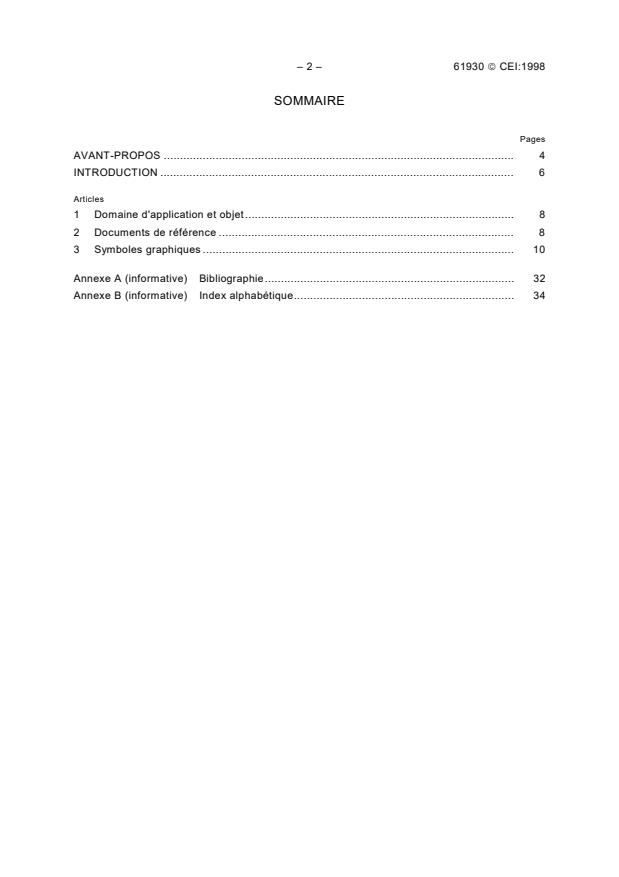
– 2 – 61930 CEI:1998
SOMMAIRE
Pages
AVANT-PROPOS . 4
INTRODUCTION . 6
Articles
1 Domaine d'application et objet. 8
2 Documents de référence . 8
3 Symboles graphiques . 10
Annexe A (informative) Bibliographie. 32
Annexe B (informative) Index alphabétique. 34
61930 IEC:1998 – 3 –
CONTENTS
Page
FOREWORD . 5
INTRODUCTION . 7
Clause
1 Scope and object . 9
2 Reference documents . 9
3 Graphical symbols. 11
Annex A (informative) Bibliography . 33
Annex B (informative) Alphabetical index . 35
– 4 – 61930 CEI:1998
COMMISSION ÉLECTROTECHNIQUE INTERNATIONALE
___________
SYMBOLOGIE DES GRAPHIQUES DE FIBRES OPTIQUES
AVANT-PROPOS
1) La CEI (Commission Electrotechnique Internationale) est une organisation mondiale de normalisation composée
de l'ensemble des comités électrotechniques nationaux (Comités nationaux de la CEI). La CEI a pour objet de
favoriser la coopération internationale pour toutes les questions de normalisation dans les domaines de
l'électricité et de l'électronique. A cet effet, la CEI, entre autres activités, publie des Normes internationales.
Leur élaboration est confiée à des comités d'études, aux travaux desquels tout Comité national intéressé par le
sujet traité peut participer. Les organisations internationales, gouvernementales et non gouvernementales, en
liaison avec la CEI, participent également aux travaux. La CEI collabore étroitement avec l'Organisation
Internationale de Normalisation (ISO), selon des conditions fixées par accord entre les deux organisations.
2) Les décisions ou accords officiels de la CEI concernant les questions techniques représentent, dans la mesure
du possible un accord international sur les sujets étudiés, étant donné que les Comités nationaux intéressés
sont représentés dans chaque comité d’études.
3) Les documents produits se présentent sous la forme de recommandations internationales. Ils sont publiés
comme normes, rapports techniques ou guides et agréés comme tels par les Comités nationaux.
4) Dans le but d'encourager l'unification internationale, les Comités nationaux de la CEI s'engagent à appliquer de
façon transparente, dans toute la mesure possible, les Normes internationales de la CEI dans leurs normes
nationales et régionales. Toute divergence entre la norme de la CEI et la norme nationale ou régionale
correspondante doit être indiquée en termes clairs dans cette dernière.
5) La CEI n’a fixé aucune procédure concernant le marquage comme indication d’approbation et sa responsabilité
n’est pas engagée quand un matériel est déclaré conforme à l’une de ses normes.
6) L’attention est attirée sur le fait que certains des éléments de la présente Norme internationale peuvent faire
l’objet de droits de propriété intellectuelle ou de droits analogues. La CEI ne saurait être tenue pour
responsable de ne pas avoir identifié de tels droits de propriété et de ne pas avoir signalé leur existence.
La tâche principale des comités d’études de la CEI est d’élaborer des Normes internationales.
Exceptionnellement, un comité d’études peut proposer la publication d’un rapport technique de
l’un des types suivants:
• type 1, lorsque, en dépit de maints efforts, l’accord requis ne peut être réalisé en faveur
de la publication d’une Norme internationale;
• type 2, lorsque le sujet en question est encore en cours de développement technique
ou lorsque, pour une raison quelconque, la possibilité d’un accord pour la publication
d’une Norme internationale peut être envisagée pour l’avenir mais pas dans l’immédiat;
• type 3, lorsqu’un comité d’études a réuni des données de nature différente de celles qui
sont normalement publiées comme Normes internationales, cela pouvant comprendre, par
exemple, des informations sur l’état de la technique.
La CEI 61930, rapport technique de type 3, a été établie par le comité 86 de la CEI: Fibres
optiques.
Le texte de ce rapport est issu des documents suivants:
Projet du comité Rapport de vote
86/86/CDV 86/108/RVC
Le rapport de vote indiqué dans le tableau ci-dessus donne toute information sur le vote ayant
abouti à l'approbation de ce rapport technique.
Les annexes A et B sont données uniquement à titre d’information.
61930 IEC:1998 – 5 –
INTERNATIONAL ELECTROTECHNICAL COMMISSION
___________
FIBRE OPTIC GRAPHICAL SYMBOLOGY
FOREWORD
1) The IEC (International Electrotechnical Commission) is a worldwide organization for standardization comprising
all national electrotechnical committees (IEC National Committees). The object of the IEC is to promote
international co-operation on all questions concerning standardization in the electrical and electronic fields. To
this end and in addition to other activities, the IEC publishes International Standards. Their preparation is
entrusted to technical committees; any IEC National Committee interested in the subject dealt with may
participate in this preparatory work. International, governmental and non-governmental organizations liaising
with the IEC also participate in this preparation. The IEC collaborates closely with the International Organization
for Standardization (ISO) in accordance with conditions determined by agreement between the two
organizations.
2) The formal decisions or agreements of the IEC on technical matters express, as nearly as possible, an
international consensus of opinion on the relevant subjects since each technical committee has representation
from all interested National Committees.
3) The documents produced have the form of recommendations for international use and are published in the form
of standards, technical reports or guides and they are accepted by the National Committees in that sense.
4) In order to promote international unification, IEC National Committees undertake to apply IEC International
Standards transparently to the maximum extent possible in their national and regional standards. Any
divergence between the IEC Standard and the corresponding national or regional standard shall be clearly
indicated in the latter.
5) The IEC provides no marking procedure to indicate its approval and cannot be rendered responsible for any
equipment declared to be in conformity with one of its standards.
6) Attention is drawn to the possibility that some of the elements of this International Standard may be the subject
of patent rights. The IEC shall not be held responsible for identifying any or all such patent rights.
The main task of IEC technical committees is to prepare International Standards. In
exceptional circumstances, a technical committee may propose the publication of a technical
report of one of the following types:
• type 1, when the required support cannot be obtained for the publication of an
International Standard, despite repeated efforts;
• type 2, when the subject is still under technical development or where for any other
reason there is the future but not immediate possibility of an agreement on an International
Standard;
• type 3, when a technical committee has collected data of a different kind from that
which is normally published as an International Standard, for example "state of the art".
IEC 61930, which is a technical report of type 3, has been prepared by IEC technical
committee 86: Fibre optics.
The text of this technical report is based on the following documents:
Committee draft Report on voting
86/86/CDV 86/108/RVC
Full information on the voting for the approval of this technical report can be found in the report
on voting indicated in the above table.
Annexes A and B are for information only.
– 6 – 61930 CEI:1998
INTRODUCTION
Le présent rapport technique regroupe les symboles graphiques les plus couramment utilisés
dans les publications de la CEI qui traitent des fibres optiques. Il est principalement destiné à
l’usage du comité d’études 86 et il convient qu’il soit suivi et mis à jour régulièrement. Les
symboles graphiques sont donnés dans l'ordre alphabétique anglais. Toutefois, pour faciliter
l'accès au texte, un index de références croisées est donné à l'annexe B.
61930 IEC:1998 – 7 –
INTRODUCTION
This technical report collects the most commonly used graphic symbols in IEC publications
concerning fibre optics. It is mainly intended for use by technical committee 86, and should be
checked and periodically updated. The graphical symbols are given in alphabetical order.
However, for an easier access to the whole text, a cross-référence index is given in annex B.
– 8 – 61930 CEI:1998
SYMBOLOGIE DES GRAPHIQUES DE FIBRES OPTIQUES
1 Domaine d'application et objet
Le présent rapport technique s'applique aux symboles graphiques utilisés dans les publications
de la CEI qui traitent des fibres optiques.
L'objet de ce rapport est de fournir des symboles graphiques uniformes pour les divers
éléments et dispositifs à fibres optiques. Il n'est pas destiné à remplacer la CEI 60617-10.
Toutefois, il est utilisable jusqu'à la décision de mise à jour ou de révision de la CEI 60617-10.
2 Documents de référence
CEI 60617-10:1996, Symboles graphiques pour schémas – Partie 10: Télécommunications:
Transmission
CEI 61931, Rapport Technique de type 3:1998, Terminologie des fibres optiques
61930 IEC:1998 – 9 –
FIBRE OPTIC GRAPHICAL SYMBOLOGY
1 Scope and object
This technical report applies to graphical symbols used in IEC publications dealing with fibre
optics.
The object of this technical report is to provide uniform graphical symbols for the various fibre
optic elements and devices. It is not intended to replace IEC 60617-10. Nevertheless, it may be
used until a revision or updating of IEC 60617-10 is decided.
2 Reference documents
IEC 60617-10:1996, Graphical symbols for diagrams – Part 10: Telecommunication
transmissions
IEC 61931, Technical Report type 3:1998, Fibre optic terminology
– 10 – 61930 CEI:1998
3 Symboles graphiques
3.3 Séparateur de faisceaux
3.1 Amplificateur optique
PRÉFÉRENTIEL
PRÉFÉRENTIEL VARIANTE
OA
dB
dB
NOTE – Ce symbole s'applique à un séparateur
optique cubique en vrac. Ce dispositif étant ré-
VARIANTE
VARIANTE
versible, les flèches peuvent être inversées pour
indiquer un mélangeur optique ou un multiplexeur.
OA
dB
VARIANTE
NOTE – Indique vraisemblablement une modification
spécifique en décibels
3.2 Atténuateur optique
dérivation.
Voir également: séparateur; dispositif de
3.2.1 Fixe
dB
3.4 Dispositif en cours d'essai
NOTE – Indique vraisemblablement une modification
spécifique en décibels.
3.2.2 Variable
DUT
PRÉFÉRENTIEL
dB
VARIANTE
3.2.3 A l'intérieur d'un ensemble
connecteur
PRÉFÉRENTIEL
dB
VARIANTE
dB dB
61930 IEC:1998 – 11 –
3 Graphical symbols
3.3 Beamsplitter
3.1 Amplifier, optical
PREFERRED
PREFERRED ALTERNATIVE
OA
dB
dB
NOTE – This symbol is for a bulk optic cube
beamsplitter. Since this device is reversible, the
ALTERNATIVE ALTERNATIVE
arrows can be reversed to indicate a bulk optic
combiner or multiplexer.
OA
dB
ALTERNATIVE
NOTE – Possibly indicate the specific change in
decibels.
See also: splitter; directional branching device.
3.2 Attenuator, optical
3.2.1 Fixed
dB
3.4 Device under test
NOTE – Possibly indicates the specific change in
decibels.
DUT
3.2.2 Variable
PREFERRED
dB
ALTERNATIVE
3.2.3 Within a connector assembly;
connectorized attenuator
PREFERRED
dB
ALTERNATIVE
dB dB
– 12 – 61930 CEI:1998
3.5 Mélangeur optique
3.7 Ensemble connecteur; jeu de connecteurs
3.5.1 Symbole général
PRÉFÉRENTIEL
n
VARIANTE
NOTE – Il s'agit de dispositifs indépendants de la
longueur d'onde. Un accès à entrées multiples (n:1)
est illustré. On pourrait préciser n.
NOTE 1 – En optique traitant de fibres, on utilise
souvent 2 connecteurs mâles et un raccord unique
3.5.2 Type de transition protégé par fusible
femelle-femelle (constituant un ensemble connecteur)
au lieu d'un connecteur unique mâle-femelle.
PRÉFÉRENTIEL VARIANTE
NOTE 2 – On peut ajouter NC ou PC pour indiquer
respectivement une terminaison sans contact ou à
contact physique.
NOTE 3 – Il faut ajouter APC pour indiquer un con-
necteur physique coudé.
NOTE – On peut omettre le cercle si aucune am-
biguïté ne subsiste. Ce symbole peut être inversé pour VARIANTE
représenter un séparateur.
NOTE – Genre du connecteur non défini.
3.5.3 Type micro-optique
3.8 Convertisseur
3.8.1 Electrique-optique
NOTE – Illustration d'un mélangeur 2 vers 1. Un mé-
PRÉFÉRENTIEL VARIANTE
langeur 2 vers 1 est également appelé coupleur.
E/O
3.6 Composants d’un jeu de connecteurs
3.8.2 Optique-électrique
3.6.1 Prise
PRÉFÉRENTIEL VARIANTE
VARIANTE
PRÉFÉRENTIEL
O/E
NOTE – Mâle
3.6.2 Adapteur pour une prise, socle
PRÉFÉRENTIEL VARIANTE
3.9 Temporisateur optique
NOTE – Femelle
3.6.3 Adapteur pour deux prises
PRÉFÉRENTIEL VARIANTE
NOTE – On peut inclure la temporisation dans le carré.
Voir aussi: prise, socle.
61930 IEC:1998 – 13 –
3.5 Combiner, optical
3.7 Connector set; connector assembly
3.5.1 General symbol
PREFERRED
n
ALTERNATIVE
NOTE – This is a wavelength independent device. A
multiple input port (n:1) device is shown. n could be
specified.
NOTE 1 – In fibre optics, 2 male connectors and a
single female – female coupling (which form a
3.5.2 Fused taper type
connector assembly) are often used instead of a
PREFERRED ALTERNATIVE single male – female connection.
NOTE 2 – "NC"or "PC" can be added to indicate non-
contact or physical contact termination respectively.
NOTE 3 – "APC" shall be added to indicate angled
physical contact.
NOTE – The circle may be omitted if no confusion is
ALTERNATIVE
likely. This symbol may be reversed to represent a
splitter.
NOTE – Gender of the connector is unidentified.
3.5.3 Micro-optic type
3.8 Converter
3.8.1 Electrical-to-optical
NOTE – A 2 to 1 combiner is shown. A 2 to 1
PREFERRED ALTERNATIVE
combiner is also known as a coupler.
E/O
3.6 Connector set components
3.6.1 Plug
3.8.2 Optical-to-electrical
PREFERRED ALTERNATIVE
ALTERNATIVE
PREFERRED
NOTE – Male
O/E
3.6.2 Adapter for one plug, receptacle
PREFERRED ALTERNATIVE
3.9 Delay device, optical
NOTE – Female
3.6.3 Adapter for two plugs
PREFERRED ALTERNATIVE
NOTE – The specific delay time can be included
See also: plug, receptacle.
inside the square.
– 14 – 61930 CEI:1998
3.11.2 Diode laser à injection (ILD)
PRÉFÉRENTIEL
sans amorce avec amorce
3.10 Démultiplexeur de longueurs d'onde
PRÉFÉRENTIEL
VARIANTE
DMUX
sans amorce avec amorce
n
λ
NOTE – Illustration type de 4 canaux.
VARIANTE
VARIANTE
sans amorce avec amorce
DMUX
•
•
n
•
λ
NOTE – Illustration d'un dispositif 1 à n. On peut
préciser n.
NOTE – La barre de liaison à la base des deux
flèches, symbole de qualification CEI 60617.02-09-02
indique une lumière cohérente.
3.11.3 Diode électroluminescente (DEL)
PRÉFÉRENTIEL
sans amorce avec amorce
3.11 Diode
3.11.1 Photodiode à avalanche (PDA)
PRÉFÉRENTIEL VARIANTE
3.11.4 Photodétecteur à diode électrolu-
luminescente, détecteur-émetteur
(DETEM)
NOTE – Également appelé détecteur photodiode à
avalanche. Voir diode électroluminescente pour un PRÉFÉRENTIEL VARIANTE
exemple de fibre amorce.
61930 IEC:1998 – 15 –
3.11.2 Injection laser diode (ILD)
PREFERRED
Unpigtailed Pigtailed
3.10 Demultiplexer, wavelength
PREFERRED
ALTERNATIVE
DMUX
Unpigtailed Pigtailed
n
λ
NOTE – A typical illustration of four channel is shown.
ALTERNATIVE
ALTERNATIVE
Unpigtailed Pigtailed
DMUX
•
n •
•
λ
NOTE – A 1 to n device is shown. n could be
specified.
NOTE – The connecting bar at the base of the two
arrows, IEC qualifying symbol 60617.02-09-02,
denotes coherent light.
3.11.3 Light-emitting diode (LED)
PREFERRED
Unpigtailed Pigtailed
3.11 Diode
3.11.1 Avalanche photodiode (APD)
PREFERRED ALTERNATIVE
3.11.4 Light-emitting photodetector,
detector-emitter (DETEM)
PREFERRED ALTERNATIVE
NOTE – Also known as an APD detector. See light
emitting diode for a pigtailed example.
– 16 – 61930 CEI:1998
3.14 Filtre Fabry-Perot
3.11.5 Photodiode PIN
PRÉFÉRENTIEL VARIANTE
NOTE – Également appelé étalon.
NOTE – Également appelé détecteur PIN. Voir
diode électroluminescente pour un exemple de fibre
amorce.
3.15 Fibre en cours d'essai (FUT)
3.12 Dispositif de dérivation;
n/a
coupleur directionnel
n = nombre de boucles
a = diamètre de boucle
PRÉFÉRENTIEL PRÉFÉRENTIEL
NOTE – Voir également bobine de fibre.
3.16 Lentille à gradient d'indice (GRIN)
3.16.1 Demi-lentille
VARIANTE
VARIANTE
3.16.2 Pleine lentille
1x2 2x2
3 accès 4 accès
3.17 Isolateur optique
3.13 Système d'excitation
E
61930 IEC:1998 – 17 –
3.14 Fabry-Perot filter
3.11.5 PIN photodiode
PREFERRED ALTERNATIVE
NOTE – Also known as an etalon.
NOTE – Also known as a PIN detector. See light
emitting diode for a pigtailed example.
3.15 Fibre under test (FUT)
3.12 (Directional) branching device;
n/a
(directional) coupler
n = number of loops
a = diameter of the loop
PREFERRED PREFERRED
NOTE – See spool of fibre.
3.16 Graded index lens (GRIN)
3.16.1 Half
ALTERNATIVE
ALTERNATIVE
3.16.2 Full
1x2 2x2
3 ports 4 ports
3.17 Isolator, optical
3.13 Excitation unit
E
– 18 – 61930 CEI:1998
3.21 Suppresseur de mode de gaine
3.18 Laser (sauf diode laser)
PRÉFÉRENTIEL
VARIANTE
3.19 Filtre de mode
CMS
NOTE – Également appelé suppresseur de mode.
NOTE – Il convient d'indiquer les longueurs d'onde 3.22 Multiplexeur de longueurs d'onde
limitatives au-dessus du symbole.
PRÉFÉRENTIEL
3.20 Mélangeur de mode
MUX
n
λ
NOTE – Illustration type de 4 canaux.
NOTE – Également appelé brouilleur de mode.
VARIANTE
MUX
•
•
n
•
λ
NOTE – Illustration d'un dispositif 1 à n. On peut
préciser n.
61930 IEC:1998 – 19 –
3.21 Cladding mode stripper
3.18 Laser (except laser diode)
PREFERRED
ALTERNATIVE
3.19 Mode filter
CMS
NOTE – Also known as a mode stripper.
NOTE – The limiting wavelengths should be provided 3.22 Multiplexer, wavelength
above the symbol.
PREFERRED
3.20 Mode mixer
MUX
n
λ
NOTE – A typical illustration of four channels is shown.
NOTE – Also known as a mode scrambler.
ALTERNATIVE
MUX
•
•
n
•
λ
NOTE – A n to 1 device is shown. n could be specified.
– 20 – 61930 CEI:1998
3.23 Fibre optique ou câble à fibres optiques
3.23.1 Symbole général
3.23.6 Informations supplémentaires
PRÉFÉRENTIEL VARIANTE
n
a/b/c/d/e
FO
MULTIMODE:
NOTE – En l'absence d’ambiguïté, on peut omettre le
symbole indiquant une fibre optique (deux flèches dans
a = diamètre du coeur
un cercle ou FO).
b = diamètre de la gaine
c = ouverture numérique (NA)
d = diamètre extérieur de la protection
3.23.2 Transmission cohérente de lumière
e = diamètre extérieur du revêtement secondaire
ou de la gaine intermédiaire
n = nombre de fibres
MONOMODE:
a = diamètre du champ de mode
b = diamètre de la gaine
c = diamètre extérieur de la gaine
d = diamètre extérieur de la protection
3.23.3 Fibre monomode
e = longueur d'onde de coupure
n = nombre de fibres
3.23.7 Câble composite
IVa
NOTE – La catégorie de dispersion des fibres mono-
modes (par exemple IVa pour une dispersion non
décalée ou IVb pour une dispersion décalée) peut être
Cu
indiquée, comme illustré.
3.23.4 Fibre multimode à saut d'indice
62,5/125/0,27
NOTE – Exemple de câble composite contenant à la
fois des conducteurs en cuivre et des fibres optiques,
avec complément d'informations. Cet exemple parti-
culier montre un câble composite contenant quatre
conducteurs en cuivre et 12 fibres optiques multimodes
à gradient d'indice, chacun ayant un diamètre de coeur
de 62,5 μm, un diamètre de gaine de 125 μm, et une
3.23.5 Fibre multimode à gradient d'indice
ouverture numérique de 0,27.
3.24 Réflectomètre optique dans le domaine
temporel (OTDR)
NOTE – Il convient de placer l'identificateur d'indice des
fibres pour chaque type de fibre à côté du symbole
indiquant une fibre optique, comme le montre
l'illustration, pour éviter toute confusion avec les formes
d'onde du signal.
OTDR
61930 IEC:1998 – 21 –
3.23 Optical fibre or optical fibre cable
3.23.1 General symbol
3.23.6 Supplementary information
PREFERRED ALTERNATIVE
n
a/b/c/d/e
FO
NOTE – If no confusion can arise, the symbol element
MULTIMODE:
denoting an optical fibre (two arrows in a circle) or the
a = core diameter
"FO" may be omitted.
b = cladding diameter
c = numerical aperture (NA)
d = coating OD
e = jacketing or buffering OD
3.23.2 Coherent light transmission
n = number of fibres
SINGLE-MODE:
a = mode-field diameter
b = cladding diameter
c = coating OD
d = jacketing or buffering OD
e = cut-off wavelength
3.23.3 Single-mode fibre
n = number of fibres
3.23.7 Composite cable
IVa
NOTE – The single-mode fibre dispersion classification
(e.g. IVa for dispersion-unshifted or IVb for dispersion-
shifted) can be given as shown.
Cu
3.23.4 Multimode step-index fibre
62,5/125/0,27
NOTE – An example of a composite cable containing
both copper conductors and optical fibres with
supplementary information is shown. This specific
example shows the composite cable containing four
copper conductors along with 12 multimode graded-
index optical fibres, each with a core diameter of
62,5 μm and cladding diameter of 125 μm and NA
3.23.5 Multimode graded-index fibre
of 0,27.
3.24 (OTDR) Optical time domain reflectometer
NOTE – The fibre index identifier for each type of fibre
should be placed adjacent to the symbol element
denoting an optical fibre as shown to avoid confusion
with signal waveforms.
OTDR
– 22 – 61930 CEI:1998
3.25 Prise avec source optique 3.28 Récepteur
3.28.1 Symbole général
PRÉFÉRENTIEL
Source laser Source à diode LED PRÉFÉRENTIEL
RCVR
VARIANTE
NOTE – La prise est présentée avec un socle femelle
pour illustrer une description type. Pour les prises
munies de détecteurs optiques à la place de sources
RX
D
optiques, inverser le sens des flèches.
VARIANTE
3.28.2 Récepteur sans connecteur à lumière
guidée (à amorce)
S
PRÉFÉRENTIEL
Voir également: transmetteur et récepteur avec con-
necteurs pour les symboles préférentiels.
VARIANTE VARIANTE
D
3.26 Polariseur
3.28.3 Récepteur avec connecteur
PRÉFÉRENTIEL
RCVR
VARIANTE
3.27 Contrôleur de polarisation
RCVR
NOTE – Récepteur avec connecteur mâle illustré.
Voir également prise ou socle.
VARIANTE
RX D
NOTE – Genre du connecteur non défini.
61930 IEC:1998 – 23 –
3.25 Plug, with optical source 3.28 Receiver
3.28.1 General symbol
PREFERRED
Laser source LED source PREFERRED
RCVR
ALTERNATIVE
NOTE – The plug is shown with a female receptacle to
show a typical depiction. For plugs with optical detectors
in lieu of optical sources, reverse the direction of arrows.
RX
D
ALTERNATIVE
3.28.2 Guided light unconnectorized
(pigtailed) receiver
S
PREFERRED
See also: connectorized transmitter and receiver for pre-
ferred symbols.
ALTERNATIVE ALTERNATIVE
D
3.26 Polarizer
3.28.3 Connectorized receiver
PREFERRED
RCVR
ALTERNATIVE
3.27 Polarization controller
RCVR
NOTE – Receiver with male connector shown
See also: receptacle or plug.
ALTERNATIVE
RX D
NOTE – Gender of connector unidentified.
– 24 – 61930 CEI:1998
3.32 Epissure
3.29 Socle avec source optique
PRÉFÉRENTIEL
S
VARIANTE
3.33 Répartiteur
Source laser Source LED
3.33.1 Symbole général
n
NOTE – Le socle est présenté avec une prise mâle
pour illustrer une description type. Pour les socles
munis de détecteurs optiques à la place d'une source
NOTE – Il s'agit de dispositifs indépendants des
optique, inverser le sens des flèches.
longueurs d'onde. Un dispositif à porte d'entrée
multiple (1:n) est illustré. On pourrait préciser n.
Voir également: transmetteur et récepteur avec
connecteurs pour les symboles préférentiels.
3.33.2 Type de transition protégé par fusible
3.30 Point de réflexion (bidirectionnel)
PRÉFÉRENTIEL VARIANTE
NOTE – On peut omettre le cercle si aucune am-
biguïté ne subsiste. Ce symbole peut être inversé
pour représenter un mélangeur.
3.31 Régénérateur; répéteur régénérateur 3.33.3 Type micro-optique
NOTE – Également appelé répéteur régénérateur.
3.31.1 Bidirectionnel
NOTE – Un répartiteur de 1 à 2 est illustré. Un répar-
titeur de 1 à 2 est également appelé raccord passif.
3.34 Bobine de fibre
3.31.2 Unidirectionnel
61930 IEC:1998 – 25 –
3.32 Splice
3.29 Receptacle, with optical source
PREFERRED
S
ALTERNATIVE
3.33 Splitter, optical
Laser source LED source
3.33.1 General symbol
n
NOTE – The receptacle is shown with a male plug to
show a typical depiction. For receptacles with optical
detectors in lieu of optical source, reverse the
NOTE – This is a wavelength independent device. A
direction of arrows.
multiple input port (1: n) device is shown. n could be
specified.
See also: connectorized transmitter and receiver for
preferrable symbols.
3.33.2 Fused taper type
3.30 Reflection point (bidirectional)
PREFERRED ALTERNATIVE
NOTE – The circle may be omitted if no confusion is
likely. This symbol may be reversed to represent a
combiner.
3.31 Regenerator; regenerative repeater 3.33.3 Micro-optic type
NOTE – Also known as a regenerative repeater.
3.31.1 Bidirectional
NOTE – A 1 to 2 splitter is shown. A 1 to 2 splitter is
also known as a passive tap.
3.34 Spool of fibre
3.31.2 Unidirectional
– 26 – 61930 CEI:1998
3.35 Dispositif à branchement en étoile; 3.36 Interrupteur optique
coupleur en étoile
3.36.1 Interrupteur unipolaire (SPST)
3.35.1 Symbole général
NOTE – Illustration d'un interrupteur mécanique.
n x m
3.36.2 Interrupteur 1 x n
NOTE – Illustration d'un dispositif à branchement en
étoile de n x m branches. On peut préciser n et m. Une
version passive de ce dispositif est quelquefois appelée
mélangeur optique.
n
3.35.2 Type transmetteur
3.37 Raccord
n
NOTE – Un dispositif de branchement en étoile de ce
type relie chaque entrée à toutes les sorties, mais les
différentes entrées sont isolées.
NOTE – Illustration du symbole général d'un raccord
unique. Une désignation peut remplacer le trait à
l'intérieur du cercle. Si aucune ambiguïté n'est
possible, il est permit d’omettre le trait représentant la
liaison d'abonné. Un raccord passif est également
appelé répartiteur.
3.38 Liaison provisoire
TJ
61930 IEC:1998 – 27 –
3.36 Switch, optical
3.35 Star branching device; star coupler
3.36.1 Single-pole single pole throw
3.35.1 General symbol
(SPST) switch
NOTE – A mechanical switch is shown.
n x m
3.36.2 1 by n switch
NOTE – An n x m star branching device is shown. n
and m can be specified. A passive version of this
device is sometimes referred to as an optical combiner.
n
3.35.2 Reflective type
n
3.37 Tap
NOTE – In a star branching device of this type, each
port is bidirectional and may be used simultaneusly as
an input and an output. Each port feeds every other
port.
NOTE – The general symbol for a single tap-off is
shown. The line inside the circle may be replaced by a
designation. The line representing the subscriber
feeder may be omitted if no ambiguity will arise. A
passive tap is also known as a splitter.
3.38 Temporary joint
TJ
– 28 – 61930 CEI:1998
3.39 Terminaison
3.40.5 Transmetteur avec connecteur
3.39.1 Réfléchie
PRÉFÉRENTIEL
PRÉFÉRENTIEL
VARIANTE
XMTR
NOTE – Type de source non identifiée. Connecteur
femelle illustré.
3.39.2 Sans réflexion
PRÉFÉRENTIEL
VARIANTE
VARIANTE
NR
XMTR
3.40 Transmetteur
NOTE – Transmetteur laser avec connecteur femelle
illustré.
3.40.1 Symbole général
Voir également : socle et prise.
PRÉFÉRENTIEL
VARIANTE
XMTR
VARIANTE
S
TX
TX S
NOTE – Genre du connecteur non identifié. Type de
source non identifié. Pour identifier le genre du
3.40.2 Transmetteur sans connecteur connecteur, voir le symbole des socle et prise.
(à amorce) avec source à diode laser
3.40.6 Module transmetteur laser
T
3.40.3 Transmetteur sans connecteur
(à amorce) avec source à diode
électroluminescente
TEC
NOTE – Illustration d'une diode laser, d'un thermistor,
d'un réfrigérateur thermoélectrique (TEC) et d'une
3.40.4 Transmetteur (à amorce) sans
amorce de fibre optique.
connecteur à lumière guidée
cohérente avec diode laser
61930 IEC:1998 – 29 –
3.39 Termination
3.40.5 Connectorized transmitter
3.39.1 Mirror
PREFERRED
PREFERRED ALTERNATIVE
XMTR
NOTE – Type of source unidentified. Female con-
nector shown.
3.39.2 Reflectionless
PREFERRED ALTERNATIVE
ALTERNATIVE
NR
XMTR
3.40 Transmitter
NOTE – Laser transmitter with female connector
3.40.1 General symbol
shown.
PREFERRED
See also: receptacle and plug.
XMTR
ALTERNATIVE
ALTERNATIVE
S
TX
TX S
NOTE – Gender of connector unidentified. Type of
source unidentified. To identify gender of connector,
3.40.2 Unconnectorized (pigtailed) trans-
see symbols for receptacle or plug.
mitter with laser diode source
3.40.6 Laser transmitter module
T
3.40.3 Unconnectorized (pigtailed)
transmitter with LED source
TEC
NOTE – A laser diode, a back facet monitor, a ther-
3.40.4 Coherent guided light
mistor (T), a thermoelectric cooler (TEC), and a fibre
unconnectorized (pigtailed)
pigtail are shown.
transmitter with a laser diode
– 30 – 61930 CEI:1998
3.41 Interrupteur de longueur d'onde
3.41.1 Normalement fermé
λ2
λ1
NOTE – La position normalement fermée représente un
interrupteur qui, à l'état de repos, bloque une longueur
d'onde de lumière λ1 et permet à la longueur d'onde de
lumière λ2 de parcourir la fibre. En actionnant l'interrupteur,
on autorise la longueur d'onde de lumière λ1 à parcourir la
fibre et à bloquer la longueur d'onde de lumière λ2.
3.41.2 Normalement ouvert
λ1
λ2
NOTE – La position normalement fermée représente un
interrupteur qui, à l'état de repos, bloque une longueur
d'onde de lumière λ2 et permet à une longueur d'onde de
lumière λ1 de parcourir la fibre. En actionnant l'interrupteur,
on autorise la longueur d'onde de lumière λ2 à parcourir la
fibre et à bloquer la longueur d'onde de lumière λ1.
61930 IEC:1998 – 31 –
3.41 Wavelength switch
3.41.1 NC – Normally closed
λ2
λ1
NOTE – Normally closed represents a switch that in the
unactuated condition blocks a wavelength of light λ1 and
allows a wavelenght of light λ2 to travel down the fibre.
Actuating the switch will allow a wavelength of light 1 to
λ
travel down the fibre and block a wavelength of light λ2.
3.41.2 NO – Normally open
λ1
λ2
NOTE – Normally open represents a switch that in the
unactuated condition blocks a wavelength of light λ2 and
allows a wavelenght of light λ1 to travel down the fibre.
Actuating the switch will allow a wavelength of light λ2 to
travel down the fibre and block a wavelength of light λ1.
– 32 – 61930 CEI:1998
Annexe A
(informative)
Bibliographie
CEI 60050(731):1991, Vocabulaire Electrotechnique International (VEI) – Chapitre 731:
Télécommunications par fibres optiques
TIA/EIA-587 (anciennement TIA/EIA SP 224) «Fibre optic graphic symbols»
DOD-STD-1864A «Fibre optic symbols»
ANSI/IEEE Std 315A: 1986, «Supplement to Graphic symbols for electrical and electronic
diagrams»
IEEE P1040/D3 «Graphic symbols for fibre optic devices»
IEEE 315 PR 901 «Proposed Supplement to IEEE STD 315 to add symbols to Fibre optic paths
and devices»
TIA/EIA-440-A «Fibre optic terminology»
61930 IEC:1998 – 33 –
Annex A
(informative)
Bibliography
IEC 60050(731):1991, International Electrotechnical Vocabulary (IEV) – Chapter 731: Optical
fibre communication
TIA/EIA-587 (formerly TIA/EIA SP 224): Fibre optic graphic symbols
DOD-STD-1864A: Fibre optic symbols
ANSI/IEEE Std 315A: 1986, Supplement to graphic symbols for electrical and electronic
diagrams
IEEE P1040/D3: Graphic symbols for fibre optic devices
IEEE 315 PR 901: Proposed supplement to IEEE STD 315 to add symbols to Fibre optic paths
and devices
TIA/EIA-440-A: Fibre optic terminology
– 34 – 61930 CEI:1998
Annexe B
(informative)
Index alphabétique
Définitions Paragraphes
A
Adapteur pour deux prises . 3.6.3
Adapteur pour une prise . 3.6.2
Amplificateur optique . 3.1
Atténuateur optique . 3.2
Atténuateur optique à l’intérieur d’un ensemble connecteur . 3.2.3
Atténuateur optique fixe. 3.2.1
Atténuateur optique variable . 3.2.2
B
Bobine de fibre . 3.34
C
Câble à fibre optique . 3.23
Câble composite. 3.23.7
Composants d’un jeu de connecteurs. 3.6
Contrôleur de polarisation. 3.27
Convertisseur . 3.8
Convertisseur électrique-optique . 3.8.1
Convertisseur optique-électrique. 3.8.2
Coupleur directionnel . 3.12
Coupleur en étoile . 3.35
D
(DEL), Diode électroluminescente. 3.11.3
Demilentille à gradient d’indice . 3.16.1
Démultiplexeur de longeurs d’onde . 3.10
Détecteur-émetteur (DETEM) . 3.11.4
Détecteur PDA (voir NOTE) . 3.11.1
Détecteur PIN (voir NOTE) . 3.11.5
(DETEM), détecteur-émetteur . 3.11.4
61930 IEC:1998 – 35 –
Annex B
(informative)
Alphabetical index
Definition Subclause
1 by n switch . 3.36.2
A
Adapter for one plug . 3.6.2
Adapter for two plugs. 3.6.3
Amplifier, optical. 3.1
APD detector (in NOTE) . 3.11.1
(APD), avalanche photodiode. 3.11.1
Attenuator, connectorized . 3.2.3
Attenuator, optical . 3.2
Avalanche photodiode (APD) . 3.11.1
B
Beamsplitter . 3.3
Bidirectional regenarator. 3.31.1
Branching device (directional). 3.12
C
Cladding mode stripper. 3.21
Coherent guided light unconnectorized transmitter . 3.40.4
Coherent light transmission . 3.23.2
Combiner, optical . 3.5
Composite cable.
...