


IEC TS 62607-9-1:2021
(Main)Nanomanufacturing - Key control characteristics - Part 9-1: Traceable spatially resolved nano-scale stray magnetic field measurements - Magnetic force microscopy
Nanomanufacturing - Key control characteristics - Part 9-1: Traceable spatially resolved nano-scale stray magnetic field measurements - Magnetic force microscopy
IEC TS 62607-9-1:2021(E) establishes a standardized method to characterize spatially varying magnetic fields with a spatial resolution down to 10 nm for flat magnetic specimens by magnetic force microscopy (MFM). MFM primarily detects the stray field component perpendicular to the sample surface. The resolution is achieved by the calibration of the MFM tip using magnetically nanostructured reference materials.
General Information
- Status
- Published
- Publication Date
- 13-Oct-2021
- Technical Committee
- TC 113 - Nanotechnology for electrotechnical products and systems
- Drafting Committee
- PT 62607-9-1 - TC 113/PT 62607-9-1
- Current Stage
- PPUB - Publication issued
- Start Date
- 14-Oct-2021
- Completion Date
- 01-Nov-2021
Overview - IEC TS 62607-9-1:2021 (Magnetic force microscopy, MFM)
IEC TS 62607-9-1:2021 defines a standardized, traceable method to characterize spatially varying nano‑scale stray magnetic fields for flat magnetic specimens using magnetic force microscopy (MFM). The technical specification enables calibrated, spatially resolved measurements with spatial resolution down to 10 nm, primarily detecting the stray-field component perpendicular to the sample surface. Resolution and traceability are achieved by calibrating the MFM tip against magnetically nanostructured reference materials.
Key topics and technical requirements
- Measurement principle and setup: description of MFM operation, detection of perpendicular stray field, scan discretization and measurement height control.
- Tip calibration / Instrument Calibration Function (ICF): calibration of MFM tips using calculable or band‑domain reference samples and deconvolution approaches to obtain a transfer function for traceable field reconstruction.
- Lever correction function (LCF) and distance-loss modeling to account for cantilever mechanics and tip–sample coupling.
- Regularized deconvolution: mathematical methods (pseudo‑Wiener filter, L‑curve) for stable inversion of measured signals to field maps.
- Reference samples: use of "well‑known" and band‑domain patterned specimens for tip calibration and verification.
- Uncertainty evaluation: procedures for Type A/B uncertainties, propagation through Fourier and real space, and Monte Carlo techniques to quantify measurement confidence.
- Artefact identification and mitigation: guidance on common MFM artefacts (tip/sample switching, domain distortion) and contingency strategies.
- Reporting and validation: required metadata (setup parameters, sample ID, test conditions) and validity assessment protocols.
Practical applications and users
This TS is practical for organizations that require traceable, high‑resolution magnetic characterization, including:
- Metrology and calibration laboratories establishing traceable MFM measurements.
- Nanomanufacturing and quality‑control teams working with magnetic thin films, patterned magnetic media, spintronic devices and MRAM.
- R&D groups in academia and industry performing quantitative stray field mapping at the nanoscale.
- Suppliers of MFM probes and instrument manufacturers implementing calibration procedures and software for deconvolution and uncertainty estimation.
Benefits include reproducible, comparable stray‑field maps, improved device characterization, and defensible uncertainty statements for product acceptance or research publications.
Related standards
- Other parts of the IEC 62607 Nanomanufacturing - Key control characteristics series and international magnetic metrology guidance (refer to local IEC/ISO catalogs for related documents).
Keywords: IEC TS 62607-9-1, magnetic force microscopy, MFM calibration, nano-scale stray magnetic field, traceable measurements, tip calibration, instrument calibration function, uncertainty evaluation.
Buy Documents

IEC TS 62607-9-1:2021 - Nanomanufacturing - Key control characteristics - Part 9-1: Traceable spatially resolved nano-scale stray magnetic field measurements - Magnetic force microscopy Released:10/14/2021 Isbn:9782832243787
Get Certified
Connect with accredited certification bodies for this standard

TL 9000 QuEST Forum
Telecommunications quality management system.

ANCE
Mexican certification and testing association.

Intertek Slovenia
Intertek testing, inspection, and certification services in Slovenia.
Sponsored listings
Frequently Asked Questions
IEC TS 62607-9-1:2021 is a technical specification published by the International Electrotechnical Commission (IEC). Its full title is "Nanomanufacturing - Key control characteristics - Part 9-1: Traceable spatially resolved nano-scale stray magnetic field measurements - Magnetic force microscopy". This standard covers: IEC TS 62607-9-1:2021(E) establishes a standardized method to characterize spatially varying magnetic fields with a spatial resolution down to 10 nm for flat magnetic specimens by magnetic force microscopy (MFM). MFM primarily detects the stray field component perpendicular to the sample surface. The resolution is achieved by the calibration of the MFM tip using magnetically nanostructured reference materials.
IEC TS 62607-9-1:2021(E) establishes a standardized method to characterize spatially varying magnetic fields with a spatial resolution down to 10 nm for flat magnetic specimens by magnetic force microscopy (MFM). MFM primarily detects the stray field component perpendicular to the sample surface. The resolution is achieved by the calibration of the MFM tip using magnetically nanostructured reference materials.
IEC TS 62607-9-1:2021 is classified under the following ICS (International Classification for Standards) categories: 07.120 - Nanotechnologies; 33.180.01 - Fibre optic systems in general. The ICS classification helps identify the subject area and facilitates finding related standards.
IEC TS 62607-9-1:2021 is available in PDF format for immediate download after purchase. The document can be added to your cart and obtained through the secure checkout process. Digital delivery ensures instant access to the complete standard document.
Standards Content (Sample)
IEC TS 62607-9-1 ®
Edition 1.0 2021-10
TECHNICAL
SPECIFICATION
colour
inside
Nanomanufacturing – Key control characteristics –
Part 9-1: Traceable spatially resolved nano-scale stray magnetic field
measurements – Magnetic force microscopy
All rights reserved. Unless otherwise specified, no part of this publication may be reproduced or utilized in any form
or by any means, electronic or mechanical, including photocopying and microfilm, without permission in writing from
either IEC or IEC's member National Committee in the country of the requester. If you have any questions about IEC
copyright or have an enquiry about obtaining additional rights to this publication, please contact the address below or
your local IEC member National Committee for further information.
IEC Central Office Tel.: +41 22 919 02 11
3, rue de Varembé info@iec.ch
CH-1211 Geneva 20 www.iec.ch
Switzerland
About the IEC
The International Electrotechnical Commission (IEC) is the leading global organization that prepares and publishes
International Standards for all electrical, electronic and related technologies.
About IEC publications
The technical content of IEC publications is kept under constant review by the IEC. Please make sure that you have the
latest edition, a corrigendum or an amendment might have been published.
IEC publications search - webstore.iec.ch/advsearchform IEC online collection - oc.iec.ch
The advanced search enables to find IEC publications by a Discover our powerful search engine and read freely all the
variety of criteria (reference number, text, technical publications previews. With a subscription you will always
committee, …). It also gives information on projects, replaced have access to up to date content tailored to your needs.
and withdrawn publications.
Electropedia - www.electropedia.org
IEC Just Published - webstore.iec.ch/justpublished
The world's leading online dictionary on electrotechnology,
Stay up to date on all new IEC publications. Just Published
containing more than 22 000 terminological entries in English
details all new publications released. Available online and
and French, with equivalent terms in 18 additional languages.
once a month by email.
Also known as the International Electrotechnical Vocabulary
(IEV) online.
IEC Customer Service Centre - webstore.iec.ch/csc
If you wish to give us your feedback on this publication or
need further assistance, please contact the Customer Service
Centre: sales@iec.ch.
IEC TS 62607-9-1 ®
Edition 1.0 2021-10
TECHNICAL
SPECIFICATION
colour
inside
Nanomanufacturing – Key control characteristics –
Part 9-1: Traceable spatially resolved nano-scale stray magnetic field
measurements – Magnetic force microscopy
INTERNATIONAL
ELECTROTECHNICAL
COMMISSION
ICS 07.120 ISBN 978-2-8322-1032-9
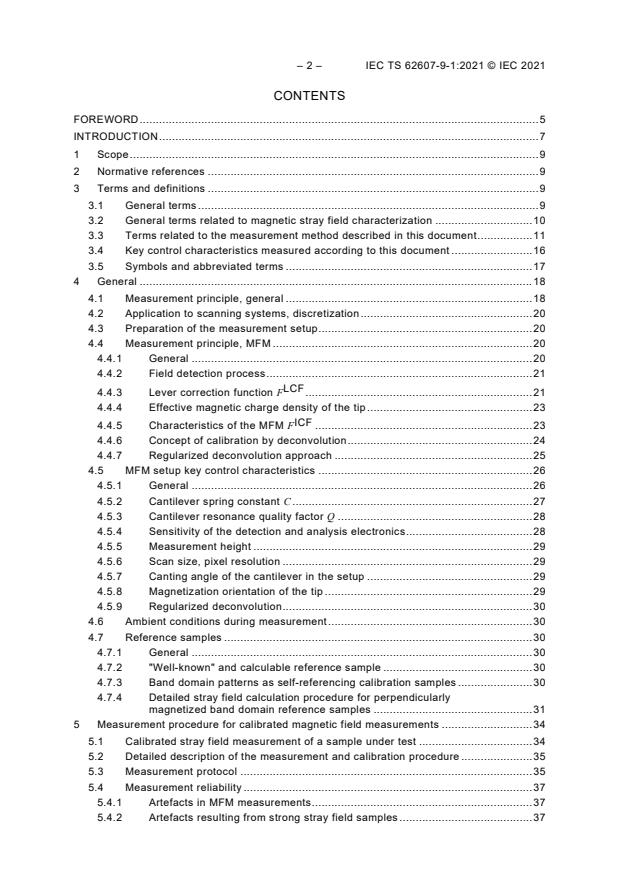
– 2 – IEC TS 62607-9-1:2021 © IEC 2021
CONTENTS
FOREWORD . 5
INTRODUCTION . 7
1 Scope . 9
2 Normative references . 9
3 Terms and definitions . 9
3.1 General terms . 9
3.2 General terms related to magnetic stray field characterization . 10
3.3 Terms related to the measurement method described in this document . 11
3.4 Key control characteristics measured according to this document . 16
3.5 Symbols and abbreviated terms . 17
4 General . 18
4.1 Measurement principle, general . 18
4.2 Application to scanning systems, discretization . 20
4.3 Preparation of the measurement setup . 20
4.4 Measurement principle, MFM . 20
4.4.1 General . 20
4.4.2 Field detection process . 21
LCF
4.4.3 Lever correction function F . 21
4.4.4 Effective magnetic charge density of the tip . 23
ICF
4.4.5 Characteristics of the MFM F . 23
4.4.6 Concept of calibration by deconvolution . 24
4.4.7 Regularized deconvolution approach . 25
4.5 MFM setup key control characteristics . 26
4.5.1 General . 26
4.5.2 Cantilever spring constant C . 27
4.5.3 Cantilever resonance quality factor Q . 28
4.5.4 Sensitivity of the detection and analysis electronics . 28
4.5.5 Measurement height . 29
4.5.6 Scan size, pixel resolution . 29
4.5.7 Canting angle of the cantilever in the setup . 29
4.5.8 Magnetization orientation of the tip . 29
4.5.9 Regularized deconvolution . 30
4.6 Ambient conditions during measurement . 30
4.7 Reference samples . 30
4.7.1 General . 30
4.7.2 "Well-known" and calculable reference sample . 30
4.7.3 Band domain patterns as self-referencing calibration samples . 30
4.7.4 Detailed stray field calculation procedure for perpendicularly
magnetized band domain reference samples . 31
5 Measurement procedure for calibrated magnetic field measurements . 34
5.1 Calibrated stray field measurement of a sample under test . 34
5.2 Detailed description of the measurement and calibration procedure . 35
5.3 Measurement protocol . 35
5.4 Measurement reliability . 37
5.4.1 Artefacts in MFM measurements . 37
5.4.2 Artefacts resulting from strong stray field samples . 37
5.4.3 Artefacts when measuring samples with low coercivity . 38
5.4.4 Distortion of the domain structure . 38
5.4.5 Contingency strategy . 39
5.4.6 Strategies to improve the quality of the measurements . 39
5.5 Uncertainty evaluation . 39
5.5.1 General . 39
5.5.2 Reference sample . 39
5.5.3 ICF determination . 40
5.5.4 Calibrated field measurement . 40
6 Data analysis / interpretation of results . 41
6.1 Software for data analysis . 41
7 Results to be reported . 43
7.1 General . 43
7.2 Product / sample identification . 43
7.3 Test conditions . 43
7.4 Measurement set-up specific information . 43
7.5 Test results . 44
8 Validity assessment . 44
8.1 General aspects . 44
8.2 Requirements . 45
8.3 Example. 45
ICF
8.3.1 Determination of the Instrument Calibration Function F . 45
8.3.2 Calibrated measurement . 47
Annex A (informative) Algorithm . 49
A.1 Mathematical basics . 49
A.1.1 Continuous Fourier transform versus discrete Fourier Transform . 49
A.1.2 Partial (two-dimensional) Fourier space . 49
A.1.3 Cross correlation theorem . 49
A.2 Magnetic fields in partial Fourier space . 50
A.2.1 Differentiation in partial Fourier space . 50
A.2.2 Magnetic fields in partial Fourier space . 50
A.3 Signal generation in magnetic force microscopy . 50
A.3.1 General . 50
A.3.2 MFM phase shift signal . 51
A.3.3 L-curve criterion for pseudo-Wiener filter-based deconvolution process . 52
Annex B (informative) Uncertainty evaluation . 54
B.1 Definition for instrument calibration . 54
B.2 Definition for calibrated field measurement . 54
B.3 A type uncertainty evaluation . 55
B.4 B type uncertainty evaluation . 55
B.4.1 General . 55
B.4.2 Propagation of uncertainty from the real to the Fourier domain . 55
B.4.3 Propagation of uncertainty from the Fourier to the real space domain . 56
B.4.4 Uncertainty propagation based on the Wiener filter . 57
B.4.5 Uncertainty evaluation for the tip calibration . 59
B.4.6 Uncertainty evaluation for the stray field evaluation . 60
B.5 Monte Carlo technique . 61
Bibliography . 62
– 4 – IEC TS 62607-9-1:2021 © IEC 2021
Figure 1 – Spatial resolution of magnetic stray field characterization techniques and
their possible maximum scan area . 8
Figure 2 – Field measurement with finite-size sensors . 19
Figure 3 – Schematic MFM setup . 20
LCF
Figure 4 – Lever correction function (F ) in Fourier space . 22
LCF
Figure 5 – Lever correction function (F ) and distance losses . 23
ICF
Figure 6 – Instrument calibration function (F ) in real and Fourier space. Line plots
of the partial Fourier space (absolute value, left) and real space (right). . 24
Figure 7 – Typical resonance curve of a cantilever. 28
Figure 8 – Typical amplitude–distance plot of a cantilever with the linear transition
region indicated . 29
Figure 9 – Band domain reference sample . 31
Figure 10 – Artefacts that occur if the tip magnetization is switched by the stray field of
the sample . 38
Figure 11 – Artefacts if the sample domain orientation is switched by a strong tip stray
field 38
Figure 12 – Typical distortion of an MFM image: different domain widths . 39
Figure 13 – Normalized Fourier amplitudes of the measured reference sample signal
ref
Δφ and the reference sample magnetic field . 46
Figure 14 – Typical transfer functions in Fourier and real space for different values of
the regularization parameter α . 47
ref
Figure 15 – Comparison of the reference sample signal Δφ and the SUT signal
SUT
Δφ . 47
Figure A.1 – Plot of the 2-norm of the residual as a function of the regularization
parameter . 53
Figure A.2 – Example of an L-curve . 53
Figure A.3 – Illustration of the curvature of the L-curve as a function of the
regularization parameter . 53
Table 1 – MFM setup key control characteristics . 27
Table 2 – Ambient conditions key control characteristics . 30
Table 3 – Stray field estimation key control characteristics . 32
Table 4 – Stray field estimation protocol . 33
Table 5 – Measurement protocol . 36
Table 6 – Uncertainty evaluation key control characteristics . 41
Table 7 – Software implementation of stray field calculation of band domain samples . 42
Table 8 – Software-based realization of calibrated measurement . 42
INTERNATIONAL ELECTROTECHNICAL COMMISSION
____________
NANOMANUFACTURING –
KEY CONTROL CHARACTERISTICS –
Part 9-1: Traceable spatially resolved nano-scale stray magnetic
field measurements – Magnetic force microscopy
FOREWORD
1) The International Electrotechnical Commission (IEC) is a worldwide organization for standardization comprising
all national electrotechnical committees (IEC National Committees). The object of IEC is to promote international
co-operation on all questions concerning standardization in the electrical and electronic fields. To this end and
in addition to other activities, IEC publishes International Standards, Technical Specifications, Technical Reports,
Publicly Available Specifications (PAS) and Guides (hereafter referred to as "IEC Publication(s)"). Their
preparation is entrusted to technical committees; any IEC National Committee interested in the subject dealt with
may participate in this preparatory work. International, governmental and non-governmental organizations liaising
with the IEC also participate in this preparation. IEC collaborates closely with the International Organization for
Standardization (ISO) in accordance with conditions determined by agreement between the two organizations.
2) The formal decisions or agreements of IEC on technical matters express, as nearly as possible, an international
consensus of opinion on the relevant subjects since each technical committee has representation from all
interested IEC National Committees.
3) IEC Publications have the form of recommendations for international use and are accepted by IEC National
Committees in that sense. While all reasonable efforts are made to ensure that the technical content of IEC
Publications is accurate, IEC cannot be held responsible for the way in which they are used or for any
misinterpretation by any end user.
4) In order to promote international uniformity, IEC National Committees undertake to apply IEC Publications
transparently to the maximum extent possible in their national and regional publications. Any divergence between
any IEC Publication and the corresponding national or regional publication shall be clearly indicated in the latter.
5) IEC itself does not provide any attestation of conformity. Independent certification bodies provide conformity
assessment services and, in some areas, access to IEC marks of conformity. IEC is not responsible for any
services carried out by independent certification bodies.
6) All users should ensure that they have the latest edition of this publication.
7) No liability shall attach to IEC or its directors, employees, servants or agents including individual experts and
members of its technical committees and IEC National Committees for any personal injury, property damage or
other damage of any nature whatsoever, whether direct or indirect, or for costs (including legal fees) and
expenses arising out of the publication, use of, or reliance upon, this IEC Publication or any other IEC
Publications.
8) Attention is drawn to the Normative references cited in this publication. Use of the referenced publications is
indispensable for the correct application of this publication.
9) Attention is drawn to the possibility that some of the elements of this IEC Publication may be the subject of patent
rights. IEC shall not be held responsible for identifying any or all such patent rights.
IEC TS 62607-9-1 has been prepared by IEC technical committee 113: Nanotechnology for
electrotechnical products and systems. It is a Technical Specification.
The text of this Technical Specification is based on the following documents:
Draft Report on voting
113/584/DTS 113/606/RVDTS
Full information on the voting for its approval can be found in the report on voting indicated in
the above table.
The language used for the development of this Technical Specification is English.
– 6 – IEC TS 62607-9-1:2021 © IEC 2021
This document was drafted in accordance with ISO/IEC Directives, Part 2, and developed in
accordance with ISO/IEC Directives, Part 1 and ISO/IEC Directives, IEC Supplement, available
at www.iec.ch/members_experts/refdocs. The main document types developed by IEC are
described in greater detail at www.iec.ch/standardsdev/publications.
A list of all parts of the IEC TS 62607 series, published under the general title
Nanomanufacturing – Key control characteristics, can be found on the IEC website.
The committee has decided that the contents of this document will remain unchanged until the
stability date indicated on the IEC website under webstore.iec.ch in the data related to the
specific document. At this date, the document will be
• reconfirmed,
• withdrawn,
• replaced by a revised edition, or
• amended.
IMPORTANT – The "colour inside" logo on the cover page of this document indicates that it
contains colours which are considered to be useful for the correct understanding of its
contents. Users should therefore print this document using a colour printer.
INTRODUCTION
Measurements of magnetic fields that are homogeneous over macroscopic volumes can be
made traceable to the SI standards, and traceable calibration chains from the national
metrology institutes to the end users are well-established.
However, many important industrial applications such as magneto-resistive position, angle, or
motion control rely on precision sensing of spatially varying magnetic fields. Such spatially
varying magnetic fields can, for example, be generated by a magnetic bit pattern of a magnetic
encoder scale. Today, magnetic encoder bit patterns have typically a lateral periodicity above
100 μm. Based on stray field interpolation, such encoders are applied, for example, for precision
positioning systems with sub-micrometre resolution. However, such precision positioning
requires reliable local field measurements which are not yet underpinned by any suitable
standards.
Today, local magnetic stray field measurements with resolutions from above 50 µm down to
below 500 nm can be realized by scanning magnetic field detection (SMF) methods with
different field sensors such as Hall sensors, magneto-resistive (MR) sensors and magnetically
coated tips on an oscillating cantilever (magnetic force microscopy (MFM)), or with imaging
techniques like Kerr and magneto-optical indicator film (MOIF) microscopy. Achievable spatial
resolution and typical scanning area are compared in Figure 1.
MFM provides a significantly higher resolution than other SMF techniques and MOIF
(see Figure 1) and can therefore be considered as the standard tool for nano-scale
investigations of the local magnetic properties of magnetic nanostructures, thin films and
devices [1] . However, despite its wide use, MFM measurements per se only deliver purely
qualitative stray field images that cannot be applied for quantitative data analysis. This results
from the fact that the measured signal strongly depends on the properties of the magnetic tip,
the mechanical properties of the cantilever and the sensitivity of the detection device. Hence a
calibration that includes the characterization of the magnetic tip and the microscope is needed
if the MFM method is to be used to provide values of key control characteristics (KCCs) which
are ultimately traceable to national calibration standards.
This document aims to provide industry end users, instrument manufactures and calibration
laboratories with a description of traceable calibration procedures based on reference materials
with well-defined local stray field distributions. This document includes the description of
suitable reference samples, the evaluation of MFM key parameters required for the method,
and the determination of the instrument calibration function (ICF). Due to the finite dimension
of the tip, a spatial broadening of the MFM signal is unavoidable. Mathematically this
broadening can be described by the convolution of the ICF and the real magnetic field structure
of the sample to be measured. Vice versa, a quantitative analysis of the measured data is
achieved by a deconvolution of the MFM measurement data using the ICF. The description of
this process is the key part of this document.
__________
Numbers in square brackets refer to the Bibliography.
– 8 – IEC TS 62607-9-1:2021 © IEC 2021
Figure 1 – Spatial resolution of magnetic stray field characterization
techniques and their possible maximum scan area
The MFM technique as described in this document has a resolution down to about 10 nm to
20 nm (depending on the signal-to-noise ratio of the instrument), which is at least one order of
magnitude superior to other common characterization techniques for spatially varying magnetic
fields. MFM systems operated at ambient conditions typically can achieve a resolution of around
50 nm [1]. With optimized tips, a resolution down to below 20 nm is possible [2]. The highest
resolution in MFM is achieved in vacuum. With very precise tip–sample distance control [3] and
high-resolution tips [4], a resolution down to 10 nm could be demonstrated.
While the MFM technique has the best precision and accuracy of the test methods
(see Figure 1), as a scanning technique it is comparatively slow, requires specific ambient
conditions such as stable temperatures and can only be used for samples which are flat and
smooth on a micrometre scale (depending on the scanning unit). For routine statistical process
control (SPC) of the manufacturing process, it may not be suitable in many use cases.
Therefore, it is anticipated that the MFM technique needs to be complemented, for example,
by:
• the magneto-optical indicator film technique (MOIF), which, as an imaging process, allows
high throughput;
• scanning Hall or MR test methods, which can easily be calibrated in homogeneous external
fields. In CMOS technique, arrays of parallel Hall sensors can be prepared and thus a high
throughput can be achieved in a scanning process.
Wherever possible, existing relevant scanning probe microscopy (SPM) standards are referred
to, especially those developed by ISO/TC 201 like ISO 18115-2 [5] and ISO 11952 [6].
In summary, this document provides a traceable method for nanometre-resolution
measurements of magnetic field patterns, which is the basis for precise control of fabrication
processes and final product qualification. The key control characteristics for those products are
very product specific (see, for example, IEC TS 62622:2012 [7]).
NANOMANUFACTURING –
KEY CONTROL CHARACTERISTICS –
Part 9-1: Traceable spatially resolved nano-scale stray magnetic
field measurements – Magnetic force microscopy
1 Scope
This part of IEC 62607 establishes a standardized method to characterize spatially varying
magnetic fields with a spatial resolution down to 10 nm for flat magnetic specimens by magnetic
force microscopy (MFM). MFM primarily detects the stray field component perpendicular to the
sample surface. The resolution is achieved by the calibration of the MFM tip using magnetically
nanostructured reference materials.
The objective of this document is to define and describe:
• reference materials for traceable high resolution magnetic stray field measurements;
• the calibration procedures to determine the instrument calibration function (ICF) and, if
required, MFM key parameters entering the deconvolution process;
• the deconvolution process which allows to calculate quantitative stray field data from the
measured MFM data using the ICF;
• the evaluation of the measurement uncertainty, including the prevention of potential
artefacts which can occur during the measurement leading to a misinterpretation of the
results.
2 Normative references
There are no normative references in this document.
3 Terms and definitions
For the purposes of this document, the following terms and definitions apply.
ISO and IEC maintain terminological databases for use in standardization at the following
addresses:
• IEC Electropedia: available at http://www.electropedia.org/
• ISO Online browsing platform: available at http://www.iso.org/obp
3.1 General terms
3.1.1
key control characteristic
KCC
key performance indicator
measurement process characteristic which can affect compliance with regulations and quality,
reliability or subsequent application of the measurement result
Note 1 to entry: The measurement of a key control characteristic is described in a standardized measurement
procedure with known accuracy and precision.
Note 2 to entry: It is possible to define more than one measurement method for a key control characteristic, if the
correlation of the results is well-defined and known.
– 10 – IEC TS 62607-9-1:2021 © IEC 2021
Note 3 to entry: In IATF 16949 [8] the term "special characteristic" is used for a KCC. The term key control
characteristic is preferred since it signals directly the relevance of the parameter for the quality of the final product.
3.2 General terms related to magnetic stray field characterization
3.2.1
magnetic-force microscopy
MFM
atomic force microscopy mode employing a probe assembly that monitors both atomic forces
and magnetic interactions between the probe tip and a surface
[SOURCE: ISO 18115-2:2013, 3.15]
3.2.2
magneto-optical indicator film technique
MOIF technique
method of mapping the magnetic field above a sample surface by a thin magneto-optical
indicator film
Note 1 to entry: The magnetic fields induce a perpendicular magnetization component in the active layer of the
detector, which is recorded with the Faraday effect.
3.2.3
dynamic mode scanning force microscopy
scanning magnetic force microscopy mode in which the relative positions of the probe tip and
sample vary in a sinusoidal manner in time at each point in the image
Note 1 to entry: The sinusoidal oscillation is usually in the form of a vibration in the z-direction and is often driven
at a frequency close to, and sometimes equal to, the cantilever resonance frequency.
Note 2 to entry: The signal measured can be the amplitude, the phase shift, or the resonance frequency shift of the
cantilever.
[SOURCE: ISO 18115-2:2013, 3.6, modified – The source uses the term "dynamic-mode AFM"
instead of "dynamic mode scanning force microscopy" and the term "AFM mode" instead of
"scanning magnetic force microscopy mode"]
3.2.4
intermittent contact mode
mode of scanning the probe where the probe is operated with a sinusoidal z-displacement
modulation such that the probe tip makes contact with the sample for a fraction of the sinusoidal
cycle
[SOURCE: ISO 18115-2:2013, 5.73]
3.2.5
non-contact magnetic-force microscopy
NC-MFM
dynamic mode scanning force microscopy (3.2.3) in which the probe tip is operated at such a
distance from the surface that it samples the weak attractive van der Waals or other forces
3.2.6
scanning magnetic field microscopy
SMF microscopy
method of measuring and mapping the magnetic field from a sample surface by mechanically
scanning a probe above the sample surface
Note 1 to entry: This generic term encompasses scanning Hall probe magnetometry (3.2.7) and scanning MR
magnetometry (3.2.8).
3.2.7
scanning Hall probe magnetometry
SHM
scanning magnetic field microscopy (3.2.6) mode in which a Hall probe is used as the scanning
sensor to measure and map the magnetic field from a sample surface by acquiring a Hall voltage
[SOURCE: ISO 18115-2:2013, 3.23, modified – The phrase "scanning magnetic field
microscopy" is used instead of "SPM" and the phrase "by acquiring a Hall voltage" is added ]
3.2.8
scanning MR magnetometry
SMR magnetometry
scanning magnetic field microscopy (3.2.6) mode in which a magneto-resistive sensor probe on
a cantilever is scanned over a magnetic sample surface to measure the magnetic field
distribution (3.3.1) by acquiring a magneto-resistive voltage
[SOURCE: ISO 18115-2:2013, 3.25, modified – The "phrase "scanning magnetic field
microscopy" is used instead of "SPM" and the phrase "magnetic field distribution" is used
instead of "two-dimensional magnetic images"]
3.3 Terms related to the measurement method described in this document
3.3.1
magnetic field distribution
spatially resolved magnetic field data array in the x-y-plane with the x-, y-direction in the sample
plane and the z-direction along the sample surface normal with a spatial resolution dx, dy at a
distance d above the surface of a test specimen
3.3.2
raw data distribution
spatially resolved MFM raw data array with the x-, y-direction in the sample plane and the z-
direction along the sample surface normal at a distance d above the surface of a test specimen
3.3.3
magnetic force
force acting between magnetic volumes
Note 1 to entry: In SPM, the magnetic dipoles are usually incorporated as ferromagnetic material in the probe tip
and it is the magnetic field of the sample that is measured.
[SOURCE: ISO 18115-2:2013, 5.8, modified – The phrase "magnetic volumes" is used instead
of "magnetic dipoles in a magnetic field"]
3.3.4
magnetically coated probe tip
probe which is coated with a thin magnetic layer on the tip side of the cantilever
Note 1 to entry: The magnetic layer creates a magnetic volume that interacts with the sample magnetic field and
thus probes it.
3.3.5
constant height mode
mode of scanning the probe tip over the sample surface at a constant height of the centre of
the oscillation of the tip apex relative to the surface plane of the sample during the scan
[SOURCE: ISO 18115-2:2013, 5.34, modified –"over the surface" is replaced with "of the centre
of the oscillation of the tip apex relative to the surface plane of the sample". ]
– 12 – IEC TS 62607-9-1:2021 © IEC 2021
3.3.6
measurement height
value of the constant height of the centre of the oscillation of the tip apex relative to the surface
plane of the sample during a measurement in constant height mode (3.3.5)
3.3.7
measurement plane
plane at constant height above the surface where the raw data distribution is measured in
constant height mode (3.3.5)
3.3.8
cantilever oscillation
sinusoidal z-displacement of the cantilever and thus the tip in dynamic mode scanning force
microscopy (3.2.3)
Note 1 to entry: The z-displacement is typically induced by the oscillation of the cantilever by means of an excitation
piezo, the driven frequency is close to the cantilever resonance frequency.
3.3.9
cantilever
thin force-sensing support for a magnetically coated probe tip (3.3.4) joined to the cantilever
chip (3.3.10) at the end furthest from the probe tip
[SOURCE: ISO 18115-2:2013, 5.18, modified – The phrase "a magnetically coated probe tip"
is used instead of "a probe tip". ]
3.3.10
cantilever chip
small piece, usually of silicon, on which the cantilever (3.3.9) with the magnetically coated probe
tip (3.3.4) has been fabricated and to which it is still attached as a convenient supporting
structure in the probe assembly (3.3.12)
[SOURCE: ISO 18115-2, 5.26, modified – The phrase "with the magnetically coated probe tip"
is added.]
3.3.11
chip holder
structure on which the cantilever chip (3.3.10) with the cantilever (3.3.9) and the magnetically
coated probe tip (3.3.4) are mounted
Note 1 to entry: The chip holder, chip, cantilever, and probe comprise the probe assembly (3.3.12).
[SOURCE: ISO 18115-2:2013, 5.27, modified – The phrase "the magnetically coated" is added.]
3.3.12
probe assembly
structure comprising the chip holder (3.3.11), cantilever chip (3.3.10), cantilever (3.3.9) and
magnetically coated probe tip (3.3.4) including a provision to drive a sinusoidal oscillation of
the cantilever in the form of a vibration in the z-direction
Note 1 to entry: This provision typically is an excitation piezo, see ISO 18115-2.
[SOURCE: ISO 18115-2:2013, 5.20, modified– The phrase "magnetically coated probe tip" is
used instead of "probe" and the phrase "including a provision to drive a sinusoidal oscillation of
the cantilever in the form of a vibration in the z-direction" is added.]
3.3.13
excitation piezo
provision to drive a sinusoidal oscillation of the cantilever (3.3.9) in the form of a vibration in
the z-direction exploiting the variation of a piezo active material induced by a sinusoidal electric
drive signal
Note 1 to entry: See ISO 18115-2.
3.3.14
MFM observation variable
phase shift between sinusoidal cantilever drive signal and cantilever oscillation at fixed
excitation frequency and excitation amplitude
Note 1 to entry: In principle, other measurands can also be exploited to detect the interaction between magnetic tip
and sample stray field, e.g. the frequency shift of the resonance frequency of the oscillating cantilever.
3.3.15
phase shift signal
Δφ
MFM observation variable (3.3.14) defined as the phase shift between sinusoidal cantilever
drive signal and cantilever oscillation at fixed excitation frequency and excitation amplitude
Note 1 to entry: The signal may be corrected by a constant offset.
3.3.16
signal detector
detector that transforms the amplitude and temporal course of the cantilever oscillation into an
electrical signal
Note 1 to entry: In this case a light pointer combined with a sensitive photo detector (PSD).
3.3.17
signal analysis system
system to extract and record the MFM observation variable (3.3.14) as a function of the lateral
displacement of the tip
Note 1 to entry: In this case a system to extract the phase shift between the cantilever driving sinusoidal oscillation
and the signal detected by the signal detector. The phase shift may be offset corrected.
3.3.18
z-scanner
element for the realization of the vertical displacement of the specimen/probe distance during
x-y-scanning
Note 1 to entry: See ISO 18115-2:2013, 5.136.
3.3.19
x-y-scanner
element for realization of the lateral displacement of the probe or of the specimen in the x-y-
plane
3.3.20
data pre-processing
raw data treatment to remove known artefacts of the measurement process
3.3.21
data levelling
form of data pre-processing (3.3.20) to eliminate unwanted features from scan lines, such as
drift and offsets
– 14 – IEC TS 62607-9-1:2021 © IEC 2021
3.3.22
magnetic field reference sample
magnetic sample whose magnetic field distribution (3.3.1) above the sample surface is well-
known or can be calculated
3.3.23
cantilever resonance quality factor
Q
energy stored in a cantilever for a particular resonance peak divided by the average energy lost
per radian of oscillation, this average being over one cycle
Note 1 to entry: A practical method of measuring the cantilever resonance quality factor is to record a resonance
curve as a function of frequency. Q is approximately equal to the resonance frequency divided by the bandwidth of
the resonance, and this approximation is excellent for quality factors above about 4.
Note 2 to entry: The bandwidth of the resonance can be measured from a plot of the square of the amplitude against
frequency. The bandwidth is the frequency interval between the two points 3 dB below the peak maximum on either
side of the peak. This is, to an error of less than 0,25 %, the full width at half maximum height (FWHM) of this curve,
so the FWHM can be judged a more convenient and sufficiently accurate measure of bandwidth for many practical
purposes.
[SOURCE: ISO 18115-2:2013, 5.127, modified – The term is "cantilever resonance quality
factor" instead of merely "quality factor" and, accordingly, the more general phrase "a given
resonator" is replaced with "a cantilever". The original Note 1 is omitted. ]
3.3.24
oscillation amplitude
A
osc
tip oscillation amplitude caused by the cantilever oscillation (3.3.8) in dynamic mode scanning
force microscopy (3.2.3)
Note 1 to entry: The oscillation amplitude for an approached intermittent contact mode measurement and for a
constant height measurement may be different.
3.3.25
lift height
lh
z
vertical distance by which the distance of the oscillation centre of the probe's tip apex to the
sample surface is increased in between intermittent contact mode and constant height
measurements
3.3.26
measurement height
z
distance of the oscillation centre of the probe's tip apex to the sample surface in a dynamic
mode MFM
Note 1 to entry: Instruments typically give a lift height (3.3.25) value for the MFM measurement in a dynamic mode.
The tip–sample distance is the sum of the lift height and the oscillation amplitude (3.3.24) as measured when the
probe is approached to the sample surface.
3.3.27
scan size
Sx, Sy
length and width of the scanned area in the scan plane
3.3.28
pixel size
Δx, Δy
length and width of the area represented by each measured point in a 2D raster image
3.3.29
cantilever canting angles
θ, φ
azimuthal and polar angles describing the tilt of the cantilever with respect to the MFM
measurement plane in polar coordinates
Note 1 to entry: See ISO 18115-2:2013, 5.92 Note 2 to entry and 5.119.
3.3.30
tip magnetization orientation
M
tip
sign of the net effective magnetic charge distribution of the magnetic tip, described as "up" or
"down" or as "+" or "−"
Note 1 to entry: The underlying tip magnetization distribution depends on the structure of the probe tip and the
coating method of the magnetic thin layer.
Note 2 to entry: The tip can be magnetized in a magnetic field higher than the tip coercive field normal to the
cantilever.
3.3.31
effective magnetic charge distribution
eff
...
Questions, Comments and Discussion
Ask us and Technical Secretary will try to provide an answer. You can facilitate discussion about the standard in here.
Loading comments...