

IEC 62703:2013
(Main)Expression of performance of fluorometric oxygen analyzers in liquid media
General Information
- Abstract
IEC 62703:2013 specifies the general aspects in the terminology and definitions related to the performance of fluorometric oxygen analyzers used for the continuous determination of dissolved oxygen partial pressure or concentration in liquid media; unifies methods used in making and verifying statements on the functional performance of such analyzers; specifies which tests should be performed in order to determine the functional performance and how such tests should be carried out and provides basic documents to support the application of standards of quality assurance within ISO 9001.
- Status
- Published
- Publication Date
- 26-Jun-2013
- Technical Committee
- SC 65B - Measurement and control devices
- Drafting Committee
- WG 14 - TC 65/SC 65B/WG 14
- Current Stage
- PPUB - Publication issued
- Start Date
- 27-Jun-2013
- Completion Date
- 30-Jun-2013
Overview
IEC 62703:2013 is an international standard published by the International Electrotechnical Commission (IEC) that defines the expression of performance of fluorometric oxygen analyzers used in liquid media. This standard provides essential terminology, definitions, test methods, and performance criteria for evaluating the continuous measurement of dissolved oxygen partial pressure or concentration in aqueous environments. It applies broadly to analyzers utilized in natural and industrial water systems, including potable water, seawater, ultrapure water, and wastewater streams.
With a focus on fluorometric technology-where the sensor uses a luminophore within an oxygen-permeable polymer membrane-IEC 62703:2013 establishes consistent guidelines for manufacturers to specify and verify analyzer performance. This ensures reliability and comparability within oxygen monitoring, critical in environmental monitoring, process control, and water quality management.
Key Topics
- Terminology and Definitions: Standardizes expressions related to fluorometric oxygen analyzers, covering basic terms, fluorometry-specific concepts, and measurement quantities.
- Performance Specifications: Details the parameters manufacturers must specify, including rated operating conditions, uncertainty limits (intrinsic, interference-related), repeatability, drift, and response times.
- Test Procedures: Describes methods for conducting functional performance tests such as calibration, repeatability, output fluctuation, drift measurement, and interference uncertainty testing under controlled reference conditions.
- Operational Conditions: Specifies how to consider environmental and operational influences like temperature, pressure, and medium composition when evaluating analyzer performance.
- Quality Assurance Support: Provides documentation and frameworks to aid compliance with ISO 9001 quality management standards, enhancing trust in performance claims.
Applications
IEC 62703:2013 addresses fluorometric oxygen analyzers designed for permanent on-line installation in diverse settings:
Environmental Monitoring
Monitoring dissolved oxygen in natural water bodies (lakes, rivers, estuaries) helps assess ecological health and detect pollution.Water Treatment and Supply
Ensures adequate oxygen levels in potable and ultrapure water systems to meet health and safety regulations.Industrial Process Control
Supports real-time oxygen measurement in industrial process liquids, optimizing reactions and maintaining quality.Wastewater Management
Continuous oxygen measurement in municipal or industrial wastewater streams aids effective treatment and compliance with discharge standards.
Fluorometric oxygen analyzers complying with IEC 62703 deliver consistent and reliable data essential for process optimization, regulatory reporting, and environmental protection.
Related Standards
IEC 62703:2013 complements several other IEC and ISO standards that provide additional requirements or focus on related technologies:
- IEC 60359 – General principles for specification and verification of performance characteristics of electrical measuring instruments.
- IEC 60770 Series – Transmitters for process measurement signals.
- IEC 61010-1 – Safety requirements for electrical equipment for measurement, control, and laboratory use.
- IEC 60381-1 – Standard ranges for analogue d.c. current signals in process control.
- IEC 60654 Series – Specification and testing for influence quantities affecting instrument performance.
- IEC 61187 – Documentation requirements for measuring instruments.
- ISO 80000-1:2009 – Quantities and units-general principles.
- ISO 9001 – Quality management systems, supported through standardized test documentation.
Conclusion
IEC 62703:2013 provides a comprehensive framework for defining, specifying, and testing the functional performance of fluorometric oxygen analyzers in liquid media. By ensuring consistent terminology, rigorous testing methods, and clear performance criteria, this standard facilitates reliable dissolved oxygen monitoring essential for environmental management, industrial processes, and water quality assurance. Compliance with IEC 62703 supports manufacturers and end-users in achieving high-quality, traceable oxygen measurements aligned with international best practices.
Get Certified
Connect with accredited certification bodies for this standard

ECOCERT
Organic and sustainability certification.

BSMI (Bureau of Standards, Metrology and Inspection)
Taiwan's standards and inspection authority.

Eurofins Food Testing Global
Global leader in food, environment, and pharmaceutical product testing.
Sponsored listings
Frequently Asked Questions
IEC 62703:2013 is a standard published by the International Electrotechnical Commission (IEC). Its full title is "Expression of performance of fluorometric oxygen analyzers in liquid media". This standard covers: IEC 62703:2013 specifies the general aspects in the terminology and definitions related to the performance of fluorometric oxygen analyzers used for the continuous determination of dissolved oxygen partial pressure or concentration in liquid media; unifies methods used in making and verifying statements on the functional performance of such analyzers; specifies which tests should be performed in order to determine the functional performance and how such tests should be carried out and provides basic documents to support the application of standards of quality assurance within ISO 9001.
IEC 62703:2013 specifies the general aspects in the terminology and definitions related to the performance of fluorometric oxygen analyzers used for the continuous determination of dissolved oxygen partial pressure or concentration in liquid media; unifies methods used in making and verifying statements on the functional performance of such analyzers; specifies which tests should be performed in order to determine the functional performance and how such tests should be carried out and provides basic documents to support the application of standards of quality assurance within ISO 9001.
IEC 62703:2013 is classified under the following ICS (International Classification for Standards) categories: 17.020 - Metrology and measurement in general; 71.040.40 - Chemical analysis; 71.120.01 - Equipment for the chemical industry in general. The ICS classification helps identify the subject area and facilitates finding related standards.
IEC 62703:2013 is available in PDF format for immediate download after purchase. The document can be added to your cart and obtained through the secure checkout process. Digital delivery ensures instant access to the complete standard document.
Standards Content (Sample)
IEC 62703 ®
Edition 1.0 2013-06
INTERNATIONAL
STANDARD
NORME
INTERNATIONALE
Expression of performance of fluorometric oxygen analyzers in liquid media
Expression des performances des analyseurs d'oxygène fluorométriques en
milieu liquide
All rights reserved. Unless otherwise specified, no part of this publication may be reproduced or utilized in any form
or by any means, electronic or mechanical, including photocopying and microfilm, without permission in writing from
either IEC or IEC's member National Committee in the country of the requester.
If you have any questions about IEC copyright or have an enquiry about obtaining additional rights to this publication,
please contact the address below or your local IEC member National Committee for further information.
Droits de reproduction réservés. Sauf indication contraire, aucune partie de cette publication ne peut être reproduite ni
utilisée sous quelque forme que ce soit et par aucun procédé, électronique ou mécanique, y compris la photocopie et les
microfilms, sans l'accord écrit de la CEI ou du Comité national de la CEI du pays du demandeur.
Si vous avez des questions sur le copyright de la CEI ou si vous désirez obtenir des droits supplémentaires sur cette
publication, utilisez les coordonnées ci-après ou contactez le Comité national de la CEI de votre pays de résidence.
IEC Central Office Tel.: +41 22 919 02 11
3, rue de Varembé Fax: +41 22 919 03 00
CH-1211 Geneva 20 info@iec.ch
Switzerland www.iec.ch
About the IEC
The International Electrotechnical Commission (IEC) is the leading global organization that prepares and publishes
International Standards for all electrical, electronic and related technologies.
About IEC publications
The technical content of IEC publications is kept under constant review by the IEC. Please make sure that you have the
latest edition, a corrigenda or an amendment might have been published.
Useful links:
IEC publications search - www.iec.ch/searchpub Electropedia - www.electropedia.org
The advanced search enables you to find IEC publications The world's leading online dictionary of electronic and
by a variety of criteria (reference number, text, technical electrical terms containing more than 30 000 terms and
committee,…). definitions in English and French, with equivalent terms in
It also gives information on projects, replaced and additional languages. Also known as the International
withdrawn publications. Electrotechnical Vocabulary (IEV) on-line.
IEC Just Published - webstore.iec.ch/justpublished Customer Service Centre - webstore.iec.ch/csc
Stay up to date on all new IEC publications. Just Published If you wish to give us your feedback on this publication
details all new publications released. Available on-line and or need further assistance, please contact the
also once a month by email. Customer Service Centre: csc@iec.ch.
A propos de la CEI
La Commission Electrotechnique Internationale (CEI) est la première organisation mondiale qui élabore et publie des
Normes internationales pour tout ce qui a trait à l'électricité, à l'électronique et aux technologies apparentées.
A propos des publications CEI
Le contenu technique des publications de la CEI est constamment revu. Veuillez vous assurer que vous possédez
l’édition la plus récente, un corrigendum ou amendement peut avoir été publié.
Liens utiles:
Recherche de publications CEI - www.iec.ch/searchpub Electropedia - www.electropedia.org
La recherche avancée vous permet de trouver des Le premier dictionnaire en ligne au monde de termes
publications CEI en utilisant différents critères (numéro de électroniques et électriques. Il contient plus de 30 000
référence, texte, comité d’études,…). termes et définitions en anglais et en français, ainsi que
Elle donne aussi des informations sur les projets et les les termes équivalents dans les langues additionnelles.
publications remplacées ou retirées. Egalement appelé Vocabulaire Electrotechnique
International (VEI) en ligne.
Just Published CEI - webstore.iec.ch/justpublished
Service Clients - webstore.iec.ch/csc
Restez informé sur les nouvelles publications de la CEI.
Just Published détaille les nouvelles publications parues. Si vous désirez nous donner des commentaires sur
Disponible en ligne et aussi une fois par mois par email. cette publication ou si vous avez des questions
contactez-nous: csc@iec.ch.
IEC 62703 ®
Edition 1.0 2013-06
INTERNATIONAL
STANDARD
NORME
INTERNATIONALE
Expression of performance of fluorometric oxygen analyzers in liquid media
Expression des performances des analyseurs d'oxygène fluorométriques en
milieu liquide
INTERNATIONAL
ELECTROTECHNICAL
COMMISSION
COMMISSION
ELECTROTECHNIQUE
PRICE CODE
INTERNATIONALE
CODE PRIX X
ICS 17.020; 71.04; 71.120 ISBN 978-2-83220-835-9
– 2 – 62703 IEC:2013
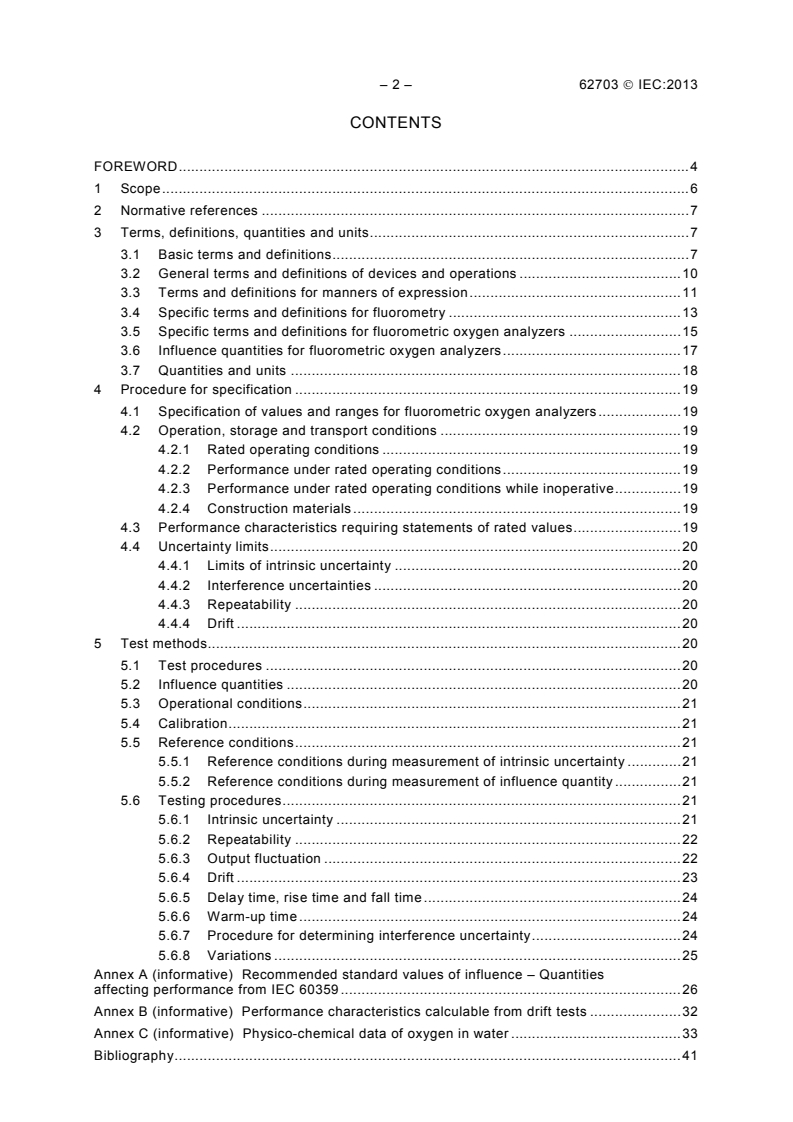
CONTENTS
FOREWORD . 4
1 Scope . 6
2 Normative references . 7
3 Terms, definitions, quantities and units . 7
3.1 Basic terms and definitions . 7
3.2 General terms and definitions of devices and operations . 10
3.3 Terms and definitions for manners of expression . 11
3.4 Specific terms and definitions for fluorometry . 13
3.5 Specific terms and definitions for fluorometric oxygen analyzers . 15
3.6 Influence quantities for fluorometric oxygen analyzers . 17
3.7 Quantities and units . 18
4 Procedure for specification . 19
4.1 Specification of values and ranges for fluorometric oxygen analyzers . 19
4.2 Operation, storage and transport conditions . 19
4.2.1 Rated operating conditions . 19
4.2.2 Performance under rated operating conditions . 19
4.2.3 Performance under rated operating conditions while inoperative . 19
4.2.4 Construction materials . 19
4.3 Performance characteristics requiring statements of rated values . 19
4.4 Uncertainty limits . 20
4.4.1 Limits of intrinsic uncertainty . 20
4.4.2 Interference uncertainties . 20
4.4.3 Repeatability . 20
4.4.4 Drift . 20
5 Test methods. 20
5.1 Test procedures . 20
5.2 Influence quantities . 20
5.3 Operational conditions . 21
5.4 Calibration . 21
5.5 Reference conditions . 21
5.5.1 Reference conditions during measurement of intrinsic uncertainty . 21
5.5.2 Reference conditions during measurement of influence quantity . 21
5.6 Testing procedures . 21
5.6.1 Intrinsic uncertainty . 21
5.6.2 Repeatability . 22
5.6.3 Output fluctuation . 22
5.6.4 Drift . 23
5.6.5 Delay time, rise time and fall time . 24
5.6.6 Warm-up time . 24
5.6.7 Procedure for determining interference uncertainty . 24
5.6.8 Variations . 25
Annex A (informative) Recommended standard values of influence – Quantities
affecting performance from IEC 60359 . 26
Annex B (informative) Performance characteristics calculable from drift tests . 32
Annex C (informative) Physico-chemical data of oxygen in water . 33
Bibliography . 41
62703 IEC:2013 – 3 –
Figure 1 – Output fluctuations . 23
Table 1 – Time intervals for statement of stability limits . 23
Table A.1 – Mains supply voltage . 30
Table A.2 – Mains supply frequency. 30
Table A.3 – Ripple of d.c. supply . 31
Table B.1 – Data: applied concentration 1 000 units . 32
Table C.1 – Correlation conductivity-salinity . 33
Table C.2 – Elevation barometric pressure (example) . 34
Table C.3 – Solubility of oxygen in water exposed to water-saturated air at atmospheric
pressure (1 013 hPa) (Salinity see Table C.1) . 35
Table C.4 – Solubility of oxygen in water vs. temperature and barometric pressure
(lower range) . 37
Table C.5 – Solubility of oxygen in water vs. temperature and barometric pressure
(upper range) . 38
Table C.6 – Pressure conversions . 39
– 4 – 62703 IEC:2013
INTERNATIONAL ELECTROTECHNICAL COMMISSION
____________
EXPRESSION OF PERFORMANCE OF FLUOROMETRIC
OXYGEN ANALYZERS IN LIQUID MEDIA
FOREWORD
1) The International Electrotechnical Commission (IEC) is a worldwide organization for standardization comprising
all national electrotechnical committees (IEC National Committees). The object of IEC is to promote
international co-operation on all questions concerning standardization in the electrical and electronic fields. To
this end and in addition to other activities, IEC publishes International Standards, Technical Specifications,
Technical Reports, Publicly Available Specifications (PAS) and Guides (hereafter referred to as “IEC
Publication(s)”). Their preparation is entrusted to technical committees; any IEC National Committee interested
in the subject dealt with may participate in this preparatory work. International, governmental and non-
governmental organizations liaising with the IEC also participate in this preparation. IEC collaborates closely
with the International Organization for Standardization (ISO) in accordance with conditions determined by
agreement between the two organizations.
2) The formal decisions or agreements of IEC on technical matters express, as nearly as possible, an international
consensus of opinion on the relevant subjects since each technical committee has representation from all
interested IEC National Committees.
3) IEC Publications have the form of recommendations for international use and are accepted by IEC National
Committees in that sense. While all reasonable efforts are made to ensure that the technical content of IEC
Publications is accurate, IEC cannot be held responsible for the way in which they are used or for any
misinterpretation by any end user.
4) In order to promote international uniformity, IEC National Committees undertake to apply IEC Publications
transparently to the maximum extent possible in their national and regional publications. Any divergence
between any IEC Publication and the corresponding national or regional publication shall be clearly indicated in
the latter.
5) IEC itself does not provide any attestation of conformity. Independent certification bodies provide conformity
assessment services and, in some areas, access to IEC marks of conformity. IEC is not responsible for any
services carried out by independent certification bodies.
6) All users should ensure that they have the latest edition of this publication.
7) No liability shall attach to IEC or its directors, employees, servants or agents including individual experts and
members of its technical committees and IEC National Committees for any personal injury, property damage or
other damage of any nature whatsoever, whether direct or indirect, or for costs (including legal fees) and
expenses arising out of the publication, use of, or reliance upon, this IEC Publication or any other IEC
Publications.
8) Attention is drawn to the Normative references cited in this publication. Use of the referenced publications is
indispensable for the correct application of this publication.
9) Attention is drawn to the possibility that some of the elements of this IEC Publication may be the subject of
patent rights. IEC shall not be held responsible for identifying any or all such patent rights.
International Standard IEC 62703 has been prepared by subcommittee 65B: Measurement
and control devices, of IEC technical committee 65: Industrial-process measurement, control
and automation.
The text of this standard is based on the following documents:
FDIS Report on voting
65B/867/FDIS 65B/871/RVD
Full information on the voting for the approval of this standard can be found in the report on
voting indicated in the above table.
This publication has been drafted in accordance with the ISO/IEC Directives, Part 2.
62703 IEC:2013 – 5 –
The committee has decided that the contents of this publication will remain unchanged until
the stability date indicated on the IEC web site under "http://webstore.iec.ch" in the data
related to the specific publication. At this date, the publication will be
• reconfirmed,
• withdrawn,
• replaced by a revised edition, or
• amended.
– 6 – 62703 IEC:2013
EXPRESSION OF PERFORMANCE OF FLUOROMETRIC
OXYGEN ANALYZERS IN LIQUID MEDIA
1 Scope
This International Standard is applicable to fluorometric oxygen analyzers used for the
continuous determination of dissolved oxygen partial pressure or concentration. It applies to
fluorometric oxygen analyzers suitable for use in water containing liquids, ultrapure waters,
fresh or potable water, sea water or other aqueous solutions, industrial or municipal waste
water from water bodies (e.g. lakes, rivers, estuaries) as well as for industrial process
streams and process liquids. Whilst in principle fluorometric oxygen-analyzers are applicable
in gaseous phases, the expression of performance in the gas-phase will not be subject of this
standard.
The sensor unit of a fluorometric oxygen analyzer being in contact with the media to be
measured contains a luminophore in a polymer-membrane permeable for oxygen or within
other oxygen permeable materials (or substrates).
This standard specifies the terminology, definitions, requirements for statements by
manufacturers and tests for fluorometric oxygen analyzers.
This standard is in accordance with the general principles set out in IEC 60359 and
IEC 60770 series.
This standard is applicable to analyzers specified for permanent installation installation in any
location (indoors or outdoors) utilizing an on-line measurement technique.
Safety requirements are dealt with in IEC 61010-1.
Standard range of analogue d.c. current signals used in process control systems are dealt
with in IEC 60381-1.
Specifications for values for the testing of influence quantities can be found in IEC 60654
series.
Requirements for documentation to be supplied with instruments are dealt with in IEC 61187.
Requirements for general principles concerning quantities, units and symbols are dealt with in
ISO 80000-1:2009.
The object of IEC 62703 is:
– to specify the general aspects in the terminology and definitions related to the
performance of fluorometric oxygen analyzers used for the continuous determination of
dissolved oxygen partial pressure or concentration in liquid media;
– to unify methods used in making and verifying statements on the functional performance of
such analyzers;
– to specify which tests should be performed in order to determine the functional
performance and how such tests should be carried out;
– to provide basic documents to support the application of standards of quality assurance
within ISO 9001.
62703 IEC:2013 – 7 –
2 Normative references
The following documents, in whole or in part, are normatively referenced in this document and
are indispensable for its application. For dated references, only the edition cited applies. For
undated references, the latest edition of the referenced document (including any
amendments) applies.
IEC 60068 (all parts), Environmental testing
IEC 60359:2001, Electrical and electronic measurement equipment – Expression of
performance
IEC 61010-1, Safety requirements for electrical equipment for measurement, control and
laboratory use – Part 1: General requirements
IEC 61187, Electrical and electronic measuring equipment – Documentation
3 Terms, definitions, quantities and units
For the purposes of this document, the following terms, definitions, quantities and units apply.
NOTE Terms and definitions are taken partially from IEC 60359:2001and IEC 61207-1:2010.
3.1 Basic terms and definitions
3.1.1
measurand
quantity subjected to measurement, evaluated in the state assumed by the measured system
during the measurement itself
Note 1 to entry: The value assumed by a quantity subjected to measurement when it is not interacting with the
measuring instrument may be called unperturbed value of the quantity.
Note 2 to entry: The unperturbed value and its associated uncertainty can only be computed through a model of
the measured system and of the measurement interaction with the knowledge of the appropriate metrological
characteristics of the instrument that may be called instrumental load.
3.1.2
result of a measurement
set of values attributed to a measurand, including a value, the corresponding uncertainty and
the unit of measurement
Note 1 to entry: The mid-value of the interval is called the value (see 3.1.3) of the measurand and its half-width
the uncertainty (see 3.1.4).
Note 2 to entry: The measurement is related to the indication (see 3.1.5) given by the instrument and to the
values of correction obtained by calibration.
Note 3 to entry: The interval can be considered as representing the measurand provided that it is compatible with
all other measurements of the same measurand.
Note 4 to entry: The width of the interval, and hence the uncertainty, can only be given with a stated level of
confidence (see 3.1.4, NOTE 1).
[SOURCE: IEC 60050-300:2001, 311-01-01, modified – revision of the definition and the
notes]
3.1.3
measure-value
mid element of the set assigned to represent the measurand
– 8 – 62703 IEC:2013
Note 1 to entry: The measure-value is no more representative of the measurand than any other element of the
set. It is singled out merely for the convenience of expressing the set in the format V ± U, where V is the mid
element and U the half-width of the set, rather than by its extremes. The qualifier "measure-" is used when deemed
necessary to avoid confusion with the reading-value or the indicated value.
3.1.4
uncertainty
uncertainty of measurement
parameter, associated with the result of a measurement, that characterizes the dispersion of
the values that could reasonably be attributed to the measurand
Note 1 to entry: The parameter can be, for example, a standard deviation (or a given multiple of it), or a half-width
of an interval having a stated level of confidence.
Note 2 to entry: Uncertainty of measurement comprises, in general, many components. Some of these
components can be evaluated from the statistical distribution of the results of a series of measurements and can be
characterized by experimental standard deviations. The other components, which can also be characterized by
standard deviations, are evaluated from the assumed probability distributions based on experience or other
information.
Note 3 to entry: It is understood that the result of the measurement is the best estimate of the value of the
measurand, and that all components of uncertainty, including those arising from systematic effects, such as
components associated with corrections and reference standards, contribute to the dispersion.
Note 4 to entry: The definition and notes 1 and 2 are from JCGM 100:2008 Clause 2.2.3 The option used in this
standard is to express the uncertainty as the half-width of an interval with the GUM procedures with a coverage
factor of 2. This choice corresponds to the practice now adopted by many national standards laboratories. With the
normal distribution a coverage factor of 2 corresponds to a level of confidence of 95 %. Otherwise statistical
elaborations are necessary to establish the correspondence between the coverage factor and the level of
confidence. As the data for such elaborations are not always available, it is deemed preferable to state the
coverage factor. This interval can be "reasonably" assigned to describe the measurand, in the sense of the GUM
definition, as in most usual cases it ensures compatibility with all other results of measurements of the same
measurand assigned in the same way at a sufficiently high confidence level.
[SOURCE: IEC 60050-300:2001, 311-01-02, modified – deletion of the existing Note 1 and
addition of two new notes]
3.1.5
indication
reading-value
output signal of the instrument
Note 1 to entry: The indicated value can be derived from the indication by means of the calibration curve.
Note 2 to entry: For a material measure, the indication is its nominal or stated value.
Note 3 to entry: The indication depends on the output format of the instrument:
– for analogue outputs it is a number tied to the appropriate unit of the display;
– for digital outputs it is the displayed digitized number;
– for code outputs it is the identification of the code pattern.
Note 4 to entry: For analogue outputs meant to be read by a human observer (as in the index-on-scale
instruments) the unit of output is the unit of scale numbering; for analogue outputs meant to be read by another
instrument (as in calibrated transducers) the unit of output is the unit of measurement of the quantity supporting the
output signal.
[SOURCE: IEC 60050-300:2001, 311-01-01, modified – modification of the definition and
addition of new notes]
3.1.6
calibration
set of operations which establishes the relationship which exists, under specified conditions,
between the indication and the result of a measurement
62703 IEC:2013 – 9 –
Note 1 to entry: Calibrations are performed under well-defined operating conditions for the instrument. The
calibration diagram representing its result is not valid if the instrument is operated under conditions outside the
range used for the calibration.
Note 2 to entry: The relationship between the indications and the results of measurement can be expressed, in
principle, by a calibration diagram.
[SOURCE: IEC 60050-300:2001, 311-01-09, modified – modification of Note 1]
3.1.7
calibration diagram
portion of the co-ordinate plane, defined by the axis of indication and the axis of results of
measurement, which represents the response of the instrument to differing values of the
measurand
[SOURCE: IEC 60050-300:2001, 311-01-10, modified – deletion of the note]
3.1.8
calibration curve
curve which gives the relationship between the indication and the value of the measurand
Note 1 to entry: When the calibration curve is a straight line passing through zero, it is convenient to refer to the
slope which is known as the instrument constant.
Note 2 to entry: The calibration curve is the curve bisecting the width of the calibration diagram parallel to the
axis of results of measurement, thus joining the points representing the values of the measurand.
[SOURCE: IEC 60050-300:2001, 311-01-11, modified – deletion of Note 1]
3.1.9
indicated value
value given by an indicating instrument on the basis of its calibration curve
Note 1 to entry: The indicated value is the measure-value of the measurand when the instrument is used in a
direct measurement under all the operating conditions for which the calibration diagram is valid.
[SOURCE: IEC 60050-300:2001, 311-01-08, modified – update of the definition and the note]
3.1.10
conventional value measure
value of a standard used in a calibration operation and known with uncertainty negligible with
respect to the uncertainty of the instrument to be calibrated
Note 1 to entry: This definition is adapted to the object of this standard from the definition of "conventional true
value (of a quantity)": value attributed to a particular quantity and accepted, sometimes by convention, as having
an uncertainty appropriate for a given purpose (see IEC 60050-300:2001 311-01-06).
3.1.11
influence quantity
quantity which is not the subject of the measurement and whose change affects the
relationship between the indication and the result of the measurement
Note 1 to entry: Influence quantities can originate from the measured system, the measuring equipment or the
environment.
Note 2 to entry: As the calibration diagram depends on the influence quantities, in order to assign the result of a
measurement it is necessary to know whether the relevant influence quantities lie within the specified range.
Note 3 to entry: An influence quantity is said to lie within a range C’ to C" when the results of its measurement
satisfy the relationship: C' ≤ V – U < V + U ≤ C". (see 3.1.3)
[SOURCE: IEC 60050-300:2001, 311-06-01, modified – deletion of Note 1 and addition of a
new Note 3]
– 10 – 62703 IEC:2013
3.1.12
steady-state conditions
operating conditions of a measuring device in which the variation of the measurand with the
time is such that the relation between the input and output signals of the instruments does not
suffer a significant change with respect to the relation obtaining when the measurand is
constant in time
3.1.13
traceability
property of the result of a measurement or of the value of a standard such that it can be
related to stated references, usually national or international standards, through an unbroken
chain of comparisons all having stated uncertainties
Note 1 to entry: The concept is often expressed by the adjective traceable.
Note 2 to entry: The unbroken chain of comparisons is called a traceability chain.
Note 3 to entry: The traceability implies that a metrological organization be established with a hierarchy of
standards (instruments and material measures) of increasing intrinsic uncertainty. The chain of comparisons from
the primary standard to the calibrated device adds indeed new uncertainty at each step.
Note 4 to entry: Traceability is ensured only within a given uncertainty that should be specified.
[SOURCE: IEC 60050-300:2001, 311-01-15, modified – deletion of Note 3 and addition of
new Notes 3 and 4]
3.1.14
mean
summation of the individual values divided by the total number of values for a set of values
3.2 General terms and definitions of devices and operations
3.2.1
electrical measuring instrument
measuring instrument intended to measure an electrical or non-electrical quantity using
electrical or electronic means
[SOURCE: IEC 60050-300:2001, 311-03-04]
3.2.2
transducer
technical device which performs a given elaboration on an input signal, transforming it into an
output signal
Note 1 to entry: Measuring instruments contain transducers and they may consist of one transducer. When the
signals are elaborated by a chain of transducers, the input and output signals of each transducer are not always
directly and univocally accessible.
3.2.3
intrinsic uncertainty
intrinsic instrumental uncertainty
uncertainty of a measuring instrument when used under reference conditions
[SOURCE: IEC 60050-300:2001, 311-03-09, modified – update of the term]
3.2.4
operating instrumental uncertainty
instrumental uncertainty under the rated operating conditions
Note 1 to entry: The operating instrumental uncertainty, like the intrinsic one, is not evaluated by the user of the
instrument, but is stated by its manufacturer or calibrator. The statement may be expressed by means of an
algebraic relation involving the intrinsic instrumental uncertainty and the values of one or several influence
62703 IEC:2013 – 11 –
quantities, but such a relation is just a convenient means of expressing a set of operating instrumental
uncertainties under different operating conditions, not a functional relation to be used for evaluating the
propagation of uncertainty inside the instrument.
3.2.5
verification of calibration
set of operations which is used to check whether the indications, under specified conditions,
correspond with a given set of known measurands within the limits of a predetermined
calibration diagram
Note 1 to entry: The known uncertainty of the measurand used for verification will generally be negligible with
respect to the uncertainty assigned to the instrument in the calibration diagram.
Note 2 to entry: The verification of calibration of a material measure consists in checking whether the result of a
measurement of the supplied quantity is compatible with the interval given by the calibration diagram.
[SOURCE: IEC 60050-300:2001, 311-01-13, modified – deletion of Note 1 and addition of the
new Notes 2]
3.2.6
adjustment of a measuring instrument
set of operations carried out on a measuring instrument in order that it provides given
indications corresponding to given values of the measurand
Note 1 to entry: When the instrument is made to give a null indication corresponding to a null value of the
measurand, the set of operations is called zero adjustment.
[SOURCE: IEC 60050-300:2001, 311-03-16]
3.2.7
user adjustment of a measuring instrument
adjustment, employing only the means at the disposal of the user, specified by the
manufacturer
[SOURCE: IEC 60050-300:2001, 311-03-17]
3.3 Terms and definitions for manners of expression
3.3.1
range
domain of values of a quantity included between a lower and an upper limit
Note 1 to entry: The term "range" is usually used with a modifier. It may apply to a performance characteristic, to
an influence quantity, etc.
Note 2 to entry: When one of the limits of a range is zero or infinity, the other finite limit is called a threshold.
Note 3 to entry: No uncertainty is associated with the values of range limits or thresholds as they are not
themselves results of measurements but a priori statements about conditions to be met by results of
measurements. If the result of a measurement have to lie within a rated range, it is understood that the whole
interval V ± U representing it shall lie within the values of the range limits or beyond the threshold value, unless
otherwise specified by relevant standards or by explicit agreements.
Note 4 to entry: A range may be expressed by stating the values of its lower and upper limits, or by stating its mid
value and its half-width.
3.3.2
variation due to an influence quantity
difference between the indicated values for the same value of the measurand of an indicating
instrument, or the values of a material measure, when an influence quantity assumes,
successively, two different values
Note 1 to entry: The uncertainty associated with the different measure values of the influence quantity for which
the variation is evaluated should not be wider than the width of the reference range for the same influence quantity.
– 12 – 62703 IEC:2013
The other performance characteristics and the other influence quantities should stay within the ranges specified for
the reference conditions.
Note 2 to entry: The variation is a meaningful parameter when it is greater than the intrinsic instrumental
uncertainty.
[SOURCE: IEC 60050-300:2001, 311-07-03, modified – addition of two new notes]
3.3.3
limit of uncertainty
limiting value of the instrumental uncertainty for equipment operating under specified
conditions
Note 1 to entry: A limit of uncertainty may be assigned by the manufacturer of the instrument, who states that
under the specified conditions the instrumental uncertainty is never higher than this limit, or may be defined by
standards, that prescribe that under specified conditions the instrumental uncertainty should not be larger than this
limit for the instrument to belong to a given accuracy class.
Note 2 to entry: A limit of uncertainty may be expressed in absolute terms or in the relative or fiducial forms.
3.3.4
specified measuring range
range defined by two values of the measurand, or quantity to be supplied, within which the
limits of uncertainty of the measuring instrument are specified
Note 1 to entry: An instrument can have several measuring ranges.
Note 2 to entry: The upper and lower limits of the specified measuring range are sometimes called the maximum
capacity and minimum capacity respectively.
[SOURCE: IEC 60050-300:2001, 311-03-12, modified – addition of a new Note 2]
3.3.5
reference conditions
appropriate set of specified values and/or ranges of values of influence quantities under which
the smallest permissible uncertainties of a measuring instrument are specified
Note 1 to entry: The ranges specified for the reference conditions, called reference ranges, are not wider, and are
usually narrower, than the ranges specified for the rated operating conditions.
[SOURCE: IEC 60050-300:2001, 311-06-02, modified – update of the definition and addition
of a new note]
3.3.6
reference value
specified value of one of a set of reference conditions
[SOURCE: IEC 60050-300:2001, 311-07-01, modified – update of the definition]
3.3.7
reference range
specified range of values of one of a set of reference conditions
[SOURCE: IEC 60050-300:2001, 311-07-02, modified – update of the definition]
3.3.8
rated operating conditions
set of conditions that shall be fulfilled during the measurement in order that a calibration
diagram may be valid
Note 1 to entry: Beside the specified measuring range and rated operating ranges for the influence quantities, the
conditions may include specified ranges for other performance characteristics and other indications that cannot be
expressed as ranges of quantities.
62703 IEC:2013 – 13 –
3.3.9
nominal range of use
rated operating range for influence quantities
specified range of values which an influence quantity can assume without causing a variation
exceeding specified limits
Note 1 to entry: The rated operating range of each influence quantity is a part of the rated operating conditions.
[SOURCE: IEC 60050-300:2001, 311-07-05, modified – addition of a new Note 1]
3.3.10
limiting conditions
extreme conditions which an operating measuring instrument can withstand without damage
and without degradation of its metrological characteristics when it is subsequently operated
under its rated operating conditions
3.3.11
limiting values for operation
extreme values which an influence quantity can assume during operation without damaging
the measuring instrument so that it no longer meets its performance requirements when it is
subsequently operated under reference conditions
Note 1 to entry: The limiting values can depend on the duration of their application.
[SOURCE: IEC 60050-300:2001, 311-07-06]
3.3.12
storage and transport conditions
extreme conditions which a non-operating measuring instrument can withstand without
damage and without degradation of its metrological characteristics when it is subsequently
operated under its rated operating conditions
3.3.13
limiting values for storage
extreme values which an influence quantity can assume during storage without damaging the
measuring instrument so that it no longer meets its performance requirements when it is
subsequently operated under reference conditions
Note 1 to entry: The limiting values can depend on the duration of their application.
[SOURCE: IEC 60050-300:2001, 311-07-07]
3.3.14
limiting values for transport
extreme values which an influence quantity can assume during transport without damaging
the instrument so that it no longer meets its performance requirements when it is
subsequently operated under reference conditions
Note 1 to entry: The limiting values can depend on the duration of their application.
[SOURCE: IEC 60050-300:2001, 311-07-08]
3.4 Specific terms and definitions for fluorometry
3.4.1
luminescence
spontaneous emission of radiation from an electronically excited molecular entity (or atom or
group of atoms) emitted with a particular intensity (luminescence-intensity)
– 14 – 62703 IEC:2013
Note 1 to entry: A luminophore (lumiphore) is a fluorescent or phophorescent molecular entity (or atom or group
of atoms) in which electronic excitation associated with a given emission band is approximately localized. (see
Bibliography, PAC, 1996, 68, 2223)
Note 2 to entry: The fluorescence is the luminescent radiation that occurs after excitation of a fluorophore from its
originated excited state without electron spin conversion. (see Bibliography, PAC, 1994, 66, 2513)
A fluorophore (fluoriphore) is the molecular entity (often organic or inorganic transition metal complexes) that emits
fluorescence. (see Bibliography, PAC, 2007, 79, 293)
A fluorometer (fluorimeter) is an instrument used to measure the intensity and the wavelength distribution of the
radiation emitted as fluorescence from a molecule excited at a specific wavelength or wavelengths within the
absorption band of a particular compound. (see Bibliography, PAC, 1990, 62, 2167)
Note 3 to entry: The phosphorescence the term designates luminescence involving change in spin multiplicity,
typically from triplet to singlet. (see Bibliography, PAC, 1996, 68, 2223)
Note 4 to entry: Luminescence quenching occurs, if instead of fluorescent or phosphorescent luminescence, the
excitation energy is radiationless redistributed via interaction (electronic energy or charge transfer) between an
emitting species and a quenching species.The radiationless deactivation may occur from an singulet state or from
an triplet state of the exited species. (see Bibliography, PAC, 1984, 56, 231)
3.4.2
luminescence quenching by oxygen
phenomenon that occurs occurs mainly by quenching of the exited state of the luminophore
with triplet dioxygen (the groundstate of common molecular dioxygen, O2)
3.4.3
lifetime of luminescence
time required for the luminescence intensity to decay from some initial value to 1/e of that
value (e = 2,718 28)
Note 1 to entry: Lifetimes can be measured by decay time measurements, flash fluorometry or single-photon
timing techniques, by frequency-domain fluorometry (phase fluorometry) where the phase shift between the
sinusoidally modulated exciting light and the emitted light is measured.
Note 2 to entry: Applying flash (pulse) fluorometry for the measurement of lifetimes of luminescence using a
pulsed source of radiation, it is often necessary to separate the signal due to the light flash from the luminescence
emission signal by a deconvolution technique in order to obtain the correct decay curve for the emission. Decay
times corrected for this effect are termed corrected decay times of fluorescence or phosphorescence. (see
Bibliography, PAC, 1984, 56, 231)
3.4.4
frequency-domain fluorometry
phase-domain fluorometry
technique that permits recovery of the parameters characterizing fluorescence decay or
phosphorescence decay (lifetime of luminescence)
Note 1 to entry: The sample is excited by (sinusoidally) modulated radiation at a specific frequency. The
fluoresence will be modulated at the same frequency, but delayed in phase, as a measure of the lifetime of
luminescence.
Note 2 to entry: The modulation ratio is defined as the ratio is defined as the ratio of the modulation depth of the
fluorescence and the modulation depth of the excitation. The phase shift and the modulation ratio characterize the
harmonic response of the system. These parameters are measured as a function of the modulation frequency.
3.4.5
temperature effect of luminescence
change of the luminescence parameters caused by changes in temperature
3.4.6
bleaching of the luminophore
loss of luminescence intensity due to degradation of the luminophore
62703 IEC:2013 – 15 –
3.5 Specific terms and definitions for fluorometric oxygen analyzers
3.5.1
fluorometric oxygen analyzer
analytical instrument that provides an output signal which is a monotonic function of the
dissolved oxygen partial pressure or the concentration
3.5.2
sensor unit
fluorometric oxygen sensor consisting of an oxygen permeable substrate containing a
luminophore and
...