

IEC 60601-2-41:2000
(Main)Medical electrical equipment - Part 2-41: Particular requirements for the safety of surgical luminaires and luminaires for diagnosis
General Information
- Abstract
Establishes particular requirements for the safety of surgical luminaires and luminaires for diagnosis.
- Status
- Published
- Publication Date
- 23-Feb-2000
- Technical Committee
- SC 62D - Particular medical equipment, software, and systems
- Current Stage
- DELPUB - Deleted Publication
- Start Date
- 12-Aug-2009
- Completion Date
- 28-Aug-2026
Overview
IEC 60601-2-41:2000 is a Particular Standard of the IEC 60601 series that establishes safety and performance requirements for surgical luminaires and luminaires for diagnosis. It amends and supplements IEC 60601-1 (the General Standard for medical electrical equipment) and defines the specific electrical, optical and mechanical criteria needed for lighting equipment intended for clinical and operating-room use.
Key topics and technical requirements
The standard covers both functional and safety aspects, including:
Scope and classification
- Defines minor (treatment) surgical luminaires, major surgical luminaires, surgical luminaire systems, and luminaires for diagnosis.
- Specifies which products are excluded (e.g., headlights, endoscope light sources covered by IEC 60601-2-18; dental luminaires - ISO 9680; general-purpose and emergency luminaires - IEC 60598 series).
Optical performance
- Central illuminance (Ec): quantitative requirements for major luminaires and systems (ranges shown in the standard).
- Light field diameter and depth of illumination: definitions and measurement points (d10, d50, LFC).
- Colour temperature: 3 000 K ≤ T ≤ 6 700 K.
- Colour rendering index (CRI): 85 ≤ R ≤ 100.
- Shadow dilution and light distribution: criteria to minimize operator-caused shadowing.
- Total irradiance limits: maximum permissible irradiance values for given Ec to manage heating and patient exposure.
Safety and construction
- Electrical safety: protection against electric shock, mains parts and applied-part considerations.
- Mechanical safety: moving parts, stability, expelled parts, sterile handles.
- Radiation safety: limits on ultraviolet and other unwanted/excessive radiation.
- Thermal and environmental: excessive temperature, ingress of liquids, sterilization and disinfection procedures.
- Fault and abnormal operation: requirements for fail‑safe design (notably for major luminaires and systems), tests for abnormal conditions.
- Documentation and marking: identification, user instructions, and performance data.
Applications and users
Who uses IEC 60601-2-41:
- Medical device manufacturers designing and validating surgical and diagnostic luminaires.
- Test laboratories and certification bodies performing conformity assessment to IEC 60601 series requirements.
- Clinical engineers, hospital procurement and maintenance teams specifying and maintaining OR and exam-room lighting.
- Regulatory authorities referencing harmonized safety/performance criteria.
Practical uses:
- Product design guidance (optical layout, thermal management, electrical safety).
- Pre‑market compliance testing and technical documentation.
- Procurement specs to ensure clinical suitability (illuminance, CRI, shadow behavior).
Related standards
- IEC 60601-1 (General requirements for safety of medical electrical equipment) - this Particular Standard supplements it.
- IEC 60601-2-18 (endoscopes/headlights), ISO 9680 (dental luminaires), IEC 60598 series (general-purpose luminaires) - for product types excluded from IEC 60601-2-41.
Keywords: IEC 60601-2-41, surgical luminaires, luminaires for diagnosis, medical electrical equipment safety, central illuminance, colour rendering index, light field diameter, fail-safe design.
Relations
- Effective Date
- 05-Sep-2023
Get Certified
Connect with accredited certification bodies for this standard

BSI Group
BSI (British Standards Institution) is the business standards company that helps organizations make excellence a habit.

TÜV Rheinland
TÜV Rheinland is a leading international provider of technical services.

TÜV SÜD
TÜV SÜD is a trusted partner of choice for safety, security and sustainability solutions.
Sponsored listings
Frequently Asked Questions
IEC 60601-2-41:2000 is a standard published by the International Electrotechnical Commission (IEC). Its full title is "Medical electrical equipment - Part 2-41: Particular requirements for the safety of surgical luminaires and luminaires for diagnosis". This standard covers: Establishes particular requirements for the safety of surgical luminaires and luminaires for diagnosis.
Establishes particular requirements for the safety of surgical luminaires and luminaires for diagnosis.
IEC 60601-2-41:2000 is classified under the following ICS (International Classification for Standards) categories: 11.040.30 - Surgical instruments and materials; 11.040.55 - Diagnostic equipment; 11.040.99 - Other medical equipment. The ICS classification helps identify the subject area and facilitates finding related standards.
IEC 60601-2-41:2000 has the following relationships with other standards: It is inter standard links to IEC 60601-2-41:2009. Understanding these relationships helps ensure you are using the most current and applicable version of the standard.
IEC 60601-2-41:2000 is available in PDF format for immediate download after purchase. The document can be added to your cart and obtained through the secure checkout process. Digital delivery ensures instant access to the complete standard document.
Standards Content (Sample)
INTERNATIONAL IEC
STANDARD
60601-2-41
First edition
2000-02
Medical electrical equipment –
Part 2-41:
Particular requirements for the safety of
surgical luminaires and luminaires for diagnosis
Appareils électromédicaux –
Partie 2-41:
Règles particulières de sécurité pour les éclairages
chirurgicaux et les éclairages de diagnostic
Reference number
Numbering
As from 1 January 1997 all IEC publications are issued with a designation in the
60000 series.
Consolidated publications
Consolidated versions of some IEC publications including amendments are
available. For example, edition numbers 1.0, 1.1 and 1.2 refer, respectively, to the
base publication, the base publication incorporating amendment 1 and the base
publication incorporating amendments 1 and 2.
Validity of this publication
The technical content of IEC publications is kept under constant review by the IEC,
thus ensuring that the content reflects current technology.
Information relating to the date of the reconfirmation of the publication is available
in the IEC catalogue.
Information on the subjects under consideration and work in progress undertaken
by the technical committee which has prepared this publication, as well as the list
of publications issued, is to be found at the following IEC sources:
• IEC web site*
•
Catalogue of IEC publications
Published yearly with regular updates
(On-line catalogue)*
• IEC Bulletin
Available both at the IEC web site* and as a printed periodical
Terminology, graphical and letter symbols
For general terminology, readers are referred to IEC 60050: International
Electrotechnical Vocabulary (IEV).
For graphical symbols, and letter symbols and signs approved by the IEC for
general use, readers are referred to publications IEC 60027: Letter symbols to be
used in electrical technology, IEC 60417: Graphical symbols for use on equipment.
Index, survey and compilation of the single sheets and IEC 60617: Graphical symbols
for diagrams.
* See web site address on title page.
INTERNATIONAL IEC
STANDARD
60601-2-41
First edition
2000-02
Medical electrical equipment –
Part 2-41:
Particular requirements for the safety of
surgical luminaires and luminaires for diagnosis
Appareils électromédicaux –
Partie 2-41:
Règles particulières de sécurité pour les éclairages
chirurgicaux et les éclairages de diagnostic
IEC 2000 Copyright - all rights reserved
No part of this publication may be reproduced or utilized in any form or by any means, electronic or
mechanical, including photocopying and microfilm, without permission in writing from the publisher.
International Electrotechnical Commission 3, rue de Varembé Geneva, Switzerland
Telefax: +41 22 919 0300 e-mail: inmail@iec.ch IEC web site http://www.iec.ch
Commission Electrotechnique Internationale
PRICE CODE
W
International Electrotechnical Commission
For price, see current catalogue
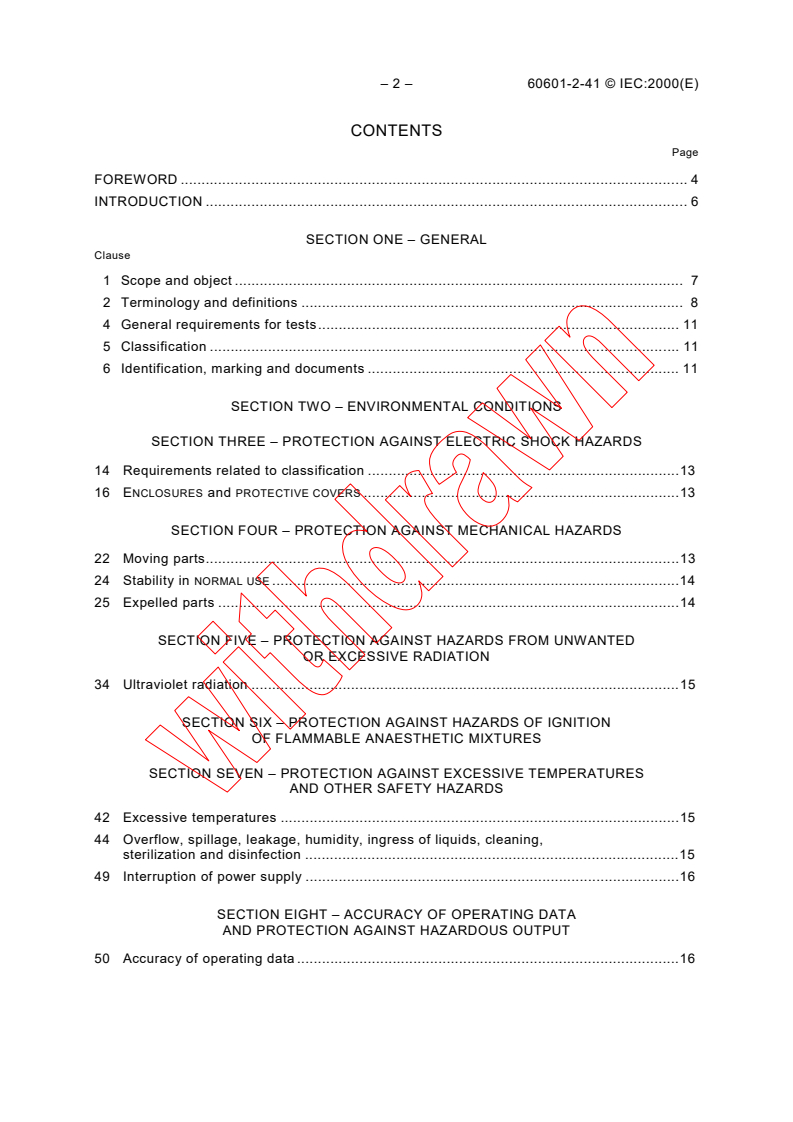
– 2 – 60601-2-41 © IEC:2000(E)
CONTENTS
Page
FOREWORD . 4
INTRODUCTION .6
SECTION ONE – GENERAL
Clause
1 Scope and object . 7
2 Terminology and definitions . 8
4 General requirements for tests. 11
5 Classification . 11
6 Identification, marking and documents . 11
SECTION TWO – ENVIRONMENTAL CONDITIONS
SECTION THREE – PROTECTION AGAINST ELECTRIC SHOCK HAZARDS
14 Requirements related to classification .13
16 ENCLOSURES and PROTECTIVE COVERS .13
SECTION FOUR – PROTECTION AGAINST MECHANICAL HAZARDS
22 Moving parts.13
24 Stability in NORMAL USE .14
25 Expelled parts.14
SECTION FIVE – PROTECTION AGAINST HAZARDS FROM UNWANTED
OR EXCESSIVE RADIATION
34 Ultraviolet radiation.15
SECTION SIX – PROTECTION AGAINST HAZARDS OF IGNITION
OF FLAMMABLE ANAESTHETIC MIXTURES
SECTION SEVEN – PROTECTION AGAINST EXCESSIVE TEMPERATURES
AND OTHER SAFETY HAZARDS
42 Excessive temperatures.15
44 Overflow, spillage, leakage, humidity, ingress of liquids, cleaning,
sterilization and disinfection .15
49 Interruption of power supply .16
SECTION EIGHT – ACCURACY OF OPERATING DATA
AND PROTECTION AGAINST HAZARDOUS OUTPUT
50 Accuracy of operating data .16
60601-2-41 © IEC:2000(E) – 3 –
Page
SECTION NINE – ABNORMAL OPERATION AND FAULT CONDITIONS;
ENVIRONMENTAL TESTS
52 Abnormal operation and fault conditions .22
SECTION TEN – CONSTRUCTIONAL REQUIREMENTS
55 ENCLOSURES and covers .22
56 Components and general assembly .22
57 MAINS PARTS, components and layout .22
59 Construction and layout.23
Figures 101 to 115 . 24 – 34
Annex L References – Publications mentioned in this standard . 35
Annex AA (informative) Guidance and rationale for particular clauses and subclauses . 36
– 4 – 60601-2-41 © IEC:2000(E)
INTERNATIONAL ELECTROTECHNICAL COMMISSION
____________
MEDICAL ELECTRICAL EQUIPMENT –
Part 2-41: Particular requirements for the safety of surgical luminaires
and luminaires for diagnosis
FOREWORD
1) The IEC (International Electrotechnical Commission) is a worldwide organization for standardization comprising
all national electrotechnical committees (IEC National Committees). The object of the IEC is to promote
international co-operation on all questions concerning standardization in the electrical and electronic fields. To
this end and in addition to other activities, the IEC publishes International Standards. Their preparation is
entrusted to technical committees; any IEC National Committee interested in the subject dealt with may
participate in this preparatory work. International, governmental and non-governmental organizations liaising
with the IEC also participate in this preparation. The IEC collaborates closely with the International
Organization for Standardization (ISO) in accordance with conditions determined by agreement between the
two organizations.
2) The formal decisions or agreements of the IEC on technical matters express, as nearly as possible, an
international consensus of opinion on the relevant subjects since each technical committee has representation
from all interested National Committees.
3) The documents produced have the form of recommendations for international use and are published in the form
of standards, technical specifications, technical reports or guides and they are accepted by the National
Committees in that sense.
4) In order to promote international unification, IEC National Committees undertake to apply IEC International
Standards transparently to the maximum extent possible in their national and regional standards. Any
divergence between the IEC Standard and the corresponding national or regional standard shall be clearly
indicated in the latter.
5) The IEC provides no marking procedure to indicate its approval and cannot be rendered responsible for any
equipment declared to be in conformity with one of its standards.
6) Attention is drawn to the possibility that some of the elements of this International Standard may be the subject
of patent rights. The IEC shall not be held responsible for identifying any or all such patent rights.
International Standard IEC 60601-2-41 has been prepared by subcommittee 62D:
Electromedical equipment, of IEC technical committee 62: Electrical equipment in medical
practice.
The text of this standard is based on the following documents:
FDIS Report on voting
62D/344/FDIS 62D/352/RVD
Full information on the voting for the approval of this standard can be found in the report on
voting indicated in the above table.
This publication has been drafted in accordance with the ISO/IEC Directives, Part 3.
Annex AA is for information only.
60601-2-41 © IEC:2000(E) – 5 –
In this Particular Standard the following print types are used:
– requirements, compliance with which can be tested, and definitions: in roman type;
– notes, explanations, advice, introductions, general statements, exceptions and references: in smaller type;
– test specifications: in italic type;
– TERMS DEFINED IN CLAUSE 2 OF THE GENERAL STANDARD IEC 60601-1 OR THIS PARTICULAR
STANDARD: SMALL CAPITALS.
The committee has decided that this publication remains valid until 2005.
At this date, in accordance with the committee’s decision, the publication will be
• reconfirmed;
• withdrawn;
• replaced by a revised edition, or
• amended.
A bilingual version of this standard may be issued at a later date.
– 6 – 60601-2-41 © IEC:2000(E)
INTRODUCTION
This Particular Standard concerns the safety of SURGICAL LUMINAIRES and LUMINAIRES FOR
DIAGNOSIS. It amends and supplements IEC 60601-1 (second edition 1988), hereinafter
referred to as the General Standard. The requirements of this Particular Standard take priority
over those of the General Standard, entitled “Medical electrical equipment – Part 1: General
requirements for safety.”
A “Guidance and rationale” for the requirements of this Particular Standard is included in
annex AA.
It is considered that a knowledge of the reasons for these requirements will not only facilitate
the proper application of the standard but will, in due course, expedite any revision
necessitated by changes in clinical practice or as a result of developments in technology.
However, this annex does not form part of the requirements of this Standard.
An asterisk (*) inserted before a clause or subclause number indicates that some explanatory
notes are given in annex AA at the end of this Particular Standard.
60601-2-41 © IEC:2000(E) – 7 –
MEDICAL ELECTRICAL EQUIPMENT –
Part 2-41: Particular requirements for the safety of surgical luminaires
and luminaires for diagnosis
SECTION ONE – GENERAL
The clauses and subclauses of this section of the General Standard apply except as follows.
1 Scope and object
This clause of the General Standard applies except as follows:
*1.1 Scope
Addition:
This Particular Standard details the requirements to be applied to SURGICAL LUMINAIRES and
LUMINAIRES FOR DIAGNOSIS as defined in 2.101 to 2.105, hereinafter referred to as EQUIPMENT.
This standard does not apply to
– headlights,
– endoscopes, laparoscopes and their light sources, which are covered by IEC 60601-2-18,
– luminaires used in dentistry, which are covered by ISO 9680,
– luminaires for general purposes, which are covered by IEC 60598-2-1 and IEC 60598-2-4,
– luminaires of an emergency lighting, which are covered by IEC 60598-2-22.
NOTE Luminaires used in clinical areas of hospitals other than those defined in 2.101 to 2.105 are covered by
IEC 60598-2-25.
1.2 Object
Replacement:
The object of this Particular Standard is to establish particular requirements for the safety of
SURGICAL LUMINAIRES and LUMINAIRES FOR DIAGNOSIS.
1.3 Particular Standards
Addition:
This Particular Standard refers to IEC 60601-1 (1988): Medical electrical equipment – Part 1:
General requirements for safety, as amended by its amendment 1 (1991) and its
amendment 2 (1995).
For brevity, IEC 60601-1 is referred to in this Particular Standard either as the General
Standard or as the General Requirement(s).
– 8 – 60601-2-41 © IEC:2000(E)
The numbering of sections, clauses and subclauses of this Particular Standard corresponds to
that of the General Standard. The changes to the text of the General standard are specified
by the use of the following words:
“Replacement” means that the clause or subclause of the General Standard is replaced
completely by the text of this Particular Standard.
“Addition” means that the text of this Particular Standard is additional to the requirements of
the General Standard.
“Amendment” means that the clause or subclause of the General Standard is amended as
indicated by the text of this Particular Standard.
“Modification” means that the clause or subclause of the General Standard is modified as
indicated by the text of this Particular Standard.
Subclauses or figures which are additional to those of the General Standard are numbered
starting from 101, additional annexes are lettered AA, BB, etc. and additional items aa), bb),
etc.
The term “this Standard” is used to make reference to the General Standard and this
Particular Standard taken together.
Where there is no corresponding section, clause or subclause in this Particular Standard, the
section, clause or subclause of the General Standard, although possibly not relevant, applies
without modification; where it is intended that any part of the General Standard, although
possibly relevant, is not to be applied, a statement to that effect is given in this Particular
Standard.
2 Terminology and definitions
This clause of the General Standard applies except as follows:
Additional definitions:
2.101
MAJOR SURGICAL LUMINAIRE
Single luminaire in the PATIENT environment which is FAIL SAFE and provides an adequate
CENTRAL ILLUMINANCE to illuminate locally the body of the PATIENT. It is intended to support the
treatment and diagnosis, and to be used in operating rooms. See table 101
2.102
MINOR SURGICAL LUMINAIRE (treatment luminaire)
Single luminaire in the PATIENT environment which provides an adequate CENTRAL ILLUMINANCE
to illuminate the body of the PATIENT locally. It is intended to be used in operating rooms for
diagnosis and treatment which can be interrupted without any hazard for the PATIENT in case
of failure of the light. See table 101
2.103
LUMINAIRE FOR DIAGNOSIS
Luminaire to illuminate the body of the PATIENT locally in order to support diagnosis or
treatment which could be interrupted without any hazard for the PATIENT in case of failure of
the light. It is not intended to be used in operating rooms. See table 101
60601-2-41 © IEC:2000(E) – 9 –
2.104
SURGICAL LUMINAIRE SYSTEM
Combination of several SURGICAL LUMINAIRES to illuminate the body of the PATIENT locally. It is
FAIL SAFE and provides an adequate CENTRAL ILLUMINANCE. It is intended to support the
treatment and diagnosis, and to be used in operating rooms. See table 101
(Example: A proved fail safe combination of two or more minor surgical luminaires is a
SURGICAL LUMINAIRE SYSTEM.)
2.105
SURGICAL LUMINAIRE
Generic term applicable to minor surgical luminaires, major surgical luminaires and surgical
luminaire systems
Table 101 – Classification of surgical luminaires and luminaires for diagnosis
Type of luminaire
Requirements Clause
Surgical luminaires
Luminaires for
diagnosis
Minor (treatment) Major and system
EQUIPMENT classification 14.2 a) 2) No requirement Class I, or Class II with Class I, or Class II with
a a
connector to PA connector to PA
Fail safe 2.10.101 No No Yes
Anaesthesia (intended Localized Local/general Local/general
purpose)
Intended location Examination room Operating room Operating room
Sterile handle (standard) No Yes Yes
Central illuminance (E ) 50.102.1.1 a) No requirement
c 40 klx ≤ E ≤ 160 klx 40 klx ≤ E ≤ 160 klx
c c
b b
Light field diameter (d ) 50.102.1.1 b) No requirement Yes Yes
c c
Light distribution 50.102.1.1 b) No requirement Yes Yes
d d
Shadow dilution 50.102.1.1 c) No requirement Yes Yes
Colour temperature 50.102.2.1
3 000 K ≤ T ≤ 6 700 K 3 000 K ≤ T ≤ 6 700 K 3 000 K ≤ T ≤ 6 700 K
c c c
Colour rendering index 50.102.2.1
85 ≤ R ≤ 100 85 ≤ R ≤ 100 85 ≤ R ≤ 100
a a a
e e e
Maximum value for total 50.102.3.1 Yes Yes Yes
irradiance E
e
a
PA means potential equalization conductor.
b
LIGHT FIELD DIAMETER(d ) where the illuminance reaches 10 % of CENTRAL ILLUMINANCE E .
10 c
c
CENTRAL ILLUMINANCE
Diameter d50 where the illuminance reaches 50 % of Ec.
d
Percentage of remaining illuminance when the beam is obstructed by one or two masks, with or without tube.
e
Information on the total irradiance E for the given CENTRAL ILLUMINANCE E .
e c
2.106
CENTRAL ILLUMINANCE (E )
c
Illuminance at 1 m distance from the light emitting area of the EQUIPMENT in the LIGHT FIELD
CENTRE (LFC) without any obstruction of the light beam
– 10 – 60601-2-41 © IEC:2000(E)
2.107
LIGHT FIELD DIAMETER (d )
Diameter of a circle around the LIGHT FIELD CENTRE (point of CENTRAL ILLUMINANCE) where the
illuminance reaches 10 % of E
c
2.108
LIGHT FIELD CENTRE (LFC)
Point of maximum illuminance in the light field (lighted area). It is the reference point for light
field size and distribution measurements
2.109
DEPTH OF ILLUMINATION
Working distance around 1 m below the emitting surface of the EQUIPMENT, in which the
CENTRAL ILLUMINANCE
illuminance reaches at least 20 % of (E ). (See figure 115)
c
2.110
SHADOW DILUTION
Ability of the EQUIPMENT to minimize the impact of shadows in the working area due to the
partial obstruction by the OPERATOR of the emitted light
2.1.101
STERILE HANDLE
Device maintaining a sterile area in order to handle it under aseptic conditions when attached
to the EQUIPMENT
2.1.5
APPLIED PART
Addition:
SURGICAL LUMINAIRE LUMINAIRE FOR DIAGNOSIS APPLIED
NOTE Except if intended for such purpose, a or has no
PART on the PATIENT.
2.2.15
MEDICAL ELECTRICAL EQUIPMENT
Replacement:
Electrical EQUIPMENT, provided with one or more connections to particular SUPPLY MAINS and
intended to diagnose, treat, or monitor the PATIENT under medical supervision, and which
makes physical or electrical contact with the PATIENT and/or transfers energy to or from the
PATIENT and/or detects such energy transfer to or from the PATIENT.
See figure 101 describing the possible SUPPLY MAINS for SURGICAL LUMINAIRES.
*2.4.3
SAFETY EXTRA-LOW VOLTAGE (SELV)
Modification:
Voltage is changed from 25 V a.c. to 30 V a.c.
*2.10.101
Addition:
FAIL SAFE
Capability of an EQUIPMENT to provide a minimum illuminance and to be directed on the
operation area even in SINGLE FAULT CONDITION.
60601-2-41 © IEC:2000(E) – 11 –
4 General requirements for tests
This clause of the General Standard applies except as follows:
4.6 Other conditions
Addition:
f) In order to measure stabilized performances, the output values shall be measured after a
pre-ageing period, depending on the lamp technology, at RATED VOLTAGE under NORMAL
CONDITIONS
. This pre-ageing period is:
– 3 h for halogen lamps;
– 50 h for discharge lamps;
– for other lamps, the pre-ageing period is determined when the performances variation
does not exceed 1 % per 10 h.
4.11 Sequence
Addition:
The photometric tests and the tests for the quality of illuminance of the EQUIPMENT are
performed after inspection of the marking (see clause C.3 of Appendix C of the General
Standard).
5 Classification
This clause of the General Standard applies except as follows:
5.6 According to the mode of operation
Modification:
Delete all but continuous operation.
6 Identification, marking and documents
This clause of the General Standard applies except as follows:
6.1 Marking on the outside of EQUIPMENT or EQUIPMENT parts
Addition:
RATED
aa) voltage and power consumption (6.1 g) and j) shall be marked on each lighthead.
If these values differ from power input and voltage at the MAINS TERMINAL DEVICE of the
EQUIPMENT, additional marking of voltage and power consumption is required near the MAINS
TERMINAL DEVICE.
6.1.101 NOMINAL power of an EQUIPMENT
The NOMINAL power in watts of the lamp(s). When the indication of the power of a lamp is not
sufficient, the number of lamps and their type shall be marked too. EQUIPMENT using tungsten
filament lamps shall be marked with the NOMINAL power.
– 12 – 60601-2-41 © IEC:2000(E)
6.1.102 POWER SUPPLY CORD without connector
MOBILE EQUIPMENT with a fixed flexible POWER SUPPLY CORD with no MAINS PLUG attached for
connection to the SUPPLY MAINS shall have a clearly visible label to show the correct method of
connection to a MAINS PLUG.
6.2.101 Marking of light sources
Identification and characteristics of lamps (power, voltage) shall be marked near the
lampholder and on the lamps.
6.8.2 Instructions for use
a)
Ad dition:
Instructions for use shall contain information on:
– cleaning and decontamination of the EQUIPMENT,
– safety aspects of optical filters (purpose and warning to prevent removal),
– CENTRAL ILLUMINANCE,
– LIGHT FIELD DIAMETER,
– DEPTH OF ILLUMINATION (see 50.102.1, not for LUMINAIRES FOR DIAGNOSIS),
– SHADOW DILUTION (see 50.102.1, not for LUMINAIRES FOR DIAGNOSIS),
– correlated colour temperature and colour rendering index,
– total irradiance,
– cleaning, disinfection and sterilization of the STERILE HANDLE,
– handling of the lamps in case of lamp changing,
– how the USER shall respect the requirements of the national committee responsible for
hygiene and disinfection,
d) Cleaning, disinfection and sterilization of parts in contact with the PATIENT
Addition:
This subclause also applies to the STERILE HANDLE.
SECTION TWO – ENVIRONMENTAL CONDITIONS
The clauses and subclauses of this section of General Standard apply.
60601-2-41 © IEC:2000(E) – 13 –
SECTION THREE – PROTECTION AGAINST ELECTRIC SHOCK HAZARDS
The clauses and subclauses of this section of the General Standard apply except as follows:
14 Requirements related to classification
This clause of the General Standard applies except as follows:
14.2 a) 2)
Addition:
SURGICAL LUMINAIRES of CLASS II need a connector to a POTENTIAL EQUALIZATION CONDUCTOR.
NOTE SURGICAL LUMINAIRES are set up in operating theatres in which an equipotential bonding has been placed
between exposed conductive parts.
*16 ENCLOSURES and PROTECTIVE COVERS
This clause of the General Standard applies except as follows:
Modification:
Replace
25 V a.c. by 30 V a.c.
SECTION FOUR – PROTECTION AGAINST MECHANICAL HAZARDS
The clauses and subclauses of this section of the General Standard apply except as follows:
22 Moving parts
This clause of the General Standard applies except as follows:
Addition:
*22.101
Attachment and detachment of the STERILE HANDLE: see rationale (annex AA).
The maximum attachment and detachment force of the STERILE HANDLE shall not exceed 10 N.
The maximum attachment and detachment torque shall not exceed 1 Nm.
The force for unintended detachment shall exceed 100 N.
The torque for unintended detachment shall exceed 5 Nm or require three or more 360°
rotations of the STERILE HANDLE.
Compliance is checked by test (see figure 102).
At the end of the test no damage shall be detected on the shaft (or carrier) of the STERILE
HANDLE or on the STERILE HANDLE itself.
– 14 – 60601-2-41 © IEC:2000(E)
24 Stability in NORMAL USE
This clause of the General Standard applies except as follows:
MOBILE EQUIPMENT
24.1 to 24.3 These clauses of the General Standard apply only to .
24.101
Addition:
Ease of motion and stability
The mechanical parts of the EQUIPMENT shall be designed to have very easy motions during
handling.
The EQUIPMENT shall be stable when not being moved.
Compliance is checked as follows:
The manipulation of the lighthead is tested along three perpendicular axes as described in
figure 103. The application point of the force shall be in the middle of the gripping area
defined by the manufacturer.
The maximum force for vertical positioning shall not exceed 55 N.
Articulation of the lighthead in the remaining axis shall not exceed 25 N.
Compliance is checked manually along one axis at a time, the other axes of rotation being
locked.
25 Expelled parts
This clause of the General Standard applies except as follows:
25.1
Addition:
The EQUIPMENT shall be so designed that, in case of lamp burst, all flinders and broken parts
are kept inside the EQUIPMENT in all possible positions of the lighthead in the INTENDED USE.
Compliance is checked by a test in accordance with IEC 60598-2-9.
Only the structural integrity of the enclosure shall be checked at the end of the test.
60601-2-41 © IEC:2000(E) – 15 –
SECTION FIVE – PROTECTION AGAINST HAZARDS FROM UNWANTED
OR EXCESSIVE RADIATION
The clauses and subclauses of this section of the General Standard apply except as follows:
34 Ultraviolet radiation
Replacement:
The UV-irradiance for wavelengths below 400 nm shall not exceed 10 W/m².
Compliance is checked by inspection or
...