

IEC 60601-2-41:2009
(Main)Medical electrical equipment - Part 2-41: Particular requirements for the basic safety and essential performance of surgical luminaires and luminaires for diagnosis
General Information
- Abstract
IEC 60601-2-41:2009 applies to the basic safety and essential performance of surgical luminaires and luminaires for diagnosis. It amends and supplements IEC 60601-1 (third Edition 2005), hereinafter referred to as the general standard. This second edition cancels and replaces the first edition published in 2000. This edition constitutes a technical revision to be consistent with the third edition of the IEC 60601-1.
- Status
- Published
- Publication Date
- 28-Oct-2013
- Technical Committee
- SC 62D - Particular medical equipment, software, and systems
- Drafting Committee
- MT 27 - TC 62/SC 62D/MT 27
- Current Stage
- DELPUB - Deleted Publication
- Start Date
- 03-Sep-2021
- Completion Date
- 23-Feb-2018
Buy Documents
IEC 60601-2-41:2009 - Medical electrical equipment - Part 2-41: Particular requirements for the basic safety and essential performance of surgical luminaires and luminaires for diagnosis Released:8/12/2009

IEC 60601-2-41:2009+AMD1:2013 CSV - Medical electrical equipment - Part 2-41: Particular requirementsfor the basic safety and essential performance of surgical luminaires and luminaires for diagnosis Released:10/29/2013
Overview
IEC 60601-2-41:2009 is an international standard published by the International Electrotechnical Commission (IEC) that sets out particular requirements for the basic safety and essential performance of surgical luminaires and luminaires for diagnosis. This standard is part of the IEC 60601 series, building upon the general safety and performance requirements for medical electrical equipment defined in IEC 60601-1. IEC 60601-2-41 focuses specifically on lighting devices used during surgery and diagnosis, ensuring safety, performance, and reliability in medical environments.
Key Topics
- Scope of Application
- Covers luminaires designed for surgical procedures and diagnostics within medical settings.
- Excludes general-purpose luminaires, dental luminaires, headlights, endoscopes and their sources, and emergency lighting.
- Basic Safety and Essential Performance
- Emphasizes the need for sufficient illumination, shadow dilution, and fail-safe features for surgical lighting.
- Requires energy limitation to the operating field for patient and operator safety.
- Classification and Definitions
- Differentiates between major and minor surgical luminaires and luminaires for diagnosis.
- Introduces terms such as “central illuminance,” “depth of illumination,” “shadow dilution,” and “detachable handle.”
- Testing and Marking
- Specifies procedures for performance stabilization, marking of equipment and replaceable light sources, and comprehensive instructions for use.
- Mechanical and Electrical Safety
- Addresses risks associated with electrical hazards, mechanical instability, and moving parts.
- Details requirements for detachable handles, ease of motion, and resistance to unintentional detachment.
Applications
IEC 60601-2-41:2009 is valuable for manufacturers, healthcare providers, regulatory authorities, and procurement specialists involved in:
- Hospital Operating Rooms
- Ensures surgical luminaires deliver reliable, uninterrupted, and safe illumination during critical procedures.
- Medical Examination Rooms
- Applies to diagnostic luminaires providing safe lighting to aid medical assessments, while allowing interruption without patient hazard.
- Medical Device Development
- Provides manufacturers with guidelines for design, testing, and documentation to achieve compliance, particularly in global markets.
- Regulatory and Quality Assurance
- Aids regulatory authorities and quality managers in verifying that surgical and diagnostic lighting equipment meets international safety standards.
- Procurement and Maintenance
- Guides hospital technical staff in selecting, installing, and maintaining compliant surgical and diagnostic lights for optimal safety and performance.
Related Standards
- IEC 60601-1:2005 – Medical electrical equipment - Part 1: General requirements for basic safety and essential performance.
- IEC 60601-2-18 – Particular requirements for endoscopes and their light sources.
- ISO 9680 – Dental operating lights.
- IEC 60598-2-1 & IEC 60598-2-4 – General lighting luminaires.
- IEC 60598-2-22 – Emergency lighting.
- Colorimetry and Measurement (e.g., CIE 13.3, CIE 15, ISO 11664-1) – Lighting color and rendering properties relevant to luminaires.
Practical Value
Adhering to IEC 60601-2-41 helps ensure that surgical and diagnostic luminaires used in healthcare settings are:
- Safe for both patients and healthcare professionals.
- Tested for essential lighting performance characteristics.
- Compliant with international regulatory expectations, simplifying approvals and market access.
- Designed with critical features such as shadow minimization, effective marking, and mechanical safety for medical environments.
Instituting this standard promotes patient safety, supports high-quality care, and safeguards hospital infrastructure investments in medical lighting.
Relations
- Effective Date
- 05-Sep-2023
- Effective Date
- 05-Sep-2023
Buy Documents
IEC 60601-2-41:2009 - Medical electrical equipment - Part 2-41: Particular requirements for the basic safety and essential performance of surgical luminaires and luminaires for diagnosis Released:8/12/2009
IEC 60601-2-41:2009+AMD1:2013 CSV - Medical electrical equipment - Part 2-41: Particular requirementsfor the basic safety and essential performance of surgical luminaires and luminaires for diagnosis Released:10/29/2013
Get Certified
Connect with accredited certification bodies for this standard

BSI Group
BSI (British Standards Institution) is the business standards company that helps organizations make excellence a habit.

TÜV Rheinland
TÜV Rheinland is a leading international provider of technical services.

TÜV SÜD
TÜV SÜD is a trusted partner of choice for safety, security and sustainability solutions.
Sponsored listings
Frequently Asked Questions
IEC 60601-2-41:2009 is a standard published by the International Electrotechnical Commission (IEC). Its full title is "Medical electrical equipment - Part 2-41: Particular requirements for the basic safety and essential performance of surgical luminaires and luminaires for diagnosis". This standard covers: IEC 60601-2-41:2009 applies to the basic safety and essential performance of surgical luminaires and luminaires for diagnosis. It amends and supplements IEC 60601-1 (third Edition 2005), hereinafter referred to as the general standard. This second edition cancels and replaces the first edition published in 2000. This edition constitutes a technical revision to be consistent with the third edition of the IEC 60601-1.
IEC 60601-2-41:2009 applies to the basic safety and essential performance of surgical luminaires and luminaires for diagnosis. It amends and supplements IEC 60601-1 (third Edition 2005), hereinafter referred to as the general standard. This second edition cancels and replaces the first edition published in 2000. This edition constitutes a technical revision to be consistent with the third edition of the IEC 60601-1.
IEC 60601-2-41:2009 is classified under the following ICS (International Classification for Standards) categories: 11.040.20 - Transfusion, infusion and injection equipment; 11.040.55 - Diagnostic equipment; 11.040.99 - Other medical equipment. The ICS classification helps identify the subject area and facilitates finding related standards.
IEC 60601-2-41:2009 has the following relationships with other standards: It is inter standard links to IEC 60601-2-41:2009/AMD1:2013, IEC 60601-2-41:2000. Understanding these relationships helps ensure you are using the most current and applicable version of the standard.
IEC 60601-2-41:2009 is available in PDF format for immediate download after purchase. The document can be added to your cart and obtained through the secure checkout process. Digital delivery ensures instant access to the complete standard document.
Standards Content (Sample)
IEC 60601-2-41 ®
Edition 2.0 2009-08
INTERNATIONAL
STANDARD
NORME
INTERNATIONALE
Medical electrical equipment –
Part 2-41: Particular requirements for the basic safety and essential performance
of surgical luminaires and luminaires for diagnosis
Appareils électromédicaux –
Partie 2-41: Exigences particulières pour la sécurité de base et les performances
essentielles des éclairages chirurgicaux et des éclairages de diagnostic
All rights reserved. Unless otherwise specified, no part of this publication may be reproduced or utilized in any form or by
any means, electronic or mechanical, including photocopying and microfilm, without permission in writing from either IEC or
IEC's member National Committee in the country of the requester.
If you have any questions about IEC copyright or have an enquiry about obtaining additional rights to this publication,
please contact the address below or your local IEC member National Committee for further information.
Droits de reproduction réservés. Sauf indication contraire, aucune partie de cette publication ne peut être reproduite
ni utilisée sous quelque forme que ce soit et par aucun procédé, électronique ou mécanique, y compris la photocopie
et les microfilms, sans l'accord écrit de la CEI ou du Comité national de la CEI du pays du demandeur.
Si vous avez des questions sur le copyright de la CEI ou si vous désirez obtenir des droits supplémentaires sur cette
publication, utilisez les coordonnées ci-après ou contactez le Comité national de la CEI de votre pays de résidence.
IEC Central Office
3, rue de Varembé
CH-1211 Geneva 20
Switzerland
Email: inmail@iec.ch
Web: www.iec.ch
About the IEC
The International Electrotechnical Commission (IEC) is the leading global organization that prepares and publishes
International Standards for all electrical, electronic and related technologies.
About IEC publications
The technical content of IEC publications is kept under constant review by the IEC. Please make sure that you have the
latest edition, a corrigenda or an amendment might have been published.
ƒ Catalogue of IEC publications: www.iec.ch/searchpub
The IEC on-line Catalogue enables you to search by a variety of criteria (reference number, text, technical committee,…).
It also gives information on projects, withdrawn and replaced publications.
ƒ IEC Just Published: www.iec.ch/online_news/justpub
Stay up to date on all new IEC publications. Just Published details twice a month all new publications released. Available
on-line and also by email.
ƒ Electropedia: www.electropedia.org
The world's leading online dictionary of electronic and electrical terms containing more than 20 000 terms and definitions
in English and French, with equivalent terms in additional languages. Also known as the International Electrotechnical
Vocabulary online.
ƒ Customer Service Centre: www.iec.ch/webstore/custserv
If you wish to give us your feedback on this publication or need further assistance, please visit the Customer Service
Centre FAQ or contact us:
Email: csc@iec.ch
Tel.: +41 22 919 02 11
Fax: +41 22 919 03 00
A propos de la CEI
La Commission Electrotechnique Internationale (CEI) est la première organisation mondiale qui élabore et publie des
normes internationales pour tout ce qui a trait à l'électricité, à l'électronique et aux technologies apparentées.
A propos des publications CEI
Le contenu technique des publications de la CEI est constamment revu. Veuillez vous assurer que vous possédez
l’édition la plus récente, un corrigendum ou amendement peut avoir été publié.
ƒ Catalogue des publications de la CEI: www.iec.ch/searchpub/cur_fut-f.htm
Le Catalogue en-ligne de la CEI vous permet d’effectuer des recherches en utilisant différents critères (numéro de référence,
texte, comité d’études,…). Il donne aussi des informations sur les projets et les publications retirées ou remplacées.
ƒ Just Published CEI: www.iec.ch/online_news/justpub
Restez informé sur les nouvelles publications de la CEI. Just Published détaille deux fois par mois les nouvelles
publications parues. Disponible en-ligne et aussi par email.
ƒ Electropedia: www.electropedia.org
Le premier dictionnaire en ligne au monde de termes électroniques et électriques. Il contient plus de 20 000 termes et
définitions en anglais et en français, ainsi que les termes équivalents dans les langues additionnelles. Egalement appelé
Vocabulaire Electrotechnique International en ligne.
ƒ Service Clients: www.iec.ch/webstore/custserv/custserv_entry-f.htm
Si vous désirez nous donner des commentaires sur cette publication ou si vous avez des questions, visitez le FAQ du
Service clients ou contactez-nous:
Email: csc@iec.ch
Tél.: +41 22 919 02 11
Fax: +41 22 919 03 00
IEC 60601-2-41 ®
Edition 2.0 2009-08
INTERNATIONAL
STANDARD
NORME
INTERNATIONALE
Medical electrical equipment –
Part 2-41: Particular requirements for the basic safety and essential
performance of surgical luminaires and luminaires for diagnosis
Appareils électromédicaux –
Partie 2-41: Exigences particulières pour la sécurité de base et les
performances essentielles des éclairages chirurgicaux et des éclairages de
diagnostic
INTERNATIONAL
ELECTROTECHNICAL
COMMISSION
COMMISSION
ELECTROTECHNIQUE
PRICE CODE
INTERNATIONALE
W
CODE PRIX
ICS 11.040.20; 11.040.55; 11.040.99 ISBN 978-2-88910-222-8
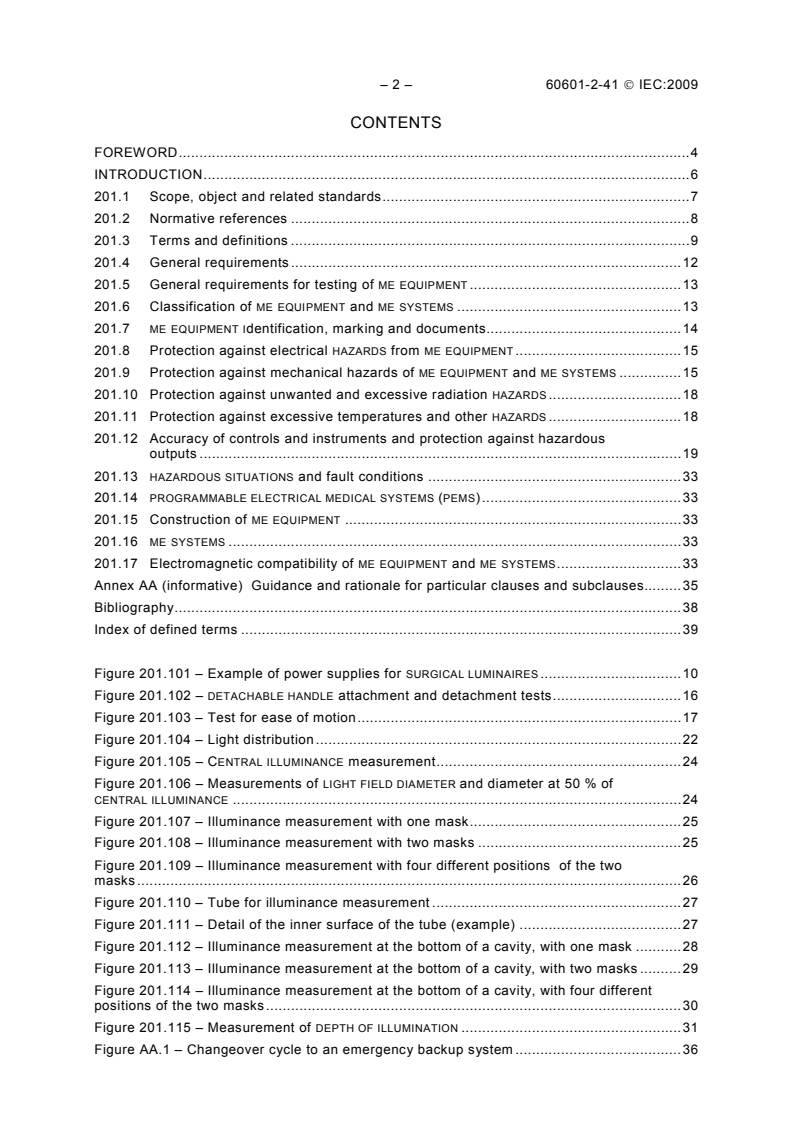
– 2 – 60601-2-41 © IEC:2009
CONTENTS
FOREWORD.4
INTRODUCTION.6
201.1 Scope, object and related standards.7
201.2 Normative references .8
201.3 Terms and definitions .9
201.4 General requirements.12
201.5 General requirements for testing of ME EQUIPMENT .13
201.6 Classification of ME EQUIPMENT and ME SYSTEMS .13
201.7 ME EQUIPMENT Identification, marking and documents.14
201.8 Protection against electrical HAZARDS from ME EQUIPMENT .15
201.9 Protection against mechanical hazards of ME EQUIPMENT and ME SYSTEMS .15
201.10 Protection against unwanted and excessive radiation HAZARDS .18
201.11 Protection against excessive temperatures and other HAZARDS .18
201.12 Accuracy of controls and instruments and protection against hazardous
outputs .19
201.13 HAZARDOUS SITUATIONS and fault conditions .33
201.14 PROGRAMMABLE ELECTRICAL MEDICAL SYSTEMS (PEMS).33
201.15 Construction of ME EQUIPMENT .33
201.16 ME SYSTEMS .33
201.17 Electromagnetic compatibility of ME EQUIPMENT and ME SYSTEMS.33
Annex AA (informative) Guidance and rationale for particular clauses and subclauses.35
Bibliography.38
Index of defined terms .39
Figure 201.101 – Example of power supplies for SURGICAL LUMINAIRES .10
Figure 201.102 – DETACHABLE HANDLE attachment and detachment tests.16
Figure 201.103 – Test for ease of motion.17
Figure 201.104 – Light distribution.22
Figure 201.105 – CENTRAL ILLUMINANCE measurement.24
Figure 201.106 – Measurements of LIGHT FIELD DIAMETER and diameter at 50 % of
CENTRAL ILLUMINANCE .24
Figure 201.107 – Illuminance measurement with one mask.25
Figure 201.108 – Illuminance measurement with two masks .25
Figure 201.109 – Illuminance measurement with four different positions of the two
masks.26
Figure 201.110 – Tube for illuminance measurement .27
Figure 201.111 – Detail of the inner surface of the tube (example) .27
Figure 201.112 – Illuminance measurement at the bottom of a cavity, with one mask .28
Figure 201.113 – Illuminance measurement at the bottom of a cavity, with two masks .29
Figure 201.114 – Illuminance measurement at the bottom of a cavity, with four different
positions of the two masks.30
Figure 201.115 – Measurement of DEPTH OF ILLUMINATION .31
Figure AA.1 – Changeover cycle to an emergency backup system .36
60601-2-41 © IEC:2009 – 3 –
Table 201.101 – Classification of SURGICAL LUMINAIRES and LUMINAIRES FOR DIAGNOSIS.12
Table 201.102 – Distributed ESSENTIAL PERFORMANCE requirements .13
Table 201.103 – Allowable maximum temperatures for ME EQUIPMENT parts that are
likely to be touched.19
– 4 – 60601-2-41 © IEC:2009
INTERNATIONAL ELECTROTECHNICAL COMMISSION
____________
MEDICAL ELECTRICAL EQUIPMENT –
Part 2-41: Particular requirements for the basic safety and essential
performance of surgical luminaires and luminaires for diagnosis
FOREWORD
1) The International Electrotechnical Commission (IEC) is a worldwide organization for standardization comprising
all national electrotechnical committees (IEC National Committees). The object of IEC is to promote
international co-operation on all questions concerning standardization in the electrical and electronic fields. To
this end and in addition to other activities, IEC publishes International Standards, Technical Specifications,
Technical Reports, and Guides (hereafter referred to as “IEC Publication(s)”). Their preparation is entrusted to
technical committees; any IEC National Committee interested in the subject dealt with may participate in this
preparatory work. International, governmental and non-governmental organizations liaising with the IEC also
participate in this preparation. IEC collaborates closely with the International Organization for Standardization
(ISO) in accordance with conditions determined by agreement between the two organizations.
2) The formal decisions or agreements of IEC on technical matters express, as nearly as possible, an international
consensus of opinion on the relevant subjects since each technical committee has representation from all
interested IEC National Committees.
3) IEC Publications have the form of recommendations for international use and are accepted by IEC National
Committees in that sense. While all reasonable efforts are made to ensure that the technical content of IEC
Publications is accurate, IEC cannot be held responsible for the way in which they are used or for any
misinterpretation by any end user.
4) In order to promote international uniformity, IEC National Committees undertake to apply IEC Publications
transparently to the maximum extent possible in their national and regional publications. Any divergence
between any IEC Publication and the corresponding national or regional publication shall be clearly indicated in
the latter.
5) IEC provides no marking procedure to indicate its approval and cannot be rendered responsible for any
equipment declared to be in conformity with an IEC Publication.
6) All users should ensure that they have the latest edition of this publication.
7) No liability shall attach to IEC or its directors, employees, servants or agents including individual experts and
members of its technical committees and IEC National Committees for any personal injury, property damage or
other damage of any nature whatsoever, whether direct or indirect, or for costs (including legal fees) and
expenses arising out of the publication, use of, or reliance upon, this IEC Publication or any other IEC
Publications.
8) Attention is drawn to the Normative references cited in this publication. Use of the referenced publications is
indispensable for the correct application of this publication.
9) Attention is drawn to the possibility that some of the elements of this IEC Publication may be the subject of
patent rights. IEC shall not be held responsible for identifying any or all such patent rights.
International standard IEC 60601-2-41 has been prepared by subcommittee 62D:
Electromedical equipment, of IEC technical committee 62: Electrical equipment in medical
practice.
This second edition cancels and replaces the first edition published in 2000. This edition
constitutes a technical revision to be consistent with the third edition of the IEC 60601-1.
The text of this particular standard is based on the following documents:
FDIS Report on voting
62D/773/FDIS 62D/787/RVD
Full information on the voting for the approval of this particular standard can be found in the
report on voting indicated in the above table.
This publication has been drafted in accordance with the ISO/IEC Directives, Part 2.
60601-2-41 © IEC:2009 – 5 –
In this standard, the following print types are used:
– Requirements and definitions: roman type.
– Test specifications: italic type.
– Informative material appearing outside of tables, such as notes, examples and references: in smaller type.
Normative text of tables is also in a smaller type.
– TERMS DEFINED IN CLAUSE 3 OF THE GENERAL STANDARD, IN THIS PARTICULAR STANDARD OR AS
NOTED: SMALL CAPITALS.
In referring to the structure of this standard, the term
– “clause” means one of the seventeen numbered divisions within the table of contents,
inclusive of all subdivisions (e.g. Clause 7 includes subclauses 7.1, 7.2, etc.);
– “subclause” means a numbered subdivision of a clause (e.g. 7.1, 7.2 and 7.2.1 are all
subclauses of Clause 7).
References to clauses within this standard are preceded by the term “Clause” followed by the
clause number. References to subclauses within this particular standard are by number only.
In this standard, the conjunctive “or” is used as an “inclusive or” so a statement is true if any
combination of the conditions is true.
The verbal forms used in this standard conform to usage described in Annex H of the ISO/IEC
Directives, Part 2. For the purposes of this standard, the auxiliary verb:
– “shall” means that compliance with a requirement or a test is mandatory for compliance
with this standard;
– “should” means that compliance with a requirement or a test is recommended but is not
mandatory for compliance with this standard;
– “may” is used to describe a permissible way to achieve compliance with a requirement or
test.
An asterisk (*) as the first character of a title or at the beginning of a paragraph or table title
indicates that there is guidance or rationale related to that item in Annex AA.
A list of all parts of the IEC 60601 series, published under the general title Medical electrical
equipment, can be found on the IEC website.
The committee has decided that the contents of this publication will remain unchanged until
the maintenance result date indicated on the IEC web site under "http://webstore.iec.ch" in
the data related to the specific publication. At this date, the publication will be
• reconfirmed,
• withdrawn,
• replaced by a revised edition, or
• amended.
– 6 – 60601-2-41 © IEC:2009
INTRODUCTION
This particular standard concerns the basic safety and essential performance of SURGICAL
LUMINAIRES and LUMINAIRES FOR DIAGNOSIS.
It amends and supplements IEC 60601-1 (third Edition 2005), hereinafter referred to as the
general standard.
The requirements of this particular standard take priority over those of the general standard,
entitled “Medical electrical equipment Part 1: General requirements for basic safety and
essential performance.
60601-2-41 © IEC:2009 – 7 –
MEDICAL ELECTRICAL EQUIPMENT –
Part 2-41: Particular requirements for the basic safety and essential
performance of surgical luminaires and luminaires for diagnosis
201.1 Scope, object and related standards
1)
Clause 1 of the general standard applies, except as follows:
201.1.1 *Scope
Replacement:
This particular standard applies to the BASIC SAFETY and ESSENTIAL PERFORMANCE of SURGICAL
LUMINAIRES AND LUMINAIRES FOR DIAGNOSIS, hereafter referred to as ME EQUIPMENT.
This particular standard does not apply to
– headlights;
– endoscopes, laparoscopes and their light sources, which are covered by IEC 60601-2-18;
– luminaires used in dentistry, which are covered by ISO 9680;
– luminaires for general purposes, which are covered by IEC 60598-2-1 and IEC 60598-2-4;
– luminaires dedicated to therapeutic purposes;
– special purpose lights with different conditions of use such as UV lights for dermatological
diagnosis, slit lamps for ophthalmology, lights for surgical microscopes and lights for
surgical navigation systems;
– lights connected to surgical instruments;
– luminaires of an emergency lighting, which are covered by IEC 60598-2-22.
NOTE See also 4.2 of the general standard.
201.1.2 Object
Replacement:
The object of this particular standard is to establish particular BASIC SAFETY and ESSENTIAL
PERFORMANCE requirements for SURGICAL LUMINAIRES and LUMINAIRES FOR DIAGNOSIS as
defined in 201.3.
201.1.4 Particular standards
Replacement:
In the IEC 60601 series, particular standards may modify, replace or delete requirements
contained in the general standard and collateral standards as appropriate for the particular
ME EQUIPMENT under consideration, and may add other BASIC SAFETY and ESSENTIAL
PERFORMANCE requirements.
A requirement of a particular standard takes priority over the general standard.
—————————
1)
The general standard is IEC 60601-1:2005, Medical electrical equipment – Part 1: General requirements for
basic safety and essential performance.
– 8 – 60601-2-41 © IEC:2009
For brevity, IEC 60601-1 is referred to in this particular standard as the general standard.
Collateral standards are referred to by their document number.
The numbering of clauses and subclauses of this particular standard corresponds to that of
the general standard with the prefix “201” (e.g. 201.1 in this standard addresses the content
of Clause 1 of the general standard) or applicable collateral standard with the prefix “20x”
where x is the final digit(s) of the collateral standard document number (e.g. 202.4 in this
particular standard addresses the content of Clause 4 of the 60601-1-2 collateral standard,
203.4 in this particular standard addresses the content of Clause 4 of the 60601-1-3 collateral
standard, etc.). The changes to the text of the general standard are specified by the use of
the following words:
"Replacement" means that the clause or subclause of the general standard or applicable
collateral standard is replaced completely by the text of this particular standard.
"Addition" means that the text of this particular standard is additional to the requirements of
the general standard or applicable collateral standard.
"Amendment" means that the clause or subclause of the general standard or applicable
collateral standard is amended as indicated by the text of this particular standard.
Subclauses, figures or tables which are additional to those of the general standard are
numbered starting from 201.101. However, due to the fact that definitions in the general
standard are numbered 3.1 through 3.139, additional definitions in this standard are
numbered beginning from 201.3.201. Additional annexes are lettered AA, BB, etc., and
additional items aa), bb), etc.
Subclauses or figures which are additional to those of a collateral standard are numbered
starting from 20x, where “x” is the number of the collateral standard, e.g. 202 for IEC 60601-
1-2, 203 for IEC 60601-1-3, etc.
The term "this standard" is used to make reference to the general standard, any applicable
collateral standards and this particular standard taken together.
Where there is no corresponding clause or subclause in this particular standard, the clause or
subclause of the general standard or applicable collateral standard, although possibly not
relevant, applies without modification; where it is intended that any part of the general
standard or applicable collateral standard, although possibly relevant, is not to be applied, a
statement to that effect is given in this particular standard.
201.2 Normative references
Clause 2 of the general standard applies except as follows:
Addition:
IEC 60417, Graphical symbols for use on equipment
IEC 60598-2-9, Luminaires – Part 2: Particular requirements. Section Nine: Photo and film
luminaires (non-professional)
ISO 11664-1, Colorimetry – Part 1: CIE standard colorimetric observers
CIE 13.3, Method of Measuring and Specifying Colour Rendering Properties of Light Sources
CIE 15, Colorimetry
60601-2-41 © IEC:2009 – 9 –
CIE 69, Methods of characterizing illuminance meters and luminance meters: Performance,
characteristics and specifications
201.3 Terms and definitions
For the purposes of this document, the terms and definitions given in IEC 60601-1:2005,
apply, except as follows:
NOTE An index of defined terms is found beginning on page 39.
201.3.63
MEDICAL ELECTRICAL EQUIPMENT
Addition:
NOTE See Figure 201.101 as an example of possible POWER SUPPLIES for SURGICAL LUMINAIRES.
– 10 – 60601-2-41 © IEC:2009
B
a)
M
G
B DC/AC
b)
M
G
M
c)
G
Key Lamp
B Battery
Transformer
M Mains
G Generator
DC/AC Direct current to alternative
current converter
Switch
IEC 1370/09
Figure 201.101 – Example of power supplies for SURGICAL LUMINAIRES
Addition:
201.3.101
CENTRAL ILLUMINANCE
E
c
illuminance at a 1 000 mm distance (or a measurement distance specified by the
MANUFACTURER if the specified working range does not include 1 000 mm) from the light-
emitting area of the ME EQUIPMENT in the LIGHT FIELD CENTRE without any obstruction of the
light beam
60601-2-41 © IEC:2009 – 11 –
201.3.102
DEPTH OF ILLUMINATION
working distance around the 1 000 mm distance (or a measurement distance specified by the
MANUFACTURER if the specified working range does not include 1 000 mm) below the emitting
surface of the ME EQUIPMENT, in which the illuminance reaches at least 60 % of CENTRAL
ILLUMINANCE (E )
c
201.3.103
*FAIL SAFE
capability of an ME EQUIPMENT to provide a minimum illuminance and to be directed on the
SINGLE FAULT CONDITION
operation area even in
201.3.104
LIGHT FIELD CENTRE
LFC
point of maximum illuminance in the light field (lighted area)
NOTE It is the reference point for light field size and distribution measurements.
201.3.105
LIGHT FIELD DIAMETER
d
diameter of a circle around the LIGHT FIELD CENTRE (point of CENTRAL ILLUMINANCE) where the
illuminance reaches 10 % of E
c
201.3.106
LUMINAIRE FOR DIAGNOSIS
luminaire to illuminate the body of the PATIENT locally in order to support diagnosis or
treatment which could be interrupted without any hazard for the PATIENT in case of failure of
the light
NOTE It is not intended to be used in operating rooms. See Table 201.101.
201.3.107
MAJOR SURGICAL LUMINAIRE
single luminaire in the PATIENT ENVIRONMENT which is intended to support treatment and
diagnosis where interruption of the illumination would be a HAZARDOUS CONDITION and to be
used in operating rooms
NOTE A MAJOR SURGICAL LUMINAIRE needs to provide an adequate CENTRAL ILLUMINANCE to illuminate locally the
body of the PATIENT even in SINGLE FAULT CONDITION. See Table 201.101.
201.3.108
MINOR SURGICAL LUMINAIRE (TREATMENT LUMINAIRE)
single luminaire in the PATIENT ENVIRONMENT which is intended to support treatment and
diagnosis which can be interrupted without any HAZARD for the PATIENT in case of failure of the
light and to be used in operating rooms
NOTE A MINOR SURGICAL LUMINAIRE needs to provide an adequate CENTRAL ILLUMINANCE to illuminate locally the
body of the PATIENT. See Table 201.101.
201.3.109
SHADOW DILUTION
ability of the ME EQUIPMENT to minimise the impact of shadows in the working area due to the
partial obstruction by the OPERATOR of the emitted light
201.3.110
DETACHABLE HANDLE
device that is intended to position and adjust the luminaire which can be removed from the ME
EQUIPMENT
– 12 – 60601-2-41 © IEC:2009
NOTE The DETACHABLE HANDLE may be sterilisable in order to maintain it under aseptic conditions.
201.3.111
SURGICAL LUMINAIRE
a generic term applicable to MINOR SURGICAL LUMINAIREs, MAJOR SURGICAL LUMINAIREs and a SURGICAL
LUMINAIRE SYSTEM
NOTE See Table 201.101.
201.3.112
SURGICAL LUMINAIRE SYSTEM
combination of several SURGICAL LUMINAIRES that is intended to support treatment and
diagnosis and to be used in operating rooms
NOTE 1 A SURGICAL LUMINAIRE SYSTEM needs to be FAIL SAFE and to provide an adequate CENTRAL ILLUMINANCE to
illuminate locally the body of the PATIENT even in SINGLE FAULT CONDITION. See Table 201.101.
EXAMPLE A proven FAIL SAFE combination of two or more MINOR SURGICAL LUMINAIRES is a SURGICAL LUMINAIRE
SYSTEM.
NOTE 2 This SURGICAL LUMINAIRE SYSTEM is not a system in the sense of Clause 16 (ME SYSTEMS).
Table 201.101 – Classification of SURGICAL LUMINAIRES and LUMINAIRES FOR DIAGNOSIS
Type of luminaire
SURGICAL LUMINAIREs
Requirements Clause Luminaires for Minor (treatment) Major and system
diagnosis
ME EQUIPMENT 201.6 No requirement Class I, or Class II Class I, or Class II
a a
classification with connector to PA with connector to PA
FAIL SAFE 201.3.103 No No Yes
Intended location Examination room Operating room Operating room
Ease of motion 201.9.4.2.2.101 Yes Yes Yes
CENTRAL ILLUMINANCE 201.12.1.102.1.1 a) No requirement
40 klx ≤ E ≤ 160 klx 40 klx ≤ E ≤ 160 klx
c c
(E )
c
b b
LIGHT FIELD 201.12.1.102.1.1 b) No requirement Specified Specified
DIAMETER(d )
Light distribution(d ) 201.12.1.102.1.1 b) No requirement d at least 50 % of d at least 50 % of
50 50
the LIGHT FIELD the LIGHT FIELD
c c
DIAMETER d DIAMETER d
10 10
d d
SHADOW DILUTION 201.12.1.102.1.1 c) No requirement Specified Specified
Colour temperature 201.12.1.102.2.1 3 000 K ≤ T ≤ 6 700 K 3 000 K ≤ T ≤ 6 700 K 3 000 K ≤ T ≤ 6 700 K
c c c
Colour rendering index 201.12.1.102.2.1 85 ≤ R ≤ 100 85 ≤ R ≤ 100 85 ≤ R ≤ 100
a a a
2 2 2
Maximum value for 201.12.1.102.3.1 E < 1 000 W/m E < 1 000 W/m E < 1 000 W/m
e e e
total irradiance E
e
a
PA means potential equalization conductor.
b
LIGHT FIELD DIAMETER(d ) where the illuminance reaches 10 % of CENTRAL ILLUMINANCE E .
10 c
c
Diameter d where the illuminance reaches 50 % of CENTRAL ILLUMINANCE E .
50 c
d
Percentage of remaining illuminance when the beam is obstructed by one or two masks, with or without tube.
201.4 General requirements
Clause 4 of the general standard applies, except as follows:
60601-2-41 © IEC:2009 – 13 –
201.4.3 ESSENTIAL PERFORMANCE
Addition:
The ESSENTIAL PERFORMANCE is the delivery of illumination and the limitation of energy to the
operating field.
Table 201.102 – Distributed ESSENTIAL PERFORMANCE requirements
Requirement Subclause
DELIVERY OF A MINIMUM AND ADEQUATE ILLUMINATION ON THE OPERATING FIELD 201.12.1.102.1.1 a)
and 201.12.1.102.4
LIMITATION OF ENERGY IN THE OPERATING FIELD 201.12.1.102.1.1 a)
201.10.7 and
201.12.1.102.3
201.5 General requirements for testing of ME EQUIPMENT
Clause 5 of the general standard applies except as follows:
201.5.4 Other conditions
Addition:
aa) In order to measure stabilised performances, the output values shall be measured after a
pre-ageing period, depending on the light source technology, at RATED VOLTAGE under
NORMAL CONDITIONS. This pre-aging period is:
– 3 h for halogen lamp and LED;
– 50 h for discharge lamp;
– for other light sources, the preaging period after which the performances variation
does not exceed 1% per 100 h.
201.5.8 Sequence of test
Addition:
The photometric tests and the tests for the quality of illuminance of the ME EQUIPMENT are
performed after inspection of the marking.
201.6 Classification of ME EQUIPMENT and ME SYSTEMS
Clause 6 of the general standard applies, except as follows:
201.6.2 Protection against electric shock
Addition:
NOTE Except if intended for such purpose, a SURGICAL LUMINAIRE or LUMINAIRE FOR DIAGNOSIS has no APPLIED
PART on the PATIENT.
201.6.6 Mode of operation
Amendment:
Delete all but CONTINUOUS OPERATION.
– 14 – 60601-2-41 © IEC:2009
201.7 ME EQUIPMENT Identification, marking and documents
Clause 7 of the general standard applies, except as follows:
201.7.2 Marking on the outside of ME EQUIPMENT or ME EQUIPMENT parts
Addition:
201.7.2.101 Connection to the SUPPLY MAINS
MOBILE ME EQUIPMENT with a fixed flexible POWER SUPPLY CORD with no MAINS PLUG attached
for connection to the SUPPLY MAINS shall have a clearly visible label to show the correct
method of connection to a MAINS PLUG.
Rated voltage and power consumption shall be marked on each light head. If these values
differ from power input and voltage at the MAINS TERMINAL DEVICE of each ME EQUIPMENT,
additional marking of voltage and power consumption is required near the MAINS TERMINAL
DEVICE.
201.7.3 Marking on the inside of ME EQUIPMENT or ME EQUIPMENT parts
Addition:
201.7.3.101 Marking of light sources
Identification and characteristics of the light source (power, voltage) shall be marked near the
light source holder and on the light source or its packaging if it is intended to be replaced by
the USER.
201.7.9.2 Instructions for use
201.7.9.2.1 General
Addition:
Instructions for use shall contain information on
– cleaning and disinfection of the ME EQUIPMENT including suitable temperature conditions;
– CENTRAL ILLUMINANCE and the corresponding measurement distance;
– LIGHT FIELD DIAMETER;
– DEPTH OF ILLUMINATION (see 201.12.1.102.1.3. i), not for LUMINAIRES FOR DIAGNOSIS);
– SHADOW DILUTION (see 201.12.1.102.1.3. d) to h), not for LUMINAIRES FOR DIAGNOSIS);
– correlated colour temperature and general colour rendering index Ra and the specific
index R9;
– total irradiance;
– cleaning, disinfection and sterilisation of any DETACHABLE HANDLE;
– handling of the lamps in case of lamp changing;
– the fact that the RESPONSIBLE ORGANIZATION shall follow the national requirements
(standards and directives) for hygiene and disinfection.
201.7.9.2.2 Warning and safety notices
Addition:
If optical filters are used, the instructions for use shall include the safety aspects of these
filters (purpose and warning to prevent their removal).
60601-2-41 © IEC:2009 – 15 –
201.7.9.2.12 Cleaning, disinfection and sterilization
Addition:
This subclause also applies to any DETACHABLE HANDLE.
201.8 Protection against electrical HAZARDS from ME EQUIPMENT
Clause 8 of the general standard applies, except as follows:
201.8.6.7 POTENTIAL EQUALIZATION CONDUCTOR
Addition:
URGICAL LUMINAIRES of CLASS II with a conductive enclosure shall have a terminal for the
S
connection of a POTENTIAL EQUALIZATION CONDUCTOR
NOTE Surgical luminaries are set up in operating theatres in which the equipotential bonding has been placed
between exposed conductive parts.
201.8.11 MAINS PARTS, components and layout
201.8.11.1 Isolation from the SUPPLY MAINS
Addition:
In case of several SUPPLY MAINS, ME EQUIPMENT shall have means to isolate its circuits
electrically from the several SUPPLY MAINS, on all poles simultaneously.
201.9 Protection against mechanical hazards of ME EQUIPMENT and ME SYSTEMS
Clause 9 of the general standard applies, except as follows:
201.9.2 HAZARDS associated with moving parts
Addition:
201.9.2.101 * DETACHABLE HANDLE
Attachment and detachment of any DETACHABLE HANDLE: See rationale (Annex AA).
The force for intentional detachment of the DETACHABLE HANDLE shall not exceed 10 N. The
RISK MANAGEMENT FILE shall identify an appropriate test procedure.
Compliance is checked as specified in the RISK MANAGEMENT FILE.
The attachment of the DETACHABLE HANDLE shall not exceed 10 N. The maximum attachment
and detachment torque shall not exceed 1 Nm.
The force for unintended detachment shall exceed 100 N.
The torque for unintended detachment shall exceed 5 Nm or require 3 or more 360° rotations
of the DETACHABLE HANDLE.
Compliance is checked by tests according to Figure 201.102 (a, b, c, d).
– 16 – 60601-2-41 © IEC:2009
At the end of the tests no damage shall be detected on the shaft (or carrier) of the
DETACHABLE HANDLE or on the DETACHABLE HANDLE itself.
a)
10 N Attachment force
DETACHABLE HANDLE
ME EQUIPMENT
b)
ME EQUIPMENT
DETACHABLE HANDLE
Unintended detachment force
100 N
c)
DETACHABLE HANDLE
100 N
Unintended detachment force
d)
ME EQUIPMENT
DETACHABLE HANDLE
Attachment and detachment torque
1 Nm for voluntary attachment and detachment
5 Nm for unintended detachment
IEC 1371/09
Figure 201.102 – DETACHABLE HANDLE attachment and detachment tests
201.9.4 Instability HAZARDS
Addition:
201.9.4.2.2.101 Ease of motion and stability
The mechanical parts of the ME EQUIPMENT shall be designed to have very easy motions
during handling.
The ME EQUIPMENT shall remain in the intended position after adjustment or positioning.
ME EQUIPMENT
60601-2-41 © IEC:2009 – 17 –
Compliance is checked as follows:
The manipulation of the light head is tested along three perpendicular axes as described in
Figure 201.103 a). The application point of the force shall be in the middle of the gripping
area defined by the MANUFACTURER as described in Figure 201.103 b).
The maximum force for positioning in the vertical plane (z) shall not exceed 55 N.
The maximum force for positioning in the horizontal plane (x and y) shall not exceed 25 N.
Compliance is checked manually along one axis at a time, the other axes of rotation being
locked for the duration of the test.
a)
ME EQUIPMENT
Z
Y
X
DETACHABLE HANDLE
b)
Application point
Detail of DETACHABLE HANDLE
IEC 1372/09
Figure 201.103 – Test for ease of motion
d/2 d/2
Gripping area = d
– 18 – 60601-2-41 © IEC:2009
201.9.5 Expelled parts HAZARD
201.9.5.1 Protective means
Addition:
201.9.5.1.101 The ME EQUIPMENT shall be designed so that, in case of lamp burst, all
fragments and broken parts are kept inside the ME EQUIPMENT in all possible positions of the
light head in the INTENDED USE.
Compliance is checked by a test in accordance with IEC 60598-2-9.
Only the structural integrity of the enclosure shall be checked at the end of the test.
201.10 Protection against unwanted and excessive radiation HAZARDS
Clause 10 of the general standard applies, except as follows:
201.10.7 Ultraviolet radiation
Replacement:
The UV-irradiance for wavelengths below 400 nm shall not exceed 10 W/m .
In the case of SURGICAL LUMINAIRE SYSTEMS, it is possible to exceed this limit by overlapping
the light fields of several luminaires. Therefore, information in this regard shall be given in the
instruction for use.
Compliance is checked by inspection or measurement. Measurement is to be carried out in
conditions in accordance with 201.12.1.102.1.2.
201.11 Protection against excessive temperatures and other HAZARDS
Clause 11 of the general standard applies, except as follows:
201.11.1 Excessive temperatures in ME EQUIPMENT
201.11.1.1 Maximum temperature during NORMAL USE
Replacement of Table 23:
60601-2-41 © IEC:2009 – 19 –
Table 201.103 – Allowable maximum temperatures for ME EQUIPMENT parts
that are likely to be touched
a
Maximum temperature
°C
ME EQUIPMENT and its parts Moulded
material,
Metal Glass, porcelain, plastic, rubber,
wood
and liquids vitreous material
For surfaces of
74 80 86
ENCLOSURES
External surfaces of
ME EQUIPMENT that are
likely to be touched
DETACHABLE
HANDLE and 51 56 60
other rails
a
These temperature limit values are applicable for touching the healthy skin of adults. They are not applicable
when large areas of the skin (10 % of total body surface or more) can be in contact with a hot surface. This also
applies in the case of skin contact with over 10 % of the head surface. Where this is the case, appropriate limits
shall be determined and documented in the RISK MANAGEMENT FILE.
The light-transmitting surface (e.g. lens or cover glass) is excluded from the so-called "likely to be touched"
parts for the following reasons: As a protective surface, it absorbs a part of the energy delivered to the surgical
site. The sterile OPERATOR shall not touch a non-sterile illuminating surface during surgery.
201.11.1.4 GUARDS
Addition:
When covers are removable without a TOOL for light source changing, then touchable hot
surfaces shall be marked with a warning sign for “hot surface” in accordance with IEC 60417.
201.11.8 * Interruption of the power supply/SUPPLY MAINS to ME EQUIPMENT
Addition:
201.11.8.101 In the event of interruption of the SUPPLY MAINS, MAJOR SURGICAL LUMINAIRES
and SURGICAL LUMINAIRE SYSTEMS shall:
– automatically change over to additional power supply for safety services, on failure of the
mains power supply;
– during the emergency operation, restore in less than 5 s the CENTRAL ILLUMINATION to not
less than 40 000 lx and not less than 50 % of the CENTRAL ILLUMINANCE before the
interruption;
– restore at least 95 % of the initial illuminance within 40 s.
NOTE See rationale.
Compliance is tested by interruption of the SUPPLY MAINS.
201.12 Accuracy of controls and instruments and protection against hazardous
outputs
Clause 12 of the general standard applies, except as follows:
201.12.1 Accuracy of controls and instruments
Addition:
– 20 – 60601-2-41 © IEC:2009
201.12.1.101 General
The following requirements specify the characteristics of illumination and the related tests for
the ME EQUIPMENT or give the frame of standardized measurements so that consistent and
comparable data are available to the OPERATOR.
The ME EQUIPMENT, in the region of the operating field, shall satisfy the following conditions as
described in 201.12.1.102:
– give a lighting with a radially tapered distribution and with attenuation of the cast shadow
(see 201.12.1.102.1.1 c));
– light the bottom of deep cavities and minimise the surgeon’s eye fatigue (see
201.12.1.102.1.1 c));
NOTE The deep cavities will be simulated by a tube during testing.
– give lighting directed adequately to give the necessary stereoscopic vision, quickly and
without ambiguity (see 201.12.1.102.1.1 a) and b));
– emit a minimum energy in the operating field (risk of drying-out of tissues in the operative
cavity) (see 201.12.1.102.3.1);
– not emit excessive energy that would be uncomfortable for the OPERATOR (see
201.12.1.102.3.1);
– have an optical spectrum which renders all colours faithfully and which is characterised by
colour temperature and the colour rendering index (see 201.12.1.102.2).
In order to have the lighting level appropriate to the nature of tissues and the type of cavity to
be observed, while taking the characteristics of the OPERATOR’s sight into consideration, any
EQUIPMENT may include a device to adjust brightness and field size.
201.12.1.102 Characteristics of illumination
201.12.1.102.1 Illuminance
201.12.1.102.1.1 General requirements
Visual differentiation of very closely graded tissues is particularly delicate and requires
sufficient levels of illumination, especially between 600 nm and 700 nm where tissue
reflection is low. Moreover, in this spectral interval, human eye sensitivity is reduced.
SURGICAL LUMINAIRES AND SURGICAL LUMINAIRE SYSTEMS shall offer a good lighted surface
homogeneity during observation on a flat surface or at the bottom of a deep and narrow
cavity, despite obstacles, e.g., the OPERATOR’s head or shoulders.
a) CENTRAL ILLUMINANCE
Without any obstruction of the light beam, the level of CENTRAL ILLUMINANCE of a single
SURGICAL LUMINAIRE shall reach the minimum value of 40 000 lx and shall not exceed
160 000 lx . (see Figure 201.105)
No minimum value is required for LUMINAIRES FOR DIAGNOSIS.
b) LIGHT FIELD DIAMETER and light distribution (see Figure 201.104)
The minimum diameter d where the illuminance reaches 50 % of the CENTRAL
ILLUMINANCE shall be at least 50 % of the LIGHT FIELD DIAMETER d .
No value is required for LUMINAIRES FOR DIAGNOSIS.
c) SHADOW DILUTION (see Figures 201.107, 201.108, 201.109, 201.110, 201.111, 201.112,
201.113 and 201.114)
In the presence of masks simulating the head of one and two OPERATORS partly
obstructing the light beams, the level of the remaining CENTRAL ILLUMINANCE of SURGICAL
LUMINAIRES is measured with and without a tube simulating a cavity.
No measurement is required for LUMINAIRES FOR DIAGNOSIS.
60601-2-41 © IEC:2009 – 21 –
d) DEPTH OF ILLUMINATION (see Figure 201.115)
Length measured along the optical axis where the illuminance reaches at least 60 % of
CENTRAL ILLUMINANCE.
No measurement is required for LUMINAIRES FOR DIAGNOSIS.
The instructions for use shall indicate the values of
– CENTRAL ILLUMINANCE E and the corresponding measurement distance
c ,
– LIGHT FIELD DIAMETER d ,
– diameter d where the illuminance reaches 50 % of CENTRAL ILLUMINANCE,
– remaining illuminance when the beam is obstructed by one mask,
– remaining illuminance when the beam is obstructed by two masks,
– remaining illuminance at the bottom of a standardized tube (inside),
– remaining illuminance at the bottom of a standardized tube when the beam is
obstructed by one mask,
– remaining illuminance at the bottom of a standardized tube when the beam is
obstructed
...
IEC 60601-2-41 ®
Edition 2.1 2013-10
CONSOLIDATED
VERSION
VERSION
CONSOLIDÉE
colour
inside
Medical electrical equipment –
Part 2-41: Particular requirements for the basic safety and essential performance
of surgical luminaires and luminaires for diagnosis
Appareils électromédicaux –
Partie 2-41: Exigences particulières pour la sécurité de base et les performances
essentielles des éclairages chirurgicaux et des éclairages de diagnostic
All rights reserved. Unless otherwise specified, no part of this publication may be reproduced or utilized in any form
or by any means, electronic or mechanical, including photocopying and microfilm, without permission in writing from
either IEC or IEC's member National Committee in the country of the requester.
If you have any questions about IEC copyright or have an enquiry about obtaining additional rights to this publication,
please contact the address below or your local IEC member National Committee for further information.
Droits de reproduction réservés. Sauf indication contraire, aucune partie de cette publication ne peut être reproduite ni
utilisée sous quelque forme que ce soit et par aucun procédé, électronique ou mécanique, y compris la photocopie et les
microfilms, sans l'accord écrit de la CEI ou du Comité national de la CEI du pays du demandeur.
Si vous avez des questions sur le copyright de la CEI ou si vous désirez obtenir des droits supplémentaires sur cette
publication, utilisez les coordonnées ci-après ou contactez le Comité national de la CEI de votre pays de résidence.
IEC Central Office Tel.: +41 22 919 02 11
3, rue de Varembé Fax: +41 22 919 03 00
CH-1211 Geneva 20 info@iec.ch
Switzerland www.iec.ch
About the IEC
The International Electrotechnical Commission (IEC) is the leading global organization that prepares and publishes
International Standards for all electrical, electronic and related technologies.
About IEC publications
The technical content of IEC publications is kept under constant review by the IEC. Please make sure that you have the
latest edition, a corrigenda or an amendment might have been published.
Useful links:
IEC publications search - www.iec.ch/searchpub Electropedia - www.electropedia.org
The advanced search enables you to find IEC publications The world's leading online dictionary of electronic and
by a variety of criteria (reference number, text, technical electrical terms containing more than 30 000 terms and
committee,…). definitions in English and French, with equivalent terms in
It also gives information on projects, replaced and additional languages. Also known as the International
withdrawn publications. Electrotechnical Vocabulary (IEV) on-line.
IEC Just Published - webstore.iec.ch/justpublished Customer Service Centre - webstore.iec.ch/csc
Stay up to date on all new IEC publications. Just Published If you wish to give us your feedback on this publication
details all new publications released. Available on-line and or need further assistance, please contact the
also once a month by email. Customer Service Centre: csc@iec.ch.
A propos de la CEI
La Commission Electrotechnique Internationale (CEI) est la première organisation mondiale qui élabore et publie des
Normes internationales pour tout ce qui a trait à l'électricité, à l'électronique et aux technologies apparentées.
A propos des publications CEI
Le contenu technique des publications de la CEI est constamment revu. Veuillez vous assurer que vous possédez
l’édition la plus récente, un corrigendum ou amendement peut avoir été publié.
Liens utiles:
Recherche de publications CEI - www.iec.ch/searchpub Electropedia - www.electropedia.org
La recherche avancée vous permet de trouver des Le premier dictionnaire en ligne au monde de termes
publications CEI en utilisant différents critères (numéro de électroniques et électriques. Il contient plus de 30 000
référence, texte, comité d’études,…). termes et définitions en anglais et en français, ainsi que
Elle donne aussi des informations sur les projets et les les termes équivalents dans les langues additionnelles.
publications remplacées ou retirées. Egalement appelé Vocabulaire Electrotechnique
International (VEI) en ligne.
Just Published CEI - webstore.iec.ch/justpublished
Service Clients - webstore.iec.ch/csc
Restez informé sur les nouvelles publications de la CEI.
Just Published détaille les nouvelles publications parues. Si vous désirez nous donner des commentaires sur
Disponible en ligne et aussi une fois par mois par email. cette publication ou si vous avez des questions
contactez-nous: csc@iec.ch.
IEC 60601-2-41 ®
Edition 2.1 2013-10
CONSOLIDATED
VERSION
VERSION
CONSOLIDÉE
colour
inside
Medical electrical equipment –
Part 2-41: Particular requirements for the basic safety and essential performance
of surgical luminaires and luminaires for diagnosis
Appareils électromédicaux –
Partie 2-41: Exigences particulières pour la sécurité de base et les performances
essentielles des éclairages chirurgicaux et des éclairages de diagnostic
INTERNATIONAL
ELECTROTECHNICAL
COMMISSION
COMMISSION
ELECTROTECHNIQUE
INTERNATIONALE
ICS 11.040.20; 11.040.55; 11.040.99 ISBN 978-2-8322-1184-7
IEC 60601-2-41 ®
Edition 2.1 2013-10
REDLINE VERSION
VERSION REDLINE
colour
inside
Medical electrical equipment –
Part 2-41: Particular requirements for the basic safety and essential performance
of surgical luminaires and luminaires for diagnosis
Appareils électromédicaux –
Partie 2-41: Exigences particulières pour la sécurité de base et les performances
essentielles des éclairages chirurgicaux et des éclairages de diagnostic
– 2 – 60601-2-41 IEC:2009+A1:2013
CONTENTS
FOREWORD . 4
INTRODUCTION . 6
INTRODUCTION TO THE AMENDMENT . 7
201.1 Scope, object and related standards . 8
201.2 Normative references . 9
201.3 Terms and definitions . 10
201.4 General requirements . 14
201.5 General requirements for testing of ME EQUIPMENT . 14
201.6 Classification of ME EQUIPMENT and ME SYSTEMS . 14
201.7 ME EQUIPMENT Identification, marking and documents. 15
201.8 Protection against electrical HAZARDS from ME EQUIPMENT . 16
201.9 Protection against mechanical hazards of ME EQUIPMENT and ME SYSTEMS . 16
201.10 Protection against unwanted and excessive radiation HAZARDS . 20
201.11 Protection against excessive temperatures and other HAZARDS . 20
201.12 Accuracy of controls and instruments and protection against hazardous
outputs . 21
201.13 HAZARDOUS SITUATIONS and fault conditions . 34
201.14 PROGRAMMABLE ELECTRICAL MEDICAL SYSTEMS (PEMS) . 34
201.15 Construction of ME EQUIPMENT . 34
201.16 ME SYSTEMS . 34
201.17 Electromagnetic compatibility of ME EQUIPMENT and ME SYSTEMS . 34
Annex AA (informative) Guidance and rationale for particular clauses and subclauses. 36
Bibliography . 39
Index of defined terms . 40
Figure 201.101 – Example of power supplies for SURGICAL LUMINAIRES . 11
Figure 201.102 – DETACHABLE HANDLE attachment and detachment tests . 17
Figure 201.103 – Test for ease of motion . 19
Figure 201.104 – Light distribution . 23
Figure 201.105 – CENTRAL ILLUMINANCE measurement . 25
Figure 201.106 – Measurements of LIGHT FIELD DIAMETER and diameter at 50 % of
CENTRAL ILLUMINANCE . 25
Figure 201.107 – Illuminance measurement with one mask . 26
Figure 201.108 – Illuminance measurement with two masks . 26
Figure 201.109 – Illuminance measurement with four different positions of the two
masks . 27
Figure 201.110 – Tube for illuminance measurement . 28
Figure 201.111 – Detail of the inner surface of the tube (example) . 28
Figure 201.112 – Illuminance measurement at the bottom of a cavity, with one mask . 29
Figure 201.113 – Illuminance measurement at the bottom of a cavity, with two masks . 30
Figure 201.114 – Illuminance measurement at the bottom of a cavity, with four different
positions of the two masks . 31
Figure 201.115 – Measurement of DEPTH OF ILLUMINATION . 32
60601-2-41 IEC:2009+A1:2013 – 3 –
Figure AA.1 – Changeover cycle to an emergency backup system . 38
Table 201.101 – Classification of SURGICAL LUMINAIRES and LUMINAIRES FOR DIAGNOSIS. 13
Table 201.102 – Distributed ESSENTIAL PERFORMANCE requirements . 13
Table 201.103 – Allowable maximum temperatures for ME EQUIPMENT parts that are
likely to be touched . 20
– 4 – 60601-2-41 IEC:2009+A1:2013
INTERNATIONAL ELECTROTECHNICAL COMMISSION
____________
MEDICAL ELECTRICAL EQUIPMENT –
Part 2-41: Particular requirements for the basic safety and essential
performance of surgical luminaires and luminaires for diagnosis
FOREWORD
1) The International Electrotechnical Commission (IEC) is a worldwide organization for standardization comprising
all national electrotechnical committees (IEC National Committees). The object of IEC is to promote
international co-operation on all questions concerning standardization in the electrical and electronic fields. To
this end and in addition to other activities, IEC publishes International Standards, Technical Specifications,
Technical Reports, and Guides (hereafter referred to as “IEC Publication(s)”). Their preparation is entrusted to
technical committees; any IEC National Committee interested in the subject dealt with may participate in this
preparatory work. International, governmental and non-governmental organizations liaising with the IEC also
participate in this preparation. IEC collaborates closely with the International Organization for Standardization
(ISO) in accordance with conditions determined by agreement between the two organizations.
2) The formal decisions or agreements of IEC on technical matters express, as nearly as possible, an international
consensus of opinion on the relevant subjects since each technical committee has representation from all
interested IEC National Committees.
3) IEC Publications have the form of recommendations for international use and are accepted by IEC National
Committees in that sense. While all reasonable efforts are made to ensure that the technical content of IEC
Publications is accurate, IEC cannot be held responsible for the way in which they are used or for any
misinterpretation by any end user.
4) In order to promote international uniformity, IEC National Committees undertake to apply IEC Publications
transparently to the maximum extent possible in their national and regional publications. Any divergence
between any IEC Publication and the corresponding national or regional publication shall be clearly indicated in
the latter.
5) IEC provides no marking procedure to indicate its approval and cannot be rendered responsible for any
equipment declared to be in conformity with an IEC Publication.
6) All users should ensure that they have the latest edition of this publication.
7) No liability shall attach to IEC or its directors, employees, servants or agents including individual experts and
members of its technical committees and IEC National Committees for any personal injury, property damage or
other damage of any nature whatsoever, whether direct or indirect, or for costs (including legal fees) and
expenses arising out of the publication, use of, or reliance upon, this IEC Publication or any other IEC
Publications.
8) Attention is drawn to the Normative references cited in this publication. Use of the referenced publications is
indispensable for the correct application of this publication.
9) Attention is drawn to the possibility that some of the elements of this IEC Publication may be the subject of
patent rights. IEC shall not be held responsible for identifying any or all such patent rights.
This Consolidated version of IEC 60601-2-41 bears the edition number 2.1. It consists of
the second edition (2009) [documents 62D/773/FDIS and 62D/787/RVD] and its
amendment 1 (2013) [documents 62D/1081/FDIS and 62D/1097/RVD]. The technical
content is identical to the base edition and its amendment.
In this Redline version, a vertical line in the margin shows where the technical content
is modified by amendment 1. Additions and deletions are displayed in red, with
deletions being struck through. A separate Final version with all changes accepted is
available in this publication.
This publication has been prepared for user convenience.
60601-2-41 IEC:2009+A1:2013 – 5 –
International standard IEC 60601-2-41 has been prepared by subcommittee 62D:
Electromedical equipment, of IEC technical committee 62: Electrical equipment in medical
practice.
This publication has been drafted in accordance with the ISO/IEC Directives, Part 2.
In this standard, the following print types are used:
– Requirements and definitions: roman type.
– Test specifications: italic type.
– Informative material appearing outside of tables, such as notes, examples and references: in smaller type.
Normative text of tables is also in a smaller type.
– TERMS DEFINED IN CLAUSE 3 OF THE GENERAL STANDARD, IN THIS PARTICULAR STANDARD OR AS
NOTED: SMALL CAPITALS.
In referring to the structure of this standard, the term
– “clause” means one of the seventeen numbered divisions within the table of contents,
inclusive of all subdivisions (e.g. Clause 7 includes subclauses 7.1, 7.2, etc.);
– “subclause” means a numbered subdivision of a clause (e.g. 7.1, 7.2 and 7.2.1 are all
subclauses of Clause 7).
References to clauses within this standard are preceded by the term “Clause” followed by the
clause number. References to subclauses within this particular standard are by number only.
In this standard, the conjunctive “or” is used as an “inclusive or” so a statement is true if any
combination of the conditions is true.
The verbal forms used in this standard conform to usage described in Annex H of the ISO/IEC
Directives, Part 2. For the purposes of this standard, the auxiliary verb:
– “shall” means that compliance with a requirement or a test is mandatory for compliance
with this standard;
– “should” means that compliance with a requirement or a test is recommended but is not
mandatory for compliance with this standard;
– “may” is used to describe a permissible way to achieve compliance with a requirement or
test.
An asterisk (*) as the first character of a title or at the beginning of a paragraph or table title
indicates that there is guidance or rationale related to that item in Annex AA.
A list of all parts of the IEC 60601 series, published under the general title Medical electrical
equipment, can be found on the IEC website.
The committee has decided that the contents of the base publication and its amendment will
remain unchanged until the stability date indicated on the IEC web site under
"http://webstore.iec.ch" in the data related to the specific publication. At this date, the
publication will be
• reconfirmed,
• withdrawn,
• replaced by a revised edition, or
• amended.
IMPORTANT – The “colour inside” logo on the cover page of this publication indicates
that it contains colours which are considered to be useful for the correct understanding
of its contents. Users should therefore print this publication using a colour printer.
– 6 – 60601-2-41 IEC:2009+A1:2013
INTRODUCTION
This particular standard concerns the basic safety and essential performance of SURGICAL
LUMINAIRES and LUMINAIRES FOR DIAGNOSIS.
It amends and supplements IEC 60601-1 (third Edition 2005), hereinafter referred to as the
general standard.
The requirements of this particular standard take priority over those of the general standard,
entitled “Medical electrical equipment Part 1: General requirements for basic safety and
essential performance.
60601-2-41 IEC:2009+A1:2013 – 7 –
INTRODUCTION TO THE AMENDMENT
The purpose of this amendment is to address comments received during the process of
harmonizing the standard in Europe, update defined terms, improve terminology usage and
expand the rationale for the Scope in An0nex AA to take these changes into account.
– 8 – 60601-2-41 IEC:2009+A1:2013
MEDICAL ELECTRICAL EQUIPMENT –
Part 2-41: Particular requirements for the basic safety and essential
performance of surgical luminaires and luminaires for diagnosis
201.1 Scope, object and related standards
1)
Clause 1 of the general standard applies, except as follows:
201.1.1 *Scope
Replacement:
This particular standard applies to the BASIC SAFETY and ESSENTIAL PERFORMANCE of SURGICAL
LUMINAIRES AND LUMINAIRES FOR DIAGNOSIS, hereafter referred to as ME EQUIPMENT.
This particular standard does not apply to
– headlights;
– endoscopes, laparoscopes and their light sources, which are covered by IEC 60601-2-18;
– luminaires used in dentistry, which are covered by ISO 9680;
– luminaires for general purposes, which are covered by IEC 60598-2-1 and IEC 60598-2-4;
– luminaires dedicated to therapeutic purposes;
– special purpose lights with different conditions of use such as UV lights for dermatological
diagnosis, slit lamps for ophthalmology, lights for surgical microscopes and lights for
surgical navigation systems;
– lights connected to surgical instruments;
– luminaires of an emergency lighting, which are covered by IEC 60598-2-22.
NOTE See also 4.2 of the general standard.
201.1.2 Object
Replacement:
BASIC SAFETY and ESSENTIAL
The object of this particular standard is to establish particular
PERFORMANCE requirements for SURGICAL LUMINAIRES and LUMINAIRES FOR DIAGNOSIS as
defined in 201.3.
201.1.4 Particular standards
Replacement:
In the IEC 60601 series, particular standards may modify, replace or delete requirements
contained in the general standard and collateral standards as appropriate for the particular
ME EQUIPMENT under consideration, and may add other BASIC SAFETY and ESSENTIAL
requirements.
PERFORMANCE
A requirement of a particular standard takes priority over the general standard.
—————————
1)
The general standard is IEC 60601-1:2005, Medical electrical equipment – Part 1: General requirements for
basic safety and essential performance.
60601-2-41 IEC:2009+A1:2013 – 9 –
For brevity, IEC 60601-1 is referred to in this particular standard as the general standard.
Collateral standards are referred to by their document number.
The numbering of clauses and subclauses of this particular standard corresponds to that of
the general standard with the prefix “201” (e.g. 201.1 in this standard addresses the content
of Clause 1 of the general standard) or applicable collateral standard with the prefix “20x”
where x is the final digit(s) of the collateral standard document number (e.g. 202.4 in this
particular standard addresses the content of Clause 4 of the 60601-1-2 collateral standard,
203.4 in this particular standard addresses the content of Clause 4 of the 60601-1-3 collateral
standard, etc.). The changes to the text of the general standard are specified by the use of
the following words:
"Replacement" means that the clause or subclause of the general standard or applicable
collateral standard is replaced completely by the text of this particular standard.
"Addition" means that the text of this particular standard is additional to the requirements of
the general standard or applicable collateral standard.
"Amendment" means that the clause or subclause of the general standard or applicable
collateral standard is amended as indicated by the text of this particular standard.
Subclauses, figures or tables which are additional to those of the general standard are
numbered starting from 201.101. However, due to the fact that definitions in the general
standard are numbered 3.1 through 3.139, additional definitions in this standard are
numbered beginning from 201.3.201. Additional annexes are lettered AA, BB, etc., and
additional items aa), bb), etc.
Subclauses or figures which are additional to those of a collateral standard are numbered
starting from 20x, where “x” is the number of the collateral standard, e.g. 202 for IEC 60601-
1-2, 203 for IEC 60601-1-3, etc.
The term "this standard" is used to make reference to the general standard, any applicable
collateral standards and this particular standard taken together.
Where there is no corresponding clause or subclause in this particular standard, the clause or
subclause of the general standard or applicable collateral standard, although possibly not
relevant, applies without modification; where it is intended that any part of the general
standard or applicable collateral standard, although possibly relevant, is not to be applied, a
statement to that effect is given in this particular standard.
201.2 Normative references
Clause 2 of the general standard applies except as follows:
Addition:
IEC 60417, Graphical symbols for use on equipment
IEC 60598-2-9, Luminaires – Part 2: Particular requirements. Section Nine: Photo and film
luminaires (non-professional)
ISO 11664-1, Colorimetry – Part 1: CIE standard colorimetric observers
CIE 13.3, Method of Measuring and Specifying Colour Rendering Properties of Light Sources
CIE 15, Colorimetry
– 10 – 60601-2-41 IEC:2009+A1:2013
CIE 69, Methods of characterizing illuminance meters and luminance meters: Performance,
characteristics and specifications
201.3 Terms and definitions
For the purposes of this document, the terms and definitions given in IEC 60601-1:2005,
apply, except as follows:
NOTE An index of defined terms is found beginning on page 39 40.
201.3.63
MEDICAL ELECTRICAL EQUIPMENT
Addition:
NOTE See Figure 201.101 as an example of possible POWER SUPPLIES for SURGICAL LUMINAIRES.
60601-2-41 IEC:2009+A1:2013 – 11 –
B
a)
M
G
B DC/AC
b)
M
G
M
c)
G
Key Lamp
B Battery
Transformer
M Mains
G Generator
DC/AC Direct current to alternative
current converter
Switch
IEC 1370/09
Figure 201.101 – Example of power supplies for SURGICAL LUMINAIRES
Addition:
201.3.101201
CENTRAL ILLUMINANCE
E
c
illuminance at a 1 000 mm distance (or a measurement distance specified by the
MANUFACTURER if the specified working range does not include 1 000 mm) from the light-
emitting area of the ME EQUIPMENT in the LIGHT FIELD CENTRE without any obstruction of the
light beam
– 12 – 60601-2-41 IEC:2009+A1:2013
201.3.102202
DEPTH OF ILLUMINATION ABOVE 60 %
working distance around the 1 000 mm distance (or a measurement distance specified by the
MANUFACTURER if the specified working range does not include 1 000 mm) below the emitting
surface of the ME EQUIPMENT, in which the illuminance reaches at least 60 % of CENTRAL
ILLUMINANCE (E )
c
201.3.103203
*FAIL SAFE
capability of an ME EQUIPMENT to provide a minimum illuminance and to be directed on the
operation area even in SINGLE FAULT CONDITION
201.3.104204
LIGHT FIELD CENTRE
LFC
point of maximum illuminance in the light field (lighted area)
NOTE It is the reference point for light field size and distribution measurements.
201.3.105205
LIGHT FIELD DIAMETER
d
diameter of a circle around the LIGHT FIELD CENTRE (point of CENTRAL ILLUMINANCE) where the
illuminance reaches 10 % of E
c
201.3.106206
LUMINAIRE FOR DIAGNOSIS
luminaire to illuminate the body of the PATIENT locally in order to support diagnosis or
treatment which could be interrupted without any hazard for the PATIENT in case of failure of
the light
NOTE It is not intended to be used in operating rooms. See Table 201.101.
201.3.107207
MAJOR SURGICAL LUMINAIRE
single luminaire in the PATIENT ENVIRONMENT which is intended to support treatment and
diagnosis where interruption of the illumination would be a HAZARDOUS CONDITION and to be
used in operating rooms
NOTE A MAJOR SURGICAL LUMINAIRE needs to provide an adequate CENTRAL ILLUMINANCE to illuminate locally the
body of the PATIENT even in SINGLE FAULT CONDITION. See Table 201.101.
201.3.108208
MINOR SURGICAL LUMINAIRE (TREATMENT LUMINAIRE)
single luminaire in the PATIENT ENVIRONMENT which is intended to support treatment and
diagnosis which can be interrupted without any HAZARD for the PATIENT in case of failure of the
light and to be used in operating rooms
NOTE A MINOR SURGICAL LUMINAIRE needs to provide an adequate CENTRAL ILLUMINANCE to illuminate locally the
body of the PATIENT. See Table 201.101.
201.3.109209
SHADOW DILUTION
ability of the ME EQUIPMENT to minimise the impact of shadows in the working area due to the
partial obstruction by the OPERATOR of the emitted light
201.3.110210
DETACHABLE HANDLE
device that is intended to position and adjust the luminaire which can be removed from the ME
EQUIPMENT
60601-2-41 IEC:2009+A1:2013 – 13 –
NOTE The DETACHABLE HANDLE may be sterilisable in order to maintain it under aseptic conditions.
201.3.111211
SURGICAL LUMINAIRE
a generic term applicable to MINOR SURGICAL LUMINAIREs, MAJOR SURGICAL LUMINAIREs and a SURGICAL
LUMINAIRE SYSTEM
NOTE See Table 201.101.
201.3.112212
SURGICAL LUMINAIRE SYSTEM
combination of several SURGICAL LUMINAIRES that is intended to support treatment and
diagnosis and to be used in operating rooms
NOTE 1 A SURGICAL LUMINAIRE SYSTEM needs to be FAIL SAFE and to provide an adequate CENTRAL ILLUMINANCE to
illuminate locally the body of the PATIENT even in SINGLE FAULT CONDITION. See Table 201.101.
EXAMPLE A proven FAIL SAFE combination of two or more MINOR SURGICAL LUMINAIRES is a SURGICAL LUMINAIRE
SYSTEM.
NOTE 2 This SURGICAL LUMINAIRE SYSTEM is not a system in the sense of Clause 16 (ME SYSTEMS).
201.3.213
SINGLE SURGICAL LUMINAIRE
illumination device used for surgery that aims a light beam independently of other light beams
Table 201.101 – Classification of SURGICAL LUMINAIRES and LUMINAIRES FOR DIAGNOSIS
Type of luminaire
SURGICAL LUMINAIREs
Requirements Clause Luminaires for Minor (treatment) Major and system
diagnosis
ME EQUIPMENT 201.6 No requirement Class I, or Class II Class I, or Class II
a a
classification with connector to PA with connector to PA
FAIL SAFE 201.3.103203 No No Yes
Intended location Examination room Operating room Operating room
Ease of motion 201.9.4.2.2.101 Yes Yes Yes
CENTRAL ILLUMINANCE 201.12.1.102.1.1 a) No requirement 40 klx E 160 klx 40 klx E 160 klx
c c
(E )
c
b b
LIGHT FIELD 201.12.1.102.1.1 b) No requirement Specified Specified
DIAMETER(d )
Light distribution(d ) 201.12.1.102.1.1 b) No requirement d at least 50 % of d at least 50 % of
50 50 50
the LIGHT FIELD the LIGHT FIELD
c c
DIAMETER d DIAMETER d
10 10
d d
SHADOW DILUTION 201.12.1.102.1.1 c) No requirement Specified Specified
e e
DEPTH OF ILLUMINATION 201.12.1.102.1.1 d) No requirement Specified Specified
ABOVE 60 %
Colour temperature 201.12.1.102.2.1
3 000 K T 6 700 K 3 000 K T 6 700 K 3 000 K T 6 700 K
c c c
Colour rendering index 201.12.1.102.2.1
85 R 100 85 R 100 85 R 100
a a a
2 2 2
Maximum value for 201.12.1.102.3.1 E < 1 000 W/m E < 1 000 W/m E < 1 000 W/m
e e e
total irradiance E
e
a
PA means potential equalization conductor.
b
LIGHT FIELD DIAMETER(d ) where the illuminance reaches 10 % of CENTRAL ILLUMINANCE E .
10 c
c
Diameter d where the illuminance reaches 50 % of CENTRAL ILLUMINANCE E .
50 c
d
Percentage of remaining illuminance when the beam is obstructed by one or two masks, with or without tube.
e
Working range where the illuminance reaches at least 60 % of the central illuminance.
– 14 – 60601-2-41 IEC:2009+A1:2013
201.4 General requirements
Clause 4 of the general standard applies, except as follows:
201.4.3 ESSENTIAL PERFORMANCE
Addition:
The ESSENTIAL PERFORMANCE is the delivery of illumination and the limitation of energy to the
operating field.
Table 201.102 – Distributed ESSENTIAL PERFORMANCE requirements
Requirement Subclause
DELIVERY OF A MINIMUM AND ADEQUATE ILLUMINATION ON THE OPERATING FIELD 201.12.1.102.1.1 a)
and 201.12.1.102.4
LIMITATION OF ENERGY IN THE OPERATING FIELD 201.12.1.102.1.1 a)
201.10.7 and
201.12.1.102.3
201.5 General requirements for testing of ME EQUIPMENT
Clause 5 of the general standard applies except as follows:
201.5.4 Other conditions
Addition:
aa) In order to measure stabilised performances, the output values shall be measured after a
pre-ageing period, depending on the light source technology, at RATED VOLTAGE under
NORMAL CONDITIONS. This pre-aging period is:
– 3 h for halogen lamp and LED;
– 50 h for discharge lamp;
– for other light sources, the preaging period after which the performances variation
does not exceed 1% per 100 h.
201.5.8 Sequence of test
Addition:
The photometric tests and the tests for the quality of illuminance of the ME EQUIPMENT are
performed after inspection of the marking.
201.6 Classification of ME EQUIPMENT and ME SYSTEMS
Clause 6 of the general standard applies, except as follows:
201.6.2 Protection against electric shock
Addition:
NOTE Except if intended for such purpose, a SURGICAL LUMINAIRE or LUMINAIRE FOR DIAGNOSIS has no APPLIED
PART on the PATIENT.
60601-2-41 IEC:2009+A1:2013 – 15 –
201.6.6 Mode of operation
Amendment:
Delete all but CONTINUOUS OPERATION.
201.7 ME EQUIPMENT Identification, marking and documents
Clause 7 of the general standard applies, except as follows:
201.7.2 Marking on the outside of ME EQUIPMENT or ME EQUIPMENT parts
Addition:
201.7.2.101 Connection to the SUPPLY MAINS
MOBILE ME EQUIPMENT with a fixed flexible POWER SUPPLY CORD with no MAINS PLUG attached
for connection to the SUPPLY MAINS shall have a clearly visible label to show the correct
method of connection to a MAINS PLUG.
Rated voltage and power consumption shall be marked on each light head. If these values
differ from power input and voltage at the MAINS TERMINAL DEVICE of each ME EQUIPMENT,
additional marking of voltage and power consumption is required near the MAINS TERMINAL
DEVICE.
201.7.3 Marking on the inside of ME EQUIPMENT or ME EQUIPMENT parts
Addition:
201.7.3.101 Marking of light sources
Identification and characteristics of the light source (power, voltage) shall be marked near the
light source holder and on the light source or its packaging if it is intended to be replaced by
the USER.
201.7.9.2 Instructions for use
201.7.9.2.1 General
Addition:
Instructions for use shall contain information on
– cleaning and disinfection of the ME EQUIPMENT including suitable temperature conditions;
– CENTRAL ILLUMINANCE E and the corresponding measurement distance and corresponding
c
correlated colour temperature;
– LIGHT FIELD DIAMETER;
– DEPTH OF ILLUMINATION (see 201.12.1.102.1.3. i), not for LUMINAIRES FOR DIAGNOSIS);
– SHADOW DILUTION (see 201.12.1.102.1.3. d) to h), not for LUMINAIRES FOR DIAGNOSIS);
– correlated colour temperature and corresponding general colour rendering index RaR and
a
the corresponding specific index R9R ;
– total irradiance;
– cleaning, disinfection and sterilisation of any DETACHABLE HANDLE;
– handling of the lamps in case of lamp changing;
– 16 – 60601-2-41 IEC:2009+A1:2013
– the fact that the RESPONSIBLE ORGANIZATION shall follow the national requirements
(standards and directives) for hygiene and disinfection.
201.7.9.2.2 Warning and safety notices
Addition:
If optical filters are used, the instructions for use shall include the safety aspects of these
filters (purpose and warning to prevent their removal).
201.7.9.2.12 Cleaning, disinfection and sterilization
Addition:
This subclause also applies to any DETACHABLE HANDLE.
201.8 Protection against electrical HAZARDS from ME EQUIPMENT
Clause 8 of the general standard applies, except as follows:
201.8.6.7 POTENTIAL EQUALIZATION CONDUCTOR
Addition:
URGICAL LUMINAIRES of CLASS II with a conductive enclosure shall have a terminal for the
S
connection of a POTENTIAL EQUALIZATION CONDUCTOR
NOTE Surgical luminaries are set up in operating theatres in which the equipotential bonding has been placed
between exposed conductive parts.
201.8.11 MAINS PARTS, components and layout
201.8.11.1 Isolation from the SUPPLY MAINS
Addition:
In case of several SUPPLY MAINS, ME EQUIPMENT shall have means to isolate its circuits
electrically from the several SUPPLY MAINS, on all poles simultaneously.
201.9 Protection against mechanical hazards of ME EQUIPMENT and ME SYSTEMS
Clause 9 of the general standard applies, except as follows:
AZARDS associated with moving parts
201.9.2 H
Addition:
201.9.2.101 * DETACHABLE HANDLE
Attachment and detachment of any DETACHABLE HANDLE: See rationale (Annex AA).
The force for intentional detachment of the DETACHABLE HANDLE shall not exceed 10 N. The
RISK MANAGEMENT FILE shall identify an appropriate test procedure.
Compliance is checked as specified in the RISK MANAGEMENT FILE.
The attachment of the DETACHABLE HANDLE shall not exceed 10 N. The maximum attachment
and detachment torque shall not exceed 1 Nm.
60601-2-41 IEC:2009+A1:2013 – 17 –
The force for unintended detachment shall exceed 100 N.
The torque for unintended detachment shall exceed 5 Nm or require 3 or more 360° rotations
of the DETACHABLE HANDLE.
Compliance is checked by tests according to Figure 201.102 (a, b, c, d).
At the end of the tests no damage shall be detected on the shaft (or carrier) of the
DETACHABLE HANDLE or on the DETACHABLE HANDLE itself.
a)
10 N Attachment force
DETACHABLE HANDLE
ME EQUIPMENT
b)
ME EQUIPMENT
DETACHABLE HANDLE
Unintended detachment force
100 N
c)
DETACHABLE HANDLE
100 N
Unintended detachment force
d)
ME EQUIPMENT
DETACHABLE HANDLE
Attachment and detachment torque
1 Nm for voluntary attachment and detachment
5 Nm for unintended detachment
IEC 1371/09
Figure 201.102 – DETACHABLE HANDLE attachment and detachment tests
201.9.4 Instability HAZARDS
Addition:
ME EQUIPMENT
– 18 – 60601-2-41 IEC:2009+A1:2013
201.9.4.2.2.101 Ease of motion and stability
The mechanical parts of the ME EQUIPMENT shall be designed to have very easy motions
during handling.
The ME EQUIPMENT shall remain in the intended position after adjustment or positioning.
Compliance is checked as follows:
The manipulation of the light head is tested along three perpendicular axes as described in
Figure 201.103 a). The application point of the force shall be in the middle of the gripping
area defined by the MANUFACTURER as described in Figure 201.103 b).
The maximum force for positioning in the vertical plane (z) shall not exceed 55 N.
The maximum force for positioning in the horizontal plane (x and y) shall not exceed 25 N.
Compliance is checked manually along one axis at a time, the other axes of rotation being
locked for the duration of the test.
60601-2-41 IEC:2009+A1:2013 – 19 –
a)
ME EQUIPMENT
Z
Y
X
DETACHABLE HANDLE
b)
Application point
Detail of DETACHABLE HANDLE
IEC 1372/09
Figure 201.103 – Test for ease of motion
201.9.5 Expelled parts HAZARD
201.9.5.1 Protective means
Addition:
201.9.5.1.101 The ME EQUIPMENT shall be designed so that, in case of lamp burst, all
fragments and broken parts are kept inside the ME EQUIPMENT in all possible positions of the
light head in the INTENDED USE.
Compliance is checked by a test in accordance with IEC 60598-2-9.
Only the structural integrity of the enclosure shall be checked at the end of the test.
d/2 d/2
Gripping area = d
– 20 – 60601-2-41 IEC:2009+A1:2013
201.10 Protection against unwanted and excessive radiation HAZARDS
Clause 10 of the general standard applies, except as follows:
201.10.7 Ultraviolet radiation
Replacement:
The UV-irradiance for wavelengths below 400 nm shall not exceed 10 W/m .
In the case of SURGICAL LUMINAIRE SYSTEMS, it is possible to exceed this limit by overlapping
the light fields of several luminaires. Therefore, information in this regard shall be given in the
instruction for use.
Compliance is checked by inspection or measurement. Measurement is to be carried out in
conditions in accordance with 201.12.1.102.1.2.
201.11 Protection against excessive temperatures and other HAZARDS
Clause 11 of the general standard applies, except as follows:
201.11.1 Excessive temperatures in ME EQUIPMENT
201.11.1.1 Maximum temperature during NORMAL USE
Replacement of Table 23:
Table 201.103 – Allowable maximum temperatures for ME EQUIPMENT parts
that are likely to be touched
a
Maximum temperature
°C
Moulded
ME EQUIPMENT and its parts
material,
Metal Glass, porcelain, plastic, rubber,
and liquids vitreous material wood
For surfaces of
74 80 86
ENCLOSURES
External surfaces of
ME EQUIPMENT that are
likely to be touched
DETACHABLE
HANDLE and 51 56 60
other rails
a
These temperature limit values are applicable for touching the healthy skin of adults. They are not applicable
when large areas of the skin (10 % of total body surface or more) can be in contact with a hot surface. This also
applies in the case of skin contact with over 10 % of the head surface. Where this is the case, appropriate limits
shall be determined and documented in the RISK MANAGEMENT FILE.
The light-transmitting surface (e.g. lens or cover glass) is excluded from the so-called "likely to be touched"
parts for the following reasons: As a protective surface, it absorbs a part of the energy delivered to the surgical
site. The sterile OPERATOR shall not touch a non-sterile illuminating surface during surgery.
201.11.1.4 GUARDS
Addition:
60601-2-41 IEC:2009+A1:2013 – 21 –
When covers are removable without a TOOL for light source changing, then touchable hot
surfaces shall be marked with a warning sign for “hot surface” in accordance with IEC 60417.
201.11.8 * Interruption of the power supply/SUPPLY MAINS to ME EQUIPMENT
Addition:
201.11.8.101 In the event of interruption of the SUPPLY MAINS, MAJOR SURGICAL LUMINAIRES
and SURGICAL LUMINAIRE SYSTEMS shall:
– automatically change over to additional power supply for safety services, on failure of the
mains power supply;
– during the emergency operation, restore in less than 5 s the CENTRAL ILLUMINATION to not
less than 40 000 lx and not less than 50 % of the CENTRAL ILLUMINANCE before the
interruption;
– restore at least 95 % of the initial illuminance within 40 s.
NOTE See rationale.
Compliance is tested by interruption of the SUPPLY MAINS.
201.12 Accuracy of controls and instruments and protection against hazardous
outputs
Clause 12 of the general standard applies, except as follows:
201.12.1 Accuracy of controls and instruments
Addition:
201.12.1.101 General
The following requirements specify the characteristics of illumination and the related tests for
the ME EQUIPMENT or give the frame of standardized measurements so that consistent and
comparable data are available to the OPERATOR.
The ME EQUIPMENT, in the region of the operating field, shall satisfy the following conditions as
described in 201.12.1.102:
– give a lighting with a radially tapered distribution and with attenuation of the cast shadow
(see 201.12.1.102.1.1 c));
– light the bottom of deep cavities and minimise the surgeon’s eye fatigue (see
201.12.1.102.1.1 c));
NOTE The deep cavities will be simulated by a tube during testing.
– give lighting directed adequately to give the necessary stereoscopic vision, quickly and
without ambiguity (see 201.12.1.102.1.1 a) and b));
– emit a minimum energy in the operating field (risk of drying-out of tissues in the operative
cavity) (see 201.12.1.102.3.1);
– not emit excessive energy that would be uncomfortable for the OPERATOR (see
201.
...