

IEC 60970:2007
(Main)Insulating liquids - Methods for counting and sizing particles
General Information
- Abstract
Describes the sampling procedures and methods for the determination of particle concentration and size distribution. Three methods are specified. One uses an automatic particle size analyser, working on the light interruption principle. The other two use an optical microscope, in either the transmitted light or incident light mode, to count particles collected on the surface of a membrane filter. The optical microscope methods are described in ISO 4407. All three methods are applicable to both used and unused insulating liquids. Annex A contains an alternative sampling procedure using a syringe and Annex B reports a reference for the calibration of automatic particle counters. The significant technical changes with respect to the previous edition are as follows: - new calibration procedures for automated laser particle; - three figures contamination code; - new procedure of sample pre-treatment when automated laser counter method are used.
- Status
- Published
- Publication Date
- 15-Jul-2007
- Technical Committee
- TC 10 - Fluids for electrotechnical applications
- Current Stage
- PPUB - Publication issued
- Start Date
- 16-Jul-2007
- Completion Date
- 30-Sep-2007
Overview
IEC 60970:2007 - Insulating liquids – Methods for counting and sizing particles is an international standard developed by the International Electrotechnical Commission (IEC) to address the critical needs in analyzing particulate contamination in insulating liquids. Insulating liquids, commonly used in electrical equipment such as transformers, circuit breakers, and other power apparatus, must maintain high dielectric strength and purity to ensure operational reliability. IEC 60970:2007 specifies reliable and consistent methods for sampling, counting, and sizing particles within these liquids, making it an essential standard for professionals in electrical maintenance and laboratory settings.
Key Topics
This standard is structured to guide users through the complete process of particle analysis in insulating liquids. Key topics include:
- Sampling Procedures: Detailed guidance on how to collect representative samples, including the types of containers, cleaning protocols, and sample labelling requirements. Special attention is given to preventing sample contamination and ensuring accuracy.
- Methods for Particle Counting and Sizing: Three principal methods are defined:
- Method A: Utilizes an automatic particle size analyser based on the light interruption principle for quick and automated particle counting and sizing.
- Methods B (Microscopy): Employ optical microscopy (using transmitted or incident light) to manually count and size particles collected on membrane filters, as further described in ISO 4407.
- Calibration and Pre-Treatment: The standard highlights the importance of proper calibration of automatic particle counters (with reference to ISO MTD calibration) and introduces new procedures for sample pre-treatment when using automated laser counters.
- Reporting: Consistent reporting using a three-figure contamination code in accordance with ISO 4406, accommodating cumulative particle counts in specified size ranges.
- Health, Safety, and Environmental Considerations: Emphasizes best practices and regulatory requirements for handling, storage, and disposal of insulating liquids and sample residues.
Applications
The application of IEC 60970:2007 is widespread within industries where electrical equipment operation and reliability are paramount. Typical practical uses include:
- Condition Monitoring: Regular particle counting and sizing helps identify early signs of contamination or degradation in insulating liquids, preventing equipment failure and extending service life.
- Quality Control: Ensures insulation quality for new and in-service electrical apparatus by verifying particle contamination levels meet specified requirements.
- Maintenance Programs: Facilitates targeted maintenance by allowing operators to assess the effectiveness of filtering processes or oil purification systems.
- Equipment Commissioning and Diagnostics: Detects unacceptable levels or types of particulate matter that could indicate faults or manufacturing residues in new or refurbished equipment.
The methods outlined are applicable to both used and unused insulating liquids, making IEC 60970:2007 versatile for both factory environments and field operations.
Related Standards
Implementing IEC 60970:2007 often requires reference to or integration with related standards, including:
- IEC 60475: Method of sampling liquid dielectrics.
- ISO 4406: Hydraulic fluid power – Fluids – Method for coding the level of contamination by solid particles.
- ISO 4407: Hydraulic fluid power – Fluid contamination – Determination of particulate contamination by the counting method using an optical microscope.
- ISO 5884: Aerospace – Fluid systems and components – Methods for sampling and measuring solid particle contamination of hydraulic fluids.
- EN 50353: Insulating oil – Determination of fibre contamination by the counting method using a microscope.
These standards collectively ensure a holistic and accurate approach to particle contamination analysis in insulating liquids, supporting the safe, efficient, and reliable operation of high-voltage electrical equipment.
By following IEC 60970:2007, organizations can effectively monitor and control particulate contamination, ensuring compliance with international best practices and significantly reducing the risk of costly equipment failures.
Get Certified
Connect with accredited certification bodies for this standard

IMQ S.p.A. (Certification)
Italian electrical product certification.

SLG Prüf- und Zertifizierungs GmbH
German testing and certification body.

UL Solutions
Global safety science company with testing, inspection and certification.
Sponsored listings
Frequently Asked Questions
IEC 60970:2007 is a standard published by the International Electrotechnical Commission (IEC). Its full title is "Insulating liquids - Methods for counting and sizing particles". This standard covers: Describes the sampling procedures and methods for the determination of particle concentration and size distribution. Three methods are specified. One uses an automatic particle size analyser, working on the light interruption principle. The other two use an optical microscope, in either the transmitted light or incident light mode, to count particles collected on the surface of a membrane filter. The optical microscope methods are described in ISO 4407. All three methods are applicable to both used and unused insulating liquids. Annex A contains an alternative sampling procedure using a syringe and Annex B reports a reference for the calibration of automatic particle counters. The significant technical changes with respect to the previous edition are as follows: - new calibration procedures for automated laser particle; - three figures contamination code; - new procedure of sample pre-treatment when automated laser counter method are used.
Describes the sampling procedures and methods for the determination of particle concentration and size distribution. Three methods are specified. One uses an automatic particle size analyser, working on the light interruption principle. The other two use an optical microscope, in either the transmitted light or incident light mode, to count particles collected on the surface of a membrane filter. The optical microscope methods are described in ISO 4407. All three methods are applicable to both used and unused insulating liquids. Annex A contains an alternative sampling procedure using a syringe and Annex B reports a reference for the calibration of automatic particle counters. The significant technical changes with respect to the previous edition are as follows: - new calibration procedures for automated laser particle; - three figures contamination code; - new procedure of sample pre-treatment when automated laser counter method are used.
IEC 60970:2007 is classified under the following ICS (International Classification for Standards) categories: 01 - GENERALITIES. TERMINOLOGY. STANDARDIZATION. DOCUMENTATION; 17.220.99 - Other standards related to electricity and magnetism; 29.040.10 - Insulating oils. The ICS classification helps identify the subject area and facilitates finding related standards.
IEC 60970:2007 is available in PDF format for immediate download after purchase. The document can be added to your cart and obtained through the secure checkout process. Digital delivery ensures instant access to the complete standard document.
Standards Content (Sample)
INTERNATIONAL IEC
STANDARD
CEI
NORME
Second edition
INTERNATIONALE
Deuxième édition
2007-07
Insulating liquids – Methods for counting and
sizing particles
Isolants liquides – Méthodes de détermination du
nombre et de la taille des particules
Reference number
Numéro de référence
IEC/CEI 60970:2007
All rights reserved. Unless otherwise specified, no part of this publication may be reproduced or utilized in any form
or by any means, electronic or mechanical, including photocopying and microfilm, without permission in writing from
either IEC or IEC's member National Committee in the country of the requester.
If you have any questions about IEC copyright or have an enquiry about obtaining additional rights to this publication,
please contact the address below or your local IEC member National Committee for further information.
Droits de reproduction réservés. Sauf indication contraire, aucune partie de cette publication ne peut être reproduite
ni utilisée sous quelque forme que ce soit et par aucun procédé, électronique ou mécanique, y compris la photocopie
et les microfilms, sans l'accord écrit de la CEI ou du Comité national de la CEI du pays du demandeur.
Si vous avez des questions sur le copyright de la CEI ou si vous désirez obtenir des droits supplémentaires sur cette
publication, utilisez les coordonnées ci-après ou contactez le Comité national de la CEI de votre pays de résidence.
IEC Central Office
3, rue de Varembé
CH-1211 Geneva 20
Switzerland
Email: inmail@iec.ch
Web: www.iec.ch
About the IEC
The International Electrotechnical Commission (IEC) is the leading global organization that prepares and publishes
International Standards for all electrical, electronic and related technologies.
About IEC publications
The technical content of IEC publications is kept under constant review by the IEC. Please make sure that you have the
latest edition, a corrigenda or an amendment might have been published.
ƒ Catalogue of IEC publications: www.iec.ch/searchpub
The IEC on-line Catalogue enables you to search by a variety of criteria (reference number, text, technical committee,…).
It also gives information on projects, withdrawn and replaced publications.
ƒ IEC Just Published: www.iec.ch/online_news/justpub
Stay up to date on all new IEC publications. Just Published details twice a month all new publications released. Available
on-line and also by email.
ƒ Customer Service Centre: www.iec.ch/webstore/custserv
If you wish to give us your feedback on this publication or need further assistance, please visit the Customer Service
Centre FAQ or contact us:
Email: csc@iec.ch
Tel.: +41 22 919 02 11
Fax: +41 22 919 03 00
A propos de la CEI
La Commission Electrotechnique Internationale (CEI) est la première organisation mondiale qui élabore et publie des
normes internationales pour tout ce qui a trait à l'électricité, à l'électronique et aux technologies apparentées.
A propos des publications CEI
Le contenu technique des publications de la CEI est constamment revu. Veuillez vous assurer que vous possédez
l’édition la plus récente, un corrigendum ou amendement peut avoir été publié.
ƒ Catalogue des publications de la CEI: www.iec.ch/searchpub/cur_fut-f.htm
Le Catalogue en-ligne de la CEI vous permet d’effectuer des recherches en utilisant différents critères (numéro de
référence, texte, comité d’études,…). Il donne aussi des informations sur les projets et les publications retirées ou
remplacées.
ƒ Just Published CEI: www.iec.ch/online_news/justpub
Restez informé sur les nouvelles publications de la CEI. Just Published détaille deux fois par mois les nouvelles
publications parues. Disponible en-ligne et aussi par email.
ƒ Service Clients: www.iec.ch/webstore/custserv/custserv_entry-f.htm
Si vous désirez nous donner des commentaires sur cette publication ou si vous avez des questions, visitez le FAQ du
Service clients ou contactez-nous:
Email: csc@iec.ch
Tél.: +41 22 919 02 11
Fax: +41 22 919 03 00
INTERNATIONAL IEC
STANDARD
CEI
NORME
Second edition
INTERNATIONALE
Deuxième édition
2007-07
Insulating liquids – Methods for counting and
sizing particles
Isolants liquides – Méthodes de détermination du
nombre et de la taille des particules
PRICE CODE
R
CODE PRIX
Commission Electrotechnique Internationale
International Electrotechnical Commission
МеждународнаяЭлектротехническаяКомиссия
For price, see current catalogue
Pour prix, voir catalogue en vigueur
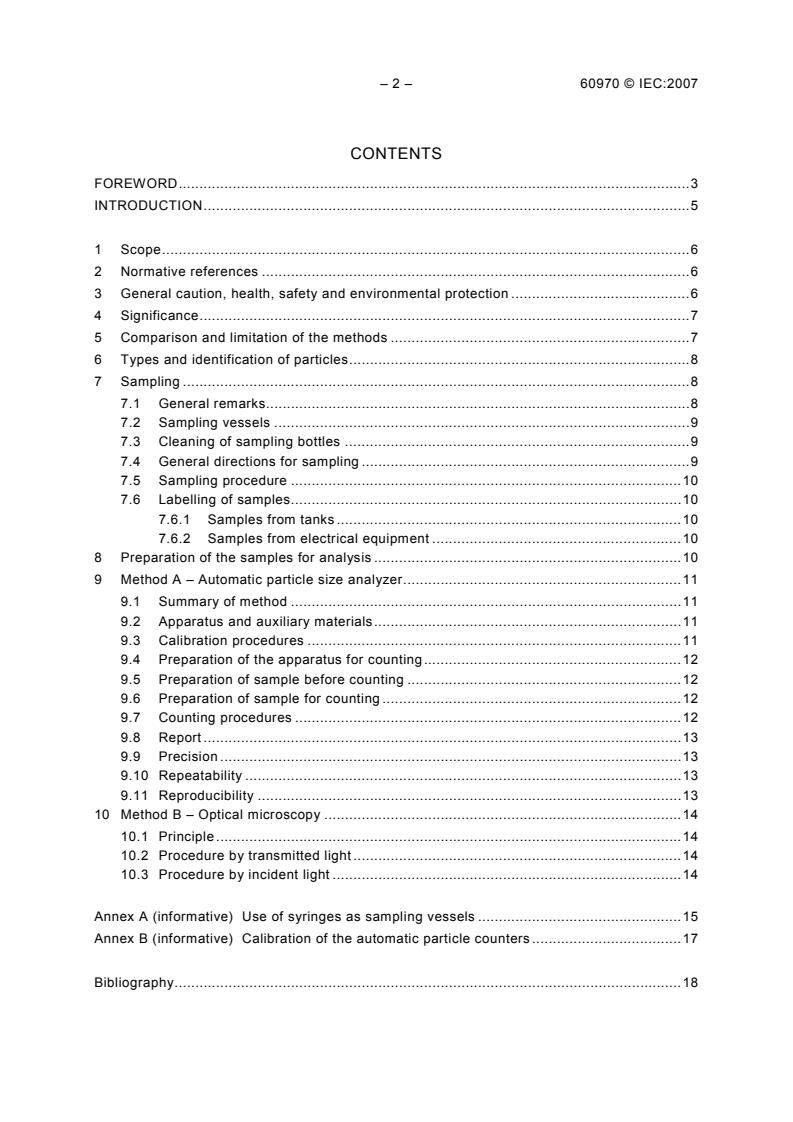
– 2 – 60970 © IEC:2007
CONTENTS
FOREWORD.3
INTRODUCTION.5
1 Scope.6
2 Normative references .6
3 General caution, health, safety and environmental protection .6
4 Significance.7
5 Comparison and limitation of the methods .7
6 Types and identification of particles.8
7 Sampling .8
7.1 General remarks.8
7.2 Sampling vessels .9
7.3 Cleaning of sampling bottles .9
7.4 General directions for sampling .9
7.5 Sampling procedure .10
7.6 Labelling of samples.10
7.6.1 Samples from tanks .10
7.6.2 Samples from electrical equipment .10
8 Preparation of the samples for analysis .10
9 Method A – Automatic particle size analyzer.11
9.1 Summary of method .11
9.2 Apparatus and auxiliary materials.11
9.3 Calibration procedures .11
9.4 Preparation of the apparatus for counting.12
9.5 Preparation of sample before counting .12
9.6 Preparation of sample for counting .12
9.7 Counting procedures .12
9.8 Report .13
9.9 Precision .13
9.10 Repeatability .13
9.11 Reproducibility .13
10 Method B – Optical microscopy .14
10.1 Principle.14
10.2 Procedure by transmitted light .14
10.3 Procedure by incident light .14
Annex A (informative) Use of syringes as sampling vessels .15
Annex B (informative) Calibration of the automatic particle counters .17
Bibliography.18
60970 © IEC:2007 – 3 –
INTERNATIONAL ELECTROTECHNICAL COMMISSION
____________
INSULATING LIQUIDS – METHODS FOR COUNTING AND SIZING
PARTICLES
FOREWORD
1) The International Electrotechnical Commission (IEC) is a worldwide organization for standardization comprising
all national electrotechnical committees (IEC National Committees). The object of IEC is to promote
international co-operation on all questions concerning standardization in the electrical and electronic fields. To
this end and in addition to other activities, IEC publishes International Standards, Technical Specifications,
Technical Reports, Publicly Available Specifications (PAS) and Guides (hereafter referred to as “IEC
Publication(s)”). Their preparation is entrusted to technical committees; any IEC National Committee interested
in the subject dealt with may participate in this preparatory work. International, governmental and non-
governmental organizations liaising with the IEC also participate in this preparation. IEC collaborates closely
with the International Organization for Standardization (ISO) in accordance with conditions determined by
agreement between the two organizations.
2) The formal decisions or agreements of IEC on technical matters express, as nearly as possible, an international
consensus of opinion on the relevant subjects since each technical committee has representation from all
interested IEC National Committees.
3) IEC Publications have the form of recommendations for international use and are accepted by IEC National
Committees in that sense. While all reasonable efforts are made to ensure that the technical content of IEC
Publications is accurate, IEC cannot be held responsible for the way in which they are used or for any
misinterpretation by any end user.
4) In order to promote international uniformity, IEC National Committees undertake to apply IEC Publications
transparently to the maximum extent possible in their national and regional publications. Any divergence
between any IEC Publication and the corresponding national or regional publication shall be clearly indicated in
the latter.
5) IEC provides no marking procedure to indicate its approval and cannot be rendered responsible for any
equipment declared to be in conformity with an IEC Publication.
6) All users should ensure that they have the latest edition of this publication.
7) No liability shall attach to IEC or its directors, employees, servants or agents including individual experts and
members of its technical committees and IEC National Committees for any personal injury, property damage or
other damage of any nature whatsoever, whether direct or indirect, or for costs (including legal fees) and
expenses arising out of the publication, use of, or reliance upon, this IEC Publication or any other IEC
Publications.
8) Attention is drawn to the Normative references cited in this publication. Use of the referenced publications is
indispensable for the correct application of this publication.
9) Attention is drawn to the possibility that some of the elements of this IEC Publication may be the subject of
patent rights. IEC shall not be held responsible for identifying any or all such patent rights.
International Standard IEC 60970 has been prepared by IEC technical committee 10: Fluids
for electrotechnical applications.
This second edition cancels and replaces the first edition published in 1989. This edition
constitutes a technical revision.
The significant technical changes with respect to the previous edition are as follows:
– new calibration procedures for automated laser particle;
– three figures contamination code;
– new procedure of sample pre-treatment when automated laser counter method are used.
– 4 – 60970 © IEC:2007
The text of this standard is based on the following documents:
FDIS Report on voting
10/695/FDIS 10/714/RVD
Full information on the voting for the approval of this standard can be found in the report on
voting indicated in the above table.
This publication has been drafted in accordance with the ISO/IEC Directives, Part 2.
The committee has decided that the contents of this publication will remain unchanged until
the maintenance result date indicated on the IEC web site under "http://webstore.iec.ch" in
the data related to the specific publication. At this date, the publication will be
• reconfirmed;
• withdrawn;
• replaced by a revised edition, or
• amended.
60970 © IEC:2007 – 5 –
INTRODUCTION
The first edition of this standard was published in 1989, and confirmed in 1996. The present
edition has been found necessary for consistency with the new ISO 4406:1999, in which
calibration procedures for automated particles counters have been changed from ACFTD
standard to ISO-MTD standard. Specific procedures for sample preparation are described in
more detail when automated particle counters are used. Results and ISO Code reporting are
consistent with ISO 4406:1999 standard. Repeatability and reproducibility data are reported.
It has been demonstrated that particle contamination of insulating liquids used in electrical
equipment have been responsible for major faults [1] . Particle analysis is recommended (as
complementary test) by IEC 60422[3] for power transformers with nominal voltage above
170 kV[2].
Particle counting and sizing is usually carried out using automated counters; the calibration
standard for these counters was changed in 1999. The ISO reporting code has also been
changed from a two-figure to a three-figure code. This code gives information on three
classes of cumulative counting: particles/ml with ∅ > 4 μm, particles/ml with ∅ > 6 μm,
particles/ml with ∅ > 14 μm. Particle analysis with automated particle counters has been
thoroughly investigated to verify factors influencing the results and to optimize the analysis
procedure. Reference figures for repeatability and Reproducibility are reported, for particle
counting and for ISO Class.
Annex A provides information about sampling with syringes. Annex B reports a reference for
ISO MTD calibration procedure.
___________
Figures in square brackets refer to the bibliography.
– 6 – 60970 © IEC:2007
INSULATING LIQUIDS – METHODS FOR COUNTING AND SIZING
PARTICLES
1 Scope
This standard describes the sampling procedures and methods for the determination of
particle concentration and size distribution.
Three methods are specified. One uses an automatic particle size analyser, working on the
light interruption principle. The other two use an optical microscope, in either the transmitted
light or incident light mode, to count particles collected on the surface of a membrane filter.
The optical microscope methods are described in ISO 4407.
All three methods are applicable to both used and unused insulating liquids.
Annex A contains an alternative sampling procedure using a syringe and Annex B reports a
reference for the calibration of automatic particle counters.
NOTE 1 The methods are not intended to measure particulate matter in liquids containing sludge. While analysing
solid content on oils containing sludge refers to method for sediment and sludge determination in IEC 60422,
Annex C.
NOTE 2 The methods specified are only applicable to measurements related to a limited range of size and
number.
2 Normative references
The following referenced documents are indispensable for the application of this document.
For dated references, only the edition cited applies. For undated references, the latest edition
of the referenced document (including any amendments) applies.
IEC 60475: Method of sampling liquid dielectrics
ISO 4406: Hydraulic fluid power – Fluids – Method for coding the level of contamination by
solid particles
ISO 4407: Hydraulic fluid power – Fluid contamination – Determination of particulate
contamination by the counting method using an optical microscope
ISO 5884: Aerospace – Fluid systems and components – Methods for sampling and
measuring the solid particle contamination of hydraulic fluids
EN 50353: Insulating oil – Determination of fibre contamination by the counting method using
a microscope
3 General caution, health, safety and environmental protection
This International Standard does not purport to address all the safety problems associated
with its use. It is the responsibility of the user of the standard to establish appropriate health
and safety practices and determine the applicability of regulatory limitations prior to use.
The insulating liquids which are the subject of this standard should be handled with due
regard to personal hygiene. Direct contact with the eyes may cause irritation. In the case of
eye contact, irrigation with copious quantities of clean running water should be carried out
60970 © IEC:2007 – 7 –
and medical advice sought. Some of the tests specified in this standard involve the use of
processes that could lead to a hazardous situation. Attention is drawn to the relevant standard
for guidance.
This standard is applicable to insulating liquids and used sample containers, the disposal or
decontamination of which must be done according to local regulations. Every precaution
should be taken to prevent release of mineral oil into the environment.
4 Significance
It is well known that particles have a detrimental effect on the dielectric strength of insulating
liquids. It has long been the practice to include in specifications of insulating liquids the
requirement that the fluid be clear and free of visible particulate matter. However, there has
been no standard method for quantitative estimates, so that practices have differed. This
standard gives standard procedures for the test.
Filtration of insulating liquids is an established practice in the electrical industry. The
procedure described may serve to assess the performance of the filter system. The results
obtained are dependent upon the method used. With the automatic counter the measured
values also depend on the calibration procedure and in particular on the calibration material.
It is therefore essential that the methods of analysis and the calibration standards are
specified when quoting results.
The particle content of a sample may depend on different transformer parameters as well as
the condition of the oil itself.
Storage may affect the sample, due to sedimentation and/or coalescence of particles. Shaking
of the sample before analysis will be necessary.
5 Comparison and limitation of the methods
Automatic particle counters using the light interruption principle are quick and easy to use, but
the following points should be borne in mind:
– With some liquids it may be necessary to modify their viscosity to comply with the
operating parameters of the instrument.
– It is necessary to choose a sensor head suitable for counting in the size range required.
No single head can count both very small particles (<2 µm) and very large particles
(>200 µm).
– The instrument records the light interruption area of the particle and from this calculates
the diameter of a sphere having the equivalent area or the longer axis of a specified
ellipsoid with the same area, as established by ISO 4407. When measurements are
carried out with automatic particle counters, the reported sizes are expressed as μm(c) to
indicate that the particle size has been calculated from the observed cross-sectional area.
Particle sizes from optical microscope counting are expressed as μm. The relationship
between the two units is described in ISO 4406:
• 6 μm(c) corresponds to 5 μm
• 14 μm(c) corresponds to 15 μm.
– Automatic counters give no information as to the shape of the particles, and this
constitutes a limitation with respect to the recognition of fibres. Their narrow and
elongated shape results in a slight light obscuration and consequently in a very small
equivalent sphere diameter. The results obtained can be different from those obtained by
microscope counting. When it is important to evaluate the concentration of fibres,
automatic counters cannot perform this task adequately.
– When air-saturated or over-saturated liquids are shaken manually or in a shaking machine,
or given high-energy ultrasonic treatment, finely dispersed micro-bubbles may be formed
– 8 – 60970 © IEC:2007
in the liquid. In the optical system of the automatic counter, these micro-bubbles will be
counted as solid particles.
– These difficulties are avoided when using either of the optical microscopic methods. In
addition, optical microscopy may give some information about the types of particles
present. These methods are, however, much more time-consuming and operator
dependent and may be very difficult to count particles of less than 5 µm.
6 Types and identification of particles
The origins of particles found in insulating liquids are manifold.
In new, unenergized, equipment the insulating liquid may contain cellulose fibres plus
particles from the manufacturing process. These could include iron, aluminium, brass, welding
cinder and sandblasting materials.
Insulating liquids in working transformers, at both normal and overload temperatures, slowly
acquire soot and sludge particles. Localised overheating over 500 ºC could be a source of
carbon. The carbon particles produced in the OLTC diverter may migrate by leakage,
accidents or human error into the bulk fluid compartment and contaminate the full charge.
A typical source of metallic particles is from pump bearing wear, although corrosion and
arcing on metallic components may also produce particles.
Cellulose lint, sand, dust and particles of varnish, plastic or rubber can also be found in the
fluid of transformers in service.
A knowledge of which particle types are present in the insulating liquid can, in certain cases,
help in assessing the conditions of the equipment, in diagnosing a fault or indicating a risk of
failure. The most dangerous particles are the conductive ones (metals, carbon, wet fibres,
etc.). Particle identification and counting have been found to be necessary procedures of
condition monitoring (CIGRE brochures 157[1] and 227[2]).
Certain particles may be identified by filtering a sample through a membrane filter and
examining the residue under a microscope (EN 50353). At this stage some fibres can be
identified using the dispersion staining technique and a number of metals by means of spot
tests or micro chemical methods. Metallic particles can be better identified and quantified by
instrumental analytical methods such as atomic absorption spectroscopy (AAS), induced
coupled plasma (ICP-AES), and wet chemical analysis. A detailed description of methods for
the identification of particles is, however, outside the scope of this standard.
7 Sampling
7.1 General remarks
The sample taken should only be used for the particle count determination. Further analysis
may be done on the residual sample, but after the particle count determination.
The particle content of a sample is also dependant on the sampling point, time elapsed since
the transformer was filled, the circulation rate and the time that the transformer has been left
to stand prior to sampling.
With used liquids, oxidation products which are soluble at operating temperatures may
precipitate when the sample is allowed to stand at room temperature for a prolonged period.
This process, which is dependent upon the service age of the liquid, the time between
sampling and analysis and the storage temperature, can affect the particle count.
For the above mentioned reasons, sampling is the main source of spreading of results.
60970 © IEC:2007 – 9 –
7.2 Sampling vessels
The sampling vessels recommended in this standard are cylindrical, flat-bottomed, wide-
necked, clear glass bottles fitted with a polypropylene threaded cap forming a seal with the
bottle without the use of any inserts.
When an automatic particle size analyzer is used, the volume sampled shall be enough to
allow a proper rinsing of the instrument’s dead volume and measuring cell before the analysis.
For microscopy, the bottles shall have at least 100 cm³ capacity and be permanently marked
to indicate 100 cm³ sample size.
An alternative method for insulating liquids in service using syringes as sampling vessels is
given in Annex A.
7.3 Cleaning of sampling bottles
It is recommended that the bottles be cleaned to achieve a blank count of less than 200
particles above 5 µm per 100 cm³. The test should be performed on the filtered solvent used
in the last stage of the cleaning process.
A cleaning method is given for guidance, but other methods can be used provided they
achieve a similar or greater degree of cleanliness.
a) Wash with warm water containing a detergent
b Rinse with warm water and drain
c) Rinse thoroughly with 0,45 µm membrane filtered acetone to remove water
d) Rinse with 0,45 µm membrane filtered petroleum ether 40 °C to 70 °C or with another
suitable solvent. Leave 1 cm³ or 2 cm³ of solvent in the bottle and close the bottle.
If ultrasonic agitation is used before counting particles, the cleaning procedure must include
ultrasonic treatment. Reject the procedure outlined in stage c) and instead place the sample
bottle, filled with 0,45 µm membrane filtered acetone, in an ultrasonic bath for 1 min.
A residue of solvent in the bottle creates a positive pressure in the bottle helping to prevent
contamination from the atmosphere when opening the bottle.
Warning: Attention is called to national regulations associated with the use of solvents.
The use of purchased sample bottles cleaned in accordance with ISO 5884 is allowed.
7.4 General directions for sampling
It is difficult to obtain representative samples from a drum. If sampling is found to be
necessary, the procedure given in Annex A may be used or, alternatively, the procedures
given in IEC 60475. In the case of sealed power transformers and instrument transformers or
similar equipment with small liquid volume, the manufacturer’s instructions on sampling
procedure and quantity shall be followed. A sample from a transformer should preferably be
taken during fluid circulation or immediately afterwards. The analysis obtained may depend on
the sampling point selected. Confirmatory or follow-up samples should therefore always be
taken from the same point.
Every precaution shall be taken when sampling not to contaminate the sample.
Outdoor sampling of insulating liquids in rain, fog, snowfall or high wind is only permitted if all
precautions are taken to avoid contamination of the samples. In this special case the use of a
cover is necessary.
– 10 – 60970 © IEC:2007
Ensure that sampling is done by an experienced person.
7.5 Sampling procedure
Prior to taking the sample, the exterior of the sampling valve and the adjacent parts shall be
thoroughly cleaned using lint-free wiping materials.
– Connect a length of plastic tubing, which is resistant to the liquid being sampled, to the
sampling valve.
– If the sampling bottle contains filtered solvent, it may be necessary at low ambient
temperature to warm the bottle with the hands, in order to create a positive pressure and
thereby prevent the ingress of atmospheric particulate matter.
Warning: Petroleum ether, as well as many of its alternatives, is a highly flammable solvent, and appropriate
safety measures must be observed when the bottle is opened.
– Thoroughly flush the valve and by draining a sufficient quantity of liquid into a waste
container. The adequate draining volume depends on the total oil volume of the equipment
(for big power units 5 l is recommended).
– Remove the cap from the bottle; do not empty out the solvent. Without interrupting the
flow from the valve, substitute the bottle for the waste container and collect the required
volume of sample as quickly as possible. Then remove the sample bottle and replace the
waste container.
– Replace the bottle cap without over tightening.
– Close the sampling valve and replace any protection. Label the sample.
The sample shall be protected against light during transportation and storage.
7.6 Labelling of samples
7.6.1 Samples from tanks
Labels shall carry the following markings:
– tank identification;
– sampling point;
– type of insulating liquid;
– date of sampling.
7.6.2 Samples from electrical equipment
Labels shall carry the following markings:
– equipment identification;
– sampling point;
– equipment in factory/in service;
– liquid identification;
– temperature of liquid;
– date of sampling.
8 Preparation of the samples for analysis
Samples should be processed as soon as possible after sampling, because their long storage
will generally lead to sedimentation of particles. Fine particles may also coalesce to form
larger particles. For the above mentioned reasons, a shaking procedure will be necessary.
60970 © IEC:2007 – 11 –
When automatic particle analysers are used, a detailed procedure for sample treatment is
described in Clause 9 (Method A – Automatic particle size analyzer).
If high-energy ultrasonic treatment or higher shear mixing is used, there is a risk that the
particle count determined will be enhanced owing to breakdown of sludge and other large
particles and also that finely dispersed micro bubbles are formed in the liquid. If too high a
vacuum is applied to air-saturated liquids, more micro bubbles may be released from the
liquid.
NOTE It is advisable that the agitation and vacuum procedure developed be tested for effectiveness. This can be
done by taking several samples simultaneously. One sample is tested immediately after sampling, with no agitation
or vacuum treatment at all, another after treatment and a third after some storage time. The test should be applied
to liquids with a varying degree of particle content, state of ageing and air content.
For optical microscopy systems shaking can be done manually, in a shaking machine, or by
ultrasonic treatment (see Clause 10: Method B – Optical microscopy).
9 Method A – Automatic particle size analyzer
9.1 Summary of method
The sample is agitated to suspend the particles, then passed at an optimum flow rate through
the sensor unit of the particle counter. After the required fluid volume has been passed
through the sensor the count is terminated and the results recorded.
9.2 Apparatus and auxiliary materials
– An automatic particle counter fitted with a sensor operating on the light interruption
principle and suitable for counting within the range of 2,0 µm to greater than 200 µm. The
automatic particle counter shall be capable of:
• Sorting particles into at least > 4μm, > 6 μm, > 14 μm size ranges.
• Providing a specific particle count and distribution for a measured quantity of reference
material to a precision of ±10 % of the total count.
• Not saturating (i.e. providing a lower than expected count as a result of particle
coincidence within the sensing zone) when analysing a suspension containing less
than 2 000 particles per millilitre of fluid.
NOTE Alternative detectors may be used to extend the size range of the particles measured.
– Compressed gas – a pressurized source of air or nitrogen free from oil or water
contamination filtered through a 0,45 µm membrane filter. The capacity, pressure range
and constant pressure controls should meet the requirements of the particular equipment
in use.
– Solvent dispenser fitted with a 0,45 µm membrane filter at the outlet.
– Solvent – petroleum ether with a boiling-range of 40 °C to 70 °C, or suitable alternative
filtered through a 0,45 µm membrane filter.
– Detergent – liquid, water soluble, commercial grade.
– Calibration standard ISO MTD.
– Ultrasonic bath.
9.3 Calibration procedures
The calibration of the instrument shall be carried out using one of the procedures given in
Annex B.
Calibration should be advisably carried out annually or when any repair/change is made to the
sensor or whenever results are suspect. It is recommended to check instrument’s
performance at least each 6 months, by analysing a standard sample of standard reference
material (SRM). The results must be consistent with the reproducibility in 9.11.
– 12 – 60970 © IEC:2007
NOTE Laboratory reference materials (LRM) can be used for instrument’s checks if their stability and uncertainty
are demonstrated to be equivalent to standard reference materials.
9.4 Preparation of the apparatus for counting
Check that the instrument is set to the calibration numbers for the required size ranges in
accordance with the procedure given in the instrument manual.
When the instrument has been switched off, the check procedure shall be carried out prior to
use or daily, whichever is less frequent.
If the instrument is permanently switched on, the check procedure shall be carried out at least
monthly.
9.5 Preparation of sample before counting
– Remove any visible contamination from the exterior of the bottle.
– Samples which are found on visual examination to contain water or suspended solids (e.g.
sludge) likely to affect the performance of the sensor shall be rejected.
– Sample dilution should be avoided as far as possible. However, if in order to comply with
the instrument operating parameters dilution is necessary then a liquid of the same type
as the sample, or a compatible solvent, may be used. The solvent must be filtered through
a 0,45 µm membrane before mixing. Then record the dilution ratio.
NOTE In order to meet the instrument operating parameters, the viscosity of the liquid may be modified by
heating. In this case, due regard to the instrument manufacturer’s recommendations regarding sensor life should
be noted. It should also be established that the precision obtained is acceptable. If sample heating is applied, note
the analysis temperature on the Report of results.
9.6 Preparation of sample for counting
– Detach particles coalesced on the vessel by immersing the bottle in an ultrasonic bath for
5 min.
– Shake vigorously by hand for 30 s.
NOTE Suitable mechanical apparatus can be used for shaking several samples at the same time
– After shaking the sample must be degassed by immersing the bottle in an ultrasonic bath
for 5 min.
NOTE Vacuum degassing can either be used, if a sufficient repeatability can be achieved (see 9.10). It is
advisable, when using automatic bottle sampling apparatus, that the sensor uptake tube be filled with the test
fluid before applying the vacuum.
– Count the sample immediately after the degassing stage. If unable to count within 2 min
then the particle suspension shall be maintained by continuous rolling of the sample
container.
9.7 Counting procedures
– The counting procedure shall be carried out in accordance with the instrument
manufacturer’s operating instructions, paying particular attention to the required flow rate
and selecting the cumulative mode of counting.
– The sample shall be counted in at least three equal volumes, greater than or equal to 10
millilitres. These three counts should agree within 10 % in the smallest size range (> 4
μm). If this requirement is not attained the sample shall be discarded or re-agitated and
re-counted.
NOTE The above minimum count of 20 particles ensures that the counting reproducibility is in accordance
with 9.11 of this standard.
– After each sample has been counted remove the sample bottle and flush the system with
solvent, filtered through a 0,45 µm membrane filter. It is not recommended that the sensor
be dried out after flushing.
– Calculate the particle concentration in each size range from the mean of the counts
obtained for each sample aliquot, taking into account the volume of the aliquot and the
dilution ratio.
60970 © IEC:2007 – 13 –
9.8 Report
Report the cumulative number of particles per millilitre of the original sample in at least the
following size ranges (see notes):
– ISO code, expressed according to ISO 4406:
• (AA)/BB/CC
• AA is the scale number representing the number of particles equal to or larger then 4
μm(c) per millilitre of fluid
• BB is the scale number representing the number of particles equal to or larger then 6
μm (c) per millilitre of fluid
• CC is the scale number representing the number of particles equal to or larger then 14
μm (c) per millilitre of fluid
NOTE 1 The μm(c) notation of the size ranges means that the measurement is carried out using an
automatic particle counter which has been calibrated in accordance with ISO 11171[4] (ISO MTD
calibration).
NOTE 2 When the raw data in one of the size ranges results in an actual particle count of fewer then 20
particles, the scale number for that size range should be labelled as: ≥ scale number (e.g.: a code of
14/12/≥7 signifies that the counting for size range of 14 μm(c) was more than 0,64 and up to and including
1,3 particles, but less than 20 particles were counted).
NOTE 3 When the raw data in one of the size ranges is ‘too numerous to count’ report a «*» sign (e.g.: a
code of */22/7).
NOTE 4 When no counts are detected in one of the size ranges report a «-» sign (e.g.: a code of 12/9/-).
NOTE 5 According to ISO 4406, size ranges of 6 µm (c) and 14 µm (c) are equivalent to the old 5 µm
and 15 µm particle sizes obtained using the now defunct ISO 4402:1991[5] method of calibrating
automatic particle counters.
– Total number of particles (where p is the diameter in micrometers)
• p > 4 μm(c)
• p > 6 μm(c)
• p > 14 μm(c)
– The report shall also include the following:
• method of calibration;
• date of sampling;
• date of analysis.
9.9 Precision
Precision data for this method has been provided by a round robin test performed on three
samples of mineral insulating oil taken from transformers with different levels of particle
contamination.
NOTE Repeatability and reproducibility are referred to a 95 % confidence level.
9.10 Repeatability
The repeatability has been estimated independently by different laboratories by preparing
sample batches of mineral oil and making 7 to 10 replications of the analysis.
When the same laboratory analyses twice the same sample, the difference in each one of the
three scale numbers of the ISO code should not exceed 1.
9.11 Reproducibility
The reproducibility has been estimated on the results provided by different laboratories on the
same samples.
– 14 – 60970 © IEC:2007
When different laboratories analyse the same sample, the difference in each one of the three
scale numbers of the ISO code should not exceed 2.
10 Method B – Optical microscopy
10.1 Principle
A known volume of insulating liquid is filtered under vacuum conditions through a membrane
filter to collect contaminants on the filter surface. The membrane is then mounted between
glass slides and examined microscopically by transmitted or incident light to measure, count
and size particles according to their largest dimension.
10.2 Procedure by transmitted light
Counting and sizing of particulate matter microscopically by transmitted light shall be made
according to the procedure described in ISO 4407.
10.3 Procedure by incident light
Counting and sizing of particulate matter by incident light shall be made according to the
procedure described in ISO 4407.
60970 © IEC:2007 – 15 –
Annex A
(informative)
Use of syringes as sampling vessels
A.1 Type of syringe
Syringes shall be made of glass, polypropylene or other suitable polymeric materials and have
a volume of at least 150 cm³ when using automatic counters. For microscopy, the syringe
capacity shall be at least 100 cm³.
NOTE This will, however, reduce the accuracy of the result. For liquids with a high particle content one syringe
with 50 cm³ capacity may suffice.
A.2 Cleaning of syringes
The same procedure as for bottles (see 7.2) can be used, except that no solvent shall be left
in the syringe.
A.3 General directions for sampling
The same considerations given in 7.4 apply here.
A.4 Sampling from apparatus or tank with sampling valve
Prior to taking the sample, the exterior of the sampling valve and the adjacent parts shall be
thoroughly cleaned with lint-free wiping materials.
– Connect the sampling valve directly to a two-way cock with a plastic tube resistant to the
liquid.
– Thoroughly flush the sampling valve, the tube and the two-way cock by draining a
sufficient quantity of liquid into a waste container.
– Connect the syringe directly to the two-way cock and take the sample.
– Disconnect the syringe and plug its bottom.
– Close the sampling valve and replace any protection.
– The sample shall be protected against light during transportation and storage.
A.5 Sampling from tank or drum without bottom valve
– Connect a two-way cock to a plastic tube resistant to the liquid.
– Plunge the tube into the container.
– Connect a syringe to the two-way cock.
– Suck a sufficient quantity of liquid to rinse the system, by repeatedly filling and emptying
the syringe.
– Replace the syringe with a new one and take the sample.
– Disconnect the syringe and plug its bottom.
The sample shall be protected against light during transportation and storage.
– 16 – 60970 © IEC:2007
A.6 Labelling of samples
See 7.6.
A.7 Preparation of the samples for analysis
See Clause 8.
60970 © IEC:2007 – 17 –
Annex B
(informative)
Calibration of the automatic particle counters
Calibration of automatic particle counters should be done with ISO MTD material (NIST
standard reference material SRM 2806) and accomplished according to ISO 11171.
– 18 – 60970 © IEC:2007
Bibliography
[1] J. Aubin et al., «Effect of particles on transformer dielectric strength», Final Report of
Cigre SC 12, WG 17 (Particles in Oil), CIGRE Technical Brochure 157.
[2] V. Sokolov et al., «Life management techniques for power transformers», Final Report
of Cigre SC A2 WG 18, CIGRE Technical Brochure 227.
[3] IEC 60422: Mineral insulating oils in electrical equipment – Supervision and
maintenance guidance
[4] ISO 11171: Hydraulic fluid power – Calibration of automatic particle counters for
liquids
[5] ISO 4402: Hydraulic fluid power – Calibration of liquid automatic particle-count
instruments – Method using Air Cleaner Fine Test Dust contaminant
___________
– 20 – 60970 © CEI:2007
SOMMAIRE
AVANT-PROPOS.
...