


IEC TS 62657-1:2014
(Main)Industrial communication networks - Wireless communication networks - Part 1: Wireless communication requirements and spectrum considerations
General Information
- Abstract
IEC TS 62657-1:2014(en) provides the wireless communication requirements dictated by the applications of wireless communication systems in industrial automation, and requirements of related context. The requirements are specified in a way that is independent of the wireless technology employed. The requirements are described in detail and in such a way as to be understood by a large audience, including readers who are not familiar with the industry applications. Social aspects, environmental aspects, health aspects and market requirements for wireless communication systems in industrial automation are described to justify the wireless communication requirements. This Technical Specification describes requirements of the industrial automation applications that can be used to ask for additional dedicated, worldwide unique spectrum. This additional spectrum is intended to be used for additional wireless applications while continuing using the current ISM bands.
- Status
- Replaced
- Publication Date
- 23-Apr-2014
- Technical Committee
- SC 65C - Industrial networks
- Drafting Committee
- WG 17 - TC 65/SC 65C/WG 17
- Current Stage
- DELPUB - Deleted Publication
- Start Date
- 19-Jun-2017
- Completion Date
- 28-Aug-2026
Buy Documents
IEC TS 62657-1:2014 - Industrial communication networks - Wireless communication networks - Part 1: Wireless communication requirements and spectrum considerations Released:4/24/2014
IEC TS 62657-1:2014 - Industrial communication networks - Wireless communication networks - Part 1: Wireless communication requirements and spectrum considerations/24/2014
Relations
- Effective Date
- 05-Sep-2023
Buy Documents
IEC TS 62657-1:2014 - Industrial communication networks - Wireless communication networks - Part 1: Wireless communication requirements and spectrum considerations Released:4/24/2014
IEC TS 62657-1:2014 - Industrial communication networks - Wireless communication networks - Part 1: Wireless communication requirements and spectrum considerations/24/2014
Get Certified
Connect with accredited certification bodies for this standard

BSI Group
BSI (British Standards Institution) is the business standards company that helps organizations make excellence a habit.

DVS-ZERT GmbH
German welding certification society.

NYCE
Mexican standards and certification body.
Sponsored listings
Frequently Asked Questions
IEC TS 62657-1:2014 is a technical specification published by the International Electrotechnical Commission (IEC). Its full title is "Industrial communication networks - Wireless communication networks - Part 1: Wireless communication requirements and spectrum considerations". This standard covers: IEC TS 62657-1:2014(en) provides the wireless communication requirements dictated by the applications of wireless communication systems in industrial automation, and requirements of related context. The requirements are specified in a way that is independent of the wireless technology employed. The requirements are described in detail and in such a way as to be understood by a large audience, including readers who are not familiar with the industry applications. Social aspects, environmental aspects, health aspects and market requirements for wireless communication systems in industrial automation are described to justify the wireless communication requirements. This Technical Specification describes requirements of the industrial automation applications that can be used to ask for additional dedicated, worldwide unique spectrum. This additional spectrum is intended to be used for additional wireless applications while continuing using the current ISM bands.
IEC TS 62657-1:2014(en) provides the wireless communication requirements dictated by the applications of wireless communication systems in industrial automation, and requirements of related context. The requirements are specified in a way that is independent of the wireless technology employed. The requirements are described in detail and in such a way as to be understood by a large audience, including readers who are not familiar with the industry applications. Social aspects, environmental aspects, health aspects and market requirements for wireless communication systems in industrial automation are described to justify the wireless communication requirements. This Technical Specification describes requirements of the industrial automation applications that can be used to ask for additional dedicated, worldwide unique spectrum. This additional spectrum is intended to be used for additional wireless applications while continuing using the current ISM bands.
IEC TS 62657-1:2014 is classified under the following ICS (International Classification for Standards) categories: 25.040.40 - Industrial process measurement and control; 31.220.10 - Plug-and-socket devices. Connectors; 33.040.40 - Data communication networks; 35.100.05 - Multilayer applications. The ICS classification helps identify the subject area and facilitates finding related standards.
IEC TS 62657-1:2014 has the following relationships with other standards: It is inter standard links to IEC 62657-1:2017. Understanding these relationships helps ensure you are using the most current and applicable version of the standard.
IEC TS 62657-1:2014 is available in PDF format for immediate download after purchase. The document can be added to your cart and obtained through the secure checkout process. Digital delivery ensures instant access to the complete standard document.
Standards Content (Sample)
IEC TS 62657-1 ®
Edition 1.0 2014-04
TECHNICAL
SPECIFICATION
colour
inside
Industrial communication networks – Wireless communication networks –
Part 1: Wireless communication requirements and spectrum considerations
All rights reserved. Unless otherwise specified, no part of this publication may be reproduced or utilized in any form
or by any means, electronic or mechanical, including photocopying and microfilm, without permission in writing from
either IEC or IEC's member National Committee in the country of the requester. If you have any questions about IEC
copyright or have an enquiry about obtaining additional rights to this publication, please contact the address below or
your local IEC member National Committee for further information.
IEC Central Office Tel.: +41 22 919 02 11
3, rue de Varembé Fax: +41 22 919 03 00
CH-1211 Geneva 20 info@iec.ch
Switzerland www.iec.ch
About the IEC
The International Electrotechnical Commission (IEC) is the leading global organization that prepares and publishes
International Standards for all electrical, electronic and related technologies.
About IEC publications
The technical content of IEC publications is kept under constant review by the IEC. Please make sure that you have the
latest edition, a corrigenda or an amendment might have been published.
IEC Catalogue - webstore.iec.ch/catalogue Electropedia - www.electropedia.org
The stand-alone application for consulting the entire The world's leading online dictionary of electronic and
bibliographical information on IEC International Standards, electrical terms containing more than 30 000 terms and
Technical Specifications, Technical Reports and other definitions in English and French, with equivalent terms in 14
documents. Available for PC, Mac OS, Android Tablets and additional languages. Also known as the International
iPad. Electrotechnical Vocabulary (IEV) online.
IEC publications search - www.iec.ch/searchpub IEC Glossary - std.iec.ch/glossary
The advanced search enables to find IEC publications by a More than 55 000 electrotechnical terminology entries in
variety of criteria (reference number, text, technical English and French extracted from the Terms and Definitions
committee,…). It also gives information on projects, replaced clause of IEC publications issued since 2002. Some entries
and withdrawn publications. have been collected from earlier publications of IEC TC 37,
77, 86 and CISPR.
IEC Just Published - webstore.iec.ch/justpublished
Stay up to date on all new IEC publications. Just Published IEC Customer Service Centre - webstore.iec.ch/csc
details all new publications released. Available online and If you wish to give us your feedback on this publication or
also once a month by email. need further assistance, please contact the Customer Service
Centre: csc@iec.ch.
IEC TS 62657-1 ®
Edition 1.0 2014-04
TECHNICAL
SPECIFICATION
colour
inside
Industrial communication networks – Wireless communication networks –
Part 1: Wireless communication requirements and spectrum considerations
INTERNATIONAL
ELECTROTECHNICAL
COMMISSION
PRICE CODE
X
ICS 25.040; 33.040.40; 35.100; 35.240.50 ISBN 978-2-8322-1484-8
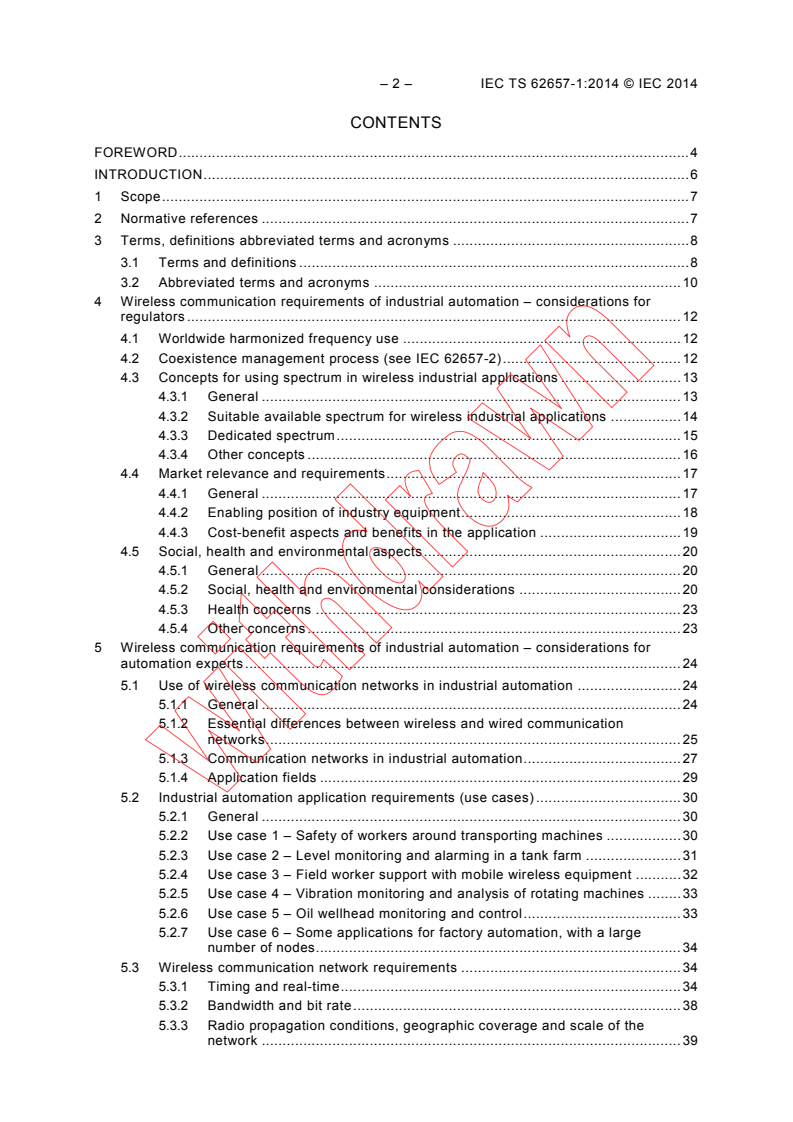
– 2 – IEC TS 62657-1:2014 © IEC 2014
CONTENTS
FOREWORD . 4
INTRODUCTION . 6
1 Scope . 7
2 Normative references . 7
3 Terms, definitions abbreviated terms and acronyms . 8
3.1 Terms and definitions . 8
3.2 Abbreviated terms and acronyms . 10
4 Wireless communication requirements of industrial automation – considerations for
regulators . 12
4.1 Worldwide harmonized frequency use . 12
4.2 Coexistence management process (see IEC 62657-2) . 12
4.3 Concepts for using spectrum in wireless industrial applications . 13
4.3.1 General . 13
4.3.2 Suitable available spectrum for wireless industrial applications . 14
4.3.3 Dedicated spectrum . 15
4.3.4 Other concepts . 16
4.4 Market relevance and requirements . 17
4.4.1 General . 17
4.4.2 Enabling position of industry equipment . 18
4.4.3 Cost-benefit aspects and benefits in the application . 19
4.5 Social, health and environmental aspects . 20
4.5.1 General . 20
4.5.2 Social, health and environmental considerations . 20
4.5.3 Health concerns . 23
4.5.4 Other concerns . 23
5 Wireless communication requirements of industrial automation – considerations for
automation experts . 24
5.1 Use of wireless communication networks in industrial automation . 24
5.1.1 General . 24
5.1.2 Essential differences between wireless and wired communication
networks . 25
5.1.3 Communication networks in industrial automation . 27
5.1.4 Application fields . 29
5.2 Industrial automation application requirements (use cases) . 30
5.2.1 General . 30
5.2.2 Use case 1 – Safety of workers around transporting machines . 30
5.2.3 Use case 2 – Level monitoring and alarming in a tank farm . 31
5.2.4 Use case 3 – Field worker support with mobile wireless equipment . 32
5.2.5 Use case 4 – Vibration monitoring and analysis of rotating machines . 33
5.2.6 Use case 5 – Oil wellhead monitoring and control . 33
5.2.7 Use case 6 – Some applications for factory automation, with a large
number of nodes . 34
5.3 Wireless communication network requirements . 34
5.3.1 Timing and real-time . 34
5.3.2 Bandwidth and bit rate . 38
5.3.3 Radio propagation conditions, geographic coverage and scale of the
network . 39
5.3.4 Power consumption . 41
5.3.5 EMC . 42
5.3.6 Functional safety . 42
5.3.7 Security . 43
5.3.8 Availability, reliability . 44
Bibliography . 47
Figure 1 – End producer revenue . 18
Figure 2 – Typical risk reduction methods found in process plants . 21
Figure 3 – Wireless communication system interrelated with the automation pyramid . 28
Figure 4 – Example of graphical representation of consistent indicators. 36
Table 1 – Application communication requirements . 18
Table 2 – Structure of the communication networks used in the application fields . 25
Table 3 – Benefits of using wireless systems . 26
Table 4 – Examples of application grace time . 45
– 4 – IEC TS 62657-1:2014 © IEC 2014
INTERNATIONAL ELECTROTECHNICAL COMMISSION
____________
INDUSTRIAL COMMUNICATION NETWORKS –
WIRELESS COMMUNICATION NETWORKS –
Part 1: Wireless communication requirements
and spectrum considerations
FOREWORD
1) The International Electrotechnical Commission (IEC) is a worldwide organization for standardization comprising
all national electrotechnical committees (IEC National Committees). The object of IEC is to promote
international co-operation on all questions concerning standardization in the electrical and electronic fields. To
this end and in addition to other activities, IEC publishes International Standards, Technical Specifications,
Technical Reports, Publicly Available Specifications (PAS) and Guides (hereafter referred to as “IEC
Publication(s)”). Their preparation is entrusted to technical committees; any IEC National Committee interested
in the subject dealt with may participate in this preparatory work. International, governmental and non-
governmental organizations liaising with the IEC also participate in this preparation. IEC collaborates closely
with the International Organization for Standardization (ISO) in accordance with conditions determined by
agreement between the two organizations.
2) The formal decisions or agreements of IEC on technical matters express, as nearly as possible, an international
consensus of opinion on the relevant subjects since each technical committee has representation from all
interested IEC National Committees.
3) IEC Publications have the form of recommendations for international use and are accepted by IEC National
Committees in that sense. While all reasonable efforts are made to ensure that the technical content of IEC
Publications is accurate, IEC cannot be held responsible for the way in which they are used or for any
misinterpretation by any end user.
4) In order to promote international uniformity, IEC National Committees undertake to apply IEC Publications
transparently to the maximum extent possible in their national and regional publications. Any divergence
between any IEC Publication and the corresponding national or regional publication shall be clearly indicated in
the latter.
5) IEC itself does not provide any attestation of conformity. Independent certification bodies provide conformity
assessment services and, in some areas, access to IEC marks of conformity. IEC is not responsible for any
services carried out by independent certification bodies.
6) All users should ensure that they have the latest edition of this publication.
7) No liability shall attach to IEC or its directors, employees, servants or agents including individual experts and
members of its technical committees and IEC National Committees for any personal injury, property damage or
other damage of any nature whatsoever, whether direct or indirect, or for costs (including legal fees) and
expenses arising out of the publication, use of, or reliance upon, this IEC Publication or any other IEC
Publications.
8) Attention is drawn to the Normative references cited in this publication. Use of the referenced publications is
indispensable for the correct application of this publication.
9) Attention is drawn to the possibility that some of the elements of this IEC Publication may be the subject of
patent rights. IEC shall not be held responsible for identifying any or all such patent rights.
The main task of IEC technical committees is to prepare International Standards. In
exceptional circumstances, a technical committee may propose the publication of a technical
specification when
• the required support cannot be obtained for the publication of an International Standard,
despite repeated efforts, or
• the subject is still under technical development or where, for any other reason, there is the
future but no immediate possibility of an agreement on an International Standard.
Technical specifications are subject to review within three years of publication to decide
whether they can be transformed into International Standards.
IEC/TS 62657-1, which is a technical specification, has been prepared by subcommittee 65C:
Industrial networks, of IEC technical committee 65: Industrial-process measurement, control
and automation.
The text of this technical specification is based on the following documents:
Enquiry draft Report on voting
65C/741A/DTS 65C/749/RVC
Full information on the voting for the approval of this technical specification can be found in
the report on voting indicated in the above table.
This publication has been drafted in accordance with the ISO/IEC Directives, Part 2.
A list of all parts in the IEC 62657 series, published under the general title Industrial
communication networks – Wireless communication networks, can be found on the IEC
website.
The committee has decided that the contents of this publication will remain unchanged until
the stability date indicated on the IEC web site under "http://webstore.iec.ch" in the data
related to the specific publication. At this date, the publication will be
• transformed into an International standard,
• reconfirmed,
• withdrawn,
• replaced by a revised edition, or
• amended.
A bilingual version of this publication may be issued at a later date.
IMPORTANT – The 'colour inside' logo on the cover page of this publication indicates
that it contains colours which are considered to be useful for the correct
understanding of its contents. Users should therefore print this document using a
colour printer.
– 6 – IEC TS 62657-1:2014 © IEC 2014
INTRODUCTION
The IEC 62657 series has two parts:
Part 1: Wireless communication requirements and spectrum considerations
Part 2: Coexistence management
This part of IEC 62657 provides general requirements of industrial automation and spectrum
considerations that are the basis for industrial communication solutions. This Part 1 is
intended to facilitate harmonization of future adjustments to international, national, regional
and local regulations.
IEC 62657-2 provides the coexistence management concept and process. Based on the
coexistence management process, a predictable assuredness of coexistence can be achieved
for a given spectrum with certain application requirements.
INDUSTRIAL COMMUNICATION NETWORKS –
WIRELESS COMMUNICATION NETWORKS –
Part 1: Wireless communication requirements
and spectrum considerations
1 Scope
This Technical Specification provides the wireless communication requirements dictated by
the applications of wireless communication systems in industrial automation, and
requirements of related context. The requirements are specified in a way that is independent
of the wireless technology employed. The requirements are described in detail and in such a
way as to be understood by a large audience, including readers who are not familiar with the
industry applications.
Social aspects, environmental aspects, health aspects and market requirements for wireless
communication systems in industrial automation are described to justify the wireless
communication requirements.
This document also provides a rationale to successfully articulate the proposed short-term
and long-term solutions. Coexistence management according to IEC 62657-2 is already
applied in the short-term solutions.
This Technical Specification describes requirements of the industrial automation applications
that can be used to ask for additional dedicated, worldwide unique spectrum. This additional
spectrum is intended to be used for additional wireless applications while continuing using the
current ISM bands.
This document provides useful information for the automation field professionals who are not
familiar with the spectrum and wireless technologies.
Building automation is excluded from the scope because of the different usage constraints (for
most non-industrial buildings it is normally difficult for the owner/operator to impose control
over the presence and operation of radio equipment).
2 Normative references
The following documents, in whole or in part, are normatively referenced in this document and
are indispensable for its application. For dated references, only the edition cited applies. For
undated references, the latest edition of the referenced document (including any
amendments) applies.
IEC 61508 (all parts), Functional safety of electrical/electronic/programmable electronic
safety-related systems
IEC 61784-2, Industrial communication networks – Profiles – Part 2: Additional fieldbus
profiles for real-time networks based on ISO/IEC 8802-3
IEC 61784-3, Industrial communication networks – Profiles – Part 3: Functional safety
fieldbuses – General rules and profile definitions
IEC 62443 (all parts), Industrial communication networks – Network and system security
– 8 – IEC TS 62657-1:2014 © IEC 2014
IEC 62657-2:2013, Industrial communication networks – Wireless communication network –
Part 2: Coexistence management
ETSI/TR 102 889-2:2011, Electromagnetic compatibility and Radio spectrum Matters (ERM);
System Reference Document; Short Range Devices (SRD); Part 2: Technical characteristics
for SRD equipment for wireless industrial applications using technologies different from Ultra-
Wide Band (UWB)
3 Terms, definitions abbreviated terms and acronyms
3.1 Terms and definitions
For the purposes of this document, the terms and definitions given in IEC 62657-2- and the
following apply.
3.1.1
automation application
application of measurement and automatic control in the industrial automation domains
3.1.2
availability (performance)
ability of an item to be in a state to perform a required function under given conditions at a
given instant of time or over a given time interval, assuming that the required external
resources are provided
Note 1 to entry: This ability depends on the combined aspects of the reliability performance, the maintainability
performance, and the maintenance support performance.
Note 2 to entry: Required external resources, other than maintenance resources, do not affect the availability
performance of the item.
[SOURCE: IEC 60050-191:1990, 191-02-05]
3.1.3
coexistence
wireless communication coexistence
state in which all wireless communication solutions of a plant using shared medium fulfill all
their application communication requirements
Note 1 to entry: This is consistent with the definition of coexistence in IEEE 802.15.2-2003.
[SOURCE: IEC 62657-2:2013, 3.1.12]
3.1.4
coexistence management
process to establish and to maintain coexistence that includes technical and organizational
measures
[SOURCE: IEC 62657-2:2013, 3.1.14]
3.1.5
cognitive radio system
radio system employing technology that allows the system to obtain knowledge of its
operational and geographical environment, established policies and its internal state to
dynamically and autonomously adjust its operational parameters and protocols according to
its obtained knowledge in order to achieve predefined objectives; and to learn from the results
obtained
[SOURCE: ITU-R SM.2152:2009] [10]
3.1.6
conduit
logical grouping of communication assets that protects the security of the channels it contains
Note 1 to entry: This is analogous to the way that a physical conduit protects cables from physical damage (see
IEC 62443).
Note 2 to entry: A USB port is considered a conduit, but a USB device (e.g., memory stick) is considered an asset.
3.1.7
Ethernet
communication system according to ISO/IEC 8802-3 and IEEE 802.1D
3.1.8
factory automation
automation application in industrial automation branches typically with discrete characteristics
of the application to be automated with specific requirements for determinism, low latency,
reliability, redundancy, cyber security, and functional safety
Note 1 to entry: Low latency typically means below 10 ms delivery time.
3.1.9
frequency band
range in the frequency spectrum that is assigned by regulatory organizations for use for
specific applications
[SOURCE: IEC 62657-2:2013, 3.1.21]
3.1.10
plant
complete set of technical equipment and facilities to accomplish a defined technical task
Note 1 to entry: A plant includes apparatus, machines, instruments, devices, means of transportation, control
equipment and other operating equipment.
[SOURCE: IEC 60050-351:2006, 351-21-45]
3.1.11
process automation
automation application in industrial automation branches typically with continuous
characteristics of the application to be automated with specific requirements for determinism,
reliability, redundancy, cyber security, and functional safety
3.1.12
reconfigurable radio system
RRS
radio system encompassing software defined radio and/or cognitive radio system
3.1.13
reliability
ability of an item to perform a required function under given conditions for a given time
interval
Note 1 to entry: It is generally assumed that the item is in a state to perform this required function at the
beginning of the time interval.
—————————
Numbers in square brackets refer to the Bibliography.
– 10 – IEC TS 62657-1:2014 © IEC 2014
Note 2 to entry: The term “reliability” is also used as a measure of reliability performance (see
IEC 60050-191:1990, 191-12-01).
[SOURCE: IEC 60050-191:1990, 191-02-06, modified – Note 2 to entry has been modified]
3.1.14
shared medium
resource of frequency band in particular area shared by several wireless applications
Note 1 to entry: In the Industrial, Scientific and Medical (ISM)-bands many wireless applications are used. Due to
this joint use, the term shared medium is used in this document. The frequency bands are used by diverse ISM and
wireless applications.
[SOURCE: IEC 62657-2:2013, 3.1.38]
3.1.15
software defined radio
radio transmitter and/or receiver employing a technology that allows the RF operating
parameters including, but not limited to, frequency range, modulation type, or output power to
be set or altered by software, excluding changes to operating parameters which occur during
the normal pre-installed and predetermined operation of a radio according to a system
specification or standard
[SOURCE: ITU-R SM.2152:2009] [10]
3.1.16
wireless application
any use of electromagnetic waves with devices or equipment for the generation and use of
radio frequency energy
[SOURCE: IEC 62657-2:2013, 3.1.46]
3.1.17
wireless communication
communication in which electromagnetic radiations are used to transfer information
3.1.18
wireless communication solution
specific implementation or instance of a wireless communication system
Note 1 to entry: A wireless communication solution may be composed of products of one or more producers.
[SOURCE: IEC 62657-2:2013, 3.1.49]
3.1.19
wireless communication system
set of interrelated elements providing a wireless communication
Note 1 to entry: A wireless communication system is a high level representation of a system, while a wireless
communication solution is a practical instance of a system.
[SOURCE: IEC 62657-2:2013, 3.1.50]
3.2 Abbreviated terms and acronyms
AGV Automated guided vehicle
AP Access point
APDU Application protocol data unit
BPCS Basic process control system
CCS Carbon dioxide capture and storage
CO Carbon dioxide
CP Communication profile according to IEC 61784-1 or IEC 61784-2
CR Cognitive radio
CRC Cyclic redundancy check
DAA Detect and avoid
DCS Distributed control system
DECT Digital enhanced cordless telecommunications
DSL Digital subscriber line
EC European Commission
EDGE Enhanced data GSM environment
EIRP Equivalent isotropic radiated power
EM Electromagnetic
EMC Electromagnetic compatibility
EMI Electromagnetic interference
EMS Electromagnetic susceptibility
FSCP Functional safety communication profiles
GPRS General packet radio service
GPS Global positioning system
GSM Global system for mobile communications
I/O Input/Output
ID Identification
IEA International energy agency
IP Internet protocol
ISDN Integrated services digital network
ISM Industrial, Scientific and Medical
LAN Local area network
LBT Listen before talk
LOS Line of sight
LTE Long term evolution
MU Medium utilization factor
NLOS Non line of sight
OLOS Obstructed line of sight
PC Personal computer
PLC Programmable logic controller
PPE Personal protective equipment
RE Renewable energies
RF Radio frequency
RRS Reconfigurable Radio System
SDR Software defined radio
SIL Safety integrity level
SIS Safety instrumented system
SOP Standard operating procedures
– 12 – IEC TS 62657-1:2014 © IEC 2014
SRD Short range devices
TDMA Time Division Multiple Access
TS Technical Specification
UMTS Universal mobile telecommunications system
USB Universal serial bus
WIA-PA Wireless network for industrial automation – process automation
WLAN Wireless local area network
WRT Wireless real-time
4 Wireless communication requirements of industrial automation –
considerations for regulators
4.1 Worldwide harmonized frequency use
One of the reasons to enable worldwide use of wireless devices is that a wireless component
will go through several steps of successive integration before being actually used (into a
product, then a machine, then a factory), so the final geographical location of the wireless
interface is not necessarily known. Regulation of the utilization of frequency bands is a matter
of national sovereignty and has not yet been harmonized worldwide. Even when using the
2,4 GHz ISM band, national device approvals or licenses could be required. Furthermore, it
could be necessary in some countries to gain approval for the operation of a wireless network,
or to publish details of such a network in advance. Occasionally there are local usage
restrictions related to the maximum transmission power that exceed international or regional
norms, or a limitation of operation for indoor or outdoor areas. It is therefore important when
exporting wireless systems to clarify in advance whether and under what circumstances the
devices in question are permitted to be operated in the respective country.
NOTE Normally, manufacturers include such information in their documentation.
4.2 Coexistence management process (see IEC 62657-2)
Standard network solutions with specific performance characteristics (such as time criticality,
safety and security) are used in industrial automation applications. The specific performance
characteristics needed for industrial automation are identified and provided in Clause 5.
Examples of industrial domains are:
• process automation, covering for example the following industry branches:
– Oil & Gas, refining,
– chemical,
– pharmaceutical,
– mining,
– Pulp & Paper,
– Water & Wastewater,
– steel;
• electric power, covering for example:
– power generation (wind turbine, etc.),
– power distribution (grid);
• factory automation, covering for example the following industry branches:
– Food & Beverage,
– automotive,
– machinery,
– semiconductor.
In industrial automation nowadays there are both wired networks and wireless networks.
Examples of these wireless networks are IEC 62591 (WirelessHART®2), IEC 62601 (WIA-PA)
and IEC/PAS 62734 (ISA100.11a); all these networks use IEEE 802.15.4 for the process
applications. Other examples of wireless networks are specified in IEC 61784-1 and
IEC 61784-2 CPs that use IEEE 802.11 and IEEE 802.15.1 for factory automation applications.
Unlike separately wired networks, wireless networks share the same media and thus may
interfere with each other. Therefore, unless predicable coexistence is assured, operation of
multiple wireless networks within the same facility could be problematic, resulting in the
failure to meet time critical, safety and security requirements.
Typically, an industrial plant is in a fenced area and all the plant equipment are under the
supervision of the plant management who can fully implement a coexistence management
process for all the wireless networks of the plant.
In some cases the owner/operator may not be able to control, or may not choose to control,
the equipment present. This document can also be used to assist in the identification of the
resulting performance limitations.
The coexistence management process represents the activities of the coexistence
management system. The coexistence management process includes technical and
organizational activities in order to establish and to maintain the coexistence state of all
wireless solutions in a plant. The coexistence parameters specified in IEC 62657-2:2013,
Clause 5, and provided as described in IEC 62657-2:2013, Clause 6, are used in different
phases of the coexistence management process. The coexistence management process
consists of the following phases:
• investigation phase (see IEC 62657-2:2013, 7.4.1);
• planning phase (see IEC 62657-2:2013, 7.4.2);
• implementation phase (see IEC 62657-2:2013, 7.4.3);
• operation phase (see IEC 62657-2:2013, 7.4.4).
Robust wireless communication requires the use of a suitable coexistence management
system. Such a system could use manual or automated procedures to ensure coexistence as
discussed in IEC 62657-2.
Coexistence management should be established whatever spectrum is in use (licensed,
unlicensed).
4.3 Concepts for using spectrum in wireless industrial applications
4.3.1 General
This part of IEC 62657 discusses the following concepts and the resulting requirements for
using spectrum in wireless industrial applications:
• coexistence management according to IEC 62657-2 in a controlled environment, see 4.2;
• use of suitable available spectrum for wireless industrial applications, see 4.3.2;
• dedicated spectrum for wireless industrial applications, see 4.3.3;
• additional concepts, see 4.3.4.
NOTE The order of the concepts does not mean any ranking or priority.
—————————
WirelessHART® is the registered trade name of the HART Communication Foundation. This information is
given for the convenience of users of this document and does not constitute an endorsement by IEC of the
product named. Equivalent products may be used if they can be shown to lead to the same results.
– 14 – IEC TS 62657-1:2014 © IEC 2014
In addition to the coexistence management, combinations of the other concepts can be found
in practical applications.
4.3.2 Suitable available spectrum for wireless industrial applications
Several frequency bands are necessary that provide different coverage areas to address all
the different operational requirements for wireless industrial applications, sometimes
operating simultaneously in parallel and covering very different operational environments.
While the non-critical wireless links could use existing spectrum and comply with existing
rules and standards, new frequencies (outside the 2,4 GHz and other SRD bands) need to be
identified for the most demanding/critical wireless links in industrial applications. The
preference is to have this new spectrum close to or adjacent to bands which are globally
already available and for which industrial wireless technology has already been developed.
To address the specific needs for wireless industrial applications, the following requirements
and recommendations are identified.
• Specific wireless technologies that are robust in a dynamic and multi-path environment
shall be used.
• Frequency bands, which shall be either globally available, or adjacent to such bands, to
facilitate the use of similar technology with minimally different operating frequencies.
• Frequency bands should be above 1,4 GHz to avoid interference from welding machines
and below 6 GHz due to the quasi optical propagation behavior above this value, the
requirement for non-line-of-sight wireless communications and power efficiency as needed
for battery powered devices.
Existing solutions for industrial wireless communication use frequencies such as 900 MHz
(US only), 1 880 MHz to 1 900 MHz (DECT), the 2,4 GHz ISM-band or the 5 GHz WLAN
bands.
Currently, the industrial automation applications use the existing spectrum allocated for
generic SRDs. The 2,4 GHz band is a commonly used band and its use is regulated by each
country.
For example, in Europe devices with an EIRP of less than 10 mW can be used with no
restriction for mitigation techniques. These devices shall comply with ETSI EN 300 440-1 and
ETSI EN 300 440-2, while devices with an EIRP of 10 mW to 100 mW can only be used with
restrictions. These devices shall comply with ETSI EN 300 328 and CEPT/ERC/REC 70.03.
The restrictions in ETSI EN 300 328 require
• an automatic sharing mechanism, which requires the use of listen before talk (LBT) or
• a medium utilization factor (MU) or
• a detect and avoid (DAA) mechanism, also called “listen after talk”.
These restrictions are incompatible with the needs of industrial wireless links.
Security mechanisms shall always be part of the communication architecture of industrial
wireless applications to defend the industrial user against attacks. Pervasive action plans (so-
called "safe-modes") also exist to take into account intended and unintended interference
created by others such as jamming. This may include moving to different frequencies. Cyber
security standards for industrial applications are available, such as IEC 62443.
Typically the use of a single common wireless standard by multiple uncoordinated users will
not result in interference between them. For example, separate user groups may each
establish IEEE 802.11 radio networks in the same space, and conformance to this standard
will allow them to coexist to a basic extent. Provisions in some other standards, e.g.
®
Bluetooth , may also provide some measures to facilitate basic coexistence among certain
differing standards. However, the basic level of coexistence provided by these measures will
not meet industrial requirements, since they do not guarantee deterministic and managed
sharing of the common radio resource. In an industrial context, where many diverse radio
networks shall simultaneously meet performance requirements and different levels of priorities
shall be satisfied, additional coexistence solutions are required to ensure predetermined and
equitable sharing.
An example of a suitable wireless technology for wireless industrial applications is the
industrial protocol compliant with IEC 62591 that allows several thousand devices to operate
in a meshed network over several years without any collision among themselves. The
technical basis for this behavior is a clock synchronized slot assignment, called Time Division
Multiple Access (TDMA) technology and a network manager tool in an access point (gateway)
that assigns the allowed slots to transmit data.
Non-critical wireless links can use the existing non-licensed bands such as ISM and have to
comply with national or regional regulations. Operation in some of the SRD bands is subject
to using specific mitigation techniques as mandated by the applicable regulation/standard.
These mitigation techniques would apply to any SRD, including those used for industrial
applications, as it is obvious that a variety of SRD applications might already be present in the
industrial environment.
4.3.3 Dedicated spectrum
4.3.3.1 Critical wireless links in industrial applications
Some industrial applications require a strictly deterministic behavior of the wireless
communication links. The availability, reliability, predictability, dependability, immunity and
quality of industrial wireless equipment are quite different from many other short range
applications. Therefore the short term solution that is based on coexistence management and
the spectrum typically used for the mass market generic type of SRD applications may not be
adequate for these industrial applications. Coexistence management in the long term should
be complemented by an additional dedicated, worldwide unique spectrum.
The candidate frequency bands are not supposed to become generic SRD bands but should
be limited to certain specific applications.
This document highlights the need for a new spectrum to be designated that corresponds to
the following needs.
• The critical wireless links in industrial applications assume a certain priority in spectrum
designation.
• The requested band should be specific for these industrial applications and not be
overlapping with the existing SRD bands.
• This new band shall be for worldwide use.
Once the new spectrum has been designated, the development of a harmonized standard for
these critical wireless links in industrial applications is needed.
4.3.3.2 Proposed candidate frequency bands
The requirement to use radio systems in an area where electromagnetic emissions occur
results in a request of spectrum above 1,4 GHz. The requirements of non-line-of-sight
communications and power efficiency result in a request of spectrum below 6 GHz (see also
4.3.2 and 5.3.2).
————————— ®
Bluetooth is the trade name of a product supplied by the Bluetooth Special Interest Group. This information is
given for the convenience of users of this standard and does not constitute an endorsement by IEC of the
product named. Equivalent products may be used if they can be shown to lead to the same results.
– 16 – IEC TS 62657-1:2014 © IEC 2014
There exists no specific regulation for industrial applications at the publication time of this
part of IEC 62657. Wireless industrial applications that currently exist on the market use the
existing spectrum designated for generic devices or some specific short range devices and
therefore fall within the scope of any of the existing annexes of REC 70-03 [12]. However, the
requirements of critical wireless links in industrial applications cannot be fulfilled when these
links operate in these SRD bands; this is why an exclusive (specific SRD) spectrum is
required as soon as possible.
4.3.4 Other concepts
4.3.4.1 Geolocation licensing
The dense deployment of wireless solutions can be foreseen to be restricted to well defined
areas (building, site, user premises etc.), so that it makes sense to take into account
geolocation information as an additional parameter in the shared medium access rules of a
wireless device. The aim is to avoid communication overhead and to simultaneously protect
possible victim devices. It is requested that the victim devices shall be protected in a way that
they do not experience an unfair degradation of service from other devices.
The inclusion of geolocation information is also in line with the ITU definition of the spectrum
utilization factor in ITU-R SM.1046-2, which is the product of frequency bandwidth, geometric
(geographic) space, and time.
As a prerequisite for interference three conditions have to be fulfilled simultaneously: same
location , same time, and same frequency. If any of these three conditions is not fulfilled
there will be no interference with any possible victim devices.
The proposal is to consider the geolocation of the device to control its transmission
characteristics. In a non-crowded area or in owned premises (where radio environment can be
managed), a license for a specific band should be obtainable from the relevant national
regulator.
A device can obtain information about its current geolocation by several techniques, ranging
from simple to sophisticated solutions. Currently this domain experiences further progress and
interest because of the discussion about cognitive radio systems.
A first and simple approach is to link the device to a fixed mounted controller, following a
master-slave concept. If a slave device is in range and under management of such a
controller (master), it is allowed to operate with up to 100 mW employing relaxed timing
constrains for its transmissions. Slave devices losing the link to the master shall stop their
relaxed operation immediately. The geolocation information is owed to the proposed master-
slave concept given in an implicit manner, thus avoiding the need of explicit geolocation
information by positioning systems such as GPS, Galileo or Glonass. In addition, it is
proposed that slave devices employ an assessment metric of their slave-to-slave and slave-
to-master connections (e.g. link quality indication) that can be reported back to the controller
and which enables an immediate reactive adaption by the slave device itself in case of
interference experienced by victim devices. The controller can be additionally in charge of
maintaining proper coexistence and interference management within the user’s premises.
By limiting the range of operation for example to a typical indoor environment, the risk of
interference with devices outside the user’s premises is eliminated by the attenuation of
surrounding walls. Typical values of attenuation by walls and floors are 10 dB and above,
which limits the field strength below the limits of a device operating with less than or equal to
10 mW, which can be operated without timing constraints.
Even without a wall, propagation losses can
...
IEC TS 62657-1 ®
Edition 1.0 2014-04
TECHNICAL
SPECIFICATION
colour
inside
Industrial communication networks – Wireless communication networks –
Part 1: Wireless communication requirements and spectrum considerations
All rights reserved. Unless otherwise specified, no part of this publication may be reproduced or utilized in any form
or by any means, electronic or mechanical, including photocopying and microfilm, without permission in writing from
either IEC or IEC's member National Committee in the country of the requester. If you have any questions about IEC
copyright or have an enquiry about obtaining additional rights to this publication, please contact the address below or
your local IEC member National Committee for further information.
IEC Central Office Tel.: +41 22 919 02 11
3, rue de Varembé Fax: +41 22 919 03 00
CH-1211 Geneva 20 info@iec.ch
Switzerland www.iec.ch
About the IEC
The International Electrotechnical Commission (IEC) is the leading global organization that prepares and publishes
International Standards for all electrical, electronic and related technologies.
About IEC publications
The technical content of IEC publications is kept under constant review by the IEC. Please make sure that you have the
latest edition, a corrigenda or an amendment might have been published.
IEC Catalogue - webstore.iec.ch/catalogue Electropedia - www.electropedia.org
The stand-alone application for consulting the entire The world's leading online dictionary of electronic and
bibliographical information on IEC International Standards, electrical terms containing more than 30 000 terms and
Technical Specifications, Technical Reports and other definitions in English and French, with equivalent terms in 14
documents. Available for PC, Mac OS, Android Tablets and additional languages. Also known as the International
iPad. Electrotechnical Vocabulary (IEV) online.
IEC publications search - www.iec.ch/searchpub IEC Glossary - std.iec.ch/glossary
The advanced search enables to find IEC publications by a More than 55 000 electrotechnical terminology entries in
variety of criteria (reference number, text, technical English and French extracted from the Terms and Definitions
committee,…). It also gives information on projects, replaced clause of IEC publications issued since 2002. Some entries
and withdrawn publications. have been collected from earlier publications of IEC TC 37,
77, 86 and CISPR.
IEC Just Published - webstore.iec.ch/justpublished
Stay up to date on all new IEC publications. Just Published IEC Customer Service Centre - webstore.iec.ch/csc
details all new publications released. Available online and If you wish to give us your feedback on this publication or
also once a month by email. need further assistance, please contact the Customer Service
Centre: csc@iec.ch.
IEC TS 62657-1 ®
Edition 1.0 2014-04
TECHNICAL
SPECIFICATION
colour
inside
Industrial communication networks – Wireless communication networks –
Part 1: Wireless communication requirements and spectrum considerations
INTERNATIONAL
ELECTROTECHNICAL
COMMISSION
PRICE CODE
X
ICS 25.040; 33.040.40; 35.100; 35.240.50 ISBN 978-2-8322-1484-8
– 2 – IEC TS 62657-1:2014 © IEC 2014
CONTENTS
FOREWORD . 4
INTRODUCTION . 6
1 Scope . 7
2 Normative references . 7
3 Terms, definitions abbreviated terms and acronyms . 8
3.1 Terms and definitions . 8
3.2 Abbreviated terms and acronyms . 10
4 Wireless communication requirements of industrial automation – considerations for
regulators . 12
4.1 Worldwide harmonized frequency use . 12
4.2 Coexistence management process (see IEC 62657-2) . 12
4.3 Concepts for using spectrum in wireless industrial applications . 13
4.3.1 General . 13
4.3.2 Suitable available spectrum for wireless industrial applications . 14
4.3.3 Dedicated spectrum . 15
4.3.4 Other concepts . 16
4.4 Market relevance and requirements . 17
4.4.1 General . 17
4.4.2 Enabling position of industry equipment . 18
4.4.3 Cost-benefit aspects and benefits in the application . 19
4.5 Social, health and environmental aspects . 20
4.5.1 General . 20
4.5.2 Social, health and environmental considerations . 20
4.5.3 Health concerns . 23
4.5.4 Other concerns . 23
5 Wireless communication requirements of industrial automation – considerations for
automation experts . 24
5.1 Use of wireless communication networks in industrial automation . 24
5.1.1 General . 24
5.1.2 Essential differences between wireless and wired communication
networks . 25
5.1.3 Communication networks in industrial automation . 27
5.1.4 Application fields . 29
5.2 Industrial automation application requirements (use cases) . 30
5.2.1 General . 30
5.2.2 Use case 1 – Safety of workers around transporting machines . 30
5.2.3 Use case 2 – Level monitoring and alarming in a tank farm . 31
5.2.4 Use case 3 – Field worker support with mobile wireless equipment . 32
5.2.5 Use case 4 – Vibration monitoring and analysis of rotating machines . 33
5.2.6 Use case 5 – Oil wellhead monitoring and control . 33
5.2.7 Use case 6 – Some applications for factory automation, with a large
number of nodes . 34
5.3 Wireless communication network requirements . 34
5.3.1 Timing and real-time . 34
5.3.2 Bandwidth and bit rate . 38
5.3.3 Radio propagation conditions, geographic coverage and scale of the
network . 39
5.3.4 Power consumption . 41
5.3.5 EMC . 42
5.3.6 Functional safety . 42
5.3.7 Security . 43
5.3.8 Availability, reliability . 44
Bibliography . 47
Figure 1 – End producer revenue . 18
Figure 2 – Typical risk reduction methods found in process plants . 21
Figure 3 – Wireless communication system interrelated with the automation pyramid . 28
Figure 4 – Example of graphical representation of consistent indicators. 36
Table 1 – Application communication requirements . 18
Table 2 – Structure of the communication networks used in the application fields . 25
Table 3 – Benefits of using wireless systems . 26
Table 4 – Examples of application grace time . 45
– 4 – IEC TS 62657-1:2014 © IEC 2014
INTERNATIONAL ELECTROTECHNICAL COMMISSION
____________
INDUSTRIAL COMMUNICATION NETWORKS –
WIRELESS COMMUNICATION NETWORKS –
Part 1: Wireless communication requirements
and spectrum considerations
FOREWORD
1) The International Electrotechnical Commission (IEC) is a worldwide organization for standardization comprising
all national electrotechnical committees (IEC National Committees). The object of IEC is to promote
international co-operation on all questions concerning standardization in the electrical and electronic fields. To
this end and in addition to other activities, IEC publishes International Standards, Technical Specifications,
Technical Reports, Publicly Available Specifications (PAS) and Guides (hereafter referred to as “IEC
Publication(s)”). Their preparation is entrusted to technical committees; any IEC National Committee interested
in the subject dealt with may participate in this preparatory work. International, governmental and non-
governmental organizations liaising with the IEC also participate in this preparation. IEC collaborates closely
with the International Organization for Standardization (ISO) in accordance with conditions determined by
agreement between the two organizations.
2) The formal decisions or agreements of IEC on technical matters express, as nearly as possible, an international
consensus of opinion on the relevant subjects since each technical committee has representation from all
interested IEC National Committees.
3) IEC Publications have the form of recommendations for international use and are accepted by IEC National
Committees in that sense. While all reasonable efforts are made to ensure that the technical content of IEC
Publications is accurate, IEC cannot be held responsible for the way in which they are used or for any
misinterpretation by any end user.
4) In order to promote international uniformity, IEC National Committees undertake to apply IEC Publications
transparently to the maximum extent possible in their national and regional publications. Any divergence
between any IEC Publication and the corresponding national or regional publication shall be clearly indicated in
the latter.
5) IEC itself does not provide any attestation of conformity. Independent certification bodies provide conformity
assessment services and, in some areas, access to IEC marks of conformity. IEC is not responsible for any
services carried out by independent certification bodies.
6) All users should ensure that they have the latest edition of this publication.
7) No liability shall attach to IEC or its directors, employees, servants or agents including individual experts and
members of its technical committees and IEC National Committees for any personal injury, property damage or
other damage of any nature whatsoever, whether direct or indirect, or for costs (including legal fees) and
expenses arising out of the publication, use of, or reliance upon, this IEC Publication or any other IEC
Publications.
8) Attention is drawn to the Normative references cited in this publication. Use of the referenced publications is
indispensable for the correct application of this publication.
9) Attention is drawn to the possibility that some of the elements of this IEC Publication may be the subject of
patent rights. IEC shall not be held responsible for identifying any or all such patent rights.
The main task of IEC technical committees is to prepare International Standards. In
exceptional circumstances, a technical committee may propose the publication of a technical
specification when
• the required support cannot be obtained for the publication of an International Standard,
despite repeated efforts, or
• the subject is still under technical development or where, for any other reason, there is the
future but no immediate possibility of an agreement on an International Standard.
Technical specifications are subject to review within three years of publication to decide
whether they can be transformed into International Standards.
IEC/TS 62657-1, which is a technical specification, has been prepared by subcommittee 65C:
Industrial networks, of IEC technical committee 65: Industrial-process measurement, control
and automation.
The text of this technical specification is based on the following documents:
Enquiry draft Report on voting
65C/741A/DTS 65C/749/RVC
Full information on the voting for the approval of this technical specification can be found in
the report on voting indicated in the above table.
This publication has been drafted in accordance with the ISO/IEC Directives, Part 2.
A list of all parts in the IEC 62657 series, published under the general title Industrial
communication networks – Wireless communication networks, can be found on the IEC
website.
The committee has decided that the contents of this publication will remain unchanged until
the stability date indicated on the IEC web site under "http://webstore.iec.ch" in the data
related to the specific publication. At this date, the publication will be
• transformed into an International standard,
• reconfirmed,
• withdrawn,
• replaced by a revised edition, or
• amended.
A bilingual version of this publication may be issued at a later date.
IMPORTANT – The 'colour inside' logo on the cover page of this publication indicates
that it contains colours which are considered to be useful for the correct
understanding of its contents. Users should therefore print this document using a
colour printer.
– 6 – IEC TS 62657-1:2014 © IEC 2014
INTRODUCTION
The IEC 62657 series has two parts:
Part 1: Wireless communication requirements and spectrum considerations
Part 2: Coexistence management
This part of IEC 62657 provides general requirements of industrial automation and spectrum
considerations that are the basis for industrial communication solutions. This Part 1 is
intended to facilitate harmonization of future adjustments to international, national, regional
and local regulations.
IEC 62657-2 provides the coexistence management concept and process. Based on the
coexistence management process, a predictable assuredness of coexistence can be achieved
for a given spectrum with certain application requirements.
INDUSTRIAL COMMUNICATION NETWORKS –
WIRELESS COMMUNICATION NETWORKS –
Part 1: Wireless communication requirements
and spectrum considerations
1 Scope
This Technical Specification provides the wireless communication requirements dictated by
the applications of wireless communication systems in industrial automation, and
requirements of related context. The requirements are specified in a way that is independent
of the wireless technology employed. The requirements are described in detail and in such a
way as to be understood by a large audience, including readers who are not familiar with the
industry applications.
Social aspects, environmental aspects, health aspects and market requirements for wireless
communication systems in industrial automation are described to justify the wireless
communication requirements.
This document also provides a rationale to successfully articulate the proposed short-term
and long-term solutions. Coexistence management according to IEC 62657-2 is already
applied in the short-term solutions.
This Technical Specification describes requirements of the industrial automation applications
that can be used to ask for additional dedicated, worldwide unique spectrum. This additional
spectrum is intended to be used for additional wireless applications while continuing using the
current ISM bands.
This document provides useful information for the automation field professionals who are not
familiar with the spectrum and wireless technologies.
Building automation is excluded from the scope because of the different usage constraints (for
most non-industrial buildings it is normally difficult for the owner/operator to impose control
over the presence and operation of radio equipment).
2 Normative references
The following documents, in whole or in part, are normatively referenced in this document and
are indispensable for its application. For dated references, only the edition cited applies. For
undated references, the latest edition of the referenced document (including any
amendments) applies.
IEC 61508 (all parts), Functional safety of electrical/electronic/programmable electronic
safety-related systems
IEC 61784-2, Industrial communication networks – Profiles – Part 2: Additional fieldbus
profiles for real-time networks based on ISO/IEC 8802-3
IEC 61784-3, Industrial communication networks – Profiles – Part 3: Functional safety
fieldbuses – General rules and profile definitions
IEC 62443 (all parts), Industrial communication networks – Network and system security
– 8 – IEC TS 62657-1:2014 © IEC 2014
IEC 62657-2:2013, Industrial communication networks – Wireless communication network –
Part 2: Coexistence management
ETSI/TR 102 889-2:2011, Electromagnetic compatibility and Radio spectrum Matters (ERM);
System Reference Document; Short Range Devices (SRD); Part 2: Technical characteristics
for SRD equipment for wireless industrial applications using technologies different from Ultra-
Wide Band (UWB)
3 Terms, definitions abbreviated terms and acronyms
3.1 Terms and definitions
For the purposes of this document, the terms and definitions given in IEC 62657-2- and the
following apply.
3.1.1
automation application
application of measurement and automatic control in the industrial automation domains
3.1.2
availability (performance)
ability of an item to be in a state to perform a required function under given conditions at a
given instant of time or over a given time interval, assuming that the required external
resources are provided
Note 1 to entry: This ability depends on the combined aspects of the reliability performance, the maintainability
performance, and the maintenance support performance.
Note 2 to entry: Required external resources, other than maintenance resources, do not affect the availability
performance of the item.
[SOURCE: IEC 60050-191:1990, 191-02-05]
3.1.3
coexistence
wireless communication coexistence
state in which all wireless communication solutions of a plant using shared medium fulfill all
their application communication requirements
Note 1 to entry: This is consistent with the definition of coexistence in IEEE 802.15.2-2003.
[SOURCE: IEC 62657-2:2013, 3.1.12]
3.1.4
coexistence management
process to establish and to maintain coexistence that includes technical and organizational
measures
[SOURCE: IEC 62657-2:2013, 3.1.14]
3.1.5
cognitive radio system
radio system employing technology that allows the system to obtain knowledge of its
operational and geographical environment, established policies and its internal state to
dynamically and autonomously adjust its operational parameters and protocols according to
its obtained knowledge in order to achieve predefined objectives; and to learn from the results
obtained
[SOURCE: ITU-R SM.2152:2009] [10]
3.1.6
conduit
logical grouping of communication assets that protects the security of the channels it contains
Note 1 to entry: This is analogous to the way that a physical conduit protects cables from physical damage (see
IEC 62443).
Note 2 to entry: A USB port is considered a conduit, but a USB device (e.g., memory stick) is considered an asset.
3.1.7
Ethernet
communication system according to ISO/IEC 8802-3 and IEEE 802.1D
3.1.8
factory automation
automation application in industrial automation branches typically with discrete characteristics
of the application to be automated with specific requirements for determinism, low latency,
reliability, redundancy, cyber security, and functional safety
Note 1 to entry: Low latency typically means below 10 ms delivery time.
3.1.9
frequency band
range in the frequency spectrum that is assigned by regulatory organizations for use for
specific applications
[SOURCE: IEC 62657-2:2013, 3.1.21]
3.1.10
plant
complete set of technical equipment and facilities to accomplish a defined technical task
Note 1 to entry: A plant includes apparatus, machines, instruments, devices, means of transportation, control
equipment and other operating equipment.
[SOURCE: IEC 60050-351:2006, 351-21-45]
3.1.11
process automation
automation application in industrial automation branches typically with continuous
characteristics of the application to be automated with specific requirements for determinism,
reliability, redundancy, cyber security, and functional safety
3.1.12
reconfigurable radio system
RRS
radio system encompassing software defined radio and/or cognitive radio system
3.1.13
reliability
ability of an item to perform a required function under given conditions for a given time
interval
Note 1 to entry: It is generally assumed that the item is in a state to perform this required function at the
beginning of the time interval.
—————————
Numbers in square brackets refer to the Bibliography.
– 10 – IEC TS 62657-1:2014 © IEC 2014
Note 2 to entry: The term “reliability” is also used as a measure of reliability performance (see
IEC 60050-191:1990, 191-12-01).
[SOURCE: IEC 60050-191:1990, 191-02-06, modified – Note 2 to entry has been modified]
3.1.14
shared medium
resource of frequency band in particular area shared by several wireless applications
Note 1 to entry: In the Industrial, Scientific and Medical (ISM)-bands many wireless applications are used. Due to
this joint use, the term shared medium is used in this document. The frequency bands are used by diverse ISM and
wireless applications.
[SOURCE: IEC 62657-2:2013, 3.1.38]
3.1.15
software defined radio
radio transmitter and/or receiver employing a technology that allows the RF operating
parameters including, but not limited to, frequency range, modulation type, or output power to
be set or altered by software, excluding changes to operating parameters which occur during
the normal pre-installed and predetermined operation of a radio according to a system
specification or standard
[SOURCE: ITU-R SM.2152:2009] [10]
3.1.16
wireless application
any use of electromagnetic waves with devices or equipment for the generation and use of
radio frequency energy
[SOURCE: IEC 62657-2:2013, 3.1.46]
3.1.17
wireless communication
communication in which electromagnetic radiations are used to transfer information
3.1.18
wireless communication solution
specific implementation or instance of a wireless communication system
Note 1 to entry: A wireless communication solution may be composed of products of one or more producers.
[SOURCE: IEC 62657-2:2013, 3.1.49]
3.1.19
wireless communication system
set of interrelated elements providing a wireless communication
Note 1 to entry: A wireless communication system is a high level representation of a system, while a wireless
communication solution is a practical instance of a system.
[SOURCE: IEC 62657-2:2013, 3.1.50]
3.2 Abbreviated terms and acronyms
AGV Automated guided vehicle
AP Access point
APDU Application protocol data unit
BPCS Basic process control system
CCS Carbon dioxide capture and storage
CO Carbon dioxide
CP Communication profile according to IEC 61784-1 or IEC 61784-2
CR Cognitive radio
CRC Cyclic redundancy check
DAA Detect and avoid
DCS Distributed control system
DECT Digital enhanced cordless telecommunications
DSL Digital subscriber line
EC European Commission
EDGE Enhanced data GSM environment
EIRP Equivalent isotropic radiated power
EM Electromagnetic
EMC Electromagnetic compatibility
EMI Electromagnetic interference
EMS Electromagnetic susceptibility
FSCP Functional safety communication profiles
GPRS General packet radio service
GPS Global positioning system
GSM Global system for mobile communications
I/O Input/Output
ID Identification
IEA International energy agency
IP Internet protocol
ISDN Integrated services digital network
ISM Industrial, Scientific and Medical
LAN Local area network
LBT Listen before talk
LOS Line of sight
LTE Long term evolution
MU Medium utilization factor
NLOS Non line of sight
OLOS Obstructed line of sight
PC Personal computer
PLC Programmable logic controller
PPE Personal protective equipment
RE Renewable energies
RF Radio frequency
RRS Reconfigurable Radio System
SDR Software defined radio
SIL Safety integrity level
SIS Safety instrumented system
SOP Standard operating procedures
– 12 – IEC TS 62657-1:2014 © IEC 2014
SRD Short range devices
TDMA Time Division Multiple Access
TS Technical Specification
UMTS Universal mobile telecommunications system
USB Universal serial bus
WIA-PA Wireless network for industrial automation – process automation
WLAN Wireless local area network
WRT Wireless real-time
4 Wireless communication requirements of industrial automation –
considerations for regulators
4.1 Worldwide harmonized frequency use
One of the reasons to enable worldwide use of wireless devices is that a wireless component
will go through several steps of successive integration before being actually used (into a
product, then a machine, then a factory), so the final geographical location of the wireless
interface is not necessarily known. Regulation of the utilization of frequency bands is a matter
of national sovereignty and has not yet been harmonized worldwide. Even when using the
2,4 GHz ISM band, national device approvals or licenses could be required. Furthermore, it
could be necessary in some countries to gain approval for the operation of a wireless network,
or to publish details of such a network in advance. Occasionally there are local usage
restrictions related to the maximum transmission power that exceed international or regional
norms, or a limitation of operation for indoor or outdoor areas. It is therefore important when
exporting wireless systems to clarify in advance whether and under what circumstances the
devices in question are permitted to be operated in the respective country.
NOTE Normally, manufacturers include such information in their documentation.
4.2 Coexistence management process (see IEC 62657-2)
Standard network solutions with specific performance characteristics (such as time criticality,
safety and security) are used in industrial automation applications. The specific performance
characteristics needed for industrial automation are identified and provided in Clause 5.
Examples of industrial domains are:
• process automation, covering for example the following industry branches:
– Oil & Gas, refining,
– chemical,
– pharmaceutical,
– mining,
– Pulp & Paper,
– Water & Wastewater,
– steel;
• electric power, covering for example:
– power generation (wind turbine, etc.),
– power distribution (grid);
• factory automation, covering for example the following industry branches:
– Food & Beverage,
– automotive,
– machinery,
– semiconductor.
In industrial automation nowadays there are both wired networks and wireless networks.
Examples of these wireless networks are IEC 62591 (WirelessHART®2), IEC 62601 (WIA-PA)
and IEC/PAS 62734 (ISA100.11a); all these networks use IEEE 802.15.4 for the process
applications. Other examples of wireless networks are specified in IEC 61784-1 and
IEC 61784-2 CPs that use IEEE 802.11 and IEEE 802.15.1 for factory automation applications.
Unlike separately wired networks, wireless networks share the same media and thus may
interfere with each other. Therefore, unless predicable coexistence is assured, operation of
multiple wireless networks within the same facility could be problematic, resulting in the
failure to meet time critical, safety and security requirements.
Typically, an industrial plant is in a fenced area and all the plant equipment are under the
supervision of the plant management who can fully implement a coexistence management
process for all the wireless networks of the plant.
In some cases the owner/operator may not be able to control, or may not choose to control,
the equipment present. This document can also be used to assist in the identification of the
resulting performance limitations.
The coexistence management process represents the activities of the coexistence
management system. The coexistence management process includes technical and
organizational activities in order to establish and to maintain the coexistence state of all
wireless solutions in a plant. The coexistence parameters specified in IEC 62657-2:2013,
Clause 5, and provided as described in IEC 62657-2:2013, Clause 6, are used in different
phases of the coexistence management process. The coexistence management process
consists of the following phases:
• investigation phase (see IEC 62657-2:2013, 7.4.1);
• planning phase (see IEC 62657-2:2013, 7.4.2);
• implementation phase (see IEC 62657-2:2013, 7.4.3);
• operation phase (see IEC 62657-2:2013, 7.4.4).
Robust wireless communication requires the use of a suitable coexistence management
system. Such a system could use manual or automated procedures to ensure coexistence as
discussed in IEC 62657-2.
Coexistence management should be established whatever spectrum is in use (licensed,
unlicensed).
4.3 Concepts for using spectrum in wireless industrial applications
4.3.1 General
This part of IEC 62657 discusses the following concepts and the resulting requirements for
using spectrum in wireless industrial applications:
• coexistence management according to IEC 62657-2 in a controlled environment, see 4.2;
• use of suitable available spectrum for wireless industrial applications, see 4.3.2;
• dedicated spectrum for wireless industrial applications, see 4.3.3;
• additional concepts, see 4.3.4.
NOTE The order of the concepts does not mean any ranking or priority.
—————————
WirelessHART® is the registered trade name of the HART Communication Foundation. This information is
given for the convenience of users of this document and does not constitute an endorsement by IEC of the
product named. Equivalent products may be used if they can be shown to lead to the same results.
– 14 – IEC TS 62657-1:2014 © IEC 2014
In addition to the coexistence management, combinations of the other concepts can be found
in practical applications.
4.3.2 Suitable available spectrum for wireless industrial applications
Several frequency bands are necessary that provide different coverage areas to address all
the different operational requirements for wireless industrial applications, sometimes
operating simultaneously in parallel and covering very different operational environments.
While the non-critical wireless links could use existing spectrum and comply with existing
rules and standards, new frequencies (outside the 2,4 GHz and other SRD bands) need to be
identified for the most demanding/critical wireless links in industrial applications. The
preference is to have this new spectrum close to or adjacent to bands which are globally
already available and for which industrial wireless technology has already been developed.
To address the specific needs for wireless industrial applications, the following requirements
and recommendations are identified.
• Specific wireless technologies that are robust in a dynamic and multi-path environment
shall be used.
• Frequency bands, which shall be either globally available, or adjacent to such bands, to
facilitate the use of similar technology with minimally different operating frequencies.
• Frequency bands should be above 1,4 GHz to avoid interference from welding machines
and below 6 GHz due to the quasi optical propagation behavior above this value, the
requirement for non-line-of-sight wireless communications and power efficiency as needed
for battery powered devices.
Existing solutions for industrial wireless communication use frequencies such as 900 MHz
(US only), 1 880 MHz to 1 900 MHz (DECT), the 2,4 GHz ISM-band or the 5 GHz WLAN
bands.
Currently, the industrial automation applications use the existing spectrum allocated for
generic SRDs. The 2,4 GHz band is a commonly used band and its use is regulated by each
country.
For example, in Europe devices with an EIRP of less than 10 mW can be used with no
restriction for mitigation techniques. These devices shall comply with ETSI EN 300 440-1 and
ETSI EN 300 440-2, while devices with an EIRP of 10 mW to 100 mW can only be used with
restrictions. These devices shall comply with ETSI EN 300 328 and CEPT/ERC/REC 70.03.
The restrictions in ETSI EN 300 328 require
• an automatic sharing mechanism, which requires the use of listen before talk (LBT) or
• a medium utilization factor (MU) or
• a detect and avoid (DAA) mechanism, also called “listen after talk”.
These restrictions are incompatible with the needs of industrial wireless links.
Security mechanisms shall always be part of the communication architecture of industrial
wireless applications to defend the industrial user against attacks. Pervasive action plans (so-
called "safe-modes") also exist to take into account intended and unintended interference
created by others such as jamming. This may include moving to different frequencies. Cyber
security standards for industrial applications are available, such as IEC 62443.
Typically the use of a single common wireless standard by multiple uncoordinated users will
not result in interference between them. For example, separate user groups may each
establish IEEE 802.11 radio networks in the same space, and conformance to this standard
will allow them to coexist to a basic extent. Provisions in some other standards, e.g.
®
Bluetooth , may also provide some measures to facilitate basic coexistence among certain
differing standards. However, the basic level of coexistence provided by these measures will
not meet industrial requirements, since they do not guarantee deterministic and managed
sharing of the common radio resource. In an industrial context, where many diverse radio
networks shall simultaneously meet performance requirements and different levels of priorities
shall be satisfied, additional coexistence solutions are required to ensure predetermined and
equitable sharing.
An example of a suitable wireless technology for wireless industrial applications is the
industrial protocol compliant with IEC 62591 that allows several thousand devices to operate
in a meshed network over several years without any collision among themselves. The
technical basis for this behavior is a clock synchronized slot assignment, called Time Division
Multiple Access (TDMA) technology and a network manager tool in an access point (gateway)
that assigns the allowed slots to transmit data.
Non-critical wireless links can use the existing non-licensed bands such as ISM and have to
comply with national or regional regulations. Operation in some of the SRD bands is subject
to using specific mitigation techniques as mandated by the applicable regulation/standard.
These mitigation techniques would apply to any SRD, including those used for industrial
applications, as it is obvious that a variety of SRD applications might already be present in the
industrial environment.
4.3.3 Dedicated spectrum
4.3.3.1 Critical wireless links in industrial applications
Some industrial applications require a strictly deterministic behavior of the wireless
communication links. The availability, reliability, predictability, dependability, immunity and
quality of industrial wireless equipment are quite different from many other short range
applications. Therefore the short term solution that is based on coexistence management and
the spectrum typically used for the mass market generic type of SRD applications may not be
adequate for these industrial applications. Coexistence management in the long term should
be complemented by an additional dedicated, worldwide unique spectrum.
The candidate frequency bands are not supposed to become generic SRD bands but should
be limited to certain specific applications.
This document highlights the need for a new spectrum to be designated that corresponds to
the following needs.
• The critical wireless links in industrial applications assume a certain priority in spectrum
designation.
• The requested band should be specific for these industrial applications and not be
overlapping with the existing SRD bands.
• This new band shall be for worldwide use.
Once the new spectrum has been designated, the development of a harmonized standard for
these critical wireless links in industrial applications is needed.
4.3.3.2 Proposed candidate frequency bands
The requirement to use radio systems in an area where electromagnetic emissions occur
results in a request of spectrum above 1,4 GHz. The requirements of non-line-of-sight
communications and power efficiency result in a request of spectrum below 6 GHz (see also
4.3.2 and 5.3.2).
————————— ®
Bluetooth is the trade name of a product supplied by the Bluetooth Special Interest Group. This information is
given for the convenience of users of this standard and does not constitute an endorsement by IEC of the
product named. Equivalent products may be used if they can be shown to lead to the same results.
– 16 – IEC TS 62657-1:2014 © IEC 2014
There exists no specific regulation for industrial applications at the publication time of this
part of IEC 62657. Wireless industrial applications that currently exist on the market use the
existing spectrum designated for generic devices or some specific short range devices and
therefore fall within the scope of any of the existing annexes of REC 70-03 [12]. However, the
requirements of critical wireless links in industrial applications cannot be fulfilled when these
links operate in these SRD bands; this is why an exclusive (specific SRD) spectrum is
required as soon as possible.
4.3.4 Other concepts
4.3.4.1 Geolocation licensing
The dense deployment of wireless solutions can be foreseen to be restricted to well defined
areas (building, site, user premises etc.), so that it makes sense to take into account
geolocation information as an additional parameter in the shared medium access rules of a
wireless device. The aim is to avoid communication overhead and to simultaneously protect
possible victim devices. It is requested that the victim devices shall be protected in a way that
they do not experience an unfair degradation of service from other devices.
The inclusion of geolocation information is also in line with the ITU definition of the spectrum
utilization factor in ITU-R SM.1046-2, which is the product of frequency bandwidth, geometric
(geographic) space, and time.
As a prerequisite for interference three conditions have to be fulfilled simultaneously: same
location , same time, and same frequency. If any of these three conditions is not fulfilled
there will be no interference with any possible victim devices.
The proposal is to consider the geolocation of the device to control its transmission
characteristics. In a non-crowded area or in owned premises (where radio environment can be
managed), a license for a specific band should be obtainable from the relevant national
regulator.
A device can obtain information about its current geolocation by several techniques, ranging
from simple to sophisticated solutions. Currently this domain experiences further progress and
interest because of the discussion about cognitive radio systems.
A first and simple approach is to link the device to a fixed mounted controller, following a
master-slave concept. If a slave device is in range and under management of such a
controller (master), it is allowed to operate with up to 100 mW employing relaxed timing
constrains for its transmissions. Slave devices losing the link to the master shall stop their
relaxed operation immediately. The geolocation information is owed to the proposed master-
slave concept given in an implicit manner, thus avoiding the need of explicit geolocation
information by positioning systems such as GPS, Galileo or Glonass. In addition, it is
proposed that slave devices employ an assessment metric of their slave-to-slave and slave-
to-master connections (e.g. link quality indication) that can be reported back to the controller
and which enables an immediate reactive adaption by the slave device itself in case of
interference experienced by victim devices. The controller can be additionally in charge of
maintaining proper coexistence and interference management within the user’s premises.
By limiting the range of operation for example to a typical indoor environment, the risk of
interference with devices outside the user’s premises is eliminated by the attenuation of
surrounding walls. Typical values of attenuation by walls and floors are 10 dB and above,
which limits the field strength below the limits of a device operating with less than or equal to
10 mW, which can be operated without timing constraints.
Even without a wall, propagation losses can
...