

IEC 60601-2-46:2016
(Main)Medical electrical equipment - Part 2-46: Particular requirements for the basic safety and essential performance of operating tables
General Information
- Abstract
IEC 60601-2-46:2016 specifies safety requirements for operating tables, whether or not having electrical parts, including transporters, used for the transportation of the operating table top to or from the base or pedestal of an operating table with detachable operating table top. This third edition cancels and replaces the second edition published in 2010 and constitutes a technical revision. This edition of IEC 60601-2-46 was revised to align structurally with the 2005 edition of IEC 60601-1 and with IEC 60601-1:2005/AMD1:2012.
- Status
- Published
- Publication Date
- 09-Aug-2016
- Technical Committee
- SC 62D - Particular medical equipment, software, and systems
- Drafting Committee
- MT 28 - TC 62/SC 62D/MT 28
- Current Stage
- DELPUB - Deleted Publication
- Start Date
- 26-May-2023
- Completion Date
- 30-Jun-2021
Buy Documents
IEC 60601-2-46:2016 RLV - Medical electrical equipment - Part 2-46: Particular requirements for the basic safety and essential performance of operating tables Released:8/10/2016
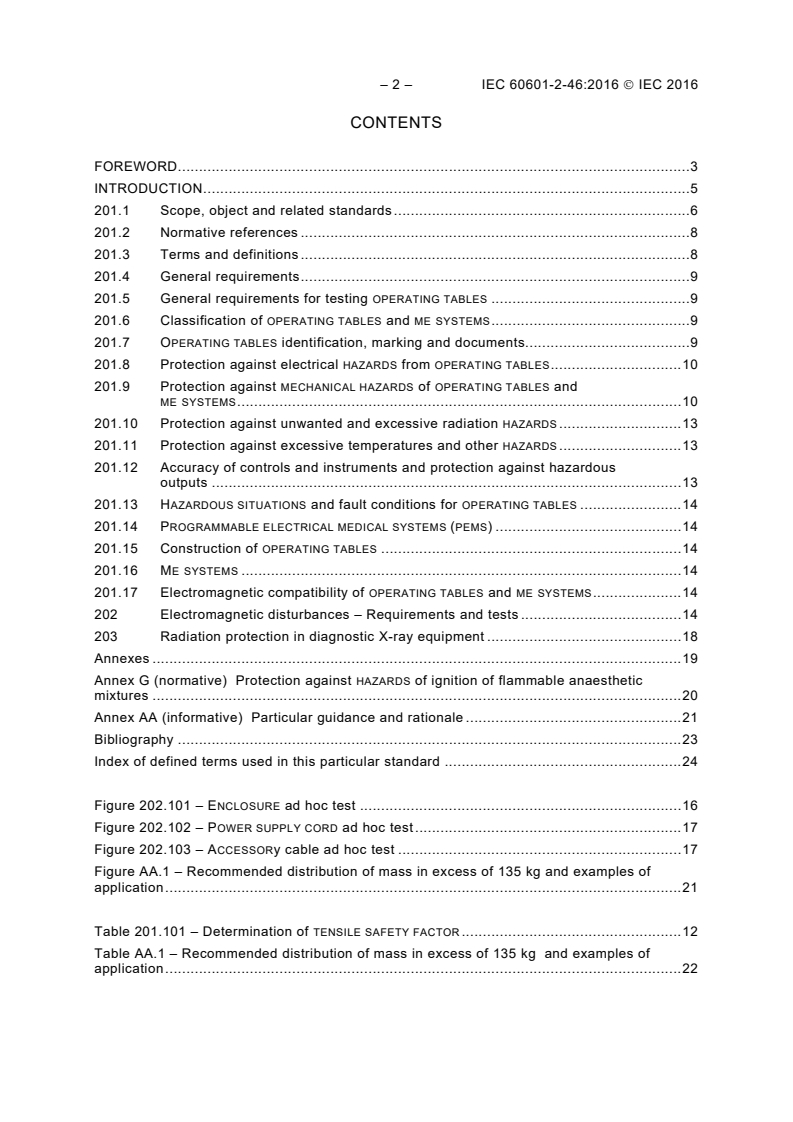
IEC 60601-2-46:2016 - Medical electrical equipment - Part 2-46: Particular requirements for the basic safety and essential performance of operating tables Released:8/10/2016
Overview
IEC 60601-2-46:2016 is the third-edition particular standard in the IEC 60601 series that specifies basic safety and essential performance requirements for operating tables (including transporters and detachable tops). It replaces the 2010 edition and was revised to align structurally with IEC 60601-1:2005/AMD1:2012. The standard covers both electrically powered and purely mechanical operating tables and defines requirements that take precedence over the general IEC 60601-1 standard where applicable.
Key Topics
- Scope and exclusions
- Applies to operating tables and associated transporters; excludes dental patient chairs, examination couches, medical beds, delivery tables, patient transfer equipment, heating blankets, and certain device-specific patient-support systems.
- Safety and essential performance
- Requirements for protection against electrical hazards, mechanical hazards (stability, load handling, moving parts), temperature and other patient/staff injury risks.
- Testing and construction
- Mandatory tests and test methods for mechanical strength, tensile safety factors, and ad hoc tests (enclosure, power-supply cord, accessory cables) used to verify compliance.
- Electromagnetic compatibility (EMC)
- EMC requirements and tests are included (see Clause 202) to ensure safe operation near other medical devices.
- Radiation considerations
- Guidance for operating tables used with diagnostic X‑ray equipment (Clause 203).
- Documentation, marking and classification
- Requirements for labeling, user documentation, classification of equipment and systems, and instructions for safe use.
- Programmable systems
- Rules for Programmable Electrical Medical Systems (PEMS) when software or control systems influence table performance.
- Annexes
- Normative and informative annexes (e.g., Annex G on ignition protection for flammable anaesthetic mixtures; Annex AA provides rationale and guidance).
Applications
- Manufacturers designing and producing operating tables and transporters to meet international safety and performance expectations.
- Medical device compliance engineers and test laboratories performing conformity assessments against IEC 60601 series requirements.
- Regulatory bodies, procurement teams and clinical engineers evaluating device safety, EMC and usability in operating rooms.
- R&D teams integrating electronics, software or imaging compatibility (X‑ray) into table systems.
Related Standards
- IEC 60601-1 (general standard) - baseline requirements (this particular standard amends/supplements it)
- IEC 60601-1-2 (EMC) - applies as modified by Clause 202
- Referenced exclusions or related device standards: IEC 60601-2-43, IEC 80601-2-35, IEC 60601-2-52
- Note: IEC 60601-1-3, -1-8, -1-10, -1-11, -1-12 do not apply to this particular standard.
Keywords: IEC 60601-2-46, operating tables safety, medical electrical equipment, essential performance, operating table standards, IEC 60601 series, EMC for medical devices.
Relations
- Effective Date
- 05-Sep-2023
- Effective Date
- 05-Sep-2023
Buy Documents
IEC 60601-2-46:2016 RLV - Medical electrical equipment - Part 2-46: Particular requirements for the basic safety and essential performance of operating tables Released:8/10/2016
IEC 60601-2-46:2016 - Medical electrical equipment - Part 2-46: Particular requirements for the basic safety and essential performance of operating tables Released:8/10/2016
Get Certified
Connect with accredited certification bodies for this standard

BSI Group
BSI (British Standards Institution) is the business standards company that helps organizations make excellence a habit.

TÜV Rheinland
TÜV Rheinland is a leading international provider of technical services.

TÜV SÜD
TÜV SÜD is a trusted partner of choice for safety, security and sustainability solutions.
Sponsored listings
Frequently Asked Questions
IEC 60601-2-46:2016 is a standard published by the International Electrotechnical Commission (IEC). Its full title is "Medical electrical equipment - Part 2-46: Particular requirements for the basic safety and essential performance of operating tables". This standard covers: IEC 60601-2-46:2016 specifies safety requirements for operating tables, whether or not having electrical parts, including transporters, used for the transportation of the operating table top to or from the base or pedestal of an operating table with detachable operating table top. This third edition cancels and replaces the second edition published in 2010 and constitutes a technical revision. This edition of IEC 60601-2-46 was revised to align structurally with the 2005 edition of IEC 60601-1 and with IEC 60601-1:2005/AMD1:2012.
IEC 60601-2-46:2016 specifies safety requirements for operating tables, whether or not having electrical parts, including transporters, used for the transportation of the operating table top to or from the base or pedestal of an operating table with detachable operating table top. This third edition cancels and replaces the second edition published in 2010 and constitutes a technical revision. This edition of IEC 60601-2-46 was revised to align structurally with the 2005 edition of IEC 60601-1 and with IEC 60601-1:2005/AMD1:2012.
IEC 60601-2-46:2016 is classified under the following ICS (International Classification for Standards) categories: 11.140 - Hospital equipment; 17.220.20 - Measurement of electrical and magnetic quantities. The ICS classification helps identify the subject area and facilitates finding related standards.
IEC 60601-2-46:2016 has the following relationships with other standards: It is inter standard links to IEC 60601-2-46:2010, IEC 60601-2-46:2023. Understanding these relationships helps ensure you are using the most current and applicable version of the standard.
IEC 60601-2-46:2016 is available in PDF format for immediate download after purchase. The document can be added to your cart and obtained through the secure checkout process. Digital delivery ensures instant access to the complete standard document.
Standards Content (Sample)
IEC 60601-2-46 ®
Edition 3.0 2016-08
REDLINE VERSION
INTERNATIONAL
STANDARD
colour
inside
Medical electrical equipment –
Part 2-46: Particular requirements for the basic safety and essential performance
of operating tables
All rights reserved. Unless otherwise specified, no part of this publication may be reproduced or utilized in any form
or by any means, electronic or mechanical, including photocopying and microfilm, without permission in writing from
either IEC or IEC's member National Committee in the country of the requester. If you have any questions about IEC
copyright or have an enquiry about obtaining additional rights to this publication, please contact the address below or
your local IEC member National Committee for further information.
IEC Central Office Tel.: +41 22 919 02 11
3, rue de Varembé Fax: +41 22 919 03 00
CH-1211 Geneva 20 info@iec.ch
Switzerland www.iec.ch
About the IEC
The International Electrotechnical Commission (IEC) is the leading global organization that prepares and publishes
International Standards for all electrical, electronic and related technologies.
About IEC publications
The technical content of IEC publications is kept under constant review by the IEC. Please make sure that you have the
latest edition, a corrigenda or an amendment might have been published.
IEC Catalogue - webstore.iec.ch/catalogue Electropedia - www.electropedia.org
The stand-alone application for consulting the entire The world's leading online dictionary of electronic and
bibliographical information on IEC International Standards, electrical terms containing 20 000 terms and definitions in
Technical Specifications, Technical Reports and other English and French, with equivalent terms in 15 additional
documents. Available for PC, Mac OS, Android Tablets and languages. Also known as the International Electrotechnical
iPad. Vocabulary (IEV) online.
IEC publications search - www.iec.ch/searchpub IEC Glossary - std.iec.ch/glossary
The advanced search enables to find IEC publications by a 65 000 electrotechnical terminology entries in English and
variety of criteria (reference number, text, technical French extracted from the Terms and Definitions clause of
committee,…). It also gives information on projects, replaced IEC publications issued since 2002. Some entries have been
and withdrawn publications. collected from earlier publications of IEC TC 37, 77, 86 and
CISPR.
IEC Just Published - webstore.iec.ch/justpublished
Stay up to date on all new IEC publications. Just Published IEC Customer Service Centre - webstore.iec.ch/csc
details all new publications released. Available online and If you wish to give us your feedback on this publication or
also once a month by email. need further assistance, please contact the Customer Service
Centre: csc@iec.ch.
IEC 60601-2-46 ®
Edition 3.0 2016-08
REDLINE VERSION
INTERNATIONAL
STANDARD
colour
inside
Medical electrical equipment –
Part 2-46: Particular requirements for the basic safety and essential
performance of operating tables
INTERNATIONAL
ELECTROTECHNICAL
COMMISSION
ICS 11.140 ISBN 978-2-8322-3581-2
– 2 – IEC 60601-2-46:2016 RLV © IEC 2016
CONTENTS
FOREWORD . 3
INTRODUCTION . 6
201.1 Scope, object and related standards . 7
201.2 Normative references . 9
201.3 Terms and definitions . 9
201.4 General requirements . 10
201.5 General requirements for testing ME EQUIPMENT OPERATING TABLES . 10
201.6 Classification of ME EQUIPMENT OPERATING TABLES and ME SYSTEMS. 10
201.7 ME EQUIPMENT OPERATING TABLES identification, marking and documents . 11
201.8 Protection against electrical HAZARDS from ME EQUIPMENT OPERATING TABLES . 11
201.9 Protection against MECHANICAL HAZARDS of ME EQUIPMENT OPERATING TABLES
and ME SYSTEMS . 11
201.10 Protection against unwanted and excessive radiation HAZARDS . 14
201.11 Protection against excessive temperatures and other HAZARDS . 14
201.12 Accuracy of controls and instruments and protection against hazardous
outputs . 15
201.13 HAZARDOUS SITUATIONS and fault conditions for OPERATING TABLES . 15
201.14 PROGRAMMABLE ELECTRICAL MEDICAL SYSTEMS (PEMS) . 15
201.15 Construction of ME EQUIPMENT OPERATING TABLES . 15
201.16 ME SYSTEMS . 15
201.17 Electromagnetic compatibility of ME EQUIPMENT OPERATING TABLES and
ME SYSTEMS . 16
202 Electromagnetic compatibility disturbances – Requirements and tests . 16
203 Radiation protection in diagnostic X-ray equipment. 20
Annexes . 21
Annex G (normative) Protection against HAZARDS of ignition of flammable anaesthetic
mixtures . 22
Annex AA (informative) Particular guidance and rationale . 23
Bibliography . 25
Index of defined terms used in this particular standard . 26
Figure 202.101 – ENCLOSURE ad hoc test . 18
Figure 202.102 – POWER SUPPLY CORD ad hoc test . 19
Figure 202.103 – ACCESSORy cable ad hoc test. 19
Figure AA.1 – Recommended distribution of mass in excess of 135 kg and examples of
application . 23
Table 201.101 – Determination of TENSILE SAFETY FACTOR . 13
Table AA.1 – Recommended distribution of mass in excess of 135 kg and examples of
application . 24
INTERNATIONAL ELECTROTECHNICAL COMMISSION
____________
MEDICAL ELECTRICAL EQUIPMENT –
Part 2-46: Particular requirements for the basic safety
and essential performance of operating tables
FOREWORD
1) The International Electrotechnical Commission (IEC) is a worldwide organization for standardization comprising
all national electrotechnical committees (IEC National Committees). The object of IEC is to promote
international co-operation on all questions concerning standardization in the electrical and electronic fields. To
this end and in addition to other activities, IEC publishes International Standards, Technical Specifications,
Technical Reports, Publicly Available Specifications (PAS) and Guides (hereafter referred to as “IEC
Publication(s)”). Their preparation is entrusted to technical committees; any IEC National Committee interested
in the subject dealt with may participate in this preparatory work. International, governmental and non-
governmental organizations liaising with the IEC also participate in this preparation. IEC collaborates closely
with the International Organization for Standardization (ISO) in accordance with conditions determined by
agreement between the two organizations.
2) The formal decisions or agreements of IEC on technical matters express, as nearly as possible, an international
consensus of opinion on the relevant subjects since each technical committee has representation from all
interested IEC National Committees.
3) IEC Publications have the form of recommendations for international use and are accepted by IEC National
Committees in that sense. While all reasonable efforts are made to ensure that the technical content of IEC
Publications is accurate, IEC cannot be held responsible for the way in which they are used or for any
misinterpretation by any end user.
4) In order to promote international uniformity, IEC National Committees undertake to apply IEC Publications
transparently to the maximum extent possible in their national and regional publications. Any divergence
between any IEC Publication and the corresponding national or regional publication shall be clearly indicated in
the latter.
5) IEC itself does not provide any attestation of conformity. Independent certification bodies provide conformity
assessment services and, in some areas, access to IEC marks of conformity. IEC is not responsible for any
services carried out by independent certification bodies.
6) All users should ensure that they have the latest edition of this publication.
7) No liability shall attach to IEC or its directors, employees, servants or agents including individual experts and
members of its technical committees and IEC National Committees for any personal injury, property damage or
other damage of any nature whatsoever, whether direct or indirect, or for costs (including legal fees) and
expenses arising out of the publication, use of, or reliance upon, this IEC Publication or any other IEC
Publications.
8) Attention is drawn to the Normative references cited in this publication. Use of the referenced publications is
indispensable for the correct application of this publication.
9) Attention is drawn to the possibility that some of the elements of this IEC Publication may be the subject of
patent rights. IEC shall not be held responsible for identifying any or all such patent rights.
This redline version of the official IEC Standard allows the user to identify the changes
made to the previous edition. A vertical bar appears in the margin wherever a change
has been made. Additions are in green text, deletions are in strikethrough red text.
– 4 – IEC 60601-2-46:2016 RLV IEC 2016
International standard IEC 60601-2-46 has been prepared by IEC subcommittee 62D
Electromedical equipment, of IEC technical committee 62: Electrical equipment in medical
practice.
This third edition cancels and replaces the second edition published in 2010 and constitutes a
technical revision. This edition of IEC 60601-2-46 was revised to align structurally with the
2005 edition of IEC 60601-1 and with IEC 60601-1:2005/AMD1:2012.
The text of this standard is based on the following documents:
FDIS Report on voting
62D/1365/FDIS 62D/1371/RVD
Full information on the voting for the approval of this standard can be found in the report on
voting indicated in the above table.
This publication has been drafted in accordance with the ISO/IEC Directives, Part 2.
In this standard, the following print types are used:
– Requirements and definitions: roman type.
– Test specifications: italic type.
– Informative material appearing outside of tables, such as notes, examples and references: in smaller type.
Normative text of tables is also in a smaller type.
– TERMS DEFINED IN CLAUSE 3 OF THE GENERAL STANDARD, IN THIS PARTICULAR STANDARD OR AS
NOTED: SMALL CAPITALS.
In referring to the structure of this standard, the term
– “clause” means one of the numbered divisions within the table of contents, inclusive of all
subdivisions (e.g. Clause 7 includes subclauses 7.1, 7.2, etc.);
– “subclause” means a numbered subdivision of a clause (e.g. 7.1, 7.2 and 7.2.1 are all
subclauses of Clause 7).
References to clauses within this standard are preceded by the term “Clause” followed by the
clause number. References to subclauses within this particular standard are by number only.
In this standard, the conjunctive “or” is used as an “inclusive or” so a statement is true if any
combination of the conditions is true.
The verbal forms used in this standard conform to usage described in Annex H of the ISO/IEC
Directives, Part 2. For the purposes of this standard, the auxiliary verb:
– “shall” means that compliance with a requirement or a test is mandatory for compliance
with this standard;
– “should” means that compliance with a requirement or a test is recommended but is not
mandatory for compliance with this standard;
– “may” is used to describe a permissible way to achieve compliance with a requirement or
test.
An asterisk (*) as the first character of a title or at the beginning of a paragraph or table title
indicates that there is guidance or rationale related to that item in Annex AA.
A list of all parts of the IEC 60601 series, published under the general title Medical electrical
equipment, can be found on the IEC website.
The committee has decided that the contents of this publication will remain unchanged until
the stability date indicated on the IEC website under "http://webstore.iec.ch" in the data
related to the specific publication. At this date, the publication will be
• reconfirmed,
• withdrawn,
• replaced by a revised edition, or
• amended.
IMPORTANT – The “colour inside” logo on the cover page of this publication indicates
that it contains colours which are considered to be useful for the correct understanding
of its contents. Users should therefore print this publication using a colour printer.
– 6 – IEC 60601-2-46:2016 RLV IEC 2016
INTRODUCTION
This particular standard concerns the BASIC SAFETY and ESSENTIAL PERFORMANCE of OPERATING
TABLES. It amends and supplements IEC 60601-1 (third edition, 2005): Medical electrical
equipment – Part 1: General requirements for basic safety and essential performance) and its
Amendment 1 (IEC 60601-1:2005/AMD1:2012), hereinafter referred to as the general
standard.
The aim of this third edition is to bring this particular standard up to date with reference to the
third edition of the general standard through reformatting and technical changes.
The requirements of this particular standard take priority over those of the general standard.
A “General guidance and rationale” for the more important requirements of this particular
standard is included in Annex AA. It is considered that knowledge of the reasons for these
requirements will not only facilitate the proper application of the standard but will, in due
course, expedite any revision necessitated by changes in clinical practice or as a result of
developments in technology. However, Annex AA does not form part of the requirements of
this Standard.
MEDICAL ELECTRICAL EQUIPMENT –
Part 2-46: Particular requirements for the basic safety
and essential performance of operating tables
201.1 Scope, object and related standards
1)
Clause 1 of the general standard applies, except as follows:
201.1.1 Scope
Replacement:
This particular standard specifies safety requirements for OPERATING TABLES, whether or not
having electrical parts, including TRANSPORTERS, used for the transportation of the OPERATING
TABLE top to or from the base or pedestal of an OPERATING TABLE with detachable OPERATING
TABLE top.
NOTE See also 4.2 of the General Standard.
This particular standard does not apply to
– dental PATIENT chairs;
– examination chairs and couches;
– PATIENT-supporting systems of diagnostic and therapeutic devices; (see IEC 60601-2-43)
– OPERATING TABLE heating blankets; (see IEC 80601-2-35)
– PATIENT transfer equipment;
– delivery tables and beds;
– medical beds; (see IEC 60601-2-52)
– field tables.
NOTE If OPERATING TABLES will be used in combination with diagnostic and/or therapeutic
devices the relevant requirements of each related particular standard have to be considered
are also applicable.
201.1.2 Object
Replacement:
The object of this particular standard is to establish particular BASIC SAFETY and ESSENTIAL
PERFORMANCE requirements for OPERATING TABLES as defined in 201.3.201 and hereinafter
also referred to as ME EQUIPMENT.
201.1.3 Collateral standards
Addition:
This particular standard refers to those applicable collateral standards that are listed in
Clause 2 of the general standard and Clause 201.2 of this particular standard.
______________
1)
The general standard is IEC 60601-1:2005/AMD1:2012, Medical electrical equipment – Part 1: General
requirements for basic safety and essential performance.
– 8 – IEC 60601-2-46:2016 RLV IEC 2016
IEC 60601-1-2 and IEC 60601-1-3 apply as modified in Clauses 202 and 203 respectively.
IEC 60601-1-3, IEC 60601-1-8, IEC 60601-1-10, IEC 60601-1-11 and IEC 60601-1-12 do not
apply. All other published collateral standards in the IEC 60601-1 series apply as published.
201.1.4 Particular standards
Replacement:
In the IEC 60601 series, particular standards may modify, replace or delete requirements
contained in the general standard and collateral standards as appropriate for the particular ME
EQUIPMENT under consideration, and may add other BASIC SAFETY and ESSENTIAL PERFORMANCE
requirements.
A requirement of a particular standard takes priority over the general standard.
For brevity, IEC 60601-1 is referred to in this particular standard as the general standard.
Collateral standards are referred to by their document number.
The numbering of clauses and subclauses of this particular standard corresponds to that of
the general standard with the prefix “201” (e.g. 201.1 in this standard addresses the content
of Clause 1 of the general standard) or applicable collateral standard with the prefix “20x”
where × is the final digit(s) of the collateral standard document number (e.g. 202.4 in this
particular standard addresses the content of Clause 4 of the IEC 60601-1-2 collateral
standard, 203.4 in this particular standard addresses the content of Clause 4 of the
IEC 60601-1-3 collateral standard, etc.). The changes to the text of the general standard are
specified by the use of the following words:
"Replacement" means that the clause or subclause of the general standard or applicable
collateral standard is replaced completely by the text of this particular standard.
"Addition" means that the text of this particular standard is additional to the requirements of
the general standard or applicable collateral standard.
"Amendment" means that the clause or subclause of the general standard or applicable
collateral standard is amended as indicated by the text of this particular standard.
Subclauses, figures or tables which are additional to those of the general standard are
numbered starting from 201.101. However, due to the fact that definitions in the general
standard are numbered 3.1 through 3.147, additional definitions in this standard are
numbered beginning from 201.3.201. Additional annexes are lettered AA, BB, etc., and
additional items aa), bb), etc.
Subclauses, figures or tables which are additional to those of a collateral standard are
numbered starting from 20x, where “x” is the number of the collateral standard, e.g. 202 for
IEC 60601-1-2, 203 for IEC 60601-1-3, etc.
The term "this standard" is used to make reference to the general standard, any applicable
collateral standards and this particular standard taken together.
Where there is no corresponding clause or subclause in this particular standard, the clause or
subclause of the general standard or applicable collateral standard, although possibly not
relevant, applies without modification; where it is intended that any part of the general
standard or applicable collateral standard, although possibly relevant, is not to be applied, a
statement to that effect is given in this particular standard.
201.2 Normative references
Clause 2 of the general standard applies, except as follows:
Replacement:
IEC 60601-1-2:2007 2014, Medical electrical equipment – Part 1-2: General requirements for
basic safety and essential performance – Collateral standard: Electromagnetic compatibility
disturbances – Requirements and tests
IEC 60601-1-3:2008, Medical electrical equipment – Part 1-3: General requirements for basic
safety and essential performance – Collateral standard: Radiation protection in diagnostic X-
ray equipment
IEC 60601-1-3:2008/AMD1:2013
Addition:
IEC 60601-2-2, Medical electrical equipment – Part 2-2: Particular requirements for the basic
safety and essential performance of high frequency surgical equipment and high frequency
surgical accessories
IEC 60601-2-43, Medical electrical equipment – Part 2-43: Particular requirements for the
basic safety and essential performance of X-ray equipment for interventional procedures
201.3 Terms and definitions
For the purposes of this document, the terms and definitions given in IEC 60601-1:2005
apply, except as follows:
NOTE An index of defined terms is found beginning on page 24.
Addition:
201.3.201
MOBILE OPERATING TABLE
OPERATING TABLE intended to be relocated from one location to another while supported by its
own wheels or equivalent means
201.3.202
NORMAL POSITION
position of the OPERATING TABLE top with all sections set in the horizontal position
201.3.203
OPERATING TABLE (hereinafter also referred to as ME EQUIPMENT)
device for TEMPORARY USE, with the INTENDED USE of supporting and positioning a PATIENT
during surgical procedures for not more than 24 h
Note 1 to entry: This includes pre- and post-operative phases in general, surgical/medical procedures under
medical supervision.
201.3.204
TEMPORARY USE
normally intended for continuous use for not more than 24 hours
______________
There exists a consolidated edition 2.1, which includes IEC 60601-1-3:2008 and its Amendment 1 (2013).
– 10 – IEC 60601-2-46:2016 RLV IEC 2016
201.3.204
TRANSPORTER
device intended for the transportation of an OPERATING TABLE top to or from the base or
pedestal of an OPERATING TABLE, or the transportation of the OPERATING TABLE top complete
with the base
Note 1 to entry: This definition does not include devices intended to simplify the transport of the PATIENT from one
location to another without the transfer of parts associated with an OPERATING TABLE.
Note 2 to entry: The transportation can be done with or without a PATIENT in place.
201.3.205
TRENDELENBURG POSITION
a supine PATIENT position where the body is in a single plane, with that plane inclined so that
the head is lower than the pelvis
201.4 General requirements
Clause 4 of the general standard applies, except as follows.
201.4.3 Essential performance
Addition:
Besides the definition of the MANUFACTURER, the following ESSENTIAL PERFORMANCE is required
from OPERATING TABLES:
– no unwanted movement in any SINGLE FAULT CONDITION and any combined fault conditions
as derived from RISK MANAGEMENT specified by the MANUFACTURER.
– supporting a PATIENT without unwanted movement in a SINGLE FAULT CONDITION.
201.4.7 SINGLE FAULT CONDITION for ME EQUIPMENT OPERATING TABLES
Addition:
Additional SINGLE FAULT CONDITIONS to be regarded with OPERATING TABLES:
• flaw (impairment) in the transmission of commands from/to input devices.
NOTE 101 The MANUFACTURER should provide means, where practical, to ensure that in a
SINGLE FAULT CONDITION the PATIENT support platform of the OPERATING TABLE can return to a
position for emergency treatment.
NOTE 101 Examples of positions for emergency treatment are TRENDELENBURG or positions for cardiopulmonary
resuscitation (CPR), emergency back flattening.
201.5 General requirements for testing ME EQUIPMENT OPERATING TABLES
Clause 5 of the general standard applies.
201.6 Classification of ME EQUIPMENT OPERATING TABLES and ME SYSTEMS
Clause 6 of the general standard applies.
201.7 ME EQUIPMENT OPERATING TABLES identification, marking and
documents
Clause 7 of the general standard applies, except as follows:
201.7.2 Marking on the outside of OPERATING TABLES or OPERATING TABLES parts
201.7.2.10 Applied parts
Amendment:
The APPLIED PART marking symbol according to Table D.1 (symbol 19, 20 or 21) shall be
located in a prominent place. Compliance is checked by inspection.
201.7.2.21 Mass of MOBILE OPERATING TABLES
This subclause of the general standard does not apply.
201.7.9.2 Instructions for use
201.7.9.2.1 General
Addition:
Instructions for use shall include information, regarding potential HAZARDS related to high-
frequency surgical equipment, cardiac defibrillators and cardiac defibrillator-monitors.
NOTE 101 Potential HAZARDS which have to be considered include but are not limited to: PATIENT burns, explosion
HAZARDS or electrical shock of the PATIENT or OPERATOR.
201.8 Protection against electrical HAZARDS from ME EQUIPMENT OPERATING
TABLES
Clause 8 of the general standard applies, except as follows:
201.8.6.7 POTENTIAL EQUALIZATION CONDUCTOR
Addition:
Where POTENTIAL EQUALIZATION is required, the APPLIED PARTS of OPERATING TABLES with
ACCESSIBLE PARTS which are not PROTECTIVELY EARTHED shall be provided with a POTENTIAL
EQUALIZATION terminal.
For ME EQUIPMENT OPERATING TABLES with a POTENTIAL EQUALIZATION terminal the impedance
between the potential equalization terminal and any ACCESSIBLE PART shall not exceed
200 mΩ,
Compliance is checked by using the test method of 8.6.4 of the general standard.
201.9 Protection against MECHANICAL HAZARDS of ME EQUIPMENT OPERATING
TABLES and ME SYSTEMS
Clause 9 of the general standard applies, except as follows:
– 12 – IEC 60601-2-46:2016 RLV IEC 2016
201.9.2.3 Other MECHANICAL HAZARDS associated with moving parts
201.9.2.3.1 *Unintended movement
Addition:
Wireless remote control devices of OPERATING TABLES shall be clearly assigned by internal
means to the individual items of ME EQUIPMENT OPERATING TABLES.
Compliance is checked by inspection.
201.9.4 Instability hazards
201.9.4.2.2 *Instability excluding transport position
Item a)
Addition:
ME EQUIPMENT OPERATING TABLES shall be subjected to SAFE WORKING LOAD.
NOTE See Figure AA.1 and Table AA.1 for guidance regarding weight mass distribution.
Additional requirement:
OPERATING TABLES with transferable OPERATING TABLE tops shall be designed and
manufactured so as to minimize the RISK of physical injuries and of accidental separation of
the OPERATING TABLE tops when being transferred.
Specifications concerning OPERATING TABLE top transfer operations shall indicate in the
instructions for use the safety elements inherent in the transfer operation.
Compliance is checked by inspection and the following tests:
Having transferred the OPERATING TABLE top to the TRANSPORTER, the stability in NORMAL USE
test of 9.4.2.2 of the general standard shall be carried out. The OPERATING TABLE top shall not
disengage from the TRANSPORTER.
The test is then repeated with the OPERATING TABLE top being placed on the base and the
stability test is carried out on the base immediately after transfer.
201.9.4.2.4.3 *Movement over a threshold
Addition:
If MOBILE OPERATING TABLES and TRANSPORTERS are not able to negotiate such obstacles
safely, the MANUFACTURER shall include a warning in the instructions for use or determine
which threshold can be negotiated safely and inform the OPERATOR accordingly.
201.9.4.3.1 Instability in transport position
Replacement of items b) and c) of the test procedure:
The MOBILE OPERATING TABLE or TRANSPORTER is placed with the SAFE WORKING LOAD in place,
and the locking device (e.g. brakes) activated, on a plane covered with 2 mm to 4 mm thick
vinyl flooring material and inclined at 6° from the horizontal plane on a concrete floor.
Following initial elastic movement, initial creepage, and initial pivoting of castors, there shall
be no movement of the MOBILE OPERATING TABLE or TRANSPORTER greater than 50 mm (in
relation to the inclined plane). Any initial movement shall not result in an unacceptable RISK,
taking into account the NORMAL USE of the MOBILE OPERATING TABLE or TRANSPORTER.
NOTE See Figure AA.1 and Table AA.1 for guidance regarding weight mass distribution.
201.9.8 MECHANICAL HAZARDS associated with support systems
201.9.8.1 General
Replacement of first dash:
– The construction of the support, suspension or actuation system shall be designed based
upon Table 201.101 and the SAFE WORKING LOAD.
201.9.8.2 *TENSILE SAFETY FACTOR
Replacement:
Support systems shall maintain structural integrity during the EXPECTED SERVICE LIFE of the
OPERATING TABLE or TRANSPORTER. TENSILE SAFETY FACTORS shall not be less than those shown
in Table 201.101 unless an alternative method demonstrates structural integrity throughout
the EXPECTED SERVICE LIFE of the OPERATING TABLE or TRANSPORTER.
Due to the fact that it is not always possible to determine in general whether a specific
component or construction is impaired by wear, the decision shall be based on experience,
tests and/or RISK MANAGEMENT and shall be documented accordingly. However, the
MANUFACTURER is responsible for choosing the adequate TENSILE SAFETY FACTOR.
The OPERATING TABLE or TRANSPORTER shall be tested:
– with the SAFE WORKING LOAD (required PATIENT weight mass according to Figure AA.1 and
Table AA.1) and a TENSILE SAFETY FACTOR according to Table 201.101:
Table 201.101 – Determination of TENSILE SAFETY FACTOR
Situation Minimum
TENSILE SAFETY
FACTOR
No. System part Elongation
1 Support system not impaired by wear Material having a specific elongation at 2,5
break equal to or greater than 5 %
2 Support system not impaired by wear Material having a specific elongation at 4
break of less than 5 %
3 Support system impaired by wear Material having a specific elongation at 5
break equal to or greater than 5 %
4 Support system impaired by wear Material having a specific elongation at 8
break of less than 5 %
The material tensile strength and all external forces to be expected are quantifiable and known accurately.
Compliance with 201.9.8.1 and 201.9.8.2 is checked by inspection of the OPERATING TABLE or
TRANSPORTER, the RISK MANAGEMENT FILE, the specifications of materials used and the
processing specifications for these materials.
When test results are part of relevant information, testing consists of gradually applying a test
load to the support assembly under test equal to the SAFE WORKING LOAD times the required
TENSILE SAFETY FACTOR. The support assembly under test is to be in equilibrium after 1 min, or
otherwise not result in an unacceptable RISK.
NOTE The 1 min time period might need to be longer for materials which might have creep type problems, such
as plastics or other non-metallic materials.
– 14 – IEC 60601-2-46:2016 RLV IEC 2016
201.9.8.3.2 *Static forces due to loading from persons
Replacement of item b):
b) OPERATING TABLES and TRANSPORTERS shall be designed so that failure or permanent
deformation shall not occur when subjected to 2,2 times SAFE WORKING LOAD.
NOTE See Figure AA.1 and Table AA.1 for guidance regarding weight mass distribution.
Compliance is checked by the following test:
1) In NORMAL POSITION and at maximum height the ME EQUIPMENT OPERATING TABLES shall
be statically loaded with 2,2 times SAFE WORKING LOAD. The deformation after 5 min is
recorded. The ME EQUIPMENT OPERATING TABLES shall not be operated or moved during
this part of the test.
2) The load is removed and replaced as soon as practical with SAFE WORKING LOAD.
3) After waiting 5 min in NORMAL POSITION and at maximum height the ME EQUIPMENT
OPERATING TABLES shall be statically loaded with 2,2 times SAFE WORKING LOAD. The
deformation after 5 min is recorded.
The deflections are compared to the values measured under 1) and shall be within
± 2,5 mm of the original readings.
4) The load is removed and replaced with SAFE WORKING LOAD and the ME EQUIPMENT
OPERATING TABLES shall operate over the full range of movements. The
deformation/deflection shall be measured at the end of the head- and leg-section of the
OPERATING TABLE. For accessories the measuring point shall be determined according
the intended use.
201.9.8.3.3 *Dynamic forces due to loading from persons
This subclause of the general standard does not apply.
201.10 Protection against unwanted and excessive radiation HAZARDS
Clause 10 of the general standard applies.
201.11 Protection against excessive temperatures and other HAZARDS
Clause 11 of the general standard applies, except as follows:
201.11.6 Overflow, spillage, leakage, ingress of water or particulate matter,
cleaning, disinfection, sterilization and compatibility with substances
used with the ME EQUIPMENT OPERATING TABLES
Additional subclause:
201.11.6.5 Ingress of water or particulate matter into ME EQUIPMENT OPERATING TABLES
and ME SYSTEMS
Addition:
OPERATING TABLES shall be at least IPX4.
201.11.8 Interruption of the power supply/SUPPLY MAINS to ME EQUIPMENT OPERATING
TABLES
Addition:
In the event of interruption of the SUPPLY MAINS, whether or not the SUPPLY MAINS is restored,
the height and configuration of the OPERATING TABLE top shall not alter. Movement into NORMAL
POSITION and/or TRENDELENBURG POSITION shall remain possible.
Compliance is checked as follows:
a) By test after interruption of the SUPPLY MAINS with the OPERATING TABLE top in any position,
other than the NORMAL POSITION, midway between its maximum and minimum heights,
subjected to SAFE WORKING LOAD with weight mass distributed according to Figure AA.1
and Table AA.1. Movement into and out of the NORMAL POSITION shall be obtainable using
the methods described by the MANUFACTURER.
b) By observation after restoration of the SUPPLY MAINS.
201.12 Accuracy of controls and instruments and protection against
hazardous outputs
Clause 12 of the general standard applies.
201.13 HAZARDOUS SITUATIONS and fault conditions for OPERATING TABLES
Clause 13 of the general standard applies.
201.14 PROGRAMMABLE ELECTRICAL MEDICAL SYSTEMS (PEMS)
Clause 14 of the general standard applies.
201.15 Construction of ME EQUIPMENT OPERATING TABLES
Clause 15 of the general standard applies, except of follows:
201.15.3.5 Rough handling test
Amendment:
Subclause 15.3.5 of the general standard applies to TRANSPORTERS and MOBILE OPERATING
TABLES only.
201.15.4.7.2 Accidental operation of ME EQUIPMENT OPERATING TABLES
Addition:
201.15.4.7.2.101 Inadvertent operation
The actuating force for foot-operated control devices shall not be smaller than 10 N.
Compliance is checked by inspection.
201.16 ME SYSTEMS
Clause 16 of the general standard applies.
– 16 – IEC 60601-2-46:2016 RLV IEC 2016
201.17 Electromagnetic compatibility of ME EQUIPMENT OPERATING TABLES and
ME SYSTEMS
Clause 17 of the general standard applies.
202 Electromagnetic compatibility disturbances – Requirements and tests
IEC 60601-1-2:2007 applies, except as follows:
202.6.2.2.1 Requirements
Replacement:
ME EQUIPMENT shall comply with the requirements of 6.2.1.10 [of IEC 60601-1-2:2007] as
modified below. For this requirement, the following conditions associated with BASIC SAFETY
and ESSENTIAL PERFORMANCE shall apply:
No permanent DEGRADATION or loss of function or OPERATOR settings which are not
recoverable shall be observed at any immunity test level.
No inappropriate movement shall occur at all immunity test levels.
At all immunity test levels the ME EQUIPMENT shall maintain ESSENTIAL PERFORMANCE within the
specification limits.
At all immunity test levels the temporary DEGRADATION or loss of function or performance is
acceptable.
Within 10 s or after OPERATOR intervention without requiring the use of a tool, the
ME EQUIPMENT shall resume normal operation in the previous operating mode, without loss of
any OPERATOR settings or stored data, and shall continue to perform its intended function as
described in the ACCOMPANYING DOCUMENTS.
Check compliance by application of the tests in 6.2.2.2. Evaluate the response of the
ME EQUIPMENT or ME SYSTEM during and after these tests in accordance with 6.2.1.10 [of
IEC 60601-1-2:2007] as modified in above, considering each discharge individually.
Additional subclause:
202.6.2.2.1.101 Interference with high-frequency surgical equipment
OPERATING TABLES and remote control devices for OPERATING TABLES shall not present a
HAZARDOUS SITUATION when used together with high-frequency surgical equipment.
Compliance is checked by the following tests:
NOTE 1 To accommodate the huge variety of high-frequency surgical equipment, two different test-scenarios
have been created.
a) The high-frequency surgical equipment which is used for this test shall comply with
IEC 60601-2-2, shall have a rated output power of 300 W at least for an impedance
between 200 Ohms and 500 Ohms, a quasi-square wave output frequency characteristic
and shall operate in the frequency range of 400 kHz to 1 MHz.
b) The high frequency surgical equipment which is used for this test shall comply with
IEC 60601-2-2, shall have an argon plasma coagulation mode with a peak voltage of
4 000 Vp (open circuit voltage) and 120 W power capability
NOTE 2 For details, see Annex A.
In all cases shall leads of the active and neutral electrodes be draped along the side rails
and/or the exposed metal parts of the OPERATING TABLE top.
The high frequency surgical equipment shall then be operated in a mode which generates
an output power of 300 W ("conventional") or 4 000 Vp/120 W (argon plasma coagulation).
c) Compliance
1) Operating the high frequency surgical equipment at open circuit shall cause no
movement of the OPERATING TABLE.
2) Operating the high-frequency surgical equipment while short-circuiting the active and
neutral electrodes and sparking with the active electrodes at the side rails and/or the
exposed metal parts of the OPERATING TABLE top, shall cause no movement of the
OPERATING TABLE.
NOTE 3 If operating tables will be used in combination with diagnostic X-ray equipment, the relevant
requirements of the collateral standard have to be considered.
202.8 Electromagnetic IMMUNITY requirements for OPERATING TABLES and ME SYSTEMS
Additional subclauses:
202.8.101 IMMUNITY pass/fail criteria
At least the following IMMUNITY pass/fail criteria associated with BASIC SAFETY and ESSENTIAL
PERFORMANCE shall apply at all immunity test levels:
– no permanent degradation or loss of function or OPERATOR settings which are not
recoverable shall be observed;
– no movement without activation of the OPERATOR shall occur;
– no movement, other than intended by the OPERATOR, shall occur;
– the OPERATING TABLE shall maintain ESSENTIAL PERFORMANCE within the limits specified by
the MANUFACTURER (e.g. temporary degradation of functionality);
– within 15 s after the immunity test the OPERATING TABLE shall resume normal operation in
the previous operating mode, without loss of any OPERATOR settings or stored data, and
shall continue to perform its intended function as described in the ACCOMPANYING
DOCUMENTS.
202.8.102 IMMUNITY to HF SURGICAL EQUIPMENT EMISSIONS
Electrical OPERATING TABLES intended for use within 2 m of active HF SURGICAL EQUIPMENT or to
have a connection to a PATIENT undergoing treatment with HF SURGICAL EQUIPMENT shall be
tested for IMMUNITY to HF SURGICAL EQUIPMENT EMISSIONS.
The IMMUNITY pass/fail criteria of 202.8.101 shall apply.
All tests have to be performed in two conditions:
– without activating a movement of the OPERATING TABLE;
– with activating any movement of the OPERATING TABLE (e.g. height movement).
In order to accommodate the huge variety of HF SURGICAL EQUIPMENT, all the tests described in
this subclause have to be applied with two different HF SURGICAL EQUIPMENTS:
– HF SURGICAL EQUIPMENT complying with IEC 60601-2-2 and having a minimum power cut
mode capability of 300 W, a minimum coagulation mode of 100 W and working frequencies
to include at least 400 kHz ± 100 kHz. The HF SURGICAL EQUIPMENT used shall be specified
in the test report;
– 18 – IEC 60601-2-46:2016 RLV IEC 2016
– HF SURGICAL EQUIPMENT, should have an argon plasma coagulation mode with a peak
voltage of 4 000 Vp (open circuit voltage) and 120 W power capability. The HF SURGICAL
EQUIPMENT used shall be specified in the test report.
NOTE 1 The EM environment for OPERATING TABLES is a special environment (medical treatment areas with high-
powered OPERATING TABLES). Besides the immunity tests required for the professional healthcare facility
environment (according to Table 4 to Table 9 of IEC 60601-1-2:2014) at least immunity to HF surgical equipment
emissions as described in this subclause is applicable to OPERATING TABLES.
Compliance is checked by the following tests:
a) For parts of OPERATING TABLES that are not PATIENT-COUPLED (e.g. remote control devices,
foot-switches), wrap the cable of a MONOPOLAR HF SURGICAL ACCESSORY around the
ENCLOSURE of such parts so that at least two full loops of the cable are present, as shown
in Figure 202.101. No more than three loops are needed. If the part of the OPERATING
TABLE is too large to accommodate two loops, wrap as much as possible or drape the
cable over the portion of the parts of the OPERATING TABLE that is most likely to come in
contact with HF SURGICAL EQUIPMENT ACCESSORY cables.
Attach one end of a cable to the NEUTRAL ELECTRODE connector of the HF SURGICAL
EQUIPMENT and the other end to a metal plate
...
IEC 60601-2-46 ®
Edition 3.0 2016-08
INTERNATIONAL
STANDARD
NORME
INTERNATIONALE
Medical electrical equipment –
Part 2-46: Particular requirements for the basic safety and essential performance
of operating tables
Appareils électromédicaux –
Partie 2-46: Exigences particulières pour la sécurité de base et les performances
essentielles des tables d'opération
All rights reserved. Unless otherwise specified, no part of this publication may be reproduced or utilized in any form
or by any means, electronic or mechanical, including photocopying and microfilm, without permission in writing from
either IEC or IEC's member National Committee in the country of the requester. If you have any questions about IEC
copyright or have an enquiry about obtaining additional rights to this publication, please contact the address below or
your local IEC member National Committee for further information.
Droits de reproduction réservés. Sauf indication contraire, aucune partie de cette publication ne peut être reproduite
ni utilisée sous quelque forme que ce soit et par aucun procédé, électronique ou mécanique, y compris la photocopie
et les microfilms, sans l'accord écrit de l'IEC ou du Comité national de l'IEC du pays du demandeur. Si vous avez des
questions sur le copyright de l'IEC ou si vous désirez obtenir des droits supplémentaires sur cette publication, utilisez
les coordonnées ci-après ou contactez le Comité national de l'IEC de votre pays de résidence.
IEC Central Office Tel.: +41 22 919 02 11
3, rue de Varembé Fax: +41 22 919 03 00
CH-1211 Geneva 20 info@iec.ch
Switzerland www.iec.ch
About the IEC
The International Electrotechnical Commission (IEC) is the leading global organization that prepares and publishes
International Standards for all electrical, electronic and related technologies.
About IEC publications
The technical content of IEC publications is kept under constant review by the IEC. Please make sure that you have the
latest edition, a corrigenda or an amendment might have been published.
IEC Catalogue - webstore.iec.ch/catalogue Electropedia - www.electropedia.org
The stand-alone application for consulting the entire The world's leading online dictionary of electronic and
bibliographical information on IEC International Standards, electrical terms containing 20 000 terms and definitions in
Technical Specifications, Technical Reports and other English and French, with equivalent terms in 15 additional
documents. Available for PC, Mac OS, Android Tablets and languages. Also known as the International Electrotechnical
iPad. Vocabulary (IEV) online.
IEC publications search - www.iec.ch/searchpub IEC Glossary - std.iec.ch/glossary
The advanced search enables to find IEC publications by a 65 000 electrotechnical terminology entries in English and
variety of criteria (reference number, text, technical French extracted from the Terms and Definitions clause of
committee,…). It also gives information on projects, replaced IEC publications issued since 2002. Some entries have been
and withdrawn publications. collected from earlier publications of IEC TC 37, 77, 86 and
CISPR.
IEC Just Published - webstore.iec.ch/justpublished
Stay up to date on all new IEC publications. Just Published IEC Customer Service Centre - webstore.iec.ch/csc
details all new publications released. Available online and If you wish to give us your feedback on this publication or
also once a month by email. need further assistance, please contact the Customer Service
Centre: csc@iec.ch.
A propos de l'IEC
La Commission Electrotechnique Internationale (IEC) est la première organisation mondiale qui élabore et publie des
Normes internationales pour tout ce qui a trait à l'électricité, à l'électronique et aux technologies apparentées.
A propos des publications IEC
Le contenu technique des publications IEC est constamment revu. Veuillez vous assurer que vous possédez l’édition la
plus récente, un corrigendum ou amendement peut avoir été publié.
Catalogue IEC - webstore.iec.ch/catalogue Electropedia - www.electropedia.org
Application autonome pour consulter tous les renseignements
Le premier dictionnaire en ligne de termes électroniques et
bibliographiques sur les Normes internationales,
électriques. Il contient 20 000 termes et définitions en anglais
Spécifications techniques, Rapports techniques et autres
et en français, ainsi que les termes équivalents dans 15
documents de l'IEC. Disponible pour PC, Mac OS, tablettes
langues additionnelles. Egalement appelé Vocabulaire
Android et iPad.
Electrotechnique International (IEV) en ligne.
Recherche de publications IEC - www.iec.ch/searchpub
Glossaire IEC - std.iec.ch/glossary
La recherche avancée permet de trouver des publications IEC 65 000 entrées terminologiques électrotechniques, en anglais
en utilisant différents critères (numéro de référence, texte, et en français, extraites des articles Termes et Définitions des
comité d’études,…). Elle donne aussi des informations sur les publications IEC parues depuis 2002. Plus certaines entrées
projets et les publications remplacées ou retirées. antérieures extraites des publications des CE 37, 77, 86 et
CISPR de l'IEC.
IEC Just Published - webstore.iec.ch/justpublished
Service Clients - webstore.iec.ch/csc
Restez informé sur les nouvelles publications IEC. Just
Published détaille les nouvelles publications parues. Si vous désirez nous donner des commentaires sur cette
Disponible en ligne et aussi une fois par mois par email. publication ou si vous avez des questions contactez-nous:
csc@iec.ch.
IEC 60601-2-46 ®
Edition 3.0 2016-08
INTERNATIONAL
STANDARD
NORME
INTERNATIONALE
Medical electrical equipment –
Part 2-46: Particular requirements for the basic safety and essential performance
of operating tables
Appareils électromédicaux –
Partie 2-46: Exigences particulières pour la sécurité de base et les performances
essentielles des tables d'opération
INTERNATIONAL
ELECTROTECHNICAL
COMMISSION
COMMISSION
ELECTROTECHNIQUE
INTERNATIONALE
ICS 11.140 ISBN 978-2-8322-3565-2
– 2 – IEC 60601-2-46:2016 IEC 2016
CONTENTS
FOREWORD . 3
INTRODUCTION . 5
201.1 Scope, object and related standards . 6
201.2 Normative references . 8
201.3 Terms and definitions . 8
201.4 General requirements . 9
201.5 General requirements for testing OPERATING TABLES . 9
201.6 Classification of OPERATING TABLES and ME SYSTEMS . 9
201.7 OPERATING TABLES identification, marking and documents. 9
201.8 Protection against electrical HAZARDS from OPERATING TABLES . 10
201.9 Protection against MECHANICAL HAZARDS of OPERATING TABLES and
ME SYSTEMS . 10
201.10 Protection against unwanted and excessive radiation HAZARDS . 13
201.11 Protection against excessive temperatures and other HAZARDS . 13
201.12 Accuracy of controls and instruments and protection against hazardous
outputs . 13
201.13 HAZARDOUS SITUATIONS and fault conditions for OPERATING TABLES . 14
201.14 PROGRAMMABLE ELECTRICAL MEDICAL SYSTEMS (PEMS) . 14
201.15 Construction of OPERATING TABLES . 14
201.16 ME SYSTEMS . 14
201.17 Electromagnetic compatibility of OPERATING TABLES and ME SYSTEMS . 14
202 Electromagnetic disturbances – Requirements and tests . 14
203 Radiation protection in diagnostic X-ray equipment . 18
Annexes . 19
Annex G (normative) Protection against HAZARDS of ignition of flammable anaesthetic
mixtures . 20
Annex AA (informative) Particular guidance and rationale . 21
Bibliography . 23
Index of defined terms used in this particular standard . 24
Figure 202.101 – ENCLOSURE ad hoc test . 16
Figure 202.102 – POWER SUPPLY CORD ad hoc test . 17
Figure 202.103 – ACCESSORy cable ad hoc test . 17
Figure AA.1 – Recommended distribution of mass in excess of 135 kg and examples of
application . 21
Table 201.101 – Determination of TENSILE SAFETY FACTOR . 12
Table AA.1 – Recommended distribution of mass in excess of 135 kg and examples of
application . 22
INTERNATIONAL ELECTROTECHNICAL COMMISSION
____________
MEDICAL ELECTRICAL EQUIPMENT –
Part 2-46: Particular requirements for the basic safety
and essential performance of operating tables
FOREWORD
1) The International Electrotechnical Commission (IEC) is a worldwide organization for standardization comprising
all national electrotechnical committees (IEC National Committees). The object of IEC is to promote
international co-operation on all questions concerning standardization in the electrical and electronic fields. To
this end and in addition to other activities, IEC publishes International Standards, Technical Specifications,
Technical Reports, Publicly Available Specifications (PAS) and Guides (hereafter referred to as “IEC
Publication(s)”). Their preparation is entrusted to technical committees; any IEC National Committee interested
in the subject dealt with may participate in this preparatory work. International, governmental and non-
governmental organizations liaising with the IEC also participate in this preparation. IEC collaborates closely
with the International Organization for Standardization (ISO) in accordance with conditions determined by
agreement between the two organizations.
2) The formal decisions or agreements of IEC on technical matters express, as nearly as possible, an international
consensus of opinion on the relevant subjects since each technical committee has representation from all
interested IEC National Committees.
3) IEC Publications have the form of recommendations for international use and are accepted by IEC National
Committees in that sense. While all reasonable efforts are made to ensure that the technical content of IEC
Publications is accurate, IEC cannot be held responsible for the way in which they are used or for any
misinterpretation by any end user.
4) In order to promote international uniformity, IEC National Committees undertake to apply IEC Publications
transparently to the maximum extent possible in their national and regional publications. Any divergence
between any IEC Publication and the corresponding national or regional publication shall be clearly indicated in
the latter.
5) IEC itself does not provide any attestation of conformity. Independent certification bodies provide conformity
assessment services and, in some areas, access to IEC marks of conformity. IEC is not responsible for any
services carried out by independent certification bodies.
6) All users should ensure that they have the latest edition of this publication.
7) No liability shall attach to IEC or its directors, employees, servants or agents including individual experts and
members of its technical committees and IEC National Committees for any personal injury, property damage or
other damage of any nature whatsoever, whether direct or indirect, or for costs (including legal fees) and
expenses arising out of the publication, use of, or reliance upon, this IEC Publication or any other IEC
Publications.
8) Attention is drawn to the Normative references cited in this publication. Use of the referenced publications is
indispensable for the correct application of this publication.
9) Attention is drawn to the possibility that some of the elements of this IEC Publication may be the subject of
patent rights. IEC shall not be held responsible for identifying any or all such patent rights.
International standard IEC 60601-2-46 has been prepared by IEC subcommittee 62D
Electromedical equipment, of IEC technical committee 62: Electrical equipment in medical
practice.
This third edition cancels and replaces the second edition published in 2010 and constitutes a
technical revision. This edition of IEC 60601-2-46 was revised to align structurally with the
2005 edition of IEC 60601-1 and with IEC 60601-1:2005/AMD1:2012.
The text of this standard is based on the following documents:
FDIS Report on voting
62D/1365/FDIS 62D/1371/RVD
Full information on the voting for the approval of this standard can be found in the report on
voting indicated in the above table.
– 4 – IEC 60601-2-46:2016 IEC 2016
This publication has been drafted in accordance with the ISO/IEC Directives, Part 2.
In this standard, the following print types are used:
– Requirements and definitions: roman type.
– Test specifications: italic type.
– Informative material appearing outside of tables, such as notes, examples and references: in smaller type.
Normative text of tables is also in a smaller type.
– TERMS DEFINED IN CLAUSE 3 OF THE GENERAL STANDARD, IN THIS PARTICULAR STANDARD OR AS
NOTED: SMALL CAPITALS.
In referring to the structure of this standard, the term
– “clause” means one of the numbered divisions within the table of contents, inclusive of all
subdivisions (e.g. Clause 7 includes subclauses 7.1, 7.2, etc.);
– “subclause” means a numbered subdivision of a clause (e.g. 7.1, 7.2 and 7.2.1 are all
subclauses of Clause 7).
References to clauses within this standard are preceded by the term “Clause” followed by the
clause number. References to subclauses within this particular standard are by number only.
In this standard, the conjunctive “or” is used as an “inclusive or” so a statement is true if any
combination of the conditions is true.
The verbal forms used in this standard conform to usage described in Annex H of the ISO/IEC
Directives, Part 2. For the purposes of this standard, the auxiliary verb:
– “shall” means that compliance with a requirement or a test is mandatory for compliance
with this standard;
– “should” means that compliance with a requirement or a test is recommended but is not
mandatory for compliance with this standard;
– “may” is used to describe a permissible way to achieve compliance with a requirement or
test.
An asterisk (*) as the first character of a title or at the beginning of a paragraph or table title
indicates that there is guidance or rationale related to that item in Annex AA.
A list of all parts of the IEC 60601 series, published under the general title Medical electrical
equipment, can be found on the IEC website.
The committee has decided that the contents of this publication will remain unchanged until
the stability date indicated on the IEC website under "http://webstore.iec.ch" in the data
related to the specific publication. At this date, the publication will be
• reconfirmed,
• withdrawn,
• replaced by a revised edition, or
• amended.
INTRODUCTION
This particular standard concerns the BASIC SAFETY and ESSENTIAL PERFORMANCE of OPERATING
TABLES. It amends and supplements IEC 60601-1 (third edition, 2005) and its Amendment 1
(IEC 60601-1:2005/AMD1:2012), hereinafter referred to as the general standard.
The aim of this third edition is to bring this particular standard up to date with reference to the
third edition of the general standard through reformatting and technical changes.
The requirements of this particular standard take priority over those of the general standard.
A “General guidance and rationale” for the more important requirements of this particular
standard is included in Annex AA. It is considered that knowledge of the reasons for these
requirements will not only facilitate the proper application of the standard but will, in due
course, expedite any revision necessitated by changes in clinical practice or as a result of
developments in technology. However, Annex AA does not form part of the requirements of
this Standard.
– 6 – IEC 60601-2-46:2016 IEC 2016
MEDICAL ELECTRICAL EQUIPMENT –
Part 2-46: Particular requirements for the basic safety
and essential performance of operating tables
201.1 Scope, object and related standards
1)
Clause 1 of the general standard applies, except as follows:
201.1.1 Scope
Replacement:
This particular standard specifies safety requirements for OPERATING TABLES, whether or not
having electrical parts, including TRANSPORTERS, used for the transportation of the OPERATING
TABLE top to or from the base or pedestal of an OPERATING TABLE with detachable OPERATING
TABLE top.
NOTE See also 4.2 of the General Standard.
This particular standard does not apply to
– dental PATIENT chairs;
– examination chairs and couches;
– PATIENT-supporting systems of diagnostic and therapeutic devices; (see IEC 60601-2-43)
– OPERATING TABLE heating blankets; (see IEC 80601-2-35)
– PATIENT transfer equipment;
– delivery tables and beds;
– medical beds; (see IEC 60601-2-52)
– field tables.
If OPERATING TABLES will be used in combination with diagnostic and/or therapeutic devices the
relevant requirements of each related particular standard are also applicable.
201.1.2 Object
Replacement:
The object of this particular standard is to establish particular BASIC SAFETY and ESSENTIAL
PERFORMANCE requirements for OPERATING TABLES as defined in 201.3.201.
201.1.3 Collateral standards
Addition:
This particular standard refers to those applicable collateral standards that are listed in
Clause 2 of the general standard and Clause 201.2 of this particular standard.
______________
1)
The general standard is IEC 60601-1:2005/AMD1:2012, Medical electrical equipment – Part 1: General
requirements for basic safety and essential performance.
IEC 60601-1-2 and IEC 60601-1-3 apply as modified in Clauses 202 and 203 respectively.
IEC 60601-1-8, IEC 60601-1-10, IEC 60601-1-11 and IEC 60601-1-12 do not apply. All other
published collateral standards in the IEC 60601-1 series apply as published.
201.1.4 Particular standards
Replacement:
In the IEC 60601 series, particular standards may modify, replace or delete requirements
contained in the general standard and collateral standards as appropriate for the particular ME
EQUIPMENT under consideration, and may add other BASIC SAFETY and ESSENTIAL PERFORMANCE
requirements.
A requirement of a particular standard takes priority over the general standard.
For brevity, IEC 60601-1 is referred to in this particular standard as the general standard.
Collateral standards are referred to by their document number.
The numbering of clauses and subclauses of this particular standard corresponds to that of
the general standard with the prefix “201” (e.g. 201.1 in this standard addresses the content
of Clause 1 of the general standard) or applicable collateral standard with the prefix “20x”
where × is the final digit(s) of the collateral standard document number (e.g. 202.4 in this
particular standard addresses the content of Clause 4 of the IEC 60601-1-2 collateral
standard, 203.4 in this particular standard addresses the content of Clause 4 of the IEC
60601-1-3 collateral standard, etc.). The changes to the text of the general standard are
specified by the use of the following words:
"Replacement" means that the clause or subclause of the general standard or applicable
collateral standard is replaced completely by the text of this particular standard.
"Addition" means that the text of this particular standard is additional to the requirements of
the general standard or applicable collateral standard.
"Amendment" means that the clause or subclause of the general standard or applicable
collateral standard is amended as indicated by the text of this particular standard.
Subclauses, figures or tables which are additional to those of the general standard are
numbered starting from 201.101. However, due to the fact that definitions in the general
standard are numbered 3.1 through 3.147, additional definitions in this standard are
numbered beginning from 201.3.201. Additional annexes are lettered AA, BB, etc., and
additional items aa), bb), etc.
Subclauses, figures or tables which are additional to those of a collateral standard are
numbered starting from 20x, where “x” is the number of the collateral standard, e.g. 202 for
IEC 60601-1-2, 203 for IEC 60601-1-3, etc.
The term "this standard" is used to make reference to the general standard, any applicable
collateral standards and this particular standard taken together.
Where there is no corresponding clause or subclause in this particular standard, the clause or
subclause of the general standard or applicable collateral standard, although possibly not
relevant, applies without modification; where it is intended that any part of the general
standard or applicable collateral standard, although possibly relevant, is not to be applied, a
statement to that effect is given in this particular standard.
– 8 – IEC 60601-2-46:2016 IEC 2016
201.2 Normative references
Clause 2 of the general standard applies, except as follows:
Replacement:
IEC 60601-1-2:2014, Medical electrical equipment – Part 1-2: General requirements for basic
safety and essential performance – Collateral standard: Electromagnetic disturbances –
Requirements and tests
IEC 60601-1-3:2008, Medical electrical equipment – Part 1-3: General requirements for basic
safety and essential performance – Collateral standard: Radiation protection in diagnostic X-
ray equipment
IEC 60601-1-3:2008/AMD1:2013
Addition:
IEC 60601-2-2, Medical electrical equipment – Part 2-2: Particular requirements for the basic
safety and essential performance of high frequency surgical equipment and high frequency
surgical accessories
IEC 60601-2-43, Medical electrical equipment – Part 2-43: Particular requirements for the
basic safety and essential performance of X-ray equipment for interventional procedures
201.3 Terms and definitions
For the purposes of this document, the terms and definitions given in IEC 60601-1 apply,
except as follows:
NOTE An index of defined terms is found beginning on page 24.
Addition:
201.3.201
MOBILE OPERATING TABLE
OPERATING TABLE intended to be relocated from one location to another while supported by its
own wheels or equivalent means
201.3.202
NORMAL POSITION
position of the OPERATING TABLE top with all sections set in the horizontal position
201.3.203
OPERATING TABLE
device with the INTENDED USE of supporting and positioning a PATIENT during surgical
procedures for not more than 24 h
Note 1 to entry: This includes pre- and post-operative phases in general, surgical/medical procedures under
medical supervision.
______________
There exists a consolidated edition 2.1, which includes IEC 60601-1-3:2008 and its Amendment 1 (2013).
201.3.204
TRANSPORTER
device intended for the transportation of an OPERATING TABLE top to or from the base or
pedestal of an OPERATING TABLE, or the transportation of the OPERATING TABLE top complete
with the base
Note 1 to entry: This definition does not include devices intended to simplify the transport of the PATIENT from one
location to another without the transfer of parts associated with an OPERATING TABLE.
Note 2 to entry: The transportation can be done with or without a PATIENT in place.
201.3.205
TRENDELENBURG POSITION
a supine PATIENT position where the body is in a single plane, with that plane inclined so that
the head is lower than the pelvis
201.4 General requirements
Clause 4 of the general standard applies, except as follows.
201.4.3 Essential performance
Addition:
Besides the definition of the MANUFACTURER, the following ESSENTIAL PERFORMANCE is required
from OPERATING TABLES:
– supporting a PATIENT without unwanted movement in a SINGLE FAULT CONDITION.
201.4.7 SINGLE FAULT CONDITION for OPERATING TABLES
Addition:
Additional SINGLE FAULT CONDITIONS to be regarded with OPERATING TABLES:
• flaw (impairment) in the transmission of commands from/to input devices.
The MANUFACTURER should provide means, where practical, to ensure that in a SINGLE FAULT
CONDITION the PATIENT support platform of the OPERATING TABLE can return to a position for
emergency treatment.
NOTE 101 Examples of positions for emergency treatment are TRENDELENBURG or positions for cardiopulmonary
resuscitation (CPR), emergency back flattening.
201.5 General requirements for testing OPERATING TABLES
Clause 5 of the general standard applies.
201.6 Classification of OPERATING TABLES and ME SYSTEMS
Clause 6 of the general standard applies.
201.7 OPERATING TABLES identification, marking and documents
Clause 7 of the general standard applies, except as follows:
– 10 – IEC 60601-2-46:2016 IEC 2016
201.7.2 Marking on the outside of OPERATING TABLES or OPERATING TABLES parts
201.7.2.10 Applied parts
Amendment:
The APPLIED PART marking symbol according to Table D.1 (symbol 19, 20 or 21) shall be
located in a prominent place. Compliance is checked by inspection.
201.7.2.21 Mass of MOBILE OPERATING TABLES
This subclause of the general standard does not apply.
201.7.9.2 Instructions for use
201.7.9.2.1 General
Addition:
Instructions for use shall include information, regarding potential HAZARDS related to cardiac
defibrillators and cardiac defibrillator-monitors.
NOTE 101 Potential HAZARDS which have to be considered include but are not limited to: PATIENT burns, explosion
HAZARDS or electrical shock of the PATIENT or OPERATOR.
201.8 Protection against electrical HAZARDS from OPERATING TABLES
Clause 8 of the general standard applies, except as follows:
201.8.6.7 POTENTIAL EQUALIZATION CONDUCTOR
Addition:
Where POTENTIAL EQUALIZATION is required, the APPLIED PARTS of OPERATING TABLES with
ACCESSIBLE PARTS which are not PROTECTIVELY EARTHED shall be provided with a POTENTIAL
EQUALIZATION terminal.
For OPERATING TABLES with a POTENTIAL EQUALIZATION terminal the impedance between the
potential equalization terminal and any ACCESSIBLE PART shall not exceed 200 mΩ,
Compliance is checked by using the test method of 8.6.4 of the general standard.
201.9 Protection against MECHANICAL HAZARDS of OPERATING TABLES and
ME SYSTEMS
Clause 9 of the general standard applies, except as follows:
201.9.2.3 Other MECHANICAL HAZARDS associated with moving parts
201.9.2.3.1 *Unintended movement
Addition:
Wireless remote control devices of OPERATING TABLES shall be clearly assigned by internal
means to the individual items of OPERATING TABLES.
Compliance is checked by inspection.
201.9.4 Instability hazards
201.9.4.2.2 *Instability excluding transport position
Item a)
Addition:
OPERATING TABLES shall be subjected to SAFE WORKING LOAD.
NOTE See Figure AA.1 and Table AA.1 for guidance regarding mass distribution.
Additional requirement:
OPERATING TABLES with transferable OPERATING TABLE tops shall be designed and
manufactured so as to minimize the RISK of physical injuries and of accidental separation of
the OPERATING TABLE tops when being transferred.
Specifications concerning OPERATING TABLE top transfer operations shall indicate in the
instructions for use the safety elements inherent in the transfer operation.
Compliance is checked by inspection and the following tests:
Having transferred the OPERATING TABLE top to the TRANSPORTER, the stability in NORMAL USE
test of 9.4.2.2 of the general standard shall be carried out. The OPERATING TABLE top shall not
disengage from the TRANSPORTER.
The test is then repeated with the OPERATING TABLE top being placed on the base and the
stability test is carried out on the base immediately after transfer.
201.9.4.2.4.3 *Movement over a threshold
Addition:
If MOBILE OPERATING TABLES and TRANSPORTERS are not able to negotiate such obstacles
safely, the MANUFACTURER shall include a warning in the instructions for use or determine
which threshold can be negotiated safely and inform the OPERATOR accordingly.
201.9.4.3.1 Instability in transport position
Replacement of items b) and c) of the test procedure:
The MOBILE OPERATING TABLE or TRANSPORTER is placed with the SAFE WORKING LOAD in place,
and the locking device (e.g. brakes) activated, on a plane covered with 2 mm to 4 mm thick
vinyl flooring material and inclined at 6° from the horizontal plane on a concrete floor.
Following initial elastic movement, initial creepage, and initial pivoting of castors, there shall
be no movement of the MOBILE OPERATING TABLE or TRANSPORTER greater than 50 mm (in
relation to the inclined plane). Any initial movement shall not result in an unacceptable RISK,
taking into account the NORMAL USE of the MOBILE OPERATING TABLE or TRANSPORTER.
NOTE See Figure AA.1 and Table AA.1 for guidance regarding mass distribution.
201.9.8 MECHANICAL HAZARDS associated with support systems
201.9.8.1 General
Replacement of first dash:
– The construction of the support, suspension or actuation system shall be designed based
upon Table 201.101 and the SAFE WORKING LOAD.
– 12 – IEC 60601-2-46:2016 IEC 2016
201.9.8.2 *TENSILE SAFETY FACTOR
Replacement:
Support systems shall maintain structural integrity during the EXPECTED SERVICE LIFE of the
OPERATING TABLE or TRANSPORTER. TENSILE SAFETY FACTORS shall not be less than those shown
in Table 201.101 unless an alternative method demonstrates structural integrity throughout
the EXPECTED SERVICE LIFE of the OPERATING TABLE or TRANSPORTER.
Due to the fact that it is not always possible to determine in general whether a specific
component or construction is impaired by wear, the decision shall be based on experience,
tests and/or RISK MANAGEMENT and shall be documented accordingly. However, the
MANUFACTURER is responsible for choosing the adequate TENSILE SAFETY FACTOR.
The OPERATING TABLE or TRANSPORTER shall be tested:
– with the SAFE WORKING LOAD (required PATIENT mass according to Figure AA.1 and
Table AA.1) and a TENSILE SAFETY FACTOR according to Table 201.101:
Table 201.101 – Determination of TENSILE SAFETY FACTOR
Situation Minimum
TENSILE SAFETY
FACTOR
No. System part Elongation
1 Support system not impaired by wear Material having a specific elongation at 2,5
break equal to or greater than 5 %
2 Support system not impaired by wear Material having a specific elongation at 4
break of less than 5 %
3 Support system impaired by wear Material having a specific elongation at 5
break equal to or greater than 5 %
4 Support system impaired by wear Material having a specific elongation at 8
break of less than 5 %
The material tensile strength and all external forces to be expected are quantifiable and known accurately.
Compliance with 201.9.8.1 and 201.9.8.2 is checked by inspection of the OPERATING TABLE or
TRANSPORTER, the RISK MANAGEMENT FILE, the specifications of materials used and the
processing specifications for these materials.
When test results are part of relevant information, testing consists of gradually applying a test
load to the support assembly under test equal to the SAFE WORKING LOAD times the required
TENSILE SAFETY FACTOR. The support assembly under test is to be in equilibrium after 1 min, or
otherwise not result in an unacceptable RISK.
NOTE The 1 min time period might need to be longer for materials which might have creep type problems, such
as plastics or other non-metallic materials.
201.9.8.3.2 *Static forces due to loading from persons
Replacement of item b):
b) OPERATING TABLES and TRANSPORTERS shall be designed so that failure or permanent
deformation shall not occur when subjected to 2,2 times SAFE WORKING LOAD.
NOTE See Figure AA.1 and Table AA.1 for guidance regarding mass distribution.
Compliance is checked by the following test:
1) In NORMAL POSITION and at maximum height the OPERATING TABLES shall be statically
loaded with 2,2 times SAFE WORKING LOAD. The deformation after 5 min is recorded.
The OPERATING TABLES shall not be operated or moved during this part of the test.
2) The load is removed and replaced as soon as practical with SAFE WORKING LOAD.
3) After waiting 5 min in NORMAL POSITION and at maximum height the OPERATING TABLES
shall be statically loaded with 2,2 times SAFE WORKING LOAD. The deformation after
5 min is recorded.
The deflections are compared to the values measured under 1) and shall be within
± 2,5 mm of the original readings.
4) The load is removed and replaced with SAFE WORKING LOAD and the OPERATING TABLES
shall operate over the full range of movements. The deformation/deflection shall be
measured at the end of the head- and leg-section of the OPERATING TABLE. For
accessories the measuring point shall be determined according the intended use.
201.9.8.3.3 *Dynamic forces due to loading from persons
This subclause of the general standard does not apply.
201.10 Protection against unwanted and excessive radiation HAZARDS
Clause 10 of the general standard applies.
201.11 Protection against excessive temperatures and other HAZARDS
Clause 11 of the general standard applies, except as follows:
201.11.6 Overflow, spillage, leakage, ingress of water or particulate matter,
cleaning, disinfection, sterilization and compatibility with substances
used with the OPERATING TABLES
201.11.6.5 Ingress of water or particulate matter into OPERATING TABLES and ME
SYSTEMS
Addition:
OPERATING TABLES shall be at least IPX4.
201.11.8 Interruption of the power supply/SUPPLY MAINS to OPERATING TABLES
Addition:
In the event of interruption of the SUPPLY MAINS, whether or not the SUPPLY MAINS is restored,
the height and configuration of the OPERATING TABLE top shall not alter. Movement into
NORMAL POSITION and/or TRENDELENBURG POSITION shall remain possible.
Compliance is checked as follows:
a) By test after interruption of the SUPPLY MAINS with the OPERATING TABLE top in any position,
other than the NORMAL POSITION, midway between its maximum and minimum heights,
subjected to SAFE WORKING LOAD with mass distributed according to Figure AA.1 and Table
AA.1. Movement into and out of the NORMAL POSITION shall be obtainable using the
methods described by the MANUFACTURER.
b) By observation after restoration of the SUPPLY MAINS.
201.12 Accuracy of controls and instruments and protection against
hazardous outputs
Clause 12 of the general standard applies.
– 14 – IEC 60601-2-46:2016 IEC 2016
201.13 HAZARDOUS SITUATIONS and fault conditions for OPERATING TABLES
Clause 13 of the general standard applies.
201.14 PROGRAMMABLE ELECTRICAL MEDICAL SYSTEMS (PEMS)
Clause 14 of the general standard applies.
201.15 Construction of OPERATING TABLES
Clause 15 of the general standard applies, except of follows:
201.15.3.5 Rough handling test
Amendment:
Subclause 15.3.5 of the general standard applies to TRANSPORTERS and MOBILE OPERATING
TABLES only.
201.15.4.7.2 Accidental operation of OPERATING TABLES
Addition:
201.15.4.7.2.101 Inadvertent operation
The actuating force for foot-operated control devices shall not be smaller than 10 N.
Compliance is checked by inspection.
201.16 ME SYSTEMS
Clause 16 of the general standard applies.
201.17 Electromagnetic compatibility of OPERATING TABLES and ME SYSTEMS
Clause 17 of the general standard applies.
202 Electromagnetic disturbances – Requirements and tests
IEC 60601-1-2 applies, except as follows:
202.8 Electromagnetic IMMUNITY requirements for OPERATING TABLES and ME SYSTEMS
Additional subclauses:
202.8.101 IMMUNITY pass/fail criteria
At least the following IMMUNITY pass/fail criteria associated with BASIC SAFETY and ESSENTIAL
PERFORMANCE shall apply at all immunity test levels:
– no permanent degradation or loss of function or OPERATOR settings which are not
recoverable shall be observed;
– no movement without activation of the OPERATOR shall occur;
– no movement, other than intended by the OPERATOR, shall occur;
– the OPERATING TABLE shall maintain ESSENTIAL PERFORMANCE within the limits specified by
the MANUFACTURER (e.g. temporary degradation of functionality);
– within 15 s after the immunity test the OPERATING TABLE shall resume normal operation in
the previous operating mode, without loss of any OPERATOR settings or stored data, and
shall continue to perform its intended function as described in the ACCOMPANYING
DOCUMENTS.
202.8.102 IMMUNITY to HF SURGICAL EQUIPMENT EMISSIONS
Electrical OPERATING TABLES intended for use within 2 m of active HF SURGICAL EQUIPMENT or to
have a connection to a PATIENT undergoing treatment with HF SURGICAL EQUIPMENT shall be
tested for IMMUNITY to HF SURGICAL EQUIPMENT EMISSIONS.
The IMMUNITY pass/fail criteria of 202.8.101 shall apply.
All tests have to be performed in two conditions:
– without activating a movement of the OPERATING TABLE;
– with activating any movement of the OPERATING TABLE (e.g. height movement).
In order to accommodate the huge variety of HF SURGICAL EQUIPMENT, all the tests described in
this subclause have to be applied with two different HF SURGICAL EQUIPMENTS:
– HF SURGICAL EQUIPMENT complying with IEC 60601-2-2 and having a minimum power cut
mode capability of 300 W, a minimum coagulation mode of 100 W and working frequencies
to include at least 400 kHz ± 100 kHz. The HF SURGICAL EQUIPMENT used shall be specified
in the test report;
– HF SURGICAL EQUIPMENT, should have an argon plasma coagulation mode with a peak
voltage of 4 000 Vp (open circuit voltage) and 120 W power capability. The HF SURGICAL
EQUIPMENT used shall be specified in the test report.
NOTE 1 The EM environment for OPERATING TABLES is a special environment (medical treatment areas with high-
powered OPERATING TABLES). Besides the immunity tests required for the professional healthcare facility
environment (according to Table 4 to Table 9 of IEC 60601-1-2:2014) at least immunity to HF surgical equipment
emissions as described in this subclause is applicable to OPERATING TABLES.
Compliance is checked by the following tests:
a) For parts of OPERATING TABLES that are not PATIENT-COUPLED (e.g. remote control devices,
foot-switches), wrap the cable of a MONOPOLAR HF SURGICAL ACCESSORY around the
ENCLOSURE of such parts so that at least two full loops of the cable are present, as shown
in Figure 202.101. No more than three loops are needed. If the part of the OPERATING
TABLE is too large to accommodate two loops, wrap as much as possible or drape the
cable over the portion of the parts of the OPERATING TABLE that is most likely to come in
contact with HF SURGICAL EQUIPMENT ACCESSORY cables.
Attach one end of a cable to the NEUTRAL ELECTRODE connector of the HF SURGICAL
EQUIPMENT and the other end to a metal plate. Using the MONOPOLAR HF SURGICAL
ACCESSORY, activate the HF SURGICAL EQUIPMENT in each possible output mode and arc the
ACCESSORY to the metal plate. For each mode, adjust the HF SURGICAL EQUIPMENT to the
setting that will create the highest peak output voltage.
NOTE 2 This test generates high E-fields and high H-fields with the greatest possible spread of frequencies.
– 16 – IEC 60601-2-46:2016 IEC 2016
IEC
Key
1 HF SURGICAL EQUIPMENT
2 Part of OPERATING TABLE (e.g. remote control devices, foot switches)
3 Metal plate (typical size of a neutral electrode, specified by the MANUFACTURER of the used HF-surgical
equipment)
Figure 202.101 – ENCLOSURE ad hoc test
b) Repeat the test of a) with the MONOPOLAR HF SURGICAL ACCESSORY short-circuiting to the
metal plate. The HF SURGICAL EQUIPMENT should be adjusted to obtain the maximum output
power for each output mode.
NOTE 3 This test generates the highest output currents and thus the greatest H-fields. It also creates high E-
fields at the fundamental output frequency.
c) Repeat the tests of a) and b) with the cable of the MONOPOLAR HF SURGICAL ACCESSORY
wrapped around the POWER SUPPLY CORD of the OPERATING TABLE (unit under test) as
shown in Figure 202.102. This test does not need to be performed for PERMANENTLY
INSTALLED OPERATING TABLES or for OPERATING TABLES without a mains POWER SUPPLY
CORD. Three windings of the MONOPOLAR HF SURGICAL ACCESSORY cable around the POWER
SUPPLY CORD are sufficient.
NOTE 4 This test simulates the noise that can be coupled into the OPERATING CABLES or ME SYSTEM
through the mains power cable.
IEC
Key
1 HF SURGICAL EQUIPMENT
2 Unit under test
3 Metal plate (typical size of a neutral electrode, specified by the MANUFACTURER of the used HF-surgical
equipment)
4 MAINS POWER SUPPLY CORD of unit under test
Figure 202.102 – POWER SUPPLY CORD ad hoc test
d) If the OPERATING TABLE has cables that enter the sterile field (e.g. cables from a remote
control), coupling can also occur between those cables and the MONOPOLAR HF SURGICAL
ACCESSORY cable. To test for this possibility, repeat the tests of a) and b) with the cable of
the MONOPOLAR HF SURGICAL ACCESSORY wrapped around the ACCESSORY cable of the
OPERATING TABLE under test, as shown in Figure 202.103. Three windin
...