

IEC 61558-1:2017
(Main)Safety of transformers, reactors, power supply units and combinations thereof - Part 1: General requirements and tests
General Information
- Abstract
CORRECTED VERSION 2025-12
IEC 61558-1:2017 deals with safety aspects of transformers, reactors, power supply units and combinations thereof such as electrical, thermal and mechanical safety. This document covers the following independent or associated stationary or portable types of dry-type transformers, power supply units, including switch mode power supply units, reactors and combinations thereof in the field of safety. The windings can be encapsulated or non-encapsulated. They are not forming a part of the distribution network. This third edition cancels and replaces the second edition published in 2005 and Amendment 1:2009. This edition constitutes a technical revision. This edition includes the following significant technical changes with respect to the previous edition:
a. fully insulated winding wires (FIW), new tables and aging tests for FIW constructions,
b. overvoltage categories 1, 2, 3 and 4 for clearances and dielectric strength tests (new tables) are included,
c. development of new symbols for the different overvoltage categories,
d. symbol for maximum altitudes, if higher than 2 000 m,
e. symbol for plug in power supply units, if the pins are damaged (tumbling barrel test),
f. symbol for minimum temperature (even during the transportation),
g. alternative temperature measurement, simulated load and back to back method according to IEC 60076-11,
h. short circuit and overload protection, simulated load and back to back method according to IEC 60076-11,
i. adjustment of temperatures in Table 2 according to CENELEC Guide 29,
j. establishing partial discharge test above 750 V for FIW constructions,
k. requirements for toroidal core constructions, division for basic and for supplementary isolation,
l. modification of protection indexes for enclosures (IP-code),
m. dimensioning of rectangular cross section connectors for transformers,
n. repetition test, 80% of required dielectric strength test voltage of Table 14,a.
o. vibration test for vehicles and railway applications,
p. two Y1 Capacitors for working voltages above 250 V and not exceeding 500 V with overvoltage category 3.
It has the status of a group safety publication in accordance with IEC Guide 104.
The content of the corrigendum 1 (2025-12) has been included in this copy.
- Status
- Published
- Publication Date
- 28-Sep-2017
- Technical Committee
- TC 96 - Transformers and reactors
- Drafting Committee
- MT 1 - TC 96/MT 1
- Current Stage
- PPUB - Publication issued
- Start Date
- 29-Sep-2017
- Completion Date
- 23-Sep-2017
Buy Documents
IEC 61558-1:2017 RLV - Safety of transformers, reactors, power supply units and combinations thereof - Part 1: General requirements and tests
IEC 61558-1:2017 - Safety of transformers, reactors, power supply units and combinations thereof - Part 1: General requirements and tests
Overview
IEC 61558-1:2017 - Safety of transformers, reactors, power supply units and combinations thereof (Part 1: General requirements and tests) is the third edition (technical revision) of the international safety standard for stationary and portable dry-type transformers, reactors and power supply units (including switch‑mode power supplies) that are not part of the distribution network. It replaces the 2005 edition and its 2009 amendment and is a group safety publication in accordance with IEC Guide 104. The 2017 edition (with corrigendum included) updates test methods, marking symbols and insulation requirements to reflect modern constructions and use cases.
Key topics and technical requirements
- Scope and classification: Safety requirements for dry‑type transformers, reactors and power supply units (encapsulated or non‑encapsulated windings), for both stationary and portable types.
- Electrical, thermal and mechanical safety: General requirements, protective earthing, touch current limits, insulation coordination and mechanical strength.
- Insulation and dielectric testing: New overvoltage categories (1–4) for clearances and dielectric strength tests; partial discharge testing introduced for fully insulated winding (FIW) constructions above 750 V.
- Winding and material requirements: Introduction of tests and tables for fully insulated winding (FIW) constructions and updated requirements for toroidal cores and division of basic/supplementary insulation.
- Temperature and ageing tests: Alternative temperature‑rise measurement and simulated load / back‑to‑back methods aligned with IEC 60076‑11; accelerated ageing provisions for undeclared insulation classes.
- Short‑circuit & overload: Updated short‑circuit and overload protection test methods (including simulated and back‑to‑back approaches per IEC 60076‑11).
- Mechanical & environmental tests: Increased emphasis on IP‑code modifications, vibration tests for vehicle and railway applications, tumbling barrel (pin‑damage) test for plug‑in PSUs, and symbols for minimum temperature and maximum altitude (>2 000 m).
- Components and connectors: Dimensioning rules for rectangular cross‑section connectors and updates to repetition dielectric testing (80% of required test voltage).
Practical applications and who uses the standard
IEC 61558-1:2017 is used by:
- Manufacturers and designers of transformers, reactors, and power supply units (including switch‑mode PSUs) to design safe products and prepare technical files for certification.
- Test laboratories and conformity assessment bodies for type and routine testing, dielectric and temperature‑rise verification, and mechanical/environmental testing.
- Safety engineers, product compliance managers and regulatory authorities assessing compliance with international safety requirements.
- Industries deploying transformers in industrial equipment, consumer electronics, railway and vehicle systems, and medical or control systems where safety isolation and performance under overload/fault conditions are critical.
Related standards
- IEC 60076‑11 (temperature and short‑circuit test methods for power transformers) - referenced for alternative test methods.
- IEC Guide 104 (group safety publications) and CENELEC Guide 29 (alignment on temperature adjustments).
- Other parts of the IEC 61558 series for specific product types and application‑specific requirements.
Keywords: IEC 61558-1:2017, transformer safety standard, power supply safety, dielectric strength, FIW, overvoltage categories, temperature‑rise test, transformer testing, IP-code, short‑circuit protection.
Relations
- Effective Date
- 25-Aug-2026
- Effective Date
- 25-Aug-2026
- Effective Date
- 25-Aug-2026
- Referred By
EN ISO 28881:2022 - Machine tools - Safety - Electrical discharge machines (ISO 28881:2022) - Effective Date
- 25-Aug-2026
- Effective Date
- 26-Oct-2025
- Effective Date
- 05-Sep-2023
- Effective Date
- 05-Sep-2023
- Effective Date
- 05-Sep-2023
- Effective Date
- 05-Sep-2023
- Effective Date
- 05-Sep-2023
Buy Documents
IEC 61558-1:2017 RLV - Safety of transformers, reactors, power supply units and combinations thereof - Part 1: General requirements and tests
IEC 61558-1:2017 - Safety of transformers, reactors, power supply units and combinations thereof - Part 1: General requirements and tests
Get Certified
Connect with accredited certification bodies for this standard

IMQ S.p.A. (Certification)
Italian electrical product certification.

SLG Prüf- und Zertifizierungs GmbH
German testing and certification body.

UL Solutions
Global safety science company with testing, inspection and certification.
Sponsored listings
Frequently Asked Questions
IEC 61558-1:2017 is a standard published by the International Electrotechnical Commission (IEC). Its full title is "Safety of transformers, reactors, power supply units and combinations thereof - Part 1: General requirements and tests". This standard covers: CORRECTED VERSION 2025-12 IEC 61558-1:2017 deals with safety aspects of transformers, reactors, power supply units and combinations thereof such as electrical, thermal and mechanical safety. This document covers the following independent or associated stationary or portable types of dry-type transformers, power supply units, including switch mode power supply units, reactors and combinations thereof in the field of safety. The windings can be encapsulated or non-encapsulated. They are not forming a part of the distribution network. This third edition cancels and replaces the second edition published in 2005 and Amendment 1:2009. This edition constitutes a technical revision. This edition includes the following significant technical changes with respect to the previous edition: a. fully insulated winding wires (FIW), new tables and aging tests for FIW constructions, b. overvoltage categories 1, 2, 3 and 4 for clearances and dielectric strength tests (new tables) are included, c. development of new symbols for the different overvoltage categories, d. symbol for maximum altitudes, if higher than 2 000 m, e. symbol for plug in power supply units, if the pins are damaged (tumbling barrel test), f. symbol for minimum temperature (even during the transportation), g. alternative temperature measurement, simulated load and back to back method according to IEC 60076-11, h. short circuit and overload protection, simulated load and back to back method according to IEC 60076-11, i. adjustment of temperatures in Table 2 according to CENELEC Guide 29, j. establishing partial discharge test above 750 V for FIW constructions, k. requirements for toroidal core constructions, division for basic and for supplementary isolation, l. modification of protection indexes for enclosures (IP-code), m. dimensioning of rectangular cross section connectors for transformers, n. repetition test, 80% of required dielectric strength test voltage of Table 14,a. o. vibration test for vehicles and railway applications, p. two Y1 Capacitors for working voltages above 250 V and not exceeding 500 V with overvoltage category 3. It has the status of a group safety publication in accordance with IEC Guide 104. The content of the corrigendum 1 (2025-12) has been included in this copy.
CORRECTED VERSION 2025-12 IEC 61558-1:2017 deals with safety aspects of transformers, reactors, power supply units and combinations thereof such as electrical, thermal and mechanical safety. This document covers the following independent or associated stationary or portable types of dry-type transformers, power supply units, including switch mode power supply units, reactors and combinations thereof in the field of safety. The windings can be encapsulated or non-encapsulated. They are not forming a part of the distribution network. This third edition cancels and replaces the second edition published in 2005 and Amendment 1:2009. This edition constitutes a technical revision. This edition includes the following significant technical changes with respect to the previous edition: a. fully insulated winding wires (FIW), new tables and aging tests for FIW constructions, b. overvoltage categories 1, 2, 3 and 4 for clearances and dielectric strength tests (new tables) are included, c. development of new symbols for the different overvoltage categories, d. symbol for maximum altitudes, if higher than 2 000 m, e. symbol for plug in power supply units, if the pins are damaged (tumbling barrel test), f. symbol for minimum temperature (even during the transportation), g. alternative temperature measurement, simulated load and back to back method according to IEC 60076-11, h. short circuit and overload protection, simulated load and back to back method according to IEC 60076-11, i. adjustment of temperatures in Table 2 according to CENELEC Guide 29, j. establishing partial discharge test above 750 V for FIW constructions, k. requirements for toroidal core constructions, division for basic and for supplementary isolation, l. modification of protection indexes for enclosures (IP-code), m. dimensioning of rectangular cross section connectors for transformers, n. repetition test, 80% of required dielectric strength test voltage of Table 14,a. o. vibration test for vehicles and railway applications, p. two Y1 Capacitors for working voltages above 250 V and not exceeding 500 V with overvoltage category 3. It has the status of a group safety publication in accordance with IEC Guide 104. The content of the corrigendum 1 (2025-12) has been included in this copy.
IEC 61558-1:2017 is classified under the following ICS (International Classification for Standards) categories: 29.180 - Transformers. Reactors; 31.220.10 - Plug-and-socket devices. Connectors. The ICS classification helps identify the subject area and facilitates finding related standards.
IEC 61558-1:2017 has the following relationships with other standards: It is inter standard links to EN ISO 3691-4:2020, EN ISO 12696:2022, EN ISO 3691-4:2023, EN ISO 28881:2022, IEC 61558-1:2017/COR1:2025, IEC 61558-1:2005, IEC 61558-1:2005/COR3:2011, IEC 61558-1:2005/COR2:2010, IEC 61558-1:2005/COR1:2008, IEC 61558-1:2005/AMD1:2009. Understanding these relationships helps ensure you are using the most current and applicable version of the standard.
IEC 61558-1:2017 is available in PDF format for immediate download after purchase. The document can be added to your cart and obtained through the secure checkout process. Digital delivery ensures instant access to the complete standard document.
Standards Content (Sample)
IEC 61558-1 ®
Edition 3.0 2017-09
REDLINE VERSION
INTERNATIONAL
STANDARD
colour
inside
GROUP SAFETY PUBLICATION
Safety of power transformers, power supplies, reactors, power supply units and
similar products combinations thereof –
Part 1: General requirements and tests
All rights reserved. Unless otherwise specified, no part of this publication may be reproduced or utilized in any form
or by any means, electronic or mechanical, including photocopying and microfilm, without permission in writing from
either IEC or IEC's member National Committee in the country of the requester. If you have any questions about IEC
copyright or have an enquiry about obtaining additional rights to this publication, please contact the address below or
your local IEC member National Committee for further information.
IEC Central Office Tel.: +41 22 919 02 11
3, rue de Varembé Fax: +41 22 919 03 00
CH-1211 Geneva 20 info@iec.ch
Switzerland www.iec.ch
About the IEC
The International Electrotechnical Commission (IEC) is the leading global organization that prepares and publishes
International Standards for all electrical, electronic and related technologies.
About IEC publications
The technical content of IEC publications is kept under constant review by the IEC. Please make sure that you have the
latest edition, a corrigenda or an amendment might have been published.
colour
inside
IEC Catalogue - webstore.iec.ch/catalogue Electropedia - www.electropedia.org
The stand-alone application for consulting the entire The world's leading online dictionary of electronic and
bibliographical information on IEC International Standards, electrical terms containing 20 000 terms and definitions in
Technical Specifications, Technical Reports and other English and French, with equivalent terms in 16 additional
documents. Available for PC, Mac OS, Android Tablets and languages. Also known as the International Electrotechnical
iPad. Vocabulary (IEV) online.
IEC publications search - www.iec.ch/searchpub IEC Glossary - std.iec.ch/glossary
The advanced search enables to find IEC publications by a 65 000 electrotechnical terminology entries in English and
variety of criteria (reference number, text, technical French extracted from the Terms and Definitions clause of
committee,…). It also gives information on projects, replaced IEC publications issued since 2002. Some entries have been
and withdrawn publications. collected from earlier publications of IEC TC 37, 77, 86 and
CISPR.
IEC Just Published - webstore.iec.ch/justpublished
Stay up to date on all new IEC publications. Just Published IEC Customer Service Centre - webstore.iec.ch/csc
details all new publications released. Available online and If you wish to give us your feedback on this publication or
also once a month by email. need further assistance, please contact the Customer Service
Centre: csc@iec.ch.
IEC 61558-1 ®
Edition 3.0 2017-09
REDLINE VERSION
INTERNATIONAL
STANDARD
colourcolour
insinsiidede
GROUP SAFETY PUBLICATION
Safety of power transformers, power supplies, reactors, power supply units and
similar products combinations thereof –
Part 1: General requirements and tests
INTERNATIONAL
ELECTROTECHNICAL
COMMISSION
ICS 29.180 ISBN 978-2-8322-4887-4
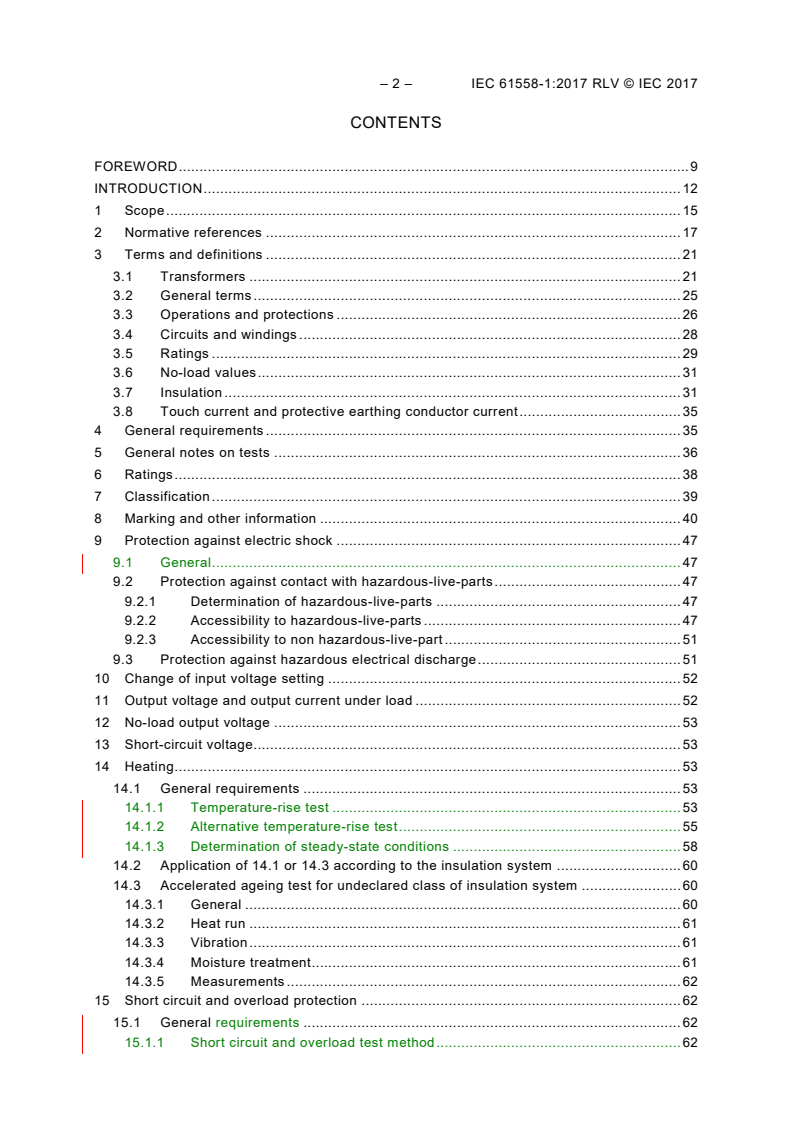
– 2 – IEC 61558-1:2017 RLV © IEC 2017
CONTENTS
FOREWORD . 9
INTRODUCTION . 12
1 Scope . 15
2 Normative references . 17
3 Terms and definitions . 21
3.1 Transformers . 21
3.2 General terms . 25
3.3 Operations and protections . 26
3.4 Circuits and windings . 28
3.5 Ratings . 29
3.6 No-load values . 31
3.7 Insulation . 31
3.8 Touch current and protective earthing conductor current . 35
4 General requirements . 35
5 General notes on tests . 36
6 Ratings . 38
7 Classification . 39
8 Marking and other information . 40
9 Protection against electric shock . 47
9.1 General . 47
9.2 Protection against contact with hazardous-live-parts . 47
9.2.1 Determination of hazardous-live-parts . 47
9.2.2 Accessibility to hazardous-live-parts . 47
9.2.3 Accessibility to non hazardous-live-part . 51
9.3 Protection against hazardous electrical discharge . 51
10 Change of input voltage setting . 52
11 Output voltage and output current under load . 52
12 No-load output voltage . 53
13 Short-circuit voltage. 53
14 Heating . 53
14.1 General requirements . 53
14.1.1 Temperature-rise test . 53
14.1.2 Alternative temperature-rise test . 55
14.1.3 Determination of steady-state conditions . 58
14.2 Application of 14.1 or 14.3 according to the insulation system . 60
14.3 Accelerated ageing test for undeclared class of insulation system . 60
14.3.1 General . 60
14.3.2 Heat run . 61
14.3.3 Vibration . 61
14.3.4 Moisture treatment . 61
14.3.5 Measurements . 62
15 Short circuit and overload protection . 62
15.1 General requirements . 62
15.1.1 Short circuit and overload test method . 62
15.1.2 Alternative short circuit and overload test method . 64
15.2 Inherently short-circuit proof transformers . 64
15.3 Non-inherently short-circuit proof transformers . 64
15.4 Non-short-circuit proof transformers . 65
15.5 Fail-safe transformers . 65
16 Mechanical strength . 66
16.1 General . 66
16.2 Stationary transformers . 66
16.3 Portable transformers (except portable transformers with integral pins for
introduction in socket-outlet in the fixed wiring) . 67
16.4 Portable transformers provided with integral pins for introduction in socket-
outlets of the fixed wiring . 67
16.4.1 General requirements . 67
16.4.2 Portable transformers provided with integral pins according to EN
50075 (IEC plug type C) for introduction in socket-outlets of the fixed
wiring . 68
16.5 Additional requirements for transformers to be used in vehicles and railway
applications . 69
16.5.1 Transformers to be used in vehicles and railway applications . 69
16.5.2 Test requirements for the transportation of transformers . 70
17 Protection against harmful ingress of dust, solid objects and moisture . 71
17.1 Degrees of protection provided by enclosures (IP code) . 71
17.1.1 General requirements . 71
17.1.2 Tests on transformers with enclosure . 72
17.2 Humidity treatment . 75
18 Insulation resistance, dielectric strength and leakage current . 75
18.1 General . 75
18.2 Insulation resistance . 76
18.3 Dielectric strength test . 76
18.4 Insulation between and within windings . 79
18.5 Touch current and protective earthing conductor current . 79
18.5.1 General . 79
18.5.2 Touch current . 80
18.5.3 Protective earthing conductor current . 81
19 Construction . 82
19.1 General construction . 82
19.1.1 General . 82
19.1.2 Auto-transformers . 82
19.1.3 Separating transformers . 83
19.1.4 Isolating transformers and safety isolating transformers . 84
19.2 Flammability of materials . 86
19.3 Short-circuit characteristics of portable transformers . 86
19.4 Class II transformer contact prevention of accessible conductive parts . 86
19.5 Class II transformer insulation reassembling after service . 86
19.6 Loosening of wires, screws or similar parts . 87
19.7 Resistor or capacitor connection with accessible conductive parts . 87
19.8 Bridging of separated conductive parts by resistors or capacitors . 87
19.9 Insulating material separating input and output windings . 88
19.10 Accidental contact protection against hazardous-live-parts provided by
isolating coating . 88
– 4 – IEC 61558-1:2017 RLV © IEC 2017
19.11 Insulating material of handles, operating levers, knobs and similar parts . 89
19.12 Winding construction . 89
19.13 Fixing of handles, operating levers and similar parts . 94
19.14 Fixing of covers providing protection against electric shock . 94
19.15 Strain on fixed socket-outlets caused by pin-transformers connection . 94
19.17 Drain hole of transformers protected against ingress of water . 94
19.18 Plug connected transformers protected against ingress of water . 95
19.19 Flexible cable or flexible cord connection for class I portable transformers . 95
19.20 SELV- and PELV-circuit separation of live parts . 95
19.21 Protection against contact for FELV-circuit . 96
19.22 Protective earthing regarding class II transformers . 96
19.23 Protective earthing regarding class III transformers . 96
20 Components . 96
21 Internal wiring . 101
22 Supply connection and other external flexible cables or cords . 102
23 Terminals for external conductors . 108
24 Provisions for protective earthing . 110
25 Screws and connections . 111
26 Creepage distances, clearances and distances through insulation . 114
26.1 General . 114
26.2 Creepage distances and clearances. 115
26.2.1 General . 115
26.2.2 Windings covered with adhesive tape . 115
26.2.3 Uncemented insulationing parts . 115
26.2.4 Cemented insulating parts . 116
26.2.5 Enclosed parts (e.g. by impregnation or potting) . 116
26.3 Distance through insulation . 118
27 Resistance to heat, fire and tracking . 131
27.1 General . 131
27.2 Resistance to heat . 131
27.2.1 General . 131
27.2.2 External accessible parts . 131
27.2.3 Internal parts . 132
27.3 Resistance to abnormal heat under fault conditions . 132
27.4 Resistance to fire . 133
27.4.1 General . 133
27.4.2 External accessible parts . 134
27.4.3 Internal parts . 134
27.5 Resistance to tracking. 135
28 Resistance to rusting . 135
Annex A (normative) Measurement of creepage distances and clearances . 136
Annex B (normative) Testing a series of transformers . 140
B.1 General . 140
B.2 Requirements . 140
B.3 Constructional inspection . 141
Annex C (normative) Creepage distances (cr), clearances (cl) and distances through
insulation (dti) Material group II (400 ≤CTI <600) (void) . 142
Annex D (normative) Creepage distances (cr), clearances (cl) and distances through
insulation (dti) Material group I (CTI ≥600) (void) . 145
Annex E (normative) Glow-wire test . 148
E.1 General . 148
E.2 Severity . 148
E.3 Conditioning. 148
E.4 Test procedure. 148
Annex F (normative) Requirements for manually operated switches which are parts of
transformers assembly . 149
F.1 General . 149
F.2 Switches tested as a separate component . 149
F.3 Switches tested as part of the transformer . 149
Annex G (normative) Tracking test . 152
G.1 General . 152
G.2 Test specimen . 152
G.3 Test apparatus . 152
G.4 Procedure . 152
Annex H (normative) Electronic circuits . 154
H.1 General . 154
H.2 General notes on tests (addition to Clause 5) . 154
H.3 Short circuit and overload protection (addition to Clause 15) . 154
H.4 Creepage distances, clearances and distances through insulation (addition
to Clause 26) . 156
Annex I (void) (informative) Dimensions for rectangular cross-section connectors of
transformers, basic dimensions and coordination . 158
Annex J (normative) Measuring network for touch-currents . 161
Annex K (normative) Insulated winding wires for use as multiple layer insulation . 162
K.1 General . 163
K.2 Type tests . 163
K.2.1 General . 163
K.2.2 Dielectric strength test . 163
K.2.3 Flexibility and adherence . 163
K.2.4 Heat shock . 164
K.2.5 Retention of dielectric strength after bending . 164
K.3 Testing during manufacturing . 165
K.3.1 General . 165
K.3.2 Routine test . 165
K.3.3 Sampling test. 165
Annex L (normative) Routine tests (production tests) . 166
L.1 General . 166
L.2 Protective earthing continuity test . 166
L.3 Checking of no-load output voltage . 166
L.4 Dielectric strength test . 166
L.5 Checking of protective devices mounting . 167
L.6 Visual inspection . 167
L.7 Repetition test after routine dielectric strength test . 167
Annex M (informative) Examples to be used as a guide for 19.1 . 168
M.1 General . 168
– 6 – IEC 61558-1:2017 RLV © IEC 2017
M.2 Coil-former . 168
M.2.1 Concentric type . 168
M.2.2 Side-by-side type . 169
M.3 Windings . 169
M.3.1 Without screen . 169
M.3.2 With screen . 170
Annex N (informative) Examples of for checking points of application of dielectric
strength test voltages. 171
Annex O (void) . 173
Annex P (informative) Examples of points of measurement points of creepage
distances and clearances . 174
Annex Q (informative) Explanation of IP numbers for degrees of protection . 177
Q.1 General . 177
Q.2 Degrees of protection against access to hazardous parts and against solid
foreign objects . 177
Q.3 Degrees of protection against ingress of water . 179
Annex R (normative) Explanations of the application of 4.1.1.2.1 6.1.2.2.1 of
IEC 60664-1:2007 (see 26.2) . 182
R.1 Impulse dielectric test . 182
R.2 Example . 182
Annex S (void) . 184
Annex T (void) . 185
Annex U (informative) Optional t –marking of transformers (void) . 186
w
Annex V (informative) Symbols to be used for thermal cut-outs . 195
V.1 Introduction General . 195
V.2 Non-self-resetting thermal cut-out (see 3.3.4) . 195
V.3 Self-resetting thermal cut-out (see 3.3.3) . 196
Annex W (normative) Coated printed circuit boards . 197
W.1 Preamble . 197
W.2 General . 197
W.3 Cold . 197
W.4 Rapid change of temperature . 197
W.5 Additional tests . 197
Index of defined terms . 200
Figure 1 – IEC 61558 principle . 13
Figure 2 – Mounting box for flush-type transformer . 38
Figure 3 – Test pin (see IEC 61032, test probe 13) . 48
Figure 4 – Standard test finger (see IEC 61032, test probe B) . 50
Figure 5 – Example of back-to-back method – Single phase . 57
Figure 6 – Example of back-to-back method – Three phase . 58
Figure 7 – Amplitude spectrum density for random testing . 70
Figure 8 – Normalised spectrum of shock . 71
Figure 9 – Test voltage sequence . 79
Figure 10 – Test configuration: single-phase equipment on star TN or TT system . 81
Figure 11 – Abrasion resistance test for insulating coated layers . 89
Figure 12 – Flexing test apparatus . 106
Figure 13 – Test arrangement for checking mechanical withstanding of insulating
materials in thin sheet layers . 123
Figure 14 – Ball-pressure apparatus . 131
Figure A.1 – Example 1 . 137
Figure A.2 – Example 2 . 137
Figure A.3 – Example 3 . 137
Figure A.4 – Example 4 . 138
Figure A.5 – Example 5 . 138
Figure A.6 – Example 6 . 138
Figure A.7 – Example 7 . 139
Figure A.8 – Example 8 . 139
Figure H.1 – Example of an electronic circuit with low-power points . 157
Figure J.1 – Measuring network for touch-current . 161
Figure M.1 – Examples for concentric type constructions . 168
Figure M.2 – Examples for side-by-side type constructions . 169
Figure M.3 – Examples for winding constructions without screen . 169
Figure M.4 – Examples for wrapped winding constructions . 170
Figure M.5 – Examples for winding constructions with screen . 170
Figure N.1 – Transformer of class I construction with metal enclosure . 171
Figure N.2 – Transformer of class II construction with metal enclosure . 172
Figure N.3 – Transformer of class II construction with enclosure of insulating material . 172
Figure P.1 – Transformer of class I construction . 174
Figure P.2 – Transformer of class I construction with earthed metal screen . 175
Figure P.3 – Transformer of class II construction with metal enclosure . 175
Figure P.4 – Transformer of class II construction with enclosure of insulating material . 176
Figure U.1 – Relation between winding temperature and endurance test duration .
Figure U.2 – Assessment of claimed value of S .
Figure V.1 – Restored by manual operation . 195
Figure V.2 – Restored by disconnection of the supply . 195
Figure V.3 – Thermal link (see 3.3.5) . 195
Figure V.4 – Self-resetting thermal cut-out . 196
Table 1 – Symbols used on equipment or in instructions . 44
Table 2 – Values of maximum temperatures in normal use . 59
Table 3 – Explanation of the maximum winding temperatures required in Table 2 . 60
Table 4 – Test temperature and testing time (in days) per cycle . 61
Table 5 – Maximum values of temperatures under short-circuit or overload conditions . 63
Table 6 – Values of T and k for fuses . 64
Table 7 – Pull force on pins . 68
Table 8 – Conditions for vibration testing (random) . 69
Table 9 – Amplitude spectrum density ASD values for accelerated life testing . 69
Table 10 – Frequency values depending on the weight of the specimen. 70
Table 11 – Excitation values for vibration testing . 70
– 8 – IEC 61558-1:2017 RLV © IEC 2017
Table 12 – Solid-object-proof transformer test . 73
Table 13 – Creepage distances (cr), clearances (cl) and distances through insulation
(dti) – Material group IIIa (175 ≤ CTI < 400) .
Table 13 – Values of insulation resistance . 76
Table 14 – Table of dielectric strength test voltages . 77
Table 15 – Limits for currents . 81
Table 16 – Nominal cross-sectional areas of external flexible cables or cords . 103
Table 17 – Pull and torque to be applied to external flexible cables or cords fixed to
stationary and portable transformers . 108
Table 18 – Torque to be applied to screws and connections . 113
Table 19 – Torque test on glands . 114
Table 20 – Clearances in mm . 124
Table 21 – Creepage distances in mm . 125
Table 22 – Distance through insulation in mm . 126
Table 23 – Creepage distances and clearance between terminals for external
connection . 127
Table 24 – Values of FIW wires with minimum overall diameter and minimum test
voltages according to the total enamel increase . 129
Table A.1 – Width of groove values depending on the pollution degree . 136
Table C.1 – Creepage distances (cr), clearances (cl) and distances through insulation
(dti) – Material group II (400 ≤CTI <600) .
Table D.1 – Creepage distances (cr), clearances (cl) and distances through insulation
(dti) – Material group I (CTI ≥600) .
Table F.1 – Peak surge current of additional loads . 150
Table I.1 – Dimensions of rectangular copper connectors . 159
Table K.1 – Mandrel diameter . 164
Table K.2 – Oven temperature . 164
Table Q.1 – Degrees of protection against access to hazardous parts indicated by the
first characteristic numeral . 178
Table Q.2 – Degrees of protection against solid foreign objects indicated by the first
characteristic numeral . 179
Table Q.3 – Degrees of protection indicated by the second characteristic numeral . 180
Table R.1 – Impulse test voltage according to 4.1.1.2.1 6.1.2.2.1 of IEC 60664-1:2007 . 182
Table U.1 – Example of maximum temperatures of windings under short circuit or
overload conditions and at 110 % of rated voltage for transformers subjected to an
endurance test duration of 30 days and a life expectance of 10 years .
Table U.2 –Theoretical test temperatures for transformers subjected to an endurance
test duration of 30 days and a life expectancy of 10 years .
INTERNATIONAL ELECTROTECHNICAL COMMISSION
____________
SAFETY OF POWER TRANSFORMERS, POWER SUPPLIES, REACTORS,
POWER SUPPLY UNITS AND SIMILAR PRODUCTS
COMBINATIONS THEREOF –
Part 1: General requirements and tests
FOREWORD
1) The International Electrotechnical Commission (IEC) is a worldwide organization for standardization comprising
all national electrotechnical committees (IEC National Committees). The object of IEC is to promote
international co-operation on all questions concerning standardization in the electrical and electronic fields. To
this end and in addition to other activities, IEC publishes International Standards, Technical Specifications,
Technical Reports, Publicly Available Specifications (PAS) and Guides (hereafter referred to as “IEC
Publication(s)”). Their preparation is entrusted to technical committees; any IEC National Committee interested
in the subject dealt with may participate in this preparatory work. International, governmental and non-
governmental organizations liaising with the IEC also participate in this preparation. IEC collaborates closely
with the International Organization for Standardization (ISO) in accordance with conditions determined by
agreement between the two organizations.
2) The formal decisions or agreements of IEC on technical matters express, as nearly as possible, an international
consensus of opinion on the relevant subjects since each technical committee has representation from all
interested IEC National Committees.
3) IEC Publications have the form of recommendations for international use and are accepted by IEC National
Committees in that sense. While all reasonable efforts are made to ensure that the technical content of IEC
Publications is accurate, IEC cannot be held responsible for the way in which they are used or for any
misinterpretation by any end user.
4) In order to promote international uniformity, IEC National Committees undertake to apply IEC Publications
transparently to the maximum extent possible in their national and regional publications. Any divergence
between any IEC Publication and the corresponding national or regional publication shall be clearly indicated in
the latter.
5) IEC itself does not provide any attestation of conformity. Independent certification bodies provide conformity
assessment services and, in some areas, access to IEC marks of conformity. IEC is not responsible for any
services carried out by independent certification bodies.
6) All users should ensure that they have the latest edition of this publication.
7) No liability shall attach to IEC or its directors, employees, servants or agents including individual experts and
members of its technical committees and IEC National Committees for any personal injury, property damage or
other damage of any nature whatsoever, whether direct or indirect, or for costs (including legal fees) and
expenses arising out of the publication, use of, or reliance upon, this IEC Publication or any other IEC
Publications.
8) Attention is drawn to the Normative references cited in this publication. Use of the referenced publications is
indispensable for the correct application of this publication.
9) Attention is drawn to the possibility that some of the elements of this IEC Publication may be the subject of
patent rights. IEC shall not be held responsible for identifying any or all such patent rights.
This redline version of the official IEC Standard allows the user to identify the changes
made to the previous edition. A vertical bar appears in the margin wherever a change
has been made. Additions are in green text, deletions are in strikethrough red text.
– 10 – IEC 61558-1:2017 RLV © IEC 2017
International Standard IEC 61558-1 has been prepared by IEC techn
...
IEC 61558-1 ®
Edition 3.0 2017-09
INTERNATIONAL
STANDARD
NORME
INTERNATIONALE
GROUP SAFETY PUBLICATION
PUBLICATION GROUPÉE DE SÉCURITÉ
Safety of transformers, reactors, power supply units and combinations thereof –
Part 1: General requirements and tests
Sécurité des transformateurs, bobines d’inductance, blocs d’alimentation et
des combinaisons de ces éléments –
Partie 1: Exigences générales et essais
All rights reserved. Unless otherwise specified, no part of this publication may be reproduced or utilized in any form
or by any means, electronic or mechanical, including photocopying and microfilm, without permission in writing from
either IEC or IEC's member National Committee in the country of the requester. If you have any questions about IEC
copyright or have an enquiry about obtaining additional rights to this publication, please contact the address below or
your local IEC member National Committee for further information.
Droits de reproduction réservés. Sauf indication contraire, aucune partie de cette publication ne peut être reproduite
ni utilisée sous quelque forme que ce soit et par aucun procédé, électronique ou mécanique, y compris la photocopie
et les microfilms, sans l'accord écrit de l'IEC ou du Comité national de l'IEC du pays du demandeur. Si vous avez des
questions sur le copyright de l'IEC ou si vous désirez obtenir des droits supplémentaires sur cette publication, utilisez
les coordonnées ci-après ou contactez le Comité national de l'IEC de votre pays de résidence.
IEC Central Office Tel.: +41 22 919 02 11
3, rue de Varembé Fax: +41 22 919 03 00
CH-1211 Geneva 20 info@iec.ch
Switzerland www.iec.ch
About the IEC
The International Electrotechnical Commission (IEC) is the leading global organization that prepares and publishes
International Standards for all electrical, electronic and related technologies.
About IEC publications
The technical content of IEC publications is kept under constant review by the IEC. Please make sure that you have the
latest edition, a corrigenda or an amendment might have been published.
IEC Catalogue - webstore.iec.ch/catalogue Electropedia - www.electropedia.org
The stand-alone application for consulting the entire The world's leading online dictionary of electronic and
bibliographical information on IEC International Standards, electrical terms containing 20 000 terms and definitions in
Technical Specifications, Technical Reports and other English and French, with equivalent terms in 16 additional
documents. Available for PC, Mac OS, Android Tablets and languages. Also known as the International Electrotechnical
iPad. Vocabulary (IEV) online.
IEC publications search - www.iec.ch/searchpub IEC Glossary - std.iec.ch/glossary
The advanced search enables to find IEC publications by a 65 000 electrotechnical terminology entries in English and
variety of criteria (reference number, text, technical French extracted from the Terms and Definitions clause of
committee,…). It also gives information on projects, replaced IEC publications issued since 2002. Some entries have been
and withdrawn publications. collected from earlier publications of IEC TC 37, 77, 86 and
CISPR.
IEC Just Published - webstore.iec.ch/justpublished
Stay up to date on all new IEC publications. Just Published IEC Customer Service Centre - webstore.iec.ch/csc
details all new publications released. Available online and If you wish to give us your feedback on this publication or
also once a month by email. need further assistance, please contact the Customer Service
Centre: csc@iec.ch.
A propos de l'IEC
La Commission Electrotechnique Internationale (IEC) est la première organisation mondiale qui élabore et publie des
Normes internationales pour tout ce qui a trait à l'électricité, à l'électronique et aux technologies apparentées.
A propos des publications IEC
Le contenu technique des publications IEC est constamment revu. Veuillez vous assurer que vous possédez l’édition la
plus récente, un corrigendum ou amendement peut avoir été publié.
Catalogue IEC - webstore.iec.ch/catalogue Electropedia - www.electropedia.org
Application autonome pour consulter tous les renseignements
Le premier dictionnaire en ligne de termes électroniques et
bibliographiques sur les Normes internationales,
électriques. Il contient 20 000 termes et définitions en anglais
Spécifications techniques, Rapports techniques et autres
et en français, ainsi que les termes équivalents dans 16
documents de l'IEC. Disponible pour PC, Mac OS, tablettes
langues additionnelles. Egalement appelé Vocabulaire
Android et iPad.
Electrotechnique International (IEV) en ligne.
Recherche de publications IEC - www.iec.ch/searchpub
Glossaire IEC - std.iec.ch/glossary
65 000 entrées terminologiques électrotechniques, en anglais
La recherche avancée permet de trouver des publications IEC
en utilisant différents critères (numéro de référence, texte, et en français, extraites des articles Termes et Définitions des
comité d’études,…). Elle donne aussi des informations sur les publications IEC parues depuis 2002. Plus certaines entrées
projets et les publications remplacées ou retirées. antérieures extraites des publications des CE 37, 77, 86 et
CISPR de l'IEC.
IEC Just Published - webstore.iec.ch/justpublished
Service Clients - webstore.iec.ch/csc
Restez informé sur les nouvelles publications IEC. Just
Published détaille les nouvelles publications parues. Si vous désirez nous donner des commentaires sur cette
Disponible en ligne et aussi une fois par mois par email. publication ou si vous avez des questions contactez-nous:
csc@iec.ch.
IEC 61558-1 ®
Edition 3.0 2017-09
INTERNATIONAL
STANDARD
NORME
INTERNATIONALE
GROUP SAFETY PUBLICATION
PUBLICATION GROUPÉE DE SÉCURITÉ
Safety of transformers, reactors, power supply units and combinations thereof –
Part 1: General requirements and tests
Sécurité des transformateurs, bobines d’inductance, blocs d’alimentation et
des combinaisons de ces éléments –
Partie 1: Exigences générales et essais
INTERNATIONAL
ELECTROTECHNICAL
COMMISSION
COMMISSION
ELECTROTECHNIQUE
INTERNATIONALE
ICS 29.180 ISBN 978-2-8322-4750-1
– 2 – IEC 61558-1:2017 © IEC 2017
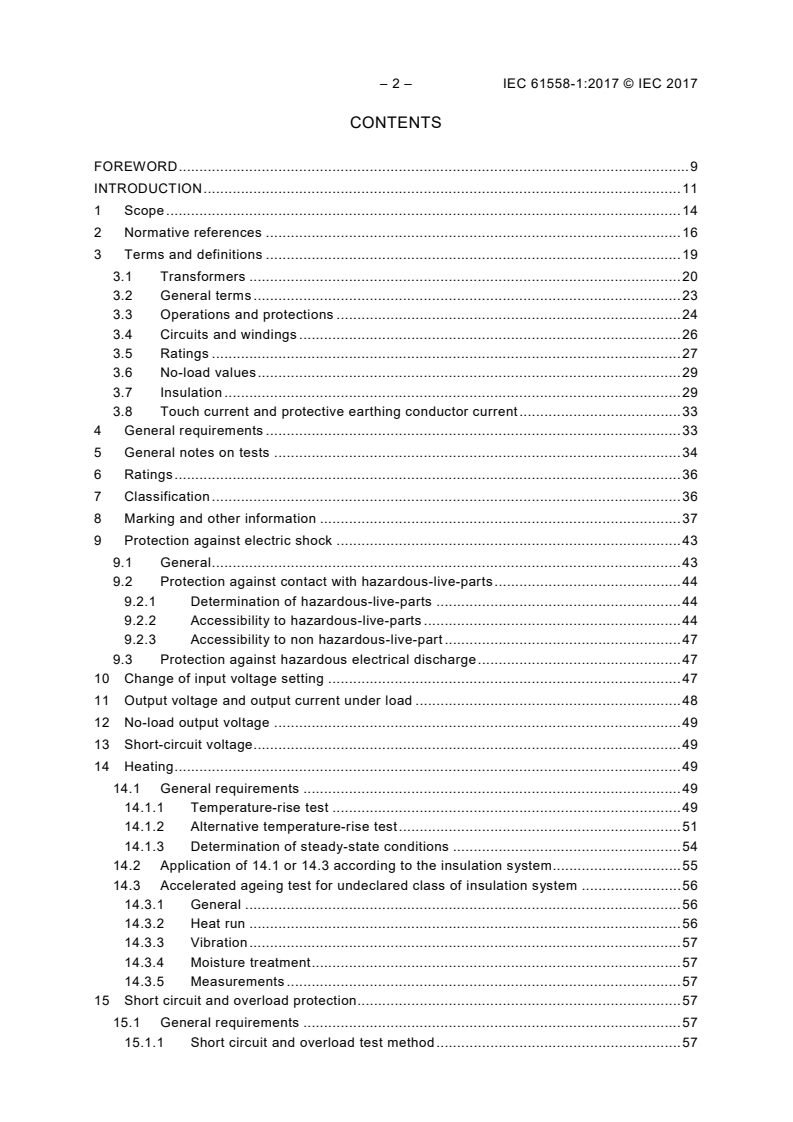
CONTENTS
FOREWORD . 9
INTRODUCTION . 11
1 Scope . 14
2 Normative references . 16
3 Terms and definitions . 19
3.1 Transformers . 20
3.2 General terms . 23
3.3 Operations and protections . 24
3.4 Circuits and windings . 26
3.5 Ratings . 27
3.6 No-load values . 29
3.7 Insulation . 29
3.8 Touch current and protective earthing conductor current . 33
4 General requirements . 33
5 General notes on tests . 34
6 Ratings . 36
7 Classification . 36
8 Marking and other information . 37
9 Protection against electric shock . 43
9.1 General . 43
9.2 Protection against contact with hazardous-live-parts . 44
9.2.1 Determination of hazardous-live-parts . 44
9.2.2 Accessibility to hazardous-live-parts . 44
9.2.3 Accessibility to non hazardous-live-part . 47
9.3 Protection against hazardous electrical discharge . 47
10 Change of input voltage setting . 47
11 Output voltage and output current under load . 48
12 No-load output voltage . 49
13 Short-circuit voltage . 49
14 Heating . 49
14.1 General requirements . 49
14.1.1 Temperature-rise test . 49
14.1.2 Alternative temperature-rise test . 51
14.1.3 Determination of steady-state conditions . 54
14.2 Application of 14.1 or 14.3 according to the insulation system. 55
14.3 Accelerated ageing test for undeclared class of insulation system . 56
14.3.1 General . 56
14.3.2 Heat run . 56
14.3.3 Vibration . 57
14.3.4 Moisture treatment . 57
14.3.5 Measurements . 57
15 Short circuit and overload protection. 57
15.1 General requirements . 57
15.1.1 Short circuit and overload test method . 57
15.1.2 Alternative short circuit and overload test method . 60
15.2 Inherently short-circuit proof transformers . 60
15.3 Non-inherently short-circuit proof transformers. 60
15.4 Non-short-circuit proof transformers . 61
15.5 Fail-safe transformers . 61
16 Mechanical strength . 62
16.1 General . 62
16.2 Stationary transformers . 62
16.3 Portable transformers (except portable transformers with integral pins for
introduction in socket-outlet in the fixed wiring) . 63
16.4 Portable transformers provided with integral pins for introduction in socket-
outlets of the fixed wiring . 63
16.4.1 General requirements . 63
16.4.2 Portable transformers provided with integral pins according to EN
50075 (IEC plug type C) for introduction in socket-outlets of the fixed
wiring . 64
16.5 Additional requirements for transformers to be used in vehicles and railway
applications . 65
16.5.1 Transformers to be used in vehicles and railway applications . 65
16.5.2 Test requirements for the transportation of transformers . 66
17 Protection against harmful ingress of dust, solid objects and moisture . 67
17.1 Degrees of protection provided by enclosures (IP code) . 67
17.1.1 General requirements . 67
17.1.2 Tests on transformers with enclosure . 68
17.2 Humidity treatment . 70
18 Insulation resistance, dielectric strength and leakage current . 71
18.1 General . 71
18.2 Insulation resistance . 71
18.3 Dielectric strength test . 72
18.4 Insulation between and within windings . 74
18.5 Touch current and protective earthing conductor current . 74
18.5.1 General . 74
18.5.2 Touch current . 75
18.5.3 Protective earthing conductor current . 76
19 Construction . 77
19.1 General construction . 77
19.1.1 General . 77
19.1.2 Auto-transformers . 77
19.1.3 Separating transformers . 78
19.1.4 Isolating transformers and safety isolating transformers . 79
19.2 Flammability of materials . 81
19.3 Short-circuit characteristics of portable transformers . 81
19.4 Class II transformer contact prevention of accessible conductive parts . 81
19.5 Class II transformer insulation reassembling after service . 81
19.6 Loosening of wires, screws or similar parts . 82
19.7 Resistor or capacitor connection with accessible conductive parts . 82
19.8 Bridging of separated conductive parts by resistors or capacitors . 82
19.9 Insulating material separating input and output windings . 83
19.10 Accidental contact protection against hazardous-live-parts provided by
isolating coating . 83
– 4 – IEC 61558-1:2017 © IEC 2017
19.11 Insulating material of handles, operating levers, knobs and similar parts. 84
19.12 Winding construction . 84
19.13 Fixing of handles, operating levers and similar parts . 88
19.14 Fixing of covers providing protection against electric shock . 88
19.15 Strain on fixed socket-outlets caused by pin-transformers connection . 89
19.16 Portable transformers for use in irregular or harsh conditions . 89
19.17 Drain hole of transformers protected against ingress of water . 89
19.18 Plug connected transformers protected against ingress of water . 89
19.19 Flexible cable or flexible cord connection for class I portable transformers . 89
19.20 SELV- and PELV-circuit separation of live parts . 89
19.21 Protection against contact for FELV-circuit. 90
19.22 Protective earthing regarding class II transformers . 90
19.23 Protective earthing regarding class III transformers . 91
20 Components . 91
21 Internal wiring . 96
22 Supply connection and other external flexible cables or cords . 96
23 Terminals for external conductors . 103
24 Provisions for protective earthing. 104
25 Screws and connections . 106
26 Creepage distances, clearances and distances through insulation . 108
26.1 General . 108
26.2 Creepage distances and clearances . 109
26.2.1 General . 109
26.2.2 Windings covered with adhesive tape . 109
26.2.3 Uncemented insulationing parts . 109
26.2.4 Cemented insulating parts . 109
26.2.5 Enclosed parts (e.g. by impregnation or potting) . 110
26.3 Distance through insulation . 111
27 Resistance to heat, fire and tracking . 122
27.1 General . 122
27.2 Resistance to heat . 122
27.2.1 General . 122
27.2.2 External accessible parts . 122
27.2.3 Internal parts . 123
27.3 Resistance to abnormal heat under fault conditions . 123
27.4 Resistance to fire . 124
27.4.1 General . 124
27.4.2 External accessible parts . 125
27.4.3 Internal parts . 125
27.5 Resistance to tracking . 126
28 Resistance to rusting . 126
Annex A (normative) Measurement of creepage distances and clearances. 127
Annex B (normative) Testing a series of transformers . 131
B.1 General . 131
B.2 Requirements . 131
B.3 Constructional inspection . 132
Annex C (void) . 133
Annex D (void) . 134
Annex E (normative) Glow-wire test . 135
E.1 General . 135
E.2 Severity . 135
E.3 Conditioning . 135
E.4 Test procedure . 135
Annex F (normative) Requirements for manually operated switches which are parts of
transformers assembly . 136
F.1 General . 136
F.2 Switches tested as a separate component . 136
F.3 Switches tested as part of the transformer . 136
Annex G (normative) Tracking test . 139
G.1 General . 139
G.2 Test specimen . 139
G.3 Test apparatus . 139
G.4 Procedure . 139
Annex H (normative) Electronic circuits . 140
H.1 General . 140
H.2 General notes on tests (addition to Clause 5). 140
H.3 Short circuit and overload protection (addition to Clause 15) . 140
H.4 Creepage distances, clearances and distances through insulation (addition
to Clause 26) . 142
Annex I (informative) Dimensions for rectangular cross-section connectors of
transformers, basic dimensions and coordination . 144
Annex J (normative) Measuring network for touch-currents . 146
Annex K (normative) Insulated winding wires . 147
K.1 General . 147
K.2 Type tests . 147
K.2.1 General . 147
K.2.2 Dielectric strength test . 147
K.2.3 Flexibility and adherence . 147
K.2.4 Heat shock . 148
K.2.5 Retention of dielectric strength after bending . 148
K.3 Testing during manufacturing . 149
K.3.1 General . 149
K.3.2 Routine test . 149
K.3.3 Sampling test . 149
Annex L (normative) Routine tests (production tests) . 150
L.1 General . 150
L.2 Protective earthing continuity test . 150
L.3 Checking of no-load output voltage . 150
L.4 Dielectric strength test . 150
L.5 Checking of protective devices mounting . 151
L.6 Visual inspection . 151
L.7 Repetition test after routine dielectric strength test . 151
Annex M (informative) Examples to be used as a guide for 19.1 . 152
M.1 General . 152
M.2 Coil-former . 152
– 6 – IEC 61558-1:2017 © IEC 2017
M.2.1 Concentric type . 152
M.2.2 Side-by-side type . 153
M.3 Windings . 153
M.3.1 Without screen . 153
M.3.2 With screen . 154
Annex N (informative) Examples for checking points of dielectric strength test voltages . 155
Annex O (void) . 157
Annex P (informative) Examples for measurement points of creepage distances and
clearances . 158
Annex Q (informative) Explanation of IP numbers for degrees of protection . 161
Q.1 General . 161
Q.2 Degrees of protection against access to hazardous parts and against solid
foreign objects . 161
Q.3 Degrees of protection against ingress of water . 163
Annex R (normative) Explanations of the application of 6.1.2.2.1 of IEC 60664-1:2007 . 164
R.1 Impulse dielectric test . 164
R.2 Example. 164
Annex S (void) . 166
Annex T (void) . 167
Annex U (void) . 168
Annex V (informative) Symbols to be used for thermal cut-outs . 169
V.1 General . 169
V.2 Non-self-resetting thermal cut-out (see 3.3.4) . 169
V.3 Self-resetting thermal cut-out (see 3.3.3) . 169
Annex W (normative) Coated printed circuit boards . 170
W.1 Preamble . 170
W.2 General . 170
W.3 Cold . 170
W.4 Rapid change of temperature . 170
W.5 Additional tests . 170
Bibliography . 171
Index of defined terms . 173
Figure 1 – IEC 61558 principle . 12
Figure 2 – Mounting box for flush-type transformer . 35
Figure 3 – Test pin (see IEC 61032, test probe 13) . 45
Figure 4 – Standard test finger (see IEC 61032, test probe B) . 46
Figure 5 – Example of back-to-back method – Single phase . 53
Figure 6 – Example of back-to-back method – Three phase . 53
Figure 7 – Amplitude spectrum density for random testing . 66
Figure 8 – Normalised spectrum of shock . 67
Figure 9 – Test voltage sequence . 74
Figure 10 – Test configuration: single-phase equipment on star TN or TT system . 76
Figure 11 – Abrasion resistance test for insulating coated layers . 84
Figure 12 – Flexing test apparatus . 100
Figure 13 – Test arrangement for checking mechanical withstanding of insulating
materials in thin sheet layers . 114
Figure 14 – Ball-pressure apparatus . 122
Figure A.1 – Example 1. 127
Figure A.2 – Example 2. 128
Figure A.3 – Example 3. 128
Figure A.4 – Example 4. 128
Figure A.5 – Example 5. 129
Figure A.6 – Example 6. 129
Figure A.7 – Example 7. 130
Figure A.8 – Example 8. 130
Figure H.1 – Example of an electronic circuit with low-power points . 143
Figure J.1 – Measuring network for touch-current . 146
Figure M.1 – Examples for concentric type constructions . 152
Figure M.2 – Examples for side-by-side type constructions . 153
Figure M.3 – Examples for winding constructions without screen . 153
Figure M.4 – Examples for wrapped winding constructions . 154
Figure M.5 – Examples for winding constructions with screen . 154
Figure N.1 – Transformer of class I construction with metal enclosure . 155
Figure N.2 – Transformer of class II construction with metal enclosure . 156
Figure N.3 – Transformer of class II construction with enclosure of insulating material . 156
Figure P.1 – Transformer of class I construction . 158
Figure P.2 – Transformer of class I construction with earthed metal screen . 159
Figure P.3 – Transformer of class II construction with metal enclosure . 159
Figure P.4 – Transformer of class II construction with enclosure of insulating material . 160
Figure V.1 – Restored by manual operation . 169
Figure V.2 – Restored by disconnection of the supply . 169
Figure V.3 – Thermal link (see 3.3.5) . 169
Figure V.4 – Self-resetting thermal cut-out . 169
Table 1 – Symbols used on equipment or in instructions . 41
Table 2 – Values of maximum temperatures in normal use . 54
Table 3 – Explanation of the maximum winding temperatures required in Table 2 . 55
Table 4 – Test temperature and testing time (in days) per cycle . 56
Table 5 – Maximum values of temperatures under short-circuit or overload conditions . 59
Table 6 – Values of T and k for fuses . 60
Table 7 – Pull force on pins . 64
Table 8 – Conditions for vibration testing (random) . 65
Table 9 – Amplitude spectrum density ASD values for accelerated life testing . 65
Table 10 – Frequency values depending on the weight of the specimen . 66
Table 11 – Excitation values for vibration testing . 66
Table 12 – Solid-object-proof transformer test . 69
Table 13 – Values of insulation resistance . 72
– 8 – IEC 61558-1:2017 © IEC 2017
Table 14 – Table of dielectric strength test voltages. 73
Table 15 – Limits for currents . 76
Table 16 – Nominal cross-sectional areas of external flexible cables or cords . 98
Table 17 – Pull and torque to be applied to external flexible cables or cords fixed to
stationary and portable transformers . 102
Table 18 – Torque to be applied to screws and connections . 107
Table 19 – Torque test on glands . 108
Table 20 – Clearances in mm . 115
Table 21 – Creepage distances in mm . 116
Table 22 – Distance through insulation in mm . 117
Table 23 – Creepage distances and clearance between terminals for external
connection . 118
Table 24 – Values of FIW wires with minimum overall diameter and minimum test
voltages according to the total enamel increase . 120
Table A.1 – Width of groove values depending on the pollution degree . 127
Table F.1 – Peak surge current of additional loads. 137
Table I.1 – Dimensions of rectangular copper connectors . 144
Table K.1 – Mandrel diameter . 148
Table K.2 – Oven temperature . 148
Table Q.1 – Degrees of protection against access to hazardous parts indicated by the
first characteristic numeral . 162
Table Q.2 – Degrees of protection against solid foreign objects indicated by the first
characteristic numeral . 162
Table Q.3 – Degrees of protection indicated by the second characteristic numeral . 163
Table R.1 – Impulse test voltage according to 6.1.2.2.1 of IEC 60664-1:2007 . 164
INTERNATIONAL ELECTROTECHNICAL COMMISSION
____________
SAFETY OF TRANSFORMERS, REACTORS,
POWER SUPPLY UNITS AND COMBINATIONS THEREOF –
Part 1: General requirements and tests
FOREWORD
1) The International Electrotechnical Commission (IEC) is a worldwide organization for standardization comprising
all national electrotechnical committees (IEC National Committees). The object of IEC is to promote
international co-operation on all questions concerning standardization in the electrical and electronic fields. To
this end and in addition to other activities, IEC publishes International Standards, Technical Specifications,
Technical Reports, Publicly Available Specifications (PAS) and Guides (hereafter referred to as “IEC
Publication(s)”). Their preparation is entrusted to technical committees; any IEC National Committee interested
in the subject dealt with may participate in this preparatory work. International, governmental and non-
governmental organizations liaising with the IEC also participate in this preparation. IEC collaborates closely
with the International Organization for Standardization (ISO) in accordance with conditions determined by
agreement between the two organizations.
2) The formal decisions or agreements of IEC on technical matters express, as nearly as possible, an international
consensus of opinion on the relevant subjects since each technical committee has representation from all
interested IEC National Committees.
3) IEC Publications have the form of recommendations for international use and are accepted by IEC National
Committees in that sense. While all reasonable efforts are made to ensure that the technical content of IEC
Publications is accurate, IEC cannot be held responsible for the way in which they are used or for any
misinterpretation by any end user.
4) In order to promote international uniformity, IEC National Committees undertake to apply IEC Publications
transparently to the maximum extent possible in their national and regional publications. Any divergence
between any IEC Publication and the corresponding national or regional publication shall be clearly indicated in
the latter.
5) IEC
...