

IEC 61228:2020
(Main)Fluorescent ultraviolet lamps used for tanning - Measurement and specification method
General Information
- Abstract
IEC 61228:2020 describes the method of measuring, evaluating and specifying the UV irradiation characteristics of fluorescent ultraviolet lamps that are used in appliances for tanning purposes. It includes specific requirements regarding the marking of such lamps. This third edition cancels and replaces the second edition published in 2008. This edition constitutes a technical revision. This edition includes the following significant technical changes with respect to the previous edition:
- maintenance code: description of the depreciation of the UV irradiance lamp during operation;
- operating position: information added for single capped lamps;
- spectroradiometric measuring system: new information about distance between sensor and lamp axis;
- measurement and evaluation procedure: separated detailed information for double capped fluorescent UV lamps and single capped fluorescent UV lamps;
- Annex C (normative), Method of test for irradiance maintenance: new information added;
- Annex D (normative), Reflector gauge: new information added;
- Annex E (normative), Lamp datasheets for measurement: complementary information added.
- Status
- Published
- Publication Date
- 03-Nov-2020
- Technical Committee
- SC 34A - Electric light sources
- Drafting Committee
- WG 6 - TC 34/SC 34A/WG 6
- Current Stage
- PPUB - Publication issued
- Start Date
- 04-Nov-2020
- Completion Date
- 04-Dec-2020
Buy Documents
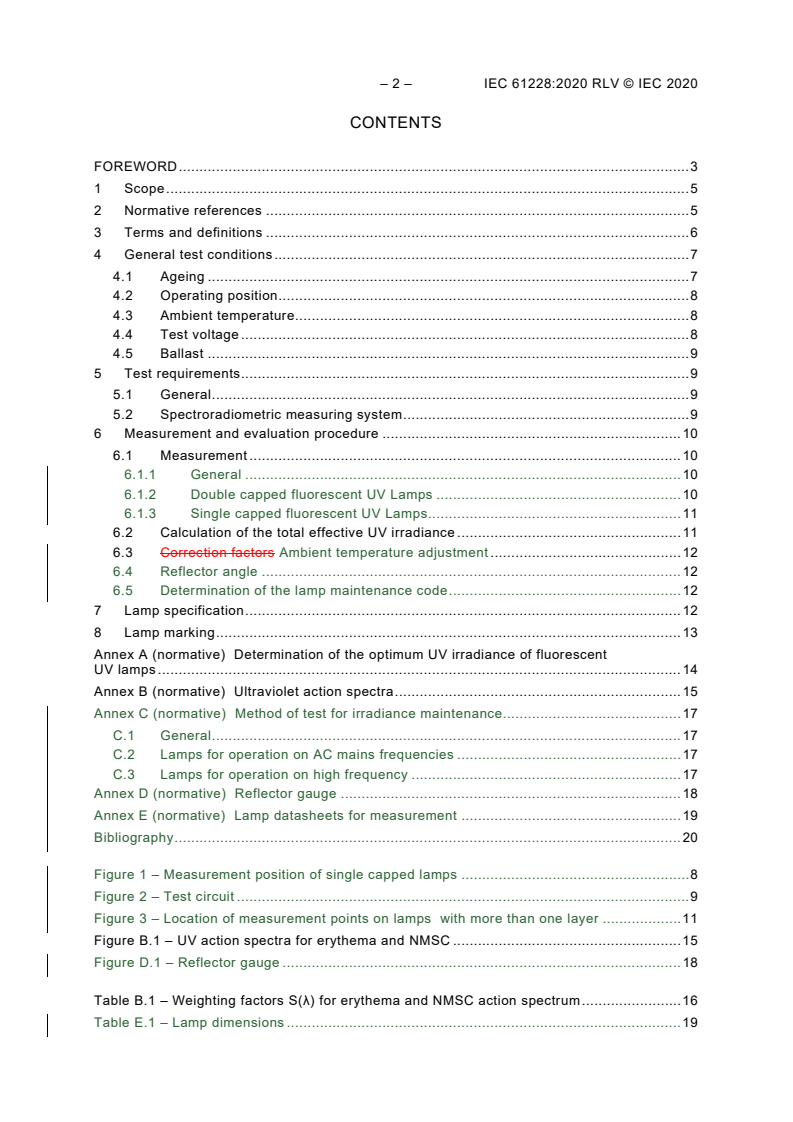
IEC 61228:2020 RLV - Fluorescent ultraviolet lamps used for tanning - Measurement and specification method Released:11/4/2020
IEC 61228:2020 - Fluorescent ultraviolet lamps used for tanning - Measurement and specification method Released:11/4/2020
Overview
IEC 61228:2020 - Fluorescent ultraviolet lamps used for tanning - Measurement and specification method - defines a type-testing framework for measuring, evaluating and specifying the UV irradiation characteristics of fluorescent UV lamps intended for tanning appliances. The 2020 (3rd) edition is a technical revision of the 2008 standard and adds updated requirements on measurement technique, lamp marking and maintenance characterization.
Key topics
- Scope and purpose: Measurement and specification methods for fluorescent UV lamps used in tanning; requirements relate to type testing and lamp marking.
- Measurement systems: Requirements for a spectroradiometric measuring system are specified (including new guidance on sensor-to-lamp-axis distance).
- Measurement procedures: Distinct and detailed procedures for double-capped and single-capped fluorescent UV lamps (measurement positions and evaluation are separated).
- Operating conditions: Test conditions include ageing (initial measurements after 5 h), operating position (additional information for single-capped lamps), ambient temperature, test voltage and ballast considerations.
- Irradiance evaluation: Calculation of total effective UV irradiance and use of action spectra (e.g., erythema) for weighting; correction factors for ambient temperature and reflector angle are included.
- Maintenance code: New definition and method to describe depreciation of UV irradiance during operation (irradiance maintenance ratio between 5 h and 500 h) and normative test methods in Annex C.
- Annexes and tooling: Normative Annex C (irradiance maintenance), Annex D (reflector gauge), and Annex E (lamp datasheets for measurement) provide practical test artifacts and datasheet requirements.
- Marking and specification: Requirements for lamp datasheets and markings to ensure traceability and consistent specification.
Applications and who uses it
IEC 61228:2020 is directly relevant to:
- Fluorescent UV lamp manufacturers - for product design verification, datasheets and compliance with type-test requirements.
- Tanning appliance manufacturers - to select and document lamps for safe and consistent tanning performance.
- Test laboratories and QA teams - for standardized spectroradiometric measurement, maintenance testing and reporting.
- Regulatory bodies and certification organizations - to assess conformity and inform safety guidance related to UV output and marking.
- R&D and standards engineers - for comparative evaluation of single-capped vs double-capped lamp performance and long-term irradiance behaviour.
Practical benefits include consistent UV irradiance measurement, reproducible maintenance characterization, improved lamp marking and clearer test reporting - all supporting product safety, performance claims and market transparency.
Related standards
Relevant normative references and related IEC/ISO documents to consult alongside IEC 61228:2020:
- IEC 61195, IEC 61199 (mechanical/electrical safety of lamps)
- IEC 60901 (single-capped fluorescent lamps)
- IEC 60061-1 (lamp caps and gauges)
- IEC 62471 (photobiological safety of lamps and lamp systems)
- ISO/CIE 28077 (photocarcinogenesis action spectrum)
Keywords: IEC 61228:2020, fluorescent ultraviolet lamps, tanning lamps, UV irradiance measurement, spectroradiometer, maintenance code, irradiance maintenance, lamp marking, single-capped, double-capped.
Relations
- Effective Date
- 05-Sep-2023
Buy Documents
IEC 61228:2020 RLV - Fluorescent ultraviolet lamps used for tanning - Measurement and specification method Released:11/4/2020
IEC 61228:2020 - Fluorescent ultraviolet lamps used for tanning - Measurement and specification method Released:11/4/2020
Get Certified
Connect with accredited certification bodies for this standard

IMQ S.p.A. (Certification)
Italian electrical product certification.

SLG Prüf- und Zertifizierungs GmbH
German testing and certification body.

UL Solutions
Global safety science company with testing, inspection and certification.
Sponsored listings
Frequently Asked Questions
IEC 61228:2020 is a standard published by the International Electrotechnical Commission (IEC). Its full title is "Fluorescent ultraviolet lamps used for tanning - Measurement and specification method". This standard covers: IEC 61228:2020 describes the method of measuring, evaluating and specifying the UV irradiation characteristics of fluorescent ultraviolet lamps that are used in appliances for tanning purposes. It includes specific requirements regarding the marking of such lamps. This third edition cancels and replaces the second edition published in 2008. This edition constitutes a technical revision. This edition includes the following significant technical changes with respect to the previous edition: - maintenance code: description of the depreciation of the UV irradiance lamp during operation; - operating position: information added for single capped lamps; - spectroradiometric measuring system: new information about distance between sensor and lamp axis; - measurement and evaluation procedure: separated detailed information for double capped fluorescent UV lamps and single capped fluorescent UV lamps; - Annex C (normative), Method of test for irradiance maintenance: new information added; - Annex D (normative), Reflector gauge: new information added; - Annex E (normative), Lamp datasheets for measurement: complementary information added.
IEC 61228:2020 describes the method of measuring, evaluating and specifying the UV irradiation characteristics of fluorescent ultraviolet lamps that are used in appliances for tanning purposes. It includes specific requirements regarding the marking of such lamps. This third edition cancels and replaces the second edition published in 2008. This edition constitutes a technical revision. This edition includes the following significant technical changes with respect to the previous edition: - maintenance code: description of the depreciation of the UV irradiance lamp during operation; - operating position: information added for single capped lamps; - spectroradiometric measuring system: new information about distance between sensor and lamp axis; - measurement and evaluation procedure: separated detailed information for double capped fluorescent UV lamps and single capped fluorescent UV lamps; - Annex C (normative), Method of test for irradiance maintenance: new information added; - Annex D (normative), Reflector gauge: new information added; - Annex E (normative), Lamp datasheets for measurement: complementary information added.
IEC 61228:2020 is classified under the following ICS (International Classification for Standards) categories: 17.240 - Radiation measurements; 29.140.01 - Lamps in general; 97.170 - Body care equipment. The ICS classification helps identify the subject area and facilitates finding related standards.
IEC 61228:2020 has the following relationships with other standards: It is inter standard links to IEC 61228:2008. Understanding these relationships helps ensure you are using the most current and applicable version of the standard.
IEC 61228:2020 is available in PDF format for immediate download after purchase. The document can be added to your cart and obtained through the secure checkout process. Digital delivery ensures instant access to the complete standard document.
Standards Content (Sample)
IEC 61228 ®
Edition 3.0 2020-11
REDLINE VERSION
INTERNATIONAL
STANDARD
colour
inside
Fluorescent ultraviolet lamps used for tanning – Measurement and specification
method
All rights reserved. Unless otherwise specified, no part of this publication may be reproduced or utilized in any form
or by any means, electronic or mechanical, including photocopying and microfilm, without permission in writing from
either IEC or IEC's member National Committee in the country of the requester. If you have any questions about IEC
copyright or have an enquiry about obtaining additional rights to this publication, please contact the address below or
your local IEC member National Committee for further information.
IEC Central Office Tel.: +41 22 919 02 11
3, rue de Varembé info@iec.ch
CH-1211 Geneva 20 www.iec.ch
Switzerland
About the IEC
The International Electrotechnical Commission (IEC) is the leading global organization that prepares and publishes
International Standards for all electrical, electronic and related technologies.
About IEC publications
The technical content of IEC publications is kept under constant review by the IEC. Please make sure that you have the
latest edition, a corrigendum or an amendment might have been published.
IEC publications search - webstore.iec.ch/advsearchform Electropedia - www.electropedia.org
The advanced search enables to find IEC publications by a The world's leading online dictionary on electrotechnology,
variety of criteria (reference number, text, technical containing more than 22 000 terminological entries in English
committee,…). It also gives information on projects, replaced and French, with equivalent terms in 16 additional languages.
and withdrawn publications. Also known as the International Electrotechnical Vocabulary
(IEV) online.
IEC Just Published - webstore.iec.ch/justpublished
Stay up to date on all new IEC publications. Just Published IEC Glossary - std.iec.ch/glossary
details all new publications released. Available online and 67 000 electrotechnical terminology entries in English and
once a month by email. French extracted from the Terms and Definitions clause of
IEC publications issued since 2002. Some entries have been
IEC Customer Service Centre - webstore.iec.ch/csc collected from earlier publications of IEC TC 37, 77, 86 and
If you wish to give us your feedback on this publication or CISPR.
need further assistance, please contact the Customer Service
Centre: sales@iec.ch.
IEC 61228 ®
Edition 3.0 2020-11
REDLINE VERSION
INTERNATIONAL
STANDARD
colour
inside
Fluorescent ultraviolet lamps used for tanning – Measurement and specification
method
INTERNATIONAL
ELECTROTECHNICAL
COMMISSION
ICS 17.240; 29.140.01; 97.170 ISBN 978-2-8322-9041-5
– 2 – IEC 61228:2020 RLV © IEC 2020
CONTENTS
FOREWORD . 3
1 Scope . 5
2 Normative references . 5
3 Terms and definitions . 6
4 General test conditions . 7
4.1 Ageing . 7
4.2 Operating position . 8
4.3 Ambient temperature. 8
4.4 Test voltage . 8
4.5 Ballast . 9
5 Test requirements . 9
5.1 General . 9
5.2 Spectroradiometric measuring system . 9
6 Measurement and evaluation procedure . 10
6.1 Measurement . 10
6.1.1 General . 10
6.1.2 Double capped fluorescent UV Lamps . 10
6.1.3 Single capped fluorescent UV Lamps. 11
6.2 Calculation of the total effective UV irradiance . 11
6.3 Correction factors Ambient temperature adjustment . 12
6.4 Reflector angle . 12
6.5 Determination of the lamp maintenance code . 12
7 Lamp specification . 12
8 Lamp marking . 13
Annex A (normative) Determination of the optimum UV irradiance of fluorescent
UV lamps . 14
Annex B (normative) Ultraviolet action spectra . 15
Annex C (normative) Method of test for irradiance maintenance . 17
C.1 General . 17
C.2 Lamps for operation on AC mains frequencies . 17
C.3 Lamps for operation on high frequency . 17
Annex D (normative) Reflector gauge . 18
Annex E (normative) Lamp datasheets for measurement . 19
Bibliography . 20
Figure 1 – Measurement position of single capped lamps . 8
Figure 2 – Test circuit . 9
Figure 3 – Location of measurement points on lamps with more than one layer . 11
Figure B.1 – UV action spectra for erythema and NMSC . 15
Figure D.1 – Reflector gauge . 18
Table B.1 – Weighting factors S(λ) for erythema and NMSC action spectrum . 16
Table E.1 – Lamp dimensions . 19
INTERNATIONAL ELECTROTECHNICAL COMMISSION
____________
FLUORESCENT ULTRAVIOLET LAMPS USED FOR TANNING –
MEASUREMENT AND SPECIFICATION METHOD
FOREWORD
1) The International Electrotechnical Commission (IEC) is a worldwide organization for standardization comprising
all national electrotechnical committees (IEC National Committees). The object of IEC is to promote international
co-operation on all questions concerning standardization in the electrical and electronic fields. To this end and
in addition to other activities, IEC publishes International Standards, Technical Specifications, Technical Reports,
Publicly Available Specifications (PAS) and Guides (hereafter referred to as “IEC Publication(s)”). Their
preparation is entrusted to technical committees; any IEC National Committee interested in the subject dealt with
may participate in this preparatory work. International, governmental and non-governmental organizations liaising
with the IEC also participate in this preparation. IEC collaborates closely with the International Organization for
Standardization (ISO) in accordance with conditions determined by agreement between the two organizations.
2) The formal decisions or agreements of IEC on technical matters express, as nearly as possible, an international
consensus of opinion on the relevant subjects since each technical committee has representation from all
interested IEC National Committees.
3) IEC Publications have the form of recommendations for international use and are accepted by IEC National
Committees in that sense. While all reasonable efforts are made to ensure that the technical content of IEC
Publications is accurate, IEC cannot be held responsible for the way in which they are used or for any
misinterpretation by any end user.
4) In order to promote international uniformity, IEC National Committees undertake to apply IEC Publications
transparently to the maximum extent possible in their national and regional publications. Any divergence between
any IEC Publication and the corresponding national or regional publication shall be clearly indicated in the latter.
5) IEC itself does not provide any attestation of conformity. Independent certification bodies provide conformity
assessment services and, in some areas, access to IEC marks of conformity. IEC is not responsible for any
services carried out by independent certification bodies.
6) All users should ensure that they have the latest edition of this publication.
7) No liability shall attach to IEC or its directors, employees, servants or agents including individual experts and
members of its technical committees and IEC National Committees for any personal injury, property damage or
other damage of any nature whatsoever, whether direct or indirect, or for costs (including legal fees) and
expenses arising out of the publication, use of, or reliance upon, this IEC Publication or any other IEC Publications.
8) Attention is drawn to the Normative references cited in this publication. Use of the referenced publications is
indispensable for the correct application of this publication.
9) Attention is drawn to the possibility that some of the elements of this IEC Publication may be the subject of patent
rights. IEC shall not be held responsible for identifying any or all such patent rights.
This redline version of the official IEC Standard allows the user to identify the changes
made to the previous edition. A vertical bar appears in the margin wherever a change has
been made. Additions are in green text, deletions are in strikethrough red text.
– 4 – IEC 61228:2020 RLV © IEC 2020
International Standard IEC 61228 has been prepared by subcommittee 34A: Electric light
sources, of IEC technical committee 34: Lighting.
This third edition cancels and replaces the second edition published in 2008. This edition
constitutes a technical revision.
This edition includes the following significant technical changes with respect to the previous
edition:
a) maintenance code: description of the depreciation of the UV irradiance lamp during
operation;
b) operating position: information added for single capped lamps;
c) spectroradiometric measuring system: new information about distance between sensor and
lamp axis;
d) measurement and evaluation procedure: separated detailed information for double capped
fluorescent UV lamps and single capped fluorescent UV lamps;
e) Annex C (normative), Method of test for irradiance maintenance: new information added;
f) Annex D (normative), Reflector gauge: new information added;
g) Annex E (normative), Lamp datasheets for measurement: complementary information added.
The text of this International Standard is based on the following documents:
FDIS Report on voting
34A/2213/FDIS 34A/2220/RVD
Full information on the voting for the approval of this International Standard can be found in the
report on voting indicated in the above table.
This document has been drafted in accordance with the ISO/IEC Directives, Part 2.
The committee has decided that the contents of this document will remain unchanged until the
stability date indicated on the IEC website under "http://webstore.iec.ch" in the data related to
the specific document. At this date, the document will be
• reconfirmed,
• withdrawn,
• replaced by a revised edition, or
• amended.
IMPORTANT – The 'colour inside' logo on the cover page of this publication indicates
that it contains colours which are considered to be useful for the correct understanding
of its contents. Users should therefore print this document using a colour printer.
FLUORESCENT ULTRAVIOLET LAMPS USED FOR TANNING –
MEASUREMENT AND SPECIFICATION METHOD
1 Scope
This document describes the method of measuring, evaluating and specifying the UV irradiation
characteristics of fluorescent ultraviolet lamps that are used in appliances for tanning purposes.
It includes specific requirements regarding the marking of such lamps.
These recommendations requirements relate only to type testing.
Lamps complying with the requirements of this document comply with the electrical and
mechanical safety requirements of IEC 61195 and IEC 61199 with the exception of the
requirements for maximum limits of UV radiation.
2 Normative references
The following documents are referred to in the text in such a way that some or all of their content
constitutes requirements of this document. For dated references, only the edition cited applies.
For undated references, the latest edition of the referenced document (including any
amendments) applies.
IEC 60050-845:1987, International Electrotechnical Vocabulary (IEV) – Chapter 845: Lighting
IEC 60061-1, Lamp caps and holders together with gauges for the control of interchangeability
and safety – Part 1: Lamp caps
IEC 60081, Double-capped fluorescent lamps – Performance specifications
IEC 60155, Glow-starters for fluorescent lamps
IEC 60901, Single-capped fluorescent lamps – Performance specifications
IEC 60335-2-27, Household and similar electrical appliances – Safety – Part 2-27: Particular
requirements for appliances for skin exposure to ultraviolet and infrared optical radiation
IEC 60921, Ballasts for tubular fluorescent lamps – Performance requirements
IEC 60929, AC and/or DC-supplied electronic control gear for tubular fluorescent lamps –
Performance requirements
IEC 61049, Capacitors for use in tubular fluorescent and other discharge lamp circuits.
Performance requirements
ISO/CIE 28077:2016, Photocarcinogenesis action spectrum (non-melanoma skin cancers)
ClE 63:1984, The spectroradiometric measurement of light sources
IEC 62471, Photobiological safety of lamps and lamp systems
– 6 – IEC 61228:2020 RLV © IEC 2020
3 Terms and definitions
For the purposes of this document, the following terms and definitions apply.
ISO and IEC maintain terminological databases for use in standardization at the following
addresses:
• IEC Electropedia: available at http://www.electropedia.org/
• ISO Online browsing platform: available at http://www.iso.org/obp
3.1
ultraviolet lamp
lamp which radiates especially strongly in the ultraviolet, the visible radiation produced, if any,
not being of direct interest
[SOURCE: IEC 60050-845:1987, 845-07-52, modified – Note deleted.]
3.2
fluorescent lamp
discharge lamp of the low-pressure mercury type in which most of the light is emitted by one or
several layers of phosphors excited by the ultraviolet radiation from the discharge
[SOURCE: IEC 60050-845:1987, 845-07-26, modified – Note deleted.]
3.3
type test
test or a series of tests made on a type test sample for the purpose of checking compliance of
the design of a given product with the requirements of the relevant standard
3.3
spectroradiometer
instrument for measuring radiometric quantities in narrow wavelength intervals over a given
spectral region
[SOURCE: IEC 60050-845:1987, 845-05-07]
3.4
bandwidth at a given wavelength
width at half-amplitude points of the transmittance function of a monochromator
Note 1 to entry: The bandwidth is expressed in nm.
3.5
spectral
adjective that, when applied to a quantity X pertaining to electromagnetic radiation, indicates:
– either that X is a function of the wavelength λ, symbol: X(λ);
– or that the quantity referred to is the spectral concentration of X, symbol: X = dX/dλ.
λ
X is also a function of λ and in order to stress this, it may be written X (λ) without any change
λ λ
of meaning
[SOURCE: IEC 60050-845:1987, 845-01-16, modified – Note deleted.]
3.6
irradiance
quotient of the radiant flux dφ incident on an element of the surface containing the point, by
e
the area dA of that element
Note 1 to entry: Irradiance is expressed in W/m .
[SOURCE: IEC 60050-845:1987, 845-01-37, modified – Domain and equivalent definition
deleted.]
3.7
action spectrum
efficiency of monochromatic radiations for producing a specified phenomenon in a specified
system
[SOURCE: IEC 60050-845:1987, 845-06-14, modified – Definition revised.]
3.8
effective
adjective that, when applied to a quantity pertaining to electromagnetic radiation, indicates that
the quantity referred to is weighed according to a specified action spectrum
3.9
nominal value
approximate quantity value used to designate or identify a lamp
[SOURCE: IEC 60050-151:2001, 151-16-09, modified – Definition revised and note deleted.]
3.10
rated value
quantity value for a characteristic of a lamp for specified operating conditions
Note 1 to entry: The value and/or conditions are specified in this document or assigned by the manufacturer or
responsible vendor.
3.11
irradiance maintenance ratio
r
rated value of the ratio of the effective UV irradiance weighed according to the erythema action
spectrum (250 nm to 400 nm) at a specified time to initial values
3.12
initial value
electrical and radiometric characteristics measured at the end of a 5 h ageing period
3.13
maintenance code
description of the depreciation of the UV irradiance lamp during operation between 5 h and
500 h
4 General test conditions
4.1 Ageing
Before the initial measurements, lamps shall be aged for a period of 5 h ± 0,25 h under normal
operating conditions.
– 8 – IEC 61228:2020 RLV © IEC 2020
The ageing shall be performed in accordance with Annex C.
4.2 Operating position
During ageing and measurement, lamps shall be operated in a horizontal position. Ageing is
preferably in a horizontal position; a vertical position may also be applied.
Single capped lamps shall be positioned such that the sensor sees both legs of the lamp
(see Figure 1). If the lamp has more than two limbs, the manufacturer or responsible vendor
shall specify the measurement position.
Figure 1 – Measurement position of single capped lamps
NOTE The lamp orientation in appliances used for skin exposure to ultraviolet radiation (sunbeds) can differ from
the measuring position and hence the irradiance values can also differ.
4.3 Ambient temperature
The measurement shall be made in a draught-free atmosphere at an ambient temperature of
25 °C ± 1 °C.
NOTE If applicable, lamps may also be measured under conditions different from the above
standard ambient temperature conditions to establish the optimum UV irradiance, as described
in Annex A.
4.4 Test voltage
All measurements shall be made by applying the test circuit in Figure 2 (preheat start).
Figure 2 – Test circuit
The test voltage applied to the circuit shall be as specified on the relevant lamp data sheet 110 %
of the rated voltage of the reference ballast with the starter circuit continuously closed.
The AC mains/supply voltage for the irradiance measurements shall maintain a tolerance of
±0,2 %.
The AC mains/supply frequency shall be 50 Hz ± 0,1 % or 60 Hz ± 0,1 % for each measurement.
4.5 Ballast
Lamps shall be operated with a reference ballast. In cases where a reference ballast has not
been established, an appropriate test ballast shall be specified by the lamp manufacturer or
responsible vendor.
The ballast shall be operating at a frequency of 50 – 60 Hz.
Lamps shall be operated with a ballast that generates electrical values for the operation of the
respective lamp that match the values given by the corresponding lamp manufacturer or
responsible vendor.
The ballast shall be operated at a frequency of 50 Hz or 60 Hz. The frequency shall be specified
for each measurement.
5 Test requirements
5.1 General
Spectroradiometric measurements shall be made in accordance with the relevant
recommendations of the CIE (International commission on illumination), as given in CIE 63.
NOTE 1 Additional information about UV measurements is given in Annex B of IEC 62471:2006.
NOTE 2 Additional requirements for electrical measurements are given in Annex B of IEC 60081:1997, Annex B of
IEC 60081:1997/AMD2:2003, Annex B of IEC 60081:1997/AMD4:2010, Annex B of IEC 60081:1997/AMD5:2013 and
Annex B of IEC 60901:1996, Annex B of IEC 60901:1996/AMD2:2000, Annex B of IEC 60901:1996/AMD5:2011 and
Annex B of IEC 60901:1996/AMD6:2014.
5.2 Spectroradiometric measuring system
Lamps shall be measured in an appropriate spectroradiometric a spectroradiometer system to
obtain the spectral irradiance.
– 10 – IEC 61228:2020 RLV © IEC 2020
The system input optics shall have a cosine response to accurately measure irradiance.
The spectroradiometer shall have a bandwidth at a given wavelength not exceeding 2,5 nm and
its wavelength resolution shall not be higher than 1 nm.
The distance between detector and lamp axis is not specified but shall be not less than 10 cm.
NOTE 1 For the publication of the final lamp specifications, the measured irradiance values are corrected to arrive
at irradiance values at 25 cm distance from the lamp axis (see 6.3).
NOTE 2 A bandwidth of 1 nm is advisable for greater measurement accuracy in cases where a rapid change of the
spectral irradiance occurs within a small bandwidth area.
NOTE 3 The bandwidth should be at least 2,5 times the measurement interval.(e.g. 2,5 nm bandwidth requires
1 nm measurement interval)
The distance between sensor and lamp axis, D , shall be (25 ± 0,5) cm (see Figure 1).
sensor
NOTE A bandwidth at a given wavelength of 1 nm is preferred for greater measurement accuracy in cases where a
rapid change of the spectral irradiance occurs within a small bandwidth area.
6 Measurement and evaluation procedure
6.1 Measurement
6.1.1 General
The spectral irradiance shall be measured at intervals of 1 nm from 250 nm to 400 nm. Under
the test conditions, the lamp power, current and voltage shall be recorded. The lamp shall be
in stable electric and radiometric conditions.
6.1.2 Double capped fluorescent UV Lamps
Double capped UV fluorescent lamps shall be operated during measurement such that the lamp
axis is at the same height as the centre of the entrance aperture of the sensor. The sensor shall
be placed in front of the middle of the lamp (see Figure 1).
Reflector lamps shall be operated such that the non-reflecting side is directed towards the
entrance aperture of the spectroradiometer. Lamps having a portion with no phosphor layer
shall be positioned, such that the uncoated portion is directed centrally towards the entrance
aperture of the spectroradiometer.
UV Lamps having more than one phosphor layer along the lamp axis (see Figure 3) shall be
measured in front of the middle of that layer, which shows the highest erythema effective
irradiance.
NOTE For determining the layer showing the highest erythema effective irradiance, a spectral broad band
radiometer can be used.
The drawing shows three layers.
Figure 3 – Location of measurement points on lamps
with more than one layer
6.1.3 Single capped fluorescent UV Lamps
Single capped UV fluorescent lamps shall be operated during measurement such that the
middle of the lamp bulb is at the same height as the centre of the entrance aperture of the
sensor.
Single capped UV fluorescent lamps shall be operated during measurement such that both
limbs have the same distance to the centre of the entrance aperture of the spectroradiometer
(see 4.2 and Figure 1).
For single capped fluorescent UV lamps having more than two limbs, the measurement position
that results in the highest measured erythema effective irradiance shall be specified by the
manufacturer or responsible vendor.
6.2 Calculation of the total effective UV irradiance
The total effective UV irradiance shall be calculated from the spectral irradiance using the
following formula:
E = Σ E ∙ S(λ) ∙ ∆λ
eff λ
where
E is the total effective irradiance (W/m );
eff
E is the spectral irradiance (W/(m · nm));
λ
S(λ) is the weighting factor according to the applicable action spectrum;
∆λ is the wavelength interval (nm).
The wavelength interval for the calculation shall preferably be equal to the bandwidth 1 nm.
The applicable action spectra for erythema and non-melanoma skin cancer (NMSC) are given
in Annex B.
For the total effective UV irradiance weighted according to the erythema action spectrum, the
summation shall be performed over the following wavelength range: 250 nm ≤ λ ≤ 400 nm.
For the total effective UV irradiance weighted according to the NMSC action spectrum, the
summation shall be performed over two wavelength ranges: 250 nm ≤ λ ≤ 320 nm, and
320 nm < ≤ λ ≤ 400 nm. The separate sums will be used in the specification of the equivalency
code in Clause 8.
NOTE 1 The limit of 320 nm is chosen in accordance with IEC 60335-2-27, where, for this application, the CIE
nomenclature UV-A and UV-B with a limit of 315 nm is not used.
– 12 – IEC 61228:2020 RLV © IEC 2020
NOTE 2 For evaluating the border wavelength of each wavelength interval accurate for calculating the total effective
irradiance values, the trapezoid formula is used:
λ
o-1
E =05,E⋅ λλ= ⋅=S λλ + E λ⋅S λ⋅Δλ+ 05,⋅E λ=λ ⋅=S λλ
( ) ( ) ( ) ( ) ( ) ( )
eff λ u u λλ o o
∑
λ
u+1
where
λ is the lower border wavelength of the wavelength interval;
u
λ is the upper border wavelength of the wavelength interval.
o
6.3 Correction factors Ambient temperature adjustment
In order to arrive at the final total effective UV irradiance values, the following two correction
factors may have to be applied:
a) for lamps having the optimum UV irradiance at an ambient temperature other than 25 °C, a
factor to obtain the optimum UV irradiance, as described in Annex A;
b) for lamps measured at a distance other than 25 cm, a factor to obtain the UV irradiance at
25 cm distance. This geometrical factor can be obtained for each lamp type either
experimentally or by calculation.
For lamps having the optimum UV irradiance at an ambient temperature other than 25 °C, a
factor shall be applied to obtain the optimum UV irradiance, as specified in Annex A.
6.4 Reflector angle
The reflector angle of fluorescent UV lamps shall be measured by using a reflector angle gauge,
in accordance with Annex D. The measurement of the reflector angle shall be performed in the
middle of the lamp.
If the lamp to be measured is not covered by the gauge shown in Annex D (see Figure D.1), the
measurement of the reflector angle shall be specified by the manufacturer or the responsible
vendor.
6.5 Determination of the lamp maintenance code
Lamps shall be designated by a maintenance code in accordance with the ratio, r, of UV
radiance measured at 500 h divided by the UV radiance measured at 5 h.
For expression in the equivalency code IR, (see Clause 8), the UV irradiance ratio, r, shall be
multiplied by ten and the result rounded down to the next integer value.
7 Lamp specification
The following information shall be given for each lamp type in the manufacturers literature
manufacturer’s documentation:
a) lamp dimensions;
b) for reflector lamps, the reflector angle α, i.e. the angle subtended at the lamp axis by the
reflector coating;
c) the type of ballast (operation frequency, nominal wattage) for which the lamp is designed;
NOTE Operation frequency can either be 50 Hz/60 Hz and/or HF.
d) the rated electrical characteristics:
– lamp wattage;
– lamp current;
– lamp voltage;
e) three the rated total effective UV irradiance values at a (25 ± 0,5) cm distance from the lamp
axis and weighted in accordance with Annex B:
– the erythema action spectrum over the wavelength range 250 nm ≤ λ ≤ 400 nm;
– the NMSC action spectrum over the wavelength range 250 nm ≤ λ ≤ 320 nm;
– the NMSC action spectrum over the wavelength range 320 nm < ≤ λ ≤ 400 nm.
f) the equivalency code (see Clause 8);
The values under items d) and e) shall be given under conditions of optimum UV irradiance.
The values under item e) shall be given in mW/m and rounded to the nearest integer.
8 Lamp marking
The following information shall be legibly and durably marked on the lamp:
a) the type reference of the lamp, containing:
– a mark of origin (this may take the form of a trademark, the manufacturer’s name or the
name of the responsible vendor);
– the nominal lamp wattage (marked "W" or "watts");
– a further identification of the specific lamp type (mostly in the form of a commercial
designation);
b) the equivalency code, in the form: Wattage–Reflector type code–UV code–Maintenance
code: The maintenance code IR (see 6.5) shall be used in the equivalency code only for
lamps intended for operation with dimmable ballasts.
– The wattage in the equivalency code shall be the nominal lamp wattage.
– The following reflector type code shall be used in the equivalency code:
O for non-reflector lamps;
B for lamps with a broad reflector angle α > 230°;
N for lamps with a narrow reflector angle α < 200°;
R for lamps with a regular reflector 200° ≤ α ≤ 230°.
– The following UV code shall be used in the equivalency code:
UV code = X/Y
X = total erythema effective UV irradiance over the range 250 nm to 400 nm;
Y = ratio of the NMSC effective UV irradiances ≤ 320 nm and > ≥ 320 nm.
X is to be given in mW/m rounded to the nearest integer, Y is to be rounded to the
nearest first decimal. The effective values are at a 25 cm distance and under
conditions of optimum UV irradiance.
– The maintenance code IR (see 6.5) shall be used in the equivalency code:
EXAMPLE
100 W reflector lamp with 220° reflector angle
Erythema effective UV irradiance (250 nm to 400 nm) = 47 mW/m
Short wave NMSC effective UV irradiance (≤ 320 nm) = 61 mW/m
Long wave NMSC effective UV irradiance (> ≥ 320 nm) = 19 mW/m
Irradiance maintenance ratio r = 0,83 (83 %)
Equivalency code: 100–R–47/3,2/8
– 14 – IEC 61228:2020 RLV © IEC 2020
Annex A
(normative)
Determination of the optimum UV irradiance
of fluorescent UV lamps
Many fluorescent UV lamps for tanning have a very high wall loading. When operated at the
standard ambient temperature of 25 °C, the vapour pressure will be too high, and the emitted
UV radiation will be lower than its optimum value. In many appliances, forced cooling is applied
in order to reach optimum conditions for the radiation. The electrical characteristics and the
effective UV irradiance have to be specified under these conditions for optimum UV irradiance.
To arrive at the values at optimum UV irradiance two methods can, the following method shall
be applied:
a) the measurement is made under non-standard ambient conditions to control the vapour
pressure, i.e. by a lower ambient temperature or by local cooling. The conditions to be
applied are dependent on the lamp type and shall be described in the manufacturer’s
documentation.
b) the measurement is made under standard ambient conditions and a correction factor is
applied to the results. This correction factor can be determined for each lamp type from a
continuous plot of the UV irradiance, emitted by the phosphor, during the run-up of the lamp
until a stable situation is reached. From this plot, the maximum value and the value after
stabilisation can be measured. The correction factor to be applied follows from the quotient
of the maximum value by the stabilised value. At the time of maximum UV irradiance the
lamp wattage, current and voltage have to be recorded.
In case of dispute, the second method shall be the reference measuring method.
Start and operate a lamp through a complete warm-up and using a fast detector, record an
erythema effective irradiance plot every second. Determine the maximum erythema effective
irradiance over the range 250 nm to 400 nm during the warm-up phase. Cool the lamp to
stabilized conditions at the maximum erythema effective irradiance and perform spectral
measurements with a double monochromator. Determine the values of X, the total erythema
effective UV irradiance over the range 250 nm to 400 nm and Y, the ratio of the NMSC effective
UV irradiances ≤ 320 nm and ≥ 320 nm from this spectral measurement.
Annex B
(normative)
Ultraviolet action spectra
The UV action spectra to be applied are shall be the erythema and the non-melanoma skin
cancer (NMSC) action spectra, as given in IEC 60335-2-27 and in ISO/CIE 28077:2016.
The action spectra are shown graphically in Figure B.1 and the weighting factors S(λ) are listed
in Table B.1.
NOTE The erythema action spectrum is defined from the following parameters:
Wavelength λ Weighting factor S(λ)
(nm)
λ ≤ 298 1
0,094(298 – λ)
298 < λ ≤ 328
0,015(140 – λ)
328< λ ≤ 400
Figure B.1 – UV action spectra for erythema and NMSC
– 16 – IEC 61228:2020 RLV © IEC 2020
Table B.1 – Weighting factors S(λ) for erythema and NMSC action spectrum
Wavelength Weighting factor Wavelength Weighting factor Wavelength Weighting factor
nm nm nm
Erythema NMSC Erythema NMSC Erythema NMSC
250 1,000 000 0,010 900 300 0,648 634 0,991 996 350 0,000 708 0,000 394
251 1,000 000 0,011 139 301 0,522 396 0,967 660 351 0,000 684 0,000 394
252 1,000 000 0,011 383 302 0,420 727 0,929 095 352 0,000 661 0,000 394
253 1,000 000 0,011 633 303 0,338 844 0,798 410 353 0,000 638 0,000 394
254 1,000 000 0,011 888 304 0,272 898 0,677 339 354 0,000 617 0,000 394
255 1,000 000 0,012 158 305 0,219 786 0,567 466 355 0,000 596 0,000 394
256 1,000 000 0,012 435 306 0,177 011 0,470 257 356 0,000 575 0,000 394
257 1,000 000 0,012 718 307 0,142 561 0,385 911 357 0,000 556 0,000 394
258 1,000 000 0,013 007 308 0,114 815 0,313 889 358 0,000 537 0,000 394
259 1,000 000 0,013 303 309 0,092 469 0,253 391 359 0,000 519 0,000 394
260 1,000 000 0,013 605 310 0,074 473 0,203 182 360 0,000 501 0,000 394
261 1,000 000 0,013 915 311 0,059 979 0,162 032 361 0,000 484 0,000 394
262 1,000 000 0,014 231 312 0,048 306 0,128 671 362 0,000 468 0,000 394
263 1,000 000 0,014 555 313 0,038 905 0,101 794 363 0,000 452 0,000 394
264 1,000 000 0,014 886 314 0,031 333 0,079 247 364 0,000 437 0,000 394
265 1,000 000 0,015 225 315 0,025 235 0,061 659 365 0,000 422 0,000 394
266 1,000 000 0,015 571 316 0,020 324 0,047 902 366 0,000 407 0,000 394
267 1,000 000 0,015 925 317 0,016 368 0,037 223 367 0,000 394 0,000 394
268 1,000 000 0,016 287 318 0,013 183 0,028 934 368 0,000 380 0,000 394
269 1,000 000 0,016 658 319 0,010 617 0,022 529 369 0,000 367 0,000 394
270 1,000 000 0,017 037 320 0,008 551 0,017 584 370 0,000 355 0,000 394
271 1,000 000 0,017 424 321 0,006 887 0,013 758 371 0,000 343 0,000 394
272 1,000 000 0,017 821 322 0,005 546 0,010 804 372 0,000 331 0,000 394
273 1,000 000 0,018 226 323 0,004 467 0,008 525 373 0,000 320 0,000 394
274 1,000 000 0,018 641 324 0,003 597 0,006 756 374 0,000 309 0,000 394
275 1,000 000 0,019 065 325 0,002 897 0,005 385 375 0,000 299 0,000 394
276 1,000 000 0,019 498 326 0,002 333 0,004 316 376 0,000 288 0,000 394
277 1,000 000 0,019 942 327 0,001 879 0,003 483 377 0,000 279 0,000 394
278 1,000 000 0,020 395 328 0,001 514 0,002 830 378 0,000 269 0,000 394
279 1,000 000 0,020 859 329 0,001 462 0,002 316 379 0,000 260 0,000 394
280 1,000 000 0,021 334 330 0,001 413 0,001 911 380 0,000 251 0,000 394
281 1,000 000 0,025 368 331 0,001 365 0,001 590 381 0,000 243 0,000 394
282 1,000 000 0,030 166 332 0,001 318 0,001 333 382 0,000 234 0,000 394
283 1,000 000 0,035 871 333 0,001 274 0,001 129 383 0,000 226 0,000 394
284 1,000 000 0,057 388 334 0,001 230 0,000 964 384 0,000 219 0,000 394
285 1,000 000 0,088 044 335 0,001 189 0,000 810 385 0,000 211 0,000 394
286 1,000 000 0,129 670 336 0,001 148 0,000 688 386 0,000 204 0,000 394
287 1,000 000 0,183 618 337 0,001 109 0,000 589 387 0,000 197 0,000 394
288 1,000 000 0,250 586 338 0,001 072 0,000 510 388 0,000 191 0,000 394
289 1,000 000 0,330 048 339 0,001 035 0,000 446 389 0,000 184 0,000 394
290 1,000 000 0,420 338 340 0,001 000 0,000 394 390 0,000 178 0,000 394
291 1,000 000 0,514 138 341 0,000 966 0,000 394 391 0,000 172 0,000 394
292 1,000 000 0,609 954 342 0,000 933 0,000 394 392 0,000 166 0,000 394
293 1,000 000 0,703 140 343 0,000 902 0,000 394 393 0,000 160 0,000 394
294 1,000 000 0,788 659 344 0,000 871 0,000 394 394 0,000 155 0,000 394
295 1,000000 0,861 948 345 0,000 841 0,000 394 395 0,000 150 0,000 394
296 1,000 000 0,919 650 346 0,000 813 0,000 394 396 0,000 145 0,000 394
297 1,000 000 0,958 965 347 0,000 785 0,000 394 397 0,000 140 0,000 394
298 1,000 000 0,988 917 348 0,000 759 0,000 394 398 0,000 135 0,000 394
299 0,805 378 1,000 000 349 0,000 733 0,000 394 399 0,000 130 0,000 394
400 0,000 126 0,000 394
Annex C
(normative)
Method of test for irradiance maintenance
C.1 General
The irradiance at a given time in the life of a lamp shall be measured as specified in Clauses 4,
5 and 6.
During ageing, lamps shall be operated as follows:
• Lamps should preferably be operated at an ambient temperature between 15 °C and 50 °C.
Excessive draughts shall be avoided, and the lamps shall not be subjected to extreme
vibration and shock.
• Lamps shall be operated in a horizontal position; a vertical position may also be applied.
• The connections of the lamp contacts, with reference to the terminations of the ballast, shall
not be changed for the whole course of the tests.
• Lamps shall be operated in the circuit for which they are intended by the manufacturer.
• Lamps shall be switched for ageing. The switching cycle shall be specified by the
manufacturer. The OFF-time interval shall not be less than 2 min.
NOTE Typical switching cycles are 25 min ON/5 min OFF or 20 min ON/5 min OFF or 10 min ON/2 min OFF.
C.2 Lamps for operation on AC mains frequencies
Ballasts used to operate lamps at AC mains frequency shall comply with the requirements of
IEC 60921. Additionally, for capacitive circuits, the capacitor used shall comply with the
requirements of IEC 61049.
The choice of the type of ballasts for these tests is left open, but the type used can have an
influence on the results of the test. It is recommended that the type of ballast employed should
be stated. In case of doubt, the use of an inductive type of ballast is recommended because
such a type has the smallest number of parameters capable of affecting the results.
For lamps operated with a starter, the preheating current, at rated supply voltage, shall not
differ by more than 10 % from the rated value specified by the corresponding manufacturer or
responsible vendor.
For lamps operated with a starter, the type of starter to be used shall comply with the
requirements of IEC 60155, and shall in any case be subject to agreement with the lamp
manufacturer or responsible vendor.
During ageing, the supply voltage and frequency shall not differ by more than 2 % from the
rated voltage and frequency of the ballast used.
C.3 Lamps for operation on high frequency
Ballasts used to operate lamps on frequencies above the AC mains frequency shall comply with
the requirements of IEC 60929.
– 18 – IEC 61228:2020 RLV © IEC 2020
Annex D
(normative)
Reflector gauge
Measure T5 [mm] T8 [mm] T12 [mm] Diameter
D 17 29 41,5 Min.
NOTE Dimensions N, R and B are specified in Clause 8, item b)
Figure D.1 – Reflector gauge
Annex E
(normative)
Lamp datasheets for measurement
The AC mains/supply voltage for the irradiance measurements shall maintain a tolerance of
±0,2 %. The AC mains/supply frequency shall be 50 Hz with a tolerance of ±0,1 % or 60 Hz with
a tolerance of ±0,1 %. The AC mains/supply frequency shall be specified for each
measurement.
The dimensional provisions A, B, C, D in Table E.1 shall comply with sheet 60081-IEC-01-1 of
IEC 60081:1997. Lamps listed in Table E.1 shall comply with the cap dimensions specified in
IEC 60061-1. Similarly, the lamp dimensions for the listed lamps in IEC 60061-1 shall comply
with the values indicated in Table E.1.
Table E.1 – Lamp dimensions
b
Lamp type Nominal Lamp Nominal A B B C
D
max min max max
max
a
power dimensions
cap
mm mm mm mm
W mm
mm
T5 linear fluorescent
0,300m F12 T5 15W 15 G5 300 x 16 288,3 293,0 295,4 302,5 16,0
0,525m F21 T5 25W 25 G5 525 x 16 516,9 521,6 524,0 531,1 16,0
T12 linear fluorescent
1,76m F71 T12 100W 100 G13 1 760 x 38 1 763,8 1 768,5 1 770,9 1 778,0 40,5
1,90m F75 T12 120W 120 G13 1 900 x 38 1 901,3 1 905,8 1 908,4 1 915,5 40,5
2,00m F79 T12 120W 120 G13 2 000 x 38 2 001,3 2 005,8 2 008,4 2 015,5 40,5
1,50m F59 T12 140W sm 140 G13 1 500 x 38 1 500,0 1 504,7 1 507,1 1 514,2 40,5
1,50m F59 T12 140W lm 140 G13 1 500 x 38 1 500,0 1 504,7 1 507,1 1 514,2 40,5
1,76m F71 T12 160W sm 160 G13 1 760 x 38 1 763,8 1 768,5 1 770,9 1 778,0 40,5
1,76m F71 T12 160W lm 160 G13 1 760 x 38 1 763,8 1 768,5 1 770,9 1 778,0 40,5
1,90m F75 T12 160W sm 160 G13 1 900 x 38 1 901,3 1 905,8 1 908,4 1 915,5 40,5
1,90m F75 T12 180W sm 180 G13 1 900 x 38 1 901,3 1 905,8 1 908,4 1 915,5 40,5
2,00m F79 T12 180W sm 180 G13 2 000 x 38 2 001,3 2 005,8 2 008,4 2 015,5 40,5
2,00m F79 T12 180W lm 180 G13 2 000 x 38 2 001,3 2 005,8 2 008,4 2 015,5 40,5
2,00m F79 T12 225W lm 225 G13 2 000 x 38 2 001,3 2 005,8 2 008,4 2 015,5 40,5
a
In accordance wi
...
IEC 61228 ®
Edition 3.0 2020-11
INTERNATIONAL
STANDARD
NORME
INTERNATIONALE
colour
inside
Fluorescent ultraviolet lamps used for tanning – Measurement and specification
method
Lampes fluorescentes à ultraviolet utilisées pour le bronzage – Méthode
de mesure et de spécification
All rights reserved. Unless otherwise specified, no part of this publication may be reproduced or utilized in any form
or by any means, electronic or mechanical, including photocopying and microfilm, without permission in writing from
either IEC or IEC's member National Committee in the country of the requester. If you have any questions about IEC
copyright or have an enquiry about obtaining additional rights to this publication, please contact the address below or
your local IEC member National Committee for further information.
Droits de reproduction réservés. Sauf indication contraire, aucune partie de cette publication ne peut être reproduite
ni utilisée sous quelque forme que ce soit et par aucun procédé, électronique ou mécanique, y compris la photocopie
et les microfilms, sans l'accord écrit de l'IEC ou du Comité national de l'IEC du pays du demandeur. Si vous avez des
questions sur le copyright de l'IEC ou si vous désirez obtenir des droits supplémentaires sur cette publication, utilisez
les coordonnées ci-après ou contactez le Comité national de l'IEC de votre pays de résidence.
IEC Central Office Tel.: +41 22 919 02 11
3, rue de Varembé info@iec.ch
CH-1211 Geneva 20 www.iec.ch
Switzerland
About the IEC
The International Electrotechnical Commission (IEC) is the leading global organization that prepares and publishes
International Standards for all electrical, electronic and related technologies.
About IEC publications
The technical content of IEC publications is kept under constant review by the IEC. Please make sure that you have the
latest edition, a corrigendum or an amendment might have been published.
IEC publications search - webstore.iec.ch/advsearchform Electropedia - www.electropedia.org
The advanced search enables to find IEC publications by a The world's leading online dictionary on electrotechnology,
variety of criteria (reference number, text, technical containing more than 22 000 terminological entries in English
committee,…). It also gives information on projects, replaced and French, with equivalent terms in 16 additional languages.
and withdrawn publications. Also known as the International Electrotechnical Vocabulary
(IEV) online.
IEC Just Published - webstore.iec.ch/justpublished
Stay up to date on all new IEC publications. Just Published IEC Glossary - std.iec.ch/glossary
details all new publications released. Available online and 67 000 electrotechnical terminology entries in English and
once a month by email. French extracted from the Terms and Definitions clause of
IEC publications issued since 2002. Some entries have been
IEC Customer Service Centre - webstore.iec.ch/csc collected from earlier publications of IEC TC 37, 77, 86 and
If you wish to give us your feedback on this publication or CISPR.
need further assistance, please contact the Customer Service
Centre: sales@iec.ch.
A propos de l'IEC
La Commission Electrotechnique Internationale (IEC) est la première organisation mondiale qui élabore et publie des
Normes internationales pour tout ce qui a trait à l'électricité, à l'électronique et aux technologies apparentées.
A propos des publications IEC
Le contenu technique des publications IEC est constamment revu. Veuillez vous assurer que vous possédez l’édition la
plus récente, un corrigendum ou amendement peut avoir été publié.
Recherche de publications IEC - Electropedia - www.electropedia.org
webstore.iec.ch/advsearchform Le premier dictionnaire d'électrotechnologie en ligne au
La recherche avancée permet de trouver des publications IEC monde, avec plus de 22 000 articles terminologiques en
en utilisant différents critères (numéro de référence, texte, anglais et en français, ainsi que les termes équivalents dans
comité d’études,…). Elle donne aussi des informations sur les 16 langues additionnelles. Egalement appelé Vocabulaire
projets et les publications remplacées ou retirées. Electrotechnique International (IEV) en ligne.
IEC Just Published - webstore.iec.ch/justpublished Glossaire IEC - std.iec.ch/glossary
Restez informé sur les nouvelles publications IEC. Just 67 000 entrées terminologiques électrotechniques, en anglais
Published détaille les nouvelles publications parues. et en français, extraites des articles Termes et Définitions des
Disponible en ligne et une fois par mois par email. publications IEC parues depuis 2002. Plus certaines entrées
antérieures extraites des publications des CE 37, 77, 86 et
Service Clients - webstore.iec.ch/csc CISPR de l'IEC.
Si vous désirez nous donner des commentaires sur cette
publication ou si vous avez des questions contactez-nous:
sales@iec.ch.
IEC 61228 ®
Edition 3.0 2020-11
INTERNATIONAL
STANDARD
NORME
INTERNATIONALE
colour
inside
Fluorescent ultraviolet lamps used for tanning – Measurement and specification
method
Lampes fluorescentes à ultraviolet utilisées pour le bronzage – Méthode
de mesure et de spécification
INTERNATIONAL
ELECTROTECHNICAL
COMMISSION
COMMISSION
ELECTROTECHNIQUE
INTERNATIONALE
ICS 17.240; 29.140.01; 97.170 ISBN 978-2-8322-9009-5
– 2 – IEC 61228:2020 © IEC 2020
CONTENTS
FOREWORD . 3
1 Scope . 5
2 Normative references . 5
3 Terms and definitions . 5
4 General test conditions . 7
4.1 Ageing . 7
4.2 Operating position . 7
4.3 Ambient temperature. 8
4.4 Test voltage . 8
4.5 Ballast . 9
5 Test requirements . 9
5.1 General . 9
5.2 Spectroradiometric measuring system . 9
6 Measurement and evaluation procedure . 9
6.1 Measurement . 9
6.1.1 General . 9
6.1.2 Double capped fluorescent UV Lamps . 9
6.1.3 Single capped fluorescent UV Lamps. 10
6.2 Calculation of the total effective UV irradiance . 10
6.3 Ambient temperature adjustment . 11
6.4 Reflector angle . 11
6.5 Determination of the lamp maintenance code . 11
7 Lamp specification . 11
8 Lamp marking . 12
Annex A (normative) Determination of the optimum UV irradiance of fluorescent
UV lamps . 13
Annex B (normative) Ultraviolet action spectra . 14
Annex C (normative) Method of test for irradiance maintenance . 16
C.1 General . 16
C.2 Lamps for operation on AC mains frequencies . 16
C.3 Lamps for operation on high frequency . 16
Annex D (normative) Reflector gauge . 17
Annex E (normative) Lamp datasheets for measurement . 18
Bibliography . 19
Figure 1 – Measurement position of single capped lamps . 8
Figure 2 – Test circuit . 8
Figure 3 – Location of measurement points on lamps with more than one layer . 10
Figure B.1 – UV action spectra for erythema and NMSC . 14
Figure D.1 – Reflector gauge . 17
Table B.1 – Weighting factors S(λ) for erythema and NMSC action spectrum . 15
Table E.1 – Lamp dimensions . 18
INTERNATIONAL ELECTROTECHNICAL COMMISSION
____________
FLUORESCENT ULTRAVIOLET LAMPS USED FOR TANNING –
MEASUREMENT AND SPECIFICATION METHOD
FOREWORD
1) The International Electrotechnical Commission (IEC) is a worldwide organization for standardization comprising
all national electrotechnical committees (IEC National Committees). The object of IEC is to promote international
co-operation on all questions concerning standardization in the electrical and electronic fields. To this end and
in addition to other activities, IEC publishes International Standards, Technical Specifications, Technical Reports,
Publicly Available Specifications (PAS) and Guides (hereafter referred to as “IEC Publication(s)”). Their
preparation is entrusted to technical committees; any IEC National Committee interested in the subject dealt with
may participate in this preparatory work. International, governmental and non-governmental organizations liaising
with the IEC also participate in this preparation. IEC collaborates closely with the International Organization for
Standardization (ISO) in accordance with conditions determined by agreement between the two organizations.
2) The formal decisions or agreements of IEC on technical matters express, as nearly as possible, an international
consensus of opinion on the relevant subjects since each technical committee has representation from all
interested IEC National Committees.
3) IEC Publications have the form of recommendations for international use and are accepted by IEC National
Committees in that sense. While all reasonable efforts are made to ensure that the technical content of IEC
Publications is accurate, IEC cannot be held responsible for the way in which they are used or for any
misinterpretation by any end user.
4) In order to promote international uniformity, IEC National Committees undertake to apply IEC Publications
transparently to the maximum extent possible in their national and regional publications. Any divergence between
any IEC Publication and the corresponding national or regional publication shall be clearly indicated in the latter.
5) IEC itself does not provide any attestation of conformity. Independent certification bodies provide conformity
assessment services and, in some areas, access to IEC marks of conformity. IEC is not responsible for any
services carried out by independent certification bodies.
6) All users should ensure that they have the latest edition of this publication.
7) No liability shall attach to IEC or its directors, employees, servants or agents including individual experts and
members of its technical committees and IEC National Committees for any personal injury, property damage or
other damage of any nature whatsoever, whether direct or indirect, or for costs (including legal fees) and
expenses arising out of the publication, use of, or reliance upon, this IEC Publication or any other IEC Publications.
8) Attention is drawn to the Normative references cited in this publication. Use of the referenced publications is
indispensable for the correct application of this publication.
9) Attention is drawn to the possibility that some of the elements of this IEC Publication may be the subject of patent
rights. IEC shall not be held responsible for identifying any or all such patent rights.
International Standard IEC 61228 has been prepared by subcommittee 34A: Electric light
sources, of IEC technical committee 34: Lighting.
This third edition cancels and replaces the second edition published in 2008. This edition
constitutes a technical revision.
This edition includes the following significant technical changes with respect to the previous
edition:
a) maintenance code: description of the depreciation of the UV irradiance lamp during
operation;
b) operating position: information added for single capped lamps;
c) spectroradiometric measuring system: new information about distance between sensor and
lamp axis;
d) measurement and evaluation procedure: separated detailed information for double capped
fluorescent UV lamps and single capped fluorescent UV lamps;
e) Annex C (normative), Method of test for irradiance maintenance: new information added;
f) Annex D (normative), Reflector gauge: new information added;
– 4 – IEC 61228:2020 © IEC 2020
g) Annex E (normative), Lamp datasheets for measurement: complementary information added.
The text of this International Standard is based on the following documents:
FDIS Report on voting
34A/2213/FDIS 34A/2220/RVD
Full information on the voting for the approval of this International Standard can be found in the
report on voting indicated in the above table.
This document has been drafted in accordance with the ISO/IEC Directives, Part 2.
The committee has decided that the contents of this document will remain unchanged until the
stability date indicated on the IEC website under "http://webstore.iec.ch" in the data related to
the specific document. At this date, the document will be
• reconfirmed,
• withdrawn,
• replaced by a revised edition, or
• amended.
IMPORTANT – The 'colour inside' logo on the cover page of this publication indicates
that it contains colours which are considered to be useful for the correct understanding
of its contents. Users should therefore print this document using a colour printer.
FLUORESCENT ULTRAVIOLET LAMPS USED FOR TANNING –
MEASUREMENT AND SPECIFICATION METHOD
1 Scope
This document describes the method of measuring, evaluating and specifying the UV irradiation
characteristics of fluorescent ultraviolet lamps that are used in appliances for tanning purposes.
It includes specific requirements regarding the marking of such lamps.
These requirements relate only to type testing.
Lamps complying with the requirements of this document comply with the electrical and
mechanical safety requirements of IEC 61195 and IEC 61199 with the exception of the
requirements for maximum limits of UV radiation.
2 Normative references
The following documents are referred to in the text in such a way that some or all of their content
constitutes requirements of this document. For dated references, only the edition cited applies.
For undated references, the latest edition of the referenced document (including any
amendments) applies.
IEC 60061-1, Lamp caps and holders together with gauges for the control of interchangeability
and safety – Part 1: Lamp caps
IEC 60081, Double-capped fluorescent lamps – Performance specifications
IEC 60155, Glow-starters for fluorescent lamps
IEC 60335-2-27, Household and similar electrical appliances – Safety – Part 2-27: Particular
requirements for appliances for skin exposure to optical radiation
IEC 60921, Ballasts for tubular fluorescent lamps – Performance requirements
IEC 60929, AC and/or DC-supplied electronic control gear for tubular fluorescent lamps –
Performance requirements
IEC 61049, Capacitors for use in tubular fluorescent and other discharge lamp circuits.
Performance requirements
ISO/CIE 28077:2016, Photocarcinogenesis action spectrum (non-melanoma skin cancers)
ClE 63:1984, The spectroradiometric measurement of light sources
3 Terms and definitions
For the purposes of this document, the following terms and definitions apply.
– 6 – IEC 61228:2020 © IEC 2020
ISO and IEC maintain terminological databases for use in standardization at the following
addresses:
• IEC Electropedia: available at http://www.electropedia.org/
• ISO Online browsing platform: available at http://www.iso.org/obp
3.1
ultraviolet lamp
lamp which radiates especially strongly in the ultraviolet, the visible radiation produced, if any,
not being of direct interest
[SOURCE: IEC 60050-845:1987, 845-07-52, modified – Note deleted.]
3.2
fluorescent lamp
discharge lamp of the low-pressure mercury type in which most of the light is emitted by one or
several layers of phosphors excited by the ultraviolet radiation from the discharge
[SOURCE: IEC 60050-845:1987, 845-07-26, modified – Note deleted.]
3.3
spectroradiometer
instrument for measuring radiometric quantities in narrow wavelength intervals over a given
spectral region
[SOURCE: IEC 60050-845:1987, 845-05-07]
3.4
bandwidth at a given wavelength
width at half-amplitude points of the transmittance function of a monochromator
Note 1 to entry: The bandwidth is expressed in nm.
3.5
spectral
adjective that, when applied to a quantity X pertaining to electromagnetic radiation, indicates:
– either that X is a function of the wavelength λ, symbol: X(λ);
– or that the quantity referred to is the spectral concentration of X, symbol: X = dX/dλ.
λ
X is also a function of λ and in order to stress this, it may be written X (λ) without any change
λ λ
of meaning
[SOURCE: IEC 60050-845:1987, 845-01-16, modified – Note deleted.]
3.6
irradiance
quotient of the radiant flux dφ incident on an element of the surface containing the point, by
e
the area dA of that element
Note 1 to entry: Irradiance is expressed in W/m .
[SOURCE: IEC 60050-845:1987, 845-01-37, modified – Domain and equivalent definition
deleted.]
3.7
action spectrum
efficiency of monochromatic radiations for producing a specified phenomenon in a specified
system
[SOURCE: IEC 60050-845:1987, 845-06-14, modified – Definition revised.]
3.8
effective
adjective that, when applied to a quantity pertaining to electromagnetic radiation, indicates that
the quantity referred to is weighed according to a specified action spectrum
3.9
nominal value
approximate quantity value used to designate or identify a lamp
[SOURCE: IEC 60050-151:2001, 151-16-09, modified – Definition revised and note deleted.]
3.10
rated value
quantity value for a characteristic of a lamp for specified operating conditions
Note 1 to entry: The value and/or conditions are specified in this document or assigned by the manufacturer or
responsible vendor.
3.11
irradiance maintenance ratio
r
rated value of the ratio of the effective UV irradiance weighed according to the erythema action
spectrum (250 nm to 400 nm) at a specified time to initial values
3.12
initial value
electrical and radiometric characteristics measured at the end of a 5 h ageing period
3.13
maintenance code
description of the depreciation of the UV irradiance lamp during operation between 5 h and
500 h
4 General test conditions
4.1 Ageing
Before the initial measurements, lamps shall be aged for a period of 5 h ± 0,25 h.
The ageing shall be performed in accordance with Annex C.
4.2 Operating position
During measurement, lamps shall be operated in a horizontal position. Ageing is preferably in
a horizontal position; a vertical position may also be applied.
Single capped lamps shall be positioned such that the sensor sees both legs of the lamp
(see Figure 1). If the lamp has more than two limbs, the manufacturer or responsible vendor
shall specify the measurement position.
– 8 – IEC 61228:2020 © IEC 2020
Figure 1 – Measurement position of single capped lamps
NOTE The lamp orientation in appliances used for skin exposure to ultraviolet radiation (sunbeds) can differ from
the measuring position and hence the irradiance values can also differ.
4.3 Ambient temperature
The measurement shall be made in a draught-free atmosphere at an ambient temperature of
25 °C ± 1 °C.
If applicable, lamps may also be measured under conditions different from the above standard
ambient temperature conditions to establish the optimum UV irradiance, as described in
Annex A.
4.4 Test voltage
All measurements shall be made by applying the test circuit in Figure 2 (preheat start).
Figure 2 – Test circuit
The test voltage applied to the circuit shall be 110 % of the rated voltage of the reference ballast
with the starter circuit continuously closed.
The AC mains/supply voltage for the irradiance measurements shall maintain a tolerance of
±0,2 %.
The AC mains/supply frequency shall be 50 Hz ± 0,1 % or 60 Hz ± 0,1 % for each measurement.
4.5 Ballast
Lamps shall be operated with a ballast that generates electrical values for the operation of the
respective lamp that match the values given by the corresponding lamp manufacturer or
responsible vendor.
The ballast shall be operated at a frequency of 50 Hz or 60 Hz. The frequency shall be specified
for each measurement.
5 Test requirements
5.1 General
Spectroradiometric measurements shall be made in accordance with the relevant
recommendations of the CIE (International commission on illumination), as given in CIE 63.
NOTE 1 Additional information about UV measurements is given in Annex B of IEC 62471:2006.
NOTE 2 Additional requirements for electrical measurements are given in Annex B of IEC 60081:1997, Annex B of
IEC 60081:1997/AMD2:2003, Annex B of IEC 60081:1997/AMD4:2010, Annex B of IEC 60081:1997/AMD5:2013 and
Annex B of IEC 60901:1996, Annex B of IEC 60901:1996/AMD2:2000, Annex B of IEC 60901:1996/AMD5:2011 and
Annex B of IEC 60901:1996/AMD6:2014.
5.2 Spectroradiometric measuring system
Lamps shall be measured in a spectroradiometer system to obtain the spectral irradiance.
The system input optics shall have a cosine response to accurately measure irradiance.
The spectroradiometer shall have a bandwidth at a given wavelength not exceeding 2,5 nm and
its wavelength resolution shall not be higher than 1 nm.
The distance between sensor and lamp axis, D , shall be (25 ± 0,5) cm (see Figure 1).
sensor
NOTE A bandwidth at a given wavelength of 1 nm is preferred for greater measurement accuracy in cases where a
rapid change of the spectral irradiance occurs within a small bandwidth area.
6 Measurement and evaluation procedure
6.1 Measurement
6.1.1 General
The spectral irradiance shall be measured at intervals of 1 nm from 250 nm to 400 nm. Under
the test conditions, the lamp power, current and voltage shall be recorded. The lamp shall be
in stable electric and radiometric conditions.
6.1.2 Double capped fluorescent UV Lamps
Double capped UV fluorescent lamps shall be operated during measurement such that the lamp
axis is at the same height as the centre of the entrance aperture of the sensor. The sensor shall
be placed in front of the middle of the lamp (see Figure 1).
Reflector lamps shall be operated such that the non-reflecting side is directed towards the
entrance aperture of the spectroradiometer. Lamps having a portion with no phosphor layer
shall be positioned, such that the uncoated portion is directed centrally towards the entrance
aperture of the spectroradiometer.
– 10 – IEC 61228:2020 © IEC 2020
UV Lamps having more than one phosphor layer along the lamp axis (see Figure 3) shall be
measured in front of the middle of that layer, which shows the highest erythema effective
irradiance.
NOTE For determining the layer showing the highest erythema effective irradiance, a spectral broad band
radiometer can be used.
The drawing shows three layers.
Figure 3 – Location of measurement points on lamps
with more than one layer
6.1.3 Single capped fluorescent UV Lamps
Single capped UV fluorescent lamps shall be operated during measurement such that the
middle of the lamp bulb is at the same height as the centre of the entrance aperture of the
sensor.
Single capped UV fluorescent lamps shall be operated during measurement such that both
limbs have the same distance to the centre of the entrance aperture of the spectroradiometer
(see 4.2 and Figure 1).
For single capped fluorescent UV lamps having more than two limbs, the measurement position
that results in the highest measured erythema effective irradiance shall be specified by the
manufacturer or responsible vendor.
6.2 Calculation of the total effective UV irradiance
The total effective UV irradiance shall be calculated from the spectral irradiance using the
following formula:
= Σ E ∙ S(λ) ∙ ∆λ
E
eff λ
where
E is the total effective irradiance (W/m );
eff
E is the spectral irradiance (W/(m · nm));
λ
S(λ) is the weighting factor according to the applicable action spectrum;
∆λ is the wavelength interval (nm).
The wavelength interval for the calculation shall be 1 nm.
The applicable action spectra for erythema and non-melanoma skin cancer (NMSC) are given
in Annex B.
For the total effective UV irradiance weighted according to the erythema action spectrum, the
summation shall be performed over the following wavelength range: 250 nm ≤ λ ≤ 400 nm.
For the total effective UV irradiance weighted according to the NMSC action spectrum, the
summation shall be performed over two wavelength ranges: 250 nm ≤ λ ≤ 320 nm, and
320 nm ≤ λ ≤ 400 nm. The separate sums will be used in the specification of the equivalency
code in Clause 8.
NOTE 1 The limit of 320 nm is chosen in accordance with IEC 60335-2-27, where, for this application, the CIE
nomenclature UV-A and UV-B with a limit of 315 nm is not used.
NOTE 2 For evaluating the border wavelength of each wavelength interval accurate for calculating the total effective
irradiance values, the trapezoid formula is used:
λ
o-1
E =05,E⋅ λλ= ⋅=S λλ + E λ⋅S λ⋅Δλ+ 05,⋅E λ=λ ⋅=S λλ
( ) ( ) ( ) ( ) ( ) ( )
eff λ u u ∑ λλ o o
λ
u+1
where
λ is the lower border wavelength of the wavelength interval;
u
λ is the upper border wavelength of the wavelength interval.
o
6.3 Ambient temperature adjustment
In order to arrive at the final total effective UV irradiance values, the following correction factor
may have to be applied.
For lamps having the optimum UV irradiance at an ambient temperature other than 25 °C, a
factor shall be applied to obtain the optimum UV irradiance, as specified in Annex A.
6.4 Reflector angle
The reflector angle of fluorescent UV lamps shall be measured by using a reflector angle gauge,
in accordance with Annex D. The measurement of the reflector angle shall be performed in the
middle of the lamp.
If the lamp to be measured is not covered by the gauge shown in Annex D (see Figure D.1), the
measurement of the reflector angle shall be specified by the manufacturer or the responsible
vendor.
6.5 Determination of the lamp maintenance code
Lamps shall be designated by a maintenance code in accordance with the ratio, r, of UV
radiance measured at 500 h divided by the UV radiance measured at 5 h.
For expression in the equivalency code IR, (see Clause 8), the UV irradiance ratio, r, shall be
multiplied by ten and the result rounded down to the next integer value.
7 Lamp specification
The following information shall be given for each lamp type in the manufacturer’s documentation:
a) lamp dimensions;
b) for reflector lamps, the reflector angle α, i.e. the angle subtended at the lamp axis by the
reflector coating;
c) the ballast (operation frequency, nominal wattage) for which the lamp is designed;
NOTE Operation frequency can either be 50 Hz/60 Hz and/or HF.
d) the rated electrical characteristics:
– lamp wattage;
– 12 – IEC 61228:2020 © IEC 2020
– lamp current;
– lamp voltage;
e) the rated total effective UV irradiance values at a (25 ± 0,5) cm distance from the lamp axis
and weighted in accordance with Annex B:
– the erythema action spectrum over the wavelength range 250 nm ≤ λ ≤ 400 nm;
– the NMSC action spectrum over the wavelength range 250 nm ≤ λ ≤ 320 nm;
– the NMSC action spectrum over the wavelength range 320 nm ≤ λ ≤ 400 nm.
f) the equivalency code (see Clause 8);
The values under items d) and e) shall be given under conditions of optimum UV irradiance.
The values under item e) shall be given in mW/m and rounded to the nearest integer.
8 Lamp marking
The following information shall be legibly and durably marked on the lamp:
a) the type reference of the lamp, containing:
– a mark of origin (this may take the form of a trademark, the manufacturer’s name or the
name of the responsible vendor);
– the nominal lamp wattage (marked "W" or "watts");
– a further identification of the specific lamp type (mostly in the form of a commercial
designation);
b) the equivalency code, in the form: Wattage–Reflector type code–UV code–Maintenance
code: The maintenance code IR (see 6.5) shall be used in the equivalency code only for
lamps intended for operation with dimmable ballasts.
– The wattage in the equivalency code shall be the nominal lamp wattage.
– The following reflector type code shall be used in the equivalency code:
O for non-reflector lamps;
B for lamps with a broad reflector angle α > 230°;
N for lamps with a narrow reflector angle α < 200°;
R for lamps with a regular reflector 200° ≤ α ≤ 230°.
– The following UV code shall be used in the equivalency code:
UV code = X/Y
X = total erythema effective UV irradiance over the range 250 nm to 400 nm;
Y = ratio of the NMSC effective UV irradiances ≤ 320 nm and ≥ 320 nm.
X is to be given in mW/m rounded to the nearest integer, Y is to be rounded to the
nearest first decimal. The effective values are at a 25 cm distance and under
conditions of optimum UV irradiance.
– The maintenance code IR (see 6.5) shall be used in the equivalency code:
EXAMPLE
100 W reflector lamp with 220° reflector angle
Erythema effective UV irradiance (250 nm to 400 nm) = 47 mW/m
Short wave NMSC effective UV irradiance (≤ 320 nm) = 61 mW/m
Long wave NMSC effective UV irradiance (≥ 320 nm) = 19 mW/m
Irradiance maintenance ratio r = 0,83 (83 %)
Equivalency code: 100–R–47/3,2/8
Annex A
(normative)
Determination of the optimum UV irradiance
of fluorescent UV lamps
Many fluorescent UV lamps for tanning have a very high wall loading. When operated at the
standard ambient temperature of 25 °C, the vapour pressure will be too high, and the emitted
UV radiation will be lower than its optimum value. In many appliances, forced cooling is applied
in order to reach optimum conditions for the radiation. The electrical characteristics and the
effective UV irradiance have to be specified under these conditions for optimum UV irradiance.
To arrive at the values at optimum UV irradiance, the following method shall be applied:
Start and operate a lamp through a complete warm-up and using a fast detector, record an
erythema effective irradiance plot every second. Determine the maximum erythema effective
irradiance over the range 250 nm to 400 nm during the warm-up phase. Cool the lamp to
stabilized conditions at the maximum erythema effective irradiance and perform spectral
measurements with a double monochromator. Determine the values of X, the total erythema
effective UV irradiance over the range 250 nm to 400 nm and Y, the ratio of the NMSC effective
UV irradiances ≤ 320 nm and ≥ 320 nm from this spectral measurement.
– 14 – IEC 61228:2020 © IEC 2020
Annex B
(normative)
Ultraviolet action spectra
The UV action spectra to be applied shall be the erythema and the non-melanoma skin cancer
(NMSC) action spectra, as given in IEC 60335-2-27 and in ISO/CIE 28077:2016.
The action spectra are shown graphically in Figure B.1 and the weighting factors S(λ) are listed
in Table B.1.
NOTE The erythema action spectrum is defined from the following parameters:
Wavelength λ Weighting factor S(λ)
(nm)
λ ≤ 298 1
0,094(298 – λ)
298 < λ ≤ 328
0,015(140 – λ)
328< λ ≤ 400
Figure B.1 – UV action spectra for erythema and NMSC
Table B.1 – Weighting factors S(λ) for erythema and NMSC action spectrum
Wavelength Weighting factor Wavelength Weighting factor Wavelength Weighting factor
nm nm nm
Erythema NMSC Erythema NMSC Erythema NMSC
250 1,000 000 0,010 900 300 0,648 634 0,991 996 350 0,000 708 0,000 394
251 1,000 000 0,011 139 301 0,522 396 0,967 660 351 0,000 684 0,000 394
252 1,000 000 0,011 383 302 0,420 727 0,929 095 352 0,000 661 0,000 394
253 1,000 000 0,011 633 303 0,338 844 0,798 410 353 0,000 638 0,000 394
254 1,000 000 0,011 888 304 0,272 898 0,677 339 354 0,000 617 0,000 394
255 1,000 000 0,012 158 305 0,219 786 0,567 466 355 0,000 596 0,000 394
256 1,000 000 0,012 435 306 0,177 011 0,470 257 356 0,000 575 0,000 394
257 1,000 000 0,012 718 307 0,142 561 0,385 911 357 0,000 556 0,000 394
258 1,000 000 0,013 007 308 0,114 815 0,313 889 358 0,000 537 0,000 394
259 1,000 000 0,013 303 309 0,092 469 0,253 391 359 0,000 519 0,000 394
260 1,000 000 0,013 605 310 0,074 473 0,203 182 360 0,000 501 0,000 394
261 1,000 000 0,013 915 311 0,059 979 0,162 032 361 0,000 484 0,000 394
262 1,000 000 0,014 231 312 0,048 306 0,128 671 362 0,000 468 0,000 394
263 1,000 000 0,014 555 313 0,038 905 0,101 794 363 0,000 452 0,000 394
264 1,000 000 0,014 886 314 0,031 333 0,079 247 364 0,000 437 0,000 394
265 1,000 000 0,015 225 315 0,025 235 0,061 659 365 0,000 422 0,000 394
266 1,000 000 0,015 571 316 0,020 324 0,047 902 366 0,000 407 0,000 394
267 1,000 000 0,015 925 317 0,016 368 0,037 223 367 0,000 394 0,000 394
268 1,000 000 0,016 287 318 0,013 183 0,028 934 368 0,000 380 0,000 394
269 1,000 000 0,016 658 319 0,010 617 0,022 529 369 0,000 367 0,000 394
270 1,000 000 0,017 037 320 0,008 551 0,017 584 370 0,000 355 0,000 394
271 1,000 000 0,017 424 321 0,006 887 0,013 758 371 0,000 343 0,000 394
272 1,000 000 0,017 821 322 0,005 546 0,010 804 372 0,000 331 0,000 394
273 1,000 000 0,018 226 323 0,004 467 0,008 525 373 0,000 320 0,000 394
274 1,000 000 0,018 641 324 0,003 597 0,006 756 374 0,000 309 0,000 394
275 1,000 000 0,019 065 325 0,002 897 0,005 385 375 0,000 299 0,000 394
276 1,000 000 0,019 498 326 0,002 333 0,004 316 376 0,000 288 0,000 394
277 1,000 000 0,019 942 327 0,001 879 0,003 483 377 0,000 279 0,000 394
278 1,000 000 0,020 395 328 0,001 514 0,002 830 378 0,000 269 0,000 394
279 1,000 000 0,020 859 329 0,001 462 0,002 316 379 0,000 260 0,000 394
280 1,000 000 0,021 334 330 0,001 413 0,001 911 380 0,000 251 0,000 394
281 1,000 000 0,025 368 331 0,001 365 0,001 590 381 0,000 243 0,000 394
282 1,000 000 0,030 166 332 0,001 318 0,001 333 382 0,000 234 0,000 394
283 1,000 000 0,035 871 333 0,001 274 0,001 129 383 0,000 226 0,000 394
284 1,000 000 0,057 388 334 0,001 230 0,000 964 384 0,000 219 0,000 394
285 1,000 000 0,088 044 335 0,001 189 0,000 810 385 0,000 211 0,000 394
286 1,000 000 0,129 670 336 0,001 148 0,000 688 386 0,000 204 0,000 394
287 1,000 000 0,183 618 337 0,001 109 0,000 589 387 0,000 197 0,000 394
288 1,000 000 0,250 586 338 0,001 072 0,000 510 388 0,000 191 0,000 394
289 1,000 000 0,330 048 339 0,001 035 0,000 446 389 0,000 184 0,000 394
290 1,000 000 0,420 338 340 0,001 000 0,000 394 390 0,000 178 0,000 394
291 1,000 000 0,514 138 341 0,000 966 0,000 394 391 0,000 172 0,000 394
292 1,000 000 0,609 954 342 0,000 933 0,000 394 392 0,000 166 0,000 394
293 1,000 000 0,703 140 343 0,000 902 0,000 394 393 0,000 160 0,000 394
294 1,000 000 0,788 659 344 0,000 871 0,000 394 394 0,000 155 0,000 394
295 1,000000 0,861 948 345 0,000 841 0,000 394 395 0,000 150 0,000 394
296 1,000 000 0,919 650 346 0,000 813 0,000 394 396 0,000 145 0,000 394
297 1,000 000 0,958 965 347 0,000 785 0,000 394 397 0,000 140 0,000 394
298 1,000 000 0,988 917 348 0,000 759 0,000 394 398 0,000 135 0,000 394
299 0,805 378 1,000 000 349 0,000 733 0,000 394 399 0,000 130 0,000 394
400 0,000 126 0,000 394
– 16 – IEC 61228:2020 © IEC 2020
Annex C
(normative)
Method of test for irradiance maintenance
C.1 General
The irradiance at a given time in the life of a lamp shall be measured as specified in Clauses 4,
5 and 6.
During ageing, lamps shall be operated as follows:
• Lamps should preferably be operated at an ambient temperature between 15 °C and 50 °C.
Excessive draughts shall be avoided, and the lamps shall not be subjected to extreme
vibration and shock.
• Lamps shall be operated in a horizontal position; a vertical position may also be applied.
• The connections of the lamp contacts, with reference to the terminations of the ballast, shall
not be changed for the whole course of the tests.
• Lamps shall be operated in the circuit for which they are intended by the manufacturer.
• Lamps shall be switched for ageing. The switching cycle shall be specified by the
manufacturer. The OFF-time interval shall not be less than 2 min.
NOTE Typical switching cycles are 25 min ON/5 min OFF or 20 min ON/5 min OFF or 10 min ON/2 min OFF.
C.2 Lamps for operation on AC mains frequencies
Ballasts used to operate lamps at AC mains frequency shall comply with the requirements of
IEC 60921. Additionally, for capacitive circuits, the capacitor used shall comply with the
requirements of IEC 61049.
The choice of the type of ballasts for these tests is left open, but the type used can have an
influence on the results of the test. It is recommended that the type of ballast employed should
be stated. In case of doubt, the use of an inductive type of ballast is recommended because
such a type has the smallest number of parameters capable of affecting the results.
For lamps operated with a starter, the preheating current, at rated supply voltage, shall not
differ by more than 10 % from the rated value specified by the corresponding manufacturer or
responsible vendor.
For lamps operated with a starter, the type of starter to be used shall comply with the
requirements of IEC 60155, and shall in any case be subject to agreement with the lamp
manufacturer or responsible vendor.
During ageing, the supply voltage and frequency shall not differ by more than 2 % from the
rated voltage and frequency of the ballast used.
C.3 Lamps for operation on high frequency
Ballasts used to operate lamps on frequencies above the AC mains frequency shall comply with
the requirements of IEC 60929.
Annex D
(normative)
Reflector gauge
Measure T5 [mm] T8 [mm] T12 [mm] Diameter
D 17 29 41,5 Min.
NOTE Dimensions N, R and B are specified in Clause 8, item b)
Figure D.1 – Reflector gauge
– 18 – IEC 61228:2020 © IEC 2020
Annex E
(normative)
Lamp datasheets for measurement
The AC mains/supply voltage for the irradiance measurements shall maintain a tolerance of
±0,2 %. The AC mains/supply frequency shall be 50 Hz with a tolerance of ±0,1 % or 60 Hz with
a tolerance of ±0,1 %. The AC mains/supply frequency shall be specified for each
measurement.
The dimensional provisions A, B, C, D in Table E.1 shall comply with sheet 60081-IEC-01-1 of
IEC 60081:1997. Lamps listed in Table E.1 shall comply with the cap dimensions specified in
IEC 60061-1. Similarly, the lamp dimensions for the listed lamps in IEC 60061-1 shall comply
with the values indicated in Table E.1.
Table E.1 – Lamp dimensions
b
Lamp type Nominal Lamp Nominal A B B C
D
max min max max
max
a
power dimensions
cap
mm mm mm mm
W mm
mm
T5 linear fluorescent
0,300m F12 T5 15W 15 G5 300 x 16 288,3 293,0 295,4 302,5 16,0
0,525m F21 T5 25W 25 G5 525 x 16 516,9 521,6 524,0 531,1 16,0
T12 linear fluorescent
1,76m F71 T12 100W 100 G13 1 760 x 38 1 763,8 1 768,5 1 770,9 1 778,0 40,5
1,90m F75 T12 120W 120 G13 1 900 x 38 1 901,3 1 905,8 1 908,4 1 915,5 40,5
2,00m F79 T12 120W 120 G13 2 000 x 38 2 001,3 2 005,8 2 008,4 2 015,5 40,5
1,50m F59 T12 140W sm 140 G13 1 500 x 38 1 500,0 1 504,7 1 507,1 1 514,2 40,5
1,50m F59 T12 140W lm 140 G13 1 500 x 38 1 500,0 1 504,7 1 507,1 1 514,2 40,5
1,76m F71 T12 160W sm 160 G13 1 760 x 38 1 763,8 1 768,5 1 770,9 1 778,0 40,5
1,76m F71 T12 160W lm 160 G13 1 760 x 38 1 763,8 1 768,5 1 770,9 1 778,0 40,5
1,90m F75 T12 160W sm 160 G13 1 900 x 38 1 901,3 1 905,8 1 908,4 1 915,5 40,5
1,90m F75 T12 180W sm 180 G13 1 900 x 38 1 901,3 1 905,8 1 908,4 1 915,5 40,5
2,00m F79 T12 180W sm 180 G13 2 000 x 38 2 001,3 2 005,8 2 008,4 2 015,5 40,5
2,00m F79 T12 180W lm 180 G13 2 000 x 38 2 001,3 2 005,8 2 008,4 2 015,5 40,5
2,00m F79 T12 225W lm 225 G13 2 000 x 38 2 001,3 2 005,8 2 008,4 2 015,5 40,5
a
In accordance with IEC 60061-1.
b
In accordance with IEC 60081.
Bibliography
IEC 60050-151, International Electrotechnical Vocabulary (IEV) – Part 151: Electrical and
magnetic devices (available at http://www.electropedia.org)
IEC 60050-845, International Electrotechnical Vocabulary (IEV) – Part 845: Lighting (available
at http://www.electropedia.org)
IEC 60081:1997, Double-capped fluorescent lamps – Performance specifications
IEC 60081:1997/AMD1:
...