

IEC 60079-45:2025
(Main)Explosive atmospheres - Part 45: Electrical ignition systems for internal combustion engines
General Information
- Abstract
IEC 60079-45:2025 is intended to enhance the safety of personnel by providing minimum requirements for electrical ignition systems for spark-ignited reciprocating internal combustion engines, parts of which provide Equipment Protection Level (EPL) Gc.
This document provides minimum construction and test requirements, in addition to manufacturer installation and maintenance recommendations, for the safe operation of ignition systems and components for spark-ignited reciprocating internal combustion engines providing EPL Gc for equipment Group IIB+H2, IIB or IIA. These requirements apply to systems rated for normal operation with secondary voltages less than or equal to 60 kV.
This document applies only to the ignition systems or the individual ignition system components used on reciprocating internal combustion engines that are stationary when in operation and mobile machinery where the internal combustion engine can be potential source of ignition. Applications addressed by the scope of this document include but are not limited to gas compressors, electric power generators, forklift trucks, and pumps.
This document does not apply to:
a) Engine ignition systems that utilize a breaker point or magneto type ignition systems as these would not be suitable for use in a hazardous area.
b) Road vehicles.
c) Low voltage parts and electrical installation that are not included in the ignition system, such as various sensors and thermocouples, throttle actuator(s), fuel control valve(s), human machine interface (HMI), respective harness and wiring and all the other items that might belong to the integrated control system besides the ignition system.
This document supplements and modifies the general requirements of IEC 60079-0 and the requirements of ISO/IEC 80079-41. Where a requirement of this document conflicts with IEC 60079 0 or ISO/IEC 80079-41, the requirement of this document takes precedence.
- Status
- Published
- Publication Date
- 26-Aug-2025
- Technical Committee
- TC 31 - Equipment for explosive atmospheres
- Drafting Committee
- PT 60079-45 - TC 31/PT 60079-45
- Current Stage
- PPUB - Publication issued
- Start Date
- 27-Aug-2025
- Completion Date
- 12-Sep-2025
Buy Documents
IEC 60079-45:2025 - Explosive atmospheres - Part 45: Electrical ignition systems for internal combustion engines Released:8/27/2025
IEC 60079-45:2025 - Atmospheres explosives - Partie 45: Systemes d’allumage électrique pour les moteurs a combustion interne Released:8/27/2025
IEC 60079-45:2025 - Explosive atmospheres - Part 45: Electrical ignition systems for internal combustion engines Released:8/27/2025
Overview - IEC 60079-45:2025 (Explosive atmospheres)
IEC 60079-45:2025 specifies minimum safety, construction and test requirements for electrical ignition systems for spark‑ignited reciprocating internal combustion engines intended to operate in or adjacent to explosive atmospheres. The standard targets systems and components that provide Equipment Protection Level (EPL) Gc for equipment groups IIB+H2, IIB or IIA, and applies to systems with secondary voltages ≤ 60 kV. It covers stationary engines and mobile machinery where the engine can be a potential ignition source (e.g., gas compressors, generators, forklift trucks, pumps) and supplements IEC 60079-0 and ISO/IEC 80079-41.
Key topics and requirements
- Scope and exclusions: Applies only to ignition systems/components for stationary reciprocating engines and some mobile machinery; excludes breaker-point or magneto systems, road vehicles, and low-voltage parts outside the ignition system.
- Safety objectives: Enhance personnel safety by mitigating ignition risks in hazardous areas and ensuring ignition system parts meet EPL Gc.
- Design and construction: Requirements for ignition coils, secondary leads (flexible and rigid), spark plugs, terminations, enclosures and spark containment features.
- Spark controls:
- Spark containment - prevent release of hot particles/gases to hazardous atmospheres.
- Spark prevention/detection - design and protective measures to avoid unintended ignition.
- Testing program: Detailed test procedures and performance tests such as abrasion, chemical compatibility, vibration, flashover, spark plug gas‑tightness, dielectric withstand and pull/cut tests for leads and terminations.
- Marking & documentation: Ex certificate requirements, warning markings, manufacturer’s instructions, installation drawings, commissioning checklists and maintenance recommendations.
- Conformity: Where this part conflicts with IEC 60079‑0 or ISO/IEC 80079‑41, IEC 60079‑45 takes precedence for ignition-system specifics.
Practical applications - who uses this standard
- Manufacturers of ignition coils, secondary leads, spark plugs and ignition control units developing EPL Gc equipment.
- Certification bodies assessing compliance for use in hazardous (classified) locations.
- Design and safety engineers specifying ignition systems for gas compressors, power generators, pumps, forklifts and other machinery where engines are potential ignition sources.
- Installers and maintenance personnel following manufacturer installation, commissioning and maintenance requirements to preserve safe operation.
Related standards
- IEC 60079-0 - General requirements for equipment in explosive atmospheres.
- ISO/IEC 80079-41 - Additional requirements for non-electrical equipment; supplemented/modified by this document.
- ANSI/UL 122001 - Served as a basis during development (regional reference).
Keywords: IEC 60079-45, explosive atmospheres, electrical ignition systems, internal combustion engines, EPL Gc, spark containment, spark prevention, hazardous areas, ignition coils, secondary leads, IEC 60079-0.
Buy Documents
IEC 60079-45:2025 - Explosive atmospheres - Part 45: Electrical ignition systems for internal combustion engines Released:8/27/2025
IEC 60079-45:2025 - Atmospheres explosives - Partie 45: Systemes d’allumage électrique pour les moteurs a combustion interne Released:8/27/2025
IEC 60079-45:2025 - Explosive atmospheres - Part 45: Electrical ignition systems for internal combustion engines Released:8/27/2025
Get Certified
Connect with accredited certification bodies for this standard

TÜV Rheinland
TÜV Rheinland is a leading international provider of technical services.

TÜV SÜD
TÜV SÜD is a trusted partner of choice for safety, security and sustainability solutions.

DEKRA Certification Inc.
DEKRA US certification services.
Sponsored listings
Frequently Asked Questions
IEC 60079-45:2025 is a standard published by the International Electrotechnical Commission (IEC). Its full title is "Explosive atmospheres - Part 45: Electrical ignition systems for internal combustion engines". This standard covers: IEC 60079-45:2025 is intended to enhance the safety of personnel by providing minimum requirements for electrical ignition systems for spark-ignited reciprocating internal combustion engines, parts of which provide Equipment Protection Level (EPL) Gc. This document provides minimum construction and test requirements, in addition to manufacturer installation and maintenance recommendations, for the safe operation of ignition systems and components for spark-ignited reciprocating internal combustion engines providing EPL Gc for equipment Group IIB+H2, IIB or IIA. These requirements apply to systems rated for normal operation with secondary voltages less than or equal to 60 kV. This document applies only to the ignition systems or the individual ignition system components used on reciprocating internal combustion engines that are stationary when in operation and mobile machinery where the internal combustion engine can be potential source of ignition. Applications addressed by the scope of this document include but are not limited to gas compressors, electric power generators, forklift trucks, and pumps. This document does not apply to: a) Engine ignition systems that utilize a breaker point or magneto type ignition systems as these would not be suitable for use in a hazardous area. b) Road vehicles. c) Low voltage parts and electrical installation that are not included in the ignition system, such as various sensors and thermocouples, throttle actuator(s), fuel control valve(s), human machine interface (HMI), respective harness and wiring and all the other items that might belong to the integrated control system besides the ignition system. This document supplements and modifies the general requirements of IEC 60079-0 and the requirements of ISO/IEC 80079-41. Where a requirement of this document conflicts with IEC 60079 0 or ISO/IEC 80079-41, the requirement of this document takes precedence.
IEC 60079-45:2025 is intended to enhance the safety of personnel by providing minimum requirements for electrical ignition systems for spark-ignited reciprocating internal combustion engines, parts of which provide Equipment Protection Level (EPL) Gc. This document provides minimum construction and test requirements, in addition to manufacturer installation and maintenance recommendations, for the safe operation of ignition systems and components for spark-ignited reciprocating internal combustion engines providing EPL Gc for equipment Group IIB+H2, IIB or IIA. These requirements apply to systems rated for normal operation with secondary voltages less than or equal to 60 kV. This document applies only to the ignition systems or the individual ignition system components used on reciprocating internal combustion engines that are stationary when in operation and mobile machinery where the internal combustion engine can be potential source of ignition. Applications addressed by the scope of this document include but are not limited to gas compressors, electric power generators, forklift trucks, and pumps. This document does not apply to: a) Engine ignition systems that utilize a breaker point or magneto type ignition systems as these would not be suitable for use in a hazardous area. b) Road vehicles. c) Low voltage parts and electrical installation that are not included in the ignition system, such as various sensors and thermocouples, throttle actuator(s), fuel control valve(s), human machine interface (HMI), respective harness and wiring and all the other items that might belong to the integrated control system besides the ignition system. This document supplements and modifies the general requirements of IEC 60079-0 and the requirements of ISO/IEC 80079-41. Where a requirement of this document conflicts with IEC 60079 0 or ISO/IEC 80079-41, the requirement of this document takes precedence.
IEC 60079-45:2025 is classified under the following ICS (International Classification for Standards) categories: 29.260.20 - Electrical apparatus for explosive atmospheres; 43.060.50 - Electrical and electronic equipment. Control systems. The ICS classification helps identify the subject area and facilitates finding related standards.
IEC 60079-45:2025 is available in PDF format for immediate download after purchase. The document can be added to your cart and obtained through the secure checkout process. Digital delivery ensures instant access to the complete standard document.
Standards Content (Sample)
IEC 60079-45 ®
Edition 1.0 2025-08
INTERNATIONAL
STANDARD
Explosive atmospheres -
Part 45: Electrical ignition systems for internal combustion engines
ICS 29.260.20; 43.060.50 ISBN 978-2-8327-0651-0
All rights reserved. Unless otherwise specified, no part of this publication may be reproduced or utilized in any form or
by any means, electronic or mechanical, including photocopying and microfilm, without permission in writing from either
IEC or IEC's member National Committee in the country of the requester. If you have any questions about IEC copyright
or have an enquiry about obtaining additional rights to this publication, please contact the address below or your local
IEC member National Committee for further information.
IEC Secretariat Tel.: +41 22 919 02 11
3, rue de Varembé info@iec.ch
CH-1211 Geneva 20 www.iec.ch
Switzerland
About the IEC
The International Electrotechnical Commission (IEC) is the leading global organization that prepares and publishes
International Standards for all electrical, electronic and related technologies.
About IEC publications
The technical content of IEC publications is kept under constant review by the IEC. Please make sure that you have the
latest edition, a corrigendum or an amendment might have been published.
IEC publications search - IEC Products & Services Portal - products.iec.ch
webstore.iec.ch/advsearchform Discover our powerful search engine and read freely all the
The advanced search enables to find IEC publications by a
publications previews, graphical symbols and the glossary.
variety of criteria (reference number, text, technical With a subscription you will always have access to up to date
committee, …). It also gives information on projects, content tailored to your needs.
replaced and withdrawn publications.
Electropedia - www.electropedia.org
IEC Just Published - webstore.iec.ch/justpublished The world's leading online dictionary on electrotechnology,
Stay up to date on all new IEC publications. Just Published containing more than 22 500 terminological entries in English
details all new publications released. Available online and and French, with equivalent terms in 25 additional languages.
once a month by email. Also known as the International Electrotechnical Vocabulary
(IEV) online.
IEC Customer Service Centre - webstore.iec.ch/csc
If you wish to give us your feedback on this publication or
need further assistance, please contact the Customer
Service Centre: sales@iec.ch.
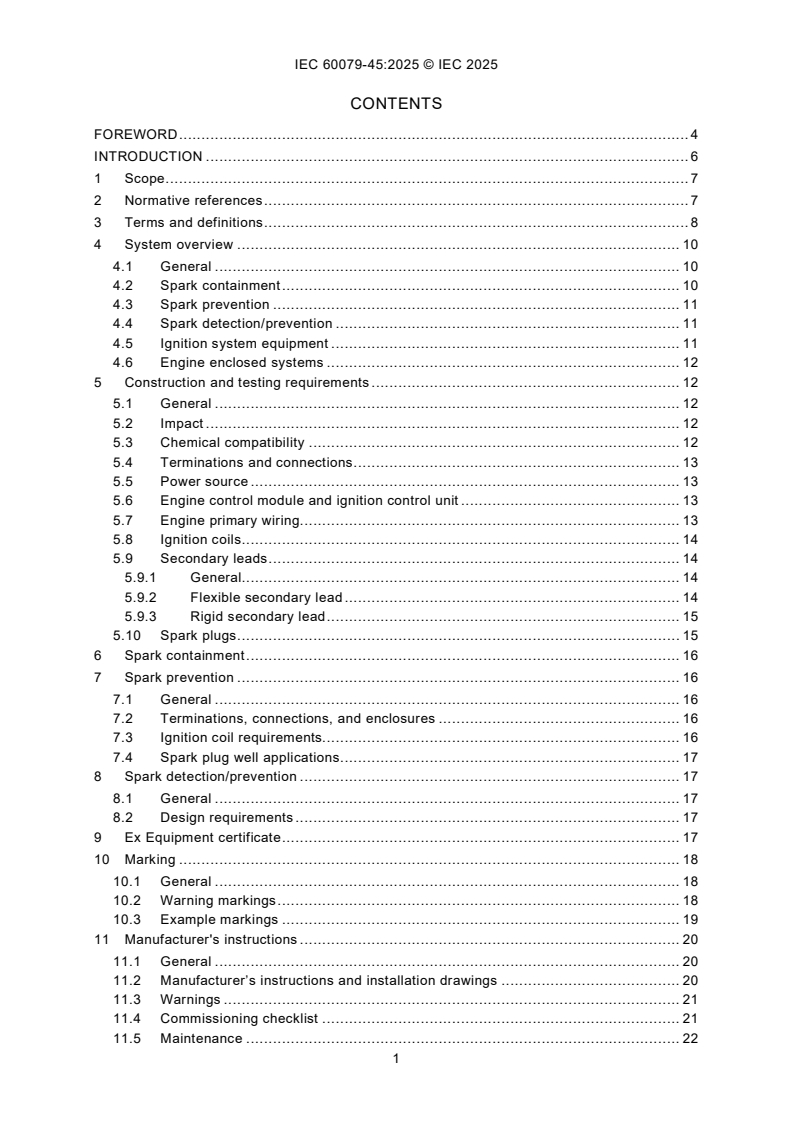
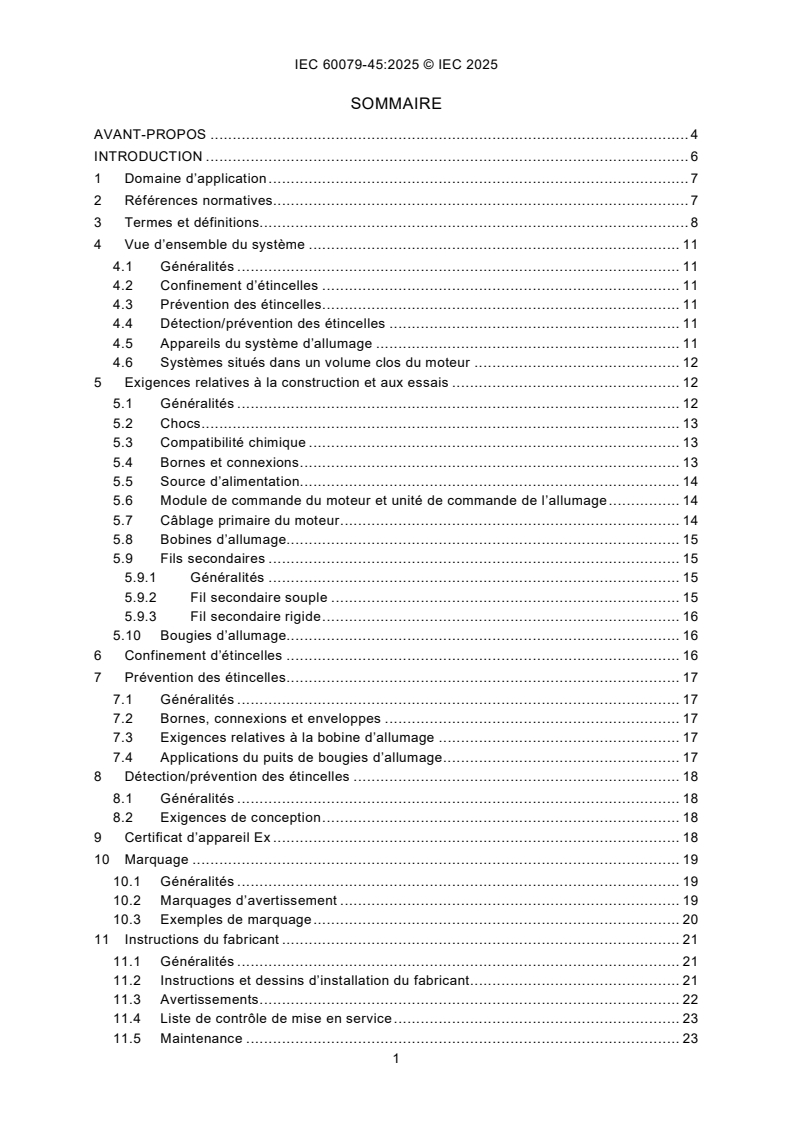
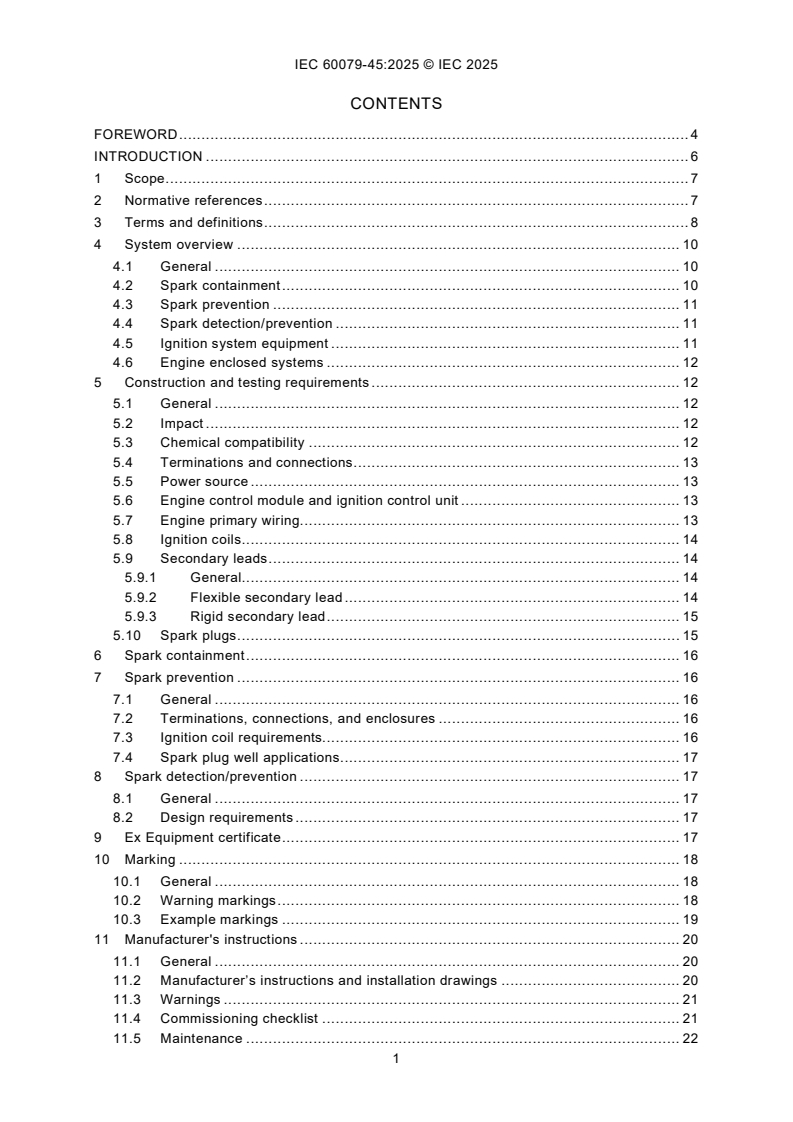
CONTENTS
FOREWORD . 4
INTRODUCTION . 6
1 Scope . 7
2 Normative references . 7
3 Terms and definitions . 8
4 System overview . 10
4.1 General . 10
4.2 Spark containment . 10
4.3 Spark prevention . 11
4.4 Spark detection/prevention . 11
4.5 Ignition system equipment . 11
4.6 Engine enclosed systems . 12
5 Construction and testing requirements . 12
5.1 General . 12
5.2 Impact . 12
5.3 Chemical compatibility . 12
5.4 Terminations and connections . 13
5.5 Power source . 13
5.6 Engine control module and ignition control unit . 13
5.7 Engine primary wiring. 13
5.8 Ignition coils . 14
5.9 Secondary leads . 14
5.9.1 General. 14
5.9.2 Flexible secondary lead . 14
5.9.3 Rigid secondary lead . 15
5.10 Spark plugs . 15
6 Spark containment . 16
7 Spark prevention . 16
7.1 General . 16
7.2 Terminations, connections, and enclosures . 16
7.3 Ignition coil requirements. 16
7.4 Spark plug well applications . 17
8 Spark detection/prevention . 17
8.1 General . 17
8.2 Design requirements . 17
9 Ex Equipment certificate . 17
10 Marking . 18
10.1 General . 18
10.2 Warning markings . 18
10.3 Example markings . 19
11 Manufacturer's instructions . 20
11.1 General . 20
11.2 Manufacturer’s instructions and installation drawings . 20
11.3 Warnings . 21
11.4 Commissioning checklist . 21
11.5 Maintenance . 22
12 Test procedures . 22
12.1 General . 22
12.2 Abrasion test for flexible secondary leads . 23
12.2.1 General. 23
12.2.2 Abrasive wheel test . 23
12.2.3 Emery cloth abrasion test . 24
12.3 Ignition coils, extensions or non-flexible secondary leads elevated
temperature exposure test . 25
12.4 Chemical compatibility . 25
12.4.1 General. 25
12.4.2 Chemical compatibility for non-flexible leads and equipment. 26
12.4.3 Chemical compatibility for flexible leads . 26
12.5 Vibration test . 27
12.6 Shielded secondary system tests . 28
12.6.1 General. 28
12.6.2 Explosion test exemption for metallic flexible leads . 29
12.7 Spark plug gas tightness test . 29
12.7.1 Spark plug gas tightness test (primary test) . 29
12.7.2 Spark plug gas tightness test (alternate test) . 30
12.8 Flashover tests . 30
12.8.1 General. 30
12.8.2 Rigid secondary lead test configuration . 31
12.8.3 Flexible lead test configurations . 32
12.9 Flexible Secondary lead bending and dielectric voltage withstand tests . 33
12.10 Spark prevention test . 34
12.11 Primary and secondary lead terminations pull test . 35
12.12 Flexible secondary lead insulation cut test. 35
12.13 Flexible secondary lead insulation pull test. . 36
Annex A (informative) Guidance for spark containment . 37
Annex B (informative) Guidance for spark prevention . 38
Bibliography . 43
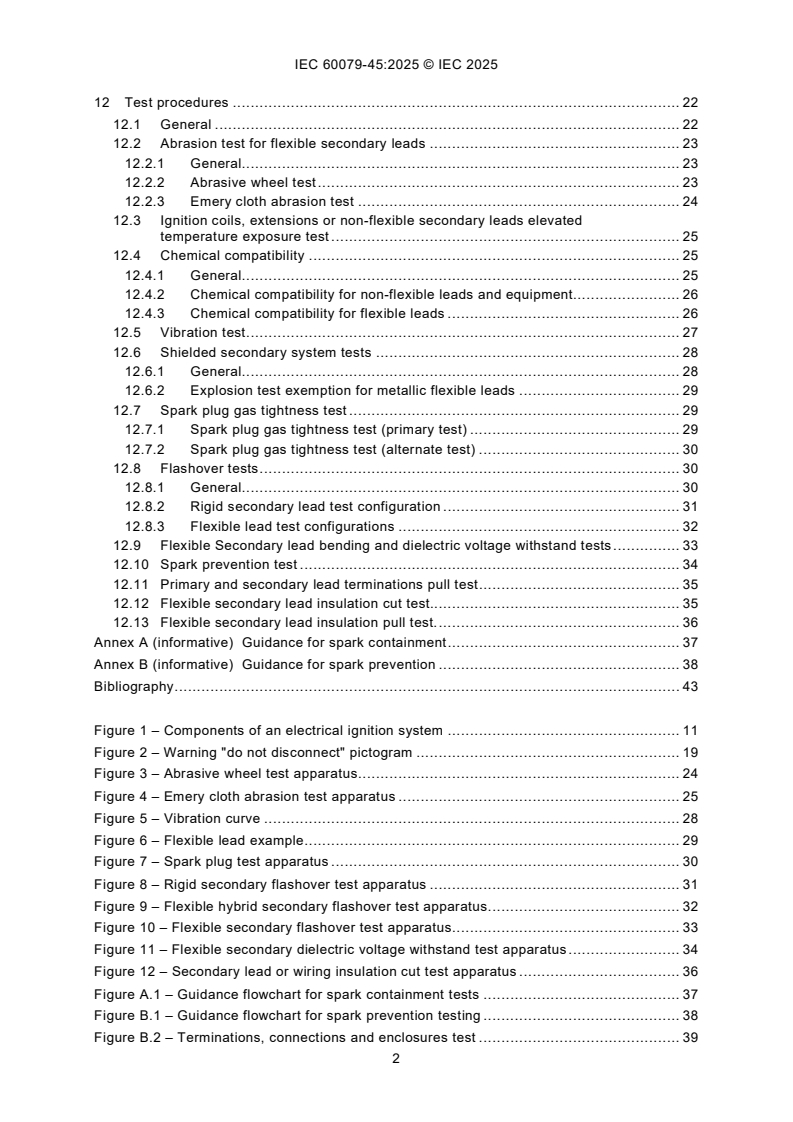
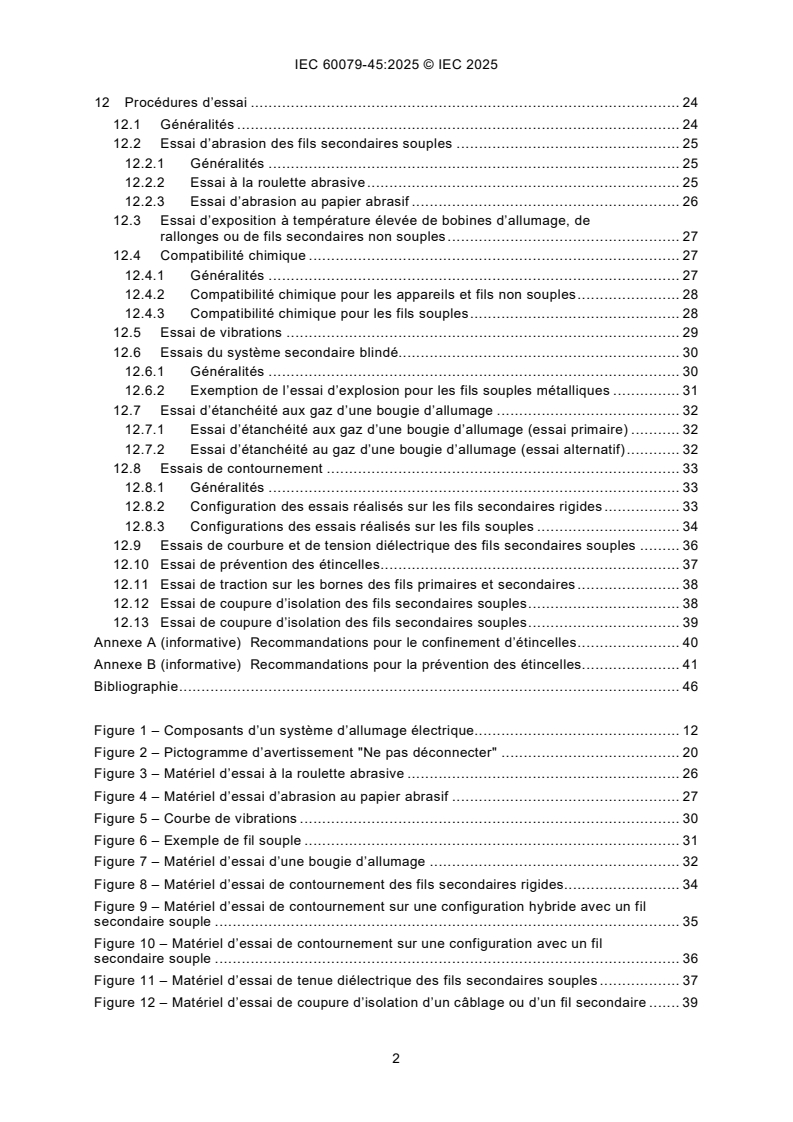
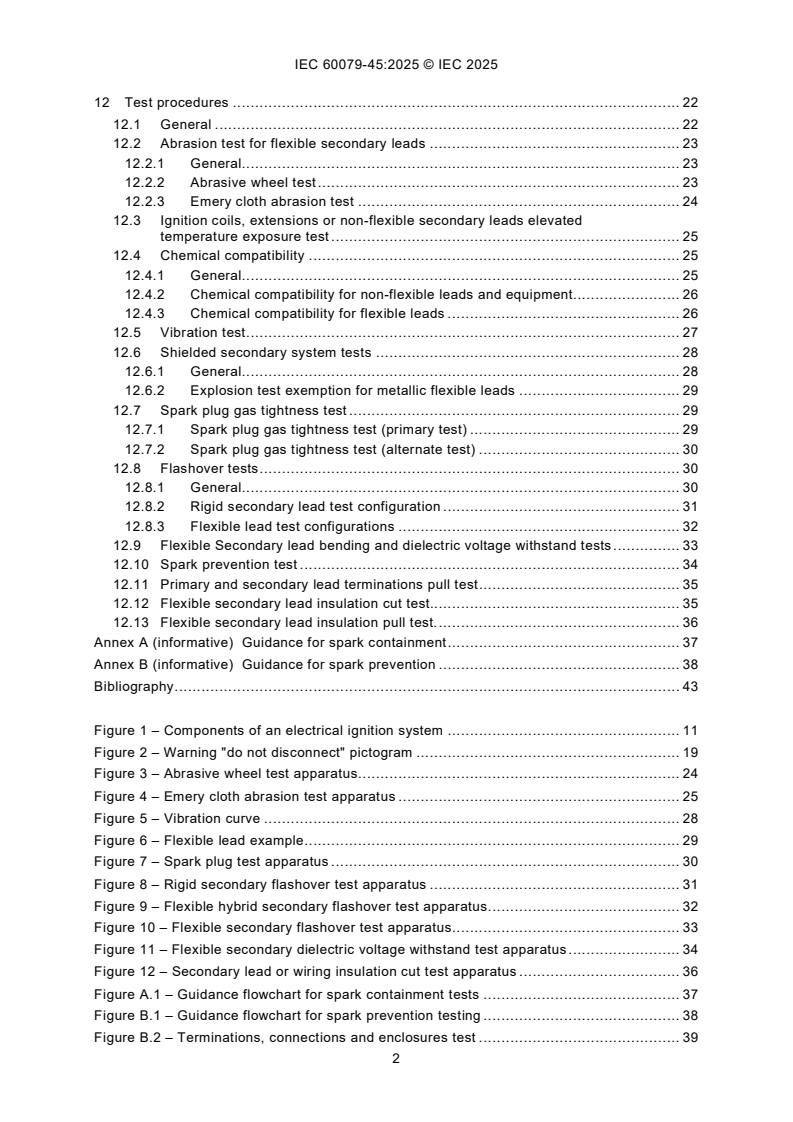
Figure 1 – Components of an electrical ignition system . 11
Figure 2 – Warning "do not disconnect" pictogram . 19
Figure 3 – Abrasive wheel test apparatus . 24
Figure 4 – Emery cloth abrasion test apparatus . 25
Figure 5 – Vibration curve . 28
Figure 6 – Flexible lead example . 29
Figure 7 – Spark plug test apparatus . 30
Figure 8 – Rigid secondary flashover test apparatus . 31
Figure 9 – Flexible hybrid secondary flashover test apparatus . 32
Figure 10 – Flexible secondary flashover test apparatus . 33
Figure 11 – Flexible secondary dielectric voltage withstand test apparatus . 34
Figure 12 – Secondary lead or wiring insulation cut test apparatus . 36
Figure A.1 – Guidance flowchart for spark containment tests . 37
Figure B.1 – Guidance flowchart for spark prevention testing . 38
Figure B.2 – Terminations, connections and enclosures test . 39
Figure B.3 – Cut test . 40
Figure B.4 – Abrasion test . 40
Figure B.5 – Chemical compatibility test . 41
Figure B.6 – Pull test . 41
Figure B.7 – Ignition coils and rigid extenders test . 42
Figure B.8 – Spark prevention test . 42
Table 1 – List of critical parameters . 18
Table 2 – List of performance tests for spark containment and spark prevention . 22
Table 3 – Chemical compatibility . 27
Table 4 – Vibration test requirements . 28
Table 5 – Compositions of explosive test mixtures . 34
INTERNATIONAL ELECTROTECHNICAL COMMISSION
____________
Explosive atmospheres -
Part 45: Electrical ignition systems for internal combustion engines
FOREWORD
1) The International Electrotechnical Commission (IEC) is a worldwide organization for standardization comprising
all national electrotechnical committees (IEC National Committees). The object of IEC is to promote international
co-operation on all questions concerning standardization in the electrical and electronic fields. To this end and
in addition to other activities, IEC publishes International Standards, Technical Specifications, Technical Reports,
Publicly Available Specifications (PAS) and Guides (hereafter referred to as "IEC Publication(s)"). Their
preparation is entrusted to technical committees; any IEC National Committee interested in the subject dealt with
may participate in this preparatory work. International, governmental and non-governmental organizations liaising
with the IEC also participate in this preparation. IEC collaborates closely with the International Organization for
Standardization (ISO) in accordance with conditions determined by agreement between the two organizations.
2) The formal decisions or agreements of IEC on technical matters express, as nearly as possible, an international
consensus of opinion on the relevant subjects since each technical committee has representation from all
interested IEC National Committees.
3) IEC Publications have the form of recommendations for international use and are accepted by IEC National
Committees in that sense. While all reasonable efforts are made to ensure that the technical content of
IEC Publications is accurate, IEC cannot be held responsible for the way in which they are used or for any
misinterpretation by any end user.
4) In order to promote international uniformity, IEC National Committees undertake to apply IEC Publications
transparently to the maximum extent possible in their national and regional publications. Any divergence between
any IEC Publication and the corresponding national or regional publication shall be clearly indicated in the latter.
5) IEC itself does not provide any attestation of conformity. Independent certification bodies provide conformity
assessment services and, in some areas, access to IEC marks of conformity. IEC is not responsible for any
services carried out by independent certification bodies.
6) All users should ensure that they have the latest edition of this publication.
7) No liability shall attach to IEC or its directors, employees, servants or agents including individual experts and
members of its technical committees and IEC National Committees for any personal injury, property damage or
other damage of any nature whatsoever, whether direct or indirect, or for costs (including legal fees) and
expenses arising out of the publication, use of, or reliance upon, this IEC Publication or any other
IEC Publications.
8) Attention is drawn to the Normative references cited in this publication. Use of the referenced publications is
indispensable for the correct application of this publication.
9) IEC draws attention to the possibility that the implementation of this document may involve the use of (a)
patent(s). IEC takes no position concerning the evidence, validity or applicability of any claimed patent rights in
respect thereof. As of the date of publication of this document, IEC had not received notice of (a) patent(s), which
may be required to implement this document. However, implementers are cautioned that this may not represent
the latest information, which may be obtained from the patent database available at https://patents.iec.ch.
IEC shall not be held responsible for identifying any or all such patent rights.
IEC 60079-45 has been prepared by IEC technical committee TC 31, Equipment for explosive
atmospheres. It is an International Standard.
ANSI/UL 122001 Standard for safety, General Requirements for Electrical Ignition Systems for
Internal Combustion Engines in Class I, Division 2 or Zone 2, Hazardous (Classified) Locations,
has served as a basis for the elaboration of this document.
Users of this document are advised that interpretation sheets clarifying the interpretation of this
document can be published. Interpretation sheets are available from the IEC webstore and can
be found in the "history" tab of the page for each document.
The text of this International Standard is based on the following documents:
Draft Report on voting
31/1880/FDIS 31/1895/RVD
Full information on the voting for its approval can be found in the report on voting indicated in
the above table.
The language used for the development of this International Standard is English.
This document was drafted in accordance with ISO/IEC Directives, Part 2, and developed in
accordance with ISO/IEC Directives, Part 1 and ISO/IEC Directives, IEC Supplement, available
at www.iec.ch/members_experts/refdocs. The main document types developed by IEC are
described in greater detail at www.iec.ch/publications.
A list of all parts in the IEC 60079 series, published under the general title Explosive
atmospheres, can be found on the IEC website.
The committee has decided that the contents of this document will remain unchanged until the
stability date indicated on the IEC website under webstore.iec.ch in the data related to the
specific document. At this date, the document will be
• reconfirmed,
• withdrawn, or
• revised.
INTRODUCTION
This part of IEC 60079 also refers to IEC 60079-0 and its associated standards for the
construction, testing and marking requirements of suitable electrical Ex Equipment.
This document has been developed from ANSI/UL 122001 Standard for safety, General
Requirements for Electrical Ignition Systems for Internal Combustion Engines in Class I,
Division 2 or Zone 2, Hazardous (Classified) Locations.
The original content was developed primarily by the user community in response to operations
and maintenance problems arising from the use of shielded ignition systems (flameproof or
explosionproof) on reciprocating engines driving compressors and pumps handling flammable
materials and installed in hazardous areas. Experience has shown that these types of ignition
systems are subjected to significant dielectric stress due to being completely encapsulated in
grounded metallic raceways and suffer premature failure resulting in engine cylinder misfiring
and engine miss-operation and shutdown.
This document is intended to supplement ISO/IEC 80079-41 with the requirements for ignition
systems for reciprocating spark-ignited engines to be installed in hazardous areas for EPL Gc
applications. In addition, it is a standalone set of requirements for a complete ignition system
or for the individual components thereof to be installed on a reciprocating engine to meet EPL
Gc requirements in a repair or replacement activity.
Examples of reciprocating gas engines which typically need to be EPL Gc are:
a) Offshore oil and gas platforms that are typically crowded or congested by design and the
gas engine and driven equipment is required to achieve EPL Gc.
b) Onshore facilities where the gas engine and driven equipment assembly is located under a
shelter or in an enclosed building for environmental protection or noise suppression.
NOTE 1 Certified ignition systems can also be considered as an alternative replacement to non-Ex systems for
engines located in a non-hazardous area where the driven equipment is located in an EPL Gc area. This could
provide the additional explosion protection for larger than anticipated flammable releases.
NOTE 2 Ongoing inspection, maintenance and repair aspects also play an important role in control of hazardous
area installations and the user's attention is drawn to IEC 60079-17, IEC 60079-19 and manufacturer's instructions
for further information concerning these aspects.
NOTE 3 In any industrial installation, irrespective of size, there can be numerous sources of ignition apart from
those associated with electrical equipment. Precautions are necessary to ensure safety from other possible ignition
sources, but guidance on this aspect is outside the scope of this document.
1 Scope
This part of IEC 60079 is intended to enhance the safety of personnel by providing minimum
requirements for electrical ignition systems for spark-ignited reciprocating internal combustion
engines, parts of which provide Equipment Protection Level (EPL) Gc.
This document provides minimum construction and test requirements, in addition to
manufacturer installation and maintenance recommendations, for the safe operation of ignition
systems and components for spark-ignited reciprocating internal combustion engines providing
EPL Gc for equipment Group IIB+H , IIB or IIA. These requirements apply to systems rated for
normal operation with secondary voltages less than or equal to 60 kV.
This document applies only to the ignition systems or the individual ignition system components
used on reciprocating internal combustion engines that are stationary when in operation and
mobile machinery where the internal combustion engine can be potential source of ignition.
Applications addressed by the scope of this document include but are not limited to gas
compressors, electric power generators, forklift trucks, and pumps.
This document does not apply to:
a) Engine ignition systems that utilize a breaker point or magneto type ignition systems as
these would not be suitable for use in a hazardous area.
b) Road vehicles.
c) Low voltage parts and electrical installation that are not included in the ignition system, such
as various sensors and thermocouples, throttle actuator(s), fuel control valve(s), human
machine interface (HMI), respective harness and wiring and all the other items that might
belong to the integrated control system besides the ignition system.
This document supplements and modifies the general requirements of IEC 60079-0 and the
requirements of ISO/IEC 80079-41. Where a requirement of this document conflicts with
IEC 60079-0 or ISO/IEC 80079-41, the requirement of this document takes precedence.
NOTE See ISO/IEC 80079-41 for the requirements for explosion protection for EPL Gc reciprocating internal
combustion engines.
2 Normative references
The following documents are referred to in the text in such a way that some or all of their content
constitutes requirements of this document. For dated references, only the edition cited applies.
For undated references, the latest edition of the referenced document (including any
amendments) applies.
IEC 60079-0, Explosive atmospheres - Part 0: Equipment - General requirements, Edition 7.0
IEC 60079-1, Explosive atmospheres - Part 1: Equipment protection by flameproof enclosures
"d"
IEC 60079-7, Explosive atmospheres - Part 7: Equipment protection by increased safety "e"
IEC 60079-11, Explosive atmospheres - Part 11: Equipment protection by intrinsic safety "i"
ISO 11565, Road vehicles - Spark-plugs - Test methods and requirements
ISO/IEC 80079-41, Explosive atmospheres - Part 41: Reciprocating internal combustion
engines
SAE J2031, High-Tension Ignition Cable
3 Terms and definitions
For the purposes of this document, the following terms and definitions apply.
ISO and IEC maintain terminology databases for use in standardization at the following
addresses:
• IEC Electropedia: available at https://www.electropedia.org/
• ISO Online browsing platform: available at https://www.iso.org/obp
3.1
ignition coil
inductive device used to convert primary voltage to secondary voltage intended to initiate
combustion
3.2
ignition control unit
ICU
component assembly that transforms energy from the ignition system power source and
provides it to the primary distribution system
Note 1 to entry: The ignition control unit is sometimes referred to as an ignition control module.
3.3
engine control module
ECM
electronic processor managing the timing relationship of the engine, transfer of data between
engine sensors, actuators, control elements, and information-storage and display units
3.4
ignition system
electrical system designed to produce and distribute electrical energy to initiate combustion
Note 1 to entry: An ignition system can be a part of integrated control system of the engine and hence connected
to the engine control module ECM. This can be any type of electrical system but is typically a capacitive or inductive
type system.
Note 2 to entry: A capacitive discharge ignition system is a type of ignition system, a charging circuit creates an
intermediate voltage on a capacitor, and at the instant of ignition timing applies the capacitor energy and voltage to
the ignition coil primary side which subsequently reflects to the secondary coil winding and spark plug.
Note 3 to entry: An inductive discharge ignition system is where the primary winding is directly connected to the
battery and stores energy while the primary winding conducts current from the battery. At the desired ignition timing,
the primary winding current is interrupted which drives a flyback event on the primary, which is reflected to the
secondary and generates a voltage high enough to ionize the spark plug gap. Following ionization of the spark plug
gap, most of the ignition coil energy is driven through the spark plug gap.
3.5
installation drawing
drawing or other document prepared by the equipment manufacturer that details the allowed
interconnections of ignition system components, indicates any Specific Conditions of Use,
provides initial parameters if required, and provides the necessary information for operational
use of the system or any component
___________
Under development. Stage at the time of publication: ISO/IEC/CCDV 80079-41:2025.
3.6
integral ignition coil
ignition coil with a rigid connection to the spark plug (coil on plug), on which no flexible cable
is used
3.7
maximum secondary peak output circuit voltage
maximum open circuit voltage produced by the ignition system with the
secondary lead disconnected from the spark plug
3.8
normal operation
operation of equipment conforming electrically and mechanically with its design specification
and used within the limits specified by the manufacturer
Note 1 to entry: For electrical ignition systems, this can include:
• supply voltage, current, and frequency;
• environmental conditions;
• minimum and maximum engine operating and cranking speeds;
• all removable parts in place; and
• all operator-accessible adjustments at their most unfavourable settings within the normal range.
[SOURCE: IEC 60079-0:2017, 3.62, modified – replacement of Notes to entry.]
3.9
engine driven power source
power source that relies on mechanical energy from the engine for conversion to ignition system
electrical energy
3.10
external power source
power source that relies on energy from a source other than the engine for
ignition system electrical energy
3.11
primary distribution system
components that deliver the primary voltage (low voltage) and current from the power supply
and ignition control unit to the ignition coil, including the coil primary terminations
3.12
primary wire
insulated conductor interconnecting the ignition control unit and the ignition coil
3.13
primary voltage
voltage produced across the primary of the ignition coil under normal operating conditions
3.14
primary wiring harness
group of wires transporting voltage to the primary of the ignition coil
3.15
raceway
enclosure for routing, protecting, and supporting wires or cables
3.16
secondary distribution system
component assembly that electrically interconnects the ignition coil and the spark gap, including
the coil secondary terminations
3.17
secondary lead
part of the secondary distribution system, either rigid or flexible, electrically interconnecting the
coil and the spark plug
Note 1 to entry: Often referred to as secondary lead assembly.
3.18
secondary voltage
open circuit voltage produced across the spark gap
3.19
spark gap
space between two conductors across which electrical energy is discharged
3.20
spark plug
electromechanical device that provides a spark gap intended to ignite a fuel mixture
3.21
flashover
electric breakdown between conductors in a gas or a liquid or in vacuum, at least partly along
the surface of solid insulation
Note 1 to entry: Where a spark occurs from the internal live wires of the ignition system to an external metal surface
such as the secondary lead to surrounding metallic surface.
[SOURCE: IEC 60050-212:2010, 212-11-47, modified – addition of Note 1 to entry.]
3.22
end gas knock
autoignition of the unburned air fuel mixture ahead of the flame front
4 System overview
4.1 General
Any portion of an ignition system providing EPL Gc during normal operation is intended to not
produce arcs, sparks, or heat that could ignite a surrounding flammable atmosphere. This may
be achieved through conformance with the construction requirements of Clause 5 and utilizing
at least one of the types of protection indicated in 4.2, 4.3 or 4.4, or any combination thereof
(see 4.5). The portions of the ignition system which operate at voltage levels of 15 kV and less
may use other Types of Protection defined in the IEC 60079 series (considering the voltage
restrictions allowed within the specific part of the series).
4.2 Spark containment
Any portion of the ignition system providing EPL Gc shall be constructed such that arcs or
sparks that could occur under normal operating conditions are contained in a manner that
precludes ignition of a surrounding flammable atmosphere. See Clause 6 for requirements for
spark containment. Refer to Annex A for a flowchart providing guidance on test sequencing.
4.3 Spark prevention
Any portion of the ignition system providing EPL Gc shall be constructed such that arcs or
sparks under normal operating conditions do not occur outside of the combustion chamber. See
Clause 7 for requirements for spark prevention. Refer to Figure B.1 through Figure B.8 of
Annex B for a flowchart providing guidance on test sequencing.
4.4 Spark detection/prevention
Any portion of the ignition system providing EPL Gc shall be designed and constructed such
that conditions leading to arcs or sparks in any portion of the ignition system outside of the
engine are detected and remedied before such sparks occur. See Clause 8 for spark detection
and prevention requirements.
4.5 Ignition system equipment
Ex Components and Ex Equipment of ignition systems can be examined separately for
conformance with the applicable requirements of this document or other types of protection
defined in other IEC 60079 series standards.
The parties assembling the completed ignition system are responsible for total system
documentation and demonstrating conformance of the completed ignition system to this
standard.
Ex Components and Ex Equipment shall be marked as detailed in Clause 10.
A typical ignition system is illustrated in Figure 1.
Key
1 Power source
2 Primary wiring
3 Ignition coil
4 Secondary leads
5 Spark plug
6 Ignition control unit
7 Engine control module
NOTE 1 The order and arrangement of components in an ignition system can be different; only basic ignition system
components are shown in this diagram.
NOTE 2 Ground conductors can be insulated conductors or part of a metallic frame.
Figure 1 – Components of an electrical ignition system
4.6 Engine enclosed systems
For any ignition system components that are contained completely within an enclosed volume
of the engine that is subject to the positive pressure from the crankcase are by definition not
exposed to a flammable atmosphere, therefore the requirements for explosion protection
outlined in this document do not apply.
NOTE For additional information concerning the enclosed volumes of engines and their possibility of having an
explosive mixture internally, see ISO/IEC 80079-41.
5 Construction and testing requirements
5.1 General
Ignition systems shall be constructed to withstand the service temperatures to which they will
be exposed in normal operation. Different service temperature ratings may apply to separate
devices of an ignition system. Maximum surface temperature of all equipment within the ignition
system shall be determined in accordance with the test procedures as defined by maximum
surface temperature in IEC 60079-0, modified for a system input voltage of ±25 % of rated for
DC powered systems, or ±10 % of rated for AC powered systems, or as specified by the
manufacturer. The equipment shall be marked as specified in Clause 10.
Ignition systems shall be constructed to withstand the effects of vibration levels they are likely
to encounter during normal operation such that they are prevented from becoming a potential
source of ignition. The test in 12.11 demonstrates conformance with this requirement.
For all types of protection, the complete test program for the system and component level is
defined in Table 2.
5.2 Impact
All parts of the ignition system that can be exposed to impact and intended for installation in a
hazardous area shall meet the high-level Resistance to Impact Test as specified for Group II in
IEC 60079-0.
5.3 Chemical compatibility
Enclosures and insulating materials shall provide protection to prevent deterioration and
corrosion that could adversely affect the suitability of the parts of the equipment intended to be
installed in a hazardous area. The list of compounds in Table 3 includes chemicals
representative of those to which ignition systems would likely be exposed in normal operation.
All non-metallic enclosure materials, secondary leads, secondary lead assembly, or secondary
lead harness, and insulation compounds associated with the ignition system utilized on the
exterior of the engine, shall comply with the chemical compatibility tests of 12.4. Test chemicals
in Table 3 shall be included in the test. One or more of the test chemicals may be omitted from
the test if the manufacturer’s instructions prepared in accordance with Clause 10 states that
the equipment is not suitable for use in locations where the omitted test chemical is present. If
one or more of the test chemicals is excluded, the certificate number shall include the suffix "X"
to indicate this Specific Condition of Use according to IEC 60079-0. The manufacturer of the
device shall make available information necessary to determine if critical materials of
construction are compatible with substances not included in Table 3 that might be present in
an installation area.
5.4 Terminations and connections
Electrical terminations and connections for the secondary lead system intended to be installed
in a hazardous area shall be mechanically secured against unintentional disconnection.
Terminations shall be constructed such that, when connected as specified on the installation
drawing, a separating force of at least that specified in the pull test described in 12.11 is
required for disconnection. Terminations shall also maintain continuity when subjected to the
vibration test specified in 12.5. The vibration test shall be completed as a prerequisite to the
pull test described in 12.11.
The pull test in 12.11 is not required for terminations that:
a) have a threaded interconnection, or
b) require the use of a tool such as a key, screwdriver or wrench to remove, or
c) requires two independent actions for separation.
All electrical terminations and connections for the primary wiring system intended to be installed
in a hazardous area that are subject to vibration, shall be secured against unintentional
disconnection except for intrinsically safe circuits (IEC 60079-11). These electrical terminations
and connections shall be designed in accordance with IEC 60079-7 and shall be subject to the
vibration test as detailed in 12.5.
5.5 Power source
When the power source is located in the hazardous area, it shall be explosion protected and
meet the appropriate requirements of IEC 60079-0. Ignition systems shall operate at a voltage
of ± 25 % of rated for DC powered systems, or ± 10 % of rated for AC powered systems, or as
specified by the manufacturer. Engine driven power source requirements (if required) shall be
indicated on the manufacturer’s instructions.
NOTE Measurements by the manufacturer are usually specified as an absolute voltage range
5.6 Engine control module and ignition control unit
The engine control module and ignition control unit, when installed in a hazardous area, shall
be explosion protected and meet the requirements of IEC 60079-0 for EPL Gc and the
temperature classification compatible with the application. The ICU output voltage, current limit,
and duration settings shall be set such that the peak secondary voltage produced by the coil
under open circuit operation does not exceed the coil manufacturer's specification.
NOTE The ICU can be contained in the engine control module.
5.7 Engine primary wiring
Engine primary wiring, including cables and connections, are not subject to the requirements in
IEC 60079-14. Engine primary wiring shall be designed to withstand vibration, service
temperature, abrasion, UV exposure, chemical compatibility to which it will be exposed, and be
protected from damage including being cut.
NOTE 1 It is not a requirement of this document that compliance with the relevant industrial standards for engine
primary wiring be verified.
Primary wiring insulation shall be selected based on the associated service temperatures and
be rated for the service temperature and voltage to which the wires will be exposed in normal
operation. Earth return (utilizing the metallic portions of the engine) circuits is permitted.
Engine primary wiring shall be routed such that it is:
a) sufficiently supported to minimize deleterious effects.
b) installed to facilitate inspections.
c) not in direct contact with:
1) hot surfaces that exceed the wiring assembly temperature rating
2) fuel lines
3) pneumatic lines
4) hydraulic lines
5) abrasive surfaces or sharp edges.
Engine primary wiring that passes through conduits, partition walls or terminal box walls shall
be restrained and protected from abrasion by cable glands, flexible bushings or grommets
suitable for the application.
If intrinsically safe circuit wiring is used, it may be provided with alternative forms of protection
if installed in a manner which guards against potential damage from the environment in which
it is installed.
NOTE 2 See IEC 60079-14 and IEC 60079-25 for further information on intrinsically safe wiring and systems.
5.8 Ignition coils
The maximum operating secondary voltage of an ignition coil (or integral ignition coil) shall be
no greater than specified by the ignition system manufacturer. The maximum output circuit
voltage rating is limited to 60 kV.
5.9 Secondary leads
5.9.1 General
The secondary leads of the ignition system are used to transfer the high voltage energy to the
spark plug. There are two types of secondary leads, flexible and rigid, and each type (including
extension and non-flexible section of the lead) shall be constructed to withstand the service
temperatures to which they will be exposed in normal operation. The secondary leads shall be
explosion protected in accordance with this document or a Type of Protection described in
IEC 60079-0 that is appropriate for the voltage. The thermal endurance to heat and to cold shall
be conducted using the requirements for EPL Gb. The material selection is in accordance with
the requirements of IEC 60079-0 for EPL Gb referenced to the service temperature of the
secondary lead.
All secondary leads exposed to any outdoor conditions shall comply with the resistance to
ultraviolet light in IEC 60079-0. If the secondary lead does not meet the ultraviolet light
requirements, the certificate number shall include the suffix "X" to indicate this Specific
Condition of Use according to IEC 60079-0. This requirement is not applicable for metal-
sheathed secondary leads if the metal sheath has a minimal thickness of 0,1 mm.
5.9.2 Flexible secondary lead
Ignition cable used for flexible secondary leads shall meet all of the construction and testing
methods required by 5.9.1 and the appropriate tests in Table 2.
Flexible secondary leads shall be constructed such that, under normal operating conditions,
there will be minimum breakdown of insulation due to abrasion. The tests in 12.8 shall be used
to demonstrate conformance of flexible secondary leads with this requirement. These tests are
not required for metal-sheathed secondary leads if the metal sheath has a
...
IEC 60079-45 ®
Edition 1.0 2025-08
NORME
INTERNATIONALE
Atmosphères explosives -
Partie 45: Systèmes d’allumage électrique pour les moteurs à combustion
interne
ICS 29.260.20; 43.060.50 ISBN 978-2-8327-0651-0
Droits de reproduction réservés. Sauf indication contraire, aucune partie de cette publication ne peut être reproduite ni
utilisée sous quelque forme que ce soit et par aucun procédé, électronique ou mécanique, y compris la photocopie et
les microfilms, sans l'accord écrit de l'IEC ou du Comité national de l'IEC du pays du demandeur. Si vous avez des
questions sur le copyright de l'IEC ou si vous désirez obtenir des droits supplémentaires sur cette publication, utilisez
les coordonnées ci-après ou contactez le Comité national de l'IEC de votre pays de résidence.
IEC Secretariat Tel.: +41 22 919 02 11
3, rue de Varembé info@iec.ch
CH-1211 Geneva 20 www.iec.ch
Switzerland
A propos de l'IEC
La Commission Electrotechnique Internationale (IEC) est la première organisation mondiale qui élabore et publie des
Normes internationales pour tout ce qui a trait à l'électricité, à l'électronique et aux technologies apparentées.
A propos des publications IEC
Le contenu technique des publications IEC est constamment revu. Veuillez vous assurer que vous possédez l’édition la
plus récente, un corrigendum ou amendement peut avoir été publié.
Recherche de publications IEC - IEC Products & Services Portal - products.iec.ch
webstore.iec.ch/advsearchform Découvrez notre puissant moteur de recherche et consultez
La recherche avancée permet de trouver des publications gratuitement tous les aperçus des publications, symboles
IEC en utilisant différents critères (numéro de référence, graphiques et le glossaire. Avec un abonnement, vous aurez
texte, comité d’études, …). Elle donne aussi des toujours accès à un contenu à jour adapté à vos besoins.
informations sur les projets et les publications remplacées
ou retirées. Electropedia - www.electropedia.org
Le premier dictionnaire d'électrotechnologie en ligne au
IEC Just Published - webstore.iec.ch/justpublished monde, avec plus de 22 500 articles terminologiques en
Restez informé sur les nouvelles publications IEC. Just anglais et en français, ainsi que les termes équivalents
Published détaille les nouvelles publications parues. dans 25 langues additionnelles. Egalement appelé
Disponible en ligne et une fois par mois par email. Vocabulaire Electrotechnique International (IEV) en ligne.
Service Clients - webstore.iec.ch/csc
Si vous désirez nous donner des commentaires sur cette
publication ou si vous avez des questions contactez-
nous: sales@iec.ch.
SOMMAIRE
AVANT-PROPOS . 4
INTRODUCTION . 6
1 Domaine d’application . 7
2 Références normatives . 7
3 Termes et définitions. 8
4 Vue d’ensemble du système . 11
4.1 Généralités . 11
4.2 Confinement d’étincelles . 11
4.3 Prévention des étincelles . 11
4.4 Détection/prévention des étincelles . 11
4.5 Appareils du système d’allumage . 11
4.6 Systèmes situés dans un volume clos du moteur . 12
5 Exigences relatives à la construction et aux essais . 12
5.1 Généralités . 12
5.2 Chocs . 13
5.3 Compatibilité chimique . 13
5.4 Bornes et connexions . 13
5.5 Source d’alimentation. 14
5.6 Module de commande du moteur et unité de commande de l’allumage . 14
5.7 Câblage primaire du moteur . 14
5.8 Bobines d’allumage. 15
5.9 Fils secondaires . 15
5.9.1 Généralités . 15
5.9.2 Fil secondaire souple . 15
5.9.3 Fil secondaire rigide . 16
5.10 Bougies d’allumage. 16
6 Confinement d’étincelles . 16
7 Prévention des étincelles . 17
7.1 Généralités . 17
7.2 Bornes, connexions et enveloppes . 17
7.3 Exigences relatives à la bobine d’allumage . 17
7.4 Applications du puits de bougies d’allumage . 17
8 Détection/prévention des étincelles . 18
8.1 Généralités . 18
8.2 Exigences de conception . 18
9 Certificat d’appareil Ex . 18
10 Marquage . 19
10.1 Généralités . 19
10.2 Marquages d’avertissement . 19
10.3 Exemples de marquage . 20
11 Instructions du fabricant . 21
11.1 Généralités . 21
11.2 Instructions et dessins d’installation du fabricant . 21
11.3 Avertissements . 22
11.4 Liste de contrôle de mise en service . 23
11.5 Maintenance . 23
12 Procédures d’essai . 24
12.1 Généralités . 24
12.2 Essai d’abrasion des fils secondaires souples . 25
12.2.1 Généralités . 25
12.2.2 Essai à la roulette abrasive . 25
12.2.3 Essai d’abrasion au papier abrasif . 26
12.3 Essai d’exposition à température élevée de bobines d’allumage, de
rallonges ou de fils secondaires non souples . 27
12.4 Compatibilité chimique . 27
12.4.1 Généralités . 27
12.4.2 Compatibilité chimique pour les appareils et fils non souples . 28
12.4.3 Compatibilité chimique pour les fils souples . 28
12.5 Essai de vibrations . 29
12.6 Essais du système secondaire blindé. 30
12.6.1 Généralités . 30
12.6.2 Exemption de l’essai d’explosion pour les fils souples métalliques . 31
12.7 Essai d’étanchéité aux gaz d’une bougie d’allumage . 32
12.7.1 Essai d’étanchéité aux gaz d’une bougie d’allumage (essai primaire) . 32
12.7.2 Essai d’étanchéité au gaz d’une bougie d’allumage (essai alternatif) . 32
12.8 Essais de contournement . 33
12.8.1 Généralités . 33
12.8.2 Configuration des essais réalisés sur les fils secondaires rigides . 33
12.8.3 Configurations des essais réalisés sur les fils souples . 34
12.9 Essais de courbure et de tension diélectrique des fils secondaires souples . 36
12.10 Essai de prévention des étincelles . 37
12.11 Essai de traction sur les bornes des fils primaires et secondaires . 38
12.12 Essai de coupure d’isolation des fils secondaires souples . 38
12.13 Essai de coupure d’isolation des fils secondaires souples . 39
Annexe A (informative) Recommandations pour le confinement d’étincelles . 40
Annexe B (informative) Recommandations pour la prévention des étincelles . 41
Bibliographie . 46
Figure 1 – Composants d’un système d’allumage électrique . 12
Figure 2 – Pictogramme d’avertissement "Ne pas déconnecter" . 20
Figure 3 – Matériel d’essai à la roulette abrasive . 26
Figure 4 – Matériel d’essai d’abrasion au papier abrasif . 27
Figure 5 – Courbe de vibrations . 30
Figure 6 – Exemple de fil souple . 31
Figure 7 – Matériel d’essai d’une bougie d’allumage . 32
Figure 8 – Matériel d’essai de contournement des fils secondaires rigides. 34
Figure 9 – Matériel d’essai de contournement sur une configuration hybride avec un fil
secondaire souple . 35
Figure 10 – Matériel d’essai de contournement sur une configuration avec un fil
secondaire souple . 36
Figure 11 – Matériel d’essai de tenue diélectrique des fils secondaires souples . 37
Figure 12 – Matériel d’essai de coupure d’isolation d’un câblage ou d’un fil secondaire . 39
Figure A.1 – Organigramme de recommandations pour les essais de confinement
d’étincelles . 40
Figure B.1 – Organigramme de recommandations pour les essais de prévention des
étincelles . 41
Figure B.2 – Essai des bornes, connexions et enveloppes . 42
Figure B.3 – Essai de coupure . 43
Figure B.4 – Essai d’abrasion . 43
Figure B.5 – Essai de compatibilité chimique . 44
Figure B.6 – Essai de traction . 44
Figure B.7 – Essai des bobines d’allumage et des rallonges rigides . 45
Figure B.8 – Essai de prévention des étincelles . 45
Tableau 1 – Liste des paramètres critiques . 19
Tableau 2 – Liste des essais de performance pour le confinement et la prévention des
étincelles . 24
Tableau 3 – Compatibilité chimique . 29
Tableau 4 – Exigences de l’essai de vibrations . 30
Tableau 5 – Compositions des mélanges d’essai explosifs. 37
COMMISSION ÉLECTROTECHNIQUE INTERNATIONALE
____________
Atmosphères explosives -
Partie 45: Systèmes d’allumage électrique
pour les moteurs à combustion interne
AVANT-PROPOS
1) La Commission Électrotechnique Internationale (IEC) est une organisation mondiale de normalisation
composée de l’ensemble des comités électrotechniques nationaux (Comités nationaux de l’IEC). L’IEC a pour
objet de favoriser la coopération internationale pour toutes les questions de normalisation dans les domaines
de l’électricité et de l’électronique. À cet effet, l’IEC – entre autres activités – publie des
Normes internationales, des Spécifications techniques, des Rapports techniques, des Spécifications
accessibles au public (PAS) et des Guides (ci-après dénommés "Publication(s) de l’IEC"). Leur élaboration est
confiée à des comités d’études, aux travaux desquels tout Comité national intéressé par le sujet traité peut
participer. Les organisations internationales, gouvernementales et non gouvernementales, en liaison avec
l’IEC, participent également aux travaux. L’IEC collabore étroitement avec l’Organisation Internationale de
Normalisation (ISO), selon des conditions fixées par accord entre les deux organisations.
2) Les décisions ou accords officiels de l’IEC concernant les questions techniques représentent, dans la mesure
du possible, un accord international sur les sujets étudiés, étant donné que les Comités nationaux de l’IEC
intéressés sont représentés dans chaque comité d’études.
3) Les Publications de l’IEC se présentent sous la forme de recommandations internationales et sont agréées
comme telles par les Comités nationaux de l’IEC. Tous les efforts raisonnables sont entrepris afin que l’IEC
s’assure de l’exactitude du contenu technique de ses publications; l’IEC ne peut pas être tenue responsable de
l’éventuelle mauvaise utilisation ou interprétation qui en est faite par un quelconque utilisateur final.
4) Dans le but d’encourager l’uniformité internationale, les Comités nationaux de l’IEC s’engagent, dans toute la
mesure possible, à appliquer de façon transparente les Publications de l’IEC dans leurs publications nationales
et régionales. Toutes divergences entre toutes Publications de l’IEC et toutes publications nationales ou
régionales correspondantes doivent être indiquées en termes clairs dans ces dernières.
5) L’IEC elle-même ne fournit aucune attestation de conformité. Des organismes de certification indépendants
fournissent des services d’évaluation de conformité et, dans certains secteurs, accèdent aux marques de
conformité de l’IEC. L’IEC n’est responsable d’aucun des services effectués par les organismes de certification
indépendants.
6) Tous les utilisateurs doivent s’assurer qu’ils sont en possession de la dernière édition de cette publication.
7) Aucune responsabilité ne doit être imputée à l’IEC, à ses administrateurs, employés, auxiliaires ou
mandataires, y compris ses experts particuliers et les membres de ses comités d’études et des
Comités nationaux de l’IEC, pour tout préjudice causé en cas de dommages corporels et matériels, ou de tout
autre dommage de quelque nature que ce soit, directe ou indirecte, ou pour supporter les coûts (y compris les
frais de justice) et les dépenses découlant de la publication ou de l’utilisation de cette Publication de l’IEC ou
de toute autre Publication de l’IEC, ou au crédit qui lui est accordé.
8) L’attention est attirée sur les références normatives citées dans cette publication. L’utilisation de publications
référencées est obligatoire pour une application correcte de la présente publication.
9) L’IEC attire l’attention sur le fait que la mise en application du présent document peut entraîner l’utilisation d’un
ou de plusieurs brevets. L’IEC ne prend pas position quant à la preuve, à la validité et à l’applicabilité de tout
droit de brevet revendiqué à cet égard. À la date de publication du présent document, l’IEC n’avait pas reçu
notification qu’un ou plusieurs brevets pouvaient être nécessaires à sa mise en application. Toutefois, il y a lieu
d’avertir les responsables de la mise en application du présent document que des informations plus récentes
sont susceptibles de figurer dans la base de données de brevets, disponible à l’adresse https://patents.iec.ch.
L’IEC ne saurait être tenue pour responsable de ne pas avoir identifié de tels droits de brevet.
L’IEC 60079-45 a été établie par le comité technique 31 de l’IEC, Équipements pour
atmosphères explosives. Il s’agit d’une Norme internationale.
La norme de sécurité ANSI/UL 122001, General Requirements for Electrical Ignition Systems
for Internal Combustion Engines in Class I, Division 2 or Zone 2, Hazardous (Classified)
Locations, a servi de base à l’élaboration du présent document.
Les utilisateurs du présent document sont informés que des fiches d’interprétation clarifiant
l’interprétation de ce dernier peuvent être publiées. Ces fiches d’interprétation sont
disponibles sur le webstore de l’IEC, dans l’onglet "History" de la page de chaque document.
Le texte de cette Norme internationale est issu des documents suivants:
Projet Rapport de vote
31/1880/FDIS 31/1895/RVD
Le rapport de vote indiqué dans le tableau ci-dessus donne toute information sur le vote ayant
abouti à son approbation.
La langue employée pour l’élaboration de cette Norme internationale est l’anglais.
Ce document a été rédigé selon les Directives ISO/IEC, Partie 2, il a été développé selon les
Directives ISO/IEC, Partie 1 et les Directives ISO/IEC, Supplément IEC, disponibles sous
www.iec.ch/members_experts/refdocs. Les principaux types de documents développés par
l’IEC sont décrits plus en détail sous www.iec.ch/publications.
Une liste de toutes les parties de la série IEC 60079, publiées sous le titre général
Atmosphères explosives, se trouve sur le site web de l’IEC.
Le comité a décidé que le contenu de ce document ne sera pas modifié avant la date de
stabilité indiquée sur le site web de l’IEC sous webstore.iec.ch dans les données relatives au
document recherché. À cette date, le document sera
• reconduit,
• supprimé, ou
• révisé.
INTRODUCTION
La présente partie de l’IEC 60079 fait aussi référence à l’IEC 60079-0 et à ses normes
associées pour les exigences relatives à la construction, aux essais et au marquage des
appareils Ex électriques appropriés.
Le présent document a été élaboré à partir de la norme de sécurité ANSI/UL 122001,
General Requirements for Electrical Ignition Systems for Internal Combustion Engines in
Class I, Division 2 or Zone 2, Hazardous (Classified) Locations.
Le contenu original a été développé principalement par la communauté des utilisateurs en
réponse aux problèmes d’exploitation et de maintenance découlant de l’utilisation de
systèmes d’allumage blindés (ignifugés ou antidéflagrants) sur des moteurs alternatifs
entraînant des compresseurs et des pompes manipulant des matières inflammables et
installés dans des zones dangereuses. L’expérience a montré que ces types de systèmes
d’allumage sont soumis à des contraintes diélectriques importantes en raison du fait qu’ils
sont complètement encapsulés dans des canalisations métalliques mises à la terre et qu’ils
subissent des défaillances prématurées entraînant des ratés d’allumage dans les cylindres du
moteur ainsi que des dysfonctionnements et des arrêts du moteur.
Le présent document est destiné à compléter l’ISO/IEC 80079-41 avec les exigences relatives
aux systèmes d’allumage pour les moteurs alternatifs à allumage par étincelle devant être
installés dans des zones dangereuses pour des applications fournissant un niveau de
protection de l’appareil Gc. En outre, il s’agit d’un ensemble autonome d’exigences pour un
système d’allumage complet ou pour ses composants individuels à installer sur un moteur
alternatif, afin de satisfaire aux exigences relatives au niveau de protection de l’appareil Gc
dans le cadre d’une activité de réparation ou de remplacement.
Voici des exemples de moteurs à gaz alternatifs qui nécessitent généralement de fournir un
niveau de protection de l’appareil Gc:
a) les plateformes pétrolières et gazières offshore qui sont généralement surpeuplées ou
encombrées en raison de leur conception et dont il est exigé que le moteur à gaz et les
appareils entraînés fournissent un niveau de protection de l’appareil Gc;
b) les installations terrestres dans lesquelles le moteur à gaz et les appareils entraînés sont
situés sous un abri ou dans un bâtiment fermé pour protéger l’environnement ou
supprimer les nuisances sonores.
NOTE 1 Les systèmes d’allumage certifiés peuvent également être considérés comme une solution de
substitution aux systèmes non Ex pour les moteurs situés dans une zone non dangereuse lorsque l’appareil
entraîné est situé dans une zone fournissant un niveau de protection de l’appareil Gc. Cela pourrait fournir une
protection supplémentaire contre l’explosion en cas de dégagements de substances inflammables plus importants
que prévu.
NOTE 2 Les aspects relatifs à l’inspection, la maintenance et la réparation continues jouent également un rôle
important dans la maîtrise des installations en emplacements dangereux, et l’attention des utilisateurs est attirée
sur le fait que l’IEC 60079-17, l’IEC 60079-19 et les instructions du fabricant apportent d’autres informations
concernant ces aspects.
NOTE 3 Dans toute installation industrielle, quelle que soit sa taille, il peut y avoir de nombreuses sources
d’inflammation, autres que celles associées aux appareils électriques. Des précautions sont nécessaires pour
assurer la sécurité vis-à-vis d’autres sources d’inflammation potentielles, mais les recommandations sur cet aspect
ne relèvent pas du domaine d’application du présent document.
1 Domaine d’application
La présente partie de l’IEC 60079 est destinée à améliorer la sécurité du personnel en
fournissant des exigences minimales pour les systèmes d’allumage électrique des moteurs
alternatifs à combustion interne à allumage par étincelle, dont des parties assurant un niveau
de protection de l’appareil (EPL) Gc.
Le présent document fournit des exigences minimales de construction et d’essai, en plus des
recommandations d’installation et de maintenance du fabricant, pour un fonctionnement sûr
des systèmes d’allumage et des composants des moteurs alternatifs à combustion interne à
allumage par étincelle assurant un niveau de protection Gc pour les appareils du
Groupe IIB+H , IIB ou IIA. Ces exigences s’appliquent aux systèmes conçus pour un
fonctionnement normal avec des tensions secondaires inférieures ou égales à 60 kV.
Le présent document s’applique uniquement aux systèmes d’allumage ou à chaque
composant d’un système d’allumage utilisés sur les moteurs alternatifs à combustion interne
qui sont fixes lorsqu’ils fonctionnent, et sur les machines mobiles dans lesquelles le moteur à
combustion interne peut être une source potentielle d’allumage. Les applications couvertes
par le domaine d’application du présent document comprennent, sans s’y limiter, les
compresseurs à gaz, les générateurs électriques, les chariots élévateurs à fourche et les
pompes.
Le présent document ne s’applique pas:
a) aux systèmes d’allumage de moteurs qui utilisent un point de rupture ou aux systèmes
d’allumage de type magnéto, car ils ne conviendraient pas à une utilisation dans une zone
dangereuse;
b) aux véhicules routiers;
c) aux pièces et installations électriques basse tension qui ne sont pas incluses dans le
système d’allumage, telles que les divers capteurs et thermocouples, les commandes des
gaz, les robinets de commande carburant, l’interface homme-machine (IHM), les faisceaux
et câblages correspondants et tous les autres éléments susceptibles d’appartenir au
système de commande intégré en plus du système d’allumage.
Le présent document complète et modifie les exigences générales de l’IEC 60079-0 et les
exigences de l’ISO/IEC 80079-41. En cas de contradiction entre une exigence du présent
document et l’IEC 60079-0 ou l’ISO/IEC 80079-41, l’exigence du présent document prévaut.
NOTE Voir l’ISO/IEC 80079-41 pour les exigences relatives à la protection contre l’explosion pour les moteurs
alternatifs à combustion interne assurant un niveau de protection de l’appareil Gc.
2 Références normatives
Les documents suivants sont cités dans le texte de sorte qu’ils constituent, pour tout ou partie
de leur contenu, des exigences du présent document. Pour les références datées,
seule l’édition citée s’applique. Pour les références non datées, la dernière édition du
document de référence s’applique (y compris les éventuels amendements).
IEC 60079-0, Atmosphères explosives - Partie 0: Matériel - Exigences générales, Édition 7.0
IEC 60079-1, Atmosphères explosives - Partie 1: Protection du matériel par enveloppes
antidéflagrantes "d"
IEC 60079-7, Atmosphères explosives - Partie 7: Protection du matériel par sécurité
augmentée "e"
IEC 60079-11, Atmosphères explosives - Partie 11: Protection de l’appareil par sécurité
intrinsèque "i"
ISO 11565, Véhicules routiers - Bougies d’allumage - Méthodes d’essai et exigences
ISO/IEC 80079-41, Atmosphères explosives - Partie 41: Moteurs alternatifs à combustion
interne
SAE J2031, High-Tension Ignition Cable (disponible en anglais seulement)
3 Termes et définitions
Pour les besoins du présent document, les termes et définitions suivants s’appliquent.
L’ISO et l’IEC tiennent à jour des bases de données terminologiques destinées à être utilisées
en normalisation, consultables aux adresses suivantes:
• IEC Electropedia: disponible à l’adresse https://www.electropedia.org/
• ISO Online browsing platform: disponible à l’adresse https://www.iso.org/obp
3.1
bobine d’allumage
dispositif inductif utilisé pour convertir la tension primaire en tension secondaire destinée à
déclencher la combustion
3.2
unité de commande de l’allumage
ICU
ensemble de composants qui transforme l’énergie provenant de la source d’alimentation du
système d’allumage et la fournit au système de distribution primaire
Note 1 à l’article: L’unité de commande de l’allumage est parfois appelée module de commande de l’allumage.
Note 2 à l'article: L’abréviation "ICU" est dérivée du terme anglais développé correspondant "Ignition Control
Unit".
3.3
module de commande du moteur
ECM
processeur électronique assurant la synchronisation du moteur, le transfert des données
entre les capteurs du moteur, les actionneurs, les éléments de commande et les unités de
stockage et d’affichage de l’information
Note 1 à l'article: L’abréviation "ECM" est dérivée du terme anglais développé correspondant "Engine Control
Module".
___________
En cours de développement. Stade au moment de la publication: ISO/IEC/CCDV 80079-41:2025.
3.4
système d’allumage
système électrique conçu pour produire et distribuer de l’énergie électrique afin d’amorcer la
combustion
Note 1 à l’article: Un système d’allumage peut faire partie du système de commande intégré du moteur et être,
de ce fait, connecté au module de commande du moteur (ECM). Il peut s’agir de n’importe quel type de système
électrique, mais consiste généralement en un système de type capacitif ou inductif.
Note 2 à l’article: Un système d’allumage à décharge capacitive est un type de système d’allumage dans lequel
un circuit de charge crée une tension intermédiaire sur un condensateur et, au moment de l’allumage, applique
l’énergie et la tension du condensateur au côté primaire de la bobine d’allumage, qui se répercute ensuite sur
l’enroulement de la bobine secondaire et sur la bougie d’allumage.
Note 3 à l’article: Un système d’allumage à décharge inductive est un système dans lequel l’enroulement primaire
est directement connecté à la batterie et stocke l’énergie tandis que l’enroulement primaire conduit le courant
depuis la batterie. Au moment de l’allumage souhaité, le courant dans l’enroulement primaire est interrompu,
ce qui provoque un retour de flamme sur le primaire, qui se répercute sur le secondaire et génère une tension
suffisamment élevée pour ioniser l’écartement des électrodes. Après l’ionisation de l’écartement des électrodes,
la majeure partie de l’énergie de la bobine d’allumage passe par l’écartement des électrodes.
3.5
dessin d’installation
dessin ou autre document préparé par le fabricant de l’appareil qui détaille les
interconnexions autorisées des composants du système d’allumage, indique les quelconques
conditions particulières d’utilisation, fournit les paramètres initiaux, si cela est exigé, et fournit
les informations nécessaires à l’utilisation opérationnelle du système ou de tout composant
3.6
bobine d’allumage intégrée
bobine d’allumage présentant une connexion rigide à la bougie d’allumage (bobine sur la
bougie), sur laquelle aucun câble souple n’est utilisé
3.7
tension maximale de sortie de crête secondaire du circuit
tension maximale produite dans un circuit ouvert par le système
d’allumage lorsque le fil secondaire est déconnecté de la bougie d’allumage
3.8
fonctionnement normal
fonctionnement du matériel conforme électriquement et mécaniquement à la spécification de
conception et utilisé dans les limites spécifiées par le constructeur
Note 1 à l’article: Pour les systèmes d’allumage électriques, cela peut inclure:
• la tension, le courant et la fréquence d’alimentation;
• les conditions d’environnement;
• les vitesses minimales et maximales de fonctionnement et de démarrage du moteur;
• toutes les pièces amovibles en place; et
• tous les réglages accessibles par l’opérateur à leur position la plus défavorable dans la plage normale.
[SOURCE: IEC 60079-0:2017, 3.62, modifié – Les notes à l’article ont été remplacées par une
nouvelle note à l’article.]
3.9
source d’alimentation entraînée par le moteur
source d’alimentation qui s’appuie sur l’énergie mécanique du moteur pour alimenter
électriquement le système d’allumage
3.10
source d’alimentation externe
source d’alimentation qui s’appuie sur l’énergie d’une source autre que
le moteur pour alimenter électriquement le système d’allumage
3.11
système de distribution primaire
composants qui fournissent la tension primaire (basse tension) et le courant de l’alimentation
électrique et de l’unité de commande de l’allumage à la bobine d’allumage, y compris aux
bornes primaires de la bobine
3.12
fil primaire
conducteur isolé reliant l’unité de commande de l’allumage et la bobine d’allumage
3.13
tension primaire
tension produite au primaire de la bobine d’allumage dans des conditions normales de
fonctionnement
3.14
faisceau de câblage primaire
groupe de fils transportant la tension vers le primaire de la bobine d’allumage
3.15
canalisation
enveloppe permettant d’acheminer, de protéger et de supporter des fils ou des câbles
3.16
système de distribution secondaire
ensemble de composants reliant électriquement la bobine d’allumage et l’écartement des
électrodes, y compris les bornes secondaires de la bobine
3.17
fil secondaire
partie du système de distribution secondaire, rigide ou souple, qui relie électriquement la
bobine et la bougie d’allumage
Note 1 à l’article: Souvent appelé "ensemble de fils secondaires".
3.18
tension secondaire
tension en circuit ouvert produite à travers l’écartement des électrodes
3.19
écartement des électrodes
espace entre deux conducteurs à travers lequel l’énergie électrique est déchargée
3.20
bougie d’allumage
dispositif électromécanique qui crée un écartement des électrodes destiné à enflammer un
mélange de carburant
3.21
contournement
claquage électrique entre des conducteurs dans un gaz, un liquide ou le vide, au moins en
partie le long de la surface d’une isolation solide
Note 1 à l’article: Lorsqu’une étincelle se produit entre les fils internes sous tension du système d’allumage et
une surface métallique externe (par exemple entre le fil secondaire et la surface métallique environnante).
[SOURCE: IEC 60050-212:2010, 212-11-47, modifié – La Note 1 à l’article a été ajoutée.]
3.22
détonation
autoinflammation du mélange air-carburant imbrûlé à l’avant du front de flamme
4 Vue d’ensemble du système
4.1 Généralités
Toute partie d’un système d’allumage fournissant un niveau de protection de l’appareil Gc en
fonctionnement normal est destiné à ne produire aucun arc, aucune étincelle ni aucune
chaleur susceptibles d’enflammer une atmosphère inflammable environnante. Le respect des
exigences de construction de l’Article 5 et l’utilisation d’au moins un des modes de protection
indiqués en 4.2, 4.3 ou 4.4, ou toute combinaison de ceux-ci (voir en 4.5), peut permettre d’y
parvenir. Les parties du système d’allumage qui fonctionnent à des niveaux de tension
inférieurs ou égaux à 15 kV peuvent utiliser d’autres modes de protection définis dans la série
IEC 60079 (en tenant compte des restrictions de tension autorisées dans la partie spécifique
de la série).
4.2 Confinement d’étincelles
Toute partie du système d’allumage fournissant un niveau de protection de l’appareil Gc doit
être construite de sorte que les arcs ou les étincelles susceptibles de se produire dans des
conditions normales de fonctionnement soient contenus pour empêcher l’inflammation d’une
atmosphère inflammable environnante. Voir l’Article 6 pour les exigences relatives au
confinement d’étincelle. Voir l’Annexe A pour un organigramme de recommandations sur le
séquencement des essais.
4.3 Prévention des étincelles
Toute partie du système d’allumage fournissant un niveau de protection de l’appareil Gc doit
être construite de sorte qu’aucun arc ou aucune étincelle ne se produise en dehors de la
chambre de combustion dans des conditions normales de fonctionnement. Voir l’Article 7 pour
les exigences relatives à la prévention des étincelles. Voir les figures de l’Annexe B, de la
Figure B.1 à la Figure B.8, pour un organigramme de recommandations sur le séquencement
des essais.
4.4 Détection/prévention des étincelles
Toute partie du système d’allumage fournissant un niveau de protection de l’appareil Gc doit
être conçue et construite de sorte que les conditions conduisant à des arcs ou des étincelles
dans toute partie du système d’allumage à l’extérieur du moteur soient détectées et corrigées
avant que de telles étincelles ne se produisent. Voir l’Article 8 pour les exigences de
détection et de prévention des étincelles.
4.5 Appareils du système d’allumage
Les composants Ex et appareils Ex des systèmes d’allumage peuvent être examinés
séparément pour vérifier leur conformité aux exigences applicables du présent document ou à
d’autres modes de protection définis dans d’autres normes de la série IEC 60079.
Les parties qui assemblent le système d’allumage final sont responsables de la
documentation complète du système et sont tenues de démontrer la conformité du système
d’allumage final à la présente norme.
Les composants Ex et appareils Ex doivent être marqués comme détaillé à l’Article 10.
Un système d’allumage type est représenté à la Figure 1.
Légende
1 Source d’alimentation
2 Câblage primaire
3 Bobine d’allumage
4 Fils secondaires
5 Bougie d’allumage
6 Unité de commande de l’allumage
7 Module de commande du moteur
NOTE 1 L’ordre et la disposition des composants d’un système d’allumage peuvent être différents. Seuls les
composants de base du système d’allumage sont représentés dans ce schéma.
NOTE 2 Les conducteurs de terre peuvent être des conducteurs isolés ou une partie d’un cadre métallique.
Figure 1 – Composants d’un système d’allumage électrique
4.6 Systèmes situés dans un volume clos du moteur
Par définition, les composants du système d’allumage qui sont entièrement contenus dans un
volume clos du moteur soumis à la pression positive du carter de vilebrequin ne sont pas
exposés à une atmosphère inflammable. Par conséquent, les exigences relatives à la
protection contre l’explosion décrites dans le présent document ne s’appliquent pas.
NOTE Pour plus d’informations concernant les volumes clos des moteurs et la possibilité qu’ils contiennent un
mélange explosif, voir l’ISO/IEC 80079-41.
5 Exigences relatives à la construction et aux essais
5.1 Généralités
Les systèmes d’allumage doivent être construits pour résister aux températures de service
auxquelles ils sont exposés en fonctionnement normal. Des températures de service
assignées différentes peuvent s’appliquer aux divers dispositifs d’un système d’allumage.
La température de surface maximale de tous les appareils d’un système d’allumage doit être
déterminée conformément aux procédures d’essai telles que définies par la température de
surface maximale dans l’IEC 60079-0, modifiée pour une tension d’entrée du système de
±25 % de la valeur assignée pour des systèmes alimentés en courant continu, ou de ±10 %
de la valeur assignée pour des systèmes alimentés en courant alternatif, ou selon ce qui est
spécifié par le fabricant. Les appareils doivent être marqués comme spécifié à l’Article 10.
Les systèmes d’allumage doivent être construits pour résister aux effets des niveaux de
vibration qu’ils sont susceptibles de rencontrer en fonctionnement normal, de manière à éviter
qu’ils ne deviennent une source potentielle d’inflammation. L’essai en 12.11 démontre la
conformité à cette exigence.
Pour tous les modes de protection, le programme complet d’essai du système et du niveau
des composants est défini dans le Tableau 2.
5.2 Chocs
Tous les éléments du système d’allumage susceptibles d’être exposés à des chocs et
destinés à être installés dans une zone dangereuse doivent satisfaire à l’essai de résistance
au choc mécanique élevé spécifié pour le Groupe II de l’IEC 60079-0.
5.3 Compatibilité chimique
Les enveloppes et les matériaux isolants doivent fournir une protection pour empêcher la
détérioration et la corrosion qui pourraient compromettre l’adéquation des éléments de
l’appareil destinés à être installés dans une zone dangereuse. La liste des composés figurant
dans le Tableau 3 comprend des produits chimiques représentatifs de ceux auxquels les
systèmes d’allumage seraient susceptibles d’être exposés en fonctionnement normal.
Tous les matériaux d’enveloppe non métalliques, les fils secondaires, les ensembles de fils
secondaires ou les faisceaux de fils secondaires et les composés isolants associés au
système d’allumage utilisé à l’extérieur du moteur doivent satisfaire aux essais de
compatibilité chimique de 12.4. Les produits chimiques d’essai du Tableau 3 doivent être
inclus dans l’essai. Un ou plusieurs des produits chimiques d’essai peuvent être omis de
l’essai si les instructions du fabricant préparées conformément à l’Article 10 indiquent que
l’appareil n’est pas adapté à une utilisation dans des emplacements où le produit chimique
d’essai omis est présent. Si un ou plusieurs produits chimiques d’essai sont exclus, le numéro
de certificat doit inclure le suffixe "X" pour indiquer cette condition particulière d’utilisation
conformément à l’IEC 60079-0. Le fabricant de l’appareil doit fournir les informations
nécessaires pour déterminer si les matériaux critiques de construction sont compatibles avec
des substances non incluses dans le Tableau 3, susceptibles d’être présentes dans une zone
d’installation.
5.4 Bornes et connexions
Les bornes et connexions électriques du système de fils secondaires destinées à être
installées dans une zone dangereuse doivent être protégées mécaniquement contre toute
déconnexion involontaire. Les bornes doivent être construites de sorte que, lorsqu’elles sont
connectées comme spécifié sur le dessin d’installation, une force de séparation au moins
égale à celle spécifiée dans l’essai de traction décrit en 12.11, soit exigée pour la
déconnexion. Les bornes doivent également assurer la continuité lorsqu’elles sont soumises à
l’essai de vibrations spécifié en 12.5. L’essai de vibrations doit être effectué comme condition
préalable à l’essai de traction décrit en 12.11.
L’essai de traction en 12.11 n’est pas exigé pour les bornes qui:
a) disposent d’une interconnexion filetée; ou
b) exigent l’utilisation d’un outil tel qu’une clé ou un tournevis pour les retirer; ou
c) exigent deux actions indépendantes pour être séparées.
Toutes les bornes et connexions électriques du système de câblage primaire destinées à être
installées dans une zone dangereuse soumise à des vibrations doivent être protégées contre
toute déconnexion involontaire, sauf sur les circuits de sécu
...
IEC 60079-45 ®
Edition 1.0 2025-08
INTERNATIONAL
STANDARD
NORME
INTERNATIONALE
Explosive atmospheres -
Part 45: Electrical ignition systems for internal combustion engines
Atmosphères explosives -
Partie 45: Systèmes d’allumage électrique pour les moteurs à combustion
interne
ICS 29.260.20, 43.060.50 ISBN 978-2-8327-0651-0
All rights reserved. Unless otherwise specified, no part of this publication may be reproduced or utilized in any form or
by any means, electronic or mechanical, including photocopying and microfilm, without permission in writing from either
IEC or IEC's member National Committee in the country of the requester. If you have any questions about IEC copyright
or have an enquiry about obtaining additional rights to this publication, please contact the address below or your local
IEC member National Committee for further information.
Droits de reproduction réservés. Sauf indication contraire, aucune partie de cette publication ne peut être reproduite ni
utilisée sous quelque forme que ce soit et par aucun procédé, électronique ou mécanique, y compris la photocopie et
les microfilms, sans l'accord écrit de l'IEC ou du Comité national de l'IEC du pays du demandeur. Si vous avez des
questions sur le copyright de l'IEC ou si vous désirez obtenir des droits supplémentaires sur cette publication, utilisez
les coordonnées ci-après ou contactez le Comité national de l'IEC de votre pays de résidence.
IEC Secretariat Tel.: +41 22 919 02 11
3, rue de Varembé info@iec.ch
CH-1211 Geneva 20 www.iec.ch
Switzerland
About the IEC
The International Electrotechnical Commission (IEC) is the leading global organization that prepares and publishes
International Standards for all electrical, electronic and related technologies.
About IEC publications
The technical content of IEC publications is kept under constant review by the IEC. Please make sure that you have the
latest edition, a corrigendum or an amendment might have been published.
IEC publications search - IEC Products & Services Portal - products.iec.ch
webstore.iec.ch/advsearchform Discover our powerful search engine and read freely all the
The advanced search enables to find IEC publications by a publications previews, graphical symbols and the glossary.
variety of criteria (reference number, text, technical With a subscription you will always have access to up to date
committee, …). It also gives information on projects, content tailored to your needs.
replaced and withdrawn publications.
Electropedia - www.electropedia.org
IEC Just Published - webstore.iec.ch/justpublished The world's leading online dictionary on electrotechnology,
Stay up to date on all new IEC publications. Just Published containing more than 22 500 terminological entries in English
details all new publications released. Available online and and French, with equivalent terms in 25 additional languages.
once a month by email. Also known as the International Electrotechnical Vocabulary
(IEV) online.
IEC Customer Service Centre - webstore.iec.ch/csc
If you wish to give us your feedback on this publication or
need further assistance, please contact the Customer
Service Centre: sales@iec.ch.
A propos de l'IEC
La Commission Electrotechnique Internationale (IEC) est la première organisation mondiale qui élabore et publie des
Normes internationales pour tout ce qui a trait à l'électricité, à l'électronique et aux technologies apparentées.
A propos des publications IEC
Le contenu technique des publications IEC est constamment revu. Veuillez vous assurer que vous possédez l’édition la
plus récente, un corrigendum ou amendement peut avoir été publié.
Recherche de publications IEC - IEC Products & Services Portal - products.iec.ch
webstore.iec.ch/advsearchform Découvrez notre puissant moteur de recherche et consultez
La recherche avancée permet de trouver des publications gratuitement tous les aperçus des publications, symboles
IEC en utilisant différents critères (numéro de référence, graphiques et le glossaire. Avec un abonnement, vous aurez
texte, comité d’études, …). Elle donne aussi des toujours accès à un contenu à jour adapté à vos besoins.
informations sur les projets et les publications remplacées
ou retirées. Electropedia - www.electropedia.org
Le premier dictionnaire d'électrotechnologie en ligne au
IEC Just Published - webstore.iec.ch/justpublished monde, avec plus de 22 500 articles terminologiques en
Restez informé sur les nouvelles publications IEC. Just anglais et en français, ainsi que les termes équivalents
Published détaille les nouvelles publications parues. dans 25 langues additionnelles. Egalement appelé
Disponible en ligne et une fois par mois par email. Vocabulaire Electrotechnique International (IEV) en ligne.
Service Clients - webstore.iec.ch/csc
Si vous désirez nous donner des commentaires sur cette
publication ou si vous avez des questions contactez-
nous: sales@iec.ch.
CONTENTS
FOREWORD . 4
INTRODUCTION . 6
1 Scope . 7
2 Normative references . 7
3 Terms and definitions . 8
4 System overview . 10
4.1 General . 10
4.2 Spark containment . 10
4.3 Spark prevention . 11
4.4 Spark detection/prevention . 11
4.5 Ignition system equipment . 11
4.6 Engine enclosed systems . 12
5 Construction and testing requirements . 12
5.1 General . 12
5.2 Impact . 12
5.3 Chemical compatibility . 12
5.4 Terminations and connections . 13
5.5 Power source . 13
5.6 Engine control module and ignition control unit . 13
5.7 Engine primary wiring. 13
5.8 Ignition coils . 14
5.9 Secondary leads . 14
5.9.1 General. 14
5.9.2 Flexible secondary lead . 14
5.9.3 Rigid secondary lead . 15
5.10 Spark plugs . 15
6 Spark containment . 16
7 Spark prevention . 16
7.1 General . 16
7.2 Terminations, connections, and enclosures . 16
7.3 Ignition coil requirements. 16
7.4 Spark plug well applications . 17
8 Spark detection/prevention . 17
8.1 General . 17
8.2 Design requirements . 17
9 Ex Equipment certificate . 17
10 Marking . 18
10.1 General . 18
10.2 Warning markings . 18
10.3 Example markings . 19
11 Manufacturer's instructions . 20
11.1 General . 20
11.2 Manufacturer’s instructions and installation drawings . 20
11.3 Warnings . 21
11.4 Commissioning checklist . 21
11.5 Maintenance . 22
12 Test procedures . 22
12.1 General . 22
12.2 Abrasion test for flexible secondary leads . 23
12.2.1 General. 23
12.2.2 Abrasive wheel test . 23
12.2.3 Emery cloth abrasion test . 24
12.3 Ignition coils, extensions or non-flexible secondary leads elevated
temperature exposure test . 25
12.4 Chemical compatibility . 25
12.4.1 General. 25
12.4.2 Chemical compatibility for non-flexible leads and equipment. 26
12.4.3 Chemical compatibility for flexible leads . 26
12.5 Vibration test . 27
12.6 Shielded secondary system tests . 28
12.6.1 General. 28
12.6.2 Explosion test exemption for metallic flexible leads . 29
12.7 Spark plug gas tightness test . 29
12.7.1 Spark plug gas tightness test (primary test) . 29
12.7.2 Spark plug gas tightness test (alternate test) . 30
12.8 Flashover tests . 30
12.8.1 General. 30
12.8.2 Rigid secondary lead test configuration . 31
12.8.3 Flexible lead test configurations . 32
12.9 Flexible Secondary lead bending and dielectric voltage withstand tests . 33
12.10 Spark prevention test . 34
12.11 Primary and secondary lead terminations pull test . 35
12.12 Flexible secondary lead insulation cut test. 35
12.13 Flexible secondary lead insulation pull test. . 36
Annex A (informative) Guidance for spark containment . 37
Annex B (informative) Guidance for spark prevention . 38
Bibliography . 43
Figure 1 – Components of an electrical ignition system . 11
Figure 2 – Warning "do not disconnect" pictogram . 19
Figure 3 – Abrasive wheel test apparatus . 24
Figure 4 – Emery cloth abrasion test apparatus . 25
Figure 5 – Vibration curve . 28
Figure 6 – Flexible lead example . 29
Figure 7 – Spark plug test apparatus . 30
Figure 8 – Rigid secondary flashover test apparatus . 31
Figure 9 – Flexible hybrid secondary flashover test apparatus . 32
Figure 10 – Flexible secondary flashover test apparatus . 33
Figure 11 – Flexible secondary dielectric voltage withstand test apparatus . 34
Figure 12 – Secondary lead or wiring insulation cut test apparatus . 36
Figure A.1 – Guidance flowchart for spark containment tests . 37
Figure B.1 – Guidance flowchart for spark prevention testing . 38
Figure B.2 – Terminations, connections and enclosures test . 39
Figure B.3 – Cut test . 40
Figure B.4 – Abrasion test . 40
Figure B.5 – Chemical compatibility test . 41
Figure B.6 – Pull test . 41
Figure B.7 – Ignition coils and rigid extenders test . 42
Figure B.8 – Spark prevention test . 42
Table 1 – List of critical parameters . 18
Table 2 – List of performance tests for spark containment and spark prevention . 22
Table 3 – Chemical compatibility . 27
Table 4 – Vibration test requirements . 28
Table 5 – Compositions of explosive test mixtures . 34
INTERNATIONAL ELECTROTECHNICAL COMMISSION
____________
Explosive atmospheres -
Part 45: Electrical ignition systems for internal combustion engines
FOREWORD
1) The International Electrotechnical Commission (IEC) is a worldwide organization for standardization comprising
all national electrotechnical committees (IEC National Committees). The object of IEC is to promote international
co-operation on all questions concerning standardization in the electrical and electronic fields. To this end and
in addition to other activities, IEC publishes International Standards, Technical Specifications, Technical Reports,
Publicly Available Specifications (PAS) and Guides (hereafter referred to as "IEC Publication(s)"). Their
preparation is entrusted to technical committees; any IEC National Committee interested in the subject dealt with
may participate in this preparatory work. International, governmental and non-governmental organizations liaising
with the IEC also participate in this preparation. IEC collaborates closely with the International Organization for
Standardization (ISO) in accordance with conditions determined by agreement between the two organizations.
2) The formal decisions or agreements of IEC on technical matters express, as nearly as possible, an international
consensus of opinion on the relevant subjects since each technical committee has representation from all
interested IEC National Committees.
3) IEC Publications have the form of recommendations for international use and are accepted by IEC National
Committees in that sense. While all reasonable efforts are made to ensure that the technical content of
IEC Publications is accurate, IEC cannot be held responsible for the way in which they are used or for any
misinterpretation by any end user.
4) In order to promote international uniformity, IEC National Committees undertake to apply IEC Publications
transparently to the maximum extent possible in their national and regional publications. Any divergence between
any IEC Publication and the corresponding national or regional publication shall be clearly indicated in the latter.
5) IEC itself does not provide any attestation of conformity. Independent certification bodies provide conformity
assessment services and, in some areas, access to IEC marks of conformity. IEC is not responsible for any
services carried out by independent certification bodies.
6) All users should ensure that they have the latest edition of this publication.
7) No liability shall attach to IEC or its directors, employees, servants or agents including individual experts and
members of its technical committees and IEC National Committees for any personal injury, property damage or
other damage of any nature whatsoever, whether direct or indirect, or for costs (including legal fees) and
expenses arising out of the publication, use of, or reliance upon, this IEC Publication or any other
IEC Publications.
8) Attention is drawn to the Normative references cited in this publication. Use of the referenced publications is
indispensable for the correct application of this publication.
9) IEC draws attention to the possibility that the implementation of this document may involve the use of (a)
patent(s). IEC takes no position concerning the evidence, validity or applicability of any claimed patent rights in
respect thereof. As of the date of publication of this document, IEC had not received notice of (a) patent(s), which
may be required to implement this document. However, implementers are cautioned that this may not represent
the latest information, which may be obtained from the patent database available at https://patents.iec.ch.
IEC shall not be held responsible for identifying any or all such patent rights.
IEC 60079-45 has been prepared by IEC technical committee TC 31, Equipment for explosive
atmospheres. It is an International Standard.
ANSI/UL 122001 Standard for safety, General Requirements for Electrical Ignition Systems for
Internal Combustion Engines in Class I, Division 2 or Zone 2, Hazardous (Classified) Locations,
has served as a basis for the elaboration of this document.
Users of this document are advised that interpretation sheets clarifying the interpretation of this
document can be published. Interpretation sheets are available from the IEC webstore and can
be found in the "history" tab of the page for each document.
The text of this International Standard is based on the following documents:
Draft Report on voting
31/1880/FDIS 31/1895/RVD
Full information on the voting for its approval can be found in the report on voting indicated in
the above table.
The language used for the development of this International Standard is English.
This document was drafted in accordance with ISO/IEC Directives, Part 2, and developed in
accordance with ISO/IEC Directives, Part 1 and ISO/IEC Directives, IEC Supplement, available
at www.iec.ch/members_experts/refdocs. The main document types developed by IEC are
described in greater detail at www.iec.ch/publications.
A list of all parts in the IEC 60079 series, published under the general title Explosive
atmospheres, can be found on the IEC website.
The committee has decided that the contents of this document will remain unchanged until the
stability date indicated on the IEC website under webstore.iec.ch in the data related to the
specific document. At this date, the document will be
• reconfirmed,
• withdrawn, or
• revised.
INTRODUCTION
This part of IEC 60079 also refers to IEC 60079-0 and its associated standards for the
construction, testing and marking requirements of suitable electrical Ex Equipment.
This document has been developed from ANSI/UL 122001 Standard for safety, General
Requirements for Electrical Ignition Systems for Internal Combustion Engines in Class I,
Division 2 or Zone 2, Hazardous (Classified) Locations.
The original content was developed primarily by the user community in response to operations
and maintenance problems arising from the use of shielded ignition systems (flameproof or
explosionproof) on reciprocating engines driving compressors and pumps handling flammable
materials and installed in hazardous areas. Experience has shown that these types of ignition
systems are subjected to significant dielectric stress due to being completely encapsulated in
grounded metallic raceways and suffer premature failure resulting in engine cylinder misfiring
and engine miss-operation and shutdown.
This document is intended to supplement ISO/IEC 80079-41 with the requirements for ignition
systems for reciprocating spark-ignited engines to be installed in hazardous areas for EPL Gc
applications. In addition, it is a standalone set of requirements for a complete ignition system
or for the individual components thereof to be installed on a reciprocating engine to meet EPL
Gc requirements in a repair or replacement activity.
Examples of reciprocating gas engines which typically need to be EPL Gc are:
a) Offshore oil and gas platforms that are typically crowded or congested by design and the
gas engine and driven equipment is required to achieve EPL Gc.
b) Onshore facilities where the gas engine and driven equipment assembly is located under a
shelter or in an enclosed building for environmental protection or noise suppression.
NOTE 1 Certified ignition systems can also be considered as an alternative replacement to non-Ex systems for
engines located in a non-hazardous area where the driven equipment is located in an EPL Gc area. This could
provide the additional explosion protection for larger than anticipated flammable releases.
NOTE 2 Ongoing inspection, maintenance and repair aspects also play an important role in control of hazardous
area installations and the user's attention is drawn to IEC 60079-17, IEC 60079-19 and manufacturer's instructions
for further information concerning these aspects.
NOTE 3 In any industrial installation, irrespective of size, there can be numerous sources of ignition apart from
those associated with electrical equipment. Precautions are necessary to ensure safety from other possible ignition
sources, but guidance on this aspect is outside the scope of this document.
1 Scope
This part of IEC 60079 is intended to enhance the safety of personnel by providing minimum
requirements for electrical ignition systems for spark-ignited reciprocating internal combustion
engines, parts of which provide Equipment Protection Level (EPL) Gc.
This document provides minimum construction and test requirements, in addition to
manufacturer installation and maintenance recommendations, for the safe operation of ignition
systems and components for spark-ignited reciprocating internal combustion engines providing
EPL Gc for equipment Group IIB+H , IIB or IIA. These requirements apply to systems rated for
normal operation with secondary voltages less than or equal to 60 kV.
This document applies only to the ignition systems or the individual ignition system components
used on reciprocating internal combustion engines that are stationary when in operation and
mobile machinery where the internal combustion engine can be potential source of ignition.
Applications addressed by the scope of this document include but are not limited to gas
compressors, electric power generators, forklift trucks, and pumps.
This document does not apply to:
a) Engine ignition systems that utilize a breaker point or magneto type ignition systems as
these would not be suitable for use in a hazardous area.
b) Road vehicles.
c) Low voltage parts and electrical installation that are not included in the ignition system, such
as various sensors and thermocouples, throttle actuator(s), fuel control valve(s), human
machine interface (HMI), respective harness and wiring and all the other items that might
belong to the integrated control system besides the ignition system.
This document supplements and modifies the general requirements of IEC 60079-0 and the
requirements of ISO/IEC 80079-41. Where a requirement of this document conflicts with
IEC 60079-0 or ISO/IEC 80079-41, the requirement of this document takes precedence.
NOTE See ISO/IEC 80079-41 for the requirements for explosion protection for EPL Gc reciprocating internal
combustion engines.
2 Normative references
The following documents are referred to in the text in such a way that some or all of their content
constitutes requirements of this document. For dated references, only the edition cited applies.
For undated references, the latest edition of the referenced document (including any
amendments) applies.
IEC 60079-0, Explosive atmospheres - Part 0: Equipment - General requirements, Edition 7.0
IEC 60079-1, Explosive atmospheres - Part 1: Equipment protection by flameproof enclosures
"d"
IEC 60079-7, Explosive atmospheres - Part 7: Equipment protection by increased safety "e"
IEC 60079-11, Explosive atmospheres - Part 11: Equipment protection by intrinsic safety "i"
ISO 11565, Road vehicles - Spark-plugs - Test methods and requirements
ISO/IEC 80079-41, Explosive atmospheres - Part 41: Reciprocating internal combustion
engines
SAE J2031, High-Tension Ignition Cable
3 Terms and definitions
For the purposes of this document, the following terms and definitions apply.
ISO and IEC maintain terminology databases for use in standardization at the following
addresses:
• IEC Electropedia: available at https://www.electropedia.org/
• ISO Online browsing platform: available at https://www.iso.org/obp
3.1
ignition coil
inductive device used to convert primary voltage to secondary voltage intended to initiate
combustion
3.2
ignition control unit
ICU
component assembly that transforms energy from the ignition system power source and
provides it to the primary distribution system
Note 1 to entry: The ignition control unit is sometimes referred to as an ignition control module.
3.3
engine control module
ECM
electronic processor managing the timing relationship of the engine, transfer of data between
engine sensors, actuators, control elements, and information-storage and display units
3.4
ignition system
electrical system designed to produce and distribute electrical energy to initiate combustion
Note 1 to entry: An ignition system can be a part of integrated control system of the engine and hence connected
to the engine control module ECM. This can be any type of electrical system but is typically a capacitive or inductive
type system.
Note 2 to entry: A capacitive discharge ignition system is a type of ignition system, a charging circuit creates an
intermediate voltage on a capacitor, and at the instant of ignition timing applies the capacitor energy and voltage to
the ignition coil primary side which subsequently reflects to the secondary coil winding and spark plug.
Note 3 to entry: An inductive discharge ignition system is where the primary winding is directly connected to the
battery and stores energy while the primary winding conducts current from the battery. At the desired ignition timing,
the primary winding current is interrupted which drives a flyback event on the primary, which is reflected to the
secondary and generates a voltage high enough to ionize the spark plug gap. Following ionization of the spark plug
gap, most of the ignition coil energy is driven through the spark plug gap.
3.5
installation drawing
drawing or other document prepared by the equipment manufacturer that details the allowed
interconnections of ignition system components, indicates any Specific Conditions of Use,
provides initial parameters if required, and provides the necessary information for operational
use of the system or any component
___________
Under development. Stage at the time of publication: ISO/IEC/CCDV 80079-41:2025.
3.6
integral ignition coil
ignition coil with a rigid connection to the spark plug (coil on plug), on which no flexible cable
is used
3.7
maximum secondary peak output circuit voltage
maximum open circuit voltage produced by the ignition system with the
secondary lead disconnected from the spark plug
3.8
normal operation
operation of equipment conforming electrically and mechanically with its design specification
and used within the limits specified by the manufacturer
Note 1 to entry: For electrical ignition systems, this can include:
• supply voltage, current, and frequency;
• environmental conditions;
• minimum and maximum engine operating and cranking speeds;
• all removable parts in place; and
• all operator-accessible adjustments at their most unfavourable settings within the normal range.
[SOURCE: IEC 60079-0:2017, 3.62, modified – replacement of Notes to entry.]
3.9
engine driven power source
power source that relies on mechanical energy from the engine for conversion to ignition system
electrical energy
3.10
external power source
power source that relies on energy from a source other than the engine for
ignition system electrical energy
3.11
primary distribution system
components that deliver the primary voltage (low voltage) and current from the power supply
and ignition control unit to the ignition coil, including the coil primary terminations
3.12
primary wire
insulated conductor interconnecting the ignition control unit and the ignition coil
3.13
primary voltage
voltage produced across the primary of the ignition coil under normal operating conditions
3.14
primary wiring harness
group of wires transporting voltage to the primary of the ignition coil
3.15
raceway
enclosure for routing, protecting, and supporting wires or cables
3.16
secondary distribution system
component assembly that electrically interconnects the ignition coil and the spark gap, including
the coil secondary terminations
3.17
secondary lead
part of the secondary distribution system, either rigid or flexible, electrically interconnecting the
coil and the spark plug
Note 1 to entry: Often referred to as secondary lead assembly.
3.18
secondary voltage
open circuit voltage produced across the spark gap
3.19
spark gap
space between two conductors across which electrical energy is discharged
3.20
spark plug
electromechanical device that provides a spark gap intended to ignite a fuel mixture
3.21
flashover
electric breakdown between conductors in a gas or a liquid or in vacuum, at least partly along
the surface of solid insulation
Note 1 to entry: Where a spark occurs from the internal live wires of the ignition system to an external metal surface
such as the secondary lead to surrounding metallic surface.
[SOURCE: IEC 60050-212:2010, 212-11-47, modified – addition of Note 1 to entry.]
3.22
end gas knock
autoignition of the unburned air fuel mixture ahead of the flame front
4 System overview
4.1 General
Any portion of an ignition system providing EPL Gc during normal operation is intended to not
produce arcs, sparks, or heat that could ignite a surrounding flammable atmosphere. This may
be achieved through conformance with the construction requirements of Clause 5 and utilizing
at least one of the types of protection indicated in 4.2, 4.3 or 4.4, or any combination thereof
(see 4.5). The portions of the ignition system which operate at voltage levels of 15 kV and less
may use other Types of Protection defined in the IEC 60079 series (considering the voltage
restrictions allowed within the specific part of the series).
4.2 Spark containment
Any portion of the ignition system providing EPL Gc shall be constructed such that arcs or
sparks that could occur under normal operating conditions are contained in a manner that
precludes ignition of a surrounding flammable atmosphere. See Clause 6 for requirements for
spark containment. Refer to Annex A for a flowchart providing guidance on test sequencing.
4.3 Spark prevention
Any portion of the ignition system providing EPL Gc shall be constructed such that arcs or
sparks under normal operating conditions do not occur outside of the combustion chamber. See
Clause 7 for requirements for spark prevention. Refer to Figure B.1 through Figure B.8 of
Annex B for a flowchart providing guidance on test sequencing.
4.4 Spark detection/prevention
Any portion of the ignition system providing EPL Gc shall be designed and constructed such
that conditions leading to arcs or sparks in any portion of the ignition system outside of the
engine are detected and remedied before such sparks occur. See Clause 8 for spark detection
and prevention requirements.
4.5 Ignition system equipment
Ex Components and Ex Equipment of ignition systems can be examined separately for
conformance with the applicable requirements of this document or other types of protection
defined in other IEC 60079 series standards.
The parties assembling the completed ignition system are responsible for total system
documentation and demonstrating conformance of the completed ignition system to this
standard.
Ex Components and Ex Equipment shall be marked as detailed in Clause 10.
A typical ignition system is illustrated in Figure 1.
Key
1 Power source
2 Primary wiring
3 Ignition coil
4 Secondary leads
5 Spark plug
6 Ignition control unit
7 Engine control module
NOTE 1 The order and arrangement of components in an ignition system can be different; only basic ignition system
components are shown in this diagram.
NOTE 2 Ground conductors can be insulated conductors or part of a metallic frame.
Figure 1 – Components of an electrical ignition system
4.6 Engine enclosed systems
For any ignition system components that are contained completely within an enclosed volume
of the engine that is subject to the positive pressure from the crankcase are by definition not
exposed to a flammable atmosphere, therefore the requirements for explosion protection
outlined in this document do not apply.
NOTE For additional information concerning the enclosed volumes of engines and their possibility of having an
explosive mixture internally, see ISO/IEC 80079-41.
5 Construction and testing requirements
5.1 General
Ignition systems shall be constructed to withstand the service temperatures to which they will
be exposed in normal operation. Different service temperature ratings may apply to separate
devices of an ignition system. Maximum surface temperature of all equipment within the ignition
system shall be determined in accordance with the test procedures as defined by maximum
surface temperature in IEC 60079-0, modified for a system input voltage of ±25 % of rated for
DC powered systems, or ±10 % of rated for AC powered systems, or as specified by the
manufacturer. The equipment shall be marked as specified in Clause 10.
Ignition systems shall be constructed to withstand the effects of vibration levels they are likely
to encounter during normal operation such that they are prevented from becoming a potential
source of ignition. The test in 12.11 demonstrates conformance with this requirement.
For all types of protection, the complete test program for the system and component level is
defined in Table 2.
5.2 Impact
All parts of the ignition system that can be exposed to impact and intended for installation in a
hazardous area shall meet the high-level Resistance to Impact Test as specified for Group II in
IEC 60079-0.
5.3 Chemical compatibility
Enclosures and insulating materials shall provide protection to prevent deterioration and
corrosion that could adversely affect the suitability of the parts of the equipment intended to be
installed in a hazardous area. The list of compounds in Table 3 includes chemicals
representative of those to which ignition systems would likely be exposed in normal operation.
All non-metallic enclosure materials, secondary leads, secondary lead assembly, or secondary
lead harness, and insulation compounds associated with the ignition system utilized on the
exterior of the engine, shall comply with the chemical compatibility tests of 12.4. Test chemicals
in Table 3 shall be included in the test. One or more of the test chemicals may be omitted from
the test if the manufacturer’s instructions prepared in accordance with Clause 10 states that
the equipment is not suitable for use in locations where the omitted test chemical is present. If
one or more of the test chemicals is excluded, the certificate number shall include the suffix "X"
to indicate this Specific Condition of Use according to IEC 60079-0. The manufacturer of the
device shall make available information necessary to determine if critical materials of
construction are compatible with substances not included in Table 3 that might be present in
an installation area.
5.4 Terminations and connections
Electrical terminations and connections for the secondary lead system intended to be installed
in a hazardous area shall be mechanically secured against unintentional disconnection.
Terminations shall be constructed such that, when connected as specified on the installation
drawing, a separating force of at least that specified in the pull test described in 12.11 is
required for disconnection. Terminations shall also maintain continuity when subjected to the
vibration test specified in 12.5. The vibration test shall be completed as a prerequisite to the
pull test described in 12.11.
The pull test in 12.11 is not required for terminations that:
a) have a threaded interconnection, or
b) require the use of a tool such as a key, screwdriver or wrench to remove, or
c) requires two independent actions for separation.
All electrical terminations and connections for the primary wiring system intended to be installed
in a hazardous area that are subject to vibration, shall be secured against unintentional
disconnection except for intrinsically safe circuits (IEC 60079-11). These electrical terminations
and connections shall be designed in accordance with IEC 60079-7 and shall be subject to the
vibration test as detailed in 12.5.
5.5 Power source
When the power source is located in the hazardous area, it shall be explosion protected and
meet the appropriate requirements of IEC 60079-0. Ignition systems shall operate at a voltage
of ± 25 % of rated for DC powered systems, or ± 10 % of rated for AC powered systems, or as
specified by the manufacturer. Engine driven power source requirements (if required) shall be
indicated on the manufacturer’s instructions.
NOTE Measurements by the manufacturer are usually specified as an absolute voltage range
5.6 Engine control module and ignition control unit
The engine control module and ignition control unit, when installed in a hazardous area, shall
be explosion protected and meet the requirements of IEC 60079-0 for EPL Gc and the
temperature classification compatible with the application. The ICU output voltage, current limit,
and duration settings shall be set such that the peak secondary voltage produced by the coil
under open circuit operation does not exceed the coil manufacturer's specification.
NOTE The ICU can be contained in the engine control module.
5.7 Engine primary wiring
Engine primary wiring, including cables and connections, are not subject to the requirements in
IEC 60079-14. Engine primary wiring shall be designed to withstand vibration, service
temperature, abrasion, UV exposure, chemical compatibility to which it will be exposed, and be
protected from damage including being cut.
NOTE 1 It is not a requirement of this document that compliance with the relevant industrial standards for engine
primary wiring be verified.
Primary wiring insulation shall be selected based on the associated service temperatures and
be rated for the service temperature and voltage to which the wires will be exposed in normal
operation. Earth return (utilizing the metallic portions of the engine) circuits is permitted.
Engine primary wiring shall be routed such that it is:
a) sufficiently supported to minimize deleterious effects.
b) installed to facilitate inspections.
c) not in direct contact with:
1) hot surfaces that exceed the wiring assembly temperature rating
2) fuel lines
3) pneumatic lines
4) hydraulic lines
5) abrasive surfaces or sharp edges.
Engine primary wir
...