


IEC 60601-1:2005/ISH2:2009
(Main)Interpretation sheet 2 - Medical electrical equipment - Part 1: General requirements for basic safety and essential performance
Interpretation sheet 2 - Medical electrical equipment - Part 1: General requirements for basic safety and essential performance
Specifies the outline dimensions of transformers and inductors, using E and I laminations, built for the three most commonly used forms of mounting style, namely bracket mounting, U-clamp mounting and printed wiring board mounting.
Feuille d'interprétation 2 - Appareils électromédicaux - Partie 1: Exigences générales pour la sécurité de base et les performances essentielles
Spécifie les dimensions extérieures des transformateurs et inductances, utilisant des tôles découpées du type E et I, prévues pour les trois formes de montage les plus utilisées, à savoir: le montage sur cornières, le montage à étrier et le montage pour circuits imprimés.
General Information
- Status
- Published
- Publication Date
- 27-Jan-2009
- Technical Committee
- SC 62A - Common aspects of medical equipment, software, and systems
- Current Stage
- PPUB - Publication issued
- Start Date
- 28-Jan-2009
- Completion Date
- 30-Mar-2009
Relations
- Effective Date
- 05-Sep-2023

Get Certified
Connect with accredited certification bodies for this standard

BSI Group
BSI (British Standards Institution) is the business standards company that helps organizations make excellence a habit.

TÜV Rheinland
TÜV Rheinland is a leading international provider of technical services.

TÜV SÜD
TÜV SÜD is a trusted partner of choice for safety, security and sustainability solutions.
Sponsored listings
Frequently Asked Questions
IEC 60601-1:2005/ISH2:2009 is a standard published by the International Electrotechnical Commission (IEC). Its full title is "Interpretation sheet 2 - Medical electrical equipment - Part 1: General requirements for basic safety and essential performance". This standard covers: Specifies the outline dimensions of transformers and inductors, using E and I laminations, built for the three most commonly used forms of mounting style, namely bracket mounting, U-clamp mounting and printed wiring board mounting.
Specifies the outline dimensions of transformers and inductors, using E and I laminations, built for the three most commonly used forms of mounting style, namely bracket mounting, U-clamp mounting and printed wiring board mounting.
IEC 60601-1:2005/ISH2:2009 is classified under the following ICS (International Classification for Standards) categories: 11.040.01 - Medical equipment in general; 29.100.10 - Magnetic components; 29.180 - Transformers. Reactors. The ICS classification helps identify the subject area and facilitates finding related standards.
IEC 60601-1:2005/ISH2:2009 has the following relationships with other standards: It is inter standard links to IEC 60601-1:2005. Understanding these relationships helps ensure you are using the most current and applicable version of the standard.
IEC 60601-1:2005/ISH2:2009 is available in PDF format for immediate download after purchase. The document can be added to your cart and obtained through the secure checkout process. Digital delivery ensures instant access to the complete standard document.
Standards Content (Sample)
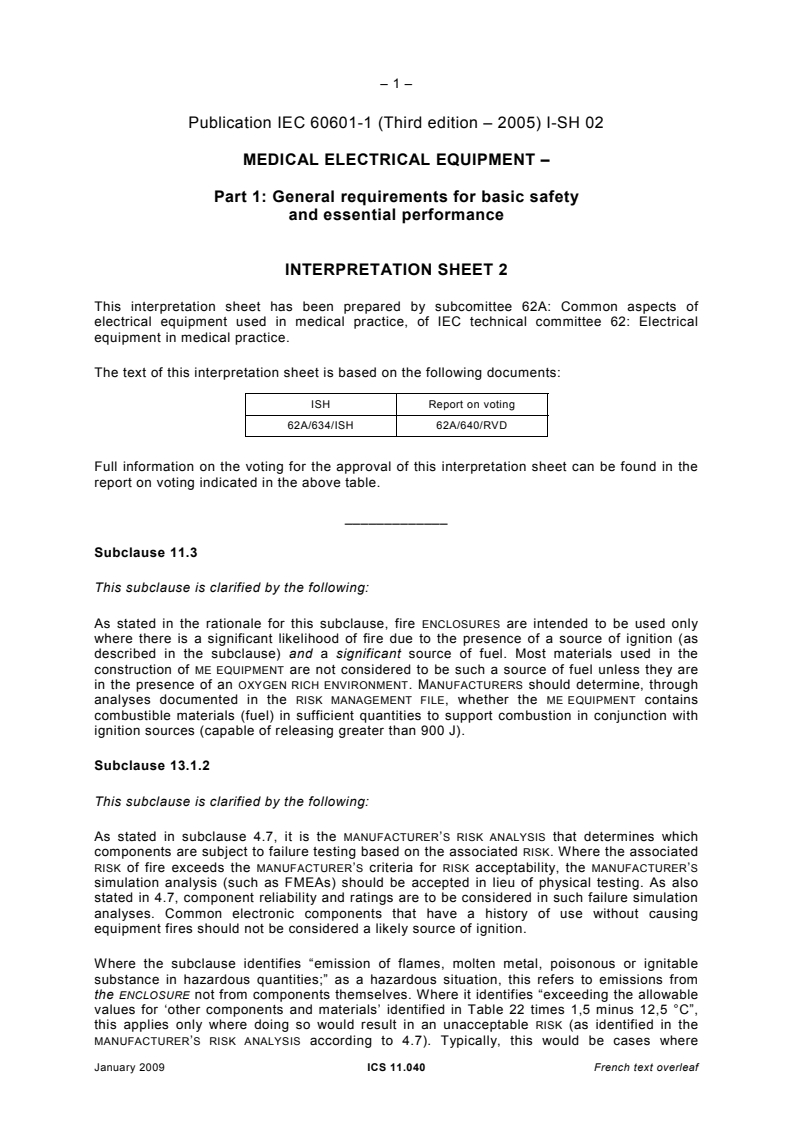
– 1 –
Publication IEC 60601-1 (Third edition – 2005) I-SH 02
MEDICAL ELECTRICAL EQUIPMENT –
Part 1: General requirements for basic safety
and essential performance
INTERPRETATION SHEET 2
This interpretation sheet has been prepared by subcomittee 62A: Common aspects of
electrical equipment used in medical practice, of IEC technical committee 62: Electrical
equipment in medical practice.
The text of this interpretation sheet is based on the following documents:
ISH Report on voting
62A/634/ISH 62A/640/RVD
Full information on the voting for the approval of this interpretation sheet can be found in the
report on voting indicated in the above table.
_____________
Subclause 11.3
This subclause is clarified by the following:
As stated in the rationale for this subclause, fire ENCLOSURES are intended to be used only
where there is a significant likelihood of fire due to the presence of a source of ignition (as
described in the subclause) and a significant source of fuel. Most materials used in the
construction of ME EQUIPMENT are not considered to be such a source of fuel unless they are
in the presence of an OXYGEN RICH ENVIRONMENT. MANUFACTURERS should determine, through
analyses documented in the RISK MANAGEMENT FILE, whether the ME EQUIPMENT contains
combustible materials (fuel) in sufficient quantities to support combustion in conjunction with
ignition sources (capable of releasing greater than 900 J).
Subclause 13.1.2
This subclause is clarified by the following:
As stated in subclause 4.7, it is the MANUFACTURER’S RISK ANALYSIS that determines which
components are subject to failure testing based on the associated RISK. Where the associated
RISK of fire exceeds the MANUFACTURER’S criteria for RISK acceptability, the MANUFACTURER’S
simulation analysis (such as FMEAs) should be accepted in lieu of physical testing. As also
stated in 4.7, component reliability and ratings are to be considered in such failure simulation
analyses. Common electronic components that have a history of use without causing
equipment fires should not be considered a likely source of ignition.
Where the subclause identifies “emission of flames, molten metal, poisonous or ignitable
substance in hazardous quantities;” as a hazardous situation, this refers to emissions from
the ENCLOSURE not from components themselves. Where it identifies “exceeding the allowable
values for ‘other components and materials’ identified in Table 22 times 1,5 minus 12,5 °C”,
this applies only where doing so would result in an unacceptable RISK (as identified in the
MANUFACTURER’S RISK ANALYSIS according to 4.7). Typically, this would be cases where
January 2009 ICS 11.040 French text overleaf
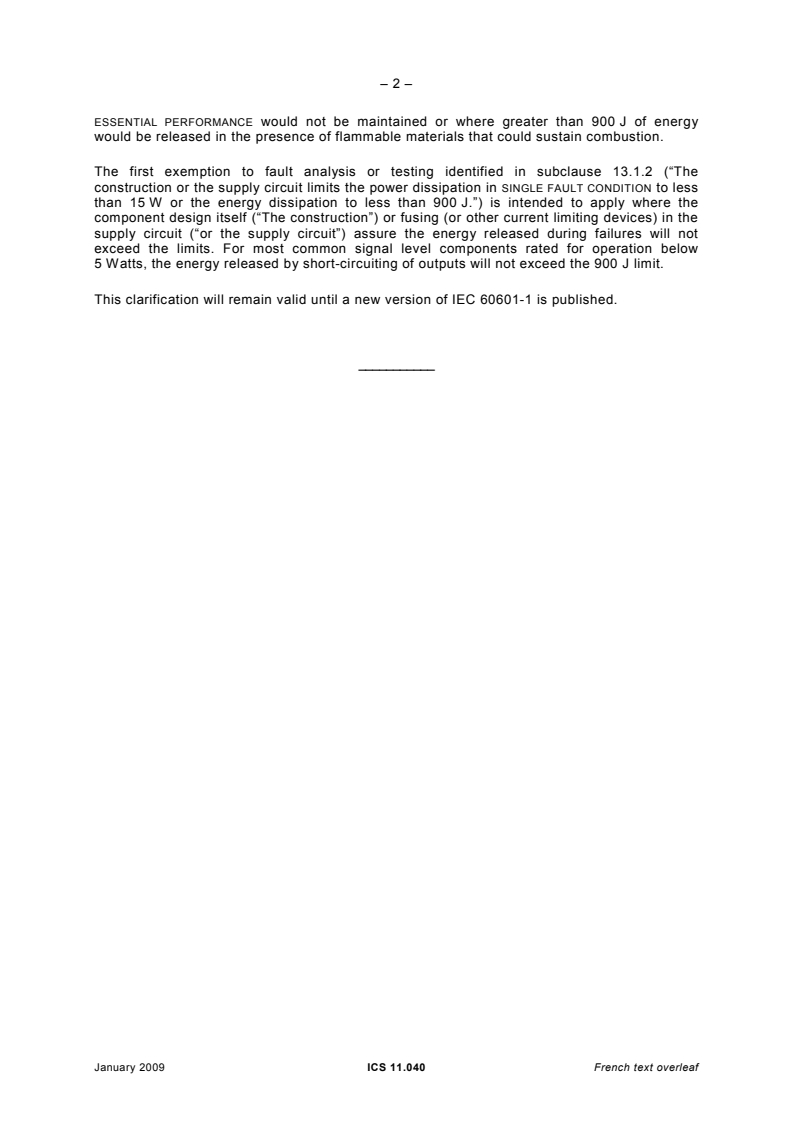
– 2 –
ESSENTIAL PERFORMANCE would not be maintained or where greater than 900 J of energy
would be released in the presence of flammable materials that could sustain combustion.
The first exemption to fault analysis or testing identified in subclause 13.1.2 (“The
construction or the supply circuit limits the power dissipation in SINGLE FAULT CONDITION to less
than 15 W or the energy dissipation to less than 900 J.”) is intended to apply where the
component design itself (“The construction”) or fusing (or other current limiting devices) in the
supply circuit (“or the supply circuit”) assure the energy released during failures will not
exceed the limits. For most common signal level components rated for operation below
5 Watts, the energy released by short-circuiting of outputs will not exceed the 900 J limit.
This clarification will remain valid until a new version of IEC 60601-1 is published.
___________
January 2009 ICS 11.040 French text overleaf
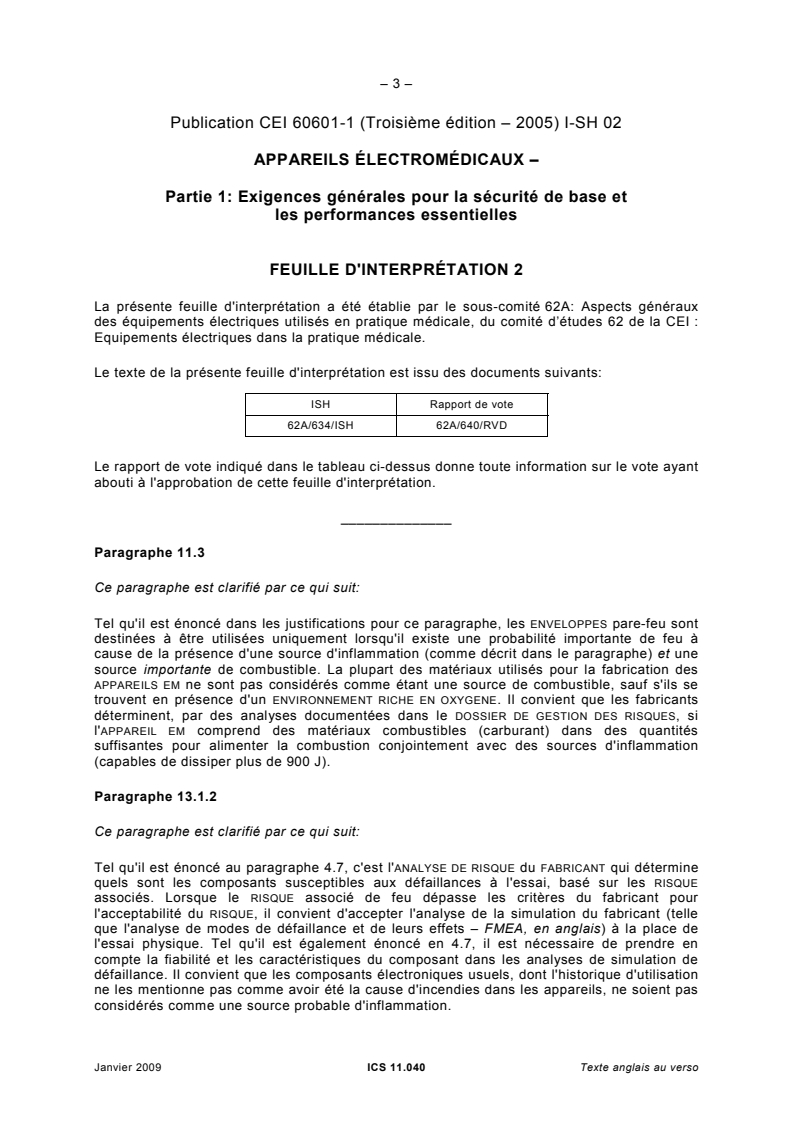
– 3 –
Publication CEI 60601-1 (Troisième édition – 2005) I-SH 02
APPAREILS ÉLECTROMÉDICAUX –
Partie 1: Exigences générales pour la sécurité de base et
les performances essentielles
FEUILLE D'INTERPRÉTATION 2
La présente feuille d'interprétation a été établie par le sous-comité 62A: Aspects généraux
des équipements électriques utilisés en pratique méd
...
Questions, Comments and Discussion
Ask us and Technical Secretary will try to provide an answer. You can facilitate discussion about the standard in here.
Loading comments...