

IEC 62055-42:2022
(Main)Electricity metering - Payment systems - Part 42: Transaction Reference Numbers (TRN)
- Abstract
IEC 62055-42:2022, specifies a token generation mechanism and token structure for smart prepayment functionality in markets where IEC 62055-41 compliant systems are not used, and where a different security mechanism is required by project-specific or national requirements. This document specifies token structure, authentication and an anti-replay mechanism, token operating model, and protocol.
This document is informed by the STS Association key management services, and by the key management mechanisms used within the DLMS/COSEM security model within IEC 62056‑6‑2. Reference is made to the international STS token standards (IEC 62055-41, IEC 62055-51 and IEC 62055-52) for payment metering systems, and interworking has been considered where appropriate in terms of token carrier ranges in the decimal domain. IEC 62055-41 tokens and those described in this document are not interoperable, however their domains are designed to be mutually exclusive to ensure the two kinds of tokens do not interfere with each other.
Metering application processing and functionality, HAN interface commands and attributes, WAN interface commands and attributes are outside the scope of this document; however, reference is made to other standards in this regard.
The mechanism for auditing and retrieving data from the meter relating to tariffication, meter readings, profile data and other legal metrology information is outside the scope of this document; however, this is defined as part of any overall metering solution. Such interfaces for retrieving data from a meter may be defined using suitable protocols such as DLMS/COSEM as defined in the IEC 62056 series.
- Status
- Published
- Publication Date
- 12-Jul-2022
- Technical Committee
- TC 13 - Electrical energy measurement and control
- Drafting Committee
- WG 15 - TC 13/WG 15
- Current Stage
- PPUB - Publication issued
- Start Date
- 13-Jul-2022
- Completion Date
- 29-Jul-2022
Overview
IEC 62055-42:2022 is an international standard developed by the International Electrotechnical Commission (IEC) focusing on electricity metering payment systems. Specifically, it defines the Transaction Reference Numbers (TRN) token generation mechanism and token structure used in smart prepayment electricity metering systems. This standard targets scenarios where IEC 62055-41 compliant systems are not employed, and alternative security mechanisms are required due to project-specific or national requirements.
The document details the authentication framework, anti-replay mechanisms, token operating models, and communication protocols that enable secure and reliable electricity payment transactions. It draws from the STS Association key management services and the DLMS/COSEM security model specified in the IEC 62056-6-2 series. While related to IEC 62055-41, IEC 62055-42 tokens are designed to be mutually exclusive to avoid interference between token systems.
Key Topics
The IEC 62055-42 standard encompasses several crucial topics fundamental to smart prepayment metering:
Token Structure and Format
Defines the token data elements, including sequential token numbers, message authentication codes (MACs), and function indexes, ensuring the tokens are secure and traceable.Authentication and Security Mechanisms
Specifies techniques for token authentication, key management, encryption, and anti-replay features to enhance security against fraud and unauthorized transactions.Token Operating Models
Illustrates the flow of tokens from the Point-of-Sale (POS) application to the meter via token carriers, outlining data flows and interface protocols.Application Layer Protocols
Details the Application Protocol Data Units (APDUs) for both POSToTokenCarrier and TokenCarriertoMeter interfaces, enabling robust communication between system components.Key Management System (KMS)
Sets generic requirements for handling cryptographic keys, including derivation and lifecycle management within the metering payment ecosystem.Interoperability Considerations
Addresses how the IEC 62055-42 token domains are designed to coexist without conflict with IEC 62055-41 tokens, ensuring non-interference though there is no direct interoperability.
Applications
IEC 62055-42 serves as a foundational standard in electricity prepayment metering systems used globally in environments where existing STS (Standard Transfer Specification) compliant systems (IEC 62055-41) are unsuitable. Practical applications include:
Smart Prepayment Electricity Meters
Allowing consumers to purchase electricity credit using secure transaction tokens conforming to national or project-specific security requirements.Utility Payment Systems
Enabling utilities to implement payment verification and transaction tracking using the TRN token mechanism with robust security.Security-Critical Energy Markets
Where advanced token authentication and anti-replay protections are critical for preventing fraud and ensuring accurate electricity usage billing.Token Carrier Devices
Such as smartcards or hand-held keypads used to load tokens generated from point-of-sale terminals and transfer them to meters.
This standard is vital for utilities and manufacturers designing non-STS but secure token-based prepayment systems, helping to deliver reliable, secure, and auditable electricity transactions.
Related Standards
IEC 62055-42 links closely with several standards in the electricity metering domain, including:
IEC 62055-41 / 51 / 52
The core international STS token standards providing the basis for interoperable token generation and transfer mechanisms.IEC 62056 Series
Covers the DLMS/COSEM standards for meter data exchange and communication protocols, which inform security mechanisms referenced by IEC 62055-42.IEC 62056-6-2
Specifies the DLMS/COSEM security model leveraged for key management and encryption processes in IEC 62055-42.IEC 62055-42
Communicates with other metering system interfaces such as HAN (Home Area Network) and WAN (Wide Area Network) interfaces, which are outside its direct scope but referenced for comprehensive metering solutions.
Utilizing IEC 62055-42 along with these standards supports the development of secure, compliant, and interoperable prepayment electricity metering solutions adapted to a wide range of market and regulatory scenarios.
Keywords: IEC 62055-42, Transaction Reference Number, TRN, electricity metering, payment systems, smart prepayment, token generation, token structure, authentication, anti-replay, key management, metering communication protocol, IEC 62055-41, DLMS/COSEM, IEC 62056, security mechanisms, prepayment tokens, electricity utilities, smart meter security.
Get Certified
Connect with accredited certification bodies for this standard

BSI Group
BSI (British Standards Institution) is the business standards company that helps organizations make excellence a habit.

DIBt (Deutsches Institut für Bautechnik)
German Institute for Building Technology.
DIN CERTCO
DIN Group product certification.
Sponsored listings
Frequently Asked Questions
IEC 62055-42:2022 is a standard published by the International Electrotechnical Commission (IEC). Its full title is "Electricity metering - Payment systems - Part 42: Transaction Reference Numbers (TRN)". This standard covers: IEC 62055-42:2022, specifies a token generation mechanism and token structure for smart prepayment functionality in markets where IEC 62055-41 compliant systems are not used, and where a different security mechanism is required by project-specific or national requirements. This document specifies token structure, authentication and an anti-replay mechanism, token operating model, and protocol. This document is informed by the STS Association key management services, and by the key management mechanisms used within the DLMS/COSEM security model within IEC 62056‑6‑2. Reference is made to the international STS token standards (IEC 62055-41, IEC 62055-51 and IEC 62055-52) for payment metering systems, and interworking has been considered where appropriate in terms of token carrier ranges in the decimal domain. IEC 62055-41 tokens and those described in this document are not interoperable, however their domains are designed to be mutually exclusive to ensure the two kinds of tokens do not interfere with each other. Metering application processing and functionality, HAN interface commands and attributes, WAN interface commands and attributes are outside the scope of this document; however, reference is made to other standards in this regard. The mechanism for auditing and retrieving data from the meter relating to tariffication, meter readings, profile data and other legal metrology information is outside the scope of this document; however, this is defined as part of any overall metering solution. Such interfaces for retrieving data from a meter may be defined using suitable protocols such as DLMS/COSEM as defined in the IEC 62056 series.
IEC 62055-42:2022, specifies a token generation mechanism and token structure for smart prepayment functionality in markets where IEC 62055-41 compliant systems are not used, and where a different security mechanism is required by project-specific or national requirements. This document specifies token structure, authentication and an anti-replay mechanism, token operating model, and protocol. This document is informed by the STS Association key management services, and by the key management mechanisms used within the DLMS/COSEM security model within IEC 62056‑6‑2. Reference is made to the international STS token standards (IEC 62055-41, IEC 62055-51 and IEC 62055-52) for payment metering systems, and interworking has been considered where appropriate in terms of token carrier ranges in the decimal domain. IEC 62055-41 tokens and those described in this document are not interoperable, however their domains are designed to be mutually exclusive to ensure the two kinds of tokens do not interfere with each other. Metering application processing and functionality, HAN interface commands and attributes, WAN interface commands and attributes are outside the scope of this document; however, reference is made to other standards in this regard. The mechanism for auditing and retrieving data from the meter relating to tariffication, meter readings, profile data and other legal metrology information is outside the scope of this document; however, this is defined as part of any overall metering solution. Such interfaces for retrieving data from a meter may be defined using suitable protocols such as DLMS/COSEM as defined in the IEC 62056 series.
IEC 62055-42:2022 is classified under the following ICS (International Classification for Standards) categories: 17.220.20 - Measurement of electrical and magnetic quantities; 35.100.70 - Application layer; 91.140.50 - Electricity supply systems. The ICS classification helps identify the subject area and facilitates finding related standards.
IEC 62055-42:2022 is available in PDF format for immediate download after purchase. The document can be added to your cart and obtained through the secure checkout process. Digital delivery ensures instant access to the complete standard document.
Standards Content (Sample)
IEC 62055-42 ®
Edition 1.0 2022-07
INTERNATIONAL
STANDARD
NORME
INTERNATIONALE
colour
inside
Electricity metering – Payment systems –
Part 42: Transaction Reference Numbers (TRN)
Comptage de l’électricité – Systèmes de paiement –
Partie 42: Numéros de référence des transactions (TRN)
All rights reserved. Unless otherwise specified, no part of this publication may be reproduced or utilized in any form
or by any means, electronic or mechanical, including photocopying and microfilm, without permission in writing from
either IEC or IEC's member National Committee in the country of the requester. If you have any questions about IEC
copyright or have an enquiry about obtaining additional rights to this publication, please contact the address below or
your local IEC member National Committee for further information.
Droits de reproduction réservés. Sauf indication contraire, aucune partie de cette publication ne peut être reproduite
ni utilisée sous quelque forme que ce soit et par aucun procédé, électronique ou mécanique, y compris la photocopie
et les microfilms, sans l'accord écrit de l'IEC ou du Comité national de l'IEC du pays du demandeur. Si vous avez des
questions sur le copyright de l'IEC ou si vous désirez obtenir des droits supplémentaires sur cette publication, utilisez
les coordonnées ci-après ou contactez le Comité national de l'IEC de votre pays de résidence.
IEC Secretariat Tel.: +41 22 919 02 11
3, rue de Varembé info@iec.ch
CH-1211 Geneva 20 www.iec.ch
Switzerland
About the IEC
The International Electrotechnical Commission (IEC) is the leading global organization that prepares and publishes
International Standards for all electrical, electronic and related technologies.
About IEC publications
The technical content of IEC publications is kept under constant review by the IEC. Please make sure that you have the
latest edition, a corrigendum or an amendment might have been published.
IEC publications search - webstore.iec.ch/advsearchform IEC Products & Services Portal - products.iec.ch
The advanced search enables to find IEC publications by a Discover our powerful search engine and read freely all the
variety of criteria (reference number, text, technical publications previews. With a subscription you will always
committee, …). It also gives information on projects, replaced have access to up to date content tailored to your needs.
and withdrawn publications.
Electropedia - www.electropedia.org
IEC Just Published - webstore.iec.ch/justpublished
The world's leading online dictionary on electrotechnology,
Stay up to date on all new IEC publications. Just Published
containing more than 22 300 terminological entries in English
details all new publications released. Available online and
and French, with equivalent terms in 19 additional languages.
once a month by email.
Also known as the International Electrotechnical Vocabulary
(IEV) online.
IEC Customer Service Centre - webstore.iec.ch/csc
If you wish to give us your feedback on this publication or
need further assistance, please contact the Customer Service
Centre: sales@iec.ch.
A propos de l'IEC
La Commission Electrotechnique Internationale (IEC) est la première organisation mondiale qui élabore et publie des
Normes internationales pour tout ce qui a trait à l'électricité, à l'électronique et aux technologies apparentées.
A propos des publications IEC
Le contenu technique des publications IEC est constamment revu. Veuillez vous assurer que vous possédez l’édition la
plus récente, un corrigendum ou amendement peut avoir été publié.
Recherche de publications IEC - IEC Products & Services Portal - products.iec.ch
webstore.iec.ch/advsearchform Découvrez notre puissant moteur de recherche et consultez
La recherche avancée permet de trouver des publications IEC gratuitement tous les aperçus des publications. Avec un
en utilisant différents critères (numéro de référence, texte, abonnement, vous aurez toujours accès à un contenu à jour
comité d’études, …). Elle donne aussi des informations sur adapté à vos besoins.
les projets et les publications remplacées ou retirées.
Electropedia - www.electropedia.org
IEC Just Published - webstore.iec.ch/justpublished
Le premier dictionnaire d'électrotechnologie en ligne au
Restez informé sur les nouvelles publications IEC. Just
monde, avec plus de 22 300 articles terminologiques en
Published détaille les nouvelles publications parues.
anglais et en français, ainsi que les termes équivalents dans
Disponible en ligne et une fois par mois par email.
19 langues additionnelles. Egalement appelé Vocabulaire
Electrotechnique International (IEV) en ligne.
Service Clients - webstore.iec.ch/csc
Si vous désirez nous donner des commentaires sur cette
publication ou si vous avez des questions contactez-nous:
sales@iec.ch.
IEC 62055-42 ®
Edition 1.0 2022-07
INTERNATIONAL
STANDARD
NORME
INTERNATIONALE
colour
inside
Electricity metering – Payment systems –
Part 42: Transaction Reference Numbers (TRN)
Comptage de l’électricité – Systèmes de paiement –
Partie 42: Numéros de référence des transactions (TRN)
INTERNATIONAL
ELECTROTECHNICAL
COMMISSION
COMMISSION
ELECTROTECHNIQUE
INTERNATIONALE
ICS 17.220.20, ICS 35.100.70, ICS 91.140.50 ISBN 978-2-8322-3951-3
– 2 – IEC 62055-42:2022 © IEC 2022
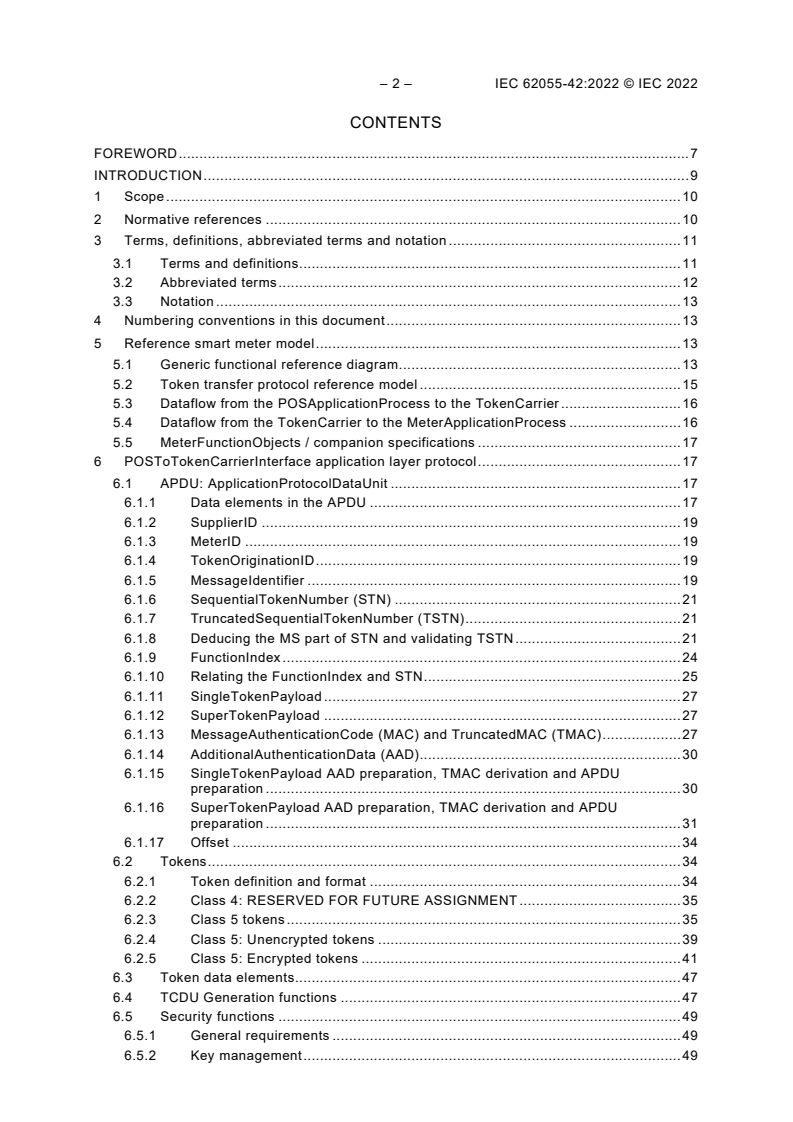
CONTENTS
FOREWORD . 7
INTRODUCTION . 9
1 Scope . 10
2 Normative references . 10
3 Terms, definitions, abbreviated terms and notation . 11
3.1 Terms and definitions . 11
3.2 Abbreviated terms . 12
3.3 Notation . 13
4 Numbering conventions in this document . 13
5 Reference smart meter model . 13
5.1 Generic functional reference diagram . 13
5.2 Token transfer protocol reference model . 15
5.3 Dataflow from the POSApplicationProcess to the TokenCarrier . 16
5.4 Dataflow from the TokenCarrier to the MeterApplicationProcess . 16
5.5 MeterFunctionObjects / companion specifications . 17
6 POSToTokenCarrierInterface application layer protocol . 17
6.1 APDU: ApplicationProtocolDataUnit . 17
6.1.1 Data elements in the APDU . 17
6.1.2 SupplierID . 19
6.1.3 MeterID . 19
6.1.4 TokenOriginationID . 19
6.1.5 MessageIdentifier . 19
6.1.6 SequentialTokenNumber (STN) . 21
6.1.7 TruncatedSequentialTokenNumber (TSTN) . 21
6.1.8 Deducing the MS part of STN and validating TSTN . 21
6.1.9 FunctionIndex . 24
6.1.10 Relating the FunctionIndex and STN . 25
6.1.11 SingleTokenPayload . 27
6.1.12 SuperTokenPayload . 27
6.1.13 MessageAuthenticationCode (MAC) and TruncatedMAC (TMAC) . 27
6.1.14 AdditionalAuthenticationData (AAD). 30
6.1.15 SingleTokenPayload AAD preparation, TMAC derivation and APDU
preparation . 30
6.1.16 SuperTokenPayload AAD preparation, TMAC derivation and APDU
preparation . 31
6.1.17 Offset . 34
6.2 Tokens . 34
6.2.1 Token definition and format . 34
6.2.2 Class 4: RESERVED FOR FUTURE ASSIGNMENT . 35
6.2.3 Class 5 tokens . 35
6.2.4 Class 5: Unencrypted tokens . 39
6.2.5 Class 5: Encrypted tokens . 41
6.3 Token data elements. 47
6.4 TCDU Generation functions . 47
6.5 Security functions . 49
6.5.1 General requirements . 49
6.5.2 Key management . 49
6.5.3 Key deriviation . 50
6.5.4 Encryption process . 50
7 TokenCarriertoMeterInterface application layer protocol . 50
7.1 APDU: ApplicationProtocolDataUnit . 50
7.1.1 Data elements in the APDU . 50
7.1.2 TokenData . 50
7.1.3 AuthenticationResult . 50
7.1.4 ValidationResult . 51
7.1.5 TokenResult . 51
7.2 APDU Extraction processes . 52
7.2.1 APDU Extraction process for Class 5 tokens . 52
7.2.2 APDU Extraction process for SubClass 0 unencrypted token . 53
7.2.3 APDU Extraction process for SubClass 8 encrypted token . 53
7.3 Security functions . 54
7.3.1 Key attributes and key changes . 54
7.3.2 Decryption algorithm . 55
7.3.3 TokenAuthentication . 55
7.3.4 TokenValidation . 55
7.3.5 TokenResult . 55
8 MeterApplicationProcess requirements . 56
8.1 General requirements . 56
8.2 Token acceptance/rejection . 56
8.3 Display indicators and markings . 57
8.4 TransferCredit tokens . 57
8.5 Engineering/SpecialFunction tokens . 57
9 KMS: KeyManagementSystem generic requirements . 58
10 Maintenance of unassigned entities . 58
Annex A (informative) Verhoeff code implementation example . 59
A.1 Sample code . 59
Annex B (informative) Example of ExtendedTransferCredit . 61
B.1 Class 5: SubClass 10: TransferCredit + Tariff . 61
B.1.1 General . 61
B.1.2 Block sequence/SuperTokenBlockToFollow . 61
B.1.3 Complete tariff . 62
B.1.4 Tariff sub-information. 62
B.1.5 Tariff activation month . 62
B.1.6 Tariff data . 63
B.1.7 Tariff types . 63
B.1.8 Tariff sub-information. 63
B.2 Class 5, SubClass 10, tariff type 0: TransferCredit + slab or time-of-use tariff . 64
B.2.1 Class 5, SubClass 10, tariff type 0, sub-type 0: TransferCredit + slab
tariff . 64
B.2.2 Number of slab boundaries . 65
B.2.3 Slab scaling . 65
B.2.4 Slab field size . 65
B.2.5 Slab value . 66
B.2.6 Class 5, SubClass 10, tariff type 0, sub-type 1: TransferCredit + time of
use (TOU) tariff . 66
B.2.7 Week definition . 66
– 4 – IEC 62055-42:2022 © IEC 2022
B.2.8 Time period definitions . 67
B.2.9 Register definitions . 68
B.3 Class 5, SubClass 10, tariff type 1: TransferCredit + rate prices or fixed
charge price token format . 68
B.3.1 Class 5, SubClass 10, tariff type 1: tariff sub-information . 68
B.3.2 Class 5, SubClass 10, tariff type 1, sub-type 0: TransferCredit + rate
prices . 68
B.3.3 Class 5, SubClass 10, tariff type 1: tariff sub-information . 69
B.3.4 Number of rate prices . 69
B.3.5 Rate price multiplier . 70
B.3.6 Rate price field size . 70
B.3.7 Rate price value . 70
B.3.8 Class 5, SubClass 10, tariff type 1, sub type 1: TransferCredit + fixed
charge prices . 71
B.3.9 Number of fixed charge prices . 71
B.3.10 Fixed charge price multiplier . 72
B.3.11 Fixed charge price field size . 72
B.3.12 Fixed charge application . 72
B.3.13 Fixed charge price value . 72
B.4 Class 5, SubClass 10, tariff type 2: TransferCredit + electricity duty (ED)
token format . 72
B.4.1 Electricity duty (ED) . 72
B.4.2 Electricity duty on energy charges . 73
B.4.3 Electricity duty on fixed charges . 73
B.4.4 Number of electricity duty slabs . 73
B.4.5 Electricity duty rate . 73
B.4.6 Electricity duty slab size . 74
B.5 SubClass 0 TCDU generation detailed process . 75
B.6 SubClass 8 TCDU generation detailed process . 75
B.7 SubClass 10 TCDU generation detailed process . 76
B.8 SubClass 10 APDU extraction detailed process . 77
Bibliography . 80
Figure 1 – Functional block diagram of a generic payment meter . 14
Figure 2 – Reference model as a 2-layer collapsed OSI protocol stack . 15
Figure 3 – Generic model of POSApplicationProcess to TokenCarrier . 16
Figure 4 – Dataflow from the TokenCarrier to the MeterApplicationProcess . 16
Figure 5 – Generic data elements for AAD payload construction for
SingleTokenPayload . 28
Figure 6 – Generic data elements for AAD payload construction for
SuperTokenPayload . 29
Figure 7 – InitializationVector (IV) construction . 29
Figure 8 – GMAC construction . 30
Figure 9 – Class 5 SubClass 8 TMAC derivation and full APDU preparation example. 31
Figure 10 – Class 5 SubClass 10 TMAC derivation and full APDU preparation example . 33
Figure 11 – TCDU generation for SubClass 0 unencrypted tokens . 48
Figure 12 – TCDU generation for SubClass 8 encrypted tokens . 49
Figure 13 – APDU extraction process for SubClass 0 tokens . 53
Figure 14 – APDU extraction process for SubClass 8 tokens . 54
Figure B.1 – TCDU generation process for SubClass 0 . 75
Figure B.2 – TCDU generation process for SubClass 8 . 76
Figure B.3 – TCDU generation process for SubClass 10 . 77
Figure B.4 – APDU extraction process for SubClass 10 . 78
Table 1 – Basic and derived elements of APDU and TCDU construction . 17
Table 2 – SubClass-wise MessageIdentifier detail and SubClass Functional Class . 20
Table 3 – Example of defining L and U for each SubClass . 22
N N
Table 4 – Process of validating STN and deducing MS(N) . 23
Table 5 – Last accepted token example(a) . 23
Table 6 – Last accepted token example(b) . 23
Table 7 – Last accepted token example(c) . 24
Table 8 – Last accepted token example(d) . 24
Table 9 – Numeric constants and their purpose . 34
Table 10 – Token definition and format . 35
Table 11 – Class 5 SubClass assignment . 36
Table 12 –SubClass-wise boundaries for Class 5 APDU before encryption . 37
Table 13 – SubClass-wise boundaries for Class 5 tokens, TCDU after encryption (if
applicable) and adding offset (without CheckDigit) . 37
Table 14 – Class 5 SubClass boundaries for TCDU (reserved space) . 38
Table 15 – SubClass related FunctionalClass and associated use cases . 39
Table 16 – SubClass 0: TransferCredit token . 40
Table 17 – SubClass 8: TransferCredit token . 41
Table 18 – Class 5, SubClass 9: SpecialFunction token . 41
Table 19 – Service types . 42
Table 20 – Block 1 of TransferCredit + Function token . 43
Table 21 – Block 2 to N-1 of N (N > 2) TransferCredit + Function token . 44
Table 22 – Last block TransferCredit + Function token. 44
Table 23 – Block 1 for Class 5 SubClass 11 meter generated token structure . 45
Table 24 – Block 2 for Class 5 SubClass 11 meter generated token structure . 45
Table 25 – Token data elements . 47
Table 26 – Data elements in the APDU . 50
Table 27 – Possible values for AuthenticationResult . 51
Table 28 – Possible values for ValidationResult . 51
Table 29 – Possible values for TokenResult . 52
Table B.1 – Block 1 of TransferCredit + tariff token . 61
Table B.2 – Block 2 of TransferCredit + Tariff token . 61
Table B.3 – Block 3 of TransferCredit + Tariff token . 63
Table B.4 – Block 4 of TransferCredit + Tariff token . 63
Table B.5 – Tariff types . 63
Table B.6 – Details of tariff sub-information . 64
Table B.7 – Block 2 for class 5, SubClass 10, tariff type 0, sub-type 0
(TransferCredit + slab tariff) . 64
– 6 – IEC 62055-42:2022 © IEC 2022
Table B.8 – Block 2 for Class 5, SubClass 10, tariff type 0, sub-type 0
(TransferCredit + slab tariff) – tariff data part . 65
Table B.9 – Block 3 for class 5, SubClass 10, tariff type 0, sub-type 0
(TransferCredit + slab tariff) . 66
Table B.10 – Block 2 for class 5, SubClass 10, tariff type 0, sub-type 1
(TransferCredit + time of use tariff) . 66
Table B.11 – Block 3 for class 5, SubClass 10, tariff type 0, sub-type 1
(TransferCredit + time of use tariff) . 68
Table B.12 – Block 4 for class 5, SubClass 10, tariff type 0, sub-type 1
(TransferCredit + time of use tariff) . 68
Table B.13 – Block 2 for class 5, SubClass 10, tariff type 1, sub-type 0
(TransferCredit + rate prices) . 69
Table B.14 – Block 2 for class 5, SubClass 10, tariff type 1, sub-type 0
(TransferCredit + rate prices) – tariff data . 69
Table B.15 – Block 3 for class 5, SubClass 10, tariff type 1, sub-type 0
(TransferCredit + rate prices) . 70
Table B.16 – Block 4 for class 5, SubClass 10, tariff type 1, sub-type 0
(TransferCredit + rate prices) . 71
Table B.17 – Block 2 for class 5, SubClass 10, tariff type 1, sub-type 1
(TransferCredit + fixed charge prices) . 71
Table B.18 – Block 2 for class 5, SubClass 10, tariff type 1, sub-type 1
(TransferCredit + fixed charge prices) – tariff data . 71
Table B.19 – Block 2 for class 5, SubClass 10, tariff type 2, sub-type 0
(TransferCredit + electricity duty) . 73
Table B.20 – Block 2 for class 5, SubClass 10, tariff type 2, sub-type 0
(TransferCredit + electricity duty) – data field. 73
Table B.21 – Electricity duty slab value encoding . 74
Table B.22 – Block 3 for class 5, SubClass 10, tariff type 2, sub-type 0
(TransferCredit + electricity duty) . 75
INTERNATIONAL ELECTROTECHNICAL COMMISSION
____________
ELECTRICITY METERING – PAYMENT SYSTEMS –
Part 42: Transaction Reference Numbers (TRN)
FOREWORD
1) The International Electrotechnical Commission (IEC) is a worldwide organization for standardization comprising
all national electrotechnical committees (IEC National Committees). The object of IEC is to promote international
co-operation on all questions concerning standardization in the electrical and electronic fields. To this end and
in addition to other activities, IEC publishes International Standards, Technical Specifications, Technical Reports,
Publicly Available Specifications (PAS) and Guides (hereafter referred to as "IEC Publication(s)"). Their
preparation is entrusted to technical committees; any IEC National Committee interested in the subject dealt with
may participate in this preparatory work. International, governmental and non-governmental organizations liaising
with the IEC also participate in this preparation. IEC collaborates closely with the International Organization for
Standardization (ISO) in accordance with conditions determined by agreement between the two organizations.
2) The formal decisions or agreements of IEC on technical matters express, as nearly as possible, an international
consensus of opinion on the relevant subjects since each technical committee has representation from all
interested IEC National Committees.
3) IEC Publications have the form of recommendations for international use and are accepted by IEC National
Committees in that sense. While all reasonable efforts are made to ensure that the technical content of IEC
Publications is accurate, IEC cannot be held responsible for the way in which they are used or for any
misinterpretation by any end user.
4) In order to promote international uniformity, IEC National Committees undertake to apply IEC Publications
transparently to the maximum extent possible in their national and regional publications. Any divergence between
any IEC Publication and the corresponding national or regional publication shall be clearly indicated in the latter.
5) IEC itself does not provide any attestation of conformity. Independent certification bodies provide conformity
assessment services and, in some areas, access to IEC marks of conformity. IEC is not responsible for any
services carried out by independent certification bodies.
6) All users should ensure that they have the latest edition of this publication.
7) No liability shall attach to IEC or its directors, employees, servants or agents including individual experts and
members of its technical committees and IEC National Committees for any personal injury, property damage or
other damage of any nature whatsoever, whether direct or indirect, or for costs (including legal fees) and
expenses arising out of the publication, use of, or reliance upon, this IEC Publication or any other IEC
Publications.
8) Attention is drawn to the Normative references cited in this publication. Use of the referenced publications is
indispensable for the correct application of this publication.
9) Attention is drawn to the possibility that some of the elements of this IEC Publication may be the subject of patent
rights. IEC shall not be held responsible for identifying any or all such patent rights.
IEC 62055-42 has been prepared by IEC technical committee 13: Electrical energy
measurement and control. It is an International Standard.
The text of this International Standard is based on the following documents:
Draft Report on voting
13/1843/CDV 13/1860/RVC
Full information on the voting for its approval can be found in the report on voting indicated in
the above table.
The language used for the development of this International Standard is English.
This document was drafted in accordance with ISO/IEC Directives, Part 2, and developed in
accordance with ISO/IEC Directives, Part 1 and ISO/IEC Directives, IEC Supplement, available
at www.iec.ch/members_experts/refdocs. The main document types developed by IEC are
described in greater detail at www.iec.ch/standardsdev/publications.
– 8 – IEC 62055-42:2022 © IEC 2022
A list of all parts in the IEC 62055 series, published under the general title Electricity metering
– Payment systems, can be found on the IEC website.
The committee has decided that the contents of this document will remain unchanged until the
stability date indicated on the IEC website under webstore.iec.ch in the data related to the
specific document. At this date, the document will be
• reconfirmed,
• withdrawn,
• replaced by a revised edition, or
• amended.
IMPORTANT – The "colour inside" logo on the cover page of this document indicates
that it contains colours which are considered to be useful for the correct understanding
of its contents. Users should therefore print this document using a colour printer.
INTRODUCTION
The IEC 62055 series recognizes and takes into account the concept of layered interoperability
for use within the smart metering and smart grid domains.
It also ensures system element interoperability above the semantic layer to include business
function and business process interoperability layers within an electricity metering system, thus
ensuring overall compatibility at all these levels.
This document is based on the principles the IEC 62055 standards are built on and sets the
rules for future extensions to guarantee consistency, thus providing a common vocabulary for
use by utilities to express requirements in tenders and also by vendors to have a unified
understanding for interpretation of the tender requirements.
This document forms part of the IEC 62055 series and shares some references with IEC 62055-
41, in that both standards represent TransferCredit tokens utilising 20-digit token carriers.
However, IEC 62055-41 and IEC 62055-42 differ greatly in their encoding, security mechanism
and intended use cases. Whereas IEC 62055-41 is meant for predominantly offline systems,
IEC 62055-42 is intended for mostly online systems where the decimal token carrier is used as
a back-up mechanism for vending while meters are intermittently offline.
The IEC 62055 series has been developed by IEC TC13 specifically for electricity metering
systems, but it is equally applicable in the domain of other utility services such as water and
gas.
– 10 – IEC 62055-42:2022 © IEC 2022
ELECTRICITY METERING – PAYMENT SYSTEMS –
Part 42: Transaction Reference Numbers (TRN)
1 Scope
This document specifies a token generation mechanism and token structure for smart
prepayment functionality in markets where IEC 62055-41 compliant systems are not used, and
where a different security mechanism is required by project-specific or national requirements.
This document specifies token structure, authentication and an anti-replay mechanism, token
operating model, and protocol.
This document is informed by the STS Association key management services, and by the key
management mechanisms used within the DLMS/COSEM security model within IEC 62056‑6‑2.
Reference is made to the international STS token standards (IEC 62055-41, IEC 62055-51 and
IEC 62055-52) for payment metering systems, and interworking has been considered where
appropriate in terms of token carrier ranges in the decimal domain. IEC 62055-41 tokens and
those described in this document are not interoperable, however their domains are designed to
be mutually exclusive to ensure the two kinds of tokens do not interfere with each other.
Metering application processing and functionality, HAN interface commands and attributes,
WAN interface commands and attributes are outside the scope of this document; however,
reference is made to other standards in this regard.
The mechanism for auditing and retrieving data from the meter relating to tariffication, meter
readings, profile data and other legal metrology information is outside the scope of this
document; however, this is defined as part of any overall metering solution. Such interfaces for
retrieving data from a meter may be defined using suitable protocols such as DLMS/COSEM as
defined in the IEC 62056 series.
2 Normative references
The following documents are referred to in the text in such a way that some or all of their content
constitutes requirements of this document. For dated references, only the edition cited applies.
For undated references, the latest edition of the referenced document (including any
amendments) applies.
IEC 60050-300:2001, International Electrotechnical Vocabulary (IEV) – Part 300: Electrical and
electronic measurements and measuring instruments – Part 311: General terms relating to
measurements – Part 312: General terms relating to electrical measurements – Part 313: Types
of electrical measuring instruments – Part 314: Specific terms according to the type of
instrument
IEC 60050-300:2001/AMD1:2015
IEC 60050-300:2001/AMD2:2016
IEC 60050-300:2001/AMD3:2017
IEC 60050-300:2001/AMD4:2020
IEC TR 62051:1999, Electricity metering – Glossary of terms
IEC TR 62055-21:2005, Electricity metering – Payment systems – Part 21: Framework for
standardization
IEC 62055-31:2005, Electricity metering – Payment systems – Part 31: Particular requirements
– Static payment meters for active energy (classes 1 and 2)
IEC 62055-41:2018, Electricity metering – Payment systems – Part 41: Standard transfer
specification – Application layer protocol for one-way token carrier systems
IEC 62056-5-3:2017, Electricity metering data exchange – The DLMS/COSEM suite – Part 5-3:
DLMS/COSEM application layer
IEEE EUI 64, https://standards.ieee.org/develop/regauth/tut/eui64.pdf
Verhoeff, J.,1975, Error Detecting Decimal Codes, (Tract 29)
NIST SP 800-38D: 2007, Recommendation for Block Cipher Modes of Operation:
Galois/Counter Mode (GCM) and GMAC
3 Terms, definitions, abbreviated terms and notation
3.1 Terms and definitions
For the purposes of this document, the terms and definitions given in IEC 60050-300:2001, IEC
TR 62051:1999, IEC 62055-31:2005, IEC 62055-41:2018, IEC 62055-21:2005 and the
following apply.
ISO and IEC maintain terminological databases for use in standardization at the following
addresses:
• IEC Electropedia: available at http://www.electropedia.org/
• ISO Online browsing platform: available at http://www.iso.org/obp
NOTE Where there is a difference between the definitions in this document and those contained in other referenced
IEC standards, then those defined in this document take precedence.
3.1.1
companion specification
regional, consortia, or manufacturer-specific set of requirements and choices taken from a base
standard, in order to facilitate a particular set of use cases
3.1.2
meter
measuring instrument; synonymous with “payment meter” and “decoder” where the decoder is
a sub-part of of a multi-device installation
3.1.3
POS
point of sale; entity that may create and transfer tokens, synonymous with “CIS”, “MIS” and
“HHU”
3.1.4
super token
group of digits derived from more than one data block of the APDU that shall be entered together
in sequence to form a larger message
3.1.5
utility
retailer or supplier of an energy or water commodity service
Note 1 to entry: In the liberalized markets the actual contracting party acting as the "supplier" of the service to the
consumer may not be the traditional utility as such, but may be a third service provider party.
– 12 – IEC 62055-42:2022 © IEC 2022
3.2 Abbreviated terms
AES Advanced Encryption Standard
AAD AdditionalAuthenticatedData
AMT Amount
APDU ApplicationProtocolDataUnit
CIS Customer Intormation System
COSEM Companion Specification for Electricity Metering
DLMS Device Language Message Specification
EUI Extended Unique Identifier
GMAC Galois Message Authentication Code
HAN Home Area Network
HES Head End System
HHU Hand Held Unit
HMI Human to Machine Interface
ID Identifier
IHD In-Home Display
IEEE Institute of Electrical and Electronics Engineers
KMS Key Management System
LCS Load Control Switch
LSB Least Significant Byte
MAC MessageAuthenticationCode
MIS Management Information System
MOD Modulo operation
MS Most Significant
MSB Most Significan Byte
NIST National Institute of Standards and Technology
NSP National Service Provider
PIN Personal Identification Number
POS Point Of Sale
RANDz Reasonable And Non-Discriminatory with Zero royalty
RES Reserved
SE Smart Energy
SMS Short Message Service
STN SequentialTokenNumber
STS Standard Transfer Specification
TC Technical Committee
TCDU TokenCarierDataUnit
TMAC Truncated Message Authentication Code
TOU Time Of Use
TSTN TruncatedSequentialTokenNumber
WAN Wide Area Network
WG Working Group
3.3 Notation
Entity names, data element names, function names and process names are treated as generic
object classes and are given names in terms of phrases in which the words are capitalized and
joined without spaces.
NOTE The notation used for naming of objects has been aligned with the so called "camel-notation" used in the
common information model (CIM) standards prepared by IEC TC 57, in order to facilitate future harmonization and
integration of payment system standards with the CIM standards.
The symbol "||" inserted between two expressions means that the resultant values of the two
expressions are concatenated into a single string without separators.
4 Numbering conventions in this document
Numbers are in decimal format, unless otherwise indicated. Decimal digit values range from 0
to 9.
Binary digit values range from 0 to 1. Binary numbers are indicated by suffix "b". The
representation of binary strings is such that the least significant bit is to the right
...