

IEC 62055-41:2018
(Main)Electricity metering - Payment systems - Part 41: Standard transfer specification (STS) - Application layer protocol for one-way token carrier systems
General Information
- Abstract
IEC 62055-41:2018 specifies the application layer protocol of the standard transfer specification (STS) used for transferring units of credit and other management information from a point of sale (POS) system to an STS-compliant payment meter in a one-way token carrier system. It is primarily intended for application with electricity payment meters without a tariff employing energy-based tokens, but may also have application with currency-based token systems and for services other than electricity. It is intended for use by manufacturers of payment meters that have to accept tokens that comply with the STS and also by manufacturers of POS systems that have to produce STS-compliant tokens and is to be read in conjunction with IEC 62055-5x series. This third edition cancels and replaces the second edition of IEC 62055-41, issued in 2014. It constitutes a technical revision. The main technical changes with regard to the previous edition are as follows:
- currency transfer tokens for electricity, water, gas and time metering;
- finer resolution for gas and time credit transfer;
- common code PAN for 2 and 4 digit manufacturer codes;
- reserved MfrCode values for certification and testing purposes;
- provision for DLMS/COSEM as a virtual token carrier type;
- addition of DKGA04, an advanced key derivation function from 160-bit VendingKey;
- withdrawal of DES for EA09 and TDES for DKGA03 cryptographic algorithms, but DES for DKGA02 remains in use;
- addition of MISTY1 cryptographic algorithm using a 128-bit DecoderKey with supporting key change tokens;
- transfer of SGC values to the meter via key change tokens;
- revision of the test/display token requirements;
- revision of the KMS to reflect current best practice;
- revision of the TID roll over management guidelines;
- definition of BaseDate is referenced to Coordinated Universal Time;
- some clarifications and additional examples have been added.
- Status
- Published
- Publication Date
- 27-Mar-2018
- Technical Committee
- TC 13 - Electrical energy measurement and control
- Drafting Committee
- WG 15 - TC 13/WG 15
- Current Stage
- PPUB - Publication issued
- Start Date
- 28-Mar-2018
- Completion Date
- 13-Apr-2018
Buy Documents
IEC 62055-41:2018 RLV - Electricity metering - Payment systems - Part 41: Standard transfer specification (STS) - Application layer protocol for one-way token carrier systems Released:3/28/2018
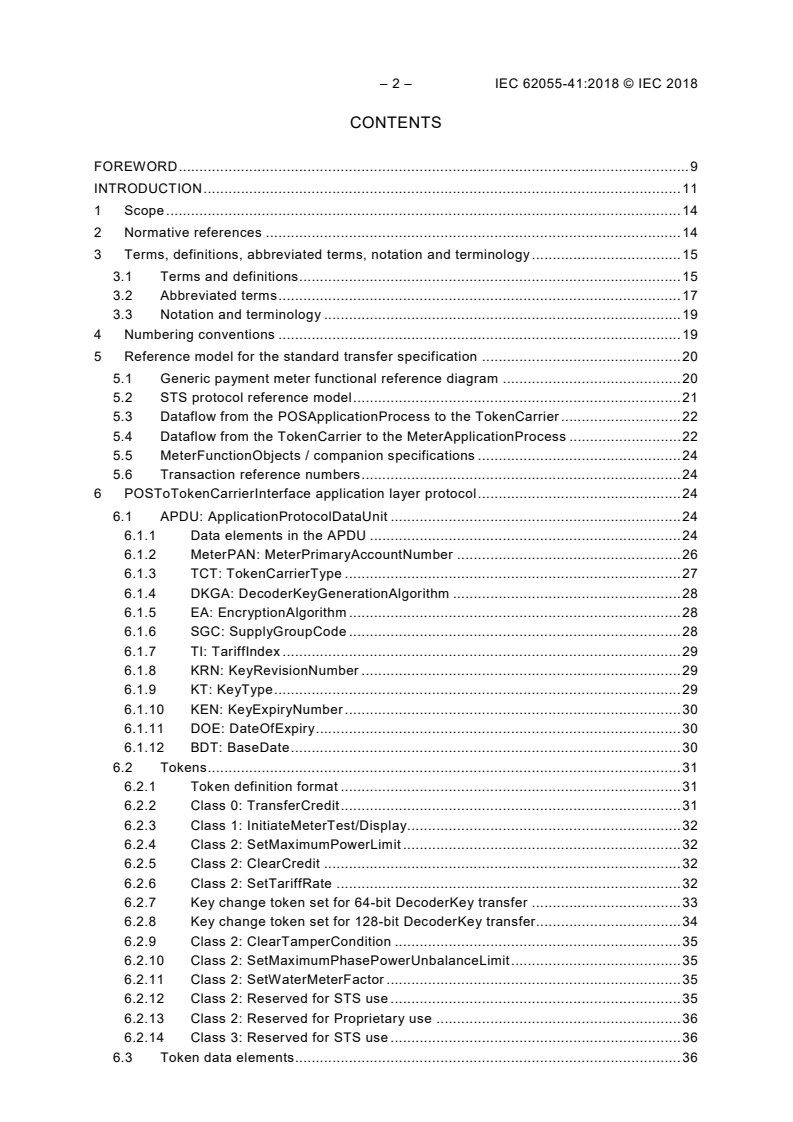
IEC 62055-41:2018 - Electricity metering - Payment systems - Part 41: Standard transfer specification (STS) - Application layer protocol for one-way token carrier systems Released:3/28/2018
Overview - IEC 62055-41:2018 (STS Application Layer for One‑Way Token Carrier Systems)
IEC 62055-41:2018 defines the application layer protocol of the Standard Transfer Specification (STS) for one‑way token carrier payment systems. It specifies how units of credit and management information are transferred from a point‑of‑sale (POS) to an STS‑compliant payment meter using one‑way tokens. The standard targets electricity payment meters (energy‑based tokens) but also covers currency‑based tokens and other services (water, gas, time). It is intended for meter and POS manufacturers and is to be read alongside the IEC 62055‑5x series.
Key technical topics and requirements
- Application layer protocol (APDU): Defines APDU data elements, token formats and the POSToTokenCarrier and TokenCarriertoMeter interfaces used for token transfer and extraction.
- Token architecture and classes: Token definition format with classes for TransferCredit, InitiateMeterTest/Display, SetMaximumPowerLimit, ClearCredit and other meter control functions.
- Security & cryptography: DecoderKey generation, key attributes and key change tokens, TokenAuthentication, TokenValidation and TokenCancellation procedures. Edition 3 introduces:
- DKGA04 advanced key derivation from 160‑bit VendingKey
- MISTY1 algorithm with 128‑bit DecoderKey and supporting key change tokens
- Withdrawal of DES for EA09 and TDES for DKGA03 (DES for DKGA02 remains)
- Provision for DLMS/COSEM as a virtual token carrier type
- Key Management System (KMS): Generic KMS requirements, key revision (KRN), KeyExpiryNumber (KEN), KEK/CERT management and guidance for secure maintenance.
- Operational data elements: MeterPAN (Meter Primary Account Number), TokenCarrierType (TCT), SupplyGroupCode (SGC), TokenIdentifier (TID), TransferAmount, BaseDate referenced to UTC, CRC and other token fields.
- Test, display and maintenance: Token/display test requirements, TID rollover guidance, transfer of SGC values via key change tokens, and updated KMS best practices.
Practical applications and users
- Who uses it: Manufacturers of payment meters, POS vendors that generate STS tokens, utilities and integrators implementing prepayment systems for electricity, water, gas or time‑based services.
- Where it’s applied: Prepayment metering deployments, field devices accepting one‑way tokens, secure vending systems, and integration projects that require interoperable token formats and robust key management.
- Benefits: Ensures interoperability between vending/POS and meters, improves security posture (modern crypto options and key lifecycle controls), and supports multi‑commodity and virtual token carriers like DLMS/COSEM.
Related standards
- IEC 62055‑5x series (companion specifications for STS)
- DLMS/COSEM (for virtual token carrier application)
Keywords: IEC 62055-41, STS, standard transfer specification, electricity metering, payment systems, one-way token carrier, tokens, POS, DecoderKey, KMS, MISTY1, DLMS/COSEM.
Relations
- Effective Date
- 05-Sep-2023
Buy Documents
IEC 62055-41:2018 RLV - Electricity metering - Payment systems - Part 41: Standard transfer specification (STS) - Application layer protocol for one-way token carrier systems Released:3/28/2018
IEC 62055-41:2018 - Electricity metering - Payment systems - Part 41: Standard transfer specification (STS) - Application layer protocol for one-way token carrier systems Released:3/28/2018
Get Certified
Connect with accredited certification bodies for this standard

BSI Group
BSI (British Standards Institution) is the business standards company that helps organizations make excellence a habit.

DIBt (Deutsches Institut für Bautechnik)
German Institute for Building Technology.
DIN CERTCO
DIN Group product certification.
Sponsored listings
Frequently Asked Questions
IEC 62055-41:2018 is a standard published by the International Electrotechnical Commission (IEC). Its full title is "Electricity metering - Payment systems - Part 41: Standard transfer specification (STS) - Application layer protocol for one-way token carrier systems". This standard covers: IEC 62055-41:2018 specifies the application layer protocol of the standard transfer specification (STS) used for transferring units of credit and other management information from a point of sale (POS) system to an STS-compliant payment meter in a one-way token carrier system. It is primarily intended for application with electricity payment meters without a tariff employing energy-based tokens, but may also have application with currency-based token systems and for services other than electricity. It is intended for use by manufacturers of payment meters that have to accept tokens that comply with the STS and also by manufacturers of POS systems that have to produce STS-compliant tokens and is to be read in conjunction with IEC 62055-5x series. This third edition cancels and replaces the second edition of IEC 62055-41, issued in 2014. It constitutes a technical revision. The main technical changes with regard to the previous edition are as follows: - currency transfer tokens for electricity, water, gas and time metering; - finer resolution for gas and time credit transfer; - common code PAN for 2 and 4 digit manufacturer codes; - reserved MfrCode values for certification and testing purposes; - provision for DLMS/COSEM as a virtual token carrier type; - addition of DKGA04, an advanced key derivation function from 160-bit VendingKey; - withdrawal of DES for EA09 and TDES for DKGA03 cryptographic algorithms, but DES for DKGA02 remains in use; - addition of MISTY1 cryptographic algorithm using a 128-bit DecoderKey with supporting key change tokens; - transfer of SGC values to the meter via key change tokens; - revision of the test/display token requirements; - revision of the KMS to reflect current best practice; - revision of the TID roll over management guidelines; - definition of BaseDate is referenced to Coordinated Universal Time; - some clarifications and additional examples have been added.
IEC 62055-41:2018 specifies the application layer protocol of the standard transfer specification (STS) used for transferring units of credit and other management information from a point of sale (POS) system to an STS-compliant payment meter in a one-way token carrier system. It is primarily intended for application with electricity payment meters without a tariff employing energy-based tokens, but may also have application with currency-based token systems and for services other than electricity. It is intended for use by manufacturers of payment meters that have to accept tokens that comply with the STS and also by manufacturers of POS systems that have to produce STS-compliant tokens and is to be read in conjunction with IEC 62055-5x series. This third edition cancels and replaces the second edition of IEC 62055-41, issued in 2014. It constitutes a technical revision. The main technical changes with regard to the previous edition are as follows: - currency transfer tokens for electricity, water, gas and time metering; - finer resolution for gas and time credit transfer; - common code PAN for 2 and 4 digit manufacturer codes; - reserved MfrCode values for certification and testing purposes; - provision for DLMS/COSEM as a virtual token carrier type; - addition of DKGA04, an advanced key derivation function from 160-bit VendingKey; - withdrawal of DES for EA09 and TDES for DKGA03 cryptographic algorithms, but DES for DKGA02 remains in use; - addition of MISTY1 cryptographic algorithm using a 128-bit DecoderKey with supporting key change tokens; - transfer of SGC values to the meter via key change tokens; - revision of the test/display token requirements; - revision of the KMS to reflect current best practice; - revision of the TID roll over management guidelines; - definition of BaseDate is referenced to Coordinated Universal Time; - some clarifications and additional examples have been added.
IEC 62055-41:2018 is classified under the following ICS (International Classification for Standards) categories: 17.220.20 - Measurement of electrical and magnetic quantities; 35.100.70 - Application layer; 91.140.50 - Electricity supply systems. The ICS classification helps identify the subject area and facilitates finding related standards.
IEC 62055-41:2018 has the following relationships with other standards: It is inter standard links to IEC 62055-41:2014. Understanding these relationships helps ensure you are using the most current and applicable version of the standard.
IEC 62055-41:2018 is available in PDF format for immediate download after purchase. The document can be added to your cart and obtained through the secure checkout process. Digital delivery ensures instant access to the complete standard document.
Standards Content (Sample)
IEC 62055-41 ®
Edition 3.0 2018-03
REDLINE VERSION
INTERNATIONAL
STANDARD
colour
inside
Electricity metering – Payment systems –
Part 41: Standard transfer specification (STS) – Application layer protocol for
one-way token carrier systems
All rights reserved. Unless otherwise specified, no part of this publication may be reproduced or utilized in any form
or by any means, electronic or mechanical, including photocopying and microfilm, without permission in writing from
either IEC or IEC's member National Committee in the country of the requester. If you have any questions about IEC
copyright or have an enquiry about obtaining additional rights to this publication, please contact the address below or
your local IEC member National Committee for further information.
IEC Central Office Tel.: +41 22 919 02 11
3, rue de Varembé info@iec.ch
CH-1211 Geneva 20 www.iec.ch
Switzerland
About the IEC
The International Electrotechnical Commission (IEC) is the leading global organization that prepares and publishes
International Standards for all electrical, electronic and related technologies.
About IEC publications
The technical content of IEC publications is kept under constant review by the IEC. Please make sure that you have the
latest edition, a corrigenda or an amendment might have been published.
IEC Catalogue - webstore.iec.ch/catalogue Electropedia - www.electropedia.org
The stand-alone application for consulting the entire The world's leading online dictionary of electronic and
bibliographical information on IEC International Standards, electrical terms containing 21 000 terms and definitions in
Technical Specifications, Technical Reports and other English and French, with equivalent terms in 16 additional
documents. Available for PC, Mac OS, Android Tablets and languages. Also known as the International Electrotechnical
iPad. Vocabulary (IEV) online.
IEC publications search - webstore.iec.ch/advsearchform IEC Glossary - std.iec.ch/glossary
The advanced search enables to find IEC publications by a 67 000 electrotechnical terminology entries in English and
variety of criteria (reference number, text, technical French extracted from the Terms and Definitions clause of
committee,…). It also gives information on projects, replaced IEC publications issued since 2002. Some entries have been
and withdrawn publications. collected from earlier publications of IEC TC 37, 77, 86 and
CISPR.
IEC Just Published - webstore.iec.ch/justpublished
Stay up to date on all new IEC publications. Just Published IEC Customer Service Centre - webstore.iec.ch/csc
details all new publications released. Available online and If you wish to give us your feedback on this publication or
also once a month by email. need further assistance, please contact the Customer Service
Centre: sales@iec.ch.
IEC 62055-41 ®
Edition 3.0 2018-03
REDLINE VERSION
INTERNATIONAL
STANDARD
colour
inside
Electricity metering – Payment systems –
Part 41: Standard transfer specification (STS) – Application layer protocol for
one-way token carrier systems
INTERNATIONAL
ELECTROTECHNICAL
COMMISSION
ICS 17.220.20; 35.100.70; 91.140.50 ISBN 978-2-8322-5556-8
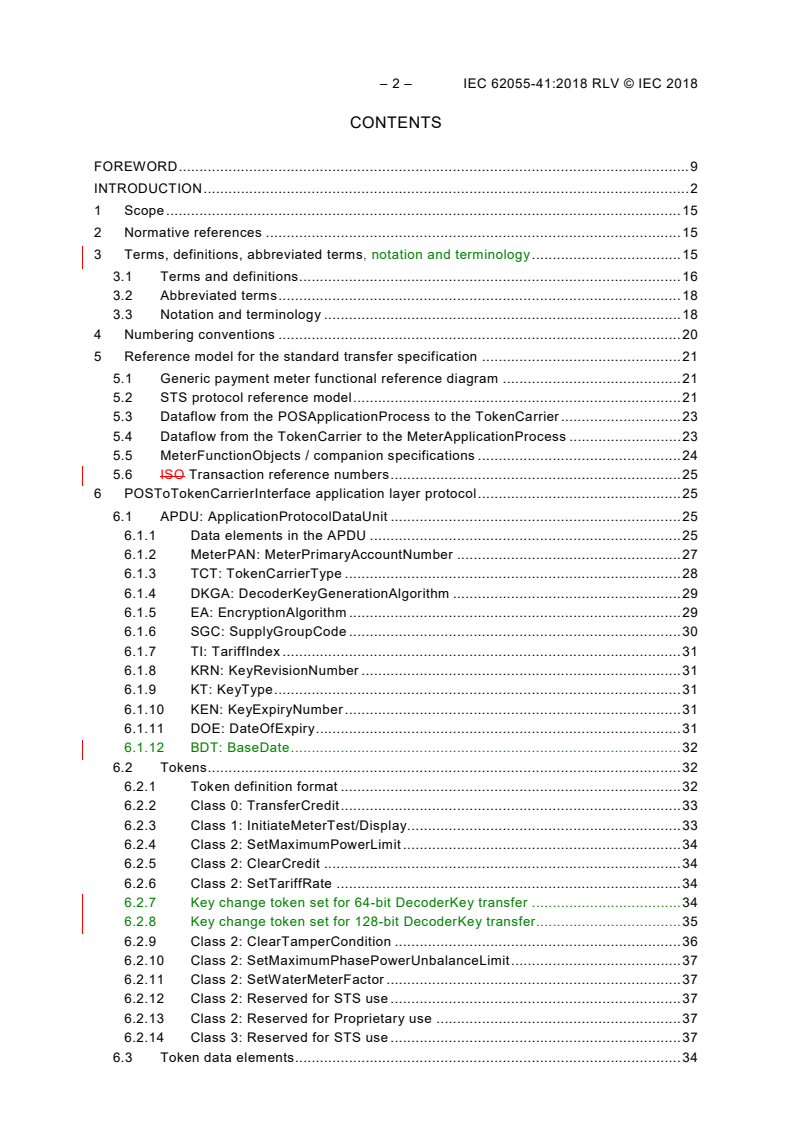
– 2 – IEC 62055-41:2018 RLV © IEC 2018
CONTENTS
FOREWORD . 9
INTRODUCTION . 2
1 Scope . 15
2 Normative references . 15
3 Terms, definitions, abbreviated terms, notation and terminology . 15
3.1 Terms and definitions . 16
3.2 Abbreviated terms . 18
3.3 Notation and terminology . 18
4 Numbering conventions . 20
5 Reference model for the standard transfer specification . 21
5.1 Generic payment meter functional reference diagram . 21
5.2 STS protocol reference model . 21
5.3 Dataflow from the POSApplicationProcess to the TokenCarrier . 23
5.4 Dataflow from the TokenCarrier to the MeterApplicationProcess . 23
5.5 MeterFunctionObjects / companion specifications . 24
5.6 ISO Transaction reference numbers . 25
6 POSToTokenCarrierInterface application layer protocol . 25
6.1 APDU: ApplicationProtocolDataUnit . 25
6.1.1 Data elements in the APDU . 25
6.1.2 MeterPAN: MeterPrimaryAccountNumber . 27
6.1.3 TCT: TokenCarrierType . 28
6.1.4 DKGA: DecoderKeyGenerationAlgorithm . 29
6.1.5 EA: EncryptionAlgorithm . 29
6.1.6 SGC: SupplyGroupCode . 30
6.1.7 TI: TariffIndex . 31
6.1.8 KRN: KeyRevisionNumber . 31
6.1.9 KT: KeyType . 31
6.1.10 KEN: KeyExpiryNumber . 31
6.1.11 DOE: DateOfExpiry . 31
6.1.12 BDT: BaseDate . 32
6.2 Tokens . 32
6.2.1 Token definition format . 32
6.2.2 Class 0: TransferCredit . 33
6.2.3 Class 1: InitiateMeterTest/Display. 33
6.2.4 Class 2: SetMaximumPowerLimit . 34
6.2.5 Class 2: ClearCredit . 34
6.2.6 Class 2: SetTariffRate . 34
6.2.7 Key change token set for 64-bit DecoderKey transfer . 34
6.2.8 Key change token set for 128-bit DecoderKey transfer . 35
6.2.9 Class 2: ClearTamperCondition . 36
6.2.10 Class 2: SetMaximumPhasePowerUnbalanceLimit . 37
6.2.11 Class 2: SetWaterMeterFactor . 37
6.2.12 Class 2: Reserved for STS use . 37
6.2.13 Class 2: Reserved for Proprietary use . 37
6.2.14 Class 3: Reserved for STS use . 37
6.3 Token data elements. 34
6.3.1 Data elements used in tokens . 38
6.3.2 Class: TokenClass . 39
6.3.3 SubClass: TokenSubClass . 40
6.3.4 RND: RandomNumber . 40
6.3.5 TID: TokenIdentifier . 41
6.3.6 Amount: TransferAmount . 43
6.3.7 CRC: CyclicRedundancCodeCheck . 46
6.3.8 Control: InitiateMeterTest/DisplayControlField . 46
6.3.9 MPL: MaximumPowerLimit . 47
6.3.10 MPPUL: MaximumPhasePowerUnbalanceLimit . 48
6.3.11 Rate: TariffRate . 48
6.3.12 WMFactor: WaterMeterFactor . 48
6.3.13 Register: RegisterToClear . 48
6.3.14 NKHO: NewKeyHighOrder . 48
6.3.15 NKLO: NewKeyLowOrder . 48
6.3.16 NKMO1: NewKeyMiddleOrder1 . 48
6.3.17 NKMO2: NewKeyMiddleOrder2 . 48
6.3.18 KENHO: KeyExpiryNumberHighOrder . 49
6.3.19 KENLO: KeyExpiryNumberLowOrder . 49
6.3.20 RO: RolloverKeyChange . 49
6.3.21 S&E: SignAndExponent . 49
6.3.22 CRC_C: CyclicRedundancyCheck_C . 49
6.4 TCDUGeneration functions . 49
6.4.1 Definition of the TCDU . 49
6.4.2 Transposition of the Class bits . 49
6.4.3 TCDUGeneration function for Class 0,1 and 2 tokens . 50
6.4.4 TCDUGeneration function for Set1stSectionDecoderKey key change
tokens . 52
6.4.5 TCDUGeneration function for Set2ndSectionDecoderKey token . 54
6.5 Security functions . 54
6.5.1 General requirements . 55
6.5.2 Key attributes and key changes . 55
6.5.3 DecoderKey generation . 64
6.5.4 STA: EncryptionAlgorithm07 . 69
6.5.5 DEA: EncryptionAlgorithm09 . 75
6.5.6 MISTY1: EncryptionAlgorithm11 . 75
7 TokenCarriertoMeterInterface application layer protocol . 75
7.1 APDU: ApplicationProtocolDataUnit . 77
7.1.1 Data elements in the APDU . 77
7.1.2 Token . 78
7.1.3 AuthenticationResult . 78
7.1.4 ValidationResult . 78
7.1.5 TokenResult . 79
7.2 APDUExtraction functions . 80
7.2.1 Extraction process . 80
7.2.2 Extraction of the 2 Class bits . 80
7.2.3 APDUExtraction function for Class 0 and Class 2 tokens . 81
7.2.4 APDUExtraction function for Class 1 tokens . 82
– 4 – IEC 62055-41:2018 RLV © IEC 2018
7.2.5 APDUExtraction function for Set1stSectionDecoderKey and
Set2ndSectionDecoderKey key change tokens set . 82
7.3 Security functions . 83
7.3.1 Key attributes and key changes . 83
7.3.2 DKR: DecoderKeyRegister . 83
7.3.3 STA: DecryptionAlgorithm07 . 84
7.3.4 DEA: DecryptionAlgorithm09. 87
7.3.5 MISTY1: DecryptionAlgorithm11 . 88
7.3.6 TokenAuthentication . 87
7.3.7 TokenValidation . 90
7.3.8 TokenCancellation . 90
8 MeterApplicationProcess requirements . 91
8.1 General requirements . 91
8.2 Token acceptance/rejection . 91
8.3 Display indicators and markings . 92
8.4 TransferCredit tokens . 93
8.5 InitiateMeterTest/Display tokens . 93
8.6 SetMaximumPowerLimit tokens . 94
8.7 ClearCredit tokens . 94
8.8 SetTariffRate tokens . 94
8.9 Set1stSectionDecoderKey Key change tokens . 94
8.10 Set2ndSectionDecoderKey tokens . 95
8.11 ClearTamperCondition tokens . 95
8.12 SetMaximumPhasePowerUnbalanceLimit tokens . 95
8.13 SetWaterMeterFactor . 95
8.14 Class 2: Reserved for STS use tokens . 95
8.15 Class 2: Reserved for Proprietary use tokens . 95
8.16 Class 3: Reserved for STS use tokens . 95
9 KMS: KeyManagementSystem generic requirements . 96
10 Maintenance of STS entities and related services . 96
10.1 General . 96
10.2 Operations . 98
10.2.1 Product certification maintenance . 98
10.2.2 DSN maintenance . 98
10.2.3 RO maintenance . 98
10.2.4 TI maintenance . 98
10.2.5 TID maintenance . 99
10.2.6 SpecialReservedTokenIdentifier maintenance . 99
10.2.7 MfrCode maintenance . 99
10.2.8 Substitution tables maintenance . 99
10.2.9 Permutation tables maintenance . 99
10.2.10 SGC maintenance. 99
10.2.11 VendingKey maintenance . 99
10.2.12 KRN maintenance . 99
10.2.13 KT maintenance . 99
10.2.14 KEN maintenance . 100
10.2.15 KEK CERT maintenance . 100
10.2.16 CC maintenance . 100
10.2.17 UC maintenance . 100
10.2.18 KMCID maintenance . 100
10.2.19 CMID maintenance . 100
CMAC maintenance .
10.3 Standardisation . 100
10.3.1 IIN maintenance . 101
10.3.2 TCT maintenance . 101
10.3.3 DKGA maintenance . 101
10.3.4 EA maintenance . 101
10.3.5 TokenClass maintenance . 101
10.3.6 TokenSubClass maintenance . 102
10.3.7 InitiateMeterTest/DisplayControlField maintenance . 102
10.3.8 RegisterToClear maintenance . 102
10.3.9 STS BaseDate maintenance . 102
10.3.10 Rate maintenance . 102
10.3.11 WMFactor maintenance . 102
10.3.12 MFO maintenance . 103
10.3.13 FOIN maintenance . 103
10.3.14 Companion specification maintenance . 103
Annex A (informative) Guidelines for a KeyManagementSystem (KMS) . 104
Annex B (informative) Entities and identifiers in an STS-compliant system . 108
Annex C (informative) Code of practice for the implementation of STS-compliant
systems . 112
C.1 General . 112
C.2 Maintenance and support services provided by the STS Association . 112
C.3 Key management . 112
C.3.1 Key management services . 112
C.3.2 SupplyGroupCode and VendingKey distribution . 112
C.3.3 CryptographicModule distribution . 113
C.3.4 Key expiry . 114
C.4 MeterPAN . 114
C.4.1 General practice . 114
C.4.2 IssuerIdentificationNumbers . 114
C.4.3 ManufacturerCodes . 114
C.4.4 DecoderSerialNumbers . 115
C.5 SpecialReservedTokenIdentifier . 115
C.6 Permutation and substitution tables for the STA . 115
C.7 EA codes . 115
C.8 TokenCarrierType codes . 115
C.9 MeterFunctionObject instances / companion specifications . 116
C.10 TariffIndex . 116
C.11 STS-compliance certification . 116
C.11.1 IEC certification services . 116
C.11.2 Products . 116
C.11.3 Certification authority . 116
C.12 Procurement options for users of STS-compliant systems . 117
C.13 Management of TID roll over . 120
C.13.1 Introduction . 120
C.13.2 Overview . 121
C.13.3 Impact analysis . 123
– 6 – IEC 62055-41:2018 RLV © IEC 2018
C.13.4 Base dates . 124
C.13.5 Implementation . 124
Bibliography . 127
Figure – TCDUGeneration function for Set2ndSectionDecoderKey token .
Figure – DecoderKeyGenerationAlgorithm03 .
Figure – DEA: EncryptionAlgorithm09 .
Figure – DEA DecryptionAlgorithm09 .
Figure 1 – Functional block diagram of a generic single-part device payment meter . 21
Figure 2 – STS modelled as a 2-layer collapsed OSI protocol stack . 22
Figure 3 – Dataflow from the POSApplicationProcess to the TokenCarrier . 23
Figure 4 – Dataflow from the TokenCarrier to the MeterApplicationProcess . 24
Figure 5 – ISO Composition of transaction reference number . 25
Figure 6 – Transposition of the 2 Class bits . 50
Figure 7 – TCDUGeneration function for Class 0, 1 and 2 tokens . 51
Figure 8 – TCDUGeneration function for key change tokens . 52
Figure 9 – DecoderKey changes – state diagram . 61
Figure 10 – DecoderKeyGenerationAlgorithm01 . 67
Figure 11 – DecoderKeyGenerationAlgorithm02 . 68
Figure 12 – STA: EncryptionAlgorithm07 . 71
Figure 13 – STA encryption substitution process . 72
Figure 14 – STA encryption permutation process . 73
Figure 15 – STA encryption DecoderKey rotation process . 73
Figure 16 – STA encryption worked example for TransferCredit token . 74
Figure 17 – MISTY1: EncryptionAlgorithm11 . 76
Figure 18 – MISTY1 encryption worked example for TransferCredit token . 77
Figure 19 – APDUExtraction function . 80
Figure 20 – Extraction of the 2 Class bits . 81
Figure 21 – STA DecryptionAlgorithm07 . 84
Figure 22 – STA decryption permutation process . 84
Figure 23 – STA decryption substitution process . 85
Figure 24 – STA decryption DecoderKey rotation process . 86
Figure 25 – STA decryption worked example for TransferCredit token . 87
Figure 26 – STA DecryptionAlgorithm11 . 88
Figure 27 – MISTY1 decryption worked example for TransferCredit token . 89
Figure A.1 – KeyManagementSystem and interactive relationships between entities . 104
Figure B.1 – Entities and identifiers deployed in an STS-compliant system . 108
Figure C.1 – System overview . 122
Table 1 – Data elements in the APDU . 26
Table 2 – Data elements in the IDRecord . 26
Table 3 – Data elements in the MeterPAN. 27
Table 4 – Data elements in the IAIN / DRN . 28
Table 5 – Token carrier types . 29
Table 6 – DKGA codes . 29
Table 7 – EA codes . 30
Table 8 – SGC types and key types . 30
Table 9 – DOE codes for the year . 32
Table 10 – DOE codes for the month . 32
Table 11 – BDT representation . 32
Table 12 – Token definition format . 33
Table 13 – Data elements used in tokens . 38
Table 14 – Token classes . 39
Table 15 – Token sub-classes . 40
Table 16 – TID calculation examples . 42
Table 17 – Units of measure for electricity . 43
Table 18 – Units of measure for other applications. 43
Table 19 – Bit allocations for the Transfer Amount field for SubClass 0 to 3 . 43
Table 20 – Maximum error due to rounding . 44
Table 21 – Examples of TransferAmount values for credit transfer . 44
Table 22 – Bit allocations for the Amount field for SubClass 4 to 7 . 44
Table 23 – Bit allocations for the exponent e . 45
Table 24 – Examples of rounding of negative and positive values . 45
Table 25 – Examples of TransferAmounts and rounding errors . 46
Table 26 – Example of a CRC calculation . 46
Table 27 – Permissible control field values . 47
Table 28 – Selection of register to clear . 48
Table 29 – S&E bit positions for variables s, e , e and e . 49
4 3 2
Table 30 – Example of a CRC_C calculation . 49
Table 31 – Classification of vending keys . 57
Table 32 – Classification of decoder keys . 57
Table 33 – Permitted relationships between decoder key types . 62
Table 34 – Definition of the PANBlock . 64
Table 35 – Data elements in the PANBlock . 64
Table 36 – Definition of the CONTROLBlock . 65
Table 37 – Data elements in the CONTROLBlock . 65
Table 38 – Range of applicable decoder reference numbers . 66
Table 39 – List of applicable supply group codes . 66
Table 40 – Data elements in DataBlock. 70
Table 41 – Input parameters for a worked example . 70
Table 42 – DataBlock example construction . 71
Table 43 – DecoderKey construction example . 71
Table 44 – Sample substitution tables . 72
Table 45 – Sample permutation table . 73
Table 46 – Data elements in the APDU . 78
Table 47 – Possible values for the AuthenticationResult . 78
– 8 – IEC 62055-41:2018 RLV © IEC 2018
Table 48 – Possible values for the ValidationResult . 79
Table 49 – Possible values for the TokenResult . 79
Table 50 – Values stored in the DKR . 83
Table 51 – Sample permutation table . 85
Table 52 – Sample substitution tables . 86
Table 53 – Entities/services requiring maintenance service. 97
Table A.1 – Entities that participate in KMS processes . 105
Table A.2 – Processes surrounding the payment meter and DecoderKey . 105
Table A.3 – Processes surrounding the CryptographicModule . 106
Table A.4 – Processes surrounding the SGC and VendingKey . 106
Table B.1 – Typical entities deployed in an STS-compliant system . 109
Table B.2 – Identifiers associated with the entities in an STS-compliant system. 110
Table C.1 – Data elements associated with a SGC . 113
Table C.2 – Data elements associated with the CryptographicModule . 114
Table C.3 – Items that should be noted in purchase orders and tenders . 117
INTERNATIONAL ELECTROTECHNICAL COMMISSION
____________
ELECTRICITY METERING – PAYMENT SYSTEMS –
Part 41: Standard transfer specification (STS) –
Application layer protocol for one-way token carrier systems
FOREWORD
1) The International Electrotechnical Commission (IEC) is a worldwide organization for standardization comprising
all national electrotechnical committees (IEC National Committees). The object of IEC is to promote
international co-operation on all questions concerning standardization in the electrical and electronic fields. To
this end and in addition to other activities, IEC publishes International Standards, Technical Specifications,
Technical Reports, Publicly Available Specifications (PAS) and Guides (hereafter referred to as “IEC
Publication(s)”). Their preparation is entrusted to technical committees; any IEC National Committee interested
in the subject dealt with may participate in this preparatory work. International, governmental and non-
governmental organizations liaising with the IEC also participate in this preparation. IEC collaborates closely
with the International Organization for Standardization (ISO) in accordance with conditions determined by
agreement between the two organizations.
2) The formal decisions or agreements of IEC on technical matters express, as nearly as possible, an international
consensus of opinion on the relevant subjects since each technical committee has representation from all
interested IEC National Committees.
3) IEC Publications have the form of recommendations for international use and are accepted by IEC National
Committees in that sense. While all reasonable efforts are made to ensure that the technical content of IEC
Publications is accurate, IEC cannot be held responsible for the way in which they are used or for any
misinterpretation by any end user.
4) In order to promote international uniformity, IEC National Committees undertake to apply IEC Publications
transparently to the maximum extent possible in their national and regional publications. Any divergence
between any IEC Publication and the corresponding national or regional publication shall be clearly indicated in
the latter.
5) IEC itself does not provide any attestation of conformity. Independent certification bodies provide conformity
assessment services and, in some areas, access to IEC marks of conformity. IEC is not responsible for any
services carried out by independent certification bodies.
6) All users should ensure that they have the latest edition of this publication.
7) No liability shall attach to IEC or its directors, employees, servants or agents including individual experts and
members of its technical committees and IEC National Committees for any personal injury, property damage or
other damage of any nature whatsoever, whether direct or indirect, or for costs (including legal fees) and
expenses arising out of the publication, use of, or reliance upon, this IEC Publication or any other IEC
Publications.
8) Attention is drawn to the Normative references cited in this publication. Use of the referenced publications is
indispensable for the correct application of this publication.
9) Attention is drawn to the possibility that some of the elements of this IEC Publication may be the subject of
patent rights. IEC shall not be held responsible for identifying any or all such patent rights.
This redline version of the official IEC Standard allows the user to identify the changes
made to the previous edition. A vertical bar appears in the margin wherever a change
has been made. Additions are in green text, deletions are in strikethrough red text.
– 10 – IEC 62055-41:2018 RLV © IEC 2018
International Standard IEC 62055-41 has been prepared by IEC technical committee 13:
Electrical energy measurement and control.
This third edition cancels and replaces the second edition of IEC 62055-41, issued in 2014. It
constitutes a technical revision.
The main technical changes with regard to the previous edition are as follows:
• currency transfer tokens for electricity, water, gas and time metering;
• finer resolution for gas and time credit transfer;
• common code PAN for 2 and 4 digit manufacturer codes;
• reserved MfrCode values for certification and testing purposes;
• provision for DLMS/COSEM as a virtual token carrier type;
• addition of DKGA04, an advanced key derivation function from 160-bit VendingKey;
• withdrawal of DES for EA09 and TDES for DKGA03 cryptographic algorithms, but DES for
DKGA02 remains in use;
• addition of MISTY1 cryptographic algorithm using a 128-bit DecoderKey with supporting
key change tokens;
• transfer of SGC values to the meter via key change tokens;
• revision of the test/display token requirements;
• revision of the KMS to reflect current best practice;
• revision of the TID roll over management guidelines;
• definition of BaseDate is referenced to Coordinated Universal Time;
• disassociation of IIN from the ISO standard definition;
• various clarifications and enhancements to support the above.
The text of this standard is based on the following documents:
FDIS Report on voting
13/1755/FDIS 13/1764/RVD
Full information on the voting for the approval of this standard can be found in the report on
voting indicated in the above table.
This publication has been drafted in accordance with the ISO/IEC Directives, Part 2.
A list of all parts in the IEC 62055 series, published under the general title Electricity metering
– Payment systems, can be found on the IEC website.
The committee has decided that the contents of this document will remain unchanged until the
stability date indicated on the IEC website under "http://webstore.iec.ch" in the data related to
the specific document. At this date, the document will be
• reconfirmed,
• withdrawn,
• replaced by a revised edition, or
• amended.
IMPORTANT – The “colour inside” logo on the cover page of this publication indicates
that it contains colours which are considered to be useful for the correct understanding
of its contents. Users should therefore print this publication using a colour printer.
– 12 – IEC 62055-41:2018 RLV © IEC 2018
INTRODUCTION
The IEC 62055 series covers payment systems, encompassing the customer information
systems, point of sale systems, token carriers, payment meters and the respective interfaces
that exist between these entities. At the time of preparation of this document, IEC 62055
comprised the following parts, under the general title, Electricity metering – Payment systems:
Part 21: Framework for standardization
Part 31: Particular requiremen
...
IEC 62055-41 ®
Edition 3.0 2018-03
INTERNATIONAL
STANDARD
NORME
INTERNATIONALE
Electricity metering – Payment systems –
Part 41: Standard transfer specification (STS) – Application layer protocol for
one-way token carrier systems
Comptage de l'électricité – Systèmes de paiement –
Partie 41: Spécification de transfert normalisé (STS) – Protocole de couche
application pour les systèmes de supports de jeton unidirectionnel
All rights reserved. Unless otherwise specified, no part of this publication may be reproduced or utilized in any form
or by any means, electronic or mechanical, including photocopying and microfilm, without permission in writing from
either IEC or IEC's member National Committee in the country of the requester. If you have any questions about IEC
copyright or have an enquiry about obtaining additional rights to this publication, please contact the address below or
your local IEC member National Committee for further information.
Droits de reproduction réservés. Sauf indication contraire, aucune partie de cette publication ne peut être reproduite
ni utilisée sous quelque forme que ce soit et par aucun procédé, électronique ou mécanique, y compris la photocopie
et les microfilms, sans l'accord écrit de l'IEC ou du Comité national de l'IEC du pays du demandeur. Si vous avez des
questions sur le copyright de l'IEC ou si vous désirez obtenir des droits supplémentaires sur cette publication, utilisez
les coordonnées ci-après ou contactez le Comité national de l'IEC de votre pays de résidence.
IEC Central Office Tel.: +41 22 919 02 11
3, rue de Varembé info@iec.ch
CH-1211 Geneva 20 www.iec.ch
Switzerland
About the IEC
The International Electrotechnical Commission (IEC) is the leading global organization that prepares and publishes
International Standards for all electrical, electronic and related technologies.
About IEC publications
The technical content of IEC publications is kept under constant review by the IEC. Please make sure that you have the
latest edition, a corrigenda or an amendment might have been published.
IEC Catalogue - webstore.iec.ch/catalogue Electropedia - www.electropedia.org
The stand-alone application for consulting the entire The world's leading online dictionary of electronic and
bibliographical information on IEC International Standards, electrical terms containing 21 000 terms and definitions in
Technical Specifications, Technical Reports and other English and French, with equivalent terms in 16 additional
documents. Available for PC, Mac OS, Android Tablets and languages. Also known as the International Electrotechnical
iPad. Vocabulary (IEV) online.
IEC publications search - webstore.iec.ch/advsearchform IEC Glossary - std.iec.ch/glossary
The advanced search enables to find IEC publications by a 67 000 electrotechnical terminology entries in English and
variety of criteria (reference number, text, technical French extracted from the Terms and Definitions clause of
committee,…). It also gives information on projects, replaced IEC publications issued since 2002. Some entries have been
and withdrawn publications. collected from earlier publications of IEC TC 37, 77, 86 and
CISPR.
IEC Just Published - webstore.iec.ch/justpublished
Stay up to date on all new IEC publications. Just Published IEC Customer Service Centre - webstore.iec.ch/csc
details all new publications released. Available online and If you wish to give us your feedback on this publication or
also once a month by email. need further assistance, please contact the Customer Service
Centre: sales@iec.ch.
A propos de l'IEC
La Commission Electrotechnique Internationale (IEC) est la première organisation mondiale qui élabore et publie des
Normes internationales pour tout ce qui a trait à l'électricité, à l'électronique et aux technologies apparentées.
A propos des publications IEC
Le contenu technique des publications IEC est constamment revu. Veuillez vous assurer que vous possédez l’édition la
plus récente, un corrigendum ou amendement peut avoir été publié.
Catalogue IEC - webstore.iec.ch/catalogue Electropedia - www.electropedia.org
Application autonome pour consulter tous les renseignements
Le premier dictionnaire en ligne de termes électroniques et
bibliographiques sur les Normes internationales,
électriques. Il contient 21 000 termes et définitions en anglais
Spécifications techniques, Rapports techniques et autres
et en français, ainsi que les termes équivalents dans 16
documents de l'IEC. Disponible pour PC, Mac OS, tablettes
langues additionnelles. Egalement appelé Vocabulaire
Android et iPad.
Electrotechnique International (IEV) en ligne.
Recherche de publications IEC -
Glossaire IEC - std.iec.ch/glossary
webstore.iec.ch/advsearchform
67 000 entrées terminologiques électrotechniques, en anglais
La recherche avancée permet de trouver des publications IEC et en français, extraites des articles Termes et Définitions des
en utilisant différents critères (numéro de référence, texte, publications IEC parues depuis 2002. Plus certaines entrées
comité d’études,…). Elle donne aussi des informations sur les antérieures extraites des publications des CE 37, 77, 86 et
projets et les publications remplacées ou retirées. CISPR de l'IEC.
IEC Just Published - webstore.iec.ch/justpublished Service Clients - webstore.iec.ch/csc
Restez informé sur les nouvelles publications IEC. Just Si vous désirez nous donner des commentaires sur cette
Published détaille les nouvelles publications parues. publication ou si vous avez des questions contactez-nous:
Disponible en ligne et aussi une fois par mois par email. sales@iec.ch.
IEC 62055-41 ®
Edition 3.0 2018-03
INTERNATIONAL
STANDARD
NORME
INTERNATIONALE
Electricity metering – Payment systems –
Part 41: Standard transfer specification (STS) – Application layer protocol for
one-way token carrier systems
Comptage de l'électricité – Systèmes de paiement –
Partie 41: Spécification de transfert normalisé (STS) – Protocole de couche
application pour les systèmes de supports de jeton unidirectionnel
INTERNATIONAL
ELECTROTECHNICAL
COMMISSION
COMMISSION
ELECTROTECHNIQUE
INTERNATIONALE
ICS 17.220.20; 35.100.70; 91.140.50 ISBN 978-2-8322-5499-8
– 2 – IEC 62055-41:2018 © IEC 2018
CONTENTS
FOREWORD . 9
INTRODUCTION . 11
1 Scope . 14
2 Normative references . 14
3 Terms, definitions, abbreviated terms, notation and terminology . 15
3.1 Terms and definitions . 15
3.2 Abbreviated terms . 17
3.3 Notation and terminology . 19
4 Numbering conventions . 19
5 Reference model for the standard transfer specification . 20
5.1 Generic payment meter functional reference diagram . 20
5.2 STS protocol reference model . 21
5.3 Dataflow from the POSApplicationProcess to the TokenCarrier . 22
5.4 Dataflow from the TokenCarrier to the MeterApplicationProcess . 22
5.5 MeterFunctionObjects / companion specifications . 24
5.6 Transaction reference numbers . 24
6 POSToTokenCarrierInterface application layer protocol . 24
6.1 APDU: ApplicationProtocolDataUnit . 24
6.1.1 Data elements in the APDU . 24
6.1.2 MeterPAN: MeterPrimaryAccountNumber . 26
6.1.3 TCT: TokenCarrierType . 27
6.1.4 DKGA: DecoderKeyGenerationAlgorithm . 28
6.1.5 EA: EncryptionAlgorithm . 28
6.1.6 SGC: SupplyGroupCode . 28
6.1.7 TI: TariffIndex . 29
6.1.8 KRN: KeyRevisionNumber . 29
6.1.9 KT: KeyType . 29
6.1.10 KEN: KeyExpiryNumber . 30
6.1.11 DOE: DateOfExpiry . 30
6.1.12 BDT: BaseDate . 30
6.2 Tokens . 31
6.2.1 Token definition format . 31
6.2.2 Class 0: TransferCredit . 31
6.2.3 Class 1: InitiateMeterTest/Display. 32
6.2.4 Class 2: SetMaximumPowerLimit . 32
6.2.5 Class 2: ClearCredit . 32
6.2.6 Class 2: SetTariffRate . 32
6.2.7 Key change token set for 64-bit DecoderKey transfer . 33
6.2.8 Key change token set for 128-bit DecoderKey transfer . 34
6.2.9 Class 2: ClearTamperCondition . 35
6.2.10 Class 2: SetMaximumPhasePowerUnbalanceLimit . 35
6.2.11 Class 2: SetWaterMeterFactor . 35
6.2.12 Class 2: Reserved for STS use . 35
6.2.13 Class 2: Reserved for Proprietary use . 36
6.2.14 Class 3: Reserved for STS use . 36
6.3 Token data elements. 36
6.3.1 Data elements used in tokens . 36
6.3.2 Class: TokenClass . 37
6.3.3 SubClass: TokenSubClass . 38
6.3.4 RND: RandomNumber . 38
6.3.5 TID: TokenIdentifier . 39
6.3.6 Amount: TransferAmount . 40
6.3.7 CRC: CyclicRedundancyCheck . 44
6.3.8 Control: InitiateMeterTest/DisplayControlField . 45
6.3.9 MPL: MaximumPowerLimit . 46
6.3.10 MPPUL: MaximumPhasePowerUnbalanceLimit . 46
6.3.11 Rate: TariffRate . 46
6.3.12 WMFactor: WaterMeterFactor . 46
6.3.13 Register: RegisterToClear . 46
6.3.14 NKHO: NewKeyHighOrder . 46
6.3.15 NKLO: NewKeyLowOrder . 46
6.3.16 NKMO1: NewKeyMiddleOrder1 . 46
6.3.17 NKMO2: NewKeyMiddleOrder2 . 47
6.3.18 KENHO: KeyExpiryNumberHighOrder . 47
6.3.19 KENLO: KeyExpiryNumberLowOrder . 47
6.3.20 RO: RolloverKeyChange . 47
6.3.21 S&E: SignAndExponent . 47
6.3.22 CRC_C: CyclicRedundancyCheck_C . 47
6.4 TCDUGeneration functions . 47
6.4.1 Definition of the TCDU . 47
6.4.2 Transposition of the Class bits . 48
6.4.3 TCDUGeneration function for Class 0,1 and 2 tokens . 48
6.4.4 TCDUGeneration function for key change tokens . 50
6.4.5 TCDUGeneration function for Set2ndSectionDecoderKey token . 51
6.5 Security functions . 51
6.5.1 General requirements . 51
6.5.2 Key attributes and key changes . 51
6.5.3 DecoderKey generation . 59
6.5.4 STA: EncryptionAlgorithm07 . 66
6.5.5 DEA: EncryptionAlgorithm09 . 69
6.5.6 MISTY1: EncryptionAlgorithm11 . 69
7 TokenCarriertoMeterInterface application layer protocol . 71
7.1 APDU: ApplicationProtocolDataUnit . 71
7.1.1 Data elements in the APDU . 71
7.1.2 Token . 72
7.1.3 AuthenticationResult . 72
7.1.4 ValidationResult . 72
7.1.5 TokenResult . 73
7.2 APDUExtraction functions . 74
7.2.1 Extraction process . 74
7.2.2 Extraction of the 2 Class bits . 74
7.2.3 APDUExtraction function for Class 0 and Class 2 tokens . 75
7.2.4 APDUExtraction function for Class 1 tokens . 76
7.2.5 APDUExtraction function for key change token set . 76
7.3 Security functions . 77
– 4 – IEC 62055-41:2018 © IEC 2018
7.3.1 Key attributes and key changes . 77
7.3.2 DKR: DecoderKeyRegister . 77
7.3.3 STA: DecryptionAlgorithm07 . 78
7.3.4 DEA: DecryptionAlgorithm09. 81
7.3.5 MISTY1: DecryptionAlgorithm11 . 81
7.3.6 TokenAuthentication . 83
7.3.7 TokenValidation . 83
7.3.8 TokenCancellation . 84
8 MeterApplicationProcess requirements . 84
8.1 General requirements . 84
8.2 Token acceptance/rejection . 85
8.3 Display indicators and markings . 86
8.4 TransferCredit tokens . 86
8.5 InitiateMeterTest/Display tokens . 86
8.6 SetMaximumPowerLimit tokens . 87
8.7 ClearCredit tokens . 87
8.8 SetTariffRate tokens . 87
8.9 Key change tokens . 87
8.10 Set2ndSectionDecoderKey tokens . 88
8.11 ClearTamperCondition tokens . 88
8.12 SetMaximumPhasePowerUnbalanceLimit tokens . 88
8.13 SetWaterMeterFactor . 88
8.14 Class 2: Reserved for STS use tokens . 88
8.15 Class 2: Reserved for Proprietary use tokens . 88
8.16 Class 3: Reserved for STS use tokens . 89
9 KMS: KeyManagementSystem generic requirements . 89
10 Maintenance of STS entities and related services . 89
10.1 General . 89
10.2 Operations . 91
10.2.1 Product certification maintenance . 91
10.2.2 DSN maintenance . 91
10.2.3 RO maintenance . 91
10.2.4 TI maintenance . 91
10.2.5 TID maintenance . 92
10.2.6 SpecialReservedTokenIdentifier maintenance . 92
10.2.7 MfrCode maintenance . 92
10.2.8 Substitution tables maintenance . 92
10.2.9 Permutation tables maintenance . 92
10.2.10 SGC maintenance. 92
10.2.11 VendingKey maintenance . 92
10.2.12 KRN maintenance . 92
10.2.13 KT maintenance . 92
10.2.14 KEN maintenance . 93
10.2.15 CERT maintenance . 93
10.2.16 CC maintenance . 93
10.2.17 UC maintenance . 93
10.2.18 KMCID maintenance . 93
10.2.19 CMID maintenance . 93
10.3 Standardisation . 93
10.3.1 IIN maintenance . 93
10.3.2 TCT maintenance . 94
10.3.3 DKGA maintenance . 94
10.3.4 EA maintenance . 94
10.3.5 TokenClass maintenance . 94
10.3.6 TokenSubClass maintenance . 94
10.3.7 InitiateMeterTest/DisplayControlField maintenance . 94
10.3.8 RegisterToClear maintenance . 95
10.3.9 STS BaseDate maintenance . 95
10.3.10 Rate maintenance . 95
10.3.11 WMFactor maintenance . 95
10.3.12 MFO maintenance . 95
10.3.13 FOIN maintenance . 96
10.3.14 Companion specification maintenance . 96
Annex A (informative) Guidelines for a KeyManagementSystem (KMS) . 97
Annex B (informative) Entities and identifiers in an STS-compliant system . 101
Annex C (informative) Code of practice for the implementation of STS-compliant
systems . 105
C.1 General . 105
C.2 Maintenance and support services provided by the STS Association . 105
C.3 Key management . 105
C.3.1 Key management services . 105
C.3.2 SupplyGroupCode and VendingKey distribution . 105
C.3.3 CryptographicModule distribution . 106
C.3.4 Key expiry . 107
C.4 MeterPAN . 107
C.4.1 General practice . 107
C.4.2 IssuerIdentificationNumbers . 107
C.4.3 ManufacturerCodes . 107
C.4.4 DecoderSerialNumbers . 108
C.5 SpecialReservedTokenIdentifier . 108
C.6 Permutation and substitution tables for the STA . 108
C.7 EA codes . 108
C.8 TokenCarrierType codes . 108
C.9 MeterFunctionObject instances / companion specifications . 109
C.10 TariffIndex . 109
C.11 STS-compliance certification . 109
C.11.1 IEC certification services . 109
C.11.2 Products . 109
C.11.3 Certification authority . 109
C.12 Procurement options for users of STS-compliant systems . 109
C.13 Management of TID roll over . 113
C.13.1 Introduction . 113
C.13.2 Overview . 114
C.13.3 Impact analysis . 115
C.13.4 Base dates . 116
C.13.5 Implementation . 116
Bibliography . 119
– 6 – IEC 62055-41:2018 © IEC 2018
Figure 1 – Functional block diagram of a generic single-device payment meter . 20
Figure 2 – STS modelled as a 2-layer collapsed OSI protocol stack . 21
Figure 3 – Dataflow from the POSApplicationProcess to the TokenCarrier . 22
Figure 4 – Dataflow from the TokenCarrier to the MeterApplicationProcess . 23
Figure 5 – Composition of transaction reference number . 24
Figure 6 – Transposition of the 2 Class bits . 48
Figure 7 – TCDUGeneration function for Class 0, 1 and 2 tokens . 49
Figure 8 – TCDUGeneration function for key change tokens . 50
Figure 9 – DecoderKey changes – state diagram . 57
Figure 10 – DecoderKeyGenerationAlgorithm01 . 62
Figure 11 – DecoderKeyGenerationAlgorithm02 . 63
Figure 12 – STA: EncryptionAlgorithm07 . 66
Figure 13 – STA encryption substitution process . 67
Figure 14 – STA encryption permutation process . 68
Figure 15 – STA encryption DecoderKey rotation process . 68
Figure 16 – STA encryption worked example for TransferCredit token . 69
Figure 17 – MISTY1: EncryptionAlgorithm11 . 70
Figure 18 – MISTY1 encryption worked example for TransferCredit token . 71
Figure 19 – APDUExtraction function . 74
Figure 20 – Extraction of the 2 Class bits . 75
Figure 21 – STA DecryptionAlgorithm07 . 78
Figure 22 – STA decryption permutation process . 78
Figure 23 – STA decryption substitution process . 79
Figure 24 – STA decryption DecoderKey rotation process . 80
Figure 25 – STA decryption worked example for TransferCredit token . 81
Figure 26 – STA DecryptionAlgorithm11 . 82
Figure 27 – MISTY1 decryption worked example for TransferCredit token . 82
Figure A.1 – KeyManagementSystem and interactive relationships between entities . 97
Figure B.1 – Entities and identifiers deployed in an STS-compliant system . 101
Figure C.1 – System overview . 114
Table 1 – Data elements in the APDU . 25
Table 2 – Data elements in the IDRecord . 25
Table 3 – Data elements in the MeterPAN. 26
Table 4 – Data elements in the IAIN / DRN . 26
Table 5 – Token carrier types . 27
Table 6 – DKGA codes . 28
Table 7 – EA codes . 28
Table 8 – SGC types and key types . 29
Table 9 – DOE codes for the year . 30
Table 10 – DOE codes for the month . 30
Table 11 – BDT representation . 31
Table 12 – Token definition format . 31
Table 13 – Data elements used in tokens . 36
Table 14 – Token classes . 37
Table 15 – Token sub-classes . 38
Table 16 – TID calculation examples . 39
Table 17 – Units of measure for electricity . 40
Table 18 – Units of measure for other applications. 41
Table 19 – Bit allocations for the Amount field for SubClass 0 to 3 . 41
Table 20 – Maximum error due to rounding . 42
Table 21 – Examples of TransferAmount values for credit transfer . 42
Table 22 – Bit allocations for the Amount field for SubClass 4 to 7 . 42
Table 23 – Bit allocations for the exponent e . 42
Table 24 – Examples of rounding of negative and positive values . 43
Table 25 – Examples of TransferAmounts and rounding errors . 44
Table 26 – Example of a CRC calculation . 44
Table 27 – Permissible control field values . 45
Table 28 – Selection of register to clear . 46
Table 29 – S&E bit positions for variables s, e , e and e . 47
4 3 2
Table 30 – Example of a CRC_C calculation . 47
Table 31 – Classification of vending keys . 53
Table 32 – Classification of decoder keys . 53
Table 33 – Permitted relationships between decoder key types . 58
Table 34 – Definition of the PANBlock . 60
Table 35 – Data elements in the PANBlock . 60
Table 36 – Definition of the CONTROLBlock . 60
Table 37 – Data elements in the CONTROLBlock . 60
Table 38 – Range of applicable decoder reference numbers . 61
Table 39 – List of applicable supply group codes . 62
Table 40 – Data elements in DataBlock. 64
Table 41 – Input parameters for a worked example . 65
Table 42 – DataBlock example construction . 65
Table 43 – DecoderKey construction example . 65
Table 44 – Sample substitution tables . 67
Table 45 – Sample permutation table . 68
Table 46 – Data elements in the APDU . 72
Table 47 – Possible values for the AuthenticationResult . 72
Table 48 – Possible values for the ValidationResult . 73
Table 49 – Possible values for the TokenResult . 73
Table 50 – Values stored in the DKR . 77
Table 51 – Sample permutation table . 79
Table 52 – Sample substitution tables . 80
Table 53 – Entities/services requiring maintenance service. 90
Table A.1 – Entities that participate in KMS processes . 98
Table A.2 – Processes surrounding the payment meter and DecoderKey . 98
– 8 – IEC 62055-41:2018 © IEC 2018
Table A.3 – Processes surrounding the CryptographicModule . 99
Table A.4 – Processes surrounding the SGC and VendingKey . 99
Table B.1 – Typical entities deployed in an STS-compliant system . 102
Table B.2 – Identifiers associated with the entities in an STS-compliant system. 103
Table C.1 – Data elements associated with a SGC . 106
Table C.2 – Data elements associated with the CryptographicModule . 107
Table C.3 – Items that should be noted in purchase orders and tenders . 110
INTERNATIONAL ELECTROTECHNICAL COMMISSION
____________
ELECTRICITY METERING – PAYMENT SYSTEMS –
Part 41: Standard transfer specification (STS) –
Application layer protocol for one-way token carrier systems
FOREWORD
1) The International Electrotechnical Commission (IEC) is a worldwide organization for standardization comprising
all national electrotechnical committees (IEC National Committees). The object of IEC is to promote
international co-operation on all questions concerning standardization in the electrical and electronic fields. To
this end and in addition to other activities, IEC publishes International Standards, Technical Specifications,
Technical Reports, Publicly Available Specifications (PAS) and Guides (hereafter referred to as “IEC
Publication(s)”). Their preparation is entrusted to technical committees; any IEC National Committee interested
in the subject dealt with may participate in this preparatory work. International, governmental and non-
governmental organizations liaising with the IEC also participate in this preparation. IEC collaborates closely
with the International Organization for Standardization (ISO) in accordance with conditions determined by
agreement between the two organizations.
2) The formal decisions or agreements of IEC on technical matters express, as nearly as possible, an international
consensus of opinion on the relevant subjects since each technical committee has representation from all
interested IEC National Committees.
3) IEC Publications have the form of recommendations for international use and are accepted by IEC National
Committees in that sense. While all reasonable efforts are made to ensure that the technical content of IEC
Publications is accurate, IEC cannot be held responsible for the way in which they are used or for any
misinterpretation by any end user.
4) In order to promote international uniformity, IEC National Committees undertake to apply IEC Publications
transparently to the maximum extent possible in their national and regional publications. Any divergence
between any IEC Publication and the corresponding national or regional publication shall be clearly indicated in
the latter.
5) IEC itself does not provide any attestation of conformity. Independent certification bodies provide conformity
assessment services and, in some areas, access to IEC marks of conformity. IEC is not responsible for any
services carried out by independent certification bodies.
6) All users should ensure that they have the latest edition of this publication.
7) No liability shall attach to IEC or its directors, employees, servants or agents including individual experts and
members of its technical committees and IEC National Committees for any personal injury, property damage or
other damage of any nature whatsoever, whether direct or indirect, or for costs (including legal fees) and
expenses arising out of the publication, use of, or reliance upon, this IEC Publication or any other IEC
Publications.
8) Attention is drawn to the Normative references cited in this publication. Use of the referenced publications is
indispensable for the correct application of this publication.
9) Attention is drawn to the possibility that some of the elements of this IEC Publication may be the subject of
patent rights. IEC shall not be held responsible for identifying any or all such patent rights.
International Standard IEC 62055-41 has been prepared by IEC technical committee 13:
Electrical energy measurement and control.
This third edition cancels and replaces the second edition of IEC 62055-41, issued in 2014. It
constitutes a technical revision.
The main technical changes with regard to the previous edition are as follows:
• currency transfer tokens for electricity, water, gas and time metering;
• finer resolution for gas and time credit transfer;
• common code PAN for 2 and 4 digit manufacturer codes;
• reserved MfrCode values for certification and testing purposes;
• provision for DLMS/COSEM as a virtual token carrier type;
– 10 – IEC 62055-41:2018 © IEC 2018
• addition of DKGA04, an advanced key derivation function from 160-bit VendingKey;
• withdrawal of DES for EA09 and TDES for DKGA03 cryptographic algorithms, but DES for
DKGA02 remains in use;
•
...