

IEC 61850-10:2012
(Main)Communication networks and systems for power utility automation - Part 10: Conformance testing
General Information
- Abstract
IEC 61850-10:2012 specifies standard techniques for testing of conformance of client, server and sampled value devices and engineering tools, as well as specific measurement techniques to be applied when declaring performance parameters. The use of these techniques will enhance the ability of the system integrator to integrate IEDs easily, operate IEDs correctly, and support the applications as intended. The major technical changes with regard to the previous edition are as follows:
- updates to server device conformance test procedures;
- additions of certain test procedures (client device conformance, sampled values device conformance, (engineering) tool related conformance, GOOSE performance).
- Status
- Published
- Publication Date
- 29-Jul-2025
- Technical Committee
- TC 57 - Power systems management and associated information exchange
- Drafting Committee
- WG 10 - TC 57/WG 10
- Current Stage
- PPUB - Publication issued
- Start Date
- 14-Dec-2012
- Completion Date
- 15-Jan-2013
Buy Documents


IEC 61850-10:2012+AMD1:2025 CSV - Communication networks and systems for power utility automation - Part 10: Conformance testing Released:7/30/2025
IEC 61850-10:2012 - Communication networks and systems for power utility automation - Part 10: Conformance testing Released:12/14/2012
Overview
IEC 61850-10:2012 (Consolidated with Amendment) defines standardized methods for conformance testing within the IEC 61850 family - the communications framework for power utility automation. The standard specifies test techniques for verifying client, server and sampled values devices, as well as engineering tools. It also defines measurement techniques for declaring performance parameters (for example, communications latency and time synchronization). Updates include revised server test procedures and added test procedures for client devices, sampled value devices, tool-related conformance and GOOSE performance.
Key Topics
- Conformance test procedures: Standardized test structure, test cases and acceptance criteria for server, client and sampled values devices.
- Device testing methodology: Use of SCL files, device documentation checks, data model validation and service-level testing.
- Tool-related conformance: Test procedures for IED configurator tools and system configurator tools (format, behavior and interoperability).
- Performance tests: Measurement methods for communications latency, GOOSE performance, round-trip time and time synchronization/accuracy.
- Reporting & QA: Quality plans, documentation of conformance test reports and test-system architecture guidance for reproducible results.
- Security considerations: Conformance test aspects related to cyber security are included to support secure integration.
- Sampled Values (SV): Publish/subscribe testing, control block validation and SV-specific positive/negative test cases.
Applications
IEC 61850-10 is practical for anyone responsible for verifying that Intelligent Electronic Devices (IEDs), engineering tools and system components conform to IEC 61850 interoperability and performance expectations. Typical applications:
- Verifying interoperability of IED servers and clients in substations.
- Testing sampled values publishers/subscribers used for protection and measurement.
- Validating engineering/configurator tools that generate or consume SCL (Substation Configuration Language) files.
- Measuring GOOSE messaging latency and behavior under defined test conditions.
- Producing formal conformance test reports for procurement, compliance or certification purposes.
Who uses this standard
- Utility engineers and substation integrators
- IED and relay manufacturers
- Test laboratories and certification bodies
- Engineering tool vendors and system integrators
- QA teams responsible for commissioning and interoperability testing
Related standards
- Part of the IEC 61850 series (communication services, data models and SCL). For complete conformance and interoperability programs, IEC 61850-10 should be used together with other IEC 61850 parts covering data models, services and configuration.
Keywords: IEC 61850-10, conformance testing, power utility automation, IED testing, GOOSE performance, sampled values, SCL, conformance test procedures, time synchronization.
Relations
- Effective Date
- 05-Sep-2023
- Revises
IEC 61850-10:2005 - Communication networks and systems in substations - Part 10: Conformance testing - Effective Date
- 05-Sep-2023
Buy Documents
IEC 61850-10:2012+AMD1:2025 CSV - Communication networks and systems for power utility automation - Part 10: Conformance testing Released:7/30/2025
IEC 61850-10:2012 - Communication networks and systems for power utility automation - Part 10: Conformance testing Released:12/14/2012
Get Certified
Connect with accredited certification bodies for this standard

IMQ S.p.A. (Certification)
Italian electrical product certification.

SLG Prüf- und Zertifizierungs GmbH
German testing and certification body.

UL Solutions
Global safety science company with testing, inspection and certification.
Sponsored listings
Frequently Asked Questions
IEC 61850-10:2012 is a standard published by the International Electrotechnical Commission (IEC). Its full title is "Communication networks and systems for power utility automation - Part 10: Conformance testing". This standard covers: IEC 61850-10:2012 specifies standard techniques for testing of conformance of client, server and sampled value devices and engineering tools, as well as specific measurement techniques to be applied when declaring performance parameters. The use of these techniques will enhance the ability of the system integrator to integrate IEDs easily, operate IEDs correctly, and support the applications as intended. The major technical changes with regard to the previous edition are as follows: - updates to server device conformance test procedures; - additions of certain test procedures (client device conformance, sampled values device conformance, (engineering) tool related conformance, GOOSE performance).
IEC 61850-10:2012 specifies standard techniques for testing of conformance of client, server and sampled value devices and engineering tools, as well as specific measurement techniques to be applied when declaring performance parameters. The use of these techniques will enhance the ability of the system integrator to integrate IEDs easily, operate IEDs correctly, and support the applications as intended. The major technical changes with regard to the previous edition are as follows: - updates to server device conformance test procedures; - additions of certain test procedures (client device conformance, sampled values device conformance, (engineering) tool related conformance, GOOSE performance).
IEC 61850-10:2012 is classified under the following ICS (International Classification for Standards) categories: 29.080.10 - Insulators; 33.200 - Telecontrol. Telemetering. The ICS classification helps identify the subject area and facilitates finding related standards.
IEC 61850-10:2012 has the following relationships with other standards: It is inter standard links to IEC 61850-10:2012/AMD1:2025, IEC 61850-10:2005. Understanding these relationships helps ensure you are using the most current and applicable version of the standard.
IEC 61850-10:2012 is available in PDF format for immediate download after purchase. The document can be added to your cart and obtained through the secure checkout process. Digital delivery ensures instant access to the complete standard document.
Standards Content (Sample)
IEC 61850-10 ®
Edition 2.1 2025-07
INTERNATIONAL
STANDARD
CONSOLIDATED VERSION
Communication networks and systems for power utility automation -
Part 10: Conformance testing
ICS 33.200 ISBN 978-2-8327-0627-5
All rights reserved. Unless otherwise specified, no part of this publication may be reproduced or utilized in any form or
by any means, electronic or mechanical, including photocopying and microfilm, without permission in writing from either
IEC or IEC's member National Committee in the country of the requester. If you have any questions about IEC copyright
or have an enquiry about obtaining additional rights to this publication, please contact the address below or your local
IEC member National Committee for further information.
IEC Secretariat Tel.: +41 22 919 02 11
3, rue de Varembé info@iec.ch
CH-1211 Geneva 20 www.iec.ch
Switzerland
About the IEC
The International Electrotechnical Commission (IEC) is the leading global organization that prepares and publishes
International Standards for all electrical, electronic and related technologies.
About IEC publications
The technical content of IEC publications is kept under constant review by the IEC. Please make sure that you have the
latest edition, a corrigendum or an amendment might have been published.
IEC publications search - IEC Products & Services Portal - products.iec.ch
webstore.iec.ch/advsearchform Discover our powerful search engine and read freely all the
The advanced search enables to find IEC publications by a publications previews, graphical symbols and the glossary.
variety of criteria (reference number, text, technical With a subscription you will always have access to up to date
committee, …). It also gives information on projects, content tailored to your needs.
replaced and withdrawn publications.
Electropedia - www.electropedia.org
The world's leading online dictionary on electrotechnology,
IEC Just Published - webstore.iec.ch/justpublished
Stay up to date on all new IEC publications. Just Published containing more than 22 500 terminological entries in English
details all new publications released. Available online and and French, with equivalent terms in 25 additional languages.
once a month by email. Also known as the International Electrotechnical Vocabulary
(IEV) online.
IEC Customer Service Centre - webstore.iec.ch/csc
If you wish to give us your feedback on this publication or
need further assistance, please contact the Customer
Service Centre: sales@iec.ch.
CONTENTS
FOREWORD . 5
INTRODUCTION . 7
1 Scope . 8
2 Normative references . 8
3 Terms and definitions . 9
4 Abbreviated terms . 11
5 Introduction to conformance testing . 12
5.1 General . 12
5.2 Conformance test procedures . 13
5.3 Quality assurance and testing . 14
5.3.1 General . 14
5.3.2 Quality plan . 14
5.4 Testing . 15
5.4.1 General . 15
5.4.2 Use of SCL files . 16
5.4.3 Device testing . 17
5.5 Documentation of conformance test report . 17
6 Device related conformance testing . 18
6.1 Test methodology . 18
6.2 Conformance test procedures . 18
6.2.1 General . 18
6.2.2 Test procedure requirements . 18
6.2.3 Test structure . 20
6.2.4 Test cases to test a server device . 21
6.2.5 Test cases to test a client device . 56
6.2.6 Test cases to test sampled values device . 76
6.2.7 Acceptance criteria . 81
6.3 Cyber security . 81
7 Tool related conformance testing . 81
7.1 General guidelines . 81
7.1.1 Test methodology . 81
7.1.2 Test system architecture. 82
7.2 Conformance test procedures . 82
7.2.1 General . 82
7.2.2 Test procedure requirements . 82
7.2.3 Test structure . 82
7.2.4 Test cases to test a Server IED configurator tool . 83
7.2.5 Test cases to test a system configurator tool . 85
7.2.6 Acceptance criteria . 91
8 Performance tests . 92
8.1 General . 92
8.2 Communications latency . 92
8.2.1 Application domain . 92
8.2.2 Methodology . 93
8.2.3 GOOSE performance test . 93
8.3 Time synchronisation and accuracy . 98
8.3.1 Application domain . 98
8.3.2 Methodology . 98
8.3.3 Testing criteria . 99
8.3.4 Performance . 99
9 Additional tests . 99
Annex A (informative) Examples of test procedure template . 100
A.1 Example 1 . 100
A.2 Example 2 . 100
Bibliography . 101
Figure 1 – Conceptual conformance assessment process . 16
Figure 2 – Test procedure format . 20
Figure 3 – Test system architecture to test a server device . 22
Figure 4 – Test system architecture to test a client device . 57
Figure 7 – Test system architecture to test a configurator tool . 82
Figure 8 – Performance testing (black box principle) . 93
Figure 9 – Measure round trip time using GOOSE ping-pong method . 94
Figure 10 – Time synchronisation and accuracy test setup . 98
Table 1 – Server documentation test cases . 23
Table 2 – Server configuration file test cases . 23
Table 3 – Server data model test cases . 29
Table 4 – Association positive test cases . 31
Table 5 – Association negative test cases . 31
Table 6 – Server positive test cases . 32
Table 7 – Server negative test cases . 33
Table 8 – Data set positive test cases . 34
Table 9 – Date Data set negative test cases . 34
Table 10 – Service tracking test cases . 35
Table 11 – Substitution positive test cases . 36
Table 12 – Setting group positive test cases . 36
Table 13 – Setting group negative test cases . 37
Table 14 – Unbuffered reporting positive test cases . 38
Table 15 – Unbuffered reporting negative test cases . 39
Table 16 – Buffered reporting positive test cases . 40
Table 17 – Buffered reporting negative test cases . 43
Table 18 – Log positive test cases . 43
Table 19 – Log negative test cases . 44
Table 20 – GOOSE publish positive test cases . 45
Table 21 – GOOSE subscribe positive test cases . 45
Table 22 – GOOSE management positive test cases . 46
Table 23 – GOOSE publish negative test cases . 47
Table 24 – GOOSE subscribe negative test cases . 47
Table 25 – GOOSE management negative test cases . 47
Table 26 – Control test cases . 48
Table 27 – SBOes test cases . 49
Table 28 – DOns test cases . 50
Table 29 – SBOns test cases . 50
Table 30 – DOes test cases . 51
Table 31 – Time positive test cases . 52
Table 32 – Time negative test cases . 52
Table 33 – File transfer positive test cases . 52
Table 34 – File transfer negative test cases . 53
Table 35 – Network redundancy test cases .
Table 35 – Sampled Values Publish test cases . 53
Table 36 – Sampled Values Subscribe positive test cases . 55
Table 37 – Sampled Values Subscribe negative test cases . 56
Table 3638 – Client documentation test cases . 57
Table 3739 – Client configuration test cases . 58
Table 3840 – Client data model test cases . 59
Table 3941 – Association positive test cases . 60
Table 4042 – Association negative test cases . 60
Table 4143 – Server positive test cases . 61
Table 4244 – Server negative test cases . 62
Table 4345 – Data set positive test cases . 63
Table 4446 – Data set negative test cases . 63
Table 4547 – Service tracking test cases . 64
Table 4648 – Substitution test cases . 65
Table 4749 – Setting group positive test cases . 65
Table 4850 – Setting group negative test cases . 66
Table 4951 – Unbuffered reporting positive test cases . 66
Table 5052 – Unbuffered reporting negative test cases . 67
Table 5153 – Buffered reporting positive test cases . 68
Table 5254 – Buffered reporting negative test cases . 70
Table 5355 – Log positive test cases . 71
Table 5456 – Log negative test cases . 71
Table 5557 – GOOSE control block test cases . 72
Table 5658 – Control general test cases . 72
Table 5759 – SBOes test cases . 73
Table 5860 – DOns test cases . 73
Table 5961 – SBOns test cases . 74
Table 6062 – DOes test cases . 74
Table 6163 – Time positive test cases . 75
Table 6264 – Time negative test cases . 75
Table 6365 – File transfer positive test cases . 75
Table 6466 – File transfer negative test cases . 76
Table 67 – Samples Value control block test cases . 76
Table 65 – Sampled values documentation test cases .
Table 66 – Sampled values configuration test cases .
Table 67 – Sampled values datamodel test cases .
Table 68 – Sampled value control block test cases .
Table 69 – Send SV message publish test cases .
Table 70 – Send SV message subscribe positive test cases .
Table 71 – Send SV message subscribe negative test cases .
Table 72 – ICD test cases .
Table 73 – ICD export test cases .
Table 74 – SCD Import test cases .
Table 7568 – IED configurator data model tool functionality cases . 84
Table 7669 – IID export test cases . 85
Table 7770 – Negative IID export test case . 85
Table 7871 – System configurator documentation test case . 85
Table 7972 – ICD / IID import test cases . 86
Table 8073 – ICD / IID negative test case . 86
Table 8174 – Communication engineering test cases . 86
Table 8275 – Communication engineering negative test case . 87
Table 8376 – Data flow test cases . 87
Table 8477 – Data flow negative test cases . 87
Table 8578 – Substation section handling test cases . 88
Table 8679 – SCD modification test cases . 88
Table 8780 – SCD export test cases . 89
Table 8881 – SCD import test cases . 90
Table 8982 – SED file handling test cases . 91
Table 9083 – GOOSE performance test cases . 96
INTERNATIONAL ELECTROTECHNICAL COMMISSION
____________
Communication networks and systems for power utility automation -
Part 10: Conformance testing
FOREWORD
1) The International Electrotechnical Commission (IEC) is a worldwide organization for standardization comprising
all national electrotechnical committees (IEC National Committees). The object of IEC is to promote
international co-operation on all questions concerning standardization in the electrical and electronic fields. To
this end and in addition to other activities, IEC publishes International Standards, Technical Specifications,
Technical Reports, Publicly Available Specifications (PAS) and Guides (hereafter referred to as "IEC
Publication(s)"). Their preparation is entrusted to technical committees; any IEC National Committee interested
in the subject dealt with may participate in this preparatory work. International, governmental and non-
governmental organizations liaising with the IEC also participate in this preparation. IEC collaborates closely
with the International Organization for Standardization (ISO) in accordance with conditions determined by
agreement between the two organizations.
2) The formal decisions or agreements of IEC on technical matters express, as nearly as possible, an international
consensus of opinion on the relevant subjects since each technical committee has representation from all
interested IEC National Committees.
3) IEC Publications have the form of recommendations for international use and are accepted by IEC National
Committees in that sense. While all reasonable efforts are made to ensure that the technical content of IEC
Publications is accurate, IEC cannot be held responsible for the way in which they are used or for any
misinterpretation by any end user.
4) In order to promote international uniformity, IEC National Committees undertake to apply IEC Publications
transparently to the maximum extent possible in their national and regional publications. Any divergence
between any IEC Publication and the corresponding national or regional publication shall be clearly indicated in
the latter.
5) IEC itself does not provide any attestation of conformity. Independent certification bodies provide conformity
assessment services and, in some areas, access to IEC marks of conformity. IEC is not responsible for any
services carried out by independent certification bodies.
6) All users should ensure that they have the latest edition of this publication.
7) No liability shall attach to IEC or its directors, employees, servants or agents including individual experts and
members of its technical committees and IEC National Committees for any personal injury, property damage or
other damage of any nature whatsoever, whether direct or indirect, or for costs (including legal fees) and
expenses arising out of the publication, use of, or reliance upon, this IEC Publication or any other IEC
Publications.
8) Attention is drawn to the Normative references cited in this publication. Use of the referenced publications is
indispensable for the correct application of this publication.
9) IEC draws attention to the possibility that the implementation of this document may involve the use of (a)
patent(s). IEC takes no position concerning the evidence, validity or applicability of any claimed patent rights in
respect thereof. As of the date of publication of this document, IEC had not received notice of (a) patent(s),
which may be required to implement this document. However, implementers are cautioned that this may not
represent the latest information, which may be obtained from the patent database available at
https://patents.iec.ch [and/or] www.iso.org/patents. IEC shall not be held responsible for identifying any or all
such patent rights.
This consolidated version of the official IEC Standard and its amendment has been prepared
for user convenience.
IEC 61850-10 edition 2.1 contains the second edition (2012-12) [documents 57/1284/FDIS
and 57/1303/RVD] and its amendment 1 (2025-07) [documents 57/2769/FDIS and
57/2797/RVD].
In this Redline version, a vertical line in the margin shows where the technical content is
modified by amendment 1. Additions are in green text, deletions are in strikethrough red text.
A separate Final version with all changes accepted is available in this publication.
International Standard IEC 61850-10 has been prepared by IEC technical committee 57:
Power systems management and associated information exchange.
This second edition cancels and replaces the first edition published in 2005. It constitutes a
technical revision.
The major technical changes with regard to the previous edition are as follows:
– server device conformance test procedures have been updated;
– client device conformance test procedures have been added;
– sampled values device conformance test procedures have been added;
– (engineering) tool related conformance test procedures have been added;
– GOOSE performance test procedures have been added.
The text of this standard is based on the following documents:
FDIS Report on voting
57/1284/FDIS 57/1303/RVD
Full information on the voting for the approval of this standard can be found in the report on
voting indicated in the above table.
This publication has been drafted in accordance with the ISO/IEC Directives, Part 2.
A list of all parts of IEC 61850 series, under the general title Communication networks and
systems for power utility automation, can be found on the IEC website.
The committee has decided that the contents of this document and its amendment will remain
unchanged until the stability date indicated on the IEC website under webstore.iec.ch in the
data related to the specific document. At this date, the document will be
• reconfirmed,
• withdrawn, or
• revised.
INTRODUCTION
This part of IEC 61850 is part of a set of specifications which details a layered power utility
communication architecture.
This part of IEC 61850 defines:
• the methods and abstract test cases for conformance testing of client, server and sampled
values devices used in power utility automation systems, and
• the methods and abstract test cases for conformance testing of engineering tools used in
power utility automation systems, and
• the metrics to be measured within devices according to the requirements defined in
IEC 61850-5.
The intended readers are IEC 61850 developers, test engineers and test system developers.
NOTE 1 Tests regarding EMC requirements and environmental conditions are subject to IEC 61850-3 and not
included in this part of IEC 61850.
It is recommended that IEC 61850-5 and IEC 61850-7-1 be read first in conjunction with
IEC 61850-7-2, IEC 61850-7-3, and IEC 61850-7-4.
NOTE 2 Abbreviations used in IEC 61850-10 are listed in Clause 4 or may be found in other parts of IEC 61850
that are relevant for conformance testing.
1 Scope
This part of IEC 61850 specifies standard techniques for testing of conformance of client,
server and sampled value devices and engineering tools, as well as specific measurement
techniques to be applied when declaring performance parameters. The use of these
techniques will enhance the ability of the system integrator to integrate IEDs easily, operate
IEDs correctly, and support the applications as intended.
Cyber security extensions provided by IEC 62351 are conformance tested against the
IEC 62351-100-4 and IEC 62351-100-6.
NOTE The role of the test facilities for conformance testing and certifying the results is beyond the scope of this
part of IEC 61850.
2 Normative references
The following documents, in whole or in part, are normatively referenced in this document and
are indispensable for its application. For dated references, only the edition cited applies. For
undated references, the latest edition of the referenced document (including any
amendments) applies.
IEC 61850-2, Communication networks and systems for power utility automation – Part 2:
Glossary
IEC 61850-3, Communication networks and systems for power utility automation – Part 3:
General requirements
IEC 61850-4:2011, Communication networks and systems for power utility automation –
Part 4: System and project management
IEC 61850-5:2003, Communication networks and systems for power utility automation –
Part 5: Communication requirements for functions and devices models
IEC 61850-6:2009, Communication networks and systems for power utility automation –
Part 6: Configuration description language for communication in electrical substations related
to IEDs
IEC 61850-7-1:2011, Communication networks and systems for power utility automation –
Part 7-1: Basic communication structure – Principles and models
IEC 61850-7-2:2010, Communication networks and systems for power utility automation –
Part 7-2: Basic information and communication structure – Abstract communication service
interface (ACSI)
IEC 61850-7-3:2010, Communication networks and systems for power utility automation –
Part 7-3: Basic communication structure – Common data classes
IEC 61850-7-4:2011, Communication networks and systems for power utility automation –
Part 7-4: Basic communication structure – Compatible logical node classes and data object
classes
IEC 61850-8-1:2011, Communication networks and systems for power utility automation –
Part 8-1: Specific communication service mapping (SCSM) – Mappings to MMS
(ISO/IEC 9506-1 and ISO/IEC 9506-2) and to ISO/IEC 8802-3
IEC 61850-9-2:2011, Communication networks and systems for power utility automation –
Part 9-2: Specific Communication Service Mapping (SCSM) – Sampled values over
ISO/IEC 8802-3
IEC 61869-9:2016, Instrument transformers – Part 9: Digital interface for instrument
transformers
IEC 62439-3:2012, Industrial communication networks – High availability automation networks
– Part 3: Parallel Redundancy Protocol (PRP) and High Availability Seamless Redundancy
(HSR)
ISO/IEC 9646 (all parts), Information technology – Open Systems Interconnection –
Conformance testing methodology and framework
ISO 9001 (all parts), Quality management systems
ISO 9506 (all parts), Industrial automation systems – Manufacturing Message Specification
IEC/IEEE 61850-9-3:2016, Communication networks and systems for power utility automation
– Part 9-3: Precision time protocol profile for power utility
IEEE 1588:2008, Standard for a precision clock synchronization protocol for networked
measurement and control systems
3 Terms and definitions
For the purposes of this document, the terms and definitions given in IEC 61850-2 and the
following apply.
3.1
factory acceptance test
FAT
customer-agreed functional tests of the specifically manufactured power utility automation
system or its parts using the parameter set for the planned application as specified in a
specific customer specification
Note 1 to entry: The FAT will be carried out in the factory of the manufacturer or other agreed-upon location by
the use of process simulating test equipment.
3.2
hold point
point, defined in the appropriate document beyond which an activity shall not proceed without
the approval of the initiator of the conformance test
Note 1 to entry: The test facility shall provide a written notice to the initiator at an agreed time prior to the hold
point. The initiator or his representative is obligated to verify the hold point and approve the proceeding of the
activity.
3.3
interoperability
ability of two or more IEDs from the same vendor (or different vendors) to exchange
information and use that information for correct co-operation.
t of values having defined correspondence with the quantities or values of another set
Se
3.4
model implementation conformance statement
MICS
statement that details the standard data object model elements supported by the system or
device
3.5
negative test
test to verify the correct response of a system or a device when subjected to:
– IEC 61850 series conformant information and services which are not implemented in the
system or device under test;
– non IEC 61850 series conformant information and services sent to the system or device
under test
3.6
protocol implementation conformance statement
PICS
statement with the summary of the communication capabilities of the system or device to be
tested
3.7
protocol implementation extra Information for testing
PIXIT
statement with system or device specific information regarding the communication capabilities
of the system or device to be tested and which are outside the scope of the IEC 61850 series.
The PIXIT is not subject to standardisation.
3.8
routine test
performed by the manufacturer in order to ensure device operation and safety
3.9
site acceptance test
SAT
verification of each data and control point and the correct functionality within the PUAS and
between the PUAS and its operating environment at the whole installed plant by use of the
final parameter set as specified in a specific customer specification
Note 1 to entry: The SAT is the precondition for the power utility automation system (PUAS) being put into
operation.
3.10
SCL implementation conformance statement
SICS
statement with the summary of the capabilities of the SCL engineering tool
3.11
system related test
verification of correct behaviour of the IEDs and of the overall PUAS under specific
application conditions
Note 1 to entry: The system related test is part of the final stage of the development of IEDs as belonging to a
PUAS-product family.
3.12
test equipment
all tools and instruments which simulate and verify the input/outputs of the operating
environment of the PUAS such as switchgear, transformers, network control centres or
connected telecommunication units on the one side, and the serial links between the IEDs of
the PUAS on the other
3.13
test facility
organisation able to provide appropriate test equipment and trained staff for conformance
testing
Note 1 to entry: The management of conformance tests and the resulting information should follow a quality
system.
3.14
technical issues conformance statement
TICS
statement with device specific information regarding the implemented technical issues
detected after publication of the standard. The TICS is not subject to standardisation.
3.15
type test
verification of correct behaviour of the IEDs of the PUAS by use of the system tested software
under the test conditions corresponding with the technical data
Note 1 to entry: The type test marks the final stage of the hardware development and is the precondition for the
start of the production. This test is carried out with IEDs, which have been manufactured through the normal
production cycle.
3.16
witness point
point, defined in the appropriate document, at which an inspection will take place on an
activity
Note 1 to entry: The activity may proceed without the approval of the initiator of the conformance test. The test
facility provides a written notice to the initiator at an agreed time prior to the witness point. The initiator or his
representative has the right, but is not obligated, to verify the witness point.
4 Abbreviated terms
ACSI abstract communication service interface
BRCB buffered report control block
CDC common data class
DUT device under test
FAT factory acceptance test
GI general interrogation
GoCB GOOSE control block
GOOSE generic object oriented substation events
HMI human machine interface
HSR high availability seamless ring
ICD IED capability description
IED intelligent electronic device
IID instantiated IED description
IP internet protocol
LCB log control block
LD logical device
LN logical node
MICS model implementation conformance statement
MMS manufacturing message specification (ISO 9506 series)
MSVCB multicast sampled value control block
PICS protocol implementation conformance statement
PIXIT protocol implementation extra information for testing
PPS pulse per second
PRP parallel redundancy protocol
PTP Precision Time Protocol
PUAS power utility automation system
SAT site acceptance test
SAV sampled analogue values (IEC 61850-9-2)
SCD substation configuration description
SCL substation configuration language
SCSM specific communication service mapping
SGCB setting group control block
SICS SCL implementation conformance statement
SNTP simple network time protocol
SSD system specification description
SV sampled values
SVCB sampled values control block
TCP transport control protocol
TICS technical issues conformance statement
TPAA two party application association
TUT tool under test
URCB unbuffered report control block
USVCB unicast sampled values control block
UTC coordinated universal time
XML extensible markup language
5 Introduction to conformance testing
5.1 General
There are many steps involved from the development and production of a device to the proper
running of a complete system designed according the specific needs of a customer. Suitable
test steps are incorporated in this process.
The quality system of the producer/supplier forms the basis of reliable testing in development
and production activities.
Many internal tests during the development of a device (or a system kit) result in a type test
(unit level test) performed at least by the provider and – if required by applicable standards –
by an independent test authority. In the context of this standard, the term type test is
restricted to the functional behaviour of the device.
Continuing routine tests in the production chain are necessary to ensure a constant quality of
delivered devices in accordance with the quality procedures of the producer.
A conformance test is the type test for communication and – since communication establishes
a system – the system related test of the incorporated IEDs. As a global communications
standard, the IEC 61850 series includes standardised conformance tests to ensure that all
suppliers comply with applicable requirements.
Type tests and conformance tests do not completely guarantee that all functional and
performance requirements are met. However, when properly performed, such tests
significantly reduce the risk of costly problems occurring during system integration in the
factory and on-site.
Conformance testing does not replace project specific system related tests such as the FAT
and SAT. The FAT and SAT are based on specific customer requirements for a dedicated
power utility automation system and are done by the system integrator and normally
witnessed by the customer. These tests increase the confidence level that all potential
problems in the system have been identified and solved. These tests establish that the
delivered power utility automation system is performing as specified.
5.2 Conformance test procedures
In general, conformance testing of the communication behaviour of an IED should address the
functional requirements and performance requirements of typical applications supported by
these devices in a PUAS. IEC 61850-4 defines a general classification of quality tests, which
are used within this part.
Conformance testing demonstrates the capability of the DUT to operate with other IEDs in a
specified way according to the IEC 61850 series.
Conformance testing requires consideration of the following issues:
– The problem of all testing is the completeness of the tests. The number of all possible
situations can be very large. It may be possible to cover all normal operating cases, but
this may not be true for all failure cases.
– It is impossible to test all system configurations using IEDs from different world-wide
suppliers. Therefore, a standardized test architecture with device simulators should be
used. The use of such a test architecture implies agreement about its configuration and
the test procedures applied in order to achieve compatible and reproducible results.
– A communication standard does not standardise the functions of the communicating
equipment. Therefore, the failure modes of the functions are outside the scope of this part
of the IEC 61850 series. But both, the existence of distributed functions and the impact of
function response in devices on the data flow create some interdependence.
– Depending on the definition range of the standard, some properties of the device may be
proven by information and documents provided with the DUT for the conformance testing
instead of the conformance test itself.
The conformance test establishes that the communication of the DUT works according the
IEC 61850 series. The IEC 61850 series is focussed on interoperability using data, function
and device models including all services above or at the application level (ACSI). In addition,
performance classes are addressed.
Since the IEC 61850 series defines no new communication stacks, the conformance to all
seven ISO/OSI layers may be proven by documentation that communication stack software
compliant with the corresponding specifications is implemented and may have been pre-
tested and optionally certified. In the standard conformance test, only the application
according to ACSI can be tested.
5.3 Quality assurance and testing
5.3.1 General
In order to ensure the quality during conformance testing, a qu
...
IEC 61850-10 ®
Edition 2.0 2012-12
INTERNATIONAL
STANDARD
NORME
INTERNATIONALE
colour
inside
Communication networks and systems for power utility automation –
Part 10: Conformance testing
Réseaux et systèmes de communication pour l'automatisation des systèmes
électriques –
Partie 10: Essais de conformité
All rights reserved. Unless otherwise specified, no part of this publication may be reproduced or utilized in any form
or by any means, electronic or mechanical, including photocopying and microfilm, without permission in writing from
either IEC or IEC's member National Committee in the country of the requester.
If you have any questions about IEC copyright or have an enquiry about obtaining additional rights to this publication,
please contact the address below or your local IEC member National Committee for further information.
Droits de reproduction réservés. Sauf indication contraire, aucune partie de cette publication ne peut être reproduite ni
utilisée sous quelque forme que ce soit et par aucun procédé, électronique ou mécanique, y compris la photocopie et les
microfilms, sans l'accord écrit de la CEI ou du Comité national de la CEI du pays du demandeur.
Si vous avez des questions sur le copyright de la CEI ou si vous désirez obtenir des droits supplémentaires sur cette
publication, utilisez les coordonnées ci-après ou contactez le Comité national de la CEI de votre pays de résidence.
IEC Central Office Tel.: +41 22 919 02 11
3, rue de Varembé Fax: +41 22 919 03 00
CH-1211 Geneva 20 info@iec.ch
Switzerland www.iec.ch
About the IEC
The International Electrotechnical Commission (IEC) is the leading global organization that prepares and publishes
International Standards for all electrical, electronic and related technologies.
About IEC publications
The technical content of IEC publications is kept under constant review by the IEC. Please make sure that you have the
latest edition, a corrigenda or an amendment might have been published.
Useful links:
IEC publications search - www.iec.ch/searchpub Electropedia - www.electropedia.org
The advanced search enables you to find IEC publications The world's leading online dictionary of electronic and
by a variety of criteria (reference number, text, technical electrical terms containing more than 30 000 terms and
committee,…). definitions in English and French, with equivalent terms in
It also gives information on projects, replaced and additional languages. Also known as the International
withdrawn publications. Electrotechnical Vocabulary (IEV) on-line.
IEC Just Published - webstore.iec.ch/justpublished Customer Service Centre - webstore.iec.ch/csc
Stay up to date on all new IEC publications. Just Published If you wish to give us your feedback on this publication
details all new publications released. Available on-line and or need further assistance, please contact the
also once a month by email. Customer Service Centre: csc@iec.ch.
A propos de la CEI
La Commission Electrotechnique Internationale (CEI) est la première organisation mondiale qui élabore et publie des
Normes internationales pour tout ce qui a trait à l'électricité, à l'électronique et aux technologies apparentées.
A propos des publications CEI
Le contenu technique des publications de la CEI est constamment revu. Veuillez vous assurer que vous possédez
l’édition la plus récente, un corrigendum ou amendement peut avoir été publié.
Liens utiles:
Recherche de publications CEI - www.iec.ch/searchpub Electropedia - www.electropedia.org
La recherche avancée vous permet de trouver des Le premier dictionnaire en ligne au monde de termes
publications CEI en utilisant différents critères (numéro de électroniques et électriques. Il contient plus de 30 000
référence, texte, comité d’études,…). termes et définitions en anglais et en français, ainsi que
Elle donne aussi des informations sur les projets et les les termes équivalents dans les langues additionnelles.
publications remplacées ou retirées. Egalement appelé Vocabulaire Electrotechnique
International (VEI) en ligne.
Just Published CEI - webstore.iec.ch/justpublished
Service Clients - webstore.iec.ch/csc
Restez informé sur les nouvelles publications de la CEI.
Just Published détaille les nouvelles publications parues. Si vous désirez nous donner des commentaires sur
Disponible en ligne et aussi une fois par mois par email. cette publication ou si vous avez des questions
contactez-nous: csc@iec.ch.
IEC 61850-10 ®
Edition 2.0 2012-12
INTERNATIONAL
STANDARD
NORME
INTERNATIONALE
colour
inside
Communication networks and systems for power utility automation –
Part 10: Conformance testing
Réseaux et systèmes de communication pour l'automatisation des systèmes
électriques –
Partie 10: Essais de conformité
INTERNATIONAL
ELECTROTECHNICAL
COMMISSION
COMMISSION
ELECTROTECHNIQUE
PRICE CODE
INTERNATIONALE
CODE PRIX XC
ICS 33.200 ISBN 978-2-83220-557-0
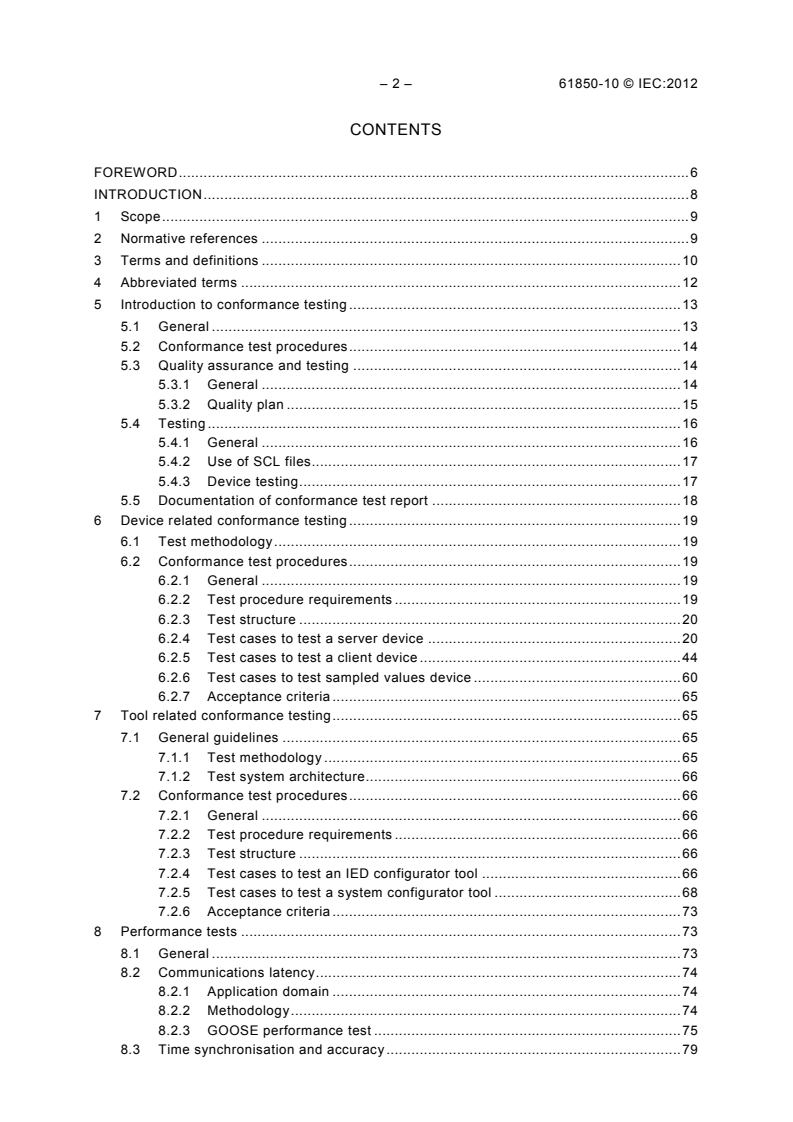
– 2 – 61850-10 © IEC:2012
CONTENTS
FOREWORD . 6
INTRODUCTION . 8
1 Scope . 9
2 Normative references . 9
3 Terms and definitions . 10
4 Abbreviated terms . 12
5 Introduction to conformance testing . 13
5.1 General . 13
5.2 Conformance test procedures . 14
5.3 Quality assurance and testing . 14
5.3.1 General . 14
5.3.2 Quality plan . 15
5.4 Testing . 16
5.4.1 General . 16
5.4.2 Use of SCL files. 17
5.4.3 Device testing . 17
5.5 Documentation of conformance test report . 18
6 Device related conformance testing . 19
6.1 Test methodology . 19
6.2 Conformance test procedures . 19
6.2.1 General . 19
6.2.2 Test procedure requirements . 19
6.2.3 Test structure . 20
6.2.4 Test cases to test a server device . 20
6.2.5 Test cases to test a client device . 44
6.2.6 Test cases to test sampled values device . 60
6.2.7 Acceptance criteria . 65
7 Tool related conformance testing . 65
7.1 General guidelines . 65
7.1.1 Test methodology . 65
7.1.2 Test system architecture . 66
7.2 Conformance test procedures . 66
7.2.1 General . 66
7.2.2 Test procedure requirements . 66
7.2.3 Test structure . 66
7.2.4 Test cases to test an IED configurator tool . 66
7.2.5 Test cases to test a system configurator tool . 68
7.2.6 Acceptance criteria . 73
8 Performance tests . 73
8.1 General . 73
8.2 Communications latency . 74
8.2.1 Application domain . 74
8.2.2 Methodology . 74
8.2.3 GOOSE performance test . 75
8.3 Time synchronisation and accuracy . 79
61850-10 © IEC:2012 – 3 –
8.3.1 Application domain . 79
8.3.2 Methodology . 79
8.3.3 Testing criteria . 80
8.3.4 Performance . 81
9 Additional tests . 81
Annex A (informative) Examples of test procedure template . 82
Bibliography . 83
Figure 1 – Conceptual conformance assessment process . 17
Figure 2 – Test procedure format . 20
Figure 3 – Test system architecture to test a server device . 21
Figure 4 – Test system architecture to test a client device . 44
Figure 5 – Test system architecture to test a sampled values publishing device . 60
Figure 6 – Test system architecture to test a sampled values subscribing device . 61
Figure 7 – Test system architecture to test a configurator tool . 66
Figure 8 – Performance testing (black box principle) . 75
Figure 9 – Measure round trip time using GOOSE ping-pong method . 76
Figure 10 – Time synchronisation and accuracy test setup. 80
Table 1 – Server documentation test cases . 21
Table 2 – Server configuration test cases . 22
Table 3 – Server data model test cases . 22
Table 4 – Association positive test cases . 23
Table 5 – Association negative test cases . 24
Table 6 – Server positive test cases . 24
Table 7 – Server negative test cases . 25
Table 8 – Data set positive test cases . 26
Table 9 – Date set negative test cases . 27
Table 10 – Service tracking test cases . 28
Table 11 – Substitution positive test cases . 28
Table 12 – Setting group positive test cases . 29
Table 13 – Setting group negative test cases . 29
Table 14 – Unbuffered reporting positive test cases . 30
Table 15 – Unbuffered reporting negative test cases . 31
Table 16 – Buffered reporting positive test cases . 32
Table 17 – Buffered reporting negative test cases. 34
Table 18 – Log positive test cases . 35
Table 19 – Log negative test cases . 35
Table 20 – GOOSE publish positive test cases . 36
Table 21 – GOOSE subscribe positive test cases . 37
Table 22 – GOOSE management positive test cases . 37
Table 23 – GOOSE publish negative test cases . 37
Table 24 – GOOSE subscribe negative test cases . 38
Table 25 – GOOSE management negative test cases . 38
– 4 – 61850-10 © IEC:2012
Table 26 – Control test cases . 38
Table 27 – SBOes test cases . 40
Table 28 – DOns test cases . 41
Table 29 – SBOns test cases . 41
Table 30 – DOes test cases . 42
Table 31 – Time positive test cases . 42
Table 32 – Time negative test cases . 43
Table 33 – File transfer positive test cases . 43
Table 34 – File transfer negative test cases . 43
Table 35 – Network redundancy test cases . 44
Table 36 – Client documentation test cases . 45
Table 37 – Client configuration test cases . 45
Table 38 – Client data model test cases. 45
Table 39 – Association positive test cases . 46
Table 40 – Association negative test cases . 47
Table 41 – Server positive test cases. 47
Table 42 – Server negative test cases . 48
Table 43 – Data set positive test cases . 48
Table 44 – Data set negative test cases. 49
Table 45 – Service tracking test cases . 50
Table 46 – Substitution test cases . 50
Table 47 – Setting group positive test cases . 51
Table 48 – Setting group negative test cases . 51
Table 49 – Unbuffered reporting positive test cases . 52
Table 50 – Unbuffered reporting negative test cases . 53
Table 51 – Buffered reporting positive test cases . 53
Table 52 – Buffered reporting negative test cases. 55
Table 53 – Log positive test cases . 55
Table 54 – Log negative test cases . 56
Table 55 – GOOSE control block test cases . 56
Table 56 – Control general test cases . 56
Table 57 – SBOes test cases . 57
Table 58 – DOns test cases . 57
Table 59 – SBOns test cases . 58
Table 60 – DOes test cases . 58
Table 61 – Time positive test cases . 59
Table 62 – Time negative test cases . 59
Table 63 – File transfer positive test cases . 59
Table 64 – File transfer negative test cases . 59
Table 65 – Sampled values documentation test cases . 61
Table 66 – Sampled values configuration test cases . 62
Table 67 – Sampled values datamodel test cases . 62
Table 68 – Sampled value control block test cases . 63
61850-10 © IEC:2012 – 5 –
Table 69 – Send SV message publish test cases . 64
Table 70 – Send SV message subscribe positive test cases . 64
Table 71 – Send SV message subscribe negative test cases . 65
Table 72 – ICD test cases . 67
Table 73 – ICD export test cases . 67
Table 74 – SCD Import test cases . 67
Table 75 – IED configurator data model test cases . 68
Table 76 – IID export test cases . 68
Table 77 – Negative IID export test case . 68
Table 78 – System configurator documentation test case . 68
Table 79 – ICD / IID import test cases. 69
Table 80 – ICD / IID negative test case . 69
Table 81 – Communication engineering test cases. 70
Table 82 – Communication engineering negative test case . 70
Table 83 – Data flow test cases . 70
Table 84 – Data flow negative test cases . 70
Table 85 – Substation section handling test cases . 71
Table 86 – SCD modification test cases . 71
Table 87 – SCD export test cases . 72
Table 88 – SCD import test cases . 72
Table 89 – SED file handling test cases . 73
Table 90 – GOOSE performance test cases . 78
– 6 – 61850-10 © IEC:2012
INTERNATIONAL ELECTROTECHNICAL COMMISSION
____________
COMMUNICATION NETWORKS AND SYSTEMS
FOR POWER UTILITY AUTOMATION –
Part 10: Conformance testing
FOREWORD
1) The International Electrotechnical Commission (IEC) is a worldwide organization for standardization comprising
all national electrotechnical committees (IEC National Committees). The object of IEC is to promote
international co-operation on all questions concerning standardization in the electrical and electronic fields. To
this end and in addition to other activities, IEC publishes International Standards, Technical Specifications,
Technical Reports, Publicly Available Specifications (PAS) and Guides (hereafter referred to as “IEC
Publication(s)”). Their preparation is entrusted to technical committees; any IEC National Committee interested
in the subject dealt with may participate in this preparatory work. International, governmental and non-
governmental organizations liaising with the IEC also participate in this preparation. IEC collaborates closely
with the International Organization for Standardization (ISO) in accordance with conditions determined by
agreement between the two organizations.
2) The formal decisions or agreements of IEC on technical matters express, as nearly as possible, an international
consensus of opinion on the relevant subjects since each technical committee has representation from all
interested IEC National Committees.
3) IEC Publications have the form of recommendations for international use and are accepted by IEC National
Committees in that sense. While all reasonable efforts are made to ensure that the technical content of IEC
Publications is accurate, IEC cannot be held responsible for the way in which they are used or for any
misinterpretation by any end user.
4) In order to promote international uniformity, IEC National Committees undertake to apply IEC Publications
transparently to the maximum extent possible in their national and regional publications. Any divergence
between any IEC Publication and the corresponding national or regional publication shall be clearly indicated in
the latter.
5) IEC itself does not provide any attestation of conformity. Independent certification bodies provide conformity
assessment services and, in some areas, access to IEC marks of conformity. IEC is not responsible for any
services carried out by independent certification bodies.
6) All users should ensure that they have the latest edition of this publication.
7) No liability shall attach to IEC or its directors, employees, servants or agents including individual experts and
members of its technical committees and IEC National Committees for any personal injury, property damage or
other damage of any nature whatsoever, whether direct or indirect, or for costs (including legal fees) and
expenses arising out of the publication, use of, or reliance upon, this IEC Publication or any other IEC
Publications.
8) Attention is drawn to the Normative references cited in this publication. Use of the referenced publications is
indispensable for the correct application of this publication.
9) Attention is drawn to the possibility that some of the elements of this IEC Publication may be the subject of
patent rights. IEC shall not be held responsible for identifying any or all such patent rights.
International Standard IEC 61850-10 has been prepared by IEC technical committee 57:
Power systems management and associated information exchange.
This second edition cancels and replaces the first edition published in 2005. It constitutes a
technical revision.
The major technical changes with regard to the previous edition are as follows:
– server device conformance test procedures have been updated;
– client device conformance test procedures have been added;
– sampled values device conformance test procedures have been added;
– (engineering) tool related conformance test procedures have been added;
– GOOSE performance test procedures have been added.
61850-10 © IEC:2012 – 7 –
The text of this standard is based on the following documents:
FDIS Report on voting
57/1284/FDIS 57/1303/RVD
Full information on the voting for the approval of this standard can be found in the report on
voting indicated in the above table.
This publication has been drafted in accordance with the ISO/IEC Directives, Part 2.
A list of all parts of IEC 61850 series, under the general title Communication networks and
systems for power utility automation, can be found on the IEC website.
The committee has decided that the contents of this publication will remain unchanged until
the stability date indicated on the IEC web site under "http://webstore.iec.ch" in the data
related to the specific publication. At this date, the publication will be
• reconfirmed,
• withdrawn,
• replaced by a revised edition, or
• amended.
IMPORTANT – The 'colour inside' logo on the cover page of this publication indicates
that it contains colours which are considered to be useful for the correct
understanding of its contents. Users should therefore print this document using a
colour printer.
– 8 – 61850-10 © IEC:2012
INTRODUCTION
This part of IEC 61850 is part of a set of specifications which details a layered power utility
communication architecture.
This part of IEC 61850 defines:
• the methods and abstract test cases for conformance testing of client, server and sampled
values devices used in power utility automation systems, and
• the methods and abstract test cases for conformance testing of engineering tools used in
power utility automation systems, and
• the metrics to be measured within devices according to the requirements defined in
IEC 61850-5.
The intended readers are IEC 61850 developers, test engineers and test system developers.
NOTE 1 Tests regarding EMC requirements and environmental conditions are subject to IEC 61850-3 and not
included in this part of IEC 61850.
It is recommended that IEC 61850-5 and IEC 61850-7-1 be read first in conjunction with
IEC 61850-7-2, IEC 61850-7-3, and IEC 61850-7-4.
NOTE 2 Abbreviations used in IEC 61850-10 are listed in Clause 4 or may be found in other parts of IEC 61850
that are relevant for conformance testing.
61850-10 © IEC:2012 – 9 –
COMMUNICATION NETWORKS AND SYSTEMS
FOR POWER UTILITY AUTOMATION –
Part 10: Conformance testing
1 Scope
This part of IEC 61850 specifies standard techniques for testing of conformance of client,
server and sampled value devices and engineering tools, as well as specific measurement
techniques to be applied when declaring performance parameters. The use of these
techniques will enhance the ability of the system integrator to integrate IEDs easily, operate
IEDs correctly, and support the applications as intended.
NOTE The role of the test facilities for conformance testing and certifying the results is beyond the scope of this
part of IEC 61850.
2 Normative references
The following documents, in whole or in part, are normatively referenced in this document and
are indispensable for its application. For dated references, only the edition cited applies. For
undated references, the latest edition of the referenced document (including any
amendments) applies.
IEC 61850-2, Communication networks and systems for power utility automation – Part 2:
Glossary
IEC 61850-3, Communication networks and systems for power utility automation – Part 3:
General requirements
IEC 61850-4:2011, Communication networks and systems for power utility automation –
Part 4: System and project management
IEC 61850-5:2003, Communication networks and systems for power utility automation –
Part 5: Communication requirements for functions and devices models
IEC 61850-6:2009, Communication networks and systems for power utility automation –
Part 6: Configuration description language for communication in electrical substations related
to IEDs
IEC 61850-7-1:2011, Communication networks and systems for power utility automation –
Part 7-1: Basic communication structure – Principles and models
IEC 61850-7-2:2010, Communication networks and systems for power utility automation –
Part 7-2: Basic information and communication structure – Abstract communication service
interface (ACSI)
IEC 61850-7-3:2010, Communication networks and systems for power utility automation –
Part 7-3: Basic communication structure – Common data classes
IEC 61850-7-4:2011, Communication networks and systems for power utility automation –
Part 7-4: Basic communication structure – Compatible logical node classes and data object
classes
– 10 – 61850-10 © IEC:2012
IEC 61850-8-1:2011, Communication networks and systems for power utility automation –
Part 8-1: Specific communication service mapping (SCSM) – Mappings to MMS
(ISO/IEC 9506-1 and ISO/IEC 9506-2) and to ISO/IEC 8802-3
IEC 61850-9-2:2011, Communication networks and systems for power utility automation –
Part 9-2: Specific Communication Service Mapping (SCSM) – Sampled values over
ISO/IEC 8802-3
IEC 62439-3:2012, Industrial communication networks – High availability automation networks
– Part 3: Parallel Redundancy Protocol (PRP) and High Availability Seamless Redundancy
(HSR)
ISO/IEC 9646 (all parts), Information technology – Open Systems Interconnection –
Conformance testing methodology and framework
ISO 9001 (all parts), Quality management systems
ISO 9506 (all parts), Industrial automation systems – Manufacturing Message Specification
IEEE 1588:2008, Standard for a precision clock synchronization protocol for networked
measurement and control systems
3 Terms and definitions
For the purposes of this document, the terms and definitions given in IEC 61850-2 and the
following apply.
3.1
factory acceptance test
FAT
customer-agreed functional tests of the specifically manufactured power utility automation
system or its parts using the parameter set for the planned application as specified in a
specific customer specification
Note 1 to entry: The FAT will be carried out in the factory of the manufacturer or other agreed-upon location by
the use of process simulating test equipment.
3.2
hold point
point, defined in the appropriate document beyond which an activity shall not proceed without
the approval of the initiator of the conformance test
Note 1 to entry: The test facility shall provide a written notice to the initiator at an agreed time prior to the hold
point. The initiator or his representative is obligated to verify the hold point and approve the proceeding of the
activity.
3.3
interoperability
ability of two or more IEDs from the same vendor (or different vendors) to exchange
information and use that information for correct co-operation.
Set of values having defined correspondence with the quantities or values of another set
3.4
model implementation conformance statement
MICS
statement that details the standard data object model elements supported by the system or
device
61850-10 © IEC:2012 – 11 –
3.5
negative test
test to verify the correct response of a system or a device when subjected to:
– IEC 61850 series conformant information and services which are not implemented in the
system or device under test;
– non IEC 61850 series conformant information and services sent to the system or device
under test
3.6
protocol implementation conformance statement
PICS
statement with the summary of the communication capabilities of the system or device to be
tested
3.7
protocol implementation extra Information for testing
PIXIT
statement with system or device specific information regarding the communication capabilities
of the system or device to be tested and which are outside the scope of the IEC 61850 series.
The PIXIT is not subject to standardisation.
3.8
routine test
performed by the manufacturer in order to ensure device operation and safety
3.9
site acceptance test
SAT
verification of each data and control point and the correct functionality within the PUAS and
between the PUAS and its operating environment at the whole installed plant by use of the
final parameter set as specified in a specific customer specification
Note 1 to entry: The SAT is the precondition for the power utility automation system (PUAS) being put into
operation.
3.10
SCL implementation conformance statement
SICS
statement with the summary of the capabilities of the SCL engineering tool
3.11
system related test
verification of correct behaviour of the IEDs and of the overall PUAS under specific
application conditions
Note 1 to entry: The system related test is part of the final stage of the development of IEDs as belonging to a
PUAS-product family.
3.12
test equipment
all tools and instruments which simulate and verify the input/outputs of the operating
environment of the PUAS such as switchgear, transformers, network control centres or
connected telecommunication units on the one side, and the serial links between the IEDs of
the PUAS on the other
3.13
test facility
organisation able to provide appropriate test equipment and trained staff for conformance
testing
– 12 – 61850-10 © IEC:2012
Note 1 to entry: The management of conformance tests and the resulting information should follow a quality
system.
3.14
technical issues conformance statement
TICS
statement with device specific information regarding the implemented technical issues
detected after publication of the standard. The TICS is not subject to standardisation.
3.15
type test
verification of correct behaviour of the IEDs of the PUAS by use of the system tested software
under the test conditions corresponding with the technical data
Note 1 to entry: The type test marks the final stage of the hardware development and is the precondition for the
start of the production. This test is carried out with IEDs, which have been manufactured through the normal
production cycle.
3.16
witness point
point, defined in the appropriate document, at which an inspection will take place on an
activity
Note 1 to entry: The activity may proceed without the approval of the initiator of the conformance test. The test
facility provides a written notice to the initiator at an agreed time prior to the witness point. The initiator or his
representative has the right, but is not obligated, to verify the witness point.
4 Abbreviated terms
ACSI abstract communication service interface
BRCB buffered report control block
CDC common data class
DUT device under test
FAT factory acceptance test
GI general interrogation
GoCB GOOSE control block
GOOSE generic object oriented substation events
HMI human machine interface
HSR high availability seamless ring
ICD IED capability description
IED intelligent electronic device
IID instantiated IED description
IP internet protocol
LCB log control block
LD logical device
LN logical node
MICS model implementation conformance statement
MMS manufacturing message specification (ISO 9506 series)
MSVCB multicast sampled value control block
PICS protocol implementation conformance statement
PIXIT protocol implementation extra information for testing
PPS pulse per second
61850-10 © IEC:2012 – 13 –
PRP parallel redundancy protocol
PUAS power utility automation system
SAT site acceptance test
SAV sampled analogue values (IEC 61850-9-2)
SCD substation configuration description
SCL substation configuration language
SCSM specific communication service mapping
SGCB setting group control block
SICS SCL implementation conformance statement
SNTP simple network time protocol
SSD system specification description
SV sampled values
SVCB sampled values control block
TCP transport control protocol
TICS technical issues conformance statement
TPAA two party application association
TUT tool under test
URCB unbuffered report control block
USVCB unicast sampled values control block
UTC coordinated universal time
XML extensible markup language
5 Introduction to conformance testing
5.1 General
There are many steps involved from the development and production of a device to the proper
running of a complete system designed according the specific needs of a customer. Suitable
test steps are incorporated in this process.
The quality system of the producer/supplier forms the basis of reliable testing in development
and production activities.
Many internal tests during the development of a device (or a system kit) result in a type test
(unit level test) performed at least by the provider and – if required by applicable standards –
by an independent test authority. In the context of this standard, the term type test is
restricted to the functional behaviour of the device.
Continuing routine tests in the production chain are necessary to ensure a constant quality of
delivered devices in accordance with the quality procedures of the producer.
A conformance test is the type test for communication and – since communication establishes
a system – the system related test of the incorporated IEDs. As a global communications
standard, the IEC 61850 series includes standardised conformance tests to ensure that all
suppliers comply with applicable requirements.
Type tests and conformance tests do not completely guarantee that all functional and
performance requirements are met. However, when properly performed, such tests
– 14 – 61850-10 © IEC:2012
significantly reduce the risk of costly problems occurring during system integration in the
factory and on-site.
Conformance testing does not replace project specific system related tests such as the FAT
and SAT. The FAT and SAT are based on specific customer requirements for a dedicated
power utility automation system and are done by the system integrator and normally
witnessed by the customer. These tests increase the confidence level that all potential
problems in the system have been identified and solved. These tests establish that the
delivered power utility automation system is performing as specified.
5.2 Conformance test procedures
In general, conformance testing of the communication behaviour of an IED should address the
functional requirements and performance requirements of typical applications supported by
these devices in a PUAS. IEC 61850-4 defines a general classification of quality tests, which
are used within this part.
Conformance testing demonstrates the capability of the DUT to operate with other IEDs in a
specified way according to the IEC 61850 series.
Conformance testing requires consideration of the following issues:
– The problem of all testing is the completeness of the tests. The number of all possible
situations can be very large. It may be possible to cover all normal operating cases, but
this may not be true for all failure cases.
– It is impossible to test all system configurations using IEDs from different world-wide
suppliers. Therefore, a standardized test architecture with device simulators should be
used. The use of such a test architecture implies agreement about its configuration and
the test procedures applied in order to achieve compatible and reproducible results.
– A communication standard does not standardise the functions of the communicating
equipment. Therefore, the failure modes of the functions are outside the scope of this part
of the IEC 61850 series. But both, the existence of distributed functions and the impact of
function response in devices on the data flow create some interdependence.
– Depending on the definition range of the standard, some properties of the device may be
proven by information and documents provided with the DUT for the conformance testing
instead of the conformance test itself.
The conformance test establishes that the communication of the DUT works according the
IEC 61850 series. The IEC 61850 series is focussed on
...