

IEC 62969-1:2017
(Main)Semiconductor devices - Semiconductor interface for automotive vehicles - Part 1: General requirements of power interface for automotive vehicle sensors
General Information
- Abstract
IEC 62969-1:2017 provides general requirements for performance evaluations and environmental conditions for the power interface of automotive vehicle sensors. For performance evaluations, various electrical performances such as voltage drop from power source to automotive sensors, AC noises and voltage level are included. For environmental conditions, various test conditions such as temperature, humidity and vibration are included. In addition, terms, definitions, symbols and configurations are covered in this part.
- Status
- Published
- Publication Date
- 12-Dec-2017
- Technical Committee
- TC 47 - Semiconductor devices
- Drafting Committee
- WG 6 - TC 47/WG 6
- Current Stage
- PPUB - Publication issued
- Start Date
- 13-Dec-2017
- Completion Date
- 12-Jan-2018
Buy Documents
IEC 62969-1:2017 - Semiconductor devices - Semiconductor interface for automotive vehicles - Part 1: General requirements of power interface for automotive vehicle sensors Released:12/13/2017
IEC 62969-1:2017 - Semiconductor devices - Semiconductor interface for automotive vehicles - Part 1: General requirements of power interface for automotive vehicle sensors Released:12/13/2017
Overview
IEC 62969-1:2017 defines general requirements for the power interface of automotive vehicle sensors. It specifies performance evaluation items and environmental test conditions to ensure reliable power delivery from vehicle power sources to sensors. The standard also includes terms, definitions, symbols and typical configurations for sensor power interfaces, and describes test setups and checking items for validating electrical and environmental performance.
Keywords: IEC 62969-1, automotive sensors, power interface, sensor power supply, performance evaluation
Key Topics
- Electrical performance requirements
- Input voltage level and acceptable ranges for sensor power lines
- Assessment of voltage drop from the vehicle power source to sensors
- Measurement and evaluation of AC noise and other electrical disturbances on sensor supply
- Identification of main error sources affecting sensor power integrity
- Environmental conditions and testing
- Temperature range, humidity, damp heat and temperature cycling test conditions
- Mechanical stress conditions such as vibration and impact
- EMC (electromagnetic compatibility) test considerations for sensor power interfaces
- Protection and ingress ratings (IP ratings) for sensor enclosures
- System architecture and configurations
- Power supply chain models to sensors and classification of sensor types and power sources
- Consideration of redundancy in power interfaces and monitoring/reset mechanisms
- Test setups and procedures
- Recommended test setups for measuring input voltage, noise, and voltage drop
- Cross-references to normative measurement methods and EMC/EMI test standards
Keywords: voltage drop, AC noise, vibration testing, IP ratings, EMC, redundancy
Applications and Users
IEC 62969-1 is practical for organizations involved in the design, validation and deployment of sensor power systems in vehicles:
- Automotive OEMs and Tier‑1 suppliers defining sensor power requirements
- Sensor manufacturers and semiconductor device designers specifying input power tolerance and immunity
- Test laboratories and reliability engineers executing environmental and EMC qualification
- Quality and compliance teams ensuring product conformity with automotive power-interface expectations
Typical uses: designing robust sensor power chains, specifying test plans for environmental and electrical validation, assessing failure modes related to supply noise and voltage degradation.
Keywords: automotive OEM, sensor validation, test laboratory, reliability testing
Related Standards
- Other parts of the IEC 62969 series: Part 2 (wireless power transmission efficiency), Part 3 (piezoelectric energy harvesting), Part 4 (data interface evaluation)
- Normative references cited in IEC 62969-1 include environmental and EMC standards such as IEC 60068 (environmental testing), IEC 60529 (IP Code), IEC 61967 / IEC 62132 series (EM emissions and immunity)
Using IEC 62969-1 helps harmonize power-interface testing and specification across the automotive supply chain, improving sensor reliability under real-world electrical and environmental stresses.
Buy Documents
IEC 62969-1:2017 - Semiconductor devices - Semiconductor interface for automotive vehicles - Part 1: General requirements of power interface for automotive vehicle sensors Released:12/13/2017
IEC 62969-1:2017 - Semiconductor devices - Semiconductor interface for automotive vehicles - Part 1: General requirements of power interface for automotive vehicle sensors Released:12/13/2017
Frequently Asked Questions
IEC 62969-1:2017 is a standard published by the International Electrotechnical Commission (IEC). Its full title is "Semiconductor devices - Semiconductor interface for automotive vehicles - Part 1: General requirements of power interface for automotive vehicle sensors". This standard covers: IEC 62969-1:2017 provides general requirements for performance evaluations and environmental conditions for the power interface of automotive vehicle sensors. For performance evaluations, various electrical performances such as voltage drop from power source to automotive sensors, AC noises and voltage level are included. For environmental conditions, various test conditions such as temperature, humidity and vibration are included. In addition, terms, definitions, symbols and configurations are covered in this part.
IEC 62969-1:2017 provides general requirements for performance evaluations and environmental conditions for the power interface of automotive vehicle sensors. For performance evaluations, various electrical performances such as voltage drop from power source to automotive sensors, AC noises and voltage level are included. For environmental conditions, various test conditions such as temperature, humidity and vibration are included. In addition, terms, definitions, symbols and configurations are covered in this part.
IEC 62969-1:2017 is classified under the following ICS (International Classification for Standards) categories: 01.040.31 - Electronics (Vocabularies); 31.080.99 - Other semiconductor devices. The ICS classification helps identify the subject area and facilitates finding related standards.
IEC 62969-1:2017 is available in PDF format for immediate download after purchase. The document can be added to your cart and obtained through the secure checkout process. Digital delivery ensures instant access to the complete standard document.
Standards Content (Sample)
IEC 62969-1 ®
Edition 1.0 2017-12
INTERNATIONAL
STANDARD
colour
inside
Semiconductor devices – Semiconductor interface for automotive vehicles –
Part 1: General requirements of power interface for automotive vehicle sensors
All rights reserved. Unless otherwise specified, no part of this publication may be reproduced or utilized in any form
or by any means, electronic or mechanical, including photocopying and microfilm, without permission in writing from
either IEC or IEC's member National Committee in the country of the requester. If you have any questions about IEC
copyright or have an enquiry about obtaining additional rights to this publication, please contact the address below or
your local IEC member National Committee for further information.
IEC Central Office Tel.: +41 22 919 02 11
3, rue de Varembé Fax: +41 22 919 03 00
CH-1211 Geneva 20 info@iec.ch
Switzerland www.iec.ch
About the IEC
The International Electrotechnical Commission (IEC) is the leading global organization that prepares and publishes
International Standards for all electrical, electronic and related technologies.
About IEC publications
The technical content of IEC publications is kept under constant review by the IEC. Please make sure that you have the
latest edition, a corrigenda or an amendment might have been published.
IEC Catalogue - webstore.iec.ch/catalogue Electropedia - www.electropedia.org
The stand-alone application for consulting the entire The world's leading online dictionary of electronic and
bibliographical information on IEC International Standards, electrical terms containing 20 000 terms and definitions in
Technical Specifications, Technical Reports and other English and French, with equivalent terms in 16 additional
documents. Available for PC, Mac OS, Android Tablets and languages. Also known as the International Electrotechnical
iPad. Vocabulary (IEV) online.
IEC publications search - www.iec.ch/searchpub IEC Glossary - std.iec.ch/glossary
The advanced search enables to find IEC publications by a 65 000 electrotechnical terminology entries in English and
variety of criteria (reference number, text, technical French extracted from the Terms and Definitions clause of
committee,…). It also gives information on projects, replaced IEC publications issued since 2002. Some entries have been
and withdrawn publications. collected from earlier publications of IEC TC 37, 77, 86 and
CISPR.
IEC Just Published - webstore.iec.ch/justpublished
Stay up to date on all new IEC publications. Just Published IEC Customer Service Centre - webstore.iec.ch/csc
details all new publications released. Available online and If you wish to give us your feedback on this publication or
also once a month by email. need further assistance, please contact the Customer Service
Centre: csc@iec.ch.
IEC 62969-1 ®
Edition 1.0 2017-12
INTERNATIONAL
STANDARD
colour
inside
Semiconductor devices – Semiconductor interface for automotive vehicles –
Part 1: General requirements of power interface for automotive vehicle sensors
INTERNATIONAL
ELECTROTECHNICAL
COMMISSION
ICS 31.080.99 ISBN 978-2-8322-5147-8
– 2 – IEC 62969-1:2017 © IEC 2017
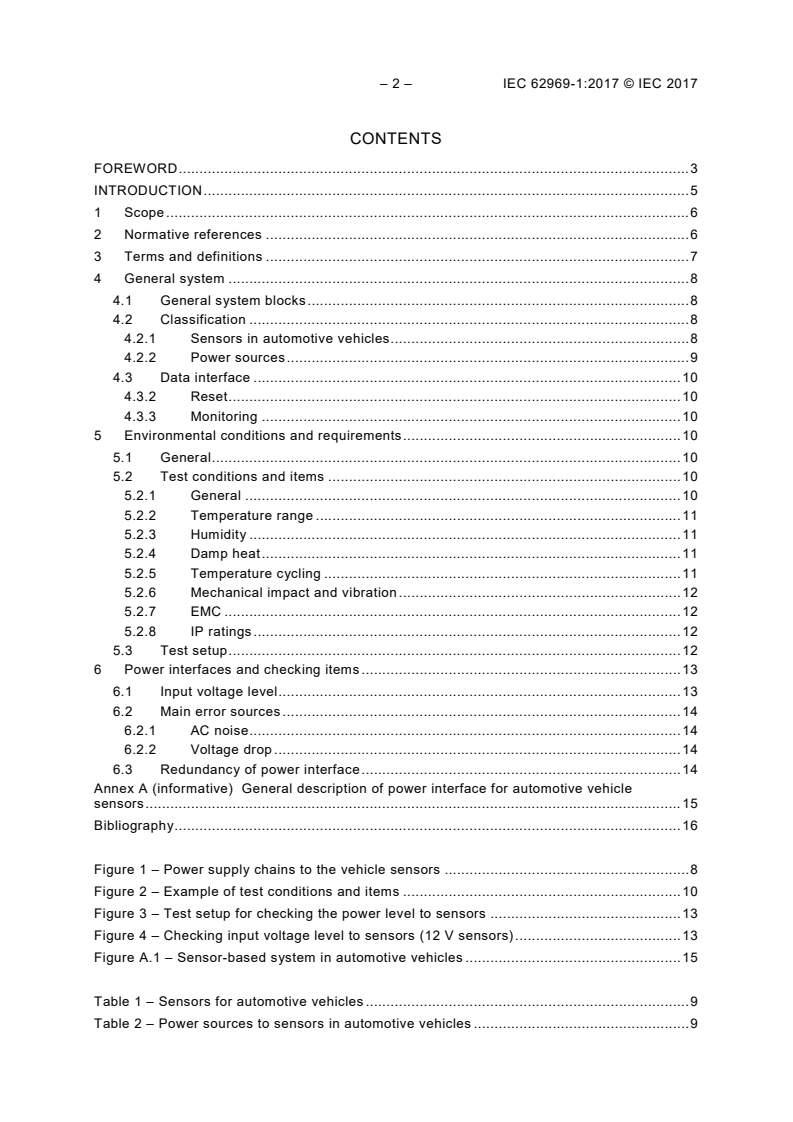
CONTENTS
FOREWORD . 3
INTRODUCTION . 5
1 Scope . 6
2 Normative references . 6
3 Terms and definitions . 7
4 General system . 8
4.1 General system blocks . 8
4.2 Classification . 8
4.2.1 Sensors in automotive vehicles . 8
4.2.2 Power sources . 9
4.3 Data interface . 10
4.3.2 Reset . 10
4.3.3 Monitoring . 10
5 Environmental conditions and requirements . 10
5.1 General . 10
5.2 Test conditions and items . 10
5.2.1 General . 10
5.2.2 Temperature range . 11
5.2.3 Humidity . 11
5.2.4 Damp heat . 11
5.2.5 Temperature cycling . 11
5.2.6 Mechanical impact and vibration . 12
5.2.7 EMC . 12
5.2.8 IP ratings . 12
5.3 Test setup . 12
6 Power interfaces and checking items . 13
6.1 Input voltage level . 13
6.2 Main error sources . 14
6.2.1 AC noise . 14
6.2.2 Voltage drop . 14
6.3 Redundancy of power interface . 14
Annex A (informative) General description of power interface for automotive vehicle
sensors . 15
Bibliography . 16
Figure 1 – Power supply chains to the vehicle sensors . 8
Figure 2 – Example of test conditions and items . 10
Figure 3 – Test setup for checking the power level to sensors . 13
Figure 4 – Checking input voltage level to sensors (12 V sensors) . 13
Figure A.1 – Sensor-based system in automotive vehicles . 15
Table 1 – Sensors for automotive vehicles . 9
Table 2 – Power sources to sensors in automotive vehicles . 9
INTERNATIONAL ELECTROTECHNICAL COMMISSION
____________
SEMICONDUCTOR DEVICES –
SEMICONDUCTOR INTERFACE FOR AUTOMOTIVE VEHICLES –
Part 1: General requirements of power interface
for automotive vehicle sensors
FOREWORD
1) The International Electrotechnical Commission (IEC) is a worldwide organization for standardization comprising
all national electrotechnical committees (IEC National Committees). The object of IEC is to promote
international co-operation on all questions concerning standardization in the electrical and electronic fields. To
this end and in addition to other activities, IEC publishes International Standards, Technical Specifications,
Technical Reports, Publicly Available Specifications (PAS) and Guides (hereafter referred to as “IEC
Publication(s)”). Their preparation is entrusted to technical committees; any IEC National Committee interested
in the subject dealt with may participate in this preparatory work. International, governmental and non-
governmental organizations liaising with the IEC also participate in this preparation. IEC collaborates closely
with the International Organization for Standardization (ISO) in accordance with conditions determined by
agreement between the two organizations.
2) The formal decisions or agreements of IEC on technical matters express, as nearly as possible, an international
consensus of opinion on the relevant subjects since each technical committee has representation from all
interested IEC National Committees.
3) IEC Publications have the form of recommendations for international use and are accepted by IEC National
Committees in that sense. While all reasonable efforts are made to ensure that the technical content of IEC
Publications is accurate, IEC cannot be held responsible for the way in which they are used or for any
misinterpretation by any end user.
4) In order to promote international uniformity, IEC National Committees undertake to apply IEC Publications
transparently to the maximum extent possible in their national and regional publications. Any divergence
between any IEC Publication and the corresponding national or regional publication shall be clearly indicated in
the latter.
5) IEC itself does not provide any attestation of conformity. Independent certification bodies provide conformity
assessment services and, in some areas, access to IEC marks of conformity. IEC is not responsible for any
services carried out by independent certification bodies.
6) All users should ensure that they have the latest edition of this publication.
7) No liability shall attach to IEC or its directors, employees, servants or agents including individual experts and
members of its technical committees and IEC National Committees for any personal injury, property damage or
other damage of any nature whatsoever, whether direct or indirect, or for costs (including legal fees) and
expenses arising out of the publication, use of, or reliance upon, this IEC Publication or any other IEC
Publications.
8) Attention is drawn to the Normative references cited in this publication. Use of the referenced publications is
indispensable for the correct application of this publication.
9) Attention is drawn to the possibility that some of the elements of this IEC Publication may be the subject of
patent rights. IEC shall not be held responsible for identifying any or all such patent rights.
International Standard IEC 62969-1 has been prepared by IEC technical committee 47:
Semiconductor devices.
The text of this International Standard is based on the following documents:
FDIS Report on voting
47/2433/FDIS 47/2447/RVD
Full information on the voting for the approval of this International Standard can be found in
the report on voting indicated in the above table.
This document has been drafted in accordance with the ISO/IEC Directives, Part 2.
– 4 – IEC 62969-1:2017 © IEC 2017
A list of all the parts in the IEC 62969 series, published under the general title Semiconductor
devices – Semiconductor interface for automotive vehicles, can be found on the IEC website.
The committee has decided that the contents of this document will remain unchanged until the
stability date indicated on the IEC website under "http://webstore.iec.ch" in the data related to
the specific document. At this date, the document will be
• reconfirmed,
• withdrawn,
• replaced by a revised edition, or
• amended.
A bilingual version of this publication may be issued at a later date.
IMPORTANT – The 'colour inside' logo on the cover page of this publication indicates
that it contains colours which are considered to be useful for the correct
understanding of its contents. Users should therefore print this document using a
colour printer.
INTRODUCTION
The IEC 62969 series is composed of four parts as follows:
• IEC 62969-1, Semiconductor devices – Semiconductor interface for automotive vehicles –
Part 1: General requirements of power interface for automotive vehicle sensors
• IEC 62969-2, Semiconductor devices – Semiconductor interface for automotive vehicles –
Part 2: Efficiency evaluation methods of wireless power transmission using resonance for
automotive vehicle sensors
• IEC 62969-3, Semiconductor devices – Semiconductor interface for automotive vehicles –
Part 3: Shock driven piezoelectric energy harvesting for automotive vehicle sensors
• IEC 62969-4, Semiconductor devices – Semiconductor interface for automotive vehicles –
Part 4: Evaluation methods of data interface for automotive vehicle sensors
The IEC 62969 series covers power and data interfaces for sensors in automotive vehicles.
The first part covers general requirements of test conditions such as temperature, humidity,
vibration, etc. for automotive sensor power interface. This part also includes various electrical
performances of power interface such as voltage drop from power source to automotive
sensors, noises, voltage level, etc. The second part covers “Efficiency evaluation methods of
wireless power transmission using resonance for automotive vehicle sensors “. The third part
covers “Shock driven piezoelectric energy harvesting for automotive vehicle sensors”. The
fourth part covers “Evaluation methods of data interface for automotive vehicle sensors”.
– 6 – IEC 62969-1:2017 © IEC 2017
SEMICONDUCTOR DEVICES –
SEMICONDUCTOR INTERFACE FOR AUTOMOTIVE VEHICLES –
Part 1: General requirements of power interface
for automotive vehicle sensors
1 Scope
This part of IEC 62969 provides general requirements for performance evaluations and
environmental conditions for the power interface of automotive vehicle sensors. For
performance evaluations, various electrical performances such as voltage drop from power
source to automotive sensors, AC noises and voltage level are included. For environmental
conditions, various test conditions such as temperature, humidity and vibration are included.
In addition, terms, definitions, symbols and configurations are covered in this part.
NOTE Additional information on power interface for automotive vehicle sensors is provided in Annex A.
2 Normative references
The following documents are referred to in the text in such a way that some or all of their
content constitutes requirements of this document. For dated references, only the edition
cited applies. For undated references, the latest edition of the referenced document (including
any amendments) applies.
IEC 60068-2-1, Environmental testing – Part 2-1: Tests – Test A: Cold
IEC 60068-2-2, Environmental testing – Part 2-2: Tests – Test B: Dry heat
IEC 6
...
IEC 62969-1 ®
Edition 1.0 2017-12
INTERNATIONAL
STANDARD
NORME
INTERNATIONALE
colour
inside
Semiconductor devices – Semiconductor interface for automotive vehicles –
Part 1: General requirements of power interface for automotive vehicle sensors
Dispositifs à semiconducteurs – Interface à semiconducteurs pour les véhicules
automobiles –
Partie 1: Exigences générales de l’interface d’alimentation destinée aux capteurs
de véhicules automobiles
All rights reserved. Unless otherwise specified, no part of this publication may be reproduced or utilized in any form
or by any means, electronic or mechanical, including photocopying and microfilm, without permission in writing from
either IEC or IEC's member National Committee in the country of the requester. If you have any questions about IEC
copyright or have an enquiry about obtaining additional rights to this publication, please contact the address below or
your local IEC member National Committee for further information.
Droits de reproduction réservés. Sauf indication contraire, aucune partie de cette publication ne peut être reproduite
ni utilisée sous quelque forme que ce soit et par aucun procédé, électronique ou mécanique, y compris la photocopie
et les microfilms, sans l'accord écrit de l'IEC ou du Comité national de l'IEC du pays du demandeur. Si vous avez des
questions sur le copyright de l'IEC ou si vous désirez obtenir des droits supplémentaires sur cette publication, utilisez
les coordonnées ci-après ou contactez le Comité national de l'IEC de votre pays de résidence.
IEC Central Office Tel.: +41 22 919 02 11
3, rue de Varembé info@iec.ch
CH-1211 Geneva 20 www.iec.ch
Switzerland
About the IEC
The International Electrotechnical Commission (IEC) is the leading global organization that prepares and publishes
International Standards for all electrical, electronic and related technologies.
About IEC publications
The technical content of IEC publications is kept under constant review by the IEC. Please make sure that you have the
latest edition, a corrigenda or an amendment might have been published.
IEC Catalogue - webstore.iec.ch/catalogue Electropedia - www.electropedia.org
The stand-alone application for consulting the entire The world's leading online dictionary of electronic and
bibliographical information on IEC International Standards, electrical terms containing 21 000 terms and definitions in
Technical Specifications, Technical Reports and other English and French, with equivalent terms in 16 additional
documents. Available for PC, Mac OS, Android Tablets and languages. Also known as the International Electrotechnical
iPad. Vocabulary (IEV) online.
IEC publications search - webstore.iec.ch/advsearchform IEC Glossary - std.iec.ch/glossary
The advanced search enables to find IEC publications by a 67 000 electrotechnical terminology entries in English and
variety of criteria (reference number, text, technical French extracted from the Terms and Definitions clause of
committee,…). It also gives information on projects, replaced IEC publications issued since 2002. Some entries have been
and withdrawn publications. collected from earlier publications of IEC TC 37, 77, 86 and
CISPR.
IEC Just Published - webstore.iec.ch/justpublished
Stay up to date on all new IEC publications. Just Published IEC Customer Service Centre - webstore.iec.ch/csc
details all new publications released. Available online and If you wish to give us your feedback on this publication or
also once a month by email. need further assistance, please contact the Customer Service
Centre: sales@iec.ch.
A propos de l'IEC
La Commission Electrotechnique Internationale (IEC) est la première organisation mondiale qui élabore et publie des
Normes internationales pour tout ce qui a trait à l'électricité, à l'électronique et aux technologies apparentées.
A propos des publications IEC
Le contenu technique des publications IEC est constamment revu. Veuillez vous assurer que vous possédez l’édition la
plus récente, un corrigendum ou amendement peut avoir été publié.
Catalogue IEC - webstore.iec.ch/catalogue Electropedia - www.electropedia.org
Application autonome pour consulter tous les renseignements
Le premier dictionnaire en ligne de termes électroniques et
bibliographiques sur les Normes internationales,
électriques. Il contient 21 000 termes et définitions en anglais
Spécifications techniques, Rapports techniques et autres
et en français, ainsi que les termes équivalents dans 16
documents de l'IEC. Disponible pour PC, Mac OS, tablettes
langues additionnelles. Egalement appelé Vocabulaire
Android et iPad.
Electrotechnique International (IEV) en ligne.
Recherche de publications IEC -
Glossaire IEC - std.iec.ch/glossary
webstore.iec.ch/advsearchform
67 000 entrées terminologiques électrotechniques, en anglais
La recherche avancée permet de trouver des publications IEC et en français, extraites des articles Termes et Définitions des
en utilisant différents critères (numéro de référence, texte, publications IEC parues depuis 2002. Plus certaines entrées
comité d’études,…). Elle donne aussi des informations sur les antérieures extraites des publications des CE 37, 77, 86 et
projets et les publications remplacées ou retirées. CISPR de l'IEC.
IEC Just Published - webstore.iec.ch/justpublished Service Clients - webstore.iec.ch/csc
Restez informé sur les nouvelles publications IEC. Just Si vous désirez nous donner des commentaires sur cette
Published détaille les nouvelles publications parues. publication ou si vous avez des questions contactez-nous:
Disponible en ligne et aussi une fois par mois par email. sales@iec.ch.
IEC 62969-1 ®
Edition 1.0 2017-12
INTERNATIONAL
STANDARD
NORME
INTERNATIONALE
colour
inside
Semiconductor devices – Semiconductor interface for automotive vehicles –
Part 1: General requirements of power interface for automotive vehicle sensors
Dispositifs à semiconducteurs – Interface à semiconducteurs pour les véhicules
automobiles –
Partie 1: Exigences générales de l’interface d’alimentation destinée aux capteurs
de véhicules automobiles
INTERNATIONAL
ELECTROTECHNICAL
COMMISSION
COMMISSION
ELECTROTECHNIQUE
INTERNATIONALE
ICS 31.080.99 ISBN 978-2-8322-5272-7
– 2 – IEC 62969-1:2017 © IEC 2017
CONTENTS
FOREWORD . 3
INTRODUCTION . 5
1 Scope . 6
2 Normative references . 6
3 Terms and definitions . 7
4 General system . 8
4.1 General system blocks . 8
4.2 Classification . 8
4.2.1 Sensors in automotive vehicles . 8
4.2.2 Power sources . 9
4.3 Data interface . 10
4.3.2 Reset . 10
4.3.3 Monitoring . 10
5 Environmental conditions and requirements . 10
5.1 General . 10
5.2 Test conditions and items . 10
5.2.1 General . 10
5.2.2 Temperature range . 11
5.2.3 Humidity . 11
5.2.4 Damp heat . 11
5.2.5 Temperature cycling . 11
5.2.6 Mechanical impact and vibration . 12
5.2.7 EMC . 12
5.2.8 IP ratings . 12
5.3 Test setup . 12
6 Power interfaces and checking items . 13
6.1 Input voltage level . 13
6.2 Main error sources . 14
6.2.1 AC noise . 14
6.2.2 Voltage drop . 14
6.3 Redundancy of power interface . 14
Annex A (informative) General description of power interface for automotive vehicle
sensors . 15
Bibliography . 16
Figure 1 – Power supply chains to the vehicle sensors . 8
Figure 2 – Example of test conditions and items . 10
Figure 3 – Test setup for checking the power level to sensors . 13
Figure 4 – Checking input voltage level to sensors (12 V sensors) . 13
Figure A.1 – Sensor-based system in automotive vehicles . 15
Table 1 – Sensors for automotive vehicles . 9
Table 2 – Power sources to sensors in automotive vehicles . 9
INTERNATIONAL ELECTROTECHNICAL COMMISSION
____________
SEMICONDUCTOR DEVICES –
SEMICONDUCTOR INTERFACE FOR AUTOMOTIVE VEHICLES –
Part 1: General requirements of power interface
for automotive vehicle sensors
FOREWORD
1) The International Electrotechnical Commission (IEC) is a worldwide organization for standardization comprising
all national electrotechnical committees (IEC National Committees). The object of IEC is to promote
international co-operation on all questions concerning standardization in the electrical and electronic fields. To
this end and in addition to other activities, IEC publishes International Standards, Technical Specifications,
Technical Reports, Publicly Available Specifications (PAS) and Guides (hereafter referred to as “IEC
Publication(s)”). Their preparation is entrusted to technical committees; any IEC National Committee interested
in the subject dealt with may participate in this preparatory work. International, governmental and non-
governmental organizations liaising with the IEC also participate in this preparation. IEC collaborates closely
with the International Organization for Standardization (ISO) in accordance with conditions determined by
agreement between the two organizations.
2) The formal decisions or agreements of IEC on technical matters express, as nearly as possible, an international
consensus of opinion on the relevant subjects since each technical committee has representation from all
interested IEC National Committees.
3) IEC Publications have the form of recommendations for international use and are accepted by IEC National
Committees in that sense. While all reasonable efforts are made to ensure that the technical content of IEC
Publications is accurate, IEC cannot be held responsible for the way in which they are used or for any
misinterpretation by any end user.
4) In order to promote international uniformity, IEC National Committees undertake to apply IEC Publications
transparently to the maximum extent possible in their national and regional publications. Any divergence
between any IEC Publication and the corresponding national or regional publication shall be clearly indicated in
the latter.
5) IEC itself does not provide any attestation of conformity. Independent certification bodies provide conformity
assessment services and, in some areas, access to IEC marks of conformity. IEC is not responsible for any
services carried out by independent certification bodies.
6) All users should ensure that they have the latest edition of this publication.
7) No liability shall attach to IEC or its directors, employees, servants or agents including individual experts and
members of its technical committees and IEC National Committees for any personal injury, property damage or
other damage of any nature whatsoever, whether direct or indirect, or for costs (including legal fees) and
expenses arising out of the publication, use of, or reliance upon, this IEC Publication or any other IEC
Publications.
8) Attention is drawn to the Normative references cited in this publication. Use of the referenced publications is
indispensable for the correct application of this publication.
9) Attention is drawn to the possibility that some of the elements of this IEC Publication may be the subject of
patent rights. IEC shall not be held responsible for identifying any or all such patent rights.
International Standard IEC 62969-1 has been prepared by IEC technical committee 47:
Semiconductor devices.
This bilingual version (2018-01) corresponds to the monolingual English version, published in
2017-12.
The text of this International Standard is based on the following documents:
FDIS Report on voting
47/2433/FDIS 47/2447/RVD
Full information on the voting for the approval of this International Standard can be found in
the report on voting indicated in the above table.
– 4 – IEC 62969-1:2017 © IEC 2017
The French version of this standard has not been voted upon.
This document has been drafted in accordance with the ISO/IEC Directives, Part 2.
A list of all the parts in the IEC 62969 series, published under the general title Semiconductor
devices – Semiconductor interface for automotive vehicles, can be found on the IEC website.
The committee has decided that the contents of this document will remain unchanged until the
stability date indicated on the IEC website under "http://webstore.iec.ch" in the data related to
the specific document. At this date, the document will be
• reconfirmed,
• withdrawn,
• replaced by a revised edition, or
• amended.
IMPORTANT – The 'colour inside' logo on the cover page of this publication indicates
that it contains colours which are considered to be useful for the correct
understanding of its contents. Users should therefore print this document using a
colour printer.
INTRODUCTION
The IEC 62969 series is composed of four parts as follows:
• IEC 62969-1, Semiconductor devices – Semiconductor interface for automotive vehicles –
Part 1: General requirements of power interface for automotive vehicle sensors
• IEC 62969-2, Semiconductor devices – Semiconductor interface for automotive vehicles –
Part 2: Efficiency evaluation methods of wireless power transmission using resonance for
automotive vehicle sensors
• IEC 62969-3, Semiconductor devices – Semiconductor interface for automotive vehicles –
Part 3: Shock driven piezoelectric energy harvesting for automotive vehicle sensors
• IEC 62969-4, Semiconductor devices – Semiconductor interface for automotive vehicles –
Part 4: Evaluation methods of data interface for automotive vehicle sensors
The IEC 62969 series covers power and data interfaces for sensors in automotive vehicles.
The first part covers general requirements of test conditions such as temperature, humidity,
vibration, etc. for automotive sensor power interface. This part also includes various electrical
performances of power interface such as voltage drop from power source to automotive
sensors, noises, voltage level, etc. The second part covers “Efficiency evaluation methods of
wireless power transmission using resonance for automotive vehicle sensors “. The third part
covers “Shock driven piezoelectric energy harvesting for automotive vehicle sensors”. The
fourth part covers “Evaluation methods of data interface for automotive vehicle sensors”.
– 6 – IEC 62969-1:2017 © IEC 2017
SEMICONDUCTOR DEVICES –
SEMICONDUCTOR INTERFACE FOR AUTOMOTIVE VEHICLES –
Part 1: General requirements of power interface
for automotive vehicle sensors
1 Scope
This part of IEC 62969 provides general requirements for performance evaluations and
environmental conditions for the power interface of automotive vehicle sensors. For
performance evaluations, various electrical performances such as voltage drop from power
source to automotive sensors, AC noises and voltage level are included. For environmental
conditions, various test conditions such as temperature, humidity and vibration are included.
In addition, terms, definitions, symbols and configurations are covered in this part.
NOTE Additional information on power interface for automotive vehicle sensors is provided in Annex A.
2 Normative references
The following documents are referred to in the text in such a way that some or all of their
content constitutes requirements of this document. For dated references, only the edition
cited applies. For undated references, the latest edition of the referenced document (including
any amendments) applies.
IEC 60068-2-1, Environmental testing – Part 2-1: Tests – Test A: Cold
IEC 60068-2-2, Environmental testing – Part 2-2: Tests – Test B: Dry heat
IEC 60068-2-14, Environmental testing – Part 2-14: Tests – Test N: Change of temperature
IEC 60068-2-30, Environmental testing – Part 2-30: Tests – Test Db: Damp heat, cyclic
(12 h + 12 h cycle)
IEC 60529, Degrees of protection provided by enclosures (IP Code)
IEC 60721 (all parts), Classification of environmental conditions
IEC 60749-10, Semiconductor devices – Mechanical and climatic test methods – Part 10:
Mechanical shock
IEC 60749-12, Semiconductor devices – Mechanical and climatic test methods – Part 12:
Vibration, variable frequency
IEC 61851-1, Electric vehicle conductive charging system – Part 1: General requirements
IEC 61967-1, Integrated circuits – Measurement of electromagnetic emissions, 150 kHz to
1 GHz – Part 1: General conditions and definitions
IEC 61967-2, Integrated circuits – Measurement of electromagnetic emissions, 150 kHz to
1 GHz – Part 2: Measurement of radiated emissions – TEM cell and wideband TEM cell
method
IEC TS 61967-3, Integrated circuits – Measurement of electromagnetic emissions – Part 3:
Measurement of radiated emissions – Surface scan method
IEC 61967-4, Integrated circuits – Measurement of electromagnetic emissions, 150 kHz to
1 GHz – Part 4: Measurement of conducted emissions, 1 ohm/150 ohm direct coupling
method
IEC 61967-5, Integrated circuits – Measurement of electromagnetic emissions, 150 kHz to
1 GHz – Part 5: Measurement of conducted emissions – Workbench Faraday Cage method
IEC 61967-6, Integrated circuits – Measurement of electromagnetic emissions, 150 kHz to
1 GHz – Part 6: Measurement of conducted emissions – Magnetic probe method
IEC 61967-8, Integrated circuits – Measurement of electromagnetic emissions – Part 8:
Measurement of radiated emissions – IC stripline method
IEC 62132-1, Integrated circuits – Measurement of electromagnetic immunity – Part 1:
General conditions and definitions
IEC 62132-2, Integrated circuits – Measurement of electromagnetic immunity – Part 2:
Measurement of radiated immunity – TEM cell and wideband TEM cell method
IEC 62132-3, Integrated circuits – Measurement of electromagnetic immunity, 150 kHz to
1 GHz – Part 3: Bulk current injection (BCI) method
IEC 62132-4, Integrated circuits – Measurement of electromagnetic immunity 150 kHz to
1 GHz – Part 4: Direct RF power injection method
IEC 62132-5, Integrated circuits – Measurement of electromagnetic immunity, 150 kHz to
1 GHz – Part 5: Workbench Faraday cage method
IEC TS 62215-2, Integrated circuits – Measurement of impulse immunity – Part 2:
Synchronous transient injection method
IEC 62262, Degrees of protection provided by enclosures for electrical equipment against
external mechanical impacts (IK code)
3 Terms and definitions
For the purposes of this document, the following terms and definitions apply.
ISO and IEC maintain terminological databases for use in standardization at the following
addresses:
• IEC Electropedia: available at http://www.electropedia.org/
• ISO Online browsing platform: available at http://www.iso.org/obp
3.1
power interface
physical connection between two different functional units those are connected via cable,
printed circuit or wireless connection through a medium such as air to transfer the electrical
power
EXAMPLE connection between battery and electrical load such as electronic control units (ECU) and sensors
through electrical cable to transfer electrical power.
– 8 – IEC 62969-1:2017 © IEC 2017
3.2
reference voltage
V
r
value of the voltage in accordance with which the relevant performance of a meter is fixed
[SOURCE: IEC 60050-314:2001, 314-07-04]
3.3
maximum voltage
V
max
the specified highest voltage applied to a load at which the load (systems or devices) operate
normally
3.4
minimum voltage
V
min
the specified lowest voltage applied to a load at which the load (systems or devices) operate
normally
4 General system
4.1 General system blocks
Power sources in automotive vehicles vary depending on the type of automotive vehicles.
Using energy harvesting and wireless power transfer technologies, the battery in an
automotive vehicle can be charged to provide power to sensors directly or through ECU as
shown in Figure 1.
DC power
Parking
Convenience
mode
(Black box, motion)
Accessory Fundamental function
mode (Audio, clock)
Power on Convenience
mode
(Rain sensor)
Run/Safety
ECU
(Pressure, fluid)
Battery Ignition
Alternator
mode
AC power
Wireless sensors
- Energy harvesting
Energy harvesting
(TPMS)
- Wireless power transfer
IEC
Figure 1 – Power supply chains to the vehicle sensors
4.2 Classification
4.2.1 Sensors in automotive vehicles
The type of the applicable sensors with respect to usage shall be listed as shown in Table 1.
Table 1 – Sensors for automotive vehicles
Usage Sensors Type
oxygen sensor gas sensor
crankshaft position sensor magnetic sensor
engine coolant temperature sensor temperature sensor
wheels speed sensor magnetic sensor
shaft speed sensor hall sensor
manifold absolute pressure (MAP) sensor pressure sensor
throttle position sensor hall sensor
Run (power train and
torque sensor magnetic sensor
control)
transmission fluid temperature sensor temperature sensor
turbine speed sensor magnetic sensor
vehicle speed sensor magnetic sensor
current sensor current sensor
fuel level sensor capacitive sensor
engine oil level sensor ultrasonic sensor
brake fluid level sensor magnetic sensor
air bag sensor accelerometer sensor
steering wheel angle sensor magnetic sensor
blind spot monitor image sensor
Safety parking sensor ultrasonic sensor
radar sensor radar sensor
yaw rate sensor gyro sensor
tire pressure sensor pressure sensor
rain sensor light sensor
light sensor light sensor
Security,
Convenience and temperature/ humidity sensor temperature/ humidity sensor
Entertainment
air quality sensor gas sensor
black box image sensor
NOTE Additional sensors can be added.
4.2.2 Power sources
To provide power to sensors, various power sourcing technologies can be used as in Table 2.
Table 2 – Power sources to sensors in automotive vehicles
Power sources Power sourcing methods
Generating power using Fuel or gas
Activating engine to generate electrical power using fuel or gas
Providing electrical power from transmitter to sensors through air or
Wireless power transfer medium (inductive coupling, magnetic resonance, microwave-based
transfer, etc.)
Acquiring electrical power from physical phenomena of environment
Energy harvesting
such as vibration, thermal difference, etc.
NOTE Additional power sourcing technologies can be added.
– 10 – IEC 62969-1:2017 © IEC 2017
4.3 Data interface
4.3.1 General
The functions described in 4.3.2 and 4.3.3 shall be included to control and monitor the status
of power supply between ECU and sensors.
4.3.2 Reset
Reset function of power supply shall be provided. This function shall be done automatically or
manually.
4.3.3 Monitoring
Monitoring function of power supply shall be provided. This function shall be provided with
user interface (UI) such as display.
5 Environmental conditions and requirements
5.1 General
The power interface for sensors in automotive vehicles shall be designed and manufactured
to resist the effect of various solvents and fluids, vibration and shock, temperature changes,
humidity changes and dust.
Environmental conditions shall be defined for semiconductor components used for automotive
vehicle according to existing specifications based on IEC 61851-1 and classification of
environmental conditions based on IEC 60721 (all parts).
5.2 Test conditions and items
5.2.1 General
All test conditions and items shall be listed in a table or diagram as shown as an example in
Figure 2.
Test procedure and items
Electrical properties EMC/ESD Environmental test Reliability test
Voltage level on each mode EMC (EMI/EMS) Temperature on each mode Impact test
Voltage level in battery ESD Temperature/humidity Vibration test
Power switching test Thermal shock
Open/short test Temperature cycle
Reverse voltage test Temperature/humidity cycle
Dust
Over voltage test
Water proof test
Salt water
IEC
Figure 2 – Example of test conditions and items
NOTE Additional tests can be added.
5.2.2 Temperature range
5.2.2.1 General
The semiconductor components in the power interface shall be checked by ECU or another
monitoring system under various temperature conditions to prevent malfunction and damage.
5.2.2.2 Temperature monitoring
The temperature for the ambient, coldest and hottest including damp heat and temperature
cycling shall be monitored and recorded at real time and various places. For the monitoring,
widely used thermistors can be used.
5.2.2.3 Ambient temperature
The ambient temperature shall be measured and recorded to provide reference temperature
for the coldest and the hottest temperature conditions. The ambient temperature range shall
be provided by the manufacturer.
5.2.2.4 Coldest temperature
The coldest temperature shall be measured and recorded at real time and in various places
and the semiconductor components in the power interface shall be tested at the coldest
temperature.
The test shall be in accordance with IEC 60068-2-1 at – 25 °C ± 3 °C for 16 hours.
5.2.2.5 Hottest temperature
The hottest temperature shall be measured and recoded at real time and in various places
and the semiconductor components in the power interface shall be tested at the hottest
temperature.
The test shall be in accordance with IEC 60068-2-2.
5.2.3 Humidity
The semiconductor components in the power interface shall be checked by ECU or other
monitoring system under various humidity conditions to prevent malfunction and damage.
The semiconductor components in the power interface shall be tested at a range between 5 %
and 95 %. The test shall be in accordance with IEC 60068-2-30 for the 12 days. The test shall
be done 5 cycles at the various damp heat cycling, (40 ± 3) °C and relative humidity of 95 %
for 24 hours according to IEC 60068-2-30.
5.2.4 Damp heat
This test applies a highly accelerated temperature and humidity stress test for the purpose of
evaluating the resistance of the semiconductor components in the power interface against
damp heat conditions. The effect of damp heat conditions on semiconductor components in
the power interface shall be checked by ECU or another monitoring system to prevent
malfunction and damage.
5.2.5 Temperature cycling
The ability of the semiconductor components in the power interface to withstand mechanical
stresses induced by alternating high and low temperature extremes shall be checked by ECU
or another monitoring system to prevent malfunction and damage.
– 12 – IEC 62969-1:2017 © IEC 2017
The test shall be in accordance with IEC 60068-2-14.
5.2.6 Mechanical impact and vibration
The effect of mechanical shock, impact and vibration to the semiconductor components in the
power interface shall be checked by ECU or another monitoring system to prevent malfunction
and damage. This test is intended to determine the suitability of the semiconductor
components in the power interface for use in vehicles which may be subjected to moderately
severe shocks as a result of suddenly applied forces or abrupt changes in motion produced by
rough handling, transportation, or field operation.
The test shall be in accordance with IEC 62262 and IEC 60749-10.
5.2.7 EMC
5.2.7.1 General
The EMC of the semiconductor components in the power interface shall be tested to prevent
malfunction and damage.
5.2.7.2 Immunity
The immunity of the semiconductor components in the power interface shall be tested with
respect to performance criteria to prevent malfunction and damage.
The test shall be in accordance with IEC TS 62215-2, IEC 62132-1, IEC 62132-2,
IEC 62132-3, IEC 62132-4 and IEC 62132-5.
5.2.7.3 Emission
The electromagnetic wave emission from the semiconductor components in the power
interface shall be tested under the worst cast scenarios in order to create maximum emissions.
The test shall be in accordance with IEC 61967-1, IEC 61967-2, IEC 61967-3, IEC 61967-4,
IEC 61967-5, IEC 61967-6 and IEC 61967-8.
5.2.8 IP ratings
The IP (Ingress Protection) rating of the semiconductor components in power interface shall
be provided by the manufacturer.
The test shall be in accordance with IEC 60529.
5.3 Test setup
A multi-meter or other equipment can be used to evaluate quality of power from the power
source through an interface such as switchboard to the ECU and sensors as shown
in Figure 3.
Oscilloscope
Checking
error code
data
Interface /
Power
power
power
data
switch
ECU Actuators
source
board
power
data
Multi-meter
(Measuring V/I)
Sensors
(DUT)
IEC
Figure 3 – Test setup for checking the power level to sensors
6 Power interfaces and checking items
6.1 Input voltage level
Many sensors could be used to provide drivers or users of automotive vehicles with
convenience and safety. In that case, a secured power supply to the sensor is a key issue to
ensure functional safety.
V
max
V
r
V
min
Time (ms)
IEC
Key:
V Reference voltage
r
V Maximum voltage
max
V Minimum voltage
min
Figure 4 – Checking input voltage level to sensors (12 V sensors)
Voltage (V)
– 14 – IEC 62969-1:2017 © IEC 2017
This test shall be performed to check the input voltage level to sensors as shown in Figure 4.
Using an oscilloscope or multi-meter, input voltage level to sensors shall be checked to
ensure proper function of sensors. The deviation between “V ” and “V ” or “V ” and “V ”
r max r min
shall be confirmed.
6.2 Main error sources
6.2.1 AC noise
AC noise level from motors, pan, oil pumps, etc. shall be provided by the manufacturer to
evaluate power quality.
6.2.2 Voltage drop
Voltage drops from power sources (generator or battery) to sensors shall be checked
according to a power path. The path could be printed circuit board, cable and some active
semiconductor components.
6.3 Redundancy of power interface
Power interface could be open or voltage level could be unstable due to several reasons such
as malfunctions or damage. To secure functional safety of power interface from power source
to sensors, a redundant power interface shall be provided.
Annex A
(informative)
General description of power interface
for automotive vehicle sensors
There is a great interest for semiconductor electronic devices in vehicles. In particular,
various sensors are used in automotive vehicles to enhance the safety and comfort of humans.
For example, ISO 26262 (all parts) covers various requirements of electronic systems in
automotive vehicles to secure functional safety.
The needs for sensors in automotive vehicles are increased to ensure humans’ safety and
convenience. The sensors convert physical and environmental information into electrical
signal to control various actuators such as motor, engine, etc. (see Figure A.1).
Power
Physical/Environmental
Signal
Command
Control
information
Sensors
Actuators
Unit
(ECU)
IEC
Figure A.1 – Sensor-based system in automotive vehicles
To guarantee the functional safety of various sensors in automotive vehicles, the power
interface and distribution of power to the sensors and the data interface between sensors and
electronic control units (ECUs) are very important.
– 16 – IEC 62969-1:2017 © IEC 2017
Bibliography
IEC 61508 (all parts), Functional safety of electrical/electronic/programmable electronic
safety-related systems
ISO 26262 (all parts), Road vehicles – Functional safety
___________
– 18 – IEC 62969-1:2017 © IEC 2017
SOMMAIRE
AVANT-PROPOS . 19
INTRODUCTION . 21
1 Domaine d’application . 22
2 Références normatives . 22
3 Termes et définitions . 23
4 Système général . 24
4.1 Blocs du système général . 24
4.2 Classification . 25
4.2.1 Capteurs des véhicules automobiles . 25
4.2.2 Sources d’alimentation . 26
4.3 Interface de données . 27
4.3.2 Réinitialisation . 27
4.3.3 Surveillance . 27
5 Conditions environnementales et exigences . 27
5.1 Généralités . 27
5.2 Conditions d’essai et éléments . 27
5.2.1 Généralités . 27
5.2.2 Plage de températures. 29
5.2.3 Humidité . 29
5.2.4 Chaleur humide . 29
5.2.5 Cycles de température . 30
5.2.6 Impacts et vibrations mécaniques . 30
5.2.7 CEM . 30
5.2.8 Indices IP . 30
5.3 Montage d’essai . 30
6 Interfaces d’alimentation et vérification des éléments . 31
6.1 Niveau de tension d’entrée . 31
6.2 Sources d’erreur principales . 32
6.2.1 Bruit CA . 32
6.2.2 Chute de tension . 32
6.3 Redondance de l’interface d’alimentation . 32
Annexe A (informative) Description générale de l’interface d’alimentation destinée aux
capteurs de véhicules automobiles . 33
Bibliographie . 34
Figure 1 – Chaîne d’alimentation électrique destinée aux capteurs de véhicule . 25
Figure 2 – Exemple de conditions d’essai et d’éléments . 28
Figure 3 – Montage d’essai pour la vérification du niveau de l’alimentation appliquée
aux capteurs . 31
Figure 4 – Vérification du niveau de la tension d’entrée destinée aux capteurs
(capteurs 12 V) . 32
Figure A.1 – Système à base de capteurs des véhicules automobiles . 33
Tableau 1 – Capteurs pour véhicules automobiles . 26
Tableau 2 – Sources d’alimentation destinées aux capteurs des véhicules automobiles . 27
COMMISSION ÉLECTROTECHNIQUE INTERNATIONALE
____________
DISPOSITIFS À SEMICONDUCTEURS –
INTERFACE À SEMICONDUCTEURS POUR LES VÉHICULES
AUTOMOBILES –
Partie 1: Exigences générales de l’interface d’alimentation destinée
aux capteurs de véhicules automobiles
AVANT-PROPOS
1) La Commission Electrotechnique Internationale (IEC) est une organisation mondiale de normalisation
composée de l’ensemble des comités électrotechniques nationaux (Comités nationaux de l’IEC). L’IEC a pour
objet de favoriser la coopération internationale pour toutes les questions de normalisation dans les domaines
de l’électricité et de l’électronique. A cet effet, l’IEC – entre autres activités – publie des Normes internationales,
des Spécifications techniques, des Rapports techniques, des Spécifications accessibles au public (PAS) et des
Guides (ci-après dénommés "Publication(s) de l’IEC"). Leur élaboration est confiée à des comités d’études, aux
travaux desquels tout Comité national intéressé par le sujet traité peut participer. Les organisations
internationales, gouvernementales et non gouvernementales, en liaison avec l’IEC, participent également aux
travaux. L’IEC collabore étroitement avec l’Organisation Internationale de Normalisation (ISO), selon des
conditions fixées par accord entre les deux organisations.
2) Les décisions ou accords officiels de l’IEC concernant les questions techniques représentent, dans la mesure
du possible, un accord international sur les sujets étudiés, étant donné que les Comités nationaux de l’IEC
intéressés sont représentés dans chaque comité d’études.
3) Les Publications de l’IEC se présentent sous la forme de recommandations internationales et sont agréées
comme telles par les Comités nationaux de l’IEC. Tous les efforts raisonnables sont entrepris afin que l’IEC
s’assure de l’exactitude du contenu technique de ses publications; l’IEC ne peut pas être tenue responsable de
l’éventuelle mauvaise utilisation ou interprétation qui en est faite par un quelconque utilisateur final.
4) Dans le but d’encourager l’uniformité internationale, les Comités nationaux de l’IEC s’engagent, dans toute la
mesure possible, à appliquer de façon transparente les Publications de l’IEC dans leurs publications nationales
et régionales. Toutes divergences entre toutes Publications de l’IEC et toutes publications nationales ou
régionales correspondantes doivent être indiquées en termes clairs dans ces dernières.
5) L’IEC elle-même ne fournit aucune attestation de conformité. Des organismes de certification indépendants
fournissent des services d’évaluation de conformité et, dans certains secteurs, accèdent aux marques de
conformité de l’IEC. L’IEC n’est responsable d’aucun des services effectués par les organismes de certification
indépendants.
6) Tous les utilisateurs doivent s’assurer qu’ils sont en possession de la dernière édition de cette publication.
7) Aucune responsab
...