

IEC 62271-214:2019
(Main)High-voltage switchgear and controlgear - Part 214: Internal arc classification for metal-enclosed pole-mounted switchgear and controlgear for rated voltages above 1 kV and up to and including 52 kV
General Information
- Abstract
IEC 62271-214:2019 specifies requirements for internal arc classification of metal-enclosed pole-mounted switchgear installations used for alternating current with rated voltages above 1 kV and up to and including 52 kV with service frequencies up to and including 60 Hz. This document is applicable to three-phase, two-phase and single phase equipment. Enclosures may include fixed and removable components and may be filled with fluid (liquid or gas) to provide insulation.
- Status
- Published
- Publication Date
- 19-Jun-2019
- Technical Committee
- SC 17C - Assemblies
- Drafting Committee
- WG 35 - TC 17/SC 17C/WG 35
- Current Stage
- DELPUB - Deleted Publication
- Start Date
- 16-Apr-2024
- Completion Date
- 30-Nov-2021
Buy Documents
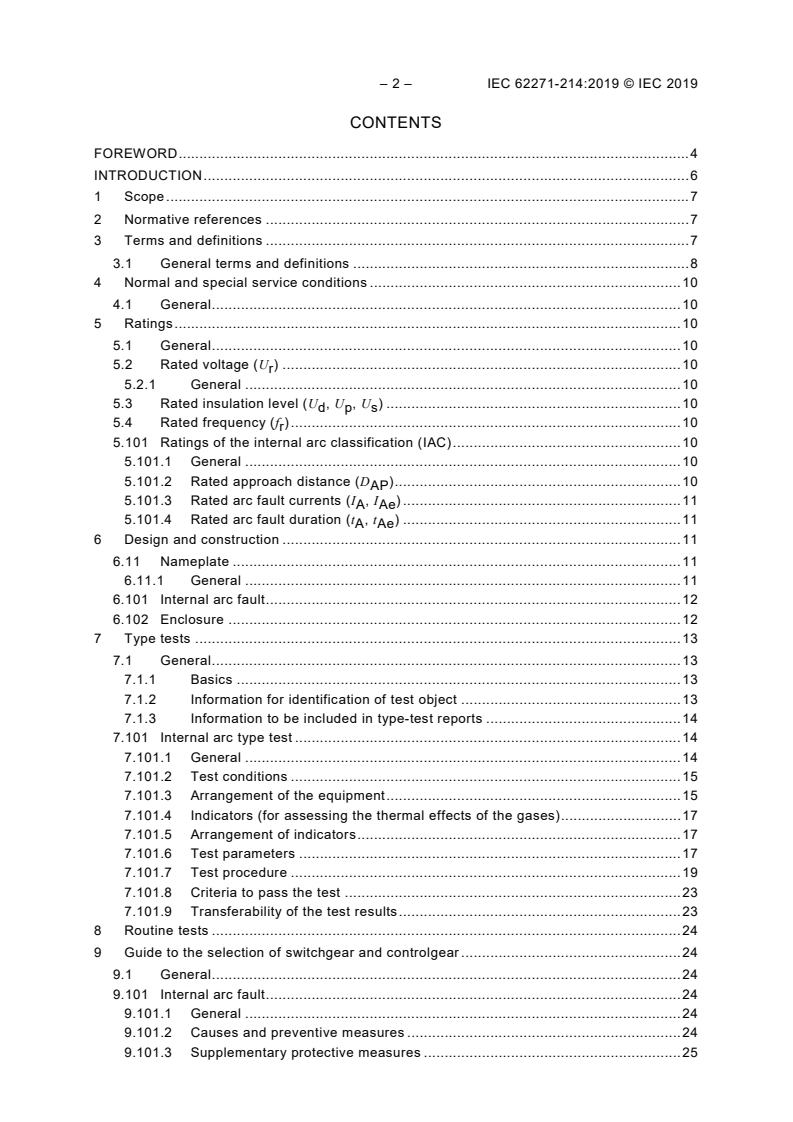
IEC 62271-214:2019 - High-voltage switchgear and controlgear - Part 214: Internal arc classification for metal-enclosed pole-mounted switchgear and controlgear for rated voltages above 1 kV and up to and including 52 kV Released:6/20/2019
Overview
IEC 62271-214:2019 is an international standard developed by the International Electrotechnical Commission (IEC) focusing on the internal arc classification (IAC) of metal-enclosed pole-mounted high-voltage switchgear and controlgear. This standard applies to installations with rated voltages above 1 kV and up to and including 52 kV, designed for alternating current with service frequencies up to 60 Hz. The equipment covered includes three-phase, two-phase, and single-phase setups, and may incorporate fixed or removable metallic enclosures that are possibly filled with insulating fluids like liquids or gases.
This standard is essential for ensuring safety and reliability by specifying the requirements and testing procedures for internal arc faults, which are critical events that could release hazardous energy inside switchgear enclosures. IEC 62271-214:2019 enables manufacturers, utilities, and engineers to classify and verify the internal arc withstand capability of pole-mounted high-voltage switchgear, enhancing operator protection and system stability.
Key Topics
- Internal Arc Classification (IAC): Provides detailed ratings and criteria for evaluating equipment capability to withstand and contain internal arc faults safely.
- Scope and Application: Applies to metal-enclosed pole-mounted switchgear with voltages ranging from 1 kV to 52 kV, covering various phase configurations and insulation types.
- Design and Construction: Specifies how enclosures should be designed and constructed to withstand thermal and mechanical effects of internal arcs.
- Type and Routine Testing: Defines standardized test procedures such as internal arc type tests and routine tests to assess equipment performance against defined internal arc conditions.
- Safety Measures: Includes guidelines for reducing the likelihood and impact of internal arc faults through design, installation, and maintenance best practices.
- Nameplate and Identification: Requirements for clear and comprehensive nameplate information to aid identification and traceability of internal arc classification.
- Preventive and Protective Measures: Discusses possible causes of internal arc faults, preventive strategies, and supplementary protective measures to mitigate risks.
- Environmental and Operational Conditions: Addresses normal and special service conditions including transport, storage, installation, and operation instructions.
Applications
IEC 62271-214:2019 is highly relevant for:
- Power Utilities: Ensuring that pole-mounted switchgear installations in distribution networks meet stringent safety and reliability standards.
- Equipment Manufacturers: Designing and certifying high-voltage switchgear that complies with recognized international internal arc classification requirements.
- Electrical Contractors and Installers: Selecting appropriate switchgear with verified internal arc performance for safe field installations.
- Maintenance Teams: Following recommended maintenance and operation procedures to preserve the integrity of arc-resistant enclosures and extend equipment lifespan.
- Safety Engineers: Implementing risk assessment strategies to minimize hazards arising from internal arc faults in high-voltage installations.
Adherence to this standard enhances personnel safety by reducing exposure to arc flash hazards, improves system availability through robust equipment construction, and supports regulatory compliance and international market acceptance.
Related Standards
- IEC 62271-1: Requirements for high-voltage switchgear and controlgear general specifications.
- IEC 62271-200: Metal-enclosed switchgear and controlgear for rated voltages above 1 kV for internal arc classification.
- IEC 62271-100: High-voltage alternating current circuit-breakers.
- IEC 60529: Degrees of protection provided by enclosures (IP Code) useful for enclosure design considerations.
- ISO 45001: Occupational health and safety management systems relevant for personnel protection.
- IEEE C37 Series: Standards related to electrical switchgear and arc flash safety guidance.
Following IEC 62271-214:2019 along with these complementary standards ensures a comprehensive approach to the design, testing, and application of safe, reliable high-voltage pole-mounted switchgear.
Keywords: IEC 62271-214, internal arc classification, high-voltage switchgear, pole-mounted switchgear, metal-enclosed switchgear, arc fault testing, rated voltage 1 kV-52 kV, electrical safety standards, internal arc withstand, switchgear enclosure design, high-voltage controlgear, arc fault protection.
Relations
- Effective Date
- 05-Sep-2023
Buy Documents
IEC 62271-214:2019 - High-voltage switchgear and controlgear - Part 214: Internal arc classification for metal-enclosed pole-mounted switchgear and controlgear for rated voltages above 1 kV and up to and including 52 kV Released:6/20/2019
Get Certified
Connect with accredited certification bodies for this standard

BSI Group
BSI (British Standards Institution) is the business standards company that helps organizations make excellence a habit.

TÜV Rheinland
TÜV Rheinland is a leading international provider of technical services.

TÜV SÜD
TÜV SÜD is a trusted partner of choice for safety, security and sustainability solutions.
Sponsored listings
Frequently Asked Questions
IEC 62271-214:2019 is a standard published by the International Electrotechnical Commission (IEC). Its full title is "High-voltage switchgear and controlgear - Part 214: Internal arc classification for metal-enclosed pole-mounted switchgear and controlgear for rated voltages above 1 kV and up to and including 52 kV". This standard covers: IEC 62271-214:2019 specifies requirements for internal arc classification of metal-enclosed pole-mounted switchgear installations used for alternating current with rated voltages above 1 kV and up to and including 52 kV with service frequencies up to and including 60 Hz. This document is applicable to three-phase, two-phase and single phase equipment. Enclosures may include fixed and removable components and may be filled with fluid (liquid or gas) to provide insulation.
IEC 62271-214:2019 specifies requirements for internal arc classification of metal-enclosed pole-mounted switchgear installations used for alternating current with rated voltages above 1 kV and up to and including 52 kV with service frequencies up to and including 60 Hz. This document is applicable to three-phase, two-phase and single phase equipment. Enclosures may include fixed and removable components and may be filled with fluid (liquid or gas) to provide insulation.
IEC 62271-214:2019 is classified under the following ICS (International Classification for Standards) categories: 11.040.50 - Radiographic equipment; 29.130.10 - High voltage switchgear and controlgear. The ICS classification helps identify the subject area and facilitates finding related standards.
IEC 62271-214:2019 has the following relationships with other standards: It is inter standard links to IEC 62271-214:2024. Understanding these relationships helps ensure you are using the most current and applicable version of the standard.
IEC 62271-214:2019 is available in PDF format for immediate download after purchase. The document can be added to your cart and obtained through the secure checkout process. Digital delivery ensures instant access to the complete standard document.
Standards Content (Sample)
IEC 62271-214 ®
Edition 1.0 2019-06
INTERNATIONAL
STANDARD
NORME
INTERNATIONALE
High-voltage switchgear and controlgear –
Part 214: Internal arc classification for metal-enclosed pole-mounted switchgear
and controlgear for rated voltages above 1 kV and up to and including 52 kV
Appareillage à haute tension –
Partie 214: Classification arc interne des appareillages sous enveloppe
métallique de tensions assignées supérieures à 1 kV et inférieures ou égales à
52 kV montés sur poteau
All rights reserved. Unless otherwise specified, no part of this publication may be reproduced or utilized in any form
or by any means, electronic or mechanical, including photocopying and microfilm, without permission in writing from
either IEC or IEC's member National Committee in the country of the requester. If you have any questions about IEC
copyright or have an enquiry about obtaining additional rights to this publication, please contact the address below or
your local IEC member National Committee for further information.
Droits de reproduction réservés. Sauf indication contraire, aucune partie de cette publication ne peut être reproduite
ni utilisée sous quelque forme que ce soit et par aucun procédé, électronique ou mécanique, y compris la photocopie
et les microfilms, sans l'accord écrit de l'IEC ou du Comité national de l'IEC du pays du demandeur. Si vous avez des
questions sur le copyright de l'IEC ou si vous désirez obtenir des droits supplémentaires sur cette publication, utilisez
les coordonnées ci-après ou contactez le Comité national de l'IEC de votre pays de résidence.
IEC Central Office Tel.: +41 22 919 02 11
3, rue de Varembé info@iec.ch
CH-1211 Geneva 20 www.iec.ch
Switzerland
About the IEC
The International Electrotechnical Commission (IEC) is the leading global organization that prepares and publishes
International Standards for all electrical, electronic and related technologies.
About IEC publications
The technical content of IEC publications is kept under constant review by the IEC. Please make sure that you have the
latest edition, a corrigendum or an amendment might have been published.
IEC publications search - webstore.iec.ch/advsearchform Electropedia - www.electropedia.org
The advanced search enables to find IEC publications by a The world's leading online dictionary on electrotechnology,
variety of criteria (reference number, text, technical containing more than 22 000 terminological entries in English
committee,…). It also gives information on projects, replaced and French, with equivalent terms in 16 additional languages.
and withdrawn publications. Also known as the International Electrotechnical Vocabulary
(IEV) online.
IEC Just Published - webstore.iec.ch/justpublished
Stay up to date on all new IEC publications. Just Published IEC Glossary - std.iec.ch/glossary
details all new publications released. Available online and 67 000 electrotechnical terminology entries in English and
once a month by email. French extracted from the Terms and Definitions clause of
IEC publications issued since 2002. Some entries have been
IEC Customer Service Centre - webstore.iec.ch/csc collected from earlier publications of IEC TC 37, 77, 86 and
If you wish to give us your feedback on this publication or CISPR.
need further assistance, please contact the Customer Service
Centre: sales@iec.ch.
A propos de l'IEC
La Commission Electrotechnique Internationale (IEC) est la première organisation mondiale qui élabore et publie des
Normes internationales pour tout ce qui a trait à l'électricité, à l'électronique et aux technologies apparentées.
A propos des publications IEC
Le contenu technique des publications IEC est constamment revu. Veuillez vous assurer que vous possédez l’édition la
plus récente, un corrigendum ou amendement peut avoir été publié.
Recherche de publications IEC - Electropedia - www.electropedia.org
webstore.iec.ch/advsearchform Le premier dictionnaire d'électrotechnologie en ligne au
La recherche avancée permet de trouver des publications IEC monde, avec plus de 22 000 articles terminologiques en
en utilisant différents critères (numéro de référence, texte, anglais et en français, ainsi que les termes équivalents dans
comité d’études,…). Elle donne aussi des informations sur les 16 langues additionnelles. Egalement appelé Vocabulaire
projets et les publications remplacées ou retirées. Electrotechnique International (IEV) en ligne.
IEC Just Published - webstore.iec.ch/justpublished Glossaire IEC - std.iec.ch/glossary
Restez informé sur les nouvelles publications IEC. Just 67 000 entrées terminologiques électrotechniques, en anglais
Published détaille les nouvelles publications parues. et en français, extraites des articles Termes et Définitions des
Disponible en ligne et une fois par mois par email. publications IEC parues depuis 2002. Plus certaines entrées
antérieures extraites des publications des CE 37, 77, 86 et
Service Clients - webstore.iec.ch/csc CISPR de l'IEC.
Si vous désirez nous donner des commentaires sur cette
publication ou si vous avez des questions contactez-nous:
sales@iec.ch.
IEC 62271-214 ®
Edition 1.0 2019-06
INTERNATIONAL
STANDARD
NORME
INTERNATIONALE
High-voltage switchgear and controlgear –
Part 214: Internal arc classification for metal-enclosed pole-mounted switchgear
and controlgear for rated voltages above 1 kV and up to and including 52 kV
Appareillage à haute tension –
Partie 214: Classification arc interne des appareillages sous enveloppe
métallique de tensions assignées supérieures à 1 kV et inférieures ou égales à
52 kV montés sur poteau
INTERNATIONAL
ELECTROTECHNICAL
COMMISSION
COMMISSION
ELECTROTECHNIQUE
INTERNATIONALE
ICS 29.130.10 ISBN 978-2-8322-6996-1
– 2 – IEC 62271-214:2019 © IEC 2019
CONTENTS
FOREWORD . 4
INTRODUCTION . 6
1 Scope . 7
2 Normative references . 7
3 Terms and definitions . 7
3.1 General terms and definitions . 8
4 Normal and special service conditions . 10
4.1 General . 10
5 Ratings . 10
5.1 General . 10
5.2 Rated voltage (U ) . 10
r
5.2.1 General . 10
5.3 Rated insulation level (U , U , U ) . 10
d p s
5.4 Rated frequency (f ) . 10
r
5.101 Ratings of the internal arc classification (IAC) . 10
5.101.1 General . 10
5.101.2 Rated approach distance (D ) . 10
AP
5.101.3 Rated arc fault currents (I , I ) . 11
A Ae
5.101.4 Rated arc fault duration (t , t ) . 11
A Ae
6 Design and construction . 11
6.11 Nameplate . 11
6.11.1 General . 11
6.101 Internal arc fault . 12
6.102 Enclosure . 12
7 Type tests . 13
7.1 General . 13
7.1.1 Basics . 13
7.1.2 Information for identification of test object . 13
7.1.3 Information to be included in type-test reports . 14
7.101 Internal arc type test . 14
7.101.1 General . 14
7.101.2 Test conditions . 15
7.101.3 Arrangement of the equipment . 15
7.101.4 Indicators (for assessing the thermal effects of the gases) . 17
7.101.5 Arrangement of indicators . 17
7.101.6 Test parameters . 17
7.101.7 Test procedure . 19
7.101.8 Criteria to pass the test . 23
7.101.9 Transferability of the test results . 23
8 Routine tests . 24
9 Guide to the selection of switchgear and controlgear . 24
9.1 General . 24
9.101 Internal arc fault . 24
9.101.1 General . 24
9.101.2 Causes and preventive measures . 24
9.101.3 Supplementary protective measures . 25
9.101.4 Considerations for the selection and installation . 26
9.101.5 Internal arc test . 26
9.101.6 IAC designation . 26
10 Information to be given with enquiries, tenders and orders (informative) . 27
10.1 General . 27
11 Transport, storage, installation, operation instruction and maintenance . 27
11.1 General . 27
11.2 Conditions during transport, storage and installation . 27
11.3 Installation . 28
11.3.1 General . 28
11.101 Maintenance . 28
11.101.1 General . 28
12 Safety . 28
12.1 General . 28
13 Influence of the product on the environment . 28
Annex A (normative) Identification of the test objects . 29
A.1 General . 29
A.2 Data . 29
A.3 Drawings. 29
Bibliography . 30
Figure 1 – Examples of enclosures and compartment(s) in different arrangements . 13
Figure 2 –Test arrangement for pole-mounted switchgear and controlgear . 16
Figure 3 – Horizontal indicator . 17
Figure 4 – Flow-chart for the choice of arc initiation depending on the construction . 21
Table 1 – Nameplate information . 12
Table 2 – Parameters for internal fault test according to enclosure and compartment
construction . 20
Table 3 – Locations, causes and examples of measures to decrease the probability of
internal arc faults . 25
Table 4 – Single phase-to-earth arc fault current depending on the network neutral
earthing . 27
– 4 – IEC 62271-214:2019 © IEC 2019
INTERNATIONAL ELECTROTECHNICAL COMMISSION
____________
HIGH-VOLTAGE SWITCHGEAR AND CONTROLGEAR –
Part 214: Internal arc classification for metal-enclosed pole-mounted
switchgear and controlgear for rated voltages above 1 kV and up to
and including 52 kV
FOREWORD
1) The International Electrotechnical Commission (IEC) is a worldwide organization for standardization comprising
all national electrotechnical committees (IEC National Committees). The object of IEC is to promote
international co-operation on all questions concerning standardization in the electrical and electronic fields. To
this end and in addition to other activities, IEC publishes International Standards, Technical Specifications,
Technical Reports, Publicly Available Specifications (PAS) and Guides (hereafter referred to as “IEC
Publication(s)”). Their preparation is entrusted to technical committees; any IEC National Committee interested
in the subject dealt with may participate in this preparatory work. International, governmental and non-
governmental organizations liaising with the IEC also participate in this preparation. IEC collaborates closely
with the International Organization for Standardization (ISO) in accordance with conditions determined by
agreement between the two organizations.
2) The formal decisions or agreements of IEC on technical matters express, as nearly as possible, an international
consensus of opinion on the relevant subjects since each technical committee has representation from all
interested IEC National Committees.
3) IEC Publications have the form of recommendations for international use and are accepted by IEC National
Committees in that sense. While all reasonable efforts are made to ensure that the technical content of IEC
Publications is accurate, IEC cannot be held responsible for the way in which they are used or for any
misinterpretation by any end user.
4) In order to promote international uniformity, IEC National Committees undertake to apply IEC Publications
transparently to the maximum extent possible in their national and regional publications. Any divergence
between any IEC Publication and the corresponding national or regional publication shall be clearly indicated in
the latter.
5) IEC itself does not provide any attestation of conformity. Independent certification bodies provide conformity
assessment services and, in some areas, access to IEC marks of conformity. IEC is not responsible for any
services carried out by independent certification bodies.
6) All users should ensure that they have the latest edition of this publication.
7) No liability shall attach to IEC or its directors, employees, servants or agents including individual experts and
members of its technical committees and IEC National Committees for any personal injury, property damage or
other damage of any nature whatsoever, whether direct or indirect, or for costs (including legal fees) and
expenses arising out of the publication, use of, or reliance upon, this IEC Publication or any other IEC
Publications.
8) Attention is drawn to the Normative references cited in this publication. Use of the referenced publications is
indispensable for the correct application of this publication.
9) Attention is drawn to the possibility that some of the elements of this IEC Publication may be the subject of
patent rights. IEC shall not be held responsible for identifying any or all such patent rights.
International Standard IEC 62271-214 has been prepared by subcommittee 17C Assemblies,
of IEC technical committee 17: Switchgear and controlgear.
The text of this International Standard is based on the following documents:
FDIS Report on voting
17C/706/FDIS 17C/710/RVD
Full information on the voting for the approval of this International Standard can be found in
the report on voting indicated in the above table.
This document has been drafted in accordance with the ISO/IEC Directives, Part 2.
This standard shall be read in conjunction with IEC 62271-1, second edition, published in
2017, to which it refers and which is applicable unless otherwise specified in this standard. In
order to simplify the indication of corresponding requirements, the same numbering of clauses
and subclauses is used as in IEC 62271-1. Amendments to these clauses and subclauses are
given under the same references whilst additional subclauses are numbered from 101. Any
clause with the term “Not Applicable” relates to the clause not being relevant to IEC 62271-
214 and does not infer the clause is or is not relevant for its applicable switchgear standard.
A list of all parts of the IEC 62271 series, published under the general title High-voltage
switchgear and controlgear, can be found on the IEC website.
The committee has decided that the contents of this document will remain unchanged until the
stability date indicated on the IEC website under "http://webstore.iec.ch" in the data related to
the specific document. At this date, the document will be
• reconfirmed,
• withdrawn,
• replaced by a revised edition, or
• amended.
– 6 – IEC 62271-214:2019 © IEC 2019
INTRODUCTION
IEC 62271-214 has been developed due to the requirement to remove IAC Type C designated
pole mounted switchgear from IEC 62271-200. Only enclosed terminal equipment is to be
considered within IEC 62271-200. For this reason, IEC 62271-214 is to be considered
independent of IEC 62271-200, however it is still related to other product standards of the
IEC 62271 series.
Only open terminal pole mounted switchgear has been considered within this document.
This equipment relates to operation in three-phase, two-phase and single-phase systems.
HIGH-VOLTAGE SWITCHGEAR AND CONTROLGEAR –
Part 214: Internal arc classification for metal-enclosed pole-mounted
switchgear and controlgear for rated voltages above 1 kV and up to
and including 52 kV
1 Scope
This part of IEC 62271 specifies requirements for internal arc classification of metal-enclosed
pole-mounted switchgear installations used for alternating current with rated voltages above
1 kV and up to and including 52 kV with service frequencies up to and including 60 Hz. This
document is applicable to three-phase, two-phase and single phase equipment. Enclosures
may include fixed and removable components and may be filled with fluid (liquid or gas) to
provide insulation.
NOTE For the use of this document high-voltage (IEC 60050-601:1985, 601-01-27) is the rated voltage above
1 000 V. However, medium voltage (IEC 60050-601:1985, 601-01-28) is commonly used for distribution systems
with voltages above 1 kV and generally applied up to and including 52 kV; refer to [1] of the Bibliography.
This document does not preclude that other equipment may be included in the same
enclosure. In such a case, any possible influence of that equipment on the switchgear and
controlgear is to be taken into account.
2 Normative references
The following referenced documents are indispensable for the application of this document.
For dated references, only the edition cited applies. For undated references, the latest edition
of the referenced document (including any amendments) applies.
IEC 60050-151:2001, International Electrotechnical Vocabulary – Part 151: Electrical and
magnetic devices
IEC 60050-441:1984, International Electrotechnical Vocabulary – Part 441: Switchgear,
controlgear and fuses
IEC 62271-1:2017, High-voltage switchgear and controlgear – Part 1: Common specifications
for alternating current switchgear and controlgear
3 Terms and definitions
For the purposes of this document, the terms and definitions given in IEC 60050-151,
IEC 60050-441 and IEC 62271-1 as well as the following apply.
ISO and IEC maintain terminological databases for use in standardization at the following
addresses:
• IEC Electropedia: available at http://electropedia.org
• ISO Online browsing platform: available at http://www.iso.org/obp
NOTE Additional definitions are classified so as to be aligned with the classification system used in
IEC 60050-441.
– 8 – IEC 62271-214:2019 © IEC 2019
3.1 General terms and definitions
3.1.101
metal-enclosed switchgear and controlgear
switchgear and controlgear assemblies with an external metal enclosure intended to be
earthed and completely assembled, except for external connections
[SOURCE: IEC 60050-441:1984, 441-12-04, modified – NOTE has been deleted]
3.1.102
functional unit
part of pole-mounted switchgear and controlgear comprising all the components of the
main circuits and auxiliary circuits that contribute to the fulfilment of a single function
Note 1 to entry: Functional units are distinguished according to the function for which they are intended, e.g.
incoming unit, outgoing unit, etc.
[SOURCE: IEC 60050-441:1984, 441-13-04, modified – references to the supply and feed
sides in the note has been deleted]
3.1.103
enclosure
part of an assembly providing a specified degree of protection of equipment against external
influences and a specified degree of protection against approach to or contact with live parts
and against contact with moving parts
[SOURCE: IEC 60050-441:1984, 441-13-01]
3.1.104
high-voltage compartment
compartment of switchgear and controlgear, containing high-voltage conducting parts,
enclosed except for openings necessary for interconnection, control or ventilation, where one
segment of the compartment can be part of the outer earthed metallic enclosure
3.1.105
component
essential part of the high-voltage or earthing circuits of pole-mounted switchgear and
controlgear which serves a specific function
EXAMPLE Circuit-breaker, disconnector, switch, fuse, instrument transformer, bushing, busbar.
3.1.106
main circuit
all the high-voltage conductive parts of pole-mounted switchgear and controlgear included in
a circuit which is intended to carry the rated continuous current
[SOURCE: IEC 60050-441:1984, 441-13-02, modified – “high voltage” has been added,
“assembly” has been substituted by “pole mounted switchgear and controlgear” and “transmit
electrical energy” has been substituted by “carry the rated continuous current”.]
3.1.107
earthing circuit
conductors, connections, and the conducting parts of earthing devices intended to connect the
high-voltage conductive parts to the earthing system of the installation
Note 1 to entry: Parts of metallic enclosures connected to the earthing system can be part of the earthing circuit.
3.1.108
pressure relief device
device incorporated as part of an enclosure or compartment intended to operate to prevent
excessive pressure in the enclosure or compartment
3.1.109
fluid-filled compartment
high-voltage compartment of pole-mounted switchgear and controlgear filled with a fluid,
either gas, other than ambient air, or liquid, for insulation purposes
3.1.110
pole
vertical single member support in wood, concrete, steel or other material, with one end buried
in the ground, either directly or by means of a foundation
Note 1 to entry: The term pole as defined here is not to be mixed up with the use of the same term as
synonymous for phase as used in other standards.
[SOURCE: IEC 60050-466:1990, 466-07-01, modified – Note 1 to entry has been added]
3.1.111
pole-mounted switchgear and controlgear
switchgear and controlgear, typically connected to overhead lines, installed on one or more
poles or equivalent structures at a defined height, with restricted accessibility by installation
out of reach
3.1.112
internal arc classified switchgear and controlgear
IAC
metal-enclosed switchgear and controlgear for which prescribed criteria, for protection of
authorized persons and the general public, are met in the event of internal arc as
demonstrated by type tests
Note 1 to entry: The internal arc classification is described by the characteristics given from 3.1.1013 to 3.1.1016.
[SOURCE: IEC 62271-200:2011, 3.132, modified – “authorized” and “and general public” have
been added]
3.1.113
arc fault current
three-phase and where applicable the single phase-to-earth RMS value of the internal arc
fault current for which the switchgear and controlgear is designed to protect persons in the
event of an internal arc
[SOURCE: IEC 62271-200:2011, 3.132.3]
3.1.114
arc fault duration
duration of the internal arc fault current for which the switchgear and controlgear is designed
to protect persons in the event of an internal arc
[SOURCE: IEC 62271-200:2011, 3.132.4]
3.1.115
approach distance
distance between the test object and indicators arranged in an IAC test
– 10 – IEC 62271-214:2019 © IEC 2019
3.1.116
arc mitigation device
device dedicated to reacting to internal arc fault conditions to decrease the arc energy
[SOURCE: CIGRE BROCHURE 686:2017, Mitigating the effects of arc in M.V.
Switchgear][17]
4 Normal and special service conditions
4.1 General
Unless otherwise specified in this document, operation under normal and special service
conditions is considered to be covered by the relevant IEC standard.
5 Ratings
5.1 General
The ratings with respect to the arc fault classification of pole-mounted switchgear and
controlgear are the following:
rated voltage (U );
r
rated frequency (f );
r
ratings of the internal arc classifications (IAC);
5.2 Rated voltage (U )
r
5.2.1 General
The rated voltage is equal to the maximum system voltage for which the equipment is
designed. It indicates the maximum value of the “highest system voltage” of networks for
which the equipment may be used (refer to Clause 9 of IEC 60038:2009).
NOTE It is possible that components forming part of pole-mounted switchgear and controlgear have differing
values of rated voltage in accordance with their relevant standards.
5.3 Rated insulation level (U , U , U )
d p s
Not applicable.
5.4 Rated frequency (f )
r
The standard values of the rated frequency are 16,7 Hz, 25 Hz, 50 Hz and 60 Hz.
5.101 Ratings of the internal arc classification (IAC)
5.101.1 General
An IAC classified pole-mounted switchgear and controlgear shall have the following ratings:
rated approach distance, arc fault currents and arc fault durations.
5.101.2 Rated approach distance (D )
AP
The rated approach distance shall be stated by the manufacturer (refer to Figure 2).
___________
Numbers in square brackets refer to the bibliography.
5.101.3 Rated arc fault currents (I , I )
A Ae
The standard value of rated arc fault currents should be selected from the R 10 series
specified in IEC 60059.
Two ratings of the arc fault currents are recognised:
three-phase and phase-to-phase arc fault current (I ), when applicable;
A
single phase-to earth arc fault current (I ), when applicable.
Ae
When only a three-phase rating is specified, the single-phase rating is by default 87 % of the
three-phase rating, and need not be specified.
NOTE 1 The rationale for this 87 % is the arc fault test with 2-phase ignition; refer to 7.101.7.2.
The manufacturer shall specify the compartments to which the single phase-to earth arc fault
current rating applies. Such value is assigned to switchgear and controlgear where its
construction will prevent the arc from becoming multiphase, as demonstrated during the
internal arc test.
When IAC testing on single phase switchgear and controlgear or single-phase high voltage
compartments where only a single phase supply circuit has been applied only an I rating
Ae
shall be assigned. (refer to 7.101.7.2).
NOTE 2 Information about the relationship between type of neutral earthing and the single phase-to-earth arc
fault current is provided in 9.101.6.
5.101.4 Rated arc fault duration (t , t )
A Ae
Standard recommended values for the arc fault duration (t , t ) are 0,1 s, 0,5 s and 1 s.
A Ae
NOTE It is in general not possible to calculate the permissible arc duration for a current which differs from that
used in the test.
6 Design and construction
6.11 Nameplate
6.11.1 General
Pole-mounted switchgear and controlgear, with a rated internal arc classification shall include
in the nameplate the additional IAC information in accordance with Table 1.
– 12 – IEC 62271-214:2019 © IEC 2019
Table 1 – Nameplate information
Abbreviation Unit ** Condition:
Marking only required if
(1) (2) (3) (4) (5)
Internal arc classification IAC X
Rated approach distance D m X
AP
Arc fault current and duration I , t kA, s Y three-phase test or
A A
phase-to-phase test are
applicable
Single phase-to-earth arc fault current I , t kA, s Y a single-phase test is
Ae Ae
and duration applicable or I differs
Ae
from 87 % of I
A
Fitted with arc mitigation device Y arc mitigation device
fitted and not disabled
during testing
(**)
X = the marking of these values is mandatory where internal arc classification is assigned;
Y = conditions for marking of these values are given in column (5).
NOTE 1 If there is an abbreviation in column (2) it can be used instead of the terms in column (1).
6.101 Internal arc fault
Pole-mounted switchgear and controlgear, in principle, are designed and manufactured, to
prevent the occurrence of internal arc faults.
However, where internal arc classification is assigned, the switchgear and controlgear shall
be designed to give a defined level of protection of persons in the event of an internal arc,
when the switchgear and controlgear is in normal service condition.
If an internal arc classification is assigned by the manufacturer and verified by type tests
according to 7.101, the pole-mounted switchgear and controlgear shall be designated as
follows:
– Designation: IAC (Internal Arc Classified)
– Rated three-phase arc fault values (where applicable): current [kA] and duration [s]
and/or
– Rated single-phase arc fault values (where applicable): current [kA] and duration [s]
– If the unit is fitted with a device limiting the duration of the arc that cannot be disabled,
then the IAC designation shall indicate that the switchgear and controlgear is: “Fitted with
arc mitigation device”
This designation shall be included in the nameplate (refer to 6.11)
Some examples for internal arc classification are given in 7.101.7.2.5.
6.102 Enclosure
The complete enclosure should be capable of withstanding the mechanical, electrical, thermal
and environmental stresses likely to be encountered in normal service conditions.
Figure 1 shows examples of different arrangements of components in high voltage
compartment(s) within an enclosure.
a) three-phase
b) single-phase
Figure 1 – Examples of enclosures and compartment(s) in different arrangements
7 Type tests
7.1 General
7.1.1 Basics
The type test is performed to verify the internal arc ratings and characteristics of pole-
mounted switchgear.
7.1.2 Information for identification of test object
The manufacturer shall submit to the testing laboratory, drawings and other data containing
sufficient information to unambiguously identify by type the essential details and parts of the
switchgear presented for test. A summary list of the drawings and data schedules shall be
– 14 – IEC 62271-214:2019 © IEC 2019
supplied by the manufacturer and shall be uniquely referenced and shall contain a statement
to the effect that the manufacturer guarantees that the drawings or data schedules listed are
the correct version and truly represent the switchgear to be tested.
The testing laboratory shall check that drawings and data sheets adequately represent the
essential details and parts of the test object but is not responsible for the accuracy of the
detailed information. Particular drawings or data required to be submitted by the manufacturer
to the test laboratory for identification of essential parts of test object are specified in Annex A.
7.1.3 Information to be included in type-test reports
The results shall be recorded in type-test reports containing sufficient data to prove
compliance with the test clauses of this document and sufficient information shall be included
so that the essential parts of the test object can be identified. In particular, the following
information shall be included:
– Manufacturer;
– type designation and unique identifier for switchgear;
– rated characteristics of switchgear;
– photographs to illustrate the condition of switchgear before and after test;
– sufficient outline drawings and data schedules to represent the switchgear;
– the reference numbers of all drawings including revision number submitted to identify the
essential parts of the test object;
– details of the testing arrangement (including diagram of test circuit);
– statements of the behaviour of the switchgear during test and its condition after test;
– description of the test object with a drawing showing the main dimensions, details relevant
to the mechanical strength, the arrangement of the pressure relief device(s) and the
method of fixing the switchgear and controlgear to the pole(s), including the pole
characteristics;
– point and method of initiation of the internal arc fault;
– drawings of test arrangement (test object, source side connection point, and mounting
frame of indicators, pole dimensions) and any other relevant installation conditions;
applied voltage and frequency;
• IAC designation validated by test
• include use of fuse protection if used
• include the use of arc mitigation device if used
– for the prospective or test current:
a) RMS value of the AC component during the first three half-cycles;
b) highest peak value;
c) average value of the AC component over the actual duration of the test;
d) test duration;
– oscillogram(s) showing currents and voltages;
– assessment of the test results, including a record of the observations in accordance
with 7.101.8;
– other relevant remarks.
7.101 Internal arc type test
7.101.1 General
The test is applicable to pole-mounted switchgear and controlgear for which internal arc
classification is assigned, covering the event of an arc fault within the enclosure(s) or within
components having housings which form part of the enclosure in normal operation conditions.
The internal arc test makes allowance for effects acting on all parts of the enclosure, such as
internal overpressure, thermal effects of the arc or its roots, the effects of ejected hot gases
and glowing particles.
The tests are not intended to cover e.g.:
– the influences of an internal arc between compartments
– external connections outside the enclosure;
– the effects caused by an explosion of high-voltage components;
– the presence of gases with potential toxic characteristics, or the hazard of fire propagation
to combustible materials or equipment placed in the proximity of the pole-mounted
switchgear and controlgear;
7.101.2 Test conditions
The test shall be carried out with the switchgear and controlgear in normal operating
conditions. This means the position of high-voltage switching devices, connecting and
disconnecting withdrawable parts is set according to 7.101.7.1. All other equipment, for
example measuring instruments and monitoring equipment shall be in the position as it is in
normal service.
Pole-mounted switchgear which are protected by type-tested current-limiting fuses, integrated
inside the switchgear and controlgear, shall be tested with the fuse type that causes the
highest cut-off current (let-through current). The actual duration of the current flow will be
controlled by the fuses. The tests shall be performed at the rated voltage of the equipment.
The tested switchgear and controlgear will be designated as ‘fuse-protected’. The specific
fuse, including manufacturer, part number, and ratings, used for protection shall be specified
in the instruction manual.
Application of suitable current-limiting fuses in combination with switching devices can limit
the short-circuit current and minimize the fault duration. It is well documented that the arc
energy transferred during such tests is not predictable by I2t. In the case of current-limiting
fuses, the maximum arc energy may occur at current levels below the maximum interrupting
rating. Further, the effects of using current-limiting devices that employ pyrotechnic means to
commutate current to a current-limiting fuse shall be considered when evaluating designs
utilizing such devices.
Any device (for example, protection relay) that may automatically trip the circuit before the
end of the prospective duration of the test shall be made inoperative during the test. If pole-
mounted switchgear and controlgear is equipped with devices intended to limit the duration of
the arc itself by other means (for example, by transferring the current to a metallic short
circuit), they shall be made inoperative during the test. If these devices are integral part of the
design of the high-voltage compartment or assembly which prevents to make them inoperative
without modification of the construction, the relevant high-voltage compartment of the
switchgear and controlgear may be tested with the device operative; but this switchgear and
controlgear shall be qualified according to the actual duration of the arc. The test current shall
be maintained for the rated arc fault duration of the switchgear and controlgear.
NOTE Because in general arc limiting devices are out of the scope of this document and if the switchgear and
controlgear has previously been tested with the limiting device made inoperative, an additional test can be
performed to demonstrate the behaviour of this arc limiting device.
7.101.3 Arrangement of the equipment
The test arrangement for overhead connected pole-mounted switchgear and controlgear shall
be configured as indicated in Figure 2.
– 16 – IEC 62271-214:2019 © IEC 2019
Dimensions in millimetres
Figure 2 –Test arrangement for pole-mounted
switchgear and controlgear
The equipment shall be arranged as follows:
– mock-ups of internal components are permitted provided they have the same volume and
external material as the original items and they do not affect the main and earthing circuits;
– the test object shall be mounted on a pole. If there is a control box and/or
electrical/mechanical linkages to the base of the pole, these shall be fitted at a distance
below the test object typical of a service installation. The test object shall be at a
convenient height allowing for the indicators as specified in 7.101.5, and for the control
box and/or electrical/mechanical linkages (if applicable);
– the test object shall be earthed at the earthing point provided;
– tests shall be carried out on high-voltage compartments not previously subjected to arcing,
or, if subjected, being in a condition which does not affect the result of the test;
– in the case of fluid-filled compartments (other than SF ) the test shall be made with the
original fluid at its rated filling pressure (±10 %);
– for environmental reasons, it is recommended to replace SF with air at the rated filling
pressure (±10 %).
NOTE 1 Test results with air instead of SF are considered to be representative.
NOTE 2 Nitrogen at the rated filling pressure (±10 %) can also be considered a substitute for SF rather than air.
NOTE 3 Physical dimensions of the test room should be considered to prevent hot gas reflections towards the
indicators.
7.101.4 Indicators (for assessing the thermal effects of the gases)
7.101.4.1 General
Indicators are pieces of black cotton cloth so arranged that their cut edges do not point
toward the test object.
Black cot
...