

IEC 80601-2-58:2014/AMD1:2016
(Amendment)Amendment 1 - Medical electrical equipment - Part 2-58: Particular requirements for the basic safety and essential performance of lens removal devices and vitrectomy devices for ophthalmic surgery
General Information
- Abstract
This standard specifies:[
]- the essential non-thermal output characteristics of ultrasonic surgical units;[
]- methods of measurement ot these output characteristics;[
]- those characteristics which should be declared by the manufacturers of such equipment.[
]This standard is applicable to equipment which meets the requirements of a, b and c below:[
]a) ultrasonic surgical systems operating in the frequency range 20 kHz to 60 kHz; and[
]b) ultrasonic surgical systems, whose use is the fragmentation or cutting of human tissue, whether or not those effects are delivered in conjunction with tissue removal or coagulation; and[
]c) ultrasonic surgical systems, in which an acoustic wave is conducted by means of a specifically designed wave guide to deliver energy to the surgical site.
- Status
- Published
- Publication Date
- 19-Oct-2016
- Technical Committee
- SC 62D - Particular medical equipment, software, and systems
- Drafting Committee
- JWG 9 - TC 62/SC 62D/JWG 9
- Current Stage
- DELPUB - Deleted Publication
- Start Date
- 06-Mar-2024
- Completion Date
- 28-Aug-2026
Buy Documents
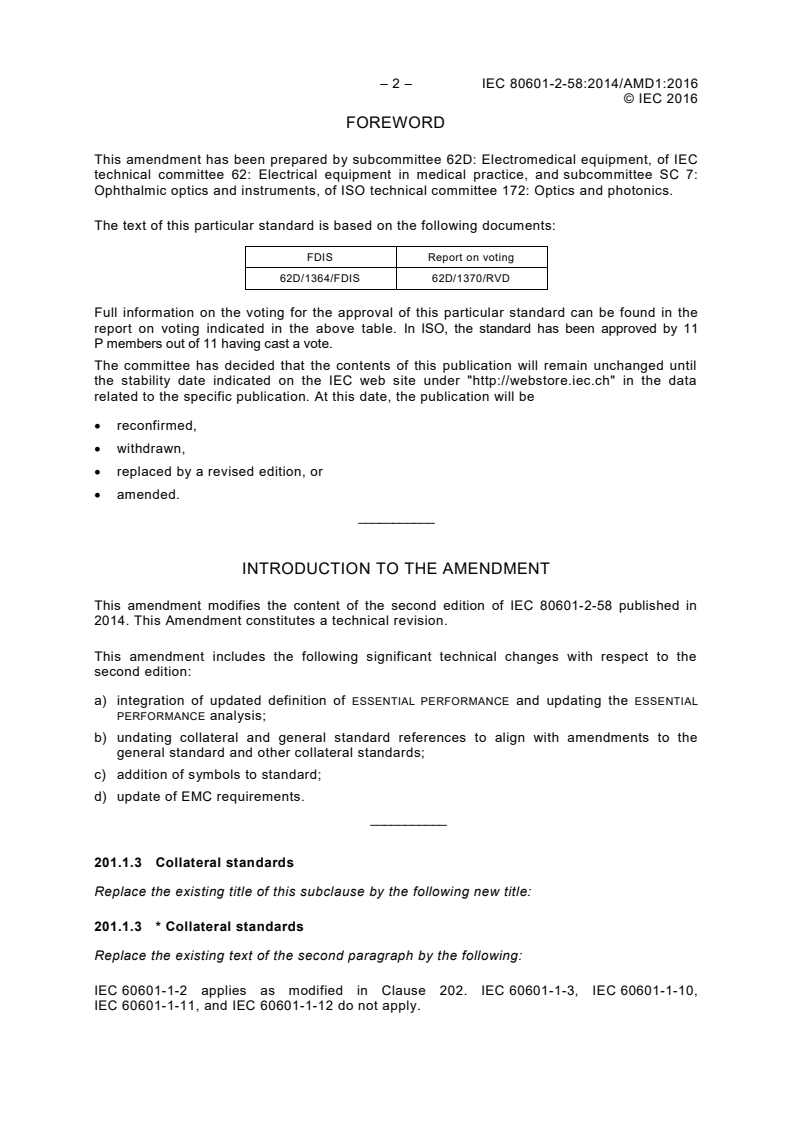
IEC 80601-2-58:2014/AMD1:2016 - Amendment 1 - Medical electrical equipment - Part 2-58: Particular requirements for the basic safety and essential performance of lens removal devices and vitrectomy devices for ophthalmic surgery Released:10/20/2016
Overview
The IEC 80601-2-58:2014/AMD1:2016 is an important amendment to the international standard governing medical electrical equipment, specifically focused on the basic safety and essential performance requirements for lens removal devices and vitrectomy devices used in ophthalmic surgery. Developed by the International Electrotechnical Commission (IEC), this amendment upgrades the second edition published in 2014 and is essential for manufacturers, healthcare providers, and regulatory authorities involved in ophthalmic surgical equipment.
This standard sets out particular requirements to ensure these devices operate safely and effectively, addressing both technical performance and risk management aspects. By specifying non-thermal output characteristics of ultrasonic surgical units, measurement methods, required manufacturer declarations, and detailed functional criteria, this amendment strengthens compliance with global medical safety regulations and promotes improved clinical outcomes.
Key Topics
Essential Non-Thermal Output Characteristics
Defines the critical parameters of ultrasonic surgical systems that operate within the frequency range of 20 kHz to 60 kHz, emphasizing accuracy and safety in tissue fragmentation and cutting.Measurement and Testing Methods
Specifies how to measure output characteristics such as ultrasonic velocity and fluid velocity during liquefaction, ensuring consistent and reliable device performance within ±20% of nominal values.Manufacturer Declarations
Requires manufacturers to declare key device characteristics openly, supporting transparency and assisting healthcare providers in device selection and risk assessment.Updated Definitions and Symbols
Incorporates revised definitions of essential performance and adds standardized symbols for functions like lens removal, vitrectomy, diathermy, fragmentation, and illumination to improve device identification and usage clarity.Electromagnetic Compatibility (EMC) Requirements
Updates EMC standards in alignment with IEC 60601-1-2 and CISPR 11 to minimize interference risks during device operation, particularly addressing RF emissions and immunity in clinical settings.Risk Management & Hazardous Situations
Enhances safety protocols by redefining hazardous situation criteria, emphasizing that performance degradation should not pose unacceptable risks to patients or operators.Cleaning, Disinfection, and Sterilization
Updates references to sterilization and packaging standards (ISO 11607 series with AMD1:2014) ensuring compliance with current best practices for device hygiene.
Applications
IEC 80601-2-58:2014/AMD1:2016 directly applies to:
Lens Removal Devices
Equipment designed for cataract surgeries that include irrigation, aspiration, and lens fragmentation via ultrasonic, laser, or liquefaction methods.Vitrectomy Devices
Surgical systems used to remove vitreous humor in the eye, often combined with illumination and other functions critical during ophthalmic procedures.
These devices are integral to ophthalmic surgeries such as cataract extraction and retinal procedures. Compliance with this standard ensures:
- Enhanced patient safety during delicate eye surgeries by defining permissible operational limits and failure tolerances.
- Reliable device performance through rigorous technical specifications and testing protocols.
- Improved interoperability and maintenance enabled by standardized markings and symbols, aiding surgical teams.
- Regulatory alignment facilitating market access in multiple countries by meeting internationally recognized safety standards.
Related Standards
This amendment aligns with and references several important IEC and ISO standards, including:
- IEC 60601-1-2: General requirements for electromagnetic disturbances and tests tailored for medical electrical equipment.
- IEC 60601-1: General basic safety and essential performance requirements for medical electrical equipment.
- IEC TR 60878: Electrosurgery and coagulation mode standards, relevant for functions like diathermy linked with vitrectomy and lens removal devices.
- ISO 11607-1 and ISO 11607-2 (with Amendment AMD1:2014): Specifications for packaging and sterilization validation for terminally sterilized medical devices.
- CISPR 11: Standards defining radio-frequency disturbance characteristics and measurement methods.
Understanding the interplay of IEC 80601-2-58 with these collateral standards supports comprehensive compliance strategy and robust device lifecycle management for ophthalmic surgical equipment manufacturers and users.
By adhering to IEC 80601-2-58:2014/AMD1:2016, stakeholders reinforce safety, performance, and regulatory confidence for critical ophthalmic surgery devices, fostering innovation and patient care excellence in the medical device industry.
Relations
- Effective Date
- 05-Sep-2023
- Effective Date
- 05-Sep-2023
Buy Documents
IEC 80601-2-58:2014/AMD1:2016 - Amendment 1 - Medical electrical equipment - Part 2-58: Particular requirements for the basic safety and essential performance of lens removal devices and vitrectomy devices for ophthalmic surgery Released:10/20/2016
Get Certified
Connect with accredited certification bodies for this standard

BSI Group
BSI (British Standards Institution) is the business standards company that helps organizations make excellence a habit.

TÜV Rheinland
TÜV Rheinland is a leading international provider of technical services.

TÜV SÜD
TÜV SÜD is a trusted partner of choice for safety, security and sustainability solutions.
Sponsored listings
Frequently Asked Questions
IEC 80601-2-58:2014/AMD1:2016 is a standard published by the International Electrotechnical Commission (IEC). Its full title is "Amendment 1 - Medical electrical equipment - Part 2-58: Particular requirements for the basic safety and essential performance of lens removal devices and vitrectomy devices for ophthalmic surgery". This standard covers: This standard specifies:[<BR>]- the essential non-thermal output characteristics of ultrasonic surgical units;[<BR>]- methods of measurement ot these output characteristics;[<BR>]- those characteristics which should be declared by the manufacturers of such equipment.[<BR>]This standard is applicable to equipment which meets the requirements of a, b and c below:[<BR>]a) ultrasonic surgical systems operating in the frequency range 20 kHz to 60 kHz; and[<BR>]b) ultrasonic surgical systems, whose use is the fragmentation or cutting of human tissue, whether or not those effects are delivered in conjunction with tissue removal or coagulation; and[<BR>]c) ultrasonic surgical systems, in which an acoustic wave is conducted by means of a specifically designed wave guide to deliver energy to the surgical site.
This standard specifies:[<BR>]- the essential non-thermal output characteristics of ultrasonic surgical units;[<BR>]- methods of measurement ot these output characteristics;[<BR>]- those characteristics which should be declared by the manufacturers of such equipment.[<BR>]This standard is applicable to equipment which meets the requirements of a, b and c below:[<BR>]a) ultrasonic surgical systems operating in the frequency range 20 kHz to 60 kHz; and[<BR>]b) ultrasonic surgical systems, whose use is the fragmentation or cutting of human tissue, whether or not those effects are delivered in conjunction with tissue removal or coagulation; and[<BR>]c) ultrasonic surgical systems, in which an acoustic wave is conducted by means of a specifically designed wave guide to deliver energy to the surgical site.
IEC 80601-2-58:2014/AMD1:2016 is classified under the following ICS (International Classification for Standards) categories: 01 - GENERALITIES. TERMINOLOGY. STANDARDIZATION. DOCUMENTATION; 11.040.01 - Medical equipment in general; 11.040.70 - Ophthalmic equipment; 17.140.50 - Electroacoustics. The ICS classification helps identify the subject area and facilitates finding related standards.
IEC 80601-2-58:2014/AMD1:2016 has the following relationships with other standards: It is inter standard links to IEC 80601-2-58:2014, IEC 80601-2-58:2024. Understanding these relationships helps ensure you are using the most current and applicable version of the standard.
IEC 80601-2-58:2014/AMD1:2016 is available in PDF format for immediate download after purchase. The document can be added to your cart and obtained through the secure checkout process. Digital delivery ensures instant access to the complete standard document.
Standards Content (Sample)
IEC 80601-2-58
Edition 2.0 2016-10
INTERNATIONAL
STANDARD
NORME
INTERNATIONALE
A MENDMENT 1
AM ENDEMENT 1
Medical electrical equipment –
Part 2-58: Particular requirements for the basic safety and essential performance
of lens removal devices and vitrectomy devices for ophthalmic surgery
Appareils électromédicaux –
Partie 2-58: Exigences particulières pour la sécurité de base et les performances
essentielles des dispositifs de retrait du cristallin et des dispositifs de
vitrectomie pour la chirurgie ophtalmique
IEC 80601-2-58:2014-09/AMD1:2016-10(en-fr)
All rights reserved. Unless otherwise specified, no part of this publication may be reproduced or utilized in any form
or by any means, electronic or mechanical, including photocopying and microfilm, without permission in writing from
either IEC or IEC's member National Committee in the country of the requester. If you have any questions about IEC
copyright or have an enquiry about obtaining additional rights to this publication, please contact the address below or
your local IEC member National Committee for further information.
Droits de reproduction réservés. Sauf indication contraire, aucune partie de cette publication ne peut être reproduite
ni utilisée sous quelque forme que ce soit et par aucun procédé, électronique ou mécanique, y compris la photocopie
et les microfilms, sans l'accord écrit de l'IEC ou du Comité national de l'IEC du pays du demandeur. Si vous avez des
questions sur le copyright de l'IEC ou si vous désirez obtenir des droits supplémentaires sur cette publication, utilisez
les coordonnées ci-après ou contactez le Comité national de l'IEC de votre pays de résidence.
IEC Central Office Tel.: +41 22 919 02 11
3, rue de Varembé Fax: +41 22 919 03 00
CH-1211 Geneva 20 info@iec.ch
Switzerland www.iec.ch
About the IEC
The International Electrotechnical Commission (IEC) is the leading global organization that prepares and publishes
International Standards for all electrical, electronic and related technologies.
About IEC publications
The technical content of IEC publications is kept under constant review by the IEC. Please make sure that you have the
latest edition, a corrigenda or an amendment might have been published.
IEC Catalogue - webstore.iec.ch/catalogue Electropedia - www.electropedia.org
The stand-alone application for consulting the entire The world's leading online dictionary of electronic and
bibliographical information on IEC International Standards, electrical terms containing 20 000 terms and definitions in
Technical Specifications, Technical Reports and other English and French, with equivalent terms in 15 additional
documents. Available for PC, Mac OS, Android Tablets and languages. Also known as the International Electrotechnical
iPad. Vocabulary (IEV) online.
IEC publications search - www.iec.ch/searchpub IEC Glossary - std.iec.ch/glossary
The advanced search enables to find IEC publications by a 65 000 electrotechnical terminology entries in English and
variety of criteria (reference number, text, technical French extracted from the Terms and Definitions clause of
committee,…). It also gives information on projects, replaced IEC publications issued since 2002. Some entries have been
and withdrawn publications. collected from earlier publications of IEC TC 37, 77, 86 and
CISPR.
IEC Just Published - webstore.iec.ch/justpublished
Stay up to date on all new IEC publications. Just Published IEC Customer Service Centre - webstore.iec.ch/csc
details all new publications released. Available online and If you wish to give us your feedback on this publication or
also once a month by email. need further assistance, please contact the Customer Service
Centre: csc@iec.ch.
A propos de l'IEC
La Commission Electrotechnique Internationale (IEC) est la première organisation mondiale qui élabore et publie des
Normes internationales pour tout ce qui a trait à l'électricité, à l'électronique et aux technologies apparentées.
A propos des publications IEC
Le contenu technique des publications IEC est constamment revu. Veuillez vous assurer que vous possédez l’édition la
plus récente, un corrigendum ou amendement peut avoir été publié.
Catalogue IEC - webstore.iec.ch/catalogue Electropedia - www.electropedia.org
Application autonome pour consulter tous les renseignements
Le premier dictionnaire en ligne de termes électroniques et
bibliographiques sur les Normes internationales,
électriques. Il contient 20 000 termes et définitions en anglais
Spécifications techniques, Rapports techniques et autres
et en français, ainsi que les termes équivalents dans 15
documents de l'IEC. Disponible pour PC, Mac OS, tablettes
langues additionnelles. Egalement appelé Vocabulaire
Android et iPad.
Electrotechnique International (IEV) en ligne.
Recherche de publications IEC - www.iec.ch/searchpub
Glossaire IEC - std.iec.ch/glossary
65 000 entrées terminologiques électrotechniques, en anglais
La recherche avancée permet de trouver des publications IEC
en utilisant différents critères (numéro de référence, texte, et en français, extraites des articles Termes et Définitions des
comité d’études,…). Elle donne aussi des informations sur les publications IEC parues depuis 2002. Plus certaines entrées
projets et les publications remplacées ou retirées. antérieures extraites des publications des CE 37, 77, 86 et
CISPR de l'IEC.
IEC Just Published - webstore.iec.ch/justpublished
Service Clients - webstore.iec.ch/csc
Restez informé sur les nouvelles publications IEC. Just
Published détaille les nouvelles publications parues. Si vous désirez nous donner des commentaires sur cette
Disponible en ligne et aussi une fois par mois par email. publication ou si vous avez des questions contactez-nous:
csc@iec.ch.
IEC 80601-2-58
Edition 2.0 2016-10
INTERNATIONAL
STANDARD
NORME
INTERNATIONALE
A MENDMENT 1
AM ENDEMENT 1
Medical electrical equipment –
Part 2-58: Particular requirements for the basic safety and essential performance
of lens removal devices and vitrectomy devices for ophthalmic surgery
Appareils électromédicaux –
Partie 2-58: Exigences particulières pour la sécurité de base et les performances
essentielles des dispositifs de retrait du cristallin et des dispositifs de
vitrectomie pour la chirurgie ophtalmique
INTERNATIONAL
ELECTROTECHNICAL
COMMISSION
COMMISSION
ELECTROTECHNIQUE
INTERNATIONALE
ICS 11.040.70 ISBN 978-2-8322-3568-3
– 2 – IEC 80601-2-58:2014/AMD1:2016
© IEC 2016
FOREWORD
This amendment has been prepared by subcommittee 62D: Electromedical equipment, of IEC
technical committee 62: Electrical equipment in medical practice, and subcommittee SC 7:
Ophthalmic optics and instruments, of ISO technical committee 172: Optics and photonics.
The text of this particular standard is based on the following documents:
FDIS Report on voting
62D/1364/FDIS 62D/1370/RVD
Full information on the voting for the approval of this particular standard can be found in the
report on voting indicated in the above table. In ISO, the standard has been approved by 11
P members out of 11 having cast a vote.
The committee has decided that the contents of this publication will remain unchanged until
the stability date indicated on the IEC web site under "http://webstore.iec.ch" in the data
related to the specific publication. At this date, the publication will be
• reconfirmed,
• withdrawn,
• replaced by a revised edition, or
• amended.
___________
INTRODUCTION TO THE AMENDMENT
This amendment modifies the content of the second edition of IEC 80601-2-58 published in
2014. This Amendment constitutes a technical revision.
This amendment includes the following significant technical changes with respect to the
second edition:
a) integration of updated definition of ESSENTIAL PERFORMANCE and updating the ESSENTIAL
PERFORMANCE analysis;
b) undating collateral and general standard references to align with amendments to the
general standard and other collateral standards;
c) addition of symbols to standard;
d) update of EMC requirements.
___________
201.1.3 Collateral standards
Replace the existing title of this subclause by the following new title:
201.1.3 * Collateral standards
Replace the existing text of the second paragraph by the following:
IEC 60601-1-2 applies as modified in Clause 202. IEC 60601-1-3, IEC 60601-1-10,
IEC 60601-1-11, and IEC 60601-1-12 do not apply.
© IEC 2016
201.1.4 Particular standards
Add, in the fourth paragraph of the subclause, "IEC" before the existing references to "60601-
1-2" and "60601-1-3".
Add, in the second sentence of the eight paragraph of the subclause, a comma immediately
after “However”.
201.2 Normative references
Delete the second footnote of the standard.
Replace the existing reference to IEC 60601-1-2, by the following new reference:
IEC 60601-1-2, Medical electrical equipment – Part 1-2: General requirements for basic
safety and essential performance – Collateral standard: Electromagnetic disturbances –
Requirements and tests
Add, before the existing reference to ISO 11607-1, the following new reference:
CISPR 11, Industrial, scientific and medical equipment – Radio-frequency disturbance
characteristics – Limits and methods of measurement
Add, in the following references, the reference to Amendment 1 "AMD1:2014":
ISO 11607-1:2006/AMD1:2014, Packaging for terminally sterilized medical devices – Part 1:
Requirements for materials, sterile barrier systems and packaging systems
ISO 11607-2:2006/AMD1:2014, Packaging for terminally sterilized medical devices – Part 2:
Validation requirements for forming, sealing and assembly processes
201.3.205
Replace the existing source by the following new source and add the end of page footnote as
follows:
[SOURCE: IEC 60825-1:2014, 3.44 [1] ]
Numbers in square brackets refer to the Bibliography.
201.3.208
LENS REMOVAL DEVICE
Replace the existing definition by the following, without modifying the existing Note to entry:
ME EQUIPMENT OR ME SYSTEM designed to remove lens material which incorporates an
IRRIGATION and ASPIRATION function, and a mechanism for LENS REMOVAL such as
PHACOFRAGMENTATION, LIQUEFACTION, OR LASER FRAGMENTATION
201.7 ME EQUIPMENT identification, marking and documents
Add, after the instruction for subclause 201.7, the following new subcause:
– 4 – IEC 80601-2-58:2014/AMD1:2016
© IEC 2016
201.7.6.101 * Additional symbols
Addition:
Symbols for LENS REMOVAL and VITRECTOMY.
If symbols for LENS REMOVAL and VITRECTOMY devices that have functions such as DIATHERMY,
FRAGMENTATION, LIQUEFACTION FRAGMENTATION, VITRECTOMY, and illumination are used, they
shall be based on the recommended symbols of Annex D and be on the device or near the
connection point of the function.
201.7.9.2.12 Cleaning, disinfection, and sterilization
Add, at the end of the last sentence of the subclause, the following reference: [2].
201.11.6.7 Sterilization of ME EQUIPMENT and ME SYSTEMS
Replace, in the existing text, the references to ISO 11607-1:2006 and ISO 11607-2:2006 by
"ISO 11607-1:2006/AMD1:2014" and "ISO 11607-2:2006/AMD1:2014" respectively.
201.12.1.101.7 Accuracy of ultrasonic velocity of TIP
Replace the first paragraph by the following:
If the ultrasonic velocity is not specified in the instruction for use, measurement of the
ultrasonic velocity of the tip is not required. If an ultrasonic fragmentation function is provided,
the ultrasonic velocity of the TIP shall not deviate by more than ± 20 % from the NOMINAL
value(s) stated in the instructions for use for each listed configuration. In the case that the
ultrasonic velocity is not specified in the instruction for use, measurement of the tip stroke
exiting the tip or equivalent shall be made to assure the ultrasonic fragmentation function
meets the hazardous output limit (see 201.12.4.101.7 for hazardous output limit).
Add, after the end of item 1) in the list, the following reference to the bibliography "[3]".
Replace the existing text in test method step 2) b) by the following:
b) verify that the values displayed by the oscilloscope are within ± 20 % of the NOMINAL
value(s) for the ultrasonic frequency(ies);
201.12.1.101.8 Accuracy of velocity of fluid entering eye for LIQUEFACTION
Replace the first paragraph by the following:
If a LIQUEFACTION function is provided, the velocity of fluid entering the eye for LIQUEFACTION
shall not deviate by more than ±20 % from the values stated in the instructions for use for
each listed configuration. In the case that the velocity of fluid entering the eye for
LIQUEFACTION is not specified in the instruction for use, measurement of the fluid velocity or
equivalent shall be made to assure the LIQUEFACTION function meets the hazardous output
limit (see 201.12.4.101.8 for hazardous output limit).
© IEC 2016
Replace the formula in Method B, item 7) by the following:
Vy = (∆y + ½ gt )/ t
201.13 Hazardous situations and fault conditions for ME EQUIPMENT
Replace the existing title of this subclause by the following new title:
201.13 HAZARDOUS SITUATIONS and fault conditions for ME EQUIPMENT
202 Electromagnetic compatibility – Requirements and tests
Replace the complete text of Clause 202 by the following text:
202 Electromagnetic disturbances – Requirements and tests
IEC 60601-1-2 applies except as follows:
202.5.2.2.2 * Requirements applicable to ME EQUIPMENT and ME SYSTEMS specified for
use only in a shielded location SPECIAL ENVIRONMENT
Subclause 5.2.2.2 of IEC 60601-1-2 does not apply.
202.5.2.2.4 Requirements applicable to ME EQUIPMENT that includes RF transmitters
Addition:
If there is a DIATHERMY function, its output shall not be considered an RF transmitter.
LECTROMAGNETIC EMISSIONS requirements for ME EQUIPMENT and ME SYSTEMS
202.7 E
202.7.1.2 Operating modes
Insert, after the first paragraph, the following text:
aa) If there is a DIATHERMY function, it shall not be tested for radiated or conducted RF
EMISSIONS when the HF output is energized.
bb) If there is a DIATHERMY function, it shall comply with the Class A requirements of CISPR
11 group 1, when it is switched on and in an idle state with the HF output not energized.
cc) The FRAGMENTATION function of the LENS REMOVAL devices and VITRECTOMY devices shall
comply with the Class A requirements of CISPR 11 group 1, when it is switched on at its
maximum power. If an illumination function is provided, it shall be turned on at its
maximum power while the FRAGMENTATION function is tested.
202.8 Electromagnetic IMMUNITY requirements for ME EQUIPMENT and ME SYSTEMS
202.8.1 * General
Insert immediately above Note 5 the following text.
For LENS REMOVAL devices and VITRECTOMY devices, the following degradations shall be
considered acceptable because they do not result in unacceptable RISK.
– Intermittent flicker of the display if one is provided with the ME EQUIPMENT or ME SYSTEM.
– 6 – IEC 80601-2-58:2014/AMD1:2016
© IEC 2016
– Interruption of the output of DIATHERMY, LENS FRAGMENTATION, or ASPIRATION functions or
reset into standby mode when clearly indicated on the operation panel of ME EQUIPMENT or
ME SYSTEM.
– Change in output power of DIATHERMY, LENS FRAGMENTATION, or ASPIRATION functions as
allowed in 201.12.1.101.
Compliance shall be considered to be met if the requirements of IEC 60601-1-2 are met with
the above changes.
Annexes
Add, after the existing Annex C, the following new annex:
© IEC 2016
Annex D
(informative)
Symbols on marking (See Clause 7)
Annex D of the general standard applies, except as follows.
Addition:
Table D.4 – LENS REMOVAL and VITRECTOMY symbols
No. Symbol Reference Title
1 IEC TR 60878[4] Electrosurgery, coagulation mode
(DIATHERMY)
IEC
2 See Annex AA, subclause 201.7.6.101 FRAGMENTATION
IEC
3 See Annex AA, subclause 201.7.6.101 LIQUEFACTION FRAGMENTATION
IEC
4 See Annex AA, subclause 201.7.6.101 VITRECTOMY
IEC
5 IEC TR 60878[4] Illumination
IEC
6 IEC TR 60878[4] OCULAR IRRIGATION
IEC
– 8 – IEC 80601-2-58:2014/AMD1:2016
© IEC 2016
Annex AA
(informative)
Particular guidance and rationale
A.A.2 Rationale for particular clauses and subclauses
Add, at the end of the existing 201.1.1, the following new subclause:
Subclause 201.1.3 – Collateral standards
The standards that do not apply to this standard are noted in the below list.
• IEC 60601-1-3 – LENS REMOVAL DEVICES and VITRECTOMY DEVICES are not Diagnostic X-ray
equipment
LENS REMOVAL DEVICES and VITRECTOMY DEVICES do not incorporate
• IEC 60601-1-10 –
therapeutic closed-loop controllers
• IEC 60601-1-11 – LENS REMOVAL DEVICES and VITRECTOMY DEVICES are not used in the
home use environment
• IEC 60601-1-12 – LENS REMOVAL DEVICES and VITRECTOMY DEVICES are not used in the
emergency medical services environment
Subclause 201.4.3 – ESSENTIAL PERFORMANCE
Replace the complete text of subclause 201.4.3 by the following:
Per IEC 60601-1, definition 3.27, ESSENTIAL PERFORMANCE is performance of a clinical function,
other than that related to BASIC SAFETY, where loss or degradation beyond the limits specified
by the MANUFACTURER results in an unacceptable RISK. It is noted that it is most easily
understood by considering whether its absence or degradation would result in an
unacceptable RISK.
In order to achieve its INTENDED USE, LENS REMOVAL DEVICES and VITRECTOMY DEVICES need to
perform within certain limits. This particular standard defines those limits on performance of
the clinical functions of these systems that are related to BASIC SAFETY, such as limits on
hazardous output and accuracy of controls and instruments (201.12). It further provides
guidance on ESSENTIAL PERFORMANCE.
– ESSENTIAL PERFORMANCE should not be confused with essential requirements of the
European Medical Device Directive 93/42/EEC [5].
– ESSENTIAL PERFORMANCE should not be confused with the essential principles of safety and
performance of medical devices per ISO/TR 16142:2006 [6].
LENS REMOVAL DEVICES and VITRECTOMY DEVICES do not have ESSENTIAL PERFORMANCE within
the meaning of IEC 60601-1. All of the features and functions of the LENS REMOVAL DEVICES
and VITRECTOMY DEVICES were considered, as outlined below, to ensure there were no
ESSENTIAL PERFORMANCE for these devices. Assessment of the RISK was made for each of the
functions listed in subclause 201.12 with the assumption that the performance would be lost
or degraded, and taking into account the severity of the HARM, and probability the HARM would
occur. It was found with the application of this RISK MANAGEMENT PROCESS that the RISK is as
low as possible – in other words, there is no level of unacceptable RISK to the PATIENTS,
OPERATORS, or others.
Following the process outlined in IEC 60601-1, 4.3 for LENS REMOVAL DEVICES and VITRECTOMY
DEVICES in general yields the following insight:
© IEC 2016
– The clinical functions of the devices necessary to achieve their INTENDED USES are those
listed in 201.12.1.101 and 201.12.4.101, namely static IRRIGATION pressure, ASPIRATION
pressure, DIATHERMY (power and frequency), illumination output, lens fragmentation output
(ultrasonic or LIQUEFACTION velocities), and vitreous removal (VITRECTOMY probe cut rate).
– The accuracy of controls specified in 201.12.4.101 constitutes the typical performance
limits in both NORMAL CONDITION and SINGLE FAULT CONDITION.
– Typically, the RISK from loss or degradation of the performance beyond these limits is low.
• Severity of transient or temporary loss or degradation of therapeutic energy output
functions – ASPIRATION, DIATHERMY, lens fragmentation and vitreous removal – is very
low, as the therapeutic effect is built up over time, and as the OPERATOR (i.e. surgeon)
is continually observing and controlling the system outputs for the overall therapeutic
effect, not the instantaneous therapeutic rate. The only impact of a transient or
temporary degradation of therapeutic energy is a slight increase in treatment time.
• Severity of permanent loss or degradation of therapeutic energy output functions –
ASPIRATION, DIATHERMY, lens fragmentation and vitreous removal – is very low, as the
expected impact to the PATIENT is a short delay while an alternative piece of equipment
is set up.
• Severity of transient or temporary loss or degradation of therapeutic supporting output
functions – illumination and IRRIGATION – is very low, as the OPERATOR (i.e. surgeon) is
continually observing and controlling the system outputs at the surgical site and is in a
position to suspend activity briefly in the unlikely event of any observed transient
changes.
• Severity of permanent loss or degradation of therapeutic supporting output functions –
illumination and IRRIGATION – is very low, as the expected impact to the PATIENT is a
short delay while an alternative piece of equipment is set up.
Independent degradation of individual functions in response to systemic insults is
unlikely, as control of the individual functions is bundled into and shared by common
components, such as processors, displays, foot pedals. That is damage to a
component that results in degradation of one function would be accompanied by
degradation of other elements. Therefore, RISK of degradation of one function, such as
IRRIGATION, of two linked functions, such as IRRIGATION and ASPIRATION, in response to
systemic stresses, without simultaneous compensating degradation of the other
function has an extremely low associated probability and is, therefore, so unlikely as to
be unforeseeable.
– Thus, where a clause in the IEC 60601-1 standard or collateral standards requires that
ESSENTIAL PERFORMANCE (but not BASIC SAFETY) is to be maintained during a particular test,
no additional monitoring is required. Where a clause in a standard requires that both
essential performance and basic safety is maintained, only monitoring of BASIC SAFETY
elements would be expected, within the appropriate limits as identified in the risk
management process.
Where the MANUFACTURER of a LENS REMOVAL DEVICE and VITRECTOMY DEVICE has identified
additional unique clinical functionality of their device beyond that identified in this standard as
necessary for the device to achieve its intended use, they shall identify that functionality in
their risk management system, and proceed to fulfill the process requirements of 4.3 to
determine any essential performance associated with that additional clinical functionality.
Some of the elements supporting this evaluation include:
a) The LENS REMOVAL DEVICES and VITRECTOMY DEVICES, are professional use devices, with
the operator present / activating the device during use. The device use involves
monitoring the patient, and provides feedback to the operator on the device performance.
There are no malfunctions of the device that are beyond the response (reaction time) of
the operator.
b) Surgery using LENS REMOVAL DEVICES and VITRECTOMY DEVICES can be stopped and
restarted at any time during the surgical procedure to mitigate any degradation of
performance out of specification. There is no unacceptable risk associated with the failure
– 10 – IEC 80601-2-58:2014/AMD1:2016
© IEC 2016
or degradation of functions or features of the LENS REMOVAL DEVICES and VITRECTOMY
DEVICES.
Subclause 201.4.101 – Additional functions
Add "[7]" after the reference to "ISO 15752:2000".
Add, at the end of the existing 201.4.101, the following new subclause:
Subclause 201.7.6.101 – Additional symbols
It is generally recognized by manufacturers of these devices that there is consensus that the
symbols number 2, 3 and 4 of Table D.4 represent the surgical functions identified. Symbols
number 2, 3, and 4 of Table D.4 are intended as a guideline when designing these symbols.
In all cases where standard international symbols exist, they should be used.
Clause 201.16 – ME SYSTEMS
Add "[8]" after the reference to "IEC 60950-1" and "[9]" after the reference to "IEC 60065".
Delete the entire text of subclause 202.5.2.2.3 and replace it with the following new
subclauses:
Subclause 202.5.2.2.2 – Requirements applicable to ME EQUIPMENT and ME SYSTEMS
specified for use only in a shielded location SPECIAL ENVIRONMENT
This particular ME EQUIPMENT or ME SYSTEM is not specified fo
...