


IEC 61158-6:2003
(Main)Digital data communications for measurement and control - Fieldbus for use in industrial control systems - Part 6: Application layer protocol specification
General Information
- Abstract
This part of IEC 61158 is one of a series produced to facilitate the interconnection of automation system components. It is related to other standards in the set as defined by the three-layer Fieldbus Reference Model, which is based in part on the Basic Reference Model for Open Systems Interconnection. Both Reference Models subdivide the area of standardisation for interconnection into a series of layers of specification, each of manageable size. This standard describes the Fieldbus Application Layer (FAL) protocol that defines the information interchange and the interactions between Application Entity invocations (AE-Is) to support the Application Services. The Application Protocol provides the Application Service by making use of the services available from the Data Link Layer or other immediately lower layer. The contents of the corrigendum of July 2004 have been included in this copy.
- Status
- Replaced
- Publication Date
- 26-May-2003
- Technical Committee
- SC 65C - Industrial networks
- Drafting Committee
- WG 9 - TC 65/SC 65C/WG 9
- Current Stage
- DELPUB - Deleted Publication
- Start Date
- 14-Dec-2007
- Completion Date
- 28-Aug-2026
Relations
- Effective Date
- 05-Sep-2023
- Effective Date
- 05-Sep-2023
- Effective Date
- 05-Sep-2023
- Effective Date
- 05-Sep-2023
- Effective Date
- 05-Sep-2023
- Effective Date
- 05-Sep-2023
- Effective Date
- 05-Sep-2023
- Effective Date
- 05-Sep-2023
- Effective Date
- 05-Sep-2023
- Effective Date
- 05-Sep-2023
- Effective Date
- 05-Sep-2023
- Effective Date
- 05-Sep-2023
- Effective Date
- 05-Sep-2023
- Effective Date
- 05-Sep-2023
- Effective Date
- 05-Sep-2023
Get Certified
Connect with accredited certification bodies for this standard

BSI Group
BSI (British Standards Institution) is the business standards company that helps organizations make excellence a habit.

DVS-ZERT GmbH
German welding certification society.
CARES (UK Certification Authority for Reinforcing Steels)
UK certification for reinforcing steels and construction.
Sponsored listings
Frequently Asked Questions
IEC 61158-6:2003 is a standard published by the International Electrotechnical Commission (IEC). Its full title is "Digital data communications for measurement and control - Fieldbus for use in industrial control systems - Part 6: Application layer protocol specification". This standard covers: This part of IEC 61158 is one of a series produced to facilitate the interconnection of automation system components. It is related to other standards in the set as defined by the three-layer Fieldbus Reference Model, which is based in part on the Basic Reference Model for Open Systems Interconnection. Both Reference Models subdivide the area of standardisation for interconnection into a series of layers of specification, each of manageable size. This standard describes the Fieldbus Application Layer (FAL) protocol that defines the information interchange and the interactions between Application Entity invocations (AE-Is) to support the Application Services. The Application Protocol provides the Application Service by making use of the services available from the Data Link Layer or other immediately lower layer. The contents of the corrigendum of July 2004 have been included in this copy.
This part of IEC 61158 is one of a series produced to facilitate the interconnection of automation system components. It is related to other standards in the set as defined by the three-layer Fieldbus Reference Model, which is based in part on the Basic Reference Model for Open Systems Interconnection. Both Reference Models subdivide the area of standardisation for interconnection into a series of layers of specification, each of manageable size. This standard describes the Fieldbus Application Layer (FAL) protocol that defines the information interchange and the interactions between Application Entity invocations (AE-Is) to support the Application Services. The Application Protocol provides the Application Service by making use of the services available from the Data Link Layer or other immediately lower layer. The contents of the corrigendum of July 2004 have been included in this copy.
IEC 61158-6:2003 is classified under the following ICS (International Classification for Standards) categories: 25.040.40 - Industrial process measurement and control; 35.100.70 - Application layer; 35.240.50 - IT applications in industry. The ICS classification helps identify the subject area and facilitates finding related standards.
IEC 61158-6:2003 has the following relationships with other standards: It is inter standard links to IEC 61158-6-13:2007, IEC 61158-6-2:2007, IEC 61158-6-10:2007, IEC 61158-6-16:2007, IEC 61158-6-5:2007, IEC 61158-6-17:2007, IEC 61158-6-3:2007, IEC 61158-6-7:2007, IEC 61158-6-18:2007, IEC 61158-6-14:2007, IEC 61158-6-8:2007, IEC 61158-6-12:2007, IEC 61158-6-11:2007, IEC 61158-6-9:2007, IEC 61158-6-15:2007. Understanding these relationships helps ensure you are using the most current and applicable version of the standard.
IEC 61158-6:2003 is available in PDF format for immediate download after purchase. The document can be added to your cart and obtained through the secure checkout process. Digital delivery ensures instant access to the complete standard document.
Standards Content (Sample)
INTERNATIONAL IEC
STANDARD
61158-6
Third edition
2003-05
Digital data communications
for measurement and control –
Fieldbus for use in industrial
control systems –
Part 6:
Application layer protocol specification
Reference number
Publication numbering
As from 1 January 1997 all IEC publications are issued with a designation in the
60000 series. For example, IEC 34-1 is now referred to as IEC 60034-1.
Consolidated editions
The IEC is now publishing consolidated versions of its publications. For example,
edition numbers 1.0, 1.1 and 1.2 refer, respectively, to the base publication, the
base publication incorporating amendment 1 and the base publication incorporating
amendments 1 and 2.
Further information on IEC publications
The technical content of IEC publications is kept under constant review by the IEC,
thus ensuring that the content reflects current technology. Information relating to
this publication, including its validity, is available in the IEC Catalogue of
publications (see below) in addition to new editions, amendments and corrigenda.
Information on the subjects under consideration and work in progress undertaken
by the technical committee which has prepared this publication, as well as the list
of publications issued, is also available from the following:
• IEC Web Site (www.iec.ch)
• Catalogue of IEC publications
The on-line catalogue on the IEC web site (http://www.iec.ch/searchpub/cur_fut.htm)
enables you to search by a variety of criteria including text searches, technical
committees and date of publication. On-line information is also available on
recently issued publications, withdrawn and replaced publications, as well as
corrigenda.
• IEC Just Published
This summary of recently issued publications (http://www.iec.ch/online_news/
justpub/jp_entry.htm) is also available by email. Please contact the Customer
Service Centre (see below) for further information.
• Customer Service Centre
If you have any questions regarding this publication or need further assistance,
please contact the Customer Service Centre:
Email: custserv@iec.ch
Tel: +41 22 919 02 11
Fax: +41 22 919 03 00
INTERNATIONAL IEC
STANDARD 61158-6
Third edition
2003-05
Digital data communications
for measurement and control –
Fieldbus for use in industrial
control systems –
Part 6:
Application layer protocol specification
© IEC 2003 – Copyright - all rights reserved
No part of this publication may be reproduced or utilized in any form or by any means, electronic or
mechanical, including photocopying and microfilm, without permission in writing from the publisher.
International Electrotechnical Commission, 3, rue de Varembé, PO Box 131, CH-1211 Geneva 20, Switzerland
Telephone: +41 22 919 02 11 Telefax: +41 22 919 03 00 E-mail: inmail@iec.ch Web: www.iec.ch
PRICE CODE
Commission Electrotechnique Internationale
XH
International Electrotechnical Commission
Международная Электротехническая Комиссия
For price, see current catalogue
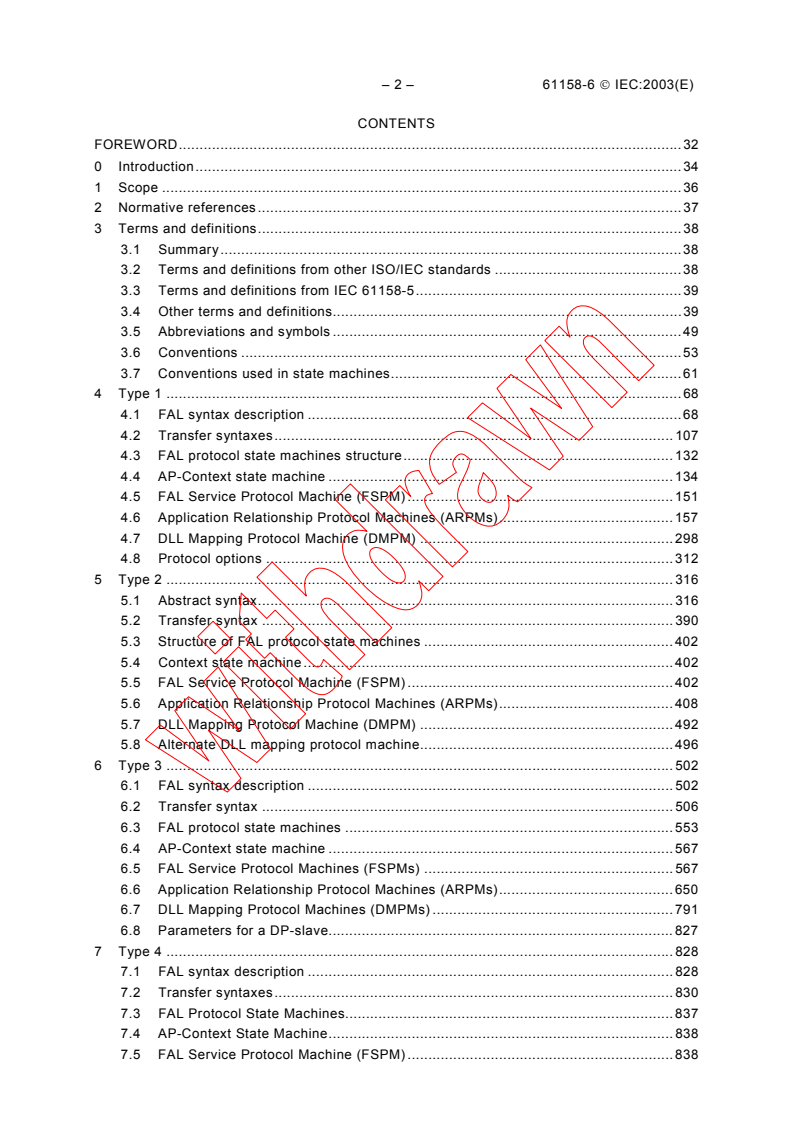
– 2 – 61158-6 IEC:2003(E)
CONTENTS
FOREWORD.32
0 Introduction.34
1 Scope .36
2 Normative references.37
3 Terms and definitions.38
3.1 Summary.38
3.2 Terms and definitions from other ISO/IEC standards .38
3.3 Terms and definitions from IEC 61158-5.39
3.4 Other terms and definitions.39
3.5 Abbreviations and symbols .49
3.6 Conventions .53
3.7 Conventions used in state machines.61
4 Type 1 .68
4.1 FAL syntax description .68
4.2 Transfer syntaxes.107
4.3 FAL protocol state machines structure.132
4.4 AP-Context state machine .134
4.5 FAL Service Protocol Machine (FSPM) .151
4.6 Application Relationship Protocol Machines (ARPMs).157
4.7 DLL Mapping Protocol Machine (DMPM) .298
4.8 Protocol options .312
5 Type 2 . 316
5.1 Abstract syntax.316
5.2 Transfer syntax .390
5.3 Structure of FAL protocol state machines .402
5.4 Context state machine.402
5.5 FAL Service Protocol Machine (FSPM) .402
5.6 Application Relationship Protocol Machines (ARPMs).408
5.7 DLL Mapping Protocol Machine (DMPM) .492
5.8 Alternate DLL mapping protocol machine.496
6 Type 3 . 502
6.1 FAL syntax description .502
6.2 Transfer syntax .506
6.3 FAL protocol state machines .553
6.4 AP-Context state machine .567
6.5 FAL Service Protocol Machines (FSPMs) .567
6.6 Application Relationship Protocol Machines (ARPMs).650
6.7 DLL Mapping Protocol Machines (DMPMs) .791
6.8 Parameters for a DP-slave.827
7 Type 4 . 828
7.1 FAL syntax description .828
7.2 Transfer syntaxes.830
7.3 FAL Protocol State Machines.837
7.4 AP-Context State Machine.838
7.5 FAL Service Protocol Machine (FSPM) .838
61158-6 IEC:2003(E) – 3 –
7.6 Application Relationship Protocol Machine (ARPM) .843
7.7 DLL Mapping Protocol Machine (DMPM) .846
7.8 Protocol options .849
8 Type 5 . 850
8.1 Overview .850
8.2 FAL Syntax Description .850
8.3 Transfer syntax .850
8.4 FAL Protocol State Machine Structure .899
8.5 SMK State Machine .899
8.6 VCR State Machine .914
8.7 FAL Service Protocol Machine (FSPM) .915
8.8 Application Relationship Protocol Machines (ARPMs).916
8.9 DLL Mapping Protocol Machine (DMPM) .930
9 Type 6 . 936
9.1 Reference.936
9.2 Usage of Parameters.936
9.3 AP Context State Tables .936
9.4 Application Relationship protocol machines (ARPMs) .936
9.5 DLL Mapping protocol machine (DMPM).952
10 Type 7 . 962
10.1 Abstract syntax of data type .962
10.2 Transfer Syntaxes .967
10.3 Structure of Protocol Machines. 1027
10.4 AP-Context state machine . 1028
10.5 Sub-MMS FAL Service Protocol Machine (FSPM). 1028
10.6 DLL Mapping Protocol Machine (DMPM) and Association Relationship
Protocol Machine (ARPM ) . 1033
10.7 Protocol options . 1081
11 Type 8 . 1101
11.1 FAL Syntax Description . 1101
11.2 Transfer Syntax . 1110
11.3 Protocol Machine Overview . 1118
11.4 AP-Context State Machine. 1119
11.5 FAL Service Protocol Machine (FSPM) . 1119
11.6 Application Relationship Protocol Machines (ARPMs). 1119
11.7 DLL Mapping Protocol Machine . 1128
12 Type 9 . 1139
12.1 FAL syntax description . 1139
12.2 Transfer Syntax . 1158
12.3 FAL Protocol State Machines Structure . 1167
12.4 VCR PM State Machine . 1170
12.5 AREP State Machines . 1182
13 Type 10. 1230
13.1 FAL Syntax Description . 1230
13.2 Transfer Syntax . 1247
13.3 FAL Protocol State Machines. 1247
– 4 – 61158-6 IEC:2003(E)
13.4 AP Context State Machine. 1248
13.5 FAL Service Protocol Machines (FSPM) . 1248
13.6 Application Relationship Protocol Machine (ARPM) . 1303
13.7 DLL Mapping Protocol Machine (DMPM) . 1306
13.8 Protocol Options. 1309
Figure 1 – Relationship of IEC 61158-6 to other fieldbus layers and to users of the
fieldbus Application service.34
Figure 2 – Attribute table format and terms .53
Figure 3 – Service request/response parameter .54
Figure 4 – Common structure of specific fields.58
Figure 5 – Example of an STD .63
Figure 6 – Example of an evaluation net .67
Figure 7 – APDU overview .108
Figure 8 – Identification information (format 1).108
Figure 9 – Identification information (format 2).109
Figure 10 – Identification information (format 3) .109
Figure 11 – Identification information (format 4) .109
Figure 12 – Coding of the data type BinaryDate .111
Figure 13 – Encoding of Time of Day value.111
Figure 14 – Encoding of Time Difference value .112
Figure 15 – Encoding Time value.112
Figure 16 – Encoding of data of data type DLTime-offset.113
Figure 17 – Structure of an object definition.114
Figure 18 – APDU overview .117
Figure 19 – Type field .117
Figure 20 – Identifier octet (context-specific) .118
Figure 21 – Identifier octet (FAL-specific) .118
Figure 22 – Length octet (one-octet format) .119
Figure 23 – Length octet (three-octet format) .119
Figure 24 – APDU overview .127
Figure 25 – Relationships among protocol machines and adjacent layers .133
Figure 26 – AP to AP-Context initiation state machine .135
Figure 27 – State transition diagram of FSPM.153
Figure 28 – State transition diagram of the QUU ARPM .160
Figure 29 – State transition diagram of QUB-CO ARPM.169
Figure 30 – State transition diagram of the QUB-CL ARPM.181
Figure 31 – State transition diagram of QUB-seg ARPM .191
Figure 32 – State transition diagram of QUB-FC ARPM .211
Figure 33 – State transition diagram of BUB ARPM.238
Figure 34 – State transition diagram of BNB ARPM (basic state machine) .254
Figure 35 – State transition diagram of BNB ARPM (confirmed service sending and
receiving – client) .255
Figure 36 – State transition diagram of BNB ARPM (confirmed service receiving and
responding – server).255
Figure 37 – State transition diagram of BNB ARPM (unconfirmed service sending- client) .255
Figure 38 – State transition diagram of the BNU ARPM .279
61158-6 IEC:2003(E) – 5 –
Figure 39 – State transition diagram of the BNU-MP ARPM .291
Figure 40 – State transition diagram of DMPM .304
Figure 41 – Primitives exchanged between protocol machines.313
Figure 42 – Primitives exchanged between protocol machines.314
Figure 43 – Primitives exchanged between protocol machines.315
Figure 44– Network connection parameters .333
Figure 45 – Time tick .335
Figure 46 – Connection establishment time-out.337
Figure 47 – Segment type.352
Figure 48 – Port segment.353
Figure 49 – Encapsulation message .377
Figure 50 – FixedLengthBitString compact encoding bit placement rules .394
Figure 51 – Example compact encoding of a OCTET FixedLengthBitString .394
Figure 52 – Example compact encoding of a WORD FixedLengthBitString.395
Figure 53 – Example compact encoding of a DWORD FixedLengthBitString .395
Figure 54 – Example compact encoding of a LWORD FixedLengthBitString.395
Figure 55 – Example 2 of formal encoding of a structure type specification.399
Figure 56 – Example of abbreviated encoding of a structure type specification .399
Figure 57 – Example 1 of formal encoding of an array type specification.400
Figure 58 – Example 2 of formal encoding of an array type specification.401
Figure 59 – Example 1 of abbreviated encoding of an array type specification .401
Figure 60 – Example 2 of abbreviated encoding of an array type specification .402
Figure 61 – State transition diagram of UCMM client.411
Figure 62 – State transition diagram of high–end UCMM server.413
Figure 63 – State transition diagram of low–end UCMM server .415
Figure 64 – Sequence diagram for a UCMM with one outstanding message.416
Figure 65 – Sequence diagram for a UCMM with multiple outstanding messages.417
Figure 66 – TPDU buffer .418
Figure 67 – Data flow diagram using a client transport class 0 and server transport class 0 420
Figure 68 – Sequence diagram of data transfer using transport class 0.421
Figure 69 – Class 0 client STD.422
Figure 70 – Class 0 server STD .423
Figure 71 – Data flow diagram using client transport class 1 and server transport class 1.424
Figure 72 – Sequence diagram of data transfer using client transport class 1 and server
transport class 1 .425
Figure 73 – Class 1 client STD.427
Figure 74 – Class 1 server STD .428
Figure 75 – Data flow diagram using client transport class 2 and server transport class 2.430
Figure 76 – Diagram of data transfer using client transport class 2 and server transport
class 2 without returned data .431
Figure 77 – Sequence diagram of data transfer using client transport class 2 and server
transport class 2 with returned data .432
Figure 78 – Class 2 client STD.434
Figure 79 – Class 2 server STD .436
Figure 80 – Data flow diagram using client transport class 3 and server transport class 3.439
Figure 81 – Sequence diagram of data transfer using client transport class 3
and server transport class 3 without returned data.440
– 6 – 61158-6 IEC:2003(E)
Figure 82 – Sequence diagram of data transfer using client transport class 3
and server transport class 3 with returned data.441
Figure 83 – Class 3 client STD.443
Figure 84 – Class 3 server STD .445
Figure 85 – Data flow diagram using transport classes 4 and 5.447
Figure 86 – Sequence diagram of message exchange using transport classes 4 and 5 .448
Figure 87 – Sequence diagram of messages overwriting each other .449
Figure 88 – Sequence diagram of queued message exchange using transport classes 4
and 5 .450
Figure 89 – Sequence diagram of retries using transport classes 4 and 5 .451
Figure 90 – Sequence diagram of idle traffic using transport classes 4 and 5.452
Figure 91 – Classes 4 and 5 basic structure.453
Figure 92 – Class 6 basic structure.454
Figure 93 – Classes 4 to 6 general STD.455
Figure 94 – Class 4 sender STD .457
Figure 95 – Class 4 receiver STD .460
Figure 96 – Sequence diagram of three fragments using transport class 5.463
Figure 97 – Sequence diagram of fragmentation with retries using transport class 5 .464
Figure 98 – Sequence diagram of two fragments using transport class 5 .465
Figure 99 – Sequence diagram of aborted message using transport class 5.465
Figure 100 – Class 5 sender STD .467
Figure 101 – Class 5 receiver STD .470
Figure 102 – Data flow diagram for transport class 6 .474
Figure 103 – Sequence diagram of message exchange using transport class 6 .476
Figure 104 – Sequence diagram of retries using transport class 6.476
Figure 105 – Sequence diagram of idle traffic using transport class 6 .477
Figure 106 – Sequence diagram of request overwriting null .478
Figure 107 – Sequence diagram of response overwriting ACK of null.479
Figure 108 – Sequence diagram of three fragments using transport class 6 .480
Figure 109 – Sequence diagram of fragmentation with retries using transport class 6 .481
Figure 110 – Sequence diagram of two fragments using transport class 6.482
Figure 111 – Sequence diagram of aborted fragmented sequence using transport class 6 .483
Figure 112 – Class 6 client STD.484
Figure 113 – Class 6 server STD .487
Figure 114 – Data flow diagram for a link producer and consumer .492
Figure 115 – State transition diagram for a link producer .495
Figure 116 – State transition diagram for a link consumer.496
Figure 117 – Coding of the data type BinaryDate .508
Figure 118 – Encoding of Time Of Day value .508
Figure 119 – Encoding of Time Difference value .508
Figure 120 – Encoding of Network Time value .509
Figure 121 – Encoding of Network Time Difference value .509
Figure 122 – Example Modul_Status_Array.514
Figure 123 – Example of Ext_Diag_Data in case of DPV1 diagnosis format with alarm
and status PDU.549
Figure 124 – Example of Ext_Diag_Data in case of the basic diagnosis format .550
Figure 125 – Example of a special identifier format.550
61158-6 IEC:2003(E) – 7 –
Figure 126 – Example of a special identifier format with data types.551
Figure 127 – Example of a special identifier format with data types.551
Figure 128 – Example of a empty slot with data types.551
Figure 129 – Example for multi-variable device with AI and DO function blocks .552
Figure 130 – Identifiers (ID) .552
Figure 131 – Identifier list .552
Figure 132 – Structure of the Data_Unit for the request- and response-DLPDU .553
Figure 133 – Structuring of the protocol machines and adjacent layers in a DP-slave .556
Figure 134 – Structuring of the protocol machines and adjacent layers in a DP-master
(class 1) .557
Figure 135 – Structuring of the protocol machines and adjacent layers in a DP-master
(class 2) .558
Figure 136 – Sequence of the communication between DP-master and DP-slave .560
Figure 137 – Sequence of communication between DP-master (class 2) and DP-master
(class 1) .562
Figure 138 – Sequence of acyclic communication between DP-master (class 1)
and DP-slave .563
Figure 139 – Example for connection establishment on MS2.565
Figure 140 – Idle at master-side on MS2.566
Figure 141 – Idle at slave-side on MS2 .567
Figure 142 – Example for connection establishment on MS2(server-side) .696
Figure 143 – Structure of RM entries in the RM_Registry.697
Figure 144 – APDU Header structure.830
Figure 145 – Instruction subfield of ControlStatus .830
Figure 146 – Errorcode subfield of ControlStatus .831
Figure 147 – Remaining subfields of ControlStatus .831
Figure 148 – DataFieldFormat encoding .832
Figure 149 – Structure of request APDU Body .832
Figure 150 – Structure of response APDU Body.832
Figure 151 – Variable Identifier.832
Figure 152 – Code subfield of Variable Identifier.833
Figure 153 – Summary of FAL Architecture.837
Figure 154 – FSPM proxy object state machine .839
Figure 155 – FSPM real object state machine .843
Figure 156 – ARPM State Machine .844
Figure 157 – DLPM State Machine.847
Figure 158 – State Transition Diagram for SMK .901
Figure 159 – State Transition Diagram of Client / Server ARPM.919
Figure 160 – State Transition diagram of the publisher / subscriber ARPM .926
Figure 161 – State transition diagram of DMPM .932
Figure 162 – State transition diagram of QUB-PC ARPM .940
Figure 163 – State transition diagram of the BNU-PC ARPM.950
Figure 164 – State transition diagram of DMPM .955
Figure 165 – Encoding of a CompactValue .967
Figure 166 – Organisation of the bits and octets within a PDU .968
Figure 167 – Encoding of a Bitstring .972
Figure 168 – Encoding of a Floating point .973
– 8 – 61158-6 IEC:2003(E)
Figure 169 – Encoding of a structure .974
Figure 170 – Encoding of a boolean array.975
Figure 171 – Representation of a MCS PDU .981
Figure 172 – Relationships among Protocol Machines and Adjacent Layers. 1027
Figure 173 – A_Readloc service evaluation net. 1033
Figure 174 – A_Writeloc service evaluation net. 1034
Figure 175 – A_Update service evaluation net . 1035
Figure 176 – A_Readfar service evaluation net . 1037
Figure 177 – A_writefar service evaluation net. 1039
Figure 178 – A_Sent service evaluation net . 1040
Figure 179 – A_Received service evaluation net. 1040
Figure 180 – Association establishment: Requester element state machine . 1047
Figure 181 – Association establishment: Responder element state machine . 1048
Figure 182 – Association termination: Requester element state machine . 1050
Figure 183 – Association termination: Responder element state machine . 1052
Figure 184 – Association revocation: Requester element state machine . 1053
Figure 185 – Association revocation: Acceptor element state machine. 1054
Figure 186 – Interactions between state machine in an associated mode data transfer . 1056
Figure 187 – Transfer service – Requester element state machine . 1060
Figure 188 – Transfer service: Acceptor element state machine. 1061
Figure 189 – Unacknowledged transfer: Requester element state machine . 1062
Figure 190 – Unacknowledged transfer: Acceptor element state machine . 1062
Figure 191 – Acknowledged transfer: Requester element state machine . 1064
Figure 192 – Acknowledged transfer: Acceptor element state machine . 1065
Figure 193 – Numbering mechanism state machine . 1066
Figure 194 – Retry machanism state machine. 1068
Figure 195 – Anticipation mechanism state machine . 1071
Figure 196 – Segmentation mechanism state machine. 1073
Figure 197 – Reassembly mechanism state machine . 1075
Figure 198 – Interaction of state machine in a non associated data transfer. 1077
Figure 199 – Unacknowledged transfer: Requester element state machine . 1078
Figure 200 – Unacknowledged transfer: Acceptor element state machine . 1078
Figure 201 – Acknowledged transfer: Requester element state machine . 1080
Figure 202 – Acknowledged transfer: Acceptor element state machine . 1081
Figure 203 – APDU overview . 1111
Figure 204 – APDU Header. 1111
Figure 205 – PDU withType Extension . 1111
Figure 206 – PDU with Address Extension . 1111
Figure 207 – PDU with Type and Length Extension. 1111
Figure 208 – Example of an Establish-Request PDU. 1112
Figure 209 – Encoding of a PRIVATE tagged value . 1112
Figure 210 – Encoding of a context specific tagged value . 1113
Figure 211 – Identification information fields . 1113
Figure 212 – ID-info for Tag 0 . 14 , Length entry 0 . 6. 1113
Figure 214 – ID-info for Tag 15 . 255 , Length entry 0 . 6. 1113
Figure 215 – ID-info for Tag 0 . 14 , Length entry 7 . 255. 1113
61158-6 IEC:2003(E) – 9 –
Figure 216 – ID-info for Tag 15 . 255 , Length entry 7 . 255 . 1114
Figure 217 – Encoding of Boolean value TRUE. 1114
Figure 218 – Encoding of Boolean value FALSE . 1114
Figure 219 – Encoding of Strings . 1114
Figure 220 – Encoding of BinaryDate Value . 1115
Figure 221 – Encoding of BinaryDate2000 Value . 1115
Figure 222 – Encoding of Time of Day value. 1116
Figure 223 – Encoding of Time Difference Value. 1116
Figure 224 – Encoding of Time Value . 1117
Figure 225 – Example for an Object Definition . 1118
Figure 226 – Primitives Exchanged between Protocol Machines . 1119
Figure 227 – State Transition Diagram of QUB-TM AREP . 1126
Figure 228 – State transition diagram of Type-8 DMPM . 1131
Figure 229 – Structure of an object description in the OD . 1154
Figure 230 – Structure of the OD object description . 1154
Figure 231 – Structure of a domain entry in the S-OD . 1154
Figure 232 – Object description of program invocation in the DP-OD . 1154
Figure 233 – Object description of simple variable in the S-OD . 1154
Figure 234 – Object description of array in the S-OD . 1154
Figure 235 – Object description of record in the S-OD . 1155
Figure 236 – Object description of variable list in the DV-OD . 1155
Figure 237 – Object description of data type in the ST-OD. 1155
Figure 238 – Object description of data type structure description in the ST-OD . 1155
Figure 239 – Object description of event in the S-OD. 1155
Figure 240 – Insertion of identification information in the FMS PDU . 1158
Figure 241 – Coding of the ID info with and without extension . 1160
Figure 242 – Coding with identification . 1160
Figure 243 – Coding without identification. 1160
Figure 244 – Representation of the value true. 1160
Figure 245 – Representation of the value false . 1160
Figure 246 – Coding of data of data type Integer16. 1161
Figure 247 – Coding of data of data type Unsigned16 . 1161
Figure 248 – Coding of data of data type Floating Point. 1162
Figure 249 – Coding of data of data type Visible String. 1162
Figure 250 – Coding of data of data type Octet String. 1162
Figure 251 – Coding of data of data type Date . 1163
Figure 252 – Coding of data of data type Time Of Day. 1164
Figure 253 – Coding of data of data type Time Difference. 1164
Figure 254 – Coding of data of data ty
...