

IEC 61158-6-10:2007
(Main)Industrial communication networks - Fieldbus specifications - Part 6-10: Application layer protocol specification - Type 10 elements
General Information
- Abstract
It provides user programs with a means to access the fieldbus communication environment. In this respect, the FAL can be viewed as a "window between corresponding application programs." This standard provides common elements for basic time-critical and non-time-critical messaging communications between application programs in an automation environment and material specific to Type 2 fieldbus. The term "time-critical" is used to represent the presence of a time-window, within which one or more specified actions are required to be completed with some defined level of certainty. Failure to complete specified actions within the time window risks failure of the applications requesting the actions, with attendant risk to equipment, plant and possibly human life. It includes the following significant changes from the previous edition deletion of the former Type 6 fieldbus for lack of market relevance; addition of new types of fieldbuses; partition of part 6 of the third edition into multiple parts numbered.
- Status
- Published
- Publication Date
- 13-Dec-2007
- Technical Committee
- SC 65C - Industrial networks
- Drafting Committee
- WG 9 - TC 65/SC 65C/WG 9
- Current Stage
- DELPUB - Deleted Publication
- Start Date
- 06-Aug-2010
- Completion Date
- 28-Aug-2026
Overview
IEC 61158-6-10:2007 is an international standard published by the International Electrotechnical Commission (IEC). It specifies the application layer protocol for industrial communication networks, specifically focusing on fieldbus systems. This part-Part 6-10-addresses the protocol requirements for Type 10 elements, detailing a functional application layer (FAL) that serves as an interface, or "window," between user programs and the fieldbus communication environment.
The standard establishes a unified set of services and protocol elements that enable basic time-critical and non-time-critical messaging between application programs within automation environments. Crucially, it aims to ensure reliable communication within stringent timing requirements-a necessity for safe and efficient plant and equipment operations.
Key Topics
- Application Layer Protocols: Defines syntax, semantics, and operational requirements for Type 10 fieldbus application layers, including both messaging and data exchange.
- Time-Critical Communications: Establishes mechanisms to ensure messages are delivered and processed within predefined time windows, reducing risks to equipment, processes, or personnel.
- Non-Time-Critical Messaging: Supports general data communications not requiring strict timing, enabling flexibility for less urgent automation tasks.
- Functional Application Layer (FAL): Acts as an intermediary, providing a standardized approach for application programs to interact with the underlying fieldbus network.
- State Machines and Protocol Structures: Specifies consistent models for protocol operation that ensure predictable behavior in industrial environments.
- Configuration and Discovery: Details protocols supporting device discovery, initial configuration, and dynamic adaptation within fieldbus networks.
- Media Redundancy and Reliability: Incorporates specifications for redundant communication paths to increase system availability and fault tolerance.
Applications
IEC 61158-6-10:2007 is widely applicable within the domain of industrial automation and process control networks. Key application areas include:
- Manufacturing Automation: Enhances real-time communication between controllers, sensors, and actuators, supporting seamless coordination of automated machinery.
- Process Control Systems: Facilitates robust and reliable data transfer in critical environments such as chemical, pharmaceutical, and energy production facilities.
- Distributed Control Systems (DCS): Enables efficient and scalable network architectures by standardizing the application layer across diverse devices and vendors.
- Safety-Critical Automation: Ensures that timing requirements for essential operations are met, minimizing potential risks and safeguarding both personnel and equipment.
- System Integration: Supports interoperability and integration of devices from various manufacturers, reducing engineering effort when designing or upgrading automation systems.
By specifying clear and common communication elements at the application layer, the standard provides a solid foundation for interoperability and long-term maintainability within complex industrial networks.
Related Standards
To achieve comprehensive industrial communication solutions, IEC 61158-6-10:2007 is best used alongside other pivotal standards in the IEC 61158 family and associated industrial communication frameworks:
- IEC 61158 (All Parts): The complete fieldbus specification series, covering physical, data-link, and application layers for various fieldbus types.
- IEC 61508: Functional safety standard frequently referenced in the design of safety-related systems.
- IEC 61784: Provides profiles for communication networks in industrial control systems, complementing IEC 61158 with user profile definitions.
- ISO/IEC 7498: The international reference model for Open Systems Interconnection (OSI), foundational for layered communication architectures such as those in IEC 61158.
- IEC 61850: Specific to communication networks and systems in substations, often linked to fieldbus technologies in broader automation environments.
These related standards, in conjunction with IEC 61158-6-10, support robust, interoperable, and safe communication infrastructure for modern industrial automation systems.
Keywords: IEC 61158-6-10, fieldbus specification, industrial communication networks, application layer protocol, automation environment, time-critical messaging, industrial networking standard, manufacturing automation, process control, interoperability.
Relations
- Effective Date
- 05-Sep-2023
- Effective Date
- 05-Sep-2023
- Effective Date
- 05-Sep-2023
- Effective Date
- 05-Sep-2023
Get Certified
Connect with accredited certification bodies for this standard

BSI Group
BSI (British Standards Institution) is the business standards company that helps organizations make excellence a habit.

DVS-ZERT GmbH
German welding certification society.
CARES (UK Certification Authority for Reinforcing Steels)
UK certification for reinforcing steels and construction.
Sponsored listings
Frequently Asked Questions
IEC 61158-6-10:2007 is a standard published by the International Electrotechnical Commission (IEC). Its full title is "Industrial communication networks - Fieldbus specifications - Part 6-10: Application layer protocol specification - Type 10 elements". This standard covers: It provides user programs with a means to access the fieldbus communication environment. In this respect, the FAL can be viewed as a "window between corresponding application programs." This standard provides common elements for basic time-critical and non-time-critical messaging communications between application programs in an automation environment and material specific to Type 2 fieldbus. The term "time-critical" is used to represent the presence of a time-window, within which one or more specified actions are required to be completed with some defined level of certainty. Failure to complete specified actions within the time window risks failure of the applications requesting the actions, with attendant risk to equipment, plant and possibly human life. It includes the following significant changes from the previous edition deletion of the former Type 6 fieldbus for lack of market relevance; addition of new types of fieldbuses; partition of part 6 of the third edition into multiple parts numbered.
It provides user programs with a means to access the fieldbus communication environment. In this respect, the FAL can be viewed as a "window between corresponding application programs." This standard provides common elements for basic time-critical and non-time-critical messaging communications between application programs in an automation environment and material specific to Type 2 fieldbus. The term "time-critical" is used to represent the presence of a time-window, within which one or more specified actions are required to be completed with some defined level of certainty. Failure to complete specified actions within the time window risks failure of the applications requesting the actions, with attendant risk to equipment, plant and possibly human life. It includes the following significant changes from the previous edition deletion of the former Type 6 fieldbus for lack of market relevance; addition of new types of fieldbuses; partition of part 6 of the third edition into multiple parts numbered.
IEC 61158-6-10:2007 is classified under the following ICS (International Classification for Standards) categories: 25.040.40 - Industrial process measurement and control; 35.100.20 - Data link layer. The ICS classification helps identify the subject area and facilitates finding related standards.
IEC 61158-6-10:2007 has the following relationships with other standards: It is inter standard links to IEC 61158-6:2003/COR1:2004, IEC 61158-6:2003, IEC PAS 62411:2005, IEC 61158-6-10:2010. Understanding these relationships helps ensure you are using the most current and applicable version of the standard.
IEC 61158-6-10:2007 is available in PDF format for immediate download after purchase. The document can be added to your cart and obtained through the secure checkout process. Digital delivery ensures instant access to the complete standard document.
Standards Content (Sample)
IEC 61158-6-10
Edition 1.0 2007-12
INTERNATIONAL
STANDARD
Industrial communication networks – Fieldbus specifications –
Part 6-10: Application layer protocol specification – Type 10 elements
All rights reserved. Unless otherwise specified, no part of this publication may be reproduced or utilized in any form
or by any means, electronic or mechanical, including photocopying and microfilm, without permission in writing from
either IEC or IEC's member National Committee in the country of the requester.
If you have any questions about IEC copyright or have an enquiry about obtaining additional rights to this publication,
please contact the address below or your local IEC member National Committee for further information.
IEC Central Office
3, rue de Varembé
CH-1211 Geneva 20
Switzerland
Email: inmail@iec.ch
Web: www.iec.ch
About the IEC
The International Electrotechnical Commission (IEC) is the leading global organization that prepares and publishes
International Standards for all electrical, electronic and related technologies.
About IEC publications
The technical content of IEC publications is kept under constant review by the IEC. Please make sure that you have the
latest edition, a corrigenda or an amendment might have been published.
ƒ Catalogue of IEC publications: www.iec.ch/searchpub
The IEC on-line Catalogue enables you to search by a variety of criteria (reference number, text, technical committee,…).
It also gives information on projects, withdrawn and replaced publications.
ƒ IEC Just Published: www.iec.ch/online_news/justpub
Stay up to date on all new IEC publications. Just Published details twice a month all new publications released. Available
on-line and also by email.
ƒ Electropedia: www.electropedia.org
The world's leading online dictionary of electronic and electrical terms containing more than 20 000 terms and definitions
in English and French, with equivalent terms in additional languages. Also known as the International Electrotechnical
Vocabulary online.
ƒ Customer Service Centre: www.iec.ch/webstore/custserv
If you wish to give us your feedback on this publication or need further assistance, please visit the Customer Service
Centre FAQ or contact us:
Email: csc@iec.ch
Tel.: +41 22 919 02 11
Fax: +41 22 919 03 00
IEC 61158-6-10
Edition 1.0 2007-12
INTERNATIONAL
STANDARD
Industrial communication networks – Fieldbus specifications –
Part 6-10: Application layer protocol specification – Type 10 elements
INTERNATIONAL
ELECTROTECHNICAL
COMMISSION
PRICE CODE
XH
ICS 35.100.70; 25.040.40 ISBN 2-8318-9485-9
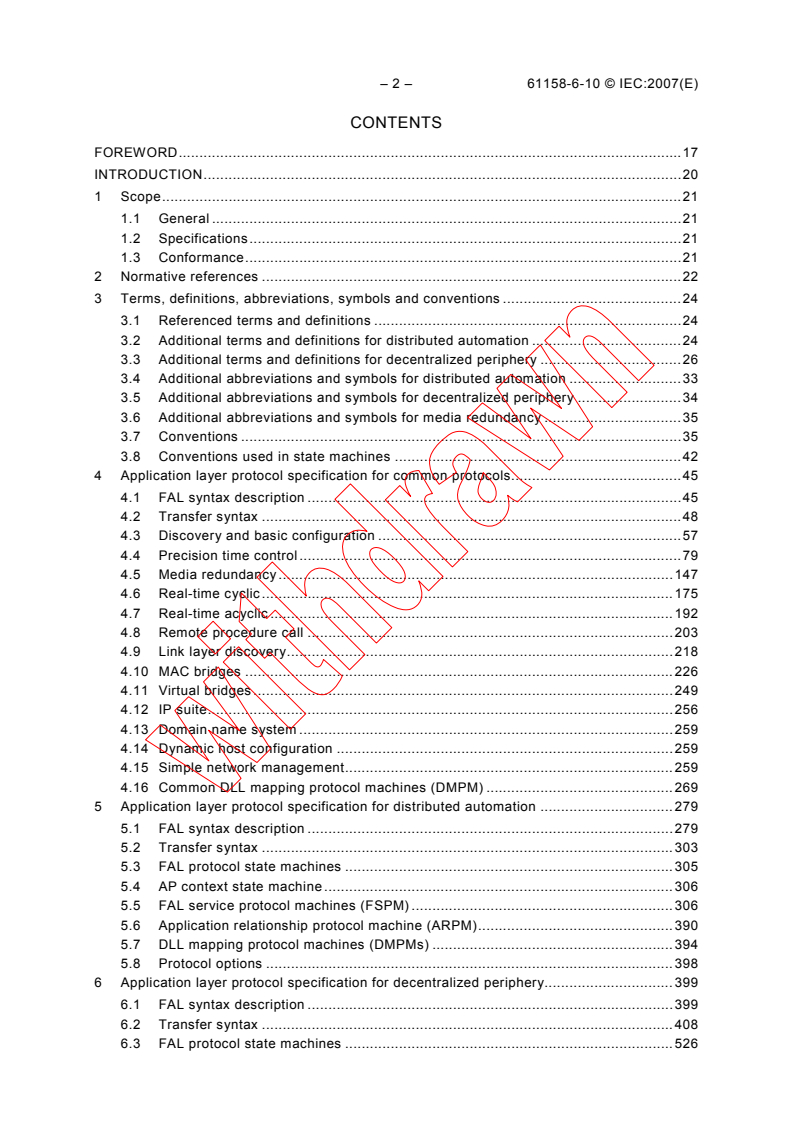
– 2 – 61158-6-10 © IEC:2007(E)
CONTENTS
FOREWORD.17
INTRODUCTION.20
1 Scope.21
1.1 General .21
1.2 Specifications.21
1.3 Conformance.21
2 Normative references .22
3 Terms, definitions, abbreviations, symbols and conventions .24
3.1 Referenced terms and definitions .24
3.2 Additional terms and definitions for distributed automation .24
3.3 Additional terms and definitions for decentralized periphery .26
3.4 Additional abbreviations and symbols for distributed automation .33
3.5 Additional abbreviations and symbols for decentralized periphery .34
3.6 Additional abbreviations and symbols for media redundancy .35
3.7 Conventions .35
3.8 Conventions used in state machines .42
4 Application layer protocol specification for common protocols.45
4.1 FAL syntax description .45
4.2 Transfer syntax .48
4.3 Discovery and basic configuration .57
4.4 Precision time control.79
4.5 Media redundancy.147
4.6 Real-time cyclic.175
4.7 Real-time acyclic .192
4.8 Remote procedure call .203
4.9 Link layer discovery.218
4.10 MAC bridges .226
4.11 Virtual bridges .249
4.12 IP suite.256
4.13 Domain name system .259
4.14 Dynamic host configuration .259
4.15 Simple network management.259
4.16 Common DLL mapping protocol machines (DMPM) . 269
5 Application layer protocol specification for distributed automation . 279
5.1 FAL syntax description .279
5.2 Transfer syntax .303
5.3 FAL protocol state machines .305
5.4 AP context state machine .306
5.5 FAL service protocol machines (FSPM) . 306
5.6 Application relationship protocol machine (ARPM). 390
5.7 DLL mapping protocol machines (DMPMs) .394
5.8 Protocol options .398
6 Application layer protocol specification for decentralized periphery. 399
6.1 FAL syntax description .399
6.2 Transfer syntax .408
6.3 FAL protocol state machines .526
61158-6-10 © IEC:2007(E) – 3 –
6.4 AP-Context state machine .527
6.5 FAL service protocol machines (FSPMs) . 527
6.6 Application relationship protocol machines (ARPMs) . 592
6.7 DLL mapping protocol machines (DMPMs) .683
Annex A (informative) Filtering data base (FDB) . 684
Annex B (informative) Establishing of a companion AR .687
Annex C (informative) Establishing of a device access AR. 688
Annex D (informative) Establishing of an AR (simple procedure). 689
Annex E (informative) Establishing of an AR (accelerated procedure). 690
Annex F (informative) Establishing of an AR (fast startup procedure). 692
Annex G (informative) Example of the upload, storage, and retrieval procedure. 693
Bibliography.695
Figure 1 – Common structure of specific fields.39
Figure 2 – Common structure of specific fields for octet 1 (high) .40
Figure 3 – Common structure of specific fields for octet 2 (low) .40
Figure 4 – Common structure of specific fields for octet 1 (high) .41
Figure 5 – Common structure of specific fields for octet 2 .41
Figure 6 – Common structure of specific fields for octet 3 .41
Figure 7 – Common structure of specific fields for octet 4 (low) .42
Figure 8 – Coding of the data type BinaryDate.49
Figure 9 – Encoding of Time Of Day value .50
Figure 10 – Encoding of Time Difference value .50
Figure 11 – Encoding of Network Time value .51
Figure 12 – Encoding of Network Time Difference value .51
Figure 13 – Timescale correspondence between PTCP_Time and CycleCounter .85
Figure 14 – Message timestamp point.88
Figure 15 – Four message timestamps .88
Figure 16 – Line delay protocol with follow up.89
Figure 17 – Line delay protocol without follow up .89
Figure 18 – Line delay measurement .91
Figure 19 – Model parameter for GSDML usage .92
Figure 20 – Bridge delay measurement.93
Figure 21 – Delay accumulation.93
Figure 22 – Worst case accumulated time deviation of synchronization .94
Figure 23 – Scheme for measurement of deviation .94
Figure 24 – Measurement of deviation .95
Figure 25 – Sending Sync-Frame without Follow Up-Frame .95
Figure 26 – Sending Sync-Frame with FollowUp-Frame .96
Figure 27 – Forwarding Sync- and FollowUp-Frame.96
Figure 28 – Transition between Synchronization Variants .97
Figure 29 – State transition diagram of delay request .98
Figure 30 – State transition diagram of delay response.106
Figure 31 – Overview of PTCP.112
– 4 – 61158-6-10 © IEC:2007(E)
Figure 32 – State transition diagram of BMA . 113
Figure 33 – State transition diagram of MSM . 130
Figure 34 – State transition diagram of BRC . 140
Figure 35 – State transition diagram of SRX .144
Figure 36 – MRM protocol machine for MRP .152
Figure 37 – MRC protocol machine .158
Figure 38 – MRM protocol machine.167
Figure 39 – MRC protocol machine for MRRT .173
Figure 40 – Structure of the CycleCounter .177
Figure 41 – Structuring of the protocol machines within the DMPM (bridge) . 270
Figure 42 – Error message structure.279
Figure 43 – Coding scheme of ITEMQUALITYDEF.284
Figure 44 – Relationship among protocol machines . 306
Figure 45 – State transition diagram of FSPM.320
Figure 46 – State transition diagram of ARPM . 392
Figure 47 – State transition diagram of DMPM .397
Figure 48 – Classification of diagnosis, maintenance and qualified . 473
Figure 49 – Definition of PLL window .486
Figure 50 – Detection of dropped frames — appear .495
Figure 51 – Detection of dropped frames — disappear.495
Figure 52 – Relationship among Protocol Machines . 526
Figure B.1 – Establishing of a companion AR .687
Figure C.1 – Establishing of a device access AR .688
Figure D.1 – Accelerated establishing of an IOAR (simple procedure). 689
Figure E.1 – Accelerated establishing of an IOAR without error . 690
Figure E.2 – Accelerated establishing of an IOAR with “late” error . 691
Figure F.1 – Establishing of an IOAR using fast startup .692
Figure G.1 – Example of upload with storage.693
Figure G.2 – Example of retrieval with storage.694
Table 1 – State machine description elements .42
Table 2 – Description of state machine elements .43
Table 3 – Conventions used in state machines .43
Table 4 – IEEE 802.3 DLPDU syntax .45
Table 5 – IEEE 802.11 DLPDU syntax .46
Table 6 – IEEE 802.15.1 DLPDU syntax .46
Table 7 – SourceAddress.52
Table 8 – DCP_MulticastMACAdd.52
Table 9 – PTCP_MulticastMACAdd.53
Table 10 – MRP OUI.53
Table 11 – MRPMulticastMACAdd .54
Table 12 – MRRTMulticastMACAdd .54
Table 13 – LT (Length/Type).54
61158-6-10 © IEC:2007(E) – 5 –
Table 14 – TagControlInformation.Priority.55
Table 15 – FrameID range 1 .55
Table 16 – FrameID range 2 .55
Table 17 – FrameID range 3 .56
Table 18 – FrameID range 4 .56
Table 19 – FrameID range 5 .56
Table 20 – FrameID range 6 .56
Table 21 – FrameID range 7 .57
Table 22 – FrameID range 8 .57
Table 23 – FrameID range 9 .57
Table 24 – DCP APDU syntax.58
Table 25 – DCP substitutions.59
Table 26 – ServiceID .61
Table 27 – ServiceType for request .61
Table 28 – ServiceType for response.61
Table 29 – List of options.62
Table 30 – List of suboptions .63
Table 31 – SuboptionDHCP .65
Table 32 – BlockQualifier with option IP.66
Table 33 – BlockQualifier with option DeviceProperties, DHCP, and
ManufacturerSpecific .66
Table 34 – BlockError .66
Table 35 – BlockInfo for SuboptionIPParameter.67
Table 36 – Bit 1 and Bit 0 of BlockInfo for SuboptionIPParameter .67
Table 37 – Bit 7 of BlockInfo for SuboptionIPParameter.67
Table 38 – BlockInfo for all other suboptions .67
Table 39 – DeviceInitiativeValue .67
Table 40 – SignalValue.68
Table 41 – DeviceRoleDetails .69
Table 42 – IPAddress .69
Table 43 – Subnetmask .70
Table 44 – StandardGateway.70
Table 45 – DCPUCS state table.73
Table 46 – DCPUCR state table.75
Table 47 – DCPMCS state table .77
Table 48 – DCPMCR state table .79
Table 49 – PTCP APDU syntax.80
Table 50 – PTCP substitutions.80
Table 51 – PTCP_TLVHeader.Type .81
Table 52 – PTCP_Delay10ns .81
Table 53 – PTCP_Delay1ns.Value .82
Table 54 – PTCP_Delay1ns.Sign .82
Table 55 – PTCP_CumulativeFrequencyOffset .82
– 6 – 61158-6-10 © IEC:2007(E)
Table 56 – PTCP_SequenceID .83
Table 57 – PTCP_SubType for OUI (=00-0E-CF) .83
Table 58 – PTCP_NanoSeconds.83
Table 59 – PTCP_Flags.LeapSecond.84
Table 60 – Timescale correspondence between MJD, UTC, and PTCP_EpochNumber .84
Table 61 – Timescale correspondence between PTCP_EpochNumber, PTCP_Second,
PTCP_Nanosecond, CycleCounter, and SendClockFactor.84
Table 62 – PTCP_ClockStratum.86
Table 63 – PTCP_ClockRole.86
Table 64 – PTCP_RequestPortID.87
Table 65 – PTCP_SyncID .87
Table 66 – PTCP_T2TimeStamp.87
Table 67 – DelayRequest state table .100
Table 68 – Macros used by DelayRequest .104
Table 69 – Functions used by DelayRequest .105
Table 70 – DelayResponse state table.107
Table 71 – Macros used by DelayResponse.110
Table 72 – Functions used by DelayResponse.111
Table 73 – BMA state table.115
Table 74 – BMA state table – check remote .122
Table 75 – BMA state table – check local vs. remote . 123
Table 76 – Macros used by BMA.125
Table 77 – Functions used by BMA.127
Table 78 – BMA_Sync_Ind.127
Table 79 – BMA_Announce_Ind .128
Table 80 – MSM state table .131
Table 81 – Macros used by MSM .136
Table 82 – Functions used by MSM .137
Table 83 – MSM_Role_Ind.137
Table 84 – MSM_Sync .138
Table 85 – MSM_Announce .139
Table 86 – BRC state table .141
Table 87 – Macros used by BRC.143
Table 88 – Macros used by the BRC .143
Table 89 – BRC_Sync_Ind.143
Table 90 – SRX state table .145
Table 91 – Functions used by SRX .146
Table 92 – MRP APDU syntax .147
Table 93 – MRP substitutions .147
Table 94 – MRP_TLVHeader.Type.148
Table 95 – MRP_Prio.148
Table 96 – MRP_PortRole .148
Table 97 – MRP_RingState.149
61158-6-10 © IEC:2007(E) – 7 –
Table 98 – MRP_Interval .149
Table 99 – MRP_Transition.149
Table 100 – MRP_TimeStamp .149
Table 101 – MRP_DomainUUID.150
Table 102 – MRRT APDU syntax .150
Table 103 – MRRT substitutions .150
Table 104 – MRRT_TLVHeader.Type.151
Table 105 – MRRT_DomainUUID.151
Table 106 – Local variables of MRM protocol machine. 153
Table 107 – MRM state machine.153
Table 108 – Local variables of MRC protocol machine .159
Table 109 – MRC state machine .159
Table 110 – Functions .164
Table 111 – FDB Clear Timer .166
Table 112 – Topology Change Timer .166
Table 113 – Local variables of MRM Protocol Machine for MRRT Activation . 168
Table 114 – MRM state machine for MRRT Activation. 168
Table 115 – MRC state machine for MRRT Activation .174
Table 116 – MRM and MRC functions .175
Table 117 – RTC APDU syntax .176
Table 118 – RTC substitutions .176
Table 119 – CycleCounter Difference.177
Table 120 – DataStatus.State .178
Table 121 – DataStatus.DataValid .178
Table 122 – DataStatus.ProviderState .178
Table 123 – DataStatus.StationProblemIndicator . 178
Table 124 – TransferStatus for RT_CLASS_3 .179
Table 125 – IOxS.Extension.180
Table 126 – IOCS.Instance .180
Table 127 – IOxS.DataState .180
Table 128 – PPM state table .182
Table 129 – Functions used by the PPM .185
Table 130 – CPM state table.186
Table 131 – Functions used by the CPM.192
Table 132 – RTA APDU syntax .192
Table 133 – RTA substitutions .193
Table 134 – PDUType.Type .193
Table 135 – PDUType.Version.194
Table 136 – APMS state table.196
Table 137 – Functions used by the APMS and APMR .199
Table 138 – A_Timer_add.199
Table 139 – A_Timer_event .200
Table 140 – A_Timer_remove .200
– 8 – 61158-6-10 © IEC:2007(E)
Table 141 – APMR state table .201
Table 142 – RPC APDU syntax.203
Table 143 – RPC substitutions.204
Table 144 – RPCPacketType .205
Table 145 – RPCFlags.205
Table 146 – RPCFlags2 .206
Table 147 – RPCDRep.Character- and IntegerEncoding . 206
Table 148 – RPCDRep Octet 2 – Floating Point Representation . 206
Table 149 – RPCObjectUUID.Data4.207
Table 150 – RPCObjectUUID – defined values .207
Table 151 – RPCInterfaceUUID – defined values.208
Table 152 – RPCOperationNmb (IO device, controller and supervisor) . 209
Table 153 – RPCOperationNmb for endpoint mapper.209
Table 154 – RPCDataRepresentationUUID – defined values.211
Table 155 – RPCInquiryType .212
Table 156 – RPCEPMapStatus .214
Table 157 – Values of NCAFaultStatus .216
Table 158 – Values of NCARejectStatus .217
Table 159 – LLDP APDU syntax .218
Table 160 – LLDP substitutions .219
Table 161 – LLDP_PNIO_SubType .220
Table 162 – PTCP_PortRxDelayLocal.221
Table 163 – PTCP_PortRxDelayRemote .221
Table 164 – PTCP_PortTxDelayLocal .221
Table 165 – PTCP_PortTxDelayRemote .221
Table 166 – CableDelayLocal .222
Table 167 – RTClass2_PortStatus.State .222
Table 168 – RTClass3_PortStatus.State .222
Table 169 – RTClass3_PortStatus.Mode.223
Table 170 – MRRT_PortStatus.State .223
Table 171 – LLDP_RedPeriodBegin.Offset .223
Table 172 – LLDP_RedPeriodBegin.Valid .223
Table 173 – LLDP_OrangePeriodBegin.Offset .224
Table 174 – LLDP_OrangePeriodBegin.Valid .224
Table 175 – LLDP_GreenPeriodBegin.Offset .224
Table 176 – LLDP_GreenPeriodBegin.Valid.224
Table 177 – LLDP_LengthOfPeriod.Length .225
Table 178 – LLDP_LengthOfPeriod.Valid .225
Table 179 – IFW state table .227
Table 180 – IFW function table .233
Table 181 – S_FW state table.235
Table 182 – S_FW function table .238
Table 183 – S_FU_FW state table .241
61158-6-10 © IEC:2007(E) – 9 –
Table 184 – S_FU_FW function table.245
Table 185 – Primitives issued by LMPM to MMAC .249
Table 186 – Primitives issued by MMAC to LMPM .249
Table 187 – Primitives issued by MMAC to MAC.249
Table 188 – Primitives issued by MAC to MMAC.250
Table 189 – MMAC state table .251
Table 190 – MMAC function table .255
Table 191 – IP/UDP APDU syntax .257
Table 192 – IP/UDP substitutions .257
Table 193 – UDP_SrcPort.258
Table 194 – UDP_DstPort.258
Table 195 – IP_DstIPAddress .258
Table 196 – IP Multicast DstIPAddress according to RFC 2365 . 258
Table 197 – Enterprise number.259
Table 198 – LMPM state table .271
Table 199 – LMPM macros table.275
Table 200 – LMPM function table.279
Table 201 – Error messages .280
Table 202 – VARTYPE values.283
Table 203 – ITEMQUALITYDEF values.284
Table 204 – STATEDEF values.287
Table 205 – GROUPERRORDEF values .287
Table 206 – ACCESSRIGHTSDEF values.288
Table 207 – PERSISTDEF values .288
Table 208 – UUID values .291
Table 209 – Data format for serialized connection data.304
Table 210 – Calculation of the RT reference data size . 305
Table 211 – Primitives issued by FAL User to FSPM.307
Table 212 – Primitives issued by FSPM to FAL User.314
Table 213 – FSPM state descriptions.320
Table 214 – FSPM state table.321
Table 215 – Primitives issued by FSPM to ARPM .391
Table 216 – Primitives issued by ARPM to FSPM .391
Table 217 – Parameters used with primitives exchanged between FSPM and ARPM . 392
Table 218 – ARPM state descriptions .392
Table 219 – ARPM state table .393
Table 220 – Primitives issued by ARPM to DMPM .394
Table 221 – Primitives issued by DMPM to ARPM .395
Table 222 – Parameters used with primitives exchanged between ARPM and DMPM . 395
Table 223 – Primitives issued by DMPM to ORPC model .396
Table 224 – Primitives issued by ORPC model to DMPM .396
Table 225 – Parameters used with primitives exchanged between DMPM
...