

IEC 60505:2011
(Main)Evaluation and qualification of electrical insulation systems
General Information
- Abstract
IEC 60505:2011 establishes the basis for estimating the ageing of electrical insulation systems (EIS) under conditions of either electrical, thermal, mechanical, environmental stresses or combinations of these (multifactor stresses). It specifies the principles and procedures that shall be followed, during the development of EIS functional test and evaluation procedures, to establish the estimated service life for a specific EIS. This standard should be used by all IEC technical committees responsible for equipment having an EIS. The contents of the corrigendum of March 2017 have been included in this copy.
- Status
- Published
- Publication Date
- 10-Jul-2011
- Technical Committee
- TC 112 - Evaluation and qualification of electrical insulating materials and systems
- Drafting Committee
- WG 6 - TC 112/WG 6
- Current Stage
- PPUB - Publication issued
- Start Date
- 11-Jul-2011
- Completion Date
- 15-Jul-2011



Overview
IEC 60505:2011 - Evaluation and qualification of electrical insulation systems - defines a harmonized framework for estimating the ageing and establishing the service life of electrical insulation systems (EIS). The standard addresses ageing caused by electrical, thermal, mechanical and environmental stresses, including multifactor (combined) stresses, and specifies the principles and procedures to be followed when developing EIS functional tests and evaluation methods. This edition incorporates the corrigendum of March 2017.
Key topics
- Ageing mechanisms and stress categories - guidance on evaluating how electrical, thermal, mechanical and environmental stresses (alone or combined) affect insulation performance over time.
- Principles for test development - procedural requirements for designing functional and accelerated ageing tests that produce data suitable for lifetime estimation.
- Service life estimation - methods and procedural steps to translate test results into an estimated service life for a specific EIS (qualitative and quantitative reporting expectations).
- Qualification and pass/fail criteria - how to define acceptance limits, failure modes to monitor, and documentation needed to support qualification decisions.
- Multifactor stress assessment - emphasis on combined-stress test sequences and interaction effects when single-stress tests are insufficient.
- Traceability and reporting - requirements for test records, sample selection, environmental control and statistical interpretation to support reproducible qualification outcomes.
Applications
IEC 60505:2011 provides practical value across the insulation lifecycle:
- Manufacturers of motors, transformers, generators, cables and other electrical equipment use it to design and qualify insulation systems and to define accelerated ageing tests.
- Test laboratories adopt its principles to develop reproducible functional test programs and to report credible service-life estimates.
- Certification bodies and compliance teams use it to assess insulation qualification evidence submitted for product approvals.
- R&D and materials engineers rely on the standard when comparing insulation materials, validating new formulations, or investigating failure root causes.
- Asset owners and maintenance planners use service-life estimates to inform replacement schedules and reliability planning.
Who should use this standard
- IEC technical committees responsible for equipment that contains EIS
- Insulation system designers and material suppliers
- Accredited test laboratories and certification bodies
- Electrical equipment manufacturers and reliability engineers
Related standards
For a complete qualification program, IEC 60505 is typically used alongside other insulation and ageing references such as IEC 60216 (thermal endurance of insulating materials) and IEC 60085 (thermal classification of insulating materials), and the specific product standards relevant to the equipment under test. Consult the applicable IEC technical committee for normative references.
Keywords: IEC 60505:2011, electrical insulation systems, insulation ageing, service life estimation, multifactor stresses, insulation qualification, functional test development.
Relations
- Corrected By
IEC 60505:2011/COR1:2017 - Corrigendum 1 - Evaluation and qualification of electrical insulation systems - Effective Date
- 05-Sep-2023
- Effective Date
- 05-Sep-2023
Get Certified
Connect with accredited certification bodies for this standard

IMQ S.p.A. (Certification)
Italian electrical product certification.

SLG Prüf- und Zertifizierungs GmbH
German testing and certification body.

UL Solutions
Global safety science company with testing, inspection and certification.
Sponsored listings
Frequently Asked Questions
IEC 60505:2011 is a standard published by the International Electrotechnical Commission (IEC). Its full title is "Evaluation and qualification of electrical insulation systems". This standard covers: IEC 60505:2011 establishes the basis for estimating the ageing of electrical insulation systems (EIS) under conditions of either electrical, thermal, mechanical, environmental stresses or combinations of these (multifactor stresses). It specifies the principles and procedures that shall be followed, during the development of EIS functional test and evaluation procedures, to establish the estimated service life for a specific EIS. This standard should be used by all IEC technical committees responsible for equipment having an EIS. The contents of the corrigendum of March 2017 have been included in this copy.
IEC 60505:2011 establishes the basis for estimating the ageing of electrical insulation systems (EIS) under conditions of either electrical, thermal, mechanical, environmental stresses or combinations of these (multifactor stresses). It specifies the principles and procedures that shall be followed, during the development of EIS functional test and evaluation procedures, to establish the estimated service life for a specific EIS. This standard should be used by all IEC technical committees responsible for equipment having an EIS. The contents of the corrigendum of March 2017 have been included in this copy.
IEC 60505:2011 is classified under the following ICS (International Classification for Standards) categories: 29.080.30 - Insulation systems; 29.180 - Transformers. Reactors. The ICS classification helps identify the subject area and facilitates finding related standards.
IEC 60505:2011 has the following relationships with other standards: It is inter standard links to IEC 60505:2011/COR1:2017, IEC 60505:2004. Understanding these relationships helps ensure you are using the most current and applicable version of the standard.
IEC 60505:2011 is available in PDF format for immediate download after purchase. The document can be added to your cart and obtained through the secure checkout process. Digital delivery ensures instant access to the complete standard document.
Standards Content (Sample)
SLOVENSKI STANDARD
01-oktober-1997
Loading guide for dry-type power transformers
Loading guide for dry-type power transformers
Guide de charge pour transformateurs de puissance du type sec
Ta slovenski standard je istoveten z: IEC 60505 Ed. 4.0
ICS:
29.180 Transformatorji. Dušilke Transformers. Reactors
2003-01.Slovenski inštitut za standardizacijo. Razmnoževanje celote ali delov tega standarda ni dovoljeno.
NORME
CEI
INTERNATIONALE IEC
INTERNATIONAL
Première
édition
STANDARD
First edition
Le contenu du corrigendum d'avril 1991 a
été incorporé dans cette réimpression
The contents of the corrigendum of April 1991 has been included in this reprint
Guide de charge pour transformateurs
de puissance du type sec
Loading guide for dry-type power transformers
© CEI 1995 Droits de reproduction réservés — Copyright — all rights reserved
Aucune partie de cette publication ne peut être reproduite ni No part of this publication may be reproduced or utilized in
utilisée sous quelque forme que ce soit et par aucun pro- any form or by any means, electronic or mechanical,
cédé, électronique ou mécanique, y compris la photocopie et including photocopying and microfilm, without permission
les microfilms, sans l'accord écrit de l'éditeur. in writing from the publisher.
Bureau Central de la Commission Electrotechnique Internationale 3, rue de Varembé
Genève, Suisse
Commission Electrotechnique Internationale CODE PRIX
International Electrotechnical Commission PRICE CODE
S
IEC Mer+tgyuapoaHaa 3nelsrporexHH4ecnaa
HoMUCCUR
• Pour prix, voir
• catalogue en vigueur
For price, see current catalogue
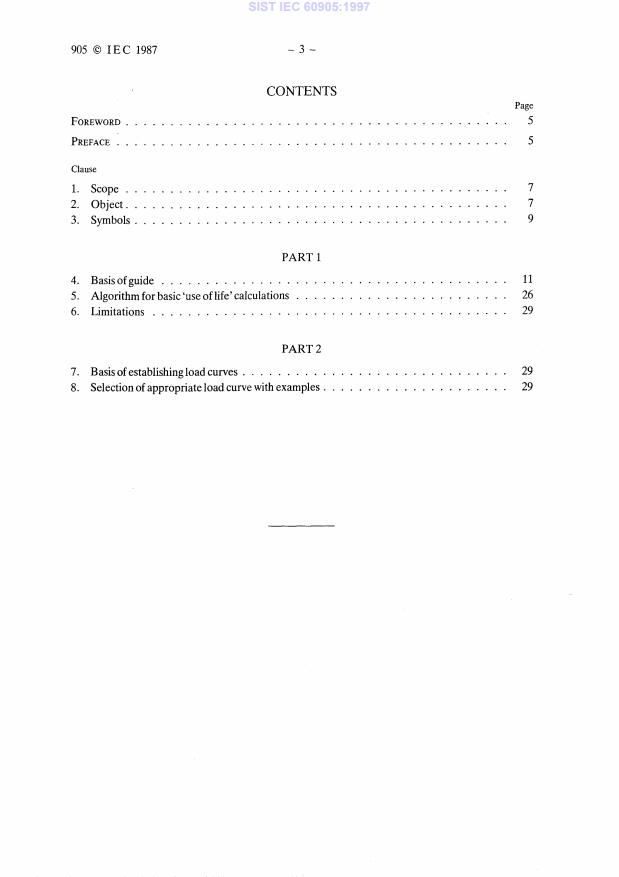
— 3
905 © I E C 1987
CONTENTS
Page
FOREWORD 5
PREFACE 5
Clause
1. Scope 7
2. Object 7
3. Symbols 9
PART 1
4. Basis of guide
5. Algorithm for basic `use of life' calculations
6. Limitations 29
PART 2
7. Basis of establishing load curves
8. Selection of appropriate load curve with examples
905 ©IEC 1987 — 5 —
INTERNATIONAL ELECTROTECHNICAL COMMISSION
LOADING GUIDE
FOR DRY-TYPE POWER TRANSFORMERS
FOREWORD
1) The formal decisions or agreements of the I EC on technical matters, prepared by Technical Committees on which all the
National Committees having a special interest therein are represented, express, as nearly as possible, an international
consensus of opinion on the subjects dealt with.
2) They have the form of recommendations for international use and they are accepted by the National Committees in that
sense.
3) In order to promote international unification, the I E C expresses the wish that all National Committees should adopt the
text of the I E C recommendation for their national rules in so far as national conditions will permit. Any divergence
between the I E C recommendations and the corresponding national rules should, as far as possible, be clearly indicated in
the latter.
PREFACE
This guide has been prepared by IEC Technical Committee No. 14: Power transformers.
The text of this guide is based on the following documents:
Six Months' Rule Report on Voting
14(CO)60 14(CO)63
Full information on the voting for the approval of this guide can be found in the Voting Report
indicated in the above table.
The following 1 EC Publications are quoted in this guide:
Publications Nos. 76-1 (1976): Power transformers, Part 1: General.
726 (1982): Dry-type power transformers.
905 © I E C 1987 7
LOADING GUIDE
FOR DRY-TYPE POWER TRANSFORMERS
1. Scope
This guide is applicable to naturally cooled dry-type power transformers complying with
IEC Publication 726 and operated within the limitations referred to in Clause 6. Six different
insulation systems are taken into account, identified by their system temperatures.
Because there are numerous combinations of different insulation systems and constructions
it is possible to make loading recommendations only of a general nature. For this reason the
guide is in two parts:
— the first part makes no loading recommendations, but gives the method of calculating
loading conditions when the variable parameters are known as the result of prototype
testing of a particular construction and/or insulation system. The calculations are given in
the form of an algorithm from which computer programs can be written;
— the second part assumes constant values for the variable parameters, with the exception of
the insulation temperature limits (Table I) and the temperature of external cooling air,
irrespective of insulation system or construction, thereby enabling load curves to be
produced.
The guide indicates how dry-type transformers may be operated without exceeding the
acceptable limit of deterioration of insulation through thermal effects. The acceptable limit of
deterioration of insulation is defined as that which occurs when the dry-type transformer is
operating under rated conditions at the basic temperature of the external cooling air.
2. Object
The object of this guide is to permit the calculation of, and to indicate the permissible loading
under certain defined conditions in terms of rated current, for the guidance of users and to help
planners to choose the rated power of transformers required for new installations.
The basic temperature of the external cooling air is assumed to be 20 °C. Guidance is given
for this temperature, and also for external cooling air temperatures of 10 °C and 30 °C.
Deviations from these temperatures are provided for in such a way that the increased use of life
when operated with a higher external cooling air temperature is balanced by a reduced use of
life with a lower external cooling air temperature.
In practice, uninterrupted continuous operation at full rated current is unusual, and this
guide gives recommendations for cyclic daily loads, taking into account seasonal variations of
ambient temperature. The daily use of life due to thermal effects is compared with normal daily
use of life which results when the dry-type transformer is operating at rated voltage and
current, with an external cooling air temperature of 20 °C.
905 ©I E C 1987 — 9 —
Load curves, Figures 5 (1) to 5 (12) on pages 32 to 43, show the permissible load current
which will result in a normal daily use of life for winding insulation systems having insulation
system temperatures of 105, 120, 130, 155, 180 and 220 °C in the following two sets of
conditions:
a)
continuous duty with different temperatures of external cooling air,
b)
cyclic duty with different temperatures of external cooling air.
Note. —
It is assumed that the transformer is adequately ventilated and the increased losses resulting from an
overload do not significantly change the temperature of the cooling air.
3.
Symbols
The following symbols are used in this guide:
a = subscript representing "ambient" (external cooling air)
c =
subscript representing the "hot spot of the winding" at rated current and basic
temperature of external cooling air
cc =
subscript representing the highest permissible "hot spot of the winding" according to
this guide
d =
subscript representing the doubling of the rate of using life
e =
subscript representing the final "average of winding" for any value of load current
= subscript representing the initial "average of winding" for any value of load current
= integer variable representing the number of the day in the year (1^j-.365)
K1, K2i . K, . K
N = load currents as fractions of rated currents
m = subscript representing maximum "average of winding". (Thus for continuous rated
current,
A0c/Z, and for a short time in excess of rated current, D°
m = 08cc/
AOmr =
Z,
resulting in a greater than normal rate of using life during this period)
n
= subscript representing any one period during the daily load cycle
q = exponent of K
by which the average temperature rise varies with load current
r =
subscript representing rated value
t = time
tb =
duration, in hours, at any load current K 1 (tb , 24 — tp)
tp =
maximum permissible duration, in hours, at any load current
K2
t1 , t2, . tn
, . tN = duration of each load condition period
w =
subscript representing the winding
wh
subscript representing the "hot spot of winding"
A
= amplitude of annual variations in the daily average ambient temperature (sinusoidal
variation is assumed)
B =
amplitude of daily variations in the ambient temperature (sinusoidal variation is
assumed)
I =
load current in amperes (any value); I r = rated current
k
=
subscript representing any individual load period prior to the start of the load period
to for which the calculation is being made
905 © I E C 1987 – 11 –
L = life consumption in hours
calculated annual use of life
Lan
LR = relative rate of using life
N = number of different load periods for a day
T = sum of the individual load periods tk prior to the start of the load period t„ for which
the calculation is being made
Z = ratio between hot spot and average winding temperature rises (see also explanations
to subscript m)
«
arbitrary variable used in determining the relative rate of using life
=
AO =
temperature rise in kelvins
accuracy factor for estimation of the hot-spot temperature at the beginning of the 24 h
E =
period
8 = temperature in degrees Celsius
Dad = daily average ambient temperature
0a,, = annual average ambient temperature
r = thermal time constant of windings at rated current, in hours
PART 1
4. Basis of guide
4.1.
Introduction
The life of a dry-type transformer is related to the deterioration of its insulation through
thermal ageing. Experience indicates that the normal life of a transformer is some tens of years.
It cannot be stated more precisely, because it may vary even between identical units, owing in
particular to operating factors which may differ from one transformer to another.
In practice, uninterrupted continuous operation at full load current is unusual and so account
should be taken of the various operating conditions and the subsequent fluctuation of the rate
of thermal deterioration of the transformer insulation.
It is necessary therefore:
a) To define "normal" expectation of life as a function of the rated load current and the rated
hot spot temperature of the winding insulation.
b) To relate the increase in hot spot winding temperature to the increase in the rate of
insulation deterioration.
c) To devise a method of calculating the net effect of variation in the winding hot spot
temperature due to changes in load period, load current and ambient temperature, on the
thermal ageing of the insulation.
d) To then compare the net "use of life" due to the sum of the different factors in the load
cycle, with the definition of "normal use of life". Hence, any of the parameters in the load
cycle can be adjusted to give a normal expectation of transformer life.
905 © I E C 1987 – 13 –
4.2 Parameters used in the calculations
4.2.1
Temperature limits
TABLE I
Temperature limits
Hot spot winding Average winding
Insulation
temperature temperature-rise
system
temperature (°C) limits at rated current
(K)
(IEC Publi-
rated highest
(I EC Publication 726)
cation 726)
permissible
(40,r)
(°C) (Bcc)
(Bc)
105 (A) 95 140 60
120 (E) 110 155
120 165 80
130 (B)
145 190 100
155 (F)
220 125
180 (H) 175
210 250 150
220(C)
is used to calculate normal life consumption. Under certain operating
4.2.2 The parameter 0,
conditions in which it is permissible to exceed this normal consumption level, high overloads
may be applied, resulting in a hot spot temperature considerably higher than O. Thus a
parameter 0 cn representing the absolute limit of the hot spot temperature has been introduced.
This temperature is that beyond which the rate of deterioration of the insulation becomes
and 8cc.)
inadmissible. (See Table I for values of 0,
4.2.3 The value of parameter 0d is taken as the increase in hot spot temperature which doubles the
rate of using life.
4.2.4 The basic value required for calculating the life consumption level is the temperature at the
hottest spot. For this purpose, it is necessary to know the temperature rise at this position for
each load condition and the ambient temperature. There are at least two methods of obtaining
the hot spot temperature rise:
Kn;
a) can be determined by performing temperature-rise tests with various loads
AOWhn
b) by using the formula:
= Z OBwr Knq (1)
OBwhn
In this case, it is necessary to know the values of Z, AO, and q.
It is preferable to use, whenever possible, the results of tests giving thus removing any
AOWhn,
uncertainty regarding the validity of the factor Z and the value of q. Experience shows that q
and Z assume different values depending on the type of transformer and the level of the load
current at which it operates.
wh„ may be possible only on prototype
Note. — With some types of winding construction determination of AB
transformers.
AOWh = f (K), which can be used to
On the basis of the test results, a curve can be plotted of
for each K n necessary for the calculation.
determine the corresponding
AOwhn
905©IEC1987 — 15 —
4.2.5 Values obtained during temperature-rise tests carried out on a prototype under different load
conditions:
z = thermal time constant in hours;
Note. — The winding to be taken into consideration is that with the shortest time constant.
40wr
= average winding temperature rise at the assigned rating;
4B =
f (K): temperature rise at the hottest spot, under the established conditions, as a
wh
function of the load.
4.2.6 Values obtained by means of ageing tests carried out on models of insulating systems:
Bc =
...
IEC 60505 ®
Edition 4.0 2011-07
INTERNATIONAL
STANDARD
NORME
INTERNATIONALE
colour
inside
Evaluation and qualification of electrical insulation systems
Évaluation et qualification des systèmes d'isolation électrique
All rights reserved. Unless otherwise specified, no part of this publication may be reproduced or utilized in any form or by
any means, electronic or mechanical, including photocopying and microfilm, without permission in writing from either IEC or
IEC's member National Committee in the country of the requester.
If you have any questions about IEC copyright or have an enquiry about obtaining additional rights to this publication,
please contact the address below or your local IEC member National Committee for further information.
Droits de reproduction réservés. Sauf indication contraire, aucune partie de cette publication ne peut être reproduite
ni utilisée sous quelque forme que ce soit et par aucun procédé, électronique ou mécanique, y compris la photocopie
et les microfilms, sans l'accord écrit de la CEI ou du Comité national de la CEI du pays du demandeur.
Si vous avez des questions sur le copyright de la CEI ou si vous désirez obtenir des droits supplémentaires sur cette
publication, utilisez les coordonnées ci-après ou contactez le Comité national de la CEI de votre pays de résidence.
IEC Central Office
3, rue de Varembé
CH-1211 Geneva 20
Switzerland
Email: inmail@iec.ch
Web: www.iec.ch
About the IEC
The International Electrotechnical Commission (IEC) is the leading global organization that prepares and publishes
International Standards for all electrical, electronic and related technologies.
About IEC publications
The technical content of IEC publications is kept under constant review by the IEC. Please make sure that you have the
latest edition, a corrigenda or an amendment might have been published.
Catalogue of IEC publications: www.iec.ch/searchpub
The IEC on-line Catalogue enables you to search by a variety of criteria (reference number, text, technical committee,…).
It also gives information on projects, withdrawn and replaced publications.
IEC Just Published: www.iec.ch/online_news/justpub
Stay up to date on all new IEC publications. Just Published details twice a month all new publications released. Available
on-line and also by email.
Electropedia: www.electropedia.org
The world's leading online dictionary of electronic and electrical terms containing more than 20 000 terms and definitions
in English and French, with equivalent terms in additional languages. Also known as the International Electrotechnical
Vocabulary online.
Customer Service Centre: www.iec.ch/webstore/custserv
If you wish to give us your feedback on this publication or need further assistance, please visit the Customer Service
Centre FAQ or contact us:
Email: csc@iec.ch
Tel.: +41 22 919 02 11
Fax: +41 22 919 03 00
A propos de la CEI
La Commission Electrotechnique Internationale (CEI) est la première organisation mondiale qui élabore et publie des
normes internationales pour tout ce qui a trait à l'électricité, à l'électronique et aux technologies apparentées.
A propos des publications CEI
Le contenu technique des publications de la CEI est constamment revu. Veuillez vous assurer que vous possédez
l’édition la plus récente, un corrigendum ou amendement peut avoir été publié.
Catalogue des publications de la CEI: www.iec.ch/searchpub/cur_fut-f.htm
Le Catalogue en-ligne de la CEI vous permet d’effectuer des recherches en utilisant différents critères (numéro de référence,
texte, comité d’études,…). Il donne aussi des informations sur les projets et les publications retirées ou remplacées.
Just Published CEI: www.iec.ch/online_news/justpub
Restez informé sur les nouvelles publications de la CEI. Just Published détaille deux fois par mois les nouvelles
publications parues. Disponible en-ligne et aussi par email.
Electropedia: www.electropedia.org
Le premier dictionnaire en ligne au monde de termes électroniques et électriques. Il contient plus de 20 000 termes et
définitions en anglais et en français, ainsi que les termes équivalents dans les langues additionnelles. Egalement appelé
Vocabulaire Electrotechnique International en ligne.
Service Clients: www.iec.ch/webstore/custserv/custserv_entry-f.htm
Si vous désirez nous donner des commentaires sur cette publication ou si vous avez des questions, visitez le FAQ du
Service clients ou contactez-nous:
Email: csc@iec.ch
Tél.: +41 22 919 02 11
Fax: +41 22 919 03 00
IEC 60505 ®
Edition 4.0 2011-07
INTERNATIONAL
STANDARD
NORME
INTERNATIONALE
colour
inside
Evaluation and qualification of electrical insulation systems
Évaluation et qualification des systèmes d'isolation électrique
INTERNATIONAL
ELECTROTECHNICAL
COMMISSION
COMMISSION
ELECTROTECHNIQUE
PRICE CODE
INTERNATIONALE
CODE PRIX XC
ICS 29.080.30 ISBN 978-2-88912-539-5
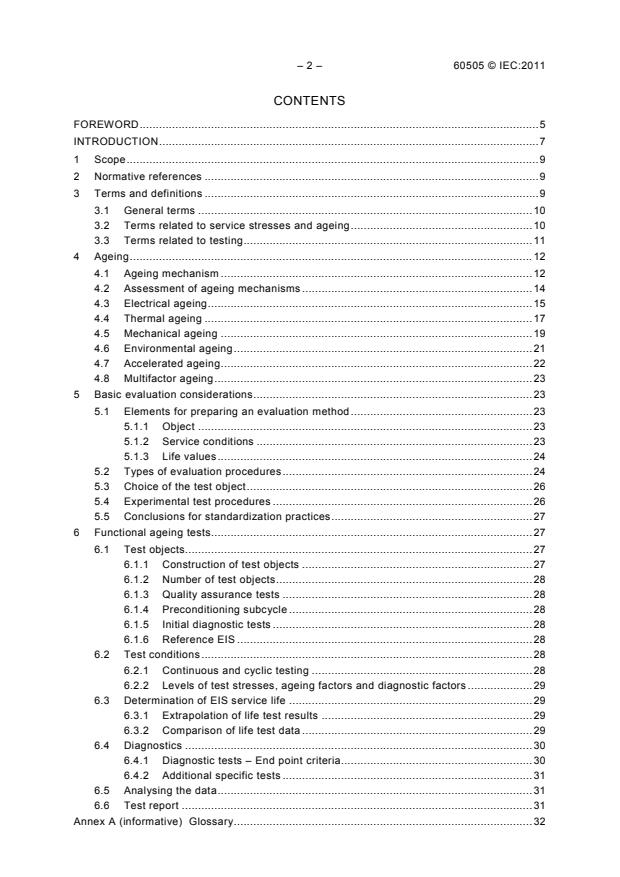
– 2 – 60505 © IEC:2011
CONTENTS
FOREWORD . 5
INTRODUCTION . 7
1 Scope . 9
2 Normative references . 9
3 Terms and definitions . 9
3.1 General terms . 10
3.2 Terms related to service stresses and ageing . 10
3.3 Terms related to testing . 11
4 Ageing . 12
4.1 Ageing mechanism . 12
4.2 Assessment of ageing mechanisms . 14
4.3 Electrical ageing . 15
4.4 Thermal ageing . 17
4.5 Mechanical ageing . 19
4.6 Environmental ageing . 21
4.7 Accelerated ageing . 22
4.8 Multifactor ageing . 23
5 Basic evaluation considerations . 23
5.1 Elements for preparing an evaluation method . 23
5.1.1 Object . 23
5.1.2 Service conditions . 23
5.1.3 Life values . 24
5.2 Types of evaluation procedures . 24
5.3 Choice of the test object . 26
5.4 Experimental test procedures . 26
5.5 Conclusions for standardization practices . 27
6 Functional ageing tests. 27
6.1 Test objects. 27
6.1.1 Construction of test objects . 27
6.1.2 Number of test objects . 28
6.1.3 Quality assurance tests . 28
6.1.4 Preconditioning subcycle . 28
6.1.5 Initial diagnostic tests . 28
6.1.6 Reference EIS . 28
6.2 Test conditions . 28
6.2.1 Continuous and cyclic testing . 28
6.2.2 Levels of test stresses, ageing factors and diagnostic factors . 29
6.3 Determination of EIS service life . 29
6.3.1 Extrapolation of life test results . 29
6.3.2 Comparison of life test data . 29
6.4 Diagnostics . 30
6.4.1 Diagnostic tests – End point criteria. 30
6.4.2 Additional specific tests . 31
6.5 Analysing the data . 31
6.6 Test report . 31
Annex A (informative) Glossary . 32
60505 © IEC:2011 – 3 –
Bibliography . 71
Figure 1 – Ageing of an EIS . 13
Figure 2 – Intrinsic/extrinsic electrical ageing of practical EIS . 15
Figure 3 – Intrinsic/extrinsic thermal ageing of practical EIS . 17
Figure 4 – Intrinsic/extrinsic mechanical ageing of practical EIS . 20
Figure 5 – Intrinsic/extrinsic environmental ageing of practical EIS . 22
Figure 6 – Elements of evaluation methods . 23
Figure 7 – Type of evaluation procedure . 25
Figure 8 – Selection of test object . 26
Figure 9 – Establishing the test method . 27
Figure A.1 – Surface abrasion damage . 32
Figure A.2 – Surface enamel peeling like string . 32
Figure A.3 – Scheme of the measurement set-up for the charging/discharging current . 33
Figure A.4 – Example of sample preparation . 33
Figure A.5 – Charging/discharging current on HDPE film . 34
Figure A.6 – Property versus time behaviour, detection of threshold (end point, p )
L
and maintenance time . 35
Figure A.7 – Correspondence between the ageing plots of the property p (in red),
obtained at different stress levels, and the resulting life line . 35
Figure A.8 – Example of charge injection of positive carriers (holes) from the anode
and of negative charge carriers (electrons) from the cathode in a PE flat specimen,
detected by space charge measurement performed by PEA method . 36
Figure A.9 – Stress-strain curve for a typical material . 37
Figure A.10 – Scheme of measurement set- up for charging/discharging current . 38
Figure A.11 – Example of sample preparation . 38
Figure A.12 – Charging/discharging current on HDPE film . 38
Figure A.13 – Charging current at 135 °C and different values of DC electrical field . 39
Figure A.14 – Charging current at 120 °C and different values of DC electrical field . 39
Figure A.15 – Corona at post insulator head . 40
Figure A.16 – Corona on top and arcing to ground . 40
Figure A.17 – Stages of mechanical ductile fracture (cracking) (Source unknown) . 41
Figure A.18 – Photo showing orderings in epoxy structure and void . 42
Figure A.19 – Discharge between conductors through air. 44
Figure A.20 – Paper insulation degraded by electrical surface discharges . 44
Figure A.21 – Example of electric strength test on XLPE sample 0,2 mm thick . 45
Figure A.22 – Two parameters Weibull plot electric strength results performed on
seven XLPE specimens, 0,2 mm thick . 45
Figure A.23 – Loss angle of a dielectric . 47
Figure A.24 – Loss factor for pre-treated and thermally aged (at 110 °C and 130 °C)
XLPE cables measured at 90 °C plotted vs. frequency . 47
Figure A.25 – Field lines from a positive charge above a plane conductor . 48
Figure A.26 – Electrical tree. 49
Figure A.27 – EPDM ashing and erosion on fitting . 50
Figure A.28 – Failing external insulation . 51
– 4 – 60505 © IEC:2011
Figure A.29 – Failing external insulation . 51
Figure A.30 – Critical failure of solid cable insulation (XLPE) by electrical breakdown . 52
Figure A.31 – Example flashover . 53
Figure A.32 – Substation – Outdoor installation . 54
Figure A.34 – Internal interfaces in epoxy structure and void . 56
Figure A.35 – Example of craze and crack development in an inter-lamellar space
under mechanical tension T . 57
Figure A.36 – Water treeing . 58
Figure A.37 – After 11 years in service UV and moisture impact . 59
Figure A.38 – Random (amorphous) structure of a molecular chain . 59
Figure A.39 – Oriented structure (semi-crystalline) of a molecular chain . 59
Figure A.40 – Typical morphology of melt-grown polyethylene spherulites . 60
Figure A.41 – Areas in which PD generally occur . 61
Figure A.42 – Classes of defect – Internal, surface and corona PD . 61
Figure A.43 – Basic PD measurement circuit . 62
Figure A.44 – Examples of PD patterns relevant to internal, surface and corona PD . 62
Figure A.45 – GIS research – Metal conductor protrusion . 63
Figure A.46 – Internally strained epoxy – Frozen in strains in epoxy resin due to
thermal stress, measured by TMA curves . 64
Figure A.47 – Externally strained parts in an on-load tap changer (OLTC) . 64
Figure A.48 – A material being loaded in a) compression, b) tension, c) shear . 65
Figure A.49 – Effect of thermal-mechanical stresses leading to interfacial electrical
tracking . 66
Figure A.50 – Stress-strain curve for a typical material . 66
Figure A.51 – Over crimped rod; breaks during tensile test . 67
Figure A.52 – Typical installation fault . 68
Figure A.53 – Surface tracking on sheds and fitting end . 68
Figure A.54 – Vented trees – Initiate at interface . 69
Figure A.55 – Tape wrinkling . 70
Table 1 – Ageing temperatures . 19
Table 2 – Cyclical and continuous procedures . 30
60505 © IEC:2011 – 5 –
INTERNATIONAL ELECTROTECHNICAL COMMISSION
___________
EVALUATION AND QUALIFICATION
OF ELECTRICAL INSULATION SYSTEMS
FOREWORD
1) The International Electrotechnical Commission (IEC) is a worldwide organization for standardization comprising
all national electrotechnical committees (IEC National Committees). The object of IEC is to promote
international co-operation on all questions concerning standardization in the electrical and electronic fields. To
this end and in addition to other activities, IEC publishes International Standards, Technical Specifications,
Technical Reports, Publicly Available Specifications (PAS) and Guides (hereafter referred to as “IEC
Publication(s)”). Their preparation is entrusted to technical committees; any IEC National Committee interested
in the subject dealt with may participate in this preparatory work. International, governmental and non-
governmental organizations liaising with the IEC also participate in this preparation. IEC collaborates closely
with the International Organization for Standardization (ISO) in accordance with conditions determined by
agreement between the two organizations.
2) The formal decisions or agreements of IEC on technical matters express, as nearly as possible, an international
consensus of opinion on the relevant subjects since each technical committee has representation from all
interested IEC National Committees.
3) IEC Publications have the form of recommendations for international use and are accepted by IEC National
Committees in that sense. While all reasonable efforts are made to ensure that the technical content of IEC
Publications is accurate, IEC cannot be held responsible for the way in which they are used or for any
misinterpretation by any end user.
4) In order to promote international uniformity, IEC National Committees undertake to apply IEC Publications
transparently to the maximum extent possible in their national and regional publications. Any divergence
between any IEC Publication and the corresponding national or regional publication shall be clearly indicated in
the latter.
5) IEC itself does not provide any attestation of conformity. Independent certification bodies provide conformity
assessment services and, in some areas, access to IEC marks of conformity. IEC is not responsible for any
services carried out by independent certification bodies.
6) All users should ensure that they have the latest edition of this publication.
7) No liability shall attach to IEC or its directors, employees, servants or agents including individual experts and
members of its technical committees and IEC National Committees for any personal injury, property damage or
other damage of any nature whatsoever, whether direct or indirect, or for costs (including legal fees) and
expenses arising out of the publication, use of, or reliance upon, this IEC Publication or any other IEC
Publications.
8) Attention is drawn to the Normative references cited in this publication. Use of the referenced publications is
indispensable for the correct application of this publication.
9) Attention is drawn to the possibility that some of the elements of this IEC Publication may be the subject of
patent rights. IEC shall not be held responsible for identifying any or all such patent rights.
International Standard IEC 60505 has been prepared by IEC technical committee 112:
Evaluation and qualification of electrical insulating materials and systems.
This fourth edition cancels and replaces the third edition, published in 2004, and constitutes a
technical revision.
The main change with respect to the previous edition is the addition of a Glossary in the form
of Annex A to this standard.
The text of this standard is based on the following documents:
FDIS Report on voting
112/174/FDIS 112/184/RVD
Full information on the voting for the approval of this standard can be found in the report on
voting indicated in the above table.
This publication has been drafted in accordance with the ISO/IEC Directives, Part 2.
– 6 – 60505 © IEC:2011
The committee has decided that the contents of this publication will remain unchanged until
the stability date indicated on the IEC web site under "http://webstore.iec.ch" in the data
related to the specific publication. At this date, the publication will be
• reconfirmed,
• withdrawn,
• replaced by a revised edition, or
• amended.
The contents of the corrigendum of March 2017 have been included in this copy.
IMPORTANT – The 'colour inside' logo on the cover page of this publication indicates
that it contains colours which are considered to be useful for the correct
understanding of its contents. Users should therefore print this document using a
colour printer.
60505 © IEC:2011 – 7 –
INTRODUCTION
The life of an electrical insulation system (EIS) or systems frequently determines the life of
electrical equipment which can be affected by electrical, thermal, mechanical or
environmental stresses acting either individually or in combination.
Intended, estimated or proven service life times are essential parameters for describing the
life of electrical insulation systems. In the early days of electrotechnical engineering, life
figures were rather vague. The limitation of the life of the insulation under thermal stress was
one of the first indicators of the effect of ageing in some equipment in service. As experience
in using EIS increased, it was appreciated that there was a need to select specific materials
having satisfactory life time at a given temperature, to enable the required service life to be
achieved and to allow for the calculation of the thermal capability of equipment.
The user of this standard may evaluate existing test methods and provide correlation with his
equipment. Therefore, the user of this standard is responsible for demonstrating the validity of
the existing test method in accordance with the principles of this standard.
The determination of the prospective life is a fundamental task when developing and
designing an EIS. Estimated service life of an EIS needs to be established for several
reasons:
– for type testing when introducing a new EIS into production;
– for quality assurance of production;
– for estimating the life expectancy of new equipment;
– for estimating the remaining life for maintenance purposes.
“Ageing” focuses on the mechanisms affecting the EIS performance. “Evaluation” links these
potential mechanisms by “Analysis” and “Diagnostics” to the design of a specific kind of
evaluation test procedure.
The keyword structure below meets such requirements and allows an easier choice of the
parts of interest.
– 8 – 60505 © IEC:2011
60505 © IEC:2011 – 9 –
EVALUATION AND QUALIFICATION
OF ELECTRICAL INSULATION SYSTEMS
1 Scope
This International Standard establishes the basis for estimating the ageing of electrical
insulation systems (EIS) under conditions of either electrical, thermal, mechanical,
environmental stresses or combinations of these (multifactor stresses).
It specifies the principles and procedures that shall be followed, during the development of
EIS functional test and evaluation procedures, to establish the estimated service life for a
specific EIS.
This standard should be used by all IEC technical committees responsible for equipment
having an EIS.
2 Normative references
The following referenced documents are indispensable for the application of this document.
For dated references, only the edition cited applies. For undated references, the latest edition
of the referenced document (including any amendments) applies.
IEC 60216-2, Electrical insulating materials – Thermal endurance properties – Part 2:
Determination of thermal endurance properties of electrical insulating materials – Choice of
test criteria
IEC 60216-3, Electrical insulating materials – Thermal endurance properties – Part 3:
Instructions for calculating thermal endurance characteristics
IEC 60216-5, Electrical insulating materials – Thermal endurance properties – Part 5:
Determination of relative thermal endurance index (RTE) of an insulating material
IEC 60493-1, Guide for the statistical analysis of ageing test data – Part 1: Methods based on
mean values of normally distributed test results
IEC 60544-1, Electrical insulating materials – Determination of the effects of ionizing radiation
– Part 1: Radiation interaction and dosimetry
IEC/TS 61251, Electrical insulating materials – AC voltage endurance evaluation –
Introduction
IEC 62539, Guide for the statistical analysis of electrical insulation breakdown data
3 Terms and definitions
For the purposes of this document, the following terms and definitions apply.
– 10 – 60505 © IEC:2011
3.1 General terms
3.1.1
electrical insulation system
EIS
insulating structure containing one or more electrical insulating materials (EIM) together with
associated conducting parts employed in an electrotechnical device
3.1.2
electrical insulating material
EIM
material with negligibly low electric conductivity, used to separate conducting parts at different
electrical potentials
[IEC 60050-212:2010, 212-11-01, modified]
3.1.3
reference EIS
established EIS evaluated on the basis of either a known service experience record or a
known comparative functional evaluation
3.1.4
candidate EIS
EIS under evaluation to determine its service capability (with regard to electrical, thermal,
mechanical, environmental or multifactor stresses)
3.1.5
intended life
design life of an EIS under service conditions
3.1.6
estimated life
expected service life derived from either service experience or the results of tests performed
in accordance with appropriate evaluation procedures, or both, as established by the
responsible organization or technical committee
3.1.7
evaluation
establishment of relationships between service requirements and life data obtained from
service experience analysis or from the results of functional tests
3.2 Terms related to service stresses and ageing
3.2.1
ageing stress
electrical, thermal, mechanical or environmental stress whose action on an EIS causes
irreversible property changes
3.2.2
potentially destructive stress
stress in service which can cause the failure of the aged EIS, alone or in combination with
other stresses
3.2.3
service conditions
combination of stresses and duty that are to be expected in a specific application of an
electrical device
60505 © IEC:2011 – 11 –
3.2.4
reference operating conditions
service conditions of the equipment to which the test conditions of the functional test
procedure are related
3.2.5
service requirements
specified stresses, intended performance and duty of an electrical device
3.2.6
service experience
the quantitative and/or qualitative record during service, with or without failure of an EIS
3.2.7
ageing
irreversible changes of the properties of an EIS due to action by one or more stresses
NOTE 1 Some changes (e.g. hydrolytic changes) can be partly reversible if the ambient conditions change.
NOTE 2 Ageing leads to degradation of the EIS.
3.2.8
intrinsic ageing
irreversible changes of fundamental properties of an EIS caused by the action of ageing
factors on the EIS
3.2.9
extrinsic ageing
irreversible changes of properties of an EIS caused by action of ageing factors on
unintentionally introduced imperfections in the EIS
3.2.10
interaction
modifications of the type or degree of ageing produced by the combination of two or more
stresses relative to their ageing effect if acting individually on separate objects
3.2.11
direct interaction
interaction between simultaneously applied stresses that differs from that occurring with
sequentially applied stresses
3.2.12
indirect interaction
interaction which occurs between simultaneously applied stresses, which remains unchanged
when the factors are applied sequentially
3.3 Terms related to testing
3.3.1
functional test
procedure to obtain information about the suitability of an EIS under specified conditions
3.3.2
test object
sample of original equipment or part thereof, or model representing the equipment completely
or partially, including the EIS, to be used in a functional test
– 12 – 60505 © IEC:2011
3.3.3
accelerated ageing
ageing resulting of an increase in the level and/or frequency of application of the stress
beyond normal service conditions
3.3.4
accelerated test
functional test applying accelerated ageing to shorten testing time
3.3.5
conditioning
subjecting a specimen to an atmosphere of a specified relative humidity or complete
immersion in water or other liquid, at a specified temperature for a specified period of time
3.3.6
prediagnostic conditioning
variable or fixed stresses, which can be applied continuously or periodically to an EIS to
enhance the ability of a functional test to detect the degree of ageing
NOTE Prediagnostic conditioning may cause additional ageing.
3.3.7
diagnostic factor
variable or fixed stress which is applied to an EIS to establish the degree of ageing
3.3.8
diagnostic test
periodic or continuous application of a specified level of a diagnostic factor to a test object to
determine whether or when the end-point criterion has been reached
3.3.9
end-point criterion
moment when a system is no longer able to fulfil its service purposes
3.3.10
life
time for a property to reach the end-point criterion for objects in functional tests
3.3.11
test cycle
in a test, repetitive period of application of one or more stresses, either sequentially or
simultaneously, and of diagnostic factors
3.3.12
subcycle
defined period within test cycle
NOTE The subcycle may be, for instance, a period of application of high temperature and humidity for influencing
the system properties, or application of high voltage for diagnostic purposes
4 Ageing
4.1 Ageing mechanism
Ageing is defined as the irreversible changes of the properties of an EIS due to action by one
or more stresses. Ageing stresses may cause either intrinsic or extrinsic ageing. A schematic
representation of the basic process is shown in Figure 1.
60505 © IEC:2011 – 13 –
Ageing stresses
Electrical Thermal Mechanical Environmental
EIS
Ageing mechanisms
Intrinsic/extrinsic
Electrical Thermal Mechanical Environmental
Direct/indirect interactions
Failure
IEC 1231/11
Figure 1 – Ageing of an EIS
The type and level of contamination and/or the extent of imperfections in an EIS will, in many
types of electrical apparatus, significantly affect the service performance. In general, the
fewer and less severe the contaminant and/or defects in the EIS, the better is its
performance. To avoid obtaining misleading results from functional tests, a candidate EIS
should contain, as far as practicable, the full range of contaminants and/or defects expected
when the actual system is used in service.
The ageing stresses produce electrical, thermal, mechanical or environmental ageing
mechanisms that eventually lead to failure. During ageing, applied stresses, which initially do
not affect the EIS, can cause additional ageing and, as a result, modify the rate of
degradation.
When ageing is dominated by one ageing factor, this is referred to as single-factor ageing.
Multifactor ageing occurs when more than one ageing factor substantially affects the ageing
of the EIS. Ageing factors can act synergistically, i.e. there can be direct interactions between
the stresses. Interactions may be either positive or negative.
The ageing of a practical EIS may be complex and failure is usually caused by a combination
of ageing mechanisms, even if there is only one dominant ageing factor as, for example, in
single-factor ageing.
Where experience or existing knowledge of how a specific EIS will perform in service is
limited, the user of this standard shall decide whether single or multifactor test procedures are
appropriate for his specific equipment or apparatus.
NOTE The classification of the operational environments of electrical equipment is dealt with in IEC publications
prepared by IEC technical committee 75, and methods for environmental endurance testing of electrical equipment
are described in IEC publications prepared by IEC technical committee 50 (notably IEC sub-committee 50B), see
bibliography.
When speaking of environmental effects, this is understood to comprise environments other
than the normal standard laboratory atmospheres specified in IEC 60212.
A number of other standards that provide methods of exposure or characterization of
insulation are listed in the bibliography.
– 14 – 60505 © IEC:2011
4.2 Assessment of ageing mechanisms
Figures 2, 3, 4 and 5, present four flow charts which describe respectively in some detail
intrinsic and extrinsic electrical, thermal, mechanical and environmental ageing of an EIS.
Each chart is based on the service experience of different types of EIS and shows possible
mechanisms of deterioration and failure that can occur for the different types of ageing and
the interactions between ageing factors. Although several failure mechanisms are shown, the
charts are not intended to be exhaustive of mechanisms that might be found in actual service
conditions of all equipment. It is important to note that ageing that leads to possible failure is
usually caused by more than one mechanism.
These charts should be used as follows:
a) as a checklist to determine the ageing mechanisms of equipment and apparatus. The
mechanisms can occur sequentially or simultaneously;
b) to develop functional and accelerated ageing tests or test cycles. The magnitudes and
types of applied stresses and their duration will depend upon how they affect the ageing
mechanisms;
c) to develop suitable diagnostic tests or test cycles to assess the condition of the EIS.
Based on knowledge of service experience, operating conditions and the properties of the
components of the EIS under consideration, the user of this standard should select one or
more charts that show the main ageing factor or factors. The various ageing mechanisms that
lead to failure should be carefully examined, taking into account the levels of contaminants
and defects in the EIS. A revised chart, which only includes the relevant ageing mechanisms,
should then be produced as an aid in the development of the functional ageing and diagnostic
test cycles.
If there is insufficient information available concerning service experience and/or the possible
ageing mechanism, then the ageing conditions should be based upon the most severe levels
of stresses expected in service for which the EIS has been designed.
60505 © IEC:2011 – 15 –
4.3 Electrical ageing
CONTAMINANTS PRODUCED BY: DEFECTS
• Impurities • Processing • Cavities
• Particles • Manufacture • Protrusions
• By-products • Transport • Interfaces, cracks
• Moisture • Installation • Missing components
• Material • Thermal, mechanical • Wrinkles
incompatibilities and environmental
• Processing errors
etc. stress
• Discontinuities
• Abuse, accident
etc.
• Mis-application
etc.
ELECTRICAL STRESS (a.c., d.c., f, transients)
ELECTRICAL INSULATION SYSTEM
Intrinsic Surface, partial Absorption, Charge Water Cavity formation
breakdown discharge, corona conduction injection treeing and expansion, or
current mechanical rupture
Chemical changes Cavity
Breakdown
formation
Corrosive
Tracking Erosion Temperature
Partial
by-products
rise
discharges
Flashover
Loss of Thermal
Electrical Partial
conductor ageing
treeing discharge
Electrical continuity
treeing
FAILURE
(Different mechanisms of failure occur)
IEC 1232/11
NOTE Other stresses may contribute to failure.
Figure 2 – Intrinsic/extrinsic electrical ageing of practical EIS
Electric ageing (either a.c., d.c. or impulse) involves:
a) the effects of partial discharges when the local field strength exceeds the breakdown
strength in the liquid or gaseous dielectric adjacent to, or included in, the EIS;
b) the effects of tracking;
c) the effects of treeing;
d) the effects of electrolysis;
– 16 – 60505 © IEC:2011
e) the effects, related to those above, on adjacent surfaces of two insulating materials where
tangential fields of relatively high value can occur;
f) the effects of increased temperatures produced by high dielectric losses;
g) the effect of space charges.
Figure 2 shows intrinsic/extrinsic electrical ageing where electrical stresses are considered to
be the main ageing factor. Consider the example of a simple EIS consisting of two parallel
plane conductors embedded in an insulating material. Protrusions are known to occur on the
surfaces of conductors, and impurities (e.g., dust particles, etc.) can be included within the
insulation. The accelerated ageing should, therefore, be carried out by using ageing factors
that increase charge injection, for example by high voltage, and the diagnostic tests should be
designed to enable measurement of the effect of the injected charge and/or the partial
discharge characteristics.
In many practical EIS, the electrical ageing process that leads to failure is complex. No rigid
mathematical models have yet been developed which predict fully how the ageing factors
affect the life of an EIS. However, one empirical relationship, the inverse power model, is
often used to relate a.c. and d.c. electrical stress with life. This states that:
−n
L ∝ V
where
L is the life (time to failure or time to end-point);
V is the voltage;
n is the voltage life exponent.
The inverse power law model predicts a linear relationship between life and voltage when
plotted on log-log graph paper. Other models may be used.
Electrical ageing may also be accelerated by testing at a higher frequency than that
experienced in normal service. The frequency increase shall have been shown to provide no
change of the ageing mechanism, in the stress range, for either the candidate or the
reference system.
In special cases it may be possible to perform electrical endurance tests with stepwise
increasing stress for each test object. It is also necessary to specify a definite mathematical
relationship between stress level and time to failure, as well as a method for reducing test
results to a common time or a common stress level value. Either fixed or increasing stress
levels may be used in cyclic tests.
For data processing and life line presentations, refer to IEC/TS 61251 and IEC 62539.
60505 © IEC:2011 – 17 –
4.4 Thermal ageing
CONTAMINANTS DEFECTS
PRODUCED BY:
• Impurities • Cavities
• Processing
• Particles • Protrusions
• Manufacture
• By-products • Interfaces, cracks
• Transport, storage
• Wrinkles
• Moisture
• Installation
• Material
• Missing components
• Electrical, mechanical
incompatibilities
• Processing errors
and environmental
etc.
• Discontinuities
stresses
etc.
• Abuse, accident
• Misapplication
etc.
TEMPERATURE – high, low, cyclic, gradient
ELECTRICAL INSULATION SYSTEM
Change in state Chemical reactions Modify electric
Thermomechanical
of material stress
• Localized or bulk
• Various rates
Localized at defect or
contaminants or bulk, dependant
e.g.: on defects, Cracks,
contaminants
• Melting
delaminations
• Vaporization
• Crystallisation
• Re-crystallization
• Glass transition
Increase in temperature
• Morphological
changes
etc.
Material modifications Corrosive
by-products
Cracks,
Localized or bulk, e.g.:
delaminations
• Polymerization
Penetration of
• Depolymerization
external
• Reduced mechanical
properties
contaminants
Penetration of
• Formation of hydrophilic Loss, migration
Loss of external
compounds of insulants
mechanical
contaminants
• Formation of conducting
strength
Loss,
compounds
migration of
• Water absorption,
Loss of
insulants
adsorption
mechanical
etc.
strength
Electrical Electrical ageing
(partial discharge,
ageing
Loss of conductor
electrical treeing,
(partial discharge,
continuity
etc.)
electrical treeing,
etc.)
FAILURE
(Different mechanisms of failure occur)
IEC 1233/11
NOTE Other stresses may contribute to failure.
Figure 3 – Intrinsic/extrinsic thermal ageing of practical EIS
– 18 – 60505 © IEC:2011
...