

ISO 80601-2-67:2014
(Main)Medical electrical equipment -- Part 2-67: Particular requirements for basic safety and essential performance of oxygen-conserving equipment
General Information
- Abstract
ISO 80601-2-67:2014 is applicable to the basic safety and essential performance of oxygen conserving equipment, hereafter referred to as me equipment, in combination with its accessories intended to conserve supplemental oxygen by delivering gas intermittently and synchronized with the patient's inspiratory cycle, when used in the home healthcare environment. Oxygen conserving equipment is typically used by a lay operator. ISO 80601-2-67:2014 is also applicable to those accessories intended by their manufacturer to be connected to conserving equipment, where the characteristics of those accessories can affect the basic safety or essential performance of the conserving equipment.
- Status
- Published
- Publication Date
- 13-May-2014
- Technical Committee
- SC 62D - Particular medical equipment, software, and systems
- Drafting Committee
- JWG 12 - TC 62/SC 62D/JWG 12
- Current Stage
- DELPUB - Deleted Publication
- Start Date
- 02-Nov-2020
- Completion Date
- 09-Feb-2018
Buy Documents

ISO 80601-2-67:2014 - Medical electrical equipment -- Part 2-67: Particular requirements for basic safety and essential performance of oxygen-conserving equipment Released:5/14/2014

ISO 80601-2-67:2014 - Medical electrical equipment -- Part 2-67: Particular requirements for basic safety and essential performance of oxygen-conserving equipment Released:5/14/2014
Overview
ISO 80601-2-67:2014 - Medical electrical equipment - Particular requirements for basic safety and essential performance of oxygen‑conserving equipment - specifies safety and performance requirements for active oxygen conserving devices and their accessories. The standard focuses on devices that deliver supplemental oxygen intermittently, synchronized with the patient’s inspiratory cycle, primarily for use in the home healthcare environment. It also covers accessories whose characteristics can affect the conserving equipment’s basic safety or essential performance.
Key Topics
- Scope and definitions: Applies to active oxygen‑conserving equipment and manufacturer‑intended accessories; non‑active devices (e.g., reservoir cannulas) are excluded.
- Basic safety and essential performance: Identification of essential performance for conserving equipment and accessories, with requirements to verify safe and effective oxygen bolus delivery.
- Oxygen delivery performance testing: Includes verification procedures and typical test setups to confirm delivered volume and synchronization with inspiratory cycles.
- Gas connections and pressure regulation: Requirements for oxygen inlet/outlet connectors and compatibility with medical gas pipeline systems and pressure regulators.
- Construction, labelling and documentation: Marking, instructions for use, technical descriptions and new symbols to reduce user misinterpretation between conserving equipment settings and continuous flow (CFO) systems.
- Cleaning, disinfection and contamination control: Tests and guidance for cleaning/disinfection procedures and prevention of breathing‑gas contamination.
- Electrical, mechanical and EMC requirements: Alignment with IEC 60601 series for electrical and electromagnetic compatibility, plus home healthcare considerations.
- Risk management and fault conditions: Requirements for hazardous situation handling, alarms and safety provisions for lay operators.
Applications
- Design and development of portable oxygen conserving devices, oxygen regulators, and accessories used with oxygen concentrators, liquid oxygen or compressed gas systems.
- Conformity testing and certification by manufacturers and test laboratories to demonstrate basic safety and essential performance for home use.
- Clinical procurement and biomedical engineering teams assessing device suitability for ambulatory oxygen therapy and patient titration.
- Regulators and standards bodies referencing performance, labelling and cleaning requirements for home healthcare oxygen equipment.
Who should use this standard
- Medical device manufacturers and designers of oxygen‑conserving equipment and related accessories
- Test laboratories and conformity assessment bodies
- Clinical engineers, respiratory therapists and procurement specialists
- Regulatory authorities overseeing home healthcare medical electrical equipment
Related Standards
- IEC 60601‑1:2005 + A1:2012 (general medical electrical safety requirements) - this particular standard aligns with its third edition.
- IEC 60601‑1‑11 (requirements for home healthcare environment)
- Collateral IEC standards for EMC and alarm systems referenced in the document
Keywords: ISO 80601-2-67:2014, oxygen‑conserving equipment, medical electrical equipment, basic safety, essential performance, home healthcare, oxygen delivery performance, labelling, cleaning and disinfection, IEC 60601.
Relations
- Effective Date
- 05-Sep-2023
Buy Documents
ISO 80601-2-67:2014 - Medical electrical equipment -- Part 2-67: Particular requirements for basic safety and essential performance of oxygen-conserving equipment Released:5/14/2014
ISO 80601-2-67:2014 - Medical electrical equipment -- Part 2-67: Particular requirements for basic safety and essential performance of oxygen-conserving equipment Released:5/14/2014
Get Certified
Connect with accredited certification bodies for this standard

BSI Group
BSI (British Standards Institution) is the business standards company that helps organizations make excellence a habit.

TÜV Rheinland
TÜV Rheinland is a leading international provider of technical services.

TÜV SÜD
TÜV SÜD is a trusted partner of choice for safety, security and sustainability solutions.
Sponsored listings
Frequently Asked Questions
ISO 80601-2-67:2014 is a standard published by the International Electrotechnical Commission (IEC). Its full title is "Medical electrical equipment -- Part 2-67: Particular requirements for basic safety and essential performance of oxygen-conserving equipment". This standard covers: ISO 80601-2-67:2014 is applicable to the basic safety and essential performance of oxygen conserving equipment, hereafter referred to as me equipment, in combination with its accessories intended to conserve supplemental oxygen by delivering gas intermittently and synchronized with the patient's inspiratory cycle, when used in the home healthcare environment. Oxygen conserving equipment is typically used by a lay operator. ISO 80601-2-67:2014 is also applicable to those accessories intended by their manufacturer to be connected to conserving equipment, where the characteristics of those accessories can affect the basic safety or essential performance of the conserving equipment.
ISO 80601-2-67:2014 is applicable to the basic safety and essential performance of oxygen conserving equipment, hereafter referred to as me equipment, in combination with its accessories intended to conserve supplemental oxygen by delivering gas intermittently and synchronized with the patient's inspiratory cycle, when used in the home healthcare environment. Oxygen conserving equipment is typically used by a lay operator. ISO 80601-2-67:2014 is also applicable to those accessories intended by their manufacturer to be connected to conserving equipment, where the characteristics of those accessories can affect the basic safety or essential performance of the conserving equipment.
ISO 80601-2-67:2014 is classified under the following ICS (International Classification for Standards) categories: 11.040.10 - Anaesthetic, respiratory and reanimation equipment; 31.220.10 - Plug-and-socket devices. Connectors. The ICS classification helps identify the subject area and facilitates finding related standards.
ISO 80601-2-67:2014 has the following relationships with other standards: It is inter standard links to ISO 80601-2-67:2020. Understanding these relationships helps ensure you are using the most current and applicable version of the standard.
ISO 80601-2-67:2014 is available in PDF format for immediate download after purchase. The document can be added to your cart and obtained through the secure checkout process. Digital delivery ensures instant access to the complete standard document.
Standards Content (Sample)
INTERNATIONAL ISO
STANDARD 80601-2-67
First edition
2014-06-01
Medical electrical equipment —
Part 2-67:
Particular requirements for basic safety
and essential performance of oxygen
conserving equipment
Appareils électromédicaux —
Partie 2-67: Exigences particulières pour la sécurité de base et
les performances essentielles des économiseurs d'oxygène
Reference number
©
ISO 2014
© ISO 2014
All rights reserved. Unless otherwise specified, no part of this publication may be reproduced or utilized in any form or by any means,
electronic or mechanical, including photocopying and microfilm, without permission in writing from either ISO at the address below or
ISO's member body in the country of the requester.
ISO copyright office
Case postale 56 CH-1211 Geneva 20
Tel. + 41 22 749 01 11
Fax + 41 22 749 09 47
E-mail copyright@iso.org
Web www.iso.org
Published in Switzerland
ii
Contents Page
201.1 Scope, object and related standards . 1
201.2 Normative references . 3
201.3 Terms and definitions . 4
201.4 General requirements . 5
201.5 General requirements for testing of ME EQUIPMENT . 7
201.6 Classification of ME EQUIPMENT and ME SYSTEMS . 7
201.7 ME EQUIPMENT identification, marking and documents . 7
201.8 Protection against electrical HAZARDS from ME EQUIPMENT . 13
201.9 Protection against mechanical HAZARDS of ME EQUIPMENT and ME SYSTEMS . 13
201.10 Protection against unwanted and excessive radiation HAZARDS . 13
201.11 Protection against excessive temperatures and other HAZARDS . 13
201.12 Accuracy of controls and instruments and protection against hazardous outputs . 15
201.13 HAZARDOUS SITUATIONS and fault conditions . 18
201.14 PROGRAMMABLE ELECTRICAL MEDICAL SYSTEMS (PEMS) . 18
201.15 Construction of ME EQUIPMENT . 18
201.16 ME SYSTEMS . 19
201.17 Electromagnetic compatibility of ME EQUIPMENT and ME SYSTEMS . 19
201.101 Gas connections . 19
201.101.1 Oxygen inlet connector . 19
201.101.2 Connection to the MEDICAL GAS PIPELINE SYSTEM . 19
201.101.3 Oxygen outlet connector . 19
201.102 Requirements for parts and ACCESSORIES . 20
201.102.1 General . 20
201.102.2 Labelling . 20
201.102.3 Fire RISK reduction in ACCESSORIES . 20
201.103 Oxygen pressure regulators . 21
202 Medical electrical equipment – Part 1-2: General requirements for basic safety and
essential performance – Collateral standard: Electromagnetic compatibility –
Requirements and tests . 21
202.6.2.1.10 Compliance criteria . 21
208 Medical electrical equipment – Part 1-8: General requirements for basic safety and
essential performance – Collateral Standard: General requirements, tests and
guidance for alarm systems in medical electrical equipment and medical electrical
systems . 22
211 Medical electrical equipment – Part 1-11: General requirements for basic safety and
essential performance – Collateral Standard: Requirements for medical electrical
equipment and medical electrical systems used in the home healthcare environment . 22
iii
Annex C (informative) Guide to marking and labelling requirements for ME EQUIPMENT and
ME SYSTEMS . 23
Annex D (informative) Symbols on marking . 27
Annex AA (informative) Particular guidance and rationale . 28
Annex BB (informative) Reference to the Essential Principles . 37
Tables
Table 201.101 — Distributed ESSENTIAL PERFORMANCE requirements . 5
Table 201.102 — VERIFICATION of oxygen delivery test parameters . 17
Table 201.C.101 — Marking on the outside of CONSERVING EQUIPMENT, its parts or ACCESSORIES . 23
Table 201.C.102 — ACCOMPANYING DOCUMENTS, general . 24
Table 201.C.103 — Instructions for use . 24
Table 201.C.104 — Technical description . 26
Table 201.D.1.101 — Additional symbols on marking. 27
Table BB.1 — Correspondence between this document and the essential principles . 37
Figures
Figure 201.101 — VERIFICATION of oxygen delivery, typical test setup . 17
iv
Foreword
ISO (the International Organization for Standardization) is a worldwide federation of national
standards bodies (ISO member bodies). The work of preparing International Standards is normally
carried out through ISO technical committees. Each member body interested in a subject for which
a technical committee has been established has the right to be represented on that committee.
International organizations, governmental and non-governmental, in liaison with ISO, also take part
in the work. ISO collaborates closely with the International Electrotechnical Commission (IEC) on all
matters of electrotechnical standardization.
The procedures used to develop this document and those intended for its further maintenance are
described in the ISO/IEC Directives, Part 1. In particular the different approval criteria needed for
the different types of ISO documents should be noted. This document was drafted in accordance
with the editorial rules of the ISO/IEC Directives, Part 2. www.iso.org/directives
Attention is drawn to the possibility that some of the elements of this document may be the subject
of patent rights. ISO shall not be held responsible for identifying any or all such patent rights.
Details of any patent rights identified during the development of the document will be in the
Introduction and/or on the ISO list of patent declarations received. www.iso.org/patents
Any trade name used in this document is information given for the convenience of users and does
not constitute an endorsement.
ISO/IEC 80601-2-67 was prepared jointly by Technical Committee ISO/TC 121, Anaesthetic and
respiratory equipment, Subcommittee SC 3, Lung ventilators and related equipment and Technical
Committee IEC/TC 62, Electrical equipment in medical practice, Subcommittee SC D, Electrical
equipment. The draft was circulated for voting to the national bodies of both ISO and IEC.
This first edition of ISO 80601-2-67 cancels and replaces the first edition of ISO 18779:2005. This
edition of ISO 80601-2-67 constitutes a major technical revision of ISO 18779:2005 and includes an
alignment with the third edition of IEC 60601-1, including its Amendment 1, and IEC 60601-1-11.
The most significant changes are the following modifications:
– extending the scope to include not only the CONSERVING EQUIPMENT but also its ACCESSORIES, where the
characteristics of those ACCESSORIES can affect the BASIC SAFETY and ESSENTIAL PERFORMANCE of the
CONSERVING EQUIPMENT;
– identification of ESSENTIAL PERFORMANCE for a CONSERVING EQUIPMENT and its ACCESSORIES;
and the following additions:
– tests for oxygen delivery performance;
– new symbols;
– tests for cleaning and disinfection procedures; and
– consideration of contamination of the breathing gas delivered to the PATIENT from the gas pathways.
This publication has been drafted in accordance with the ISO/IEC Directives, Part 2.
v
In this standard, the following print types are used:
– Requirements and definitions: roman type.
– Test specifications: italic type.
– Informative material appearing outside of tables, such as notes, examples and references: in smaller type.
Normative text of tables is also in a smaller type.
– TERMS DEFINED IN CLAUSE 3 OF THE GENERAL STANDARD, IN THIS PARTICULAR STANDARD OR AS NOTED: SMALL
CAPITALS TYPE.
In referring to the structure of this standard, the term
– "clause” means one of the seventeen numbered divisions within the table of contents, inclusive of all
subdivisions (e.g. Clause 201 includes subclauses 201.1, 201.2);
– “subclause” means a numbered subdivision of a clause (e.g. 201.7.1, 201.7.2 and 201.7.2.1 are all
subclauses of Clause 201.7).
References to clauses within this standard are preceded by the term “Clause” followed by the
clause number. References to subclauses within this particular standard are by number only.
In this standard, the conjunctive “or” is used as an “inclusive or” so a statement is true if any
combination of the conditions is true.
The verbal forms used in this standard conform to usage described in Annex H of the ISO/IEC
Directives, Part 2. For the purposes of this standard, the auxiliary verb:
– “shall” means that compliance with a requirement or a test is mandatory for compliance with this standard;
– “should” means that compliance with a requirement or a test is recommended but is not mandatory for
compliance with this standard;
– “may” is used to describe a permissible way to achieve compliance with a requirement or test.
An asterisk (*) as the first character of a title or at the beginning of a paragraph or table title
indicates that there is guidance or rationale related to that item in Annex A.
The attention of Member Bodies and National Committees is drawn to the fact that equipment
manufacturers and testing organizations may need a transitional period following publication of a
new, amended or revised ISO or IEC publication in which to make products in accordance with the
new requirements and to equip themselves for conducting new or revised tests. It is the
recommendation of the committees that the content of this publication not be adopted for mandatory
implementation nationally earlier than 3 years from the date of publication for equipment newly
designed and not earlier than 5 years from the date of publication for equipment already in
production.
vi
Introduction
Long term oxygen therapy has been demonstrated in randomized, controlled clinical trials to prolong
survival in PATIENTS with chronic respiratory disease and documented hypoxemia. Typical sources
of therapeutic long term oxygen therapy include gaseous oxygen from cylinders or from liquid
oxygen and oxygen from an oxygen concentrator.
Most clinicians prescribe low flow oxygen therapy as continuous flow oxygen (CFO) delivery in
l/min. CFO systems deliver the flow of oxygen without regard for the PATIENT’S breathing rate or
pattern. Outside of the institutional care setting, the provision of CFO therapy is often a significant
expense and can limit the mobility of a PATIENT to the immediate vicinity of a stationary or fixed
oxygen delivery system. To support mobility, PATIENTS use CFO from portable liquid or compressed
oxygen systems with a limited storage capacity that can limit a PATIENT’S time and activities while
away from a stationary oxygen supply.
CONSERVING EQUIPMENT that delivers supplemental oxygen as a bolus conserves usage while
allowing satisfactory PATIENT arterial oxygen saturation (SaO ) to be maintained during daily
activities. CONSERVING EQUIPMENT delivers supplemental oxygen unlike CFO in that the therapy gas
flow is delivered only during the inspiratory phase of the breath cycle, when it is most likely to reach
the alveoli. During both the expiratory and pause phase of the breath cycle, the flow of supplemental
oxygen is stopped, minimizing waste. Because flow over time produces a volume, the bolus
delivered by the CONSERVING EQUIPMENT is typically represented as a volume of gas. Therapy using
CONSERVING EQUIPMENT versus CFO results in lower operating costs and longer ambulatory times
for PATIENTS using the same CFO storage capacity.
Operation of CONSERVING EQUIPMENT from various MANUFACTURERS might differ in the dose delivery
mechanism resulting in variations in oxygen therapy to the PATIENT. The use of CFO numerical
markings for dose settings on CONSERVING EQUIPMENT might not directly correlate to CFO settings
and might lead to misinterpretation of gas delivery rates and volumes for a particular PATIENT. This
might result in incorrect PATIENT setup and therapy delivery over all breathing rates and patterns
versus CFO. Because of the differences in delivery, settings, and markings versus CFO therapy,
CONSERVING EQUIPMENT use requires PATIENT titration to determine the proper setting(s) needed to
provide adequate SaO levels for the PATIENT breathing patterns.
This standard is intended to reduce ambiguity between operation of various CONSERVING EQUIPMENT
models and CFO by requiring standardized performance testing and labelling.
vii
INTERNATIONAL STANDARD ISO 80601-2-67:2014(E)
Medical electrical equipment —
Part 2-67:
Particular requirements for basic safety and essential
performance of oxygen conserving equipment
201.1 Scope, object and related standards
IEC 60601-1:2005+A1:2012, Clause 1 applies, except as follows:
201.1.1 * Scope
IEC 60601-1:2005+A1:2012, 1.1 is replaced by:
This particular standard is applicable to the BASIC SAFETY and ESSENTIAL PERFORMANCE of oxygen
CONSERVING EQUIPMENT, hereafter referred to as ME EQUIPMENT, in combination with its
ACCESSORIES intended to conserve supplemental oxygen by delivering gas intermittently and
synchronized with the PATIENT'S inspiratory cycle, when used in the HOME HEALTHCARE
ENVIRONMENT. Oxygen CONSERVING EQUIPMENT is typically used by a LAY OPERATOR.
NOTE 1 CONSERVING EQUIPMENT can also be used in professional health care facilities.
NOTE 2 CONSERVING EQUIPMENT can be used with an oxygen concentrator.
This particular standard is also applicable to those ACCESSORIES intended by their MANUFACTURER to
be connected to CONSERVING EQUIPMENT, where the characteristics of those ACCESSORIES can affect
the BASIC SAFETY or ESSENTIAL PERFORMANCE of the CONSERVING EQUIPMENT.
This particular standard is only applicable to active devices (e.g. pneumatically or electrically
powered) and is not applicable to non-active devices (e.g. reservoir cannulas).
NOTE 3 CONSERVING EQUIPMENT complying with this particular standard can be incorporated with other
devices that have their own standards, in which case the combination needs to comply with both standards.
EXAMPLES CONSERVING EQUIPMENT combined with a pressure regulator [2], an oxygen concentrator [1] or
liquid oxygen equipment [6].
If a clause or subclause is specifically intended to be applicable to ME EQUIPMENT only, or to
ME SYSTEMS only, the title and content of that clause or subclause will say so. If that is not the case,
the clause or subclause applies both to ME EQUIPMENT and to ME SYSTEMS, as relevant.
HAZARDS inherent in the intended function of ME EQUIPMENT or ME SYSTEMS within the scope of this
standard are not covered by specific requirements in this standard except in 7.2.13 and 8.4.1 of the
general standard.
NOTE 4 See also 4.2 of the general standard.
This particular standard is a particular standard in the IEC 60601 series of standards.
201.1.2 Object
IEC 60601-1:2005, 1.2 is replaced by:
The object of this particular standard is to establish particular BASIC SAFETY and ESSENTIAL
PERFORMANCE requirements for CONSERVING EQUIPMENT [as defined in 201.3.201] and its
ACCESSORIES.
NOTE ACCESSORIES are included because ACCESSORIES can have a significant impact on the BASIC
SAFETY or ESSENTIAL PERFORMANCE of CONSERVING EQUIPMENT.
201.1.3 Collateral standards
IEC 60601-1:2005+A1:2012, 1.3 applies with the following addition:
This particular standard refers to those applicable collateral standards that are listed in Clause 2 of
the general standard and 201.2 of this particular standard.
IEC 60601-1-3:2008 does not apply.
201.1.4 Particular standards
IEC 60601-1:2005+A1:2012, 1.4 is replaced by:
In the IEC 60601 series, particular standards may modify, replace or delete requirements contained
in the general standard, including the collateral standards, as appropriate for the particular
ME EQUIPMENT under consideration, and may add other BASIC SAFETY or ESSENTIAL PERFORMANCE
requirements.
A requirement of a particular standard takes priority over the general standard or the collateral
standards.
For brevity, IEC 60601-1:2005+A1:2012 is referred to in this particular standard as the general
standard. Collateral standards are referred to by their document number.
The numbering of clauses and subclauses of this particular standard corresponds to those of the
general standard with the prefix “201” (e.g. 201.1 in this standard addresses the content of Clause 1
of the general standard) or applicable collateral standard with the prefix “2xx” where xx represents
the final digits of the collateral standard document number (e.g. 202.4 in this particular standard
addresses the content of Clause 4 of the IEC 60601-1-2 collateral standard, 208.4 in this particular
standard addresses the content of Clause 4 of the IEC 60601-1-8 collateral standard). The changes
to the text of the general standard are specified by the use of the following words:
"Replacement" means that the clause or subclause of the general standard or applicable collateral
standard is replaced completely by the text of this particular standard.
"Addition" means that the text of this particular standard is additional to the requirements of the
general standard or applicable collateral standard.
"Amendment" means that the clause or subclause of the general standard or applicable collateral
standard is amended as indicated by the text of this particular standard.
Subclauses or figures that are additional to those of the general standard are numbered starting
from 201.101, additional annexes are lettered AA, BB, etc., and additional items aa), bb), etc.
Subclauses or figures that are additional to those of a collateral standard are numbered starting
from 20x, where “x” is the number of the collateral standard, e.g. 202 for IEC 60601-1-2, 203 for
IEC 60601-1-3.
The term "this standard" is used to make reference to the general standard, any applicable collateral
standards and this particular standard taken together.
Where there is no corresponding clause or subclause in this particular standard, the clause or
subclause of the general standard or applicable collateral standard, although possibly not relevant,
applies without modification; where it is intended that any part of the general standard or applicable
collateral standard, although possibly relevant, is not to be applied, a statement to that effect is
given in this particular standard.
201.2 Normative references
The following documents, in whole or in part, are normatively referenced in this document and are
indispensable for its application. For dated references, only the edition cited applies. For undated
references, the latest edition of the referenced document (including any amendments) applies.
NOTE Informative references are listed in the Bibliography beginning on page 39.
IEC 60601-1:2005+A1:2012, Clause 2 applies, except as follows:
Replacement:
IEC 60601-1-2:2007, Medical electrical equipment — Part 1-2: General requirements for basic
safety and essential performance — Collateral Standard: Electromagnetic compatibility —
Requirements and tests
IEC 60601-1-6:2010, Medical electrical equipment — Part 1-6: General requirements for basic
safety and essential performance — Collateral standard: Usability +Amendment 1:2013
IEC 60601-1-8:2006, Medical electrical equipment — Part 1-8: General requirements for basic
safety and essential performance — Collateral Standard: General requirements, tests and guidance
for alarm systems in medical electrical equipment and medical electrical systems +
Amendment 1:2012
IEC 60601-1-11:2010, Medical electrical equipment — Part 1-11: General requirements for basic
safety and essential performance — Collateral Standard: Requirements for medical electrical
equipment and medical electrical systems used in the home healthcare environment
Addition:
ISO 32:1977, Gas cylinders for medical use — Marking for identification of content
ISO 4135:2001, Anaesthetic and respiratory equipment — Vocabulary
ISO 5359:2008, Low-pressure hose assemblies for use with medical gases
ISO 7000:2012, Graphical symbols for use on equipment — Registered symbols
ISO 7396-1:2007, Medical gas pipeline systems — Part 1: Pipeline systems for compressed
medical gases and vacuum +Amendment 1:2010 +Amendment 2:2010
ISO 14937:2009, Sterilization of health care products — General requirements for characterization
of a sterilizing agent and the development, validation and routine control of a sterilization process for
medical devices
ISO 10524-1:2006, Pressure regulators for use with medical gases — Part 1: Pressure regulators
and pressure regulators with flow-metering devices
ISO 10524-3:2005, Pressure regulators for use with medical gases — Part 3: Pressure regulators
integrated with cylinder valves + Amendment 1:2013
ISO 15223-1:2012, Medical devices — Symbols to be used with medical device labels, labelling and
information to be supplied — Part 1: General requirements
ISO 17664:2004, Sterilization of medical devices — Information to be provided by the manufacturer
for the processing of resterilizable medical devices
ISO 80369-1:2010, Small-bore connectors for liquids and gases in healthcare applications — Part 1:
General requirements
IEC 60601-1:2005, Medical electrical equipment — Part 1: General requirements for basic safety
and essential performance + Amendment 1:2012
IEC 62366:2007, Medical devices — Application of usability engineering to medical devices +
Amendment 1:2014
201.3 Terms and definitions
For the purposes of this document, the terms and definitions given in ISO 7396-1:2007,
IEC 60601-1:2005+A1:2012, IEC 60601-1-2:2007, IEC 60601-1-6:2010+A1:2013,
IEC 60601-1-8:2006+A1:2012, IEC 60601-1-11:2010, IEC 62366:2007+A1:2014, ISO 4135:2001
and the following apply.
NOTE An index of defined terms is found beginning on page 41.
Addition:
201.3.201
CONSERVING EQUIPMENT
ME EQUIPMENT intended to improve the utilization of the oxygen source while providing oxygen therapy
intended to maintain the required PATIENT SaO
Note to entry: CONSERVING EQUIPMENT can be electrically or pneumatically powered.
201.3.202
CONSERVING EQUIPMENT WITH MONITORING FUNCTION
CONSERVING EQUIPMENT intended for use with PATIENTS where monitoring of oxygen delivery via the
CONSERVING EQUIPMENT is indicated
201.3.203
FLOW-DIRECTION-SENSITIVE COMPONENT
component or ACCESSORY through which gas flow has to be in one direction only for proper functioning or
PATIENT safety
[SOURCE: ISO 4135:2001, definition 3.1.7, modified—added ACCESSORY and changed must to has to]
201.4 General requirements
IEC 60601-1:2005+A1:2012, Clause 4 applies, except as follows:
201.4.3 ESSENTIAL PERFORMANCE
IEC 60601-1:2005+A1:2012, 4.3 applies, except as follows:
Additional subclause:
201.4.3.101 * Additional requirements for ESSENTIAL PERFORMANCE
Additional ESSENTIAL PERFORMANCE requirements are found in the subclauses listed in
Table 201.101.
Table 201.101 — Distributed ESSENTIAL PERFORMANCE requirements
Requirement Subclause
a
For CONSERVING EQUIPMENT WITH MONITORING FUNCTION, the 201.12.1.101
DELIVERED OXYGEN DOSE, in both NORMAL CONDITION and
SINGLE FAULT CONDITION, within the accuracy as indicated in
the instructions for use
or generation of an ALARM CONDITION
triggering signal absence ALARM CONDITION 201.12.4.101
gas supply failure ALARM CONDITION 201.12.4.102
a
For other than CONSERVING EQUIPMENT WITH MONITORING 201.12.1.101
FUNCTION, the delivered oxygen dose, in NORMAL CONDITION,
within the ACCURACY indicated in the instructions for use
or an indication of abnormal operation
a
Subclause 202.6.2.1.10 indicates methods of evaluating delivered oxygen as acceptance criteria
following specific tests required by this standard.
201.4.6 * ME EQUIPMENT or ME SYSTEM parts that contact the PATIENT
Amendment (add at end of 4.6 prior to the compliance check):
The gas pathways of CONSERVING EQUIPMENT or its parts or ACCESSORIES shall be subject to the
requirements for APPLIED PARTS according to this subclause. CONSERVING EQUIPMENT or its parts or
ACCESSORIES that can come into contact with the PATIENT shall be subject to the requirements for
APPLIED PARTS according to this subclause.
201.4.11.101 * Additional requirements for pressurized gas input
201.4.11.101.1 Overpressure requirement
CONSERVING EQUIPMENT with an OPERATOR-accessible oxygen inlet connector as specified in
201.101.1, shall operate and meet the requirements of this particular standard throughout its RATED
range of input pressure and shall not cause an unacceptable RISK under the SINGLE FAULT
CONDITION of 1 000 kPa.
CONSERVING EQUIPMENT with an OPERATOR-accessible oxygen inlet connector that complies with 5.8
of ISO 80369-1:2010 shall not cause an unacceptable RISK under the SINGLE FAULT CONDITION of
twice the maximum RATED input pressure.
NOTE 1 Internal pressure regulators can be required to accommodate the SINGLE FAULT CONDITION of
maximum input pressure as well as the RATED range of input pressure.
NOTE 2 Under the SINGLE FAULT CONDITION of overpressure, it is desirable for gas to continue to flow to the
PATIENT. Under this condition, the flowrate from the CONSERVING EQUIPMENT is likely to be outside of its
specification.
Check compliance by functional testing in NORMAL USE and under NORMAL CONDITION with the most
adverse operating settings, by functional testing in SINGLE FAULT CONDITION and inspection of the
RISK MANAGEMENT FILE.
201.4.11.101.2 Compatibility requirement
If CONSERVING EQUIPMENT is intended to be connected to a MEDICAL GAS PIPELINE SYSTEM complying
with ISO 7396-1:2007 then:
– the RATED range of input pressure shall cover the range specified in ISO 7396-1:2007; and
– under NORMAL CONDITION,
1) the maximum 10 s average input flow required by the CONSERVING EQUIPMENT shall not
exceed 60 l/min at a pressure of 280 kPa, measured at the gas input port; and
2) the transient input flow shall not exceed 200 l/min averaged for 3 s;
or:
3) the ACCOMPANYING DOCUMENTS shall disclose:
i) the maximum 10 s average input flow required by the CONSERVING EQUIPMENT at a
pressure of 280 kPa, measured at the gas input port;
ii) the maximum transient input flow averaged for 3 s required by the CONSERVING
EQUIPMENT at a pressure of 280 kPa, measured at the gas input port; and
iii) a warning to the effect that “Warning: This CONSERVING EQUIPMENT is a high flow device
and should only be connected to a pipeline installation designed using a diversity factor
that allows for the indicated high flow at a specified number of terminal outlets, in order to
avoid exceeding the pipeline design flow, thereby minimising the RISK that the
CONSERVING EQUIPMENT interferes with the operation of adjacent equipment.”
Check compliance by functional testing in NORMAL USE and under NORMAL CONDITION with the most
adverse operating settings and by inspection of the ACCOMPANYING DOCUMENTS.
EXAMPLE Highest driving gas consumption, highest gas delivery and, if provided, the highest RATED gas
consumption at any gas power supply output.
201.5 General requirements for testing of ME EQUIPMENT
IEC 60601-1:2005+A1:2012, Clause 5 applies, except as follows:
Addition:
201.5.101 Additional requirements for general requirements for testing of ME EQUIPMENT
201.5.101.1 CONSERVING EQUIPMENT test conditions
For testing, CONSERVING EQUIPMENT shall be connected to a gas supply as specified for NORMAL
USE, except that industrial grade oxygen may be substituted for the equivalent medical gas, as
appropriate, unless otherwise stated. When using a substitute gas, care should be taken to ensure
that the test gas has the minimum oxygen concentration, maximum water content and the maximum
oil content specified for NORMAL USE.
201.5.101.2 * Gas flowrate specifications
In this standard, requirements for the flowrate and volume for the gas supplied to the CONSERVING
EQUIPMENT and for gas delivered to the PATIENT are expressed as if tested under STPD (standard
temperature and pressure dry) conditions.
NOTE 1 For the purposes of this standard, STPD is 101,3 kPa at an operating temperature of 20 °C, dry.
Correct all test measurements to STPD, as appropriate.
201.5.101.3 * CONSERVING EQUIPMENT testing errors
For the purposes of this standard, tolerances declared in the ACCOMPANYING DOCUMENTS shall
include the uncertainty of the measurement used to determine the specification.
201.6 Classification of ME EQUIPMENT and ME SYSTEMS
IEC 60601-1:2005, Clause 6 applies.
201.7 * ME EQUIPMENT identification, marking and documents
IEC 60601-1:2005+A1:2012, Clause 7 applies, except as follows:
201.7.1.2 * Legibility of markings
IEC 60601-1:2005+A1:2012, 7.1.2 applies, except as follows:
Replacement (at the end of the second sentence of the second paragraph of the compliance check):
Replace ‘1 m’ with ‘1 m and for BODY-WORN ME EQUIPMENT 0,5 m’
Additional subclauses:
201.7.2.4.101 Additional requirements for ACCESSORIES
ACCESSORIES supplied separately shall fulfil the requirements of 201.7.2.101 and shall be marked
with an indication of any limitations or adverse effects of the ACCESSORY on the BASIC SAFETY or
ESSENTIAL PERFORMANCE of the CONSERVING EQUIPMENT, if applicable. If marking the ACCESSORY is
not practicable, this information may be placed in the instructions for use.
Check compliance by inspection and inspection of the RISK MANAGEMENT FILE for any limitations or
adverse effects of the ACCESSORY.
201.7.2.13.101 Additional requirements for physiological effects
Any natural rubber latex-containing components in the gas pathways or ACCESSORIES shall be
marked as containing latex. Such marking shall be CLEARLY LEGIBLE. Symbol 5.4.5 from
ISO 15223-1:2012, (Table 201.D.1.101, symbol 3) may be used. The instructions for use shall also
disclose any natural rubber latex-containing components.
Check compliance by inspection.
201.7.2.17.101 Additional requirements for protective packaging
Packages shall be CLEARLY LEGIBLE and shall be marked as follows:
a) with a description of the contents;
b) with an identification reference to the batch, type or serial number or one of symbol 5.1.5 or
symbol 5.1.7 from ISO 15223-1:2012 (Table 201.D.1.101, symbol 1 or symbol 2);
c) with, for packages containing natural rubber latex, the word "LATEX", or symbol 5.4.5 from
ISO 15223-1:2012 (Table 201.D.1.101, symbol 3).
For a specific MODEL OR TYPE REFERENCE, the indication of single use shall be consistent for the
MODEL OR TYPE REFERENCE.
Check compliance by inspection.
201.7.2.101 Additional requirements for marking on the outside of ME EQUIPMENT or
ME EQUIPMENT parts
The marking of ME EQUIPMENT, parts or ACCESSORIES shall be CLEARLY LEGIBLE and shall include the
following:
a) any particular storage and/or handling instructions;
b) any particular warnings and/or precautions relevant to the immediate operation of the
CONSERVING EQUIPMENT.
If applicable, the marking of OPERATOR-accessible ME EQUIPMENT, parts or ACCESSORIES shall be
CLEARLY LEGIBLE and shall include the following:
c) for gas-specific inputs,
— the gas name or chemical symbol for oxygen in accordance with ISO 5359:2008;
— gas-specific colour coding for oxygen in accordance with ISO 32:1977, if colour coding is
used;
EXAMPLES For flow controls, flexible hoses, gas cylinders.
NOTE In some countries, other colour coding is used.
d) an arrow indicating the direction of the flow for FLOW-DIRECTION-SENSITIVE COMPONENTS that are
OPERATOR-removable without the use of a TOOL.
The marking of the oxygen delivery control shall not only be numeric and the marking shall be such
that the minimum and the maximum settings are self-evident to the OPERATOR.
Check compliance by inspection.
201.7.4.3 * Units of measurement
IEC 60601-1:2005+A1:2012, 7.4.3 applies, except as follows:
Amendment (add to the bottom as a new row in Table 1):
Gas volume and flow specifications for the gas supplied to the CONSERVING EQUIPMENT shall be
expressed at STPD (standard temperature and pressure, dry).
NOTE For the purposes of this standard, STPD is 101,3 kPa at an operating temperature of 20 °C, dry.
201.7.9.1 Additional general requirements
IEC 60601-1:2005+A1:2012, 7.9.1 applies, except as follows:
Amendment (replace the first dash with):
– name or trade name and address of
— the MANUFACTURER; and
— where the MANUFACTURER does not have an address within the locale, an authorized
representative within the locale,
to which the RESPONSIBLE ORGANIZATION can refer;
201.7.9.2 Instructions for use
IEC 60601-1:2005+A1:2012, 7.9.2 applies, except as follows:
Additional subclauses:
201.7.9.2.1.101 Additional general requirements
The instructions for use shall disclose
a) if the CONSERVING EQUIPMENT, its parts or ACCESSORIES are indicated for single use, and
information on known characteristics and technical factors known to the MANUFACTURER that
could pose a RISK if the CONSERVING EQUIPMENT, its parts or ACCESSORIES would be reused;
b) a description of the principles of operation of the CONSERVING EQUIPMENT, including the
principles of oxygen dosage, timing, triggering and the settings thereof;
c) if a manual control of the sensitivity is provided, instructions as to how to adjust the control for
optimal breath detection;
d) a pneumatic diagram of the CONSERVING EQUIPMENT, including a diagram for OPERATOR-
detachable parts either supplied or recommended in the instructions for use;
e) a statement to the effect that the responsible organization
— should ensure the compatibility of the oxygen conserving equipment and all of the parts and
accessories used to connect to the patient before use,
— should ensure that the oxygen delivery settings were determined and recorded for the
patient individually together with the configuration of the equipment to be used, including
accessories, and
— should periodically reassess the setting(s) of the therapy for effectiveness.
Check compliance by inspection.
201.7.9.2.2.101 Additional requirements for warnings and safety notices
The instructions for use shall include the following.
a) A warning statement to the effect that “WARNING: There is a risk of fire associated with oxygen
equipment and therapy. Do not use near sparks or open flames.”
b) A warning statement to the effect that “WARNING: Smoking during oxygen therapy is dangerous
and is likely to result in serious injury or death of the patient and others from fire.”
c) A warning statement to the effect that “WARNING: To ensure receiving the therapeutic amount
of oxygen delivery according to your medical condition [insert model and brand] must
— be used only after one or more settings have been individually determined or prescribed for
you at your specific activity levels.
— be used with the specific combination of parts and accessories that are in line with the
specification of the oxygen conserver manufacturer and that were used while your settings
were determined.”
d) A warning statement to the effect that “WARNING: The settings of this [insert model and brand]
might not correspond with continuous flow oxygen.”
e) A warning statement to the effect that “WARNING: The settings of other models or brands of
oxygen therapy equipment do not correspond with the settings of this [insert model and brand].”
f) A warning statement to the effect that: “WARNING: Use only water based lotions or salves that
are oxygen compatible during setup or use during oxygen therapy. Never use petroleum or oil-
based lotions or salves to avoid the risk of fire and burns.”
g) A warning statement to the effect that “WARNING: Do not lubricate replaceable fittings,
connections, tubing, or other accessories of the oxygen conserver to avoid the risk of fire and
burns.”
h) A warning statement to the effect that “WARNING: Use only spare parts recommended by the
manufacturer to ensure proper function and to avoid the risk of fire and burns.”
i) A warning statement to the effect that “WARNING: Wind or strong draughts can adversely affect
accurate delivery of oxygen therapy.”
EXAMPLE 1 Using this equipment beside an open window or in front of a fan can affect the accuracy of
delivery of oxygen.
EXAMPLE 2 Using this equipment in the back seat of an open convertible car can affect the accuracy of
delivery of oxygen.
j) A warning statement to the effect that “WARNING: Use of this device at an altitude above [insert
maximum RATED altitude] or outside a temperature of [insert RATED temperature range] is
expected to adversely affect the quality of the therapy.”
k) A warning statement to the effect that “WARNING: Oxygen makes it easier for a fire to start and
spread. Do not leave the nasal cannula on bed coverings or chair cushions, if the oxygen
conserver is turned on, but not in use; the oxygen will make the materials flammable. Turn the
oxygen conserver off when not in use.”
l) A warning statement to the effect that “WARNING: If you feel discomfort or are experiencing a
medical emergency, seek medical assistance immediately to avoid harm.”
m) A warning statement to the effect that “WARNING: Geriatric, paediatric or any other patient
unable to communicate discomfort can require additional monitoring to avoid harm.”
n) A warning statement to the effect that “WARNING: Smoking during oxygen therapy is dangerous
and is likely to result in facial burns or death. Do not allow smoking or open flames within the
same room of the oxygen conserver or any oxygen carrying accessories. If you smoke, you
must always turn the oxygen conserver off, remove the cannula and leave the room where either
the cannula or the oxygen conserver is located. If unable to leave the room, you must wait 10
minutes after the flow of oxygen has been stopped.”
Check compliance by inspection of the instructions for use.
201.7.9.2.5.101 Additional requirements for ME EQUIPMENT description
The instructions for use shall include the following.
a) A statement to the effect that the oxygen delivery setting has to be determined for each patient
individually with the configuration of the equipment to be used, including accessories.
b) A statement to the effect that the proper placement and positioning of the PATIENT interface is
critical to the consistent operation of this equipment.
EXAMPLE The proper placement and positioning of the nasal cannula in the nose is critical to the
consistent operation of this equipment.
c) The RATED range of delivered oxygen setting.
d) The RATED range of breathing frequency.
e) Information on the effects of failure of the CONSERVING EQUIPMENT, including any flow delivered
to the PATIENT.
f) A statement to the effect that some respiratory efforts of the PATIENT might not trigger the
CONSERVING EQUIPMENT.
g) The necessary application ACCESSORIES and their specifications.
EXAMPLE Only for use with a nasal cannula suitable for use between 5 l/min to 10 l/min and less than
1,5 m length.
h) An indication as to whether the CONSERVING EQUIPMENT is intended for use with a
tracheotomised PATIENT.
Check compliance by inspection of the instructions for use.
201.7.9.2.8.101 Additional requirements for start-up PROCEDURE
NOTE For the purposes of this standard, a start-up PROCEDURE is a pre-use functional test that is used to
determine that the CONSERVING EQUIPMENT is ready for use.
The instructions for use shall disclose how the OPERATOR can check for proper operation of the
CONSERVING EQUIPMENT.
For CONSERVING EQUIPMENT WITH MONITORING F
...
NORME ISO
INTERNATIONALE 80601-2-67
Première édition
2014-06-01
Appareils électromédicaux —
Partie 2-67:
Exigences particulières pour la sécurité
de base et les performances essentielles
des économiseurs d'oxygène
Medical electrical equipment —
Part 2-67: Particular requirements for basic safety and essential
performance of oxygen conserving equipment
Numéro de référence
©
ISO 2014
DOCUMENT PROTÉGÉ PAR COPYRIGHT
© ISO 2014
Droits de reproduction réservés. Sauf prescription différente, aucune partie de cette publication ne peut être reproduite ni utilisée sous
quelque forme que ce soit et par aucun procédé, électronique ou mécanique, y compris la photocopie et les microfilms, sans l'accord écrit
de l'ISO à l'adresse ci-après ou du comité membre de l'ISO dans le pays du demandeur.
ISO copyright office
Case postale 56 • CH-1211 Geneva 20
Tel. + 41 22 749 01 11
Fax + 41 22 749 09 47
E-mail copyright@iso.org
Web www.iso.org
Publié en Suisse
ii © ISO 2014 – Tous droits réservés
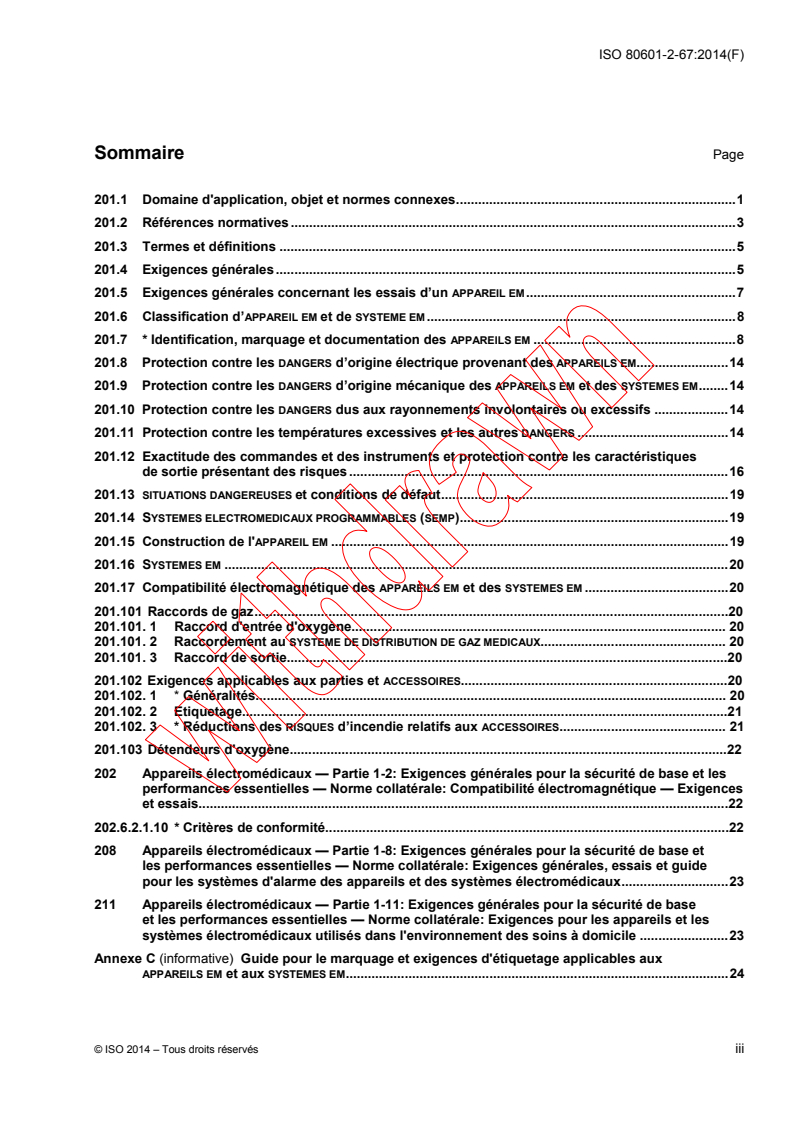
Sommaire Page
201.1 Domaine d'application, objet et normes connexes.1
201.2 Références normatives.3
201.3 Termes et définitions .5
201.4 Exigences générales.5
201.5 Exigences générales concernant les essais d’un APPAREIL EM.7
201.6 Classification d’APPAREIL EM et de SYSTEME EM.8
201.7 * Identification, marquage et documentation des APPAREILS EM .8
201.8 Protection contre les DANGERS d’origine électrique provenant des APPAREILS EM.14
201.9 Protection contre les DANGERS d’origine mécanique des APPAREILS EM et des SYSTEMES EM.14
201.10 Protection contre les DANGERS dus aux rayonnements involontaires ou excessifs .14
201.11 Protection contre les températures excessives et les autres DANGERS .14
201.12 Exactitude des commandes et des instruments et protection contre les caractéristiques
de sortie présentant des risques .16
201.13 SITUATIONS DANGEREUSES et conditions de défaut.19
201.14 SYSTEMES ELECTROMEDICAUX PROGRAMMABLES (SEMP).19
201.15 Construction de l'APPAREIL EM .19
201.16 SYSTEMES EM .20
201.17 Compatibilité électromagnétique des APPAREILS EM et des SYSTEMES EM .20
201.101 Raccords de gaz .20
201.101. 1 Raccord d'entrée d'oxygène. 20
201.101. 2 Raccordement au SYSTEME DE DISTRIBUTION DE GAZ MEDICAUX. 20
201.101. 3 Raccord de sortie.20
201.102 Exigences applicables aux parties et ACCESSOIRES.20
201.102. 1 * Généralités. 20
201.102. 2 Etiquetage.21
201.102. 3 * Réductions des RISQUES d’incendie relatifs aux ACCESSOIRES. 21
201.103 Détendeurs d'oxygène.22
202 Appareils électromédicaux — Partie 1-2: Exigences générales pour la sécurité de base et les
performances essentielles — Norme collatérale: Compatibilité électromagnétique — Exigen ces
et essais.22
202.6.2.1.10 * Critères de conformité.22
208 Appareils électromédicaux — Partie 1-8: Exigences générales pour la sécurité de base et
les performances essentielles — Norme collatérale: Exigences générales, essais et guide
pour les systèmes d'alarme des appareils et des systèmes électromédicaux.23
211 Appareils électromédicaux — Partie 1-11: Exigences générales pour la sécurité de base
et les performances essentielles — Norme collatérale: Exigences pour les appareils et les
systèmes électromédicaux utilisés dans l'environnement des soins à domicile .23
Annexe C (informative) Guide pour le marquage et exigences d'étiquetage applicables aux
APPAREILS EM et aux SYSTEMES EM.24
iii
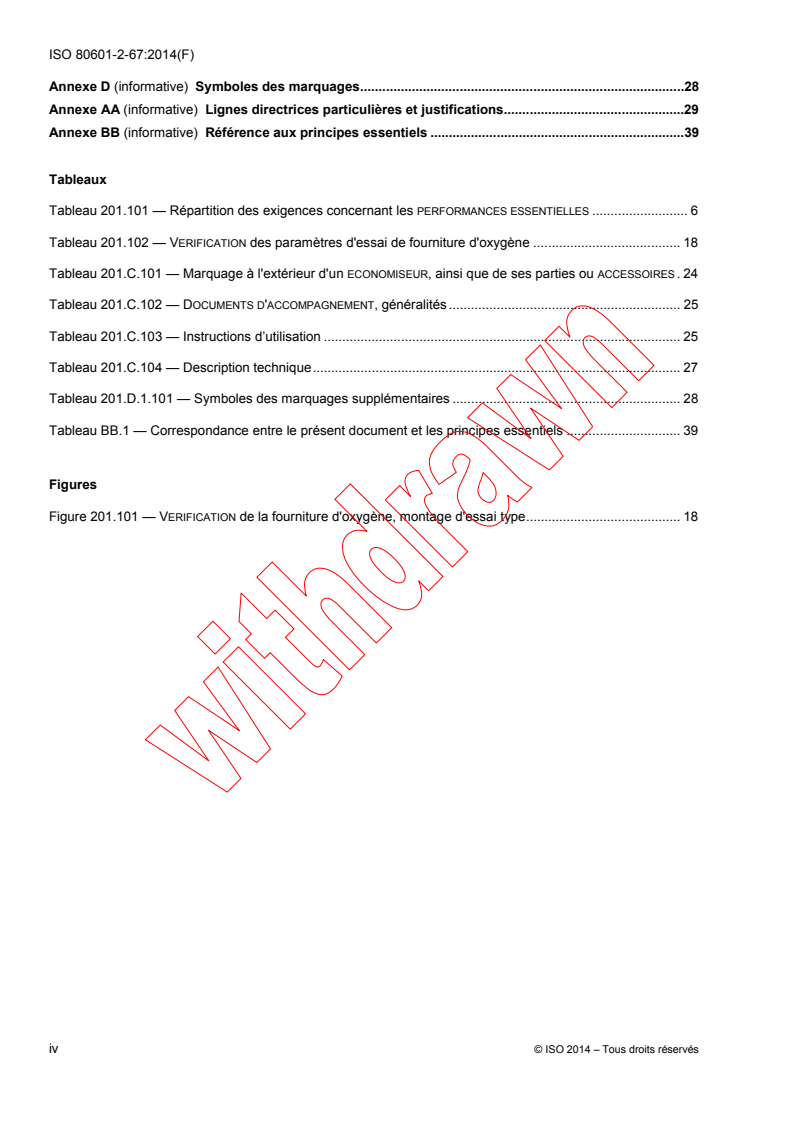
Annexe D (informative) Symboles des marquages.28
Annexe AA (informative) Lignes directrices particulières et justifications.29
Annexe BB (informative) Référence aux principes essentiels .39
Tableaux
Tableau 201.101 — Répartition des exigences concernant les PERFORMANCES ESSENTIELLES . 6
Tableau 201.102 — VERIFICATION des paramètres d'essai de fourniture d'oxygène . 18
Tableau 201.C.101 — Marquage à l'extérieur d'un ECONOMISEUR, ainsi que de ses parties ou ACCESSOIRES.24
Tableau 201.C.102 — DOCUMENTS D'ACCOMPAGNEMENT, généralités . 25
Tableau 201.C.103 — Instructions d’utilisation . 25
Tableau 201.C.104 — Description technique. 27
Tableau 201.D.1.101 — Symboles des marquages supplémentaires . 28
Tableau BB.1 — Correspondance entre le présent document et les principes essentiels . 39
Figures
Figure 201.101 — VERIFICATION de la fourniture d'oxygène, montage d'essai type. 18
iv
Avant-propos
L'ISO (Organisation internationale de normalisation) est une fédération mondiale d'organismes nationaux de
normalisation (comités membres de l'ISO). L'élaboration des Normes internationales est en général confiée
aux comités techniques de l'ISO. Chaque comité membre intéressé par une étude a le droit de faire partie du
comité technique créé à cet effet. Les organisations internationales, gouvernementales et non
gouvernementales, en liaison avec l'ISO participent également aux travaux. L'ISO collabore étroitement avec
la Commission électrotechnique internationale (CEI) en ce qui concerne la normalisation électrotechnique.
Les procédures utilisées pour élaborer le présent document et celles destinées à sa mise à jour sont décrites
dans les Directives ISO/CEI, Partie 1. Il convient, en particulier de prendre note des différents critères
d'approbation requis pour les différents types de documents ISO. Le présent document a été rédigé
conformément aux règles de rédaction données dans les Directives ISO/CEI, Partie 2, www.iso.org/directives.
L'attention est appelée sur le fait que certains des éléments du présent document peuvent faire l'objet de
droits de propriété intellectuelle ou de droits analogues. L'ISO ne saurait être tenue pour responsable de ne
pas avoir identifié de tels droits de propriété et averti de leur existence. Les détails concernant les références
aux droits de propriété intellectuelle ou autres droits analogues identifiés lors de l'élaboration du document
sont indiqués dans l'Introduction et/ou sur la liste ISO des déclarations de brevets reçues,
www.iso.org/patents.
Les éventuelles appellations commerciales utilisées dans le présent document sont données pour information
à l'intention des utilisateurs et ne constituent pas une approbation ou une recommandation.
L'ISO/CEI 80601-2-67 a été élaborée par le comité technique ISO/TC 121, Matériel d'anesthésie et de
réanimation respiratoire, sous-comité SC 3, Ventilateurs pulmonaires et équipements connexes et le comité
technique CEI/TC 62, Équipements électriques dans la pratique médicale, SC D, Équipements électriques.
Cette première édition annule et remplace la première édition de l’ISO 18779:2005. Cette édition de
l’ISO 80601-2-67 constitue une révision technique majeure de l’ISO 18779:2005 et inclut un alignement sur la
troisième édition de la CEI 60601-1, y compris son Amendement 1, et de la CEI 60601-1-11.
Les plus importantes modifications apportées sont les suivantes:
⎯ généralisation du domaine d’application afin d’inclure non seulement les ECONOMISEURS mais également
leurs ACCESSOIRES, du fait que les caractéristiques de ces ACCESSOIRES peuvent avoir un impact sur la
SECURITE DE BASE et les PERFORMANCES ESSENTIELLES des ECONOMISEURS,
⎯ identification des PERFORMANCES ESSENTIELLES pour les ECONOMISEURS et leurs ACCESSOIRES,
et les éléments suivants ont été ajoutés:
⎯ essais des performances de la fourniture d’oxygène,
⎯ nouveaux symboles,
⎯ essai des procédures de nettoyage et de désinfection et
⎯ prise en considération de l’éventuelle contamination du gaz respiratoire délivré au PATIENT provenant des
voies d’acheminement de gaz.
La présente publication a été rédigée selon les Directives de l'ISO/CEI, Partie 2.
v
Dans la présente Norme, les caractères suivants sont employés:
⎯ Exigences et définitions: caractères romains.
⎯ Modalités d’essais: caractères italiques.
⎯ Les indications de nature informative hors des tableaux, comme les notes, les exemples et les références: petits
caractères. Le texte normatif à l'intérieur des tableaux est également en petits caractères.
⎯ T ERMES DEFINIS EN 3 DE LA NORME GENERALE, DANS LA PRESENTE NORME PARTICULIERE OU TELS QUE
MENTIONNES: PETITES MAJUSCULES.
Concernant la structure de la présente Norme, le terme:
⎯ «article» désigne l'une des dix-sept sections numérotées dans la table des matières, avec toutes ses
subdivisions (par exemple, l'Article 201 inclut les Paragraphes 201.1, 201.2, etc.),
⎯ «paragraphe» désigne une subdivision numérotée d'un article (par exemple 201.7.1, 201.7.2 et 201.7.2.1
sont des paragraphes appartenant à l'Article 201.7).
Dans la présente Norme, les références à des articles sont précédées du mot «Article» suivi du numéro de
l'article concerné. Dans la présente Norme, les références aux paragraphes utilisent uniquement le numéro
du paragraphe concerné.
Dans la présente Norme, la conjonction «ou» est utilisée avec la valeur d’un «ou inclusif», ainsi un énoncé est
vrai si une combinaison des conditions quelle qu’elle soit est vraie.
Les formes verbales utilisées dans la présente Norme sont conformes à l'usage donné à l'Annexe H des
Directives ISO/CEI, Partie 2. Pour les besoins de la présente Norme:
⎯ «devoir» mis au présent de l'indicatif signifie que la satisfaction à une exigence ou à un essai est
obligatoire pour la conformité à la présente Norme,
⎯ «il convient/il est recommandé» signifie que la satisfaction à une exigence ou à un essai est
recommandée mais n'est pas obligatoire pour la conformité à la présente Norme,
⎯ «pouvoir» mis au présent de l'indicatif est utilisé pour décrire un moyen admissible pour satisfaire à une
exigence ou à un essai.
Lorsqu’un astérisque (*) est utilisé comme premier caractère devant un titre, au début d'un titre de paragraphe
ou de tableau, il indique l’existence d’une ligne directrice ou d’une justification à consulter à l’Annexe A.
L’attention des Organismes Membres et des Comités Nationaux est appelée sur le fait que les fabricants
d’équipements et les organisations en charge des essais peuvent avoir besoin d’une période de transition
après la publication d’une norme ISO ou CEI nouvelle, amendée ou révisée, leur permettant de rendre leurs
produits conformes aux nouvelles exigences et de s’équiper afin de pouvoir mener les essais nouveaux ou
révisés. Les comités formulent la recommandation que le contenu de la présente Norme ne soit pas considéré
comme une obligation de mise en œuvre sur le plan national dans les trois années à compter de la date de
publication pour un équipement de conception nouvelle et dans les cinq années à compter de la date de
publication pour un équipement déjà placé en cycle de fabrication.
vi
Introduction
Des essais cliniques aléatoires et contrôlés ont démontré que l’oxygénothérapie à long terme prolongeait la
survie des PATIENTS atteints d’une maladie respiratoire chronique et d’hypoxie corroborée. Les sources
habituelles d’oxygénothérapie thérapeutique à long terme comprennent l’oxygène gazeux provenant de
bouteilles ou d’oxygène liquide et l’oxygène provenant d’un concentrateur d’oxygène.
La plupart des cliniciens prescrivent une oxygénothérapie à faible écoulement en tant que fourniture
d’oxygène à écoulement continu en l/min. Les systèmes d’oxygénothérapie à écoulement continu fournissent
l’écoulement d’oxygène indépendamment de la fréquence et du schéma respiratoire du PATIENT. En dehors du
cadre de soins institutionnel, l’oxygénothérapie à écoulement continu constitue souvent une dépense
importante et peut restreindre la mobilité d’un PATIENT aux environs immédiats d’un système de fourniture
d’oxygène fixe ou stationnaire. Afin d’optimiser la mobilité, les PATIENTS utilisent l’oxygène à écoulement
continu provenant de systèmes d’oxygène liquide ou comprimé portables ayant une capacité de stockage
limitée qui peuvent restreindre les activités et le temps d’un patient lorsque celui-ci ne se trouve pas à
proximité d’un dispositif de fourniture d’oxygène stationnaire.
Un ECONOMISEUR qui délivre un supplément d’oxygène sous la forme d’un bolus conserve son usage tout en
permettant le maintien d’une saturation satisfaisante du sang artériel en oxygène (SaO ) du PATIENT lors des
activités quotidiennes. Un ECONOMISEUR délivre un supplément d’oxygène différemment de l’oxygénothérapie
à écoulement continu, en ce sens que l’écoulement de gaz thérapeutique n’est fourni que pendant la phase
d’inspiration du cycle respiratoire, lorsqu’il est le plus susceptible d’atteindre les alvéoles. Au cours des
phases d’expiration et de pause du cycle respiratoire, l’écoulement du supplément d’oxygène est stoppé,
réduisant ainsi au minimum les pertes. Etant donné que l’écoulement produit au fil du temps un volume, le
bolus fourni par l’ECONOMISEUR est habituellement représenté comme un volume de gaz. En comparaison
avec l’oxygénothérapie à écoulement continu, la thérapie utilisant un ECONOMISEUR permet des coûts
d’exploitation plus faibles et des durées ambulatoires plus longues pour des PATIENTS utilisant la même
capacité de stockage d’oxygène à écoulement continu.
Le fonctionnement d’un ECONOMISEUR peut être différent selon les FABRICANTS en ce qui concerne le
mécanisme de fourniture de dose, ce qui peut causer des variations dans l’oxygénothérapie du PATIENT.
L’utilisation de marquages numériques d’oxygène à écoulement continu pour les dosages sur les
ECONOMISEURS peut ne pas être directement corrélée aux réglages d’oxygène à écoulement continu et peut
conduire à une mauvaise interprétation des débits de fourniture de gaz et des volumes pour un PATIENT
particulier. Cela peut mener à un réglage incorrect et à une mauvaise thérapie pour le PATIENT pour tous les
schémas et fréquences respiratoires, par rapport à l’oxygénothérapie à écoulement continu. En raison des
différences en termes de fourniture, réglages et marquages par rapport à l’oxygénothérapie à écoulement
continu, l’utilisation d’un ECONOMISEUR requiert un titrage du PATIENT afin de déterminer le ou les réglages
appropriés nécessaires afin de fournir des niveaux de SaO adaptés aux schémas respiratoires du PATIENT.
La présente Norme est destinée à réduire l’ambigüité entre le fonctionnement de différents modèles
d’ECONOMISEUR et l’oxygénothérapie à écoulement continu en requérant des essais de performance et un
étiquetage normalisés.
vii
NORME INTERNATIONALE ISO 80601-2-67:2014(F)
Appareils électromédicaux —
Partie 2-67:
Exigences particulières pour la sécurité de base et les
performances essentielles des économiseurs d'oxygène
201.1 Domaine d'application, objet et normes connexes
L’Article 1 de la CEI 60601-1:2005+A1:2012 s’applique, à l’exception de ce qui suit:
201.1.1 * Domaine d'application
Le Paragraphe 1.1 de la CEI 60601-1:2005+A1:2012 est remplacé par:
La présente Norme particulière s’applique à la SECURITE DE BASE et aux PERFORMANCES ESSENTIELLES d’un
ECONOMISEUR d’oxygène, désigné ci-après sous le terme d’APPAREIL EM, ainsi que de ses ACCESSOIRES prévus
pour économiser le supplément d’oxygène en délivrant du gaz de manière intermittente et synchronisée en
suivant le cycle d’inspiration du PATIENT, pour une utilisation dans l’ENVIRONNEMENT DE SOINS A DOMICILE.
L’ECONOMISEUR d’oxygène est habituellement utilisé par un OPERATEUR NON SPECIALISTE.
NOTE 1 Un ECONOMISEUR peut également être utilisé dans des établissements de santé.
NOTE 2 Un ECONOMISEUR peut également être utilisé avec un concentrateur d'oxygène.
La présente Norme particulière s'applique également aux ACCESSOIRES destinés par leur FABRICANT à être
raccordés à un ECONOMISEUR, du fait que les caractéristiques de ces ACCESSOIRES peuvent avoir un impact
sur la SECURITE DE BASE ou sur les PERFORMANCES ESSENTIELLES de l'ECONOMISEUR.
La présente Norme particulière ne s'applique qu'aux dispositifs actifs (par exemple, dotés d'une alimentation
pneumatique ou électrique) et ne s'applique pas aux dispositifs non actifs (par exemple, canules de réservoir).
NOTE 3 Un ECONOMISEUR conforme à la présente Norme particulière peut être incorporé dans d'autres dispositifs
devant respecter leur propre norme, auquel cas la combinaison doit être conforme aux deux normes.
EXEMPLES Un ECONOMISEUR peut être combiné à un détendeur [2], à un concentrateur d'oxygène [1] ou à un appareil
d'oxygène liquide [6].
Si un article ou un paragraphe est spécifiquement destiné à être appliqué uniquement aux APPAREILS EM ou
uniquement aux SYSTEMES EM, le titre et le contenu dudit article ou paragraphe l'indiqueront. Si cela n'est pas
le cas, l'article ou le paragraphe s'applique à la fois aux APPAREILS EM et aux SYSTEMES EM, selon le cas.
Les DANGERS inhérents à la fonction prévue de l'APPAREIL EM ou des SYSTEMES EM dans le cadre du domaine
d'application de la présente Norme ne sont pas couverts par des exigences spécifiques contenues dans la
présente Norme, à l'exception de 7.2.13 et 8.4.1 de la norme générale.
NOTE 4 Voir également 4.2 de la norme générale.
La présente Norme particulière est une norme particulière de la série de normes CEI 60601.
201.1.2 Objet
Le Paragraphe 1.2 de la CEI 60601-1:2005 est remplacé par:
La présente Norme particulière est destinée à spécifier des exigences particulières concernant la SECURITE DE
BASE et les PERFORMANCES ESSENTIELLES applicables aux ECONOMISEURS [comme défini en 0] et à ses
ACCESSOIRES.
NOTE Les ACCESSOIRES sont inclus du fait qu'ils peuvent avoir un impact significatif sur la SECURITE DE BASE ou sur les
PERFORMANCES ESSENTIELLES d'un ECONOMISEUR.
201.1.3 Normes collatérales
Le Paragraphe 1.3 de la CEI 60601-1:2005+A1:2012 s'applique avec l'ajout suivant:
La présente Norme particulière fait référence aux normes collatérales applicables qui sont répertoriées en 2
de la norme générale et en 201.2 de la présente Norme particulière.
La CEI 60601-1-3:2008 ne s'applique pas.
201.1.4 Normes particulières
Le Paragraphe 1.4 de la CEI 60601-1:2005+A1:2012 est remplacé par:
Dans la série CEI 60601, des normes particulières peuvent modifier, remplacer ou supprimer des exigences
contenues dans la norme générale, notamment les normes collatérales, selon ce qui est approprié pour
l'APPAREIL EM particulier considéré et elles peuvent ajouter d'autres exigences concernant la SECURITE DE BASE
ou de PERFORMANCES ESSENTIELLES.
Une exigence d'une norme particulière prévaut sur l'exigence correspondante de la norme générale ou des
normes collatérales.
Dans un souci de concision, la CEI 60601-1:2005+A1:2012 est désignée dans la présente Norme particulière
par l'expression «norme générale». Les normes collatérales sont désignées par leur numéro de document.
La numérotation des articles et des paragraphes de la présente Norme particulière correspond à celle de la
norme générale avec le préfixe «201» (par exemple 201.1 dans la présente Norme traite du contenu de
l'Article 1 de la norme générale) ou de la norme collatérale applicable avec le préfixe «2xx», où xx représente
les chiffres finaux du numéro de document de norme collatérale (par exemple, 202.4 dans la présente Norme
particulière traite du contenu de l'Article 4 de la norme collatérale CEI 60601-1-2, 208.4 dans la présente
Norme particulière traite du contenu de l'Article 4 de la norme collatérale CEI 60601-1-8, etc.). Les
changements apportés au texte de la norme générale sont spécifiés en utilisant les termes suivants:
«Remplacement» signifie que l'article ou le paragraphe de la norme générale ou de la norme collatérale
applicable est remplacé totalement par le texte de la présente Norme particulière.
«Ajout» signifie que le texte de la présente Norme particulière s'ajoute aux exigences de la norme générale
ou de la norme collatérale applicable.
«Modification» signifie que l'article ou le paragraphe de la norme générale ou de la norme collatérale
applicable est modifié comme cela est indiqué par le texte de la présente Norme particulière.
Les paragraphes ou les figures ajoutés à ceux de la norme générale sont numérotés à partir de 201.101. Les
annexes supplémentaires sont désignées avec des lettres par AA, BB, etc. et les éléments supplémentaires
par aa), bb), etc.
2 © ISO 2014 – Tous droits réservés
Les paragraphes ou les figures qui sont ajoutés à ceux d'une norme collatérale sont numérotés à partir de 20x,
où «x» est le numéro de la norme collatérale, par exemple 202 pour la CEI 60601-1-2, 203 pour la CEI 60601-
1-3, etc.
L'expression «la présente Norme» est utilisée pour faire référence à la norme générale, à toutes les normes
collatérales applicables et à la présente Norme particulière considérées ensemble.
Lorsqu'il n'existe aucun article ni aucun paragraphe correspondant dans la présente Norme particulière,
l'article ou le paragraphe de la norme générale ou de la norme collatérale applicable, même éventuellement
sans intérêt, s'applique sans modification. Lorsqu'il est envisagé que toute partie de la norme générale ou de
la norme collatérale applicable, bien qu'éventuellement intéressante, ne doit pas être appliquée, une
indication à cet effet est donnée dans la présente Norme particulière.
201.2 Références normatives
Les documents suivants, en totalité ou en partie, sont référencés de manière normative dans le présent
document et sont indispensables pour son application. Pour les références datées, seule l'édition citée
s'applique. Pour les références non datées, la dernière édition du document de référence s'applique (y
compris les éventuels amendements).
NOTE Les références informatives sont répertoriées dans la bibliographie commençant à la page 39.
L'Article 2 de la CEI 60601-1:2005+A1:2012 s'applique, à l'exception de ce qui suit:
Remplacement:
CEI 60601-1-2:2007, Appareils électromédicaux — Partie 1-2: Exigences générales pour la sécurité de base
et les performances essentielles — Norme collatérale: Compatibilité électromagnétique — Exigences et
essais
CEI 60601-1-6:2010, Appareils électromédicaux — Partie 1-6: Exigences générales pour la sécurité de base
et les performances essentielles — Norme collatérale: Aptitude à l'utilisation
+Amendement 1:2013
CEI 60601-1-8:2006, Appareils électromédicaux — Partie 1-8: Exigences générales pour la sécurité de base
et les performances essentielles — Norme collatérale: Exigences générales, essais et guide pour les
systèmes d’alarme des appareils et des systèmes électromédicaux
+Amendement 1:2012
CEI 60601-1-11:2010, Appareils électromédicaux — Partie 1-11: Exigences générales pour la sécurité de
base et les performances essentielles — Norme Collatérale: Exigences pour les appareils électromédicaux et
les systèmes électromédicaux utilisés dans l’environnement des soins à domicile
Ajout:
ISO 32:1977, Bouteilles à gaz pour usages médicaux — Marquage pour l'identification du contenu
ISO 4135:2001, Matériel d'anesthésie et de réanimation respiratoire — Vocabulaire
ISO 5359:2008, Flexibles de raccordement à basse pression pour utilisation avec les gaz médicaux
ISO 7000:2012, Symboles graphiques utilisables sur le matériel — Symboles·enregistrés
ISO 7396-1:2007, Systèmes de distribution de gaz médicaux — Partie 1: Systèmes de distribution de gaz
médicaux comprimés et de vide
+Amendement 1:2010
+Amendement 2:2010
ISO 14937:2009, Stérilisation des produits de santé — Exigences générales pour la caractérisation d'un agent
stérilis ant et pour la mise au point, la validation et la vérification de routine d'un processus de stérilisation pour
dispos itifs médicaux
ISO 10524-1:2006, Détendeurs pour l'utilisation avec les gaz médicaux — Partie 1: Détendeurs et
détendeurs-débitmètres
ISO 10524-3:2005, Détendeurs pour l'utilisation avec les gaz médicaux — Partie 3: Détendeurs intégrés dans
les robinets des bouteilles de gaz
+Amendement 1:2013
ISO 15223-1:2012, Dispositifs médicaux — Symboles à utiliser avec les étiquettes, l'étiquetage et les
informations à fournir relatifs aux dispositifs médicaux — Partie 1: Exigences générales
ISO 17664:2004, Stérilisation des dispositifs médicaux — Informations devant être fournies par le fabricant
pour le processus de restérilisation des dispositifs médicaux
ISO 80369-1:2010, Raccords de petite taille pour liquides et gaz utilisés dans le domaine de la santé —
Partie 1: Exigences générales
CEI 60601-1:2005, Appareils électromédicaux — Partie 1: Exigences générales pour la sécurité de base et
les performances essentielles
+Amendement 1:2012
CEI 62366:2007, Dispositifs médicaux — Application de l'ingénierie de l'aptitude à l'utilisation aux dispositifs
médicaux
+Amendement 1:2014
4 © ISO 2014 – Tous droits réservés
201.3 Termes et définitions
Pour les besoins du présent document, les termes et définitions donnés dans l’ISO 7396-1:2007, la
CEI 60601-1:2005+A1:2012, la CEI 60601-1-2:2007, la CEI 60601-1-6:2010+A1:2013, la
CEI 60601-1-8:2006+A1:2012, la CEI 60601-1-11:2010, la CEI 60601-2-2:2007, la CEI 62366:2007+A1:2014,
l’ISO 4135:2001 ainsi que les suivants s'appliquent.
NOTE Un index des termes définis est fourni à la page 41.
Ajout:
201.3.201
ECONOMISEUR
APPAREIL EM visant à améliorer l'utilisation de la source d'oxygène tout en fournissant une
oxygénothérapie destinée à maintenir la saturation SaO requise du PATIENT
NOTE à l’article Un ECONOMISEUR peut être doté d'une alimentation électrique ou pneumatique.
201.3.202
ECONOMISEUR DOTE D'UNE FONCTION DE SURVEILLANCE
ECONOMISEUR destiné à être utilisé chez des PATIENTS pour lesquels une surveillance de la fourniture
d'oxygène via l'ECONOMISEUR est indiquée
201.3.203
DISPOSITIF SENSIBLE AU SENS DU DEBIT
dispositif ou ACCESSOIRE à travers lequel le courant gazeux ne doit s'écouler que dans une seule direction
pour que soient assurés le fonctionnement correct ou la sécurité du PATIENT
[SOURCE: ISO 4135:2001, définition 3.1.7, modifiée – ajout d’ACCESSOIRE]
201.4 Exigences générales
L'Article 4 de la CEI 60601-1:2005+A1:2012 s'applique, à l'exception de ce qui suit:
201.4.3 PERFORMANCES ESSENTIELLES
Le Paragraphe 4.3 de la CEI 60601-1:2005+A1:2012 s'applique, à l'exception de ce qui suit:
Paragraphe supplémentaire:
201.4.3.101 * Exigences supplémentaires concernant les PERFORMANCES ESSENTIELLES
Les exigences supplémentaires concernant les PERFORMANCES ESSENTIELLES sont stipulées dans les
paragraphes répertoriés dans le Tableau 201.101.
Tableau 201.101 — Répartition des exigences concernant les PERFORMANCES ESSENTIELLES
Exigence Paragraphe
a
En ce qui concerne un ECONOMISEUR DOTE D'UNE FONCTION DE SURVEILLANCE,
201.12.1.101
exigence portant sur la DOSE D'OXYGENE DELIVREE, aussi bien en CONDITIONS
NORMALES qu'en CONDITION DE PREMIER DEFAUT, devant respecter l'exactitude
indiquée dans les instructions d'utilisation
ou génération d'une CONDITION D'ALARME
absence de signal de déclenchement CONDITION D'ALARME 201.12.4.101
défaillance de la source de gaz CONDITION D'ALARME 201.12.4.102
a
En ce qui concerne les ECONOMISEURs autres qu'un ECONOMISEUR DOTE
201.12.1.101
D'UNE FONCTION DE SURVEILLANCE, exigence portant sur la dose d'oxygène
délivrée, en CONDITIONS NORMALES, devant respecter l'EXACTITUDE indiquée
dans les instructions d'utilisation
ou une indication d'un fonctionnement anormal
a
Le Paragraphe 202.6.2.1.10 indique des méthodes d'évaluation de l'oxygène délivré par
le biais d'essais spécifiques suivant des critères d'acceptation requis par la présente Norme.
201.4.6 * Parties d'APPAREIL EM ou de SYSTEME EM en contact avec le PATIENT
Modification (ajoutée à la fin de 4.6 avant le contrôle de la conformité):
Les voies d'acheminement de gaz d'un ECONOMISEUR ou ses parties ou ACCESSOIRES doivent être soumis aux
exigences applicables aux PARTIES APPLIQUEES conformément au présent paragraphe. Un ECONOMISEUR ou
ses parties ou ACCESSOIRES qui sont en contact avec le PATIENT doivent être soumis aux exigences
applicables aux PARTIES APPLIQUEES conformément au présent paragraphe.
201.4.11.101 * Exigences supplémentaires applicables à l’entrée de gaz sous pression
201.4.11.101.1 Exigence de surpression
Un ECONOMISEUR doté d’un raccord d’entrée d’oxygène auquel l’OPERATEUR spécifié en 201.101.1 a accès doit
fonctionner de manière à satisfaire aux exigences de la présente Norme particulière pour toute sa plage
ASSIGNEE de pression d’entrée et ne doit pas entraîner de RISQUE inacceptable en CONDITION DE PREMIER
DEFAUT de 1 000 kPa.
Un ECONOMISEUR doté d’un raccord d’entrée d’oxygène auquel l’OPERATEUR a accès, conforme à 5.8 de
l’ISO 80369-1:2010, ne doit pas provoquer de RISQUE inacceptable en CONDITION DE PREMIER DEFAUT pour le
double de la pression d’alimentation maximale ASSIGNEE.
NOTE 1 Des détendeurs internes peuvent être requis pour adapter la CONDITION DE PREMIER DEFAUT de pression
d’entrée maximale ainsi que la plage ASSIGNEE de pression d’entrée.
NOTE 2 En cas de CONDITION DE PREMIER DEFAUT de surpression, il est souhaitable de laisser s’écouler le gaz jusqu’au
PATIENT. Dans ce cas, le débit de l’ECONOMISEUR est susceptible de ne pas respecter sa spécification.
Vérifier la conformité par des essais fonctionnels en UTILISATION NORMALE et en CONDITIONS NORMALES avec les
réglages de fonctionnement les plus défavorables, par des essais fonctionnels en CONDITION DE PREMIER
DEFAUT et par une inspection du DOSSIER DE GESTION DES RISQUES.
6 © ISO 2014 – Tous droits réservés
201.4.11.101.2 Exigence de compatibilité
Si l’ECONOMISEUR est destiné à être raccordé à un SYSTEME DE DISTRIBUTION DE GAZ MEDICAUX conforme à
l’ISO 7396-1:2007, alors:
⎯ La plage ASSIGNEE de pression d’entrée doit couvrir la plage spécifiée dans l’ISO 7396-1:2007 et
⎯ En CONDITIONS NORMALES,
1) le débit d’entrée moyen maximal sur 10 s requis par l’ECONOMISEUR ne doit pas dépasser 60 l/min à une
pression de 280 kPa, mesuré au niveau de l’orifice d’entrée de gaz et
2) le débit d’entrée transitoire ne doit pas dépasser 200 l/min lorsqu’il est moyenné sur 3 s,
ou
DOCUMENTS D’ACCOMPAGNEMENT doivent décrire:
3) les
i) le débit d’entrée moyen maximal sur 10 s requis par l’ECONOMISEUR à une pression de 280 kPa,
mesuré au niveau de l’orifice d’entrée de gaz,
ii) le débit d’entrée transitoire maximal moyenné sur 3 s requis par l’ECONOMISEUR à une pression de
280 kPa, mesuré au niveau de l’orifice d’entrée de gaz, et
iii) un avertissement comme celui ci-après «Avertissement: cet ECONOMISEUR est un dispositif à débit
élevé et il convient de ne le raccorder qu’à une installation de distribution conçue en envisageant
tous les facteurs de diversité, afin d’inclure le débit élevé indiqué pour un nombre spécifié de
raccords de sortie de prises murales de manière à éviter de dépasser le débit de conception du
système de distribution, en réduisant ainsi au maximum le RISQUE que l’ECONOMISEUR interfère
avec le fonctionnement d’un appareil adjacent.»
Vérifier la conformité par des essais fonctionnels en UTILISATION NORMALE et en CONDITIONS NORMALES avec les
réglages de fonctionnement les plus défavorables et par inspection des DOCUMENTS D’ACCOMPAGNEMENT.
EXEMPLE La plus forte consommation de gaz, la plus forte fourniture de gaz et, si elle est fournie, la plus forte
consommation de gaz ASSIGNEE à tous débits d’alimentation en gaz.
201.5 Exigences générales concernant les essais d’un APPAREIL EM
L’Article 5 de la CEI 60601-1:2005+A1:2012, s’applique, à l’exception de ce qui suit:
Ajout:
201.5.101 Exigences supplémentaires s’ajoutant aux exigences générales concernant les
essais d’un APPAREIL EM
201.5.101.1 Conditions d’essai d’un ECONOMISEUR
Pour les essais, l’ECONOMISEUR doit être raccordé à une source de gaz comme spécifié en UTILISATION
NORMALE, excepté que l’oxygène de qualité industrielle peut être remplacé par un gaz médical équivalent,
selon ce qui est approprié, sauf spécification contraire. En cas de remplacement du gaz, il convient de veiller
à s’assurer que le gaz d’essai présente la concentration en oxygène minimale, la teneur en eau maximale et
la teneur en huile maximale, spécifiées pour une UTILISATION NORMALE.
201. 5.101.2 * Spécifications de débit de gaz
Dans la présente Norme, les exigences de débit et de volume du gaz fourni à l’ECONOMISEUR et du gaz délivré
au PATIENT sont exprimées par rapport à des essais menés dans les conditions CNTP (Conditions Normales
de Température et de Pression).
NOTE 1 Aux fins de la présente Norme, les CNTP sont fixées à 101,3 kPa à une température de fonctionnement de
20 °C, sous atmosphère sèche.
Corriger toutes les mesures d’essai par rapport aux CNTP, selon ce qui est approprié.
201.5.101.3 * Erreurs d’essai d’ECONOMISEUR
Aux fins de la présente Norme, les tolérances déclarées dans les DOCUMENTS D’ACCOMPAGNEMENT doivent
inclure l’incertitude liée aux mesurages utilisés pour déterminer la spécification.
201.6 Classification d’APPAREIL EM et de SYSTEME EM
L’Article 6 de la CEI 60601-1:2005 s’applique.
201.7 * Identification, marquage et documentation des APPAREILS EM
L’Article 7 de la CEI 60601-1:2005+A1:2012 s’applique, à l’exception de ce qui suit:
201.7.1.2 * Lisibilité des marquages
Le Paragraphe 7.1.2 de la CEI 60601-1:2005+A1:2012 s’applique, à l’exception de ce qui suit:
Remplacement (à la fin de la deuxième phrase du deuxième paragraphe du contrôle de la conformité):
Remplacer «1 m» par «1 m et, pour un APPAREIL EM PORTE SUR LE CORPS de 0,5 m»
Paragraphes supplémentaires:
201.7.2.4.101 Exigences supplémentaires applicables aux ACCESSOIRES
Les ACCESSOIRES fournis séparément doivent respecter les exigences de 201.7.2.101 et doivent être marqués
par une indication stipulant toutes limitations ou tous effets néfastes de l’ACCESSOIRE sur la SECURITE DE BASE
ou sur les PERFORMANCES ESSENTIELLES de l’ECONOMISEUR, le cas échéant. Lorsque le marquage de
l’ACCESSOIRE s’avère impossible, ces informations peuvent être placées dans les instructions d’utilisation.
Vérifier la conformité par inspection et inspection du DOSSIER DE GESTION DES RISQUES en ce qui concerne
toutes limitations ou tous effets néfastes de l’ACCESSOIRE.
201.7.2.13.101 Exigences supplémentaires concernant les effets physiologiques
Tous composants des voies d'acheminement de gaz ou tous ACCESSOIRES contenant du latex naturel doivent
être marqués comme contenant du latex. Un tel marquage doit être CLAIREMENT LISIBLE. Il est possible
d'utiliser le symbole 5.4.5 issu de l'ISO 15223-1:2012 (Tableau 201.D.1.101, symbole 3). Les instructions
d'utilisation doivent également décrire tous les composants contenant du latex naturel.
Vérifier la conformité par inspection.
8 © ISO 2014 – Tous droits réservés
201.7.2.17.101 Exigences supplémentaires applicables aux emballages de protection
Les emballages doivent être CLAIREMENT LISIBLES et doivent être marqués de la manière suivante:
a) avec une description du contenu,
b) avec une référence d’identification du lot, un numéro de type ou de série ou un symbole parmi les
symboles 5.1.5 ou 5.1.7 issus de l’ISO 15223-1:2012 (Tableau 201.D.1.101, symbole 1 ou symbole 2),
c) avec, pour les emballages contenant du latex naturel, le terme «LATEX», ou le symbole 5.4.5 issu de
l'ISO 15223-1:2012 (Tableau 201.D.1.101, symbole 3),
En ce qui concerne une REFERENCE DU MODELE OU DU TYPE spécifique, l'indication d'un usage unique doit
concorder avec la REFERENCE DU MODELE OU DU TYPE.
Vérifier la conformité par inspection.
201.7.2.101 Exigences supplémentaires applicables au marquage à l'extérieur des
APPAREILS EM ou de leurs parties
Le marquage d'un APPAREIL EM et de ses parties ou ACCESSOIRES doit être CLAIREMENT LISIBLE et doit inclure
les éléments suivants:
a) toutes les instructions particulières de stockage et/ou de manutention,
b) tous les avertissements particuliers et/ou précautions pertinents pour le fonctionnement immédiat de
l'ECONOMISEUR.
Le cas échéant, le marquage de l'APPAREIL EM auquel un OPERATEUR a accès et de ses parties ou
ACCESSOIRES doit être CLAIREMENT LISIBLE et doit inclure les éléments suivants:
c) en ce qui concerne les entrées propres à des gaz,
⎯ le nom du gaz ou le symbole chimique de l'oxygène conformément à l'ISO 5359:2008,
⎯ le code de couleur propre à l'oxygène conformément à l'ISO 32:1977, si un code de couleur est
utilisé,
EXEMPLES Pour les débitmètres, les tuyaux flexibles, les bouteilles de gaz.
NOTE Dans certains pays, d'autres codes de couleur sont utilisés.
d) une flèche indiquant le sens du débit pour les DISPOSITIFS SENSIBLES AU DEBIT qui peuvent être retirés
par l'OPERATEUR sans l'aide d'OUTIL,
Le marquage de la commande de fourniture d'oxygène ne doit pas être uniquement numérique et le
marquage doit être tel que les réglages minimal et maximal soient évidents pour l’OPERATEUR.
Vérifier la conformité par inspection.
201.7.4.3 * Unités de mesure
Le Paragraphe 7.4.3 de la CEI 60601-1:2005+A1:2012 s'applique, à l'exception de ce qui suit:
Modification (ajout en bas du Tableau 1 d'une nouvelle ligne):
Les spécifications de volume et de débit applicables au gaz fourni à l'ECONOMISEUR doivent être exprimées
aux conditions CNTP (Conditions Normales de Température et de Pression).
NOTE Aux fins de la présente Norme, les conditions CNTP sont fixées à 101,3 kPa à une température de
fonctionnement de 20 °C.
201.7.9.1 Exigences générales supplémentaires
Le Paragraphe 7.9.1 de la CEI 60601-1:2005+A1:2012 s'applique, à l'exception de ce qui suit:
Modification (remplacer le premier tiret par):
⎯ le nom ou la marque de fabrique ainsi que l'adresse
⎯ du FABRICANT et
⎯ si le FABRICANT ne dispose pas d'une adresse au niveau d’une zone géographique donnée, du
représentant autorisé dans cette zone,
à laquelle l'ORGANISME RESPONSABLE peut s'adresser,
201.7.9.2 Instructions d’utilisation
Le Paragraphe 7.9.2 de la CEI 60601-1:2005+A1:2012 s’applique, à l’exception de ce qui suit:
Paragraphes supplémentaires:
201.7.9.2.1.101 Exigences générales supplémentaires
Les instructions d'utilisation doivent indiquer:
a) si l'ECONOMISEUR et ses parties ou ACCESSOIRES sont destinés à un usage unique, des informations sur les
caractéristiques et facteurs techniques connus du FABRICANT qui sont susceptibles d'engendrer un RISQUE
si l'ECONOMISEUR et ses parties ou ACCESSOIRES sont réutilisés.
b) une description des principes de fonctionnement de l’ECONOMISEUR, notamment des principes de dosage
de l’oxygène, de synchronisation, de déclenchement et les réglages connexes.
c) si une commande manuelle de la sensibilité est fournie, des instructions sur la manière de régler la
commande de détection optimale de la respiration.
d) un schéma des dispositifs pneumatiques de l’ECONOMISEUR, y compris un schéma des pièces pouvant
être retirées par l’OPERATEUR, qu’il s’agisse de pièces fournies ou recommandées dans les instructions
d’utilisation.
e) une déclaration stipulant qu’il convient que l’organisme responsable:
⎯ garantisse la compatibilité de l’ECONOMISEUR d’oxygène et de toutes les pièces et ACCESSOIRES
utilisés afin d’être raccordés au patient avant l’utilisation,
⎯ garantisse que les réglages de fourniture d’oxygène pour le patient ont été déterminés et enregistrés
pour le patient de manière individuelle avec la configuration des équipements à utiliser, y compris les
accessoires et
⎯ réévalue de manière périodique le ou les réglages de la thérapie à des fins d’efficacité.
Vérifier la conformité par inspection.
10 © ISO 2014 – Tous droits réservés
201.7.9.2.2.101 Ex
...