

IEC 62196-1:2003
(Main)Plugs, socket-outlets, vehicle couplers and vehicle inlets - Conductive charging of electric vehicles - Part 1: Charging of electric vehicles up to 250 A a.c. and 400 A d.c.
General Information
- Abstract
This part of IEC 62196 is applicable to plugs, socket-outlets, connectors, inlets and cable assemblies for electric vehicles, intended for use in conductive charging systems which incorporate control means, with a rated operating voltage not exceeding: 690 V a.c., 50 - 60 Hz, at a rated current not exceeding 250 A; 600 V d.c., at a rated current not exceeding 400 A.
- Status
- Published
- Publication Date
- 27-Apr-2003
- Technical Committee
- SC 23H - Plugs, Socket-outlets and Couplers for industrial and similar applications, and for Electric Vehicles
- Drafting Committee
- MT 8 - TC 23/SC 23H/MT 8
- Current Stage
- DELPUB - Deleted Publication
- Start Date
- 13-Oct-2011
- Completion Date
- 28-Aug-2026
Buy Documents
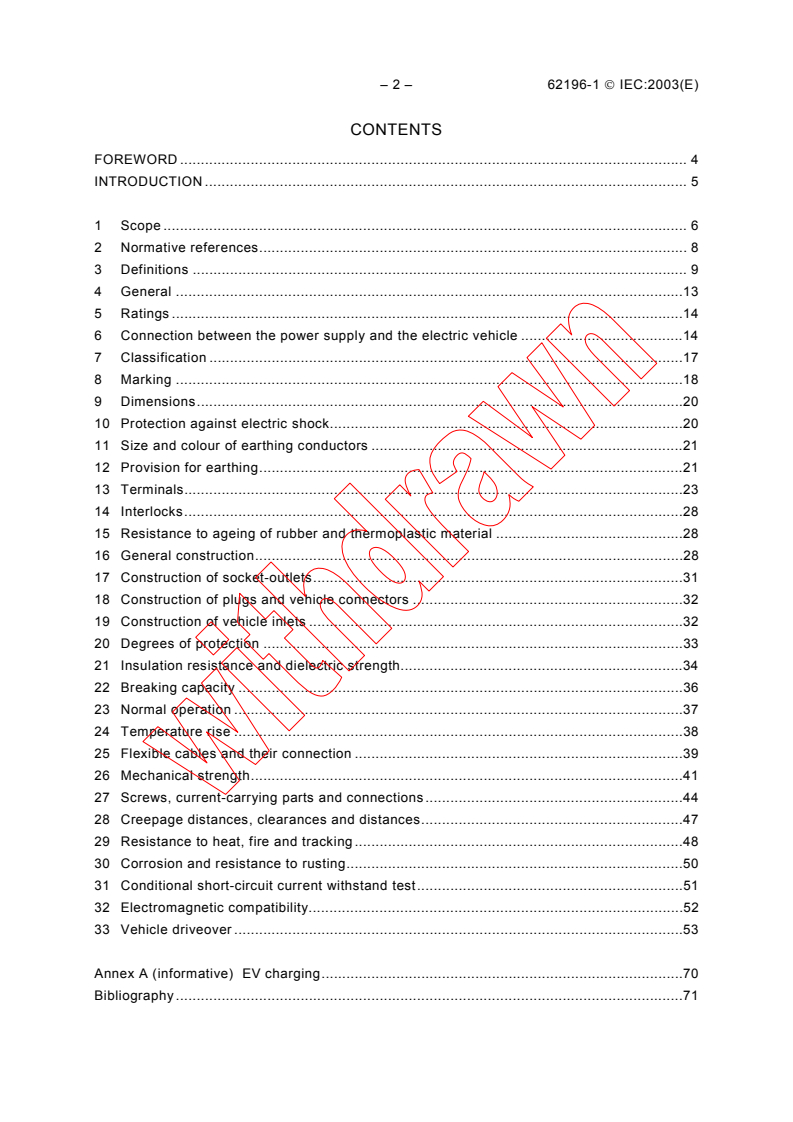
IEC 62196-1:2003 - Plugs, socket-outlets, vehicle couplers and vehicle inlets - Conductive charging of electric vehicles - Part 1: Charging of electric vehicles up to 250 A a.c. and 400 A d.c. Released:4/28/2003
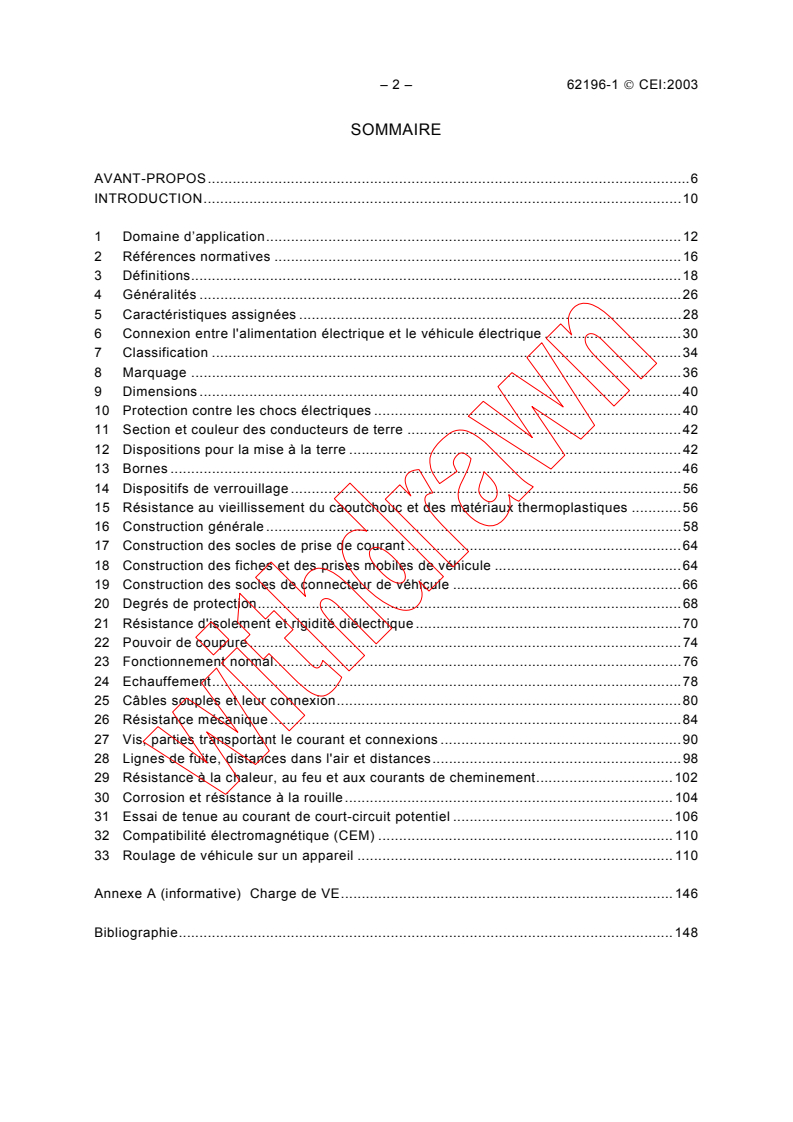
IEC 62196-1:2003 - Plugs, socket-outlets, vehicle couplers and vehicle inlets - Conductive charging of electric vehicles - Part 1: Charging of electric vehicles up to 250 A a.c. and 400 A d.c. Released:4/28/2003
Overview
IEC 62196-1:2003 defines requirements for plugs, socket‑outlets, vehicle couplers and vehicle inlets used in conductive charging of electric vehicles (EVs). This Part 1 covers dedicated conductive charging accessories intended for systems with control means and rated operating limits up to 690 V a.c. (50–60 Hz) at 250 A and 600 V d.c. at 400 A. The standard applies to plugs, connectors, inlets and cable assemblies designed for copper conductors and normal ambient temperatures from −30 °C to +50 °C.
Key topics and technical requirements
IEC 62196-1 is a comprehensive specification that addresses mechanical, electrical and performance aspects of EV conductive charging interfaces. Major topics include:
- Scope and ratings (voltage/current limits, ambient conditions)
- Definitions and classification of accessories used in EV charging
- Dimensions, markings and identification for interoperability
- Protection against electric shock, earthing and insulation requirements
- Terminal, contact and cable requirements (size, pull‑out, connections)
- Interlocks and mechanical construction for safe mating/unmating
- Dielectric strength, insulation resistance and breaking capacity tests
- Temperature rise, thermal ageing and materials resistance (rubber, thermoplastics)
- Mechanical strength, impact and flexing tests including vehicle drive‑over scenarios
- Corrosion, tracking, fire resistance and EMC considerations
- Test methods and performance verification for reliable operation
(The standard cross‑references EV charging modes and connection cases defined in IEC 61851‑1.)
Applications and who uses it
IEC 62196-1 is used by stakeholders involved in the design, manufacture, testing and deployment of EV conductive charging equipment:
- EV and charging-station manufacturers designing connectors, plugs and inlets
- Cable and accessory suppliers producing certified assemblies
- Test laboratories performing type‑approval and compliance testing
- Charging network operators and fleet integrators ensuring interoperability
- Regulatory bodies and standards committees referencing safe charging interfaces
Practical use cases include product development, conformity assessment, interoperability verification and installation guidance for dedicated AC/DC conductive charging systems.
Related standards
- IEC 61851‑1 - Electric vehicle conductive charging systems (defines charging modes, control and cases)
- IEC 60309 - Industrial plugs and socket‑outlets (referenced for some connector types)
- Other parts of the IEC 62196 series address additional connector forms and higher‑level interoperability.
Keywords: IEC 62196-1, conductive charging, electric vehicle connectors, EV plugs, socket‑outlets, vehicle inlets, 250 A AC, 400 A DC, EV charging standard.
Relations
- Effective Date
- 05-Sep-2023
Buy Documents
IEC 62196-1:2003 - Plugs, socket-outlets, vehicle couplers and vehicle inlets - Conductive charging of electric vehicles - Part 1: Charging of electric vehicles up to 250 A a.c. and 400 A d.c. Released:4/28/2003
IEC 62196-1:2003 - Plugs, socket-outlets, vehicle couplers and vehicle inlets - Conductive charging of electric vehicles - Part 1: Charging of electric vehicles up to 250 A a.c. and 400 A d.c. Released:4/28/2003
Get Certified
Connect with accredited certification bodies for this standard

TÜV Rheinland
TÜV Rheinland is a leading international provider of technical services.

TÜV SÜD
TÜV SÜD is a trusted partner of choice for safety, security and sustainability solutions.

DEKRA Certification Inc.
DEKRA US certification services.
Sponsored listings
Frequently Asked Questions
IEC 62196-1:2003 is a standard published by the International Electrotechnical Commission (IEC). Its full title is "Plugs, socket-outlets, vehicle couplers and vehicle inlets - Conductive charging of electric vehicles - Part 1: Charging of electric vehicles up to 250 A a.c. and 400 A d.c.". This standard covers: This part of IEC 62196 is applicable to plugs, socket-outlets, connectors, inlets and cable assemblies for electric vehicles, intended for use in conductive charging systems which incorporate control means, with a rated operating voltage not exceeding: 690 V a.c., 50 - 60 Hz, at a rated current not exceeding 250 A; 600 V d.c., at a rated current not exceeding 400 A.
This part of IEC 62196 is applicable to plugs, socket-outlets, connectors, inlets and cable assemblies for electric vehicles, intended for use in conductive charging systems which incorporate control means, with a rated operating voltage not exceeding: 690 V a.c., 50 - 60 Hz, at a rated current not exceeding 250 A; 600 V d.c., at a rated current not exceeding 400 A.
IEC 62196-1:2003 is classified under the following ICS (International Classification for Standards) categories: 29.120.30 - Plugs, socket-outlets, couplers; 33.160.01 - Audio, video and audiovisual systems in general; 43.120 - Electric road vehicles. The ICS classification helps identify the subject area and facilitates finding related standards.
IEC 62196-1:2003 has the following relationships with other standards: It is inter standard links to IEC 62196-1:2011. Understanding these relationships helps ensure you are using the most current and applicable version of the standard.
IEC 62196-1:2003 is available in PDF format for immediate download after purchase. The document can be added to your cart and obtained through the secure checkout process. Digital delivery ensures instant access to the complete standard document.
Standards Content (Sample)
INTERNATIONAL IEC
STANDARD
62196-1
First edition
2003-04
Plugs, socket-outlets, vehicle couplers
and vehicle inlets –
Conductive charging of electric vehicles –
Part 1:
Charging of electric vehicles up to 250 A a.c.
and 400 A d.c.
Fiches, socles de prise de courant, prises mobiles
et socles de connecteur pour véhicule –
Charge conductive des véhicules électriques –
Partie 1:
Charge des véhicules électriques jusqu'à 250 A c.a.
et 400 A c.c.
Reference number
Publication numbering
As from 1 January 1997 all IEC publications are issued with a designation in the
60000 series. For example, IEC 34-1 is now referred to as IEC 60034-1.
Consolidated editions
The IEC is now publishing consolidated versions of its publications. For example,
edition numbers 1.0, 1.1 and 1.2 refer, respectively, to the base publication, the
base publication incorporating amendment 1 and the base publication incorporating
amendments 1 and 2.
Further information on IEC publications
The technical content of IEC publications is kept under constant review by the IEC,
thus ensuring that the content reflects current technology. Information relating to
this publication, including its validity, is available in the IEC Catalogue of
publications (see below) in addition to new editions, amendments and corrigenda.
Information on the subjects under consideration and work in progress undertaken
by the technical committee which has prepared this publication, as well as the list
of publications issued, is also available from the following:
• IEC Web Site (www.iec.ch)
• Catalogue of IEC publications
The on-line catalogue on the IEC web site (http://www.iec.ch/searchpub/cur_fut.htm)
enables you to search by a variety of criteria including text searches, technical
committees and date of publication. On-line information is also available on
recently issued publications, withdrawn and replaced publications, as well as
corrigenda.
• IEC Just Published
This summary of recently issued publications (http://www.iec.ch/online_news/
justpub/jp_entry.htm) is also available by email. Please contact the Customer
Service Centre (see below) for further information.
• Customer Service Centre
If you have any questions regarding this publication or need further assistance,
please contact the Customer Service Centre:
Email: custserv@iec.ch
Tel: +41 22 919 02 11
Fax: +41 22 919 03 00
INTERNATIONAL IEC
STANDARD
62196-1
First edition
2003-04
Plugs, socket-outlets, vehicle couplers
and vehicle inlets –
Conductive charging of electric vehicles –
Part 1:
Charging of electric vehicles up to 250 A a.c.
and 400 A d.c.
Fiches, socles de prise de courant, prises mobiles
et socles de connecteur pour véhicule –
Charge conductive des véhicules électriques –
Partie 1:
Charge des véhicules électriques jusqu'à 250 A c.a.
et 400 A c.c.
IEC 2003 Copyright - all rights reserved
No part of this publication may be reproduced or utilized in any form or by any means, electronic or
mechanical, including photocopying and microfilm, without permission in writing from the publisher.
International Electrotechnical Commission, 3, rue de Varembé, PO Box 131, CH-1211 Geneva 20, Switzerland
Telephone: +41 22 919 02 11 Telefax: +41 22 919 03 00 E-mail: inmail@iec.ch Web: www.iec.ch
PRICE CODE
Commission Electrotechnique Internationale
XB
International Electrotechnical Commission
Международная Электротехническая Комиссия
For price, see current catalogue
– 2 – 62196-1 IEC:2003(E)
CONTENTS
FOREWORD . 4
INTRODUCTION .5
1 Scope . 6
2 Normative references. 8
3 Definitions . 9
4 General .13
5 Ratings .14
6 Connection between the power supply and the electric vehicle .14
7 Classification .17
8 Marking .18
9 Dimensions.20
10 Protection against electric shock.20
11 Size and colour of earthing conductors .21
12 Provision for earthing.21
13 Terminals.23
14 Interlocks.28
15 Resistance to ageing of rubber and thermoplastic material .28
16 General construction.28
17 Construction of socket-outlets.31
18 Construction of plugs and vehicle connectors .32
19 Construction of vehicle inlets .32
20 Degrees of protection .33
21 Insulation resistance and dielectric strength.34
22 Breaking capacity .36
23 Normal operation .37
24 Temperature rise .38
25 Flexible cables and their connection .39
26 Mechanical strength.41
27 Screws, current-carrying parts and connections .44
28 Creepage distances, clearances and distances.47
29 Resistance to heat, fire and tracking.48
30 Corrosion and resistance to rusting.50
31 Conditional short-circuit current withstand test.51
32 Electromagnetic compatibility.52
33 Vehicle driveover .53
Annex A (informative) EV charging.70
Bibliography.71
62196-1 IEC:2003(E) – 3 –
Figure 1 – Diagram showing the use of the accessories .54
Figure 2 – Standard test finger.55
Figure 3 – Circuit diagrams for breaking capacity and normal operation tests.56
Figure 4 – Apparatus for testing the cable anchorage.57
Figure 5 – Ball Impact test .58
Figure 6 – Arrangement for mechanical strength test for plugs and vehicle connectors .58
Figure 7 – Apparatus for flexing test.59
Figure 8 – Ball-pressure apparatus .59
Figure 9 – Test apparatus (example).60
Figure 10 – Glow-wire and position of the thermocouple .61
Figure 11 – Arrangement and dimensions of the electrodes for the tracking test .62
Figure 12 – Gauges for testing insertability of round unprepared conductors having the
maximum specified cross-section .63
Figure 13 – Examples of terminals .64
Figure 14 – Equipment test arrangement.66
Figure 15 – Diagram of the test circuit for the verification of short-circuit current
withstand of a two-pole equipment on a single-phase a.c. or d.c. .67
Figure 16 – Diagram of the test circuit for the verification of short-circuit current
withstand of a three-pole equipment.68
Figure 17 – Diagram of the test circuit for the verification of short-circuit current
withstand of a four-pole equipment.69
Table 1 – Modes and permissible connections specified in IEC 61851-1 . 7
Table 2 – Intermateability of mating devices at vehicle.15
Table 3 – Overview of the universal vehicle interface .16
Table 4 – Overview of the basic vehicle interface.17
Table 5 – Short-time test currents .22
Table 6 – Size for power and signal conductors .24
Table 7 – Value for terminal pull test .25
Table 8 – Value for flexing under mechanical load test.26
Table 9 – Cable length used to determine pull force on latch assembly .30
Table 10 – Test voltage for dielectric strength test .35
Table 11 – Breaking capacity .37
Table 12 – Normal operation .38
Table 13 – Test current and nominal cross-sectional areas of copper conductors for
temperature rise test .39
Table 14 – Pull force and torque test values for cable anchorages .41
Table 15 – Impact energy for ball impact test .42
Table 16 – Mechanical load flexing test.43
Table 17 – Torque test values for glands.44
Table 18 – Tightening torque for verification of mechanical strength of screw-type
terminals .45
– 4 – 62196-1 IEC:2003(E)
INTERNATIONAL ELECTROTECHNICAL COMMISSION
_________
PLUGS, SOCKET-OUTLETS, VEHICLE COUPLERS AND VEHICLE INLETS –
CONDUCTIVE CHARGING OF ELECTRIC VEHICLES –
Part 1: Charging of electric vehicles up to 250 A a.c.
and 400 A d.c.
FOREWORD
1) The IEC (International Electrotechnical Commission) is a worldwide organisation for standardisation comprising
all national electrotechnical committees (IEC National Committees). The object of the IEC is to promote
international co-operation on all questions concerning standardisation in the electrical and electronic fields. To
this end and in addition to other activities, the IEC publishes International Standards. Their preparation is
entrusted to technical committees; any IEC National Committee interested in the subject dealt with may
participate in this preparatory work. International, governmental and nongovernmental organisations liasing with
the IEC also participate in this preparation. The IEC collaborates closely with the International Organisation for
Standardisation (ISO) in accordance with conditions determined by agreement between the two organisations.
2) The formal decisions or agreements of the IEC on technical matters express, as nearly as possible, an
international consensus of opinion on the relevant subjects since each technical committee has representation
from all interested National Committees.
3) The documents produced have the form of recommendations for international use and are published in the form
of standards, technical specifications, technical reports or guides and they are accepted by the National
Committees in that sense.
4) In order to promote international unification, IEC National Committees undertake to apply IEC International
Standards transparently to the maximum extent possible in their national and regional standards. Any
divergence between the IEC Standard and the corresponding national or regional standard shall be clearly
indicated in the latter.
5) The IEC provides no marking procedure to indicate its approval and cannot be rendered responsible for any
equipment declared to be in conformity with one of its standards.
6) Attention is drawn to the possibility that some of the elements of this International Standard may be the subject
of patent rights. The IEC shall not be held responsible for identifying any or all such patent rights.
International Standard IEC 62196-1 has been prepared by IEC subcommittee 23H: Industrial
plugs and socket-outlets, of IEC technical committee 23: Electrical accessories.
The text of this standard is based on the following documents:
FDIS Report on voting
23H/132/FDIS 23H/135/RVD
Full information on the voting for the approval of this standard can be found in the report on
voting indicated in the above table.
This publication has been drafted in accordance with the ISO/IEC Directives, Part 2.
The committee has decided that the contents of this publication will remain unchanged until
2006. At this date, the publication will be
• reconfirmed;
• withdrawn;
• replaced by a revised edition, or
• amended.
A bilingual edition of this standard may be issued at a later date.
62196-1 IEC:2003(E) – 5 –
INTRODUCTION
IEC 61851-1 specifies electric vehicle conductive charging equipment. This International
Standard, referred to as the IEC 60309 series in IEC 61851-1, specifies the requirements for
plugs, socket-outlets, connectors, inlets and cable assemblies as described in IEC 61851-1.
Some charging can be achieved by direct connection from an electric vehicle to common
mains socket outlets. Some modes of charging require a dedicated supply and charging
equipment incorporating control and communication circuits. This standard covers the
mechanical, electrical and performance requirements for dedicated plugs, socket outlets,
vehicle connectors and vehicle inlets for interfacing between such dedicated charging
equipment and the electric vehicle.
This International Standard may be published in several parts, as necessary, including this
Part 1, comprising clauses of a general character, and subsequent parts, presenting particular
requirements for individual types.
– 6 – 62196-1 IEC:2003(E)
PLUGS, SOCKET-OUTLETS, VEHICLE COUPLERS AND VEHICLE INLETS –
CONDUCTIVE CHARGING OF ELECTRIC VEHICLES –
Part 1: Charging of electric vehicles up to 250 A a.c.
and 400 A d.c.
1 Scope
This part of IEC 62196 is applicable to plugs, socket-outlets, connectors, inlets and cable
assemblies for electric vehicles, intended for use in conductive charging systems which
incorporate control means, with a rated operating voltage not exceeding:
– 690 V a.c., 50 – 60 Hz, at a rated current not exceeding 250 A;
– 600 V d.c., at a rated current not exceeding 400 A.
These accessories and cable assemblies are intended to be used for circuits specified in
IEC 61851-1 which operate at different voltages and frequencies and which may include ELV
and communication signals.
These accessories and cable assemblies are to be used in an ambient temperature of
between –30 °C and +50 °C. In some countries, other requirements may apply.
These accessories are intended to be connected only to cables with copper or copper-alloy
conductors.
The accessories covered by this standard are for use in certain modes of charging EV’s.
These modes are defined in IEC 61851-1. These definitions and a description of the types of
connection (cases A, B and C), also described in IEC 61851-1, are reproduced herein as
Annex A.
Table 1 illustrates the types of accessories (B, U , U , U ) permitted for each charging
32 A D
situation (mode and case) and identifies where it is mandatory to use the accessories covered
by this standard. These are indicated by the entries in the columns headed “62196” in
Table 1.
The table also describes situations in which either an accessory covered by this standard, or
other standardized accessories, are permitted to be used. They are identified by an entry in
the column headed “62196” and the word “Any” under the column headed “Type”.
This standard does not apply to those standardised accessories used in charging systems
where the use of such accessories constructed to the requirements of other standards is
permitted (e.g. in mode 1 and mode 2). Such standardized accessories may be used for those
situations (mode and case) identified in Table 1 by the word “Any” under the column headed
“Type” and with no corresponding entry under the column headed “62196”.
This standard can be used as a guide for accessories with a lesser number of contacts and
lower ratings for use with light duty vehicles.
62196-1 IEC:2003(E) – 7 –
Table 1 – Modes and permissible connections specified in IEC 61851-1
Plug & socket EV connector & inlet
Power pins Control In line Power pins Control
Mode Amps Phases Comments
used & prot. pins incl. Type 62196 Case control used & prot. pins incl. Type 62196 Case
earth pilot box earth pilot
Any A A
B or
See
1 1+N, or 2 None Any B 1+N, or 2 None Any B
U
Note 1
Any A A
B or
33 + N None Any B 3 + N None Any B
U
Uses in-
1+N, or 2
B or
line
1 1+N, or 2 None Any B yes 1 B
U
32 control
3 + N
box
Uses in-
B or
line
33 + N None Any B yes 3 + N 1 B
U
control
box
AA
1+N, or 2
B or B or
1 1+N, or 2 4BB4
U U
32 32
3 + N
C C
AA
B or B or
33 + N 4BB3 + N 4
U U
32 32
C C
1+N, or 2 @
32A
1+N, or 2 @
U
1 4
A
250A
C
3 @ 32A + N
3 @ 250A
3 @ 32A + N
U
3 4
A
3 @ 250A
C
3 @ 32A + N
U
4 400 - 4
D
2 @ 400A dc
C
NOTE 1 Restrictions regarding load less than 16 A should be recognized by the vehicle maker.
NOTE 2 In the column headed “62196”, the items listed are defined as:
B Basic
U Universal interface rated for 32 A a.c. only
U Universal interface rated for 32/250 A a.c. only
A
U Universal interface prepared for 32/400 A d.c. only
D
NOTE 3 In the column headed “Type”, the word “Any” indicates that any IEC standard plug/socket-outlet interface can be used.
NOTE 4 Either “L with N” or “L with L ” are used for single-phase to match the supply.
1 1
NOTE 5 Earth-contact is mandatory in all accessories, pilot contact is mandatory in accessories in modes 2, 3, and 4. The other
contacts are provided as required by the user.
– 8 – 62196-1 IEC:2003(E)
2 Normative references
The following referenced documents are indispensable for the application of this document.
For dated references, only the edition cited applies. For undated references, the latest edition
of the referenced document (including any amendments) applies.
IEC 60112, Method for the determination of the proof and the comparative tracking indices of
solid insulating materials
IEC 60227 (all parts): Polyvinyl chloride insulated cables of rated voltages up to and including
450/750 V
IEC 60228:1978, Conductors of insulated cables
IEC 60245-4:1994, Rubber insulated cables – Rated voltages up to and including 450/750 V –
Part 4: Cords and flexible cables
IEC 60269-1:1998, Low-voltage fuses – Part 1: General requirements
IEC 60269-2:1986, Low-voltage fuses – Part 2: Supplementary requirements for fuses for use
by authorised persons (fuses mainly for industrial application
IEC 60529, Degrees of protection provided by enclosures (IP code)
IEC 60664-1:1992, Insulation coordination for equipment within low-voltage systems – Part 1:
Principles, requirements and tests
IEC 60664-3:1992, Insulation coordination for equipment within low-voltage systems – Part 3:
Use of coatings to achieve insulation coordination of printed board assemblies
IEC 60695-2-10, Fire hazard testing – Part 2-10: Glowing/hot-wire based test methods –
Glow-wire apparatus and common test procedure
IEC 60999-1:1999, Connecting devices – Electrical copper conductors – Safety requirements
for screw-type and screwless-type clamping units – Part 1: General requirements and
2 2
particular requirements for clamping units for conductors from 0,2 mm up to 35 mm
(included)
IEC 60999-2:1999, Connecting devices – Safety requirements for screw-type and screwless-
type clamping units for electrical copper conductors – Part 2: Particular requirements for
2 2
conductors from 35 mm up to 300 mm
IEC 61851-1:2001, Electric vehicle conductive charging system – Part 1: General
requirements
———————
There exists a consolidated edition 1.2 (2002) including edition 1.0 and its Amendments 1 (2000) and 2 (2002).
62196-1 IEC:2003(E) – 9 –
3 Definitions
For the purpose of this document, the following terms and definitions apply. Additional
definitions may be found in IEC 61851-1.
Where the terms voltage and current are used, they imply r.m.s. values, unless otherwise
specified.
Throughout this standard, the word “earthing” is used for “protective earthing”.
NOTE 1 The terms “basic interface” and “universal interface” refer to terms described in IEC 61851–1.
The application of accessories is shown in Figure 1.
NOTE 2 The term “accessory” is used as a generic term covering plugs, socket-outlets, vehicle connectors,
vehicle inlets and cable assemblies.
3.1
basic insulation
insulation necessary for the proper functioning of the accessory and for basic protection
against electric shock
3.2
cable assembly
piece of equipment which is used to establish the connection between the electric vehicle and
the electric vehicle supply equipment. It may be either fixed to and included in one of these
devices, or detachable. It includes the flexible cable, the vehicle connector and/or plug that
are required for proper connection
NOTE A cable assembly may include one or more cables, with or without a fixed jacket, which may be in
a flexible tube, conduit or wire way.
3.3
cable management system
device which is intended to protect a cable assembly from mechanical damage and/or to
facilitate its handling
NOTE A cable suspension device is an example of a cable management system.
3.4
cap
part separated or attached, which may be used to provide the degree of protection of a plug
or vehicle inlet, when it is not engaged with a socket-outlet or connector
3.5
clamping unit
part of a terminal necessary for the clamping and the electrical connection of the conductor
3.6
conditional short-circuit current
prospective current that an accessory, protected by a specified short-circuit protective device,
can withstand satisfactorily for the total operating time of that device under specified
conditions of use and behaviour
NOTE This definition differs from IEV 441-17-20 by broadening the concept of current-limiting device into
a short-circuit protective device, the function of which is not only to limit the current.
– 10 – 62196-1 IEC:2003(E)
3.7
connection
a single conductive path
3.8
cover
means providing the degree of protection of an accessory when it is not engaged with a
socket-outlet or vehicle connector. It can be used as the retaining means or a part of the
retaining means
NOTE Caps, lids, shutters and similar devices can perform the function of a cover.
3.9
domestic
intended for household and similar purposes, up to a maximum current rating of 30 – 32 A a.c.
3.10
double insulation
insulation comprising both basic insulation and supplementary insulation.
3.11
electric vehicle (EV)
any vehicle propelled by an electric motor drawing current from a rechargeable storage
battery or from other portable energy storage devices (rechargeable using energy from a
source off the vehicle such as residential or public electric service), which is manufactured
primarily for use on public streets, roads or highways
3.12
in-cable control box
device which is incorporated in the cable assembly and which performs control functions. It is
located within the plug or within 0,3 m of the plug or the electric vehicle supply equipment
3.13
insulation voltage
the voltage assigned to the accessory by the manufacturer and to which dielectric tests,
clearances and creepage distances are referred
3.14
integral switching device
mechanical switching device constructed as a part of an accessory covered by this standard
3.15
interlock
device, either electrical or mechanical, which prevents the contacts of a socket-outlet from
becoming live before it is in proper engagement with a plug, and which either prevents the
plug from being withdrawn while its contacts are live or makes the contacts dead before
separation
3.16
intermateability
the ability of like accessories to join together with the mating accessories they are intended to
be used with
3.17
lid
a means to ensure the degree of protection on a socket-outlet or a vehicle connector
62196-1 IEC:2003(E) – 11 –
3.18
mechanical switching device
switching device designed to close and open one or more electric circuits by means of
separable contacts
3.19
non-rewireable accessory
accessory so constructed that the cable or wiring cannot be separated from the accessory
without making it permanently useless
NOTE A plug which is integrally moulded to the cable is an example of a non-rewireable accessory.
3.20
plug and socket-outlet
a means enabling the connection at will of a flexible cable to fixed wiring. It consists of two
parts: a socket-outlet and a plug
3.20.1
plug
the part of a plug and a socket-outlet integral with or intended to be attached to one flexible
cable connected to the electric vehicle or to a vehicle connector. It may include mechanical,
electrical or electronic components and circuitry, which perform control functions
3.20.2
socket-outlet
the part of a plug and a socket-outlet intended to be installed with the fixed wiring or
incorporated in equipment
3.21
rated current(s)
current assigned to each pole of the accessory by the manufacturer
3.22
rated operating voltage
nominal voltage of the supply(ies) for which the pole of the accessory is intended to be used
3.23
reinforced insulation
an improved basic insulation with such mechanical and electrical qualities that it provides
the same degree of protection against electric shock as double insulation
3.24
retaining means
a mechanical arrangement which holds a plug or vehicle connector in position when it is in
proper engagement, and prevents its unintentional withdrawal
3.25
rewireable accessory
accessory so constructed that the cable or wiring can be replaced. It can be either a user-
serviceable accessory or a field-serviceable accessory
3.26
user-serviceable accessory
accessory so constructed that it can be rewired, or parts can be replaced, using commonly
available tools and without having to replace individual parts of the accessory
NOTE An ordinary plug, which can be disassembled and wired using a common screwdriver, is an example of
user-serviceable accessory.
– 12 – 62196-1 IEC:2003(E)
3.27
field-serviceable accessory
accessory so constructed that it shall only be rewired by the manufacturer’s authorised
personnel
3.28
switched socket-outlet
socket-outlet with an associated switching device to disconnect the supply from the socket-
outlet contacts
3.29
supplementary insulation (protective insulation)
independent insulation provided in addition to the basic insulation, in order to ensure
protection against electric shock in the event of a failure of the basic insulation
3.30
terminal
conductive part provided for the connection of a conductor to an accessory
3.30.1
pillar terminal
terminal in which the conductor is inserted into a hole or cavity, where it is clamped under the
shank of the screw or screws. The clamping pressure may be applied directly by the shank of
the screw or through an intermediate clamping member to which pressure is applied by the
shank of the screw
NOTE See Figure 13a.
3.30.2
screw terminal
a terminal in which the conductor is clamped under the head of the screw. The clamping
pressure may be applied directly by the head of the screw or through an intermediate part,
such as a washer, clamping plate or anti-spread device
NOTE See Figures 13b and 13c.
3.30.3
stud terminal
a terminal in which the conductor is clamped under a nut. The clamping pressure may be
applied directly by a suitably shaped nut or through an intermediate part, such as a washer,
clamping plate or anti-spread device
NOTE See Figure 13d.
3.30.4
saddle terminal
a terminal in which the conductor is clamped under a saddle by means of two or more screws
or nuts
NOTE See Figure 13e.
3.30.5
lug terminal
a screw terminal or stud terminal designed for clamping a cable lug or bar by means of a
screw or nut
NOTE See Figure 13f.
62196-1 IEC:2003(E) – 13 –
3.30.6
mantle terminal
terminal in which the conductor is clamped against the base of a slot in a threaded stud by
means of a nut. The conductor is clamped against the base of the slot by a suitably shaped
washer under the nut, by a central peg if the nut is a cap nut, or by equally effective means
for transmitting the pressure from the nut to the conductor within the slot
NOTE See Figure 13g.
3.31
vehicle coupler (EV coupler)
a means enabling the connection at will of a flexible cable to an electric vehicle. It consists of
two parts: a vehicle connector and a vehicle inlet
3.31.1
vehicle connector (EV connector)
the part of a vehicle coupler integral with, or intended to be attached to, one flexible cable
connected to the supply
3.31.2
vehicle inlet (EV inlet)
the part of a vehicle coupler incorporated in, or fixed to, the electric vehicle
4 General
4.1 General requirements
Accessories shall be so designed and constructed that in normal use their performance is
reliable and minimises the risk of danger to the user or surroundings.
Compliance is checked by meeting all of the relevant requirements and tests specified.
4.2 General notes on tests
4.2.1 Tests according to this standard are type tests. If a part of an accessory has previously
passed tests for a given degree of severity, the relevant type tests shall not be repeated if the
severity is not greater.
4.2.2 Unless otherwise specified, the samples are tested as delivered and under normal
conditions of use, at an ambient temperature of (20 ± 5) °C; the tests are made at rated
frequency.
4.2.3 Unless otherwise specified, the tests are carried out in the order of the clauses of this
standard.
4.2.4 Three samples are subjected to all the tests, except if necessary for the test of Clause
30, one new additional sample is tested. If, however, the tests of Clauses 21, 22 and 23 have
to be made with both d.c. and a.c., the tests with a.c. in Clauses 21, 22 and 23 are made on
three additional samples. For the tests of Clauses 21.3 and 33, three new samples are to be
used.
– 14 – 62196-1 IEC:2003(E)
4.2.5 Accessories are deemed to comply with this standard if no sample fails in the complete
series of appropriate tests. If one sample fails in a test, that test and those preceding which
may have influenced the test result are repeated on another set of three samples, all of which
shall then pass the repeated tests.
NOTE In general, it will only be necessary to repeat the test which caused the failure, unless the sample fails in
one of the tests of Clauses 22 and 23, in which case the tests are repeated from that of Clause 21 onwards.
The applicant may submit, together with the first set of samples, the additional set which may be wanted should
one sample fail. The testing station, without further request, will then test the additional samples and will reject
only if a further failure occurs. If the additional set of samples is not submitted at the same time, the failure of one
sample will entail a rejection.
4.2.6 When the tests are carried out with conductors, they shall be copper and comply with
IEC 60227, IEC 60228 [Clause 2, solid (class 1), stranded (class 2), flexible (class 5 and 6)],
and IEC 60245-4 as accessories according to this standard are intended to be connected to
cables with copper or copper-alloy conductors only.
5 Ratings
5.1 Preferred rated operating voltages:
0 to 30 V (signal or control purposes only);
230 V a.c.
400 V a.c.
500 V a.c.
600 V d.c.
5.2 Rated currents:
30 A a.c. or 32 A a.c., 250 A a.c., 400 A d.c.
NOTE 1 In the following countries the branch circuit overcurrent protection device is based upon 125 % of the
accessory rating: USA.
NOTE 2 Throughout this standard, reference to a 30 A or 32 A rating is made in accordance with national
requirements.
5.3 Rated current for signal or control purposes: 2 A
5.4 An accessory rated 250 A a.c. or 400 A d.c. shall be rated for disconnecting use only,
not for current interruption.
5.5 An accessory, rated 32 A, with a pilot circuit contact may be rated as suitable for or not
suitable for making and breaking an electrical circuit. See 7.1.4.
6 Connection between the power supply and the electric vehicle
6.1 This section provides a description of the physical conductive electrical interface
requirements between the vehicle and the power supply, which allows two designs at the
vehicle interface:
a) a universal interface for all modes of charging which provides for either:
1) high power a.c. and 32 A a.c., or
2) high power d.c. and 32 A a.c. power;
b) a basic interface for mode 1, 2 and 3 charging only, which provides for 32 A a.c.
62196-1 IEC:2003(E) – 15 –
6.2 There shall be three types of vehicle inlets, each identified by the marking specified
in 8.2:
universal, high power a.c. (U )
A
universal, high power d.c. (U )
D
basic (B)
6.3 There shall be four types of vehicle connectors, each identified by the marking specified
in Clause 8.2:
universal, high power a.c. (U )
A
universal, high power d.c. (U )
D
universal, 32 A a.c. (U )
basic (B)
NOTE The letters U , U , U and B have been chosen to correlate with the terms “universal”, “a.c. high power”,
A D 32
d.c. high power”, “low power” and “basic”, as used in IEC 61851-1.
6.4 The universal interface shall contain up to 12 power or signal contacts, with only one
physical configuration of contact positions. These positions may be used or not, according to
the mode of charging of the vehicle. The electrical ratings and their function are described in
Table 3.
The universal vehicle inlet shall be intermateable with either the high power a.c. vehicle
connector or the high power d.c. vehicle connector. This vehicle inlet shall be intermateable
with the 32 A a.c. vehicle connector, as shown in Table 2. A means shall be provided to
prevent the connection of d.c. power from the vehicle connector with the a.c. vehicle inlet and
vice versa.
Table 2 – Intermateability of mating devices at vehicle
Vehicle connector
Inlet
U U U B
A D 32
U Yes No Yes No
A
U No Yes Yes No
D
B
No No No Yes
– 16 – 62196-1 IEC:2003(E)
Table 3 – Overview of the universal vehicle interface
a
Position n° High power a.c./a.c. High power d.c./a.c.
Functions
b b
1 500 V 250 A 600 V 400 A High power d.c. or a.c.
2 500 V 250 A 600 V 400 A High power d.c. or a.c.
3 500 V 250 A – High power a.c.
c
4 400 V 32 A L1 (mains 1)
400 V 32 A
5 400 V 32 A 400 V 32 A L2 (mains 2)
6 400 V 32 A 400 V 32 A L3 (mains 3)
7 400 V 32 A 400 V 32 A N (neutral)
8 Rated for fault Rated for fault PE (ground/earth)
9 30 V 2 A 30 V 2 A Control pilot
10 30 V 2 A 30 V 2 A Communication 1 (+)
11 30 V 2 A 30 V 2 A Communication 2 (–)
12 30 V 2 A 30 V 2 A Clean data earth
a
For contacts 9 to 12, environmental conditions may demand larger conductor cross-sections.
b
For high power contacts, a duty cycle is under consideration.
c
In the following countries, the branch circuit overcurrent protection is based upon 125 % of the device rating: USA.
6.5 The basic interface shall contain up to 8 power or signal contacts, with unique physical
configurations of contact positions for single phase and for three phase. The electrical ratings
and their function are described in Table 4.
The basic vehicle inlet shall be intermateable with either the single phase or the three phase
vehicle connector. The basic vehicle connector shall not mate with a universal a.c. or d.c.
vehicle inlet.
This vehicle coupler is rated 230 V, 32 A single phase or 230/400 V, 32 A, three phase. It may
include additional contacts for control pilot and power indicator.
62196-1 IEC:2003(E) – 17 –
Table 4 – Overview of the basic vehicle interface
a
Position n° a.c.
Functions
1 – High power d.c./a.c.
2 – High power d.c./a.c.
3 – High power a.c.
b
4 400 V 32 A L1 (mains 1)
5 400 V 32 A L2 (mains 2)
6 400 V 32 A L3 (mains 3)
7 400 V 32 A N (neutral)
8 Rated for fault PE (ground/earth)
9 30 V 2 A Control pilot
10 – Communication 1 (+)
11 – Communication 2 (–)
12 – Clean data earth
13 30 V 2 A Power indicator
14 30 V 2 A Power indicator
a
For contacts 9 to 14, environmental conditions may demand larger conductor cross-sections.
b
In the following countries, the branch circuit overcurrent protection is based upon 125 % of the device
rating: USA.
6.6 Contact sequencing
The contact sequence during the connection process shall be such that the earth connection
is made first and the pilot connection is made last. The order of connection of the other
contacts is not specified. During disconnection, the pilot connection shall be broken first and
the earth connection shall be broken last. The neutral contact N shall make before or
simultaneously with contacts L , L and L and break after or simultaneously with contacts L ,
1 2 3 1
L and L . See 10.2.
2 3
7 Classification
7.1 Accessories are classified:
7.1.1 according to purpose: plugs, socket-outlets, vehicle connectors, vehicle inlets, and
cable assemblies;
7.1.2 according to the method of connecting the conductors:
– rewireable accessories;
– non-rewireable accessories;
7.1.3 according to serviceability:
– field serviceable;
– user serviceable;
– 18 – 62196-1 IEC:2003(E)
7.1.4 according to electrical operation:
– suitable for making and breaking an electrical circuit under load;
– not suitable for making and breaking an electrical circuit under load;
7.1.5 according to function as specified in Clause 6:
– basic;
– universal high power a.c.;
– universal high power d.c.;
– universal 32;
7.1.6 according to use with cable management systems.
(Under future consideration)
8 Marking
8.1 Accessories shall be marked with:
– symbol according to the intermateability of the accessories;
– rated current(s) in amperes for power;
– rated maximum operating voltage(s) in volts;
– either the name or trade mark of the manufacturer or of the responsible vendor;
– type reference, which may be a catalogue number.
Compliance is checked by inspection.
8.2 When symbols are used, they shall be as follows:
A. amperes
V. volts
Hz.hertz
...............................................protective earth
.................................................alternating current
................................................. direct current
vvvv .universal, high power a.c. (U )
A
nnnn .universal, high power d.c. (U )
D
uuuu .universal, low power a.c. (U )
rrrr .basic (B)
Compliance is checked by inspection.
62196-1 IEC:2003(E) – 19 –
8.3 For all accessories, the marking for the intermateability symbol shall be on the outside of
main part, visible to the user during use. For plugs and vehicle connectors, the marking for
either the name or trade mark of the manufacturer or the responsible vendor and the type
reference, catalogue number or designation shall also be on the outside of the accessory,
visible to the user.
8.4 The intermateability symbol shall be at least 10 mm in height and prominent, may be in
contrasting colour, and may be provided on a pressure sensitive label or similar means which
can be attached to the vehicle inlet cover and connector.
Compliance is checked by inspection.
8.5 For all accessories, the marking for the maximum rated operating voltage and rated
current shall be on a place which is visible before installation of the accessory. For socket-
outlets and vehicle inlets, the marking for either the name or trademark of the manufacturer or
the responsible vendor and the type reference, catalogue number or designation shall be on a
place which is visible before installation of the accessory. It need not be visible after
installation.
Compliance is checked by inspection.
8.6 For rewireable accessories, the contacts shall be indicated by the position numbers 1 to
12 as indicated in Table 3, or position numbers 4 to 14 as indicated in Table 4.
These position numbers shall be placed close to the relevant terminals; they shall not be
placed on screws, removable washers or other removable parts.
Compliance is checked by inspection.
8.7 For rewireable accessories, wiring instructions shall be provided.
Compliance is checked by inspection.
8.8 For non-rewireable accessori
...
IEC 62196-1
Edition 1.0 2003-04
INTERNATIONAL
STANDARD
NORME
INTERNATIONALE
Plugs, socket-outlets, vehicle couplers and vehicule inlets – Conductive
charging of electric vehicles –
Part 1: Charging of electric vehicles up to 250 A a.c. and 400 A d.c.
Fiches, socles de prise de courant, prises mobiles et socles de connecteur pour
véhicule – Charge conductive des véhicules électriques –
Partie 1: Charge des véhicules électriques jusqu’à 250 A c.a. et 400 A c.c.
All rights reserved. Unless otherwise specified, no part of this publication may be reproduced or utilized in any form or by
any means, electronic or mechanical, including photocopying and microfilm, without permission in writing from either IEC or
IEC's member National Committee in the country of the requester.
If you have any questions about IEC copyright or have an enquiry about obtaining additional rights to this publication,
please contact the address below or your local IEC member National Committee for further information.
Droits de reproduction réservés. Sauf indication contraire, aucune partie de cette publication ne peut être reproduite
ni utilisée sous quelque forme que ce soit et par aucun procédé, électronique ou mécanique, y compris la photocopie
et les microfilms, sans l'accord écrit de la CEI ou du Comité national de la CEI du pays du demandeur.
Si vous avez des questions sur le copyright de la CEI ou si vous désirez obtenir des droits supplémentaires sur cette
publication, utilisez les coordonnées ci-après ou contactez le Comité national de la CEI de votre pays de résidence.
IEC Central Office
3, rue de Varembé
CH-1211 Geneva 20
Switzerland
Email: inmail@iec.ch
Web: www.iec.ch
About the IEC
The International Electrotechnical Commission (IEC) is the leading global organization that prepares and publishes
International Standards for all electrical, electronic and related technologies.
About IEC publications
The technical content of IEC publications is kept under constant review by the IEC. Please make sure that you have the
latest edition, a corrigenda or an amendment might have been published.
ƒ Catalogue of IEC publications: www.iec.ch/searchpub
The IEC on-line Catalogue enables you to search by a variety of criteria (reference number, text, technical committee,…).
It also gives information on projects, withdrawn and replaced publications.
ƒ IEC Just Published: www.iec.ch/online_news/justpub
Stay up to date on all new IEC publications. Just Published details twice a month all new publications released. Available
on-line and also by email.
ƒ Electropedia: www.electropedia.org
The world's leading online dictionary of electronic and electrical terms containing more than 20 000 terms and definitions
in English and French, with equivalent terms in additional languages. Also known as the International Electrotechnical
Vocabulary online.
ƒ Customer Service Centre: www.iec.ch/webstore/custserv
If you wish to give us your feedback on this publication or need further assistance, please visit the Customer Service
Centre FAQ or contact us:
Email: csc@iec.ch
Tel.: +41 22 919 02 11
Fax: +41 22 919 03 00
A propos de la CEI
La Commission Electrotechnique Internationale (CEI) est la première organisation mondiale qui élabore et publie des
normes internationales pour tout ce qui a trait à l'électricité, à l'électronique et aux technologies apparentées.
A propos des publications CEI
Le contenu technique des publications de la CEI est constamment revu. Veuillez vous assurer que vous possédez
l’édition la plus récente, un corrigendum ou amendement peut avoir été publié.
ƒ Catalogue des publications de la CEI: www.iec.ch/searchpub/cur_fut-f.htm
Le Catalogue en-ligne de la CEI vous permet d’effectuer des recherches en utilisant différents critères (numéro de référence,
texte, comité d’études,…). Il donne aussi des informations sur les projets et les publications retirées ou remplacées.
ƒ Just Published CEI: www.iec.ch/online_news/justpub
Restez informé sur les nouvelles publications de la CEI. Just Published détaille deux fois par mois les nouvelles
publications parues. Disponible en-ligne et aussi par email.
ƒ Electropedia: www.electropedia.org
Le premier dictionnaire en ligne au monde de termes électroniques et électriques. Il contient plus de 20 000 termes et
définitions en anglais et en français, ainsi que les termes équivalents dans les langues additionnelles. Egalement appelé
Vocabulaire Electrotechnique International en ligne.
ƒ Service Clients: www.iec.ch/webstore/custserv/custserv_entry-f.htm
Si vous désirez nous donner des commentaires sur cette publication ou si vous avez des questions, visitez le FAQ du
Service clients ou contactez-nous:
Email: csc@iec.ch
Tél.: +41 22 919 02 11
Fax: +41 22 919 03 00
IEC 62196-1
Edition 1.0 2003-04
INTERNATIONAL
STANDARD
NORME
INTERNATIONALE
Plugs, socket-outlets, vehicle couplers and vehicule inlets – Conductive
charging of electric vehicles –
Part 1: Charging of electric vehicles up to 250 A a.c. and 400 A d.c.
Fiches, socles de prise de courant, prises mobiles et socles de connecteur pour
véhicule – Charge conductive des véhicules électriques –
Partie 1: Charge des véhicules électriques jusqu’à 250 A c.a. et 400 A c.c.
INTERNATIONAL
ELECTROTECHNICAL
COMMISSION
COMMISSION
ELECTROTECHNIQUE
PRICE CODE
INTERNATIONALE
XB
CODE PRIX
ICS 29.120.30; 43.120 ISBN 2-8318-7430-0
– 2 – 62196-1 © CEI:2003
SOMMAIRE
AVANT-PROPOS.6
INTRODUCTION.10
1 Domaine d’application.12
2 Références normatives.16
3 Définitions.18
4 Généralités.26
5 Caractéristiques assignées .28
6 Connexion entre l'alimentation électrique et le véhicule électrique .30
7 Classification.34
8 Marquage.36
9 Dimensions.40
10 Protection contre les chocs électriques .40
11 Section et couleur des conducteurs de terre .42
12 Dispositions pour la mise à la terre .42
13 Bornes.46
14 Dispositifs de verrouillage .56
15 Résistance au vieillissement du caoutchouc et des matériaux thermoplastiques .56
16 Construction générale.58
17 Construction des socles de prise de courant .64
18 Construction des fiches et des prises mobiles de véhicule .64
19 Construction des socles de connecteur de véhicule .66
20 Degrés de protection.68
21 Résistance d'isolement et rigidité diélectrique.70
22 Pouvoir de coupure.74
23 Fonctionnement normal.76
24 Echauffement.78
25 Câbles souples et leur connexion.80
26 Résistance mécanique.84
27 Vis, parties transportant le courant et connexions .90
28 Lignes de fuite, distances dans l'air et distances.98
29 Résistance à la chaleur, au feu et aux courants de cheminement.102
30 Corrosion et résistance à la rouille.104
31 Essai de tenue au courant de court-circuit potentiel .106
32 Compatibilité électromagnétique (CEM) .110
33 Roulage de véhicule sur un appareil .110
Annexe A (informative) Charge de VE.146
Bibliographie.148
62196-1 © IEC:2003 – 3 –
CONTENTS
FOREWORD.7
INTRODUCTION.11
1 Scope.13
2 Normative references.17
3 Definitions.19
4 General.27
5 Ratings.29
6 Connection between the power supply and the electric vehicle.31
7 Classification.35
8 Marking.37
9 Dimensions.41
10 Protection against electric shock .41
11 Size and colour of earthing conductors .43
12 Provision for earthing .43
13 Terminals.47
14 Interlocks.57
15 Resistance to ageing of rubber and thermoplastic material .57
16 General construction.59
17 Construction of socket-outlets.65
18 Construction of plugs and vehicle connectors .65
19 Construction of vehicle inlets.67
20 Degrees of protection.69
21 Insulation resistance and dielectric strength .71
22 Breaking capacity.75
23 Normal operation.77
24 Temperature rise.79
25 Flexible cables and their connection.81
26 Mechanical strength .85
27 Screws, current-carrying parts and connections.91
28 Creepage distances, clearances and distances .99
29 Resistance to heat, fire and tracking.103
30 Corrosion and resistance to rusting .105
31 Conditional short-circuit current withstand test .107
32 Electromagnetic compatibility.111
33 Vehicle driveover.111
Annex A (informative) EV charging .147
Bibliography.149
– 4 – 62196-1 © CEI:2003
Figure 1 – Schéma indiquant l'utilisation des appareils …………. …………………………….114
Figure 2 – Doigt d'épreuve normalisé.116
Figure 3 – Schémas du circuit pour les essais de pouvoir de coupure et de
fonctionnement normal .118
Figure 4 – Appareil d'essai du dispositif d'ancrage de câble.120
Figure 5 – Appareil d'essai d'impacts à sphère .122
Figure 6 – Dispositif pour l'essai de la résistance mécanique des fiches et des prises
mobiles de véhicule .122
Figure 7 – Appareil d'essai de flexion .124
Figure 8 – Appareil pour l'essai à la bille.124
Figure 9 – Appareil d'essai (exemple) .126
Figure 10 – Fil incandescent et position du thermocouple .128
Figure 11 – Configuration et dimensions des électrodes pour l'essai de résistance aux
courants de cheminement .130
Figure 12 – Calibres pour essayer la possibilité d'introduction des conducteurs circulaires
sans préparation spéciale de la section maximale spécifiée.132
Figure 13 – Exemples de bornes.134
Figure 14 – Disposition de l'appareillage d'essai.138
Figure 15 – Schéma du circuit d'essai pour la vérification de la tenue au courant de court-
circuit d'un matériel bipolaire en monophasé, en courant alternatif ou en courant continu .140
Figure 16 – Schéma du circuit d'essai pour la vérification de la tenue au courant de court-
circuit d'un matériel tripolaire .142
Figure 17 – Schéma du circuit d'essai pour la vérification de la tenue au courant de court-
circuit d'un matériel tétrapolaire .144
Tableau 1 – Modes et raccordements admissibles spécifiés par la CEI 61851-1 .14
Tableau 2 – Appariabilité des dispositifs correspondants sur véhicule.30
Tableau 3 – Présentation de l'interface universelle pour véhicule .32
Tableau 4 – Présentation de l'interface basique pour véhicule .34
Tableau 5 – Courants d'essai à court terme .44
Tableau 6 – Section des conducteurs de puissance et de signal .48
Tableau 7 – Valeurs pour l'essai de traction sur borne .52
Tableau 8 – Valeurs pour l'essai de flexion sous charge mécanique .54
Tableau 9 – Longueur de câble utilisée pour déterminer la force de traction sur l'organe
de verrouillage.60
Table 10 – Tension d'essai pour l'essai de rigidité diélectrique .72
Tableau 11 – Pouvoir de coupure .76
Tableau 12 – Fonctionnement normal .78
Tableau 13 – Courant d'essai et section nominale des conducteurs en cuivre pour l'essai
d'échauffement .80
Tableau 14 – Valeurs d'essai des forces de traction et de couple pour ancrages de câble .84
Tableau 15 – Énergie d'impact pour l'essai d'impacts à sphère .86
Tableau 16 – Essai de flexion sous charge mécanique .90
Tableau 17 – Valeurs du couple d'essai pour les presse-étoupe .90
Tableau 18 – Couple de serrage pour la vérification de la résistance mécanique des
bornes du type à vis.94
62196-1 © IEC:2003 – 5 –
Figure 1 – Diagram showing the use of the accessories.115
Figure 2 – Standard test finger.117
Figure 3 – Circuit diagrams for breaking capacity and normal operation tests .119
Figure 4 – Apparatus for testing the cable anchorage .121
Figure 5 – Ball Impact test .123
Figure 6 – Arrangement for mechanical strength test for plugs and vehicle connectors .123
Figure 7 – Apparatus for flexing test .125
Figure 8 – Ball-pressure apparatus .125
Figure 9 – Test apparatus (example) .127
Figure 10 – Glow-wire and position of the thermocouple .129
Figure 11 – Arrangement and dimensions of the electrodes for the tracking test .131
Figure 12 – Gauges for testing insertability of round unprepared conductors having the
maximum specified cross-section.133
Figure 13 – Examples of terminals .135
Figure 14 – Equipment test arrangement .139
Figure 15 – Diagram of the test circuit for the verification of short-circuit current
withstand of a two-pole equipment on a single-phase a.c. or d.c. .141
Figure 16 – Diagram of the test circuit for the verification of short-circuit current
withstand of a three-pole equipment .143
Figure 17 – Diagram of the test circuit for the verification of short-circuit current
withstand of a four-pole equipment .145
Table 1 – Modes and permissible connections specified in IEC 61851-1 .15
Table 2 – Intermateability of mating devices at vehicle.31
Table 3 – Overview of the universal vehicle interface.33
Table 4 – Overview of the basic vehicle interface.35
Table 5 – Short-time test currents.45
Table 6 – Size for power and signal conductors .49
Table 7 – Value for terminal pull test.53
Table 8 – Value for flexing under mechanical load test .55
Table 9 – Cable length used to determine pull force on latch assembly.61
Table 10 – Test voltage for dielectric strength test .73
Table 11 – Breaking capacity.77
Table 12 – Normal operation.79
Table 13 – Test current and nominal cross-sectional areas of copper conductors for
temperature rise test.81
Table 14 – Pull force and torque test values for cable anchorages.85
Table 15 – Impact energy for ball impact test.87
Table 16 – Mechanical load flexing test .91
Table 17 – Torque test values for glands .91
Table 18 – Tightening torque for verification of mechanical strength of screw-type
terminals.95
– 6 – 62196-1 © CEI:2003
COMMISSION ÉLECTROTECHNIQUE INTERNATIONALE
_________
FICHES, SOCLES DE PRISE DE COURANT, PRISES MOBILES
ET SOCLES DE CONNECTEUR POUR VÉHICULE –
CHARGE CONDUCTIVE DES VÉHICULES ÉLECTRIQUES –
Partie 1: Charge des véhicules électriques
jusqu'à 250 A c.a. et 400 A c.c.
AVANT-PROPOS
1) La Commission Electrotechnique Internationale (CEI) est une organisation mondiale de normalisation
composée de l'ensemble des comités électrotechniques nationaux (Comités nationaux de la CEI). La CEI a
pour objet de favoriser la coopération internationale pour toutes les questions de normalisation dans les
domaines de l'électricité et de l'électronique. A cet effet, la CEI – entre autres activités – publie des Normes
internationales, des Spécifications techniques, des Rapports techniques, des Spécifications accessibles au
public (PAS) et des Guides (ci-après dénommés «Publication(s) de la CEI»). Leur élaboration est confiée à des
comités d'études, aux travaux desquels tout Comité national intéressé par le sujet traité peut participer. Les
organisations internationales, gouvernementales et non gouvernementales, en liaison avec la CEI, participent
également aux travaux. La CEI collabore étroitement avec l'Organisation Internationale de Normalisation (ISO),
selon des conditions fixées par accord entre les deux organisations.
2) Les décisions ou accords officiels de la CEI concernant les questions techniques représentent, dans la mesure
du possible, un accord international sur les sujets étudiés, étant donné que les Comités nationaux de la CEI
intéressés sont représentés dans chaque comité d’études.
3) Les Publications de la CEI se présentent sous la forme de recommandations internationales et sont agréées
comme telles par les Comités nationaux de la CEI. Tous les efforts raisonnables sont entrepris afin que la CEI
s'assure de l'exactitude du contenu technique de ses publications; la CEI ne peut pas être tenue responsable
de l'éventuelle mauvaise utilisation ou interprétation qui en est faite par un quelconque utilisateur final.
4) Dans le but d'encourager l'uniformité internationale, les Comités nationaux de la CEI s'engagent, dans toute la
mesure possible, à appliquer de façon transparente les Publications de la CEI dans leurs publications
nationales et régionales. Toutes divergences entre toutes Publications de la CEI et toutes publications
nationales ou régionales correspondantes doivent être indiquées en termes clairs dans ces dernières.
5) La CEI n’a prévu aucune procédure de marquage valant indication d’approbation et n'engage pas sa
responsabilité pour les équipements déclarés conformes à une de ses Publications.
6) Tous les utilisateurs doivent s'assurer qu'ils sont en possession de la dernière édition de cette publication.
7) Aucune responsabilité ne doit être imputée à la CEI, à ses administrateurs, employés, auxiliaires ou
mandataires, y compris ses experts particuliers et les membres de ses comités d'études et des Comités
nationaux de la CEI, pour tout préjudice causé en cas de dommages corporels et matériels, ou de tout autre
dommage de quelque nature que ce soit, directe ou indirecte, ou pour supporter les coûts (y compris les frais
de justice) et les dépenses découlant de la publication ou de l'utilisation de cette Publication de la CEI ou de
toute autre Publication de la CEI, ou au crédit qui lui est accordé.
8) L'attention est attirée sur les références normatives citées dans cette publication. L'utilisation de publications
référencées est obligatoire pour une application correcte de la présente publication.
9) L’attention est attirée sur le fait que certains des éléments de la présente Publication de la CEI peuvent faire
l’objet de droits de propriété intellectuelle ou de droits analogues. La CEI ne saurait être tenue pour
responsable de ne pas avoir identifié de tels droits de propriété et de ne pas avoir signalé leur existence.
La Norme Internationale CEI 62196-1 a été préparée par le Sous-comité 23 H: Prises de
courant à usages industriels, du Comité d'Etudes 23 de la CEI: Petit appareillage.
Cette version bilingue, publiée en 2004-03, correspond à la version anglaise.
Le texte anglais de cette norme est issu des documents 23H/132/FDIS et 23H/135/RVD. Le
rapport de vote 23H/135/RVD donne toute information sur le vote ayant abouti à l’approbation
de cette norme.
La version française de cette norme n’a pas été soumise au vote.
62196-1 © IEC:2003 – 7 –
INTERNATIONAL ELECTROTECHNICAL COMMISSION
_________
PLUGS, SOCKET-OUTLETS, VEHICLE COUPLERS AND VEHICLE INLETS –
CONDUCTIVE CHARGING OF ELECTRIC VEHICLES –
Part 1: Charging of electric vehicles up to 250 A a.c.
and 400 A d.c.
FOREWORD
1) The International Electrotechnical Commission (IEC) is a worldwide organization for standardization comprising
all national electrotechnical committees (IEC National Committees). The object of IEC is to promote
international co-operation on all questions concerning standardization in the electrical and electronic fields. To
this end and in addition to other activities, IEC publishes International Standards, Technical Specifications,
Technical Reports, Publicly Available Specifications (PAS) and Guides (hereafter referred to as “IEC
Publication(s)”). Their preparation is entrusted to technical committees; any IEC National Committee interested
in the subject dealt with may participate in this preparatory work. International, governmental and non-
governmental organizations liaising with the IEC also participate in this preparation. IEC collaborates closely
with the International Organization for Standardization (ISO) in accordance with conditions determined by
agreement between the two organizations.
2) The formal decisions or agreements of IEC on technical matters express, as nearly as possible, an international
consensus of opinion on the relevant subjects since each technical committee has representation from all
interested IEC National Committees.
3) IEC Publications have the form of recommendations for international use and are accepted by IEC National
Committees in that sense. While all reasonable efforts are made to ensure that the technical content of IEC
Publications is accurate, IEC cannot be held responsible for the way in which they are used or for any
misinterpretation by any end user.
4) In order to promote international uniformity, IEC National Committees undertake to apply IEC Publications
transparently to the maximum extent possible in their national and regional publications. Any divergence
between any IEC Publication and the corresponding national or regional publication shall be clearly indicated in
the latter.
5) IEC provides no marking procedure to indicate its approval and cannot be rendered responsible for any
equipment declared to be in conformity with an IEC Publication.
6) All users should ensure that they have the latest edition of this publication.
7) No liability shall attach to IEC or its directors, employees, servants or agents including individual experts and
members of its technical committees and IEC National Committees for any personal injury, property damage or
other damage of any nature whatsoever, whether direct or indirect, or for costs (including legal fees) and
expenses arising out of the publication, use of, or reliance upon, this IEC Publication or any other IEC
Publications.
8) Attention is drawn to the Normative references cited in this publication. Use of the referenced publications is
indispensable for the correct application of this publication.
9) Attention is drawn to the possibility that some of the elements of this IEC Publication may be the subject of
patent rights. IEC shall not be held responsible for identifying any or all such patent rights.
International Standard IEC 62196-1 has been prepared by IEC subcommittee 23H: Industrial
plugs and socket-outlets, of IEC technical committee 23: Electrical accessories.
This bilingual version, published in 2004-03, corresponds to the English version.
The text of this standard is based on the following documents:
FDIS Report on voting
23H/132/FDIS 23H/135/RVD
Full information on the voting for the approval of this standard can be found in the report on
voting indicated in the above table.
The French version of this standard has not been voted upon.
– 8 – 62196-1 © CEI:2003
Cette publication a été rédigée selon les Directives ISO/CEI, Partie 2.
Le comité a décidé que le contenu de cette publication ne sera pas modifié avant 2006.
A cette date, la publication sera
• reconduite;
• supprimée;
• remplacée par une édition révisée, ou
• amendée.
62196-1 © IEC:2003 – 9 –
This publication has been drafted in accordance with the ISO/IEC Directives, Part 2.
The committee has decided that the contents of this publication will remain unchanged until
2006. At this date, the publication will be
• reconfirmed;
• withdrawn;
• replaced by a revised edition, or
• amended.
– 10 – 62196-1 © CEI:2003
INTRODUCTION
La CEI 61851-1 spécifie les équipements de charge conductive des véhicules électriques. La
présente partie de la CEI 62196, à laquelle il est fait référence, tout comme à la série
CEI 60309, dans la CEI 61851-1, spécifie les exigences pour les fiches, les socles de prise de
courant, les prises mobiles, les socles de connecteur de véhicule et les câbles de charge, qui
sont décrits dans la CEI 61851-1. Certaines charges peuvent être réalisées par le
raccordement direct d'un véhicule électrique aux sorties communes des socles de prise de
courant du réseau électrique d'alimentation. Certains modes de charge nécessitent une
alimentation dédiée et des équipements de charge incorporant des circuits de contrôle et de
communication. Cette norme couvre les exigences mécaniques, électriques et de
performances relatives aux fiches, aux socles de prise de courant, aux prises mobiles de
véhicule et aux socles de connecteur de véhicule dédiés, pour permettre l’interface des
équipements de charge avec les véhicules électriques.
Cette série CEI 62196 pourra être publiée en plusieurs parties, en fonction des besoins, la
présente Partie 1 comportant des articles de caractère général, et les autres parties
présentant les exigences particulières pour les différents types.
62196-1 © IEC:2003 – 11 –
INTRODUCTION
IEC 61851-1 specifies electric vehicle conductive charging equipment. This International
Standard, referred to as the IEC 60309 series in IEC 61851-1, specifies the requirements for
plugs, socket-outlets, connectors, inlets and cable assemblies as described in IEC 61851-1.
Some charging can be achieved by direct connection from an electric vehicle to common
mains socket outlets. Some modes of charging require a dedicated supply and charging
equipment incorporating control and communication circuits. This standard covers the
mechanical, electrical and performance requirements for dedicated plugs, socket outlets,
vehicle connectors and vehicle inlets for interfacing between such dedicated charging
equipment and the electric vehicle.
This International Standard may be published in several parts, as necessary, including this
Part 1, comprising clauses of a general character, and subsequent parts, presenting particular
requirements for individual types.
– 12 – 62196-1 © CEI:2003
FICHES, SOCLES DE PRISE DE COURANT, PRISES MOBILES
ET SOCLES DE CONNECTEUR POUR VÉHICULE –
CHARGE CONDUCTIVE DES VÉHICULES ÉLECTRIQUES –
Partie 1: Charge des véhicules électriques
jusqu'à 250 A c.a. et 400 A c.c.
1 Domaine d’application
La présente partie de la CEI 62196 est applicable aux fiches, aux socles de prise de courant,
aux prises mobiles, aux socles de connecteur et aux câbles de charge pour les véhicules
électriques destinés à être utilisés dans les systèmes de charge conductive, qui comprennent
des moyens de contrôle, avec une tension d'emploi assignée n'excédant pas
– 690 V en courant alternatif, 50 Hz – 60 Hz, à un courant assigné n'excédant pas 250 A,
– 600 V en courant continu, à un courant assigné n'excédant pas 400 A.
Ces appareils et câbles de charge sont prévus pour être utilisés dans les circuits spécifiés par
la CEI 61851-1, fonctionnant à différentes tensions et fréquences, et qui peuvent inclure des
signaux TBT et des signaux de communication.
Ces appareils et câbles de charge sont à utiliser à une température ambiante comprise entre
–30 °C et +50 °C. Dans certains pays, d'autres exigences peuvent s'appliquer.
Ces appareils sont prévus pour être connectés uniquement à des câbles à conducteurs en
cuivre ou en alliage de cuivre.
Les appareils couverts par cette norme sont à utiliser dans certains modes de charge des
véhicules électriques. Ces modes sont définis dans la CEI 61851-1. Ces définitions et une
description des types de raccordement (cas A, B et C), figurant également dans la CEI 61851-1,
sont reproduites dans cette norme à l'Annexe A.
Le Tableau 1 illustre les types d'appareils (B, U , U , U ) admis pour chaque situation de
32 A D
charge (mode et cas) et identifie les cas où il est obligatoire d'utiliser les appareils couverts
par cette norme. Ceux-ci sont indiqués par les entrées des colonnes du Tableau 1, libellées
«62196».
Le Tableau 1 décrit également les situations dans lesquelles il est permis d'utiliser un
appareil couvert par cette norme ou d'autres appareils normalisés. Ils sont identifiés par une
entrée dans la colonne libellée «62196» et par le mot «Tout» dans la colonne libellée «Type».
Cette norme ne s'applique pas aux appareils normalisés utilisés dans les systèmes de charge
où l'usage de tels appareils, construits suivant les exigences d'autres normes, est autorisé
(par exemple en mode 1 et en mode 2). Ces appareils normalisés peuvent être utilisés pour
les situations (mode et cas) identifiées dans le Tableau 1 par le mot «Tout» dans la colonne
libellée «Type» et sans entrée correspondante dans la colonne libellée «62196».
Cette norme peut être utilisée comme guide pour les appareils ayant un nombre plus faible de
contacts et des caractéristiques assignées inférieures, destinés à l'utilisation sur des
véhicules légers.
62196-1 © IEC:2003 – 13 –
PLUGS, SOCKET-OUTLETS, VEHICLE COUPLERS AND VEHICLE INLETS –
CONDUCTIVE CHARGING OF ELECTRIC VEHICLES –
Part 1: Charging of electric vehicles up to 250 A a.c.
and 400 A d.c.
1 Scope
This part of IEC 62196 is applicable to plugs, socket-outlets, connectors, inlets and cable
assemblies for electric vehicles, intended for use in conductive charging systems which
incorporate control means, with a rated operating voltage not exceeding:
– 690 V a.c., 50 – 60 Hz, at a rated current not exceeding 250 A;
– 600 V d.c., at a rated current not exceeding 400 A.
These accessories and cable assemblies are intended to be used for circuits specified in
IEC 61851-1 which operate at different voltages and frequencies and which may include ELV
and communication signals.
These accessories and cable assemblies are to be used in an ambient temperature of
between –30 °C and +50 °C. In some countries, other requirements may apply.
These accessories are intended to be connected only to cables with copper or copper-alloy
conductors.
The accessories covered by this standard are for use in certain modes of charging EV’s.
These modes are defined in IEC 61851-1. These definitions and a description of the types of
connection (cases A, B and C), also described in IEC 61851-1, are reproduced herein as
Annex A.
Table 1 illustrates the types of accessories (B, U , U , U ) permitted for each charging
32 A D
situation (mode and case) and identifies where it is mandatory to use the accessories covered
by this standard. These are indicated by the entries in the columns headed “62196” in
Table 1.
The table also describes situations in which either an accessory covered by this standard, or
other standardized accessories, are permitted to be used. They are identified by an entry in
the column headed “62196” and the word “Any” under the column headed “Type”.
This standard does not apply to those standardised accessories used in charging systems
where the use of such accessories constructed to the requirements of other standards is
permitted (e.g. in mode 1 and mode 2). Such standardized accessories may be used for those
situations (mode and case) identified in Table 1 by the word “Any” under the column headed
“Type” and with no corresponding entry under the column headed “62196”.
This standard can be used as a guide for accessories with a lesser number of contacts and
lower ratings for use with light duty vehicles.
– 14 – 62196-1 © CEI:2003
Tableau 1 – Modes et raccordements admissibles spécifiés par la CEI 61851-1
Fiche et socle de prise Prise mobile et socle de connecteur de VE
Contacts de Contact Boîtier Contacts de Contact
Commen-
A Phases
Mode
Cas
puissance et de de puissance et de
taires
Type 62196 Cas Type 62196
terre de contrôle, contrôle terre de contrôle,
protection y/c pilote en ligne protection y/c pilote
Tout A A
B ou Voir
1 1+N, ou 2 Aucun Tout B 1+N, ou 2 Aucun Tout B
U Note 1
1 16
Tout A A
B ou
3 3 + N Aucun Tout B 3 + N Aucun Tout B
U
Utilise le
1+N, ou 2
B ou boîtier de
1 1+N, ou 2 Aucun Tout B oui 1 B
U
contrôle
3 + N
en ligne
2 32
Utilise le
B ou
boîtier de
3 3 + N Aucun Tout B oui 3 + N 1 B
U contrôle
en ligne
A A
1+N, ou 2
B ou B ou
1 1+N, ou 2 4 4
B B
U U
32 3 + N 32
C C
A A
B ou B ou
3 3 + N 4 B B 3 + N 4
U U
32 32
C C
1+N, ou 2 à
32A
1+N, ou 2 à
1 4 U
A
250A
C
3 à 32A + N
3 à 250A
3 à 32A + N
3 4 U
A
3 à 250A
C
3 à 32A + N
4 400 - 4 U
D
2 à 400A
c.c.
C
NOTE 1 Il convient que des restrictions concernant une charge inférieure à 16 A soient identifiées par le fabricant du véhicule.
NOTE 2 Dans la colonne libellée «62196», les entrées sont définies comme:
B de base
U Une interface universelle dimensionnée pour seulement 32 A c.a.
U Une interface universelle dimensionnée pour seulement 32/250 A c.a.
A
U Une interface universelle dimensionnée pour seulement 32/400 A c.a.
D
NOTE 3 Dans la colonne libellée «Type», le mot «Tout» indique que n'importe quelle interface de fiche/socle de prise de la
CEI 61851-1 peut être utilisée.
NOTE 4 Soit «L avec N», soit «L avec L » sont utilisés en monophasé pour correspondre à l'alimentation.
1 1
NOTE 5 Le contact de terre est obligatoire pour tous les appareils; le contact pilote est obligatoire pour les appareils en modes 2,
3, et 4. Les autres contacts sont fournis en fonction des exigences de l'utilisateur.
62196-1 © IEC:2003 – 15 –
Table 1 – Modes and permissible connections specified in IEC 61851-1
Plug & socket EV connector & inlet
Power pins Control In line Power pins Control
Mode Amps Phases Comments
used & prot. pins incl. Type 62196 Case control used & prot. pins incl. Type 62196 Case
earth pilot box earth pilot
Any A A
B or
See
1 1+N, or 2 None 1+N, or 2 None
Any
...