

IEC 60477-1:2022
(Main)Laboratory resistors - Part 1: Laboratory DC resistors
General Information
- Abstract
IEC 60477-1:2022 applies to resistors intended for use as laboratory DC resistors (hereinafter referred to as "resistors") comprising standard resistors, single or multiple resistors of accuracy Classes 0,000 05 to 10 and single or multi-dial resistors of accuracy Classes 0,000 5 to 10.
This document does not apply to:
1) resistors which are intended for use solely as permanently mounted circuit components,
2) resistors used on alternating current or on pulsed current,
3) active resistors,
4) series resistors and shunts which are considered as accessories of electrical measuring instruments in the relevant IEC document (examples of these are as follows).
IEC 60477-1:2022 cancels and replaces the first edition of IEC 60477 published in 1974, and its Amendment 1:1997. This edition constitutes a technical revision.
This edition includes the following significant technical changes with respect to the previous edition:
a) extended the resistor accuracy classes;
b) deleted the resistor accuracy class expression in parts per million (ppm);
c) excluded the active resistor from the scope of this document;
d) updated the terms and definitions according to new IEC 60050 series;
e) changed the term "resistance decade" to "resistance dial" to cover the multi-dial resistors with other resistance step values;
f) updated the intrinsic error to intrinsic uncertainty according to IEC 60359;
g) added the limits of relative stability for resistors of classes 0,000 05 to 0,01;
h) added the requirements of high voltage resistors;
i) updated the safety symbols and requirements according to the new IEC 61010 series;
j) updated the insulation resistance requirements of resistors;
k) added the requirements of temperature coefficient;
l) updated the temperature requirements for transport and storage of resistors.
- Status
- Published
- Publication Date
- 29-Mar-2022
- Technical Committee
- TC 85 - Measuring equipment for electrical and electromagnetic quantities
- Drafting Committee
- MT 25 - TC 85/MT 25
- Current Stage
- PPUB - Publication issued
- Start Date
- 30-Mar-2022
- Completion Date
- 22-Apr-2022
Overview
IEC 60477-1:2022 is an international standard established by the International Electrotechnical Commission (IEC) that specifies the requirements for laboratory DC resistors. These resistors are precision devices used primarily in calibration and measurement laboratories for accurate direct current (DC) resistance measurements. The standard covers standard resistors as well as single or multiple resistors, including single or multi-dial types, with accuracy classes ranging from 0.00005 to 10.
This 2022 edition replaces the original 1974 version and its 1997 amendment, introducing significant technical revisions to improve clarity, precision, and alignment with current technology and safety practices. Notably, it excludes active resistors and focuses solely on resistors intended for laboratory use, excluding those designed for permanent circuit mounting or AC and pulsed current applications.
Key Topics
Scope and Classification
IEC 60477-1 applies specifically to laboratory DC resistors. It excludes resistors intended as permanent circuit components, those used with alternating or pulsed currents, active resistors, and instrument accessories like series resistors and shunts.Accuracy Classes
The standard extends accuracy classes from 0.00005 to 10, defining the performance and tolerance criteria for laboratory-grade resistors.Terminology and Definitions Update
Terms and definitions in the document have been revised according to the IEC 60050 series, reflecting current terminology in electrical measurements.Intrinsic Uncertainty and Stability
Intrinsic error has been updated to intrinsic uncertainty as per IEC 60359, and limits of relative stability have been added for the highest precision classes (0.00005 to 0.01).Design and Construction
It governs both single and multi-dial resistor configurations, with the term “resistance decade” replaced by “resistance dial” to accommodate varied resistance step values.Electrical and Safety Requirements
The standard updates safety symbols and requirements aligning with the IEC 61010 series. It also revises insulation resistance, temperature coefficient requirements, and stipulates conditions for transport and storage temperatures.Markings and Information
Specific requirements for information provision, labeling, and symbolic marking on resistors are detailed, ensuring traceability and user safety.
Applications
Laboratory DC resistors compliant with IEC 60477-1:2022 are critical components in precision electrical measurement setups. Their primary applications include:
Calibration of Measurement Instruments
Providing stable, precise reference resistances for the calibration of voltmeters, ammeters, and ohmmeters.Research and Development
Utilized in laboratories for R&D to ensure accurate and reliable electrical measurements during experiments and prototype testing.Quality Assurance
Employed in manufacturing environments where stringent electrical measurement standards are necessary for product quality verification.High Voltage Measurements
The standard includes requirements for high voltage resistors, expanding their applicability in specialized test scenarios involving high potentials.
Related Standards
IEC 60477-1 references and aligns closely with other important IEC standards, including:
IEC 60050 – International Electrotechnical Vocabulary
For updated terminology and definitions relating to electrical and electronic measurement.IEC 60359 – Standard for intrinsic uncertainty in electrical measurement devices.
IEC 61010 series – Safety requirements for electrical equipment for measurement, control, and laboratory use, ensuring adherence to safety protocols.
IEC 60027 – Letter symbols used in electrical technology.
IEC 60417 – Graphical symbols for use on electrical equipment, including safety and functional symbols.
These interconnected standards collectively support the interoperability, safety, and reliability of laboratory measurement equipment worldwide.
Keywords: IEC 60477-1, laboratory DC resistors, precision resistors, resistor accuracy classes, electrical measurement standards, IEC safety requirements, calibration resistors, high voltage resistors, resistance dial, intrinsic uncertainty, electrical testing equipment, international electrotechnical standards.
Relations
- Effective Date
- 05-Sep-2023
Get Certified
Connect with accredited certification bodies for this standard

BSMI (Bureau of Standards, Metrology and Inspection)
Taiwan's standards and inspection authority.
Sponsored listings
Frequently Asked Questions
IEC 60477-1:2022 is a standard published by the International Electrotechnical Commission (IEC). Its full title is "Laboratory resistors - Part 1: Laboratory DC resistors". This standard covers: IEC 60477-1:2022 applies to resistors intended for use as laboratory DC resistors (hereinafter referred to as "resistors") comprising standard resistors, single or multiple resistors of accuracy Classes 0,000 05 to 10 and single or multi-dial resistors of accuracy Classes 0,000 5 to 10. This document does not apply to: 1) resistors which are intended for use solely as permanently mounted circuit components, 2) resistors used on alternating current or on pulsed current, 3) active resistors, 4) series resistors and shunts which are considered as accessories of electrical measuring instruments in the relevant IEC document (examples of these are as follows). IEC 60477-1:2022 cancels and replaces the first edition of IEC 60477 published in 1974, and its Amendment 1:1997. This edition constitutes a technical revision. This edition includes the following significant technical changes with respect to the previous edition: a) extended the resistor accuracy classes; b) deleted the resistor accuracy class expression in parts per million (ppm); c) excluded the active resistor from the scope of this document; d) updated the terms and definitions according to new IEC 60050 series; e) changed the term "resistance decade" to "resistance dial" to cover the multi-dial resistors with other resistance step values; f) updated the intrinsic error to intrinsic uncertainty according to IEC 60359; g) added the limits of relative stability for resistors of classes 0,000 05 to 0,01; h) added the requirements of high voltage resistors; i) updated the safety symbols and requirements according to the new IEC 61010 series; j) updated the insulation resistance requirements of resistors; k) added the requirements of temperature coefficient; l) updated the temperature requirements for transport and storage of resistors.
IEC 60477-1:2022 applies to resistors intended for use as laboratory DC resistors (hereinafter referred to as "resistors") comprising standard resistors, single or multiple resistors of accuracy Classes 0,000 05 to 10 and single or multi-dial resistors of accuracy Classes 0,000 5 to 10. This document does not apply to: 1) resistors which are intended for use solely as permanently mounted circuit components, 2) resistors used on alternating current or on pulsed current, 3) active resistors, 4) series resistors and shunts which are considered as accessories of electrical measuring instruments in the relevant IEC document (examples of these are as follows). IEC 60477-1:2022 cancels and replaces the first edition of IEC 60477 published in 1974, and its Amendment 1:1997. This edition constitutes a technical revision. This edition includes the following significant technical changes with respect to the previous edition: a) extended the resistor accuracy classes; b) deleted the resistor accuracy class expression in parts per million (ppm); c) excluded the active resistor from the scope of this document; d) updated the terms and definitions according to new IEC 60050 series; e) changed the term "resistance decade" to "resistance dial" to cover the multi-dial resistors with other resistance step values; f) updated the intrinsic error to intrinsic uncertainty according to IEC 60359; g) added the limits of relative stability for resistors of classes 0,000 05 to 0,01; h) added the requirements of high voltage resistors; i) updated the safety symbols and requirements according to the new IEC 61010 series; j) updated the insulation resistance requirements of resistors; k) added the requirements of temperature coefficient; l) updated the temperature requirements for transport and storage of resistors.
IEC 60477-1:2022 is classified under the following ICS (International Classification for Standards) categories: 17.220.20 - Measurement of electrical and magnetic quantities; 31.040.01 - Resistors in general. The ICS classification helps identify the subject area and facilitates finding related standards.
IEC 60477-1:2022 has the following relationships with other standards: It is inter standard links to IEC 60477:1974/AMD1:1997. Understanding these relationships helps ensure you are using the most current and applicable version of the standard.
IEC 60477-1:2022 is available in PDF format for immediate download after purchase. The document can be added to your cart and obtained through the secure checkout process. Digital delivery ensures instant access to the complete standard document.
Standards Content (Sample)
IEC 60477-1 ®
Edition 1.0 2022-03
INTERNATIONAL
STANDARD
NORME
INTERNATIONALE
Laboratory resistors –
Part 1: Laboratory DC resistors
Résistances de laboratoire –
Partie 1: Résistances de laboratoire à courant continu
All rights reserved. Unless otherwise specified, no part of this publication may be reproduced or utilized in any form
or by any means, electronic or mechanical, including photocopying and microfilm, without permission in writing from
either IEC or IEC's member National Committee in the country of the requester. If you have any questions about IEC
copyright or have an enquiry about obtaining additional rights to this publication, please contact the address below or
your local IEC member National Committee for further information.
Droits de reproduction réservés. Sauf indication contraire, aucune partie de cette publication ne peut être reproduite
ni utilisée sous quelque forme que ce soit et par aucun procédé, électronique ou mécanique, y compris la photocopie
et les microfilms, sans l'accord écrit de l'IEC ou du Comité national de l'IEC du pays du demandeur. Si vous avez des
questions sur le copyright de l'IEC ou si vous désirez obtenir des droits supplémentaires sur cette publication, utilisez
les coordonnées ci-après ou contactez le Comité national de l'IEC de votre pays de résidence.
IEC Secretariat Tel.: +41 22 919 02 11
3, rue de Varembé info@iec.ch
CH-1211 Geneva 20 www.iec.ch
Switzerland
About the IEC
The International Electrotechnical Commission (IEC) is the leading global organization that prepares and publishes
International Standards for all electrical, electronic and related technologies.
About IEC publications
The technical content of IEC publications is kept under constant review by the IEC. Please make sure that you have the
latest edition, a corrigendum or an amendment might have been published.
IEC publications search - webstore.iec.ch/advsearchform IEC Products & Services Portal - products.iec.ch
The advanced search enables to find IEC publications by a Discover our powerful search engine and read freely all the
variety of criteria (reference number, text, technical publications previews. With a subscription you will always
committee, …). It also gives information on projects, replaced have access to up to date content tailored to your needs.
and withdrawn publications.
Electropedia - www.electropedia.org
IEC Just Published - webstore.iec.ch/justpublished
The world's leading online dictionary on electrotechnology,
Stay up to date on all new IEC publications. Just Published
containing more than 22 300 terminological entries in English
details all new publications released. Available online and
and French, with equivalent terms in 19 additional languages.
once a month by email.
Also known as the International Electrotechnical Vocabulary
(IEV) online.
IEC Customer Service Centre - webstore.iec.ch/csc
If you wish to give us your feedback on this publication or
need further assistance, please contact the Customer Service
Centre: sales@iec.ch.
A propos de l'IEC
La Commission Electrotechnique Internationale (IEC) est la première organisation mondiale qui élabore et publie des
Normes internationales pour tout ce qui a trait à l'électricité, à l'électronique et aux technologies apparentées.
A propos des publications IEC
Le contenu technique des publications IEC est constamment revu. Veuillez vous assurer que vous possédez l’édition la
plus récente, un corrigendum ou amendement peut avoir été publié.
Recherche de publications IEC - IEC Products & Services Portal - products.iec.ch
webstore.iec.ch/advsearchform Découvrez notre puissant moteur de recherche et consultez
La recherche avancée permet de trouver des publications IEC gratuitement tous les aperçus des publications. Avec un
en utilisant différents critères (numéro de référence, texte, abonnement, vous aurez toujours accès à un contenu à jour
comité d’études, …). Elle donne aussi des informations sur adapté à vos besoins.
les projets et les publications remplacées ou retirées.
Electropedia - www.electropedia.org
IEC Just Published - webstore.iec.ch/justpublished
Le premier dictionnaire d'électrotechnologie en ligne au
Restez informé sur les nouvelles publications IEC. Just
monde, avec plus de 22 300 articles terminologiques en
Published détaille les nouvelles publications parues.
anglais et en français, ainsi que les termes équivalents dans
Disponible en ligne et une fois par mois par email.
19 langues additionnelles. Egalement appelé Vocabulaire
Electrotechnique International (IEV) en ligne.
Service Clients - webstore.iec.ch/csc
Si vous désirez nous donner des commentaires sur cette
publication ou si vous avez des questions contactez-nous:
sales@iec.ch.
IEC 60477-1 ®
Edition 1.0 2022-03
INTERNATIONAL
STANDARD
NORME
INTERNATIONALE
Laboratory resistors –
Part 1: Laboratory DC resistors
Résistances de laboratoire –
Partie 1: Résistances de laboratoire à courant continu
INTERNATIONAL
ELECTROTECHNICAL
COMMISSION
COMMISSION
ELECTROTECHNIQUE
INTERNATIONALE
ICS 17.220.20; 31.040.01 ISBN 978-2-8322-1092-6
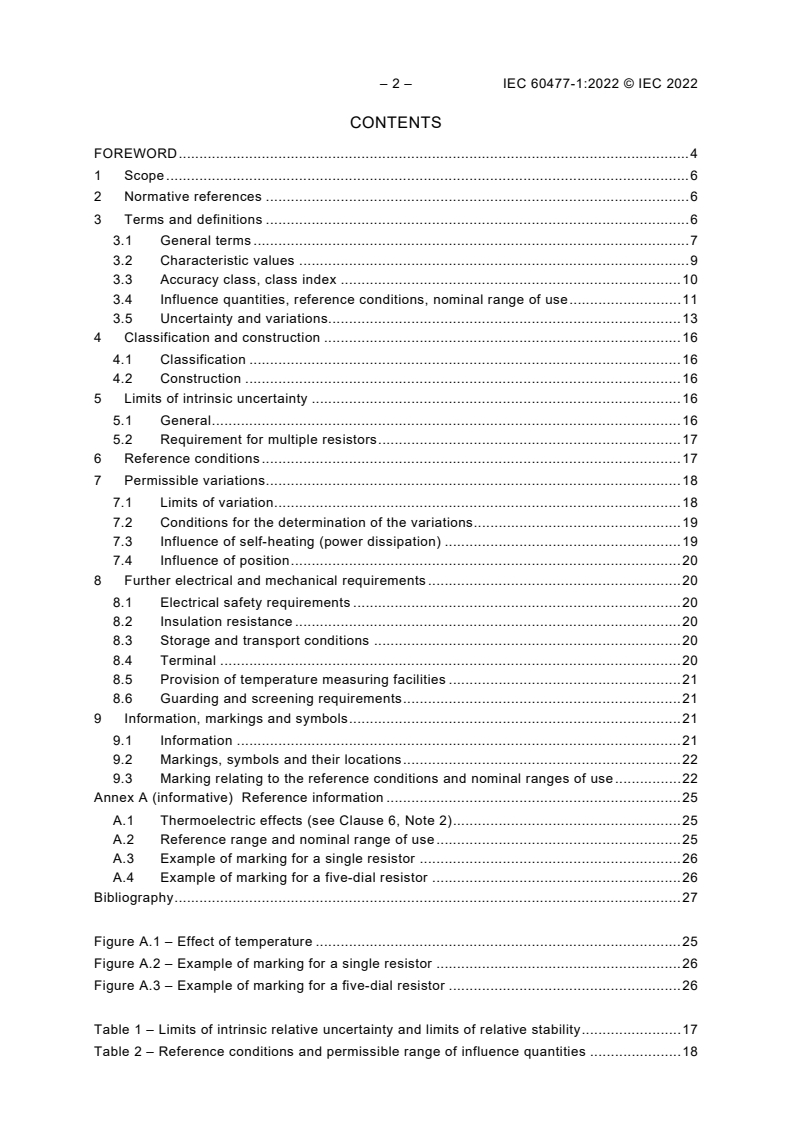
– 2 – IEC 60477-1:2022 © IEC 2022
CONTENTS
FOREWORD . 4
1 Scope . 6
2 Normative references . 6
3 Terms and definitions . 6
3.1 General terms . 7
3.2 Characteristic values . 9
3.3 Accuracy class, class index . 10
3.4 Influence quantities, reference conditions, nominal range of use . 11
3.5 Uncertainty and variations. 13
4 Classification and construction . 16
4.1 Classification . 16
4.2 Construction . 16
5 Limits of intrinsic uncertainty . 16
5.1 General . 16
5.2 Requirement for multiple resistors . 17
6 Reference conditions . 17
7 Permissible variations . 18
7.1 Limits of variation. 18
7.2 Conditions for the determination of the variations . 19
7.3 Influence of self-heating (power dissipation) . 19
7.4 Influence of position . 20
8 Further electrical and mechanical requirements . 20
8.1 Electrical safety requirements . 20
8.2 Insulation resistance . 20
8.3 Storage and transport conditions . 20
8.4 Terminal . 20
8.5 Provision of temperature measuring facilities . 21
8.6 Guarding and screening requirements . 21
9 Information, markings and symbols . 21
9.1 Information . 21
9.2 Markings, symbols and their locations . 22
9.3 Marking relating to the reference conditions and nominal ranges of use . 22
Annex A (informative) Reference information . 25
A.1 Thermoelectric effects (see Clause 6, Note 2) . 25
A.2 Reference range and nominal range of use . 25
A.3 Example of marking for a single resistor . 26
A.4 Example of marking for a five-dial resistor . 26
Bibliography . 27
Figure A.1 – Effect of temperature . 25
Figure A.2 – Example of marking for a single resistor . 26
Figure A.3 – Example of marking for a five-dial resistor . 26
Table 1 – Limits of intrinsic relative uncertainty and limits of relative stability . 17
Table 2 – Reference conditions and permissible range of influence quantities . 18
Table 3 – Nominal range of use for influence quantities (applicable unless marked
otherwise) . 19
Table 4 – Examples of markings for temperature . 23
Table 5 – Symbols for marking resistors . 24
– 4 – IEC 60477-1:2022 © IEC 2022
INTERNATIONAL ELECTROTECHNICAL COMMISSION
____________
LABORATORY RESISTORS –
Part 1: Laboratory DC resistors
FOREWORD
1) The International Electrotechnical Commission (IEC) is a worldwide organization for standardization comprising
all national electrotechnical committees (IEC National Committees). The object of IEC is to promote international
co-operation on all questions concerning standardization in the electrical and electronic fields. To this end and
in addition to other activities, IEC publishes International Standards, Technical Specifications, Technical Reports,
Publicly Available Specifications (PAS) and Guides (hereafter referred to as "IEC Publication(s)"). Their
preparation is entrusted to technical committees; any IEC National Committee interested in the subject dealt with
may participate in this preparatory work. International, governmental and non-governmental organizations liaising
with the IEC also participate in this preparation. IEC collaborates closely with the International Organization for
Standardization (ISO) in accordance with conditions determined by agreement between the two organizations.
2) The formal decisions or agreements of IEC on technical matters express, as nearly as possible, an international
consensus of opinion on the relevant subjects since each technical committee has representation from all
interested IEC National Committees.
3) IEC Publications have the form of recommendations for international use and are accepted by IEC National
Committees in that sense. While all reasonable efforts are made to ensure that the technical content of IEC
Publications is accurate, IEC cannot be held responsible for the way in which they are used or for any
misinterpretation by any end user.
4) In order to promote international uniformity, IEC National Committees undertake to apply IEC Publications
transparently to the maximum extent possible in their national and regional publications. Any divergence between
any IEC Publication and the corresponding national or regional publication shall be clearly indicated in the latter.
5) IEC itself does not provide any attestation of conformity. Independent certification bodies provide conformity
assessment services and, in some areas, access to IEC marks of conformity. IEC is not responsible for any
services carried out by independent certification bodies.
6) All users should ensure that they have the latest edition of this publication.
7) No liability shall attach to IEC or its directors, employees, servants or agents including individual experts and
members of its technical committees and IEC National Committees for any personal injury, property damage or
other damage of any nature whatsoever, whether direct or indirect, or for costs (including legal fees) and
expenses arising out of the publication, use of, or reliance upon, this IEC Publication or any other IEC
Publications.
8) Attention is drawn to the Normative references cited in this publication. Use of the referenced publications is
indispensable for the correct application of this publication.
9) Attention is drawn to the possibility that some of the elements of this IEC Publication may be the subject of patent
rights. IEC shall not be held responsible for identifying any or all such patent rights.
IEC 60477-1 has been prepared by IEC technical committee 85: Measuring equipment for
electrical and electromagnetic quantities. It is an International Standard.
This first edition cancels and replaces the first edition of IEC 60477 published in 1974, and its
Amendment 1:1997. This edition constitutes a technical revision.
This edition includes the following significant technical changes with respect to the previous
edition:
a) extended the resistor accuracy classes;
b) deleted the resistor accuracy class expression in parts per million (ppm);
c) excluded the active resistor from the scope of this document;
d) updated the terms and definitions according to new IEC 60050 series;
e) changed the term "resistance decade" to "resistance dial" to cover the multi-dial resistors
with other resistance step values;
f) updated the intrinsic error to intrinsic uncertainty according to IEC 60359;
g) added the limits of relative stability for resistors of classes 0,000 05 to 0,01;
h) added the requirements of high voltage resistors;
i) updated the safety symbols and requirements according to the new IEC 61010 series;
j) updated the insulation resistance requirements of resistors;
k) added the requirements of temperature coefficient;
l) updated the temperature requirements for transport and storage of resistors.
The text of this International Standard is based on the following documents:
Draft Report on voting
85/821/FDIS 85/824/RVD
Full information on the voting for its approval can be found in the report on voting indicated in
the above table.
The language used for the development of this International Standard is English.
A list of all parts in the IEC 60477 series, published under the general title Laboratory resistors,
can be found on the IEC website.
This document was drafted in accordance with ISO/IEC Directives, Part 2, and developed in
accordance with ISO/IEC Directives, Part 1 and ISO/IEC Directives, IEC Supplement, available
at www.iec.ch/members_experts/refdocs. The main document types developed by IEC are
described in greater detail at www.iec.ch/standardsdev/publications.
The committee has decided that the contents of this document will remain unchanged until the
stability date indicated on the IEC website under "http://webstore.iec.ch" in the data related to
the specific document. At this date, the document will be
• reconfirmed,
• withdrawn,
• replaced by a revised edition, or
• amended.
– 6 – IEC 60477-1:2022 © IEC 2022
LABORATORY RESISTORS –
Part 1: Laboratory DC resistors
1 Scope
This document applies to resistors intended for use as laboratory DC resistors (hereinafter
referred to as "resistors") comprising standard resistors, single or multiple resistors of accuracy
Classes 0,000 05 to 10 and single or multi-dial resistors of accuracy Classes 0,000 5 to 10.
This document does not apply to:
1) resistors which are intended for use solely as permanently mounted circuit components,
2) resistors used on alternating current or on pulsed current,
3) active resistors,
4) series resistors and shunts which are considered as accessories of electrical measuring
instruments in the relevant IEC document (examples of these are as follows).
EXAMPLE 1 IEC 60051 series: Recommendations for direct acting indicating analogue electrical measuring
instruments and their accessories.
EXAMPLE 2 IEC 60258: Direct acting recording electrical measuring instruments and their accessories.
2 Normative references
The following documents are referred to in the text in such a way that some or all of their content
constitutes requirements of this document. For dated references, only the edition cited applies.
For undated references, the latest edition of the referenced document (including any
amendments) applies.
IEC 60027 (all parts), Letter symbols to be used in electrical technology
IEC 60417 (all parts), Graphical symbols for use on equipment (available at http://www.graphical-
symbols.info/equipment)
IEC 61010-1:2010, Safety requirements for electrical equipment for measurement, control, and
laboratory use – Part 1: General requirements
IEC 61010-1:2010/AMD1:2016
IEC 61010-2-030, Safety requirements for electrical equipment for measurement, control, and
laboratory use – Part 2-030: Particular requirements for equipment having testing or measuring
circuits
3 Terms and definitions
For the purposes of this document, the following terms and definitions apply.
ISO and IEC maintain terminological databases for use in standardization at the following
addresses:
• IEC Electropedia: available at http://www.electropedia.org/
• ISO Online browsing platform: available at http://www.iso.org/obp
3.1 General terms
3.1.1
terminal
point of interconnection of an electric circuit element, an electric circuit or a network with other
electric circuit elements, electric circuits or networks
Note 1 to entry: For an electric circuit element the terminals are the points at which or between which the related
integral quantities are defined. At each terminal, there is only one electric current from outside into the element.
[SOURCE: IEC 60050-131:2002, 131-11-11, modified – Note 2 to entry omitted.]
3.1.2
two-terminal device
device having two terminals, or device having more than two terminals where only the
performance at two terminals forming a pair is of interest
[SOURCE: IEC 60050-151:2001, 151-12-13, modified – Note 1 to entry omitted.]
3.1.3
resistor
two-terminal device characterized essentially by its resistance
[SOURCE: IEC 60050-151:2001, 151-13-19, modified – Note 1 to entry omitted.]
3.1.4
four-terminal resistor
resistor fitted with two current terminals and two voltage terminals
[SOURCE: IEC 60050-313:2001, 313-09-06, modified – deletion of the words "injection" and
"measuring".]
3.1.5
single value resistor
device which provides a single definite resistance value between certain terminals
3.1.6
multiple value resistor
assembly comprising a number of resistors which are accessible either singly or in combination
and which provides definite resistance values between certain terminals
3.1.7
resistance dial
multiple resistor which, by means of a switching device, generally allows the selection of a
combination of resistance values rising in equal steps, each step corresponding to an increment
of an n-ary resistance value
Note 1 to entry: Resistance decade with each step corresponding to an increment of a decadic resistance value is
common (e.g. 0,1 Ω or 1 Ω or 10 Ω, etc.).
Note 2 to entry: A resistance decade generally allows a selection of 10, 11 or 12 resistance values (including zero).
3.1.8
multi-dial resistor
multiple resistor comprising a number of resistance dials which are generally connected in
series
Note 1 to entry: A resistor comprising a number of resistance decades is usually called a multi-decade resistor.
– 8 – IEC 60477-1:2022 © IEC 2022
3.1.9
material measure
device intended to reproduce or supply, in a permanent manner during its use, one or more
known values of a given quantity
EXAMPLE: Standard electric resistor.
Note 1 to entry: The quantity concerned may be called the supplied quantity.
Note 2 to entry: The definition covers also those devices, such as signal generators and standard voltage or current
generators, often referred to as supply instruments.
Note 3 to entry: The identification of the value and uncertainty of the supplied quantity is given by a number tied to
a unit of measurement or a code term, called the nominal value or marked value of the material measure.
[SOURCE: IEC 60359:2001, 3.2.3, modified – The example has been added, as given in
IEC 60050-311:2001, 311-03-03.]
3.1.10
(measurement) standard
material measure, measuring instrument, reference material or measuring system intended to
define, represent physically, conserve or reproduce a unit of a quantity, or a multiple or sub-
multiple thereof (for example, standard resistance), or a known value of a quantity (for example,
standard cell), with a given uncertainty
[SOURCE: IEC 60050-311:2001, 311-04-01]
3.1.11
residual resistance
resistance value between the terminals of a multiple resistor having switching devices with a
zero position, when all switching elements are set to the zero position
3.1.12
screen
shield (US)
device intended to reduce the penetration of an electric, magnetic or electromagnetic field into
a given region
[SOURCE: IEC 60050-151:2001, 151-13-09]
3.1.13
local earth
local ground, US
part of the Earth that is in electric contact with an earth electrode and that has an electric
potential not necessarily equal to zero
[SOURCE: IEC 60050-195:2021, 195-01-03]
3.1.14
earth, verb
ground, verb US
to make an electric connection between a conductive part and a local earth
Note 1 to entry: The connection to local earth can be
– intentional, or
– unintentional or accidental
and can be permanent or temporary.
[SOURCE: IEC 60050-195:2021, 195-01-08]
3.1.15
earthing terminal
grounding terminal, US
terminal provided on equipment and intended for the electric connection with the earthing
arrangement
[SOURCE: IEC 60050-195:2021, 195-02-31]
3.1.16
working voltage
highest RMS value of the AC or DC voltage across any particular insulation which can occur
when the equipment is supplied at rated voltage
Note 1 to entry: Transients and voltage fluctuations are not considered to be part of the working voltage.
Note 2 to entry: Both open-circuit conditions and normal operating conditions are taken into account.
[SOURCE: IEC 60050-581:2008, 581-21-19, modified – Note 1 and Note 2 to entry have been
added according to IEC 61010-1:2010, 3.3.3.]
3.1.17
measurement category
classification of testing and measuring circuits according to the type of mains to which they are
intended to be connected
Note 1 to entry: Measurement categories take into account overvoltage categories, short-circuit current levels, the
location in the building installation where the test or measurement is to be made, and some forms of energy limitation
or transient protection included in the building installation. See IEC 61010-2-30:2017, Annex AA for more information.
[SOURCE: IEC 61010-2-30:2017, 3.5.101]
3.1.18
insulation resistance
resistance under specified conditions between two conductive elements separated by the
insulating materials
[SOURCE: IEC 60050-151:2001, 151-15-43]
3.2 Characteristic values
3.2.1
nominal value
value of a quantity used to designate and identify a component, device, equipment, or system
Note 1 to entry: The nominal value is generally a rounded value.
[SOURCE: IEC 60050-151:2001, 151-16-09]
3.2.2
(measure-) value
mid element of the set assigned to represent the measurand
Note 1 to entry: The measure-value is no more representative of the measurand than any other element of the set.
It is singled out merely for the convenience of expressing the set in the format V ± U, where V is the mid element
and U the half-width of the set, rather than by its extremes. The qualifier "measure-" is used when deemed necessary
to avoid confusion with the reading-value or the indicated value.
Note 2 to entry: For a multiple resistor with switching devices having a zero position, the measure-value for a given
setting is the value obtained for that setting minus the residual resistance (see 3.1.11).
[SOURCE: IEC 60359:2001, 3.1.3, modified – Note 2 to entry has been added.]
– 10 – IEC 60477-1:2022 © IEC 2022
3.2.3
indication
reading-value
output signal of the instrument
Note 1 to entry: The indicated value can be derived from the indication by means of the calibration curve.
Note 2 to entry: For a material measure, the indication is its nominal or stated value.
Note 3 to entry: The indication depends on the output format of the instrument:
– for analogue outputs it is a number tied to the appropriate unit of the display;
– for digital outputs it is the displayed digitized number;
– for code outputs it is the identification of the code pattern.
Note 4 to entry: For analogue outputs meant to be read by a human observer (as in the index-on-scale instruments)
the unit of output is the unit of scale numbering; for analogue outputs meant to be read by another instrument (as in
calibrated transducers) the unit of output is the unit of measurement of the quantity supporting the output signal.
Note 5 to entry: The indication is the assigned value for a resistor, the measure-value stated in this document
(see 9.1 p)) for a single or a multiple resistor of classes 0,00005 to 0,01, or the nominal value for a single or a
multiple resistor of classes 0,01 to 10.
[SOURCE: IEC 60359:2001, 3.1.5, modified – Note 5 to entry has been added.]
3.2.4
indicated value
value given by an indicating instrument on the basis of its calibration curve
Note 1 to entry: The indicated value is the measure-value of the measurand when the instrument is used in a direct
measurement under all the operating conditions for which the calibration diagram is valid.
[SOURCE: IEC 60359:2001, 3.1.9]
3.2.5
stability of a measuring instrument
stability
property of a measuring instrument, whereby its metrological properties remain constant in time
Note 1 to entry: Stability may be quantified in several ways.
EXAMPLE 1 In terms of the duration of a time interval over which a metrological property changes by a stated
amount.
EXAMPLE 2 In terms of the change of a property over a stated time interval.
Note 2 to entry: For a resistor, stability is quantified in the change of resistance measure-value over a year. In this
document, it is expressed in relative form divided by the resistance measure-value.
[SOURCE: ISO/IEC GUIDE 99:2007, 4.19, modified – Note 2 to entry has been added.]
3.3 Accuracy class, class index
3.3.1
accuracy class
class of measuring instruments, all of which are intended to comply with a set of specifications
regarding uncertainty
Note 1 to entry: An accuracy class always specifies a limit of uncertainty (for a given range of influence quantities),
whatever other metrological characteristics it specifies.
Note 2 to entry: An instrument may be assigned to different accuracy classes for different rated operating
conditions.
Note 3 to entry: Unless otherwise specified, the limit of uncertainty defining an accuracy class is meant as an
interval with coverage factor 2.
Note 4 to entry: Accuracy class of a resistor is defined by the limits of intrinsic relative uncertainty, the limits of
relative stability and the limits of variations due to influence quantities.
[SOURCE: IEC 60359:2001, 3.3.7, modified – Note 4 to entry has been added.]
3.3.2
class index
conventional designation of an accuracy class by a number or symbol
[SOURCE: IEC 60050-311:2001, 311-06-10]
3.4 Influence quantities, reference conditions, nominal range of use
3.4.1
influence quantity
quantity which is not the subject of the measurement and whose change affects the relationship
between the indication and the result of the measurement
Note 1 to entry: Influence quantities can originate from the measured system, the measuring equipment or the
environment.
Note 2 to entry: As the calibration diagram depends on the influence quantities, in order to assign the result of a
measurement it is necessary to know whether the relevant influence quantities lie within the specified range.
Note 3 to entry: An influence quantity is said to lie within a range C′ to C″ when the results of its measurement
satisfy the relationship: C′ ≤ V − U < V + U ≤ C″.
[SOURCE: IEC 60359:2001, 3.1.14]
3.4.2
reference conditions
appropriate set of specified values and/or ranges of values of influence quantities under which
the smallest permissible uncertainties of a measuring instrument are specified
Note 1 to entry: The ranges specified for the reference conditions, called reference ranges, are not wider, and are
usually narrower, than the ranges specified for the rated operating conditions.
[SOURCE: IEC 60359:2001, 3.3.10]
3.4.3
reference value
specified value of one of a set of reference conditions
[SOURCE: IEC 60359:2001, 3.3.11]
3.4.4
reference range
specified range of values of one of a set of reference conditions
[SOURCE: IEC 60359:2001, 3.3.12]
3.4.5
rated operating conditions
set of conditions that must be fulfilled during the measurement in order that a calibration
diagram may be valid
Note 1 to entry: Beside the specified measuring range and rated operating ranges for the influence quantities, the
conditions may include specified ranges for other performance characteristics and other indications that cannot be
expressed as ranges of quantities.
[SOURCE: IEC 60359:2001, 3.3.13]
– 12 – IEC 60477-1:2022 © IEC 2022
3.4.6
nominal range of use (for influence quantities)
rated operating range (for influence quantities)
specified range of values which an influence quantity can assume without causing a variation
exceeding specified limits
Note 1 to entry: The rated operating range of each influence quantity is a part of the rated operating conditions.
[SOURCE: IEC 60359:2001, 3.3.14]
3.4.7
limiting values for operation
extreme values which an influence quantity can assume during operation without damaging the
measuring instrument so that it no longer meets its performance requirements when it is
subsequently operated under reference conditions
Note 1 to entry: The limiting values can depend on the duration of their application.
[SOURCE: IEC 60050-311:2001, 311-07-06]
3.4.8
storage and transport conditions
extreme conditions which a non-operating measuring instrument can withstand without damage
and without degradation of its metrological characteristics when it is subsequently operated
under its rated operating conditions
[SOURCE: IEC 60359:2001, 3.3.17]
3.4.9
temperature coefficient
coefficient of the formula which defines the measure-value of resistance as a
function of temperature
Note 1 to entry: In general, the value of resistance at any temperature can be calculated according to the following
temperature formula:
(1)
R R 1+α(tt−+) β(tt− )
tt 00
0
where:
R value of resistance at t °C (Ω)
t
R
measure-value of resistance at t °C (Ω)
t
0 0
α primary temperature coefficient of resistance (1/°C)
β secondary temperature coefficient of resistance (1/°C )
t temperature of resistance
t reference temperature value.
3.4.10
temperature coefficient of resistance
TCR
α
reversible relative variation of resistance between two given temperatures divided by the
difference in the temperature producing it
Note 1 to entry: It should be noted that the term expresses a maximum relative resistance variation within a given
temperature range, hence the use of the term does not imply any degree of linearity for this function, nor should any
be assumed.
=
Note 2 to entry: The temperature coefficient of resistance is usually determined between the reference temperature
and the category temperatures, LCT and UCT, respectively, for which the larger of the two determined coefficients
is expressed as the result.
Note 3 to entry: Related terminology: variation of resistance with temperature
[SOURCE: IEC 60115-1:2021, 3.1.34]
3.4.11
steady-state conditions
operating conditions of a measuring device in which the variation of the measurand with the
time is such that the relation between the input and output signals of the instruments does not
suffer a significant change with respect to the relation obtaining when the measurand is constant
in time
[SOURCE: IEC 60359:2001, 3.1.15]
3.5 Uncertainty and variations
3.5.1
uncertainty (of measurement)
parameter, associated with the result of a measurement, that characterizes the dispersion of
the values that could reasonably be attributed to the measurand
Note 1 to entry: The parameter can be, for example, a standard deviation (or a given multiple of it), or a half-width
of an interval having a stated level of confidence.
Note 2 to entry: Uncertainty of measurement comprises, in general, many components. Some of these components
can be evaluated from the statistical distribution of the results of a series of measurements and can be characterized
by experimental standard deviations. The other components, which can also be characterized by standard deviations,
are evaluated from the assumed probability distributions based on experience or other information.
Note 3 to entry: It is understood that the result of the measurement is the best estimate of the value of the
measurand, and that all components of uncertainty, including those arising from systematic effects, such as
components associated with corrections and reference standards, contribute to the dispersion.
Note 4 to entry: The definition and notes 1 and 2 are from GUM, clause B.2.18. The option used in this standard is
to express the uncertainty as the half-width of an interval with the GUM procedures with a coverage factor of 2. This
choice corresponds to the practice now adopted by many national standards laboratories. With the normal distribution
a coverage factor of 2 corresponds to a level of confidence of 95 %. Otherwise statistical elaborations are necessary
to establish the correspondence between the coverage factor and the level of confidence. As the data for such
elaborations are not always available, it is deemed preferable to state the coverage factor. This interval can be
"reasonably" assigned to describe the measurand, in the sense of the GUM definition, as in most usual cases it
ensures compatibility with all other results of measurements of the same measurand assigned in the same way at a
sufficiently high confidence level.
Note 5 to entry: Following CIPM document INC-1 and GUM, the components of uncertainty that are evaluated by
statistical methods are referred to as components of category A, and those evaluated with the help of other methods
as components of category B.
[SOURCE: IEC 60359:2001, 3.1.4]
3.5.2
variation (due to an influence quantity)
difference between the indicated values for the same value of the measurand of an indicating
instrument, or the values of a material measure, when an influence quantity assumes,
successively, two different values
Note 1 to entry: The uncertainty associated with the different measure values of the influence quantity for which
the variation is evaluated should not be wider than the width of the reference range for the same influence quantity.
The other performance characteristics and the other influence quantities should stay within the ranges specified for
the reference conditions.
Note 2 to entry: The variation is a meaningful parameter when it is greater than the intrinsic instrumental
uncertainty.
[SOURCE: IEC 60359:2001, 3.3.5]
– 14 – IEC 60477-1:2022 © IEC 2022
3.5.3
intrinsic uncertainty of the measurand
minimum uncertainty that can be assigned in the description of a measured quantity
Note 1 to entry: No quantity can be measured with narrower and narrower uncertainty, inasmuch as any given
quantity is defined or identified at a given level of detail. If one tries to measure a given quantity with uncertainty
lower than its own intrinsic uncertainty one is compelled to redefine it with higher detail, so that one is actually
measuring another quantity. See also GUM D.1.1.
Note 2 to entry: The result of a measurement carried out with the intrinsic uncertainty of the measurand may be
called the best measurement of the quantity in question.
[SOURCE: IEC 60359:2001, 3.1.11]
3.5.4
(absolute) instrumental uncertainty
uncertainty of the result of a direct measurement of a measurand having negligible intrinsic
uncertainty
Note 1 to entry: Unless explicitly stated otherwise, the instrumental uncertainty is expressed as an interval with
coverage factor 2.
Note 2 to entry: In single-reading direct measurements of measurands having intrinsic uncertainty small with
respect to the instrumental uncertainty, the uncertainty of the measurement coincides, by definition, with the
instrumental uncertainty. Otherwise the instrumental uncertainty is to be treated as a component of category B in
evaluating the uncertainty of the measurement on the basis of the model connecting the several direct measurements
involved.
Note 3 to entry: The instrumental uncertainty automatically includes, by definition, the effects due to the
quantization of the reading-values (minimum evaluable fraction of the scale interval in analogic outputs, unit of the
last stable digit in digital outputs).
Note 4 to entry: For material measures the instrumental uncertainty is the uncertainty that should be associated to
the value of the quantity reproduced by the material measure in order to ensure the compatibility of the results of its
measurements.
Note 5 to entry: When possible and convenient the uncertainty may be expressed in the relative form or in the
fiducial form. The relative uncertainty is the ratio U/V of the absolute uncertainty U to the measure value V, and the
fiducial uncertainty the ratio U/V of the absolute uncertainty U to a conventionally chosen value V .
f f
[SOURCE: IEC 60359:2001, 3.1.12]
3.5.5
intrinsic uncertainty
intrinsic instrument uncertainty
uncertainty of a measuring instrument when used under reference conditions
[SOURCE: IEC 60050-311:2001, 311-03-09, modified – The term "intrinsic instrument
uncertainty" has been added and the note deleted.]
3.5.6
relative form of expression
expression of a metrological characteristic, or of other data, by means of its ratio to the measure
value of the quantity under consideration
Note 1 to entry: Expression in relative form is possible when the quantity under consideration allows the ratio
relationship and its value is not zero.
Note 2 to entry: Uncertainties and limits of uncertainty are expressed in relative form by dividing their absolute
value by the value of the measurand, ranges of influence quantities by dividing the halved range by the mid value of
the domain, etc.
[SOURCE: IEC 60359:2001, 3.3.3]
3.5.7
limit of uncertainty
limiting value of the instrumental uncertainty for equipment operating under specified conditions
Note 1 to entry: A limit of uncertainty may be assigned by the manufacturer of the instrument, who states that under
the specified conditions the instrumental uncertainty is never higher than this limit, or may be defined by standards,
that prescribe that under specified conditions the instrumental uncertainty should not be larger than this limit for the
instrument to belong to a given accuracy class.
Note 2 to entry: A limit of uncertainty may be expressed in absolute terms or in the relative or fiducial forms.
[SOURCE: IEC 60359:2001, 3.3.6]
3.5.8
calibration
set of operations which establishes the relationship which exists, under specified conditions,
between the indication and the result of a measurement by reference to standards
Note 1 to entry: The relationship between the indications and the results of measurement can be expressed, in
principle, by a calibration diagram.
Note 2 to entry: The calibration must be performed under well defined operating conditions for the instrument. The
calibration diagram representing its result is not valid if the instrument is operated under conditions outside the range
used for the calibration.
Note 3 to entry: Quite often, specially for instruments whose metrological characteristics are sufficiently known from
past experience, it is convenient to predefine a simplified calibration diagram and perform only a verification of
calibration to check whether the response of the instrument stays within its limits. The simplified diagram is of course
wider than the diagram that would be defined by the full calibration of the instrument, and the uncertainty assigned
to the results of measurements is consequently larger.
[SOURCE: IEC 60359:2001, 3.1.6]
3.5.9
verification (of calibration)
set of operations which is used to check whether the indications, under specified conditions,
correspond with a given set of known measurands within the limits of a predetermined
calibration diagram
Note 1 to entry: The known uncertainty of the measurand used for verification will generally be negligible with
respect to the uncertainty assigned to the instrument in the calibration diagram.
Note 2 to entry: The verification of calibration of a material measure consists in checking whether the result of a
measurement of the supplied quantity is compatible with the interval given by the calibration diagram.
[SOURCE: IEC 60359:2001, 3.2.12]
3.5.10
deviation (for the verification of calibration)
...