

IEC 62514:2024
(Main)Multimedia gateway in home networks - Guidelines
General Information
- Abstract
IEC 62514:2024 describes the general guidelines for typical applications of the home multimedia gateway in home networks supporting IP networking. This document specifies recommended functions and services to be supported by the home multimedia gateway and, where appropriate, refers to existing standards supported in the market. For general requirements, it is expected that widely adopted standards and technologies will be considered by implementers. This document gives supplementary applications to the IEC 62481 series, which specifies a central management model in home networks supporting various interfaces on the LAN side and on the WAN side (optional). This document is applicable to home multimedia gateways in the home network or networks of similar environments. IEC 62514:2024 cancels and replaces the first edition published in 2010. This edition constitutes a technical revision.
This edition includes the following significant technical changes with respect to the previous edition:
a) addition of new multimedia processing functions and requirements the HMG shall support, including adaptive multimedia processing, audio/video remote processing, and play function enhancement, in Clause 6;
b) addition of home automation functions and requirements of audio/video analysis, recognition and alarm services based on AI technologies in Clause 7;
c) addition of upgrade function and requirements of HMG in Clause 12.
- Status
- Published
- Publication Date
- 03-Sep-2024
- Technical Committee
- TA 18 - Multimedia home systems and applications for end-user networks
- Drafting Committee
- MT 62514 - TC 100/TA 18/MT 62514
- Current Stage
- PPUB - Publication issued
- Start Date
- 04-Sep-2024
- Completion Date
- 20-Sep-2024
Buy Documents
IEC 62514:2024 - Multimedia gateway in home networks - Guidelines Released:9/4/2024
IEC 62514:2024 RLV - Multimedia gateway in home networks - Guidelines Released:9/4/2024
Overview - IEC 62514:2024 (Multimedia gateway in home networks)
IEC 62514:2024 provides guidelines for the design, functions and services of the home multimedia gateway (HMG) in IP-based home networks. This second edition cancels and replaces IEC 62514:2010 and constitutes a technical revision. It specifies recommended HMG capabilities, references existing market standards where appropriate, and supplements the IEC 62481 series (central management model for home networks). The standard is applicable to HMG devices deployed in homes or similar environments and emphasizes interoperability, security, QoS and upgradeability.
Key topics and technical requirements
- HMG architecture and interfaces
- LAN and optional WAN interface considerations; device and service interconnection models.
- AV processing and multimedia services
- Multimedia transformation, stream control, content directory services, adaptive multimedia processing, audio/video remote processing, and play-function enhancements.
- Home automation & AI-enabled services
- Integration of home automation use cases, audio/video analysis, recognition and alarm services leveraging AI technologies.
- Interconnection and protocol handling
- Address assignment/resolution, data transfer and protocol translation for heterogeneous home devices.
- QoS and performance
- Requirements for reliable multimedia delivery, stream duplication/combination, multicast handling and performance targets for HMGs.
- Security and DRM
- Security requirements including DRM support, key management, authentication and credibility of the HMG.
- Upgrade and lifecycle
- Added upgrade functions and requirements to ensure maintainability and secure firmware/software updates.
- Device management & services
- Device directories, multimedia messaging, meter reading, energy management and appliance control.
- Media formats and compatibility
- Guidance on mandatory/optional media formats and format handling (see Table 1 in the standard).
Practical applications - who uses IEC 62514
- Device manufacturers building routers, set-top boxes, smart home hubs and multimedia gateways to ensure interoperability and market compatibility.
- System integrators & service providers deploying in-home VOD, remote playback, multicast streaming, content sharing, video surveillance and smart-home automation.
- Software developers and platform providers implementing AV transformation, adaptive streaming, AI-based video/audio analysis and DRM/key management.
- Regulators and test labs assessing conformance, security and QoS for consumer-grade multimedia equipment.
Related standards
- IEC 62481 series - central management model for home networks (complementary to IEC 62514).
- The standard expects implementers to consider widely adopted IP networking and multimedia technologies and market-supported standards where applicable.
Keywords: IEC 62514, multimedia gateway, HMG, home networks, IP networking, AV processing, adaptive multimedia, QoS, DRM, home automation, AI-based video analysis, firmware upgrade.
Relations
- Effective Date
- 05-Sep-2023
Buy Documents
IEC 62514:2024 - Multimedia gateway in home networks - Guidelines Released:9/4/2024
IEC 62514:2024 RLV - Multimedia gateway in home networks - Guidelines Released:9/4/2024
Get Certified
Connect with accredited certification bodies for this standard

BSI Group
BSI (British Standards Institution) is the business standards company that helps organizations make excellence a habit.

NYCE
Mexican standards and certification body.

ANCE
Mexican certification and testing association.
Sponsored listings
Frequently Asked Questions
IEC 62514:2024 is a standard published by the International Electrotechnical Commission (IEC). Its full title is "Multimedia gateway in home networks - Guidelines". This standard covers: IEC 62514:2024 describes the general guidelines for typical applications of the home multimedia gateway in home networks supporting IP networking. This document specifies recommended functions and services to be supported by the home multimedia gateway and, where appropriate, refers to existing standards supported in the market. For general requirements, it is expected that widely adopted standards and technologies will be considered by implementers. This document gives supplementary applications to the IEC 62481 series, which specifies a central management model in home networks supporting various interfaces on the LAN side and on the WAN side (optional). This document is applicable to home multimedia gateways in the home network or networks of similar environments. IEC 62514:2024 cancels and replaces the first edition published in 2010. This edition constitutes a technical revision. This edition includes the following significant technical changes with respect to the previous edition: a) addition of new multimedia processing functions and requirements the HMG shall support, including adaptive multimedia processing, audio/video remote processing, and play function enhancement, in Clause 6; b) addition of home automation functions and requirements of audio/video analysis, recognition and alarm services based on AI technologies in Clause 7; c) addition of upgrade function and requirements of HMG in Clause 12.
IEC 62514:2024 describes the general guidelines for typical applications of the home multimedia gateway in home networks supporting IP networking. This document specifies recommended functions and services to be supported by the home multimedia gateway and, where appropriate, refers to existing standards supported in the market. For general requirements, it is expected that widely adopted standards and technologies will be considered by implementers. This document gives supplementary applications to the IEC 62481 series, which specifies a central management model in home networks supporting various interfaces on the LAN side and on the WAN side (optional). This document is applicable to home multimedia gateways in the home network or networks of similar environments. IEC 62514:2024 cancels and replaces the first edition published in 2010. This edition constitutes a technical revision. This edition includes the following significant technical changes with respect to the previous edition: a) addition of new multimedia processing functions and requirements the HMG shall support, including adaptive multimedia processing, audio/video remote processing, and play function enhancement, in Clause 6; b) addition of home automation functions and requirements of audio/video analysis, recognition and alarm services based on AI technologies in Clause 7; c) addition of upgrade function and requirements of HMG in Clause 12.
IEC 62514:2024 is classified under the following ICS (International Classification for Standards) categories: 33.160.60 - Multimedia systems and teleconferencing equipment; 35.110 - Networking; 35.200 - Interface and interconnection equipment. The ICS classification helps identify the subject area and facilitates finding related standards.
IEC 62514:2024 has the following relationships with other standards: It is inter standard links to IEC 62514:2010. Understanding these relationships helps ensure you are using the most current and applicable version of the standard.
IEC 62514:2024 is available in PDF format for immediate download after purchase. The document can be added to your cart and obtained through the secure checkout process. Digital delivery ensures instant access to the complete standard document.
Standards Content (Sample)
IEC 62514 ®
Edition 2.0 2024-09
INTERNATIONAL
STANDARD
colour
inside
Multimedia gateway in home networks – Guidelines
All rights reserved. Unless otherwise specified, no part of this publication may be reproduced or utilized in any form
or by any means, electronic or mechanical, including photocopying and microfilm, without permission in writing from
either IEC or IEC's member National Committee in the country of the requester. If you have any questions about IEC
copyright or have an enquiry about obtaining additional rights to this publication, please contact the address below or
your local IEC member National Committee for further information.
IEC Secretariat Tel.: +41 22 919 02 11
3, rue de Varembé info@iec.ch
CH-1211 Geneva 20 www.iec.ch
Switzerland
About the IEC
The International Electrotechnical Commission (IEC) is the leading global organization that prepares and publishes
International Standards for all electrical, electronic and related technologies.
About IEC publications
The technical content of IEC publications is kept under constant review by the IEC. Please make sure that you have the
latest edition, a corrigendum or an amendment might have been published.
IEC publications search - webstore.iec.ch/advsearchform IEC Products & Services Portal - products.iec.ch
The advanced search enables to find IEC publications by a Discover our powerful search engine and read freely all the
variety of criteria (reference number, text, technical publications previews, graphical symbols and the glossary.
committee, …). It also gives information on projects, replaced With a subscription you will always have access to up to date
and withdrawn publications. content tailored to your needs.
IEC Just Published - webstore.iec.ch/justpublished
Electropedia - www.electropedia.org
Stay up to date on all new IEC publications. Just Published
The world's leading online dictionary on electrotechnology,
details all new publications released. Available online and once
containing more than 22 500 terminological entries in English
a month by email.
and French, with equivalent terms in 25 additional languages.
Also known as the International Electrotechnical Vocabulary
IEC Customer Service Centre - webstore.iec.ch/csc
(IEV) online.
If you wish to give us your feedback on this publication or need
further assistance, please contact the Customer Service
Centre: sales@iec.ch.
IEC 62514 ®
Edition 2.0 2024-09
INTERNATIONAL
STANDARD
colour
inside
Multimedia gateway in home networks – Guidelines
INTERNATIONAL
ELECTROTECHNICAL
COMMISSION
ICS 33.160.60; 35.110; 35.200 ISBN 978-2-8322-9572-4
– 2 – IEC 62514:2024 © IEC 2024
CONTENTS
FOREWORD . 5
INTRODUCTION . 7
1 Scope . 8
2 Normative references . 8
3 Terms, definitions and abbreviated terms . 9
3.1 Terms and definitions . 9
3.2 Abbreviated terms . 10
4 HMG architecture . 12
4.1 Architecture of a home multimedia network . 12
4.2 HMG architecture . 12
4.2.1 General . 12
4.2.2 AV processing . 13
4.2.3 Home automation . 13
4.2.4 QoS . 13
4.2.5 Security . 13
4.2.6 Interconnection . 13
4.2.7 Interfaces and access . 14
5 Interconnection . 14
5.1 General connection requirements . 14
5.2 Address assignment and resolution . 14
5.2.1 Address assignment . 14
5.2.2 Address resolution . 15
5.3 Data transfer . 15
5.4 Protocol translation . 15
6 AV processing . 16
6.1 General . 16
6.2 Multimedia transformation service . 16
6.2.1 Requirements summary . 16
6.2.2 Applications mode . 16
6.3 Multimedia stream control service . 22
6.3.1 Requirements summary . 22
6.3.2 Application mode . 23
6.3.3 Content directory service . 40
6.4 Media format . 42
7 Home automation . 42
7.1 Requirements summary . 42
7.2 Devices in directory . 43
7.2.1 Printer . 43
7.2.2 Surveillance cameras . 43
7.2.3 Intelligent household appliance . 43
7.3 Multimedia message application . 44
7.3.1 Requirements summary for HMG . 44
7.3.2 Multimedia message . 44
7.3.3 Requirements for multimedia message . 44
7.3.4 Multimedia message format . 45
7.3.5 Send a message . 46
7.3.6 Delete a message . 46
7.3.7 Requirements for HMGs . 46
7.4 Devices management by HMG . 46
7.4.1 Device status . 46
7.4.2 Connection status . 46
7.4.3 Energy saving and power management. 47
7.5 Reading of meters. 47
7.6 Household appliance control . 48
7.7 AV recognition and analysis . 48
8 QoS . 48
8.1 General . 48
8.2 QoS for HMG . 49
9 Security . 50
9.1 Requirements summary . 50
9.2 DRM . 50
9.3 Key management . 51
9.4 Authentication . 51
9.5 Credibility of HMG . 52
10 Performance requirements. 52
11 Interfaces and protocols of HMGs . 52
11.1 General . 52
11.2 WAN side interfaces . 53
11.3 LAN side interfaces . 54
12 Upgrade . 54
Annex A (informative) Application scenario . 55
A.1 Entertainment . 55
A.1.1 Scenario 1: playback . 55
A.1.2 Scenario 2: VOD . 56
A.1.3 Scenario 3: change player . 56
A.1.4 Scenario 4: multicast . 57
A.1.5 Scenario 5: remote sharing . 58
A.1.6 Scenario 6: remote playback . 58
A.1.7 Scenario 7: upload and download . 59
A.1.8 Scenario 8: printing . 60
A.1.9 Scenario 9: home multi-screen interaction . 61
A.1.10 Scenario 10: inward remote sharing . 61
A.2 Communication . 62
A.2.1 Scenario 11: notification of new email . 62
A.2.2 Scenario 12: notification of incoming call . 63
A.2.3 Scenario 13: content sharing through videophones . 63
A.3 Security . 65
A.3.1 Scenario 14: video surveillance . 65
A.3.2 Scenario 15: image recognition and alarm . 65
A.4 Automation . 66
A.4.1 Scenario 16: controlling home appliances . 66
A.4.2 Scenario 17: meter reading . 67
A.5 Summary . 69
Bibliography . 70
– 4 – IEC 62514:2024 © IEC 2024
Figure 1 – Architecture for a home multimedia network . 12
Figure 2 – HMG architecture . 13
Figure 3 – Conversion of media streams . 17
Figure 4 – HMRec requests media conversion from HMG . 18
Figure 5 – HMRec requests WMS to support redirection . 19
Figure 6 – HMSou actively sends media to HMRec . 21
Figure 7 – Video clip . 22
Figure 8 – AV media stream division . 23
Figure 9 – Stream division process . 23
Figure 10 – Combination of media streams . 24
Figure 11 – Stream combination process . 24
Figure 12 – Duplication of media streams . 25
Figure 13 – HMRec1 duplicates media stream to HMRec2 . 26
Figure 14 – HMRec2 requests to join the multicast group of the program being played
on HMRec1 . 26
Figure 15 – HMRec1 requests media stream from HMG and duplicates media stream to
HMRec2 . 27
Figure 16 – HMRec1 duplicates media stream to HMRec2 after requesting MS to
redirect media stream to HMG . 28
Figure 17 – Media stream redirection . 29
Figure 18 – HMRec1 requests to redirect media stream to HMRec2 . 30
Figure 19 – Adaptive processing of HMG . 31
Figure 20 – HMG adaptive process media stream to HMRec2 . 31
Figure 21 – HMRec requests HMG to adaptive process media stream based on the
network environment . 32
Figure 22 – HMG requests specific parameters from MS . 33
Figure 23 – Outward remote sharing from HMSou to WMR . 34
Figure 24 – Inward remote sharing from WMS to HMRec . 34
Figure 25 – WMR requests content from HMSou for outward remote sharing . 35
Figure 26 – Outward remote sharing from HMSou to WMR . 36
Figure 27 – Inward remote sharing from WMS to HMRec . 37
Figure 28 – Media play jump control . 38
Figure 29 – Media content targeted by progress bar returned from the HMG . 39
Figure 30 – Media content targeted by progress bar returned from MS . 40
Figure 31 – HMRec selects media contents through the directory service of HMG . 41
Figure 32 – QoS Architecture overview . 49
Table 1 – Mandatory and optional media formats . 42
Table 2 – Multimedia message format recommended . 45
Table 3 – WAN side interfaces . 53
Table 4 – LAN side interfaces . 54
INTERNATIONAL ELECTROTECHNICAL COMMISSION
____________
MULTIMEDIA GATEWAY IN HOME NETWORKS – GUIDELINES
FOREWORD
1) The International Electrotechnical Commission (IEC) is a worldwide organization for standardization comprising
all national electrotechnical committees (IEC National Committees). The object of IEC is to promote international
co-operation on all questions concerning standardization in the electrical and electronic fields. To this end and
in addition to other activities, IEC publishes International Standards, Technical Specifications, Technical Reports,
Publicly Available Specifications (PAS) and Guides (hereafter referred to as "IEC Publication(s)"). Their
preparation is entrusted to technical committees; any IEC National Committee interested in the subject dealt with
may participate in this preparatory work. International, governmental and non-governmental organizations liaising
with the IEC also participate in this preparation. IEC collaborates closely with the International Organization for
Standardization (ISO) in accordance with conditions determined by agreement between the two organizations.
2) The formal decisions or agreements of IEC on technical matters express, as nearly as possible, an international
consensus of opinion on the relevant subjects since each technical committee has representation from all
interested IEC National Committees.
3) IEC Publications have the form of recommendations for international use and are accepted by IEC National
Committees in that sense. While all reasonable efforts are made to ensure that the technical content of IEC
Publications is accurate, IEC cannot be held responsible for the way in which they are used or for any
misinterpretation by any end user.
4) In order to promote international uniformity, IEC National Committees undertake to apply IEC Publications
transparently to the maximum extent possible in their national and regional publications. Any divergence between
any IEC Publication and the corresponding national or regional publication shall be clearly indicated in the latter.
5) IEC itself does not provide any attestation of conformity. Independent certification bodies provide conformity
assessment services and, in some areas, access to IEC marks of conformity. IEC is not responsible for any
services carried out by independent certification bodies.
6) All users should ensure that they have the latest edition of this publication.
7) No liability shall attach to IEC or its directors, employees, servants or agents including individual experts and
members of its technical committees and IEC National Committees for any personal injury, property damage or
other damage of any nature whatsoever, whether direct or indirect, or for costs (including legal fees) and
expenses arising out of the publication, use of, or reliance upon, this IEC Publication or any other IEC
Publications.
8) Attention is drawn to the Normative references cited in this publication. Use of the referenced publications is
indispensable for the correct application of this publication.
9) IEC draws attention to the possibility that the implementation of this document may involve the use of (a)
patent(s). IEC takes no position concerning the evidence, validity or applicability of any claimed patent rights in
respect thereof. As of the date of publication of this document, IEC had not received notice of (a) patent(s), which
may be required to implement this document. However, implementers are cautioned that this may not represent
the latest information, which may be obtained from the patent database available at https://patents.iec.ch. IEC
shall not be held responsible for identifying any or all such patent rights.
IEC 62514 has been prepared by technical area 18: Audio, video and multimedia applications
for end-user network, of IEC technical committee 100: Audio, video and multimedia systems
and equipment. It is an International Standard.
This second edition cancels and replaces the first edition published in 2010. This edition
constitutes a technical revision.
This edition includes the following significant technical changes with respect to the previous
edition:
a) addition of new multimedia processing functions and requirements the HMG shall support,
including adaptive multimedia processing, audio/video remote processing, and play function
enhancement, in Clause 6;
b) addition of home automation functions and requirements of audio/video analysis, recognition
and alarm services based on AI technologies in Clause 7;
c) addition of upgrade function and requirements of HMG in Clause 12.
– 6 – IEC 62514:2024 © IEC 2024
The text of this International Standard is based on the following documents:
Draft Report on voting
100/4160/FDIS 100/4175/RVD
Full information on the voting for its approval can be found in the report on voting indicated in
the above table.
The language used for the development of this International Standard is English.
This document was drafted in accordance with ISO/IEC Directives, Part 2, and developed in
accordance with ISO/IEC Directives, Part 1 and ISO/IEC Directives, IEC Supplement, available
at www.iec.ch/members_experts/refdocs. The main document types developed by IEC are
described in greater detail at www.iec.ch/publications.
The committee has decided that the contents of this document will remain unchanged until the
stability date indicated on the IEC website under webstore.iec.ch in the data related to the
specific document. At this date, the document will be
• reconfirmed,
• withdrawn, or
• revised.
IMPORTANT – The "colour inside" logo on the cover page of this document indicates
that it contains colours which are considered to be useful for the correct understanding
of its contents. Users should therefore print this document using a colour printer.
INTRODUCTION
In the smart-home system, in order to meet the various requirements of home intelligence, all
kinds of communication devices (computers, consumer-electrical products, etc.) and multimedia
devices (TVs, surveillance cameras, etc.) are integrated into a home network. Such a network
(comprising home information, entertainment, control services, etc.) thus forms a system of
information exchange with outside networks.
In a home network system, terminal devices such as information devices, communication
devices, entertainment devices, household appliances, meters of gas, water and electricity,
health-care equipment, and lighting and security systems are interconnected through the
Internet of Things (IoT) technology to implement the network management and services and
share the resources and services in the network. Based on the interconnection of terminal
devices, home network systems can also provide comprehensive multimedia processing
services through the use of multi-screen interactive services, remote access, image recognition,
and other audio and video processing technologies.
The multimedia services and the management for devices mentioned above can be performed
through a home multimedia gateway.
– 8 – IEC 62514:2024 © IEC 2024
MULTIMEDIA GATEWAY IN HOME NETWORKS – GUIDELINES
1 Scope
This document describes the general guidelines for typical applications of the home multimedia
gateway in home networks supporting IP networking.
This document specifies recommended functions and services to be supported by the home
multimedia gateway and, where appropriate, refers to existing standards supported in the
market. For general requirements, it is expected that widely adopted standards and
technologies will be considered by implementers.
This document gives supplementary applications to the IEC 62481 series, which specifies a
central management model in home networks supporting various interfaces on the LAN side
and on the WAN side (optional).
This document is applicable to home multimedia gateways in the home network or networks of
similar environments.
2 Normative references
The following documents are referred to in the text in such a way that some or all of their content
constitutes requirements of this document. For dated references, only the edition cited applies.
For undated references, the latest edition of the referenced document (including any
amendments) applies.
IEC 62481 (all parts), Digital living network alliance (DLNA) home networked device
interoperability guidelines
IEC 62481-1:2017, Digital living network alliance (DLNA) home networked device
interoperability guidelines – Part 1: Architecture and protocols
IEC 62481-2, Digital living network alliance (DLNA) home networked device interoperability
guidelines – Part 2: Media formats
ISO/IEC 29341 (all parts), Information technology – UPnP Device Architecture
ISO/IEC 29341-1, Information technology – UpnP Device Architecture – Part 1: UpnP Device
Architecture Version 1.0
RFC 2663, IP Network Address Translator (NAT) Terminology and Considerations
RFC 3022, Traditional IP Network Address Translator (Traditional NAT)
IEEE 802.1Q™, IEEE standard for Local and metropolitan Area Networks – Bridges and Bridge
Networks
3 Terms, definitions and abbreviated terms
For the purposes of this document, the following terms and definitions apply.
ISO and IEC maintain terminology databases for use in standardization at the following
addresses:
• IEC Electropedia: available at https://www.electropedia.org/
• ISO Online browsing platform: available at https://www.iso.org/obp
3.1 Terms and definitions
3.1.1
home multimedia network
high speed network system to transport multimedia information within the home network
3.1.2
home multimedia gateway
HMG
logical device in the home network, which provides such functions as multimedia processing
and home automations, interconnection, QoS and security
Note 1 to entry: It can connect LAN with outside networks (for example internet), implementing protocol translation
and offer various network services.
3.1.3
control point
logical device that retrieves device and Service descriptions, sends actions to Services, polls
for Service state variables and receives events from Services
Note 1 to entry: 'Service' is a term that is also defined in the ISO/IEC 29341 series.
3.1.4
terminal device
device in the home network that can be controlled and managed by HMGs and control points
3.1.5
media receiver
MR
device that receives media contents
Note 1 to entry: It normally refers to the media content player.
3.1.6
home media receiver
HMRec
device that receives media contents in the home network
Note 1 to entry: HMRec should fully support the function of DMR and DMP which are DLNA device classes defined
by IEC 62481-1.
3.1.7
media source
MS
device that owns media resources and sends media contents
– 10 – IEC 62514:2024 © IEC 2024
3.1.8
home media source
HMSou
device that provides media contents in the home network; it can be a media server
Note 1 to entry: HMSou should fully support the function of DMS and +PU+, which are defined by IEC 62481-1 and
IEC 62481-2.
3.1.9
WAN media source
WMS
device that provides media contents in the Wide Area Network (WAN)
3.1.10
WAN media receiver
WMR
device that receives media contents in the Wide Area Network (WAN)
3.2 Abbreviated terms
+DN+ download controller
+PR+ printing controller
+PU+ push uploader
+UP+ upload controller
AAC Advanced Audio Coding
ADSL Asymmetric Digital Subscriber Line
ANSI American National Standards Institute
ARP Address Resolution Protocol
ATA analogue telephone adapter
ATRAC adaptive transform acoustic coding
AV audio and video
AVC Advanced Video Coding
CDS content distribution service
CPU central processing unit
DHCP Dynamic Host Configuration Protocol
DLNA Digital Living Network Alliance
DMC digital media controller
DMR digital media renderer
DMP digital media player
DMPr digital media printer
DNS domain name system
DRM digital rights management
DSCP differentiated service code point
DSL Digital Subscriber Line
DTV digital television
EPG electronic program guide
ETH Ethernet
FTP File Transfer Protocol
GENA general event notification architecture
HMRec home media receiver
HMG home multimedia gateway
HMSou home media source
HTTP Hyper Text Transfer Protocol
ICMP Internet Control Message Protocol
ID identification
IGD internet gateway device
IGMP Internet Group Management Protocol
IP Internet Protocol
IPTV Internet Protocol television
ITU International Telecommunication Union
JPEG Joint Photographic Experts Group
LAN local area network
LPCM Linear Pulse Code Modulation
MAC media access control
MIU media interoperability unit
MPEG Moving Picture Experts Group
MR media receiver
MRCP mediarenderer:1 control point
MS media source
MSCP mediaserver:1 control point
NAT Network Address Translation
NAPT port-level NA
NID network infrastructure device
PAN personal area network
PC personal computer
QoS quality of service
RID request identity
RIP Routing Information Protocol
SOAP Simple Object Access Protocol
STB set top box
TCP Transmission Control Protocol
UDP User Datagram Protocol
UPnP Universal Plug and Play
URI Uniform Resource Identifier
URL Uniform Resource Locator
VDSL Very-high-bit-rate Digital Subscriber Line
VOD video on demand
VOIP voice over Internet Protocol
WAN wide area network
WMS WAN media source
WMM wireless multimedia
WMR WAN media receiver
– 12 – IEC 62514:2024 © IEC 2024
4 HMG architecture
4.1 Architecture of a home multimedia network
A home multimedia network adopts a multiple-level network topology consisting of two network
segments, i.e. a home multimedia network and a home control sub-network. The home control
sub-network is optional, where appropriate.
The home multimedia network supports the central management mode, which can be functioned
by HMG, as well as supporting peer-to-peer mechanisms as specified in the IEC 62481 series.
The home multimedia network can access the outside network through an HMG, while the home
control sub-network can be connected to the home multimedia network through a home control
sub-network gateway. The devices in a home control sub-network can intercommunicate and
further access outside networks by sub-gateways and HMGs.
The typical architecture of a home multimedia system is shown in Figure 1.
Figure 1 – Architecture for a home multimedia network
4.2 HMG architecture
4.2.1 General
From the aspect of the functional structure, the HMG provides such functions as multimedia
processing and applications, interconnection, and QoS and security. The architecture of the
HMG is shown in Figure 2.
Figure 2 – HMG architecture
4.2.2 AV processing
HMGs shall provide various application services of video and audio in the home multimedia
network. It shall fully support all the functions of MIU (includes MSCP, MRCP), DMPr and
+UP+/+DN+/+PR+, which are defined in IEC 62481-1 and IEC 62481-2.
4.2.3 Home automation
HMGs can offer local management and remote management, as well as various control services
to the devices in the home network.
4.2.4 QoS
HMGs should support QoS features in order to transport multimedia contents effectively in the
home network where the HMG is involved.
If the HMG supports QoS features, then the HMG shall use the priority tag of QoS in order to
transfer the multimedia contents that have IEEE 802.1Q User Priority, WMM Access Category
or DSCP.
The detailed requirements of QoS shall be compliant with IEC 62481-1:2017, 8.3.
4.2.5 Security
HMGs shall support DRM, key management, authentication and security to log onto outside
networks.
4.2.6 Interconnection
HMGs shall support the network management, protocol translation, address assignment,
configuration and management on the home networked devices, in different multimedia
networks.
– 14 – IEC 62514:2024 © IEC 2024
4.2.7 Interfaces and access
These provide the connection between the home network and outside networks (for example,
the Internet) when necessary, which is optional.
The detailed interface and communication protocol requirements on both the LAN side and the
WAN side are specified in Clause 11. The specific protocol that is to be applied depends on the
application case.
5 Interconnection
5.1 General connection requirements
Where the home multimedia network is an IP network, the requirements for the HMG are as
follows:
• HMGs shall implement a Dynamic Host Configuration Protocol (DHCP) server in order to
assign IP address to DHCP client in the home network where the HMG is involved.
• HMGs should support Domain Name System (DNS) in order to use device name for better
user experience.
• Those messages are formatted by using the SOAP HTTP binding, which shall be compliant
with ISO/IEC 29341-1.
• HMGs should collect information with respect to all the devices connected to the home
network by using the device description and the service description of each device in order
to manage the devices.
• HMGs also should control other devices such as HMRec and HMSou by using appropriate
actions to realize use cases described in this document.
HMGs shall also conform to the following requirements defined and specified in IEC 62481-1:
• HMGs shall support a TCP/IP stack that includes IPv4, TCP, UDP, ARP, and ICMP.
• HMGs may also support general capability recommendations and device recommendations.
• The detailed methods of interconnection shall be compliant with IEC 62481-1:2017, 7.3
(Device discovery and control).
• HMGs shall support Simple Object Access Protocol (SOAP) header and body elements, and
the messages are delivered via HTTP. The HMG as well as HMSou and HMRec support the
messaging scheme by using the GENA protocol to exchange the event information inside
the high-speed system. A control point invokes the action to the device's service in order to
control it and when the action has completed or failed, the service returns any results or
errors of the action.
• HMGs shall support the detailed methods of device management.
5.2 Address assignment and resolution
5.2.1 Address assignment
HMGs shall support the functions of address assignment as follows:
• HMGs shall assign the identifiers to each control sub-network in order to identify different
sub-networks.
• The control sub-network gateway shall apply for the addresses, which comply for the higher-
level network protocol and are composed of sub-network identifier and network address,
from the HMG.
• HMGs shall have the following address assignment functions.
– HMGs shall support DHCP servers to assign the addresses for the devices managed in
the home network. Through a management and configuration interface on the HMG, the
DHCP can be enabled or disabled, and the data such as address pool assignment on
the DHCP can be configured as well.
– The terminal devices shall also support AutoIP if there is no DHCP server in the sub-
network.
5.2.2 Address resolution
HMGs shall support the functions and requirements of address resolution as follows:
• If the source devices and destination devices are located in the same control sub-network
or multimedia network, then the HMG shall forward the data packet directly without any
processing.
• If the source devices and the destination devices are not located in the same control sub-
network or multimedia network, then
– the source devices shall know the identifier and network address of the control sub-
network or multimedia network in which the destination devices are located;
– the HMG shall resolve the data packet sent from the source devices and identify the
identifiers and network addresses of the control sub-network or multimedia network in
which the source devices and destination devices are located, respectively;
– the HMG shall confirm the network and address of the destination devices located
according to the identifier and network address of that control sub-network or multimedia
network;
– the HMG shall confirm the communication protocol of the destination devices from the
device registry;
– the HMG shall then re-pack the data and send to the destination device in accordance
with the communication protocol confirmed.
• The HMG shall support the ARP protocol as well.
5.3 Data transfer
HMGs
• shall support router working mode, bridge working mode or the hybrid working mode of both
router and bridge;
• shall support the static router in the router working mode;
• should support the dynamic router and support RIP V1/V2 in the router working mode;
• shall support NAT and NAPT in accordance with RFC 2663 and RFC 3022 in the bridge
working mode;
• shall support the transparent bridge protocol in accordance with IEEE 802.1Q in the bridge
working mode;
• shall support the relevant functions of both router working mode and bridge working mode
when working the hybrid mode of router and bridge.
5.4 Protocol translation
HMGs shall support the application protocol translations when communicating and interacting
between different networks or sub-networks.
– 16 – IEC 62514:2024 © IEC 2024
6 AV processing
6.1 General
HMGs may offer services for applications in home network systems. In summary, service
requirements include multimedia transformation and multimedia stream control and may be
fulfilled by using the services and actions that are defined by UPnP AV specifications
(ISO/IEC 29341-3 series) and DLNA guidelines (IEC 62481 series). HMGs need to meet some
hardware and software requirements to enable all these AV processing services.
6.2 Multimedia transformation service
6.2.1 Requirements summary
The following requirements apply.
• HMGs shall provide the media conversion service, including code conversion (transcoding),
resolution conversion (transcaling), and shall provide the media conversion service of the
frame rate conversion (transrating).
• HMGs should support voice code conversion.
• The media conversion service request message shall include the URI of the media
resources, which specifies media code format, resolution, frame rate and transport protocols
needed by the requester. In the case of getting contents from WMS, it can also include the
code format, resolution and frame rate of the requested contents, as well as the media
transport protocols supported by the media content owner.
• HMGs should be able to convert audio streams into voice streams.
• HMGs should be able to convert voice streams into audio streams.
• HMGs should be able to provide the video clip function, which shall be done in accordance
with the capability of receiving terminals.
• HMGs shall be able to convert multimedia based on the receiver's ability.
• HMGs shall be able to convert multimedia based on the network environment.
• HMGs shall be able to request multimedia with specific parameters from the media source.
• HMGs shall be able to communicate with remote HMRecs.
6.2.2 Applications mode
6.2.2.1 Media conversion
6.2.2.1.1 General
Media stream conversion is the act of converting a media stream from one mode to another. It
includes code conversion, resolution conversion, rate conversion and transport protocol
translation. As shown in Figure 3, the green media stream indicates a dynamic conversion
process; the HMG converts a MPEG2 media stream transmitted from the HMSou into an H.264
media stream transmitted through the hypertext transfer protocol (HTTP); then the HMG sends
the stream to the HMRec. If the media server can know the devices at the user's home and the
media formats supported, it can use the remaining capabilities of the HMG to convert the media
contents on the media server into the format needed by the players. In this way, when such
contents are played, they need not be dynamically converted, as the conversion might affect
the QoS in real-time playback.
Figure 3 – Conversion of media streams
As shown in Figure 3, media conversion can be performed in two modes. In the first mode, the
media sender sends the media to the HMG; then the HMG converts the media and sends it to
the media receiver. The one that requests the media conversion might be the media sender or
the media receiver. In the second mode, the device sends the media to the HMG. After being
converted, the media is returned to the device and is irrelevant for other application devices. In
this mode, the HMG can be regarded as an extension of the device. In this case, t
...
IEC 62514 ®
Edition 2.0 2024-09
REDLINE VERSION
INTERNATIONAL
STANDARD
colour
inside
Multimedia gateway in home networks – Guidelines
All rights reserved. Unless otherwise specified, no part of this publication may be reproduced or utilized in any form
or by any means, electronic or mechanical, including photocopying and microfilm, without permission in writing from
either IEC or IEC's member National Committee in the country of the requester. If you have any questions about IEC
copyright or have an enquiry about obtaining additional rights to this publication, please contact the address below or
your local IEC member National Committee for further information.
IEC Secretariat Tel.: +41 22 919 02 11
3, rue de Varembé info@iec.ch
CH-1211 Geneva 20 www.iec.ch
Switzerland
About the IEC
The International Electrotechnical Commission (IEC) is the leading global organization that prepares and publishes
International Standards for all electrical, electronic and related technologies.
About IEC publications
The technical content of IEC publications is kept under constant review by the IEC. Please make sure that you have the
latest edition, a corrigendum or an amendment might have been published.
IEC publications search - webstore.iec.ch/advsearchform IEC Products & Services Portal - products.iec.ch
The advanced search enables to find IEC publications by a Discover our powerful search engine and read freely all the
variety of criteria (reference number, text, technical publications previews, graphical symbols and the glossary.
committee, …). It also gives information on projects, replaced With a subscription you will always have access to up to date
and withdrawn publications. content tailored to your needs.
IEC Just Published - webstore.iec.ch/justpublished
Electropedia - www.electropedia.org
Stay up to date on all new IEC publications. Just Published
The world's leading online dictionary on electrotechnology,
details all new publications released. Available online and once
containing more than 22 500 terminological entries in English
a month by email.
and French, with equivalent terms in 25 additional languages.
Also known as the International Electrotechnical Vocabulary
IEC Customer Service Centre - webstore.iec.ch/csc
(IEV) online.
If you wish to give us your feedback on this publication or need
further assistance, please contact the Customer Service
Centre: sales@iec.ch.
IEC 62514 ®
Edition 2.0 2024-09
REDLINE VERSION
INTERNATIONAL
STANDARD
colour
inside
Multimedia gateway in home networks – Guidelines
INTERNATIONAL
ELECTROTECHNICAL
COMMISSION
ICS 33.160.60; 35.110; 35.200 ISBN 978-2-8322-9679-0
– 2 – IEC 62514:2024 RLV © IEC 2024
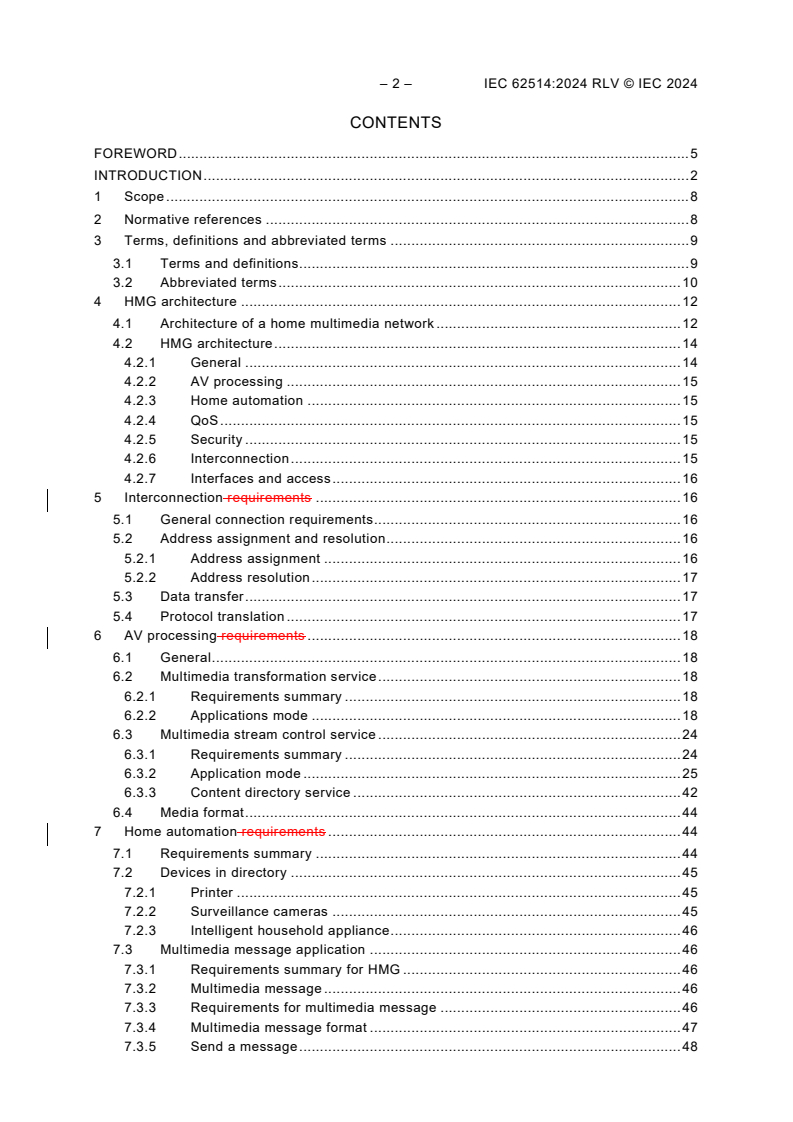
CONTENTS
FOREWORD . 5
INTRODUCTION . 2
1 Scope . 8
2 Normative references . 8
3 Terms, definitions and abbreviated terms . 9
3.1 Terms and definitions . 9
3.2 Abbreviated terms . 10
4 HMG architecture . 12
4.1 Architecture of a home multimedia network . 12
4.2 HMG architecture . 14
4.2.1 General . 14
4.2.2 AV processing . 15
4.2.3 Home automation . 15
4.2.4 QoS . 15
4.2.5 Security . 15
4.2.6 Interconnection . 15
4.2.7 Interfaces and access . 16
5 Interconnection requirements . 16
5.1 General connection requirements . 16
5.2 Address assignment and resolution . 16
5.2.1 Address assignment . 16
5.2.2 Address resolution . 17
5.3 Data transfer . 17
5.4 Protocol translation . 17
6 AV processing requirements . 18
6.1 General . 18
6.2 Multimedia transformation service . 18
6.2.1 Requirements summary . 18
6.2.2 Applications mode . 18
6.3 Multimedia stream control service . 24
6.3.1 Requirements summary . 24
6.3.2 Application mode . 25
6.3.3 Content directory service . 42
6.4 Media format . 44
7 Home automation requirements . 44
7.1 Requirements summary . 44
7.2 Devices in directory . 45
7.2.1 Printer . 45
7.2.2 Surveillance cameras . 45
7.2.3 Intelligent household appliance . 46
7.3 Multimedia message application . 46
7.3.1 Requirements summary for HMG . 46
7.3.2 Multimedia message . 46
7.3.3 Requirements for multimedia message . 46
7.3.4 Multimedia message format . 47
7.3.5 Send a message . 48
7.3.6 Delete a message . 48
7.3.7 Requirements for HMGs . 48
7.4 Devices management by HMG . 48
7.4.1 Device status . 48
7.4.2 Connection status . 48
7.4.3 Energy saving and power management. 49
7.5 Reading of meters. 49
7.6 Household appliance control . 50
7.7 AV recognition and analysis . 50
8 QoS . 50
8.1 General . 50
8.2 QoS requirements for HMG . 51
9 Security . 52
9.1 Requirements summary . 52
9.2 DRM . 52
9.3 Key management . 53
9.4 Authentication . 53
9.5 Credibility of HMG . 54
10 Performance requirements. 54
11 Requirements for Interfaces and protocols of HMGs . 55
11.1 General . 55
11.2 WAN side interfaces . 55
11.3 LAN side interfaces . 56
12 Upgrade . 56
Annex A (informative) Application scenario . 57
A.1 Entertainment . 57
A.1.1 Scenario 1: playback . 57
A.1.2 Scenario 2: VOD . 58
A.1.3 Scenario 3: change player . 58
A.1.4 Scenario 4: multicast . 59
A.1.5 Scenario 5: remote sharing . 60
A.1.6 Scenario 6: remote playback . 60
A.1.7 Scenario 7: upload and download . 61
A.1.8 Scenario 8: printing . 62
A.1.9 Scenario 9: home multi-screen interaction . 63
A.1.10 Scenario 10: inward remote sharing . 63
A.2 Communication . 64
A.2.1 Scenario 11: notification of new email . 64
A.2.2 Scenario 12: notification of incoming call . 65
A.2.3 Scenario 13: content sharing through videophones . 65
A.3 Security . 67
A.3.1 Scenario 14: video surveillance . 67
A.3.2 Scenario 15: image recognition and alarm . 67
A.4 Automation . 68
A.4.1 Scenario 16: controlling home appliances . 68
A.4.2 Scenario 17: meter reading . 69
A.5 Summary . 71
Bibliography . 72
– 4 – IEC 62514:2024 RLV © IEC 2024
Figure 1 – Architecture for a home multimedia network . 14
Figure 2 – HMG architecture . 15
Figure 3 – Conversion of media streams . 19
Figure 4 – HMRec requests media conversion from HMG . 20
Figure 5 – HMRec requests WMS to support redirection . 21
Figure 6 – HMSou actively sends media to HMRec . 23
Figure 7 – Video clip . 24
Figure 8 – AV media stream division . 25
Figure 9 – Stream division process . 25
Figure 10 – Combination of media streams . 26
Figure 11 – Stream combination process . 26
Figure 12 – Duplication of media streams . 27
Figure 13 – HMRec1 duplicates media stream to HMRec2 . 28
Figure 14 – HMRec2 requests to join the multicast group of the program being played
on HMRec1 . 29
Figure 15 – HMRec1 requests media stream from HMG and duplicates media stream to
HMRec2 . 29
Figure 16 – HMRec1 duplicates media stream to HMRec2 after requesting MS to
redirect media stream to HMG . 30
Figure 17 – Media stream redirection . 31
Figure 18 – HMRec1 requests to redirect media stream to HMRec2 . 32
Figure 19 – Adaptive processing of HMG . 33
Figure 20 – HMG adaptive process media stream to HMRec2 . 33
Figure 21 – HMRec requests HMG to adaptive process media stream based on the
network environment . 34
Figure 22 – HMG requests specific parameters from MS . 35
Figure 23 – Outward remote sharing from HMSou to WMR . 36
Figure 24 – Inward remote sharing from WMS to HMRec . 36
Figure 25 – WMR requests content from HMSou for outward remote sharing . 37
Figure 26 – Outward remote sharing from HMSou to WMR . 38
Figure 27 – Inward remote sharing from WMS to HMRec . 39
Figure 28 – Media play jump control . 40
Figure 29 – Media content targeted by progress bar returned from the HMG . 41
Figure 30 – Media content targeted by progress bar returned from MS . 42
Figure 31 – HMRec selects media contents through the directory service of HMG . 43
Figure 32 – QoS Architecture overview . 51
Table 1 – Mandatory and optional media formats . 44
Table 2 – Multimedia message format recommended . 47
Table 3 – WAN side interfaces . 55
Table 4 – LAN side interfaces . 56
INTERNATIONAL ELECTROTECHNICAL COMMISSION
____________
MULTIMEDIA GATEWAY IN HOME NETWORKS – GUIDELINES
FOREWORD
1) The International Electrotechnical Commission (IEC) is a worldwide organization for standardization comprising
all national electrotechnical committees (IEC National Committees). The object of IEC is to promote international
co-operation on all questions concerning standardization in the electrical and electronic fields. To this end and
in addition to other activities, IEC publishes International Standards, Technical Specifications, Technical Reports,
Publicly Available Specifications (PAS) and Guides (hereafter referred to as "IEC Publication(s)"). Their
preparation is entrusted to technical committees; any IEC National Committee interested in the subject dealt with
may participate in this preparatory work. International, governmental and non-governmental organizations liaising
with the IEC also participate in this preparation. IEC collaborates closely with the International Organization for
Standardization (ISO) in accordance with conditions determined by agreement between the two organizations.
2) The formal decisions or agreements of IEC on technical matters express, as nearly as possible, an international
consensus of opinion on the relevant subjects since each technical committee has representation from all
interested IEC National Committees.
3) IEC Publications have the form of recommendations for international use and are accepted by IEC National
Committees in that sense. While all reasonable efforts are made to ensure that the technical content of IEC
Publications is accurate, IEC cannot be held responsible for the way in which they are used or for any
misinterpretation by any end user.
4) In order to promote international uniformity, IEC National Committees undertake to apply IEC Publications
transparently to the maximum extent possible in their national and regional publications. Any divergence between
any IEC Publication and the corresponding national or regional publication shall be clearly indicated in the latter.
5) IEC itself does not provide any attestation of conformity. Independent certification bodies provide conformity
assessment services and, in some areas, access to IEC marks of conformity. IEC is not responsible for any
services carried out by independent certification bodies.
6) All users should ensure that they have the latest edition of this publication.
7) No liability shall attach to IEC or its directors, employees, servants or agents including individual experts and
members of its technical committees and IEC National Committees for any personal injury, property damage or
other damage of any nature whatsoever, whether direct or indirect, or for costs (including legal fees) and
expenses arising out of the publication, use of, or reliance upon, this IEC Publication or any other IEC
Publications.
8) Attention is drawn to the Normative references cited in this publication. Use of the referenced publications is
indispensable for the correct application of this publication.
9) IEC draws attention to the possibility that the implementation of this document may involve the use of (a)
patent(s). IEC takes no position concerning the evidence, validity or applicability of any claimed patent rights in
respect thereof. As of the date of publication of this document, IEC had not received notice of (a) patent(s), which
may be required to implement this document. However, implementers are cautioned that this may not represent
the latest information, which may be obtained from the patent database available at https://patents.iec.ch. IEC
shall not be held responsible for identifying any or all such patent rights.
This redline version of the official IEC Standard allows the user to identify the changes
made to the previous edition IEC 62514:2010. A vertical bar appears in the margin
wherever a change has been made. Additions are in green text, deletions are in
strikethrough red text.
– 6 – IEC 62514:2024 RLV © IEC 2024
IEC 62514 has been prepared by technical area 18: Audio, video and multimedia applications
for end-user network, of IEC technical committee 100: Audio, video and multimedia systems
and equipment. It is an International Standard.
This second edition cancels and replaces the first edition published in 2010. This edition
constitutes a technical revision.
This edition includes the following significant technical changes with respect to the previous
edition:
a) addition of new multimedia processing functions and requirements the HMG shall support,
including adaptive multimedia processing, audio/video remote processing, and play function
enhancement, in Clause 6;
b) addition of home automation functions and requirements of audio/video analysis, recognition
and alarm services based on AI technologies in Clause 7;
c) addition of upgrade function and requirements of HMG in Clause 12.
The text of this International Standard is based on the following documents:
Draft Report on voting
100/4160/FDIS 100/4175/RVD
Full information on the voting for its approval can be found in the report on voting indicated in
the above table.
The language used for the development of this International Standard is English.
This document was drafted in accordance with ISO/IEC Directives, Part 2, and developed in
accordance with ISO/IEC Directives, Part 1 and ISO/IEC Directives, IEC Supplement, available
at www.iec.ch/members_experts/refdocs. The main document types developed by IEC are
described in greater detail at www.iec.ch/publications.
The committee has decided that the contents of this document will remain unchanged until the
stability date indicated on the IEC website under webstore.iec.ch in the data related to the
specific document. At this date, the document will be
• reconfirmed,
• withdrawn, or
• revised.
IMPORTANT – The "colour inside" logo on the cover page of this document indicates
that it contains colours which are considered to be useful for the correct understanding
of its contents. Users should therefore print this document using a colour printer.
INTRODUCTION
In a digital the smart-home system, in order to meet the various requirements of digital living
home intelligence, all kinds of communication devices (computers, consumer-electrical
products, etc.) and multimedia devices (TVs, surveillance cameras, etc.) are integrated into a
home network. Such a network (comprising home information, entertainment, control services,
etc.) thus forms a system of information exchange with outside networks.
In a home network system is a Local Area Network (LAN) connecting such, terminal devices
such as information devices, communication devices, entertainment devices, household
appliances, meters of gas, water and electricity, health-care equipment, and lighting and
security systems, etc. are interconnected through the Internet of Things (IoT) technology to
implement the network management and services and share the resources and services in the
network. Based on the interconnection of terminal devices, home network systems can also
provide comprehensive multimedia processing services through the use of multi-screen
interactive services, remote access, image recognition, and other audio and video processing
technologies.
The multimedia services and the management for devices mentioned above can be performed
through a home multimedia gateway.
– 8 – IEC 62514:2024 RLV © IEC 2024
MULTIMEDIA GATEWAY IN HOME NETWORKS – GUIDELINES
1 Scope
This document describes the general guidelines for typical applications of the home multimedia
gateway in home networks supporting IP networking.
This document specifies recommended functions and services to be supported by the home
multimedia gateway and, where appropriate, refers to existing standards supported in the
market. For general requirements, it is expected that widely adopted standards and
technologies will be considered by implementers.
This document gives supplementary applications to the IEC 62481 series, which specifies a
central management model in home networks supporting various interfaces on the LAN side
and on the WAN side (optional).
This document is applicable to home multimedia gateways in the home network or networks of
similar environments.
2 Normative references
The following documents are referred to in the text in such a way that some or all of their content
constitutes requirements of this document. For dated references, only the edition cited applies.
For undated references, the latest edition of the referenced document (including any
amendments) applies.
IEC 62481 (all parts), Digital living network alliance (DLNA) home networked device
interoperability guidelines
IEC 62481-1:20072017, Digital living network alliance (DLNA) home networked device
interoperability guidelines – Part 1: Architecture and protocols
IEC 62481-2, Digital living network alliance (DLNA) home networked device interoperability
guidelines – Part 2: Media formats
ISO/IEC 14762, Information technology – Functional safety requirements for home and building
electronic systems (HBES)
ISO/IEC 29341 (all parts), Information technology – UPnP Device Architecture
ISO/IEC 29341-1, Information technology – UpnP Device Architecture – Part 1: UpnP Device
Architecture Version 1.0
ISO/IEC 29341-3 (all Parts 3), Information technology – UpnP Device Architecture – Part 3:
Audio Visual Device Control Protocol
ISO/IEC 15045-1, Information technology – Home electronic system (HES) gateway – Part 1:
A residential gateway model for HES
ITU-T G.9960 /9961/G.hn Next generation home networking transceivers
UPnP Forum: Quality of Service:3 (all parts), http://www.upnp.org/specs/qos/qos3.asp
RFC 2663, IP Network Address Translator (NAT) Terminology and Considerations
RFC 3022, Traditional IP Network Address Translator (Traditional NAT)
IEEE 802.16, IEEE standard for Local and metropolitan Area Networks Media Access Control
(MAC) Bridges
IEEE 802.1Q™, IEEE standard for Local and metropolitan Area Networks – Bridges and Bridge
Networks
3 Terms, definitions and abbreviated terms
For the purposes of this document, the following terms and definitions apply.
ISO and IEC maintain terminology databases for use in standardization at the following
addresses:
• IEC Electropedia: available at https://www.electropedia.org/
• ISO Online browsing platform: available at https://www.iso.org/obp
3.1 Terms and definitions
3.1.1
home multimedia network
high speed network system to transport multimedia information within the home network
3.1.2
home multimedia gateway
HMG
logical device in the home network, which provides such functions as multimedia processing
and home automations, interconnection, QoS and security, etc; it can also
Note 1 to entry: It can connect LAN with outside networks (for example internet), implementing protocol translation
and offer various network services.
3.1.3
home control network
network that transports control information in the home network
3.1.4
home control gateway
provides protocol translation, device management, network management and control services
in a home control network which can be combined with HMG in the form of a physical device
3.1.3
control point
logical device that retrieves device and Service descriptions, sends actions to Services, polls
for Service state variables and receives events from Services
Note 1 to entry: 'Service' is a term that is also defined in the ISO/IEC 29341 series.
3.1.4
terminal device
device in the home network that can be controlled and managed by HMGs and control points
– 10 – IEC 62514:2024 RLV © IEC 2024
3.1.5
media receiver
MR
device that receives media contents
Note 1 to entry: It normally refers to the media content player.
3.1.6
home media receiver
HMRec
device that receives media contents in the home network
Note 1 to entry: HMRec should fully support the function of DMR and DMP which are DLNA device classes defined
by IEC 62481-1.
3.1.7
media source
MS
device that owns media resources and sends media contents
3.1.8
home media source
HMSou
device that provides media contents in the home network; it can be a media server
Note 1 to entry: HMSou should fully support the function of DMS and +PU+, which are defined by IEC 62481-1 and
IEC 62481-2.
3.1.9
WAN media source
WMS
device that provides media contents in the Wide Area Network (WAN)
3.1.10
WAN media receiver
WMR
device that receives media contents in the Wide Area Network (WAN)
3.2 Abbreviated terms
+DN+ download controller
+PR+ printing controller
+PU+ push uploader
+UP+ upload controller
AAC Advanced Audio Coding
ADSL Asymmetric Digital Subscriber Line
ANSI American National Standards Institute
ARP Address Resolution Protocol
ATA analogue telephone adapter
ATRAC adaptive transform acoustic coding
AV audio and video
AVC Advanced Video Codec Coding
CDS content distribution service
CPU central processing unit
DHCP Dynamic Host Configuration Protocol
DLNA Digital Living Network Alliance
DMC digital media controller
DMR digital media renderer
DMP digital media player
DMPr digital media printer
DNS domain name system
DRM digital rights management
DSCP differentiated service code point
DSL Digital Subscriber Line
DTV digital television
EPG electronic program guide
ETH Ethernet
FTP File Transfer Protocol
GENA general event notification architecture
HMRec home media receiver
HMG home multimedia gateway
HMSou home media source
HTTP Hyper Text Transfer Protocol
ICMP Internet Control Message Protocol
ID identification
IGD internet gateway device
IGMP Internet Group Management Protocol
IP Internet Protocol
IPTV Internet Protocol television
ITU International Telecommunication Union
JPEG Joint Photographic Experts Group
LAN local area network
LPCM Linear Pulse Code Modulation
MAC media access control
MIU media interoperability unit
MPEG Moving Picture Experts Group
MR media receiver
MRCP mediarenderer:1 control point
MS media source
MSCP mediaserver:1 control point
NAT Network Address Translation
NAPT port-level NATNA
NID network infrastructure device
PAN personal area network
PC personal computer
QoS quality of service
RID request identity
RIP Routing Information Protocol
– 12 – IEC 62514:2024 RLV © IEC 2024
SOAP Simple Object Access Protocol
STB set top box
TCP Transmission Control Protocol
UDP User Datagram Protocol
UPnP Universal Plug and Play
URI Uniform Resource Identifier
URL Uniform Resource Locator
VDSL Very-high-bit-rate Digital Subscriber Line
VOD video on demand
VOIP voice over Internet Protocol
WAN wide area network
WMS WAN media source
WMM wireless multimedia
WMR WAN media receiver
4 HMG architecture
4.1 Architecture of a home multimedia network
A home multimedia network adopts a multiple-level network topology consisting of two network
segments, i.e. a home multimedia network and a home control sub-network. The home control
sub-network is optional, where appropriate.
The home multimedia network supports the central management mode, which can be functioned
by HMG, as well as supporting peer-to-peer mechanisms as specified in the IEC 62481 series.
The home multimedia network can access the outside network through an HMG, while the home
control sub-network can be connected to the home multimedia network through a home control
sub-network gateway. The devices in a home control sub-network can intercommunicate and
further access outside networks by sub-gateways and HMGs.
The typical architecture of a home multimedia system is shown in Figure 1.
··· ··· ···
HMG
Access area to outside
networks
Control sub-
Control sub-network 1
Outside Home gateway 1
network Multimedia
Network
Terminal Terminal Control Control
Device 11 ·· Device 1n Point 11 ·· Point 1m
Control sub-
Control Sub-network n
gateway n
Terminal Terminal Control Control
·· ··
Device n1 Device nn Point n1 Point nm
Terminal device
Terminal device
m
Control point 1
Control point x
IEC 1077/10
– 14 – IEC 62514:2024 RLV © IEC 2024
Figure 1 – Architecture for a home multimedia network
4.2 HMG architecture
4.2.1 General
From the aspect of the functional structure, the HMG provides such functions as multimedia
processing and applications, interconnection, and QoS and security. The architecture of the
HMG is shown in Figure 2.
Figure 2 – HMG architecture
4.2.2 AV processing
HMGs shall provide various application services of video and audio in the home multimedia
network. It shall fully support all the functions of MIU (includes MSCP, MRCP), DMPr and
+UP+/+DN+/+PR+, which are defined in IEC 62481-1 and IEC 62481-2.
4.2.3 Home automation
HMGs can offer local management and remote management, as well as various control services
to the devices in the home network.
4.2.4 QoS
HMGs should support QoS features in order to transport multimedia contents effectively in the
home network where the HMG is involved.
If the HMG supports QoS features, then the HMG shall use the priority tag of QoS in order to
transfer the multimedia contents that have IEEE 802.1Q User Priority, WMM Access Category
or DSCP.
The detailed requirements of QoS shall be compliant withIEC 62481-1:2017, 8.3.
4.2.5 Security
HMGs shall support DRM, key management, authentication and security to log onto outside
networks.
4.2.6 Interconnection
HMGs shall support the network management, protocol translation, address assignment,
configuration and management on the home networked devices, in different multimedia
networks.
– 16 – IEC 62514:2024 RLV © IEC 2024
4.2.7 Interfaces and access
These provide the connection between the home network and outside networks (for example,
the Internet) when necessary, which is optional.
The detailed interface and communication protocol requirements on both the LAN side and the
WAN side are specified in Clause 11. The specific protocol that is to be applied depends on the
application case.
5 Interconnection requirements
5.1 General connection requirements
Where the home multimedia network is an IP network, the requirements for the HMG should be
are as follows:
• HMGs shall implement a Dynamic Host Configuration Protocol (DHCP) server in order to
assign IP address to DHCP client in the home network where the HMG is involved.
• HMGs should support Domain Name System (DNS) in order to use device name for better
user experience.
• Those messages are formatted by using the SOAP HTTP binding, which shall be compliant
with ISO/IEC 29341-1.
• HMGs should collect information with respect to all the devices connected to the home
network by using the device description and the service description of each device in order
to manage the devices.
• HMGs also should control other devices such as HMRec and HMSou by using appropriate
actions to realize use cases described in this document.
HMGs shall also conform to the following requirements defined and specified in IEC 62481-1:
• HMGs shall support a TCP/IP stack that includes IPv4, TCP, UDP, ARP, and ICMP.
• HMGs may also support general capability recommendations and device recommendations.
• The detailed methods of interconnection shall be compliant with IEC 62481-1:20072017, 7.3
(Device discovery and control).
• HMGs shall support Simple Object Access Protocol (SOAP) header and body elements, and
the messages are delivered via HTTP. The HMG as well as HMSou and HMRec support the
messaging scheme by using the GENA protocol to exchange the event information inside
the high-speed system. A control point invokes the action to the device's service in order to
control it and when the action has completed or failed, the service returns any results or
errors of the action.
• HMGs shall support the detailed methods of device management.
5.2 Address assignment and resolution
5.2.1 Address assignment
HMGs shall support the functions of address assignment as follows:
• HMGs shall assign the identifiers to each control sub-network in order to identify different
sub-networks.
• The control sub-network gateway shall apply for the addresses, which comply for the higher-
level network protocol and are composed of sub-network identifier and network address,
from the HMG.
• HMGs shall have the following address assignment functions.
– HMGs shall support DHCP servers to assign the addresses for the devices managed in
the home network. Through a management and configuration interface on the HMG, the
DHCP can be enabled or disabled, and the data such as address pool assignment on
the DHCP can be configured as well.
– The terminal devices shall also support AutoIP if there is no DHCP server in the sub-
network.
5.2.2 Address resolution
HMGs shall support the functions and requirements of address resolution as follows:
• If the source devices and destination devices are located in the same control sub-network
or multimedia network, then the HMG shall forward the data packet directly without any
processing.
• If the source devices and the destination devices are not located in the same control sub-
network or multimedia network, then
– the source devices shall know the identifier and network address of the control sub-
network or multimedia network in which the destination devices are located;
– the HMG shall resolve the data packet sent from the source devices and identify the
identifiers and network addresses of the control sub-network or multimedia network in
which the source devices and destination devices are located, respectively;
– the HMG shall confirm the network and address of the destination devices located
according to the identifier and network address of that control sub-network or multimedia
network;
– the HMG shall confirm the communication protocol of the destination devices from the
device registry;
– the HMG shall then re-pack the data and send to the destination device in accordance
with the communication protocol confirmed.
• The HMG shall support the ARP protocol as well.
5.3 Data transfer
HMGs
• shall support router working mode, bridge working mode or the hybrid working mode of both
router and bridge;
• shall support the static router in the router working mode;
• should support the dynamic router and support RIP V1/V2 in the router working mode;
• shall support NAT and NAPT in accordance with RFC 2663 and RFC 3022 in the bridge
working mode;
• shall support the transparent bridge protocol in accordance with IEEE 802.1d1Q in the
bridge working mode;
• shall support the relevant functions of both router working mode and bridge working mode
when working the hybrid mode of router and bridge.
5.4 Protocol translation
HMGs shall support the application protocol translations when communicating and interacting
between different networks or sub-networks.
– 18 – IEC 62514:2024 RLV © IEC 2024
6 AV processing requirements
6.1 General
HMGs may offer services for applications in home network systems. In summary, service
requirements include multimedia transformation and multimedia stream control and may be
fulfilled by using the services and actions that are defined by UPnP AV specifications
(ISO/IEC 29341-3 series) and DLNA guidelines (IEC 62481 series). HMGs need to meet some
hardware and software requirements to enable all these AV processing services need some
requirements for hardware and software of the HMG.
6.2 Multimedia transformation service
6.2.1 Requirements summary
The following requirements apply.
• HMGs shall provide the media conversion service, including code conversion (transcoding),
resolution conversion (transcaling), and shall provide the media conversion service of the
frame rate conversion (transrating).
• HMGs should support voice code conversion.
• The media conversion service request message shall include the URI of the media
resources, which specifies media code format, resolution, frame rate and transport protocols
needed by the requester. In the case of getting contents from WMS, it can also include the
code format, resolution and frame rate of the requested contents, as well as the media
transport protocols supported by the media content owner.
• HMGs should be able to convert audio streams into voice streams.
• HMGs should be able to convert voice streams into audio streams.
• HMGs should be able to provide the video clip function, which shall
...