

IEC 61191-1:2013
(Main)Printed board assemblies - Part 1: Generic specification - Requirements for soldered electrical and electronic assemblies using surface mount and related assembly technologies
General Information
- Abstract
IEC 61191-1:2013 prescribes requirements for materials, methods and verification criteria for producing quality soldered interconnections and assemblies using surface mount and related assembly technologies. It also includes recommendations for good manufacturing processes. This edition includes the following significant technical changes with respect to the previous edition:
- reference standard IEC 61192-1 has been replaced by IPC-A-610;
- some of the terminology has been updated;
- references to IEC standards have been corrected;
- the use of lead-free alloys in the assembly have been added.
- Status
- Published
- Publication Date
- 20-May-2013
- Technical Committee
- TC 91 - Electronics assembly technology
- Drafting Committee
- WG 2 - TC 91/WG 2
- Current Stage
- DELPUB - Deleted Publication
- Start Date
- 14-Sep-2018
- Completion Date
- 28-Aug-2026
Buy Documents
IEC 61191-1:2013 - Printed board assemblies - Part 1: Generic specification - Requirements for soldered electrical and electronic assemblies using surface mount and related assembly technologies Released:5/21/2013
Overview
IEC 61191-1:2013 is an international standard developed by the International Electrotechnical Commission (IEC) that provides a generic specification for printed board assemblies (PBAs). It establishes comprehensive requirements for soldered electrical and electronic assemblies using surface mount and related assembly technologies. This standard covers materials, methods, and verification criteria essential for producing high-quality soldered interconnections. Additionally, it offers recommendations for good manufacturing practices to ensure reliability and performance in electronic assembly processes.
Significant updates in this 2013 edition include replacing the reference standard IEC 61192-1 with IPC-A-610, updated terminology, corrected IEC standards references, and the inclusion of lead-free alloy usage in soldering processes.
Key Topics
Materials Requirements
The standard outlines stringent criteria for solder, flux, solder paste, preforms, adhesives, cleaning agents, and polymeric coatings, ensuring compatibility and reliability in assembly.Assembly Process Control
IEC 61191-1 defines detailed process control requirements including cleanliness standards, thermal dissipation, moisture control, and handling procedures to prevent defects in solder joints.Soldering Techniques
Requirements cover various soldering methods such as reflow soldering, mechanized immersion soldering, and hand soldering, emphasizing process development, tool maintenance, flux application, and cooling parameters for optimum results.Verification & Inspection
The document specifies verification criteria encompassing visual aids, defect classifications, cleanliness verification, and proficiency standards for personnel to maintain high manufacturing quality.Environmental & Facility Controls
It mandates environmental controls for temperature, humidity, lighting, electrostatic discharge (ESD) protection, and clean room conditions to safeguard assembly integrity.Component and Board Requirements
Recommendations on solderability, solder purity, lead preparation, and solderability maintenance of components and printed circuit boards are provided to enhance assembly durability.
Applications
IEC 61191-1:2013 is applied extensively across industries where surface mount technology (SMT) and related assembly methods are used, including:
- Consumer Electronics Manufacturing – ensuring durable soldered connections in devices such as smartphones, tablets, and home electronics.
- Automotive Electronics – supporting high-reliability assemblies exposed to harsh operational environments.
- Industrial Equipment – providing standards for complex electronics requiring robust solder joints in machinery controls.
- Medical Devices – ensuring stringent soldering requirements are met for safety-critical electronic assemblies.
- Aerospace and Defense – maintaining rigorous quality assurance for soldered electronic components in high-performance applications.
By adhering to IEC 61191-1, manufacturers worldwide can achieve consistency, high quality, and conformance across their soldered printed board assemblies, reducing failures and boosting product reliability.
Related Standards
- IPC-A-610 – "Acceptability of Electronic Assemblies," used as a reference standard replacing IEC 61192-1 in this document.
- IEC 61191-2 and IEC 61191-3 – Parts 2 and 3 of the IEC 61191 series provide additional guidelines and process specifications for soldered assemblies.
- IEC 61760 – Related to performance specification and qualification of PBAs.
- IEC 61340 – Addresses electrostatic discharge control, referenced for personnel proficiency and facility requirements.
- IPC J-STD-001 – For soldering materials and processes, complementing material and soldering technique requirements.
Keywords: IEC 61191-1, printed board assemblies, soldered electrical assemblies, surface mount technology, SMT soldering requirements, lead-free soldering, electronic assembly standards, IPC-A-610, solder joint quality, manufacturing process control, electrostatic discharge protection, solder paste standards, assembly cleanliness criteria.
Relations
- Effective Date
- 05-Sep-2023
- Effective Date
- 05-Sep-2023
Buy Documents
IEC 61191-1:2013 - Printed board assemblies - Part 1: Generic specification - Requirements for soldered electrical and electronic assemblies using surface mount and related assembly technologies Released:5/21/2013
Frequently Asked Questions
IEC 61191-1:2013 is a standard published by the International Electrotechnical Commission (IEC). Its full title is "Printed board assemblies - Part 1: Generic specification - Requirements for soldered electrical and electronic assemblies using surface mount and related assembly technologies". This standard covers: IEC 61191-1:2013 prescribes requirements for materials, methods and verification criteria for producing quality soldered interconnections and assemblies using surface mount and related assembly technologies. It also includes recommendations for good manufacturing processes. This edition includes the following significant technical changes with respect to the previous edition: - reference standard IEC 61192-1 has been replaced by IPC-A-610; - some of the terminology has been updated; - references to IEC standards have been corrected; - the use of lead-free alloys in the assembly have been added.
IEC 61191-1:2013 prescribes requirements for materials, methods and verification criteria for producing quality soldered interconnections and assemblies using surface mount and related assembly technologies. It also includes recommendations for good manufacturing processes. This edition includes the following significant technical changes with respect to the previous edition: - reference standard IEC 61192-1 has been replaced by IPC-A-610; - some of the terminology has been updated; - references to IEC standards have been corrected; - the use of lead-free alloys in the assembly have been added.
IEC 61191-1:2013 is classified under the following ICS (International Classification for Standards) categories: 31.190 - Electronic component assemblies; 31.240 - Mechanical structures for electronic equipment. The ICS classification helps identify the subject area and facilitates finding related standards.
IEC 61191-1:2013 has the following relationships with other standards: It is inter standard links to IEC 61191-1:2018, IEC 61191-1:1998. Understanding these relationships helps ensure you are using the most current and applicable version of the standard.
IEC 61191-1:2013 is available in PDF format for immediate download after purchase. The document can be added to your cart and obtained through the secure checkout process. Digital delivery ensures instant access to the complete standard document.
Standards Content (Sample)
IEC 61191-1 ®
Edition 2.0 2013-05
INTERNATIONAL
STANDARD
NORME
INTERNATIONALE
Printed board assemblies –
Part 1: Generic specification – Requirements for soldered electrical and
electronic assemblies using surface mount and related assembly technologies
Ensembles de cartes imprimées –
Partie 1: Spécification générique – Exigences relatives aux ensembles
électriques et électroniques brasés utilisant les techniques de montage en
surface et associées
All rights reserved. Unless otherwise specified, no part of this publication may be reproduced or utilized in any form
or by any means, electronic or mechanical, including photocopying and microfilm, without permission in writing from
either IEC or IEC's member National Committee in the country of the requester.
If you have any questions about IEC copyright or have an enquiry about obtaining additional rights to this publication,
please contact the address below or your local IEC member National Committee for further information.
Droits de reproduction réservés. Sauf indication contraire, aucune partie de cette publication ne peut être reproduite ni
utilisée sous quelque forme que ce soit et par aucun procédé, électronique ou mécanique, y compris la photocopie et les
microfilms, sans l'accord écrit de la CEI ou du Comité national de la CEI du pays du demandeur.
Si vous avez des questions sur le copyright de la CEI ou si vous désirez obtenir des droits supplémentaires sur cette
publication, utilisez les coordonnées ci-après ou contactez le Comité national de la CEI de votre pays de résidence.
IEC Central Office Tel.: +41 22 919 02 11
3, rue de Varembé Fax: +41 22 919 03 00
CH-1211 Geneva 20 info@iec.ch
Switzerland www.iec.ch
About the IEC
The International Electrotechnical Commission (IEC) is the leading global organization that prepares and publishes
International Standards for all electrical, electronic and related technologies.
About IEC publications
The technical content of IEC publications is kept under constant review by the IEC. Please make sure that you have the
latest edition, a corrigenda or an amendment might have been published.
Useful links:
IEC publications search - www.iec.ch/searchpub Electropedia - www.electropedia.org
The advanced search enables you to find IEC publications The world's leading online dictionary of electronic and
by a variety of criteria (reference number, text, technical electrical terms containing more than 30 000 terms and
committee,…). definitions in English and French, with equivalent terms in
It also gives information on projects, replaced and additional languages. Also known as the International
withdrawn publications. Electrotechnical Vocabulary (IEV) on-line.
IEC Just Published - webstore.iec.ch/justpublished Customer Service Centre - webstore.iec.ch/csc
Stay up to date on all new IEC publications. Just Published If you wish to give us your feedback on this publication
details all new publications released. Available on-line and or need further assistance, please contact the
also once a month by email. Customer Service Centre: csc@iec.ch.
A propos de la CEI
La Commission Electrotechnique Internationale (CEI) est la première organisation mondiale qui élabore et publie des
Normes internationales pour tout ce qui a trait à l'électricité, à l'électronique et aux technologies apparentées.
A propos des publications CEI
Le contenu technique des publications de la CEI est constamment revu. Veuillez vous assurer que vous possédez
l’édition la plus récente, un corrigendum ou amendement peut avoir été publié.
Liens utiles:
Recherche de publications CEI - www.iec.ch/searchpub Electropedia - www.electropedia.org
La recherche avancée vous permet de trouver des Le premier dictionnaire en ligne au monde de termes
publications CEI en utilisant différents critères (numéro de électroniques et électriques. Il contient plus de 30 000
référence, texte, comité d’études,…). termes et définitions en anglais et en français, ainsi que
Elle donne aussi des informations sur les projets et les les termes équivalents dans les langues additionnelles.
publications remplacées ou retirées. Egalement appelé Vocabulaire Electrotechnique
International (VEI) en ligne.
Just Published CEI - webstore.iec.ch/justpublished
Service Clients - webstore.iec.ch/csc
Restez informé sur les nouvelles publications de la CEI.
Just Published détaille les nouvelles publications parues. Si vous désirez nous donner des commentaires sur
Disponible en ligne et aussi une fois par mois par email. cette publication ou si vous avez des questions
contactez-nous: csc@iec.ch.
IEC 61191-1 ®
Edition 2.0 2013-05
INTERNATIONAL
STANDARD
NORME
INTERNATIONALE
Printed board assemblies –
Part 1: Generic specification – Requirements for soldered electrical and
electronic assemblies using surface mount and related assembly technologies
Ensembles de cartes imprimées –
Partie 1: Spécification générique – Exigences relatives aux ensembles
électriques et électroniques brasés utilisant les techniques de montage en
surface et associées
INTERNATIONAL
ELECTROTECHNICAL
COMMISSION
COMMISSION
ELECTROTECHNIQUE
PRICE CODE
INTERNATIONALE
CODE PRIX X
ICS 31.190; 31.240 ISBN 978-2-83220-810-6
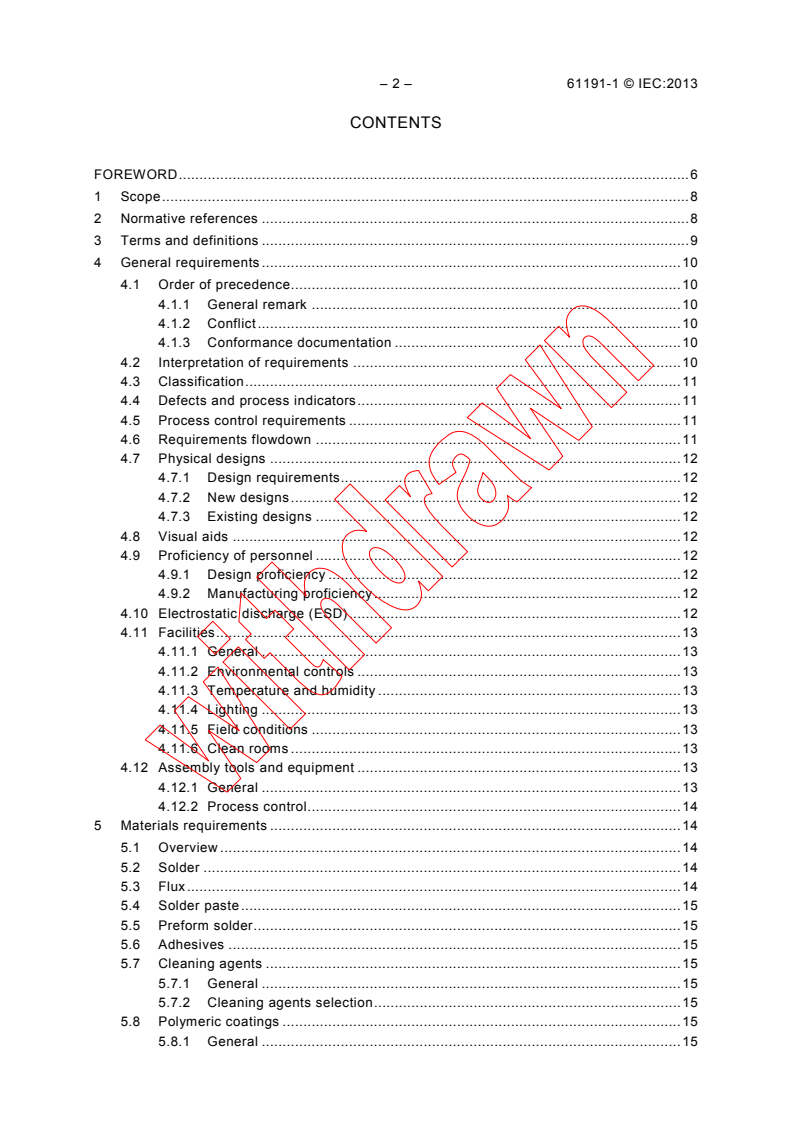
– 2 – 61191-1 © IEC:2013
CONTENTS
FOREWORD . 6
1 Scope . 8
2 Normative references . 8
3 Terms and definitions . 9
4 General requirements . 10
4.1 Order of precedence. 10
4.1.1 General remark . 10
4.1.2 Conflict . 10
4.1.3 Conformance documentation . 10
4.2 Interpretation of requirements . 10
4.3 Classification . 11
4.4 Defects and process indicators . 11
4.5 Process control requirements . 11
4.6 Requirements flowdown . 11
4.7 Physical designs . 12
4.7.1 Design requirements . 12
4.7.2 New designs . 12
4.7.3 Existing designs . 12
4.8 Visual aids . 12
4.9 Proficiency of personnel . 12
4.9.1 Design proficiency . 12
4.9.2 Manufacturing proficiency . 12
4.10 Electrostatic discharge (ESD) . 12
4.11 Facilities . 13
4.11.1 General . 13
4.11.2 Environmental controls . 13
4.11.3 Temperature and humidity . 13
4.11.4 Lighting . 13
4.11.5 Field conditions . 13
4.11.6 Clean rooms . 13
4.12 Assembly tools and equipment . 13
4.12.1 General . 13
4.12.2 Process control . 14
5 Materials requirements . 14
5.1 Overview . 14
5.2 Solder . 14
5.3 Flux . 14
5.4 Solder paste . 15
5.5 Preform solder . 15
5.6 Adhesives . 15
5.7 Cleaning agents . 15
5.7.1 General . 15
5.7.2 Cleaning agents selection . 15
5.8 Polymeric coatings . 15
5.8.1 General . 15
61191-1 © IEC:2013 – 3 –
5.8.2 Solder resists and localized maskants . 15
5.8.3 Conformal coating and encapsulants . 15
5.8.4 Spacers (permanent and temporary) . 16
5.9 Chemical strippers. 16
5.10 Heat shrinkable soldering devices . 16
6 Components and printed board requirements . 16
6.1 General . 16
6.2 Solderability . 16
6.2.1 Parts solderability . 16
6.2.2 Reconditioning . 16
6.2.3 Solderability testing of ceramic boards . 16
6.3 Solderability maintenance . 17
6.3.1 General . 17
6.3.2 Preconditioning . 17
6.3.3 Gold embrittlement of solder joints . 17
6.3.4 Tinning of non-solderable parts . 17
6.4 Solder purity maintenance . 18
6.5 Lead preparation . 18
6.5.1 General . 18
6.5.2 Lead forming . 19
6.5.3 Lead forming limits . 19
7 Assembly process requirements . 19
7.1 Overview . 19
7.2 Cleanliness . 19
7.3 Part markings and reference designations . 19
7.4 Solder connection contours . 19
7.5 Moisture traps . 19
7.6 Thermal dissipation . 20
8 Assembly soldering requirements . 20
8.1 General . 20
8.2 General . 20
8.2.1 Soldering process . 20
8.2.2 Machine maintenance . 20
8.2.3 Handling of parts . 20
8.2.4 Preheating . 20
8.2.5 Carriers . 20
8.2.6 Hold down of surface mount leads . 20
8.2.7 Heat application. 21
8.2.8 Cooling . 21
8.3 Reflow soldering . 21
8.3.1 Requirements . 21
8.3.2 Process development for reflow soldering . 21
8.3.3 Flux application . 21
8.3.4 Solder application . 21
8.4 Mechanized immersion soldering (non-reflow) . 22
8.4.1 General . 22
8.4.2 Process development for mechanized immersion soldering . 22
8.4.3 Drying/degassing . 23
8.4.4 Holding fixtures and materials . 23
– 4 – 61191-1 © IEC:2013
8.4.5 Flux application . 23
8.4.6 Solder bath . 23
8.5 Manual/hand soldering . 23
8.5.1 Requirements . 23
8.5.2 Non-reflow manual soldering . 24
8.5.3 Reflow manual soldering. 24
9 Cleanliness requirements . 25
9.1 General . 25
9.2 Equipment and material compatibility . 25
9.3 Pre-soldering cleaning . 25
9.4 Post-soldering cleaning . 25
9.4.1 General . 25
9.4.2 Ultrasonic cleaning . 25
9.5 Cleanliness verification. 26
9.5.1 General . 26
9.5.2 Visual inspection . 26
9.5.3 Testing . 26
9.6 Cleanliness criteria . 26
9.6.1 General . 26
9.6.2 Particulate matter . 26
9.6.3 Flux residues and other ionic or organic contaminants . 26
9.6.4 Cleaning option . 27
9.6.5 Test for cleanliness . 27
9.6.6 Rosin residues on cleaned board assemblies . 27
9.6.7 Ionic residues (instrument method) . 28
9.6.8 Ionic residues (manual method) . 28
9.6.9 Surface insulation resistance (SIR) . 28
9.6.10 Other contamination . 28
10 Assembly requirements . 28
10.1 General . 28
10.2 Acceptance requirements . 28
10.2.1 Process control . 28
10.2.2 Corrective action limits . 29
10.2.3 Control limit determination . 29
10.3 General assembly requirements . 29
10.3.1 Assembly integrity . 29
10.3.2 Assembly damage . 29
10.3.3 Markings. 30
10.3.4 Flatness (bow and twist) . 30
10.3.5 Solder connection . 30
10.3.6 Interfacial connections . 31
11 Coating and encapsulation . 31
11.1 Detail requirements . 31
11.2 Conformal coating . 32
11.2.1 Coating instructions . 32
11.2.2 Application . 32
11.2.3 Performance requirements. 33
11.2.4 Rework of conformal coating . 34
11.2.5 Conformal coating inspection . 34
61191-1 © IEC:2013 – 5 –
11.3 Encapsulation . 34
11.3.1 Encapsulation instructions . 34
11.3.2 Application . 34
11.3.3 Performance requirements. 34
11.3.4 Rework of encapsulant material . 34
11.3.5 Encapsulant inspection . 34
12 Rework and repair . 35
12.1 General . 35
12.2 Rework of unsatisfactory soldered electrical and electronic assemblies . 35
12.3 Repair . 36
12.4 Post rework/repair cleaning . 36
13 Product quality assurance . 37
13.1 System requirements . 37
13.2 Inspection methodology . 37
13.2.1 Verification inspection . 37
13.2.2 Visual inspection . 37
13.2.3 Sampling inspection . 38
13.3 Process control . 38
13.3.1 System details . 38
13.3.2 Defect reduction . 38
13.3.3 Variance reduction. 39
14 Other requirements . 39
14.1 Health and safety . 39
14.2 Special manufacturing requirements . 39
14.2.1 Manufacture of devices incorporating magnetic windings . 39
14.2.2 High-frequency applications . 39
14.2.3 High-voltage or high-power applications . 39
14.3 Guidance on requirement flowdown . 39
15 Ordering data . 39
Annex A (normative) Requirements for soldering tools and equipment . 41
Annex B (normative) Qualification of fluxes . 43
Annex C (normative) Quality assessment . 44
Bibliography . 46
Figure 1 – Solder contact angle . 30
Figure 2 – Solder wetting of plated through-holes without leads . 31
Figure 3 – Coating conditions . 33
Table 1 – Solder contamination limits; maximum contaminant limit (percentage by
weight) . 18
Table 2 – Electrical and electronic assembly defects . 36
Table 3 – Magnification requirements . 37
– 6 – 61191-1 © IEC:2013
INTERNATIONAL ELECTROTECHNICAL COMMISSION
____________
PRINTED BOARD ASSEMBLIES –
Part 1: Generic specification –
Requirements for soldered electrical and electronic assemblies
using surface mount and related assembly technologies
FOREWORD
1) The International Electrotechnical Commission (IEC) is a worldwide organization for standardization comprising
all national electrotechnical committees (IEC National Committees). The object of IEC is to promote
international co-operation on all questions concerning standardization in the electrical and electronic fields. To
this end and in addition to other activities, IEC publishes International Standards, Technical Specifications,
Technical Reports, Publicly Available Specifications (PAS) and Guides (hereafter referred to as “IEC
Publication(s)”). Their preparation is entrusted to technical committees; any IEC National Committee interested
in the subject dealt with may participate in this preparatory work. International, governmental and non-
governmental organizations liaising with the IEC also participate in this preparation. IEC collaborates closely
with the International Organization for Standardization (ISO) in accordance with conditions determined by
agreement between the two organizations.
2) The formal decisions or agreements of IEC on technical matters express, as nearly as possible, an international
consensus of opinion on the relevant subjects since each technical committee has representation from all
interested IEC National Committees.
3) IEC Publications have the form of recommendations for international use and are accepted by IEC National
Committees in that sense. While all reasonable efforts are made to ensure that the technical content of IEC
Publications is accurate, IEC cannot be held responsible for the way in which they are used or for any
misinterpretation by any end user.
4) In order to promote international uniformity, IEC National Committees undertake to apply IEC Publications
transparently to the maximum extent possible in their national and regional publications. Any divergence
between any IEC Publication and the corresponding national or regional publication shall be clearly indicated in
the latter.
5) IEC itself does not provide any attestation of conformity. Independent certification bodies provide conformity
assessment services and, in some areas, access to IEC marks of conformity. IEC is not responsible for any
services carried out by independent certification bodies.
6) All users should ensure that they have the latest edition of this publication.
7) No liability shall attach to IEC or its directors, employees, servants or agents including individual experts and
members of its technical committees and IEC National Committees for any personal injury, property damage or
other damage of any nature whatsoever, whether direct or indirect, or for costs (including legal fees) and
expenses arising out of the publication, use of, or reliance upon, this IEC Publication or any other IEC
Publications.
8) Attention is drawn to the Normative references cited in this publication. Use of the referenced publications is
indispensable for the correct application of this publication.
9) Attention is drawn to the possibility that some of the elements of this IEC Publication may be the subject of
patent rights. IEC shall not be held responsible for identifying any or all such patent rights.
International Standard IEC 61191-1 has been prepared by IEC technical committee 91:
Electronics assembly technology.
This second edition cancels and replaces the first edition, published in 1998, and constitutes
a technical revision.
This edition includes the following significant technical changes with respect to the previous
edition:
– reference standard IEC 61192-1 has been replaced by IPC-A-610;
– some of the terminology has been updated;
– references to IEC standards have been corrected;
– the use of lead-free alloys in the assembly have been added.
61191-1 © IEC:2013 – 7 –
The text of this standard is based on the following documents:
FDIS Report on voting
91/1089A/FDIS 91/1098/RVD
Full information on the voting for the approval of this standard can be found in the report on
voting indicated in the above table.
A list of all parts of IEC 61191 series, published under the general title Printed board
assemblies can be found in the IEC website.
This publication has been drafted in accordance with the ISO/IEC Directives, Part 2.
The committee has decided that the contents of this publication will remain unchanged until
the stability date indicated on the IEC web site under "http://webstore.iec.ch" in the data
related to the specific publication. At this date, the publication will be
• reconfirmed,
• withdrawn,
• replaced by a revised edition, or
• amended.
– 8 – 61191-1 © IEC:2013
PRINTED BOARD ASSEMBLIES –
Part 1: Generic specification –
Requirements for soldered electrical and electronic assemblies
using surface mount and related assembly technologies
1 Scope
This part of IEC 61191 prescribes requirements for materials, methods and verification criteria
for producing quality soldered interconnections and assemblies using surface mount and
related assembly technologies. This part of IEC 61191 also includes recommendations for
good manufacturing processes.
2 Normative references
The following documents, in whole or in part, are normatively referenced in this document and
are indispensable for its application. For dated references, only the edition cited applies. For
undated references, the latest edition of the referenced document (including any
amendments) applies.
IEC 60194, Printed board design, manufacture and assembly – Terms and definitions
IEC 60721-3-1, Classification of environmental conditions – Part 3: Classification of groups
of environmental parameters and their severities – Section 1: Storage
IEC 61188-1-1, Printed boards and printed board assemblies – Design and use –
Part 1-1: Generic requirements – Flatness considerations for electronic assemblies
IEC 61189-1, Test methods for electrical materials, interconnection structures and
assemblies – Part 1: General test methods and methodology
IEC 61189-3, Test methods for electrical materials, printed boards and other interconnection
structures and assemblies – Part 3: Test methods for interconnection structures (printed
boards)
IEC 61190-1-1, Attachment materials for electronic assembly – Part 1-1: Requirements for
soldering fluxes for high-quality interconnections in electronics assembly
IEC 61190-1-2, Attachment materials for electronic assembly – Part 1-2: Requirements for
soldering pastes for high-quality interconnects in electronics assembly
IEC 61190-1-3, Attachment materials for electronic assembly – Part 1-3: Requirements for
electronic grade solder alloys and fluxed and non-fluxed solid solders for electronic soldering
applications
IEC 61191-2, Printed board assemblies – Part 2: Sectional specification – Requirements for
surface mount soldered assemblies
IEC 61191-3, Printed board assemblies – Part 3: Sectional specification – Requirements for
through-hole mount soldered assemblies
IEC 61191-4, Printed board assemblies – Part 4: Sectional specification – Requirements for
terminal soldered assemblies
61191-1 © IEC:2013 – 9 –
IEC 61249-8-8, Materials for interconnection structures – Part 8: Sectional specification set
for non-conductive films and coatings – Section 8: Temporary polymer coatings
IEC 61340-5-1, Electrostatics – Part 5-1: Protection of electronic devices from electrostatic
phenomena – General requirements
IEC/TR 61340-5-2, Electrostatics – Part 5-2: Protection of electronic devices from
electrostatic phenomena – User guide
IEC 61760-2, Surface mounting technology – Part 2: Transportation and storage conditions
of surface mounting devices (SMD) – Application guide
IPC-A-610E:2010, Acceptability of Electronic Assemblies
3 Terms and definitions
For the purposes of this document, the terms and definitions given in IEC 60194 as well as
the following apply.
3.1
bow
deviation from flatness of a board characterized by a roughly cylindrical or spherical curvature
so that, if the product is rectangular, its four corners are in the same plane
3.2
manufacturer
assembler
individual or company responsible for the procurement of materials and components, as well
as all assembly process and verification operations necessary to ensure full compliance of
assemblies with this standard
3.3
objective evidence
documentation, agreed to between user and manufacturer
Note 1 to entry: The documentation can be in the form of a hard copy, computer data, computer algorithms, video
or other media.
3.4
process indicator
detectable anomaly, other than a defect, that is reflective of material, equipment, personnel,
process and/or workmanship variation
3.5
proficiency
capability to perform tasks in accordance with the requirements and verification procedures
detailed in this standard
3.6
shadowing
phenomenon where parts create a shadow of leads, lands, or other parts, which obstruct
heating at reflow soldering or spreading solder at flow soldering
3.7
supplier
individual or company responsible for assuring, to the manufacturer (assembler), full
compliance of components and base materials with the requirements and verification
procedures of this standard
– 10 – 61191-1 © IEC:2013
Note 1 to entry: Components include electronic, electromechanical, mechanical components, printed boards, etc.
Note 2 to entry: Base materials include solder, flux, cleaning agents, etc.)
3.8
twist
deviation of a rectangular sheet, panel or printed board that occurs parallel to a diagonal
across its surface, so that one of the corners of the sheet is not in the plane that contains the
other three corners
3.9
user
procuring authority
individual, company or agency responsible for the procurement of electrical/electronic
hardware, and having the authority to define the class of equipment and any variation or
restrictions to the requirements of this standard
EXAMPLE The originator/custodian of the contract detailing these requirements.
4 General requirements
4.1 Order of precedence
4.1.1 General remark
In the event of a conflict between the text of this standard and the applicable standard cited
herein, the text of this standard shall take precedence. However, nothing in this standard
supersedes applicable laws and regulations.
4.1.2 Conflict
In the event of conflict between the requirements of this standard and the applicable assembly
drawing(s), the applicable user approved assembly drawing(s) shall govern. In the event of
conflict between the requirements of this standard and assembly drawing(s) that has not been
approved, the differences shall be referred to the designated user activity for approval. Upon
such approval, the provisions shall be documented (by official revision notice or equivalent)
on the assembly drawings, which shall then govern.
4.1.3 Conformance documentation
Where this standard requires documentary evidence to support conformance claims, each
record shall be retained and be available for inspection for a minimum of two years from the
date of the recorded occurrence (see ISO 9001).
4.2 Interpretation of requirements
The introduction of product classification according to the levels and their end use (see 4.3)
permits the user to differentiate the performance requirements. When the user elects to
specify compliance with the mandatory requirements of this standard, the following conditions
apply:
• unless otherwise specified by the user, the word "shall" signifies that the requirements are
mandatory,
• deviations from any "shall" requirement requires written acceptance by the user, e.g., via
assembly drawing, specification or contract provision. The word “should” is used to
indicate a recommendation or guidance statement. The word “may” indicates an optional
situation. Both “should” and “may” express non-mandatory situations. “Will” is used to
express a declaration of purpose.
61191-1 © IEC:2013 – 11 –
4.3 Classification
This standard recognizes that electrical and electronic assemblies are subject to
classifications by intended end-item use. Three general end-product levels have been
established to reflect differences in producibility, functional performance requirements, and
verification (inspection/test) frequency.
It should be recognized that there may be overlaps of equipment between levels. The user
(see 3.5) of the assemblies is responsible for determining the level to which the product
belongs. The contract shall specify the level required and indicate any exceptions or
additional requirements to the parameters, where appropriate.
Level A: General electronics products
Includes consumer products, some computer and computer peripherals, and hardware
suitable for applications where the major requirement is function of the completed assembly.
Level B: Dedicated service electronics products
Includes communications equipment, sophisticated business machines, and instruments
where high performance and extended life is required, and for which uninterrupted service is
desired but not mandatory. Typically, the end-use environment would not cause failures.
Level C: High performance electronics products
Includes all equipment where continued performance or performance-on-demand is
mandatory. Equipment downtime cannot be tolerated, end-use environment may be
uncommonly harsh, and the equipment shall function when required, such as life support
systems and other critical systems.
4.4 Defects and process indicators
Table 2 lists the defects that are unacceptable and require attention (e.g., rework, repair, etc.).
The manufacturer is responsible for identifying other areas of risk and treating those
additional concerns as additions to Table 2. Such items should be documented on the
assembly drawing. Other than the unacceptable defects listed in Table 2, anomalies and
variances from "shall" requirements are considered as process indicators, and shall be
monitored when their occurrence is observed. The disposition of process indicators is not
required.
Workmanship requirements shall be consistent with IPC-A-610E, and match the level of
classification identified in 4.3.
4.5 Process control requirements
This standard requires the use of process control methodologies in the planning
implementation and evaluation of the manufacturing processes used to produce soldered
electrical and electronic assemblies. The philosophy, implementation strategies, tools and
techniques may be applied in different sequences depending on the specific company,
operation, or variable under consideration, to relate process control and capability to
end-product requirements. The manufacturer, subject to agreement by the user, may be
exempt from performing specific quality conformance evaluations and inspections, detailed in
this standard, provided objective evidence of a comprehensive and current continuous
improvement plan is available (see 13.3).
4.6 Requirements flowdown
The applicable requirements of this standard shall be imposed by each manufacturer or
supplier on all applicable subcontracts and purchase orders. The manufacturer or supplier
– 12 – 61191-1 © IEC:2013
shall not impose or allow any variation from these requirements on subcontracts or purchase
orders other than those that have been approved by the user.
Unless otherwise specified, the requirements of this standard are not imposed on the
procurement of off-the-shelf (catalogue) assemblies or subassemblies (see 14.3). However,
the manufacturer of these items may comply as deemed appropriate.
4.7 Physical designs
4.7.1 Design requirements
Some structural and layout design requirements are given in the following subclauses.
4.7.2 New designs
The printed board layout and mechanical and thermal structure of the electrical/electronic
assembly should, where relevant
...