


IEC TR 62710:2015
(Main)Residual current devices (RCDs) associated with additional functions(s)
Residual current devices (RCDs) associated with additional functions(s)
IEC TR 62710:2015(E) provides information concerning the possible use of:
- dedicated additional function(s) declared by a manufacturer as suitable for an assembly with declared RCDs complying with IEC standards for household and similar uses;
- specific RCDs complying with IEC standards for household and similar uses having integrated additional function(s).
General Information
- Status
- Published
- Publication Date
- 04-May-2015
- Technical Committee
- SC 23E - Circuit-breakers and similar equipment for household use
- Drafting Committee
- WG 2 - TC 23/SC 23E/WG 2
- Current Stage
- PPUB - Publication issued
- Start Date
- 05-May-2015
- Completion Date
- 15-Aug-2015
Overview
IEC TR 62710:2015 is a Technical Report published by the International Electrotechnical Commission (IEC) that addresses residual current devices (RCDs) associated with additional functions. This report offers guidelines for manufacturers and standardization bodies on how to verify the safety and proper functioning of RCDs when they are combined with extra features not covered under basic RCD standards. The technical report provides procedures to assess whether the integration of additional functions, either built into the RCD or assembled onsite, impacts the fundamental safety characteristics of the RCD.
Key Topics
- Scope and Purpose: The document focuses on RCDs used for household and similar purposes with either dedicated or integrated additional functions. It ensures that these combinations do not compromise the core protective features defined in referenced IEC standards.
- Classification of Additional Functions:
- Integrated functions (built into the RCD at the point of manufacture)
- Non-integrated functions (external modules that can be assembled onsite)
- Interface Types:
- Mechanical and/or electrical connections
- Examples: interfaces via operation mechanisms, test circuits, tripping circuits, main contacts, or a combination of interfaces
- Manufacturing and Marking Requirements:
- Specific instructions for assembly, wiring, and operation for both integrated and non-integrated solutions
- Ensuring compatibility and traceability to the same manufacturer or trademark
- Testing and Verification Procedures:
- Identifying possible impairments on RCD performance due to the additional function(s)
- Standard procedures to check that safety and operational requirements are maintained
Applications
IEC TR 62710:2015 is valuable for multiple stakeholders in electrical safety and product design:
- Manufacturers of RCDs: Ensures that additional features such as remote monitoring, thermal protection, or auto-reclosing do not diminish core RCD protective capabilities.
- Testing Laboratories: Provides testing protocols to assess the combined operation of RCDs and additional modules, ensuring compliance and safety.
- Standards Developers: Assists in the drafting of new standards or amendments for additional functions intended to be combined with RCDs.
- Electricians and Installers: Offers guidance on correct wiring, operation, and validation of RCD assemblies with additional functions in household installations.
- Product Safety Assessors: Supports conformity assessment and risk management for electrical protective devices in homes and similar environments.
Typical use cases include:
- Smart circuit protection with add-on modules for communication or system diagnostics
- RCDs integrated with voltage monitoring or programmable features
- Industrial and domestic electrical panels requiring enhanced safety and functionality
Related Standards
When implementing or assessing RCDs with additional functions, the following standards are frequently referenced alongside IEC TR 62710:2015:
- IEC 60755: General requirements for residual current-operated protective devices
- IEC 60898: Circuit-breakers for overcurrent protection for household and similar installations
- IEC 61008: Residual current-operated circuit-breakers without integral overcurrent protection (RCCBs)
- IEC 61009: Residual current-operated circuit-breakers with integral overcurrent protection (RCBOs)
- IEC 62423: Type F and type B RCDs with and without integral overcurrent protection
These standards cover the definition, construction, marking, and operational requirements for a broad range of RCDs used in domestic and similar applications, ensuring a comprehensive approach to electrical safety and device interoperability.
Keywords: IEC TR 62710, residual current device, RCD, additional functions, electrical safety, integrated protection, household device standards, IEC standards, RCD assembly, compliance testing
Get Certified
Connect with accredited certification bodies for this standard

DNV
DNV is an independent assurance and risk management provider.

Lloyd's Register
Lloyd's Register is a global professional services organisation specialising in engineering and technology.

FSC International
Forest Stewardship Council certification.
Sponsored listings
Frequently Asked Questions
IEC TR 62710:2015 is a technical report published by the International Electrotechnical Commission (IEC). Its full title is "Residual current devices (RCDs) associated with additional functions(s)". This standard covers: IEC TR 62710:2015(E) provides information concerning the possible use of: - dedicated additional function(s) declared by a manufacturer as suitable for an assembly with declared RCDs complying with IEC standards for household and similar uses; - specific RCDs complying with IEC standards for household and similar uses having integrated additional function(s).
IEC TR 62710:2015(E) provides information concerning the possible use of: - dedicated additional function(s) declared by a manufacturer as suitable for an assembly with declared RCDs complying with IEC standards for household and similar uses; - specific RCDs complying with IEC standards for household and similar uses having integrated additional function(s).
IEC TR 62710:2015 is classified under the following ICS (International Classification for Standards) categories: 29.200 - Rectifiers. Convertors. Stabilized power supply; 47.020.60 - Electrical equipment of ships and of marine structures. The ICS classification helps identify the subject area and facilitates finding related standards.
IEC TR 62710:2015 is available in PDF format for immediate download after purchase. The document can be added to your cart and obtained through the secure checkout process. Digital delivery ensures instant access to the complete standard document.
Standards Content (Sample)
IEC TR 62710 ®
Edition 1.0 2015-05
TECHNICAL
REPORT
Residual current devices (RCDs) associated with additional function(s)
All rights reserved. Unless otherwise specified, no part of this publication may be reproduced or utilized in any form
or by any means, electronic or mechanical, including photocopying and microfilm, without permission in writing from
either IEC or IEC's member National Committee in the country of the requester. If you have any questions about IEC
copyright or have an enquiry about obtaining additional rights to this publication, please contact the address below or
your local IEC member National Committee for further information.
IEC Central Office Tel.: +41 22 919 02 11
3, rue de Varembé Fax: +41 22 919 03 00
CH-1211 Geneva 20 info@iec.ch
Switzerland www.iec.ch
About the IEC
The International Electrotechnical Commission (IEC) is the leading global organization that prepares and publishes
International Standards for all electrical, electronic and related technologies.
About IEC publications
The technical content of IEC publications is kept under constant review by the IEC. Please make sure that you have the
latest edition, a corrigenda or an amendment might have been published.
IEC Catalogue - webstore.iec.ch/catalogue Electropedia - www.electropedia.org
The stand-alone application for consulting the entire The world's leading online dictionary of electronic and
bibliographical information on IEC International Standards, electrical terms containing more than 30 000 terms and
Technical Specifications, Technical Reports and other definitions in English and French, with equivalent terms in 15
documents. Available for PC, Mac OS, Android Tablets and additional languages. Also known as the International
iPad. Electrotechnical Vocabulary (IEV) online.
IEC publications search - www.iec.ch/searchpub IEC Glossary - std.iec.ch/glossary
The advanced search enables to find IEC publications by a More than 60 000 electrotechnical terminology entries in
variety of criteria (reference number, text, technical English and French extracted from the Terms and Definitions
committee,…). It also gives information on projects, replaced clause of IEC publications issued since 2002. Some entries
and withdrawn publications. have been collected from earlier publications of IEC TC 37,
77, 86 and CISPR.
IEC Just Published - webstore.iec.ch/justpublished
Stay up to date on all new IEC publications. Just Published IEC Customer Service Centre - webstore.iec.ch/csc
details all new publications released. Available online and If you wish to give us your feedback on this publication or
also once a month by email. need further assistance, please contact the Customer Service
Centre: csc@iec.ch.
IEC TR 62710 ®
Edition 1.0 2015-05
TECHNICAL
REPORT
Residual current devices (RCDs) associated with additional function(s)
INTERNATIONAL
ELECTROTECHNICAL
COMMISSION
ICS 29.200 ISBN 978-2-8322-2660-5
– 2 – IEC TR 62710:2015 © IEC 2015
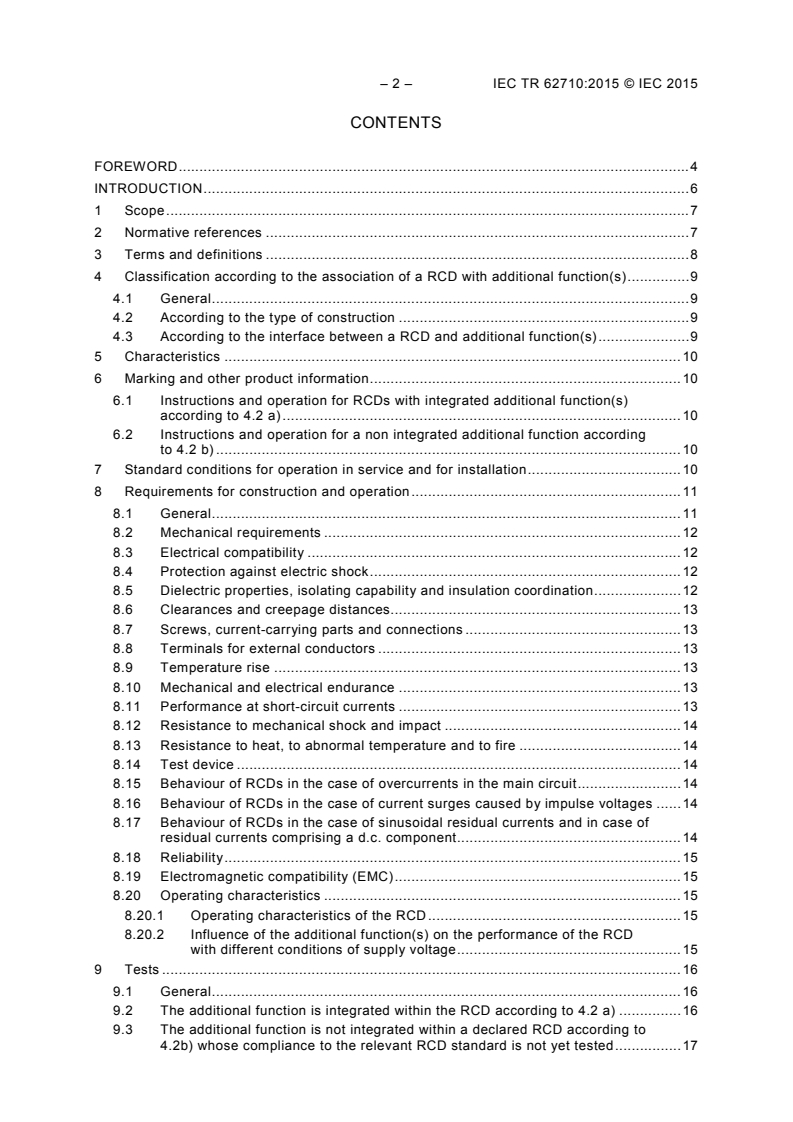
CONTENTS
FOREWORD . 4
INTRODUCTION . 6
1 Scope . 7
2 Normative references . 7
3 Terms and definitions . 8
4 Classification according to the association of a RCD with additional function(s) . 9
4.1 General . 9
4.2 According to the type of construction . 9
4.3 According to the interface between a RCD and additional function(s) . 9
5 Characteristics . 10
6 Marking and other product information . 10
6.1 Instructions and operation for RCDs with integrated additional function(s)
according to 4.2 a) . 10
6.2 Instructions and operation for a non integrated additional function according
to 4.2 b) . 10
7 Standard conditions for operation in service and for installation . 10
8 Requirements for construction and operation . 11
8.1 General . 11
8.2 Mechanical requirements . 12
8.3 Electrical compatibility . 12
8.4 Protection against electric shock . 12
8.5 Dielectric properties, isolating capability and insulation coordination . 12
8.6 Clearances and creepage distances. 13
8.7 Screws, current-carrying parts and connections . 13
8.8 Terminals for external conductors . 13
8.9 Temperature rise . 13
8.10 Mechanical and electrical endurance . 13
8.11 Performance at short-circuit currents . 13
8.12 Resistance to mechanical shock and impact . 14
8.13 Resistance to heat, to abnormal temperature and to fire . 14
8.14 Test device . 14
8.15 Behaviour of RCDs in the case of overcurrents in the main circuit . 14
8.16 Behaviour of RCDs in the case of current surges caused by impulse voltages . 14
8.17 Behaviour of RCDs in the case of sinusoidal residual currents and in case of
residual currents comprising a d.c. component . 14
8.18 Reliability . 15
8.19 Electromagnetic compatibility (EMC) . 15
8.20 Operating characteristics . 15
8.20.1 Operating characteristics of the RCD . 15
8.20.2 Influence of the additional function(s) on the performance of the RCD
with different conditions of supply voltage . 15
9 Tests . 16
9.1 General . 16
9.2 The additional function is integrated within the RCD according to 4.2 a) . 16
9.3 The additional function is not integrated within a declared RCD according to
4.2b) whose compliance to the relevant RCD standard is not yet tested . 17
9.4 The additional function is not integrated within a declared RCD according to
4.3 whose compliance to the relevant RCD standard is already tested . 17
9.5 Testing procedure . 17
9.5.1 General . 17
9.5.2 Impairment identification . 20
9.5.3 Impairment assessment . 21
9.5.4 Verification of the influence of the additional function(s) on the
performance of the RCD at different states of supply voltage . 23
9.6 Documentation . 24
Annex A (informative) Additional requirements and tests for RCDs consisting of a
RCD and a non integrated additional function unit designed for assembly on site . 25
A.1 General . 25
A.2 Scope . 25
A.3 Terms and definitions. 25
A.4 Marking and other product information . 25
A.4.1 Manufacturer's name or trademark . 25
A.4.2 Marking . 25
A.4.3 Instructions for assembly and operation . 26
A.5 Constructional requirements . 26
A.5.1 General . 26
A.5.2 Degree of protection . 26
A.5.3 Mechanical requirements . 26
A.5.4 Electrical compatibility . 27
A.6 Type tests and verifications . 27
A.6.1 Tests on RCDs . 27
A.6.2 Tests on non integrated additional function unit to be assembled on site . 27
A.6.3 Tests on assembled RCDs and non integrated additional function unit . 27
A.6.4 Verification of marking and constructional requirements . 27
Bibliography . 28
Table 1 – List of basic tests to be considered, according to the interface between
RCDs and additional function(s), during the assessment . 18
– 4 – IEC TR 62710:2015 © IEC 2015
INTERNATIONAL ELECTROTECHNICAL COMMISSION
____________
RESIDUAL CURRENT DEVICES (RCDs) ASSOCIATED
WITH ADDITIONAL FUNCTION(S)
FOREWORD
1) The International Electrotechnical Commission (IEC) is a worldwide organization for standardization comprising
all national electrotechnical committees (IEC National Committees). The object of IEC is to promote
international co-operation on all questions concerning standardization in the electrical and electronic fields. To
this end and in addition to other activities, IEC publishes International Standards, Technical Specifications,
Technical Reports, Publicly Available Specifications (PAS) and Guides (hereafter referred to as “IEC
Publication(s)”). Their preparation is entrusted to technical committees; any IEC National Committee interested
in the subject dealt with may participate in this preparatory work. International, governmental and non-
governmental organizations liaising with the IEC also participate in this preparation. IEC collaborates closely
with the International Organization for Standardization (ISO) in accordance with conditions determined by
agreement between the two organizations.
2) The formal decisions or agreements of IEC on technical matters express, as nearly as possible, an international
consensus of opinion on the relevant subjects since each technical committee has representation from all
interested IEC National Committees.
3) IEC Publications have the form of recommendations for international use and are accepted by IEC National
Committees in that sense. While all reasonable efforts are made to ensure that the technical content of IEC
Publications is accurate, IEC cannot be held responsible for the way in which they are used or for any
misinterpretation by any end user.
4) In order to promote international uniformity, IEC National Committees undertake to apply IEC Publications
transparently to the maximum extent possible in their national and regional publications. Any divergence
between any IEC Publication and the corresponding national or regional publication shall be clearly indicated in
the latter.
5) IEC itself does not provide any attestation of conformity. Independent certification bodies provide conformity
assessment services and, in some areas, access to IEC marks of conformity. IEC is not responsible for any
services carried out by independent certification bodies.
6) All users should ensure that they have the latest edition of this publication.
7) No liability shall attach to IEC or its directors, employees, servants or agents including individual experts and
members of its technical committees and IEC National Committees for any personal injury, property damage or
other damage of any nature whatsoever, whether direct or indirect, or for costs (including legal fees) and
expenses arising out of the publication, use of, or reliance upon, this IEC Publication or any other IEC
Publications.
8) Attention is drawn to the Normative references cited in this publication. Use of the referenced publications is
indispensable for the correct application of this publication.
9) Attention is drawn to the possibility that some of the elements of this IEC Publication may be the subject of
patent rights. IEC shall not be held responsible for identifying any or all such patent rights.
The main task of IEC technical committees is to prepare International Standards. However, a
technical committee may propose the publication of a technical report when it has collected
data of a different kind from that which is normally published as an International Standard, for
example "state of the art".
IEC TR 62710, which is a Technical Report, has been prepared by subcommittee 23E: Circuit-
breakers and similar equipment for household use, of IEC technical committee 23: Electrical
accessories.
The text of this standard is based on the following documents:
Enquiry draft Report on voting
23E/875/DTR 23E/900/RVC
Full information on the voting for the approval of this technical report can be found in the
report on voting indicated in the above table.
This publication has been drafted in accordance with the ISO/IEC Directives, Part 2.
In this Technical Report, the following print types are used:
– compliance statements: in italic type
The committee has decided that the contents of this publication will remain unchanged until
the stability date indicated on the IEC website under "http://webstore.iec.ch" in the data
related to the specific publication. At this date, the publication will be
• reconfirmed,
• withdrawn,
• replaced by a revised edition, or
• amended.
A bilingual version of this publication may be issued at a later date.
– 6 – IEC TR 62710:2015 © IEC 2015
INTRODUCTION
This Technical Report (TR) introduces information allowing manufacturers to introduce
additional function(s) associated with Residual current devices (RCD). This TR is also
relevant for technical committees in charge of drafting an International Standard for additional
function(s); for this purpose, requirements and tests have been introduced. It would also be of
benefit to laboratories having difficulties in testing RCDs associated with an additional
function. This TR does not cover the additional function(s) itself (this is the purpose of an
International Standard covering the additional function(s)), nor the RCD function and
characteristics (this is the purpose of an RCD International Standard). It is limited to checking
that the additional function(s) do not impair any function of the RCD in case there is no
International Standard for the additional function(s) for household and similar uses. Where
there is a relevant International Standard for household and similar uses for the additional
function(s), then it is used. This means that the assembly of the RCD plus the additional
function(s) behave correctly according to the referred standards.
This Technical Report is drafted according to the following basic principles:
– In order not to restrict innovation, it is drafted independently of the additional function(s)
and is thus applicable whatever the additional function(s) are.
NOTE It is not possible to list all possible existing and future additional function(s); some examples are given
within the definitions.
– The verification is only limited to the assembly and association of an RCD with one or
several additional function(s), being integrated or not.
– The verification aims to show that the assembly of one or several additional function(s)
declared suitable to a specific protective device is safe and does not impair the basic
characteristics of the RCD.
– Responsibility for the assembly means that the additional function(s) and the RCD are
intended to be from the same manufacturer or to be affixed with the same trademark. As a
consequence, it is intended that the manufacturer or trademark owner declare with which
protective devices the additional function(s) can be associated.
RESIDUAL CURRENT DEVICES (RCDs) ASSOCIATED
WITH ADDITIONAL FUNCTION(S)
1 Scope
This Technical Report (TR) provides information concerning the possible use of:
– dedicated additional function(s) declared by a manufacturer as suitable for an assembly
with declared RCDs complying with IEC standards for household and similar uses;
– specific RCDs complying with IEC standards for household and similar uses having
integrated additional function(s).
NOTE 1 The term RCD is a generic term applied to a family of products which open automatically in response to a
residual current at or exceeding the RCD’s rated residual operating current I . This generic term is often applied
∆n
to the following:
– RCCB: Residual current operated circuit-breaker without integral overcurrent protection;
– RCBO: Residual current operated circuit-breaker with integral overcurrent protection;
– SRCD: Residual current device with or without overcurrent protection for socket-outlets;
– PRCD: Portable residual current device without integral overcurrent protection.
This TR identifies the applicable testing procedure to determine the effect on the normal
functioning of specific RCD(s) declared suitable with one or more additional function(s)
integrated into or added to or assembled with this specific RCD.
This TR may also be used to draft additional requirements to standards for additional
function(s) intended to be combined with RCDs for household and similar applications.
This TR provides a procedure based on an assessment in order to identify the necessary
testing to demonstrate compliance with the appropriate requirements. If the assessment of the
additional function integrated in the RCDs concludes that the additional function does not
impair the RCD, no additional test is required by this TR.
Where more than one additional function(s) can be simultaneously associated with one or
several RCD(s), the possible combinations is checked by considering the most severe ones.
This TR does not apply:
– to additional functions covered by a standard which explicitly addresses the combination
with RCDs for household and similar applications;
NOTE 2 Example of an additional device with independent product standard is auxiliary contacts according to
IEC 62019.
– to additional function(s) associated with RCDs for connection purposes;
NOTE 3 Examples of additional function(s) for connection purposes are connection devices between RCBOs
and a circuit breakers.
– to locking devices.
2 Normative references
The following documents, in whole or in part, are normatively referenced in this document and
are indispensable for its application. For dated references, only the edition cited applies. For
undated references, the latest edition of the referenced document (including any
amendments) applies.
– 8 – IEC TR 62710:2015 © IEC 2015
IEC TR 60755, General requirements for residual current operated protective devices
IEC 60898 (all parts), Electrical accessories – Circuit-breakers for overcurrent protection for
household and similar installations
IEC 61008 (all parts), Residual current operated circuit-breakers without integral overcurrent
protection for household and similar uses (RCCBs)
IEC 61009 (all parts), Residual current operated circuit-breakers with integral overcurrent
protection for household and similar uses (RCBOs)
IEC 62423, Type F and type B residual current operated circuit-breakers with and without
integral overcurrent protection for household and similar uses
3 Terms and definitions
For the purposes of this document, the terms and definitions given in IEC 60755, IEC 60898,
IEC 61008, IEC 61009 and IEC 62423, as well as the following apply.
3.1
additional function
feature, action, capability, or the like integrated or assembled with a declared RCD, and not
required by the basic product standard
Note 1 to entry: The additional function(s) can have a mechanical and/or electrical interface with one or more
parts of the RCD.
Note 2 to entry: Examples of additional function(s) are: automatic reclosing devices, protection against too high or
too low voltage, remote-controlled mechanism, remote-controlled tripping, telemonitoring, undervoltage release,
shunt release, residual current indicator, lifetime monitoring, installation monitoring, thermal monitoring, self
monitoring and test, data communication, smoke detector as well as any combinations of these devices, etc.
3.1.1
integrated additional function
additional function completely built into the RCD
3.1.2
non integrated additional function
external additional function such as a module which can subsequently be built-in on site or
can be added on by the manufacturer
Note 1 to entry: The additional function(s) may influence the RCD via interfaces.
Note 2 to entry: After assembly of the external additional function(s) with the RCD, the device becomes a
constructional unit.
3.2
RCD
residual current device
mechanical switching device designed to make, carry and break currents under normal
service conditions and to cause the opening of the contacts when the residual current attains
a given value under specified conditions
Note 1 to entry: RCDs are covered by an applicable RCD product standard and are used as a protective device
against electric shock.
[SOURCE: IEC 60050-442:1998, 442-05-02, modified – The note has been modified.]
3.3
impair
impact on the operating characteristics of an RCD that results in the lack of compliance with
the applicable RCD requirements
3.4
impairment
any effect caused by an additional function that takes the operating characteristics outside the
limits specified in the relevant RCD product standard
3.5
exploratory testing
analysis and/or relevant testing performed on the assembly of
- an additional function and a RCD declared to be assembled with the additional function(s)
according to the manufacturer instructions, or
- a RCD with integrated additional function(s),
with the objective of determining whether the additional function(s) impair the correct
operation of the RCD.
3.6
residual current tripping circuit
any electrical part of the RCD allowing the RCD to trip due to residual fault current
3.7
operating means
part of a RCD which allows operation of the mechanism by manual means
EXAMPLE Rocker or rotary handle.
4 Classification according to the association of a RCD with additional
function(s)
4.1 General
Additional functions are classified in the following way.
4.2 According to the type of construction
Additional functions are classified according to the type of construction:
a) RCDs with integrated additional function(s);
b) RCDs with non integrated additional function(s);
4.3 According to the interface between a RCD and additional function(s)
Additional functions are classified according to the type of interface:
a) interface via the operating means,
b) interface via the mechanism of the RCD,
EXAMPLE Latching mechanism, operating shaft.
c) interface via the circuit of the test device,
d) interface via the residual current tripping circuit,
EXAMPLE Summation current transformer with additional winding, tripping relay, protective circuit of the
tripping relay or of the secondary circuit of the summation current transformer.
e) interface via the main circuit / main contacts / main terminals,
– 10 – IEC TR 62710:2015 © IEC 2015
f) interface via a combination of more than one interface.
5 Characteristics
The characteristics of the RCD are given in the relevant RCD standard.
The characteristics of the additional function(s) are given in the relevant standard, if any.
6 Marking and other product information
6.1 Instructions and operation for RCDs with integrated additional function(s)
according to 4.2 a)
Where the manufacturer has integrated the additional function(s) within the RCD, the RCD
shall be marked with the symbol (IEC 60417-6291) and the manufacturer shall provide
adequate instructions and information in a leaflet or data sheet.
These instructions shall cover at least the following:
– detailed description and explanation about the use and objective of the additional
function(s);
– derating factor(s), if any;
– instructions for wiring and installation of the RCD integrating the additional function(s) in
normal use;
– instructions for correct use of the additional function(s).
6.2 Instructions and operation for a non integrated additional function according to
4.2 b)
Where the additional function is not integrated within the RCD, the manufacturer shall provide
adequate instructions and information in a leaflet or data sheet. These instructions shall cover
at least the following:
– detailed description and explanation about the use and objective of the additional
function(s);
– reference to the type(s) and catalogue number(s), covering current and voltage ratings,
etc. of the declared RCD;
– derating factor(s), if any;
– method of assembly with the declared RCD(s);
– instruction for wiring and installation for normal use;
– method for checking operation after assembly to verify the mechanical operation of the
RCD by mechanical means and using the test device;
– instructions for correct use of the additional function(s).
The non-integrated additional function(s) and the RCD shall be from the same manufacturer
or be affixed with the same trademark.
7 Standard conditions for operation in service and for installation
The additional function(s) associated with a RCD shall be capable of operating under the
standard conditions for operation in service and for installation of the RCD standard with
which it is declared to be associated (IEC 61008-1 or IEC 61009-1 or IEC 61540 or IEC 62335
or IEC 62423 or IEC 62640 as applicable).
Where an additional function is declared to be associated with several RCDs, the standard
conditions of the most severe standard shall apply to the additional function.
8 Requirements for construction and operation
8.1 General
The additional function(s) assembled with a RCD shall be so designed and constructed that,
in normal use, the performance is safe and reliable to the user and the environment.
For assessment of necessary tests, it shall be verified which requirements provided within the
relevant RCD standard can be impaired by the additional function(s). The procedure for
identifying the necessary testing is given in Clause 9.
Measurement of all operating levels, values or parameters of the RCD shall comply with the
acceptance criteria of the relevant RCD product standard.
Annex A applies to the non-integrated additional function(s) unit designed for assembly on
site.
The additional function(s) shall be designed so that:
a) the RCD shall not be prevented from manual switching ON or OFF by the additional
function(s) under normal conditions;
This condition is considered as fulfilled if the manual opening of the RCD is not possible
without disabling the additional function(s) by means of manual operation
b) if the additional function is a reclosing device, it shall be provided with means to disable
this function;
c) a fault or a failure affecting the normal use of the additional function(s) shall not result in a
non-compliance of the basic requirements for the RCD function. If a fault or failure of an
additional function will result in non-compliance of the requirements of the RCD function,
the occurrence of a fault or failure of the additional function shall cause the RCD to switch
OFF;
d) it shall not be possible to energize the circuit on the load side of the RCD by operating the
additional function(s) when the RCD is manually switched OFF and connected as in
normal use (the isolation function of the RCD shall not be impaired by the additional
function(s)), unless the additional function is intended to reclose the RCD;
e) for additional function(s) according to 4.3 e), for example interface to the main contacts,
which may create specific contacts positions, it shall not be possible to alter the isolation
capability of the protective device, whatever the status of the additional function(s). In
case of the latter the RCD or the additional function(s) shall have a provision to lock the
RCD in the open position.
A deliberate residual current to earth shall not be used to trip the RCD. This requirement is
considered satisfied if:
– no fault is introduced into the installation that causes the RCD to function as a
disconnector;
– the protective conductor of the installation does not become live when the additional
function is operated. A standing current in the PE up to the limit of 1 mA is accepted with a
touch voltage limited not exceeding dangerous levels according to the IEC 60364 and
IEC 60479 series;
The degree of protection of the additional function(s) associated with a RCD shall not be less
than the degree of protection of the RCD(s) with which it is declared to be associated.
Compliance is checked by the testing procedure of Clause 9.
– 12 – IEC TR 62710:2015 © IEC 2015
8.2 Mechanical requirements
The manufacturer shall declare the effect(s) of the additional function(s) on the basic RCD
function.
The additional function(s) and the RCD shall readily fit together in the correct manner and the
design shall be such that it prevents incorrect assembly.
Parts to be coupled with the tripping mechanism shall be securely fixed after mounting and
shall not become loose.
Fixing means for assembly, if any, shall be captive except for terminal covers.
Compliance is checked by the testing procedure of Clause 9.
8.3 Electrical compatibility
Additional function(s) shall withstand the rated current and the prospective short circuit
currents to which they may be subjected.
Additional function(s) intended to be connected in series with a RCD shall withstand the rated
current of the RCD and the same short circuit currents as the RCD.
Terminals for additional function(s) not intended to carry the rated current of the RCD shall be
suitably rated for the range of conductors specified in the manufacturer’s instruction for the
additional function(s).
Compliance is checked by the testing procedure of Clause 9.
8.4 Protection against electric shock
Protection against electric shock shall not be impaired when the additional function is
integrated in or assembled with the RCD and mounted and wired in accordance with
manufacturer’s instructions.
Live parts of the additional function(s) assembled in the RCD shall not be accessible in
normal use and all requirements applicable to the RCD part before assembly are applicable to
the whole product, including the additional function(s) and the RCD, after assembly or
incorporation.
NOTE A part is considered to be "accessible" if it can be touched by the standard test finger.
Once assembled, no parts shall be likely to come loose without intentional action by a user or
technician.
Compliance is checked by the testing procedure of Clause 9.
8.5 Dielectric properties, isolating capability and insulation coordination
The overvoltage category of an additional function associated with a RCD shall not be less
than the overvoltage category of the RCD(s) with which it is declared to be associated.
The additional function(s) shall not impair the dielectric properties and the isolation capability
of the RCD with which it is associated or in which it is incorporated. This condition is
considered as fulfilled if the manual opening of the RCD is not possible without disabling the
additional function(s) by means of a manual operation.
Compliance is checked by the testing procedure of Clause 9.
8.6 Clearances and creepage distances
The clearances and creepage distances of an additional function associated with a RCD
according to classification 4.2 or 4.3 shall not be less than the required clearances and
creepage distances of the RCD(s) with which it is declared to be associated.
Compliance is checked by the testing procedure of Clause 9.
8.7 Screws, current-carrying parts and connections
Connections of the additional function(s), whether electrical or mechanical, shall withstand the
mechanical stresses occurring to the declared associated RCD(s) in normal use. In case of an
additional function able to be assembled with several RCDs, the requirements of the most
severe RCD standard shall apply.
Compliance is checked by the testing procedure of Clause 9.
8.8 Terminals for external conductors
The RCD terminals for external conductors, once assembled with the additional function(s),
shall be such that the conductors may be connected in the same conditions and with the same
requirements as the declared associated RCD(s).
Compliance is checked by the testing procedure of Clause 9.
8.9 Temperature rise
The temperature rise of a RCD with an additional function shall not exceed the values
specified in the standard for the RCD when measured according to the conditions specified in
the RCD standard while taking into account the limits of this TR.
The RCD shall not suffer damage impairing its functions and its safe use when assembled or
incorporated with an additional function.
Compliance is checked by the testing procedure of Clause 9.
8.10 Mechanical and electrical endurance
RCDs' mechanical and electrical endurance shall not be impaired by the additional function(s)
and shall be capable of performing the required number of mechanical and electrical
operations specified within the relevant standard.
Where the mechanism and/or the poles are used for reasons other than closing/opening the
RCD poles for safety reasons, a more severe testing procedure can be considered, for
example a higher number of operations than that specified in the applicable RCD standard.
NOTE The electrical or mechanical endurance of RCDs might be severely impaired if additional function(s) of any
type would use RCDs for reasons or functions different than those for which the RCD was designed.
Additional function(s) having a lower electrical or mechanical endurance may be used. The
test of the combination is then performed with that lower number of operations.
Compliance is checked by the testing procedure of Clause 9.
8.11 Performance at short-circuit currents
RCDs' performance during short-circuit currents shall not be impaired by the additional
function(s) and the RCDs shall be able to perform the specified number of short-circuit
operations during which they shall neither endanger the operator nor initiate a flashover
– 14 – IEC TR 62710:2015 © IEC 2015
between live conductive parts or between live conductive parts and earth as specified in the
relevant standard.
Compliance is checked by the testing procedure of Clause 9.
8.12 Resistance to mechanical shock and impact
RCDs' resistance to mechanical shock and impact shall not be impaired by the additional
function(s) and shall show adequate mechanical behaviour so as to withstand the stresses
imposed during installation and use as specified in the relevant standard.
Compliance is checked by the testing procedure of Clause 9.
8.13 Resistance to heat, to abnormal temperature and to fire
The resistance to heat of the RCD, to abnormal temperature and to fire shall not be impaired
by the additional function(s) and shall show adequate resistance as specified in the relevant
standard.
Compliance is checked by the testing procedure of Clause 9.
8.14 Test device
The RCD test device shall not be impaired by the additional function(s) and shall show
adequate performance according to the relevant standard.
The additional function(s) cannot replace the test device.
Any button of an integrated additional function (classified according to 4.2) shall be separated
from the RCD test button and clearly identified, the use of the letter T not being allowed.
Compliance is checked by the testing procedure of Clause 9.
8.15 Behaviour of RCDs in the case of overcurrents in the main circuit
Integration or assembly of an additional function with a RCD shall not impair the normal
operation of the RCD under specified conditions of overcurrent.
Compliance is checked by the testing procedure of Clause 9.
8.16 Behaviour of RCDs in the case of current surges caused by impulse voltages
The ability of RCDs to withstand current surges to earth due to the loading of the
capacitances of the installation and the current surges to earth due to flashover in the
installation, as required within the relevant RCD standard, shall not be impaired by the
additional function(s).
Compliance is checked by the testing procedure of Clause 9.
8.17 Behaviour of RCDs in the case of sinusoidal residual currents and in case of
residual currents comprising a d.c. component
The ability of RCDs to perform in the presence of sinusoidal residual fault currents and in
case of residual fault currents comprising a d.c. component in accordance with their
classification, as required in the relevant RCD standard, shall not be impaired by the
additional function(s).
Compliance is checked by the testing procedure of Clause 9.
8.18 Reliability
The ability of RCDs to operate reliably even after long service, taking into account the ageing
of their components as required in the relevant RCD standard, shall not be impaired by the
additional function(s).
Compliance is checked by the testing procedure of Clause 9.
8.19 Electromagnetic compatibility (EMC)
The compliance of RCDs with the EMC requirements of the relevant RCD standard shall not
be impaired by the additional function(s).
Compliance is checked by the testing procedure of Clause 9.
8.20 Operating characteristics
8.20.1 Operating characteristics of the RCD
The additional function(s) shall not impair the operating characteristics of the declared
RCD(s).
Compliance is checked by the testing procedure of Clause 9.
8.20.2 Influence of the additional function(s) on the performance of the RCD with
different conditions of supply voltage
The switching status of the RCD shall not be changed unintentionally by the additional
function(s) independent from the status of the supply voltage. For that purpose a mechanical
or electrical locking device may be used.
The following cases shall be considered.
Case 1: The RCD is in the ON position and the supply voltage is available as for normal use.
After the RCD is manually switched OFF, the RCD shall not be switched ON again due to an
action of the additional function(s) unless switching ON of the RCD is the purpose of the
additional function(s), for example automatic reclosing device.
Case 2: The RCD is in the ON position and the supply voltage is available as for normal use.
After tripping of the RCD due to a residual current, the RCD shall not switch ON again due to
the additional function(s) unless switching ON of the RCD is the purpose of the additional
function(s), for example automatic reclosing device. In case of the latter and to have the
possibility to avoid an automatic reclosing, the RCD or the additional function(s) shall have a
provision to lock the OFF position.
Case 3: Supply voltage on the RCD is not available. The additional function(s) has a separate
supply voltage. After the RCD is manually switched OFF, the RCD shall not be switched ON
again due to an action of the additional function(s).
Case 4: The RCD is in the ON position and the supply voltage is not available. When the
supply voltage is switched ON, for example after a supply failure, the RCD shall not be
switched OFF unintentionally.
Case 5: The RCD is switched OFF by the manual operating means and the supply voltage is
not available. When the supply voltage is switched ON, for example after a supply failure, the
RCD shall not close unintentionally.
– 16 – IEC TR 62710:2015 © IEC 2015
Case 6: The supply voltage is available as for normal use and the RCD is in the ON position.
When the supply voltage is switched OFF, the additional function shall not switch OFF the
RCD unless it is the purpose of the additional function(s), for example undervoltage release.
This requirement does not apply to RCDs according to classification 4.1.2 of
IEC 61008-1:2010 and 61009-1:2010.
Case 7: The supply voltage is available as for normal use and the RCD is in the OFF position.
When the supply voltage is switched OFF, the RCD shall not be switched ON again due to an
action of the additional function(s).
Compliance for these different cases is checked by the tests of Clause
...
Questions, Comments and Discussion
Ask us and Technical Secretary will try to provide an answer. You can facilitate discussion about the standard in here.
Loading comments...