

IEC 61588:2009
(Main)Precision clock synchronization protocol for networked measurement and control systems
General Information
- Abstract
IEC 61588:2009(E) defines a protocol enabling precise synchronization of clocks in measurement and control systems implemented with technologies such as network communication, local computing, and distributed objects. The protocol is applicable to systems communicating by local area networks supporting multicast messaging including, but not limited to, Ethernet. The protocol enables heterogeneous systems that include clocks of various inherent precision, resolution, and stability to synchronize to a grandmaster clock. The protocol supports system-wide synchronization accuracy in the sub-microsecond range with minimal network and local clock computing resources. The default behavior of the protocol allows simple systems to be installed and operated without requiring the administrative attention of users. The standard includes mappings to User Datagram Protocol (UDP)/Internet Protocol (IP), DeviceNet, and a layer-2 Ethernet implementation. It includes formal mechanisms for message extensions, higher sampling rates, correction for asymmetry, a clock type to reduce error accumulation in large topologies, and specifications on how to incorporate the resulting additional data into the synchronization protocol. This second edition cancels and replaces the first edition published in 2004. It constitutes a technical revision.
- Status
- Published
- Publication Date
- 26-Feb-2009
- Technical Committee
- SC 65C - Industrial networks
- Current Stage
- DELPUB - Deleted Publication
- Start Date
- 08-Jun-2021
- Completion Date
- 28-Aug-2026

Overview
IEC 61588:2009 (equivalent to IEEE 1588:2008) defines the Precision Time Protocol (PTP) - a standard protocol for precision clock synchronization in networked measurement and control systems. The standard specifies how heterogeneous devices with different clock precision, resolution, and stability can synchronize to a grandmaster clock over local area networks (LANs) that support multicast messaging (including Ethernet). IEC 61588 targets system-wide synchronization accuracy in the sub‑microsecond range while keeping network and host processing overhead low. This second edition (2009) updates and replaces the 2004 edition.
Key topics and technical requirements
- PTP architecture and device types: Defines ordinary clocks, boundary clocks, transparent clocks and grandmaster behavior to manage time distribution and error accumulation.
- Message types and formats: Formal specifications for Announce, Sync, Follow_Up, Delay_Req, Delay_Resp, Pdelay (peer delay) messages, plus management and signaling messages.
- Transport mappings: Normative mappings for UDP/IP, IPv6, IEEE 802.3 (Ethernet), DeviceNet, and ControlNet layer implementations.
- Accuracy mechanisms: Support for asymmetry correction, residence time correction, higher sampling rates, and a clock type to reduce error accumulation in large topologies.
- Extensibility and management: TLV (Type-Length-Value) extension mechanism, management messages, profiles, conformance rules, and optional features like unicast negotiation and path tracing.
- Operational ease: Default behavior designed for simple plug-and-play deployments requiring minimal administrative intervention.
- Conformance and profiles: Testable conformance clauses and profiling guidance for interoperable implementations.
Applications and who uses it
IEC 61588 / PTP is widely used where precise time alignment is critical:
- Industrial automation and distributed control systems
- Networked measurement, data acquisition and test laboratories
- Power systems and substation automation (time-tagged events)
- Telecommunications and media/broadcast synchronization
- Any LAN-based system needing sub‑microsecond alignment across heterogeneous devices
Users include device manufacturers (clocks, switches, NICs), control system integrators, network architects, test engineers and standards bodies specifying interoperable timing solutions.
Related standards and keywords
- Equivalent: IEEE 1588 (PTP)
- Transport mappings and profiles reference UDP/IP, Ethernet, DeviceNet
- SEO keywords: IEC 61588, IEEE 1588, Precision Time Protocol, PTP, grandmaster clock, sub-microsecond synchronization, boundary clock, transparent clock, asymmetry correction, timestamping, network time sync, industrial automation
IEC 61588 provides a practical, extensible framework for precise, low-overhead clock synchronization over common LAN technologies - enabling interoperable, time-coherent distributed measurement and control systems.
Relations
- Effective Date
- 10-Feb-2026
- Effective Date
- 10-Feb-2026
- Effective Date
- 10-Feb-2026
- Effective Date
- 10-Feb-2026
- Effective Date
- 10-Feb-2026
- Effective Date
- 10-Feb-2026
- Effective Date
- 10-Feb-2026
- Effective Date
- 10-Feb-2026
- Effective Date
- 10-Feb-2026
- Effective Date
- 10-Feb-2026
- Effective Date
- 10-Feb-2026
- Effective Date
- 10-Feb-2026
- Effective Date
- 10-Feb-2026
- Effective Date
- 10-Feb-2026
- Effective Date
- 10-Feb-2026
Get Certified
Connect with accredited certification bodies for this standard

BSI Group
BSI (British Standards Institution) is the business standards company that helps organizations make excellence a habit.

DVS-ZERT GmbH
German welding certification society.
CARES (UK Certification Authority for Reinforcing Steels)
UK certification for reinforcing steels and construction.
Sponsored listings
Frequently Asked Questions
IEC 61588:2009 is a standard published by the International Electrotechnical Commission (IEC). Its full title is "Precision clock synchronization protocol for networked measurement and control systems". This standard covers: IEC 61588:2009(E) defines a protocol enabling precise synchronization of clocks in measurement and control systems implemented with technologies such as network communication, local computing, and distributed objects. The protocol is applicable to systems communicating by local area networks supporting multicast messaging including, but not limited to, Ethernet. The protocol enables heterogeneous systems that include clocks of various inherent precision, resolution, and stability to synchronize to a grandmaster clock. The protocol supports system-wide synchronization accuracy in the sub-microsecond range with minimal network and local clock computing resources. The default behavior of the protocol allows simple systems to be installed and operated without requiring the administrative attention of users. The standard includes mappings to User Datagram Protocol (UDP)/Internet Protocol (IP), DeviceNet, and a layer-2 Ethernet implementation. It includes formal mechanisms for message extensions, higher sampling rates, correction for asymmetry, a clock type to reduce error accumulation in large topologies, and specifications on how to incorporate the resulting additional data into the synchronization protocol. This second edition cancels and replaces the first edition published in 2004. It constitutes a technical revision.
IEC 61588:2009(E) defines a protocol enabling precise synchronization of clocks in measurement and control systems implemented with technologies such as network communication, local computing, and distributed objects. The protocol is applicable to systems communicating by local area networks supporting multicast messaging including, but not limited to, Ethernet. The protocol enables heterogeneous systems that include clocks of various inherent precision, resolution, and stability to synchronize to a grandmaster clock. The protocol supports system-wide synchronization accuracy in the sub-microsecond range with minimal network and local clock computing resources. The default behavior of the protocol allows simple systems to be installed and operated without requiring the administrative attention of users. The standard includes mappings to User Datagram Protocol (UDP)/Internet Protocol (IP), DeviceNet, and a layer-2 Ethernet implementation. It includes formal mechanisms for message extensions, higher sampling rates, correction for asymmetry, a clock type to reduce error accumulation in large topologies, and specifications on how to incorporate the resulting additional data into the synchronization protocol. This second edition cancels and replaces the first edition published in 2004. It constitutes a technical revision.
IEC 61588:2009 is classified under the following ICS (International Classification for Standards) categories: 25.040.40 - Industrial process measurement and control; 31.200 - Integrated circuits. Microelectronics; 35.110 - Networking; 35.240.50 - IT applications in industry. The ICS classification helps identify the subject area and facilitates finding related standards.
IEC 61588:2009 has the following relationships with other standards: It is inter standard links to EN 62439-3:2012, EN 61158-6-2:2014, EN IEC 61158-4-12:2019, EN IEC 61158-5-2:2019, EN 61158-4-12:2014, EN 61158-4-22:2012, EN 61158-6-10:2014, EN 61784-2:2014, EN IEC 61158-4-2:2023, EN 61158-4-12:2012, EN IEC 61158-6-2:2019, EN 61158-4-13:2014, EN IEC 61158-4-2:2019, EN 61158-5-2:2012, EN IEC 62439-3:2018. Understanding these relationships helps ensure you are using the most current and applicable version of the standard.
IEC 61588:2009 is available in PDF format for immediate download after purchase. The document can be added to your cart and obtained through the secure checkout process. Digital delivery ensures instant access to the complete standard document.
Standards Content (Sample)
IEC 61588
Edition 2.0 2009-02
™
IEEE 1588
INTERNATIONAL
STANDARD
Precision clock synchronization protocol for networked measurement and
control systems
All rights reserved. IEEE is a registered trademark in the U.S. Patent & Trademark Office, owned by the Institute of
Electrical and Electronics Engineers, Inc.
Unless otherwise specified, no part of this publication may be reproduced or utilized in any form or by any means,
electronic or mechanical, including photocopying and microfilm, without permission in writing from the IEC Central Office.
Any questions about IEEE copyright should be addressed to the IEEE. Enquiries about obtaining additional rights
to this publication and other information requests should be addressed to the IEC or your local IEC member National
Committee.
IEC Central Office The Institute of Electrical and Electronics Engineers, Inc
3, rue de Varembé 3 Park Avenue
CH-1211 Geneva 20 US-New York, NY10016-5997
Switzerland USA
Email: inmail@iec.ch Email: stds-info@ieee.org
Web: www.iec.ch Web: www.ieee.org
About the IEC
The International Electrotechnical Commission (IEC) is the leading global organization that prepares and publishes
International Standards for all electrical, electronic and related technologies.
About IEC publications
The technical content of IEC publications is kept under constant review by the IEC. Please make sure that you have the
latest edition, a corrigenda or an amendment might have been published.
ƒ Catalogue of IEC publications: www.iec.ch/searchpub
The IEC on-line Catalogue enables you to search by a variety of criteria (reference number, text, technical committee,…).
It also gives information on projects, withdrawn and replaced publications.
ƒ IEC Just Published: www.iec.ch/online_news/justpub
Stay up to date on all new IEC publications. Just Published details twice a month all new publications released. Available
on-line and also by email.
ƒ Electropedia: www.electropedia.org
The world's leading online dictionary of electronic and electrical terms containing more than 20 000 terms and definitions
in English and French, with equivalent terms in additional languages. Also known as the International Electrotechnical
Vocabulary online.
ƒ Customer Service Centre: www.iec.ch/webstore/custserv
If you wish to give us your feedback on this publication or need further assistance, please visit the Customer Service
Centre FAQ or contact us:
Email: csc@iec.ch
Tel.: +41 22 919 02 11
IEC 61588
Edition 2.0 2009-02
IEEE 1588™
INTERNATIONAL
STANDARD
Precision clock synchronization protocol for networked measurement and
control systems
INTERNATIONAL
ELECTROTECHNICAL
COMMISSION
PRICE CODE
XH
ICS 25.040.40; 35.110; 35.240.50 ISBN 978-2-88910-546-5
– i – IEC 61588:2009(E)
IEEE 1588-2008(E)
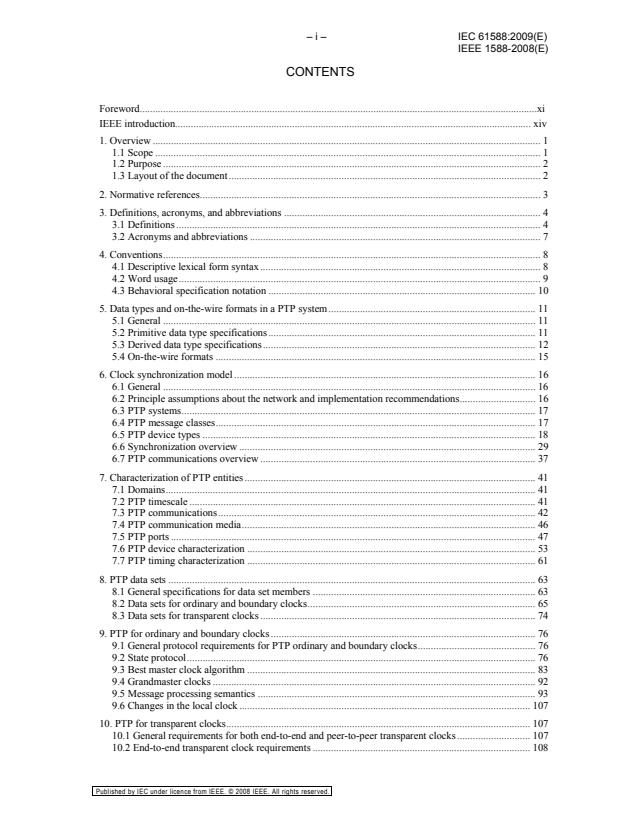
CONTENTS
Foreword.xi
IEEE introduction. xiv
1. Overview . 1
1.1 Scope . 1
1.2 Purpose . 2
1.3 Layout of the document. 2
2. Normative references. 3
3. Definitions, acronyms, and abbreviations . 4
3.1 Definitions . 4
3.2 Acronyms and abbreviations . 7
4. Conventions. 8
4.1 Descriptive lexical form syntax . 8
4.2 Word usage. 9
4.3 Behavioral specification notation . 10
5. Data types and on-the-wire formats in a PTP system. 11
5.1 General . 11
5.2 Primitive data type specifications. 11
5.3 Derived data type specifications. 12
5.4 On-the-wire formats . 15
6. Clock synchronization model . 16
6.1 General . 16
6.2 Principle assumptions about the network and implementation recommendations. 16
6.3 PTP systems. 17
6.4 PTP message classes. 17
6.5 PTP device types . 18
6.6 Synchronization overview . 29
6.7 PTP communications overview . 37
7. Characterization of PTP entities . 41
7.1 Domains. 41
7.2 PTP timescale . 41
7.3 PTP communications. 42
7.4 PTP communication media. 46
7.5 PTP ports . 47
7.6 PTP device characterization . 53
7.7 PTP timing characterization . 61
8. PTP data sets . 63
8.1 General specifications for data set members . 63
8.2 Data sets for ordinary and boundary clocks. 65
8.3 Data sets for transparent clocks . 74
9. PTP for ordinary and boundary clocks . 76
9.1 General protocol requirements for PTP ordinary and boundary clocks. 76
9.2 State protocol. 76
9.3 Best master clock algorithm . 83
9.4 Grandmaster clocks . 92
9.5 Message processing semantics . 93
9.6 Changes in the local clock . 107
10. PTP for transparent clocks. 107
10.1 General requirements for both end-to-end and peer-to-peer transparent clocks . 107
10.2 End-to-end transparent clock requirements . 108
Published by IEC under licence from IEEE. © 2008 IEEE. All rights reserved.
IEEE 1588-2008(E)
10.3 Peer-to-peer transparent clock requirements. 108
11. Clock offset, path delay, residence time, and asymmetry corrections. 108
11.1 General specifications. 108
11.2 Computation of clock offset in ordinary and boundary clocks. 109
11.3 Delay request-response mechanism. 110
11.4 Peer delay mechanism . 112
11.5 Transparent clock residence time correction for PTP version 2 events . 117
11.6 Asymmetry correction for PTP version 2 event messages. 120
12. Synchronization and syntonization of clocks . 122
12.1 Syntonization. 122
12.2 Synchronization. 123
13. PTP message formats . 124
13.1 General . 124
13.2 General message format requirements. 124
13.3 Header. 124
13.4 Suffix . 128
13.5 Announce message . 128
13.6 Sync and Delay_Req messages. 130
13.7 Follow_Up message . 130
13.8 Delay_Resp message . 130
13.9 Pdelay_Req message . 131
13.10 Pdelay_Resp message. 131
13.11 Pdelay_Resp_Follow_Up message. 132
13.12 Signaling message . 132
13.13 Management message. 133
14. TLV entity specifications . 133
14.1 General requirements. 133
14.2 Experimental TLVs . 134
14.3 Vendor and standard organization extension TLVs. 135
15. Management . 135
15.1 General . 135
15.2 PTP management mechanism. 136
15.3 Processing of management messages . 136
15.4 Management message format . 137
15.5 Management TLVs. 138
16. General optional features. 158
16.1 Unicast message negotiation (optional). 158
16.2 Path trace (optional). 163
16.3 Alternate timescales (optional) . 165
17. State configuration options. 169
17.1 General . 169
17.2 Data types for options. 169
17.3 Grandmaster clusters (optional). 170
17.4 Alternate master (optional) . 172
17.5 Unicast discovery (optional). 173
17.6 Acceptable master table (optional) . 175
18. Compatibility requirements . 177
18.1 Compatibility between version 2 and future versions. 177
18.2 Compatibility between version 1 and version 2. 177
18.3 Message formats and data types . 178
18.4 Naming changes . 183
18.5 Restrictions on mixed version 1 and version 2 systems. 183
Published by IEC under licence from IEEE. © 2008 IEEE. All rights reserved.
– ii –
– iii – IEC 61588:2009(E)
IEEE 1588-2008(E)
19. Conformance . 184
19.1 Conformance objective. 184
19.2 PTP conformance requirements. 184
19.3 PTP profiles . 185
Annex A (informative) Using PTP. 187
Annex B (informative) Timescales and epochs in PTP.197
Annex C (informative) Examples of residence and asymmetry corrections. 200
Annex D (normative) Transport of PTP over User Datagram Protocol over Internet Protocol Version 4 . 219
Annex E (normative) Transport of PTP over User Datagram Protocol over Internet Protocol Version 6. 221
Annex F (normative) Transport of PTP over IEEE 802.3 /Ethernet. 223
Annex G (normative) Transport of PTP over DeviceNET . 225
Annex H (normative) Transport of PTP over ControlNET . 228
Annex I (normative) Transport of PTP over IEC 61158 Type 10 . 230
Annex J (normative) Default PTP profiles . 237
Annex K (informative) Security protocol (experimental) .241
Annex L (informative) Transport of cumulative frequency scale factor offset (experimental). 264
Annex M (informative) Bibliography. 268
Annex N (informative) List of partcipants. 270
Published by IEC under licence from IEEE. © 2008 IEEE. All rights reserved.
IEEE 1588-2008(E)
TABLES
Table 1 ⎯Primitive PTP data types . 12
Table 2 ⎯domainNumber. 41
Table 3 ⎯networkProtocol enumeration . 46
Table 4 ⎯Non-EUI-64 addressTechnology enumeration . 51
Table 5 —clockClass specifications. 55
Table 6 —clockAccuracy enumeration . 56
Table 7 —timeSource enumeration. 57
Table 8 ⎯PTP state enumeration.73
Table 9 ⎯Delay mechanism enumeration . 74
Table 10 ⎯PTP portState definition .77
Table 11 ⎯Event applicability in boundary clocks. 83
Table 12 ⎯Information sources for data set comparison algorithm . 88
Table 13 ⎯Updates for state decision code M1 and M2 . 91
Table 14 ⎯Updates for state decision code M3. 91
Table 15 ⎯Updates for state decision code P1, and P2 . 91
Table 16 ⎯Updates for state decision code S1 . 92
Table 17 ⎯Source identity comparisons. 95
Table 18 ⎯Common message header. 124
Table 19 ⎯Values of messageType field. 125
Table 20 ⎯Values of flagField . 126
Table 21 ⎯correctionField semantics. 127
Table 22 ⎯References for sequenceId value exceptions . 127
Table 23 ⎯controlField enumeration. 128
Table 24 ⎯Values of logMessageInterval field. 128
Table 25 ⎯Announce message fields . 129
Table 26 ⎯Sync and Delay_Req message fields . 130
Table 27 ⎯Follow_Up message fields . 130
Table 28 ⎯Delay_Resp message fields . 130
Table 29 ⎯Pdelay_Req message fields . 131
Table 30 ⎯Pdelay_Resp message fields. 131
Table 31 ⎯Pdelay_Resp_Follow_Up message fields. 132
Table 32 ⎯Acceptance of signaling messages . 132
Table 33 ⎯Signaling message fields . 133
Published by IEC under licence from IEEE. © 2008 IEEE. All rights reserved.
– v – IEC 61588:2009(E)
IEEE 1588-2008(E)
Table 34 ⎯tlvType values . 134
Table 35 ⎯Organization specific TLV fields . 135
Table 36 ⎯Acceptance of management messages. 136
Table 37 ⎯Management message fields. 137
Table 38 ⎯Values of the actionField. 138
Table 39 ⎯Management TLV fields. 139
Table 40 ⎯managementId values . 140
Table 41 ⎯CLOCK_DESCRIPTION management TLV data field. 141
Table 42 ⎯clockType specification. 142
Table 43 ⎯USER_DESCRIPTION management TLV data field . 144
Table 44 ⎯INITIALIZE management TLV data field . 145
Table 45 ⎯INITIALIZATION_KEY enumeration . 145
Table 46 ⎯Fault log severityCode enumeration. 145
Table 47 ⎯FAULT_LOG management TLV data field . 146
Table 48 ⎯TIME management TLV data field . 147
Table 49 ⎯CLOCK_ACCURACY management TLV data field . 147
Table 50 ⎯DEFAULT_DATA_SET management TLV data field. 148
Table 51 ⎯PRIORITY1 management TLV data field. 148
Table 52 ⎯PRIORITY2 management TLV data field. 149
Table 53 ⎯DOMAIN management TLV data field. 149
Table 54 ⎯SLAVE_ONLY management TLV data field . 149
Table 55 ⎯CURRENT_DATA_SET management TLV data field . 149
Table 56 ⎯PARENT_DATA_SET management TLV data field . 150
Table 57 ⎯TIME_PROPERTIES_DATA_SET management TLV data field. 151
Table 58 ⎯UTC_PROPERTIES management TLV data field. 152
Table 59 ⎯TRACEABILITY_PROPERTIES management TLV data field. 152
Table 60 ⎯TIMESCALE_PROPERTIES management TLV data field . 152
Table 61 ⎯PORT_DATA_SET management TLV data field. 153
Table 62 ⎯LOG_ANNOUNCE_INTERVAL management TLV data field. 154
Table 63 ⎯ANNOUNCE_RECEIPT_TIMEOUT management TLV data field. 154
Table 64 ⎯LOG_SYNC_INTERVAL management TLV data field . 154
Table 65 ⎯DELAY_MECHANISM management TLV data field . 155
Table 66 ⎯LOG_MIN_PDELAY_REQ_INTERVAL management TLV data field. 155
Table 67 ⎯VERSION_NUMBER management TLV data field. 155
Table 68 ⎯TRANSPARENT_CLOCK_DEFAULT_DATA_SET management TLV data field. 156
Published by IEC under licence from IEEE. © 2008 IEEE. All rights reserved.
IEEE 1588-2008(E)
Table 69 ⎯PRIMARY_DOMAIN management TLV data field. 156
Table 70 ⎯TRANSPARENT_CLOCK_PORT_DATA_SET management TLV data field. 157
Table 71 ⎯MANAGEMENT_ERROR_STATUS TLV format. 157
Table 72 ⎯managementErrorId enumeration. 158
Table 73 ⎯REQUEST_UNICAST_TRANSMISSION TLV format . 160
Table 74 ⎯GRANT_UNICAST_TRANSMISSION TLV format . 161
Table 75 ⎯CANCEL_UNICAST_TRANSMISSION TLV format . 161
Table 76 ⎯ACKNOWLEDGE_CANCEL_UNICAST_TRANSMISSION TLV format . 162
Table 77 ⎯UNICAST_NEGOTIATION_ENABLE management TLV data field . 162
Table 78 ⎯PATH_TRACE TLV format . 164
Table 79 ⎯PATH_TRACE_LIST management TLV data field . 164
Table 80 ⎯PATH_TRACE_ENABLE management TLV data field. 164
Table 81 ⎯ALTERNATE_TIME_OFFSET_INDICATOR TLV format . 166
Table 82 —ALTERNATE_TIME_OFFSET_ENABLE management TLV data field. 167
Table 83 —ALTERNATE_TIME_OFFSET_NAME management TLV data field. 167
Table 84 —ALTERNATE_TIME_OFFSET_MAX_KEY management TLV data field . 168
Table 85 —ALTERNATE_TIME_OFFSET_PROPERTIES management TLV data field . 168
Table 86 ⎯GRANDMASTER_CLUSTER_TABLE management TLV data field . 171
Table 87 ⎯Alternate master attributes. 173
Table 88 ⎯ALTERNATE_MASTER management TLV data field. 173
Table 89 ⎯UNICAST_MASTER_TABLE management TLV data field. 174
Table 90 ⎯UNICAST_MASTER_MAX_TABLE_SIZE management TLV data field . 175
Table 91 ⎯Operation of acceptable master table option . 176
Table 92 ⎯ACCEPTABLE_MASTER_TABLE management TLV data field. 176
Table 93 ⎯ACCEPTABLE_MASTER_MAX_TABLE_SIZE management TLV data field. 177
Table 94 ⎯ACCEPTABLE_MASTER_TABLE_ENABLED management TLV data field. 177
Table 95 ⎯Version 1 stratum to version 2 class. 178
Table 96 ⎯Version 2 clockClass to version 1 stratum . 178
Table 97 ⎯Version 1 to version 2 translation of grandmasterIsPreferred field. 179
Table 98 ⎯Version 2 to version 1 translation of the priority1 field . 179
Table 99 ⎯Version 1 clock identifier to version 2 clockAccuracy. 179
Table 100 ⎯Version 2 clockAccuracy to version 1 clock identifier. 179
Table 101 ⎯Version 1 to version 2 translation of grandmasterIsBoundaryClock field. 180
Table 102 ⎯Version 2 to version 1 translation of the priority2 field. 180
Table 103 ⎯Version 1 control field and version 2 messageType field mappings . 180
Table 104 ⎯Translation of flagField from version 1 to version 2 . 181
Published by IEC under licence from IEEE. © 2008 IEEE. All rights reserved.
– vii – IEC 61588:2009(E)
IEEE 1588-2008(E)
Table 105 ⎯Translation of flagField from version 2 to version 1 . 181
Table 106 ⎯Version 2 fields with no version 1 counterpart. 182
Table 107 ⎯Version 1 fields with no version 2 counterpart. 183
Table 108 ⎯Name correspondence. 183
Table 109 ⎯Mixed system restrictions. 184
Table B.1⎯Relationships between timescales. 199
Table C.1⎯Interpretation of Figure C.1 key values . 202
Table C.2⎯Interpretation of Figure C.2 key values . 203
Table C.3⎯Interpretation of Figure C.3 key values . 205
Table C.4⎯Interpretation of Figure C.4 key values . 207
Table C.5⎯Interpretation of Figure C.5 key values . 209
Table C.6—Interpretation of Figure C.6 key values . 210
Table C.7—Interpretation of Figure C.7 key values . 211
Table C.8—Interpretation of Figure C.8 key values . 213
Table C.9—Interpretation of Figure C.9 key values . 215
Table C.10—Interpretation of Figure C.10 key values. 217
Table C.11—Interpretation of Figure C.11 key values. 218
Table D.1⎯IPv4 multicast addresses. 219
Table D.2⎯transportSpecific field values . 220
Table E.1⎯IPv6 multicast addresses . 222
Table F.1⎯Multicast MAC addresses . 223
Table F.2⎯Ethernet transport specific field.224
Table G.1⎯DeviceNet clockIdentity octets 0 through 7. 226
Table G.2⎯DeviceNet headers for all PTP message packets . 226
Table H.1⎯ControlNet clockIdentity octets 2 through 7. 228
Table I.1⎯Mapping of messages. 231
Table I.2⎯IEEE 802.3 DLPDU syntax . 232
Table I.3⎯Multicast MAC address. 233
Table I.4⎯LT (Length/Type). 234
Table I.6⎯Mapping of the parameter and attribute names . 235
Table I.7⎯Translation of flagField from PTP version 2 to PROFINET. 236
Table K.1⎯flagField.SECURE flag . 242
Table K.2⎯AUTHENTICATION TLV . 260
Table K.3⎯algorithmId values . 261
Table K.4⎯ICV and pad length. 261
Table K.5⎯AUTHENTICATION_CHALLENGE TLV . 262
Published by IEC under licence from IEEE. © 2008 IEEE. All rights reserved.
IEEE 1588-2008(E)
Table K.6⎯challengeType values . 262
Table K.7⎯SECURITY_ASSOCIATION_UPDATE TLV. 263
Table K.8⎯addressType values. 263
Table L.1⎯CUM_FREQ_SCALE_FACTOR_OFFSET TLV format . 266
Published by IEC under licence from IEEE. © 2008 IEEE. All rights reserved.
– ix– IEC 61588:2009(E)
IEEE 1588-2008(E)
FIGURES
Figure 1 ⎯Mealy state transition diagram . 10
Figure 2 ⎯Model of an ordinary clock . 19
Figure 3 ⎯Model of a boundary clock. 21
Figure 4 ⎯Model of an end-to-end transparent clock. 22
Figure 5 ⎯End-to-end residence time correction model. 23
Figure 6 ⎯Combined ordinary and end-to-end transparent clock. 25
Figure 7 ⎯Model of a peer-to-peer transparent clock. 27
Figure 8 ⎯Peer-to-peer residence time and link delay correction model. 28
Figure 9 ⎯Combined ordinary and peer-to-peer transparent clock. . 30
Figure 10 ⎯Simple master−slave clock hierarchy . 32
Figure 11 ⎯Pruned mesh topology . 33
Figure 12 ⎯Basic synchronization message exchange . 34
Figure 13 ⎯Link delay measurement. 35
Figure 14 ⎯Timestamp generation model. 36
Figure 15 ⎯Hierarchical topology . 37
Figure 16 ⎯Linear topology.38
Figure 17 ⎯Multiply connected topology. 39
Figure 18 ⎯Bridging disparate technologies. 40
Figure 19 ⎯Definition of latency constants . 45
Figure 20 ⎯Propagation asymmetry . 47
Figure 21 ⎯Port model . 48
Figure 22 ⎯Scaled log variance hysteresis . 60
Figure 23 ⎯State machine for a full implementation. 78
Figure 24 ⎯State machine for a slave-only implementation. 79
Figure 25 ⎯STATE_DECISION_EVENT logic . 81
Figure 26 ⎯State decision algorithm . 87
Figure 27 ⎯Data set comparison algorithm, part 1 . 89
Figure 28 ⎯Data set comparison algorithm, part 2 . 90
Figure 29 ⎯Receipt of Announce message logic. 96
Figure 30 ⎯Receipt of Sync message logic . 98
Figure 31 ⎯Receipt of Follow_Up message logic . 100
Figure 32 ⎯Receipt of Delay_Req message logic . 101
Figure 33 ⎯Receipt of Delay_Resp message logic. 103
Figure 34 ⎯Delay request-response path length measurement . 110
Published by IEC under licence from IEEE. © 2008 IEEE. All rights reserved.
IEEE 1588-2008(E)
Figure 35 ⎯Peer delay link measurement . 113
Figure 36 ⎯Permitted mixed system configuration . 183
Figure 37 ⎯Profile print form .
...