


IEC 62870:2015
(Main)Electrical installations for lighting and beaconing of aerodromes - Safety secondary circuits in series circuits - General safety requirements
General Information
- Abstract
IEC 62870:2015 specifies protective provisions for the operation of lamp systems powered by series circuits in aeronautical ground lighting. The protective provisions described here refer only to secondary supply systems for loads that are electrically separated from the series circuit.
- Status
- Replaced
- Publication Date
- 15-Sep-2015
- Withdrawal Date
- 16-Jul-2023
- Technical Committee
- TC 97 - Electrical installations for lighting and beaconing of aerodromes
- Current Stage
- WPUB - Publication withdrawn
- Start Date
- 17-Jul-2023
- Completion Date
- 17-Jul-2023
Relations
- Effective Date
- 05-Sep-2023
Get Certified
Connect with accredited certification bodies for this standard

IMQ S.p.A. (Certification)
Italian electrical product certification.

SLG Prüf- und Zertifizierungs GmbH
German testing and certification body.

UL Solutions
Global safety science company with testing, inspection and certification.
Sponsored listings
Frequently Asked Questions
IEC 62870:2015 is a standard published by the International Electrotechnical Commission (IEC). Its full title is "Electrical installations for lighting and beaconing of aerodromes - Safety secondary circuits in series circuits - General safety requirements". This standard covers: IEC 62870:2015 specifies protective provisions for the operation of lamp systems powered by series circuits in aeronautical ground lighting. The protective provisions described here refer only to secondary supply systems for loads that are electrically separated from the series circuit.
IEC 62870:2015 specifies protective provisions for the operation of lamp systems powered by series circuits in aeronautical ground lighting. The protective provisions described here refer only to secondary supply systems for loads that are electrically separated from the series circuit.
IEC 62870:2015 is classified under the following ICS (International Classification for Standards) categories: 17.240 - Radiation measurements; 29.035.01 - Insulating materials in general; 29.140.50 - Lighting installation systems; 93.120 - Construction of airports. The ICS classification helps identify the subject area and facilitates finding related standards.
IEC 62870:2015 has the following relationships with other standards: It is inter standard links to IEC 61820-3-4:2023. Understanding these relationships helps ensure you are using the most current and applicable version of the standard.
IEC 62870:2015 is available in PDF format for immediate download after purchase. The document can be added to your cart and obtained through the secure checkout process. Digital delivery ensures instant access to the complete standard document.
Standards Content (Sample)
IEC 62870 ®
Edition 1.0 2015-09
INTERNATIONAL
STANDARD
NORME
INTERNATIONALE
colour
inside
Electrical installations for lighting and beaconing of aerodromes –Safety
secondary circuits in series circuits – General safety requirements
Installations électriques pour l’éclairage et le balisage des aérodromes –
Circuits secondaires de sécurité dans des circuits série – Exigences générales
de sécurité
All rights reserved. Unless otherwise specified, no part of this publication may be reproduced or utilized in any form
or by any means, electronic or mechanical, including photocopying and microfilm, without permission in writing from
either IEC or IEC's member National Committee in the country of the requester. If you have any questions about IEC
copyright or have an enquiry about obtaining additional rights to this publication, please contact the address below or
your local IEC member National Committee for further information.
Droits de reproduction réservés. Sauf indication contraire, aucune partie de cette publication ne peut être reproduite
ni utilisée sous quelque forme que ce soit et par aucun procédé, électronique ou mécanique, y compris la photocopie
et les microfilms, sans l'accord écrit de l'IEC ou du Comité national de l'IEC du pays du demandeur. Si vous avez des
questions sur le copyright de l'IEC ou si vous désirez obtenir des droits supplémentaires sur cette publication, utilisez
les coordonnées ci-après ou contactez le Comité national de l'IEC de votre pays de résidence.
IEC Central Office Tel.: +41 22 919 02 11
3, rue de Varembé Fax: +41 22 919 03 00
CH-1211 Geneva 20 info@iec.ch
Switzerland www.iec.ch
About the IEC
The International Electrotechnical Commission (IEC) is the leading global organization that prepares and publishes
International Standards for all electrical, electronic and related technologies.
About IEC publications
The technical content of IEC publications is kept under constant review by the IEC. Please make sure that you have the
latest edition, a corrigenda or an amendment might have been published.
IEC Catalogue - webstore.iec.ch/catalogue Electropedia - www.electropedia.org
The stand-alone application for consulting the entire The world's leading online dictionary of electronic and
bibliographical information on IEC International Standards, electrical terms containing more than 30 000 terms and
Technical Specifications, Technical Reports and other definitions in English and French, with equivalent terms in 15
documents. Available for PC, Mac OS, Android Tablets and additional languages. Also known as the International
iPad. Electrotechnical Vocabulary (IEV) online.
IEC publications search - www.iec.ch/searchpub IEC Glossary - std.iec.ch/glossary
The advanced search enables to find IEC publications by a More than 60 000 electrotechnical terminology entries in
variety of criteria (reference number, text, technical English and French extracted from the Terms and Definitions
committee,…). It also gives information on projects, replaced clause of IEC publications issued since 2002. Some entries
and withdrawn publications. have been collected from earlier publications of IEC TC 37,
77, 86 and CISPR.
IEC Just Published - webstore.iec.ch/justpublished
Stay up to date on all new IEC publications. Just Published IEC Customer Service Centre - webstore.iec.ch/csc
details all new publications released. Available online and If you wish to give us your feedback on this publication or
also once a month by email. need further assistance, please contact the Customer Service
Centre: csc@iec.ch.
A propos de l'IEC
La Commission Electrotechnique Internationale (IEC) est la première organisation mondiale qui élabore et publie des
Normes internationales pour tout ce qui a trait à l'électricité, à l'électronique et aux technologies apparentées.
A propos des publications IEC
Le contenu technique des publications IEC est constamment revu. Veuillez vous assurer que vous possédez l’édition la
plus récente, un corrigendum ou amendement peut avoir été publié.
Catalogue IEC - webstore.iec.ch/catalogue Electropedia - www.electropedia.org
Application autonome pour consulter tous les renseignements
Le premier dictionnaire en ligne de termes électroniques et
bibliographiques sur les Normes internationales,
électriques. Il contient plus de 30 000 termes et définitions en
Spécifications techniques, Rapports techniques et autres
anglais et en français, ainsi que les termes équivalents dans
documents de l'IEC. Disponible pour PC, Mac OS, tablettes
15 langues additionnelles. Egalement appelé Vocabulaire
Android et iPad.
Electrotechnique International (IEV) en ligne.
Recherche de publications IEC - www.iec.ch/searchpub
Glossaire IEC - std.iec.ch/glossary
Plus de 60 000 entrées terminologiques électrotechniques, en
La recherche avancée permet de trouver des publications IEC
en utilisant différents critères (numéro de référence, texte, anglais et en français, extraites des articles Termes et
comité d’études,…). Elle donne aussi des informations sur les Définitions des publications IEC parues depuis 2002. Plus
projets et les publications remplacées ou retirées. certaines entrées antérieures extraites des publications des
CE 37, 77, 86 et CISPR de l'IEC.
IEC Just Published - webstore.iec.ch/justpublished
Service Clients - webstore.iec.ch/csc
Restez informé sur les nouvelles publications IEC. Just
Published détaille les nouvelles publications parues. Si vous désirez nous donner des commentaires sur cette
Disponible en ligne et aussi une fois par mois par email. publication ou si vous avez des questions contactez-nous:
csc@iec.ch.
IEC 62870 ®
Edition 1.0 2015-09
INTERNATIONAL
STANDARD
NORME
INTERNATIONALE
colour
inside
Electrical installations for lighting and beaconing of aerodromes –Safety
secondary circuits in series circuits – General safety requirements
Installations électriques pour l’éclairage et le balisage des aérodromes –
Circuits secondaires de sécurité dans des circuits série – Exigences générales
de sécurité
INTERNATIONAL
ELECTROTECHNICAL
COMMISSION
COMMISSION
ELECTROTECHNIQUE
INTERNATIONALE
ICS 29.140.50; 93.120 ISBN 978-2-8322-2896-8
– 2 – IEC 62870:2015 © IEC 2015
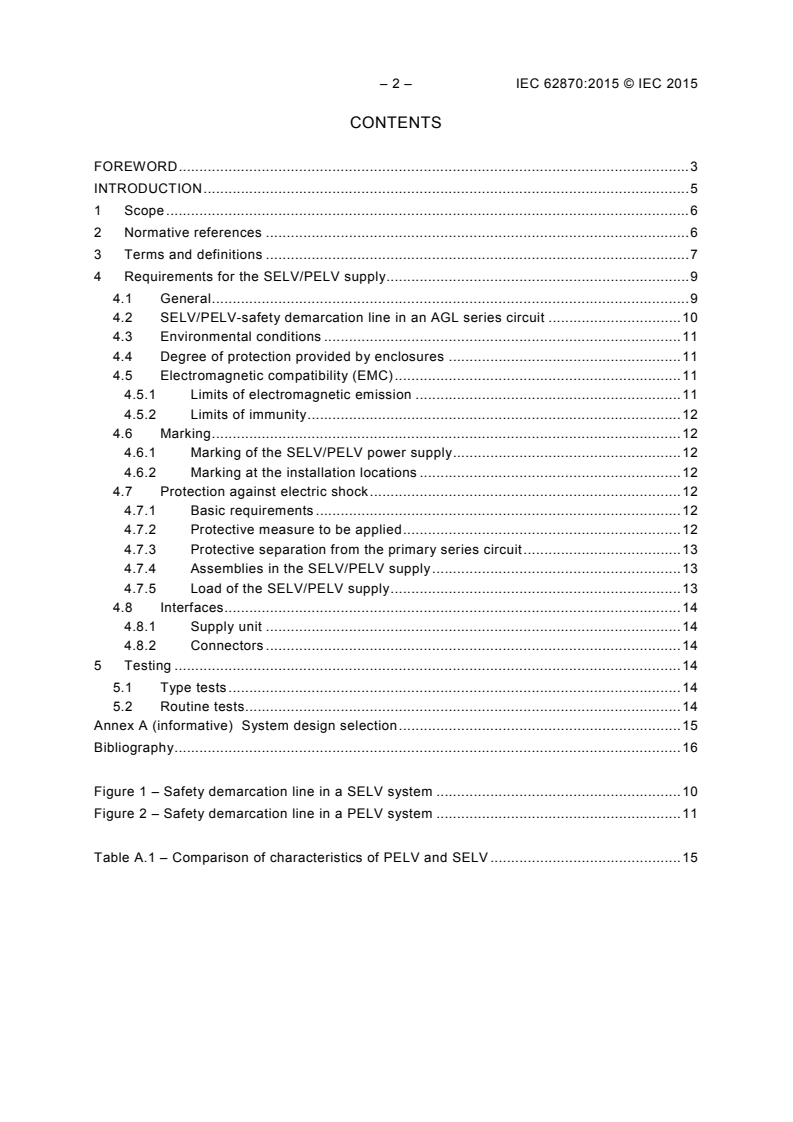
CONTENTS
FOREWORD . 3
INTRODUCTION . 5
1 Scope . 6
2 Normative references . 6
3 Terms and definitions . 7
4 Requirements for the SELV/PELV supply . 9
4.1 General . 9
4.2 SELV/PELV-safety demarcation line in an AGL series circuit . 10
4.3 Environmental conditions . 11
4.4 Degree of protection provided by enclosures . 11
4.5 Electromagnetic compatibility (EMC) . 11
4.5.1 Limits of electromagnetic emission . 11
4.5.2 Limits of immunity . 12
4.6 Marking . 12
4.6.1 Marking of the SELV/PELV power supply . 12
4.6.2 Marking at the installation locations . 12
4.7 Protection against electric shock . 12
4.7.1 Basic requirements . 12
4.7.2 Protective measure to be applied . 12
4.7.3 Protective separation from the primary series circuit . 13
4.7.4 Assemblies in the SELV/PELV supply . 13
4.7.5 Load of the SELV/PELV supply . 13
4.8 Interfaces . 14
4.8.1 Supply unit . 14
4.8.2 Connectors . 14
5 Testing . 14
5.1 Type tests . 14
5.2 Routine tests. 14
Annex A (informative) System design selection . 15
Bibliography . 16
Figure 1 – Safety demarcation line in a SELV system . 10
Figure 2 – Safety demarcation line in a PELV system . 11
Table A.1 – Comparison of characteristics of PELV and SELV . 15
INTERNATIONAL ELECTROTECHNICAL COMMISSION
____________
ELECTRICAL INSTALLATIONS FOR
LIGHTING AND BEACONING OF AERODROMES –
SAFETY SECONDARY CIRCUITS IN SERIES CIRCUITS –
GENERAL SAFETY REQUIREMENTS
FOREWORD
1) The International Electrotechnical Commission (IEC) is a worldwide organization for standardization comprising
all national electrotechnical committees (IEC National Committees). The object of IEC is to promote
international co-operation on all questions concerning standardization in the electrical and electronic fields. To
this end and in addition to other activities, IEC publishes International Standards, Technical Specifications,
Technical Reports, Publicly Available Specifications (PAS) and Guides (hereafter referred to as “IEC
Publication(s)”). Their preparation is entrusted to technical committees; any IEC National Committee interested
in the subject dealt with may participate in this preparatory work. International, governmental and non-
governmental organizations liaising with the IEC also participate in this preparation. IEC collaborates closely
with the International Organization for Standardization (ISO) in accordance with conditions determined by
agreement between the two organizations.
2) The formal decisions or agreements of IEC on technical matters express, as nearly as possible, an international
consensus of opinion on the relevant subjects since each technical committee has representation from all
interested IEC National Committees.
3) IEC Publications have the form of recommendations for international use and are accepted by IEC National
Committees in that sense. While all reasonable efforts are made to ensure that the technical content of IEC
Publications is accurate, IEC cannot be held responsible for the way in which they are used or for any
misinterpretation by any end user.
4) In order to promote international uniformity, IEC National Committees undertake to apply IEC Publications
transparently to the maximum extent possible in their national and regional publications. Any divergence
between any IEC Publication and the corresponding national or regional publication shall be clearly indicated in
the latter.
5) IEC itself does not provide any attestation of conformity. Independent certification bodies provide conformity
assessment services and, in some areas, access to IEC marks of conformity. IEC is not responsible for any
services carried out by independent certification bodies.
6) All users should ensure that they have the latest edition of this publication.
7) No liability shall attach to IEC or its directors, employees, servants or agents including individual experts and
members of its technical committees and IEC National Committees for any personal injury, property damage or
other damage of any nature whatsoever, whether direct or indirect, or for costs (including legal fees) and
expenses arising out of the publication, use of, or reliance upon, this IEC Publication or any other IEC
Publications.
8) Attention is drawn to the Normative references cited in this publication. Use of the referenced publications is
indispensable for the correct application of this publication.
9) Attention is drawn to the possibility that some of the elements of this IEC Publication may be the subject of
patent rights. IEC shall not be held responsible for identifying any or all such patent rights.
International Standard IEC 62870 has been prepared by IEC technical committee 97:
Electrical installations for lighting and beaconing of aerodromes.
The text of this standard is based on the following documents:
FDIS Report on voting
97/167/FDIS 97/169/RVD
Full information on the voting for the approval of this standard can be found in the report on
voting indicated in the above table.
This publication has been drafted in accordance with the ISO/IEC Directives, Part 2.
– 4 – IEC 62870:2015 © IEC 2015
The committee has decided that the contents of this publication will remain unchanged until
the stability date indicated on the IEC website under "http://webstore.iec.ch" in the data
related to the specific publication. At this date, the publication will be
• reconfirmed,
• withdrawn,
• replaced by a revised edition, or
• amended.
IMPORTANT – The 'colour inside' logo on the cover page of this publication indicates
that it contains colours which are considered to be useful for the correct
understanding of its contents. Users should therefore print this document using a
colour printer.
INTRODUCTION
With a few exceptions, aeronautical ground lighting is designed for series circuit technology
operating with a constant current and a maximum input voltage of 5 000 V a.c. rms, including
tolerances. The input voltage to the series circuit is constantly adjusted by the constant
current regulator to maintain the series circuit current irrespective of the variations in the load.
The properties and characteristics of the constant current regulators are provided in
IEC 61822. Due to the structure of the series circuit, i.e. a series connection of all loads, the
usual protective devices for personnel protection of an IT, TT or TN network cannot be
applied.
Aeronautical ground lighting is defined as any light provided as an aid to air navigation and as
such is subject to specific requirements with respect to its resilience, availability, and
serviceability levels. Therefore, insulation faults in the series circuit are often tolerated, and
do not lead to the automatic disconnection of the electrical supply to the series circuit.
In view of the above IEC 61821 states that no work of any kind is normally permitted on live
series circuits without first conducting a suitable and sufficient Risk Assessment and using
appropriate protective equipment according to IEC 61821.
The electrical characteristics of the constant current series circuits are often confused with
those of IT, TT or TN networks, i.e. constant input voltage, equipment connected in parallel,
and a load-dependent current. In practice, it is not always easy to assign rated voltages
correctly to individual components of the series circuit or to determine possible touch
voltages. In a constant current series circuits, the rated voltage of the equipment in the series
circuit and the maximum touch voltage frequently exceed the normal mains input voltage.
In a series circuit installation the series circuit input voltage is divided in proportion to the
internal resistances of the various loads. The rated voltage, i.e. the voltage between the input
lines of the equipment, is defined by the series circuit current that flows through the
equipment and its input impedance. Since input impedance depends on the equipment design
and the series circuit current is constant, the input voltage remains the same for each item of
equipment. As a result of the provision of current control in the series circuit the series circuit
input voltage is load-dependent and corresponds to the sum of all partial voltages in the
series circuit.
This is different to determining the maximum possible touch voltage to earth in a series
circuit. Since one or more earth faults, of varying resistance to earth, maybe present, the
touch voltage to earth may assume any value up to the maximum series circuit input voltage
depending on the location of the earth fault and the equipment installed in the series circuit.
Therefore when determining the dielectric strength against earth potential it is usual to take
the maximum series circuit input voltage. Such peculiarities of the series circuit have been
taken into account in the requirements for lamp systems in this standard.
Since there are only a few effective safety features available for personnel protection in series
circuit technology the protective measure “Safety extra low voltage (SELV)” and “Protective
extra low voltage (PELV)” is applied in this standard for the supply of lamp systems. This
measure is common practice and can resort to the application of well-known and accepted
methodology. The introduction of SELV/PELV in this type of application has been made
possible by the introduction of new illuminant technology that has lower power requirements
and hence requires a lower voltage supply.
NOTE This standard is based on SELV specification according to IEC 60364-4-41 and IEC 61558-1.
– 6 – IEC 62870:2015 © IEC 2015
ELECTRICAL INSTALLATIONS FOR
LIGHTING AND BEACONING OF AERODROMES –
SAFETY SECONDARY CIRCUITS IN SERIES CIRCUITS –
GENERAL SAFETY REQUIREMENTS
1 Scope
This International Standard specifies protective provisions for the operation of lamp systems
powered by series circuits in aeronautical ground lighting.
The protective provisions described here refer only to secondary supply systems for loads
that are electrically separated from the series circuit.
This standard specifies the level of SELV, and alternatively PELV, under consideration of
additional personnel protection during work on live secondary circuits by electrically skilled
persons. This standard also covers the special operational features of aeronautical ground
lighting and addresses the level of training and the requirements for maintenance procedures
detailed in IEC 61821.
The requirements and tests are intended to set a specification framework for system
designers, users, and maintenance personnel to ensure a safe and economic use of electrical
systems in installations for the beaconing of aerodromes.
This standard complements existing IEC Airfield-Ground- Lighting (AGL) standards and can
be used as a design specification.
2 Normative references
The following documents, in whole or in part, are normatively referenced in this document and
are indispensable for its application. For dated references, only the edition cited applies. For
undated references, the latest edition of the referenced document (including any
amendments) applies.
IEC 60364-4-41, Low-voltage electrical installations – Part 4-41: Protection for safety –
Protection against electric shock
IEC 60417, Graphical symbols for use on equipment (available from: http://www.graphical-
symbols.info/equipment)
IEC 60529, Degrees of protection provided by enclosures (IP Code)
IEC 61000-6-2, Electromagnetic compatibility (EMC) – Part 6-2: Generic standards –
Immunity for industrial environments
IEC 61000-6-4, Electromagnetic compatibility (EMC) – Part 6-4: Generic standards –
Emission standard for industrial environments
IEC 61140, Protection against electric shock – Common aspects for installation and
equipment
IEC 61558-2-4, Safety of transformers, reactors, power supply units and similar products for
supply voltages up to 1 100 V – Part 2-4: Particular requirements and tests for isolating
transformers and power supply units incorporating isolating transformers
IEC 61558-2-6, Safety of transformers, reactors, power supply units and similar products for
supply voltages up to 1 100 V – Part 2-6: Particular requirements and tests for safety isolating
transformers and power supply units incorporating safety isolating transformers
IEC 61821, Electrical installations for lighting and beaconing of aerodromes – Maintenance of
aeronautical ground lighting constant current series circuits
IEC 61822, Electrical installations for lighting and beaconing of aerodromes – Constant
current regulators
IEC 61823, Electrical installations for lighting and beaconing of aerodromes – AGL series
transformers
CISPR 11, Industrial, scientific and medical equipment – Radio-frequency disturbance
characteristics – Limits and methods of measurement
CISPR 22, Information technology equipment – Radio disturbance characteristics – Limits and
methods of measurement
3 Terms and definitions
For the purposes of this document, the following terms and definitions apply.
3.1
assembly
self-contained, closed functional unit forming a lamp system together with other assemblies
3.2
electrical equipment
equipment
anything used, intended to be used or installed for use, to generate, provide, transmit,
transform, rectify, convert, conduct, distributes, control, store, measure or use electrical
energy
3.3
basic protection
protection against electric shock under fault-free conditions
3.4
basic insulation
insulation of hazardous live parts providing basic protection
Note 1 to entry: The term “basic insulation” does not include insulation used exclusively for functional purposes.
3.5
electrically skilled person
person with relevant education and experience to enable him or her to perceive risks and to
avoid hazards which electricity can create
[SOURCE: IEC 60050-195:1998,195-04-01]
– 8 – IEC 62870:2015 © IEC 2015
3.6
SELV/PELV power supply
single physical unit or an assembly of physical units performing as the power supply
according to SELV/PELV definitions
3.7
extra-low voltage
ELV
voltage not exceeding the relevant voltage limit specified in 3.9
3.8
lighting system
the SELV/PELV power supply unit and all connected components supplied from the
SELV/PELV
3.9
safety extra-low voltage
SELV
voltage values of which does not exceed values in 4.7.2 , between conductors, or between
any conductor and reference earth, in an electric circuit which has galvanic separation from
the supplying electric power system by such means as a separate-winding transformer
3.10
SELV system
electrical system in which the voltage cannot exceed the value of extra-low voltage:
– under normal conditions, and
– under single-fault conditions, including earth faults in other electric circuits
Note 1 to entry: SELV is the abbreviation for safety extra low voltage.
[SOURCE: IEC 60050-826:2004, 826-12-31]
3.11
SELV-circuit
ELV circuit with protective separation from other circuits, and which has neither provisions for
earthing of the circuit nor of the exposed conductive parts
Note 1 to entry: SELV circuit does not include the housing of the light fixture.
[SOURCE: IEC 61558-1:2005, 3.7.17, modified – addition of a note to entry]
3.12
electrically protective separation
protective separation
separation of one electric circuit from another by means of:
– double insulation or
– basic insulation and electrically protective screening or
– reinforced insulation
3.13
protective extra low voltage circuit
PELV-circuit
ELV circuit with protective separation from other circuits and which, for functional reasons,
may be earthed and/or the exposed conductive parts of which may be earthed
Note 1 to entry: PELV-circuits are used where the circuits are earthed and SELV is not required.
[SOURCE: IEC 61558-1:2005, 3.7.18]
3.14
power supply unit
all components for the supply and transfer of energy used to operate a lighting unit in a series
circuit
3.15
electric shock
physiological effect resulting from an electric current passing through a human or animal body
[SOURCE: IEC 60050-195:1998, 195-01-04]
3.16
hazardous live part
live part which, under certain conditions, can give a harmful electric shock
[SOURCE: IEC 60050-195:1998, 195-06-05]
3.17
effective touch voltage
touch voltage
voltage between conductive parts when touched simultaneously by a person or an animal
Note 1 to entry: The value of the effective touch voltage may be appreciably influenced by the impedance of the
person or the animal in electric contact with these conductive parts.
[SOURCE: IEC 60050-195:1998, 195-05-11]
3.18
single fault condition
condition in which there is a fault of a single protection (but not a reinforced protection) or of a
single component or a device
[SOURCE: IEC 60050-903:2013, 903-01-15]
3.19
light fixture(US)
light fitting (UK)
luminaire
electrical device used to create artificial light by use of an electric lamp above ground or
inside the pavement
Note 1 to entry: The luminaire is an apparatus which distributes, filters or transforms the light transmitted from
one or more lamps and which includes all the parts necessary for supporting, aiming, fixing and protecting the
lamps, but not the lamps themselves and, where necessary, circuit auxiliaries together with the means for
connecting them to supply.
4 Requirements for the SELV/PELV supply
4.1 General
Lamp systems for use in aeronautical ground lighting shall be designed for use in a series
circuit. The maximum power ratings of the series circuit supply are given by the constant
current regulators according to IEC 61822.
If the lamp systems are designed for other current ranges, such information shall be provided
by the manufacturer.
– 10 – IEC 62870:2015 © IEC 2015
The design of the safety secondary circuit shall support safe working conditions for electrically
skilled persons.
The maintenance practices shall follow IEC 61821. When considering life work on the
secondary circuit the risk assessment should take into account the nature of the work (fault
finding, testing, and repair), the nature of the hazards present, and the provision of
SELV/PELV designs.
The recommendation is to implement a PELV design because it is considered the more
practical solution over complete live time of the installation but with the same safety level as a
SELV design. If this requirement could not be fulfilled then it has to be considered that you
need to enforce maintenance effort to achieve a suitable insulation level to implement the
SELV design.
4.2 SELV/PELV-safety demarcation line in an AGL series circuit
Figure 1 and Figure 2 below show the extent of the safety secondary system. The safety
secondary system (50 V a.c. or 120 V d.c. level) is all circuitry below the dashed safety
demarcation line.
I
circuit
U
circuit
mains
series circuit
CCR
U
Input
SELV/PELV
supply
supply input supply input supply input supply input
safety
demarcation
SELV/PELV SELV/PELV SELV/PELV SELV/PELV
line
output level output level output level output level
load load
load load
IEC
Figure 1 – Safety demarcation line in a SELV system
I
circuit
U
circuit
mains
series circuit
CCR
U
Input
SELV/PELV
supply
supply input supply input supply input supply input
safety
demarcation
line
SELV/PELV SELV/PELV SELV/PELV SELV/PELV
output level output level output level output level
load load
load load
IEC
NOTE The given earthing in this figure is an example. The earthing connection can be performed anywhere in the
secondary circuit.
Figure 2 – Safety demarcation line in a PELV system
The PELV-system can be used where local regulations require an earth (bonding of a live
conductor) to be provided.
Important notice: It is strongly recommended that SELV and PELV systems are not mixed on
a single circuit.
4.3 Environmental conditions
Lamp systems shall be designed for continuous outdoor operation without any derating factor,
under the following environmental conditions:
• temperature range from −40 °C to +55 °C;
• relative humidity from 10 % to 100 %.
4.4 Degree of protection provided by enclosures
The degree of protection against contact with conducting parts or the ingress of solid objects
and liquids shall be indicated by the IP coding according to IEC 60529.
Where the supply is intended to be installed outdoors the following IP-grade shall apply:
• underground IP 67,
• above ground IP 54.
4.5 Electromagnetic compatibility (EMC)
4.5.1 Limits of electromagnetic emission
The SELV/PELV supply shall comply with the requirements given in the EMC generic standard
IEC 61000-6-4. The limits of electromagnetic emission shall comply with CISPR 11, class B.
– 12 – IEC 62870:2015 © IEC 2015
4.5.2 Limits of immunity
The SELV/PELV supply shall comply with the requirements given in the generic standard for
industrial environments IEC 61000-6-2. The immunity limits and methods of measurement of
CISPR 22 shall be complied with.
4.6 Marking
4.6.1 Marking of the SELV/PELV power supply
Each SELV/PELV supply of it shall be permanently marked. The marking shall contain the
following information:
• unambiguous type designation of the manufacturer;
• name of the manufacturer of the assembly;
• nominal input current;
• nominal output current;
• maximum output power (W and VA);
• marking of the assembly as class III (SELV) with symbol original 5180 of IEC 60417
(Roman III within a rhombus).
The SELV/PELV marking shall be available to maintenance personnel and easily readable in
the normal installation position (see 4.7.4).
4.6.2 Marking at the installation locations
The location of a light fixture fed by a SELV/PELV power supply shall be marked as
SELV/PELV. The marking shall be clearly readable to allow maintenance people to confirm
SELV / PELV condition before starting any work on the installation. If the SELV/PELV supply
will be replaced by a non-SELV/PELV supply the marking shall be removed or permanently
covered.
4.7 Protection against electric shock
4.7.1 Basic requirements
Hazardous live parts shall not be accessible and accessible conductive parts shall not be
hazardous live
• neither in normal use without fault, nor
• under single fault conditions.
4.7.2 Protective measure to be applied
The protective mechanisms of the SELV/PELV supply shall not be lost if a single fault occurs.
For this purpose
• limitation of voltage at the output of the SELV/PELV supply and
• protective-separation of the SELV/PELV supply from all circuits other than SELV and
PELV and
• simple-separation of the SELV/PELV supply from other SELV/PELV supply
shall be provided.
For a SELV supply, operational earthing of active parts nor the intentional connection of parts
to a protective conductor or to an earth conductor according to IEC 61140 is not permitted.
Where the safety secondary system is explicitly defined as a PELV supply, the PELV circuits
and/or exposed conductive parts of equipment supplied by the PELV circuit may be earthed.
In locations where protective screening is used for the purpose of protective separation the
protective screen shall be separated from each adjacent circuit by basic insulation intended
for the highest voltage present.
The maximum SELV/PELV shall not exceed the following values:
• 50 V a.c. for a.c. voltages in the 15 Hz to 100 Hz range,
• 120 V d.c. for direct voltages with a maximum harmonic content of 10 % of the direct
voltage effective value.
SELV/PELV and non-SELV/PELV circuits shall not be carried in the same cable.
4.7.3 Protective separation from the primary series circuit
The power supply unit of the lamp systems with the SELV/PELV supply shall provide a
galvanic, safe separation from the primary side of the series circuit.
The input voltage of one single SELV /PELV supply is defined as the voltage between the two
poles of that SELV/PELV supply and shall not exceed 1 000 V a.c. rms.
Protective separation between the input and the output of the supply shall be achieved
according to IEC 61140 by means of:
• basic insulation and supplementary insulation, each rated for the highest voltage present,
i.e. double insulation, or
• reinforced insulation rated for the highest voltage present, or
• protective screening with the protective screen being separated from each adjacent circuit
by basic insulation rated for the adjacent circuit voltage, or
• a combination of these provisions.
If the conductors of the separated circuit are contained together with the conductors of other
circuits in a multi-conductor cable or in another grouping of conductors, they shall be
insulated, individually or collectively, for the highest voltage present, so that double insulation
is achieved.
If any component is connected between the separated circuits, that component shall comply
with the requirements for protective impedance devices according to IEC 61140.
4.7.4 Assemblies in the SELV/PELV supply
If assemblies in the SELV/PELV supply are connected to the power supply by means of an
external interface they shall be designed as Class III equipment according to IEC 61140.
When a SELV supply is chosen there shall be no provision for the connection of live parts to
earth.
The enclosure of an assembly may be provided with an earth terminal if it is necessary for an
earth to be provide for reasons other than personnel protection.
An earth connection may be necessary to integrate an enclosure into a lightning protection
system.
4.7.5 Load of the SELV/PELV supply
Equipment marked as Class III shall only be used in SELV or PELV systems.
– 14 – IEC 62870:2015 © IEC 2015
4.8 Interfaces
4.8.1 Supply unit
The electrical supply to the lamp system is usually provided by the series circuit. All
subsystems having a direct galvanic connection to the primary series circuit shall comply with
IEC 61823 (AGL series transformers).
If the electrical supply of a series circuit, or another voltage supply, is intended to have a
nominal voltage less than 1 000 V a.c., the dielectric strength can be determined according to
IEC 61558-2-4.
4.8.2 Connectors
The live side of the circuit shall be equipped with the socket.
Plug and socket-outlets in SELV and PELV systems shall comply to IEC 60364-4-41 with the
following requirements:
• plugs shall not be able to enter socket-outlets of other non AGL voltage systems;
• socket outlets shall not admit plugs of other non AGL voltage systems.
5 Testing
5.1 Type tests
The tests shall assure that the SELV/PELV supply complies with the applicable IEC standards
referenced in 4.1 to 4.8.2.
All applicable type tests of dielectric strength shall be carried out on applicable parts of the
SELV/PELV supply having a galvanic connection to the series circuit on one side according to
IEC 61823.
The applicable tests for safety isolating transformers according to IEC 61558-2-6 shall be
carried out.
The tests have been passed if all requirements have been fulfilled.
The tests shall be documented with all results clearly tabulated including a clear description of
the structural condition of units after the completion of each test.
If a SELV/PELV supply is modified in any way that this has an effect on the safety or basic
function of the SELV/PELV supply the type test shall be repeated.
5.2 Routine tests
After production the manufacturer shall submit each assembly to a visual inspection, a non-
destructive dielectric test according to the applicable parts of IEC 61558-2-6, and a functional
test. The functional test shall contain the basic functions and compliance with the maximum
permitted output voltage for supply unit.
The manufacturer shall document the type and scope of tests in the test instructions.
Annex A
(informative)
System design selection
To select the right system design, the airport should consider the different characteristics of
the installation (see Table A.1 below).
Table A.1 – Comparison of characteristics of PELV and SELV
PELV SELV
Work safety level Same as SELV Same as PELV
Can be combined with any local
Yes No;
earthing requirements
Earthing is not allowed
Installation cost Normal Lower,
due to the not required earthing
Functional availability Lower, Higher,
first insulation fault could cause the first insulation fault will not
lamp malfunction influence the function
Maintenance effort Lower, Higher,
requires the same maintenance as the insulation level shall be tested
with secondary earth bonded and each single fault shall be
systems repaired
– 16 – IEC 62870:2015 © IEC 2015
Bibliography
IEC 60050-195:1998, International Electrotechnical Vocabulary – Part 195: Earthing and
protection against electric shock
IEC 60050-826:2004, International Electrotechnical Vocabulary – Part 826: Electrical
installations
IEC 60050-903:2013, International Electrotechnical Vocabulary – Part 903: Risk assessment
IEC 60364-1, Low-voltage electrical installations – Part 1: Fundamental principles,
assessment of general characteristics, definitions
IEC TS 61201, Use of conventional touch voltage limits – Application guide
IEC 61558-1:2005, Safety of power transformers, power supplies, reactors and similar
products – Part 1: General requirements and tests
_____________
– 18 – IEC 62870:2015 © IEC 2015
SOMMAIRE
AVANT-PROPOS . 19
INTRODUCTION . 21
1 Domaine d'application . 22
2 Références normatives . 22
3 Termes et définitions . 23
4 Exigences pour une alimentation TBTS/TBTP . 26
4.1 Généralités . 26
4.2 Ligne de démarcation de sécurité de TBTS/TBTP dans un circuit série de
balisage aéronautique au sol . 26
4.3 Conditions environnementales . 27
4.4 Degré de protection procuré par les enveloppes . 27
4.5 Compatibilité électromagnétique (CEM) . 28
4.5.1 Limites d'émissivité . 28
4.5.2 Limites d'immunité . 28
4.6 Marquage . 28
4.6.1 Marquage d'une alimentation TBTS/TBTP . 28
4.6.2 Marquage de l'emplacement d'une installation . 28
4.7 Protection contre les chocs électriques . 28
4.7.1 Exigences de base . 28
4.7.2 Mesure de protection à appliquer . 28
4.7.3 Séparation de protection par rapport au circuit série primaire . 29
4.7.4 Ensembles dans une alimentation TBTS/TBTP . 30
4.7.5 Charge d'une alimentation TBTS/TBTP . 30
4.8 Interfaces . 30
4.8.1 Alimentation . 30
4.8.2 Connecteurs . 30
5 Essais . 30
5.1 Essais de type . 30
5.2 Essais individuels de série . 31
Annexe A (informative) Sélection de la conception du système . 32
Bibliographie . 33
Figure 1 – Ligne de démarcation de sécurité dans un système TBTS . 26
Figure 2 – Ligne de démarcation de sécurité dans un système TBTP . 27
Tableau A.1 – Comparaison des caractéristiques de TBTP et TBTS . 32
COMMISSION ÉLECTROTECHNIQUE INTERNATIONALE
____________
INSTALLATIONS ÉLECTRIQUES POUR
L’ÉCLAIRAGE ET LE BALISAGE DES AÉRODROMES –
CIRCUITS SECONDAIRES DE SÉCURITÉ DANS DES CIRCUITS SÉRIE –
EXIGENCES GÉNÉRALES DE SÉCURITÉ
AVANT-PROPOS
1) La Commission Electrotechnique Internationale (IEC) est une organisation mondiale de normalisation
composée de l'ensemble des comités électrotechniques nationaux (Comités nationaux de l’IEC). L’IEC a pour
objet de fa
...