

IEC TR 62039:2021
(Main)Selection guidelines for polymeric materials for outdoor use under HV stress
General Information
- Abstract
IEC TR 62039:2021(E) presents the important material properties of polymeric materials used in outdoor insulation and, where applicable, lists standardized test methods including minimum requirements. If no standardized tests are available, the test methods reported in literature are summarized.
This document is valid for insulating materials having polymeric insulation, which are used in outdoor high voltage electrical applications with a system voltage greater than 1 000 V AC and 1 500 V DC (several tests are only defined for alternating current, which are not applicable for direct current). Such applications are relevant where the housing is an integral part of the device, for example in surge arresters and cable terminations. The scope of this document is limited to the insulation materials only and is not generally intended for coating materials (coating materials are, for example, thin layers applied on toughened glass and ceramic). Some tests mentioned in this document are applicable for coating and are under consideration by CIGRE. The performance of insulators in service depends on several factors such as the type of material, the design and environmental conditions. Consequently, the choice of materials that fulfil the requirements listed in Table 1 is a necessary condition but does not guarantee satisfactory performance when used in outdoor insulation.
- Status
- Published
- Publication Date
- 23-Aug-2021
- Technical Committee
- TC 112 - Evaluation and qualification of electrical insulating materials and systems
- Drafting Committee
- WG 5 - TC 112/WG 5
- Current Stage
- PPUB - Publication issued
- Start Date
- 24-Aug-2021
- Completion Date
- 10-Sep-2021
Overview
IEC TR 62039:2021 - Selection guidelines for polymeric materials for outdoor use under HV stress is a Technical Report from the International Electrotechnical Commission (IEC TC 112) that identifies the important material properties and test methods for polymeric insulating materials used outdoors in high‑voltage (HV) applications. The document focuses on insulation materials for systems with voltages greater than 1 000 V AC and 1 500 V DC, lists standardized test methods and minimum requirements where available, and summarizes literature methods when standards do not exist. It is a selection guideline - a necessary condition for material choice but not a guarantee of in-service performance.
Key topics and technical requirements
IEC TR 62039:2021 documents the material properties and test approaches most relevant to outdoor HV polymeric insulation. Major topics include:
- Resistance to tracking and erosion - standardized tests for surface degradation under contaminated/wet conditions (e.g., IEC 60587).
- Arc resistance - performance under low‑current, high‑energy discharges (e.g., IEC 61621).
- Water diffusion / water uptake - test procedures, specimen preparation and acceptance criteria for degradation by water.
- Tear strength and mechanical durability (ISO 34‑1 referenced).
- Volume resistivity and breakdown field strength (IEC 60243 series; IEC 62631 series).
- Stress corrosion - resistance to chemical attack under mechanical load (newly emphasized in this edition).
- Weathering and UV resistance, flammability (IEC 60695 series), and glass transition temperature.
- Hydrophobicity - definitions, transfer, retention and recovery; testing guidance referencing IEC TS 62073.
- Additional non‑standardized tests in Annex A and B: corona/ozone resistance, acid attack from partial discharge, and water immersion effects.
Table 1 in the report consolidates important properties and minimum requirements; where standardized tests are absent the report summarizes literature methods.
Practical applications
This TR is practical for evaluating and specifying polymeric housings and insulation that are integral to devices such as:
- Surge arresters
- Cable terminations and HV connectors
- Outdoor composite insulators and housings
Use cases include material selection, supplier qualification, product design validation, and developing contract test specifications.
Who should use this standard
- Utilities and asset owners specifying outdoor HV components
- Manufacturers of polymeric HV insulation and housings
- Materials and design engineers assessing long‑term outdoor performance
- Test laboratories developing HV polymer test programs
- Procurement and standards teams preparing technical specifications
Related standards (examples referenced)
- IEC 60243‑1 / 60243‑2 (electric strength)
- IEC 60587 (tracking and erosion)
- IEC 61621 (arc resistance)
- IEC TS 62073 (hydrophobicity measurement)
- IEC 60695‑11‑10 (flammability)
- IEC 62631‑3‑1 (resistive properties)
- ISO 34‑1 (tear strength)
IEC TR 62039:2021 is a practical, literature‑backed guide for selecting polymeric materials for outdoor high‑voltage service and should be used alongside device design considerations and application‑specific testing.
Relations
- Effective Date
- 05-Sep-2023
Get Certified
Connect with accredited certification bodies for this standard

IMQ S.p.A. (Certification)
Italian electrical product certification.

SLG Prüf- und Zertifizierungs GmbH
German testing and certification body.

UL Solutions
Global safety science company with testing, inspection and certification.
Sponsored listings
Frequently Asked Questions
IEC TR 62039:2021 is a technical report published by the International Electrotechnical Commission (IEC). Its full title is "Selection guidelines for polymeric materials for outdoor use under HV stress". This standard covers: IEC TR 62039:2021(E) presents the important material properties of polymeric materials used in outdoor insulation and, where applicable, lists standardized test methods including minimum requirements. If no standardized tests are available, the test methods reported in literature are summarized. This document is valid for insulating materials having polymeric insulation, which are used in outdoor high voltage electrical applications with a system voltage greater than 1 000 V AC and 1 500 V DC (several tests are only defined for alternating current, which are not applicable for direct current). Such applications are relevant where the housing is an integral part of the device, for example in surge arresters and cable terminations. The scope of this document is limited to the insulation materials only and is not generally intended for coating materials (coating materials are, for example, thin layers applied on toughened glass and ceramic). Some tests mentioned in this document are applicable for coating and are under consideration by CIGRE. The performance of insulators in service depends on several factors such as the type of material, the design and environmental conditions. Consequently, the choice of materials that fulfil the requirements listed in Table 1 is a necessary condition but does not guarantee satisfactory performance when used in outdoor insulation.
IEC TR 62039:2021(E) presents the important material properties of polymeric materials used in outdoor insulation and, where applicable, lists standardized test methods including minimum requirements. If no standardized tests are available, the test methods reported in literature are summarized. This document is valid for insulating materials having polymeric insulation, which are used in outdoor high voltage electrical applications with a system voltage greater than 1 000 V AC and 1 500 V DC (several tests are only defined for alternating current, which are not applicable for direct current). Such applications are relevant where the housing is an integral part of the device, for example in surge arresters and cable terminations. The scope of this document is limited to the insulation materials only and is not generally intended for coating materials (coating materials are, for example, thin layers applied on toughened glass and ceramic). Some tests mentioned in this document are applicable for coating and are under consideration by CIGRE. The performance of insulators in service depends on several factors such as the type of material, the design and environmental conditions. Consequently, the choice of materials that fulfil the requirements listed in Table 1 is a necessary condition but does not guarantee satisfactory performance when used in outdoor insulation.
IEC TR 62039:2021 is classified under the following ICS (International Classification for Standards) categories: 29.035.20 - Plastics and rubber insulating materials; 29.080.10 - Insulators. The ICS classification helps identify the subject area and facilitates finding related standards.
IEC TR 62039:2021 has the following relationships with other standards: It is inter standard links to IEC TR 62039:2007. Understanding these relationships helps ensure you are using the most current and applicable version of the standard.
IEC TR 62039:2021 is available in PDF format for immediate download after purchase. The document can be added to your cart and obtained through the secure checkout process. Digital delivery ensures instant access to the complete standard document.
Standards Content (Sample)
IEC TR 62039 ®
Edition 2.0 2021-08
TECHNICAL
REPORT
colour
inside
Selection guidelines for polymeric materials for outdoor use under HV stress
All rights reserved. Unless otherwise specified, no part of this publication may be reproduced or utilized in any form
or by any means, electronic or mechanical, including photocopying and microfilm, without permission in writing from
either IEC or IEC's member National Committee in the country of the requester. If you have any questions about IEC
copyright or have an enquiry about obtaining additional rights to this publication, please contact the address below or
your local IEC member National Committee for further information.
IEC Central Office Tel.: +41 22 919 02 11
3, rue de Varembé info@iec.ch
CH-1211 Geneva 20 www.iec.ch
Switzerland
About the IEC
The International Electrotechnical Commission (IEC) is the leading global organization that prepares and publishes
International Standards for all electrical, electronic and related technologies.
About IEC publications
The technical content of IEC publications is kept under constant review by the IEC. Please make sure that you have the
latest edition, a corrigendum or an amendment might have been published.
IEC publications search - webstore.iec.ch/advsearchform IEC online collection - oc.iec.ch
The advanced search enables to find IEC publications by a Discover our powerful search engine and read freely all the
variety of criteria (reference number, text, technical publications previews. With a subscription you will always
committee, …). It also gives information on projects, replaced have access to up to date content tailored to your needs.
and withdrawn publications.
Electropedia - www.electropedia.org
IEC Just Published - webstore.iec.ch/justpublished
The world's leading online dictionary on electrotechnology,
Stay up to date on all new IEC publications. Just Published
containing more than 22 000 terminological entries in English
details all new publications released. Available online and
and French, with equivalent terms in 18 additional languages.
once a month by email.
Also known as the International Electrotechnical Vocabulary
(IEV) online.
IEC Customer Service Centre - webstore.iec.ch/csc
If you wish to give us your feedback on this publication or
need further assistance, please contact the Customer Service
Centre: sales@iec.ch.
IEC TR 62039 ®
Edition 2.0 2021-08
TECHNICAL
REPORT
colour
inside
Selection guidelines for polymeric materials for outdoor use under HV stress
INTERNATIONAL
ELECTROTECHNICAL
COMMISSION
ICS 29.035.20; 29.080.10 ISBN 978-2-8322-1012-8
– 2 – IEC TR 62039:2021 © IEC:2021
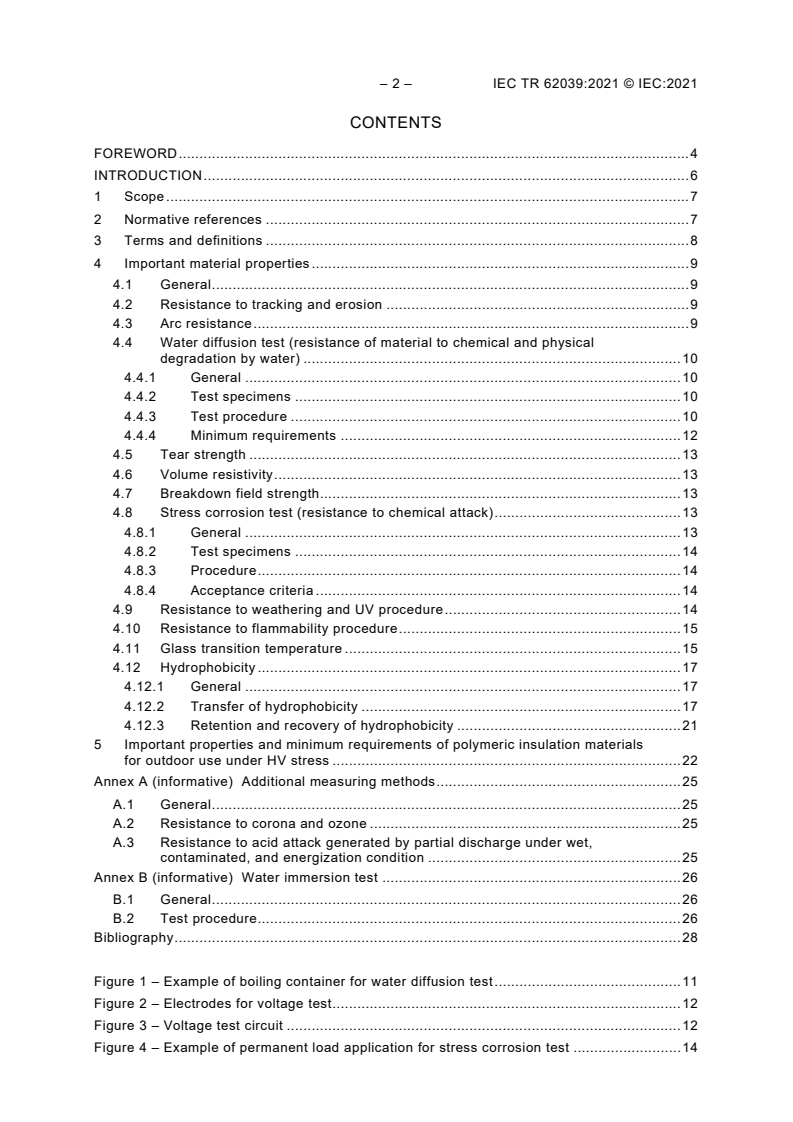
CONTENTS
FOREWORD . 4
INTRODUCTION . 6
1 Scope . 7
2 Normative references . 7
3 Terms and definitions . 8
4 Important material properties . 9
4.1 General . 9
4.2 Resistance to tracking and erosion . 9
4.3 Arc resistance . 9
4.4 Water diffusion test (resistance of material to chemical and physical
degradation by water) . 10
4.4.1 General . 10
4.4.2 Test specimens . 10
4.4.3 Test procedure . 10
4.4.4 Minimum requirements . 12
4.5 Tear strength . 13
4.6 Volume resistivity . 13
4.7 Breakdown field strength . 13
4.8 Stress corrosion test (resistance to chemical attack) . 13
4.8.1 General . 13
4.8.2 Test specimens . 14
4.8.3 Procedure . 14
4.8.4 Acceptance criteria . 14
4.9 Resistance to weathering and UV procedure . 14
4.10 Resistance to flammability procedure . 15
4.11 Glass transition temperature . 15
4.12 Hydrophobicity . 17
4.12.1 General . 17
4.12.2 Transfer of hydrophobicity . 17
4.12.3 Retention and recovery of hydrophobicity . 21
5 Important properties and minimum requirements of polymeric insulation materials
for outdoor use under HV stress . 22
Annex A (informative) Additional measuring methods . 25
A.1 General . 25
A.2 Resistance to corona and ozone . 25
A.3 Resistance to acid attack generated by partial discharge under wet,
contaminated, and energization condition . 25
Annex B (informative) Water immersion test . 26
B.1 General . 26
B.2 Test procedure . 26
Bibliography . 28
Figure 1 – Example of boiling container for water diffusion test . 11
Figure 2 – Electrodes for voltage test . 12
Figure 3 – Voltage test circuit . 12
Figure 4 – Example of permanent load application for stress corrosion test . 14
Figure 5 – Definition of glass transition temperature T . 16
g
Figure 6 – Specimen with adhesive foil . 18
Figure 7 – Specimen with pollution layer . 19
Figure 8 – Area for the drop application for measurement according to IEC TS 62073
(example for Method A). 21
Figure B.1 – Example of water uptake of two different kinds of materials (MFRP and
UFRP) . 27
Table 1 – Important properties and minimum requirements of polymeric insulation
materials for outdoor use under HV stress . 22
Table B.1 – Example of dielectric properties in dry conditions and after water
immersion for 100 days . 27
– 4 – IEC TR 62039:2021 © IEC:2021
INTERNATIONAL ELECTROTECHNICAL COMMISSION
____________
SELECTION GUIDELINES FOR POLYMERIC MATERIALS
FOR OUTDOOR USE UNDER HV STRESS
FOREWORD
1) The International Electrotechnical Commission (IEC) is a worldwide organization for standardization comprising
all national electrotechnical committees (IEC National Committees). The object of IEC is to promote international
co-operation on all questions concerning standardization in the electrical and electronic fields. To this end and
in addition to other activities, IEC publishes International Standards, Technical Specifications, Technical Reports,
Publicly Available Specifications (PAS) and Guides (hereafter referred to as “IEC Publication(s)”). Their
preparation is entrusted to technical committees; any IEC National Committee interested in the subject dealt with
may participate in this preparatory work. International, governmental and non-governmental organizations liaising
with the IEC also participate in this preparation. IEC collaborates closely with the International Organization for
Standardization (ISO) in accordance with conditions determined by agreement between the two organizations.
2) The formal decisions or agreements of IEC on technical matters express, as nearly as possible, an international
consensus of opinion on the relevant subjects since each technical committee has representation from all
interested IEC National Committees.
3) IEC Publications have the form of recommendations for international use and are accepted by IEC National
Committees in that sense. While all reasonable efforts are made to ensure that the technical content of IEC
Publications is accurate, IEC cannot be held responsible for the way in which they are used or for any
misinterpretation by any end user.
4) In order to promote international uniformity, IEC National Committees undertake to apply IEC Publications
transparently to the maximum extent possible in their national and regional publications. Any divergence between
any IEC Publication and the corresponding national or regional publication shall be clearly indicated in the latter.
5) IEC itself does not provide any attestation of conformity. Independent certification bodies provide conformity
assessment services and, in some areas, access to IEC marks of conformity. IEC is not responsible for any
services carried out by independent certification bodies.
6) All users should ensure that they have the latest edition of this publication.
7) No liability shall attach to IEC or its directors, employees, servants or agents including individual experts and
members of its technical committees and IEC National Committees for any personal injury, property damage or
other damage of any nature whatsoever, whether direct or indirect, or for costs (including legal fees) and
expenses arising out of the publication, use of, or reliance upon, this IEC Publication or any other IEC
Publications.
8) Attention is drawn to the Normative references cited in this publication. Use of the referenced publications is
indispensable for the correct application of this publication.
9) Attention is drawn to the possibility that some of the elements of this IEC Publication may be the subject of patent
rights. IEC shall not be held responsible for identifying any or all such patent rights.
IEC TR 62039 has been prepared by IEC technical committee 112: Evaluation and qualification
of electrical insulating materials and systems. It is a Technical Report.
This second edition cancels and replaces the first edition published in 2007. This edition
constitutes a technical revision.
This edition includes the following significant technical changes with respect to the previous
edition:
a) addition of hydrophobicity definitions and hydrophobicity transfer test;
b) addition of stress corrosion test.
The text of this Technical Report is based on the following documents:
Draft Report on voting
112/526/DTR 112/535/RVDTR
Full information on the voting for its approval can be found in the report on voting indicated in
the above table.
The language used for the development of this Technical Report is English.
This document was drafted in accordance with ISO/IEC Directives, Part 2, and developed in
accordance with ISO/IEC Directives, Part 1 and ISO/IEC Directives, IEC Supplement, available
at www.iec.ch/members_experts/refdocs. The main document types developed by IEC are
described in greater detail at www.iec.ch/standardsdev/publications.
The committee has decided that the contents of this document will remain unchanged until the
stability date indicated on the IEC website under webstore.iec.ch in the data related to the
specific document. At this date, the document will be
• reconfirmed,
• withdrawn,
• replaced by a revised edition, or
• amended.
IMPORTANT – The "colour inside" logo on the cover page of this document indicates
that it contains colours which are considered to be useful for the correct understanding
of its contents. Users should therefore print this document using a colour printer.
– 6 – IEC TR 62039:2021 © IEC:2021
INTRODUCTION
There is a need within utilities and industry for material standards that define the physical
properties of the polymers applied for outdoor insulation. This requirement was identified during
discussions in IEC TC 36 and IEC TC 112. As a consequence, in 2001, CIGRE formed the
working group D1.14 and later on working groups D1.27, C4.303 and D1.58 with the specific
task of defining the physical parameters which are important for the polymeric materials applied
in outdoor insulation and developing the relevant test methods, where necessary. As a first step,
a state-of-the-art report was issued by CIGRE in Technical Brochure 255. Thirteen properties
were identified; standardized test methods and minimum requirements were available for eleven
of them. For the remaining property of hydrophobicity retention and recovery, test methods and
minimum requirements still need to be defined. This will be the future task of SC D1. This
document presents, as a conclusion of the CIGRE report, the important material properties for
polymeric materials used in outdoor insulation, where they are applicable, and lists
standardized test methods including minimum requirements. If no standardized tests are
available, then test methods reported in literature (references in the bibliography) are
summarized.
SELECTION GUIDELINES FOR POLYMERIC MATERIALS
FOR OUTDOOR USE UNDER HV STRESS
1 Scope
This document presents the important material properties of polymeric materials used in
outdoor insulation and, where applicable, lists standardized test methods including minimum
requirements. If no standardized tests are available, the test methods reported in literature are
summarized.
This document is valid for insulating materials having polymeric insulation, which are used in
outdoor high voltage electrical applications with a system voltage greater than 1 000 V AC and
1 500 V DC (several tests are only defined for alternating current, which are not applicable for
direct current). Such applications are relevant where the housing is an integral part of the device,
for example in surge arresters and cable terminations. The scope of this document is limited to
the insulation materials only and is not generally intended for coating materials (coating
materials are, for example, thin layers applied on toughened glass and ceramic). Some tests
mentioned in this document are applicable for coating and are under consideration by CIGRE.
The performance of insulators in service depends on several factors such as the type of material,
the design and environmental conditions. Consequently, the choice of materials that fulfil the
requirements listed in Table 1 is a necessary condition but does not guarantee satisfactory
performance when used in outdoor insulation.
In Annex A and Annex B different test methods for testing additional properties are given, which
are not standardized.
2 Normative references
The following documents are referred to in the text in such a way that some or all of their content
constitutes requirements of this document. For dated references, only the edition cited applies.
For undated references, the latest edition of the referenced document (including any
amendments) applies.
IEC 60243-1, Electric strength of insulating materials – Test methods – Part 1: Tests at power
frequencies
IEC 60243-2, Electric strength of insulating materials – Test methods – Part 2: Additional
requirements for tests using direct voltage
IEC 60455-2, Resin based reactive compounds used for electrical insulation – Part 2: Methods
of test
IEC 60587, Electrical insulating materials used under severe ambient conditions – Test
methods for evaluating resistance to tracking and erosion
IEC 60695-11-10, Fire hazard testing – Part 11-10: Test flames – 50 W horizontal and vertical
flame test methods
IEC 61621, Dry, solid insulating materials – Resistance test to high-voltage, low-current arc
discharges
IEC TS 62073, Guidance on the measurement of hydrophobicity of insulator surfaces
– 8 – IEC TR 62039:2021 © IEC:2021
IEC 62631-3-1, Dielectric and resistive properties of solid insulating materials – Part 3-1:
Determination of resistive properties (DC methods) – Volume resistance and volume resistivity
– General method
ISO 34-1, Rubber, vulcanized or thermoplastic – Determination of tear strength – Part 1:
Trouser, angle and crescent test pieces
ISO 483, Plastics – Small enclosures for conditioning and testing using aqueous solutions to
maintain the humidity at a constant value
ISO 4892-2, Plastics – Methods of exposure to laboratory light sources – Part 2: Xenon-arc
lamps
ISO 6721-11, Plastics – Determination of dynamic mechanical properties – Part 11: Glass
transition temperature
ISO 11357-2, Plastics – Differential scanning calorimetry (DSC) – Part 2: Determination of glass
transition temperature and step height
ISO 11359-2, Plastics – Thermomechanical analysis (TMA) – Part 2: Determination of
coefficient of linear thermal expansion and glass transition temperature
3 Terms and definitions
For the purposes of this document, the following terms and definitions apply.
ISO and IEC maintain terminological databases for use in standardization at the following
addresses:
• IEC Electropedia: available at http://www.electropedia.org/
• ISO Online browsing platform: available at http://www.iso.org/obp
3.1
hydrophobicity
surface of a solid insulating material characterized by its capacity to repel water or aqueous
electrolyte solutions
Note 1 to entry: Hydrophobicity of a polymeric insulating material is, in general, a volume property by means of the
chemical composition of a material at its surface.
Note 2 to entry: Nonetheless, hydrophobicity is strongly affected by surface effects such as:
• surface structure (i.e. roughness);
• chemical interaction between water and the solid surface (adsorption, absorption, swelling of the solid material
in contact with water);
• an accumulated pollution layer.
Note 3 to entry: Furthermore, the conditions during an evaluation of hydrophobicity (climatic (temperature,
pressure, humidity), and the method for cleaning or electrostatic charges can affect the measured degree of
hydrophobicity.
3.2
hydrophobicity class
HC
specific level of the scale used in the spray method (Method C)
Note 1 to entry: Seven classes, HC1 to HC7, have been defined. HC1 corresponds to the most hydrophobic surface
and HC7 to the most hydrophilic surface.
[SOURCE: IEC TS 62073:2016, 2.6]
3.3
hydrophobicity transfer
phenomenon of a transfer of hydrophobicity from the bulk of the housing material onto the
pollution layer on its surface
[SOURCE: CIGRE TB 442:2010, Clause 4]
3.4
hydrophobicity transfer material
HTM
polymeric material which exhibits hydrophobicity and the capability to transfer hydrophobicity
onto the layer of pollution, which is a combined dynamic behaviour of retention and transfer of
hydrophobicity specific to different insulator materials
[SOURCE: IEC TS 60815-4:2016, 3.1.4. modified – The text after "pollution" has been added
and the Note to entry has been deleted.]
4 Important material properties
4.1 General
This document defines the important properties that need to be tested on the material itself in
order to ensure the functioning of the material under normal operating service conditions.
Physical, mechanical, electrical and chemical properties of the materials have been considered.
According to their function in the insulation, three categories of insulating materials are
considered:
• housing materials (in general a silicone rubber, EPDM, EVA, etc.);
• core materials (FRP, etc.);
• structural materials (epoxy, etc.).
The minimum requirements are, as far as possible, based on the performance of polymeric
insulators in service.
4.2 Resistance to tracking and erosion
The inclined-plane-test according to IEC 60587 is easily applicable, shows a good
reproducibility and allows a good differentiation between insulating materials with respect to the
resistance of electrical insulating materials against erosion and tracking. The thickness of the
test specimens should be 6 mm ± 0,5 mm.
The minimum requirements are given in Table 1.
NOTE IEC 60587 covers only alternating current. A tracking and erosion test for direct current is still under
consideration by CIGRE (see also CIGRE TB 611).
4.3 Arc resistance
The test for the arc resistance capability of housing and structural materials is carried out
according to IEC 61621.
The minimum requirements are given in Table 1.
NOTE IEC 61621 covers only alternating current. An arc resistance test for direct current is still under consideration
by CIGRE.
– 10 – IEC TR 62039:2021 © IEC:2021
4.4 Water diffusion test (resistance of material to chemical and physical degradation
by water)
4.4.1 General
The following procedure is primarily intended to evaluate the core material for resistance to
water attack. It can be also used to evaluate the resistance to water attack of housing materials,
if suitable.
4.4.2 Test specimens
At least six material samples are cut approximately 90° to the long axis of the insulating core
with a diamond-coated circular saw blade under running cold water. The length of the samples
h should be 30 mm ± 0,5 mm. The cut surfaces are smoothed by means of a fine abrasive cloth
(grain size 180). The cut ends should be clean and parallel. Detailed requirements for the
dimension of the specimen under test (e.g. circumstance, persistent) are defined in the related
products standards.
If the samples cannot be cut from the insulator or other components, they are to be tested.
Samples are prepared separately by using a similar manufacturing process and parameters as
intended for the production of the insulating parts.
4.4.3 Test procedure
4.4.3.1 Pre-stressing
The surfaces of the specimens are cleaned with ethanol and filter-paper immediately before
boiling. The specimens are boiled in a suitable container (e.g. made of glass or stainless steel)
for 100 h ± 0,5 h in deionized water with 0,1 % by weight of NaCl.
Specimens of only one core material are boiled together in the same container. An example of
such a container is shown in Figure 1.
After boiling, the specimens are removed from the boiling container and placed in another
container (e.g. made of glass or stainless steel) filled with tap water at ambient temperature for
at least 15 min. The voltage test is carried out within the next 3 h after the removal of the
specimens from the boiling container.
Dimensions in millimetres
Figure 1 – Example of boiling container for water diffusion test
4.4.3.2 Voltage test
The voltage test is carried out with the assembly shown in Figure 2. A typical high-voltage circuit
for the test is shown in Figure 3.
Immediately before the voltage test, the specimens are removed from the container and their
surfaces dried with filter paper.
Each specimen is placed between the electrodes. The test voltage is increased at approximately
1 kV/s up to 12 kV. The voltage is kept constant at 12 kV for 1 min and then decreased to zero.
The RMS value of the current is measured during the whole voltage test.
– 12 – IEC TR 62039:2021 © IEC:2021
Dimensions in millimetres
Key
D ≥ (D + 25 mm)
D ≥ (D + 14 mm)
2 1
Figure 2 – Electrodes for voltage test
Key
T regulator
T high-voltage test transformer
V high-voltage measurement
mA milliamperemeter
P protection for the milliamperemeter
r
S electrode with test-specimen
Figure 3 – Voltage test circuit
4.4.4 Minimum requirements
The minimum requirements are given in Table 1.
The maximum RMS current value depends on the sample cross-section. If other sample sizes
are used by product standards, these should be considered.
4.5 Tear strength
The standard for testing the tear strength of elastomeric housing materials is ISO 34-1 (method
B, procedure (a) – without nick).
The minimum requirements are given in Table 1.
4.6 Volume resistivity
Volume resistivity measurements can show the presence of conductive contaminants in
insulation materials. This property can have some importance in the assessment of additives
that are often used (e.g. fillers containing different levels of ionic impurities). The volume
resistivity parameter is also sensitive to incorrect curing processes of some resin systems.
The test method is in accordance with IEC 62631-3-1. The test method is applicable to core,
housing and structural materials.
The minimum requirements are given in Table 1.
NOTE The applicability for coating materials is also under consideration by CIGRE.
4.7 Breakdown field strength
The electrical breakdown strength is an important property of insulation materials and should
be verified for housing and structural materials. The breakdown strength of the core material
does not need to be measured separately because it is evaluated during the test that measures
the resistance to chemical and physical degradation by water (see 3.4).
Sheet test samples are given in IEC 60243-1 for alternating current and IEC 60243-2 for direct
current.
Insulating materials usually have high intrinsic electrical strength. In order to evaluate that, a
different test arrangement is necessary. Such an arrangement is presented in IEC 60455-2 for
rigid insulation materials (e.g. epoxy resin) and flexible insulation materials (e.g. silicone
rubber). The different test arrangements in IEC 60243-1, IEC 60243-2 and IEC 60455-2 result
in different levels of the breakdown strength.
The minimum requirements are given in Table 1.
NOTE The applicability for coating materials is also under consideration by CIGRE.
4.8 Stress corrosion test (resistance to chemical attack)
4.8.1 General
Core materials can be susceptible to acid attack that can be associated with water penetration.
When significant tensile mechanical loads are applied to the core simultaneously, stress
corrosion can occur. As a result, brittle fracture can occur.
If a core material is to be evaluated regarding its acid resistance, for example a core material
used for outdoor insulators that are predominantly subjected to tensile stress, an acid resistance
test can apply.
The test is performed under ambient temperature to confirm the mechanical resistance of the
core material to stress corrosion.
– 14 – IEC TR 62039:2021 © IEC:2021
4.8.2 Test specimens
Three specimens prepared in accordance with the normal production process are selected. The
specimens have a
...