

IEC 61360-6:2016
(Main)Standard data element types with associated classification scheme for electric components - Part 6: IEC Common Data Dictionary (IEC CDD) quality guidelines
General Information
- Abstract
IEC 61360-6:2016 provides guidance for the definition of concepts that are used to describe classes and properties submitted for update of the content of IEC Common Data Dictionary (IEC CDD). This includes:
- a basic understanding of key concepts and procedures used within IEC CDD;
- a binding reference for quality control of IEC 61360 compliant dictionary content;
- guidance on documents where necessary in-depth knowledge can be acquired.
IEC 61360-4, IEC reference collection of standard data element types and component classes, can be accessed from IEC CDD (Common Data Dictionary) Free access to Database. The database contains the IEC reference collection of classes and associated characteristic properties (data element types or DETs) of electric/electronic components including materials, geometry and features used in electrotechnical equipment and systems. The dictionary and database follow the methodology of Part 1 of IEC 61360 and the information model of Part 2.
- Status
- Published
- Publication Date
- 03-Oct-2016
- Technical Committee
- SC 3D - Classes, Properties and Identification of products - Common Data Dictionary (CDD)
- Drafting Committee
- MT 61360-6 - TC 3/SC 3D/MT 61360-6
- Current Stage
- PPUB - Publication issued
- Start Date
- 04-Oct-2016
- Completion Date
- 31-Oct-2016
Buy Documents
IEC 61360-6:2016 - Standard data element types with associated classification scheme for electric components - Part 6: IEC Common Data Dictionary (IEC CDD) quality guidelines Released:10/4/2016
Overview
IEC 61360-6:2016 is a key international standard developed by the International Electrotechnical Commission (IEC) that provides quality guidelines for the IEC Common Data Dictionary (IEC CDD). It focuses on the definition and quality control of data element types and classification schemes used to describe electric components in the IEC CDD. This standard supports consistent data management and communication across the electrotechnical industry by ensuring high-quality, standardized content for describing electric/electronic components, their materials, geometry, and features.
The standard offers:
- A foundational understanding of core concepts and procedures used within the IEC CDD
- Binding quality control references for dictionary content compliant with IEC 61360
- Guidance on accessing in-depth knowledge through relevant IEC documents
IEC 61360-6 works in conjunction with other parts of the IEC 61360 series, particularly IEC 61360-4, which provides the reference collection of standard data element types and component classes accessible through the free IEC CDD database.
Key Topics
IEC 61360-6:2016 covers several fundamental topics essential for maintaining high-quality dictionary content:
- Data Structure Fundamentals: Defines classes, properties, and attributes as the core building blocks for IEC CDD entries to ensure consistent semantic structuring.
- Writing Definitional Content: Provides principles and best practices for crafting clear, concise, and unambiguous definitions to improve the accuracy and usability of dictionary entries.
- Textual Recommendations: Offers guidelines on language use, spelling, abbreviations, and quotation marks to uphold professional and technical clarity.
- Quality Control Measures: Establishes mandatory attributes and quality checks to maintain data integrity and reliability across all IEC CDD entries.
- Contribution and Copyright: Details procedures for content submission, intellectual property rights, and authorized data import to protect and manage dictionary updates effectively.
- Use of Tools: Discusses methods and tools for consistency checking to help maintain the dictionary’s data quality.
- Terminology and Naming Conventions: Sets rules for preferred names, synonyms, and avoidance of misleading naming to enhance clarity and reduce ambiguity.
Applications
IEC 61360-6 plays a critical role in various practical domains within the electrotechnical industry:
- Component Classification: Enables manufacturers and engineers to classify and describe components uniformly, facilitating exchange and interoperability.
- Data Interchange: Supports seamless communication and data integration across systems and organizations by providing standardized data element types and definitions.
- Product Development and Documentation: Assists technical writers, product designers, and quality assurance teams in producing consistent product metadata and documentation.
- Database Management: Guides database administrators and IEC CDD maintainers in ensuring data accuracy and compliance with international standards.
- Quality Assurance: Provides criteria and guidelines that enhance quality control practices in component description and classification.
The IEC CDD, backed by IEC 61360-6, serves as a fundamental resource for industries dealing with electrical and electronic components in applications such as equipment manufacturing, system design, supply chain management, and regulatory compliance.
Related Standards
IEC 61360-6:2016 is part of the broader IEC 61360 series and closely linked to the following standards:
- IEC 61360-1: Defines the general methodology for standard data element types and classification schemes for electric components.
- IEC 61360-2: Provides the information model used for structuring data in the IEC CDD.
- IEC 61360-4: Contains the reference collection of standardized data element types and component classes accessible via the IEC CDD database.
- ISO/IEC 11179: Offers principles and guidelines on metadata registries, supporting semantic consistency in data dictionaries.
- ISO 704: Provides rules and principles for terminology work, which are complementary to the naming and definition guidelines in IEC 61360-6.
Together, these standards enable comprehensive management of data elements and classifications for electrotechnical components, ensuring interoperability and high data quality in global markets.
Keywords: IEC 61360-6, IEC Common Data Dictionary, IEC CDD, electric components, data element types, classification scheme, quality guidelines, electrotechnical standards, component classification, IEC standards, data dictionary, metadata quality, international standard, electrical components database, standardization guidelines.
Buy Documents
IEC 61360-6:2016 - Standard data element types with associated classification scheme for electric components - Part 6: IEC Common Data Dictionary (IEC CDD) quality guidelines Released:10/4/2016
Get Certified
Connect with accredited certification bodies for this standard

DVS-ZERT GmbH
German welding certification society.
CARES (UK Certification Authority for Reinforcing Steels)
UK certification for reinforcing steels and construction.
EWF/IIW (European/International Welding Federation)
International welding personnel certification.
Sponsored listings
Frequently Asked Questions
IEC 61360-6:2016 is a standard published by the International Electrotechnical Commission (IEC). Its full title is "Standard data element types with associated classification scheme for electric components - Part 6: IEC Common Data Dictionary (IEC CDD) quality guidelines". This standard covers: IEC 61360-6:2016 provides guidance for the definition of concepts that are used to describe classes and properties submitted for update of the content of IEC Common Data Dictionary (IEC CDD). This includes: - a basic understanding of key concepts and procedures used within IEC CDD; - a binding reference for quality control of IEC 61360 compliant dictionary content; - guidance on documents where necessary in-depth knowledge can be acquired. IEC 61360-4, IEC reference collection of standard data element types and component classes, can be accessed from IEC CDD (Common Data Dictionary) Free access to Database. The database contains the IEC reference collection of classes and associated characteristic properties (data element types or DETs) of electric/electronic components including materials, geometry and features used in electrotechnical equipment and systems. The dictionary and database follow the methodology of Part 1 of IEC 61360 and the information model of Part 2.
IEC 61360-6:2016 provides guidance for the definition of concepts that are used to describe classes and properties submitted for update of the content of IEC Common Data Dictionary (IEC CDD). This includes: - a basic understanding of key concepts and procedures used within IEC CDD; - a binding reference for quality control of IEC 61360 compliant dictionary content; - guidance on documents where necessary in-depth knowledge can be acquired. IEC 61360-4, IEC reference collection of standard data element types and component classes, can be accessed from IEC CDD (Common Data Dictionary) Free access to Database. The database contains the IEC reference collection of classes and associated characteristic properties (data element types or DETs) of electric/electronic components including materials, geometry and features used in electrotechnical equipment and systems. The dictionary and database follow the methodology of Part 1 of IEC 61360 and the information model of Part 2.
IEC 61360-6:2016 is classified under the following ICS (International Classification for Standards) categories: 01.110 - Technical product documentation; 25.040.40 - Industrial process measurement and control; 31.020 - Electronic components in general. The ICS classification helps identify the subject area and facilitates finding related standards.
IEC 61360-6:2016 is available in PDF format for immediate download after purchase. The document can be added to your cart and obtained through the secure checkout process. Digital delivery ensures instant access to the complete standard document.
Standards Content (Sample)
IEC 61360-6 ®
Edition 1.0 2016-10
INTERNATIONAL
STANDARD
NORME
INTERNATIONALE
colour
inside
Standard data element types with associated classification scheme for electric
components –
Part 6: IEC Common Data Dictionary (IEC CDD) quality guidelines
Types normalisés d’éléments de données avec plan de classification pour
composants électriques –
Partie 6: Dictionnaire de données communes de l’IEC (IEC CDD) – Lignes
directrices pour la qualité
All rights reserved. Unless otherwise specified, no part of this publication may be reproduced or utilized in any form
or by any means, electronic or mechanical, including photocopying and microfilm, without permission in writing from
either IEC or IEC's member National Committee in the country of the requester. If you have any questions about IEC
copyright or have an enquiry about obtaining additional rights to this publication, please contact the address below or
your local IEC member National Committee for further information.
Droits de reproduction réservés. Sauf indication contraire, aucune partie de cette publication ne peut être reproduite
ni utilisée sous quelque forme que ce soit et par aucun procédé, électronique ou mécanique, y compris la photocopie
et les microfilms, sans l'accord écrit de l'IEC ou du Comité national de l'IEC du pays du demandeur. Si vous avez des
questions sur le copyright de l'IEC ou si vous désirez obtenir des droits supplémentaires sur cette publication, utilisez
les coordonnées ci-après ou contactez le Comité national de l'IEC de votre pays de résidence.
IEC Central Office Tel.: +41 22 919 02 11
3, rue de Varembé Fax: +41 22 919 03 00
CH-1211 Geneva 20 info@iec.ch
Switzerland www.iec.ch
About the IEC
The International Electrotechnical Commission (IEC) is the leading global organization that prepares and publishes
International Standards for all electrical, electronic and related technologies.
About IEC publications
The technical content of IEC publications is kept under constant review by the IEC. Please make sure that you have the
latest edition, a corrigenda or an amendment might have been published.
IEC Catalogue - webstore.iec.ch/catalogue Electropedia - www.electropedia.org
The stand-alone application for consulting the entire The world's leading online dictionary of electronic and
bibliographical information on IEC International Standards, electrical terms containing 20 000 terms and definitions in
Technical Specifications, Technical Reports and other English and French, with equivalent terms in 15 additional
documents. Available for PC, Mac OS, Android Tablets and languages. Also known as the International Electrotechnical
iPad. Vocabulary (IEV) online.
IEC publications search - www.iec.ch/searchpub IEC Glossary - std.iec.ch/glossary
The advanced search enables to find IEC publications by a 65 000 electrotechnical terminology entries in English and
variety of criteria (reference number, text, technical French extracted from the Terms and Definitions clause of
committee,…). It also gives information on projects, replaced IEC publications issued since 2002. Some entries have been
and withdrawn publications. collected from earlier publications of IEC TC 37, 77, 86 and
CISPR.
IEC Just Published - webstore.iec.ch/justpublished
Stay up to date on all new IEC publications. Just Published IEC Customer Service Centre - webstore.iec.ch/csc
details all new publications released. Available online and If you wish to give us your feedback on this publication or
also once a month by email. need further assistance, please contact the Customer Service
Centre: csc@iec.ch.
A propos de l'IEC
La Commission Electrotechnique Internationale (IEC) est la première organisation mondiale qui élabore et publie des
Normes internationales pour tout ce qui a trait à l'électricité, à l'électronique et aux technologies apparentées.
A propos des publications IEC
Le contenu technique des publications IEC est constamment revu. Veuillez vous assurer que vous possédez l’édition la
plus récente, un corrigendum ou amendement peut avoir été publié.
Catalogue IEC - webstore.iec.ch/catalogue Electropedia - www.electropedia.org
Application autonome pour consulter tous les renseignements
Le premier dictionnaire en ligne de termes électroniques et
bibliographiques sur les Normes internationales,
électriques. Il contient 20 000 termes et définitions en anglais
Spécifications techniques, Rapports techniques et autres
et en français, ainsi que les termes équivalents dans 15
documents de l'IEC. Disponible pour PC, Mac OS, tablettes
langues additionnelles. Egalement appelé Vocabulaire
Android et iPad.
Electrotechnique International (IEV) en ligne.
Recherche de publications IEC - www.iec.ch/searchpub
Glossaire IEC - std.iec.ch/glossary
La recherche avancée permet de trouver des publications IEC 65 000 entrées terminologiques électrotechniques, en anglais
en utilisant différents critères (numéro de référence, texte, et en français, extraites des articles Termes et Définitions des
comité d’études,…). Elle donne aussi des informations sur les publications IEC parues depuis 2002. Plus certaines entrées
projets et les publications remplacées ou retirées. antérieures extraites des publications des CE 37, 77, 86 et
CISPR de l'IEC.
IEC Just Published - webstore.iec.ch/justpublished
Service Clients - webstore.iec.ch/csc
Restez informé sur les nouvelles publications IEC. Just
Published détaille les nouvelles publications parues. Si vous désirez nous donner des commentaires sur cette
Disponible en ligne et aussi une fois par mois par email. publication ou si vous avez des questions contactez-nous:
csc@iec.ch.
IEC 61360-6 ®
Edition 1.0 2016-10
INTERNATIONAL
STANDARD
NORME
INTERNATIONALE
colour
inside
Standard data element types with associated classification scheme for electric
components –
Part 6: IEC Common Data Dictionary (IEC CDD) quality guidelines
Types normalisés d’éléments de données avec plan de classification pour
composants électriques –
Partie 6: Dictionnaire de données communes de l’IEC (IEC CDD) – Lignes
directrices pour la qualité
INTERNATIONAL
ELECTROTECHNICAL
COMMISSION
COMMISSION
ELECTROTECHNIQUE
INTERNATIONALE
ICS 01.110; 25.040.40; 31.020 ISBN 978-2-8322-3645-1
– 2 – IEC 61360-6:2016 © IEC 2016
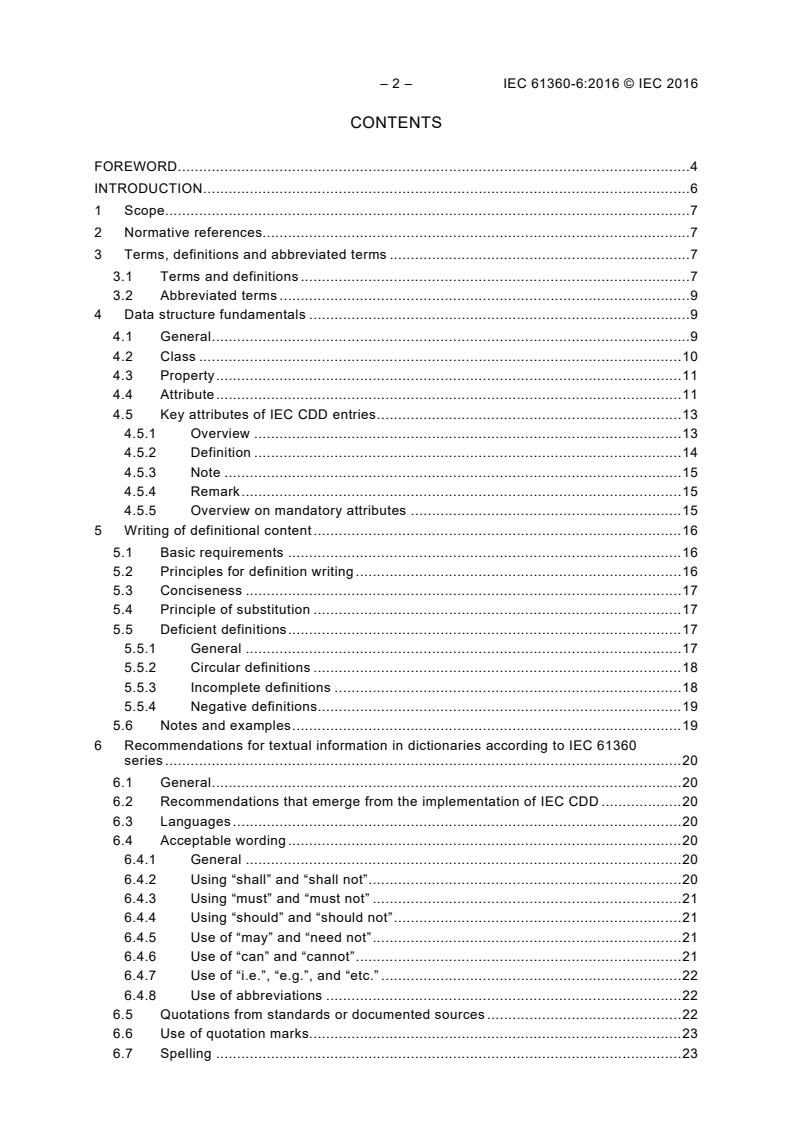
CONTENTS
FOREWORD . 4
INTRODUCTION . 6
1 Scope . 7
2 Normative references. 7
3 Terms, definitions and abbreviated terms . 7
3.1 Terms and definitions . 7
3.2 Abbreviated terms . 9
4 Data structure fundamentals . 9
4.1 General . 9
4.2 Class . 10
4.3 Property . 11
4.4 Attribute . 11
4.5 Key attributes of IEC CDD entries . 13
4.5.1 Overview . 13
4.5.2 Definition . 14
4.5.3 Note . 15
4.5.4 Remark . 15
4.5.5 Overview on mandatory attributes . 15
5 Writing of definitional content . 16
5.1 Basic requirements . 16
5.2 Principles for definition writing . 16
5.3 Conciseness . 17
5.4 Principle of substitution . 17
5.5 Deficient definitions . 17
5.5.1 General . 17
5.5.2 Circular definitions . 18
5.5.3 Incomplete definitions . 18
5.5.4 Negative definitions . 19
5.6 Notes and examples . 19
6 Recommendations for textual information in dictionaries according to IEC 61360
series . 20
6.1 General . 20
6.2 Recommendations that emerge from the implementation of IEC CDD . 20
6.3 Languages . 20
6.4 Acceptable wording . 20
6.4.1 General . 20
6.4.2 Using “shall” and “shall not” . 20
6.4.3 Using “must” and “must not” . 21
6.4.4 Using “should” and “should not” . 21
6.4.5 Use of “may” and “need not” . 21
6.4.6 Use of “can” and “cannot” . 21
6.4.7 Use of “i.e.”, “e.g.”, and “etc.” . 22
6.4.8 Use of abbreviations . 22
6.5 Quotations from standards or documented sources . 22
6.6 Use of quotation marks. 23
6.7 Spelling . 23
6.8 Hyphenation . 24
6.9 Words to avoid . 24
6.10 Frequently used words . 24
7 Names. 25
7.1 General . 25
7.2 Preferred name . 25
7.3 Synonymous name . 25
7.4 Names shall not infer range values . 25
7.5 Names shall not imply product packaging . 25
8 Units of measure . 26
9 Import of data into IEC CDD . 26
10 Quality of content . 26
11 Contributing content and copyright issues . 26
Annex A (informative) Use of tools to check consistency of data . 29
Annex B (normative) Scope and field of application of proposed data . 30
Annex C (normative) Checklist . 31
C.1 General . 31
C.2 Generic issues . 31
C.3 Extension of existing classes by adding properties . 31
C.4 Setting up new classes with associated properties . 32
Annex D (informative) IEC Maintenance procedure for IEC standards in database
format . 33
Annex E (informative) Nature of definitions and terminological principles . 35
Annex F (informative) Conventions for writing definitions . 36
F.1 General . 36
F.2 ISO/IEC 11179-4 . 36
F.2.1 Requirements . 36
F.2.2 Recommendations . 36
F.3 ISO 704 . 36
F.4 Additional conventions . 37
Bibliography . 38
Figure 1 – Characterization tree for amplifiers . 10
Figure 2 – Properties of a class . 11
Figure 3 – Attributes of a class . 12
Figure 4 – Attributes of a property . 13
Figure 5 – Input by an authorized person or body . 27
Figure 6 – Contributing content already contained in published standards . 28
Figure 7 – Database maintenance . 28
Figure D.1 – The normal database procedure (see ISO/IEC Directives
Supplement:2016, Annex SL) . 33
Figure D.2 – The extended database procedure (see ISO/IEC Directives
Supplement:2016, Annex SL) . 34
Figure D.3 – Process and related documentation . 34
Table 1 – Mandatory attributes of selected IEC CDD objects and their sources . 15
– 4 – IEC 61360-6:2016 © IEC 2016
INTERNATIONAL ELECTROTECHNICAL COMMISSION
____________
STANDARD DATA ELEMENT TYPES WITH
ASSOCIATED CLASSIFICATION SCHEME FOR
ELECTRIC COMPONENTS –
Part 6: IEC Common Data Dictionary (IEC CDD) quality guidelines
FOREWORD
1) The International Electrotechnical Commission (IEC) is a worldwide organization for standardization comprising
all national electrotechnical committees (IEC National Committees). The object of IEC is to promote
international co-operation on all questions concerning standardization in the electrical and electronic fields. To
this end and in addition to other activities, IEC publishes International Standards, Technical Specifications,
Technical Reports, Publicly Available Specifications (PAS) and Guides (hereafter referred to as “IEC
Publication(s)”). Their preparation is entrusted to technical committees; any IEC National Committee interested
in the subject dealt with may participate in this preparatory work. International, governmental and non-
governmental organizations liaising with the IEC also participate in this preparation. IEC collaborates closely
with the International Organization for Standardization (ISO) in accordance with conditions determined by
agreement between the two organizations.
2) The formal decisions or agreements of IEC on technical matters express, as nearly as possible, an international
consensus of opinion on the relevant subjects since each technical committee has representation from all
interested IEC National Committees.
3) IEC Publications have the form of recommendations for international use and are accepted by IEC National
Committees in that sense. While all reasonable efforts are made to ensure that the technical content of IEC
Publications is accurate, IEC cannot be held responsible for the way in which they are used or for any
misinterpretation by any end user.
4) In order to promote international uniformity, IEC National Committees undertake to apply IEC Publications
transparently to the maximum extent possible in their national and regional publications. Any divergence
between any IEC Publication and the corresponding national or regional publication shall be clearly indicated in
the latter.
5) IEC itself does not provide any attestation of conformity. Independent certification bodies provide conformity
assessment services and, in some areas, access to IEC marks of conformity. IEC is not responsible for any
services carried out by independent certification bodies.
6) All users should ensure that they have the latest edition of this publication.
7) No liability shall attach to IEC or its directors, employees, servants or agents including individual experts and
members of its technical committees and IEC National Committees for any personal injury, property damage or
other damage of any nature whatsoever, whether direct or indirect, or for costs (including legal fees) and
expenses arising out of the publication, use of, or reliance upon, this IEC Publication or any other IEC
Publications.
8) Attention is drawn to the Normative references cited in this publication. Use of the referenced publications is
indispensable for the correct application of this publication.
9) Attention is drawn to the possibility that some of the elements of this IEC Publication may be the subject of
patent rights. IEC shall not be held responsible for identifying any or all such patent rights.
International Standard IEC 61360-6 has been prepared by subcommittee 3D: Product
properties and classes and their identification, of IEC technical committee 3: Information
structures and elements, identification and marking principles, documentation and graphical
symbols.
The text of this standard is based on the following documents:
FDIS Report on voting
3D/279/FDIS 3D/283/RVD
Full information on the voting for the approval of this standard can be found in the report on
voting indicated in the above table.
This publication has been drafted in accordance with the ISO/IEC Directives, Part 2.
A list of all parts in the IEC 61360 series, published under the general title Standard data
element types with associated classification scheme for electric components, can be found on
the IEC website.
The committee has decided that the contents of this publication will remain unchanged until
the stability date indicated on the IEC website under "http://webstore.iec.ch" in the data
related to the specific publication. At this date, the publication will be
• reconfirmed,
• withdrawn,
• replaced by a revised edition, or
• amended.
IMPORTANT – The 'colour inside' logo on the cover page of this publication indicates
that it contains colours which are considered to be useful for the correct
understanding of its contents. Users should therefore print this document using a
colour printer.
– 6 – IEC 61360-6:2016 © IEC 2016
INTRODUCTION
The use of product data is an essential part of electronic business. Product selection,
business transactions, maintenance procedures, etc., rely on the availability of data about
products and services. To ensure a common understanding and a general treatment of
product data, classification and dictionary systems are used to define their essential technical
parameters or to categorize products.
The standards of the series IEC 61360 specify rules for structure and content of collections of
product properties and its classification structures. In most cases the classes and properties
contained in such collections are intuitively understandable. But, unfortunately, creating the
information objects and their textual content, such as definitions, has proved to be a
demanding task with potential pitfalls and problems. For avoiding such difficulties explanatory
material and sections of other standards are collected in this part of IEC 61360 providing the
necessary knowledge for successfully creating classes and properties. Thus, IEC 61360-6
provides guidance for specifying the information content of IEC 61360 classes and properties.
This part of IEC 61360 is intended for domain specialists who are technical experts in their
specific technical domain. The domain specialists do not necessarily have an in-depth
knowledge of IEC 61360-1 or IEC 61360-2.
STANDARD DATA ELEMENT TYPES WITH
ASSOCIATED CLASSIFICATION SCHEME FOR
ELECTRIC COMPONENTS –
Part 6: IEC Common Data Dictionary (IEC CDD) quality guidelines
1 Scope
This part of IEC 61360 provides guidance for the definition of concepts that are used to
describe classes and properties submitted for update of the content of IEC Common Data
Dictionary (IEC CDD). This includes
– a basic understanding of key concepts and procedures used within IEC CDD;
– a binding reference for quality control of IEC 61360 compliant dictionary content;
– guidance on documents where necessary in-depth knowledge can be acquired (see
Clause 2 and Annex D).
This part of IEC 61360 includes the following subjects:
– basic overview about fundamental concepts of IEC 61360;
– formulating definitions and other textual elements;
– overview of IEC maintenance procedure for IEC CDD;
– checklist for providing input to the IEC CDD content.
2 Normative references
The following documents, in whole or in part, are normatively referenced in this document and
are indispensable for its application. For dated references, only the edition cited applies. For
undated references, the latest edition of the referenced document (including any
amendments) applies.
IEC 61360-1, Standard data element types with associated classification scheme for electric
components – Part 1: Definitions – Principles and methods
IEC 61360-2:2012, Standard data element types with associated classification scheme for
electric components – Part 2: EXPRESS dictionary schema
IEC 62656-1, Standardized product ontology register and transfer by spreadsheets – Part 1:
Logical structure for data parcels
IEC TS 62656-2:2013, Standardized product ontology register and transfer by spreadsheets –
Part 2: Application guide for use with the IEC common data dictionary (CDD)
ISO 704:2009, Terminology work – Principles and methods
3 Terms, definitions and abbreviated terms
3.1 Terms and definitions
For the purposes of this document, the following terms and definitions apply.
– 8 – IEC 61360-6:2016 © IEC 2016
ISO and IEC maintain terminological databases for use in standardization at the following
addresses:
• IEC Electropedia: available at http://www.electropedia.org/
• ISO Online browsing platform: available at http://www.iso.org/obp
3.1.1
attribute
data element for the computer-sensible description of a property, a relation or a class
EXAMPLE Creation date of a product characterization class object in a computer system.
[SOURCE: ISO/IEC Guide 77-2:2008, 2.2, modified – The note has been deleted and the
example replaced.]
3.1.2
characteristic
distinguishing feature
Note 1 to entry: A characteristic can be inherent or assigned.
Note 2 to entry: A characteristic can be qualitative or quantitative.
[SOURCE: ISO 22274:2013, 3.3, modified – The notes 3 and 4 and the example have been
deleted.]
3.1.3
class
abstraction of a set of similar products
EXAMPLE The set of products used by a particular enterprise and the set of all ISO-standardized products are
two examples of contexts. In these two contexts (the particular enterprise and ISO), the set of products that are
considered as members of the single ball bearing class can be different, in particular because employees of each
enterprise ignore a number of existing single ball bearing products.
Note 1 to entry: A product that complies with the abstraction defined by a class is called a class member.
Note 2 to entry: A class is an intentional concept that can take different extensional meanings in different
contexts.
Note 3 to entry: Classes are structured by class inclusion relationships.
Note 4 to entry: A class of products is a general concept as defined in ISO 1087-1. Thus, it is advisable that the
rules defined in ISO 704 be used for defining the designation and definition attributes of classes of products.
Note 5 to entry: In the context of the ISO 13584 series, a class is either a characterization class, associated with
properties and usable for characterizing products, or a categorization class, not associated with properties and not
usable for characterizing products.
[SOURCE: IEC 61360-2:2012, 3.6]
3.1.4
concept
unit of knowledge created by a unique combination of characteristics
[SOURCE: ISO 22274:2013, 3.7]
3.1.5
definition
representation of a concept by a descriptive statement which serves to differentiate it from
other concepts
3.1.6
designation
representation of a concept by a sign which denotes it
3.1.7
extension
totality of objects to which a concept corresponds
[SOURCE: ISO 1087-1:2000, 3.2.8]
3.1.8
intension
set of characteristics which makes up the concept
[SOURCE: ISO 1087-1:2000, 3.2.9]
3.1.9
object
anything perceivable or conceivable
Note 1 to entry: Objects may be material (e.g., an engine, a sheet of paper, a diamond), immaterial (e.g.,
conversion ratio, a project plan) or imagined (e.g., a unicorn).
[SOURCE: ISO 1087-1:2000, 3.1.1]
3.1.10
property
defined characteristic suitable for the description and differentiation of the objects in a product
characterization class
EXAMPLE Ambient temperature can be a property of a product characterization class comprising geographical
locations.
[SOURCE: ISO 22274:2013, 3.25]
3.2 Abbreviated terms
IEC CDD IEC Common Data Dictionary
4 Data structure fundamentals
4.1 General
For the convenience of the reader, Clause 4 describes key concepts used in the IEC 61360
series and in related standards in a generic form for creating a basic understanding of the
information objects that make up IEC 61360 compliant dictionaries. For the detailed,
normative information, please refer to Part 1 and Part 2 of IEC 61360. Additional information
can be found in [7] and [8].
An IEC 61360 compliant dictionary provides an ordered collection of concepts and
characteristics that can be used for describing products or services in data sheets,
engineering tools, or electronic business applications, etc. These items may be any material
or non-material products, services, functions, locations, documentations, etc. All concepts and
characteristics shall be valid within a well defined domain and shall always have a definition.
For this the understanding of the following fundamental concepts is essential:
______________
Numbers in square brackets refer to the Bibliography.
– 10 – IEC 61360-6:2016 © IEC 2016
– class;
– property;
– attribute.
4.2 Class
A class is an abstraction of a set of products.
NOTE 1 IEC 61360-2 differentiates between various kinds of classes. For the purpose of this part "class" is
understood as "categorization class" (see 3.1.3, NOTE 5).
These products all serve the same purpose or fulfil the same function and share a number of
common peculiarities.
Thus, classes serve multiple purposes
– establishing a classification system that allows easy sorting of an item into this system of
concepts and thus specifying the nature of the item in question;
EXAMPLE The taxonomy of species, introduced by Carl von Linné at 1735, is an early representative of a
classification system. His groupings for animals remain to this day even though the groupings themselves have
been significantly changed since their conception.
– providing scoping information for the assigned characteristics and thus providing
information about their intended domains of uses;
– grouping of characteristics into easily manageable sets.
A class may be seen as a placeholder for all products of the same kind, such as the class of
amplifiers. A product is any material or non-material object being defined for some purpose.
Material products include concepts such as articles, goods, material commodities, etc.,
whereas non-material products include concepts such as services or consulting activities.
The creation of a consistent classification system that properly reflects a business domain can
be quite difficult. Such classification systems should be consistent, comprehensive, and
concise.
NOTE 2 An object that complies with the abstraction defined by a class is called a class member.
EXAMPLE Figure 1 shows a classification tree for amplifiers.
IEC
Figure 1 – Characterization tree for amplifiers
The class "Differential amplifiers" groups all characteristics that are specific for amplifiers whose output signal is
proportional to the algebraic difference between the voltages applied to their two inputs. Such a class can be split
further down into subclasses like operational amplifiers and ac-coupled amplifiers as shown in Figure 1.
4.3 Property
Properties specify the characteristics of the members of classes. Each property specifies one
characteristic and the set of associated properties fully specifies all characteristics of the
members of that class. All members of a class share the same set of properties.
In many cases properties have a unit of measure, and in some cases they have an assigned
value list or are constrained by conditions.
NOTE Properties express characteristics such as length, diameter, or rated voltage.
Additionally, each property shall be defined in a class. This class specifies the domain of
application of the property and the property shall be meaningful for the domain specified by
this class and its subclasses.
EXAMPLE Figure 2 shows properties assigned to a class.
IEC
Figure 2 – Properties of a class
4.4 Attribute
In the context of IEC 61360-1 compliant dictionaries an attribute specifies a single detail of
the dictionary item it belongs to.
EXAMPLE 1 Name of a property, identifier of a class, or version number are examples of attributes. Figure 3
shows typical attributes of a class record.
– 12 – IEC 61360-6:2016 © IEC 2016
NOTE All information elements such as classes or properties receive their information content from their
attributes.
IEC
Figure 3 – Attributes of a class
EXAMPLE 2 Figure 4 shows typical attributes of a property record.
IEC
Figure 4 – Attributes of a property
4.5 Key attributes of IEC CDD entries
4.5.1 Overview
Key elements of IEC CDD entries are the attributes that assign meaning to properties and
classes. The most important attributes are:
– definition;
– note;
– remark.
Textual information kept in the attributes of the objects such as preferred name, definition, or
note, are the backbone of the information content of the dictionary. Thus, great care shall be
applied to create syntactically and semantically error-free texts.
The quality of an IEC CDD entry mainly depends on the information given within these
attributes. Thus, it is important to draft their content carefully.
– 14 – IEC 61360-6:2016 © IEC 2016
4.5.2 Definition
Attribute name: definition
Attribute definition:
statement that describes the meaning of a property in an
unambiguous and unique manner to permit its differentiation from
all other properties
EXAMPLE 1 Definition of "arcing distance":
arcing distance
value of the shortest distance in air external to the insulator between metallic
parts normally having the operating voltage between them.
Comments:
Conventions and requirements:
a) Any definition shall be derived from the original definition as
appearing in the latest corresponding IEC or ISO standards, if
available.
b) Where possible, definitions of properties shall be independent
from specific classes. Thus, reuse of the properties in other
classes is supported.
c) ISO 704 should be used as a basis for the writing of the
definition.
d) The unit of measure shall not be included in the definition.
e) The level information should not be included in the definition.
NOTE Level information can be specified in attribute Level type.
f) The semantic context(s) should be included in the definition,
if this is essential for the understanding of its meaning.
g) If the concept requires a limitation of its applicability this shall
be explicitly expressed in the definition.
EXAMPLE 2 There exist different semantics of the term "rated voltage";
within products ≥ 1 kV, the terms rated voltage express the maximum
voltage for which a product is being designed and can be operated. This is
currently not applicable to products less than 1kV.
h) If dependency relations are an inherent part of the concept,
these shall be included in the definition.
EXAMPLE 3 Definition of the quantitative property "reverse recovery
time":
reverse recovery time
value of the time required for the reverse current of a diode to recover to a
specified value, when switched from a specified forward current to a
specified reverse voltage, at specified conditions
i) In the case conditions are specified, the definition should end
with the wording "at specified condition(s)".
j) If the concept represents a kind of average value, the method
of calculating the average shall be designated, by using a
term that designates the method, such as “arithmetic
mean”, ”geometric mean”, “median”, or “mode”, either in the
preferred name or in the definition.
Obligation: mandatory
4.5.3 Note
Attribute name: note
Attribute definition: statement which provides further information on the definition,
which is essential to the understanding of that definition
Comments:
EXAMPLE The property "reverse recovery time" is further clarified by a note:
"The reverse recovery time is measured as the time interval between t , the
point where the forward current crosses the zero current axis, and the instant
when for decreasing values of i a line through the points for 0,9 I and 0,25
R RM
I crosses the zero current axis."
RM
Obligation: optional
4.5.4 Remark
Attribute name: remark
Attribute definition: additional information in text for understanding the meaning of
the definition
Comments: the remark shall not change the meaning of the definition
Obligation: optional
4.5.5 Overview on mandatory attributes
Table 1 lists mandatory attributes of selected information objects of IEC 61360-1 and the
sources of their information content. For the description of the attributes see IEC 61360-1.
Table 1 – Mandatory attributes of selected IEC CDD objects and their sources
Source of
Name of attribute Remark
content
Identifying attributes
See IEC 61360-1 for additional information about
possible values of "code".
Code proposer
IEC maintains a list of reserved code spaces.
Preferred name proposer
Semantic attributes
Definition proposer
Administrative attributes
Status level IEC CDD
Date of current version IEC CDD
Date of current revision IEC CDD
Committee responsible for maintaining the information
Responsible committee proposer
object.
Property
Identifying attributes See above
Semantic attributes See above
Administrative attributes See above
Definition class proposer
Data element type class proposer
Data type proposer
Value format proposer
– 16 – IEC 61360-6:2016 © IEC 2016
Source of
Name of attribute Remark
content
Allowed codes:
NON_DEPENDENT_P_DET
Property data element type proposer DEPENDENT_P_DET
CONDITION_DET
DEPENDENT_C_DET
Depends on proposer Only for dependent properties: Pointer to condition
Class
Identifying attributes See above
Semantic attributes See above
Administrative attributes See above
Superclass proposer Pointer to the next higher class in the class hierarchy
Class type proposer Fixed value: ITEM_CLASS
Coded name proposer
NOTE "Property data element type" refers to a construct specified in IEC 61360-2:2012 having the same name.
5 Writing of definitional content
5.1 Basic requirements
A definition shall define a concept as a unit with a unique intension or extension. For
additional detail on terminological principles see Annex E, ISO 704:2009, or
ISO/IEC Directives, Part 2:2016, Clause 16.
The following basic requirements apply for definitions:
– Definitions shall be provided in the singular form;
EXAMPLE
Lead pencil
pencil whose graphite core is fixed in a wooden casing that is removed for usage by sharpening
– The content of the IEC 61360-1 attribute "preferred name" shall consequently be singular,
too;
– Definitions should consist ideally of a single string of words ("sentence") that may be used
to substitute the term in its original environment;
– Definitions shall start with a lowercase letter and end without a full stop.
NOTE The quality of a dictionary is decisively influenced by the quality of its definitions.
5.2 Principles for definition writing
Each definition shall comprise a statement explaining what the concept or characteristic is.
The statement is made up of a subject, copula and predicate. The subject is the designation,
the copula is understood to be the verb “is“ and the predicate constitutes the definition.
EXAMPLE 1
lead pencil
pencil whose graphite core is fixed in a wooden casing that is removed for usage by sharpening
Note 1 to entry To be used for writing or making marks, a lead pencil must be sharpened at least at one end.
The entry should read as follows: “[A] lead pencil [is a] pencil whose graphite core is fixed in a
wooden casing that is removed for usage by sharpening”.
The words making up the definition should be common language as specified by the reference
works for English language recommended by the IEC Directives (see ISO/IEC Directives,
Part 2:2016, 8.5) and should not need further explanation.
NOTE A concept or characteristic has always a definition regardless if its designation, i.e. preferred name (see
IEC 61360-1), is taken from commonly used dictionaries or other common sources.
EXAMPLE 2 The word "computer" used in the body of a definition does not need further explanation if its intended
meaning is in accordance to common language as specified, e.g., in The Concise Oxford Dictionary (see ISO/IEC
Directives, Part 2:2016, 8.2) whereas a concept or characteristic designated as "computer" always requires a
definition.
If expert language is unavoidable or misunderstandings are likely the definition should be
complemented by a reference to acknowledged sources such as International Standards or
expert literature where further explanation can be found.
5.3 Conciseness
Ideally, definitions shall be as simple and concise as possible. Complex definitions can
contain several dependent clauses, but carefully written definitions contain only that
information which makes the concept unique. On the other hand, no information required for
achieving the uniqueness of the concept or characteristic shall be hidden. All information
essential for defining the concept shall be disclosed.
EXAMPLE 1 The phrase “… and considering other conditions” in a definition states the necessity of additional
information for the definition without providing this information and, thus, violates the above requirement.
Any additional descriptive information deemed necessary should be included in a note.
EXAMPLE 2
lead pencil
pencil whose graphite core is fixed in a wooden casing that is removed for usage by sharpening
Note 1 to entry To be used for writing or making marks, a lead pencil must be sharpened at least at one end.
A definition shall describe only one concept or characteristic. It shall not include hidden
definitions for any concepts used to identify qualities. Any quality that requires an explanation
shall be defined separately as a concept or given in a note.
EXAMPLE 3
lead pencil
pencil whose wooden casing is fixed around graphite, a soft, black form of carbon
This definition of "lead pencil" includes a hidden defini
...