

IEC 62341-6-1:2017
(Main)Organic light emitting diode (OLED) displays - Part 6-1: Measuring methods of optical and electro-optical parameters
General Information
- Abstract
IEC 62341-6-1:2017(E) specifies the standard measurement conditions and measuring methods for determining optical and electro-optical parameters of organic light-emitting diode (OLED) display modules and, where specified, OLED display panels. These methods are limited to flat displays measured in a dark room.
This second edition cancels and replaces the first edition published in 2009. This edition constitutes a technical revision. This edition includes the following significant technical changes with respect to the previous edition:
a) extends the applicability of the measuring methods to include OLED displays that have multi-primary or red, green, blue and white sub-pixels;
b) adds a method to characterize how the luminance is affected by the amount of content on the screen;
c) adds a method to determine the dark room colour gamut volume in the CIELAB colour space.
- Status
- Published
- Publication Date
- 23-Jan-2017
- Technical Committee
- TC 110 - Electronic displays
- Drafting Committee
- WG 5 - TC 110/WG 5
- Current Stage
- DELPUB - Deleted Publication
- Start Date
- 14-Oct-2022
- Completion Date
- 30-Nov-2020
Buy Documents
IEC 62341-6-1:2017 - Organic light emitting diode (OLED) displays - Part 6-1: Measuring methods of optical and electro-optical parameters Released:1/24/2017
IEC 62341-6-1:2017 RLV - Organic light emitting diode (OLED) displays - Part 6-1: Measuring methods of optical and electro-optical parameters Released:1/24/2017
Overview
IEC 62341-6-1:2017 - "Organic light emitting diode (OLED) displays - Part 6‑1: Measuring methods of optical and electro‑optical parameters" - defines standard measurement conditions and methods for determining the optical and electro‑optical parameters of flat OLED display modules and, where specified, OLED panels. Measurements are taken in a controlled dark room environment. This second edition (2017) updates the first edition (2009) and extends methods to modern display architectures.
Key topics and technical requirements
The standard specifies practical, repeatable test methods and setups used by test labs and manufacturers. Major topics include:
Standard measuring conditions
- Dark‑room requirements, environmental conditions and instrument setup
- Standard test patterns, starting conditions and measurement positions on the active area
Optical and electro‑optical parameter measurements
- Luminance (maximum, full‑screen and windowed), luminance uniformity, and luminance current efficiency
- Chromaticity and colour: colour coordinates, correlated colour temperature (CCT), colour non‑uniformity
- Colour gamut and colour gamut volume: methods to derive gamut area and CIELAB colour gamut volume in dark‑room conditions
- Contrast ratio measured in dark‑room conditions (dark room contrast)
- Colour additivity, white point characterization and white field CCT
Advanced considerations for modern OLEDs
- Applicability to multi‑primary displays and RGBW/WRGB sub‑pixel structures
- APL (average picture level) loading methods to characterize how luminance depends on on‑screen content
- Procedures for power consumption measurement, response time (passive matrix), veiling glare, and methods to obtain CCT from chromaticity coordinates
Practical applications - who uses this standard
IEC 62341-6-1 is used by:
- Display manufacturers for design verification, production control and datasheet specifications
- Independent test laboratories for consistent, repeatable measurements and benchmarking
- OEMs / product integrators when validating panels for TVs, smartphones, tablets, automotive displays and signage
- R&D teams developing multi‑primary or RGBW OLED architectures, to quantify APL effects and colour volume
- Procurement and compliance teams specifying objective optical and electro‑optical acceptance criteria
Related standards
- Part of the IEC 62341 family covering OLED displays; consult other parts for module/panel mechanical, electrical or interface requirements and for the latest corrigenda or amendments.
Keywords: IEC 62341-6-1, OLED displays, measuring methods, optical parameters, electro‑optical parameters, luminance, colour gamut, CIELAB, dark room, APL loading, RGBW, multi‑primary displays.
Relations
- Effective Date
- 05-Sep-2023
- Effective Date
- 05-Sep-2023
Buy Documents
IEC 62341-6-1:2017 - Organic light emitting diode (OLED) displays - Part 6-1: Measuring methods of optical and electro-optical parameters Released:1/24/2017
IEC 62341-6-1:2017 RLV - Organic light emitting diode (OLED) displays - Part 6-1: Measuring methods of optical and electro-optical parameters Released:1/24/2017
Get Certified
Connect with accredited certification bodies for this standard

IMQ S.p.A. (Certification)
Italian electrical product certification.

SLG Prüf- und Zertifizierungs GmbH
German testing and certification body.

UL Solutions
Global safety science company with testing, inspection and certification.
Sponsored listings
Frequently Asked Questions
IEC 62341-6-1:2017 is a standard published by the International Electrotechnical Commission (IEC). Its full title is "Organic light emitting diode (OLED) displays - Part 6-1: Measuring methods of optical and electro-optical parameters". This standard covers: IEC 62341-6-1:2017(E) specifies the standard measurement conditions and measuring methods for determining optical and electro-optical parameters of organic light-emitting diode (OLED) display modules and, where specified, OLED display panels. These methods are limited to flat displays measured in a dark room. This second edition cancels and replaces the first edition published in 2009. This edition constitutes a technical revision. This edition includes the following significant technical changes with respect to the previous edition: a) extends the applicability of the measuring methods to include OLED displays that have multi-primary or red, green, blue and white sub-pixels; b) adds a method to characterize how the luminance is affected by the amount of content on the screen; c) adds a method to determine the dark room colour gamut volume in the CIELAB colour space.
IEC 62341-6-1:2017(E) specifies the standard measurement conditions and measuring methods for determining optical and electro-optical parameters of organic light-emitting diode (OLED) display modules and, where specified, OLED display panels. These methods are limited to flat displays measured in a dark room. This second edition cancels and replaces the first edition published in 2009. This edition constitutes a technical revision. This edition includes the following significant technical changes with respect to the previous edition: a) extends the applicability of the measuring methods to include OLED displays that have multi-primary or red, green, blue and white sub-pixels; b) adds a method to characterize how the luminance is affected by the amount of content on the screen; c) adds a method to determine the dark room colour gamut volume in the CIELAB colour space.
IEC 62341-6-1:2017 is classified under the following ICS (International Classification for Standards) categories: 17.220.99 - Other standards related to electricity and magnetism; 29.035.20 - Plastics and rubber insulating materials; 31.260 - Optoelectronics. Laser equipment. The ICS classification helps identify the subject area and facilitates finding related standards.
IEC 62341-6-1:2017 has the following relationships with other standards: It is inter standard links to IEC 62341-6-1:2009, IEC 62341-6-1:2022. Understanding these relationships helps ensure you are using the most current and applicable version of the standard.
IEC 62341-6-1:2017 is available in PDF format for immediate download after purchase. The document can be added to your cart and obtained through the secure checkout process. Digital delivery ensures instant access to the complete standard document.
Standards Content (Sample)
IEC 62341-6-1 ®
Edition 2.0 2017-01
INTERNATIONAL
STANDARD
colour
inside
Organic light emitting diode (OLED) displays –
Part 6-1: Measuring methods of optical and electro-optical parameters
All rights reserved. Unless otherwise specified, no part of this publication may be reproduced or utilized in any form
or by any means, electronic or mechanical, including photocopying and microfilm, without permission in writing from
either IEC or IEC's member National Committee in the country of the requester. If you have any questions about IEC
copyright or have an enquiry about obtaining additional rights to this publication, please contact the address below or
your local IEC member National Committee for further information.
IEC Central Office Tel.: +41 22 919 02 11
3, rue de Varembé Fax: +41 22 919 03 00
CH-1211 Geneva 20 info@iec.ch
Switzerland www.iec.ch
About the IEC
The International Electrotechnical Commission (IEC) is the leading global organization that prepares and publishes
International Standards for all electrical, electronic and related technologies.
About IEC publications
The technical content of IEC publications is kept under constant review by the IEC. Please make sure that you have the
latest edition, a corrigenda or an amendment might have been published.
IEC Catalogue - webstore.iec.ch/catalogue Electropedia - www.electropedia.org
The stand-alone application for consulting the entire The world's leading online dictionary of electronic and
bibliographical information on IEC International Standards, electrical terms containing 20 000 terms and definitions in
Technical Specifications, Technical Reports and other English and French, with equivalent terms in 16 additional
documents. Available for PC, Mac OS, Android Tablets and languages. Also known as the International Electrotechnical
iPad. Vocabulary (IEV) online.
IEC publications search - www.iec.ch/searchpub IEC Glossary - std.iec.ch/glossary
The advanced search enables to find IEC publications by a 65 000 electrotechnical terminology entries in English and
variety of criteria (reference number, text, technical French extracted from the Terms and Definitions clause of
committee,…). It also gives information on projects, replaced IEC publications issued since 2002. Some entries have been
and withdrawn publications. collected from earlier publications of IEC TC 37, 77, 86 and
CISPR.
IEC Just Published - webstore.iec.ch/justpublished
Stay up to date on all new IEC publications. Just Published IEC Customer Service Centre - webstore.iec.ch/csc
details all new publications released. Available online and If you wish to give us your feedback on this publication or
also once a month by email. need further assistance, please contact the Customer Service
Centre: csc@iec.ch.
IEC 62341-6-1 ®
Edition 2.0 2017-01
INTERNATIONAL
STANDARD
colour
inside
Organic light emitting diode (OLED) displays –
Part 6-1: Measuring methods of optical and electro-optical parameters
INTERNATIONAL
ELECTROTECHNICAL
COMMISSION
ICS 31.260 ISBN 978-2-8322-3845-5
– 2 – IEC 62341-6-1:2017 © IEC 2017
CONTENTS
FOREWORD . 5
1 Scope . 7
2 Normative references . 7
3 Terms, definitions, and abbreviated terms . 7
3.1 Terms and definitions . 7
3.2 Abbreviated terms . 8
4 Structure of measuring equipment . 8
5 Standard measuring conditions . 8
5.1 Standard environmental conditions for measurements . 8
5.2 Standard dark room conditions for measurements . 8
5.3 Standard setup conditions . 9
5.3.1 General . 9
5.3.2 Adjustment of OLED display modules . 9
5.3.3 Starting conditions of measurements . 9
5.3.4 Measuring equipment requirements . 9
5.4 Standard locations of measurement field. 11
5.5 Standard test patterns . 11
6 Measuring methods for optical parameters . 16
6.1 Primary luminance, colour, and uniformity of full-colour high-resolution
modules . 16
6.1.1 Purpose . 16
6.1.2 Measuring conditions . 16
6.1.3 Measuring method for high-resolution full-colour modules . 16
6.1.4 Maximum luminance of white and RGB primaries . 18
6.1.5 Average colour of white and RGB primaries . 18
6.1.6 Luminance uniformity of white and RGB primaries . 19
6.1.7 Colour non-uniformity of white and RGB primaries . 19
6.1.8 Colour additivity of white and RGB primaries . 20
6.1.9 White correlated colour temperature . 20
6.2 Primary luminance, colour, and uniformity of low-resolution modules . 21
6.2.1 Purpose . 21
6.2.2 Measuring conditions . 21
6.2.3 Measuring method for low-resolution modules and segmented displays . 21
6.3 Signal loading . 21
6.3.1 Purpose . 21
6.3.2 Measuring conditions . 21
6.3.3 Measuring methods . 21
6.4 Dark room contrast ratio . 22
6.4.1 Purpose . 22
6.4.2 Measuring conditions . 22
6.4.3 Measuring method . 23
6.5 Display colour gamut, colour gamut area, and colour gamut volume . 23
6.5.1 Purpose . 23
6.5.2 Measuring conditions . 23
6.5.3 Measuring method . 23
6.5.4 Display colour gamut . 24
6.5.5 Display colour gamut area in CIE 1976 chromaticity diagram . 24
6.5.6 Colour gamut volume . 24
7 Measuring methods for power consumption . 26
7.1 Purpose . 26
7.2 Measuring conditions . 26
7.3 Measuring method . 26
Annex A (normative) Response time of passive matrix display panels . 28
A.1 Purpose . 28
A.2 Measuring conditions . 28
A.3 Measuring method . 28
Annex B (normative) Luminance current efficiency . 30
B.1 Purpose . 30
B.2 Measuring conditions . 30
B.3 Measuring method . 30
Annex C (informative) Veiling glare frustum . 32
Annex D (informative) Methods to obtain the correlated colour temperature (CCT) from
chromaticity coordinates . 33
D.1 Method 1: using McCamy’s approximate formula. 33
D.2 Method 2: using Javier Hernandez-Andres’s approximate formula . 33
D.3 Method 3: graphical determination of correlated colour temperature. 34
Annex E (informative) Measuring the performance of modern colour-managed displays
and panels . 36
E.1 Legacy displays . 36
E.2 Modern displays . 36
E.3 Results . 38
E.4 Conclusion . 41
Annex F (informative) Simple window luminance and colour measurements . 42
F.1 Background. 42
F.2 Measuring conditions . 42
F.3 Maximum full-screen luminance . 42
F.4 4 % window luminance . 42
F.5 Sampled luminance non-uniformity . 42
F.6 4 % window centre colour . 43
F.7 Sampled colour non-uniformity . 44
Bibliography . 45
Figure 1 – Layout diagram of measurement setup . 10
Figure 2 – Standard measurement positions in the active area of the display . 11
Figure 3 – Test pattern scaling used to define the area size of the coloured rectangles
in the active area of the display . 12
Figure 4 – Low APL loading series of red, green, blue, and white test patterns used for
basic luminance, colour, and uniformity measurements . 13
Figure 5 – Medium (top) and high (bottom) APL loading versions of CTR pattern . 14
Figure 6 – Standard low APL RGBCMY test pattern used for centre luminance and
colour measurements . 15
Figure 7 – Optional medium APL RGBCMY test pattern used for centre luminance and
colour measurements . 16
– 4 – IEC 62341-6-1:2017 © IEC 2017
Figure 8 – Sequence for measuring luminance and colour at the nine standard display
positions for all coloured tile patterns . 17
Figure 9 – Colour of blackbody source at various temperatures as represented on the
CIE 1931 chromaticity diagram . 20
Figure 10 – Example representation of the same primary colours in the CIE 1931 (left)
and CIE 1976 (right) chromaticity diagrams. 24
Figure 11 –Example of the range of colours produced by a given display as
represented by the CIELAB colour space . 25
Figure 12 – Example of measurement setup of power consumption . 27
Figure A.1 – Relationship between the driving signal and the optical response times . 29
Figure B.1 – Example of a measurement configuration for measuring luminance current
efficiency . 31
Figure C.1 – Pattern for veiling glare frustum . 32
Figure D.1 – CIE 1931 XYZ chromaticity diagram . 34
Figure D.2 – Blackbody locus (Planckian locus) and isotemperature lines in CIE 1931
chromaticity diagram . 35
Figure E.1 – Legacy model where the independent drive electronics provide a direct
correlation between the input RGB signals and the display’s colour primaries . 36
Figure E.2 – Example of modern drive models utilizing multi-dimensional LUTs for
RGB (top) and multi-primary (bottom) displays . 37
Figure E.3 – Example of APL loading behaviour for a WRGB (top) and RGB (bottom)
OLED display . 39
Figure E.4 – Low APL loading test pattern with small box size (1/9 the screen size
dimensions) . 40
Figure E.5 – APL loading profiles for several input colours measured at the centre of
the test pattern using Figure E.4 . 41
Figure F.1 – Example of a simple 4 % white window pattern at the centre of the screen. 43
Table 1 – Standard digital-equivalent input signals for rendering the white, primary
and secondary colours in test patterns . 15
Table 2 – Example of luminance measured of the same colour at the nine standard
screen positions and the resulting luminance non-uniformity . 18
Table 3 – Example of the same colour measured at the nine standard screen positions
and the resulting chromaticity non-uniformity . 18
Table 4 – Scaling the size of the colour boxes in the APL loading pattern relative to
the screen dimensions . 22
Table 5 – Example of a summary sheet for module power consumption measurements . 27
Table D.1 – x , y , A and t for Formula (D.3) and Formula (D.4) . 33
e e i i
Table E.1 – Example of luminance data for an RGB and WRGB OLED display . 38
INTERNATIONAL ELECTROTECHNICAL COMMISSION
____________
ORGANIC LIGHT EMITTING DIODE (OLED) DISPLAYS –
Part 6-1: Measuring methods of optical and electro-optical parameters
FOREWORD
1) The International Electrotechnical Commission (IEC) is a worldwide organization for standardization comprising
all national electrotechnical committees (IEC National Committees). The object of IEC is to promote
international co-operation on all questions concerning standardization in the electrical and electronic fields. To
this end and in addition to other activities, IEC publishes International Standards, Technical Specifications,
Technical Reports, Publicly Available Specifications (PAS) and Guides (hereafter referred to as “IEC
Publication(s)”). Their preparation is entrusted to technical committees; any IEC National Committee interested
in the subject dealt with may participate in this preparatory work. International, governmental and non-
governmental organizations liaising with the IEC also participate in this preparation. IEC collaborates closely
with the International Organization for Standardization (ISO) in accordance with conditions determined by
agreement between the two organizations.
2) The formal decisions or agreements of IEC on technical matters express, as nearly as possible, an international
consensus of opinion on the relevant subjects since each technical committee has representation from all
interested IEC National Committees.
3) IEC Publications have the form of recommendations for international use and are accepted by IEC National
Committees in that sense. While all reasonable efforts are made to ensure that the technical content of IEC
Publications is accurate, IEC cannot be held responsible for the way in which they are used or for any
misinterpretation by any end user.
4) In order to promote international uniformity, IEC National Committees undertake to apply IEC Publications
transparently to the maximum extent possible in their national and regional publications. Any divergence
between any IEC Publication and the corresponding national or regional publication shall be clearly indicated in
the latter.
5) IEC itself does not provide any attestation of conformity. Independent certification bodies provide conformity
assessment services and, in some areas, access to IEC marks of conformity. IEC is not responsible for any
services carried out by independent certification bodies.
6) All users should ensure that they have the latest edition of this publication.
7) No liability shall attach to IEC or its directors, employees, servants or agents including individual experts and
members of its technical committees and IEC National Committees for any personal injury, property damage or
other damage of any nature whatsoever, whether direct or indirect, or for costs (including legal fees) and
expenses arising out of the publication, use of, or reliance upon, this IEC Publication or any other IEC
Publications.
8) Attention is drawn to the Normative references cited in this publication. Use of the referenced publications is
indispensable for the correct application of this publication.
9) Attention is drawn to the possibility that some of the elements of this IEC Publication may be the subject of
patent rights. IEC shall not be held responsible for identifying any or all such patent rights.
International Standard IEC 62341-6-1 has been prepared by IEC technical committee 110:
Electronic display devices.
This second edition cancels and replaces the first edition published in 2009. This edition
constitutes a technical revision.
This edition includes the following significant technical changes with respect to the previous
edition:
a) extends the applicability of the measuring methods to include OLED displays that have
multi-primary or red, green, blue and white sub-pixels;
b) adds a method to characterize how the luminance is affected by the amount of content on
the screen;
c) adds a method to determine the dark room colour gamut volume in the CIELAB colour
space.
– 6 – IEC 62341-6-1:2017 © IEC 2017
The text of this standard is based on the following documents:
FDIS Report on voting
110/816/FDIS 110/830/RVD
Full information on the voting for the approval of this International Standard can be found in
the report on voting indicated in the above table.
This document has been drafted in accordance with the ISO/IEC Directives, Part 2.
A list of all the parts in the IEC 62341 series, under the general title Organic light emitting
diode (OLED) displays, can be found on the IEC website.
The committee has decided that the contents of this document will remain unchanged until the
stability date indicated on the IEC website under "http://webstore.iec.ch" in the data related to
the specific document. At this date, the document will be
• reconfirmed,
• withdrawn,
• replaced by a revised edition, or
• amended.
A bilingual version of this publication may be issued at a later date.
IMPORTANT – The 'colour inside' logo on the cover page of this publication indicates
that it contains colours which are considered to be useful for the correct
understanding of its contents. Users should therefore print this document using a
colour printer.
ORGANIC LIGHT EMITTING DIODE (OLED) DISPLAYS –
Part 6-1: Measuring methods of optical and electro-optical parameters
1 Scope
This part of IEC 62341 specifies the standard measurement conditions and measuring
methods for determining optical and electro-optical parameters of organic light-emitting diode
(OLED) display modules and, where specified, OLED display panels. These methods are
limited to flat displays measured in a dark room.
2 Normative references
The following documents are referred to in the text in such a way that some or all of their
content constitutes requirements of this document. For dated references, only the edition
cited applies. For undated references, the latest edition of the referenced document (including
any amendments) applies.
IEC 60050-845, International Electrotechnical Vocabulary – Part 850: Lighting (available at
www.electropedia.org)
IEC 61966-2-1, Multimedia systems and equipment – Colour measurement and management
– Part 2-1: Colour management – Default RGB colour space – sRGB
IEC 62341-1-2, Organic light emitting diode (OLED) displays – Part 1-2: Terminology and
letter symbols
IEC 62341-6-2:2015, Organic light emitting diode (OLED) displays – Part 6-2: Measuring
methods of visual quality and ambient performance
CIE 15:2004, Colorimetry, 3rd edition
CIE S 014-1, Colorimetry – Part 1: CIE Standard Colorimetric Observers
3 Terms, definitions, and abbreviated terms
3.1 Terms and definitions
For the purposes of this document, the terms and definitions given in IEC 60050-845,
IEC 62341-1-2, and the following apply.
ISO and IEC maintain terminological databases for use in standardization at the following
addresses:
• IEC Electropedia: available at http://www.electropedia.org
• ISO Online browsing platform: available at http://www.iso.org/obp
3.1.1
signal pixel
smallest encoded picture element in the input image
– 8 – IEC 62341-6-1:2017 © IEC 2017
3.1.2
pre-gamma average picture level
average input level of all signal pixels relative to an equivalent white pixel driven by a digital
RGB input
Note 1 to entry: Unless otherwise stated, the pre-gamma average picture level (APL) will simply be referred to as
average picture level in this document.
Note 2 to entry: The APL will normally be expressed as a percentage, where a full white screen at maximum drive
level would be 100 % APL.
3.2 Abbreviated terms
APL average picture level
CCT correlated colour temperature
CIE Commission internationale de l’éclairage (International Commission on
Illumination)
CIELAB CIE 1976 (L*a*b*) colour space
CMY cyan, magenta, and yellow
DUT device under test
LMD light-measuring device
LUT look-up table
PMOLED passive matrix organic light-emitting diode
RGB red, green, and blue
RGBCMY red, green, blue, cyan, magenta, and yellow
sRGB standard RGB colour space as defined in IEC 61966-2-1
UCS uniform chromaticity scale
WRGB white, red, green, and blue
4 Structure of measuring equipment
The system diagrams and/or operating conditions of the measuring equipment shall comply
with the structure specified in each item.
5 Standard measuring conditions
5.1 Standard environmental conditions for measurements
Measurements shall be carried out under standard environmental conditions at a temperature
of 25 °C ± 3 °C, at a relative humidity of 25 % to 85 %, and at an air pressure of 86 kPa to
106 kPa. When different environmental conditions are used, they shall be noted in the report.
5.2 Standard dark room conditions for measurements
The luminance contribution from unwanted background illumination reflected off the test
display shall be less than 1/20 of the display’s black state luminance. If these conditions are
not satisfied, then background subtraction is required and it shall be noted in the test report.
In addition, if the sensitivity of the LMD is inadequate to measure 1/20 of the black level, then
the lower limit of the LMD shall be noted in the test report.
5.3 Standard setup conditions
5.3.1 General
Standard setup conditions are given below. Any deviations from these conditions shall be
recorded.
5.3.2 Adjustment of OLED display modules
The display shall be measured at its factory default settings. If other settings are used, they
shall be noted in the test report. These settings shall be held constant for all measurements,
unless stated otherwise. It is important, however, to make sure that not only the adjustments
are kept constant, but also that the resulting physical quantities remain constant during the
measurement. This is not automatically the case because of, for example, warm-up effects.
5.3.3 Starting conditions of measurements
Measurements shall be started after the OLED display and the measuring instruments achieve
stability. It is recommended that, when the display is first turned on, it be operated for at least
30 min with a loop of colour patterns rendered on the screen. Sufficient warm-up time has
been achieved when the luminance of the test feature to be measured varies by less than
±3 % over the entire measurement method for a given display image.
5.3.4 Measuring equipment requirements
5.3.4.1 General conditions
Light measurements shall generally be measured in terms of photometric or colorimetric units
for a CIE 1931 standard colorimetric observer as defined in CIE S 014-1. Luminance can be
measured by a photometer, and CIE tristimulus values (X, Y, Z) or CIE chromaticity
coordinates by a colorimeter. A spectroradiometer can also obtain photometric and
colorimetric values through a numerical conversion of the measured spectral radiance data
(see for example [1] ). Non-contact LMD, where the LMD is not in direct contact with the
screen, shall be used without an illumination source. The following requirements are given for
these instruments:
a) The LMD shall be a luminance meter, a colorimeter, or a spectroradiometer. The
spectroradiometer shall be capable of measuring spectral radiance over at least the
380 nm to 780 nm spectral range, with a maximum bandwidth of 10 nm for smooth
broadband spectra. For OLED primaries with bandwidth ≤ 25 nm, the maximum bandwidth
shall be ≤ 5 nm. The spectral bandwidth of the spectroradiometer shall be an integer
multiple of the sampling interval. For example, a 5 nm sampling interval can be used for a
5 nm or 10 nm bandwidth.
Care shall be taken to ensure that the LMD has enough sensitivity and dynamic range to
perform the required task. The measured LMD signal shall be at least ten times greater
than the dark level (noise floor) of the LMD, and no greater than 85 % of the saturation
level.
b) The LMD shall be focused on the image plane of the display and generally aligned
perpendicular to the display surface at the centre of the measurement field, unless stated
otherwise.
c) The relative uncertainty and repeatability of all the measuring devices shall be maintained
by following the instrument supplier’s recommended calibration schedule.
d) The LMD integration time shall be an integer number of frame periods, synchronized to
the frame rate, or the integration time shall be greater than one hundred frame periods.
___________
Numbers in square brackets refer to the Bibliography.
– 10 – IEC 62341-6-1:2017 © IEC 2017
e) If LMD measurements are taken for displays with impulse driving or duty driving, the high
peak luminance of these displays can cause detector saturation errors. The accuracy of
these measurements can be checked by attenuating the light with a neutral-density filter.
If the change in signal amplitude of the detector is proportional to the transmittance of the
neutral-density filter, then there are no detector saturation errors. This method is for
measuring the maximum time-averaged full-screen luminance.
When using LMDs, stray light within the LMD (e.g. lens flare, veiling glare) and non-
uniformities of sensitivity across the detector area should be considered.
In addition to LMDs that form an average value for the measured quantity over the
measurement field under consideration (i.e. spot photometers, Figure 1), there are imaging
LMDs which give a value (or an array of values, e.g. R, G and B) for each individual area-
element on the DUT. Such LMDs can replace a sequential mechanical scan of the surface of
a display by an image of the entire active area of the DUT, and a subsequent evaluation of
the data.
When imaging LMDs are used, a flat-field correction shall be applied to the LMD at the
measuring distance.
Acceptance area (entrance pupil)
Field of view
Luminance
Angular field
Angular
meter with
of view
aperture
viewport
Measurement
field
Measurement field angle
Focus on object
being measured
IEC
Figure 1 – Layout diagram of measurement setup
5.3.4.2 High pixel count matrix displays (≥ 320 × 240 pixels)
The following applies for high pixel count matrix displays.
a) When measuring matrix displays, the light-measuring devices should be set to a
measurement field that includes more than 500 pixels. For LMDs with a circular
measurement field, this would be equivalent to a disk with a diameter greater than 25
display pixels. If smaller measurement areas are necessary, photometric and colorimetric
equivalence to 500 pixels shall be confirmed and noted in the test report.
b) For small displays, the recommended measuring distance is between 20 cm to 50 cm. For
larger displays, the measurement area shall contain at least 500 pixels. The measuring
distance shall be noted in the report.
c) The angular aperture shall be less than or equal to 5°, and the measurement field angle
shall be less than or equal to 2° (see Figure 1).
d) The display shall be operated at its design field frequency. When using separate driving
signal equipment to operate a panel, the drive conditions shall be noted in the report.
5.3.4.3 Low pixel count matrix displays (< 320 × 240 pixels) and segmented displays
The following applies for low pixel count matrix displays.
a) Low pixel count displays may contain fewer than 500 pixels. When the number of pixels in
the measurement field is less than 500, it shall be noted in the report. The angular
aperture shall be less than or equal to 5°, and the measurement field angle shall be less
than or equal to 2°. The measurement conditions used shall be recorded.
b) For segment displays, the angular aperture shall be less than or equal to 5°, and the
measurement field angle shall be less than or equal to 2°. All measurements shall be
performed at the centre of a segment with the measurement field completely contained
within the segment.
c) For small displays, the recommended measuring distance is between 20 cm to 50 cm. For
larger displays, follow the manufacturer's recommended viewing distance. For larger
displays, the measurement area shall contain at least 500 pixels. The measuring distance
shall be noted in the report.
5.4 Standard locations of measurement field
Luminance, spectral distribution and/or tristimulus measurements may be taken at several
specified positions on the display's surface. The standard measurement locations are
identified by positions P to P in the active area, as illustrated in Figure 2. The active screen
1 9
area is divided into nine equal-sized boxes, with the measurement area centred within each
box and identified by the corresponding numbering shown in Figure 2. Each box is 1/3 of the
width (W) and height (H) of the active area. Centre screen measurements are taken at
position P The display or detector shall be translated in the horizontal and vertical directions
5.
to perform measurements at the desired display positions, with all measurements taken
normal to the screen. Any deviation from the standard positions above shall be recorded.
W/3 W/3
W
IEC
Figure 2 – Standard measurement positions in the active area of the display
5.5 Standard test patterns
The characterization of display luminance and colour can depend on the display test pattern.
Therefore, several standard test patterns are given to help make the measurements more
realistic to actual use cases (see Annex E). Additional test patterns may also be used (see
Annex F). The standard test patterns use the scaling illustrated in Figure 3. The display is
divided into a 3 × 3 array of rectangular areas, each of which has sides that are 1/3 of the
dimension of the height and width of the screen's active area. Each of these nine rectangular
areas can then be further subdivided into smaller rectangles, as demonstrated in the upper
left-hand corner of Figure 3. The smallest subdivision would yield a rectangular box that has
dimensions of 1/9 of those of the active area of each region of the 3 × 3 array.
H
H/3
H/3
– 12 – IEC 62341-6-1:2017 © IEC 2017
Figure 3 – Test pattern scaling used to define the area size
of the coloured rectangles in the active area of the display
The standard test pattern for basic primary luminance and colour measurements shall use the
low APL loading example of the colour tile test patterns illustrated in Figure 4. In this case,
coloured rectangular boxes, with 1/9 of the dimensions of the active area, are centred on the
nine standard active area locations on a black background. The red, green, and blue boxes
are driven at the maximum input signal levels for the primary channels. For example, the red
box is driven at the maximum input signal for the red channel, while the green and blue
channels are at their minimum signal level. The white boxes are driven at their maximum red,
green, and blue channel inputs. Each colour tile pattern is identified by the initials CT (colour
tile) and the colour of the centre box. The patterns in Figure 4 are identified as CTR, CTG,
CTW, and CTB when starting from the upper left-hand pattern and moving clockwise.
1 2 3 1 2 3
4 5 6 4 5 6
7 8 9 7 8 9
1 2 3 1 2 3
4 5 6 4 5 6
7 8 9 7 8 9
IEC
Figure 4 – Low APL loading series of red, green, blue, and white test
patterns used for basic luminance, colour, and uniformity measurements
The area scaling of the coloured rectangles is adjusted to manipulate the APL loading on the
display. The amount of APL loading is input-referred, assuming it is an RGB digital input. The
percent APL is defined as:
N
PLi
∑
i =1
APL(%) = 100 × (1)
N
where the summation is over all pixels in the active area, PL is the normalized signal pixel
i
level of the i-th pixel relative to maximum white level, and N is the total number of pixels. A
100 % APL would be represented by all pixels in the active area at maximum white level. This
would be implemented by setting the levels for the red, green, and blue input channels to their
maximum values. A single primary colour (e.g. red) rendered on a full screen would have 1/3
of the APL of a full white screen. If it is assumed that the red, green, and blue areas
correspond to 1/3 of the APL of the white areas, then the APL for each pattern in Figure 4 is
(starting at the upper left-hand corner and going clockwise) 5,3 %, 5,3 %, 6,2 %, and 5,3 %.
The average APL for the four patterns in Figure 4 is 5,6 %. An example calculation of the top
left pattern in Figure 4 is given by:
[(7 primary colours x 1/3 of white) + (2 white boxes x 3/3 of white)]
x [(1/9) fractional area of boxes] = 5,3% APL
Higher loading versions of the colour tile pattern are illustrated in Figure 5. The sequence of
four-colour tile patterns at the medium loading geometry would give an average APL
equivalent of 22 %, whereas the high loading pattern would give an average APL equivalent
of 50 %.
– 14 – IEC 62341-6-1:2017 © IEC 2017
1 2 3
4 5 6
7 8 9
1 2 3
4 5 6
7 8 9
IEC
NOTE The corresponding CTG, CTB, and CTW patterns are of similar size but have green, blue, and white,
respectively, in the centre box.
Figure 5 – Medium (top) and high (bottom) APL loading versions of CTR pattern
In cases where more than the white and RGB input primary colours are needed for luminance
and colour measurements, the low APL loading RBGCMY box pattern illustrated in Figure 6
shall be used. This pattern is intended for centre luminance and colour measurements. Each
coloured box is centred on the nine standard active area locations (see Figure 2) on a black
background, with height and width corresponding to 1/9 of the dimensions of the active area.
Each of the white, red, green, blue, cyan, magenta, and yellow colours are at their maximum
input-referred signal setting as defined in Table 1. The centre rectangle can be changed to
the desired colour to be measured. However, the colours of the surrounding eight rectangular
patterns shall remain constant. If a maximum white colour is rendered in the centre box, the
APL is 6,2 % for this low loading case. Additional higher-loading patterns may also be used.
For example, a medium APL loading pattern with 2/9 of the dimensions of the active area that
produces about 25 % APL is illustrated in Figure 7. A high-loading version, where each
rectangle is 1/3 of the active area's dimensions, would have 56 % APL.
IEC
NOTE The centre rectangle can be changed to any desired colour, while the surrounding rectangles remain fixed.
The notation identifies the colours used in the pattern and is not displayed when measurements are taken.
Figure 6 – Standard low APL RGBCMY test pattern
used for centre luminance and colour measurements
Table 1 – Standard digital-equivalent input signals for rendering
the white, primary and secondary colours in test patterns
Colour Q Equivalent 8-bit digital signal level
Red channel Green channel Blue channel
K (Black) 0 0 0
R (Red) 255 0 0
G (Green) 0 255 0
B (Blue) 0 0 255
Y (Yellow) 255 255 0
M (Magenta) 255 0 255
C (Cyan) 0 255 255
W (White) 255 255 255
– 16 – IEC 62341-6-1:2017 © IEC 2017
IEC
NOTE The centre rectangle can be changed to any desired colour, while the surrounding rectangles remain fixed.
Figure 7 – Optional medium APL RGBCMY test pattern
used for centre luminance and colour measurements
A more detailed evaluation of APL loading can be performed by starting with the low APL test
pattern in Figure 6, but the size of all boxes increases gradually until the entire screen is filled.
The colour pattern of each box location remains the same; only the size of each box changes.
6 Measuring methods for optical parameters
6.1 Primary luminance, colour, and uniformity of full-colour high-resolution modules
6.1.1 Purpose
The purpose of this method is to measure the display luminance, colour, and their uniformity
at maximum RGB and white input signal levels rendered on full-colour high-resolution OLED
display modules. The white field correlated colour temperature (CCT) is also measured. The
standard low APL loading colour tile pattern defined in Figure 4 shall be used for these
measurements. Additional higher-loading versions of this pattern may also be measured.
6.1.2 Measuring conditions
The following measuring conditions apply.
a) Apparatus: a light-measuring device that can measure luminance and colour, a driving
power source, driving signal equipment, and a means to translate the LMD or the display.
b) Standard environmental measurement conditions, dark room conditions, and standard
setup conditions.
c) Standard low APL loading sequence of colour tile patterns (see Figure 4).
6.1.3 Measuring method for high-resolution full-colour modules
Measure the maximum white and RGB luminance and colour at the nine standard screen
locations using the following procedure.
a) Render the CTR colour tile pattern with a red centre box (see the upper left pattern in
Figure 4) on the OLED display and allow the luminance to stabilize.
b) Align the optical axis of the LMD perpendicular to the display screen and centred on the
standard position P (see Figure 2) in the centre of the upper left-hand coloured box.
c) Measure the luminance and CIE 1931 chromaticity coordinates (x, y).
d) Translate the LMD (or display) to the other standard display positions (P to P ) i
...
IEC 62341-6-1 ®
Edition 2.0 2017-01
REDLINE VERSION
INTERNATIONAL
STANDARD
colour
inside
Organic light emitting diode (OLED) displays –
Part 6-1: Measuring methods of optical and electro-optical parameters
All rights reserved. Unless otherwise specified, no part of this publication may be reproduced or utilized in any form
or by any means, electronic or mechanical, including photocopying and microfilm, without permission in writing from
either IEC or IEC's member National Committee in the country of the requester. If you have any questions about IEC
copyright or have an enquiry about obtaining additional rights to this publication, please contact the address below or
your local IEC member National Committee for further information.
IEC Central Office Tel.: +41 22 919 02 11
3, rue de Varembé Fax: +41 22 919 03 00
CH-1211 Geneva 20 info@iec.ch
Switzerland www.iec.ch
About the IEC
The International Electrotechnical Commission (IEC) is the leading global organization that prepares and publishes
International Standards for all electrical, electronic and related technologies.
About IEC publications
The technical content of IEC publications is kept under constant review by the IEC. Please make sure that you have the
latest edition, a corrigenda or an amendment might have been published.
IEC Catalogue - webstore.iec.ch/catalogue Electropedia - www.electropedia.org
The stand-alone application for consulting the entire The world's leading online dictionary of electronic and
bibliographical information on IEC International Standards, electrical terms containing 20 000 terms and definitions in
Technical Specifications, Technical Reports and other English and French, with equivalent terms in 16 additional
documents. Available for PC, Mac OS, Android Tablets and languages. Also known as the International Electrotechnical
iPad. Vocabulary (IEV) online.
IEC publications search - www.iec.ch/searchpub IEC Glossary - std.iec.ch/glossary
The advanced search enables to find IEC publications by a 65 000 electrotechnical terminology entries in English and
variety of criteria (reference number, text, technical French extracted from the Terms and Definitions clause of
committee,…). It also gives information on projects, replaced IEC publications issued since 2002. Some entries have been
and withdrawn publications. collected from earlier publications of IEC TC 37, 77, 86 and
CISPR.
IEC Just Published - webstore.iec.ch/justpublished
Stay up to date on all new IEC publications. Just Published IEC Customer Service Centre - webstore.iec.ch/csc
details all new publications released. Available online and If you wish to give us your feedback on this publication or
also once a month by email. need further assistance, please contact the Customer Service
Centre: csc@iec.ch.
IEC 62341-6-1 ®
Edition 2.0 2017-01
REDLINE VERSION
INTERNATIONAL
STANDARD
colour
inside
Organic light emitting diode (OLED) displays –
Part 6-1: Measuring methods of optical and electro-optical parameters
INTERNATIONAL
ELECTROTECHNICAL
COMMISSION
ICS 31.260 ISBN 978-2-8322-3887-5
– 2 – IEC 62341-6-1:2017 RLV © IEC 2017
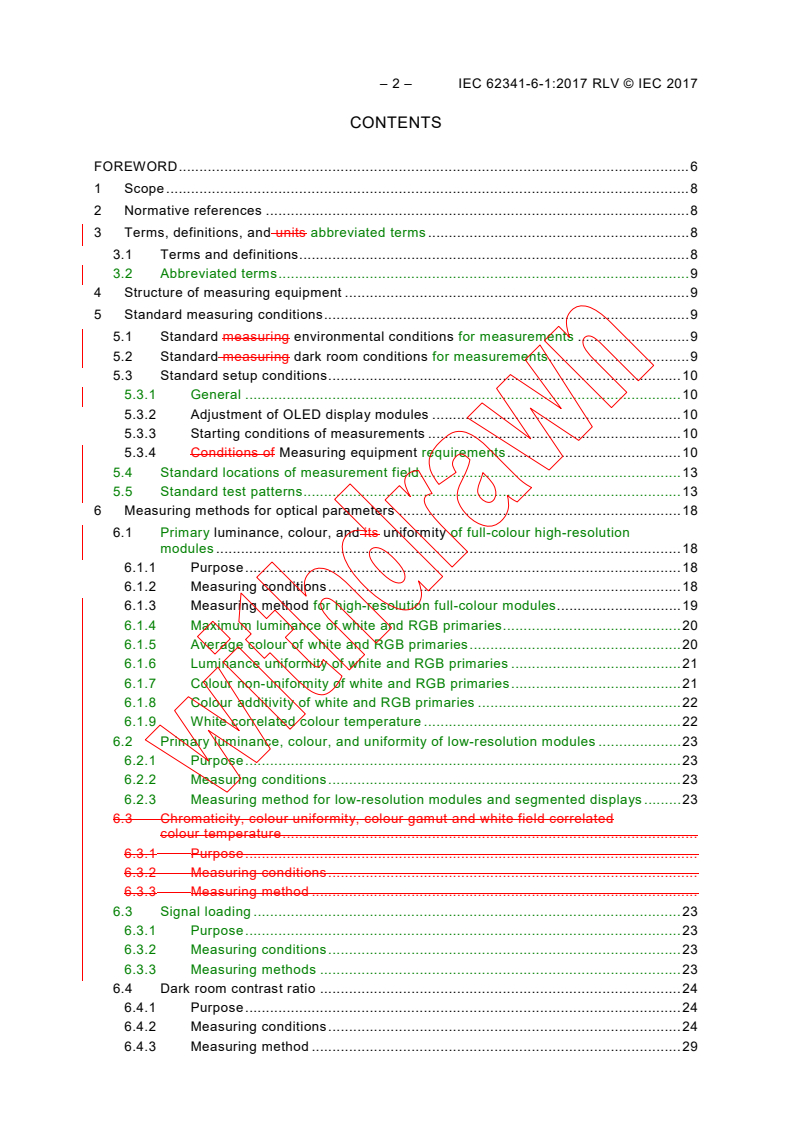
CONTENTS
FOREWORD . 6
1 Scope . 8
2 Normative references . 8
3 Terms, definitions, and units abbreviated terms . 8
3.1 Terms and definitions . 8
3.2 Abbreviated terms . 9
4 Structure of measuring equipment . 9
5 Standard measuring conditions . 9
5.1 Standard measuring environmental conditions for measurements . 9
5.2 Standard measuring dark room conditions for measurements. 9
5.3 Standard setup conditions . 10
5.3.1 General . 10
5.3.2 Adjustment of OLED display modules . 10
5.3.3 Starting conditions of measurements . 10
5.3.4 Conditions of Measuring equipment requirements . 10
5.4 Standard locations of measurement field. 13
5.5 Standard test patterns . 13
6 Measuring methods for optical parameters . 18
6.1 Primary luminance, colour, and its uniformity of full-colour high-resolution
modules . 18
6.1.1 Purpose . 18
6.1.2 Measuring conditions . 18
6.1.3 Measuring method for high-resolution full-colour modules . 19
6.1.4 Maximum luminance of white and RGB primaries . 20
6.1.5 Average colour of white and RGB primaries . 20
6.1.6 Luminance uniformity of white and RGB primaries . 21
6.1.7 Colour non-uniformity of white and RGB primaries . 21
6.1.8 Colour additivity of white and RGB primaries . 22
6.1.9 White correlated colour temperature . 22
6.2 Primary luminance, colour, and uniformity of low-resolution modules . 23
6.2.1 Purpose . 23
6.2.2 Measuring conditions . 23
6.2.3 Measuring method for low-resolution modules and segmented displays . 23
6.3 Chromaticity, colour uniformity, colour gamut and white field correlated
colour temperature .
6.3.1 Purpose .
6.3.2 Measuring conditions .
6.3.3 Measuring method .
6.3 Signal loading . 23
6.3.1 Purpose . 23
6.3.2 Measuring conditions . 23
6.3.3 Measuring methods . 23
6.4 Dark room contrast ratio . 24
6.4.1 Purpose . 24
6.4.2 Measuring conditions . 24
6.4.3 Measuring method . 29
6.5 Display colour gamut, colour gamut area, and colour gamut volume . 29
6.5.1 Purpose . 29
6.5.2 Measuring conditions . 30
6.5.3 Measuring method . 30
6.5.4 Display colour gamut . 30
6.5.5 Display colour gamut area in CIE 1976 chromaticity diagram . 30
6.5.6 Colour gamut volume . 31
7 Measuring methods for power consumption . 32
7.1 Purpose . 32
7.2 Measuring conditions . 32
7.3 Measuring method . 33
7.3.1 Measuring the power consumption of the OLED display module .
Annex A (normative) Response time of passive matrix display panels . 35
A.1 Purpose . 35
A.2 Measuring conditions . 35
A.3 Measuring method . 35
Annex B (normative) Luminance current efficiency . 37
B.1 Purpose . 37
B.2 Measuring conditions . 37
B.3 Measuring method . 37
Annex C (informative) Veiling glare frustum . 39
Annex D (informative) Methods to obtain the correlated colour temperature (CCT) from
chromaticity coordinates . 40
D.1 Method 1: using McCamy’s approximate formula. 40
D.2 Method 2: using Javier Hernandez-Andres’s approximate formula . 40
D.3 Method 3: graphical determination of correlated colour temperature. 41
Annex E (informative) Measuring the performance of modern colour-managed displays
and panels . 43
E.1 Legacy displays . 43
E.2 Modern displays . 43
E.3 Results . 45
E.4 Conclusion . 48
Annex F (informative) Simple window luminance and colour measurements . 49
F.1 Background. 49
F.2 Measuring conditions . 49
F.3 Maximum full-screen luminance . 49
F.4 4 % window luminance . 49
F.5 Sampled luminance non-uniformity . 50
F.6 4 % window centre colour . 52
F.7 Sampled colour non-uniformity . 52
Bibliography . 53
Figure 1 – Layout diagram of measurement setup . 10
Figure 2 – Standard measurement positions in the active area of the display . 11
Figure 3 – Measurement points .
Figure 3 – Test pattern scaling used to define the area size of the coloured rectangles
in the active area of the display . 12
Figure 4 – Example of the colour gamut .
– 4 – IEC 62341-6-1:2017 RLV © IEC 2017
Figure 4 – Low APL loading series of red, green, blue, and white test patterns used for
basic luminance, colour, and uniformity measurements . 13
Figure 5 – Colour of blackbody source at various temperatures .
Figure 5 – Medium (top) and high (bottom) APL loading versions of CTR pattern . 14
Figure 6 – Standard low APL RGBCMY test pattern used for centre luminance and
colour measurements . 15
Figure 7 – Optional medium APL RGBCMY test pattern used for centre luminance and
colour measurements . 16
Figure 8 – Sequence for measuring luminance and colour at the nine standard display
positions for all coloured tile patterns . 17
Figure 9 – Colour of blackbody source at various temperatures as represented on the
CIE 1931 chromaticity diagram . 20
Figure 10 – Example representation of the same primary colours in the CIE 1931 (left)
and CIE 1976 (right) chromaticity diagrams. 24
Figure 11 – Example of the range of colours produced by a given display as
represented by the CIELAB colour space . 25
Figure 12 – Example of measurement setup of power consumption . 27
Figure A.1 – Relationship between the driving signal and the optical response times . 29
Figure B.1 – Example of a measurement configuration for measuring luminance current
efficiency . 31
Figure C.1 – Pattern for veiling glare frustum . 32
Figure D.1 – CIE 1931 XYZ chromaticity diagram . 34
Figure D.2 – Blackbody locus (Planckian locus) and isotemperature lines in CIE 1931
XYZ chromaticity diagram . 35
Figure E.1 – Legacy model where the independent drive electronics provide a direct
correlation between the input RGB signals and the display’s colour primaries . 36
Figure E.2 – Example of modern drive models utilizing multi-dimensional LUTs for
RGB (top) and multi-primary (bottom) displays . 37
Figure E.3 – Example of APL loading behaviour for a WRGB (top) and RGB (bottom)
OLED display . 39
Figure E.4 – Low APL loading test pattern with small box size (1/9 the screen size
dimensions) . 40
Figure E.5 – APL loading profiles for several input colours measured at the centre of
the test pattern using Figure E.4 . 41
Figure F.1 – Luminance measuring pattern Example of a simple 4 % white window
pattern at the centre of the screen . 43
Table 1 – Example of luminance non-uniformity .
Table 1 – Standard digital-equivalent input signals for rendering the white, primary
and secondary colours in test patterns . 15
Table 2 – Example of chromaticity non-uniformity .
Table 2 – Example of luminance measured of the same colour at the nine standard
screen positions and the resulting luminance non-uniformity . 18
Table 3 – Example of the same colour measured at the nine standard screen positions
and the resulting chromaticity non-uniformity . 18
Table 4 – Scaling the size of the colour boxes in the APL loading pattern relative to
the screen dimensions . 22
Table 5 – Example of a summary sheet for module power consumption measurements . 27
Table D.1 – x , y , A and t for Formula (D.3) and Formula (D.4) . 33
e e i i
Table E.1 – Example of luminance data for an RGB and WRGB OLED display . 38
– 6 – IEC 62341-6-1:2017 RLV © IEC 2017
INTERNATIONAL ELECTROTECHNICAL COMMISSION
____________
ORGANIC LIGHT EMITTING DIODE (OLED) DISPLAYS –
Part 6-1: Measuring methods of optical and electro-optical parameters
FOREWORD
1) The International Electrotechnical Commission (IEC) is a worldwide organization for standardization comprising
all national electrotechnical committees (IEC National Committees). The object of IEC is to promote
international co-operation on all questions concerning standardization in the electrical and electronic fields. To
this end and in addition to other activities, IEC publishes International Standards, Technical Specifications,
Technical Reports, Publicly Available Specifications (PAS) and Guides (hereafter referred to as “IEC
Publication(s)”). Their preparation is entrusted to technical committees; any IEC National Committee interested
in the subject dealt with may participate in this preparatory work. International, governmental and non-
governmental organizations liaising with the IEC also participate in this preparation. IEC collaborates closely
with the International Organization for Standardization (ISO) in accordance with conditions determined by
agreement between the two organizations.
2) The formal decisions or agreements of IEC on technical matters express, as nearly as possible, an international
consensus of opinion on the relevant subjects since each technical committee has representation from all
interested IEC National Committees.
3) IEC Publications have the form of recommendations for international use and are accepted by IEC National
Committees in that sense. While all reasonable efforts are made to ensure that the technical content of IEC
Publications is accurate, IEC cannot be held responsible for the way in which they are used or for any
misinterpretation by any end user.
4) In order to promote international uniformity, IEC National Committees undertake to apply IEC Publications
transparently to the maximum extent possible in their national and regional publications. Any divergence
between any IEC Publication and the corresponding national or regional publication shall be clearly indicated in
the latter.
5) IEC itself does not provide any attestation of conformity. Independent certification bodies provide conformity
assessment services and, in some areas, access to IEC marks of conformity. IEC is not responsible for any
services carried out by independent certification bodies.
6) All users should ensure that they have the latest edition of this publication.
7) No liability shall attach to IEC or its directors, employees, servants or agents including individual experts and
members of its technical committees and IEC National Committees for any personal injury, property damage or
other damage of any nature whatsoever, whether direct or indirect, or for costs (including legal fees) and
expenses arising out of the publication, use of, or reliance upon, this IEC Publication or any other IEC
Publications.
8) Attention is drawn to the Normative references cited in this publication. Use of the referenced publications is
indispensable for the correct application of this publication.
9) Attention is drawn to the possibility that some of the elements of this IEC Publication may be the subject of
patent rights. IEC shall not be held responsible for identifying any or all such patent rights.
This redline version of the official IEC Standard allows the user to identify the changes
made to the previous edition. A vertical bar appears in the margin wherever a change
has been made. Additions are in green text, deletions are in strikethrough red text.
International Standard IEC 62341-6-1 has been prepared by IEC technical committee 110:
Electronic display devices.
This second edition cancels and replaces the first edition published in 2009. This edition
constitutes a technical revision.
This edition includes the following significant technical changes with respect to the previous
edition:
a) extends the applicability of the measuring methods to include OLED displays that have
multi-primary or red, green, blue and white sub-pixels;
b) adds a method to characterize how the luminance is affected by the amount of content on
the screen;
c) adds a method to determine the dark room colour gamut volume in the CIELAB colour
space.
The text of this standard is based on the following documents:
FDIS Report on voting
110/816/FDIS 110/830/RVD
Full information on the voting for the approval of this International Standard can be found in
the report on voting indicated in the above table.
This document has been drafted in accordance with the ISO/IEC Directives, Part 2.
A list of all the parts in the IEC 62341 series, under the general title Organic light emitting
diode (OLED) displays, can be found on the IEC website.
The committee has decided that the contents of this document will remain unchanged until the
stability date indicated on the IEC website under "http://webstore.iec.ch" in the data related to
the specific document. At this date, the document will be
• reconfirmed,
• withdrawn,
• replaced by a revised edition, or
• amended.
A bilingual version of this publication may be issued at a later date.
IMPORTANT – The 'colour inside' logo on the cover page of this publication indicates
that it contains colours which are considered to be useful for the correct
understanding of its contents. Users should therefore print this document using a
colour printer.
– 8 – IEC 62341-6-1:2017 RLV © IEC 2017
ORGANIC LIGHT EMITTING DIODE (OLED) DISPLAYS –
Part 6-1: Measuring methods of optical and electro-optical parameters
1 Scope
This part of IEC 62341 specifies the standard measurement conditions and measuring
methods for determining optical and electro-optical parameters of organic light-emitting diode
(OLED) display modules and, where specified, OLED display panels, in the following areas.
These methods are limited to flat displays measured in a dark room.
a) luminance and uniformity;
b) dark room contrast ratio;
c) chromaticity, colour uniformity, colour gamut and white field correlated colour temperature;
d) power consumption.
2 Normative references
The following documents are referred to in the text in such a way that some or all of their
content constitutes requirements of this document. For dated references, only the edition
cited applies. For undated references, the latest edition of the referenced document (including
any amendments) applies.
IEC 60050-845, International Electrotechnical Vocabulary – Part 850: Lighting (available at
www.electropedia.org)
IEC 61966-2-1, Multimedia systems and equipment – Colour measurement and management
– Part 2-1: Colour management – Default RGB colour space – sRGB
IEC 62341-1-2, Organic light emitting diode (OLED) displays – Part 1-2: Terminology and
letter symbols
IEC 62341-6-2:2015, Organic light emitting diode (OLED) displays – Part 6-2: Measuring
methods of visual quality and ambient performance
CIE 15.2:1986 2004, Colorimetry, (second 3rd edition)
CIE S 014-1/E:2006, Colorimetry – Part 1: CIE Standard Colorimetric Observers
3 Terms, definitions, and units abbreviated terms
3.1 Terms and definitions
For the purposes of this document, most of the definitions and units used comply with the
terms and definitions given in IEC 60050-845, IEC 62341-1-2, and the following apply.
ISO and IEC maintain terminological databases for use in standardization at the following
addresses:
• IEC Electropedia: available at http://www.electropedia.org
• ISO Online browsing platform: available at http://www.iso.org/obp
3.1.1
signal pixel
smallest encoded picture element in the input image
3.1.2
pre-gamma average picture level
average input level of all signal pixels relative to an equivalent white pixel driven by a digital
RGB input
Note 1 to entry: Unless otherwise stated, the pre-gamma average picture level (APL) will simply be referred to as
average picture level in this document.
Note 2 to entry: The APL will normally be expressed as a percentage, where a full white screen at maximum drive
level would be 100 % APL.
3.2 Abbreviated terms
APL average picture level
CCT correlated colour temperature
CIE Commission internationale de l’éclairage (International Commission on
Illumination)
CIELAB CIE 1976 (L*a*b*) colour space
CMY cyan, magenta, and yellow
DUT device under test
LMD light-measuring device
LUT look-up table
PMOLED passive matrix organic light-emitting diode
RGB red, green, and blue
RGBCMY red, green, blue, cyan, magenta, and yellow
sRGB standard RGB colour space as defined in IEC 61966-2-1
UCS uniform chromaticity scale
WRGB white, red, green, and blue
4 Structure of measuring equipment
The system diagrams and/or operating conditions of the measuring equipment shall comply
with the structure specified in each item.
5 Standard measuring conditions
5.1 Standard measuring environmental conditions for measurements
Measurements shall be carried out under standard environmental conditions at a temperature
of 25 °C ± 3 °C, at a relative humidity of 25 % to 85 %, and at an air pressure of 86 kPa to
106 kPa. When different environmental conditions are used, they shall be noted in the report.
5.2 Standard measuring dark room conditions for measurements
With the OLED display turned off, the ambient illuminance at all points on the screen shall be
less than 0,3 lx. When a higher ambient illuminance on the display is present, the background
luminance measured when the display is OFF shall be subtracted from subsequent luminance
measurements of the display, and shall be reported.
The luminance contribution from unwanted background illumination reflected off the test
display shall be less than 1/20 of the display’s black state luminance. If these conditions are
– 10 – IEC 62341-6-1:2017 RLV © IEC 2017
not satisfied, then background subtraction is required and it shall be noted in the test report.
In addition, if the sensitivity of the LMD is inadequate to measure 1/20 of the black level, then
the lower limit of the LMD shall be noted in the test report.
5.3 Standard setup conditions
5.3.1 General
Standard setup conditions are given below. Any deviations from these conditions shall be
reported recorded.
5.3.2 Adjustment of OLED display modules
The luminance, contrast, correlated colour temperature of the white field, and other relevant
parameters have to be adjusted to nominal values and they shall be reported in detail in the
specifications of the measurement. For a full colour display, the chromaticity of the white field
shall also be adjusted to match the product specification. When no levels are specified, the
maximum contrast and/or luminance level shall be used and the settings reported. The display
shall be measured at its factory default settings. If other settings are used, they shall be noted
in the test report. These adjustments settings shall be held constant for all measurements,
unless stated otherwise. It is important, however, to make sure that not only the adjustments
are kept constant, but also that the resulting physical quantities remain constant during the
measurement. This is not automatically the case because of, for example, warm-up effects.
5.3.3 Starting conditions of measurements
Warm-up time is defined as the time elapsed from the moment of switching on the supply
voltage until repeated measurements of the display show a variation in luminance of less than
2 % per minute. Repeated measurements shall be taken for at least a period of 15 min after
starting. The luminance variations shall also not exceed 5 % during the total measurement.
Measurements shall be started after the OLED display and the measuring instruments achieve
stability. It is recommended that, when the display is first turned on, it be operated for at least
30 min with a loop of colour patterns rendered on the screen. Sufficient warm-up time has to
be allowed for the OLED displays to reach luminescence stability been achieved when the
luminance of the test feature to be measured varies by less than ±3 % over the entire
measurement method for a given display image.
5.3.4 Conditions of Measuring equipment requirements
5.3.4.1 General conditions
Light measurements shall generally be measured in terms of photometric or colorimetric units
for a CIE 1931 standard colorimetric observer as defined in CIE S 014-1. Luminance can be
measured by a photometer, and CIE tristimulus values (X, Y, Z) or CIE chromaticity
coordinates by a colorimeter. A spectroradiometer can also obtain photometric and
colorimetric values through a numerical conversion of the measured spectral radiance data
(see for example [1] ). Non-contact LMD, where the LMD is not in direct contact with the
screen, shall be used without an illumination source. The following general conditions apply
requirements are given for these instruments:
a) The standard measurement setup is shown in Figure 1. The light measuring device (LMD)
may be any of the following meters:
1) a luminance meter with a spectral response approximating the spectral luminous
efficiency function for photopic vision;
___________
Numbers in square brackets refer to the Bibliography.
2) a colorimetric meter with the spectral sensitivity as colour-matching functions for the
CIE 1931 standard colorimetric observer (specified in CIE S 014-1);
3) a spectroradiometer with a wavelength range from 380 nm to 780 nm;
4) an imaging photometer or colourimeter with the spectral sensitivity as colour-matching
functions for the CIE 1931 standard colorimetric observer.
The LMD shall be a luminance meter, a colorimeter, or a spectroradiometer. The
spectroradiometer shall be capable of measuring spectral radiance over at least the
380 nm to 780 nm spectral range, with a maximum bandwidth of 10 nm for smooth
broadband spectra. For OLED primaries with bandwidth ≤ 25 nm, the maximum bandwidth
shall be ≤ 5 nm. The spectral bandwidth of the spectroradiometer shall be an integer
multiple of the sampling interval. For example, a 5 nm sampling interval can be used for a
5 nm or 10 nm bandwidth.
Care shall be taken to ensure that the device is capable LMD has enough sensitivity and
dynamic range to perform the required task. The measured LMD signal shall be at least
ten times greater than the dark level (noise floor) of the LMD, and no greater than 85 % of
the saturation level.
b) The LMD shall be focused on the image plane of the display and generally aligned
perpendicular to the area to be measured on the image generating surface of the OLED
display display surface at the centre of the measurement field, unless stated otherwise.
c) The relative uncertainty and repeatability of all the measuring devices shall be maintained
by following the instrument supplier’s recommended calibration schedule.
d) The LMD lens shall be focused on the light emitting plane of the display integration time
shall be an integer number (≥10) of frame periods, synchronized to the frame rate, or the
integration time shall be greater than one hundred frame periods. Shorter integration times
are acceptable if the detector is synchronized with the display frame rate.
e) If LMD measurements are taken for displays with impulse driving or duty driving, the high
peak luminance of these displays can cause detector saturation errors. The accuracy of
these measurements can be checked by attenuating the light with a neutral-density filter.
If the change in signal amplitude of the detector is proportional to the transmittance of the
neutral-density filter, then there are no detector saturation errors. This method is for
measuring the maximum time-averaged full-screen luminance.
When using LMDs, stray light within the LMD (e.g. lens flare, veiling glare) and non-
uniformities of sensitivity across the detector area should be considered.
In addition to LMDs that form an average value for the measured quantity over the
measurement field under consideration (i.e. spot photometers, Figure 1), there are imaging
LMDs which give a value (or an array of values, e.g. R, G and B) for each individual area-
element on the DUT. Such LMDs can replace a sequential mechanical scan of the surface of
a display by an image of the entire active area of the DUT, and a subsequent evaluation of
the data.
When imaging LMDs are used, a flat-field correction shall be applied to the LMD at the
measuring distance.
– 12 – IEC 62341-6-1:2017 RLV © IEC 2017
Acceptance area (entrance pupil)
Field of view
Luminance
Angular field
Angular
meter with
of view
aperture
viewport
Measurement
field
Measurement field angle
Focus on object
being measured
IEC
Figure 1 – Layout diagram of measurement setup
5.3.4.2 High pixel count matrix displays (≥ 320 × 240 pixels)
The following applies for high pixel count matrix displays.
a) When measuring matrix displays, the measurement field shall light-measuring devices
should be set to a measurement field that includes more than 500 pixels. For LMDs with a
circular measurement field, this would be equivalent to a disk with a diameter greater than
25 display pixels. If smaller measurement areas are necessary, photometric and
colorimetric equivalence to 500 pixels shall be confirmed and noted in the test report.
b) The standard measuring distance l is 2,5V (for V ≥ 20 cm) or 50 cm (for V < 20 cm),
xo
where V is the height of the display active area or the shorter of the screen width and
height dimensions. For small displays, the recommended measuring distance is between
20 cm to 50 cm. For larger displays, the measurement area shall contain at least 500
pixels. The measuring distance shall be noted in the report.
c) The angular aperture shall be less than or equal to 5°, and the measurement field angle
shall be less than or equal to 2° (see Figure 1). The measuring distance and the
measurement field angle may be adjusted to achieve a measuring field greater than 500
pixels area if setting the above aperture angle is difficult.
d) The display shall be operated at its design field frequency. When using separate driving
signal equipment to operate a panel, the drive conditions shall be noted in the report.
5.3.4.3 Low pixel count matrix displays (< 320 × 240 pixels) and segmented displays
The following applies for low pixel count matrix displays.
a) Low pixel count displays may contain fewer than 500 pixels. When the number of pixels in
the measurement field is less than 500, it shall be noted in the report. The angular
aperture shall be less than or equal to 5°, and the measurement field angle shall be less
than or equal to 2°. The measurement conditions used shall be recorded.
b) For segment displays, the angular aperture shall be less than or equal to 5°, and the
measurement field angle shall be less than or equal to 2°. All measurements shall be
performed at the centre of a segment with the measurement field completely contained
within the segment.
c) When the measurement conditions do not satisfy the requirement of ≤2° for the
measurement field angle, or the measurement field includes fewer than 500 pixels, the
measured values for these parameters shall be reported. For small displays, the
recommended measuring distance is between 20 cm to 50 cm. For larger displays, follow
the manufacturer's recommended viewing distance. For larger displays, the measurement
area shall contain at least 500 pixels. The measuring distance shall be noted in the report.
5.4 Standard locations of measurement field
Luminance, spectral distribution and/or tristimulus measurements may be taken at several
specified positions on the display's surface. The standard measurement locations are
identified by positions P to P in the active area, as illustrated in Figure 2. The active screen
1 9
area is divided into nine equal-sized boxes, with the measurement area centred within each
box and identified by the corresponding numbering shown in Figure 2. Each box is 1/3 of the
width (W) and height (H) of the active area. Centre screen measurements are taken at
position P The display or detector shall be translated in the horizontal and vertical directions
5.
to perform measurements at the desired display positions, with all measurements taken
normal to the screen. Any deviation from the standard positions above shall be recorded.
W/3 W/3
W
IEC
Figure 2 – Standard measurement positions in the active area of the display
5.5 Standard test patterns
The characterization of display luminance and colour can depend on the display test pattern.
Therefore, several standard test patterns are given to help make the measurements more
realistic to actual use cases (see Annex E). Additional test patterns may also be used (see
Annex F). The standard test patterns use the scaling illustrated in Figure 3. The display is
divided into a 3 × 3 array of rectangular areas, each of which has sides that are 1/3 of the
dimension of the height and width of the screen's active area. Each of these nine rectangular
areas can then be further subdivided into smaller rectangles, as demonstrated in the upper
left-hand corner of Figure 3. The smallest subdivision would yield a rectangular box that has
dimensions of 1/9 of those of the active area of each region of the 3 × 3 array.
H
H/3
H/3
– 14 – IEC 62341-6-1:2017 RLV © IEC 2017
Figure 3 – Test pattern scaling used to define the area size
of the coloured rectangles in the active area of the display
The standard test pattern for basic primary luminance and colour measurements shall use the
low APL loading example of the colour tile test patterns illustrated in Figure 4. In this case,
coloured rectangular boxes, with 1/9 of the dimensions of the active area, are centred on the
nine standard active area locations on a black background. The red, green, and blue boxes
are driven at the maximum input signal levels for the primary channels. For example, the red
box is driven at the maximum input signal for the red channel, while the green and blue
channels are at their minimum signal level. The white boxes are driven at their maximum red,
green, and blue channel inputs. Each colour tile pattern is identified by the initials CT (colour
tile) and the colour of the centre box. The patterns in Figure 4 are identified as CTR, CTG,
CTW, and CTB when starting from the upper left-hand pattern and moving clockwise.
1 2 3 1 2 3
4 5 6 4 5 6
7 8 9 7 8 9
1 2 3 1 2 3
4 5 6 4 5 6
7 8 9 7 8 9
IEC
Figure 4 – Low APL loading series of red, green, blue, and white test
patterns used for basic luminance, colour, and uniformity measurements
The area scaling of the coloured rectangles is adjusted to manipulate the APL loading on the
display. The amount of APL loading is input-referred, assuming it is an RGB digital input. The
percent APL is defined as:
N
PLi
∑
i =1
APL(%) = 100 × (1)
N
where the summation is over all pixels in the active area, PL is the normalized signal pixel
i
level of the i-th pixel relative to maximum white level, and N is the total number of pixels. A
100 % APL would be represented by all pixels in the active area at maximum white level. This
would be implemented by setting the levels for the red, green, and blue input channels to their
maximum values. A single primary colour (e.g. red) rendered on a full screen would have 1/3
of the APL of a full white screen. If it is assumed that the red, green, and blue areas
correspond to 1/3 of the APL of the
...