

IEC TR 62222:2012
(Main)Fire performance of communication cables installed in buildings
General Information
- Abstract
IEC/TR 62222:2012 provides recommendations for the requirements and test methods to be specified for the fire performance of communication cables when installed in buildings. The recommendations relate to typical applications and installation practices for copper and optical cables in buildings. This TechnicalReport includes an assessment of the fire hazards presented by such installations, and describes fire scenarios that have been established and the appropriate cable fire performances to mitigate these hazards. ISO/IEC 14763-2 recommends installation methods which,together with this Technical Report, provide guidelines for improving safety during fire. The recommendations also take into account legislation and regulation applicable to the fire performance of cables, an assessment of known test methods and their ability to measure the recommended fire performance. Power cables are usually segregated from communication cables for electrical safety and installed differently so they have not been addressed in this Technical Report.
- Status
- Published
- Publication Date
- 03-Jul-2012
- Technical Committee
- SC 46C - Wires and symmetric cables
- Drafting Committee
- MT 62222 - TC 46/SC 46C/MT 62222
- Current Stage
- DELPUB - Deleted Publication
- Start Date
- 18-Jan-2021
- Completion Date
- 28-Aug-2026
Buy Documents


IEC TR 62222:2012 - Fire performance of communication cables installed in buildings
IEC TR 62222:2012 - Fire performance of communication cables installed in buildings Released:7/4/2012
Overview
IEC TR 62222:2012, titled Fire performance of communication cables installed in buildings, is a comprehensive technical report published by the International Electrotechnical Commission (IEC). It provides essential recommendations on fire performance requirements and test methods for communication cables used in building installations. This standard focuses particularly on copper and optical communication cables, examining their behavior under fire conditions within typical building environments.
The report delivers an in-depth assessment of fire hazards associated with communication cable installations, outlines relevant fire scenarios, and recommends levels of cable fire performance aimed at mitigating fire risks. It also aligns with installation methods described in ISO/IEC 14763-2 to enhance fire safety and mitigate hazards through proper cable management practices.
Key Topics
Fire Performance Requirements
The report specifies the parameters critical to cable fire performance including heat generation, smoke effluents, flame propagation, ignitability, flaming droplets, and toxicity. It provides guidance on balancing these factors to minimize fire risk in building installations.Fire Hazard Assessment
Identifies hazards specifically related to communication cables, such as smoke production and toxic gases, and discusses their impact on occupant safety and fire spread within compartments.Typical Installation Scenarios
Details common installation methods for copper and optical cables in buildings and analyzes how these influence fire performance and risk.Test Methods for Fire Performance
Reviews and compares various standardized test methods (e.g., NFPA 262, EN 50399, IEC 60332-3 series, UL 1666), evaluating their efficacy in measuring key fire performance criteria relevant to communication cables.Fire Mitigation Strategies
Discusses general principles such as compartmentation, hazard management, and cable segregation to reduce fire risks linked to communication cable installations.Legislation and Regulation
Consideration of applicable local and international fire safety regulations governing communication cables, ensuring compliance and enhancing safety.
Applications
IEC TR 62222:2012 is highly valuable for a range of stakeholders involved in the design, installation, and maintenance of communication systems within buildings:
Building Designers and Architects
Use the recommendations to specify communication cable types and installation practices that minimize fire hazards in both new and existing constructions.Electrical and Communications Engineers
Apply the fire performance criteria when selecting cables and during system installation to ensure regulatory compliance and maximize occupant safety.Fire Safety Professionals
Utilize the fire hazard assessments and test method reviews to develop effective fire mitigation plans related to data and communication networks.Cable Manufacturers
Benefit from understanding the performance requirements and test standards to design and develop cables that meet stringent fire safety rules for international markets.Regulators and Authorities
Reference the report for developing or updating fire safety codes addressing communication cable installations in buildings.
Related Standards
ISO/IEC 14763-2: Installation methods for communication cables in buildings, complementing IEC TR 62222 by providing practical installation guidelines supporting fire safety.
IEC 60332 Series: Test methods for flame spread characteristics of cables, referenced within IEC TR 62222 as part of the fire performance evaluation framework.
EN 50399: European test method for cable flame propagation and smoke density, used for assessing fire behavior in cable installations.
NFPA 262: Standard method for flame testing of cables in fire hose cabinets and air-handling spaces, reviewed as an applicable test protocol.
UL 1666 and UL 1685: Safety standards for flame propagation and horizontal cable tray fire tests commonly cited for North American cable safety compliance.
By integrating the guidance from IEC TR 62222:2012, stakeholders ensure that communication cable installations in buildings align with best practices for fire safety, reducing risks of fire propagation and improving occupant protection in fire emergencies.
Keywords: IEC TR 62222:2012, fire performance, communication cables, copper cables, optical cables, building installations, fire safety, fire hazard assessment, fire test methods, cable fire performance, IEC standards, ISO/IEC 14763-2, cable fire mitigation, smoke toxicity, flame propagation.
Relations
- Effective Date
- 05-Sep-2023
- Effective Date
- 05-Sep-2023
Buy Documents
IEC TR 62222:2012 - Fire performance of communication cables installed in buildings
IEC TR 62222:2012 - Fire performance of communication cables installed in buildings Released:7/4/2012
Get Certified
Connect with accredited certification bodies for this standard

IMQ S.p.A. (Certification)
Italian electrical product certification.

SLG Prüf- und Zertifizierungs GmbH
German testing and certification body.

UL Solutions
Global safety science company with testing, inspection and certification.
Sponsored listings
Frequently Asked Questions
IEC TR 62222:2012 is a technical report published by the International Electrotechnical Commission (IEC). Its full title is "Fire performance of communication cables installed in buildings". This standard covers: IEC/TR 62222:2012 provides recommendations for the requirements and test methods to be specified for the fire performance of communication cables when installed in buildings. The recommendations relate to typical applications and installation practices for copper and optical cables in buildings. This TechnicalReport includes an assessment of the fire hazards presented by such installations, and describes fire scenarios that have been established and the appropriate cable fire performances to mitigate these hazards. ISO/IEC 14763-2 recommends installation methods which,together with this Technical Report, provide guidelines for improving safety during fire. The recommendations also take into account legislation and regulation applicable to the fire performance of cables, an assessment of known test methods and their ability to measure the recommended fire performance. Power cables are usually segregated from communication cables for electrical safety and installed differently so they have not been addressed in this Technical Report.
IEC/TR 62222:2012 provides recommendations for the requirements and test methods to be specified for the fire performance of communication cables when installed in buildings. The recommendations relate to typical applications and installation practices for copper and optical cables in buildings. This TechnicalReport includes an assessment of the fire hazards presented by such installations, and describes fire scenarios that have been established and the appropriate cable fire performances to mitigate these hazards. ISO/IEC 14763-2 recommends installation methods which,together with this Technical Report, provide guidelines for improving safety during fire. The recommendations also take into account legislation and regulation applicable to the fire performance of cables, an assessment of known test methods and their ability to measure the recommended fire performance. Power cables are usually segregated from communication cables for electrical safety and installed differently so they have not been addressed in this Technical Report.
IEC TR 62222:2012 is classified under the following ICS (International Classification for Standards) categories: 13.260 - Protection against electric shock. Live working; 29.240.20 - Power transmission and distribution lines; 29.260.99 - Other electrical equipment for working in special conditions; 33.120.20 - Wires and symmetrical cables. The ICS classification helps identify the subject area and facilitates finding related standards.
IEC TR 62222:2012 has the following relationships with other standards: It is inter standard links to IEC TR 62222:2021, IEC TR 62222:2005. Understanding these relationships helps ensure you are using the most current and applicable version of the standard.
IEC TR 62222:2012 is available in PDF format for immediate download after purchase. The document can be added to your cart and obtained through the secure checkout process. Digital delivery ensures instant access to the complete standard document.
Standards Content (Sample)
IEC/TR 62222 ®
Edition 2.0 2012-07
TECHNICAL
REPORT
RAPPORT
TECHNIQUE
Fire performance of communication cables installed in buildings
Tenue au feu des câbles de communication installés dans les bâtiments
IEC/TR 62222:2012
All rights reserved. Unless otherwise specified, no part of this publication may be reproduced or utilized in any form
or by any means, electronic or mechanical, including photocopying and microfilm, without permission in writing from
either IEC or IEC's member National Committee in the country of the requester.
If you have any questions about IEC copyright or have an enquiry about obtaining additional rights to this publication,
please contact the address below or your local IEC member National Committee for further information.
Droits de reproduction réservés. Sauf indication contraire, aucune partie de cette publication ne peut être reproduite ni
utilisée sous quelque forme que ce soit et par aucun procédé, électronique ou mécanique, y compris la photocopie et les
microfilms, sans l'accord écrit de la CEI ou du Comité national de la CEI du pays du demandeur.
Si vous avez des questions sur le copyright de la CEI ou si vous désirez obtenir des droits supplémentaires sur cette
publication, utilisez les coordonnées ci-après ou contactez le Comité national de la CEI de votre pays de résidence.
IEC Central Office Tel.: +41 22 919 02 11
3, rue de Varembé Fax: +41 22 919 03 00
CH-1211 Geneva 20 info@iec.ch
Switzerland www.iec.ch
About the IEC
The International Electrotechnical Commission (IEC) is the leading global organization that prepares and publishes
International Standards for all electrical, electronic and related technologies.
About IEC publications
The technical content of IEC publications is kept under constant review by the IEC. Please make sure that you have the
latest edition, a corrigenda or an amendment might have been published.
Useful links:
IEC publications search - www.iec.ch/searchpub Electropedia - www.electropedia.org
The advanced search enables you to find IEC publications The world's leading online dictionary of electronic and
by a variety of criteria (reference number, text, technical electrical terms containing more than 30 000 terms and
committee,…). definitions in English and French, with equivalent terms in
It also gives information on projects, replaced and additional languages. Also known as the International
withdrawn publications. Electrotechnical Vocabulary (IEV) on-line.
IEC Just Published - webstore.iec.ch/justpublished Customer Service Centre - webstore.iec.ch/csc
Stay up to date on all new IEC publications. Just Published If you wish to give us your feedback on this publication
details all new publications released. Available on-line and or need further assistance, please contact the
also once a month by email. Customer Service Centre: csc@iec.ch.
A propos de la CEI
La Commission Electrotechnique Internationale (CEI) est la première organisation mondiale qui élabore et publie des
Normes internationales pour tout ce qui a trait à l'électricité, à l'électronique et aux technologies apparentées.
A propos des publications CEI
Le contenu technique des publications de la CEI est constamment revu. Veuillez vous assurer que vous possédez
l’édition la plus récente, un corrigendum ou amendement peut avoir été publié.
Liens utiles:
Recherche de publications CEI - www.iec.ch/searchpub Electropedia - www.electropedia.org
La recherche avancée vous permet de trouver des Le premier dictionnaire en ligne au monde de termes
publications CEI en utilisant différents critères (numéro de électroniques et électriques. Il contient plus de 30 000
référence, texte, comité d’études,…). termes et définitions en anglais et en français, ainsi que
Elle donne aussi des informations sur les projets et les les termes équivalents dans les langues additionnelles.
publications remplacées ou retirées. Egalement appelé Vocabulaire Electrotechnique
International (VEI) en ligne.
Just Published CEI - webstore.iec.ch/justpublished
Service Clients - webstore.iec.ch/csc
Restez informé sur les nouvelles publications de la CEI.
Just Published détaille les nouvelles publications parues. Si vous désirez nous donner des commentaires sur
Disponible en ligne et aussi une fois par mois par email. cette publication ou si vous avez des questions
contactez-nous: csc@iec.ch.
IEC/TR 62222 ®
Edition 2.0 2012-07
TECHNICAL
REPORT
RAPPORT
TECHNIQUE
Fire performance of communication cables installed in buildings
Tenue au feu des câbles de communication installés dans les bâtiments
INTERNATIONAL
ELECTROTECHNICAL
COMMISSION
COMMISSION
ELECTROTECHNIQUE
PRICE CODE
INTERNATIONALE
CODE PRIX X
ICS 33.120.20 ISBN 978-2-83220-205-0
– 2 – TR 62222 © IEC:2012
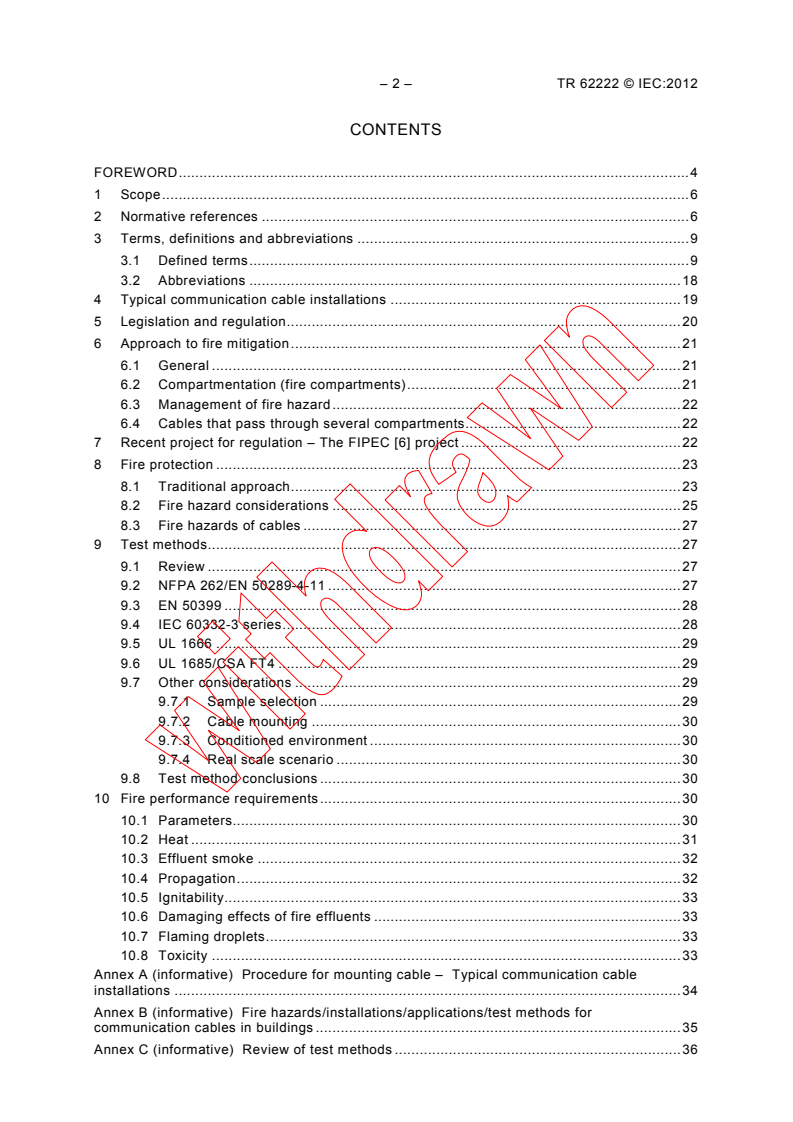
CONTENTS
FOREWORD . 4
1 Scope . 6
2 Normative references . 6
3 Terms, definitions and abbreviations . 9
3.1 Defined terms . 9
3.2 Abbreviations . 18
4 Typical communication cable installations . 19
5 Legislation and regulation . 20
6 Approach to fire mitigation . 21
6.1 General . 21
6.2 Compartmentation (fire compartments) . 21
6.3 Management of fire hazard . 22
6.4 Cables that pass through several compartments. 22
7 Recent project for regulation – The FIPEC [6] project . 22
8 Fire protection . 23
8.1 Traditional approach . 23
8.2 Fire hazard considerations . 25
8.3 Fire hazards of cables . 27
9 Test methods. 27
9.1 Review . 27
9.2 NFPA 262/EN 50289-4-11 . 27
9.3 EN 50399 . 28
9.4 IEC 60332-3 series . 28
9.5 UL 1666 . 29
9.6 UL 1685/CSA FT4 . 29
9.7 Other considerations . 29
9.7.1 Sample selection . 29
9.7.2 Cable mounting . 30
9.7.3 Conditioned environment . 30
9.7.4 Real scale scenario . 30
9.8 Test method conclusions . 30
10 Fire performance requirements . 30
10.1 Parameters. 30
10.2 Heat . 31
10.3 Effluent smoke . 32
10.4 Propagation . 32
10.5 Ignitability . 33
10.6 Damaging effects of fire effluents . 33
10.7 Flaming droplets . 33
10.8 Toxicity . 33
Annex A (informative) Procedure for mounting cable – Typical communication cable
installations . 34
Annex B (informative) Fire hazards/installations/applications/test methods for
communication cables in buildings . 35
Annex C (informative) Review of test methods . 36
TR 62222 © IEC:2012 – 3 –
Annex D (informative) Fire performance requirements . 42
Bibliography . 43
Table 1 – Abbreviations . 18
Table 2 – Typical cable installation categories . 20
Table 3 – Traditional ranking of fire hazards . 24
Table 4 – Cable fire performance requirements . 24
Table 5 – Test methods . 27
Table 6 – Typical communication cable materials . 31
Table 7 – Recommended requirements for heat . 32
Table 8 – Recommended requirements for smoke . 32
Table B.1 – Fire hazards/installations/applications/test methods for communication
cables in buildings . 35
Table C.1 – Ignitability . 36
Table C.2 – Vertical tests (1 of 3) . 37
Table C.3 – Horizontal tests for forced air systems . 40
Table C.4 – Indirect measurement of smoke . 41
Table D.1 – Fire performance requirements . 42
Table D.2 – Single cable burn test . 42
– 4 – TR 62222 © IEC:2012
INTERNATIONAL ELECTROTECHNICAL COMMISSION
____________
FIRE PERFORMANCE OF COMMUNICATION
CABLES INSTALLED IN BUILDINGS
FOREWORD
1) The International Electrotechnical Commission (IEC) is a worldwide organization for standardization comprising
all national electrotechnical committees (IEC National Committees). The object of IEC is to promote
international co-operation on all questions concerning standardization in the electrical and electronic fields. To
this end and in addition to other activities, IEC publishes International Standards, Technical Specifications,
Technical Reports, Publicly Available Specifications (PAS) and Guides (hereafter referred to as “IEC
Publication(s)”). Their preparation is entrusted to technical committees; any IEC National Committee interested
in the subject dealt with may participate in this preparatory work. International, governmental and non-
governmental organizations liaising with the IEC also participate in this preparation. IEC collaborates closely
with the International Organization for Standardization (ISO) in accordance with conditions determined by
agreement between the two organizations.
2) The formal decisions or agreements of IEC on technical matters express, as nearly as possible, an international
consensus of opinion on the relevant subjects since each technical committee has representation from all
interested IEC National Committees.
3) IEC Publications have the form of recommendations for international use and are accepted by IEC National
Committees in that sense. While all reasonable efforts are made to ensure that the technical content of IEC
Publications is accurate, IEC cannot be held responsible for the way in which they are used or for any
misinterpretation by any end user.
4) In order to promote international uniformity, IEC National Committees undertake to apply IEC Publications
transparently to the maximum extent possible in their national and regional publications. Any divergence
between any IEC Publication and the corresponding national or regional publication shall be clearly indicated in
the latter.
5) IEC itself does not provide any attestation of conformity. Independent certification bodies provide conformity
assessment services and, in some areas, access to IEC marks of conformity. IEC is not responsible for any
services carried out by independent certification bodies.
6) All users should ensure that they have the latest edition of this publication.
7) No liability shall attach to IEC or its directors, employees, servants or agents including individual experts and
members of its technical committees and IEC National Committees for any personal injury, property damage or
other damage of any nature whatsoever, whether direct or indirect, or for costs (including legal fees) and
expenses arising out of the publication, use of, or reliance upon, this IEC Publication or any other IEC
Publications.
8) Attention is drawn to the Normative references cited in this publication. Use of the referenced publications is
indispensable for the correct application of this publication.
9) Attention is drawn to the possibility that some of the elements of this IEC Publication may be the subject of
patent rights. IEC shall not be held responsible for identifying any or all such patent rights.
The main task of IEC technical committees is to prepare International Standards. However, a
technical committee may propose the publication of a technical report when it has collected
data of a different kind from that which is normally published as an International Standard, for
example "state of the art".
IEC/TR 62222, which is a technical report, has been prepared by subcommittee 46C: Wires
and symmetric cables, of IEC technical committee 46: Cables, wires, waveguides, r.f.
connectors, r.f. and microwave passive components and accessories.
This second edition cancels and replaces the first edition published in 2005. It constitutes a
technical revision.
The 2005 technical report was the first attempt in understanding the potential fire hazards
concerning new installations where large quantities of data cable are involved. Although it is
important to remember that data cables will probably not spontaneously combust and offices
are still filled with other highly flammable products, the increase of “flood wiring” should be a
building design concern. This second edition attempts to align all the installation guides found
and further improve safety with fire and its possible transmission. Projects that formed the
TR 62222 © IEC:2012 – 5 –
overall direction of the 2005 edition have been taken into account, enabling an overall general
improvement of the document.
The text of this technical report is based on the following documents:
Enquiry draft Report on voting
46C/959/DTR 46C/962/RVC
Full information on the voting for the approval of this technical report can be found in the
report on voting indicated in the above table.
This publication has been drafted in accordance with the ISO/IEC Directives, Part 2.
The committee has decided that the contents of this publication will remain unchanged until
the stability date indicated on the IEC web site under "http://webstore.iec.ch" in the data
related to the specific publication. At this date, the publication will be
• reconfirmed,
• withdrawn,
• replaced by a revised edition, or
• amended.
– 6 – TR 62222 © IEC:2012
FIRE PERFORMANCE OF COMMUNICATION
CABLES INSTALLED IN BUILDINGS
1 Scope
This Technical Report provides recommendations for the requirements and test methods to
be specified for the fire performance of communication cables when installed in buildings.
The recommendations relate to typical applications and installation practices for copper and
optical cables in buildings. This Technical Report includes an assessment of the fire hazards
presented by such installations, and describes fire scenarios that have been established and
the appropriate cable fire performances to mitigate these hazards. ISO/IEC 14763-2
recommends installation methods which, together with this Technical Report, provide
guidelines for improving safety during fire.
The recommendations also take into account legislation and regulation applicable to the fire
performance of cables, an assessment of known test methods and their ability to measure the
recommended fire performance.
Power cables are usually segregated from communication cables for electrical safety and
installed differently so they have not been addressed in this Technical Report.
2 Normative references
The following documents, in whole or in part, are normatively referenced in this document and
are indispensable for its application. For dated references, only the edition cited applies. For
undated references, the latest edition of the referenced document (including any
amendments) applies.
IEC 60332-1 (all parts), Tests on electric and optical cables under fire conditions – Part 1:
Test for vertical flame propagation for a single insulated wire or cable
IEC 60332-1-2, Tests on electric and optical fibre cables under fire conditions – Part 1-2: Test
for vertical flame propagation for a single insulated wire or cable – Procedure for 1 kW pre-
mixed flame
IEC 60332-1-3, Tests on electric and optical fibre cables under fire conditions – Part 1-3: Test
for vertical flame propagation for a single insulated wire or cable – Procedure for
determination of flaming droplets/particles
IEC 60332-2 (all parts), Tests on electric and optical cables under fire conditions – Part 2:
Test for vertical flame propagation for a single small insulated wire or cable
IEC 60332-2-2, Tests on electric and optical fibre cables under fire conditions – Part 2-2: Test
for vertical flame propagation for a single small insulated wire or cable – Procedure for
diffusion flame
IEC 60332-3 (all parts), Tests on electric and optical cables under fire conditions – Part 3:
Test for vertical flame spread of vertically-mounted bunched wires or cables
IEC 60332-3-24, Tests on electric and optical fibre cables under fire conditions – Part 3-24:
Test for vertical flame spread of vertically-mounted bunched wires or cables – Category C
TR 62222 © IEC:2012 – 7 –
IEC 60695 (all parts), Fire hazard testing
IEC 60695-1-10:2009, Fire hazard testing – Part 1-10: Guidance for assessing the fire hazard
of electrotechnical products – General guidelines
IEC 60695-1-11, Fire hazard testing – Part 1-11: Guidance for assessing the fire hazard of
electrotechnical products – Fire hazard assessment
IEC 60695-5-1, Fire hazard testing – Part 5-1: Corrosion damage effects of fire effluent –
General guidance
IEC/TS 60695-5-2, Fire hazard testing – Part 5-2: Corrosion damage effects of fire effluent –
Summary and relevance of test methods
IEC 60695-6-1, Fire hazard testing – Part 6-1: Smoke obscuration – General guidance
IEC 60695-6-2, Fire hazard testing – Part 6-2: Smoke obscuration – Summary and relevance
of test methods
IEC 60695-7-1, Fire hazard testing – Part 7-1: Toxicity of fire effluent – General guidance
IEC 60695-7-2, Toxicity of fire effluent – Part 7-2: Summary and relevance of test methods
IEC 60695-7-3, Fire hazard testing – Part 7-3: Toxicity of fire effluent – Use and interpretation
of test results
IEC 60695-8-1, Fire hazard testing – Part 8-1: Heat release – General guidance
IEC/TR 60695-8-2, Fire hazard testing – Part 8-2: Heat release – Summary and relevance of
test methods
IEC 60695-9-1, Fire hazard testing – Part 9-1: Surface spread of flame – General guidance
IEC/TS 60695-9-2, Fire hazard testing – Part 9-2: Surface spread of flame – Summary and
relevance of test methods
IEC 60754 (all parts), Test on gases evolved during combustion of materials from cables
IEC 60754-1, Test on gases evolved during combustion of materials from cables – Part 1:
Determination of the halogen acid gas content
IEC 60754-2, Test on gases evolved during combustion of materials from cables – Part 2:
Determination of acidity (by pH measurement) and conductivity
IEC 60794 (all parts), Optical fibre cables
IEC 61034 (all parts), Measurement of smoke density of cables burning under defined
conditions
IEC 61034-1:2005, Measurement of smoke density of cables burning under defined conditions
– Part 1: Test apparatus
IEC 61034-2:2005, Measurement of smoke density of cables burning under defined conditions
– Part 2: Test procedure and requirements
– 8 – TR 62222 © IEC:2012
IEC 61156 (all parts), Multicore and symmetrical pair/quad cables for digital communications
IEC 62012-1, Multicore and symmetrical pair/quad cables for digital communications to be
used in harsh environments – Part 1: Generic specification
ISO/IEC 11801, Information technology – Generic cabling for customer premises
ISO 13571, Life-threatening components of fire – Guidelines for the estimation of time
available for escape using fire data
ISO/IEC 13943:2008, Fire safety – Vocabulary
ISO/IEC 14763-2, Information technology – Implementation and operation of customer
premises cabling – Part 2: Planning and installation
ISO 9705, Fire tests – Full-scale room test for surface products
ISO 19706:2011, Guidelines for assessing the fire threat to people
EN 13501-1, Fire classification of construction products and building elements – Part 1:
Classification using test data from reaction to fire tests
EN 13823, Reaction to fire tests for building products – Building products, excluding floorings,
exposed to the thermal attack by a single burning item
EN 50174-2, Information technology – cabling installation – Part 2 Installation planning and
practises inside buildings
EN 50267-2-3, Common test methods for cables under fire conditions – Tests on gases
evolved during combustion of materials from cables – Part 2-3: Procedures – Determination of
degree of acidity of gases for cables by determination of the weighted average of pH and
conductivity
EN 50289-4-11, Communication cables – Specifications for test methods – Part 4-11:
Environmental test methods – A horizontal integrated fire test method
EN 50399, Common test methods for cables under fire conditions – Heat release and smoke
production measurement on cables during flame spread test – Test apparatus, procedures,
results
BS 7671, Requirements for electrical installations
CSA FT4, Canadian Standards Association, CSA 22.2 No. 03-01, Vertical flame test – Cables
in cable trays
CSA FT6, Canadian Standards Association, CSA 22.2 No. 03-01, Horizontal flame and smoke
test
NFPA 262, Standard method of test for flame travel and smoke of wires and cables for use in
air handling spaces (formerly UL 910)
UL 1666, Underwriters Laboratories, Inc., Test for flame propagation height of electrical and
optical fibre cables installed vertically in shafts
UL 1685, Underwriters Laboratories, Inc., Standard for vertical tray fire propagation and
smoke release test for electrical and optical fibre cables
TR 62222 © IEC:2012 – 9 –
UL VW-1, Underwriters Laboratories, Inc., VW-1 (vertical specimen) flame test – UL 1581,
Reference standard for electrical wires, cables and flexible cords
3 Terms, definitions and abbreviations
For the purposes of this document, the terms and definitions given in ISO/IEC 13943, some of
which are reproduced below for the user’s convenience, as well as the following apply,
together with some which are based on EN 13501-1.
3.1 Defined terms
3.1.1
asphyxiant
toxicant that causes hypoxia, which can result in central nervous system depression or
cardiovascular effects
[SOURCE: ISO 13943:2008, 4.17]
3.1.2
cabling
system of telecommunication cables, cords and connecting hardware that can support the
connection of information technology equipment
3.1.3
chimney effect
upward movement of hot fire effluent caused by convection currents confined within an
essentially vertical enclosure
[SOURCE: ISO 13943:2008, 4.41]
3.1.4
combustible
capable of being ignited and burned
[SOURCE: ISO 13943:2008, 4.43]
3.1.5
combustion
exothermic reaction of a substance with an oxidizing agent
Note 1 to entry: Combustion generally emits fire effluent accompanied by flames and/or glowing.
[SOURCE: ISO 13943:2008, 4.46]
3.1.6
fire compartment
enclosed space, which may be subdivided, separated from adjoining spaces by fire barriers
Note 1 to entry: Compartments are also known as “fire compartments”.
[SOURCE: ISO 13943:2008, 4.102]
3.1.7
compartmentation
division of a premise into compartments in order to provide protection for the rest of the
premises
– 10 – TR 62222 © IEC:2012
3.1.8
convection
transfer of heat by movement of a fluid
[SOURCE: ISO 13943:2008, 4.54]
3.1.9
contribution to fire
energy released by a product influencing the fire growth
3.1.10
corrosion damage
physical and/or chemical damage or impaired function caused by chemical action
[SOURCE: ISO 13943:2008, 4.56]
3.1.11
damaged length
maximum extent in a specified direction of damaged area
3.1.12
draught-free environment
space in which the results of experiments are not significantly affected by the local air speed
Note 1 to entry: A qualitative example sample is a space in which a wax candle flame (3.1.36) remains essentially
-1
undisturbed. Quantitative example examples are small-scale fire tests in which a maximum air speed of 0,1m.s or
-1
0,2 m.s is sometimes specified.
[SOURCE: ISO 13943:2008, 4.70]
3.1.13
enclosure
volume defined by bounding surfaces, which may have one or more
openings
[SOURCE: ISO 13943:2008, 4.77]
3.1.14
end use application
real application of a product in relation to all aspects that influence the behaviour of that
product under different fire situations
3.1.15
fire
process of combustion characterized by the emission of heat and fire effluent and
usually accompanied by smoke, flame, glowing or a combination thereof
3.1.16
fire attack
thermal attack by fire test burner
3.1.17
fire behaviour
change in, or maintenance of, the physical and/or chemical properties of an item and/or
structure exposed to fire
Note 1 to entry: This concept covers both reaction to fire and fire resistance.
[SOURCE: ISO 13943:2008, 4.100]
TR 62222 © IEC:2012 – 11 –
3.1.18
fire compartment
enclosed space, which may be subdivided, separated from adjoining spaces by fire barriers
[SOURCE: ISO 13943:2008, 4.102]
3.1.19
fire danger
concept including both fire hazard and fire risk
[SOURCE: ISO 13943:2008, 4.103]
3.1.20
fire effluent
totality of gases and aerosols, including suspended particles, created by combustion or
pyrolysis in a fire
[SOURCE: ISO 13943:2008, 4.105]
3.1.21
fire-effluent transport
movement of fire effluent from the location of the fire
[SOURCE: ISO 13943:2008, 4.107]
3.1.22
fire exposure
extent to which persons, animals or items are subjected to the conditions created by fire
[SOURCE: ISO 13943:2008, 4.108]
3.1.23
fire extinguishment
process that eliminates combustion
[SOURCE: ISO 13943:2008, 4.109]
3.1.24
fire growth
stage of fire development during which the heat release rate and the temperature of the fire
are increasing
[SOURCE: ISO 13943:2008, 4.111]
3.1.25
fire growth rate index
FIGRA index
maximum quotient of heat release rate from a specimen and the time of its occurrence
3.1.26
fire hazard
physical object or condition with a potential for an undesirable consequence from fire
[SOURCE: ISO 13943:2008, 4.112]
– 12 – TR 62222 © IEC:2012
3.1.27
fire load
quantity of heat which can be released by the complete combustion of all the combustible
materials in a volume, including the facings and bounding surfaces
Note 1 to entry: Fire load may be based on effective heat of combustion gross heat of combustion or net heat of
combustion as required by the specifier.
[SOURCE: ISO 13943: 4.114]
3.1.28
fire performance
response of a test specimen when exposed to a fire test
[SOURCE: ISO 13943:2008, 4.117]
3.1.29
fire propagation
combination of flame spread and spread of fire effluent
[SOURCE: ISO 13943:2008, 4.120]
3.1.30
fire resistance
ability of a test specimen to withstand fire or give protection from it for a period of time
Note 1 to entry: Typical criteria used to assess fire resistance in a standard fire test are fire integrity, fire stability
and thermal insulation material.
[SOURCE: ISO 13943:2008, 4.121]
3.1.31
fire retardance
flame retardance, fire retardant and flame retardant
[SOURCE: ISO 13943:2008, 4.122]
3.1.32
fire retardant, noun
substance added, or a treatment applied, to a material in order to delay ignition or to reduce
the rate of combustion
[SOURCE: ISO 13943:2008, 4.123]
3.1.33
fire risk
probability of a fire combined with a quantified measure of its consequences
Note 1 to entry: It is often calculated as the product of probability and consequence.
[SOURCE: ISO 13943:2008, 4.124]
3.1.34
fire safety management
application and service life maintenance of procedures to achieve fire-safety objectives
[SOURCE: ISO 13943:2008, 4.127]
TR 62222 © IEC:2012 – 13 –
3.1.35
fire safety objective
desired outcome with respect to the probability of an unwanted fire, relative to essential
aspects of the built environment
Note 1 to entry: The essential aspects typically relate to the issues of life safety, conservation of property,
continuity of operations, protection of the environment and preservation of heritage.
[SOURCE: ISO 13943:2008, 4.128]
3.1.36
fire scenario
qualitative description of the course of a fire with respect to time, identifying key events that
characterize the studied fire and differentiate it from other possible fires
[SOURCE: ISO 13943:2008, 4.129]
3.1.37
fire severity
capacity of a fire to cause damage
[SOURCE: ISO 13943:2008, 4.130]
3.1.38
fire situation
stage in the development of a fire, characterized by the nature, severity and size of the
thermal attack on the products involved
3.1.39
fire test
test that measures behaviour of a fire or exposes an item to the effects of a fire
Note 1 to entry: The results of a fire test can be used to quantify fire severity or determine the fire resistance or
reaction to fire of the test specimen.
[SOURCE: ISO 13943:2008, 4.132]
3.1.40
flame, noun
rapid, self-sustaining, sub-sonic propagation of combustion in a gaseous medium, usually with
the emission of light
[SOURCE: ISO 13943:2008, 4.133]
3.1.41
flame, verb
produce flame
[SOURCE: ISO 13943:2008, 4.134]
3.1.42
flame application time
period of time for which a burner flame is applied to a test specimen
[SOURCE: ISO 13943:2008, 4.135]
– 14 – TR 62222 © IEC:2012
3.1.43
flame retardance
property of a material whereby flaming combustion is slowed, terminated or prevented
Note 1 to entry: Flame retardance can be an inherent property of the basic material or it may be imparted by
specific treatment.
Note 2 to entry: The degree of the flame retardance exhibited by a material during testing can vary with the test
conditions.
[SOURCE: ISO 13943:2008, 4.138]
3.1.44
flame retarded
treated with a flame retardant
[SOURCE: ISO 13943:2008, 4.141]
3.1.45
flame spread
propagation of a flame front
[SOURCE: ISO 13943:2008, 4.142]
3.1.46
flame-spread rate
DEPRECATED: burning rate
DEPRECATED: rate of burning
distance travelled by a flame front during its propagation, divided by the time of travel, under
specified conditions
[SOURCE: ISO 13943:2008, 4.143]
3.1.47
flame-spread time
time taken by a flame front on a burning material to travel a specified distance on the surface,
or to cover a specified surface area under specified conditions
[SOURCE: ISO 13943:2008, 4.144]
3.1.48
flaming, noun
continuation of the presence of a flame after its first appearance
[SOURCE: ISO 13943:2008, 4.147]
3.1.49
flaming combustion
combustion in the gaseous phase, usually with emission of light
[SOURCE: ISO 13943:2008, 4.148]
3.1.50
flaming debris
material separating from a burning item and continuing to flame during a fire or fire test
[SOURCE: ISO 13943:2008, 4.149]
TR 62222 © IEC:2012 – 15 –
3.1.51
flaming droplet
molten material separating from a burning item and continuing to flame during a fire or fire
test method
[SOURCE: ISO 13943:2008, 4.150]
3.1.52
flammability
ability of a material or product to burn with a flame under specified conditions
[SOURCE: ISO 13943:2008, 4.151]
3.1.53
flammable
capable of flaming combustion under specified conditions
[SOURCE: ISO 13943:2008, 4.153]
3.1.54
flame retardant halogen free cable
material such as EVA/Al(OH) based compounds for use on cable jackets
3.1.55
flashover
transition state of total surface involvement in a fire of combustible materials
within an enclosure
[SOURCE: ISO 13943:2008, 4.156]
3.1.56
fuel
substance that can react exothermically with an oxidizing agent
[SOURCE: ISO 13943:2008, 4.161]
3.1.57
gross heat of combustion
heat of combustion of a substance when the combustion is complete and any produced water
is entirely condensed under specified conditions
[SOURCE: ISO 13943:2008, 4.170]
3.1.58
heat flow rate
amount of thermal energy transferred per unit time
[SOURCE: ISO 13943:2008, 4.172]
3.1.59
heat of combustion
DEPRECATED: calorific potential
DEPRECATED: calorific value
thermal energy produced by combustion of unit mass of a given substance
-1
Note 1 to entry: The typical units are kilojoules per gram (k.J.g ).
[SOURCE: ISO 13943:2008, 4.174]
– 16 – TR 62222 © IEC:2012
3.1.60
heat release
thermal energy produced by combustion
[SOURCE: ISO 13943:2008, 4.176]
3.1.61
heat release rate
DEPRECATED: burning rate
DEPRECATED: rate of burning
rate of thermal energy production generated by combustion
[SOURCE: ISO 13943:2008, 4.177]
3.1.62
ignitability
ease of ignition
measure of the ease with which a test specimen can be ignited under specified conditions
[SOURCE: ISO 13943:2008, 4.182]
3.1.63
ignitable
capable of being ignited
[SOURCE: ISO 13943:2008, 4.183]
3.1.64
ignited
caused to be in a state of undergoing combustion
[SOURCE: ISO 13943:2008, 4.186]
3.1.65
irritant
gas or aerosol that stimulates nerve receptors in the lower respiratory tract,
which can result in breathing discomfort
Note 1 to entry: Examples of breathing discomfort are dyspnoea and an increase in respiratory rate. In severe
cases, pneumonitis or pulmonary oedema (which can be fatal) can occur some hours after exposure.
[SOURCE: ISO 13943:2008, 4.204]
3.1.66
opacity of smoke
ratio of incident light intensity to transmitted light intensity through smoke under specified
conditions
Note 1 to entry: Opacity of smoke is the reciprocal of transmittance.
Note 2 to entry: The opacity of smoke is dimensionless.
[SOURCE: ISO 13943:2008, 4.243]
3.1.67
optical density of smoke
measure of the attenuation of a light beam passing through smoke expressed as the logarithm
to the base 10 of the opacity of smoke
Note 1 to entry: The optical density of smoke is dimensionless.
[SOURCE: ISO 13943:2008, 4.244]
TR 62222 © IEC:2012 – 17 –
3.1.68
oxidising agent
substance capable of causing oxidation
[SOURCE: ISO 13943:2008, 4.246]
3.1.69
reaction to fire
response of a test specimen when it is exposed to fire under specified conditions in a fire
[SOURCE: ISO 13943:2008, 4.272]
3.1.70
reference scenario
hazard situation and environment used as a reference for a given test method
3.1.71
small fire attack
thermal attack produced by a small flame such as a match or lighter
3.1.72
smoke growth rate index
SMOGRA index
maximum value of SMOGRA attained during a test period, and SMOGRA is 10 000 × the
quotient
3.1.73
smoke hazard
potential for injury and/or damage from smoke
3.1.74
smoke
visible part of fire effluent
[SOURCE: ISO 13943:2008, 4.293]
3.1.75
smoke production
amount of smoke produced per unit time in a fire or fire test
Note 1 to entry: The typical units are square metres (m ).
[SOURCE: ISO 13943:2008, 4.294]
3.1.76
smoke production rate
amount of smoke produced per unit time in a fire or fire test
Note 1 to entry: It is calculated as the product of the volumetric flow rate of smoke and the extinction coefficient of
the smoke at the point of measurement.
2 -1
Note 2 to entry: The typical units are square metres per second (m s ).
[SOURCE: ISO 13943:2008, 4.295]
3.1.77
soot
particulate matter produced and deposited during or after combustion
[SOURCE: ISO 13943:2008, 4.298]
– 18 – TR 62222 © IEC:2012
3.1.78
toxic
poisonous
[SOURCE: ISO 13943:2008, 4.335]
3.1.79
toxicant
toxin
toxic substance
[SOURCE: ISO 13943:2008, 4.340]
3.2 Abbreviations
The abbreviations are given in Table 1.
Table 1 – Abbreviations
Abbreviation Definition
CENELEC European committee for electrotechnical standardisation
CPR(R) 1
construction products regulation – (European regulation) [5]
CSA Canadian standards association
EN European standard
FEP fluorinated ethylene-propylene
FIPEC fire performance of electric cables [6]
HR heat release
HRR heat release rate
ISO International standards organisation
LSPVC low smoke flame retardant polyvinylchloride
NEMA National electrical manufacturers association [4]
NES naval engineering standard
NFPA National fire protection association
OD optical density
PCS gross calorific potential (calorific potential is a deprecated term and it is now referred to by the
term “heat of combustion”)
PE polyethylene
PP polypropylene
PTFE polytetrafluoroethylene
PTFE HFP polytetrafluorethylene-hexalfluoropropylene copolymer
PVC polyvinyl chloride
PVDF polyvinylidene fluoride
SP smoke production
SPR smoke production rate
THR total heat release
TSP total smoke production
UL Underwriters laboratories Inc.
___________
Figures in square brackets refer to the bibliography.
TR 62222 © IEC:2012 – 19 –
4 Typical communication cable installations
In order to define the appropriate fire test methods and performance requirements, it is
necessary to consider the fire hazards presented by typical cable installations.
During the last decade, worldwide demand for information has resulted in increasing
transmission data rates and developments in local area networks (LANs). In particular, the
growing popularity of structured cabling systems as defined in ISO/IEC 11801, known as
information technology cabling. The generic structured wiring cabling system is a hierarchical
star network linking campus distributors to different building distributors, which in turn link to
individual floor distributors which then connect with telecommunication outlets. On each floor,
the riser cable, run in vertical shafts, connects to the distributor which transmits data via the
horizontal cables to each outlet. In a typical installation, the outlets are arranged in a matrix
layout spaced about 1 m or 2 m, with the horizontal cables run in ceiling or in bigger
installations normally under-floor voids. Even in a small office, this leads to a large number of
cables run in building voids.
The evolution of cabling (otherwise known as structured wiring) has coincided with a rapid
increase in system data rates, from 10 kbps in the early 1980’s to 600 Mbps in the late
1990’s, and on to 10 GBit Ethernet™. As transmission rates increase, system upgrades to
higher performance cables and components are typically necessary. This has led to the
installation of many lengths of data cable, mainly in hidden voids.
Copper conductor cables manufactured to the IEC 61156 series and optical cables
manufactured to the IEC 60794 series are used in structured wiring. These standards detail
electrical and optical transmission requirements, mechanical performance and environmental
characteristics. Communication cables operating at low voltages and currents are not a
primary cause of fires, but their widespread use means that they may be involved in outbreaks
of fire from an external source. IEC 60695-1-10 gives general guidance on the fire hazards of
electrotechnical products.
Typical communication installations in buildings are as shown in Annex A and can be grouped
into the following descriptions.
a) In public buildings such as airports, shops and older commercial offices with solid floors,
cables are generally insta
...
IEC/TR 62222 ®
Edition 2.0 2012-07
TECHNICAL
REPORT
RAPPORT
TECHNIQUE
Fire performance of communication cables installed in buildings
Tenue au feu des câbles de communication installés dans les bâtiments
IEC/TR 62222:2012
All rights reserved. Unless otherwise specified, no part of this publication may be reproduced or utilized in any form
or by any means, electronic or mechanical, including photocopying and microfilm, without permission in writing from
either IEC or IEC's member National Committee in the country of the requester.
If you have any questions about IEC copyright or have an enquiry about obtaining additional rights to this publication,
please contact the address below or your local IEC member National Committee for further information.
Droits de reproduction réservés. Sauf indication contraire, aucune partie de cette publication ne peut être reproduite ni
utilisée sous quelque forme que ce soit et par aucun procédé, électronique ou mécanique, y compris la photocopie et les
microfilms, sans l'accord écrit de la CEI ou du Comité national de la CEI du pays du demandeur.
Si vous avez des questions sur le copyright de la CEI ou si vous désirez obtenir des droits supplémentaires sur cette
publication, utilisez les coordonnées ci-après ou contactez le Comité national de la CEI de votre pays de résidence.
IEC Central Office Tel.: +41 22 919 02 11
3, rue de Varembé Fax: +41 22 919 03 00
CH-1211 Geneva 20 info@iec.ch
Switzerland www.iec.ch
About the IEC
The International Electrotechnical Commission (IEC) is the leading global organization that prepares and publishes
International Standards for all electrical, electronic and related technologies.
About IEC publications
The technical content of IEC publications is kept under constant review by the IEC. Please make sure that you have the
latest edition, a corrigenda or an amendment might have been published.
Useful links:
IEC publications search - www.iec.ch/searchpub Electropedia - www.electropedia.org
The advanced search enables you to find IEC publications The world's leading online dictionary of electronic and
by a variety of criteria (reference number, text, technical electrical terms containing more than 30 000 terms and
committee,…). definitions in English and French, with equivalent terms in
It also gives information on projects, replaced and additional languages. Also known as the International
withdrawn publications. Electrotechnical Vocabulary (IEV) on-line.
IEC Just Published - webstore.iec.ch/justpublished Customer Service Centre - webstore.iec.ch/csc
Stay up to date on all new IEC publications. Just Published If you wish to give us your feedback on this publication
details all new publications released. Available on-line and or need further assistance, please contact the
also once a month by email. Customer Service Centre: csc@iec.ch.
A propos de la CEI
La Commission Electrotechnique Internationale (CEI) est la première organisation mondiale qui élabore et publie des
Normes internationales pour tout ce qui a trait à l'électricité, à l'électronique et aux technologies apparentées.
A propos des publications CEI
Le contenu technique des publications de la CEI est constamment revu. Veuillez vous assurer que vous possédez
l’édition la plus récente, un corrigendum ou amendement peut avoir été publié.
Liens utiles:
Recherche de publications CEI - www.iec.ch/searchpub Electropedia - www.electropedia.org
La recherche avancée vous permet de trouver des Le premier dictionnaire en ligne au monde de termes
publications CEI en utilisant différents critères (numéro de électroniques et électriques. Il contient plus de 30 000
référence, texte, comité d’études,…). termes et définitions en anglais et en français, ainsi que
Elle donne aussi des informations sur les projets et les les termes équivalents dans les langues additionnelles.
publications remplacées ou retirées. Egalement appelé Vocabulaire Electrotechnique
International (VEI) en ligne.
Just Published CEI - webstore.iec.ch/justpublished
Service Clients - webstore.iec.ch/csc
Restez informé sur les nouvelles publications de la CEI.
Just Published détaille les nouvelles publications parues. Si vous désirez nous donner des commentaires sur
Disponible en ligne et aussi une fois par mois par email. cette publication ou si vous avez des questions
contactez-nous: csc@iec.ch.
IEC/TR 62222 ®
Edition 2.0 2012-07
TECHNICAL
REPORT
RAPPORT
TECHNIQUE
Fire performance of communication cables installed in buildings
Tenue au feu des câbles de communication installés dans les bâtiments
INTERNATIONAL
ELECTROTECHNICAL
COMMISSION
COMMISSION
ELECTROTECHNIQUE
PRICE CODE
INTERNATIONALE
CODE PRIX X
ICS 33.120.20 ISBN 978-2-83220-205-0
– 2 – TR 62222 © IEC:2012
CONTENTS
FOREWORD . 4
1 Scope . 6
2 Normative references . 6
3 Terms, definitions and abbreviations . 9
3.1 Defined terms . 9
3.2 Abbreviations . 18
4 Typical communication cable installations . 19
5 Legislation and regulation . 20
6 Approach to fire mitigation . 21
6.1 General . 21
6.2 Compartmentation (fire compartments) . 21
6.3 Management of fire hazard . 22
6.4 Cables that pass through several compartments. 22
7 Recent project for regulation – The FIPEC [6] project . 22
8 Fire protection . 23
8.1 Traditional approach . 23
8.2 Fire hazard considerations . 25
8.3 Fire hazards of cables . 27
9 Test methods. 27
9.1 Review . 27
9.2 NFPA 262/EN 50289-4-11 . 27
9.3 EN 50399 . 28
9.4 IEC 60332-3 series . 28
9.5 UL 1666 . 29
9.6 UL 1685/CSA FT4 . 29
9.7 Other considerations . 29
9.7.1 Sample selection . 29
9.7.2 Cable mounting . 30
9.7.3 Conditioned environment . 30
9.7.4 Real scale scenario . 30
9.8 Test method conclusions . 30
10 Fire performance requirements . 30
10.1 Parameters. 30
10.2 Heat . 31
10.3 Effluent smoke . 32
10.4 Propagation . 32
10.5 Ignitability . 33
10.6 Damaging effects of fire effluents . 33
10.7 Flaming droplets . 33
10.8 Toxicity . 33
Annex A (informative) Procedure for mounting cable – Typical communication cable
installations . 34
Annex B (informative) Fire hazards/installations/applications/test methods for
communication cables in buildings . 35
Annex C (informative) Review of test methods . 36
TR 62222 © IEC:2012 – 3 –
Annex D (informative) Fire performance requirements . 42
Bibliography . 43
Table 1 – Abbreviations . 18
Table 2 – Typical cable installation categories . 20
Table 3 – Traditional ranking of fire hazards . 24
Table 4 – Cable fire performance requirements . 24
Table 5 – Test methods . 27
Table 6 – Typical communication cable materials . 31
Table 7 – Recommended requirements for heat . 32
Table 8 – Recommended requirements for smoke . 32
Table B.1 – Fire hazards/installations/applications/test methods for communication
cables in buildings . 35
Table C.1 – Ignitability . 36
Table C.2 – Vertical tests (1 of 3) . 37
Table C.3 – Horizontal tests for forced air systems . 40
Table C.4 – Indirect measurement of smoke . 41
Table D.1 – Fire performance requirements . 42
Table D.2 – Single cable burn test . 42
– 4 – TR 62222 © IEC:2012
INTERNATIONAL ELECTROTECHNICAL COMMISSION
____________
FIRE PERFORMANCE OF COMMUNICATION
CABLES INSTALLED IN BUILDINGS
FOREWORD
1) The International Electrotechnical Commission (IEC) is a worldwide organization for standardization comprising
all national electrotechnical committees (IEC National Committees). The object of IEC is to promote
international co-operation on all questions concerning standardization in the electrical and electronic fields. To
this end and in addition to other activities, IEC publishes International Standards, Technical Specifications,
Technical Reports, Publicly Available Specifications (PAS) and Guides (hereafter referred to as “IEC
Publication(s)”). Their preparation is entrusted to technical committees; any IEC National Committee interested
in the subject dealt with may participate in this preparatory work. International, governmental and non-
governmental organizations liaising with the IEC also participate in this preparation. IEC collaborates closely
with the International Organization for Standardization (ISO) in accordance with conditions determined by
agreement between the two organizations.
2) The formal decisions or agreements of IEC on technical matters express, as nearly as possible, an international
consensus of opinion on the relevant subjects since each technical committee has representation from all
interested IEC National Committees.
3) IEC Publications have the form of recommendations for international use and are accepted by IEC National
Committees in that sense. While all reasonable efforts are made to ensure that the technical content of IEC
Publications is accurate, IEC cannot be held responsible for the way in which they are used or for any
misinterpretation by any end user.
4) In order to promote international uniformity, IEC National Committees undertake to apply IEC Publications
transparently to the maximum extent possible in their national and regional publications. Any divergence
between any IEC Publication and the corresponding national or regional publication shall be clearly indicated in
the latter.
5) IEC itself does not provide any attestation of conformity. Independent certification bodies provide conformity
assessment services and, in some areas, access to IEC marks of conformity. IEC is not responsible for any
services carried out by independent certification bodies.
6) All users should ensure that they have the latest edition of this publication.
7) No liability shall attach to IEC or its directors, employees, servants or agents including individual experts and
members of its technical committees and IEC National Committees for any personal injury, property damage or
other damage of any nature whatsoever, whether direct or indirect, or for costs (including legal fees) and
expenses arising out of the publication, use of, or reliance upon, this IEC Publication or any other IEC
Publications.
8) Attention is drawn to the Normative references cited in this publication. Use of the referenced publications is
indispensable for the correct application of this publication.
9) Attention is drawn to the possibility that some of the elements of this IEC Publication may be the subject of
patent rights. IEC shall not be held responsible for identifying any or all such patent rights.
The main task of IEC technical committees is to prepare International Standards. However, a
technical committee may propose the publication of a technical report when it has collected
data of a different kind from that which is normally published as an International Standard, for
example "state of the art".
IEC/TR 62222, which is a technical report, has been prepared by subcommittee 46C: Wires
and symmetric cables, of IEC technical committee 46: Cables, wires, waveguides, r.f.
connectors, r.f. and microwave passive components and accessories.
This second edition cancels and replaces the first edition published in 2005. It constitutes a
technical revision.
The 2005 technical report was the first attempt in understanding the potential fire hazards
concerning new installations where large quantities of data cable are involved. Although it is
important to remember that data cables will probably not spontaneously combust and offices
are still filled with other highly flammable products, the increase of “flood wiring” should be a
building design concern. This second edition attempts to align all the installation guides found
and further improve safety with fire and its possible transmission. Projects that formed the
TR 62222 © IEC:2012 – 5 –
overall direction of the 2005 edition have been taken into account, enabling an overall general
improvement of the document.
The text of this technical report is based on the following documents:
Enquiry draft Report on voting
46C/959/DTR 46C/962/RVC
Full information on the voting for the approval of this technical report can be found in the
report on voting indicated in the above table.
This publication has been drafted in accordance with the ISO/IEC Directives, Part 2.
The committee has decided that the contents of this publication will remain unchanged until
the stability date indicated on the IEC web site under "http://webstore.iec.ch" in the data
related to the specific publication. At this date, the publication will be
• reconfirmed,
• withdrawn,
• replaced by a revised edition, or
• amended.
– 6 – TR 62222 © IEC:2012
FIRE PERFORMANCE OF COMMUNICATION
CABLES INSTALLED IN BUILDINGS
1 Scope
This Technical Report provides recommendations for the requirements and test methods to
be specified for the fire performance of communication cables when installed in buildings.
The recommendations relate to typical applications and installation practices for copper and
optical cables in buildings. This Technical Report includes an assessment of the fire hazards
presented by such installations, and describes fire scenarios that have been established and
the appropriate cable fire performances to mitigate these hazards. ISO/IEC 14763-2
recommends installation methods which, together with this Technical Report, provide
guidelines for improving safety during fire.
The recommendations also take into account legislation and regulation applicable to the fire
performance of cables, an assessment of known test methods and their ability to measure the
recommended fire performance.
Power cables are usually segregated from communication cables for electrical safety and
installed differently so they have not been addressed in this Technical Report.
2 Normative references
The following documents, in whole or in part, are normatively referenced in this document and
are indispensable for its application. For dated references, only the edition cited applies. For
undated references, the latest edition of the referenced document (including any
amendments) applies.
IEC 60332-1 (all parts), Tests on electric and optical cables under fire conditions – Part 1:
Test for vertical flame propagation for a single insulated wire or cable
IEC 60332-1-2, Tests on electric and optical fibre cables under fire conditions – Part 1-2: Test
for vertical flame propagation for a single insulated wire or cable – Procedure for 1 kW pre-
mixed flame
IEC 60332-1-3, Tests on electric and optical fibre cables under fire conditions – Part 1-3: Test
for vertical flame propagation for a single insulated wire or cable – Procedure for
determination of flaming droplets/particles
IEC 60332-2 (all parts), Tests on electric and optical cables under fire conditions – Part 2:
Test for vertical flame propagation for a single small insulated wire or cable
IEC 60332-2-2, Tests on electric and optical fibre cables under fire conditions – Part 2-2: Test
for vertical flame propagation for a single small insulated wire or cable – Procedure for
diffusion flame
IEC 60332-3 (all parts), Tests on electric and optical cables under fire conditions – Part 3:
Test for vertical flame spread of vertically-mounted bunched wires or cables
IEC 60332-3-24, Tests on electric and optical fibre cables under fire conditions – Part 3-24:
Test for vertical flame spread of vertically-mounted bunched wires or cables – Category C
TR 62222 © IEC:2012 – 7 –
IEC 60695 (all parts), Fire hazard testing
IEC 60695-1-10:2009, Fire hazard testing – Part 1-10: Guidance for assessing the fire hazard
of electrotechnical products – General guidelines
IEC 60695-1-11, Fire hazard testing – Part 1-11: Guidance for assessing the fire hazard of
electrotechnical products – Fire hazard assessment
IEC 60695-5-1, Fire hazard testing – Part 5-1: Corrosion damage effects of fire effluent –
General guidance
IEC/TS 60695-5-2, Fire hazard testing – Part 5-2: Corrosion damage effects of fire effluent –
Summary and relevance of test methods
IEC 60695-6-1, Fire hazard testing – Part 6-1: Smoke obscuration – General guidance
IEC 60695-6-2, Fire hazard testing – Part 6-2: Smoke obscuration – Summary and relevance
of test methods
IEC 60695-7-1, Fire hazard testing – Part 7-1: Toxicity of fire effluent – General guidance
IEC 60695-7-2, Toxicity of fire effluent – Part 7-2: Summary and relevance of test methods
IEC 60695-7-3, Fire hazard testing – Part 7-3: Toxicity of fire effluent – Use and interpretation
of test results
IEC 60695-8-1, Fire hazard testing – Part 8-1: Heat release – General guidance
IEC/TR 60695-8-2, Fire hazard testing – Part 8-2: Heat release – Summary and relevance of
test methods
IEC 60695-9-1, Fire hazard testing – Part 9-1: Surface spread of flame – General guidance
IEC/TS 60695-9-2, Fire hazard testing – Part 9-2: Surface spread of flame – Summary and
relevance of test methods
IEC 60754 (all parts), Test on gases evolved during combustion of materials from cables
IEC 60754-1, Test on gases evolved during combustion of materials from cables – Part 1:
Determination of the halogen acid gas content
IEC 60754-2, Test on gases evolved during combustion of materials from cables – Part 2:
Determination of acidity (by pH measurement) and conductivity
IEC 60794 (all parts), Optical fibre cables
IEC 61034 (all parts), Measurement of smoke density of cables burning under defined
conditions
IEC 61034-1:2005, Measurement of smoke density of cables burning under defined conditions
– Part 1: Test apparatus
IEC 61034-2:2005, Measurement of smoke density of cables burning under defined conditions
– Part 2: Test procedure and requirements
– 8 – TR 62222 © IEC:2012
IEC 61156 (all parts), Multicore and symmetrical pair/quad cables for digital communications
IEC 62012-1, Multicore and symmetrical pair/quad cables for digital communications to be
used in harsh environments – Part 1: Generic specification
ISO/IEC 11801, Information technology – Generic cabling for customer premises
ISO 13571, Life-threatening components of fire – Guidelines for the estimation of time
available for escape using fire data
ISO/IEC 13943:2008, Fire safety – Vocabulary
ISO/IEC 14763-2, Information technology – Implementation and operation of customer
premises cabling – Part 2: Planning and installation
ISO 9705, Fire tests – Full-scale room test for surface products
ISO 19706:2011, Guidelines for assessing the fire threat to people
EN 13501-1, Fire classification of construction products and building elements – Part 1:
Classification using test data from reaction to fire tests
EN 13823, Reaction to fire tests for building products – Building products, excluding floorings,
exposed to the thermal attack by a single burning item
EN 50174-2, Information technology – cabling installation – Part 2 Installation planning and
practises inside buildings
EN 50267-2-3, Common test methods for cables under fire conditions – Tests on gases
evolved during combustion of materials from cables – Part 2-3: Procedures – Determination of
degree of acidity of gases for cables by determination of the weighted average of pH and
conductivity
EN 50289-4-11, Communication cables – Specifications for test methods – Part 4-11:
Environmental test methods – A horizontal integrated fire test method
EN 50399, Common test methods for cables under fire conditions – Heat release and smoke
production measurement on cables during flame spread test – Test apparatus, procedures,
results
BS 7671, Requirements for electrical installations
CSA FT4, Canadian Standards Association, CSA 22.2 No. 03-01, Vertical flame test – Cables
in cable trays
CSA FT6, Canadian Standards Association, CSA 22.2 No. 03-01, Horizontal flame and smoke
test
NFPA 262, Standard method of test for flame travel and smoke of wires and cables for use in
air handling spaces (formerly UL 910)
UL 1666, Underwriters Laboratories, Inc., Test for flame propagation height of electrical and
optical fibre cables installed vertically in shafts
UL 1685, Underwriters Laboratories, Inc., Standard for vertical tray fire propagation and
smoke release test for electrical and optical fibre cables
TR 62222 © IEC:2012 – 9 –
UL VW-1, Underwriters Laboratories, Inc., VW-1 (vertical specimen) flame test – UL 1581,
Reference standard for electrical wires, cables and flexible cords
3 Terms, definitions and abbreviations
For the purposes of this document, the terms and definitions given in ISO/IEC 13943, some of
which are reproduced below for the user’s convenience, as well as the following apply,
together with some which are based on EN 13501-1.
3.1 Defined terms
3.1.1
asphyxiant
toxicant that causes hypoxia, which can result in central nervous system depression or
cardiovascular effects
[SOURCE: ISO 13943:2008, 4.17]
3.1.2
cabling
system of telecommunication cables, cords and connecting hardware that can support the
connection of information technology equipment
3.1.3
chimney effect
upward movement of hot fire effluent caused by convection currents confined within an
essentially vertical enclosure
[SOURCE: ISO 13943:2008, 4.41]
3.1.4
combustible
capable of being ignited and burned
[SOURCE: ISO 13943:2008, 4.43]
3.1.5
combustion
exothermic reaction of a substance with an oxidizing agent
Note 1 to entry: Combustion generally emits fire effluent accompanied by flames and/or glowing.
[SOURCE: ISO 13943:2008, 4.46]
3.1.6
fire compartment
enclosed space, which may be subdivided, separated from adjoining spaces by fire barriers
Note 1 to entry: Compartments are also known as “fire compartments”.
[SOURCE: ISO 13943:2008, 4.102]
3.1.7
compartmentation
division of a premise into compartments in order to provide protection for the rest of the
premises
– 10 – TR 62222 © IEC:2012
3.1.8
convection
transfer of heat by movement of a fluid
[SOURCE: ISO 13943:2008, 4.54]
3.1.9
contribution to fire
energy released by a product influencing the fire growth
3.1.10
corrosion damage
physical and/or chemical damage or impaired function caused by chemical action
[SOURCE: ISO 13943:2008, 4.56]
3.1.11
damaged length
maximum extent in a specified direction of damaged area
3.1.12
draught-free environment
space in which the results of experiments are not significantly affected by the local air speed
Note 1 to entry: A qualitative example sample is a space in which a wax candle flame (3.1.36) remains essentially
-1
undisturbed. Quantitative example examples are small-scale fire tests in which a maximum air speed of 0,1m.s or
-1
0,2 m.s is sometimes specified.
[SOURCE: ISO 13943:2008, 4.70]
3.1.13
enclosure
volume defined by bounding surfaces, which may have one or more
openings
[SOURCE: ISO 13943:2008, 4.77]
3.1.14
end use application
real application of a product in relation to all aspects that influence the behaviour of that
product under different fire situations
3.1.15
fire
process of combustion characterized by the emission of heat and fire effluent and
usually accompanied by smoke, flame, glowing or a combination thereof
3.1.16
fire attack
thermal attack by fire test burner
3.1.17
fire behaviour
change in, or maintenance of, the physical and/or chemical properties of an item and/or
structure exposed to fire
Note 1 to entry: This concept covers both reaction to fire and fire resistance.
[SOURCE: ISO 13943:2008, 4.100]
TR 62222 © IEC:2012 – 11 –
3.1.18
fire compartment
enclosed space, which may be subdivided, separated from adjoining spaces by fire barriers
[SOURCE: ISO 13943:2008, 4.102]
3.1.19
fire danger
concept including both fire hazard and fire risk
[SOURCE: ISO 13943:2008, 4.103]
3.1.20
fire effluent
totality of gases and aerosols, including suspended particles, created by combustion or
pyrolysis in a fire
[SOURCE: ISO 13943:2008, 4.105]
3.1.21
fire-effluent transport
movement of fire effluent from the location of the fire
[SOURCE: ISO 13943:2008, 4.107]
3.1.22
fire exposure
extent to which persons, animals or items are subjected to the conditions created by fire
[SOURCE: ISO 13943:2008, 4.108]
3.1.23
fire extinguishment
process that eliminates combustion
[SOURCE: ISO 13943:2008, 4.109]
3.1.24
fire growth
stage of fire development during which the heat release rate and the temperature of the fire
are increasing
[SOURCE: ISO 13943:2008, 4.111]
3.1.25
fire growth rate index
FIGRA index
maximum quotient of heat release rate from a specimen and the time of its occurrence
3.1.26
fire hazard
physical object or condition with a potential for an undesirable consequence from fire
[SOURCE: ISO 13943:2008, 4.112]
– 12 – TR 62222 © IEC:2012
3.1.27
fire load
quantity of heat which can be released by the complete combustion of all the combustible
materials in a volume, including the facings and bounding surfaces
Note 1 to entry: Fire load may be based on effective heat of combustion gross heat of combustion or net heat of
combustion as required by the specifier.
[SOURCE: ISO 13943: 4.114]
3.1.28
fire performance
response of a test specimen when exposed to a fire test
[SOURCE: ISO 13943:2008, 4.117]
3.1.29
fire propagation
combination of flame spread and spread of fire effluent
[SOURCE: ISO 13943:2008, 4.120]
3.1.30
fire resistance
ability of a test specimen to withstand fire or give protection from it for a period of time
Note 1 to entry: Typical criteria used to assess fire resistance in a standard fire test are fire integrity, fire stability
and thermal insulation material.
[SOURCE: ISO 13943:2008, 4.121]
3.1.31
fire retardance
flame retardance, fire retardant and flame retardant
[SOURCE: ISO 13943:2008, 4.122]
3.1.32
fire retardant, noun
substance added, or a treatment applied, to a material in order to delay ignition or to reduce
the rate of combustion
[SOURCE: ISO 13943:2008, 4.123]
3.1.33
fire risk
probability of a fire combined with a quantified measure of its consequences
Note 1 to entry: It is often calculated as the product of probability and consequence.
[SOURCE: ISO 13943:2008, 4.124]
3.1.34
fire safety management
application and service life maintenance of procedures to achieve fire-safety objectives
[SOURCE: ISO 13943:2008, 4.127]
TR 62222 © IEC:2012 – 13 –
3.1.35
fire safety objective
desired outcome with respect to the probability of an unwanted fire, relative to essential
aspects of the built environment
Note 1 to entry: The essential aspects typically relate to the issues of life safety, conservation of property,
continuity of operations, protection of the environment and preservation of heritage.
[SOURCE: ISO 13943:2008, 4.128]
3.1.36
fire scenario
qualitative description of the course of a fire with respect to time, identifying key events that
characterize the studied fire and differentiate it from other possible fires
[SOURCE: ISO 13943:2008, 4.129]
3.1.37
fire severity
capacity of a fire to cause damage
[SOURCE: ISO 13943:2008, 4.130]
3.1.38
fire situation
stage in the development of a fire, characterized by the nature, severity and size of the
thermal attack on the products involved
3.1.39
fire test
test that measures behaviour of a fire or exposes an item to the effects of a fire
Note 1 to entry: The results of a fire test can be used to quantify fire severity or determine the fire resistance or
reaction to fire of the test specimen.
[SOURCE: ISO 13943:2008, 4.132]
3.1.40
flame, noun
rapid, self-sustaining, sub-sonic propagation of combustion in a gaseous medium, usually with
the emission of light
[SOURCE: ISO 13943:2008, 4.133]
3.1.41
flame, verb
produce flame
[SOURCE: ISO 13943:2008, 4.134]
3.1.42
flame application time
period of time for which a burner flame is applied to a test specimen
[SOURCE: ISO 13943:2008, 4.135]
– 14 – TR 62222 © IEC:2012
3.1.43
flame retardance
property of a material whereby flaming combustion is slowed, terminated or prevented
Note 1 to entry: Flame retardance can be an inherent property of the basic material or it may be imparted by
specific treatment.
Note 2 to entry: The degree of the flame retardance exhibited by a material during testing can vary with the test
conditions.
[SOURCE: ISO 13943:2008, 4.138]
3.1.44
flame retarded
treated with a flame retardant
[SOURCE: ISO 13943:2008, 4.141]
3.1.45
flame spread
propagation of a flame front
[SOURCE: ISO 13943:2008, 4.142]
3.1.46
flame-spread rate
DEPRECATED: burning rate
DEPRECATED: rate of burning
distance travelled by a flame front during its propagation, divided by the time of travel, under
specified conditions
[SOURCE: ISO 13943:2008, 4.143]
3.1.47
flame-spread time
time taken by a flame front on a burning material to travel a specified distance on the surface,
or to cover a specified surface area under specified conditions
[SOURCE: ISO 13943:2008, 4.144]
3.1.48
flaming, noun
continuation of the presence of a flame after its first appearance
[SOURCE: ISO 13943:2008, 4.147]
3.1.49
flaming combustion
combustion in the gaseous phase, usually with emission of light
[SOURCE: ISO 13943:2008, 4.148]
3.1.50
flaming debris
material separating from a burning item and continuing to flame during a fire or fire test
[SOURCE: ISO 13943:2008, 4.149]
TR 62222 © IEC:2012 – 15 –
3.1.51
flaming droplet
molten material separating from a burning item and continuing to flame during a fire or fire
test method
[SOURCE: ISO 13943:2008, 4.150]
3.1.52
flammability
ability of a material or product to burn with a flame under specified conditions
[SOURCE: ISO 13943:2008, 4.151]
3.1.53
flammable
capable of flaming combustion under specified conditions
[SOURCE: ISO 13943:2008, 4.153]
3.1.54
flame retardant halogen free cable
material such as EVA/Al(OH) based compounds for use on cable jackets
3.1.55
flashover
transition state of total surface involvement in a fire of combustible materials
within an enclosure
[SOURCE: ISO 13943:2008, 4.156]
3.1.56
fuel
substance that can react exothermically with an oxidizing agent
[SOURCE: ISO 13943:2008, 4.161]
3.1.57
gross heat of combustion
heat of combustion of a substance when the combustion is complete and any produced water
is entirely condensed under specified conditions
[SOURCE: ISO 13943:2008, 4.170]
3.1.58
heat flow rate
amount of thermal energy transferred per unit time
[SOURCE: ISO 13943:2008, 4.172]
3.1.59
heat of combustion
DEPRECATED: calorific potential
DEPRECATED: calorific value
thermal energy produced by combustion of unit mass of a given substance
-1
Note 1 to entry: The typical units are kilojoules per gram (k.J.g ).
[SOURCE: ISO 13943:2008, 4.174]
– 16 – TR 62222 © IEC:2012
3.1.60
heat release
thermal energy produced by combustion
[SOURCE: ISO 13943:2008, 4.176]
3.1.61
heat release rate
DEPRECATED: burning rate
DEPRECATED: rate of burning
rate of thermal energy production generated by combustion
[SOURCE: ISO 13943:2008, 4.177]
3.1.62
ignitability
ease of ignition
measure of the ease with which a test specimen can be ignited under specified conditions
[SOURCE: ISO 13943:2008, 4.182]
3.1.63
ignitable
capable of being ignited
[SOURCE: ISO 13943:2008, 4.183]
3.1.64
ignited
caused to be in a state of undergoing combustion
[SOURCE: ISO 13943:2008, 4.186]
3.1.65
irritant
gas or aerosol that stimulates nerve receptors in the lower respiratory tract,
which can result in breathing discomfort
Note 1 to entry: Examples of breathing discomfort are dyspnoea and an increase in respiratory rate. In severe
cases, pneumonitis or pulmonary oedema (which can be fatal) can occur some hours after exposure.
[SOURCE: ISO 13943:2008, 4.204]
3.1.66
opacity of smoke
ratio of incident light intensity to transmitted light intensity through smoke under specified
conditions
Note 1 to entry: Opacity of smoke is the reciprocal of transmittance.
Note 2 to entry: The opacity of smoke is dimensionless.
[SOURCE: ISO 13943:2008, 4.243]
3.1.67
optical density of smoke
measure of the attenuation of a light beam passing through smoke expressed as the logarithm
to the base 10 of the opacity of smoke
Note 1 to entry: The optical density of smoke is dimensionless.
[SOURCE: ISO 13943:2008, 4.244]
TR 62222 © IEC:2012 – 17 –
3.1.68
oxidising agent
substance capable of causing oxidation
[SOURCE: ISO 13943:2008, 4.246]
3.1.69
reaction to fire
response of a test specimen when it is exposed to fire under specified conditions in a fire
[SOURCE: ISO 13943:2008, 4.272]
3.1.70
reference scenario
hazard situation and environment used as a reference for a given test method
3.1.71
small fire attack
thermal attack produced by a small flame such as a match or lighter
3.1.72
smoke growth rate index
SMOGRA index
maximum value of SMOGRA attained during a test period, and SMOGRA is 10 000 × the
quotient
3.1.73
smoke hazard
potential for injury and/or damage from smoke
3.1.74
smoke
visible part of fire effluent
[SOURCE: ISO 13943:2008, 4.293]
3.1.75
smoke production
amount of smoke produced per unit time in a fire or fire test
Note 1 to entry: The typical units are square metres (m ).
[SOURCE: ISO 13943:2008, 4.294]
3.1.76
smoke production rate
amount of smoke produced per unit time in a fire or fire test
Note 1 to entry: It is calculated as the product of the volumetric flow rate of smoke and the extinction coefficient of
the smoke at the point of measurement.
2 -1
Note 2 to entry: The typical units are square metres per second (m s ).
[SOURCE: ISO 13943:2008, 4.295]
3.1.77
soot
particulate matter produced and deposited during or after combustion
[SOURCE: ISO 13943:2008, 4.298]
– 18 – TR 62222 © IEC:2012
3.1.78
toxic
poisonous
[SOURCE: ISO 13943:2008, 4.335]
3.1.79
toxicant
toxin
toxic substance
[SOURCE: ISO 13943:2008, 4.340]
3.2 Abbreviations
The abbreviations are given in Table 1.
Table 1 – Abbreviations
Abbreviation Definition
CENELEC European committee for electrotechnical standardisation
CPR(R) 1
construction products regulation – (European regulation) [5]
CSA Canadian standards association
EN European standard
FEP fluorinated ethylene-propylene
FIPEC fire performance of electric cables [6]
HR heat release
HRR heat release rate
ISO International standards organisation
LSPVC low smoke flame retardant polyvinylchloride
NEMA National electrical manufacturers association [4]
NES naval engineering standard
NFPA National fire protection association
OD optical density
PCS gross calorific potential (calorific potential is a deprecated term and it is now referred to by the
term “heat of combustion”)
PE polyethylene
PP polypropylene
PTFE polytetrafluoroethylene
PTFE HFP polytetrafluorethylene-hexalfluoropropylene copolymer
PVC polyvinyl chloride
PVDF polyvinylidene fluoride
SP smoke production
SPR smoke production rate
THR total heat release
TSP total smoke production
UL Underwriters laboratories Inc.
___________
Figures in square brackets refer to the bibliography.
TR 62222 © IEC:2012 – 19 –
4 Typical communication cable installations
In order to define the appropriate fire test methods and performance requirements, it is
necessary to consider the fire hazards presented by typical cable installations.
During the last decade, worldwide demand for information has resulted in increasing
transmission data rates and developments in local area networks (LANs). In particular, the
growing popularity of structured cabling systems as defined in ISO/IEC 11801, known as
information technology cabling. The generic structured wiring cabling system is a hierarchical
star network linking campus distributors to different building distributors, which in turn link to
individual floor distributors which then connect with telecommunication outlets. On each floor,
the riser cable, run in vertical shafts, connects to the distributor which transmits data via the
horizontal cables to each outlet. In a typical installation, the outlets are arranged in a matrix
layout spaced about 1 m or 2 m, with the horizontal cables run in ceiling or in bigger
installations normally under-floor voids. Even in a small office, this leads to a large number of
cables run in building voids.
The evolution of cabling (otherwise known as structured wiring) has coincided with a rapid
increase in system data rates, from 10 kbps in the early 1980’s to 600 Mbps in the late
1990’s, and on to 10 GBit Ethernet™. As transmission rates increase, system upgrades to
higher performance cables and components are typically necessary. This has led to the
installation of many lengths of data cable, mainly in hidden voids.
Copper conductor cables manufactured to the IEC 61156 series and optical cables
manufactured to the IEC 60794 series are used in structured wiring. These standards detail
electrical and optical transmission requirements, mechanical performance and environmental
...