

IEC TR 62222:2005
(Main)Fire performance of communication cables installed in buildings
General Information
- Abstract
provides recommendations for the requirements and test methods to be specified for the fire performance of communication cables when installed in building,.related to typical applications and installation practices for copper and optical cables in buildings. It includes an assessment of the fire hazards presented by such installations, and describes fire scenarios that have been established and the appropriate cable fire performances to mitigate these hazards. It also takes into account legislation and regulation applicable to the fire performance of cables, the results of known research work and an assessment of known test methods and their ability to measure the recommended fire performance.
- Status
- Published
- Publication Date
- 06-Mar-2005
- Technical Committee
- SC 46C - Wires and symmetric cables
- Drafting Committee
- WG 7 - TC 46/SC 46C/WG 7
- Current Stage
- DELPUB - Deleted Publication
- Start Date
- 04-Jul-2012
- Completion Date
- 28-Aug-2026
Buy Documents
IEC TR 62222:2005 - Fire performance of communication cables installed in buildings Released:3/7/2005
IEC TR 62222:2005 - Fire performance of communication cables installed in buildings Released:3/7/2005
Overview
IEC TR 62222:2005 - Fire performance of communication cables installed in buildings is a technical report from the IEC that gives recommendations for assessing and specifying the fire performance of communication cables (copper and optical) when installed in buildings. It reviews fire hazards, established fire scenarios for typical installations, applicable legislation and research, and evaluates existing test methods and their suitability to measure required cable fire performance. Power cables are excluded.
Keywords: IEC TR 62222:2005, fire performance, communication cables, building installations, copper cables, optical fibre cables, cable fire safety
Key topics and requirements
- Scope and objectives: Recommendations for requirements and test methods relevant to in‑building cable installations and typical installation practices.
- Fire hazard assessment: Identification of hazards related to cable routes, concealed spaces, cable bundling and installation environments.
- Established fire scenarios: Describes realistic building fire scenarios used to determine required cable behaviour under fire.
- Performance parameters: Discussions and recommendations on key parameters including:
- Heat release and fire growth
- Smoke production and opacity
- Flame propagation and spread
- Ignitability
- Corrosive and damaging effects of fire effluents
- Flaming droplets and particles
- Toxicity of combustion products
- Test methods review: Evaluation of internationally used tests and standards for measuring cable fire performance - e.g., NFPA 262/EN 50289‑4‑11 (horizontal cable tests), IEC 60332 series (vertical flame propagation), EN 13823 (SBI), UL 1666/UL 1685, IEC/EN methods for smoke and gas (IEC 61034, IEC 60754, IEC 60695).
- Regulation and research: Takes into account national/regional legislation, research projects (e.g., BRE/Cardington studies, Cable Fire Research), and industry findings when recommending performance levels.
Applications
- Specification of fire performance requirements in building projects for:
- Telecommunications, data, security, fire alarm and building automation cabling
- Horizontal and vertical cable risers, cable trays and concealed voids
- Development of product standards and lab test programs
- Fire risk assessment and mitigation planning for building owners and managers
- Procurement and compliance verification by specifiers and regulators
Who uses this standard
- Cable manufacturers and product developers
- Fire safety engineers and consultants
- Building designers, electrical and IT infrastructure planners
- Testing laboratories and conformity assessment bodies
- Regulators, standards committees, insurers and facility managers
Related standards
- IEC 60332 series (vertical flame tests)
- NFPA 262 / EN 50289‑4‑11 (horizontal integrated fire test)
- EN 13823 (SBI) and EN 13501‑1 (reaction to fire classification)
- IEC 60754, IEC 61034, IEC 60695 (smoke, gases, toxicity)
- UL 1666, UL 1685 (vertical tray/shaft tests)
IEC TR 62222:2005 is a practical reference for aligning cable selection, test methods and installation practices with realistic fire scenarios and regulatory expectations to reduce fire risk from in‑building communication cabling.
Relations
- Effective Date
- 10-Feb-2026
- Effective Date
- 10-Feb-2026
- Effective Date
- 10-Feb-2026
- Effective Date
- 10-Feb-2026
- Effective Date
- 05-Sep-2023
Buy Documents
IEC TR 62222:2005 - Fire performance of communication cables installed in buildings Released:3/7/2005
IEC TR 62222:2005 - Fire performance of communication cables installed in buildings Released:3/7/2005
Get Certified
Connect with accredited certification bodies for this standard

ANCE
Mexican certification and testing association.

Intertek Slovenia
Intertek testing, inspection, and certification services in Slovenia.

LNE (Laboratoire National de Métrologie et d'Essais)
French national laboratory for metrology and testing.
Sponsored listings
Frequently Asked Questions
IEC TR 62222:2005 is a technical report published by the International Electrotechnical Commission (IEC). Its full title is "Fire performance of communication cables installed in buildings". This standard covers: provides recommendations for the requirements and test methods to be specified for the fire performance of communication cables when installed in building,.related to typical applications and installation practices for copper and optical cables in buildings. It includes an assessment of the fire hazards presented by such installations, and describes fire scenarios that have been established and the appropriate cable fire performances to mitigate these hazards. It also takes into account legislation and regulation applicable to the fire performance of cables, the results of known research work and an assessment of known test methods and their ability to measure the recommended fire performance.
provides recommendations for the requirements and test methods to be specified for the fire performance of communication cables when installed in building,.related to typical applications and installation practices for copper and optical cables in buildings. It includes an assessment of the fire hazards presented by such installations, and describes fire scenarios that have been established and the appropriate cable fire performances to mitigate these hazards. It also takes into account legislation and regulation applicable to the fire performance of cables, the results of known research work and an assessment of known test methods and their ability to measure the recommended fire performance.
IEC TR 62222:2005 is classified under the following ICS (International Classification for Standards) categories: 33.120.20 - Wires and symmetrical cables. The ICS classification helps identify the subject area and facilitates finding related standards.
IEC TR 62222:2005 has the following relationships with other standards: It is inter standard links to EN 61757-1:2012, EN IEC 61757:2018, EN 60794-2-20:2014, EN 60794-2-20:2010, IEC TR 62222:2012. Understanding these relationships helps ensure you are using the most current and applicable version of the standard.
IEC TR 62222:2005 is available in PDF format for immediate download after purchase. The document can be added to your cart and obtained through the secure checkout process. Digital delivery ensures instant access to the complete standard document.
Standards Content (Sample)
TECHNICAL IEC
REPORT TR 62222
First edition
2005-03
Fire performance of communication cables
installed in buildings
Reference number
IEC/TR 62222:2005(E)
Publication numbering
As from 1 January 1997 all IEC publications are issued with a designation in the
60000 series. For example, IEC 34-1 is now referred to as IEC 60034-1.
Consolidated editions
The IEC is now publishing consolidated versions of its publications. For example,
edition numbers 1.0, 1.1 and 1.2 refer, respectively, to the base publication, the
base publication incorporating amendment 1 and the base publication incorporating
amendments 1 and 2.
Further information on IEC publications
The technical content of IEC publications is kept under constant review by the IEC,
thus ensuring that the content reflects current technology. Information relating to
this publication, including its validity, is available in the IEC Catalogue of
publications (see below) in addition to new editions, amendments and corrigenda.
Information on the subjects under consideration and work in progress undertaken
by the technical committee which has prepared this publication, as well as the list
of publications issued, is also available from the following:
• IEC Web Site (www.iec.ch)
• Catalogue of IEC publications
The on-line catalogue on the IEC web site (www.iec.ch/searchpub) enables you to
search by a variety of criteria including text searches, technical committees
and date of publication. On-line information is also available on recently issued
publications, withdrawn and replaced publications, as well as corrigenda.
• IEC Just Published
This summary of recently issued publications (www.iec.ch/online_news/ justpub)
is also available by email. Please contact the Customer Service Centre (see
below) for further information.
• Customer Service Centre
If you have any questions regarding this publication or need further assistance,
please contact the Customer Service Centre:
Email: custserv@iec.ch
Tel: +41 22 919 02 11
Fax: +41 22 919 03 00
TECHNICAL IEC
REPORT TR 62222
First edition
2005-03
Fire performance of communication cables
installed in buildings
IEC 2005 Copyright - all rights reserved
No part of this publication may be reproduced or utilized in any form or by any means, electronic or
mechanical, including photocopying and microfilm, without permission in writing from the publisher.
International Electrotechnical Commission, 3, rue de Varembé, PO Box 131, CH-1211 Geneva 20, Switzerland
Telephone: +41 22 919 02 11 Telefax: +41 22 919 03 00 E-mail: inmail@iec.ch Web: www.iec.ch
PRICE CODE
Commission Electrotechnique Internationale
V
International Electrotechnical Commission
Международная Электротехническая Комиссия
For price, see current catalogue
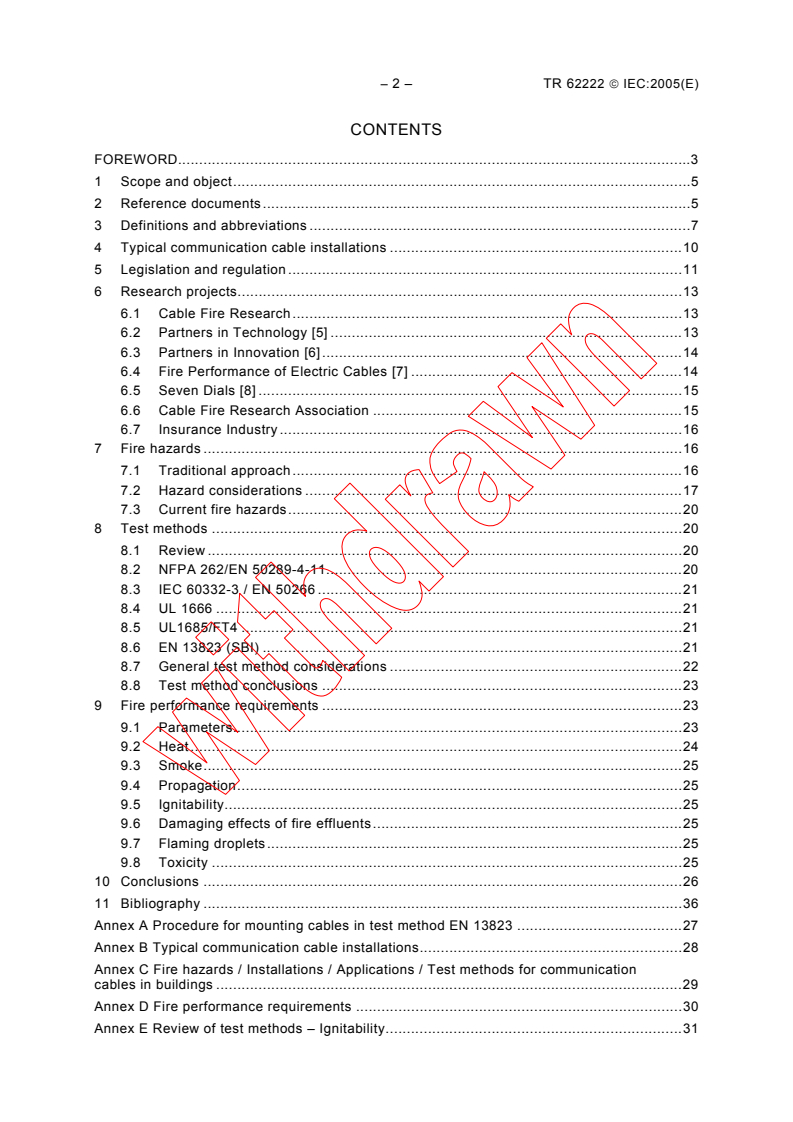
– 2 – TR 62222 IEC:2005(E)
CONTENTS
FOREWORD.3
1 Scope and object.5
2 Reference documents.5
3 Definitions and abbreviations .7
4 Typical communication cable installations .10
5 Legislation and regulation .11
6 Research projects.13
6.1 Cable Fire Research.13
6.2 Partners in Technology [5] .13
6.3 Partners in Innovation [6].14
6.4 Fire Performance of Electric Cables [7] .14
6.5 Seven Dials [8] .15
6.6 Cable Fire Research Association .15
6.7 Insurance Industry .16
7 Fire hazards .16
7.1 Traditional approach.16
7.2 Hazard considerations .17
7.3 Current fire hazards.20
8 Test methods .20
8.1 Review .20
8.2 NFPA 262/EN 50289-4-11.20
8.3 IEC 60332-3 / EN 50266 .21
8.4 UL 1666 .21
8.5 UL1685/FT4 .21
8.6 EN 13823 (SBI) .21
8.7 General test method considerations .22
8.8 Test method conclusions .23
9 Fire performance requirements .23
9.1 Parameters.23
9.2 Heat .24
9.3 Smoke.25
9.4 Propagation.25
9.5 Ignitability.25
9.6 Damaging effects of fire effluents.25
9.7 Flaming droplets.25
9.8 Toxicity .25
10 Conclusions .26
11 Bibliography .36
Annex A Procedure for mounting cables in test method EN 13823 .27
Annex B Typical communication cable installations.28
Annex C Fire hazards / Installations / Applications / Test methods for communication
cables in buildings .29
Annex D Fire performance requirements .30
Annex E Review of test methods – Ignitability.31
TR 62222 IEC:2005(E) – 3 –
INTERNATIONAL ELECTROTECHNICAL COMMISSION
____________
FIRE PERFORMANCE OF COMMUNICATION CABLES
INSTALLED IN BUILDINGS
FOREWORD
1) The International Electrotechnical Commission (IEC) is a worldwide organization for standardization comprising
all national electrotechnical committees (IEC National Committees). The object of IEC is to promote
international co-operation on all questions concerning standardization in the electrical and electronic fields. To
this end and in addition to other activities, IEC publishes International Standards, Technical Specifications,
Technical Reports, Publicly Available Specifications (PAS) and Guides (hereafter referred to as “IEC
Publication(s)”). Their preparation is entrusted to technical committees; any IEC National Committee interested
in the subject dealt with may participate in this preparatory work. International, governmental and non-
governmental organizations liaising with the IEC also participate in this preparation. IEC collaborates closely
with the International Organization for Standardization (ISO) in accordance with conditions determined by
agreement between the two organizations.
2) The formal decisions or agreements of IEC on technical matters express, as nearly as possible, an international
consensus of opinion on the relevant subjects since each technical committee has representation from all
interested IEC National Committees.
3) IEC Publications have the form of recommendations for international use and are accepted by IEC National
Committees in that sense. While all reasonable efforts are made to ensure that the technical content of IEC
Publications is accurate, IEC cannot be held responsible for the way in which they are used or for any
misinterpretation by any end user.
4) In order to promote international uniformity, IEC National Committees undertake to apply IEC Publications
transparently to the maximum extent possible in their national and regional publications. Any divergence
between any IEC Publication and the corresponding national or regional publication shall be clearly indicated in
the latter.
5) IEC provides no marking procedure to indicate its approval and cannot be rendered responsible for any
equipment declared to be in conformity with an IEC Publication.
6) All users should ensure that they have the latest edition of this publication.
7) No liability shall attach to IEC or its directors, employees, servants or agents including individual experts and
members of its technical committees and IEC National Committees for any personal injury, property damage or
other damage of any nature whatsoever, whether direct or indirect, or for costs (including legal fees) and
expenses arising out of the publication, use of, or reliance upon, this IEC Publication or any other IEC
Publications.
8) Attention is drawn to the Normative references cited in this publication. Use of the referenced publications is
indispensable for the correct application of this publication.
9) Attention is drawn to the possibility that some of the elements of this IEC Publication may be the subject of
patent rights. IEC shall not be held responsible for identifying any or all such patent rights.
The main task of IEC technical committees is to prepare International Standards. However, a
technical committee may propose the publication of a technical report when it has collected
data of a different kind from that which is normally published as an International Standard, for
example "state of the art".
IEC 62222, which is a technical report, has been prepared by subcommittee 46C: Wires and
symmetric cables, of IEC technical committee 46: Cables, wires, waveguides, r.f. connectors,
r.f. and microwave passive components and accessories
The text of this technical report is based on the following documents:
Enquiry draft Report on voting
46C/633/DTR 46C/662/RVC
Full information on the voting for the approval of this technical report can be found in the
report on voting indicated in the above table.
This publication has been drafted in accordance with the ISO/IEC Directives, Part 2.
– 4 – TR 62222 IEC:2005(E)
The committee has decided that the contents of this publication will remain unchanged until
the maintenance result date indicated on the IEC web site under "http://webstore.iec.ch" in
the data related to the specific publication. At this date, the publication will be
• reconfirmed,
• withdrawn,
• replaced by a revised edition, or
• amended.
A bilingual version of this publication may be issued at a later date.
TR 62222 IEC:2005(E) – 5 –
FIRE PERFORMANCE OF COMMUNICATION CABLES
INSTALLED IN BUILDINGS
1 Scope and object
The object of this technical report is to provide recommendations for the requirements and
test methods to be specified for the fire performance of communication cables when installed
in buildings.
The recommendations relate to typical applications and installation practices for copper and
optical cables in buildings. This technical report includes an assessment of the fire hazards
presented by such installations, and describes fire scenarios that have been established and
the appropriate cable fire performances to mitigate these hazards.
The recommendations also take into account legislation and regulation applicable to the fire
performance of cables, the results of known research work and an assessment of known test
methods and their ability to measure the recommended fire performance.
Power cables are usually segregated from communication cables for electrical safety and
installed differently so they have not been addressed in this technical report.
2 Normative references
The following referenced documents are indispensable for the application of this document.
For dated references, only the edition cited applies. For undated references, the latest edition
of the referenced document (including any amendments) applies.
IEC 60332-1-1, Tests on electric and optical cables under fire conditions – Part 1-1: Test for
vertical flame propagation for a single vertical insulated wire or cable – Apparatus
IEC 60332-1-2, Tests on electric and optical cables under fire conditions – Part 1-2: Test for
vertical flame propagation for a single insulated wire or cable - Procedure for 1 kW pre-mixed
flame
IEC 60332-3-10, Tests on electric and optical cables under fire conditions – Part 3-10: Test
for vertical flame spread of vertically-mounted bunched wires or cables – Apparatus
IEC 60332-3-24, Tests on electric and optical cables under fire conditions – Part 3-24: Test for
vertical flame spread of vertically-mounted bunched wires or cables – Category C
IEC 60695-5-1, Fire hazard testing – Part 5-1: Corrosion damage effects of fire effluent –
General guidance
IEC 60695-5-3, Fire hazard testing – Part 5-3: Corrosion damage effects of fire effluent –
Leakage current and metal loss test method
IEC 60695-6-1, Fire hazard testing – Part 6-1: Smoke opacity – General guidance
IEC 60695-7-1, Fire hazard testing – Part 7-1: Toxicity of fire effluents – General guidance
IEC 60754 (all parts), Test on gases evolved during combustion of materials from cables
IEC 60794 (all parts), Optical fibre cables
– 6 – TR 62222 IEC:2005(E)
IEC 61034(all parts), Measurement of smoke density of electric cables burning under defined
conditions
IEC 61156 (all parts), Multi-core and symmetrical pair / quad cables for digital
communications
ISO/IEC 11801, Information Technology – Generic cabling for customer premises
ISO/IEC 13943, Fire safety – Vocabulary
ISO 9705, Full-scale room test for surface products
EN 13823, Reaction to fire tests for building products – Building products, excluding floorings,
exposed to the thermal attack by a single burning item.
EN 13501-1, Fire classification of construction products and building elements – Part 1:
Classification using test data from reaction to fire tests.
EN 50265-2-1, Common test methods for cables under fire conditions – Test for vertical flame
propagation for a single insulated wire or cable – Part 2-1: Procedures – 1 kW pre-mixed
flame
EN 50266-2-4, Common test methods for cables under fire conditions – Test for vertical flame
spread of vertically-mounted bunched wires or cables – Part 2-4: Procedures – Category C
EN 50267-2-3, Common test methods for cables under fire conditions – Tests on gases
evolved during combustion of materials from cables – Part 2-3: Procedures – Determination of
degree of acidity of gases for cables by determination of the weighted average of pH and
conductivity
EN 50289-4-11, A horizontal integrated fire test method
CSA FT4, Canadian Standards Association, CSA 22.2 No. 03-01 “Vertical flame test – Cables
in cable trays”
CSA FT6, Canadian Standards Association, CSA 22.2 No. 03-01 “Horizontal flame and smoke
test”
NES 713 UK Ministry of Defence Standard 02-713 (NES 713), “Naval Engineering Standard –
Determination of the toxicity index of the products of combustion from small specimens of
materials”
NFPA 262, Standard method of test for flame travel and smoke of wires and cables for use in
air handling spaces. (Formerly UL 910)
UL 1666, Underwriters Laboratories, Inc., “Test for flame propagation height of electrical and
optical fibre cables installed vertically in shafts”
UL 1685, Underwriters Laboratories, Inc., “Standard for vertical tray fire propagation and
smoke release test for electrical and optical fibre cables”
UL VW-1, Underwriters Laboratories, Inc., “VW-1 (vertical specimen) flame test – UL 1581,
Reference standard for electrical wires, cables and flexible cords”
TR 62222 IEC:2005(E) – 7 –
3 Terms, definitions and abbreviations
For the purpose of this technical report, the definitions in ISO/IEC 13943, together with the
following (some of which are based on EN 13501-1) apply.
3.1
BRE
Building Research Establishment
3.2
“Cardington” test rig
real-scale scenario for cables in horizontal hidden voids in buildings, developed by the BRE in
the Partners in Technology project [5]
3.3
CENELEC
European Committee for Electrotechnical Standardisation
3.4
CFRA
Cable Fire Research Association [11] [16]
3.5
contribution to fire
energy released by a product influencing the fire growth
3.6
CPD
Construction Products Directive [3]
3.7
CSA
Canadian Standards Association
3.8
EN
European Standard
3.9
end use application
real application of a product in relation to all aspects that influence the behaviour of that
product under different fire situations
3.10
FEP
Polytetrafluoroethylene, Fluorinated ethylene-propylene or Polytetrafluoroethylene-hexafluoro-
propylene
3.11
fire growth rate index
FIGRA
maximum quotient of heat release rate from a specimen and the time of its occurrence
___________
Numbers in square brackets refer to the Biliography.
– 8 – TR 62222 IEC:2005(E)
3.12
FIPEC
Fire Performance of Electric Cables [7]
3.13
fire situation
stage in the development of a fire, characterised by the nature, severity and size of the
thermal attack on the products involved
3.14
flaming droplets
material separating from a specimen during a fire test and continuing to flame for a minimum
period as described by the test method
3.15
HF
halogen free or Low smoke zero halogen (sometimes known as LSOH)
3.16
HR
Heat Release
3.17
HRR
Heat Release Rate
3.18
ISO
International Standards Organisation
3.19
LC
concentration or volume fraction of gas or fire effluent statistically calculated from exposure
data to produce lethality in 50 % of test animals within a specified exposure and post-
exposure time
3.20
LSPVC
Low Smoke Flame Retardant PolyVinylCchloride
3.21
NEMA
National Electrical Manufacturers Association [2]
3.22
NES
Naval Engineering Standard
3.23
NFPA¨
National Fire Protection Association
3.24
NIST
National Institute of Standards and Technology [10]
TR 62222 IEC:2005(E) – 9 –
3.25
OD
Optical Density
3.26
PCS
Gross Calorific Potential
3.27
PE
Polyethylene
3.28
PII
Partners in Innovation [6]
3.29
PIT
Partners in Technology [5]
3.30
PP
Polypropylene
3.31
PVC
Polyvinyl chloride
3.32
PVDF
Polyvinylidene Fluoride
3.33
reaction to fire
response of a product in contributing by its own decomposition to a fire to which it is exposed,
under specified conditions
3.34
reference scenario
hazard situation and environment used as a reference for a given test method
3.35
SBI
Single Burning Item test (EN 13823)
3.36
small fire attack
thermal attack produced by a small flame such as a match or lighter
3.37
smoke growth rate index
SMOGRA
the maximum quotient of smoke production rate from a specimen and the time of its
occurrence
3.38
smoke hazard
potential for injury and/or damage from smoke
– 10 – TR 62222 IEC:2005(E)
3.39
smoke
visible part of fire effluent
3.40
SP
Smoke Production
3.41
SPR
Smoke Production Rate
3.42
THR
Total Heat Release
3.43
TSP
Total Smoke Production
3.44
UL
Underwriters Laboratories Inc.
4 Typical communication cable installations
In order to define the appropriate fire test methods and performance requirements, it is
necessary to consider the fire hazards presented by typical cable installations.
During the last decade, the worldwide demand for more and more information has resulted in
increasing transmission data rates, and developments in local area networks (LANs). In
particular the growing popularity of structured cabling systems as defined in ISO/IEC 11801
has given rise to new types of installations. The generic structured wiring cabling system is a
hierarchical star network linking campus distributors to different building distributors, which in
turn link to individual floor distributors which then connect with telecommunication outlets. On
each floor, the riser cable, run in vertical shafts, connects to the floor distributor which
transmits data via the horizontal cables to each floor outlet. In a typical installation, the floor
outlets are arranged in a matrix layout spaced about 1 or 2 metres, with the horizontal cables
run in ceiling or under-floor voids. Even in a small office, this leads to a large number of
cables run in building voids, particularly near the floor distributor.
The evolution of Structured Wiring has coincided with a rapid increase in system data rates,
from 10 kbps in the early 1980’s to 600 Mbps in the late 1990’s, and on to 1,2 Gbps in the
early 2000’s. As transmission rates increase, system upgrades to higher performance cables
and components are typically necessary. Since old redundant cables are rarely removed
before new cables are installed, frequent upgrades result in a large amount of many
generations of cables accumulating in building voids.
Copper conductor cables manufactured to the IEC 61156 series and optical cables
manufactured to the IEC 60794 series are used in Structured Wiring. These standards detail
electrical and optical transmission requirements, mechanical performance and environmental
characteristics. Optical cables and communication cables operating at low voltages and
currents are not a primary cause of fires, but their widespread use means that they may be
involved in outbreaks of fire from an external source. Therefore, fire performance is one of the
most important environmental parameters to be specified.
A review of typical installations suggested that communication cable installations in buildings
are as shown in Annex B and can be grouped into the following descriptions:
TR 62222 IEC:2005(E) – 11 –
a) In public buildings such as airports, shops and older commercial offices with solid floors,
cables are generally installed in ceiling voids with some local cabling in wall ducts.
Regulations generally require segregation of power cables for electrical safety.
b) In general, in offices and newer commercial offices, cables are generally installed in
ceiling and under-floor voids, and wall ducts. Lighting power cables and some
communication cables are run in ceiling voids, whilst computer and telephone cables and
their associated low voltage power cables are often run in under-floor voids. Again,
regulations generally require the segregation of power cables (in conduit or trunking) for
electrical safety. In such installations, relatively shallow raised flooring provides the under-
floor voids, and forced airflow is generally not used.
c) In newer large commercial offices with extensive computer facilities, the raised flooring is
deep (1,0 to 1,5 m is not uncommon) and the void can be densely packed with
communication cables. This void can also be used for the provision of environmental air to
computer equipment.
d) Under-floor and ceiling voids can have particular airflow dynamics that should be reflected
in the test method. In general, as airflow rate increases in any given apparatus, fire
propagation increases and smoke generation reduces. However research [5] has shown
that in hidden voids, combustion proceeds to the same degree whether under forced or
natural convection.
e) A considerable amount of cables can be installed in vertical riser shafts. For convenience,
these may be the same cables as are used for horizontal runs.
f) Patch cords and work area cables, whilst not permanently installed in buildings, often
accumulate in large numbers and have been included in the scope of this technical report.
g) In many installations, there can also be a number of cables that run behind and within
walls.
h) Large buildings are being designed and constructed worldwide by large multi-national
businesses, resulting in similar architecture and distribution of utilities within the structure
with raised floors and suspended ceilings creating building voids through which fire and
smoke can spread. Over 80% of cables installed in new offices are communication cables
and that could increase the fuel load in the event of a fire, an aspect not previously
addressed by IEC cable and installation standards.
i) For the purposes of defining the fire hazards and the fire performance to be specified, the
typical installations as described above and shown in Annex B, can be categorised as:
• Horizontal installations in building voids.
• Vertical installations in riser shafts.
• General installations.
• Exposed work areas.
• Installations where protection of equipment is critical.
5 Legislation and regulation
There are many different regional and local regulations. For example:
a) In Germany the amount of cable allowed in a public building is based on PCS values of
2 2
50 MJ/m for HF cables and 25 MJ/m for PVC cables. Guidance on the calculation of
PCS is given by the German Insurers [13], but it is not clear why a greater fuel load is
allowed for HF cables than for PVC cables. Doubt can also be cast on the stated
advantages that HF cables are less flammable and extinguish within a few min when the
ignition source is removed (PVC cables do not extinguish) and have less flame
propagation because of improved flame resistance.
b) Building codes in USA have very strong fire performance requirements. Cables installed in
buildings are regulated by the National Electrical Code [12]. The fire performance
requirements are specified either in code regulations (e.g. NFPA) as well as in specific
product standards. Flame propagation and smoke are the main criteria for cables in
building voids with air movement.
– 12 – TR 62222 IEC:2005(E)
c) In the UK, there is very little regulation for the fire performance of cables. In the Building
Regulations, the main concerns regarding fire safety are means of escape, fire spread and
access facilities for the fire service. On the other hand, the insurance industry (de-facto
legislation) recognises new requirements for cables, and the particular hazard of
communication cables in building voids [9].
The Loss Prevention Council is a leading authority in the field of loss prevention and
control and it publishes a “Design Guide for the Fire Protection of Buildings” [20] to allow
architects and building designers to take into account insurers’ recommendations for fire
protection. The Guide highlights the increasing numbers of cables being used in buildings,
and in particular it recommends the use of cables with enhanced fire performance in
communication rooms.
d) In South Africa, there is little or no regulation for the fire performance of cables in
dwellings and high-rise buildings. The Wiring Code provides for the segregation of power
and communication cables as well as the certification of installations by means of physical
examination and electrical testing, by accredited persons. In the Building Regulations, the
main concerns regarding fire safety are means of escape, the prevention of fire spread by
the use of firewalls, fire fighting equipment and the accessibility of the premises for
external fire fighting. In the mining industry, although not regulated, underground power
and communication cables generally have a superior fire performance.
e) In Europe, developments with respect to cables and the Construction Products Directive
may have a significant impact on the fire performance requirements for cables.
The Construction Products Directive [3] was published by the European Commission in
1989, and has six essential requirements for building products, namely Mechanical
stability, Safety in case of fire, Health and environment, Safety in use, Protection against
noise and Energy economy. For safety in case of fire, a harmonised European system for
the classification of the fire performance of building products and the corresponding test
methods has been developed. This is based on the ISO 9705 real scale reference
scenario and the EN 13823 (SBI) intermediate scale reference test.
From time to time, the Construction Products Directive (CPD) has been amended by
Commission Decisions which reflect progress in defining and testing the fire performance of
products. In a recent Decision [4], test methods and requirements are given for the
classification of the reaction to fire performance of all construction products. Products are
considered in relation to their end-use application and appeals may be made against the
appropriateness of the reference scenario or the reference test method and alternatives may
be proposed for one or both. However, any alternative intermediate reference test should be
shown to correlate with its real scale reference scenario, and should use the EN 13823 test
(modified or not) as the starting point.
In December 1998, it was decided that cables permanently installed in buildings fall within the
scope of the CPD. Since then, industry and the European Commission and its Fire Regulators
Group have been working to establish whether cables as linear products can be treated as
any other building product or whether a special classification system and test methods are
necessary.
Once the Fire Regulators Group proposals for the Classification Criteria and Test Methods
have been approved, a further Decision will be published and a mandate will be issued to
prepare product specifications for the cables involved.
A concern to the cable industry is the reluctance of the Fire Regulators Group to include
smoke production as a mandatory requirement.
It should be noted that the CPD is not intended to harmonise Regulation, or to impose
Regulation where none exists, but it is intended to harmonise the classification of the reaction
to fire of products, and the test methods used.
TR 62222 IEC:2005(E) – 13 –
Self-Certification of cable fire performance still exists generally, but the trend is to Third Party
Certification. Third Party Certification is practised in North America, and by the Insurance
Industry, and may be required in Europe under the CPD.
6 Research projects
6.1 Cable fire research
During the last decade a significant amount of research has been undertaken. This has
provided valuable data and findings which have been taken into account when establishing
the fire performance requirements recommended in this report for communication cables
installed in buildings.
A review of known research projects indicated that those with major relevance are:
• Partners in Technology (PIT);
• Partners in Innovation (PII);
• Fire Performance of Electric Cables (FIPEC);
• Seven Dials;
• Private research;
• Cable Fire Research Association (CFRA);
• Cable industry research.
6.2 Partners in Technology [5]
The Partners in Technology (PIT) project was a UK Government and industry sponsored study
into cable fires in hidden building voids. The work included carrying out surveys to establish
typical communication cable installation scenarios and assess their fire hazards, the
development of a representative real scale scenario and the construction of a real scale test
facility against which other standard cable test methods can be referenced.
This project identified the fire hazard from communication cables installed in a high density
and placed in building voids which are often filled with many generations of cables and
provide a route for the spread of fire and smoke. A real scale test facility was developed
(known as the “Cardington” test rig) representing a 50 workstation office with 200 cables run
in a ceiling void and exposed to a typical work station fire.
Using the “Cardington” real scale test rig, six cables were tested. These were 4 pair and 25
pair cables rated as NFPA 262, IEC 60332-3C (HF) and IEC 60332-1. The work also included
calorimeter testing.
The conclusions were:
a) A fire hazard exists for communication cables in high-density installations in building
voids.
b) Building voids provide a route for the spread of fire and smoke.
c) Building voids are often filled with many generations of cables.
d) The “Cardington” test rig is a suitable real scale scenario for evaluating the fire hazard
from cables installed horizontally in hidden building voids.
e) The best performance in the “Cardington” tests was achieved by NFPA 262 (EN 50289-4-
11) rated cables. It was found that IEC 60332-3C and IEC 60332-1 rated cables can
produce severe fires and IEC 60332-3C rated HF cables can produce significant smoke.
– 14 – TR 62222 IEC:2005(E)
6.3 Partners in Innovation [6]
The objective of the UK Government and industry sponsored Partners in Innovation (PII)
project was to assess existing test methods and make recommendations for the reaction-to-
fire testing of communication cables. Nine types of cables were tested in six different test
methods. The cables comprised a variety of PVC and HF sheathed structured wiring cables
with either enhanced fire performances or rated to IEC 60332-3C. An enhanced fire
performance optical cable was included. These cables were tested in the “Cardington” real-
scale test, the CPD large-scale scenario ISO 9705, EN 50289-4-11 (the horizontal test
equivalent to NFPA 262), EN 13823 (SBI), IEC 60332-3 and IEC 61034 series.
The research findings included correlations between the test methods, as well as fire
performance ranking of the cables tested. The conclusions were as follows:
a) The “Cardington” test rig is a suitable real scale reference scenario.
b) EN 50289-4-11 has a very good correlation to the “Cardington” test rig and should be used
to assess cables for installation in high-risk areas.
c) EN 13823 (SBI) has a good correlation to the “Cardington” test rig but is not suitable
without further work on cable sample loading and mounting configuration.
d) IEC 60332-3 has a poor correlation to the “Cardington” test rig and should not be used for
high-risk applications but it can be used for vertical shafts and general applications.
6.4 Fire Performance of Electric Cables (FIPEC) [7]
This was a European Commission and industry funded project set up to develop methods for
measuring the fire performance of cables. The database generated by the project covered
some fifty cables. The majority of these were power cables, with a few telephone cables and
only one data cable.
The most frequently used test methods to assess the fire performance of cables in Europe are
IEC 60332-3 and IEC 60332-1. An objective of this study was to provide a means by which
Fire Engineering considerations may be introduced to the cables sector of the European
marketplace.
Applying the information developed by the FIPEC programme it was found possible to modify
the existing IEC 60332-3 test to include heat release and smoke measurement. Changes to
sample mounting, the option of a backboard with a more powerful ignition source and an
increased airflow provide a better discrimination between cable performances.
Part of the FIPEC study was to determine the sensitivity of the various test parameters
utilized for the IEC 60332-3 test. This demonstrated that the most significant variable was in
cable mounting. It was concluded that consideration of non-metallic materials content (the
basis by which the quantity of cable sample to be mounted is selected) does not necessarily
provide a risk hierarchy. When discussing the “influence of layers” the report states “cable
loading derived categories do not correspond with a risk hierarchy, e.g. a 7 l/m loading may
not necessarily be a more severe test than a 1,5 l/m loading. These categories should be
unambiguously separate from the inferences of risk assessment.”
The two scenarios (test methods) derived through the FIPEC study do not take non-metallic
materials content into account when determining the quantity and configuration of cable
sample to be mounted for fire testing. Instead, cable diameter is the prime determinant with,
in every instance, a designated separation between adjacent cable samples. Cables having a
diameter greater than 5 mm were mounted in a single spaced row, and smaller cables were
mounted in non-twisted spaced bundles.
In test method Scenario 1, considered to be slightly more severe than IEC 60332-3, the
ignition source is 20 kW and the airflow is increased. In test method Scenario 2, considered to
TR 62222 IEC:2005(E) – 15 –
be more severe than IEC 60332-3, the ignition source is 30 kW, the airflow is increased and a
non-combustible backboard is added.
Conclusions of relevance include:
a) The current method and procedures by which cable performance is determined produces a
prescriptive requirement that does not enable a graded classification of fire hazard, nor
the provision of data by which fire hazard may be assessed.
b) IEC 60332-3 is not sensitive enough to differentiate between cables with reasonable fire
properties, and those with very good properties needed for high hazard or high-density
telecommunication cable installations.
c) The parameter that has the most effect on the test results is the method of mounting the
tested cables.
NOTE Although the FIPEC project included only one data cable, private research [16] on 13 structured wiring
cables has shown that although not as sensitive as NFPA 262 or EN 50289-4-11, with appropriate cable mounting
configurations and performance boundaries, Scenario 2 can differentiate the higher performing products.
6.5 Seven Dials [8]
This project is an investigation into a fire at the “Seven Dials”, a five storey building in
London. The building was completely destroyed. Heat and smoke was a major problem, and
the Fire Brigade had difficulty in locating the seat of the fire. Cables in the ceiling void were
very old PVC sheathed polyethylene insulated coaxials.
Tests were carried out in the real scale “Cardington” test rig with replica cables and also with
enhanced fire performance versions. The results confirmed the need for enhanced fire
performance cables in such installations.
Subsequent private research [14] involved testing another enhanced fire performance coaxial
cable (diameter 7,2 mm) in the “Cardington” test rig to investigate the conditions that arise
inside ceiling voids when a fire occurs in the room below and to measure the effect on cables
installed in the ceiling void. Again the results confirmed the need for enhanced fire
performance cables in such installations.
The Seven Dials project is significant since it is a detailed investigation into an actual fire
involving communication cables in hidden horizontal building voids.
6.6 Cable Fire Research Association
The Cable Fire Research Association (CFRA) is an international Trade Association which
researches and promotes the use of cables and cable-making materials for the enhancement
of fire safety. Established in 2001, it formalises and improves awareness of the results of
research by its members over the previous 10 years. It is made up of cable producers and
suppliers of materials to the cable industry and has Chapters operating in Canada, China,
Europe, Japan and USA.
Prompted by the conclusions of the PII and FIPEC projects, the CFRA has conducted
research to further investigate the effects of sample selection and mounting configurations
when cables are tested on ladders. The conclusions are shown in Table 1.
Mindful of the CPD appeals procedure, work has also been undertaken to investigate the
sample mounting configuration in the EN 13823 (SBI) test. This has shown that with the
procedure described in Annex A (cables mounted 1 layer touching), the SBI test is suitable for
assessing and discriminating various levels of fire performance with communication cables.
– 16 – TR 62222 IEC:2005(E)
Table 1 Sample selection and mounting
Selection/Mounting Conclusions
1,5 l/m in multiple layers Material test rather than a cable test.
e.g. IEC 60332-3C Large number of cables (e.g. 160) makes the test
labour intensive.
1 layer spaced Not representative.
e.g. FIPEC Problems with repeatability and reproducibility.
1 layer spaced bundles Not representative.
e.g. FIPEC Problems with repeatability and reproducibility.
1 layer touching Representative, repeatable and reproducible.
Private research by CFRA members since 1991 [11] [16] and their participation in the PIT, PII
and Seven Dials projects has lead the CFRA to conclude:
a) Communication cables in high concentration horizontal building voids present a fire hazard
that is not adequately addressed by existing cable standards.
b) The “Cardington” test rig is an appropriate real-scale reference scenario for cables in
horizontal building voids.
c) Smaller scale or intermediate tests should integrate as many reaction-to-fire parameters
as possible.
d) EN 50289-4-11 has the best correlation to the “Cardington” test rig and should be used to
assess cables for high-risk areas.
e) SBI has a good correlation to the “Cardington” test rig and can be used to assess the fire
performance of cables when
...
IEC/TR 62222
Edition 1.0 2005-03
TECHNICAL
REPORT
RAPPORT
TECHNIQUE
Fire performance of communication cables installed in buildings
Tenue au feu des câbles de communications installés dans les bâtiments
IEC/TR 62222:2005
All rights reserved. Unless otherwise specified, no part of this publication may be reproduced or utilized in any form or by
any means, electronic or mechanical, including photocopying and microfilm, without permission in writing from either IEC or
IEC's member National Committee in the country of the requester.
If you have any questions about IEC copyright or have an enquiry about obtaining additional rights to this publication,
please contact the address below or your local IEC member National Committee for further information.
Droits de reproduction réservés. Sauf indication contraire, aucune partie de cette publication ne peut être reproduite
ni utilisée sous quelque forme que ce soit et par aucun procédé, électronique ou mécanique, y compris la photocopie
et les microfilms, sans l'accord écrit de la CEI ou du Comité national de la CEI du pays du demandeur.
Si vous avez des questions sur le copyright de la CEI ou si vous désirez obtenir des droits supplémentaires sur cette
publication, utilisez les coordonnées ci-après ou contactez le Comité national de la CEI de votre pays de résidence.
IEC Central Office
3, rue de Varembé
CH-1211 Geneva 20
Switzerland
Email: inmail@iec.ch
Web: www.iec.ch
About the IEC
The International Electrotechnical Commission (IEC) is the leading global organization that prepares and publishes
International Standards for all electrical, electronic and related technologies.
About IEC publications
The technical content of IEC publications is kept under constant review by the IEC. Please make sure that you have the
latest edition, a corrigenda or an amendment might have been published.
ƒ Catalogue of IEC publications: www.iec.ch/searchpub
The IEC on-line Catalogue enables you to search by a variety of criteria (reference number, text, technical committee,…).
It also gives information on projects, withdrawn and replaced publications.
ƒ IEC Just Published: www.iec.ch/online_news/justpub
Stay up to date on all new IEC publications. Just Published details twice a month all new publications released. Available
on-line and also by email.
ƒ Electropedia: www.electropedia.org
The world's leading online dictionary of electronic and electrical terms containing more than 20 000 terms and definitions
in English and French, with equivalent terms in additional languages. Also known as the International Electrotechnical
Vocabulary online.
ƒ Customer Service Centre: www.iec.ch/webstore/custserv
If you wish to give us your feedback on this publication or need further assistance, please visit the Customer Service
Centre FAQ or contact us:
Email: csc@iec.ch
Tel.: +41 22 919 02 11
Fax: +41 22 919 03 00
A propos de la CEI
La Commission Electrotechnique Internationale (CEI) est la première organisation mondiale qui élabore et publie des
normes internationales pour tout ce qui a trait à l'électricité, à l'électronique et aux technologies apparentées.
A propos des publications CEI
Le contenu technique des publications de la CEI est constamment revu. Veuillez vous assurer que vous possédez
l’édition la plus récente, un corrigendum ou amendement peut avoir été publié.
ƒ Catalogue des publications de la CEI: www.iec.ch/searchpub/cur_fut-f.htm
Le Catalogue en-ligne de la CEI vous permet d’effectuer des recherches en utilisant différents critères (numéro de référence,
texte, comité d’études,…). Il donne aussi des informations sur les projets et les publications retirées ou remplacées.
ƒ Just Published CEI: www.iec.ch/online_news/justpub
Restez informé sur les nouvelles publications de la CEI. Just Published détaille deux fois par mois les nouvelles
publications parues. Disponible en-ligne et aussi par email.
ƒ Electropedia: www.electropedia.org
Le premier dictionnaire en ligne au monde de termes électroniques et électriques. Il contient plus de 20 000 termes et
définitions en anglais et en français, ainsi que les termes équivalents dans les langues additionnelles. Egalement appelé
Vocabulaire Electrotechnique International en ligne.
ƒ Service Clients: www.iec.ch/webstore/custserv/custserv_entry-f.htm
Si vous désirez nous donner des commentaires sur cette publication ou si vous avez des questions, visitez le FAQ du
Service clients ou contactez-nous:
Email: csc@iec.ch
Tél.: +41 22 919 02 11
Fax: +41 22 919 03 00
IEC/TR 62222
Edition 1.0 2005-03
TECHNICAL
REPORT
RAPPORT
TECHNIQUE
Fire performance of communication cables installed in buildings
Tenue au feu des câbles de communications installés dans les bâtiments
INTERNATIONAL
ELECTROTECHNICAL
COMMISSION
COMMISSION
ELECTROTECHNIQUE
PRICE CODE
INTERNATIONALE
W
CODE PRIX
ICS 33.120.20 ISBN 2-8318-8438-1
– 2 – TR 62222 © CEI:2005
SOMMAIRE
AVANT-PROPOS.6
1 Domaine d’application et objet.10
2 Références normatives.10
3 Définitions et abréviations .14
4 Installations classiques des câbles de communications .20
5 Législation et réglementation.24
6 Projets de recherche .26
6.1 Recherches sur le feu des câbles.26
6.2 Partenariats en technologie [5] .28
6.3 Partenariats en innovation [6].28
6.4 Tenue au feu des câbles électriques [7] .30
6.5 «Seven Dials» [8] .32
6.6 Association de recherche sur le feu de câbles.32
6.7 Profession de l’Assurance .34
7 Risques du feu .36
7.1 Approche traditionnelle.36
7.2 Etude des risques .38
7.3 Risques courants du feu.42
8 Méthodes d’essai .44
8.1 Revue .44
8.2 NFPA 262/EN 50289-4-11 .44
8.3 Série CEI 60332-3/EN 50266 .46
8.4 UL 1666 .46
8.5 UL1685/FT4 .46
8.6 EN 13823 (SBI) .48
8.7 Considérations générales des méthodes d’essai .48
8.8 Conclusions de méthodes d’essai.50
9 Exigences en tenue au feu .50
9.1 Paramètres .50
9.2 Chaleur .52
9.3 Fumée.54
9.4 Propagation.54
9.5 Inflammabilité.56
9.6 Effets préjudiciables des effluents du feu .56
9.7 Gouttelettes enflammées.56
9.8 Toxicité .56
10 Conclusions.56
Annexe A (informative) Procédure pour le montage des câbles pour la méthode d’essai
de l’EN 13823 .60
Annexe B (informative) Installations classiques de câbles de communications.62
Annexe C (informative) Risques du feu/installations/applications/méthodes d’essai
pour les câbles de communications dans les bâtiments .64
TR 62222 © IEC:2005 – 3 –
CONTENTS
FOREWORD.7
1 Scope and object.11
2 Normative references .11
3 Terms, definitions and abbreviations .15
4 Typical communication cable installations .21
5 Legislation and regulation.25
6 Research projects .27
6.1 Cable fire research.27
6.2 Partners in Technology [5].29
6.3 Partners in Innovation [6] .29
6.4 Fire Performance of Electric Cables (FIPEC) [7].31
6.5 Seven Dials [8].33
6.6 Cable Fire Research Association.33
6.7 Insurance Industry.35
7 Fire hazards .37
7.1 Traditional approach.37
7.2 Hazard considerations.39
7.3 Current fire hazards .43
8 Test methods .45
8.1 Review .45
8.2 NFPA 262/EN 50289-4-11 .45
8.3 IEC 60332-3 series/EN 50266 .47
8.4 UL 1666 .47
8.5 UL1685/CSA FT4 .47
8.6 EN 13823 (SBI) .49
8.7 General test method considerations .49
8.8 Test method conclusions .51
9 Fire performance requirements.51
9.1 Parameters .51
9.2 Heat .53
9.3 Smoke.55
9.4 Propagation.55
9.5 Ignitability.57
9.6 Damaging effects of fire effluents .57
9.7 Flaming droplets.57
9.8 Toxicity .57
10 Conclusions.57
Annex A (informative) Procedure for mounting cables in test method EN 13823.61
Annex B (informative) Typical communication cable installations .63
Annex C (informative) Fire hazards/installations/applications/test methods for
communication cables in buildings .65
– 4 – TR 62222 © CEI:2005
Annexe D (informative) Exigences en tenue au feu .66
Annexe E (informative) Revue des méthodes d’essais .68
Bibliographie.78
Figure B.1 – Installations classiques de câbles en communications .62
Tableau 1 – Sélection d’échantillon et montage .34
Tableau 2 – Classement classique des dangers au feu .36
Tableau 3 – Exigences classiques de tenue au feu des câbles .36
Tableau 4 – Méthodes d’essai .44
Tableau 5 – Matériaux classiques de câble de communications .52
Tableau 6 – Exigences recommandées pour la chaleur.54
Tableau 7 – Exigences recommandées pour la fumée.54
Tableau C.1 – Risques du feu/installations/applications/méthodes d’essai pour les
câbles de communications dans les bâtiments .64
Tableau E.1 – Inflammabilité.68
Tableau E.2 – Essais verticaux .70
Tableau E.3 – Essais horizontaux .74
Tableau E.4 – Mesure indirecte de fumée .76
TR 62222 © IEC:2005 – 5 –
Annex D (informative) Fire performance requirements .67
Annex E (informative) Review of test methods .69
Bibliography.79
Figure B.1 – Typical communication cable installations.63
Table 1 – Sample selection and mounting.35
Table 2 – Traditional ranking of fire hazards .37
Table 3 – Traditional cable fire performance requirements .37
Table 4 – Test methods .45
Table 5 – Typical communication cable materials .53
Table 6 – Recommended requirements for heat .55
Table 7 – Recommended requirements for smoke.55
Table C.1 – Fire hazards/installations/applications/test methods for communication
cables in buildings .65
Table E.1 – Ignitability .69
Table E.2 – Vertical tests.71
Table E.3 – Horizontal tests.75
Table E.4 – Indirect measurement of smoke .77
– 6 – TR 62222 © CEI:2005
COMMISSION ÉLECTROTECHNIQUE INTERNATIONALE
____________
TENUE AU FEU DES CÂBLES DE COMMUNICATIONS
INSTALLÉS DANS LES BÂTIMENTS
AVANT-PROPOS
1) La Commission Electrotechnique Internationale (CEI) est une organisation mondiale de normalisation
composée de l'ensemble des comités électrotechniques nationaux (Comités nationaux de la CEI). La CEI a
pour objet de favoriser la coopération internationale pour toutes les questions de normalisation dans les
domaines de l'électricité et de l'électronique. A cet effet, la CEI – entre autres activités – publie des Normes
internationales, des Spécifications techniques, des Rapports techniques, des Spécifications accessibles au
public (PAS) et des Guides (ci-après dénommés "Publication(s) de la CEI"). Leur élaboration est confiée à des
comités d'études, aux travaux desquels tout Comité national intéressé par le sujet traité peut participer. Les
organisations internationales, gouvernementales et non gouvernementales, en liaison avec la CEI, participent
également aux travaux. La CEI collabore étroitement avec l'Organisation Internationale de Normalisation (ISO),
selon des conditions fixées par accord entre les deux organisations.
2) Les décisions ou accords officiels de la CEI concernant les questions techniques représentent, dans la mesure
du possible, un accord international sur les sujets étudiés, étant donné que les Comités nationaux de la CEI
intéressés sont représentés dans chaque comité d’études.
3) Les Publications de la CEI se présentent sous la forme de recommandations internationales et sont agréées
comme telles par les Comités nationaux de la CEI. Tous les efforts raisonnables sont entrepris afin que la CEI
s'assure de l'exactitude du contenu technique de ses publications; la CEI ne peut pas être tenue responsable
de l'éventuelle mauvaise utilisation ou interprétation qui en est faite par un quelconque utilisateur final.
4) Dans le but d'encourager l'uniformité internationale, les Comités nationaux de la CEI s'engagent, dans toute la
mesure possible, à appliquer de façon transparente les Publications de la CEI dans leurs publications
nationales et régionales. Toutes divergences entre toutes Publications de la CEI et toutes publications
nationales ou régionales correspondantes doivent être indiquées en termes clairs dans ces dernières.
5) La CEI n’a prévu aucune procédure de marquage valant indication d’approbation et n'engage pas sa
responsabilité pour les équipements déclarés conformes à une de ses Publications.
6) Tous les utilisateurs doivent s'assurer qu'ils sont en possession de la dernière édition de cette publication.
7) Aucune responsabilité ne doit être imputée à la CEI, à ses administrateurs, employés, auxiliaires ou
mandataires, y compris ses experts particuliers et les membres de ses comités d'études et des Comités
nationaux de la CEI, pour tout préjudice causé en cas de dommages corporels et matériels, ou de tout autre
dommage de quelque nature que ce soit, directe ou indirecte, ou pour supporter les coûts (y compris les frais
de justice) et les dépenses découlant de la publication ou de l'utilisation de cette Publication de la CEI ou de
toute autre Publication de la CEI, ou au crédit qui lui est accordé.
8) L'attention est attirée sur les références normatives citées dans cette publication. L'utilisation de publications
référencées est obligatoire pour une application correcte de la présente publication.
9) L’attention est attirée sur le fait que certains des éléments de la présente Publication de la CEI peuvent faire
l’objet de droits de propriété intellectuelle ou de droits analogues. La CEI ne saurait être tenue pour
responsable de ne pas avoir identifié de tels droits de propriété et de ne pas avoir signalé leur existence.
La tâche principale des comités d’études de la CEI est l’élaboration des Normes
internationales. Toutefois, un comité d’études peut proposer la publication d’un rapport
technique lorsqu’il a réuni des données de nature différente de celles qui sont normalement
publiées comme Normes internationales, cela pouvant comprendre, par exemple, des
informations sur l’état de la technique.
La CEI 6222, qui est un rapport technique, a été établie par le sous-comité 46C: Câble
signalétiques et fils, du comité d’études 46 de la CEI: Câbles, fils, guides d'ondes,
connecteurs, composants passifs pour micro-onde et accessoires.
Cette version bilingue, publiée en 2006-01, correspond à la version anglaise.
Le texte anglais de ce rapport technique est issu des documents 46C/633/DTR et
46C/662/RVC. Le rapport de vote 46C/662/RVC donne toute information sur le vote ayant
abouti à l'approbation de ce rapport technique.
TR 62222 © IEC:2005 – 7 –
INTERNATIONAL ELECTROTECHNICAL COMMISSION
____________
FIRE PERFORMANCE OF COMMUNICATION CABLES
INSTALLED IN BUILDINGS
FOREWORD
1) The International Electrotechnical Commission (IEC) is a worldwide organization for standardization comprising
all national electrotechnical committees (IEC National Committees). The object of IEC is to promote
international co-operation on all questions concerning standardization in the electrical and electronic fields. To
this end and in addition to other activities, IEC publishes International Standards, Technical Specifications,
Technical Reports, Publicly Available Specifications (PAS) and Guides (hereafter referred to as “IEC
Publication(s)”). Their preparation is entrusted to technical committees; any IEC National Committee interested
in the subject dealt with may participate in this preparatory work. International, governmental and non-
governmental organizations liaising with the IEC also participate in this preparation. IEC collaborates closely
with the International Organization for Standardization (ISO) in accordance with conditions determined by
agreement between the two organizations.
2) The formal decisions or agreements of IEC on technical matters express, as nearly as possible, an international
consensus of opinion on the relevant subjects since each technical committee has representation from all
interested IEC National Committees.
3) IEC Publications have the form of recommendations for international use and are accepted by IEC National
Committees in that sense. While all reasonable efforts are made to ensure that the technical content of IEC
Publications is accurate, IEC cannot be held responsible for the way in which they are used or for any
misinterpretation by any end user.
4) In order to promote international uniformity, IEC National Committees undertake to apply IEC Publications
transparently to the maximum extent possible in their national and regional publications. Any divergence
between any IEC Publication and the corresponding national or regional publication shall be clearly indicated in
the latter.
5) IEC provides no marking procedure to indicate its approval and cannot be rendered responsible for any
equipment declared to be in conformity with an IEC Publication.
6) All users should ensure that they have the latest edition of this publication.
7) No liability shall attach to IEC or its directors, employees, servants or agents including individual experts and
members of its technical committees and IEC National Committees for any personal injury, property damage or
other damage of any nature whatsoever, whether direct or indirect, or for costs (including legal fees) and
expenses arising out of the publication, use of, or reliance upon, this IEC Publication or any other IEC
Publications.
8) Attention is drawn to the Normative references cited in this publication. Use of the referenced publications is
indispensable for the correct application of this publication.
9) Attention is drawn to the possibility that some of the elements of this IEC Publication may be the subject of
patent rights. IEC shall not be held responsible for identifying any or all such patent rights.
The main task of IEC technical committees is to prepare International Standards. However, a
technical committee may propose the publication of a technical report when it has collected
data of a different kind from that which is normally published as an International Standard, for
example "state of the art".
IEC 62222, which is a technical report, has been prepared by subcommittee 46C: Wires and
symmetric cables, of IEC technical committee 46: Cables, wires, waveguides, r.f. connectors,
r.f. and microwave passive components and accessories.
This bilingual version, published in 2006-01, corresponds to the English version.
The text of this technical report is based on the following documents:
Enquiry draft Report on voting
46C/633/DTR 46C/662/RVC
Full information on the voting for the approval of this technical report can be found in the
report on voting indicated in the above table.
– 8 – TR 62222 © CEI:2005
La version française de ce rapport n'a pas été soumise au vote.
NOTE Par rapport à la version anglaise publiée de ce rapport technique, certaines références normatives ont été
mises à jour eu égard aux nouvelles éditions.
Cette publication a été rédigée selon les Directives ISO/CEI, Partie 2.
Le comité a décidé que le contenu de cette publication ne sera pas modifié avant la date de
maintenance indiquée sur le site web de la CEI sous "http://webstore.iec.ch" dans les
données relatives à la publication recherchée. A cette date, la publication sera
• reconduite,
• supprimée,
• remplacée par une édition révisée, ou
• amendée.
TR 62222 © IEC:2005 – 9 –
The French version of this technical report has not been voted upon.
NOTE With respect to the already published English version of this technical report, several normative references
have been updated to reflect new editions.
This publication has been drafted in accordance with the ISO/IEC Directives, Part 2.
The committee has decided that the contents of this publication will remain unchanged until
the maintenance result date indicated on the IEC web site under "http://webstore.iec.ch" in
the data related to the specific publication. At this date, the publication will be
• reconfirmed,
• withdrawn,
• replaced by a revised edition, or
• amended.
– 10 – TR 62222 © CEI:2005
TENUE AU FEU DES CÂBLES DE COMMUNICATIONS
INSTALLÉS DANS LES BÂTIMENTS
1 Domaine d’application et objet
Le présent rapport technique a pour objet de fournir des recommandations pour les exigences
et les méthodes d’essais à spécifier pour la tenue au feu des câbles de communications
quand ils sont installés dans des bâtiments.
Les recommandations traitent des applications classiques et des pratiques d’installation dans
les bâtiments pour des câbles en cuivre et des câbles à fibres optiques. Ce rapport technique
inclut une évaluation des dangers du feu pour chaque installation, et décrit des scénarios de
feu qui ont été établis et les tenues au feu des câbles appropriés pour limiter ces dangers.
Les recommandations tiennent compte aussi de la législation et de la réglementation
applicable à la tenue au feu des câbles, des résultats des travaux de recherche connus et
une évaluation des méthodes d’essai connues et leur capacité à mesurer la tenue au feu
recommandée.
Les câbles d’énergie sont habituellement séparés des câbles de communications pour la
sécurité électrique et installés différemment, ils ne sont donc pas abordés par ce report
technique.
2 Références normatives
Les documents de référence suivants sont indispensables pour l'application du présent
document. Pour les références datées, seule l'édition citée s'applique. Pour les références
non datées, la dernière édition du document de référence s'applique (y compris les éventuels
amendements).
CEI 60332-1 (toutes les parties), Essais des câbles électriques et à fibres optiques soumis au
feu – Partie 1: Essai de propagation verticale de la flamme sur conducteur ou câble isolé
CEI 60332-3 (toutes les parties), Essais des câbles électriques soumis au feu – Partie 3:
Essai de propagation verticale de la flamme des fils ou câbles en nappes en position verticale
CEI 60332-3-24:2000, Essais des câbles électriques soumis au feu – Partie 3-24: Essai de
propagation verticale de la flamme des fils ou câbles en nappes en position verticale –
Catégorie C
CEI 60695-5-1, Essais relatifs aux risques du feu – Partie 5-1: Effets des dommages de
corrosion des effluents du feu – Guide général
CEI 60695-5-3, Essais relatifs aux risques du feu – Partie 5-3: Effets des dommages de
corrosion des effluents du feu – Méthodes d'essai du courant de fuite et de la perte métallique
CEI 60695-6-1, Essais relatifs aux risques du feu – Partie 6-1: Opacité des fumées – Lignes
directrices générales
CEI 60695-7-1, Essais relatifs aux risques du feu – Partie 7-1: Toxicité des effluents du feu –
Lignes directrices générales
TR 62222 © IEC:2005 – 11 –
FIRE PERFORMANCE OF COMMUNICATION CABLES
INSTALLED IN BUILDINGS
1 Scope and object
The object of this technical report is to provide recommendations for the requirements and
test methods to be specified for the fire performance of communication cables when installed
in buildings.
The recommendations relate to typical applications and installation practices for copper and
optical cables in buildings. This technical report includes an assessment of the fire hazards
presented by such installations, and describes fire scenarios that have been established and
the appropriate cable fire performances to mitigate these hazards.
The recommendations also take into account legislation and regulation applicable to the fire
performance of cables, the results of known research work and an assessment of known test
methods and their ability to measure the recommended fire performance.
Power cables are usually segregated from communication cables for electrical safety and
installed differently so they have not been addressed in this technical report.
2 Normative references
The following referenced documents are indispensable for the application of this document.
For dated references, only the edition cited applies. For undated references, the latest edition
of the referenced document (including any amendments) applies.
IEC 60332-1 (all parts), Tests on electric and optical cables under fire conditions – Part 1:
Test for vertical flame propagation for a single vertical insulated wire or cable
IEC 60332-3 (all parts), Tests on electric and optical cables under fire conditions – Part 3:
Test for vertical flame spread of vertically-mounted bunched wires or cables
IEC 60332-3-24:2000, Tests on electric and optical cables under fire conditions – Part 3-24:
Test for vertical flame spread of vertically-mounted bunched wires or cables – Category C
IEC 60695-5-1, Fire hazard testing – Part 5-1: Corrosion damage effects of fire effluent –
General guidance
IEC 60695-5-3, Fire hazard testing – Part 5-3: Corrosion damage effects of fire effluent –
Leakage current and metal loss test method
IEC 60695-6-1, Fire hazard testing – Part 6-1: Smoke opacity – General guidance
IEC 60695-7-1, Fire hazard testing – Part 7-1: Toxicity of fire effluents – General guidance
– 12 – TR 62222 © CEI:2005
CEI 60754 (toutes les parties), Essais sur les gaz émis lors de la combustion de matériaux
prélevés sur câbles
CEI 60754-2, Essai sur les gaz émis lors de la combustion des câbles électriques – Partie 2:
Détermination de l'acidité des gaz émis lors de la combustion d'un matériau prélevé sur un
câble par mesurage du pH et de la conductivité
CEI 60794 (toutes les parties), Câbles à fibres optiques
CEI 61034 (toutes les parties), Mesure de la densité de fumées dégagées par des câbles
brûlant dans des conditions définies
CEI 61156 (toutes les parties), Câbles multiconducteurs à paires symétriques et quartes pour
transmissions numériques
ISO/IEC 11801, Technologies de l’information – Câblage générique des locaux d’utilisateurs
(disponible en anglais seulement)
ISO/CEI 13943, Sécurité au feu – Vocabulaire
ISO 9705, Essais au feu – Essai dans une pièce de la vraie grandeur pour les produits de
surface
EN 13823, Essais de réaction au feu des produits de construction – Produits de construction
à l'exclusion des revêtements de sol exposés à une sollicitation thermique provoquée par un
objet isolé en feu
EN 13501-1, Classement au feu des produits et éléments de construction – Partie 1:
classement à partir des données d'essais de réaction au feu
EN 50265-2-1, Méthodes d'essai communes aux câbles soumis au feu – Essai de résistance
à la propagation verticale de la flamme sur un conducteur ou câble isolé – Partie 2-1:
Procédures – Flamme de type à prémélange 1 kW
EN 50266-2-4, Méthodes d'essai communes aux câbles soumis au feu – Essai de propagation
verticale de la flamme des fils ou câbles en nappes en position verticale – Partie 2-4:
Procédures – Catégorie C
EN 50267-2-3, Méthodes d'essai communes aux câbles soumis au feu – Essais sur les gaz
émis lors de la combustion d'un matériau prélevé sur un câble – Partie 2-3: Procédures –
Détermination de l'acidité des gaz des câbles par une mesure de la moyenne pondérée du pH
et de la conductivité
EN 60289-4-11, Communication cables – Specifications for test methods – Part 4-11:
Environmental test methods – A horizontal integrated fire test method (disponible en anglais
seulement)
CSA FT4, Association Canadienne de Normalisation, CSA 22.2 No. 03-01 “Essai de flamme
verticale – Câbles dans les chemin de câbles”
CSA FT6, Association Canadienne de Normalisation, CSA 22.2 No. 03-01 “Flamme
horizontale et essais de fumée”
NES 713, UK Ministry of Defence Standard 02-713 (Def stan 02-713), “Naval Engineering
Standard – Determination of the toxicity index of the products of combustion from small
specimens of materials”
TR 62222 © IEC:2005 – 13 –
IEC 60754 (all parts), Test on gases evolved during combustion of electric cables
IEC 60754-2, Test on gases evolved during combustion of electric cables – Part 2:
Determination of degree of acidity of gases evolved during the combustion of materials taken
from electric cables by measuring pH and conductivity
IEC 60794 (all parts), Optical fibre cables
IEC 61034 (all parts), Measurement of smoke density of cables burning under defined
conditions
IEC 61156 (all parts), Multicore and symmetrical pair/quad cables for digital communications
ISO/IEC 11801, Information Technology – Generic cabling for customer premises
ISO/IEC 13943, Fire safety – Vocabulary
ISO 9705, Full-scale room test for surface products
EN 13823, Reaction to fire tests for building products – Building products, excluding floorings,
exposed to the thermal attack by a single burning item
EN 13501-1, Fire classification of construction products and building elements – Part 1:
Classification using test data from reaction to fire tests
EN 50265-2-1, Common test methods for cables under fire conditions – Test for vertical flame
propagation for a single insulated wire or cable – Part 2-1: Procedures – 1 kW pre-mixed
flame
EN 50266-2-4, Common test methods for cables under fire conditions – Test for vertical flame
spread of vertically-mounted bunched wires or cables – Part 2-4: Procedures – Category C
EN 50267-2-3, Common test methods for cables under fire conditions – Tests on gases
evolved during combustion of materials from cables – Part 2-3: Procedures – Determination of
degree of acidity of gases for cables by determination of the weighted average of pH and
conductivity
EN 50289-4-11, Communication cables – Specifications for test methods – Part 4-11:
Environmental test methods – A horizontal integrated fire test method
CSA FT4, Canadian Standards Association, CSA 22.2 No. 03-01 “Vertical flame test – Cables
in cable trays”
CSA FT6, Canadian Standards Association, CSA 22.2 No. 03-01 “Horizontal flame and smoke
test”
NES 713 UK Ministry of Defence Standard 02-713 (NES 713), “Naval Engineering Standard –
Determination of the toxicity index of the products of combustion from small specimens of
materials”
– 14 – TR 62222 © CEI:2005
NFPA 262, Standard method of test for flame travel and smoke of wires and cables for use in
air handling spaces (anciennement UL 910)
UL 1666, Underwriters Laboratories, Inc., “Test for flame propagation height of electrical and
optical fibre cables installed vertically in shafts”
UL 1685, Underwriters Laboratories, Inc., “Standard for vertical tray fire propagation and
smoke release test for electrical and optical fibre cables”
UL VW1, Underwriters Laboratories, Inc., “VW-1 (vertical specimen) flame test – UL 1581,
Reference standard for electrical wires, cables and flexible cords”
3 Définitions et abréviations
Pour les besoins de ce document, les définitions de l’ISO/CEI 13943 s’appliquent en même
temps que les suivantes, dont certaines d'entre elles sont basées sur l’EN 13501-1.
3.1
BRE
Etablissement de Recherche dans les Bâtiments
3.2
plate-forme d’essai «Cardington»
le scénario en vraie grandeur pour des câbles dans des bâtiments dans des vides horizontaux
dissimulés, développé par le BRE dans le projet de partenariats en technologie [5]
3.3
CENELEC
Comité Européen de Normalisation Electrotechnique
3.4
CFRA
Association de recherche sur le feu de câbles [11] [16]
3.5
contribution au feu
énergie libérée par un produit influençant l’accroissement du feu
3.6
CPD
Directive des Produits de Construction [3]
3.7
CSA
Association Canadienne de Normalisation
3.8
EN
Norme Européenne
3.9
application d’utilisation finale
application réelle d’un produit en relation avec tous les aspects influençant le comportement
de ce produit sous différentes situations de feu
—————————
Les nombres entre crochets se réfèrent à la bibliographie.
TR 62222 © IEC:2005 – 15 –
NFPA 262, Standard method of test for flame travel and smoke of wires and cables for use in
air handling spaces. (Formerly UL 910)
UL 1666, Underwriters Laboratories, Inc., “Test for flame propagation height of electrical and
optical fibre cables installed vertically in shafts”
UL 1685, Underwriters Laboratories, Inc., “Standard for vertical tray fire propagation and
smoke release test for electrical and optical fibre cables”
UL VW-1, Underwriters Laboratories, Inc., “VW-1 (vertical specimen) flame test – UL 1581,
Reference standard for electrical wires, cables and flexible cords”
3 Terms, definitions and abbreviations
For the purpose of this document, the definitions in ISO/IEC 13943, together with the
following (some of which are based on EN 13501-1) apply.
3.1
BRE
Building Research Establishment
3.2
“Cardington” test rig
real-scale scenario for cables in horizontal hidden voids in buildings, developed by the BRE in
the Partners in Technology project [5]
3.3
CENELEC
European Committee for Electrotechnical Standardisation
3.4
CFRA
Cable Fire Research Association [11] [16]
3.5
contribution to fire
energy released by a product influencing the fire growth
3.6
CPD
Construction Products Directive [3]
3.7
CSA
Canadian Standards Association
3.8
EN
European Standard
3.9
end use application
real application of a product in relation to all aspects that influence the behaviour of that
product under different fire situations
___________
Numbers in square brackets refer to the Biliography.
– 16 – TR 62222 © CEI:2005
3.10
FEP
polytétrafluoroéthylène, éthylène-propylène fluoré ou polytétrafluoroéthylène-hexafluoro-
propylène
3.11
accélération de la production énergétique
rapport maximal du taux de dégagement de chaleur d’un échantillon sur le temps de cette
opération
3.12
FIPEC
performance au feu des câbles électriques [7]
3.13
situation du feu
état de développement d’un feu, caractérisée par la nature, la sévérité et taille de l’attaque
thermique sur les produits impliqués
3.14
gouttelettes enflammées
matériau se séparant de l’échantillon pendant l’essai au feu et prolongeant la flamme pendant
une courte période comme décrit par la méthode d’essai
3.15
HF
sans halogène ou zéro halogène avec faible émission de fumée (quelquefois connu comme
LSOH)
3.16
HR
dégagement de chaleur
3.17
HRR
débit calorifique
3.18
ISO
Organisation Internationale de Normalisation
3.19
CL
concentration létale 50 – concentration ou fraction de volume d’un gaz ou d’effluents du feu,
statistiquement calculée à partir de données
...