

IEC 61588:2021
(Main)Precision Clock Synchronization Protocol for Networked Measurement and Control Systems
General Information
- Abstract
CORRECTED VERSION 2026-01
IEC 61588:2021 defines a network protocol, the Precision Time Protocol (PTP), enabling accurate and precise synchronization of the real-time clocks of devices in networked distributed systems. The protocol is applicable to systems where devices communicate via networks, including Ethernet. The standard allows multicast communication, unicast communication or both. The standard specifies requirements for mapping the protocol to specific network implementations and defines such mappings, including User Datagram Protocol (UDP)/Internet Protocol (IP versions 4 and 6), and layer-2 IEEE 802.3 Ethernet.
- Status
- Published
- Publication Date
- 07-Jun-2021
- Technical Committee
- SC 65C - Industrial networks
- Current Stage
- PPUB - Publication issued
- Start Date
- 08-Jun-2021
- Completion Date
- 28-May-2021
Overview
IEC 61588:2021 (Edition 3.0) specifies the Precision Time Protocol (PTP) for precise clock synchronization in networked measurement and control systems. Published by IEC under license from IEEE Std 1588-2019, the standard defines the protocol, device roles, message formats and mappings for real-world networks - including UDP/IPv4, UDP/IPv6 and layer‑2 IEEE 802.3 Ethernet. It supports multicast, unicast, or mixed communication and sets requirements for mapping PTP to specific network implementations.
Key topics and technical requirements
- Protocol fundamentals: Definitions, data types, on‑the‑wire formats and behavioral notation for PTP instances and ports.
- Device types and topologies: Ordinary Clocks, Boundary Clocks, Transparent Clocks and Grandmasters; characterization of PTP networks and domains.
- Timing algorithms and control:
- Best Master Clock (BMC) algorithm for master selection.
- Clock offset, path delay, residence time and asymmetry correction procedures.
- Synchronization and syntonization requirements and clock adjustment semantics.
- Message and TLV formats: Detailed formats for Announce, Sync, Follow_Up, Delay_Req/Delay_Resp, Pdelay messages, Signaling and Management messages, plus TLV (Type-Length-Value) entities and extensions.
- Mappings and media: Requirements for mapping PTP to UDP/IP (v4/v6) and Ethernet layer‑2, and for operation over diverse network media.
- Management and optional features: PTP management messages, unicast negotiation, path trace, alternate timescales, holdover, integrated security options and enhanced accuracy metrics.
- Conformance and compatibility: Rules for conformance testing and compatibility notes with prior IEEE Std 1588 editions.
Practical applications and users
IEC 61588:2021 is relevant wherever microsecond-to-submicrosecond coordination of distributed devices is required. Typical applications:
- Industrial automation and process control (synchronized sensing/actuation)
- Telecommunications and mobile backhaul (timing distribution)
- Power systems and smart grid protection (time-tagged measurements)
- Test & measurement and laboratory instrumentation
- Professional audio/video and broadcast (synchronized playback/capture) Who uses it:
- System architects and network engineers designing time-sensitive networks
- Device manufacturers (network switches, clocks, measurement equipment)
- Integrators, test labs and compliance/QA teams implementing or validating PTP
Related standards (for further reference)
- IEEE Std 1588-2019 (PTP) - basis for IEC 61588:2021
- Standards for network transport and Ethernet (UDP/IP specifications, IEEE 802.3)
- Domain‑specific profiles and regional profiles that constrain or extend PTP for particular industries
IEC 61588:2021 is the authoritative reference for implementing reliable, interoperable PTP-based time synchronization across Ethernet and IP networks.
Relations
- Effective Date
- 05-Sep-2023
Get Certified
Connect with accredited certification bodies for this standard

TÜV Rheinland
TÜV Rheinland is a leading international provider of technical services.

TÜV SÜD
TÜV SÜD is a trusted partner of choice for safety, security and sustainability solutions.

DEKRA Certification Inc.
DEKRA US certification services.
Sponsored listings
Frequently Asked Questions
IEC 61588:2021 is a standard published by the International Electrotechnical Commission (IEC). Its full title is "Precision Clock Synchronization Protocol for Networked Measurement and Control Systems". This standard covers: CORRECTED VERSION 2026-01 IEC 61588:2021 defines a network protocol, the Precision Time Protocol (PTP), enabling accurate and precise synchronization of the real-time clocks of devices in networked distributed systems. The protocol is applicable to systems where devices communicate via networks, including Ethernet. The standard allows multicast communication, unicast communication or both. The standard specifies requirements for mapping the protocol to specific network implementations and defines such mappings, including User Datagram Protocol (UDP)/Internet Protocol (IP versions 4 and 6), and layer-2 IEEE 802.3 Ethernet.
CORRECTED VERSION 2026-01 IEC 61588:2021 defines a network protocol, the Precision Time Protocol (PTP), enabling accurate and precise synchronization of the real-time clocks of devices in networked distributed systems. The protocol is applicable to systems where devices communicate via networks, including Ethernet. The standard allows multicast communication, unicast communication or both. The standard specifies requirements for mapping the protocol to specific network implementations and defines such mappings, including User Datagram Protocol (UDP)/Internet Protocol (IP versions 4 and 6), and layer-2 IEEE 802.3 Ethernet.
IEC 61588:2021 is classified under the following ICS (International Classification for Standards) categories: 43.060.50 - Electrical and electronic equipment. Control systems. The ICS classification helps identify the subject area and facilitates finding related standards.
IEC 61588:2021 has the following relationships with other standards: It is inter standard links to IEC 61588:2009. Understanding these relationships helps ensure you are using the most current and applicable version of the standard.
IEC 61588:2021 is available in PDF format for immediate download after purchase. The document can be added to your cart and obtained through the secure checkout process. Digital delivery ensures instant access to the complete standard document.
Standards Content (Sample)
IEC 61588 ®
Edition 3.0 2021-06
™
IEEE Std 1588
INTERNATIONAL
STANDARD
Precision Clock Synchronization Protocol for Networked Measurement and
Control Systems
All rights reserved. IEEE is a registered trademark in the U.S. Patent & Trademark Office, owned by the Institute of
Electrical and Electronics Engineers, Inc. Unless otherwise specified, no part of this publication may be reproduced
or utilized in any form or by any means, electronic or mechanical, including photocopying and microfilm, without
permission in writing from the IEC Central Office. Any questions about IEEE copyright should be addressed to the
IEEE. Enquiries about obtaining additional rights to this publication and other information requests should be
addressed to the IEC or your local IEC member National Committee.
IEC Central Office Institute of Electrical and Electronics Engineers, Inc.
3, rue de Varembé 3 Park Avenue
CH-1211 Geneva 20 New York, NY 10016-5997
Switzerland United States of America
Tel.: +41 22 919 02 11 stds.info@ieee.org
info@iec.ch www.ieee.org
www.iec.ch
About the IEC
The International Electrotechnical Commission (IEC) is the leading global organization that prepares and publishes
International Standards for all electrical, electronic and related technologies.
About IEC publications
The technical content of IEC publications is kept under constant review by the IEC. Please make sure that you have the
latest edition, a corrigendum or an amendment might have been published.
IEC publications search - webstore.iec.ch/advsearchform IEC online collection - oc.iec.ch
The advanced search enables to find IEC publications by a Discover our powerful search engine and read freely all the
variety of criteria (reference number, text, technical publications previews. With a subscription you will always
committee, …). It also gives information on projects, replaced have access to up to date content tailored to your needs.
and withdrawn publications.
Electropedia - www.electropedia.org
IEC Just Published - webstore.iec.ch/justpublished
The world's leading online dictionary on electrotechnology,
Stay up to date on all new IEC publications. Just Published
containing more than 22 000 terminological entries in English
details all new publications released. Available online and
and French, with equivalent terms in 18 additional languages.
once a month by email.
Also known as the International Electrotechnical Vocabulary
(IEV) online.
IEC Customer Service Centre - webstore.iec.ch/csc
If you wish to give us your feedback on this publication or
need further assistance, please contact the Customer Service
Centre: sales@iec.ch.
IEC 61588 ®
Edition 3.0 2021-06
IEEE Std 1588™
INTERNATIONAL
STANDARD
Precision Clock Synchronization Protocol for Networked Measurement and
Control Systems
INTERNATIONAL
ELECTROTECHNICAL
COMMISSION
ICS 25.040.40; 35.110; 35.240.50 ISBN 978-2-8322-9811-4
IEEE Std 1588™-2019 – i –
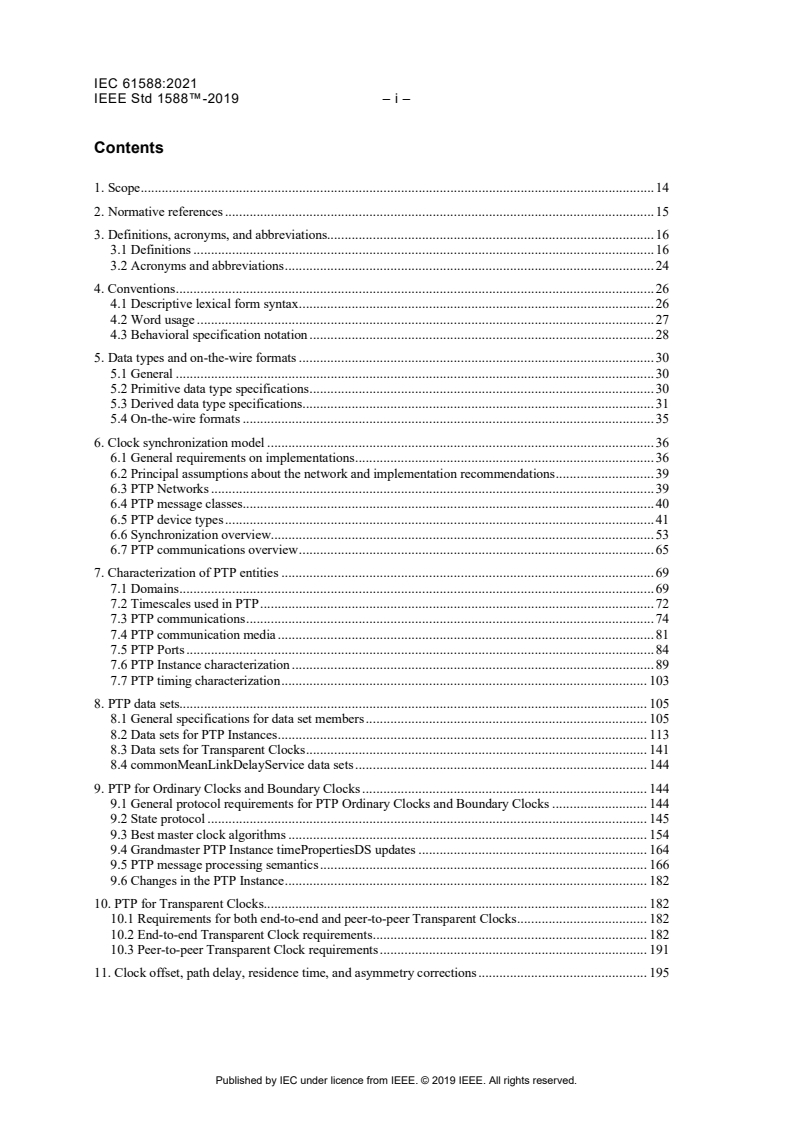
Contents
1. Scope . 14
2. Normative references . 15
3. Definitions, acronyms, and abbreviations. 16
3.1 Definitions . 16
3.2 Acronyms and abbreviations . 24
4. Conventions . 26
4.1 Descriptive lexical form syntax . 26
4.2 Word usage . 27
4.3 Behavioral specification notation . 28
5. Data types and on-the-wire formats . 30
5.1 General . 30
5.2 Primitive data type specifications . 30
5.3 Derived data type specifications . 31
5.4 On-the-wire formats . 35
6. Clock synchronization model . 36
6.1 General requirements on implementations . 36
6.2 Principal assumptions about the network and implementation recommendations . 39
6.3 PTP Networks . 39
6.4 PTP message classes . 40
6.5 PTP device types . 41
6.6 Synchronization overview. 53
6.7 PTP communications overview . 65
7. Characterization of PTP entities . 69
7.1 Domains . 69
7.2 Timescales used in PTP . 72
7.3 PTP communications . 74
7.4 PTP communication media . 81
7.5 PTP Ports . 84
7.6 PTP Instance characterization . 89
7.7 PTP timing characterization . 103
8. PTP data sets. 105
8.1 General specifications for data set members . 105
8.2 Data sets for PTP Instances . 113
8.3 Data sets for Transparent Clocks . 141
8.4 commonMeanLinkDelayService data sets . 144
9. PTP for Ordinary Clocks and Boundary Clocks . 144
9.1 General protocol requirements for PTP Ordinary Clocks and Boundary Clocks . 144
9.2 State protocol . 145
9.3 Best master clock algorithms . 154
9.4 Grandmaster PTP Instance timePropertiesDS updates . 164
9.5 PTP message processing semantics . 166
9.6 Changes in the PTP Instance . 182
10. PTP for Transparent Clocks . 182
10.1 Requirements for both end-to-end and peer-to-peer Transparent Clocks . 182
10.2 End-to-end Transparent Clock requirements . 182
10.3 Peer-to-peer Transparent Clock requirements . 191
11. Clock offset, path delay, residence time, and asymmetry corrections . 195
Published by IEC under licence from IEEE. © 2019 IEEE. All rights reserved.
– ii – IEEE Std 1588™-2019
11.1 General specifications . 195
11.2 Computation of in Ordinary Clocks and Boundary Clocks . 196
11.3 Delay request-response mechanism for Ordinary Clocks and Boundary Clocks . 197
11.4 Peer-to-peer delay mechanism . 199
11.5 MDMI interface and Special Ports . 204
12. Synchronization and syntonization of clocks . 214
12.1 Clock adjustments . 214
12.2 Syntonization . 214
12.3 Synchronization . 215
13. PTP message formats . 216
13.1 General. 216
13.2 General PTP message format requirements. 216
13.3 Header. 216
13.4 Suffix . 222
13.5 Announce message . 222
13.6 Sync and Delay_Req messages . 224
13.7 Follow_Up message . 224
13.8 Delay_Resp message . 225
13.9 Pdelay_Req message . 225
13.10 Pdelay_Resp message . 226
13.11 Pdelay_Resp_Follow_Up message . 226
13.12 Signaling message . 227
13.13 PTP management message . 228
14. TLV entity specifications . 228
14.1 General requirements . 228
14.2 Propagation of TLVs through Boundary Clocks . 230
14.3 Vendor and standard organization extension TLVs . 231
14.4 PAD TLV (optional) . 233
15. PTP management messages (optional) . 234
15.1 General. 234
15.2 PTP management mechanism . 234
15.3 Processing of PTP management messages . 234
15.4 PTP management message format . 235
15.5 Management TLVs . 238
16. General optional features . 272
16.1 Unicast message negotiation (optional) . 272
16.2 Path trace (optional) . 280
16.3 Alternate timescale offsets (optional) . 282
16.4 Holdover upgrade (optional) . 289
16.5 Isolation of PTP Instances running under profiles specified by different standards organizations
(optional) . 290
16.6 Common Mean Link Delay Service (optional). 291
16.7 Configurable correction of timestamps (optional) . 298
16.8 Calculation of the for certain media (optional) . 299
16.9 Mixed multicast/unicast operation (optional) . 301
16.10 Cumulative frequency transfer method for synchronizing clocks (optional) . 304
16.11 Slave Event Monitoring (optional) . 308
16.12 Enhanced synchronization accuracy metrics (optional) . 317
16.13 Message Length Extension (optional) . 323
16.14 PTP integrated security mechanism (optional) . 324
17. State configuration options . 338
17.1 General. 338
17.2 Grandmaster clusters (optional). 338
Published by IEC under licence from IEEE. © 2019 IEEE. All rights reserved.
IEEE Std 1588™-2019 – iii –
17.3 Alternate master (optional). 340
17.4 Unicast discovery (optional) . 343
17.5 Acceptable master table (optional) . 345
17.6 Mechanism for external configuration of a PTP Instance’s PTP Port state (optional) . 347
17.7 Reduced state sets and use of the feature (optional) . 353
18. Interactions between PTP Instances in different PTP domains . 354
18.1 General specifications . 354
18.2 Interfaces enabling interdomain interactions . 355
19. Compatibility of this edition with earlier and future editions . 355
19.1 General. 355
19.2 Compatibility between version 2 and future versions . 356
19.3 Compatibility with IEEE Std 1588-2002 . 356
19.4 Compatibility between the PTP Instance conformant to this edition and the implementations
conformant to IEEE Std 1588-2008 . 356
20. Conformance . 361
20.1 Conformance objective . 361
20.2 PTP conformance requirements. 361
20.3 PTP Profiles . 362
Annex A (informative) Using the Precision Time Protocol (PTP). 365
A.1 Overview . 365
A.2 Physical layout . 366
A.3 Logical layout. 366
A.4 Component issues . 367
A.5 Local implementation issues . 368
A.6 System implementation issues . 370
A.7 Guidelines to achieve optimal performance . 371
A.8 Recommendations to aid in conformance testing . 371
A.9 Recommendation for implementations in unicast networks or networks with non-PTP bridges and routers
........................................................................................................................................................ 372
Annex B (informative) Timescales and epochs in PTP . 375
B.1 General considerations . 375
B.2 UTC, TAI and the PTP epoch and timescale updates . 375
B.3 Standard time sources . 378
B.4 Meaning and uses of the attributes of the timePropertiesDS data set . 379
Annex C (normative) Transport of PTP over User Datagram Protocol over Internet Protocol Version 4 . 382
C.1 General . 382
C.2 UDP port numbers . 382
C.3 IPv4 multicast addresses . 382
C.4 sdoId field values . 383
C.5 Optional values . 384
C.6 IPv4 Options . 384
C.7 Protocol addresses . 384
Annex D (normative) Transport of PTP over User Datagram Protocol over Internet Protocol Version 6 385
D.1 General. 385
D.2 UDP port numbers . 385
D.3 IPv6 multicast addresses . 386
D.4 Optional values . 386
D.5 Protocol addresses . 386
Annex E (normative) Transport of PTP over IEEE 802.3 transports . 387
E.1 General . 387
E.2 Ethertype . 387
E.3 Multicast media access control (MAC) addresses . 387
Published by IEC under licence from IEEE. © 2019 IEEE. All rights reserved.
– iv – IEEE Std 1588™-2019
E.4 majorSdoId field values . 388
E.5 Optional values . 388
E.6 Protocol addresses . 388
Annex F (normative) Transport of PTP over DeviceNET . 389
F.1 Protocol . 389
F.2 message timestamp point . 389
F.3 clockIdentity . 389
F.4 PTP message formats . 389
F.5 DeviceNet addressing for PTP . 390
Annex G (normative) Transport of PTP over ControlNET . 391
G.1 Protocol . 391
G.2 clockIdentity. 391
G.3 PTP message formats . 391
G.4 ControlNet addressing for PTP. 391
Annex H (normative) Transport of PTP over IEC 61158 Type 10 . 392
H.1 Background . 392
H.2 Message specification . 393
H.3 DLPDU of the IEC 61158 TYPE10 . 394
H.4 Encoding specifications . 395
Annex I (normative) Default PTP Profiles . 398
I.1 General . 398
I.2 General requirements . 398
I.3 Delay Request-Response Default PTP Profile . 398
I.4 Peer-to-Peer Default PTP Profile . 400
I.5 High-Accuracy Delay Request-Response Default PTP Profile . 401
Annex J (normative) Performance monitoring options (optional) . 407
J.1 General . 407
J.2 Timestamp monitoring . 407
J.3 Additional parameters . 410
J.4 Record data types . 412
J.5 Data sets for performance monitoring . 414
Annex K (informative) Suppression of rogue Announce messages . 419
K.1 Example—Star topology . 420
K.2 Example—PTP Network with a single loop with an odd number of PTP Instances in the loop . 422
K.3 Example—More complex single loop PTP Network . 423
K.4 Example—Linear chain . 423
Annex L (normative) Layer-1 based synchronization performance enhancement (optional) . 425
L.1 General . 425
L.2 Basic terms . 426
L.3 Link Reference Model . 427
L.4 L1Sync port characteristics. 429
L.5 L1Sync data sets . 431
L.6 L1Sync message exchange . 434
L.7 L1Sync port operation specification . 437
L.8 Optional parameters (option within this option) . 439
L.9 Link verification using Signaling messages (informative) . 444
Annex M (informative) Sub-nanosecond synchronization using the High Accuracy Default PTP
Profile . 445
M.1 General . 445
M.2 Frequency loopback . 445
M.3 Timestamping precision . 447
M.4 Timestamping accuracy . 448
Published by IEC under licence from IEEE. © 2019 IEEE. All rights reserved.
IEEE Std 1588™-2019 – v –
M.5 Medium and its asymmetry . 449
M.6 Timing characteristics . 450
Annex N (informative) Calibration procedures . 452
N.1 General. 452
N.2 Theoretical background. 455
N.3 Assumptions and requirements . 457
N.4 Calibration procedures . 459
Annex O (informative) Example inter-domain interactions . 466
O.1 General. 466
O.2 Sourcing timing to multiple domains . 466
O.3 Providing timing to users (sinks) from multiple independent domains . 467
O.4 Transferring time from PTP domain A to PTP domain B . 468
O.5 Example use for external configuration of port state . 473
Annex P (informative) Security . 474
P.1 Overview, assumptions, and approach . 474
P.2 Multipronged approach—detailed definition . 474
Annex Q (informative) Bibliography . 495
Annex R (informative) IEEE List of participants . 498
Published by IEC under licence from IEEE. © 2019 IEEE. All rights reserved.
– vi – IEEE Std 1588™-2019
PRECISION CLOCK SYNCHRONIZATION PROTOCOL
FOR NETWORKED MEASUREMENT AND CONTROL SYSTEMS
FOREWORD
1) The International Electrotechnical Commission (IEC) is a worldwide organization for standardization comprising
all national electrotechnical committees (IEC National Committees). The object of IEC is to promote international
co-operation on all questions concerning standardization in the electrical and electronic fields. To this end and
in addition to other activities, IEC publishes International Standards, Technical Specifications, Technical Reports,
Publicly Available Specifications (PAS) and Guides (hereafter referred to as "IEC document(s)"). Their
preparation is entrusted to technical committees; any IEC National Committee interested in the subject dealt with
may participate in this preparatory work. International, governmental and non-governmental organizations liaising
with the IEC also participate in this preparation.
IEEE Standards documents are developed within IEEE Societies and Standards Coordinating Committees of the
IEEE Standards Association (IEEE SA) Standards Board. IEEE develops its standards through a consensus
development process, approved by the American National Standards Institute, which brings together volunteers
representing varied viewpoints and interests to achieve the final product. Volunteers are not necessarily members
of IEEE and serve without compensation. While IEEE administers the process and establishes rules to promote
fairness in the consensus development process, IEEE does not independently evaluate, test, or verify the
accuracy of any of the information contained in its standards. Use of IEEE Standards documents is wholly
voluntary. IEEE documents are made available for use subject to important notices and legal disclaimers (see
http://standards.ieee.org/ipr/disclaimers.html for more information).
IEC collaborates closely with IEEE in accordance with conditions determined by agreement between the two
organizations. This Dual Logo International Standard was jointly developed by the IEC and IEEE under the terms
of that agreement.
2) The formal decisions of IEC on technical matters express, as nearly as possible, an international consensus of
opinion on the relevant subjects since each technical committee has representation from all interested IEC
National Committees. The formal decisions of IEEE on technical matters, once consensus within IEEE Societies
and Standards Coordinating Committees has been reached, is determined by a balanced ballot of materially
interested parties who indicate interest in reviewing the proposed standard. Final approval of the IEEE standards
document is given by the IEEE Standards Association (IEEE SA) Standards Board.
3) IEC/IEEE Publications have the form of recommendations for international use and are accepted by IEC National
Committees/IEEE Societies in that sense. While all reasonable efforts are made to ensure that the technical
content of IEC/IEEE Publications is accurate, IEC or IEEE cannot be held responsible for the way in which they
are used or for any misinterpretation by any end user.
4) In order to promote international uniformity, IEC National Committees undertake to apply IEC Publications
(including IEC/IEEE Publications) transparently to the maximum extent possible in their national and regional
publications. Any divergence between any IEC/IEEE Publication and the corresponding national or regional
publication shall be clearly indicated in the latter.
5) IEC and IEEE do not provide any attestation of conformity. Independent certification bodies provide conformity
assessment services and, in some areas, access to IEC marks of conformity. IEC and IEEE are not responsible
for any services carried out by independent certification bodies.
6) All users should ensure that they have the latest edition of this publication.
7) No liability shall attach to IEC or IEEE or their directors, employees, servants or agents including individual
experts and members of technical committees and IEC National Committees, or volunteers of IEEE Societies and
the Standards Coordinating Committees of the IEEE Standards Association (IEEE SA) Standards Board, for any
personal injury, property damage or other damage of any nature whatsoever, whether direct or indirect, or for
costs (including legal fees) and expenses arising out of the publication, use of, or reliance upon, this IEC/IEEE
Publication or any other IEC or IEEE Publications.
8) Attention is drawn to the normative references cited in this publication. Use of the referenced publications is
indispensable for the correct application of this publication.
9) Attention is drawn to the possibility that implementation of this IEC/IEEE Publication may require use of material
covered by patent rights. By publication of this standard, no position is taken with respect to the existence or
validity of any patent rights in connection therewith. IEC or IEEE shall not be held responsible for identifying
Essential Patent Claims for which a license may be required, for conducting inquiries into the legal validity or
scope of Patent Claims or determining whether any licensing terms or conditions provided in connection with
submission of a Letter of Assurance, if any, or in any licensing agreements are reasonable or non-discriminatory.
Users of this standard are expressly advised that determination of the validity of any patent rights, and the risk
of infringement of such rights, is entirely their own responsibility.
Published by IEC under licence from IEEE. © 2019 IEEE. All rights reserved.
IEEE Std 1588™-2019 – vii –
IEC 61588/IEEE Std 1588 was processed through IEC technical committee 65C: Industrial
networks, under the IEC/IEEE Dual Logo Agreement. It is an International Standard.
The text of this International Standard is based on the following documents:
IEEE Std FDIS Report on voting
1588 (2019) 65C/1084/FDIS 65C/1091/RVD
Full information on the voting for its approval can be found in the report on voting indicated in
the above table.
The language used for the development of this International Standard is English.
The IEC Technical Committee and IEEE Technical Committee have decided that the contents
of this document will remain unchanged until the stability date indicated on the IEC website
under webstore.iec.ch in the data related to the specific document. At this date, the document
will be
• reconfirmed,
• withdrawn,
• replaced by a revised edition, or
• amended.
Published by IEC under licence from IEEE. © 2019 IEEE. All rights reserved.
Abstract: In this standard, a protocol is defined that provides precise synchronization of clocks in
packet-based networked systems. Synchronization of clocks can be achieved in heterogeneous
systems that include clocks of different inherent precision, resolution, and stability. The protocol
supports synchronization accuracy and precision in the sub-microsecond range with minimal
network and local computing resources. Customization is supported by means of profiles. The
protocol includes default profiles that permit simple systems to be installed and operated without
the need for user management. Sub-nanosecond time transfer accuracy can be achieved in a
properly designed network.
TM
Keywords: Boundary Clock, clock, Grandmaster Clock, IEEE 1588 , management, Ordinary
Clock, security, synchronization, Transparent Clock
•
Published by IEC under licence from IEEE. © 2019 IEEE. All rights reserved.
Important Notices and Disclaimers Concerning IEEE Standards Documents
IEEE documents are made available for use subject to important notices and legal disclaimers. These
notices and disclaimers, or a reference to this page, appear in all standards and may be found under the
heading “Important Notices and Disclaimers Concerning IEEE Standards Documents.” They can also be
obtained on request from IEEE or viewed at http://standards.ieee.org/ipr/disclaimers.html.
Notice and Disclaimer of Liability Concerning the Use of IEEE Standards
Documents
IEEE Standards documents (standards, recommended practices, and guides), both full-use and trial-use, are
developed within IEEE Societies and the Standards Coordinating Committees of the IEEE Standards
Association (“IEEE SA”) Standards Board. IEEE (“the Institute”) develops its standards through a
consensus development process, approved by the American National Standards Institute (“ANSI”), which
brings together volunteers representing varied viewpoints and interests to achieve the final product. IEEE
Standards are documents developed through scientific, academic, and industry-based technical working
groups. Volunteers in IEEE working groups are not necessarily members of the Institute and participate
without compensation from IEEE. While IEEE administers the process and establishes rules to promote
fairness in the consensus development process, IEEE does not independently evaluate, test, or verify the
accuracy of any of the information or the soundness of any judgments contained in its standards.
IEEE Standards do not guarantee or ensure safety, security, health, or environmental protection, or ensure
against interference with or from other devices or networks. Implementers and users of IEEE Standards
documents are responsible for determining and complying with all appropriate safety, security,
environmental, healt
...