

IEC 60947-7-2:2002
(Main)Low-voltage switchgear and controlgear - Part 7-2: Ancillary equipment - Protective conductor terminal blocks for copper conductors
General Information
- Abstract
Applies to protective conductor terminal blocks with PE function up to 120 mm2 (250 MCM) and to protective conductor terminal blocks with PEN function equal to and above 10 mm2 (AWG 8).
- Status
- Published
- Publication Date
- 30-Jul-2002
- Technical Committee
- SC 121A - Low-voltage switchgear and controlgear
- Current Stage
- DELPUB - Deleted Publication
- Start Date
- 20-Apr-2009
- Completion Date
- 28-Aug-2026
Overview
IEC 60947-7-2:2002 is a key international standard issued by the International Electrotechnical Commission (IEC) that governs low-voltage switchgear and controlgear ancillary equipment, specifically focusing on protective conductor terminal blocks for copper conductors. This standard applies to protective conductor terminal blocks equipped with Protective Earth (PE) function supporting copper conductors up to 120 mm² (250 MCM) and protective conductor terminal blocks with Protective Earth and Neutral (PEN) function for conductors equal to or larger than 10 mm² (AWG 8).
Developed by IEC Technical Committee 17, Subcommittee 17B, this second edition revises and replaces the first edition from 1995, reinforcing technical requirements to ensure international harmonization in electrical safety components used in low-voltage systems.
Key Topics
Scope and Application
Defines the operational range, physical and electrical characteristics, and classification of protective conductor terminal blocks for copper conductors. It ensures these devices meet safety and performance requirements for low-voltage electrical installations globally.Construction and Performance Requirements
Covers requirements related to the design, mechanical robustness, electrical integrity, thermal performance, and electromagnetic compatibility (EMC) of terminal blocks.Testing Protocols
Details a comprehensive suite of mechanical, electrical, thermal, and EMC tests for verifying compliance. Tests include tightening torque checks, rated current verification, and short-circuit withstand parameters.Marking and Product Information
Specifies labeling requirements to provide clear identification of terminal blocks, including rated values and manufacturer information to support traceability.Compatibility with Related Standards
Should be read alongside IEC 60947-1 (General Rules) and IEC 60947-7-1 (Terminal Blocks) to ensure consistent application of universal requirements in low-voltage switchgear systems.
Applications
IEC 60947-7-2 plays a crucial role in:
Electrical Installation Systems
Ensuring safe and reliable connection points for protective conductors (PE and PEN) in residential, commercial, and industrial switchgear assemblies.Switchgear Manufacturing
Providing manufacturers with clear specifications for producing standardized terminal blocks which are safe, durable, and compatible across international markets.Safety Compliance and Certification
Acting as a benchmark for authorities and certification bodies verifying that low-voltage switchgear meets international safety standards related to protective conductor connections.Equipment Maintenance and Upgrades
Facilitating proper replacement and upgrading of terminal blocks in existing installations, compatible with established safety and performance requirements.
Related Standards
IEC 60947-1: Low-voltage switchgear and controlgear – Part 1: General rules
Provides foundational rules, terminology, and guiding principles applicable to all parts of the IEC 60947 series.IEC 60947-7-1: Ancillary equipment – Terminal blocks for copper conductors
Covers terminal blocks for general use, complementing the specific requirements of protective conductor terminal blocks.Other IEC 60947 Parts
Elaborate on different types of switchgear and controlgear components, ensuring comprehensive coverage of low-voltage electrical equipment.
Summary
Adherence to IEC 60947-7-2:2002 ensures protective conductor terminal blocks for copper conductors meet international safety, performance, and reliability standards essential for low-voltage switchgear and controlgear. This standard supports manufacturers, engineers, and certification bodies engaged in designing, producing, and validating protective conductor terminals, thereby promoting global electrical safety and equipment interoperability.
By integrating these standardized terminals into electrical systems, stakeholders can achieve enhanced protection against electrical faults, effective grounding, and consistent operation, contributing to safer electrical infrastructures worldwide.
Relations
- Effective Date
- 05-Sep-2023
Get Certified
Connect with accredited certification bodies for this standard

IMQ S.p.A. (Certification)
Italian electrical product certification.

SLG Prüf- und Zertifizierungs GmbH
German testing and certification body.

UL Solutions
Global safety science company with testing, inspection and certification.
Sponsored listings
Frequently Asked Questions
IEC 60947-7-2:2002 is a standard published by the International Electrotechnical Commission (IEC). Its full title is "Low-voltage switchgear and controlgear - Part 7-2: Ancillary equipment - Protective conductor terminal blocks for copper conductors". This standard covers: Applies to protective conductor terminal blocks with PE function up to 120 mm2 (250 MCM) and to protective conductor terminal blocks with PEN function equal to and above 10 mm2 (AWG 8).
Applies to protective conductor terminal blocks with PE function up to 120 mm2 (250 MCM) and to protective conductor terminal blocks with PEN function equal to and above 10 mm2 (AWG 8).
IEC 60947-7-2:2002 is classified under the following ICS (International Classification for Standards) categories: 29.120.20 - Connecting devices; 29.120.99 - Other electrical accessories. The ICS classification helps identify the subject area and facilitates finding related standards.
IEC 60947-7-2:2002 has the following relationships with other standards: It is inter standard links to IEC 60947-7-2:2009. Understanding these relationships helps ensure you are using the most current and applicable version of the standard.
IEC 60947-7-2:2002 is available in PDF format for immediate download after purchase. The document can be added to your cart and obtained through the secure checkout process. Digital delivery ensures instant access to the complete standard document.
Standards Content (Sample)
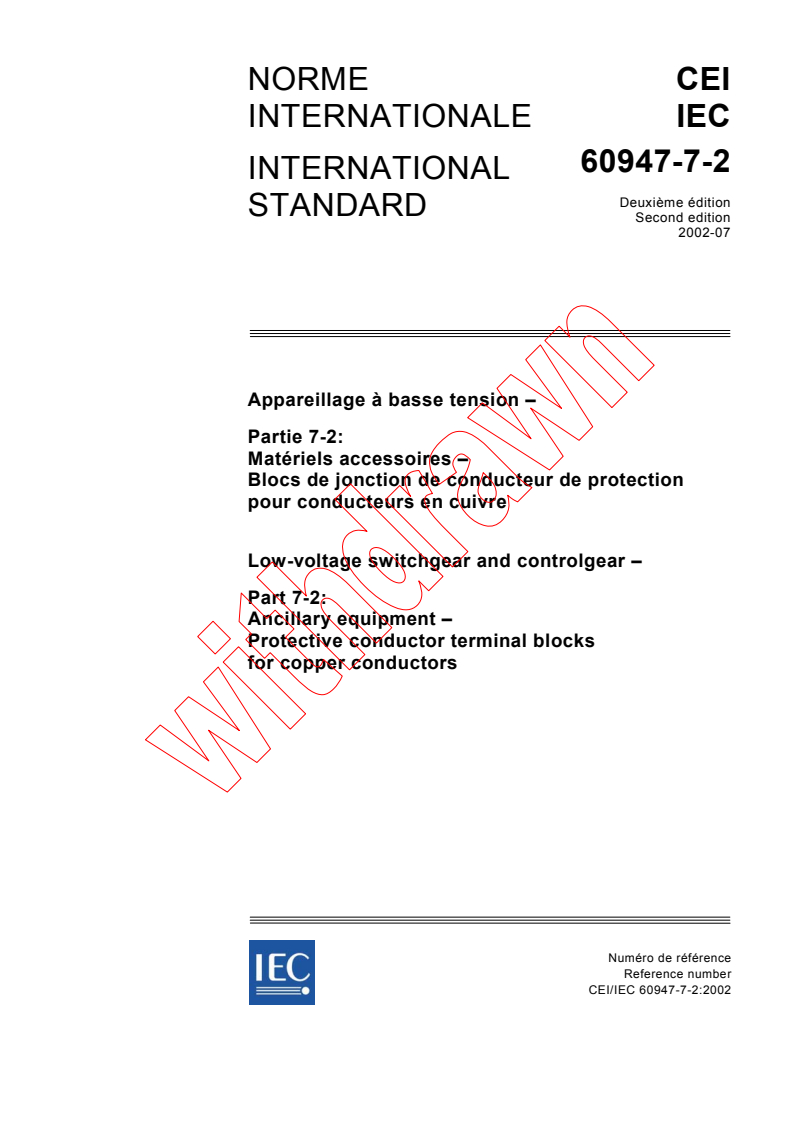
NORME CEI
INTERNATIONALE IEC
60947-7-2
INTERNATIONAL
Deuxième édition
STANDARD
Second edition
2002-07
Appareillage à basse tension –
Partie 7-2:
Matériels accessoires –
Blocs de jonction de conducteur de protection
pour conducteurs en cuivre
Low-voltage switchgear and controlgear –
Part 7-2:
Ancillary equipment –
Protective conductor terminal blocks
for copper conductors
Numéro de référence
Reference number
CEI/IEC 60947-7-2:2002
Numérotation des publications Publication numbering
Depuis le 1er janvier 1997, les publications de la CEI As from 1 January 1997 all IEC publications are
sont numérotées à partir de 60000. Ainsi, la CEI 34-1 issued with a designation in the 60000 series. For
devient la CEI 60034-1. example, IEC 34-1 is now referred to as IEC 60034-1.
Editions consolidées Consolidated editions
Les versions consolidées de certaines publications de la The IEC is now publishing consolidated versions of its
CEI incorporant les amendements sont disponibles. Par publications. For example, edition numbers 1.0, 1.1
exemple, les numéros d’édition 1.0, 1.1 et 1.2 indiquent and 1.2 refer, respectively, to the base publication,
respectivement la publication de base, la publication de the base publication incorporating amendment 1 and
base incorporant l’amendement 1, et la publication de the base publication incorporating amendments 1
base incorporant les amendements 1 et 2. and 2.
Informations supplémentaires Further information on IEC publications
sur les publications de la CEI
Le contenu technique des publications de la CEI est The technical content of IEC publications is kept
constamment revu par la CEI afin qu'il reflète l'état under constant review by the IEC, thus ensuring that
actuel de la technique. Des renseignements relatifs à the content reflects current technology. Information
cette publication, y compris sa validité, sont dispo- relating to this publication, including its validity, is
nibles dans le Catalogue des publications de la CEI available in the IEC Catalogue of publications
(voir ci-dessous) en plus des nouvelles éditions, (see below) in addition to new editions, amendments
amendements et corrigenda. Des informations sur les and corrigenda. Information on the subjects under
sujets à l’étude et l’avancement des travaux entrepris consideration and work in progress undertaken by the
par le comité d’études qui a élaboré cette publication, technical committee which has prepared this
ainsi que la liste des publications parues, sont publication, as well as the list of publications issued,
également disponibles par l’intermédiaire de: is also available from the following:
• Site web de la CEI (www.iec.ch) • IEC Web Site (www.iec.ch)
• Catalogue des publications de la CEI • Catalogue of IEC publications
Le catalogue en ligne sur le site web de la CEI The on-line catalogue on the IEC web site
(www.iec.ch/catlg-f.htm) vous permet de faire des (www.iec.ch/catlg-e.htm) enables you to search
recherches en utilisant de nombreux critères, by a variety of criteria including text searches,
comprenant des recherches textuelles, par comité technical committees and date of publication. On-
d’études ou date de publication. Des informations line information is also available on recently
en ligne sont également disponibles sur les issued publications, withdrawn and replaced
nouvelles publications, les publications rempla- publications, as well as corrigenda.
cées ou retirées, ainsi que sur les corrigenda.
• IEC Just Published
• IEC Just Published
Ce résumé des dernières publications parues
This summary of recently issued publications
(www.iec.ch/JP.htm) est aussi disponible par
(www.iec.ch/JP.htm) is also available by email.
courrier électronique. Veuillez prendre contact
Please contact the Customer Service Centre (see
avec le Service client (voir ci-dessous) pour plus
below) for further information.
d’informations.
• Service clients
• Customer Service Centre
Si vous avez des questions au sujet de cette
If you have any questions regarding this
publication ou avez besoin de renseignements
publication or need further assistance, please
supplémentaires, prenez contact avec le Service
contact the Customer Service Centre:
clients:
Email: custserv@iec.ch
Email: custserv@iec.ch
Tél: +41 22 919 02 11
Tel: +41 22 919 02 11
Fax: +41 22 919 03 00
Fax: +41 22 919 03 00
.
NORME CEI
INTERNATIONALE IEC
60947-7-2
INTERNATIONAL
Deuxième édition
STANDARD
Second edition
2002-7
Appareillage à basse tension –
Partie 7-2:
Matériels accessoires –
Blocs de jonction de conducteur de protection
pour conducteurs en cuivre
Low-voltage switchgear and controlgear –
Part 7-2:
Ancillary equipment –
Protective conductor terminal blocks
for copper conductors
IEC 2002 Droits de reproduction réservés Copyright - all rights reserved
Aucune partie de cette publication ne peut être reproduite ni No part of this publication may be reproduced or utilized in any
utilisée sous quelque forme que ce soit et par aucun procédé, form or by any means, electronic or mechanical, including
électronique ou mécanique, y compris la photocopie et les photocopying and microfilm, without permission in writing from
microfilms, sans l'accord écrit de l'éditeur. the publisher.
International Electrotechnical Commission, 3, rue de Varembé, PO Box 131, CH-1211 Geneva 20, Switzerland
Telephone: +41 22 919 02 11 Telefax: +41 22 919 03 00 E-mail: inmail@iec.ch Web: www.iec.ch
CODE PRIX
Q
Commission Electrotechnique Internationale PRICE CODE
International Electrotechnical Commission
Международная Электротехническая Комиссия
Pour prix, voir catalogue en vigueur
For price, see current catalogue
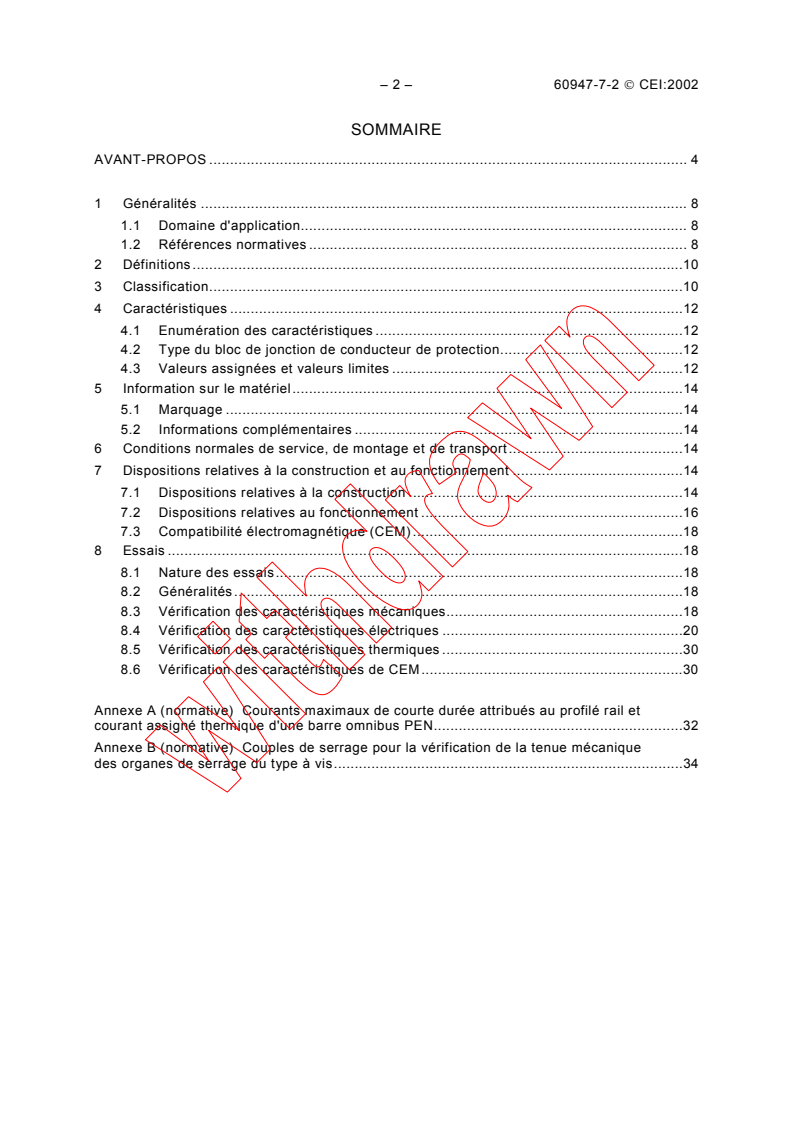
– 2 – 60947-7-2 CEI:2002
SOMMAIRE
AVANT-PROPOS . 4
1 Généralités . 8
1.1 Domaine d'application. 8
1.2 Références normatives . 8
2 Définitions .10
3 Classification.10
4 Caractéristiques .12
4.1 Enumération des caractéristiques .12
4.2 Type du bloc de jonction de conducteur de protection.12
4.3 Valeurs assignées et valeurs limites .12
5 Information sur le matériel.14
5.1 Marquage .14
5.2 Informations complémentaires .14
6 Conditions normales de service, de montage et de transport.14
7 Dispositions relatives à la construction et au fonctionnement .14
7.1 Dispositions relatives à la construction .14
7.2 Dispositions relatives au fonctionnement .16
7.3 Compatibilité électromagnétique (CEM) .18
8 Essais .18
8.1 Nature des essais.18
8.2 Généralités.18
8.3 Vérification des caractéristiques mécaniques.18
8.4 Vérification des caractéristiques électriques .20
8.5 Vérification des caractéristiques thermiques .30
8.6 Vérification des caractéristiques de CEM.30
Annexe A (normative) Courants maximaux de courte durée attribués au profilé rail et
courant assigné thermique d'une barre omnibus PEN.32
Annexe B (normative) Couples de serrage pour la vérification de la tenue mécanique
des organes de serrage du type à vis.34
60947-7-2 IEC:2002 – 3 –
CONTENTS
FOREWORD . 5
1 General . 9
1.1 Scope . 9
1.2 Normative references . 9
2 Definitions .11
3 Classification .11
4 Characteristics.13
4.1 Summary of characteristics.13
4.2 Type of protective conductor terminal block .13
4.3 Rated and limiting values.13
5 Product information.15
5.1 Marking .15
5.2 Additional information .15
6 Normal service, mounting and transport conditions .15
7 Constructional and performance requirements .15
7.1 Constructional requirements .15
7.2 Performance requirements.17
7.3 Electromagnetic compatibility (EMC).19
8 Tests .19
8.1 Kinds of test .19
8.2 General .19
8.3 Verification of mechanical characteristics .19
8.4 Verification of electrical characteristics .21
8.5 Verification of thermal characteristics .31
8.6 Verification of EMC characteristics .31
Annex A (normative) Maximum short-time withstand currents allocated to the rail
profile and thermal rated current of a PEN busbar.33
Annex B (normative) Tightening torques for the verification of the mechanical strength
of screw-type clamping units .35
– 4 – 60947-7-2 CEI:2002
COMMISSION ÉLECTROTECHNIQUE INTERNATIONALE
____________
APPAREILLAGE À BASSE TENSION –
Partie 7-2: Matériels accessoires –
Blocs de jonction de conducteur de protection
pour conducteurs en cuivre
AVANT-PROPOS
1) La CEI (Commission Électrotechnique Internationale) est une organisation mondiale de normalisation
composée de l'ensemble des comités électrotechniques nationaux (Comités nationaux de la CEI). La CEI a
pour objet de favoriser la coopération internationale pour toutes les questions de normalisation dans les
domaines de l'électricité et de l'électronique. A cet effet, la CEI, entre autres activités, publie des Normes
internationales. Leur élaboration est confiée à des comités d'études, aux travaux desquels tout Comité national
intéressé par le sujet traité peut participer. Les organisations internationales, gouvernementales et non
gouvernementales, en liaison avec la CEI, participent également aux travaux. La CEI collabore étroitement
avec l'Organisation Internationale de Normalisation (ISO), selon des conditions fixées par accord entre les
deux organisations.
2) Les décisions ou accords officiels de la CEI concernant les questions techniques représentent, dans la mesure
du possible, un accord international sur les sujets étudiés, étant donné que les Comités nationaux intéressés
sont représentés dans chaque comité d’études.
3) Les documents produits se présentent sous la forme de recommandations internationales. Ils sont publiés
comme normes, spécifications techniques, rapports techniques ou guides et agréés comme tels par les
Comités nationaux.
4) Dans le but d'encourager l'unification internationale, les Comités nationaux de la CEI s'engagent à appliquer de
façon transparente, dans toute la mesure possible, les Normes internationales de la CEI dans leurs normes
nationales et régionales. Toute divergence entre la norme de la CEI et la norme nationale ou régionale
correspondante doit être indiquée en termes clairs dans cette dernière.
5) La CEI n’a fixé aucune procédure concernant le marquage comme indication d’approbation et sa responsabilité
n’est pas engagée quand un matériel est déclaré conforme à l’une de ses normes.
6) L’attention est attirée sur le fait que certains des éléments de la présente Norme internationale peuvent faire
l’objet de droits de propriété intellectuelle ou de droits analogues. La CEI ne saurait être tenue pour
responsable de ne pas avoir identifié de tels droits de propriété et de ne pas avoir signalé leur existence.
La Norme internationale CEI 60947-7-2 a été établie par le sous-comité 17B: Appareillage
à basse tension, du comité d'études 17 de la CEI: Appareillage.
Cette deuxième édition de la CEI 60947-7-2 annule et remplace la première édition parue en
1995, dont elle constitue une révision technique.
Cette norme doit être lue conjointement avec la CEI 60947-1 et la CEI 60947-7-1. Les
dispositions des règles générales qui font l'objet de la CEI 60947-1 et les prescriptions pour
les blocs de jonction de la CEI 60947-7-1 sont applicables à la présente norme lorsque
celle-ci le précise. Les articles, paragraphes, tableaux, figures et annexes qui sont ainsi
applicables sont identifiés par référence à la CEI 60947-1 ou à la CEI 60947-7-1, par exemple:
1.2 de la CEI 60947-1, tableau 4 de la CEI 60947-7-1 ou annexe A de la CEI 60947-1.
Le texte de cette norme est issu des documents suivants:
FDIS Rapport de vote
17B/1192/FDIS 17B/1219/RVD
Le rapport de vote indiqué dans le tableau ci-dessus donne toute information sur le vote ayant
abouti à l'approbation de cette norme.
Cette publication a été rédigée selon les Directives ISO/CEI, Partie 2.
60947-7-2 IEC:2002 – 5 –
INTERNATIONAL ELECTROTECHNICAL COMMISSION
____________
LOW-VOLTAGE SWITCHGEAR AND CONTROLGEAR –
Part 7-2: Ancillary equipment –
Protective conductor terminal blocks for copper conductors
FOREWORD
1) The IEC (International Electrotechnical Commission) is a worldwide organization for standardization comprising
all national electrotechnical committees (IEC National Committees). The object of the IEC is to promote
international co-operation on all questions concerning standardization in the electrical and electronic fields. To
this end and in addition to other activities, the IEC publishes International Standards. Their preparation is
entrusted to technical committees; any IEC National Committee interested in the subject dealt with may
participate in this preparatory work. International, governmental and non-governmental organizations liaising
with the IEC also participate in this preparation. The IEC collaborates closely with the International
Organization for Standardization (ISO) in accordance with conditions determined by agreement between the
two organizations.
2) The formal decisions or agreements of the IEC on technical matters express, as nearly as possible, an
international consensus of opinion on the relevant subjects since each technical committee has representation
from all interested National Committees.
3) The documents produced have the form of recommendations for international use and are published in the form
of standards, technical specifications, technical reports or guides and they are accepted by the National
Committees in that sense.
4) In order to promote international unification, IEC National Committees undertake to apply IEC International
Standards transparently to the maximum extent possible in their national and regional standards. Any
divergence between the IEC Standard and the corresponding national or regional standard shall be clearly
indicated in the latter.
5) The IEC provides no marking procedure to indicate its approval and cannot be rendered responsible for any
equipment declared to be in conformity with one of its standards.
6) Attention is drawn to the possibility that some of the elements of this International Standard may be the subject
of patent rights. The IEC shall not be held responsible for identifying any or all such patent rights.
International Standard IEC 60947-7-2 has been prepared by subcommittee 17B: Low-voltage
switchgear and controlgear, of IEC technical committee 17: Switchgear and controlgear.
This second edition of IEC 60947-7-2 cancels and replaces the first edition, published in
1995, and constitutes a technical revision.
This standard shall be read in conjunction with IEC 60947-1 and IEC 60947-7-1. The
provisions of the general rules dealt with in IEC 60947-1 and the requirements for terminal
blocks of IEC 60947-7-1 are applicable to this standard, where specifically called for. Clauses
and subclauses, tables, figures and annexes thus applicable are identified by reference to
IEC 60947-1 or IEC 60947-7-1, e.g. 1.2 of IEC 60947-1, table 4 of IEC 60947-7-1 or annex A
of IEC 60947-1.
The text of this standard is based on the following documents:
FDIS Report on voting
17B/1192/FDIS 17B/1219/RVD
Full information on the voting for the approval of this standard can be found in the report on
voting indicated in the above table.
This publication has been drafted in accordance with the ISO/IEC Directives, Part 2.
– 6 – 60947-7-2 CEI:2002
Les annexes A et B font partie intégrante de cette norme.
Le comité a décidé que le contenu de cette publication ne sera pas modifié avant 2008.
A cette date, la publication sera
• reconduite;
• supprimée;
• remplacée par une édition révisée, ou
• amendée.
60947-7-2 IEC:2002 – 7 –
Annexes A and B form an integral part of this standard.
The committee has decided that the contents of this publication will remain unchanged until
2008. At this date, the publication will be
• reconfirmed;
• withdrawn;
• replaced by a revised edition, or
• amended.
– 8 – 60947-7-2 CEI:2002
APPAREILLAGE À BASSE TENSION –
Partie 7-2: Matériels accessoires –
Blocs de jonction de conducteur de protection
pour conducteurs en cuivre
1 Généralités
1.1 Domaine d'application
La présente partie de la CEI 60947 spécifie les prescriptions pour les blocs de jonction de
conducteur de protection avec la fonction PE jusqu'à 120 mm (250 kcmil) et pour les blocs
de jonction de conducteur de protection avec la fonction PEN de section égale ou supérieure
à 10 mm (AWG 8) avec des organes de serrage du type à vis ou du type sans vis, destinés
principalement à des usages industriels.
NOTE AWG est l’abréviation de «American Wire Gage» [Gage (US) = Gauge (UK)]
kcmil = 1000 cmil
1 cmil = 1 circular mil = surface d’un cercle ayant un diamètre de 1 mil
1 mil = 1/1000 inch
Les blocs de jonction de conducteur de protection sont utilisés afin d'assurer la connexion
électrique et mécanique entre les conducteurs en cuivre et le support de fixation.
Elle est applicable aux blocs de jonction de conducteur de protection pour le raccordement
des conducteurs ronds en cuivre, avec ou sans préparation spéciale, de section comprise
2 2
entre 0,2 mm et 120 mm (AWG 24 et 250 kcmil), prévus pour être utilisés dans des circuits
de tension assignée ne dépassant pas 1 000 V à courant alternatif jusqu'à 1 000 Hz ou
1 500 V en courant continu, et très couramment avec les blocs de jonction selon la
CEI 60947-7-1.
La présente norme peut servir de guide pour
− les blocs de jonction de conducteur de protection nécessitant la fixation de pièces
spéciales sur les conducteurs, par exemple les connexions rapides ou les connexions
enroulées, etc.;
− les blocs de jonction de conducteur de protection assurant un contact direct avec les
conducteurs au moyen de lames ou de pointes pénétrant à travers l'enveloppe isolante,
par exemple les connexions par déplacement d'isolant, etc.
Dans la présente norme, le terme «organe de serrage» a été utilisé, s'il y a lieu, à la place du
terme «borne». Cela est pris en compte en cas de référence à la CEI 60947-1.
1.2 Références normatives
Les documents de référence suivants sont indispensables pour l'application du présent
document. Pour les références datées, seule l'édition citée s'applique. Pour les références
non datées, la dernière édition du document de référence s'applique (y compris les éventuels
amendements).
CEI 60439-1:1999, Ensembles d'appareillage à basse tension – Partie 1: Ensembles de série
et ensembles dérivés de série
60947-7-2 IEC:2002 – 9 –
LOW-VOLTAGE SWITCHGEAR AND CONTROLGEAR –
Part 7-2: Ancillary equipment –
Protective conductor terminal blocks for copper conductors
1 General
1.1 Scope
This part of IEC 60947 specifies requirements for protective conductor terminal blocks with
PE function up to 120 mm² (250 kcmil) and for protective conductor terminal blocks with PEN
function equal to and above 10 mm² (AWG 8) with screw-type or screwless-type clamping
units, primarily intended for industrial applications.
NOTE AWG is the abbreviation of “American Wire Gage” [Gage (US) = Gauge (UK)]
kcmil = 1000 cmil
1 cmil = 1 circular mil = surface of a circle having a diameter of 1 mil
1 mil = 1/1000 inch
Protective conductor terminal blocks are used to form the electrical and mechanical
connection between copper conductors and the fixing support.
lt is applicable to protective conductor terminal blocks for the connection of round copper
conductors with or without special preparation having a cross-section between 0,2 mm² and
120 mm² (AWG 24 and 250 kcmil), intended to be used in circuits of a rated voltage not
exceeding 1 000 V a.c. up to 1 000 Hz or 1 500 V d.c., most commonly in conjunction with
terminal blocks according to IEC 60947-7-1.
This standard may be used as guide for
− protective conductor terminal blocks requiring the fixing of special devices to the
conductors, for example quick connect terminations or wrapped connections, etc.;
− protective conductor terminal blocks providing direct contact to the conductors by means
of edges or points penetrating the insulation, for example insulation displacement
connections, etc.
Where applicable in this standard, the term “clamping unit” has been used instead of the term
“terminal”. This is taken into account in case of reference to IEC 60947-1.
1.2 Normative references
The following referenced documents are indispensable for the application of this document.
For dated references, only the edition cited applies. For undated references, the latest edition
of the referenced document (including any amendments) applies.
IEC 60439-1:1999, Low-voltage switchgear and controlgear assemblies – Part 1: Type-tested
and partially type-tested assemblies
– 10 – 60947-7-2 CEI:2002
CEI 60715:1981, Dimensions de l'appareillage à basse tension – Montage normalisé sur
profilés-supports pour le support mécanique des appareils électriques dans les installations
d'appareillage à basse tension
Amendement 1 (1995)
CEI 60947-1:1999, Appareillage à basse tension – Partie 1: Règles générales
Amendement 1 (2000)
Amendement 2 (2001)
CEI 60947-7-1:2002, Appareillage à basse tension – Partie 7-1: Matériels accessoires – Blocs
de jonction pour conducteurs en cuivre
2 Définitions
Pour les besoins de la présente partie de la CEI 60947, les définitions données dans la
CEI 60947-7-1 ainsi que les définitions suivantes s'appliquent.
2.1
bloc de jonction de conducteur de protection
dispositif avec un ou plusieurs organes de serrage pour connecter et/ou réunir des
conducteurs de protection (conducteurs PE et PEN) avec des connexions conductrices à leurs
supports, qui peuvent être équipés de moyens de fixation du type à vis ou du type sans vis
NOTE 1 Les supports sont par exemple des profilés-supports, tôles métalliques découpées, embases de
montage, etc.
NOTE 2 Un bloc de jonction de conducteur de protection peut être soit partiellement isolé soit pas du tout isolé.
Aucune prescription concernant l'isolement n'est requise.
2.2
bloc de jonction de conducteur de protection partiellement isolé
dispositif qui est isolé par rapport aux parties actives des autres matériels mais non par
rapport au support lui-même
2.3
conducteur PEN
conducteur mis à la terre assurant à la fois les fonctions de conducteur de protection et de
conducteur neutre
NOTE L’acronyme PEN résulte de la combinaison des symboles PE pour le conducteur de protection et N pour le
conducteur neutre (voir 2.1.15 de la CEI 60947-1).
3 Classification
La distinction entre les différents types de bloc de jonction de conducteur de protection est
faite selon
− la méthode de fixation du bloc de jonction de conducteur de protection sur le support;
− le type des organes de serrage: organes de serrage du type à vis ou organes de serrage
du type sans vis;
− la possibilité de recevoir des conducteurs avec ou sans préparation spéciale (par exemple
cosses de câble);
− les ensembles de bornes avec des organes de serrage identiques ou différents;
− le nombre d'organes de serrage sur chaque ensemble de bornes;
− les conditions de service;
− les fonctions PE ou PEN.
60947-7-2 IEC:2002 – 11 –
IEC 60715:1981, Dimensions of Iow-voltage switchgear and controlgear – Standardized
mounting on rails for mechanical support of electrical devices in switchgear and controlgear
installations
Amendment 1 (1995)
IEC 60947-1:1999, Low-voltage switchgear and controlgear – Part 1: General rules
Amendment 1 (2000)
Amendment 2 (2001)
IEC 60947-7-1:2002, Low-voltage switchgear and controlgear – Part 7-1: Ancillary equipment –
Terminal blocks for copper conductors
2 Definitions
For the purpose of this part of IEC 60947, definitions given in IEC 60947-7-1, together with
the following definitions, apply.
2.1
protective conductor terminal block
device with one or more clamping units for connecting and/or joining protective conductors
(PE and PEN conductors) with conducting connection to their supports, which may be
designed with screw-type or screwless-type fixing means
NOTE 1 Supports are, for example, mounting rails, sheet metal cut-outs, mounting plates, etc.
NOTE 2 A protective conductor terminal block can be either partially insulated or not at all. lt does not require any
functional insulation.
2.2
partially insulated protective conductor terminal block
device which is only insulated against live parts of other devices but not against the support
itself
2.3
PEN conductor
earthed conductor combining the functions of both protective conductor and neutral conductor
NOTE The acronym PEN results from the combination of both symbols PE for the protective conductor and N for
the neutral conductor (see 2.1.15 of IEC 60947-1).
3 Classification
Distinction is made between various types of protective conductor terminal blocks as follows:
− method of fixing the protective conductor terminal block to the support;
− type of clamping units: screw-type clamping units or screwless-type clamping units;
− ability to receive conductors with or without special preparation (e.g. cable lugs);
− terminal assemblies with identical or dissimilar clamping units;
− number of clamping units on each terminal assembly;
− service conditions;
− PE or PEN functions.
– 12 – 60947-7-2 CEI:2002
4 Caractéristiques
4.1 Enumération des caractéristiques
Le paragraphe 4.1 de la CEI 60947-7-1 est applicable.
4.2 Type du bloc de jonction de conducteur de protection
Le paragraphe 4.2 de la CEI 60947-7-1 est applicable.
4.3 Valeurs assignées et valeurs limites
4.3.1 Vacant
4.3.2 Courant de courte durée admissible
Le paragraphe 4.3.2 de la CEI 60947-7-1 est applicable.
4.3.3 Sections normales
Le paragraphe 4.3.3 de la CEI 60947-7-1 est applicable avec le complément suivant.
Conformément au domaine d'application de la présente norme, le tableau 1 de la
CEI 60947-7-1 est applicable seulement jusqu'à 120 mm (250 kcmil).
4.3.4 Section assignée
Le paragraphe 4.3.4 de la CEI 60947-7-1 est applicable.
4.3.5 Capacité assignée de raccordement
Le paragraphe 4.3.5 de la CEI 60947-7-1 est applicable avec la modification pour un
conducteur seulement par organe de serrage, comme pour 7.4.3.1.6 de la CEI 60439-1, et
avec le tableau 1 suivant.
Tableau 1 −−−− Relation entre la section assignée et la capacité assignée de raccordement
des blocs de jonction de conducteur de protection
Section assignée Capacité assignée de raccordement
2 2
mm AWG/kcmil mm AWG/kcmil
0,2 24 0,2 24
0,34 22 0,2 – 0,34 24 – 22
0,5 20 0,2 – 0,34 – 0,5 24 – 22 – 20
0,75 18 0,34 – 0,5 – 0,75 22 – 20 – 18
1 – 0,5 – 0,75 – 1 –
1,5 16 0,75 – 1 – 1,5 20 – 18 – 16
2,5 14 1 – 1,5 – 2,5 18 – 16 – 14
4 12 1,5 – 2,5 – 4 16 – 14 – 12
6 10 2,5 – 4 – 6 14 – 12 – 10
10 8 4 – 6 – 10 12 – 10 – 8
16 6 6 – 10 – 16 10 – 8 – 6
25 4 10 – 16 – 25 8 – 6 – 4
35 2 16 – 25 – 35 6 – 4 – 2
50 0 25 – 35 – 50 4 – 2 – 0
70 00 35 – 50 – 70 2 – 0 – 00
95 000 50 – 70 – 95 0 – 00 – 000
120 250 70 – 95 – 120 00 – 000 – 250
60947-7-2 IEC:2002 – 13 –
4 Characteristics
4.1 Summary of characteristics
Subclause 4.1 of IEC 60947-7-1 applies.
4.2 Type of protective conductor terminal block
Subclause 4.2 of IEC 60947-7-1 applies.
4.3 Rated and limiting values
4.3.1 Void
4.3.2 Short-time withstand current
Subclause 4.3.2 of IEC 60947-7-1 applies.
4.3.3 Standard cross-sections
Subclause 4.3.3 of IEC 60947-7-1 applies with the following addition.
In accordance with the scope of this standard, table 1 of IEC 60947-7-1 applies only up to
120 mm (250 kcmil).
4.3.4 Rated cross-section
Subclause 4.3.4 of IEC 60947-7-1 applies.
4.3.5 Rated connecting capacity
Subclause 4.3.5 of IEC 60947-7-1 applies with the modification for one conductor per
clamping unit only, as for 7.4.3.1.6 of IEC 60439-1, and with the following table 1.
Table 1 −− Relationship between rated cross-section and rated connecting capacity
−−
of protective conductor terminal blocks
Rated cross-section Rated connecting capacity
2 2
mm AWG/kcmil mm AWG/kcmil
0,2 24 0,2 24
0,34 22 0,2 – 0,34 24 – 22
0,5 20 0,2 – 0,34 – 0,5 24 – 22 – 20
0,75 18 0,34 – 0,5 – 0,75 22 – 20 – 18
1 – 0,5 – 0,75 – 1 –
1,5 16 0,75 – 1 – 1,5 20 – 18 – 16
2,5 14 1 – 1,5 – 2,5 18 – 16 – 14
4 12 1,5 – 2,5 – 4 16 – 14 – 12
6 10 2,5 – 4 – 6 14 – 12 – 10
10 8 4 – 6 – 10 12 – 10 – 8
16 6 6 – 10 – 16 10 – 8 – 6
25 4 10 – 16 – 25 8 – 6 – 4
35 2 16 – 25 – 35 6 – 4 – 2
50 0 25 – 35 – 50 4 – 2 – 0
70 00 35 – 50 – 70 2 – 0 – 00
95 000 50 – 70 – 95 0 – 00 – 000
120 250 70 – 95 – 120 00 – 000 – 250
– 14 – 60947-7-2 CEI:2002
5 Information sur le matériel
5.1 Marquage
Un bloc de jonction de conducteur de protection doit porter, de manière durable et lisible, ce
qui suit:
a) le nom du constructeur ou une marque de fabrique qui permette de l'identifier;
b) une référence de type permettant son identification dans le but d'obtenir tout rensei-
gnement correspondant auprès du constructeur ou dans son catalogue.
5.2 Informations complémentaires
Les informations suivantes doivent être indiquées par le constructeur, s'il y a lieu, par
exemple dans la notice du constructeur ou dans son catalogue ou sur l'emballage:
a) CEI 60947-7-2, si le constructeur déclare la conformité à la présente norme;
b) la section assignée;
c) la capacité assignée de raccordement si elle diffère de celle du tableau 1;
d) les conditions de service, si elles diffèrent de celles de l'article 6.
Le constructeur doit déclarer si le bloc de jonction de conducteur de protection de section
égale ou supérieure à 10 mm² (AWG 8) est prévu pour la fonction PE seulement.
NOTE Aucun marquage signifie l'aptitude avec les deux fonctions PE + PEN.
6 Conditions normales de service, de montage et de transport
L'article 6 de la CEI 60947-1 est applicable.
7 Dispositions relatives à la construction et au fonctionnement
7.1 Dispositions relatives à la construction
7.1.1 Organes de serrage
Le paragraphe 7.1.1 de la CEI 60947-7-1 est applicable avec les compléments suivants.
Le bloc de jonction de conducteur de protection doit permettre une connexion sûre entre les
organes de serrage de conducteur et l'organe de serrage au support.
Les organes de serrage doivent pouvoir supporter les efforts qui peuvent leur être appliqués
par l'intermédiaire des conducteurs raccordés et du support raccordé.
La conformité est vérifiée par inspection, par l'essai de 8.3.3.1 et par les essais de 8.3.3.2 et
8.3.3.3 de la CEI 60947-7-1.
7.1.2 Connexion au support
Les blocs de jonction de conducteur de protection doivent être munis de dispositifs pour une
fixation sûre au support correspondant, sans risque de corrosion galvanique.
La conception du bloc de jonction de conducteur de protection doit montrer clairement
comment effectuer la fixation afin d'obtenir une connexion conductrice correcte au support
approprié.
60947-7-2 IEC:2002 – 15 –
5 Product information
5.1 Marking
A protective conductor terminal block shall be marked in a durable and legible manner with
the following:
a) the name of the manufacturer or a trade mark by which the manufacturer can be readily
identified;
b) a type reference permitting its identification in order to obtain relevant information from the
manufacturer or his catalogue.
5.2 Additional information
The following information shall be stated by the manufacturer, if applicable, e.g. in the
manufacturer's data sheet or his catalogue or on the packing unit:
a) IEC 60947-7-2, if the manufacturer claims compliance with this standard;
b) the rated cross-section;
c) the rated connecting capacity if different from table 1;
d) service conditions, if different from those of clause 6.
The manufacturer shall declare if the protective conductor terminal block rated equal to or
above 10 mm² (AWG 8) is intended for PE function only.
NOTE No marking indicates suitability for use in both PE + PEN functions.
6 Normal service, mounting and transport conditions
Clause 6 of IEC 60947-1 applies.
7 Constructional and performance requirements
7.1 Constructional requirements
7.1.1 Clamping units
Subclause 7.1.1 of IEC 60947-7-1 applies with the following additions.
The protective conductor terminal block shall permit a reliable connection between the
conductor clamping units and the clamping unit to the support.
The clamping units shall be able to withstand the forces that can be applied through
the connected conductors and the connected support.
Compliance is checked by inspection, by the test of 8.3.3.1 and by the tests of 8.3.3.2 and
8.3.3.3 of IEC 60947-7-1.
7.1.2 Connection of support
Protective conductor terminal blocks shall be provided with means for secure attachment to
the corresponding support without risk of galvanic corrosion.
The design of the protective conductor terminal block shall clearly show how the fixation has
to be made to ensure the correct conducting connection to the appropriate support.
– 16 – 60947-7-2 CEI:2002
Le desserrage de la connexion au support doit uniquement être possible par l'intermédiaire
d'outils.
L'essai doit être effectué conformément à 8.3.2 de la CEI 60947-7-1.
NOTE Des informations sur le montage sur profilés-supports peuvent être trouvées dans la CEI 60715.
7.1.3 Distances d'isolement et lignes de fuite
Les distances d'isolement et les lignes de fuite ne s'appliquent pas aux blocs de jonction de
conducteur de protection.
NOTE Il convient que la valeur des distances d'isolement et des lignes de fuite entre les blocs de jonction de
conducteur de protection et les blocs de jonction selon la CEI 60947-7-1 soit comme indiqué au 7.1.3 de la
CEI 60947-7-1.
7.1.4 Identification et marquage des blocs de jonction
Le paragraphe 7.1.4 de la CEI 60947-7-1 est applicable avec le complément suivant.
Tout bloc de jonction de conducteur de protection partiellement isolé doit être coloré en vert
et jaune.
7.1.5 Résistance à la chaleur anormale et au feu
Le paragraphe 7.1.5 de la CEI 60947-7-1 est applicable.
7.1.6 Section assignée et capacité assignée de raccordement
Le paragraphe 7.1.6 de la CEI 60947- 7-1 est applicable.
7.1.7 Profilés-supports conducteurs de protection
Les profilés-supports peuvent être utilisés comme barres omnibus conducteurs de protection
lorsque les valeurs spécifiées au tableau A.1 pour le courant thermique de courte durée
admissible et le courant thermique assigné ne sont pas dépassées.
D'autres types de profilé-support peuvent être utilisés dans ce but si les valeurs du tableau
A.1 sont comparables.
Le tableau A.1 donne des exemples de profilés-supports normalisés satisfaisant à ces
prescriptions.
Il n'est pas permis d'utiliser des barres omnibus conducteurs de protection en acier pour un
conducteur PEN.
NOTE Des essais spéciaux peuvent être nécessaires pour les blocs de jonction de conducteur de protection avec
des connexions aluminium-cuivre ou aluminium-alliage de cuivre.
7.2 Dispositions relatives au fonctionnement
7.2.1 Echauffement
Lorsque les blocs de jonction de conducteur de protection, pour la fonction PEN, sont
essayés conformément à 8.4.5, l'échauffement des bornes ne doit pas dépasser 45 K.
60947-7-2 IEC:2002 – 17 –
The clamping connection to the support shall only be released by means of tools.
The test shall be carried out in accordance with 8.3.2 of IEC 60947-7-1.
NOTE Information on mounting rails can be found in IEC 60715.
7.1.3 Clearance and creepage distances
Clearance and creepage distances do not apply to protective conductor terminal blocks.
NOTE The value of the clearance and creepage distances between protective conductor terminal blocks and
terminal blocks according to IEC 60947-7-1 should be as stated in 7.1.3 of IEC 60947-7-1.
7.1.4 Terminal block identification and marking
Subclause 7.1.4 of IEC 60947-7-1 applies with the following addition.
Any partially insulated protective conductor terminal block shall be coloured green and yellow.
7.1.5 Resistance to abnormal heat and fire
Subclause 7.1.5 of IEC 60947-7-1 applies.
7.1.6 Rated cross-section and rated connecting capacity
Subclause 7.1.6 of IEC 60947-7-1 applies.
7.1.7 Protective conductor mounting rails
Mounting rails may be used as protective conductor busbars, provided the values specified in
table A.1 for thermal short-time withstand current and the thermal rated current are not
exceeded.
Other types of mounting rails may be used for this purpose if the values of table A.1 are
comparable.
Table A.1 gives examples of standardized mounting rails meeting these requirements.
Steel protective conductor busbars are not allowed to be used as a PEN conductor.
NOTE Special tests may be necessary for protective conductor terminal blocks involving connection of aluminium
to copper or aluminium to copper alloy.
7.2 Performance requirements
7.2.1 Temperature rise
When protective conductor terminal blocks for PEN functions are tested in accordance with
8.4.5, the temperature rise of the terminals shall not exceed 45 K.
– 18 – 60947-7-2 CEI:2002
7.2.2 Propriétés diélectriques
Les blocs de jonction de conducteur de protection qui doivent être disposés directement à
côté des blocs de jonction selon la CEI 60947-7-1 doivent satisfaire aux essais diélectriques
spécifiés en 8.4.3.
7.2.3 Courant assigné de courte durée admissible
Les blocs de jonction de conducteur de protection doivent supporter trois applications, d'une
durée de 1 s chacune, du courant assigné de courte durée admissible qui correspond à
120 A/mm de sa section assignée. L'essai doit être effectué conformément à 8.4.6.
7.2.4 Chute de tension
La chute de tension occasionnée par le raccordement du conducteur et la connexion au
support d'un bloc de jonction de conducteur de protection, mesurée conformément à 8.4.4, ne
doit pas dépasser les valeurs spécifiées en 8.4.4 et, s'il y a lieu, en 8.4.7.
7.2.5 Fonctionnement électrique après vieillissement (pour les blocs de jonction de
conducteur de protection du type sans vis seulement)
Les blocs de jonction de conducteur de protection doivent satisfaire à l'essai de vieillissement
comportant 192 cycles de température, conformément à 8.4.7.
7.3 Compatibilité électromagnétique (CEM)
Le paragraphe 7.3 de la CEI 60947-7-1 est applicable.
8 Essais
8.1 Nature des essais
Le paragraphe 8.1 de la CEI 60947-7-1 est applicable.
8.2 Généralités
Le paragraphe 8.2 de la CEI 60947-7-1 est applicable.
8.3 Vérification des caractéristiques mécaniques
Le paragraphe 8.3 de la CEI 60947-7-1 est applicable avec la modification de 8.3.3.1 qui est
remplacée par ce qui suit.
8.3.3.1 Essai de tenue mécanique des organes de serrage
Les paragraphes 8.2.4.1 et 8.2.4.2 de la CEI 60947-1 sont applicables avec le complément
suivant.
En conséquence l'essai de 8.2.4.2 de la CEI 60947-1 est applicable aux organes de serrage
du type sans vis.
L'essai doit être effectué d'abord sur deux organes de serrage de conducteur, au bloc de
jonction situé au milieu de cinq blocs de jonction de conducteur de protection mo
...