


IEC 63154:2021
(Main)Maritime navigation and radiocommunication equipment and systems - Cybersecurity - General requirements, methods of testing and required test results
Maritime navigation and radiocommunication equipment and systems - Cybersecurity - General requirements, methods of testing and required test results
IEC 63154:2021 specifies requirements, methods of testing and required test results where standards are needed to provide a basic level of protection against cyber incidents (i.e. malicious attempts, which actually or potentially result in adverse consequences to equipment, their networks or the information that they process, store or transmit) for:
a) shipborne radio equipment forming part of the global maritime distress and safety system (GMDSS) mentioned in the International Convention for Safety of Life at Sea (SOLAS) as amended, and by the Torremolinos International Convention for the Safety of Fishing Vessels as amended, and to other shipborne radio equipment, where appropriate;
b) shipborne navigational equipment mentioned in the International Convention for Safety of Life at Sea (SOLAS) as amended, and by the Torremolinos International Convention for the Safety of Fishing Vessels as amended,
c) other shipborne navigational aids, and Aids to Navigation (AtoN), where appropriate.
Matériels et systèmes de navigation et de radiocommunication maritimes - Sécurité informatique - Exigences générales, méthodes d'essai et résultats d'essais exigés
L'IEC 63154:2021 spécifie les exigences, les méthodes d’essai et les résultats d’essai exigés lorsque des normes sont nécessaires pour fournir un niveau de protection de base contre les incidents de sécurité informatique (c’est-à-dire les tentatives malveillantes, qui ont un effet réellement ou potentiellement néfaste sur les matériels, sur leurs réseaux ou sur les informations qu’ils traitent, stockent ou transmettent) pour:
a) le matériel radioélectrique de bord faisant partie du système mondial de détresse et de sécurité en mer (SMDSM) mentionné dans la Convention internationale pour la sauvegarde de la vie humaine en mer (SOLAS), telle que modifiée, et par la Convention internationale de Torremolinos pour la sécurité des bateaux de pêche, telle que modifiée, et d’autres matériels radioélectriques de bord, le cas échéant;
b) le matériel de navigation de bord mentionné dans la Convention Internationale pour la sauvegarde de la vie humaine en mer (SOLAS), telle que modifiée, et par la Convention internationale de Torremolinos pour la sécurité des bateaux de pêche, telle que modifiée,
c) les autres aides à la navigation de bord, le cas échéant (AtoN), le cas échéant.
General Information
- Status
- Published
- Publication Date
- 08-Mar-2021
- Technical Committee
- TC 80 - Maritime navigation and radiocommunication equipment and systems
- Drafting Committee
- WG 6 - TC 80/WG 6
- Current Stage
- PPUB - Publication issued
- Start Date
- 09-Mar-2021
- Completion Date
- 19-Mar-2021
Overview
IEC 63154:2021 is an international standard developed by the International Electrotechnical Commission (IEC) that addresses cybersecurity for maritime navigation and radiocommunication equipment and systems. It establishes general requirements, testing methods, and the necessary test results to ensure a basic level of protection against cyber incidents. Cyber incidents include any malicious attempts causing or potentially causing adverse impacts on maritime equipment, networks, or the information they handle.
This standard applies primarily to:
- Shipborne radio equipment that forms part of the Global Maritime Distress and Safety System (GMDSS) as defined by the Safety of Life at Sea (SOLAS) Convention and the Torremolinos International Convention for Safety of Fishing Vessels.
- Shipborne navigational equipment governed by SOLAS and the Torremolinos conventions.
- Other shipborne navigational aids and Aids to Navigation (AtoN), where applicable.
IEC 63154:2021 aims to enhance cybersecurity resilience in maritime systems vital for safety, navigation, and radiocommunication by defining comprehensive security requirements and robust testing protocols.
Key Topics
The standard covers a wide range of cybersecurity aspects for maritime equipment, structured into modular sections addressing specific areas of protection and testing:
- Data Integrity and Authentication: Ensures data files maintain transport integrity and authentic origin to prevent tampering or unauthorized modifications.
- Execution Controls: Manages safe execution of software executables, preventing malicious code execution.
- User Authentication: Establishes secure user identification and access control mechanisms.
- System Defense Measures: Incorporates malware protection and denial of service (DoS) attack mitigations.
- Network Access Controls: Regulates equipment connections to various network types, ensuring secure communication pathways.
- Operating System Protection: Specifies requirements for access to OS features to minimize vulnerabilities.
- Booting Environment Security: Defines safeguards for the startup processes of maritime equipment.
- Maintenance and Software Updates: Sets protocols for secure software maintenance, semi-automatic software updates by vessel crews, and remote maintenance activities.
- Interface Controls: Addresses secure use of interfaces including USB and those defined by IEC 61162 standards for maritime navigation.
- Removable Device Security: Covers physical and operational protection for removable storage devices.
- Documentation and Compliance: Includes comprehensive requirements for cybersecurity documentation and guidelines.
Supplementary annexes provide guidance on virus and malware protection implementation, file authentication methods including digital signatures and cryptography, USB class codes, and cybersecurity configuration documentation.
Applications
IEC 63154:2021 is essential for manufacturers, shipbuilders, system integrators, and owners/operators of maritime vessels and equipment, ensuring that:
- Shipborne communication and navigation systems comply with international safety and cybersecurity regulations.
- Cybersecurity risk management is embedded during design, manufacturing, testing, and maintenance phases.
- Continuous protection is maintained against cyber threats that could disrupt navigation safety, distress signaling, or communication systems on vessels.
- Maintenance procedures and software updates are performed securely to prevent introducing vulnerabilities.
- Compliance with SOLAS and Torremolinos conventions is achieved, supporting both commercial and fishing fleets.
By following this standard, maritime stakeholders can safeguard critical systems from cyber threats, reduce operational downtime, and enhance overall maritime safety and security.
Related Standards
IEC 63154:2021 works in conjunction with related international standards to provide a holistic cybersecurity framework for maritime systems:
- IEC 61162 series: Defines communication protocols for shipborne navigational equipment, which IEC 63154 integrates for cybersecurity controls.
- SOLAS Convention: International maritime treaty that establishes safety standards, including radiocommunication requirements supported by IEC 63154.
- Torremolinos International Convention for Safety of Fishing Vessels: Sets safety protocols for fishing vessels, emphasizing adherence to cybersecurity measures.
- IEC 62507 series: Guidelines on software and data integrity in safety-critical systems, relevant to maritime equipment software.
- ISO/IEC 27000 series: General standards for information security management systems applicable to maritime cybersecurity governance.
Using these standards in synergy with IEC 63154:2021 enables maritime operators to implement comprehensive, interoperable, and internationally recognized cybersecurity strategies tailored to maritime navigation and radiocommunication environments.
Keywords: IEC 63154, maritime cybersecurity, shipborne navigation equipment, GMDSS, SOLAS cybersecurity, radiocommunication security, maritime equipment testing, cyber incident protection, maritime network security, maritime cyber standard.
Get Certified
Connect with accredited certification bodies for this standard

BSI Group
BSI (British Standards Institution) is the business standards company that helps organizations make excellence a habit.

DNV
DNV is an independent assurance and risk management provider.

Lloyd's Register
Lloyd's Register is a global professional services organisation specialising in engineering and technology.
Sponsored listings
Frequently Asked Questions
IEC 63154:2021 is a standard published by the International Electrotechnical Commission (IEC). Its full title is "Maritime navigation and radiocommunication equipment and systems - Cybersecurity - General requirements, methods of testing and required test results". This standard covers: IEC 63154:2021 specifies requirements, methods of testing and required test results where standards are needed to provide a basic level of protection against cyber incidents (i.e. malicious attempts, which actually or potentially result in adverse consequences to equipment, their networks or the information that they process, store or transmit) for: a) shipborne radio equipment forming part of the global maritime distress and safety system (GMDSS) mentioned in the International Convention for Safety of Life at Sea (SOLAS) as amended, and by the Torremolinos International Convention for the Safety of Fishing Vessels as amended, and to other shipborne radio equipment, where appropriate; b) shipborne navigational equipment mentioned in the International Convention for Safety of Life at Sea (SOLAS) as amended, and by the Torremolinos International Convention for the Safety of Fishing Vessels as amended, c) other shipborne navigational aids, and Aids to Navigation (AtoN), where appropriate.
IEC 63154:2021 specifies requirements, methods of testing and required test results where standards are needed to provide a basic level of protection against cyber incidents (i.e. malicious attempts, which actually or potentially result in adverse consequences to equipment, their networks or the information that they process, store or transmit) for: a) shipborne radio equipment forming part of the global maritime distress and safety system (GMDSS) mentioned in the International Convention for Safety of Life at Sea (SOLAS) as amended, and by the Torremolinos International Convention for the Safety of Fishing Vessels as amended, and to other shipborne radio equipment, where appropriate; b) shipborne navigational equipment mentioned in the International Convention for Safety of Life at Sea (SOLAS) as amended, and by the Torremolinos International Convention for the Safety of Fishing Vessels as amended, c) other shipborne navigational aids, and Aids to Navigation (AtoN), where appropriate.
IEC 63154:2021 is classified under the following ICS (International Classification for Standards) categories: 35.030 - IT Security; 47.020.70 - Navigation and control equipment. The ICS classification helps identify the subject area and facilitates finding related standards.
IEC 63154:2021 is available in PDF format for immediate download after purchase. The document can be added to your cart and obtained through the secure checkout process. Digital delivery ensures instant access to the complete standard document.
Standards Content (Sample)
IEC 63154 ®
Edition 1.0 2021-03
INTERNATIONAL
STANDARD
NORME
INTERNATIONALE
colour
inside
Maritime navigation and radiocommunication equipment and systems –
Cybersecurity – General requirements, methods of testing and required test
results
Matériels et systèmes de navigation et de radiocommunication maritimes –
Sécurité informatique – Exigences générales, méthodes d’essai et résultats
d’essai exigés
All rights reserved. Unless otherwise specified, no part of this publication may be reproduced or utilized in any form
or by any means, electronic or mechanical, including photocopying and microfilm, without permission in writing from
either IEC or IEC's member National Committee in the country of the requester. If you have any questions about IEC
copyright or have an enquiry about obtaining additional rights to this publication, please contact the address below or
your local IEC member National Committee for further information.
Droits de reproduction réservés. Sauf indication contraire, aucune partie de cette publication ne peut être reproduite
ni utilisée sous quelque forme que ce soit et par aucun procédé, électronique ou mécanique, y compris la photocopie
et les microfilms, sans l'accord écrit de l'IEC ou du Comité national de l'IEC du pays du demandeur. Si vous avez des
questions sur le copyright de l'IEC ou si vous désirez obtenir des droits supplémentaires sur cette publication, utilisez
les coordonnées ci-après ou contactez le Comité national de l'IEC de votre pays de résidence.
IEC Central Office Tel.: +41 22 919 02 11
3, rue de Varembé info@iec.ch
CH-1211 Geneva 20 www.iec.ch
Switzerland
About the IEC
The International Electrotechnical Commission (IEC) is the leading global organization that prepares and publishes
International Standards for all electrical, electronic and related technologies.
About IEC publications
The technical content of IEC publications is kept under constant review by the IEC. Please make sure that you have the
latest edition, a corrigendum or an amendment might have been published.
IEC publications search - webstore.iec.ch/advsearchform IEC online collection - oc.iec.ch
The advanced search enables to find IEC publications by a Discover our powerful search engine and read freely all the
variety of criteria (reference number, text, technical publications previews. With a subscription you will always
committee, …). It also gives information on projects, replaced have access to up to date content tailored to your needs.
and withdrawn publications.
Electropedia - www.electropedia.org
IEC Just Published - webstore.iec.ch/justpublished
The world's leading online dictionary on electrotechnology,
Stay up to date on all new IEC publications. Just Published
containing more than 22 000 terminological entries in English
details all new publications released. Available online and
and French, with equivalent terms in 18 additional languages.
once a month by email.
Also known as the International Electrotechnical Vocabulary
(IEV) online.
IEC Customer Service Centre - webstore.iec.ch/csc
If you wish to give us your feedback on this publication or
need further assistance, please contact the Customer Service
Centre: sales@iec.ch.
A propos de l'IEC
La Commission Electrotechnique Internationale (IEC) est la première organisation mondiale qui élabore et publie des
Normes internationales pour tout ce qui a trait à l'électricité, à l'électronique et aux technologies apparentées.
A propos des publications IEC
Le contenu technique des publications IEC est constamment revu. Veuillez vous assurer que vous possédez l’édition la
plus récente, un corrigendum ou amendement peut avoir été publié.
Recherche de publications IEC - IEC online collection - oc.iec.ch
webstore.iec.ch/advsearchform Découvrez notre puissant moteur de recherche et consultez
La recherche avancée permet de trouver des publications IEC gratuitement tous les aperçus des publications. Avec un
en utilisant différents critères (numéro de référence, texte, abonnement, vous aurez toujours accès à un contenu à jour
comité d’études, …). Elle donne aussi des informations sur adapté à vos besoins.
les projets et les publications remplacées ou retirées.
Electropedia - www.electropedia.org
IEC Just Published - webstore.iec.ch/justpublished
Le premier dictionnaire d'électrotechnologie en ligne au
Restez informé sur les nouvelles publications IEC. Just
monde, avec plus de 22 000 articles terminologiques en
Published détaille les nouvelles publications parues.
anglais et en français, ainsi que les termes équivalents dans
Disponible en ligne et une fois par mois par email.
16 langues additionnelles. Egalement appelé Vocabulaire
Electrotechnique International (IEV) en ligne.
Service Clients - webstore.iec.ch/csc
Si vous désirez nous donner des commentaires sur cette
publication ou si vous avez des questions contactez-nous:
sales@iec.ch.
IEC 63154 ®
Edition 1.0 2021-03
INTERNATIONAL
STANDARD
NORME
INTERNATIONALE
colour
inside
Maritime navigation and radiocommunication equipment and systems –
Cybersecurity – General requirements, methods of testing and required test
results
Matériels et systèmes de navigation et de radiocommunication maritimes –
Sécurité informatique – Exigences générales, méthodes d’essai et résultats
d’essai exigés
INTERNATIONAL
ELECTROTECHNICAL
COMMISSION
COMMISSION
ELECTROTECHNIQUE
INTERNATIONALE
ICS 35.030; 47.020.70 ISBN 978-2-8322-9471-0
– 2 – IEC 63154:2021 © IEC 2021
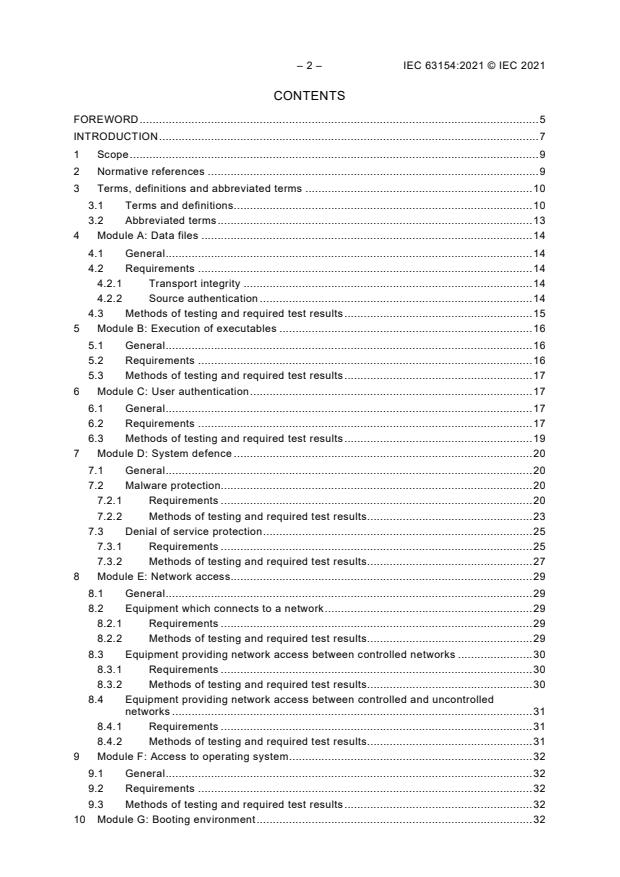
CONTENTS
FOREWORD . 5
INTRODUCTION . 7
1 Scope . 9
2 Normative references . 9
3 Terms, definitions and abbreviated terms . 10
3.1 Terms and definitions . 10
3.2 Abbreviated terms . 13
4 Module A: Data files . 14
4.1 General . 14
4.2 Requirements . 14
4.2.1 Transport integrity . 14
4.2.2 Source authentication . 14
4.3 Methods of testing and required test results . 15
5 Module B: Execution of executables . 16
5.1 General . 16
5.2 Requirements . 16
5.3 Methods of testing and required test results . 17
6 Module C: User authentication . 17
6.1 General . 17
6.2 Requirements . 17
6.3 Methods of testing and required test results . 19
7 Module D: System defence . 20
7.1 General . 20
7.2 Malware protection. 20
7.2.1 Requirements . 20
7.2.2 Methods of testing and required test results. 23
7.3 Denial of service protection . 25
7.3.1 Requirements . 25
7.3.2 Methods of testing and required test results. 27
8 Module E: Network access. 29
8.1 General . 29
8.2 Equipment which connects to a network . 29
8.2.1 Requirements . 29
8.2.2 Methods of testing and required test results. 29
8.3 Equipment providing network access between controlled networks . 30
8.3.1 Requirements . 30
8.3.2 Methods of testing and required test results. 30
8.4 Equipment providing network access between controlled and uncontrolled
networks . 31
8.4.1 Requirements . 31
8.4.2 Methods of testing and required test results. 31
9 Module F: Access to operating system . 32
9.1 General . 32
9.2 Requirements . 32
9.3 Methods of testing and required test results . 32
10 Module G: Booting environment . 32
10.1 General . 32
10.2 Requirements . 32
10.3 Methods of testing and required test results . 33
11 Module H: Maintenance mode . 33
11.1 General . 33
11.2 Requirements . 33
11.3 Methods of testing and required test results . 34
12 Module I: Protection against unintentional crash caused by user input . 35
12.1 General . 35
12.2 Requirements . 35
12.3 Methods of testing and required test results . 36
13 Module J: Interfaces for removable devices including USB . 36
13.1 General . 36
13.2 Requirements . 36
13.2.1 Physical protection . 36
13.2.2 Operational protection . 37
13.3 Methods of testing and required test results . 37
13.3.1 Physical protection . 37
13.3.2 Operational protection . 37
14 Module K: IEC 61162-1 or IEC 61162-2 as interface . 38
15 Module L: IEC 61162-450 as interface . 38
15.1 General . 38
15.2 IEC 61162-1 sentences . 38
15.3 IEC 61162-450 used for file transfer. 38
16 Module M: Other interfaces . 39
17 Module N: Software maintenance . 39
17.1 General . 39
17.2 Software maintenance in maintenance mode . 40
17.2.1 Requirements . 40
17.2.2 Methods of testing and required test results. 40
17.3 Semi-automatic software maintenance by the crew onboard the vessel . 40
17.3.1 General . 40
17.3.2 Requirements . 40
17.3.3 Methods of testing and required test results. 41
18 Module O: Remote maintenance . 42
18.1 General . 42
18.2 Requirements . 42
18.3 Methods of testing and required test results . 42
19 Module P: Documentation . 43
19.1 Requirements . 43
19.2 Methods of testing and required test results . 43
Annex A (informative) Guidance on implementing virus and malware protection on
type approved equipment . 44
Annex B (normative) File authentication . 46
B.1 General . 46
B.2 Digital signatures . 46
B.2.1 Requirements . 46
B.2.2 Methods of testing and required test results. 47
– 4 – IEC 63154:2021 © IEC 2021
B.3 Symmetric means based upon pre-shared secret keys . 48
B.3.1 Requirements . 48
B.3.2 Methods of testing and required test results. 49
Annex C (informative) Methods of authentication of data files and executables –
Examples . 51
C.1 General . 51
C.2 Explanations of terms . 51
C.3 Asymmetric cryptography . 51
C.4 Digital signatures . 52
C.5 Public key infrastructure . 53
C.5.1 General theory . 53
C.5.2 Notes about shipboard use . 55
C.6 Symmetric key authentication based on "pre-shared secret key" . 55
Annex D (normative) USB class codes . 57
Annex E (informative) Cyber security configuration document for equipment . 58
E.1 General for the document . 58
E.2 Document parts . 58
E.2.1 Hardening of the operating system . 58
E.2.2 Update strategy for cyber security reasons . 58
E.2.3 Strategies for detecting and reacting to future vulnerabilities . 58
Annex F (informative) Guidance on interconnection between networks . 59
F.1 General . 59
F.2 Guidance . 59
Bibliography . 61
Figure 1 – Some examples of data transfer . 8
Figure F.1 – Examples for different types of network and associated interconnecting
devices . 60
Table D.1 – USB class codes . 57
INTERNATIONAL ELECTROTECHNICAL COMMISSION
____________
MARITIME NAVIGATION AND RADIOCOMMUNICATION
EQUIPMENT AND SYSTEMS – CYBERSECURITY –
GENERAL REQUIREMENTS, METHODS OF TESTING
AND REQUIRED TEST RESULTS
FOREWORD
1) The International Electrotechnical Commission (IEC) is a worldwide organization for standardization comprising
all national electrotechnical committees (IEC National Committees). The object of IEC is to promote international
co-operation on all questions concerning standardization in the electrical and electronic fields. To this end and
in addition to other activities, IEC publishes International Standards, Technical Specifications, Technical Reports,
Publicly Available Specifications (PAS) and Guides (hereafter referred to as "IEC Publication(s)"). Their
preparation is entrusted to technical committees; any IEC National Committee interested in the subject dealt with
may participate in this preparatory work. International, governmental and non-governmental organizations liaising
with the IEC also participate in this preparation. IEC collaborates closely with the International Organization for
Standardization (ISO) in accordance with conditions determined by agreement between the two organizations.
2) The formal decisions or agreements of IEC on technical matters express, as nearly as possible, an international
consensus of opinion on the relevant subjects since each technical committee has representation from all
interested IEC National Committees.
3) IEC Publications have the form of recommendations for international use and are accepted by IEC National
Committees in that sense. While all reasonable efforts are made to ensure that the technical content of IEC
Publications is accurate, IEC cannot be held responsible for the way in which they are used or for any
misinterpretation by any end user.
4) In order to promote international uniformity, IEC National Committees undertake to apply IEC Publications
transparently to the maximum extent possible in their national and regional publications. Any divergence between
any IEC Publication and the corresponding national or regional publication shall be clearly indicated in the latter.
5) IEC itself does not provide any attestation of conformity. Independent certification bodies provide conformity
assessment services and, in some areas, access to IEC marks of conformity. IEC is not responsible for any
services carried out by independent certification bodies.
6) All users should ensure that they have the latest edition of this publication.
7) No liability shall attach to IEC or its directors, employees, servants or agents including individual experts and
members of its technical committees and IEC National Committees for any personal injury, property damage or
other damage of any nature whatsoever, whether direct or indirect, or for costs (including legal fees) and
expenses arising out of the publication, use of, or reliance upon, this IEC Publication or any other IEC
Publications.
8) Attention is drawn to the Normative references cited in this publication. Use of the referenced publications is
indispensable for the correct application of this publication.
9) Attention is drawn to the possibility that some of the elements of this IEC Publication may be the subject of patent
rights. IEC shall not be held responsible for identifying any or all such patent rights.
IEC 63154 has been prepared by IEC technical committee 80: Maritime navigation and
radiocommunication equipment and systems. It is an International Standard.
The text of this International Standard is based on the following documents:
FDIS Report on voting
80/984/FDIS 80/989/RVD
Full information on the voting for its approval can be found in the report on voting indicated in
the above table.
The language used for the development of this International Standard is English
– 6 – IEC 63154:2021 © IEC 2021
This document has been drafted in accordance with the ISO/IEC Directives, Part 2, and
developed in accordance with ISO/IEC Directives, Part 1 and ISO/IEC Directives,
IEC Supplement, available at www.iec.ch/members_experts/refdocs. The main document types
developed by IEC are described in greater detail at www.iec.ch/standardsdev/publications.
The committee has decided that the contents of this document will remain unchanged until the
stability date indicated on the IEC website under "http://webstore.iec.ch" in the data related to
the specific document. At this date, the document will be
• reconfirmed,
• withdrawn,
• replaced by a revised edition, or
• amended.
IMPORTANT – The 'colour inside' logo on the cover page of this publication indicates
that it contains colours which are considered to be useful for the correct understanding
of its contents. Users should therefore print this document using a colour printer.
INTRODUCTION
IMO resolution MSC.428(98) on maritime cyber risk management in safety management
systems affirms the need for cyber risk management on vessels subject to the SOLAS
Convention. This document addresses the basic cybersecurity requirements for shipborne
navigation and radiocommunication equipment falling within that need.
Shipborne navigation and radiocommunication equipment are generally installed in restricted
areas, for example at the bridge where access is defined by the IMO International Ship and Port
Facility Security (ISPS) Code or in an electronic locker room or in a closed cabinet. These
restricted areas are referred to as secure areas in this document. This is based on the
importance of navigation and radiocommunication equipment for the safety of navigation. These
restricted areas are considered as areas with implemented security and access measures.
These measures are defined in the ship security plan of the individual vessel derived from ISPS
code, they are not part of this document and not specified or tested in the context of this
document. Accordingly, equipment installed in these physically restricted access areas are
understood to benefit from these security measures. This document provides mitigation against
the remaining cyber vulnerabilities for equipment installed in such areas.
Following from the above, this document includes consideration of cyber threats from
unauthorized users, from removable external data sources (REDS) like USB sticks, from
network segments installed outside of the restricted areas including interfaces to external
networks, for example ship to shore, ship to ship.
The risk of an incident is different for each equipment/system boundary, and the mitigating
security measures required should be appropriate to the identified risk of incident and
proportional to the identified adverse consequences. Boundaries take the form of both physical,
such as direct access to the equipment via its ports (e.g. network, USB, import of digital files,
software installation) and logical (e.g. connections over a network, transfer of data, operator
use). A key tenet of cyber security is authentication of who has provided the data and
verification that what is being provided has not been tampered with.
To reflect the difference in cyber security risk, the needs for authentication and verification
between secure and non-secure areas are illustrated in Figure 1. The methods for achieving
authentication and verification are described in each module of this document.
In Figure 1, the colour red means a source requiring authentication and verification. The colour
green means a source not requiring authentication and verification.
The explanation of the numbers in Figure 1 is:
1) external communication that requires authentication and verification as the source is not a
local secure area and its provenance cannot be trusted;
2) local network message interfacing that does not require authentication and verification as
they are part of normal operation defined by configuration in a local secure area, for example
VDR binary transfer, IEC 61162 interfacing, internal proprietary data exchange;
3) local message and data import between networks that does not require authentication and
verification as they are part of normal operation defined by configuration in local secure
areas;
4) external data import by an operator from an external source via REDS that requires
authentication and verification of data import; this applies to executable or non-executable
data;
5) local serial interface messaging that does not require authentication and verification as it is
part of normal operation defined by configuration in a local secure area;
6) updates applied via external data source or REDS in maintenance mode that does not
require authentication and verification but does require user authentication to change
configuration.
– 8 – IEC 63154:2021 © IEC 2021
Figure 1 – Some examples of data transfer
MARITIME NAVIGATION AND RADIOCOMMUNICATION
EQUIPMENT AND SYSTEMS – CYBERSECURITY –
GENERAL REQUIREMENTS, METHODS OF TESTING
AND REQUIRED TEST RESULTS
1 Scope
This document specifies requirements, methods of testing and required test results where
standards are needed to provide a basic level of protection against cyber incidents (i.e.
malicious attempts, which actually or potentially result in adverse consequences to equipment,
their networks or the information that they process, store or transmit) for:
a) shipborne radio equipment forming part of the global maritime distress and safety system
(GMDSS) mentioned in the International Convention for Safety of Life at Sea (SOLAS) as
amended, and by the Torremolinos International Convention for the Safety of Fishing
Vessels as amended, and to other shipborne radio equipment, where appropriate;
b) shipborne navigational equipment mentioned in the International Convention for Safety of
Life at Sea (SOLAS) as amended, and by the Torremolinos International Convention for the
Safety of Fishing Vessels as amended,
c) other shipborne navigational aids, and Aids to Navigation (AtoN), where appropriate.
The document is organised as a series of modules dealing with different aspects. The document
considers both normal operation of equipment and the maintenance of equipment. For each
module, a statement is provided indicating whether the module applies during normal operation
or in maintenance mode.
Communication initiated from navigation or radiocommunication equipment outside of items a),
b) and c) above, for example ship side to other ship or shore side, are outside of the scope of
this document.
This document does not address cyber-hygiene checks, for example anti-malware scanning,
etc., performed outside of the cases defined in this document.
2 Normative references
The following documents are referred to in the text in such a way that some or all of their content
constitutes requirements of this document. For dated references, only the edition cited applies.
For undated references, the latest edition of the referenced document (including any
amendments) applies.
IEC 60945:2002, Maritime navigation and radiocommunication equipment and systems –
General requirements – Methods of testing and required test results
IEC 61162-450, Maritime navigation and radiocommunication equipment and systems – Digital
interfaces – Part 450: Multiple talkers and multiple listeners – Ethernet interconnection
IEC 61162-460:2018, Maritime navigation and radiocommunication equipment and systems –
Digital interfaces – Part 460: Multiple talkers and multiple listeners – Ethernet interconnection
–Safety and security
– 10 – IEC 63154:2021 © IEC 2021
3 Terms, definitions and abbreviated terms
For the purposes of this document, the following terms and definitions apply.
ISO and IEC maintain terminological databases for use in standardization at the following
addresses:
• IEC Electropedia: available at http://www.electropedia.org/
• ISO Online browsing platform: available at http://www.iso.org/obp
3.1 Terms and definitions
3.1.1
address space layout randomization authentication
ASLR
memory-protection process for operating systems that guards against buffer-overflow attacks
by randomizing the location where system executables are loaded into memory
3.1.2
authentication
provision of assurance that a claimed characteristic of an identity is correct
Note 1 to entry: Authentication is usually a prerequisite to allowing access to resources in a system.
3.1.3
authenticator
means used to confirm the identity of a user (human, software process or device)
Note 1 to entry: For example, a password or token may be used as an authenticator.
3.1.4
authenticity
property that an entity is what it claims to be
Note 1 to entry: Authenticity is typically used in the context of confidence in the identity of an entity, or the validity
of a transmission, a message or message originator.
3.1.5
basic input/output system
BIOS
non-volatile firmware used to perform hardware initialization during the booting process (power-
on startup), and to provide runtime services for operating systems and programs
Note 1 to entry: Examples include legacy BIOS (historical IBM PC compliant), UEFI (unified extensible firmware
interface).
3.1.6
controlled network
network compliant to the controlled network requirements of IEC 61162-460
3.1.7
closed network
network which is physically isolated from other networks
Note 1 to entry: A closed network is also known as an "air gapped network".
Note 2 to entry: A closed network cannot contain equipment that connects to different networks. A closed network
may be controlled or uncontrolled.
Note 3 to entry: This includes but is not limited to Ethernet networks.
3.1.8
cryptographic key
sequence of symbols that controls the operations of a cryptographic
EXAMPLE Encipherment, decipherment, cryptographic check-function computation, signature calculation and
signature verification.
3.1.9
data execution prevention
DEP
implementation of execution space protection on Microsoft Windows operating systems
Note 1 to entry: Execution space protection technique allows memory to be marked as non-executable such that
attempts to add executable code results in an error.
3.1.10
data integrity
property that data has not been altered or destroyed in an unauthorized manner
[SOURCE: ISO 7498-2:1989, 3.3.21]
3.1.11
digital signature
data appended to, or cryptographic transformation of, a data unit that allows the recipient of the
data unit to prove the source and integrity of the data unit and protect against forgery e.g. by
the recipient
[SOURCE: ISO 7498-2:1989, 3.3.26]
3.1.12
external data source
EDS
network or non-network data source, including, but not limited to, REDS and SIM cards
3.1.13
hash-code
string of bits which is the output of a hash-function
Note 1 to entry: The literature on this subject contains a variety of terms that have the same or similar meaning as
hash-code. Modification Detection Code, Manipulation Detection Code, digest, hash-result, hash-value and imprint
are some examples.
Note 2 to entry: NIST SP 800-63B uses message digest for this.
[SOURCE: ISO/IEC 10118-1:2016, 3.3, modified – Note 2 to entry has been added.]
3.1.14
hash-function
function which maps strings of bits of variable (but usually upper bounded) length to fixed-length
strings of bits, satisfying the following two properties:
– for a given output, it is computationally infeasible to find an input which maps to this output;
– for a given input, it is computationally infeasible to find a second input which maps to the
same output
Note 1 to entry: Used as part of data authentication, integrity and non-repudiation.
[SOURCE: ISO/IEC 10118-1:2016, 3.4, modified – Note 1 to entry has been replaced by a new
note.]
– 12 – IEC 63154:2021 © IEC 2021
3.1.15
maintenance mode
mode reserved for qualified and authorized persons, or authorised remote devices for the
purposes of installation, commissioning, repair or maintenance of the system
3.1.16
manufacturer's configuration
part of setup, installation or configuration parameters/selections/settings which the
manufacturer has specified in their documentation as being available only in the maintenance
mode
3.1.17
network storm
unplanned excessive transmission of traffic in a network causing the network to be overwhelmed
and degrading the planned performance
3.1.18
normal operation
use of functionality which is described as being available for an operator by the documentation
of the manufacturer
3.1.19
private key
cryptographic key of an entity's asymmetric key pair which can only be used by that entity
3.1.20
public key
cryptographic key of an entity's asymmetric key pair which can be made public
3.1.21
remote maintenance
maintenance access to equipment by any user (human, software process or device)
communicating from outside the perimeter of the controlled network being addressed that can
result in changes to the manufacturer's configuration and operator settings
3.1.22
removable external data source
REDS
user removable non-network data source, including, but not limited to, compact discs, memory
®1
sticks and Bluetooth data storage devices
[SOURCE: IEC 61162-460:2018, 3.32, modified – The words "data storage" have been added
in the definition, and the note to entry has been deleted.]
3.1.23
secret key
cryptographic key used with symmetric cryptographic techniques and usable only by a set of
specified entities
___________
Bluetooth is the trademark of a product supplied by Bluetooth Special Interest Group. This information is given
for the convenience of users of this document and does not constitute an endorsement by IEC of the product
named. Equivalent products may be used if they can be shown to lead to the same results.
3.1.24
security strength
number associated with the amount of work (that is, the number of operations) that is required
to break a cryptographic algorithm or system
EXAMPLE 80 bits, 112 bits, 128 bits, 192 bits, 256 bits.
Note 1 to entry: Security strength of a 2048-bit RSA key is 112 bits.
3.1.25
signer
entity generating a digital signature
[SOURCE: ISO/IEC 13888-1:2020, 3.52]
3.1.26
session
semi-permanent stateful and interactive information interchange between two or more
communicating devices
3.1.27
trust
relationship between two elements, a set of activities and a security policy in which element x
trusts element y if and only if x has confidence that y will behave in a well-defined way (with
respect to the activities) that does not violate the given security policy
3.1.28
trusted third party
security authority, or its agent, trusted by other entities with respect to security-related activities
Note 1 to entry: In the context of ISO/IEC 13888 (all parts), a trusted third party is trusted by the originator, the
recipient, and/or the delivery authority for the purposes of non-repudiation, and by another party such as an
adjudicator.
3.1.29
user
any person that is using the equipment as intended
3.2 Abbreviated terms
EUT equipment under test
IMO International Maritime Organization
IP Internet protocol
LAN local area network
MAC media access control
TCP transmission control protocol
UDP user datagram protocol
USB universal serial bus
VDR voyage data recorder
VLAN virtual LAN
– 14 – IEC 63154:2021 © IEC 2021
4 Module A: Data files
4.1 General
This module applies during normal operation.
During normal operation, transport integrity and source identification shall be implemented for
all non-executable data files, for example chart or route data files, when they are made available
for the first time for operational use in the equipment from the outside of a controlled network.
Non-executable files which intentionally contain executable code, for example scripts or
executable files embedded in a compressed file, shall comply with the requirement of module B
instead.
4.2 Requirements
4.2.1 Transport integrity
For a data file transfer into the equipment, a mechanism of verifying transport integrity shall be
employed such that files are transferred without being corrupted, for example hash-codes or
checksums in Ethernet frames, IP packets or communication protocols such as IEC 61162‑450.
Files which fail this integrity check shall not be made available for operational use in the
equipment.
NOTE 1 Transport method can include the possibility of requesting resend of a part of a data file. In such case, the
integrity check is passed when all parts of data file have been transferred correctly.
Where a recognised data file format supports a means for verifying the integrity of the file, such
as a checksum, hash-code or digital signature such as IHO S-100, the integrity of the file shall
be checked using this means. Files which fail this integrity check shall not be made available
for operational use in the equipment.
NOTE 2 Recording or logging of network traffic including IEC 61162-450 data files, for example by VDR, is not
subject to authentication.
NOTE 3 Integrity checking is implicit in the use of digital signatures. See Annex C for details.
NOTE 4 In addition to data integrity check, to protect against malformed data files, the end equipment can validate
the data before use (for example by checking against the data structure – also known as schema – in accordance
with individual equipment standards).
4.2.2 Source authentication
At least one of the alternatives below shall be implemented.
a) The manufacturer shall apply source authentication when a data file is made available for
operational use in the equipment in accordance with the requirements of Annex B.
d) The manufacturer shall state in the operator's manual the type(s) of data file(s) and the risk
posed to the equipment. Only stated data file type(s) shall be importable into equipment.
The manufacturer shall assess the risk posed by the permitted file types, considering the
risk to integrity and availability of equipment, and its functions shall implement additional
technical controls that may be required to mitigate the risk and shall identify any additional
procedural steps that the user should take, documenting these in the operator's manual.
Some examples of technical controls are given below.
1) The parsing of escape or other special characters and sequences to ensure that they are
correctly interpreted.
2) An XML parser which is configured to limited expansion of user defined entities.
3) Disabling macros.
4) Disabling JavaScript.
5) Employing exploit mitigation techniques such as ASLR and DEP.
6) Performing data validation in accordance with individual equipment standards.
7) Scanning files externally to the equipment using an anti-malware scanner.
8) Use of controlled external tools such as dedicated cables.
NOTE 1 There are many different controls which can be used individually or in combination, depending upon
the file type, equipment type and fun
...
Questions, Comments and Discussion
Ask us and Technical Secretary will try to provide an answer. You can facilitate discussion about the standard in here.
Loading comments...