

IEC TR 62443-2-3:2015
(Main)Security for industrial automation and control systems - Part 2-3: Patch management in the IACS environment
General Information
- Abstract
IEC TR 62443-2-3:2015(E) describes requirements for asset owners and industrial automation and control system (IACS) product suppliers that have established and are now maintaining an IACS patch management program. This Technical Report recommends a defined format for the distribution of information about security patches from asset owners to IACS product suppliers, a definition of some of the activities associated with the development of the patch information by IACS product suppliers and deployment and installation of the patches by asset owners. The exchange format and activities are defined for use in security related patches; however, it may also be applicable for non-security related patches or updates.
- Status
- Published
- Publication Date
- 29-Jun-2015
- Technical Committee
- TC 65 - Industrial-process measurement, control and automation
- Drafting Committee
- WG 10 - TC 65/WG 10
- Current Stage
- PPUB - Publication issued
- Start Date
- 30-Jun-2015
- Completion Date
- 30-Sep-2015
Overview
IEC TR 62443-2-3:2015 is a technical report developed by the International Electrotechnical Commission (IEC) focusing on security for industrial automation and control systems (IACS), with a particular emphasis on patch management within the IACS environment. It addresses the specific requirements, responsibilities, and recommended processes for both asset owners and product suppliers who have established and are actively maintaining an IACS patch management program.
This guidance is crucial for industries relying on automation and control systems, as effective patch management is a cornerstone of cyber security, system reliability, and operational safety. The document encourages a standardized exchange format for security patch information and sets out best practices for both the development and deployment of patches, specifically for IACS environments.
Key Topics
IEC TR 62443-2-3:2015 covers the following essential aspects:
- Patch Management Program Requirements: Outlines what is expected from asset owners and product suppliers in organizing, maintaining, and improving their patch management processes.
- Patch Information Exchange Format: Recommends standardized methods for exchanging security patch information to ensure compatibility and efficient deployment.
- Patch Lifecycle: Defines the various lifecycle stages of patches, from identification and testing through authorization and final installation.
- Challenges in IACS Patching: Recognizes the unique obstacles in patching industrial systems, such as ensuring system safety, minimizing downtime, and maintaining operational reliability.
- Roles and Responsibilities: Clarifies the obligations of both asset owners and IACS product suppliers throughout the patch management lifecycle.
- Testing and Validation: Highlights the need for thorough testing of patches to prevent system incompatibilities or operational issues.
- Mitigation for Obsolete Systems: Suggests risk mitigation practices for IACS assets that are no longer supported by suppliers but still operate in critical environments.
Applications
Implementing the recommendations of IEC TR 62443-2-3:2015 brings practical benefits to organizations operating industrial automation and control systems:
- Enhanced Cyber Security: Prompt and structured application of security patches helps reduce vulnerabilities and prevent cyber incidents in industrial environments.
- Reduced Operational Risks: Systematic patch management mitigates the risk of disruptions, safety hazards, and quality issues associated with unpatched systems.
- Regulatory Compliance: Following this standard helps organizations meet or exceed industry regulations and auditing requirements targeting industrial cyber security and system reliability.
- Improved Collaboration: Clear definitions for information exchange promote better communication between asset owners and suppliers, leading to faster resolution of vulnerabilities.
- Sustained System Integrity: Ongoing patch management supports long-term reliability and efficiency of industrial assets, even when dealing with legacy or unsupported equipment.
Industries benefiting from this standard include oil and gas, manufacturing, pharmaceuticals, energy, water treatment, and any sector that relies on automated control systems for mission-critical operations.
Related Standards
To ensure a comprehensive approach to industrial cyber security and patch management, reference can also be made to the following related standards:
- IEC TS 62443-1-1: Provides terminology, concepts, and models for IACS security.
- IEC 62443-2-1: Specifies requirements for establishing an IACS security management system.
- ISO/IEC 27001 & ISO/IEC 27002: Establish information security management systems guidelines, supporting broader organizational information security framework.
- Other IEC 62443 Series Standards: Several documents in this series further detail technical, process, and organizational aspects of IACS security.
By aligning with IEC TR 62443-2-3:2015, organizations can improve their patch management process, enhance resilience against threats, and ensure the safe, reliable operation of their industrial automation and control systems.
Get Certified
Connect with accredited certification bodies for this standard

BSI Group
BSI (British Standards Institution) is the business standards company that helps organizations make excellence a habit.

DVS-ZERT GmbH
German welding certification society.
CARES (UK Certification Authority for Reinforcing Steels)
UK certification for reinforcing steels and construction.
Sponsored listings
Frequently Asked Questions
IEC TR 62443-2-3:2015 is a technical report published by the International Electrotechnical Commission (IEC). Its full title is "Security for industrial automation and control systems - Part 2-3: Patch management in the IACS environment". This standard covers: IEC TR 62443-2-3:2015(E) describes requirements for asset owners and industrial automation and control system (IACS) product suppliers that have established and are now maintaining an IACS patch management program. This Technical Report recommends a defined format for the distribution of information about security patches from asset owners to IACS product suppliers, a definition of some of the activities associated with the development of the patch information by IACS product suppliers and deployment and installation of the patches by asset owners. The exchange format and activities are defined for use in security related patches; however, it may also be applicable for non-security related patches or updates.
IEC TR 62443-2-3:2015(E) describes requirements for asset owners and industrial automation and control system (IACS) product suppliers that have established and are now maintaining an IACS patch management program. This Technical Report recommends a defined format for the distribution of information about security patches from asset owners to IACS product suppliers, a definition of some of the activities associated with the development of the patch information by IACS product suppliers and deployment and installation of the patches by asset owners. The exchange format and activities are defined for use in security related patches; however, it may also be applicable for non-security related patches or updates.
IEC TR 62443-2-3:2015 is classified under the following ICS (International Classification for Standards) categories: 25.040.40 - Industrial process measurement and control; 35.040.40 - Coding of audio, video, multimedia and hypermedia information; 35.100.05 - Multilayer applications. The ICS classification helps identify the subject area and facilitates finding related standards.
IEC TR 62443-2-3:2015 is available in PDF format for immediate download after purchase. The document can be added to your cart and obtained through the secure checkout process. Digital delivery ensures instant access to the complete standard document.
Standards Content (Sample)
IEC TR 62443-2-3 ®
Edition 1.0 2015-06
TECHNICAL
REPORT
colour
inside
Security for industrial automation and control systems –
Part 2-3: Patch management in the IACS environment
All rights reserved. Unless otherwise specified, no part of this publication may be reproduced or utilized in any form
or by any means, electronic or mechanical, including photocopying and microfilm, without permission in writing from
either IEC or IEC's member National Committee in the country of the requester. If you have any questions about IEC
copyright or have an enquiry about obtaining additional rights to this publication, please contact the address below or
your local IEC member National Committee for further information.
IEC Central Office Tel.: +41 22 919 02 11
3, rue de Varembé Fax: +41 22 919 03 00
CH-1211 Geneva 20 info@iec.ch
Switzerland www.iec.ch
About the IEC
The International Electrotechnical Commission (IEC) is the leading global organization that prepares and publishes
International Standards for all electrical, electronic and related technologies.
About IEC publications
The technical content of IEC publications is kept under constant review by the IEC. Please make sure that you have the
latest edition, a corrigenda or an amendment might have been published.
IEC Catalogue - webstore.iec.ch/catalogue Electropedia - www.electropedia.org
The stand-alone application for consulting the entire The world's leading online dictionary of electronic and
bibliographical information on IEC International Standards, electrical terms containing more than 30 000 terms and
Technical Specifications, Technical Reports and other definitions in English and French, with equivalent terms in 15
documents. Available for PC, Mac OS, Android Tablets and additional languages. Also known as the International
iPad. Electrotechnical Vocabulary (IEV) online.
IEC publications search - www.iec.ch/searchpub IEC Glossary - std.iec.ch/glossary
The advanced search enables to find IEC publications by a More than 60 000 electrotechnical terminology entries in
variety of criteria (reference number, text, technical English and French extracted from the Terms and Definitions
committee,…). It also gives information on projects, replaced clause of IEC publications issued since 2002. Some entries
and withdrawn publications. have been collected from earlier publications of IEC TC 37,
77, 86 and CISPR.
IEC Just Published - webstore.iec.ch/justpublished
Stay up to date on all new IEC publications. Just Published IEC Customer Service Centre - webstore.iec.ch/csc
details all new publications released. Available online and If you wish to give us your feedback on this publication or
also once a month by email. need further assistance, please contact the Customer Service
Centre: csc@iec.ch.
IEC TR 62443-2-3 ®
Edition 1.0 2015-06
TECHNICAL
REPORT
colour
inside
Security for industrial automation and control systems –
Part 2-3: Patch management in the IACS environment
INTERNATIONAL
ELECTROTECHNICAL
COMMISSION
ICS : 25.040.40; 35.040; 35.100 ISBN 978-2-8322-2768-8
– 2 – IEC TR 62443-2-3:2015 © IEC 2015
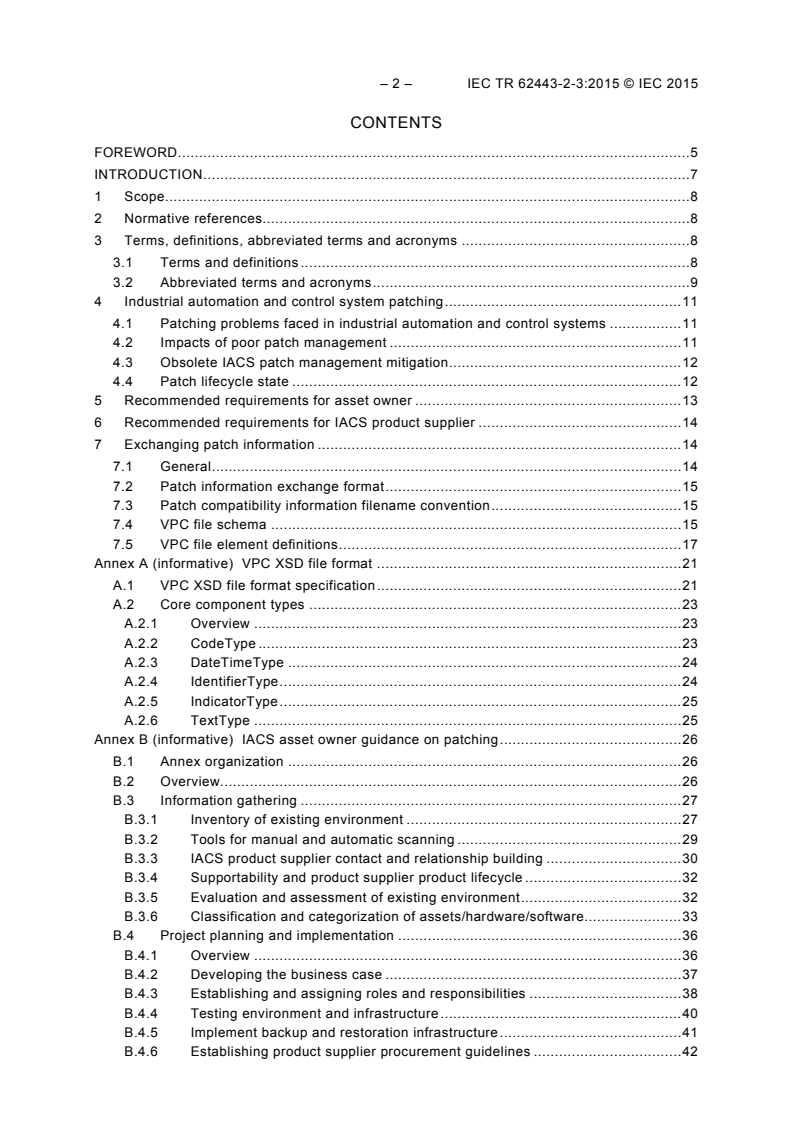
CONTENTS
FOREWORD . 5
INTRODUCTION . 7
1 Scope . 8
2 Normative references. 8
3 Terms, definitions, abbreviated terms and acronyms . 8
3.1 Terms and definitions . 8
3.2 Abbreviated terms and acronyms . 9
4 Industrial automation and control system patching . 11
4.1 Patching problems faced in industrial automation and control systems . 11
4.2 Impacts of poor patch management . 11
4.3 Obsolete IACS patch management mitigation . 12
4.4 Patch lifecycle state . 12
5 Recommended requirements for asset owner . 13
6 Recommended requirements for IACS product supplier . 14
7 Exchanging patch information . 14
7.1 General . 14
7.2 Patch information exchange format . 15
7.3 Patch compatibility information filename convention . 15
7.4 VPC file schema . 15
7.5 VPC file element definitions . 17
Annex A (informative) VPC XSD file format . 21
A.1 VPC XSD file format specification . 21
A.2 Core component types . 23
A.2.1 Overview . 23
A.2.2 CodeType . 23
A.2.3 DateTimeType . 24
A.2.4 IdentifierType . 24
A.2.5 IndicatorType . 25
A.2.6 TextType . 25
Annex B (informative) IACS asset owner guidance on patching . 26
B.1 Annex organization . 26
B.2 Overview. 26
B.3 Information gathering . 27
B.3.1 Inventory of existing environment . 27
B.3.2 Tools for manual and automatic scanning . 29
B.3.3 IACS product supplier contact and relationship building . 30
B.3.4 Supportability and product supplier product lifecycle . 32
B.3.5 Evaluation and assessment of existing environment . 32
B.3.6 Classification and categorization of assets/hardware/software. 33
B.4 Project planning and implementation . 36
B.4.1 Overview . 36
B.4.2 Developing the business case . 37
B.4.3 Establishing and assigning roles and responsibilities . 38
B.4.4 Testing environment and infrastructure . 40
B.4.5 Implement backup and restoration infrastructure . 41
B.4.6 Establishing product supplier procurement guidelines . 42
B.5 Monitoring and evaluation . 42
B.5.1 Overview . 42
B.5.2 Monitoring and identification of security related patches . 43
B.5.3 Determining patch applicability . 43
B.5.4 Impact, criticality and risk assessment . 44
B.5.5 Decision for installation . 45
B.6 Patch testing . 45
B.6.1 Patch testing process . 45
B.6.2 Asset owner qualification of security patches prior to installation . 46
B.6.3 Determining patch file authenticity . 46
B.6.4 Review functional and security changes from patches . 46
B.6.5 Installation procedure . 47
B.6.6 Patch qualification and validation . 48
B.6.7 Patch removal, roll back, restoration procedures . 48
B.6.8 Risk mitigation alternatives . 49
B.7 Patch deployment and installation . 50
B.7.1 Patch deployment and installation process . 50
B.7.2 Notification of affected parties . 50
B.7.3 Preparation . 51
B.7.4 Phased scheduling and installation . 51
B.7.5 Verification of patch installation . 52
B.7.6 Staff training and drills . 52
B.8 Operating an IACS patch management program . 53
B.8.1 Overview . 53
B.8.2 Change management . 53
B.8.3 Vulnerability awareness . 53
B.8.4 Outage scheduling . 54
B.8.5 Security hardening . 54
B.8.6 Inventory and data maintenance . 54
B.8.7 Procuring or adding new devices . 55
B.8.8 Patch management reporting and KPIs . 55
Annex C (informative) IACS product supplier / service provider guidance on patching . 56
C.1 Annex organization . 56
C.2 Discovery of vulnerabilities . 56
C.2.1 General . 56
C.2.2 Vulnerability discovery and identification within the product . 57
C.2.3 Vulnerability discovery and identification within externally sourced
product components . 57
C.3 Development, verification and validation of security updates . 58
C.4 Distribution of cyber security updates . 58
C.5 Communication and outreach . 58
Bibliography . 60
Figure 1 – Patch state model . 13
Figure 2 – VPC file schema . 16
Figure 3 – VPC file schema diagram format . 17
Figure B.1 – IACS patch management workflow . 27
Figure B.2 – Planning an IACS patch management process . 36
– 4 – IEC TR 62443-2-3:2015 © IEC 2015
Figure B.3 – Sample responsibilities chart . 40
Figure B.4 – Patch monitoring and evaluation process . 42
Figure B.5 – A patch testing process . 45
Figure B.6 – A patch deployment and installation process . 50
Table 1 – Patch lifecycle states . 12
Table 2 – VPC XSD PatchData file elements . 17
Table 3 – VPC XSD PatchVendor file elements . 18
Table 4 – VPC XSD Patch file elements . 18
Table 5 – VPC XSD VendorProduct file elements . 20
Table A.1 – CodeType optional attributes . 24
Table A.2 – DateTimeType optional attributes . 24
Table A.3 – IdentifierType optional attributes . 25
Table A.4 – IndicatorType optional attributes . 25
Table A.5 – TextType optional attributes . 25
Table B.1 – Sample product supplier profile. 31
Table B.2 – Communication capabilities . 34
Table B.3 – Sample software categorization . 35
Table B.4 – Responsibility assignment definitions . 39
Table B.5 – Sample severity based patch management timeframes . 45
INTERNATIONAL ELECTROTECHNICAL COMMISSION
____________
SECURITY FOR INDUSTRIAL AUTOMATION
AND CONTROL SYSTEMS –
Part 2-3: Patch management in the IACS environment
FOREWORD
1) The International Electrotechnical Commission (IEC) is a worldwide organization for standardization comprising
all national electrotechnical committees (IEC National Committees). The object of IEC is to promote
international co-operation on all questions concerning standardization in the electrical and electronic fields. To
this end and in addition to other activities, IEC publishes International Standards, Technical Specifications,
Technical Reports, Publicly Available Specifications (PAS) and Guides (hereafter referred to as “IEC
Publication(s)”). Their preparation is entrusted to technical committees; any IEC National Committee interested
in the subject dealt with may participate in this preparatory work. International, governmental and non-
governmental organizations liaising with the IEC also participate in this preparation. IEC collaborates closely
with the International Organization for Standardization (ISO) in accordance with conditions determined by
agreement between the two organizations.
2) The formal decisions or agreements of IEC on technical matters express, as nearly as possible, an international
consensus of opinion on the relevant subjects since each technical committee has representation from all
interested IEC National Committees.
3) IEC Publications have the form of recommendations for international use and are accepted by IEC National
Committees in that sense. While all reasonable efforts are made to ensure that the technical content of IEC
Publications is accurate, IEC cannot be held responsible for the way in which they are used or for any
misinterpretation by any end user.
4) In order to promote international uniformity, IEC National Committees undertake to apply IEC Publications
transparently to the maximum extent possible in their national and regional publications. Any divergence
between any IEC Publication and the corresponding national or regional publication shall be clearly indicated in
the latter.
5) IEC itself does not provide any attestation of conformity. Independent certification bodies provide conformity
assessment services and, in some areas, access to IEC marks of conformity. IEC is not responsible for any
services carried out by independent certification bodies.
6) All users should ensure that they have the latest edition of this publication.
7) No liability shall attach to IEC or its directors, employees, servants or agents including individual experts and
members of its technical committees and IEC National Committees for any personal injury, property damage or
other damage of any nature whatsoever, whether direct or indirect, or for costs (including legal fees) and
expenses arising out of the publication, use of, or reliance upon, this IEC Publication or any other IEC
Publications.
8) Attention is drawn to the Normative references cited in this publication. Use of the referenced publications is
indispensable for the correct application of this publication.
9) Attention is drawn to the possibility that some of the elements of this IEC Publication may be the subject of
patent rights. IEC shall not be held responsible for identifying any or all such patent rights.
The main task of IEC technical committees is to prepare International Standards. However, a
technical committee may propose the publication of a technical report when it has collected
data of a different kind from that which is normally published as an International Standard, for
example "state of the art".
Technical Report IEC 62443-2-3 has been prepared by ISA Technical Committee 99 in
partnership with IEC technical committee 65: Industrial-process measurement, control and
automation.
The text of this standard is based on the following documents:
Enquiry draft Report on voting
65/554/DTR 65/564/RVC
Full information on the voting for the approval of this technical report can be found in the
report on voting indicated in the above table.
– 6 – IEC TR 62443-2-3:2015 © IEC 2015
This publication has been drafted in accordance with the ISO/IEC Directives, Part 2.
A list of all parts in the IEC 62443 series, published under the general title Security for
industrial automation and control systems, can be found on the IEC website.
The committee has decided that the contents of this publication will remain unchanged until
the stability date indicated on the IEC website under "http://webstore.iec.ch" in the data
related to the specific publication. At this date, the publication will be
• reconfirmed,
• withdrawn,
• replaced by a revised edition, or
• amended.
A bilingual version of this publication may be issued at a later date.
IMPORTANT – The 'colour inside' logo on the cover page of this publication indicates
that it contains colours which are considered to be useful for the correct
understanding of its contents. Users should therefore print this document using a
colour printer.
INTRODUCTION
Cyber security is an increasingly important topic in modern organizations. Many organizations
involved in information technology (IT) and business have been concerned with cyber security
for many years and have well-established information security management systems (ISMS)
in place as defined by the International Organization for Standardization (ISO) and the
International Electrotechnical Commission (IEC), in ISO/IEC 27001 and ISO/IEC 27002.
These management systems provide an organization with a well-established method for
protecting its assets from cyber-attacks.
Industrial Automation and Control Systems (IACS) suppliers and owners are using
commercial-off-the-shelf (COTS) technology developed for business systems in their everyday
processes. This provides an increased opportunity for cyber-attack against the IACS
equipment, since COTS systems are more widely known and used. There has also been new
interest in ICS security research that has uncovered numerous device vulnerabilities as well.
Successful attacks against industrial systems may lead to health, safety and environmental
(HSE) consequences.
Organizations may try to use the business cyber security strategy to address security for
IACS without understanding the consequences. While many of these solutions can be applied
to IACS, they need to be applied in the correct way to eliminate inadvertent consequences.
This technical report addresses the patch management aspect of IACS cyber security. Patch
management is part of a comprehensive cyber security strategy that increases cyber security
through the installation of patches, also called software updates, software upgrades, firmware
upgrades, service packs, hotfixes, basic input output system (BIOS) updates and other digital
electronic program updates that resolve bugs, operability, reliability and cyber security
vulnerabilities. This technical report introduces to the reader many of the problems and
industry concerns associated with IACS patch management for asset owners and IACS
product suppliers. It also describes the impacts poor patch management can have on the
reliability and/or operability of the IACS.
– 8 – IEC TR 62443-2-3:2015 © IEC 2015
SECURITY FOR INDUSTRIAL AUTOMATION
AND CONTROL SYSTEMS –
Part 2-3: Patch management in the IACS environment
1 Scope
This part of IEC 62443, which is a Technical Report, describes requirements for asset owners
and industrial automation and control system (IACS) product suppliers that have established
and are now maintaining an IACS patch management program.
This Technical Report recommends a defined format for the distribution of information about
security patches from asset owners to IACS product suppliers, a definition of some of the
activities associated with the development of the patch information by IACS product suppliers
and deployment and installation of the patches by asset owners. The exchange format and
activities are defined for use in security related patches; however, it may also be applicable
for non-security related patches or updates.
The Technical Report does not differentiate between patches made available for the operating
systems (OSs), applications or devices. It does not differentiate between the product
suppliers that supply the infrastructure components or the IACS applications; it provides
guidance for all patches applicable to the IACS. Additionally, the type of patch can be for the
resolution of bugs, reliability issues, operability issues or security vulnerabilities.
NOTE 1 This Technical Report does not provide guidance on the ethics and approaches for the discovery and
disclosure of security vulnerabilities affecting IACS. This is a general issue outside the scope of this report.
NOTE 2 This Technical Report does not provide guidance on the mitigation of vulnerabilities in the period
between when the vulnerability is discovered and the date that the patch resolving the vulnerability is created. For
guidance on multiple countermeasures to mitigate security risks as part of an IACS security management system
(IACS-SMS), refer to, Annexes B.4.5, B.4.6 and B.8.5 in this Technical Report and other documents in the IEC
62443 series.
2 Normative references
The following documents, in whole or in part, are normatively referenced in this document and
are indispensable for its application. For dated references, only the edition cited applies. For
undated references, the latest edition of the referenced document (including any
amendments) applies.
IEC TS 62443-1-1, Industrial communication networks – Network and system security –
Part 1-1: Terminology, concepts and models
IEC 62443-2-1, Industrial communication networks – Network and system security – Part 2-1:
Establishing an industrial automation and control system security program
3 Terms, definitions, abbreviated terms and acronyms
3.1 Terms and definitions
For the purposes of this document, the terms and definitions given in the normative
references specified in Clause 2, as well as the following, apply:
3.1.1
bug
flaw in the original development of software (such as a security vulnerability), which causes it
to perform or behave in an unintended manner (such as cause reliability or operability issues)
3.1.2
patch
incremental software change in order to address a security vulnerability, a bug, reliability or
operability issue (update) or add a new feature (upgrade)
Note 1 to entry: Patches may also be called software updates, software upgrades, firmware upgrades, service
packs, hotfixes, basic input output system (BIOS) updates, security advisories and other digital electronic program
updates.
3.1.3
patch lifecycle
period in time that a patch is recommended or created until the patch is installed
Note 1 to entry: In the context of this technical report, this lifecycle begins when the patch is created and made
available.
Note 2 to entry: Some feel that the patching lifecycle begins when the vulnerability has been disclosed. However,
it is not possible for this technical report to provide all possible guidance for the mitigation of vulnerabilities for the
period between disclosure of a vulnerability, the decision to create a patch and the availability of a patch. It is also
to the discretion of the software developer or product supplier to determine if they develop a patch.
3.1.4
patch management
set of processes used to monitor patch releases, decide which patches should be installed to
which system under consideration (SuC), if the patch should be tested prior to installation on
a production SuC, at which specified time the patch should be installed and of tracking the
successful installation
3.2 Abbreviated terms and acronyms
ANSI American National Standards Institute
BCP Business continuity planning
BIA Business impact assessment
BIOS Basic input output system
CCTS Core Components Technical Specification
CERT Cyber Emergency Response Team, Computer Emergency Readiness Team
or other regional/industry variant
CD Compact disc
COTS Commercial-off-the-shelf
CPNI [UK] Centre for Protection of National Infrastructure
CPU Central processing unit
DCS Distributed control system
DHS [US] Department of Homeland Security
DRP Disaster recovery planning
DVD Digital versatile disc
EULA End user license agreement
FAT Factory acceptance testing
HSE Health, safety and environmental
HTML Hypertext Markup Language
HTTP Hypertext transfer protocol
ICS-CERT [US DHS] Industrial Control Systems Cyber Emergency Response Team
– 10 – IEC TR 62443-2-3:2015 © IEC 2015
IACS Industrial automation and control system(s)
IACS-SMS IACS security management system
IDS Intrusion detection system
IEC International Electro-technical Commission
IP Internet protocol
IPS Intrusion prevention system
ISA International Society of Automation
ISMS Information security management system
ISO International Organization for Standardization
IT Information technology
KPI Key performance indicator
MD5 Message digest 5
MES Manufacturing execution system
MESA Manufacturing Enterprise Solutions Association International
MSMUG Microsoft Manufacturing Users Group
NERC North American Electric Reliability Corporation
NISCC [US] National Infrastructure Security Co-ordination Centre
NSA [US] National Security Agency
OAGIS Open Applications Group Integration Specification
OEM Original equipment manufacturer
OS Operating system
PLC Programmable logic controller
RACI Responsible, accountable, consulted, informed
RAID Redundant array of independent disks
RASCI Responsible, accountable, supportive, consulted and informed
RTU Remote terminal unit
SAT Site acceptance testing
SHA Secure hash algorithm
SIS Safety instrumented system
SMTP Simple Mail Transfer Protocol
SPX Sequenced packet exchange
SQL Structured query language
SuC System under consideration
TC Technical committee
UN United Nations
UN/CEFACT United Nations Centre for Trade Facilitation and Electronic Business
URI Uniform resource identifier
USB Universal serial bus
US-CERT United States Computer Emergency Readiness Team
VPC Vendor patch compatibility
WAN Wide area network
XML eXtensible Markup Language
XSD XML schema definition
4 Industrial automation and control system patching
4.1 Patching problems faced in industrial automation and control systems
There are many challenges that asset owners face when attempting to implement a patch
management program for their IACS. Patching an IACS means changing the IACS and
changes can negatively affect its safety, operability or reliability if not performed correctly.
Preparing an IACS to be patched can require a tremendous amount of work and asset owners
may struggle for the necessary resources to address the added workload. For each patch and
for each product they own, an asset owner will have to gather and analyze patch information
for each device, install and verify on a test system, ensure backups are created before and
after, ensure testing again before turning the system back over to operations and finally track
all the necessary documentation of the changes.
Due to the resources and efforts recommended to patch an IACS most organizations schedule
patch installations during other normal routine maintenance outages. Sometimes these outage
windows are quarterly, yearly or even less frequently. Some extremely critical systems may
not have outage windows available and can therefore not be patched if a system outage is
required to do so.
Applying patches is a risk management decision. If the cost of applying patches is greater
than the risk evaluated cost, then the patch may be delayed, especially if there are other
security controls in place that mitigate the risk (such as disable or remove features).
The unintended consequences of a poor patch management program can include:
• incompatibility between patches and control system software;
• false positives due to antivirus and anti-malware; and
• degradation of system performance, reliability and operability with insufficient testing.
For additional information, see B.4.2.
4.2 Impacts of poor patch management
Adversaries (for example, malicious threat actors) will always have an advantage over their
targets given the challenges product suppliers and asset owners face in keeping their systems
up to date to minimize security risk caused by vulnerabilities. The moment a vulnerability is
disclosed, whether by well-intentioned or malicious intent, the problem is then transferred
primarily to the asset owner to apply the patch as quickly as possible. The asset owner may
or may not be able to apply the patch and it becomes a risk-based decision on how to mitigate
the vulnerability risk. Though it may never be possible to eliminate all software vulnerabilities,
there should be no excuse for not evaluating the risk of the vulnerability and determining
when and how patches should be applied.
The primary impact of poor IACS patch management is an increased risk of loss or
compromise of an IACS system. Unlike for example office or enterprise systems, compromise
of an IACS may have consequences beyond the loss of data or downtime of the system. A
compromise of an IACS may impact system safety, the physical safety of operational
personnel, the quality of produced products, the safety of produced products and the usability
of produced products.
For additional information, see B.4.2.
NOTE 1 If critical documentation on the production of a product is lost, the product may have to be scrapped,
even if there was no physical damage done to the product (such as pharmaceutical development, food production,
etc.)
NOTE 2 Directed attacks of unpatched IACS systems may even result in the destruction of equipment. Undirected
attacks of unpatched IACS systems, where the IACS system is not a primary target, may still cause the loss of
control with resultant risks to safety and product quality. One example of such an attack is Structured Query
Language (SQL) injection worms, which consume all central processing unit (CPU) and network resources.
– 12 – IEC TR 62443-2-3:2015 © IEC 2015
4.3 Obsolete IACS patch management mitigation
Asset owners may experience the situation where products are no longer supported by their
suppliers but have reported vulnerabilities. IACS systems are typically in production for
decades and adversaries know these older systems are vulnerable. Asset owners need to
consider other mitigations when patching is not an option.
For additional information on countermeasures to mitigate security risks as part of an IACS
patch management process see Annexes B.4.5, B.4.6 and B.5.5, and other documents in the
IEC 62443 series.
4.4 Patch lifecycle state
Patches have a defined lifecycle state model. They progress from available to authorized to
effective and installed. Not all patches available are relevant to the IACS and not all patches
are compatible with the IACS applications. It is important for an effective IACS patch
management process to know the state of all available patches. Lifecycle states for patches
are defined in Table 1.
Table 1 – Patch lifecycle states
Patch state Patch state definition Managed by
Available The patch has been provided by a third party or an IACS supplier but has Asset owner
not been tested.
Product supplier
In Test The patch is being tested by an IACS supplier. Product supplier
Not Approved The patch has failed the testing of the IACS supplier and should not be Product supplier
used, unless and until the IACS supplier confirms that the patch has been
Approved.
Not Applicable The patch has been tested and is not considered relevant to IACS use. Product supplier
Approved The patch has passed testing by the IACS supplier. Product supplier
Released The patch is released for use by the IACS supplier or third party, or the Asset owner
patch may be directly applicable by the asset owner for their internally
Product supplier
developed systems.
In Internal Test The patch is being tested by the asset owner testing team. Asset owner
Not Authorized The patch has failed internal testing, or may not be applicable. Asset owner
Authorized The patch is released by the asset owner and meets company standards Asset owner
for updatable devices, or by inspection did not need testing.
Effective The patch is posted by the asset owner for use. Asset owner
Installed The patch is installed on the system. Asset owner
The state model for lifecycle states is shown in Figure 1. The states maintained by the IACS
product supplier are in the dark gray area in the left half of the figure. The states maintained
by the IACS asset owner are in the light grey area in the right half of the figure. The
transitions between states are activities of the asset owners or the product suppliers, as
defined in the other parts of this report.
IEC
Figure 1 – Patch state model
5 Recommended requirements for asset owner
Asset owners have an implied obligation to uphold the safety, reliability, operability, security
and quality of their operations. Achieving cyber security assurance, through patching IACS
assets, is a critical part of that obligation.
IACS asset owners should:
a) establish and maintain an inventory of all electronic devices associated with the IACS, that
may be updated by: modification of their functionality, configuration, operation, software,
firmware, operating code, etc. These devices should be referred to as ‘updatable’ devices;
b) establish and maintain an accurate record of the currently installed versions for each
device, called the ‘installed’ version;
c) determine on a regular schedule what upgrades and updates are available for each
device, called the ‘latest’ version;
d) determine on a regular schedule the ‘released versions’ of upgrades and updates which
are identified as compatible by the IACS product supplier and meet the asset owners
standards for ‘updatable’ devices;
e) test the installation of IACS patches in a way that accurately reflects the production
environment, so as to ensure that the reliability and operability of the IACS is not
negatively affected when patches are installed on the IACS in the actual production
environment. Patches which have successfully passed these tests are called the
‘authorized patches’;
f) schedule authorized, effective patches for installation at the next available opportunity
within the constraints of system design (for example, redundancy, fault-tolerance, safety)
and operational requirements (for example, unplanned outage, scheduled outage, on-
process, etc.);
g) update records at a planned interval, at least on a quarterly basis, to include for each
updateable device: installed versions, authorized versions, effective versions and released
versions;
– 14 – IEC TR 62443-2-3:2015 © IEC 2015
h) identify a planned interval for installation of patches, such as: when patches are available,
or at least on an annual basis; and
i) install patches and/or implement compensating countermeasures to mitigate security
vulnerabilities that exist in the IACS.
Additional guidance that can be used to achieve these requirements is provided in Annex B.
6 Recommended requirements for IACS product supplier
Security of the IACS on a running facility is very important and proactive measures are
needed to reduce the probability of the plant being compromised, therefore determining which
patches apply to, and should be tested on, a product is a critical responsibility of the IACS
product supplier.
IACS product suppliers should:
a) provide documentation describing the software patching policy for the products and
systems they supply;
b) qualify in terms of applicability and compatibility, all patches, by analyzing and verifying
the patches, including patches that are released by the supplier of the OS that is used,
and all suppliers of third-party software, that may be used by the IACS products;
c) provide a list of all patches and their approval status,4.4, including the information and
data in the format described in Clause 7 and Annex A;
d) inform the asset owners, and update the list of patches described in: clause 6. b) above,
Clause 7, and Annex A periodically, and ideally within 30 days after a patch is released by
the supplier of the OS or third-party software;
e) provide adequate warning (at least two years in advance) about the components reaching
‘end of life,’ or for which cyber security patches will no longer be made available; and
f) provide information to IACS users regarding the policy of supporting IACS products,
including security updates.
Additional guidance that can be used to achieve these requirements is provided in Annex C.
7 Exchanging patch information
7.1 General
Patch information is required because a complete IACS is usually based on commercial OSs,
commercial application systems, such as distributed control systems (DCSs), historian and
manufacturing execution systems (MESs) and application specific software programs using
commercial IT tools, such as databases and libraries. All of these software elements require
periodic updates to correct newly discovered errors or to correct newly discovered security
deficiencies.
Implementing a system to manage patches requires knowledge of: what patches are
available, if the patches are applicable to installed systems, if the patches have been tested
against the installed products, and if the IACS product supplier recommends that the patches
should be installed.
Determining the compatibility of patches can be a complex task. IACS product suppliers
perform tests of their products against OS and library patches in order to determine if the
patch should be used with their automation products. Because failures in automation products
due to incompatibility with patches may result in the loss of life, property or product, there is
often a requirement that all related automation products have been tested with the patch prior
to installation of the patch in a production system.
IACS users often have various IACS product supplier systems in their facilities and managing
the patch compatibility information from multiple IACS product suppliers is difficult because
the patch information is usually available in each IACS product supplier's specific format. This
clause defines a standard format for the exchange of patch information necessary to identify a
product, patch and status of the patch. The exchanged information includes:
a) an identification of the IACS product supplier providing the product;
b) an identification of the IACS supplier’s product and version;
c) an identification of the product supplier providing the patch, such as the company
providing the OS;
d) an identification of the patch supplier’s product, such as the OS version;
e) the patch supplier’s identification of the patch;
f) an indication if the patch is applicable to the IACS product;
g) an indication of status of testing of the patch against the
...